Introduction
A significant percentage of people with bipolar disorder (BD) exhibit conspicuous functional impairments even when appropriately treated and after symptomatic recovery is achieved (Gitlin & Miklowitz, Reference Gitlin and Miklowitz2017; Mignogna & Goes, Reference Mignogna and Goes2022; Tsapekos, Strawbridge, Cella, Wykes, & Young, Reference Tsapekos, Strawbridge, Cella, Wykes and Young2021). Therefore, recovery of functional capacity is currently acknowledged as a key treatment goal in the clinical management of BD patients.
Measurable neuropsychological impairments are present in a substantial proportion of affected individuals across attention, processing speed, episodic memory, and different domains of executive functioning (Jones et al., Reference Jones, Fernandes, Husain, Ortiz, Rajji, Blumberger and Mulsant2022; Montejo et al., Reference Montejo, Torrent, Jiménez, Martínez-Arán, Blumberg and Burdick2022; Robinson et al., Reference Robinson, Thompson, Gallagher, Goswami, Young, Ferrier and Moore2006). These impairments are related to mood symptoms but persist with varying magnitude and extension during euthymia in about two thirds of BD patients (Ehrlich et al., Reference Ehrlich, Ryan, Burdick, Langenecker, McInnis and Marshall2022; Keramatian, Torres, & Yatham, Reference Keramatian, Torres and Yatham2022) and represent major predictors of poor quality of life and suboptimal outcomes in different aspects of real-world functioning (Ehrminger et al., Reference Ehrminger, Brunet-Gouet, Cannavo, Aouizerate, Cussac, Azorin and Roux2021; Gitlin & Miklowitz, Reference Gitlin and Miklowitz2017; Tsapekos et al., Reference Tsapekos, Strawbridge, Cella, Wykes and Young2021)..Consequently, the importance of identifying individuals with impaired neuropsychological performance has become widely recognized, and evidence-based treatments targeting cognition have received increasing interest over the last few years (Tamura et al., Reference Tamura, Carvalho, Leanna, Feng, Rosenblat, Mansur and McIntyre2021; Tsapekos et al., Reference Tsapekos, Seccomandi, Mantingh, Cella, Wykes and Young2020). Within this context, pharmacological, neurostimulation, and psychosocial approaches have been proposed with the aim of restoring or improving the functional capacity of BD patients (Miskowiak et al., Reference Miskowiak, Seeberg, Jensen, Balanzá-Martínez, Del Mar Bonnin, Bowie and Vieta2022; Tamura et al., Reference Tamura, Carvalho, Leanna, Feng, Rosenblat, Mansur and McIntyre2021). Among psychological interventions, cognitive remediation (CR) stands out as an emerging treatment with potential pro-cognitive effects (Miskowiak et al., Reference Miskowiak, Burdick, Martinez-Aran, Bonnin, Bowie, Carvalho and Vieta2018; Tsapekos et al., Reference Tsapekos, Seccomandi, Mantingh, Cella, Wykes and Young2020). CR approaches are frequently included in the clinical management of individuals with psychotic disorders based on the consistent evidence of modest though significant effects on both cognitive and functional outcomes (Kambeitz-Ilankovic et al., Reference Kambeitz-Ilankovic, Betz, Dominke, Haas, Subramaniam, Fisher and Kambeitz2019; Lejeune, Northrop, & Kurtz, Reference Lejeune, Northrop and Kurtz2021; Vita et al., Reference Vita, Barlati, Ceraso, Nibbio, Ariu, Deste and Wykes2021). Broadly speaking, CR includes different behavioral interventions targeting cognition by means of cognitive training and compensation techniques with the aim of improving functional adjustment (Bellani et al., Reference Bellani, Biagianti, Zovetti, Rossetti, Bressi, Perlini and Brambilla2019; Miskowiak et al., Reference Miskowiak, Burdick, Martinez-Aran, Bonnin, Bowie, Carvalho and Vieta2018). Functional remediation is a variant of standard CR designed specifically for BD patients that tackles cognitive impairments within an ecologic framework while providing psychoeducation about neuropsychological impairment and its impact on daily functioning (Bonnin et al., Reference Bonnin, Reinares, Martínez-Arán, Balanzá-Martínez, Sole and Torrent2016a, Reference Bonnin, Torrent, Arango, Amann, Solé and González-Pinto2016b; Torrent et al., Reference Torrent, Bonnin, Martínez-Arán, Valle, Amann, González-Pinto and Vieta2013).
Although not yet included as an evidence-based recommendation in the main treatment guidelines for BD (Malhi et al., Reference Malhi, Bell, Boyce, Bassett, Berk, Bryant and Murray2020; Yatham et al., Reference Yatham, Kennedy, Parikh, Schaffer, Bond, Frey and Berk2018), CR is increasingly acknowledged as a promising psychosocial intervention (Miskowiak et al., Reference Miskowiak, Burdick, Martinez-Aran, Bonnin, Bowie, Carvalho and Vieta2018; Montejo et al., Reference Montejo, Torrent, Jiménez, Martínez-Arán, Blumberg and Burdick2022; Tsapekos et al., Reference Tsapekos, Seccomandi, Mantingh, Cella, Wykes and Young2020). However, only a few randomized controlled trials (RCTs) exploring the efficacy of CR in BD are available at present; most of them are underpowered and yield inconsistent results.
This study aimed to review the evidence from RCTs exploring the efficacy of CR interventions in improving cognitive and functional outcomes in BD patients and to combine the findings of individual trials to obtain overall effect sizes for different efficacy outcome measures at different timepoints.
Method
Registration and study protocol
This study was conducted in accordance with the PRISMA 2020 Statement guidelines (Page et al., Reference Page, McKenzie, Bossuyt, Boutron, Hoffmann, Mulrow and Moher2021) (online Supplementary Table S1). The review protocol was registered (PROSPERO, CRD42022306504) and can be accessed at https://www.crd.york.ac.uk/prospero/display_record.php?ID=CRD42022306504.
Search strategy
PubMed, PsycINFO, and the Cochrane Collaboration Controlled Trials Register were searched from inception until 1 November 2022 to retrieve publications. Any language was considered as long as an abstract in English was available. At the first step of the search, combinations of keywords were used as follows: (bipolar OR bd OR manic depress*) AND (cognit* OR neurocognit* OR neuropsycholog*) AND (remediation OR rehabilitation OR training OR enhancement OR therapy) AND (efficacy OR randomized trial OR rct).
Titles and abstracts retrieved using this strategy were screened to identify relevant studies. Full texts of the articles identified in this initial screening were thoroughly assessed to confirm or reject their inclusion based on prespecified criteria. As a second step, the reference lists of the articles identified for inclusion and other relevant studies on the topic (e.g. systematic reviews) were checked for additional eligible reports. All the steps of the literature search were conducted independently by two reviewers (PD, BLC). Disagreements were resolved by consensus-based discussion.
Study selection criteria
Studies were considered for inclusion in the current review if they met the following criteria:
(1) were RCTs;
(2) included adult patients (age > 18 years) diagnosed with BD according to standardized criteria;
(3) compared changes in cognitive and/or functional outcomes between a group of patients receiving CR and a control group;
(4) used standardized instruments to assess outcome measures; and
(5) provided data to estimate between-group effect sizes for neuropsychological/functional change.
The RCTs reviewed were included in the quantitative synthesis if they explored at least one cognitive or functional variable assessed in a minimum of three independent trials. If there were studies with overlapping content based on the same patient sample, only the highest-quality study was included in the meta-analysis. Two studies based on the same sample were included in the quantitative synthesis if they provided different information that could be meta-analyzed separately (i.e. data for different variables or assessment time points) and only one (the study with the largest sample size) was considered in the total patient count. Studies based on samples of patients with different diagnoses were included as long as separate data for BD patients were available from the original authors.
Data extraction and risk of bias assessment
Two reviewers (PD, BLC) independently extracted the following data from each RCT: first author and year of publication, sample size, age, gender, study design, type of CR intervention, characteristics of the control group, assessment time points, outcome measures, and discontinuation rates. Results on neuropsychological and functional measures at baseline, treatment completion, and follow-up assessment (when available) were extracted for both treatment and control groups. A consensus meeting was held to resolve any disparities between the two reviewers. Version 2 of the Cochrane risk-of-bias tool for randomized trials (Sterne et al., Reference Sterne, Savović, Page, Elbers, Blencowe, Boutron and Higgins2019) was used to appraise possible biases in the selected studies.
Meta-analytic procedure
Meta-analyses were performed using Comprehensive Meta-Analysis version 4.0 (Borenstein, Hedges, Higgins, & Rothstein, Reference Borenstein, Hedges, Higgins and Rothstein2022). Between-group (treatment v. control) effect sizes (Hedges’ g) for test score changes (i.e. changes in scores on neuropsychological tests/functioning scales from baseline to a follow-up time point) were calculated as follows: (mean change treatment – mean change control)/pooled standard deviation of change. The sign of between-group effect sizes was adjusted so that positive effect sizes reflected greater improvement in the treatment group. The findings of individual RCTs were combined using a random-effects model. Whenever possible, subanalyses were performed considering only primary studies including remission (full or partial) and cognitive or functional impairment (subjectively or objectively assessed) as inclusion criteria. The Q test was used to explore the presence of heterogeneity among RCTs with a significance level of p < 0.1. Following the recommendations provided by the specialized literature (Borenstein, Reference Borenstein2022), prediction intervals were obtained to present the extent of between-study variation. The I 2 index was calculated to describe the percentage of total variation across reports due to between-trial heterogeneity rather than by sampling error. In meta-analyses of at least five studies, sensitivity analyses were performed using the leave-one-out approach and publication bias was assessed using Egger's test. Except for the Q test, significance was set at p < 0.05 in all the analyses performed.
Outcome measures
The results of independent RCTs were combined into summary effect sizes for different efficacy outcome measures: general functioning and six cognitive variables (online Supplementary Table S2). A meta-analysis was performed when there were at least three independent studies utilizing the same test or tapping approximately the same construct. As there is no full consensus on how individual tests map onto cognitive domains, individual-test meta-analyses were preferred and conducted whenever possible (i.e. when three independent trials using the same test were available). If a study involved more than one control group (e.g. a standard treatment group and an active control group), only the data from the best comparison group were included in the meta-analysis. In this sense, any active control condition was preferred, as the absence of psychological/behavioral treatment as a control may overestimate the effects of the psychosocial intervention explored. Given that most studies included assessment of outcome variables immediately after treatment completion and at follow-up, data obtained at different assessment timepoints were extracted separately and included in different meta-analyses.
Results
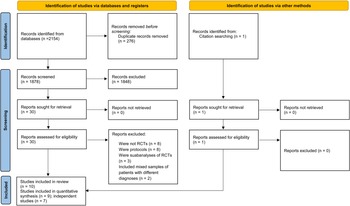
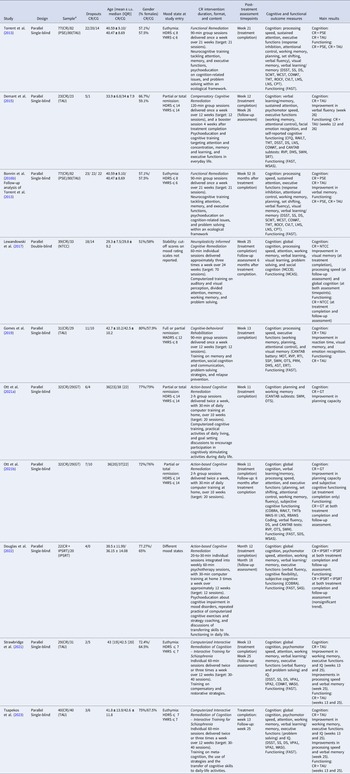
The selection process of the studies included in this review is summarized in Fig. 1. Ten RCTs met the inclusion criteria (Table 1). Seven of the selected studies were independent RCTs of CR in BD (n = 586). The studies by Torrent et al. (Reference Torrent, Bonnin, Martínez-Arán, Valle, Amann, González-Pinto and Vieta2013) and Bonnin et al. (Reference Bonnin, Torrent, Arango, Amann, Solé and González-Pinto2016b) were based on the same RCT, but the latter included long-term follow-up assessment after treatment completion. Hence, both reports were included in the quantitative synthesis but they were pooled in different meta-analyses. Subanalyses of this RCT (Bonnin et al., Reference Bonnin, Reinares, Martínez-Arán, Balanzá-Martínez, Sole and Torrent2016a; Sanchez-Moreno et al., Reference Sanchez-Moreno, Bonnín, González-Pinto, Amann, Solé and Balanzá-Martínez2017; Solé et al., Reference Solé, Bonnin, Mayoral, Amann, Torres and González-Pinto2015) were not considered in the current review. As the study by Douglas et al. (Reference Douglas, Groves, Crowe, Inder, Jordan, Carlyle and Porter2022) was based on a mixed sample of mood disorder patients, only the data for the BD subgroup were considered. The study by Tsapekos, Strawbridge, Cella, Young, and Wykes (Reference Tsapekos, Strawbridge, Cella, Young and Wykes2023) was based on the same RCT as Strawbridge et al. (Reference Strawbridge, Tsapekos, Hodsoll, Mantingh, Yalin, McCrone and Young2021) but included a larger sample size, despite a smaller number of cognitive domains being assessed. Therefore, only the data from the former study were included in the quantitative synthesis except in the phonemic fluency analysis, for which outcome measures were only available in the latter. As the two studies by Ott et al. (Reference Ott, Macoveanu, Bowie, Fisher, Knudsen, Kessing and Miskowiak2021a, Reference Ott, Vinberg, Kessing, Bowie, Forman and Miskowiak2021b) were based on the same sample, only one (Ott et al. Reference Ott, Vinberg, Kessing, Bowie, Forman and Miskowiak2021b) was included in the meta-analysis as it provides follow-up assessment and a larger number of outcome measures. Consequently, nine studies were included in the statistical analysis but only seven were independent RCTs and could therefore be pooled together.
PRISMA 2020 flow diagram. From: Page MJ, McKenzie JE, Bossuyt PM, Boutron I, Hoffmann TC, Mulrow CD, et al., The PRISMA 2020 statement: an updated guideline for reporting systematic reviews. BMJ 2021;372:n71. doi: 10.1136/bmj.n71. For more information, visit: http://www.prisma-statement.org/

Characteristics of the studies included in this review

Design and interventions: CR, cognitive remediation; CG, control group; s.d., standard deviation; IPSRT, Interpersonal and Social Rhythm Therapy; IQR, interquartile range; TAU, treatment as usual; GT, group therapy; NTCC, non-therapeutic computational control; PSE, psychoeducation.
Mood assessment: HDRS, Hamilton Depression rating Scale; MADRS, Montgomery–Asberg depression rating scale; YMRS, Young Mania Rating Scale.
Objective cognitive measures: CANTAB, Cambridge Neuropsychological Test Automated Battery; COWAT, Controlled oral word association test; CPT, Continuous performance test; CVLT, California verbal learning test; DMS, Delayed matching to sample; DS, Digit span; DSST, Digit-symbol substitution test; LMS, Logical memory scale; LNS, Letter number sequencing; MCCB, Matrics Consensus Cognitive Battery; OTS, One Touch Stockings of Cambridge; RAVLT, Rey-Auditory verbal learning test; RBANS, Repeatable battery of the assessment of neuropsychological status; RBMT, Rivermead behavioral memory test; ROCF, Rey-Osterrieth Complex Figure; RVP, Rapid visual information processing; SCWT, Stroop color-word interference test; SRT, Simple reaction time; SS, Symbol search; SWM, Spatial working memory; TAP, Test of attentional performance; TMT, Trail making test; Wechsler Adult Intelligence Scale; WASI, Wechsler Abbreviated Scale of Intelligence; WCST, Wisconsin card sorting test).
Self-report cognitive measures: CFQ, Cognitive failures questionnaires; COBRA, Cognitive Complaints in Bipolar Disorder Rating Assessment.
Functional measures: FAST, Functional assessment short test; MCAS, Multnomah community ability scale; SAS, Social Adjustment Scale; SDS, Sheehan Disability Scale, WSAS, Work and social adjustment scale).
a Includes all patients allocated to either treatment or control arms after randomization.
Study design and control conditions
All the RCTs reviewed in this study used a parallel design and, except Lewandowski et al. (Reference Lewandowski, Sperry, Cohen, Norris, Fitzmaurice, Ongur and Keshavan2017), were single-blind. Most studies used ‘treatment as usual’ (TAU)/‘standard care’ as a control condition. Depending on the study, standard treatment could involve either prescribed pharmacological treatment without adjunctive psychosocial therapy (Bonnin et al., Reference Bonnin, Torrent, Arango, Amann, Solé and González-Pinto2016b; Gomes et al., Reference Gomes, Rocca, Belizario, de B F Fernandes, Valois, Olmo and Lafer2019; Torrent et al., Reference Torrent, Bonnin, Martínez-Arán, Valle, Amann, González-Pinto and Vieta2013) or prescribed pharmacological treatment with some patients receiving, in addition, psychological treatment not specifically targeting cognition (Demant, Vinberg, Kessing, & Miskowiak, Reference Demant, Vinberg, Kessing and Miskowiak2015; Strawbridge et al., Reference Strawbridge, Tsapekos, Hodsoll, Mantingh, Yalin, McCrone and Young2021; Tsapekos et al., Reference Tsapekos, Strawbridge, Cella, Young and Wykes2023). The RCT by Torrent et al. (Bonnin et al. Reference Bonnin, Torrent, Arango, Amann, Solé and González-Pinto2016b; Torrent et al., Reference Torrent, Bonnin, Martínez-Arán, Valle, Amann, González-Pinto and Vieta2013) included two comparison conditions: TAU (pharmacological treatment only) and a psychoeducation control group (psychosocial treatment with the same frequency and duration as the CR intervention in addition to prescribed pharmacological treatment).
As shown in Table 1, CR approaches were different across studies, with duration of treatment ranging between 10 and 24 weeks (weighted mean: 16 weeks). In some RCTs (Demant et al., Reference Demant, Vinberg, Kessing and Miskowiak2015; Strawbridge et al., Reference Strawbridge, Tsapekos, Hodsoll, Mantingh, Yalin, McCrone and Young2021; Tsapekos et al., Reference Tsapekos, Strawbridge, Cella, Young and Wykes2023), many patients in the treatment (CR) group were receiving another psychological intervention not explicitly targeting cognition as part of their standard care. One RCT (Douglas et al., Reference Douglas, Groves, Crowe, Inder, Jordan, Carlyle and Porter2022) specifically explored the efficacy of CR in combination with another psychological treatment. Among studies including follow-up assessment after treatment completion, follow-up periods ranged between 3 and 6 months (weighted mean: 5 months) after treatment completion.
Clinical characteristics of the samples
Except the study by Douglas et al. (Reference Douglas, Groves, Crowe, Inder, Jordan, Carlyle and Porter2022), all selected RCTs included patients in full/ partial remission at study entry. Only four studies based on two independent trials (Bonnin et al., Reference Bonnin, Torrent, Arango, Amann, Solé and González-Pinto2016b; Strawbridge et al., Reference Strawbridge, Tsapekos, Hodsoll, Mantingh, Yalin, McCrone and Young2021; Torrent et al., Reference Torrent, Bonnin, Martínez-Arán, Valle, Amann, González-Pinto and Vieta2013; Tsapekos et al., Reference Tsapekos, Strawbridge, Cella, Young and Wykes2023) considered euthymic mood state rigorously defined as an inclusion criterion. Despite all RCTs excluding patients relapsing in a serious acute mood episode throughout the study period, information on mood state at treatment completion or at follow-up assessment was not available.
Only three RCTs considered cognitive impairment subjectively (Demant et al., Reference Demant, Vinberg, Kessing and Miskowiak2015; Douglas et al., Reference Douglas, Groves, Crowe, Inder, Jordan, Carlyle and Porter2022) or objectively measured (Ott et al., Reference Ott, Macoveanu, Bowie, Fisher, Knudsen, Kessing and Miskowiak2021a, Reference Ott, Vinberg, Kessing, Bowie, Forman and Miskowiak2021b) as an inclusion criterion, whereas the RCT by Torrent et al. (Reference Torrent, Bonnin, Martínez-Arán, Valle, Amann, González-Pinto and Vieta2013) considered the presence of moderate-to-severe functional impairment defined as a score ⩾ 18 on the Functioning Assessment Short Test (FAST) (Rosa et al., Reference Rosa, Sánchez-Moreno, Martínez-Aran, Salamero, Torrent, Reinares and Vieta2007) together with a score ⩾ 4 in the cognitive domain of the same scale for inclusion in the study.
Information on pharmacological variables throughout the study period of each trial was scarce. The RCT by Torrent et al. (Bonnin et al. Reference Bonnin, Torrent, Arango, Amann, Solé and González-Pinto2016b; Torrent et al., Reference Torrent, Bonnin, Martínez-Arán, Valle, Amann, González-Pinto and Vieta2013) did not provide any information about pharmacological variables but reported that treatment was kept stable in all groups throughout the study period. In the remaining RCTs, qualitative measures of exposure to medication were available, with treatment and control groups being well-balanced at baseline in terms of distribution of each class of drug (lithium, anticonvulsants, antipsychotics, antidepressants), except in the trial by Ott et al. (Reference Ott, Macoveanu, Bowie, Fisher, Knudsen, Kessing and Miskowiak2021a, Reference Ott, Vinberg, Kessing, Bowie, Forman and Miskowiak2021b), in which the proportion of patients receiving antidepressants was larger in the control group without any significant between-group differences regarding other pharmacological variables. Only one trial (Gomes et al., Reference Gomes, Rocca, Belizario, de B F Fernandes, Valois, Olmo and Lafer2019) provided the frequency distribution for medication variables at both study entry and treatment completion and no between-group differences were observed throughout the course of the study. Quantitative measures of exposure to pharmacological treatment were available only in one study (Lewandowski et al., Reference Lewandowski, Sperry, Cohen, Norris, Fitzmaurice, Ongur and Keshavan2017), which reported that medication did not differ by group and was essentially unchanged over the course of the study.
Risk of bias assessment
Overall, no biases were detected in the assignment of the participants to the different study groups, nor in the reporting of the results of the different investigations. However, in most trials, possible biases were found regarding the lack of blinding of the participants and the small sample size they had. Only two studies were rated as having ‘high risk’ of bias (Bonnin et al., Reference Bonnin, Torrent, Arango, Amann, Solé and González-Pinto2016b; Gomes et al., Reference Gomes, Rocca, Belizario, de B F Fernandes, Valois, Olmo and Lafer2019) (online Supplementary Table S3).
Efficacy of CR in improving general functioning
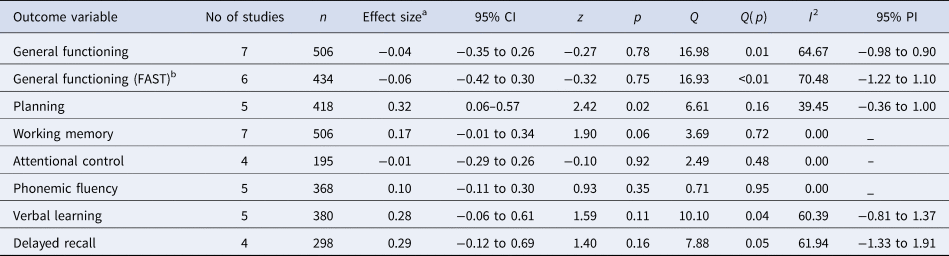
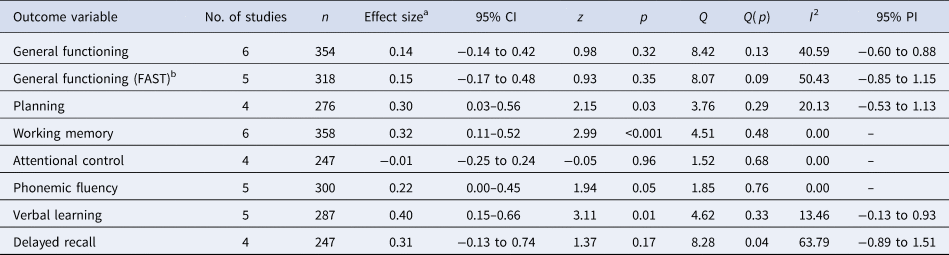
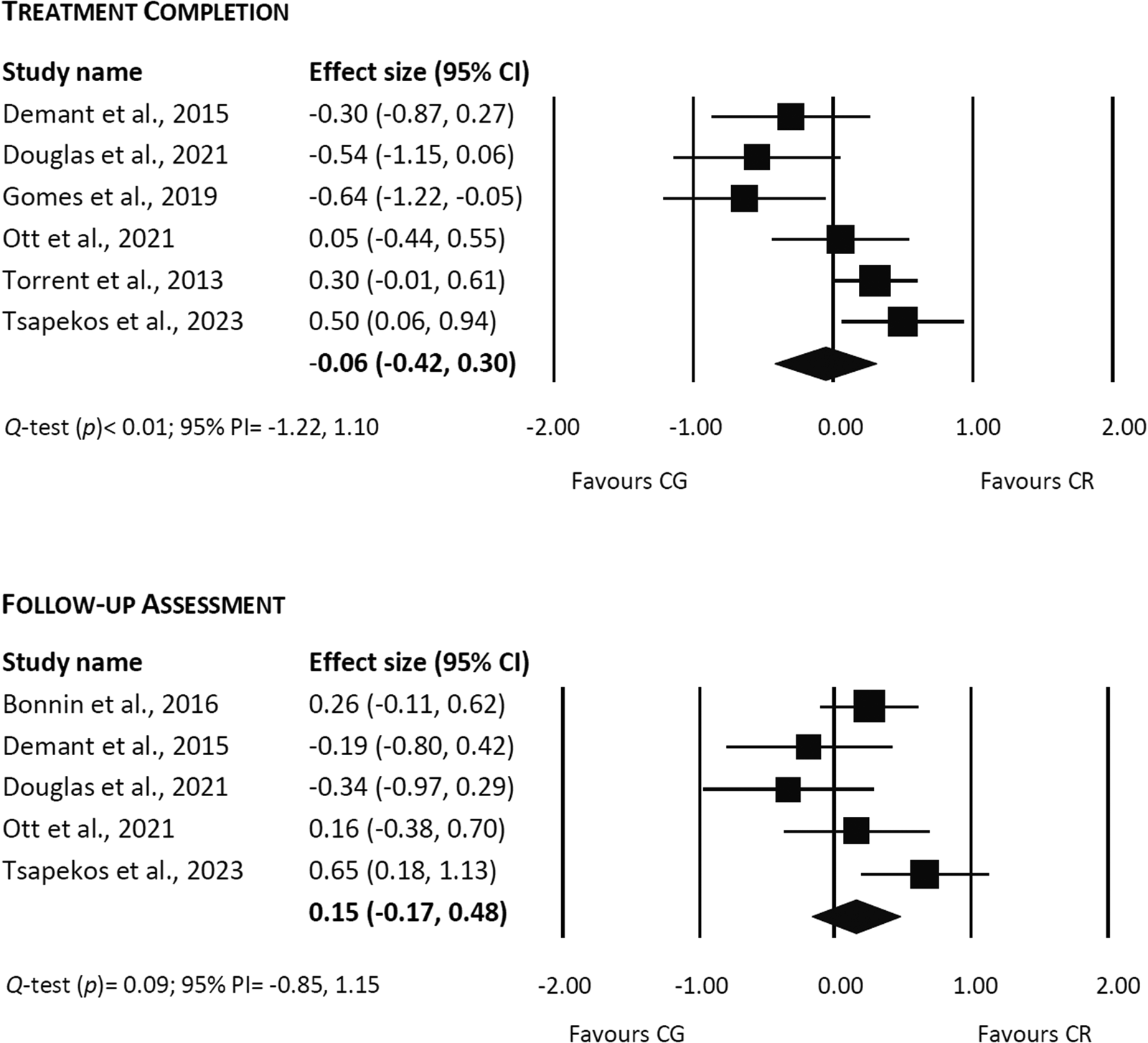
No significant effects of CR were observed on functional outcomes at treatment completion or at follow-up assessment (Tables 2 and 3, Fig. 2). The null hypothesis of homogeneity was rejected in the treatment completion meta-analyses (Table 2). The prediction interval was −0.98 to 0.90 for the General Functioning meta-analysis and −1.22 to 1.10 for the FAST-score meta-analysis. We would therefore expect that in 95% of all populations comparable to those of the analyses, the true effects will fall within these ranges. Similarly, significant heterogeneity was found in the FAST-score at follow-up meta-analysis, with a prediction interval of −0.85 to 1.15.
Random-effects meta-analysis of CR efficacy outcomes at treatment completion

CI, confidence interval; CR, cognitive remediation; FAST, Functioning Assessment Short Test; PI, prediction interval.
a Effect sizes (Hedges'g) calculated as (Mean Change treatment – Mean Change control)/pooled standard deviation of change. Positive effect sizes indicate greater improvement in the CR group.
b Subanalysis of FAST scores.
Random-effects meta-analysis of CR efficacy outcomes at follow-up assessment

CI, confidence interval; CR, cognitive remediation; FAST, Functioning Assessment Short Test; PI, prediction interval.
a Effect sizes (Hedges'g) calculated as (Mean Change treatment – Mean Change control)/pooled standard deviation of change. Positive effect sizes indicate greater improvement in the CR group.
b Subanalysis of FAST scores.
Random-effects meta-analysis of RCTs exploring the efficacy of CR in improving functional outcomes (reduction of FAST total scores). CG, control group; CI, confidence interval; CR, cognitive remediation; FAST, Functional Assessment Short Test; PI, prediction interval; RCT, randomized controlled trial.

When meta-analyses were restricted to studies including remitted patients who were cognitively/functionally impaired at baseline (Bonnin et al., Reference Bonnin, Torrent, Arango, Amann, Solé and González-Pinto2016b; Demant et al., Reference Demant, Vinberg, Kessing and Miskowiak2015; Ott et al., Reference Ott, Vinberg, Kessing, Bowie, Forman and Miskowiak2021b; Torrent et al., Reference Torrent, Bonnin, Martínez-Arán, Valle, Amann, González-Pinto and Vieta2013) overall effects were nonsignificant (online Supplementary Tables S4 and S5).
No evidence of publication bias was observed (online Supplementary Table S6).
Efficacy of CR in improving cognitive functioning
Small but significant changes were observed for planning (g = 0.32, 95% CI 0.06–0.57) at treatment completion (Table 2). At follow-up assessment, significant effects of CR were observed for planning (g = 0.30, 95% CI 0.03–0.56), working memory (g = 0.32, 95% CI 0.11–0.52), and list learning (g = 0.40, 95% CI 0.15–0.66) (Table 3). No significant effects were found for the remaining neuropsychological variables analyzed. The hypothesis of homogeneity of effect sizes was rejected in the list learning meta-analysis at treatment completion and in the delayed recall meta-analysis at treatment completion and follow-up assessment (Tables 2 and 3).
When meta-analyses were restricted to studies including remitted patients who were cognitively/functionally impaired at baseline (Bonnin et al., Reference Bonnin, Torrent, Arango, Amann, Solé and González-Pinto2016b; Demant et al., Reference Demant, Vinberg, Kessing and Miskowiak2015; Ott et al., Reference Ott, Vinberg, Kessing, Bowie, Forman and Miskowiak2021b; Torrent et al., Reference Torrent, Bonnin, Martínez-Arán, Valle, Amann, González-Pinto and Vieta2013), nonsignificant effects were found (online Supplementary Tables S4 and S5).
No evidence of publication bias was observed (online Supplementary Table S6).
Sensitivity analysis
Online Supplementary Figure S1 displays the effect of removing every single study on the overall estimates. For general functioning at treatment completion and follow-up assessment, results remained nonsignificant when removing any of the RCTs, thus supporting the robustness of the overall outcome measure. For the cognitive variables explored, most overall effects did not vary substantially when removing any of the studies from the synthesis except in two variables: planning and working memory at treatment completion. In the former, the removal of Ott et al. (Reference Ott, Vinberg, Kessing, Bowie, Forman and Miskowiak2021b) or Tsapekos et al. (Reference Tsapekos, Strawbridge, Cella, Young and Wykes2023) rendered the observed effects nonsignificant, and similarly did the removal of either of two studies (Gomes et al., Reference Gomes, Rocca, Belizario, de B F Fernandes, Valois, Olmo and Lafer2019; Lewandowski et al., Reference Lewandowski, Sperry, Cohen, Norris, Fitzmaurice, Ongur and Keshavan2017) in the latter variable. Interestingly, the removal of Douglas et al. (Reference Douglas, Groves, Crowe, Inder, Jordan, Carlyle and Porter2022), which is the only study including patients with different mood states and exploring a combination of psychological treatments, did not change the overall effects. Similarly, the exclusion of Torrent et al. (Reference Torrent, Bonnin, Martínez-Arán, Valle, Amann, González-Pinto and Vieta2013)/Bonnin et al. (Reference Bonnin, Torrent, Arango, Amann, Solé and González-Pinto2016b), which used a different CR approach, did not change the overall outcome.
Discussion
The current study is the first to explore the efficacy of CR in BD by means of meta-analytic procedures and provides an updated synthesis of the best available evidence on this topic. Ten RCTs reporting the findings of seven independent trials were reviewed. At the primary study level, most reports did not show any significant effects of CR on general functioning and none of the RCTs including an active control group as comparison has demonstrated superiority of CR in improving general functioning. As regards cognitive outcomes, most studies reported significant effects of CR on at least one neuropsychological domain. The efficacy of CR on functional outcomes and six neurocognitive variables (working memory, attentional control, planning, phonemic fluency, list learning, and delayed recall) was explored at treatment completion and after follow-up. Small but significant effect sizes were observed for list learning, planning, and working memory. However, overall effects of CR on general functioning were nonsignificant at both treatment completion and follow-up assessment.
The results of this review contrast with findings in the field of schizophrenia spectrum disorders, where different meta-analyses have shown that CR exerts a significant though small improvement in the functional outcomes of those affected (Kambeitz-Ilankovic et al., Reference Kambeitz-Ilankovic, Betz, Dominke, Haas, Subramaniam, Fisher and Kambeitz2019; Lejeune et al., Reference Lejeune, Northrop and Kurtz2021; Wykes, Huddy, Cellard, McGurk, & Czobor, Reference Wykes, Huddy, Cellard, McGurk and Czobor2011). In addition, the effects of CR have been shown to be long-lasting and may be increased when CR is combined with other psychological treatments (Kambeitz-Ilankovic et al., Reference Kambeitz-Ilankovic, Betz, Dominke, Haas, Subramaniam, Fisher and Kambeitz2019; Wykes et al., Reference Wykes, Huddy, Cellard, McGurk and Czobor2011). Contrarily, in BD patients, the small effects observed for cognitive variables did not translate into a better overall functioning. These outcomes could be partially explained by the neuropsychological differences that exist between disorders. Conspicuous neuropsychological impairment is mainly related to mood symptoms in BD, whereas in schizophrenia, this is a more persistent feature. In addition, cognitive impairment is more severe and generalized in schizophrenia, affecting areas such as social cognition and fluid intelligence, which are preserved in most BD patients (Martino, Samamé, & Strejilevich, Reference Martino, Samamé and Strejilevich2017; Samamé, Reference Samamé2019). Indeed, in schizophrenia patients, social cognition predicts community outcomes better than non-social cognitive domains (Fett et al., Reference Fett, Viechtbauer, Dominguez, Penn, van Os and Krabbendam2011), thus reflecting a distinct pattern of impairment between these disorders. Further, only about 20% of people affected by BD exhibit a magnitude of neuropsychological impairment similar to that observed in schizophrenia and approximately 30% do not present with measurable cognitive deficits (Burdick et al., Reference Burdick, Russo, Frangou, Mahon, Braga, Shanahan and Malhotra2014; Ehrlich et al., Reference Ehrlich, Ryan, Burdick, Langenecker, McInnis and Marshall2022). Therefore, it is possible that this conspicuous heterogeneity obscures stronger effects of CR occurring in the most impaired subgroup of BD patients. Finally, it has been shown that people affected by BD are more vulnerable to extrapyramidal effects of antipsychotics than those affected by schizophrenia (Gao et al., Reference Gao, Kemp, Ganocy, Gajwani, Xia and Calabrese2008). It is therefore logical to suppose that this vulnerability could extend to the cognitive adverse effects of these drugs and consequently overshadow the effects of CR among BD patients treated with antipsychotics.
A number of clinical and research considerations arise from the results of this study. First, the finding of a nonsignificant effect of CR on functional outcomes does not support the inclusion of these interventions as recommended treatments for BD in clinical guidelines for the management of the disorder. It is worth remembering that psychosocial interventions are not free from negative effects as an excessive or unnecessary exposure to the health system may be detrimental to patients (Samamé, Reference Samamé2021). For instance, CR implies significant direct and indirect costs that should be considered, as it not only involves specialized human resources but also requires patients to travel to clinical care centers, with the consequent time and economic costs.
These considerations are particularly relevant as CR approaches have been emphatically proposed in recent years as interventions that should be delivered to address specific cognitive deficits during different ‘stages’ of illness with the aim of arresting the effects of neuroprogression (Montejo et al., Reference Montejo, Torrent, Jiménez, Martínez-Arán, Blumberg and Burdick2022; Torrent et al., Reference Torrent, Bonnin, Martínez-Arán, Valle, Amann, González-Pinto and Vieta2013). At present, the evidence for the efficacy of RC derives mainly from small non RCTs (Bellani et al., Reference Bellani, Biagianti, Zovetti, Rossetti, Bressi, Perlini and Brambilla2019). Further, the hypothesis of neuroprogression is not supported by a recent meta-analysis (Samamé, Cattaneo, Richaud, Strejilevich, & Aprahamian, Reference Samamé, Cattaneo, Richaud, Strejilevich and Aprahamian2022) of controlled long-term studies (mean weighted follow-up: 8.9 years) and neurocognitive outcomes in late-life BD patients (Montejo et al., Reference Montejo, Torrent, Jiménez, Martínez-Arán, Blumberg and Burdick2022; Samamé, Martino, & Strejilevich, Reference Samamé, Martino and Strejilevich2013). In addition, BD may not be a ‘stageable’ condition as there is no one single ‘bipolar-specific’ process subserving the disorder (Malhi & Bell, Reference Malhi and Bell2021; Samamé, Reference Samamé2023).
Second, given that no pro-cognitive treatment has proven efficacious in BD and, taking into account that suboptimal cognitive performance is one of the main correlates of poor functional adjustment, clinicians should make their biggest efforts to explore and manage variables with a deleterious impact on cognition. Some of these variables may be the effects of prolonged or excessive use of some medications such as antipsychotics, which have been shown to be related to abnormalities in brain volume and diminished cognitive functioning in BD and other psychiatric disorders (Frangou, Donaldson, Hadjulis, Landau, & Goldstein, Reference Frangou, Donaldson, Hadjulis, Landau and Goldstein2005; Ho, Andreasen, Ziebell, Pierson, & Magnotta, Reference Ho, Andreasen, Ziebell, Pierson and Magnotta2011; Kanahara, Yamanaka, Shiko, Kawasaki, & Iyo, Reference Kanahara, Yamanaka, Shiko, Kawasaki and Iyo2022; Voineskos et al., Reference Voineskos, Mulsant, Dickie, Neufeld, Rothschild, Whyte and Flint2020). Further, cardiovascular and metabolic risk factors have been shown to be increased among BD patients and require adequate management to prevent cognitive and functional disabilities as well as premature death (Crump, Sundquist, Winkleby, & Sundquist, Reference Crump, Sundquist, Winkleby and Sundquist2013; Rossom, Hooker, O'Connor, Crain, & Sperl-Hillen, Reference Rossom, Hooker, O'Connor, Crain and Sperl-Hillen2022). Other variables related to treatment that could affect cognition such as lithium-related hypothyroidism should be controlled to optimize cognitive and functional outcomes (Strejilevich, Samamé, & Martino, Reference Strejilevich, Samamé and Martino2015). In addition, clinicians should prioritize the use of drugs with a more benign profile of cognitive effects such as lithium (Burdick et al., Reference Burdick, Millett, Russo, Alda, Alliey-Rodriguez, Anand and Kelsoe2020).
Finally, the broad heterogeneity that exists among BD patients should not be overlooked. For this reason, although CR may not be an efficacious approach to the management of BD patients ‘as a group’, a subgroup of patients with specific cognitive features, and in the absence of ‘secondary’ causes of cognitive impairment, could benefit from specific CR treatments. Indeed, though the significant effect observed for some cognitive variables does not transfer into functional outcomes in this meta-analysis, findings from individual studies (Tsapekos et al., Reference Tsapekos, Strawbridge, Cella, Young and Wykes2023) show that improvement in global cognition accounts for more than one third of the CR effect on psychosocial functioning, thus providing support for the theoretical model of CR. Of note, however, in this study, negative results were also found when considering only studies of cognitively/functionally impaired remitted patients.
Limitations
The results of this review should be interpreted cautiously due to some limitations. First, a small number of studies were included, which are all the RCTs published to date. Further, due to the scarcity of available data, only a few cognitive and functioning variables could be analyzed and it was not possible to perform further analyses to explore the heterogeneity observed in some meta-analyses. In addition, CR interventions were very diverse across studies regarding their content, number of sessions, and schedule, and it is possible that a significant effect emerges from certain variants of CR applied to patients with specific cognitive features.
Other limitations, however, are those of the individual studies, although most of the RCTs included in the quantitative synthesis did not have a high risk of bias. Sample sizes were relatively small and high attrition rates were observed (between 11% and 44%). Hence, in the absence of intent-to-treat analyses in most studies, it is possible that the effects of CR on different outcome measures were overestimated. In addition, none of the studies examined participant satisfaction in relation to treatment outcomes. Practice effects for neuropsychological testing cannot be ruled out, particularly for trials with a short follow-up period. Other limitation was the lack of objective reports of cognitive dysfunction as an inclusion criterion in most studies and the inclusion of ‘treatment as usual’ as a control condition rather than an active control. Furthermore, it is worth noting that double blinding is hardly possible to accomplish in RCTs of psychosocial treatments, which can lead to biased findings.
Another major shortcoming regards mood state during trials. Patients with partial remission were included in most trials as recommended by experts in the field (Miskowiak, Carvalho, Vieta, & Kessing, Reference Miskowiak, Carvalho, Vieta and Kessing2016) under the assumption that this criterion would render BD samples more representative. Further, mood changes throughout study periods were not controlled in most trials. It is evident that the impact of subsyndromal symptoms on cognition cannot be overlooked, and mood fluctuations at study entry and along the course of the RCTs could be either masking or overestimating the effects of CR. Indeed, Bonnin et al. (Reference Bonnin, Torrent, Arango, Amann, Solé and González-Pinto2016b) reported that between-arm differences regarding changes in the FAST total score were no longer significant after controlling for subthreshold depressive symptoms at six-month follow-up assessment. Finally, the effects of pharmacological treatment should be considered as these may improve or impair cognitive outcomes, and information regarding dose of each class of medication and changes across study periods were not available for most trials. One study (Lewandowski et al., Reference Lewandowski, Sperry, Cohen, Norris, Fitzmaurice, Ongur and Keshavan2017), however, adjusted the results for pharmacological variables (lithium and antipsychotics dose), and the inclusion of these covariates did not change the observed findings.
Conclusions
Although CR could exert a positive effect on some domains of executive functioning and verbal memory among BD patients, there is no robust evidence supporting that this effect translates into an improvement at the functional level. However, these results are preliminary and should be interpreted cautiously. Future lines of research should continue to explore the efficacy of different CR approaches in BD, using experimental designs (RCTs), with larger sample size, enriched samples, active control groups, and a more thorough control of mood, metabolic, and pharmacological variables together with other factors that could modulate cognitive performance. In addition, in order to base treatment recommendations on more robust pieces of evidence, it is important that future guidelines provide a clear definition for the ‘gold standard’ of RCTs of psychosocial interventions as regards blinding and control conditions. Finally, future studies should compare the efficacy of CR with that of other activities that can be conducted in the community and without added professional costs, such as sports or recreational activities. In the meantime, there is no sufficient evidence to recommend CR among the main psychosocial treatments for the management of BD.
Supplementary material
The supplementary material for this article can be found at https://doi.org/10.1017/S0033291723001897
Author contributions
CS and SS conceived and planned this study. PD, BLC, and CS were involved in data collection and statistical analysis. CS, IA, and SS supervised the project. All authors provided feedback and contributed to the final version of the manuscript.
Financial support
This study was partially supported by a grant from the National Scientific and Technical Research Council (CONICET, Buenos Aires, Argentina) awarded to Dr Samamé. The funding source played no role in the study design, collection, analysis, or interpretation of the data, in the writing of this study, or in the decision to submit this article for publication.
Competing interest
None.
Data availability
The data that support the findings of this study are available from the corresponding author upon reasonable request.