Introduction
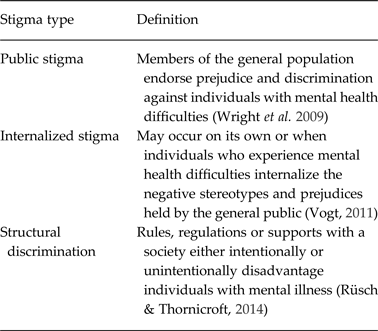
Despite previous research identifying the significant psychological needs of those serving in the armed forces (AF) (Iversen et al. Reference Iversen, van Staden, Hughes, Browne, Hull, Hall, Greenberg, Rona, Hotopf, Wessely and Fear2009; Fear et al. Reference Fear, Jones, Murphy, Hull, Iversen, Coker, Machell, Sundin, Woodhead, Jones, Greenberg, Landau, Dandeker, Rona, Hotopf and Wessely2010), only a small proportion of this population who have mental health problems use mental health services (Hoge et al. Reference Hoge, Castro, Messer, McGurk, Cotting and Koffman2004). A number of large research publications in the AF point to stigma as a significant barrier, greater than reported practical or logistical barriers (Hoge et al. Reference Hoge, Castro, Messer, McGurk, Cotting and Koffman2004; Iversen et al. Reference Iversen, van Staden, Hughes, Greenberg, Hotopf, Rona, Thornicroft, Wessely and Fear2011). A common definition of stigma used that encompasses its many elements is ‘an attribute that is deeply discrediting’ that acts to reduce an individual ‘from a whole and usual person to a tainted, discounted one’ (Goffman, Reference Goffman1963, p. 265). There are several types of stigma and these are thought to interact with each other and contribute to barriers to help seeking; the current research will focus on the types of stigma outlined in Table 1. Stigma has been linked with a number of attributes deemed desirable within the AF, such as toughness, self-sufficiency and mission focus to ensure combat readiness (Dunt, Reference Dunt2009). It is thought that these attributes are associated with help seeking being a sign of weakness, ideas of being self-reliant and a preference with dealing with difficulties on your own (Dickstein et al. Reference Dickstein, Vogt, Handa and Litz2010*)Footnote 1 Footnote † .
Stigma types and definitions

The most frequently endorsed items of public stigma in the AF are concerns regarding differential treatment from unit leaders, being perceived by peers and leaders as ‘weak’, and losing the confidence of their unit (Hoge et al. Reference Hoge, Castro, Messer, McGurk, Cotting and Koffman2004; Iversen et al. Reference Iversen, van Staden, Hughes, Greenberg, Hotopf, Rona, Thornicroft, Wessely and Fear2011; Hoerster, Reference Hoerster2012). These concerns have been found to be consistent across the US, UK, Australian, New Zealand and Canadian AF (Gould et al. Reference Gould, Adler, Zamorski, Castro, Hanily, Steele, Kearney and Greenberg2010). Organizational and leadership experiences are of particular importance with regards to AF public stigma. High ratings of unit cohesion and the quality of the officer have been associated with lower levels of stigma, whereas negative behaviours, such as causing embarrassment to a member of the unit, have been shown to contribute to mental health-related stigma (Wright et al. Reference Wright, Cabrera, Bliese, Adler, Hoge and Castro2009; Britt et al. Reference Britt, Wright and Moore2012). Internalized stigma may stand on its own or if the public stigma experienced by the person with mental health difficulties starts to internalize, resulting in impaired self-esteem, self-efficiency and feelings of shame and demoralization (Corrigan & Watson, Reference Corrigan and Watson2002*; Vogt, Reference Vogt2011*; Zinzow et al. Reference Zinzow, Britt, Pury, Raymond, McFadden and Burnette2013*). The most frequently reported internalized stigma beliefs held by individuals in the AF are ‘I am crazy’ and ‘I am weak’ (Pury et al. Reference Pury, Britt, Zinzow and Raymond2014*). Structural discrimination is often experienced when rules or regulations (un)intentionally act to disadvantage a group of people, in this case AF personnel with mental health difficulties (Rüsch & Thornicroft, Reference Rüsch and Thornicroft2014). These rules or regulations are thought to subsequently influence public stigma and then potentially lead to internalized stigma (Evans-Lacko et al. Reference Evans-Lacko, Brohan, Mojtabai and Thornicroft2012). Examples include the belief that mental health difficulties may impact one's career, being unaware of where to find help and not having access to resources to access help.
The findings of a broad systematic review regarding the impact of mental health-related stigma and help seeking across populations highlighted the military as a subgroup that were disproportionately deterred by stigma (Clement et al. Reference Clement, Schauman, Graham, Maggioni, Evans-Lacko, Bezborodovs, Morgan, Rüsch, Brown and Thornicroft2015*). However, a recent focus on the quantitative literature in the area dealing with military personnel only revealed questions regarding this association (Sharp et al. Reference Sharp, Fear, Rona, Wessely, Greenberg, Jones and Goodwin2015). Despite a high and consistent prevalence of public stigma, the majority of the studies examined found no association between public stigma and mental health service use or intentions to seek help among AF personnel. Many explanations are possible for this discordance, such as the use of different measures or perhaps measures of low quality (not validated) to examine stigma; individuals who are experiencing high levels of stigma may not disclose their mental health service usage or they may not even be aware that they experience mental health difficulties and consequently do not seek help (Fikretoglu et al. Reference Fikretoglu, Guay, Pedlar and Brunet2008; Osório et al. Reference Osório, Jones, Fertout and Greenberg2013). Further, it is feasible that the measures used did not encompass the complexity of stigma within the AF population. Nonetheless, the contribution of qualitative studies in this area has broadly been ignored and may provide further insight and clarification regarding the experience of stigma, help-seeking experiences, intentions and facilitators.
The current review aims to:
-
• Identify, synthesis and discuss qualitative literature regarding the processes contributing to and counteracting the effect of stigma on help seeking for mental health difficulties within the AF.
-
• Critically consider the quality of the identified studies.
-
• Identify future directions in research and interventions regarding stigma in the AF.
Method
Search strategy
A multi-database text word search using OVID was employed. The database incorporates searches of PsycINFO, MEDLINE, Social Policy and Practice, Social Work Abstracts, EMBASE, ERIC and EBM Review databases (1980–April 2015). A variation of the following key search terms was used: mental health, military, army, stigma, attitudes, barriers, discrimination, internalised stigma, public stigma, help-seeking (online Supplementary Appendix S2). Reference sections of articles and grey literature were also extensively searched. The date of the last search was 19 April 2015.
Inclusion/exclusion criteria
-
• Empirically based studies looking into help seeking and stigma in military or veteran populations, thereby using qualitative or mixed methods with a qualitative component, published between 1980 and 2015.
-
• Research that include adults from the age of 18 years old.
-
• Studies written in English.
-
• Review articles were excluded as well as conference proceedings and Ph.D. dissertations.
Quality assessment method
Methodological quality of the process studies was assessed using the 10-item Critical Appraisal Skills Programme (CASP) tool for qualitative research (Critical Appraisal Skills Programme, 2014) (online Supplementary Appendix S3). CASP has been widely used in a number of similar qualitative reviews. Two researchers independently assessed a subset (four) of the studies against the outlined criteria and resolved discrepancies through discussion (S.J.C. and J.A.D.). Studies that did not meet the quality criteria on more than one item were deemed fair and any more than three items were rated fair/poor. Study quality allowed a sensitivity analyses to be conducted determining the impact of lower-quality studies on the reviews findings.
Data extraction
The following data were extracted from the studies: populations studied, country, number of participants, diagnosis of participants, age, ethnicity, recruitment strategy, objective of the study, qualitative method, outcomes measures, data collection, themes identified, most relevant findings and recommendations and implications (online Supplementary Appendix S1).
Data synthesis
We used thematic synthesis to summarize and analyse the data from the various studies (Thomas et al. Reference Thomas, Harden, Chalmers, Oakley, Cooper, Hedges, Petticrew, Roberts, Chalmers, Hedges, Cooper, Juni, Altman, Egger, Mulrow, White, Campbell, Pound, Pope, Britten, Pill, Morgan, Donovan, Dixon-Woods, Bonas, Booth, Jones, Miller, Sutton, Shaw, Smith, Young, Sandelowski, Barroso, Thorne, Jensen, Kearney, Noblit, Sandelowski, Harden, Garcia, Oliver, Rees, Shepherd, Brunton, Oakley, Harden, Brunton, Fletcher, Oakley, Thomas, Sutcliffe, Harden, Oakley, Oliver, Rees, Brunton, Kavanagh, Thomas, Kavanagh, Tucker, Burchett, Tripney, Oakley, Bryman, Hammersley, Harden, Thomas, Oakley, Harden, Oakley, Oliver, Harden, Rees, Shepherd, Brunton, Oliver, Oakley, Rees, Harden, Shepherd, Brunton, Oliver, Oakley, Shepherd, Harden, Rees, Brunton, Oliver, Oakley, Thomas, Harden, Oakley, Oliver, Sutcliffe, Rees, Brunton, Kavanagh, Davies, Newman, Thompson, Roberts, Popay, Noblit, Hare, Britten, Campbell, Pope, Donovan, Morgan, Pill, Paterson, Thorne, Canam, Jillings, Dixon-Woods, Cavers, Agarwal, Annandale, Arthur, Harvey, Katbamna, Olsen, Smith, Riley, Sutton, Dixon-Woods, Agarwal, Jones, Young, Sutton, Boyatzis, Braun, Clarke, Doyle, Barroso, Gollop, Sandelowski, Meynell, Pearce, Collins, Walters, Wilczynski, Haynes, Hedges, Wong, Wilczynski, Haynes, Seale, Spencer, Ritchie, Lewis, Dillon, Boulton, Fitzpatrick, Swinburn, Cobb, Hagemaster, Mays, Pope, Alderson, Egger, Davey-Smith, Altman, Sandelowski, Barroso, Sandelowski, Thomas, Brunton, Fisher, Qureshi, Hardyman, Homewood, Dixey, Sahota, Atwal, Turner, Daly, Willis, Small, Green, Welch, Kealy, Hughes, Popay, Strike, Posner, Marston and King2008). Thematic synthesis involves identifying key concepts across studies, even when not described using identical wording or explanations. Identified concepts are developed across the studies and pulled together in themes, in an effort to go beyond the content of the original research studies (Thomas et al. Reference Thomas, Harden, Chalmers, Oakley, Cooper, Hedges, Petticrew, Roberts, Chalmers, Hedges, Cooper, Juni, Altman, Egger, Mulrow, White, Campbell, Pound, Pope, Britten, Pill, Morgan, Donovan, Dixon-Woods, Bonas, Booth, Jones, Miller, Sutton, Shaw, Smith, Young, Sandelowski, Barroso, Thorne, Jensen, Kearney, Noblit, Sandelowski, Harden, Garcia, Oliver, Rees, Shepherd, Brunton, Oakley, Harden, Brunton, Fletcher, Oakley, Thomas, Sutcliffe, Harden, Oakley, Oliver, Rees, Brunton, Kavanagh, Thomas, Kavanagh, Tucker, Burchett, Tripney, Oakley, Bryman, Hammersley, Harden, Thomas, Oakley, Harden, Oakley, Oliver, Harden, Rees, Shepherd, Brunton, Oliver, Oakley, Rees, Harden, Shepherd, Brunton, Oliver, Oakley, Shepherd, Harden, Rees, Brunton, Oliver, Oakley, Thomas, Harden, Oakley, Oliver, Sutcliffe, Rees, Brunton, Kavanagh, Davies, Newman, Thompson, Roberts, Popay, Noblit, Hare, Britten, Campbell, Pope, Donovan, Morgan, Pill, Paterson, Thorne, Canam, Jillings, Dixon-Woods, Cavers, Agarwal, Annandale, Arthur, Harvey, Katbamna, Olsen, Smith, Riley, Sutton, Dixon-Woods, Agarwal, Jones, Young, Sutton, Boyatzis, Braun, Clarke, Doyle, Barroso, Gollop, Sandelowski, Meynell, Pearce, Collins, Walters, Wilczynski, Haynes, Hedges, Wong, Wilczynski, Haynes, Seale, Spencer, Ritchie, Lewis, Dillon, Boulton, Fitzpatrick, Swinburn, Cobb, Hagemaster, Mays, Pope, Alderson, Egger, Davey-Smith, Altman, Sandelowski, Barroso, Sandelowski, Thomas, Brunton, Fisher, Qureshi, Hardyman, Homewood, Dixey, Sahota, Atwal, Turner, Daly, Willis, Small, Green, Welch, Kealy, Hughes, Popay, Strike, Posner, Marston and King2008).
This includes three stages:
-
• Stage one: line-by-line coding of the findings from primary studies.
-
• Stage two: development of descriptive themes.
-
• Stage three: generating analytical themes and ‘going beyond’ the content of the original studies.
Studies were read repeatedly to ensure that all text relating to barriers and facilitators to help seeking were identified, integrated and grouped into a map of themes. As recommended by Thomas et al. (Reference Thomas, Harden, Chalmers, Oakley, Cooper, Hedges, Petticrew, Roberts, Chalmers, Hedges, Cooper, Juni, Altman, Egger, Mulrow, White, Campbell, Pound, Pope, Britten, Pill, Morgan, Donovan, Dixon-Woods, Bonas, Booth, Jones, Miller, Sutton, Shaw, Smith, Young, Sandelowski, Barroso, Thorne, Jensen, Kearney, Noblit, Sandelowski, Harden, Garcia, Oliver, Rees, Shepherd, Brunton, Oakley, Harden, Brunton, Fletcher, Oakley, Thomas, Sutcliffe, Harden, Oakley, Oliver, Rees, Brunton, Kavanagh, Thomas, Kavanagh, Tucker, Burchett, Tripney, Oakley, Bryman, Hammersley, Harden, Thomas, Oakley, Harden, Oakley, Oliver, Harden, Rees, Shepherd, Brunton, Oliver, Oakley, Rees, Harden, Shepherd, Brunton, Oliver, Oakley, Shepherd, Harden, Rees, Brunton, Oliver, Oakley, Thomas, Harden, Oakley, Oliver, Sutcliffe, Rees, Brunton, Kavanagh, Davies, Newman, Thompson, Roberts, Popay, Noblit, Hare, Britten, Campbell, Pope, Donovan, Morgan, Pill, Paterson, Thorne, Canam, Jillings, Dixon-Woods, Cavers, Agarwal, Annandale, Arthur, Harvey, Katbamna, Olsen, Smith, Riley, Sutton, Dixon-Woods, Agarwal, Jones, Young, Sutton, Boyatzis, Braun, Clarke, Doyle, Barroso, Gollop, Sandelowski, Meynell, Pearce, Collins, Walters, Wilczynski, Haynes, Hedges, Wong, Wilczynski, Haynes, Seale, Spencer, Ritchie, Lewis, Dillon, Boulton, Fitzpatrick, Swinburn, Cobb, Hagemaster, Mays, Pope, Alderson, Egger, Davey-Smith, Altman, Sandelowski, Barroso, Sandelowski, Thomas, Brunton, Fisher, Qureshi, Hardyman, Homewood, Dixey, Sahota, Atwal, Turner, Daly, Willis, Small, Green, Welch, Kealy, Hughes, Popay, Strike, Posner, Marston and King2008), all of the study findings from text labelled as results or findings were extracted and any findings discussed in the abstracts. All results were entered verbatim into Nvivo software. Two reviewers independently coded each line of the text labelling the meaning and content (S.J.C. and J.A.D.). During coding, results to previously formed codes were added or a new code was developed where appropriate.
Sensitivity analysis
A sensitivity analysis was used to investigate the effect of methodological quality on the results of the current review. This was conducted by removing the results from the three lowest-rated studies (Stecker et al. Reference Stecker, Fortney, Hamilton and Ajzen2007; Visco, Reference Visco2009; Gibbs et al. Reference Gibbs, Rae Olmsted, Brown and Clinton-Sherrod2011).
Results
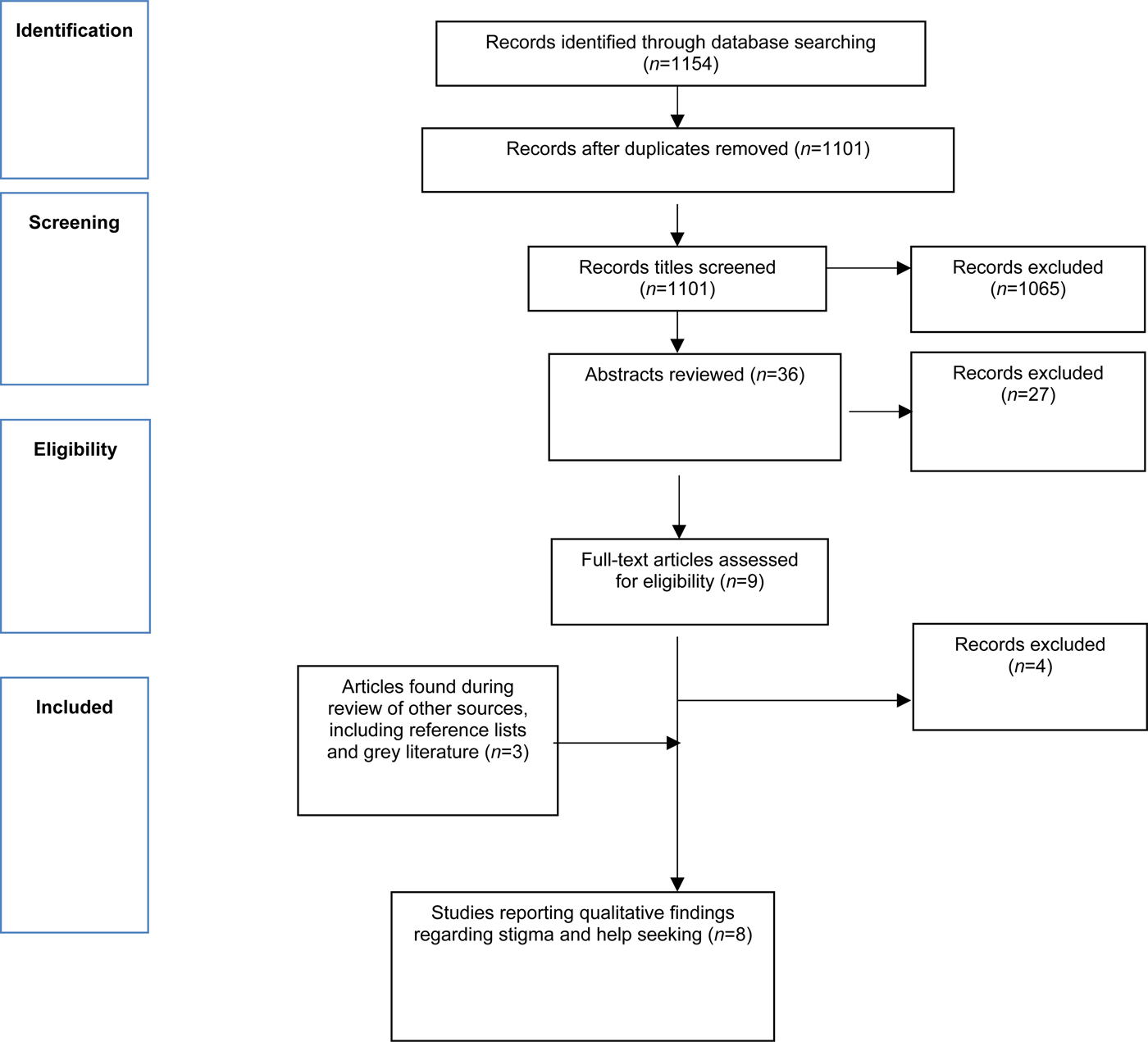
A total of eight qualitative studies (five individual interviews, one individual interviews and focus groups and two focus groups) with a total of 1012 participants were included in the review (see Fig. 1). The studies identified were carried out in the UK (n = 2) and the USA (n = 6). Two out of eight studies employed mixed-methods methodologies. Gibbs et al. (Reference Gibbs, Rae Olmsted, Brown and Clinton-Sherrod2011) was the only study that did not provide details regarding the gender distribution within their study. The studies varied in their focus. One focused broadly on barriers and facilitators to help seeking (Zinzow et al. Reference Zinzow, Britt, Pury, Raymond, McFadden and Burnette2013), one on facilitator pathways for help seeking (Murphy et al. Reference Murphy, Hunt, Luzon and Greenberg2014), one on distress and reported stigma (Langston et al. Reference Langston, Greenberg, Fear, Iversen, French and Wessely2010), two focused on stigma related directly to post-traumatic stress disorder (PTSD) (Sayer et al. Reference Sayer, Friedemann-Sanchez, Spoont, Murdoch, Parker, Chiros and Rosenheck2009; Mittal et al. Reference Mittal, Drummond, Blevins, Curran, Corrigan and Sullivan2013), one on beliefs regarding mental health treatment (Stecker et al. Reference Stecker, Fortney, Hamilton and Ajzen2007) and one on mental health symptoms and help-seeking behaviour (Visco, Reference Visco2009).
Preferred Reporting Items for Systematic Reviews and Meta-Analyses (PRISMA) flow diagram of study selection process.

Characteristics of study methodology
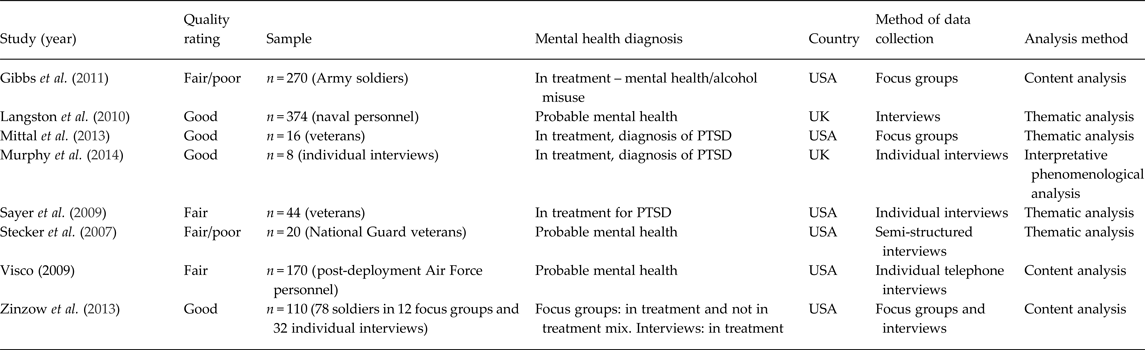
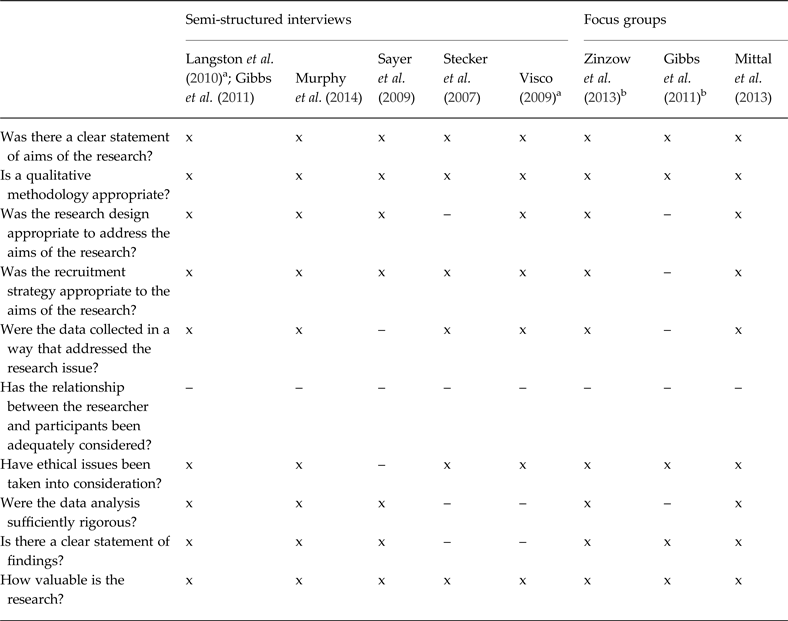
A summary of the studies is in Table 2, whilst Table 3 details the methodology of studies.
Characteristics of the studies

PTSD, Post-traumatic stress disorder.
Characteristics of study methodologies and quality assessed with the CASP quality tool (Critical Appraisal Skills Programme, 2014)

CASP, Critical Appraisal Skills Programme; x, present in study; –, absent from study.
Full details of the criteria to meet each item on the CASP can be viewed in online Supplementary Appendix S3.
a Mixed-methods study.
b This study used both semi-structured interviews and focus group methods.
Method of analysis
Four studies employed thematic analysis, three used content analysis and one used interpretative phenomenological analysis (Murphy et al. Reference Murphy, Hunt, Luzon and Greenberg2014).
Description of research design
Seven studies adequately described their research design; the remaining one failed to justify its study design. Two studies employed mixed-methods designs, integrating quantitative aspects such as questionnaires to complement the qualitative aspects (Visco, Reference Visco2009; Langston et al. Reference Langston, Greenberg, Fear, Iversen, French and Wessely2010). Both of these studies had larger sample sizes (n = 170 and n = 374, respectively) as they also encompassed a quantitative element. The effect of sample size on the qualitative results was not discussed in the studies. Two studies, namely Zinzow et al. (Reference Zinzow, Britt, Pury, Raymond, McFadden and Burnette2013) and Gibbs et al. (Reference Gibbs, Rae Olmsted, Brown and Clinton-Sherrod2011), employed both focus groups and interviews.
Adequate recruitment strategy
Seven studies used an adequate recruitment strategy; the remaining study had a senior officer instruct participants to attend the focus groups (Gibbs et al. Reference Gibbs, Rae Olmsted, Brown and Clinton-Sherrod2011). Inclusion and exclusion criteria were well documented in all of the studies. Exclusion was usually based on meeting the criteria for probable diagnosis (n = 3) (Stecker et al. Reference Stecker, Fortney, Hamilton and Ajzen2007; Visco, Reference Visco2009; Langston et al. Reference Langston, Greenberg, Fear, Iversen, French and Wessely2010) or currently in treatment (n = 5) (Sayer et al. Reference Sayer, Friedemann-Sanchez, Spoont, Murdoch, Parker, Chiros and Rosenheck2009; Gibbs et al. Reference Gibbs, Rae Olmsted, Brown and Clinton-Sherrod2011; Mittal et al. Reference Mittal, Drummond, Blevins, Curran, Corrigan and Sullivan2013; Zinzow et al. Reference Zinzow, Britt, Pury, Raymond, McFadden and Burnette2013; Murphy et al. Reference Murphy, Hunt, Luzon and Greenberg2014). A bias towards recruiting individuals with lower levels of psychological distress may have occurred by therapists referring to the studies excluding potential participants suffering from high levels of psychological distress.
Data collection
Six studies met the criteria for data collection; the other two did not discuss saturation of data nor did they provide a justification for the sample size (Stecker et al. Reference Stecker, Fortney, Hamilton and Ajzen2007; Visco, Reference Visco2009).
Relationship between the researcher and participants
None of the studies examined the relationship between the researcher and the participants primarily because all failed to include any evidence of good reflective practice. Such examples would have included accounts from the researcher regarding their own role and potential bias and how this may have influenced formulation and findings of the study.
Ethical considerations
One study did not detail how ethical approval was sought (Sayer et al. Reference Sayer, Friedemann-Sanchez, Spoont, Murdoch, Parker, Chiros and Rosenheck2009).
Sufficiently rigorous data analysis
Seven of the studies provided adequate details of transcription, reading and familiarization. Bias was addressed in five studies through the use of an independent researcher (Stecker et al. Reference Stecker, Fortney, Hamilton and Ajzen2007; Sayer et al. Reference Sayer, Friedemann-Sanchez, Spoont, Murdoch, Parker, Chiros and Rosenheck2009; Visco, Reference Visco2009; Mittal et al. Reference Mittal, Drummond, Blevins, Curran, Corrigan and Sullivan2013; Zinzow et al. Reference Zinzow, Britt, Pury, Raymond, McFadden and Burnette2013), and three studies did not make reference to a second rater or discussions of findings with an independent researcher (Langston et al. Reference Langston, Greenberg, Fear, Iversen, French and Wessely2010; Gibbs et al. Reference Gibbs, Rae Olmsted, Brown and Clinton-Sherrod2011; Murphy et al. Reference Murphy, Hunt, Luzon and Greenberg2014). Three studies failed to clearly document how they selected the results discussed (Stecker et al. Reference Stecker, Fortney, Hamilton and Ajzen2007; Sayer et al. Reference Sayer, Friedemann-Sanchez, Spoont, Murdoch, Parker, Chiros and Rosenheck2009; Gibbs et al. Reference Gibbs, Rae Olmsted, Brown and Clinton-Sherrod2011). In seven of the studies the quotations successfully supported the interpretation or themes documented with the exception of Langston et al. (Reference Langston, Greenberg, Fear, Iversen, French and Wessely2010).
Clear statement of findings
Six studies provided a clear statement of findings, with others not discussing the credibility of their findings or succinctly communicating the key findings (Stecker et al. Reference Stecker, Fortney, Hamilton and Ajzen2007; Visco, Reference Visco2009). All findings were discussed in relation to the original research question.
Value of findings
All of the research studies were thought to be valuable, as all of them discussed possible implications for practice and research, as well as identifying new areas of research. However, it was rare for authors to consider alternative explanations in the discussion of their findings.
Sensitivity analysis
We found that removing the poorer studies had relatively little impact on the overall findings of the synthesis. The main methodological limitations in those regarded as poorer studies focused on an absence of reflexive accounts regarding the influence of the researcher, neglecting to use a second rater or clearly documenting how they selected their results.
Synthesis
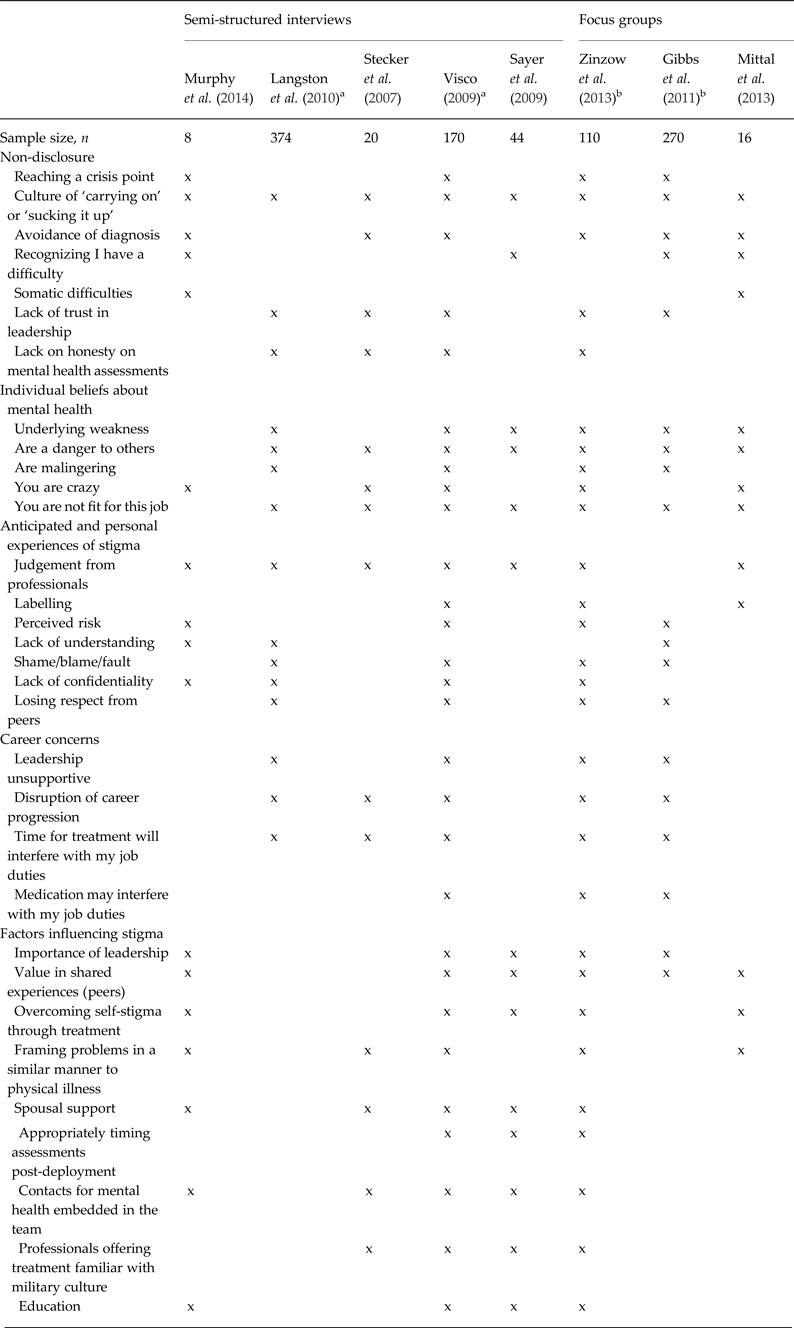
In all, five themes and 33 subthemes were identified as underlying the relationship between stigma and help seeking for mental health difficulties within the AF (Table 3). The five themes were organized under the overarching headings of either stigma-related barriers or facilitators to further organize the results into meaningful and coherent categories. The five themes were: non-disclosure, individual beliefs about mental health, anticipated and personal experience of stigma, career concerns and factors influencing stigma. The data were grouped and regrouped into a revised set of inter-related themes and subthemes; this formed the final coding framework. Quotations from the literature to support the findings can be found in online Supplementary Appendix S4.
Findings: stigma-related barriers
Non-disclosure
The theme ‘non-disclosure’ illustrates the link between a number of behaviours that delay or reduce help seeking, primarily linked to public stigma. This theme was characterized by phrases suggestive of ‘carrying on’ or ‘sucking it up’ and is consistent with previous literature regarding usual military culture which encourages individuals to try to solve their own problems and a fear of stigmatization from others driving this (Greene-Shortridge et al. Reference Greene-Shortridge, Britt and Castro2007).
Participants spoke about a difficulty recognizing that they had a problem, did not perceive their symptoms to be that severe that treatment was necessary, or indicated to rather seek help for their co-morbid somatic symptoms than mental health difficulties; the latter being a well-known issue in the AF (Britt, Reference Britt2000). There was a tendency to ignore difficulties or to not perceive the need for treatment until a ‘crisis point’ was reached, such as severe experiences of somatic difficulties or a life-threatening event, and the only option left was to seek help. Waiting until this point reportedly had a larger impact on the individuals’ working life and potentially their career. Participants across studies felt that accessing services and receiving a diagnosis illustrated to others that they had a problem. This is consistent with civilian literature regarding individuals purposefully avoiding the label that receiving formal care often brings and therefore avoiding public stigma (Corrigan, Reference Corrigan2004).
Leadership shaped participants’ perceptions of how they would be treated within the unit should they disclose their mental health difficulty. Participants discussed the heightened impact of leaders making positive statements regarding mental health and sharing their own experience of psychological difficulties. Of note, one study reported that leadership may have actively encouraged individuals not to accurately report symptoms on mental health assessments, due to fears that they would always be associated with that problem (Stecker et al. Reference Stecker, Fortney, Hamilton and Ajzen2007).
Individual beliefs about mental health
The theme ‘individual beliefs about mental health’ encompasses accounts regarding common internalized stigma. Participants across studies reported internalized stigma beliefs such as ‘I am weak’, ‘I am a danger to others’, ‘I am crazy’ and ‘I am unfit for the job’. In addition, participants across a number of studies spoke about worries that they would be perceived as ‘malingering’. In terms of gender differences, only one study specifically focused on gender and found that women were more receptive to treatment seeking (Visco, Reference Visco2009). This finding is consistent with research in both civilian and AF literature (Wang et al. Reference Wang, Lane, Olfson, Pincus, Wells and Kessler2005; Cohen et al. Reference Cohen, Gima, Bertenthal, Kim, Marmar and Seal2010).
Experiences of stigma
The theme ‘experiences of stigma’ was used to encompass individuals’ previous experience and individual fears regarding the prospect of help seeking within the AF. Participants across studies reported experiencing a ‘lack of understanding’ and ‘losing respect from peers’ and consequently some adopted feelings of being to blame, ashamed and feelings of guilt. Of those that reported utilization of mental health services, participants reported fears of experiencing judgement from professionals, particularly those outside of the AF. They anticipated that professionals without any AF experience would not understand the context of their experiences.
Career concerns
The theme ‘career concerns’ referred to participants’ worries that treatment seeking would impact on their career advancement and may lead to discharge from the AF. They feared that disclosure of their mental health difficulty would result in a lack of confidentiality and therefore act as a structural barrier for career progression. Further, they also feared a change in their duties if they were to seek help and potentially were given medication. Across studies, participants also spoke of how confidentiality could be lost as a result of their absence from the unit. Participants believed that colleagues would infer they were suffering from a mental health difficulty if they were to attend frequent appointments. Concerns about widespread knowledge of their mental health difficulties differed by rank. High-ranked officers expressed concerns that perceptions regarding their leadership abilities and a perceived risk to those that they lead might be affected. Conversely, lower-ranked officers predominantly reported fears around becoming non-deployable and unable to progress in their careers. Further, it was expressed that higher-ranking individuals would be able to conceal their engagement more readily due to increased autonomy. Due to limited research, it is unclear whether these anticipated consequences for AF personnel represent the reality of the situation. However, military personnel diagnosed with severe mental health problems have their duties restricted to ensure their safety and the safety of others and may be found to be unfit for deployment until they recover.
Findings: stigma-related facilitators to help seeking
Factors influencing stigma
The theme ‘factors influencing stigma’ included facilitating factors in reducing stigma and increasing help seeking. Many participants highlighted the role of leaders within the unit as influential in their decisions to seek help. The influence of leadership in both acting as a barrier to help seeking and a facilitator is an important finding. This result is not surprising given the strong leadership structure of the military, particularly in an active duty setting (Britt et al. Reference Britt, Wright and Moore2012). The process of overcoming stigma was attributed to the realization that previously held negative beliefs regarding mental health difficulties conflicted with positive changes in their lives as a result of treatment seeking. Participants cited the value of a psychological understanding in overcoming fears regarding help seeking, including details of where help was available and the symptoms that link to their diagnosis. This understanding assisted participants with their concerns being ‘mad’, ‘crazy’ or something wrong with them. On a broader level, a lack of psychological understanding of PTSD at a societal level was an important issue for participants.
Further, participants suggested that the appropriate timing of mental health assessments post-deployment, individual contact with mental health teams prior to incidents and professionals offering the treatment being familiar with military culture (e.g. would understand military-related PTSD) were all facilitators of help seeking. Additionally, knowing other individuals who had experienced and overcome a mental health difficulty was helpful. The value of encouragement and support to seek treatment from peers within the unit and family members highlights the importance of social support in help seeking (Table 4).
Themes across research studies

x, Present in study.
a Mixed-methods study.
b This study used both semi-structured interviews and focus group methods.
Discussion
This study was a synthesis of eight primary qualitative studies focusing on stigma-related barriers and facilitators to help seeking for mental health difficulties within the AF. Five key themes (non-disclosure, individual beliefs about mental health, anticipated and personal experience of stigma, career concerns and factors influencing stigma) relevant to the research topic were identified. Unlike the inconsistent findings from quantitative literature, this qualitative synthesis found consistent evidence that stigma did in fact present as a substantial and multifaceted barrier to accessing care and support for mental health problems in the military.
Strengths and limitations
The rigour of the review was established by applying a comprehensive search strategy to maximize the likelihood of identifying all relevant studies. Further, the widely applied CASP quality tool was used to rate the studies and the sensitivity analysis ensured that literature of lower quality did not adversely affect the overall findings of the review. One key limitation of this review relates to the process of narrative synthesis and its potential to decontextualize findings (Campbell et al. Reference Campbell, Pound, Morgan, Daker-White, Britten, Pill, Yardley, Pope and Donovan2011). The reviewers checked that each transfer of themes and concepts across studies was valid, thereby ensuring that the context of the findings was not lost. Further, as the current research included studies from both the USA and the UK the differential role of culture on stigma both at an organizational level and country level was not examined in detail. This review does not provide any direct evidence of an association between stigma and help seeking for mental health issues in the AF, but it does provide a rich account of stigma-related factors that deter and enable help seeking.
Implications for practice
The reluctance to seek help has been demonstrated in veteran and civilian populations (Woodhead et al. Reference Woodhead, Rona, Iversen, MacManus, Hotopf, Dean, McManus, Meltzer, Brugha, Jenkins, Wessely and Fear2011). Therefore, the current findings may be used to inform practice related to the reduction of stigma within the wider society, the AF and more specifically within organizational contexts in which individuals are routinely exposed to trauma, e.g. private military security companies and the emergency services.
Wider society
On a wider society level, overcoming structural discrimination is an essential aspect of targeting public stigma (Schomerus et al. Reference Schomerus, Matschinger and Angermeyer2006; Jorm, Reference Jorm2012). The use of interventions, such as mass media, has been shown to increase public knowledge and reduce prejudice (Clement et al. Reference Clement, Lassman, Barley, Evans-Lacko, Williams, Yamaguchi, Slade, Rusch and Thornicroft2013). In addition, such campaigns may counter stereotypes commonly associated with mental health difficulties, such as ‘weakness’, ‘malingering’, ‘unfit for work’ and ‘crazy’. Education through such campaigns may promote the recognition of psychological difficulties in their early stages through information on prevention and effective treatments for mental health difficulties (Jorm, Reference Jorm2012).
Interventions
Whilst there is little evidence to support the use of screening for vulnerability to mental health problems in organizational settings (Rona et al. Reference Rona, Hyams and Wessely2005), if these techniques are used, they should take account of the views of health and welfare professionals involved in any treatment provision (Bull et al. Reference Bull, Thandi, Keeling, Chesnokov, Greenberg, Jones, Rona and Hatch2015). Recent research in the civilian population has shown self-administered computer-based screening tools to screen for mood disorders in primary care setting to be more accurate in recognizing difficulties than individual general practitioner interviews (Vohringer et al. Reference Vohringer, Jimenez, Igor, Fores, Correa, Sullivan, Holtzman, Whitham, Barroilhet, Alvear, Logvinenko, Kent and Ghaemi2013). Additionally, US findings suggest that mental health screening may be of use in a primary care setting, particularly within the first few months of returning home (Milliken et al. Reference Milliken, Auchterlonie and Hoge2007). However, whilst screening procedures might assist individuals to determine if help seeking may be necessary, to be successful it is likely to be necessary to address concerns around perceived levels of confidentiality and consequent difficulties of receiving the label of a diagnosis.
Findings suggest that the individual affected might be unaware, or that they are reluctant to report their mental health difficulties. In these cases, peer-led intervention, such as Trauma Risk Management (TRiM), has been demonstrated to be effective (Greenberg et al. Reference Greenberg, Brooks and Dunn2015). This programme has been adopted by the UK AF and, in an adapted format, by the US AF. The peer-led approach of this programme may act to address barriers to help seeking such as distrust of mental health professionals. Research suggested that this approach is more acceptable to members of the AF, has a positive effect on organizational functioning and reduces absence rates after the occurrence of traumatic incidents (Whybrow et al. Reference Whybrow, Jones, Evans, Minshall, Smith and Greenberg2016). The aim of such an intervention is not, however, to treat mental health symptoms; instead it provides a degree of psychoeducation, to allow members of the team to identify persistent symptoms and signpost colleagues to treatment when appropriate.
Treatment
The review has important implications for practising clinicians treating members of the AF. Clinicians may want to integrate strategies into treatment that help to counter stigma associated with treatment and target internalized stigma. The following recommendations were identified:
-
• During treatment clinicians should endeavour to proactively tackle stigma during each consultation to reduce drop out, e.g. normalization of symptoms, challenges to stereotypes and labels.
-
• Framing mental health difficulties in a similar manner to physical health difficulties.
-
• Providing a psychological understanding of how symptoms developed.
-
• Given reported participant worries regarding whether treatment would meet their needs, it is essential to identify individual needs early in the course of treatment and ensure that these are met and clinicians continue to check with patients that this continues to be the case.
-
• It may be preferable to time post-deployment mental health assessments a number of days after individuals have returned home, as many reported not disclosing their persistent difficulties to ensure they returned home in a timely manner.
-
• Given the value of knowing other individuals who had experienced a mental health, it may be of use to offer group therapy where appropriate.
-
• Providing psycho-education and access to joint sessions where appropriate.
Future research
These results suggest that future research integrating findings from qualitative studies to inform the design of future quantitative measures is essential to ensure that quantitative research studies in the area of stigma and help seeking are asking the right questions. Further research into the design and ecological validity of questionnaires commonly used in AF stigma research should be priority. Future research should build on some of the highlighted quality shortcomings of the current research included, for example none of the eight studies included a reflective aspect. In addition, research could be directed to evaluating the use of interventions such as providing psycho-education to promote the recognition of mental health difficulties and evaluating stigma-specific interventions targeting leadership. The current findings infer that overcoming internalized stigma may be an important process of help seeking; however, there is very little research in this area to date.
Conclusions
The current systematic review demonstrated that unlike inconsistent findings from quantitative literature, the qualitative literature provides substantial evidence regarding the relationship between stigma and help seeking for mental health difficulties within the AF.
Supplementary material
The supplementary material for this article can be found at https://doi.org/10.1017/S0033291717000356
Acknowledgements
S.L.H. receives salary support from the National Institute for Health Research (NIHR) Mental Health Biomedical Research Centre at South London and Maudsley NHS Foundation Trust and King's College London. The views expressed are those of the authors and not necessarily those of the National Health Service (NHS), the NIHR or the Department of Health. The funders did not have a role in the study design; collection, analysis or interpretation of data; the writing of the manuscript; or in the decision to submit the manuscript for publication.
Declaration of Interest
None.