The frequency of international natural disasters is increasing over time. Reference Hikichi, Sawada and Tsuboya1 Earthquakes are a kind of natural disaster that endanger the lives of people more than other types of disasters, and they have not been controllable to date. Each year, 500,000 up to 1,000,000 earthquakes occur globally, but the majority have an insignificant magnitude. Reference Below and Wallemacq2 The United States Geological Survey has reported a 6-fold increase of earthquake occurrence in the past 4 decades, all over the world. 3
Twenty-one major earthquakes were reported between 1970 and 2005. Reference Hikichi, Sawada and Tsuboya1,Reference MacKenzie, Banskota and Sirisreetreerux4 According to EM-DAT (the global database on natural and technological disasters), the total number of deaths and people affected by natural disasters per 100,000 inhabitants from 1974 to 2003 in Iran is 1001-5000. Reference Coppola and Scott5 In Iran, most of the reported deaths caused by natural disasters have been attributed to earthquakes. Reference Jackson6 Two of the 5 great earthquakes occurred in Iran between 1990 and 2005. Reference Seyedin, Abasi Dolat Abadi, Sorani and Naghdi7
More than 800,000 deaths and even more injuries have been reported due to major earthquakes from 2000 to now. Reference Towe, Acosta and Chandra8 After buildings’ destruction by earthquakes, disruption continues deeper and further, affecting infrastructure, economy, and people. Reference Whittaker, McLennan and Handmer9
After natural disasters, governments and citizens come together to take part in responding. Reference MacKenzie, Banskota and Sirisreetreerux4 Past experiments have shown that logistic activities are not so efficient in the first hours after the earthquake. Government and volunteers’ cooperation is a crucial process in the field. Reference Chandra, Kim and Pieters10 There are different definitions for a volunteer, so it is logical paying attention to a spectrum. At 1 end of the spectrum, the definition is so strict that it considers not any relation in religion, nationality, ethnicity, or any interest (financial, private, and so forth) between volunteers and victims. At the other end, voluntary activities may be based on religious or ethical obligation, or those those will be done even with the perspective of gain (such as a better job or position). Regardless, it may be defined as those acts that are executed out of the volunteer’s main organization, not consistent with dominant paradigms, and in favor of people. Volunteers have a significant role in disasters. Their categorization might be in different manners, that is, professional and nonprofessional, formal and informal, and so on. Plenty of volunteers have extensive specialties and capabilities. There were more than 1.5 million first-time volunteers during large-scale disasters from 1995 to 2004. Reference Haraoka, Hayasaka and Murata11
Although the presence of volunteers in most casualties provides a great deal of assistance in disaster management, they can be a threat to the field management due to over-crowdedness, unnecessary repeated works, and lack of proper planning in utilizing their capacity. Expressing the experiences and challenges of informal volunteers, who often have left their homes in the hope of effective action and risking their lives on the scene, is context-relevant and might be related to the attitudes, expectations, and culture of communities. Qualitative studies may explain the challenges of managing such volunteers from a stakeholder perspective. It is likely to be more accurate if expression of these experiences would occur nearer to the time and place of the incident. For this reason, this qualitative study was conducted in the early days after the Sar-e Pol Zahab earthquake in the same region with the aim of investigating the management of informal volunteers in 2017 earthquake of the west of Iran, distinguishing the challenges engaged.
METHODS
Design
This article is the result of a qualitative study with a content analysis approach.
Setting
An earthquake of 7.3 Richter magnitude scale occurred on November 12, 2017, at 21:48 local time in the west of Iran (Ezgeleh as the epicenter, at 34.88°N and 45.84°E). Its hypocenter, or focus, was 23 km deep, and the duration was 30 s according to anInternational Institute of Seismology report. Reference Ostadtaghizadeh, Khaleghy Rad and Aghababaeian12 Eight cities, 1950 villages, and 427,266 persons were affected by the earthquake. There were 620 deaths registered according to the formal report of Iran Forensic Medicine Organization. 13 An Emergency Operation Center was activated immediately in Kermanshah province. The setting of this study was the earthquake province, damaged villages, and also a hospital in Kermanshah.
Participants
Participants were 12 persons, including managers of the field and civil hospital, officials of other relief organizations (Iranian Red Crescent Society and Iranian Emergency organization), health-care providers (involved in survivors’ management at first 48 hours), and informal volunteers.
Data Collection
Data were gathered through observation and semi-structured interviews with volunteers and important officials. The process of volunteers’ management was observed, and semi-structured interviews were performed. Some of the interview questions were as following: What are the challenges of volunteers’ management in this recent earthquake? What is your experience of volunteering? Was your specialty (or experience) exploited properly? In your opinion, volunteers had what advantages for disaster management process?
Sampling
Sampling was purposive. It was continued until reaching the saturation of concepts and data, as analysis of 2 last interviews had no new concepts.
Data Analysis
Content analysis was performed by Graneheim approach (oral interviews were written down; reviewed repeatedly, meaning units and codes were assigned; and subcategories and categories were extracted). Field observations were noted simultaneously, and notes were analyzed too.
Trustworthiness
To achieve maximum credibility, we used maximum diversity in the selection of participants. Content analysis was begun along with data gathering. The texts were transcribed in a short interval after each interview. The researcher listened repeatedly to the interviews, and assigned the meaning units. The assignment of codes was based on condensation and abstracting of meaning units. Then subcategories were formed by assigning similar codes. Finally, according to the similarities and differences between subcategories, the categories were extracted. Analysis and data gathering were done simultaneously. Confirmation of interview transcripts was done by 2 colleagues immediately after reading and verification. For formation of codes, subcategories, and categories, the research team announced expert opinions; researchers, experts, and participants came to an agreement about the differences.
Ethics
This study was approved by the National Committee of Ethics of Iran (code number: IR.SBMU.PHNS.REC.1397.100). All participants were aware of the research objectives. Their participation was confidential and with informed consent. All interviews were recorded with participants’ permission.
RESULTS
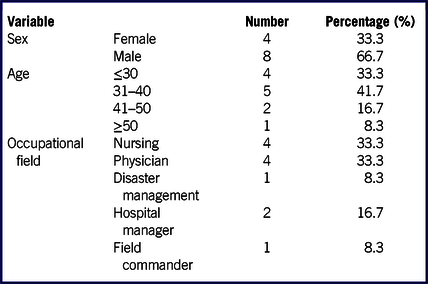
The research team arrived in the area on the 4th day after the earthquake and remained there for 5 days. Data about challenges of informal volunteers’ management were gathered by visiting and evaluation of the damaged areas of Sar-e Pole Zahab, the damaged villages nearby, volunteers’ residence place, field hospitals, and the district military hospital. Although the authors found no accurate record of informal volunteers dispatched, field surveys showed the presence and arrival of a large number of these volunteers on the days after the earthquake. Semi-structured interviews were performed with volunteers and important officials. Table 1 shows the demographic characteristics of paricipants. Most of them had entered the area without prior registration from the beginning of the response phase. The majority of volunteers were participating in this disaster for the first time.
Demographic Characteristics of Participants

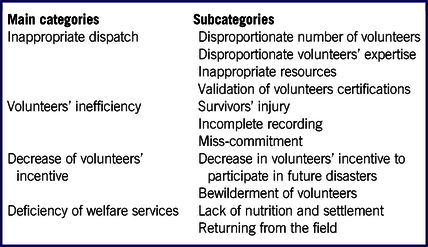
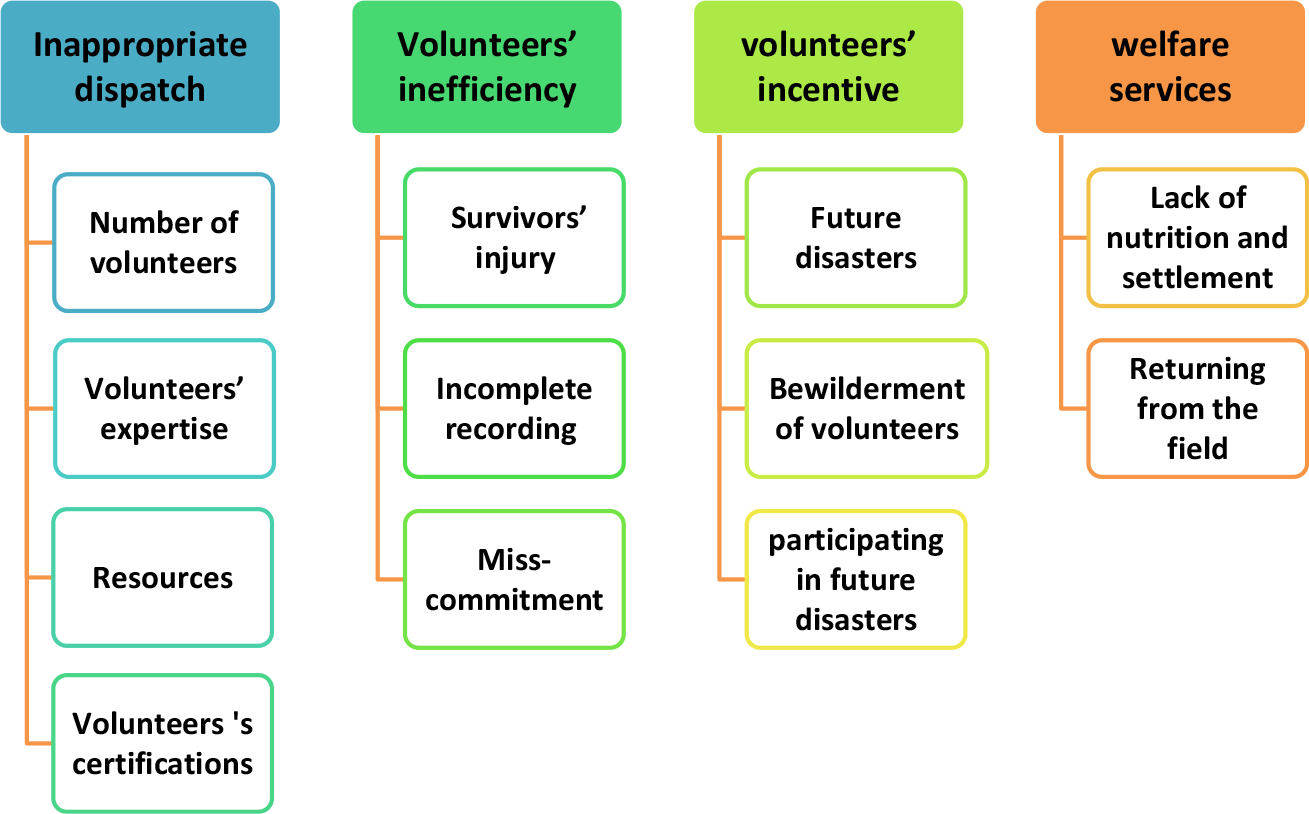
The results of the content analysis revealed that those centers did not have any specific mechanism for registration of volunteers. The observation and surveys also showed that there was not any developed unit for managing volunteers, so they were engaged without valid qualification for their announced specialty. After a content analysis of 12 interviews, 356 codes were obtained. Similar codes were summarized in 4 main categories and 11 subcategories (Table 2; Figure 1).
Main Extracted Categories and Subcategories

Main Categories and Subcategories Obtained by the Research.

1. Inappropriate Dispatch
By considering participants’ view and research team observations (on days 4–9), the process of volunteers dispatch was not appropriate after the Kermanshah earthquake, and the following items were obtained: Overcrowding of volunteers in the early days after the earthquake; Disproportionate number of volunteers according to the situation; Sending volunteers with similar specialties, voluntary (spontaneous) volunteers; Dispatch of teams with similar expertise from several organizations without any need assessment; Deployment of medical specialists and fellowships without need assessment; Parallel activities of volunteers, lack of resources for employing volunteering expertise; Inadequate validation of volunteers’ certifications; Miss-commitment of volunteers to continue relief processes; Possibility of incomplete registration of survivors’ identity.
Disproportionate Number of Volunteers
By our observations and talks of participants, the dispatch of volunteers was carried out without a realistic need assessment. Several organizations had carried out the dispatches, and there was not sufficient feedback about the situation even with a past need assessment. There was also no proper distribution of volunteers within the region, so overcrowding of volunteers had occurred in the central area, but there was a minimum of volunteers in other regions. Most volunteers had spontaneously come to the region because there was no professional and efficient mechanism for need assessment, informing, announcement of the needs, and halting the operations. Participants believed that volunteers had deployed occasionally with similar or inefficient expertise and often by several organizations.
One of the nurses at the field hospital quoted: “There was volunteer overcrowding so that we should often stop our duty and give information to them.”
Disproportionate Volunteers’ Expertise
In some cases, there were many volunteers with the same specialties, without the urgent need for their activity. Many organizations or universities had usually sent volunteers in similar areas. The need assessment was not controlled by the higher centers, and each team was deployed independently. Most participants also believed that volunteers had not arrived to the field due to a need assessment, which had led to reduced efficiency.
An official in the field hospital said: “A famous cardiac surgeon was referred to us the day after the earthquake, ready to go to the operation room, but we did not need him at all.”
Inappropriate Resources
Most participants believed that performance of skilled informal volunteers had declined due to lack of facilities in the field, so they were unable to make effective measures. Some experts were forced to leave the region due to lack of resources and equipment.
One of the field hospital officials said: “A transplant surgeon was referred to the hospital, and he was forced to return after an overnight stay because we did not have transplant facilities.”
Validation of Volunteer’s Certifications
Participants believed that their documents credit was not assessed adequately. The process was due to the lack of a coherent registration system and the time-consuming process of evaluation at the preparedness and response phases. So the volunteers had started without careful evaluation of their documents.
2. Volunteers’ Inefficiency
The following subcategories were obtained.
Survivors’ Injury
The possibility of survivors’ injury or deterioration of their injury by volunteers might be caused by the presence of nonspecialist volunteers from different organizations in the early hours and also due to the urgent nature of the relief (especially at the acute phase of the disaster).
A rescuer said: “Carrying victims with spinal cord injuries was sometimes done without any precaution.”
Incomplete Recording
Accurate recording of victims and the possibility of tracking them in the coming days is one of the most important activities in the acute phase of disasters. The use of informal volunteers had led to incomplete registration of victims (killed and injured), especially in the first few days after the Sar-e Pol Zahab earthquake. It was possible to record improperly, especially on the early days. The burial of corpses was carried out by unofficial volunteers, sometimes even without any registration.
A volunteer said: “The volunteers would come and do the primary ceremonies, without registration.”
Miss-commitment
After analyzing the interview with health-care workers at Kermanshah Hospital about the challenges of informal volunteers’ activities, miss-commitment subcategory was extracted. Kermanshah Hospital was the main site for treatment and care of the victims; many informal volunteers were introduced to the hospital for conducting activities.
A nurse from the Kermanshah hospital said: “We could not trust all volunteers. Once I noticed the volunteer had gone, but some patients still needed care.”
3. Decrease in Volunteers’ Incentive
Decrease in Volunteers’ Incentive to Participate in Future Disasters
After analyzing the data of informal volunteers, it was found that most volunteers believed they might not volunteer in a future disaster. They had somehow lost their motivation for volunteering.
An expert who was forced to return due to lack of specialized facilities said: “I would rather not volunteer in the next disaster.”
Bewilderment of Volunteers
Bewildering of volunteers was revealed by the analysis of observations and most of the interviews for those who were not fit for the event; so they did not have anything to do and were forced to return.
A volunteer said: “Unplanned and mal-practiced dispatching would decrease our motivation to collaborate in the next event.”
4. Deficiency of Welfare Services
Lack of Nutrition and Settlement
Volunteers are ready to work in difficult situations. When they are overcrowded, providing their nutrition and habitation becomes a necessity.
One of the volunteers mentioned: “We were delayed for 2 days to come because we had to find somewhere for settlement.”
Returning From the Field
Those volunteers who were forced to return became a challenge for disaster managers of the province. They required basic minimum needs such as water, food, and resting place in addition to arrangements for returning as they leave. This subcategory was created according to the research purpose.
One manager from the Kermanshah incident command center said: “Sometimes we were exhausted returning those experts we did not need.”
DISCUSSION
All volunteers in our study believed in the inappropriate process of dispatch; inefficiency of informal volunteers resulted from the challenges of disaster management. These categories were obtained from subcategories of a disproportionate number of volunteers, disproportionate volunteers’ expertise, inappropriate resources for applying volunteering expertise, and inappropriate evaluation of volunteers’ certifications and their functions.
The extracted category mainly referred to the dispatch process of informal volunteers. A large number of volunteers and their bewilderment due to unplanned dispatches are those topics addressed by articles. 14,Reference Orloff15
Applying informal volunteers often provides the extracurricular opportunity that is needed in disasters. Although informal volunteers would be of great aid in disaster management, it is not reliable or effective without planning. 14,Reference Scanlon, Helsloot and Groenendaal16
Yafe et al. considered the effect of volunteers’ actions on reducing the impact of trauma on survivors. They declared that, with the importance of rapid response to the trauma, volunteers would help in decreasing trauma-induced mortality. Their study emphasized the importance of planning for this group. Reference Yafe, Walker and Amram17
The US Federal Emergency Management Agency emphasizes that, although non-affiliated volunteers are among effective sources for managing disaster, their independence from emergency organizations could make problems, such as validation and coordination of their skills with appropriate services (emphasizing training course validation).
Heide et al. emphasized that convergence of humans and their volunteer activities in incidents might be an opportunity for disaster managers Reference Heide18 , but most disaster organizations believe that volunteers need to be managed and integrated into respondent organizations. Reference Towe, Acosta and Chandra8,Reference Whittaker, McLennan and Handmer9,Reference Yafe, Walker and Amram17
There were 2,300,000 volunteers to search for the remains of the airplane of flight MH370 in the Indian Ocean in 2014 Reference Fishwick19 and to rescue 80% of the 300,000 survivors remaining under debris after the Tangshan earthquake in China in 1976, a million volunteers participated in response to the Kobe earthquake in Japan in 1995, and there are many other examples regarding the importance of the role of volunteers. Reference Whittaker, McLennan and Handmer9
Volunteers are usually active in disaster response in Iran due to repeated disasters. The Red Crescent volunteer society is a formal responding organization, training and applying volunteers. Training courses would be held before a disaster at various levels. Participants’ level would be determined, and there are upgrading courses. Reference Droogers, Ciotti and Kreidl20 Although accurate statistics were not found regarding the number of informal volunteers in past disasters of Iran, field observations show the presence of these motivated people at the scene of events. 21,22 The Iranian Nursing Organization and Ministry of Health are other organizations involved. Helsloot and Ruitenberg showed that the number of volunteers is growing, which means a large proportion of the volunteers are informal volunteers. Reference Helsloot and Ruitenberg23
Volunteers’ inefficiency was another extracted category with related subcategories, such as the possibility of injury to victims by volunteers, possibility of incomplete recording of survivors’ identity, and miss-commitment to continue the relief process by volunteers.
Individual competencies and effective communication are 2 aspects of volunteers’ capabilities that are more important than other volunteering elements. Kirsten Johnson and colleagues consider volunteers’ skills and sharing their capabilities as 2 critical components in volunteer participation. They agree that education should be based on comprehensive capabilities. They also emphasize practicality and applicability of training, the possibility for training, and the possibility of applying measurements. Reference Johnson, Idzerda and Baras24
Although Orloff considers informal volunteering as a cost-effective solution for disaster management, Reference Orloff15 Whittaker et al. describe this response as threats in 2 areas: the first is a disturbance in the management of disaster with a subsequent increase in financial and human losses, and the second threat is a waste of resources. Reference Whittaker, McLennan and Handmer9 Of course, threatens would become so crucial that responders are not able to organize informal volunteers even in the response phase. Reference Roy25 In this study, heavy traffic caused by unplanned volunteers was the major problem for transportation. The same problem occurred after Turkey’s 1999 earthquake (disturbance of emergency services due to 32-km traffic jam). Reference Whittaker, McLennan and Handmer9 Sauer et al. in 2014 studied 24 national volunteer organizations and showed that 95% of the organizations checked informal volunteers’ expertise, 53% provided training courses when applying volunteers, and only 26% had an appropriate system for evaluation and giving feedback to managers. Reference Sauer, Catlett and Tosatto26
Planning for volunteers should be started at the prevention and mitigation phases, but it is possible to create a proper organization of volunteers even after the onset of incidents. Stallings and Quarantelli have provided the key principles needed by emergency managers who coordinate with leading teams. These principles also might be used to manage relationships between managers and informal volunteers: (1) Phenomenon of increasing numbers of informal volunteers, considered as an inevitable emergence due to unidentified citizens’ needs (after disasters or even afterward); (2) Emphasis on recognition of informal volunteers as a formal subject; and (3) Emergence of informal volunteers when there is a lack of response to the needs of the damaged province (they are not always opposed to government). Reference Stallings and Quarantelli27
Scanlon et al. proposed an integrated model for emergency management that combines formal emergency responses with existing social structures, but no attempt to reorganize volunteer teams and their activities. Volunteers’ management in a disaster would be facilitated by: (1) Establishing formal systems in collaboration with the participants’ leaders (in emergency response processes), (2) Presenting special clothing, (3) Offering mutual counseling, and (4) Other measures. Reference Scanlon, Helsloot and Groenendaal16
Orloff et al. considered the challenge of volunteers’ performance in 2 areas of: (1) Harm to survivors, and (2) Damage to volunteers.
Providing clear guidelines on the responsibility of protecting survivors and volunteers may help to reduce damage during the response phase. Reference Orloff15 For example, although volunteers rescued 800 victims in the Mexico earthquake, 100 volunteers were killed. Reference Helsloot and Ruitenberg23,Reference Castaños and Lomnitz28 In certain events such as chemical leakage, volunteers will be more prone to harm if they have no personal protective equipment. Reference Orloff15 Sauer et al., after reviewing the security of volunteers’ activities (from both aspects of injury to themselves or the others), concluded that security would be increased by: (1) Registering volunteers, (2) Accrediting their documents, (3) Considering proportionate tasks, and (4) Supervising their work. They found that only 32% of national organizations will accept the legal responsibility of volunteers. Reference Sauer, Catlett and Tosatto26
Disaster response organizations emphasize the necessity of tutorial and academic training of volunteers in the response phase. Reference Johnson, Idzerda and Baras24,Reference Burkle, Walls and Heck29,Reference Jacquet, Obi and Chang30 Core competencies of basic capabilities in disaster management and humanitarian assistance were reviewed systematically by Ripoll Gallardo et al. in 2015. The results showed that most of the studies about disaster-preparedness capabilities were done on health care, and most items were nursing related. However, it is necessary to reach a standard in medical education and humanitarian assistance for coming to this point, that is, a general competence for all professionals involved in the disaster. Reference Ripoll Gallardo, Djalali and Foletti31
On the other hand, it is probable that survivors may be injured physically or psychologically by untrained and inconsistent volunteers. Reference Chandra, Kim and Pieters10,Reference Dieltjens, Moonens and Van Praet32,Reference Gil-Rivas and Kilmer33 Educational interventions are appropriate for volunteers’ education that would improve their knowledge, attitude, and performance. Reference Jamshidi, Majdzadeh and Saberi Namin34 McCabe and colleagues concluded that interventional programs would enhance knowledge and individual skills of volunteers. Reference McCabe, Marum and Mosley35
Based on our study, the other extracted categories were: Possibility of a decrease in volunteers’ registration for future disasters, and considering no welfare services for volunteers. All volunteers who were not able to continue participation in the earthquake of western Iran believed that they might not take part again in a future event as a volunteer. This finding suggests that volunteer recruitment processes should be started in the preparedness phase and be continued in responding phase. It is also important to motivate and address social culture.
The phenomenon of volunteering also has some advantages for volunteers. Disaster-focused activities can be accompanied by post-traumatic growth. Reference Anderson, Prioleau and Taku36 After research on volunteer and non-volunteer students during the Fukushima earthquake and tsunami (2011), Anderson and colleagues’ conclusion was more post-traumatic growth in volunteers. The matter was observed more in those who had more diverse activities. In another study from Turkey’s Marmara earthquake in 1999, it was shown that volunteer survivors were more active than nonvolunteers and had problem-solving coping Fstrategies. Reference Orloff15 Helsloot and Ruitenberg identified that cultural factors and independence on emergency services lead to citizens’ non-responsiveness and passive behavior to disasters. Reference Helsloot and Ruitenberg23
The development of standards for information gathering from volunteers will help to a better response. Reference Arbon, Bobrowski and Zeitz37 Having a registration system is necessary. Voluntary participation can enhance the sense of volunteering, security, and trust. In the present study, we extracted a category that showed a probable decrease in volunteers’ registration in subsequent events. Avoiding mistrust and decrease of motivation, it is better to plan more precisely at the scene of the event and even with the onset of a disaster. We recommend that extracurricular programs and applying of potential volunteers should be started within the preparedness phase, and to follow up at the beginning of the response phase.
Future studies should be aimed to identify volunteers’ expectations in order to provide the volunteers’ needs effectively in the disaster area. It is recommended to design research on volunteers as well as paying attention to the volunteers’ needs. The experiences of volunteers would be another valuable source for further research.
LIMITATIONS AND PROPOSAL FOR FURTHER RESEARCH
One of the limitations of this research was the time of study, the first days (4–9) of the acute phase, making any research difficult to perform. Another limitation was the low number of participants. Although reaching the saturation of concepts and data would determine the sample size in qualitative studies, which we used the same method, but we recommend more participants be interviewed in subsequent studies.
We also recommend developing quantitative tools based on the obtained categories and subcategories, to measure the satisfaction of informal volunteers in future research.
We should mention that the present study has been carried out in the context of the Islamic Rebublic of Iran. It is possible to generalize the results to other countries according to our view, but the choice is reserved for the readers.
CONCLUSIONS
Volunteers are a potential force that has an enormous impact on extracurricular supply for responding to disasters. Bringing such enormous extracurricular power in major disasters is possible by: (1) Providing a relationship between volunteers and responding organizations, (2) Integrating the management of informal volunteers in the preparedness phase, (3) Designing and implementing training courses during the same period, and (4) Organizing rapid and relevant training courses.
The followings might be solutions: (1) Apply modern communication systems and the creation of registration networks, (2) Accreditation of certificates and expertise, (3) Development of standards in collecting information, (4) Perform periodic drills, (5) Record volunteers damaging items and finding their cause, and (6) Record survivors hurt by volunteers.
Decreased motivation to participate in future events was extracted as a category in our research and needs to be studied more comprehensively.