Australia has never been so hated in India and in much of Asia . . . Australia is enduring a catastrophe in its foreign policy and its standing in the world generally . . . this is happening throughout Asia. (The Australian columnist Greg Sheridan (Reference Sheridan2010) following a series of violent assaults on Indian men in Melbourne).
A central theme in Australian foreign policy over the past 20 years has been that of ‘Asian engagement’, reflecting increased interactions with the countries of Asia, especially in economic and security issues (Capling, Reference Capling2008: 601; McDougall and Edney, Reference McDougall and Edney2010). Concurrently, various scholars have asked whether the Australian public supports greater integration with the region (Milner, Reference Milner, Cotton and Ravenhill1997; McAllister and Ravenhill, Reference McAllister and Ravenhill1998; Johnson et al., Reference Johnson, Ahluwalia and McCarthy2010; Pietsch et al., Reference Pietsch, Clark and He2010). However, although politicians and journalists appear to believe it is significant, how Asian publics view Australia has rarely been the focus of scholarly studies. We concur that this is potentially an important question because how people interpret Australia's behavior may have implications for its relations with regional governments, for example in the extent of its integration into regional institutions or whether its regional initiatives are accepted. It is important, therefore, to assess the perception among some policy makers, members of the mass media, and scholars that there is considerable anti-Australian sentiment in Asia.
How does the typical citizen in Asia perceive Australia? According to one view, Australia is not particularly well liked. Three reasons are commonly cited for this. First, Australia is said to be a culturally Western nation dominated by people with European ethnicity and, therefore, an outsider in Asia often perceived to be socially, economically, and politically separate (Capling, Reference Capling2008: 603). During the 1980s and 1990s, for example, following attempts by Prime Ministers Hawke and Keating to promote economic interdependence with Asia, political leaders in Malaysia and Singapore argued that Australia should not be accepted into regional organizations because it was not culturally Asian (Johnson et al., Reference Johnson, Ahluwalia and McCarthy2010: 66). Second, Australia is sometimes labelled a racist country because of the legacy of the White Australia policy (Bowring, Reference Bowring2003). The Age newspaper, for example, claimed that ‘many ordinary people in Asia do not understand Australia’ and ‘the one criticism they are likely to level is that Australians are racist’ (Backman, Reference Backman2007). Such concerns were especially salient when Pauline Hanson – the leader of the One Nation Party who once said that Australia was ‘in danger of being swamped by Asians’ (Dalrymple, Reference Dalrymple1997: 245) – was elected to Parliament in 1996 following a pledge to reduce immigration from neighboring countries. More recently, the image of Australia as a nation hostile to non-whites reemerged following violence inspired by perceived ethnic differences in the 2005 Cronulla riots near Sydney, and a series of violent assaults on Indian men in Melbourne and Sydney in 2009 and 2010. A third reason cited for Australia's negative image in Asia is its foreign policy behavior and close ties to the United States. Its UN-backed use of force in East Timor (then part of Indonesia) in 1999 and strong support for the US-led conflicts in Afghanistan and Iraq have, according to some, generated mistrust among countries in the region.
In contrast, some Australian elites argue that Australia is a country that actually enjoys a good reputation among its neighbors. One reason cited for this is the feelings elicited by its natural environment. Foreign Minister Gareth Evans (Reference Evans1990), for instance, celebrated that Australia was viewed in North East Asia ‘as a land of open spaces, exotic flora and fauna, an exporter of commodities – and a good place in which to relax!’ Others argue that it is viewed positively because of its well-run economy and political system, as well as its regional commitments. Sheridan (Reference Sheridan2010), for example, writes that: ‘Australia is generally seen in Asia as a mostly boring but well-run nation of beaches and good lifestyle and rock-solid political and economic stability.’ Foreign Minister Alexander Downer (Reference Downer2005) maintained that Australia's reputation in Asia was that of a reliable partner, stable country, and helpful neighbor.
The image of Australia among the mass publics of Asia is considered important for its foreign affairs because governments can respond to preferences of their people. According to Sheridan (Reference Sheridan1999), anti-Australianism has ‘enormous implications for our national security and place in the region’, while the Senate Committee on Foreign Affairs, Defense and Trade (2007) warned that ‘some of the outdated images held about Australia may not only limit a broader appreciation of Australia and affect its reputation, but act as an obstacle to the effective pursuit of its foreign policy’. As a result, Australia's regional initiatives may be greeted with skepticism (Dalrymple, Reference Dalrymple1997: 245), or the country may be excluded from other states’ regional collaborations (Goldsworthy, Reference Goldsworthy1996: 201).
Yet the discussion of perceptions of Australia in the region has tended to be based more on assertion than evidence (O’Connor, Reference O’Connor2004: 215). The purpose of this study is to address concerns that Australia's image in Asia is problematic and to examine what common factors shape perceptions among individual citizens throughout the region. To do this, we focus on two questions. First, how do people in Asian nations tend to view Australia? Second, what factors, if any, can consistently explain variation in perceptions of Australia among people in the different countries in the region?
Analyzing data from the AsiaBarometer survey project, we conclude that while it is viewed more favorably than non-favorably in large parts of Asia, most people in the region probably do not have a meaningful opinion about Australia.Footnote 1 Two basic findings led us to this inference. First, we find high levels of neutral views, as well as fairly high non-response rates regarding Australia. Second, we doubt that even the views of many of those individuals who are more favorable toward Australia have much substance. Although some theoretical indicators were found to have an impact on views of Australia's influence in specific national contexts, most notably education, the effects of only two variables were consistently significant – perceptions of the influence of the United States and of China. Both are positive and consistently related to perceptions of Australia in just about all countries. We attribute this robust finding among individuals from such a wide range of societies to general orientations of either internationalism or isolationism, or to general orientations towards large powers active in the region, or to both. Before proceeding to our theoretical discussion, we next briefly examine what is currently known about public opinion about Australia in Asia.
Views of Australia in Asia
A handful of studies present evidence of views of Australia in Asia based on aggregate country-level statistics taken from public opinion surveys. Despite some concerns among policy making and media elites, the most common finding is that Australia tends to be viewed favorably in the region. One poll in 2006 found that Australia is regarded generally positively in South Korea and China, as well as to a lesser extent in India (Chicago Council on Global Affairs, 2006: 49). The Program on International Policy Attitudes (2007) used a feeling thermometer to find that perceptions of Australia were moderately warm in four Asian countries – China, Thailand, India, and Indonesia. Meanwhile, the results from two polls by the Lowy Institute, a think tank in Sydney, also suggest that Australia is viewed moderately favorably in Indonesia and China (Cook, Reference Cook2007: 15).
The reasons for views of Australia were suggested in a separate Lowy poll done in China which asked questions that are more specific about perceptions of Australia. The majority reason for its positive image was that it is a good place to visit (84%). It was also seen as a country with attractive values (68%), a reliable supplier of natural resources (64%), and possessing a good political system (57%) (Hanson and Shearer, Reference Hanson and Shearer2009). Overall, the available survey analysis is not consistent with the claim that anti-Australian sentiment is a problem in Asia.
While these surveys suggest that Australia is generally viewed well in the aggregate, knowledge on this topic can be improved. First, the sample of countries is somewhat limited. Second, the phrasing of questions in the different polls means that the results are not directly comparable. Third, the data are analyzed only at the aggregate level. While this may tell us that views of Australia vary between countries, it is difficult to discern the reasons for such variation, and differences among individuals within or across countries remain unexamined. This study seeks to improve on the state of knowledge by examining individual-level data, based on consistent question wording to measure perceptions of Australia in 14 polities in Asia. To guide the analysis we propose a set of theoretically based hypotheses, which we describe in the next section.
Hypotheses
Although public opinion about Australia in a particular country may be affected by country-level factors such as its position in the international system, bilateral relations with Australia, and a number of domestic factors, we expect that there will also be considerable variation in attitudes among individuals within the same country. We propose that people across a range of national contexts will exhibit similar patterns of thinking when evaluating Australia. In particular, we expect individuals to be influenced by their core values, their identity, and their level of information about foreign countries. We also consider the possibility that certain demographic characteristics may also have an effect. From each of these categories, we derive a series of empirically testable propositions. In addition, we consider the possibility that individuals in Asia tend not to have well-formed views about Australia, but instead derive their attitudes from a general orientation towards foreign countries, and/or their views of specific, better-known nations such as the great powers in Asia.
Core values
As suggested by criticisms of Australia that have come from political leaders such as Malaysia's Mahathir Mohammed, we consider the possibility that a person's views of Australia may be shaped by their core values. These have been found to play a large role in forming general political preferences (Goren, Reference Goren2001) and, more specifically, foreign policy beliefs (Hurwitz and Peffley, Reference Hurwitz and Peffley1987: 1105). Core values, for example, were found to shape Americans’ views of the USSR because it was seen as threatening the American ‘way of life’ (Hurwitz and Peffley, Reference Hurwitz and Peffley1990: 7). Some people in Asia might see Australia, a secular, wealthy, and culturally Western nation, as a symbolic threat to some of their core values.
Since strong feelings of nationalism tend to be associated with a dislike of out-groups (de Figueiredo and Elkins, Reference de Figueiredo and Elkins2003), national pride may lead to a hostile view of Australia as a threat to what citizens believe is unique about their country. As a former British outpost, a country that once defined Asia mainly in racial terms, and a former colonial power in Papua New Guinea (Reynolds, Reference Reynolds2005: 358), Australia may be a target of hostility among more nationalistic individuals. National pride may also increase susceptibility to cues from nationalistic politicians. For example, the Australian government's strong anti-whaling position has been portrayed as anti-Japanese (Sato, Reference Sato2008); the decision to send troops to East Timor in 1999 inflamed nationalist groups in Indonesia, who protested in front of the Australian embassy; and Mahathir once called countries with majority Anglo-Saxon populations violent and greedy (Kuppusamy, Reference Kuppusamy2003). We hypothesize that the core value of national pride is consistently associated with unfavorable perceptions of Australia in Asia (hypothesis 1).
Strongly held religious beliefs may lead a person to view a secular state like Australia with hostility. Highly religious individuals, especially those who interpret secularism as an anti-religious ideology, may resent countries, like Australia, which, as Capling (Reference Capling2008: 609) observes, has political and social institutions that reflect secular, liberal, capitalist, and democratic values. Religiosity may also lead to feelings of prejudice toward non-members of one's religion (Batson and Burris, Reference Batson, Burris, Zanna and Olson1993). We predict that Australia's image as a Western, secular state (albeit with a Christian heritage) will mean that religiosity is consistently associated with unfavorable views of Australia in Asia (hypothesis 2).
As with religiosity, moral traditionalism may lead to hostility toward Australia because it is seen as a country that is morally bankrupt (Peffley and Hurwitz, Reference Peffley and Hurwitz1992: 443). Those individuals who believe that the traditional values associated with family and morality in their society are important may resent countries that symbolize ‘Western’ or post-materialist values. Assertions by East Asian thinkers and political leaders than Confucianism and ‘Asian values’ make their political and economic systems distinct continue to enjoy wide currency in the region (Mahbubahni, Reference Mahbubahni1993; Chang et al., Reference Chang, Chu and Tsai2005). One Australian diplomat with extensive experience in Asia remarked that Australians were seen in the region ‘as uncouth, undisciplined, lazy, materialist, insular, hedonistic, loud-mouthed, insensitive and self-righteous’ (Woolcott, Reference Woolcott1992). Moral traditionalism may lead to a sense of difference from, or even cultural threat from Western societies and, therefore, be consistently associated with unfavorable perceptions of Australia in Asia (hypothesis 3).
Identity
Another factor that may play a role in a person's perceptions of Australia is the group with which they tend to identify, because of the tendency to evaluate members of an in-group more favorably than non-members (Hewstone et al., Reference Hewstone, Rubin and Willis2002: 576). Huntington (Reference Huntington1993) argues that people often define themselves in ethnic and religious terms, with a world view consisting of an ‘us’ versus ‘them’ dynamic. Political elites in Asia have at times framed Australia as a cultural and ethnic outsider, most notably in Southeast Asia. Singapore's Prime Minister, for example, claimed that Australians would not be regarded as ‘indigenous Asians’ until ‘there's more Asians going to Australia and the population is over 50 per cent non-white and the rest white’ (Allard, Reference Allard2003).
Religious affiliation (as distinct from the strength of religiosity) is one possible source of identity that may influence views of Australia because it can produce positive or negative attitudes towards particular religious groups and therefore countries (Page et al., Reference Page, Rabinovich and Tully2008: 33). In particular, Christians in Asia may have positive views of Australia because they may perceive it as a majority Christian nation.Footnote 2 On the other hand, Muslims may take a more negative view of Australia since they may feel little affinity for a country in which their fellow believers are only 1.7% of the population (The World Factbook, 2011) and which has been accused of an anti-Islamic bias in both its domestic and foreign policies (Dunn et al., Reference Dunn, Klocker and Salabay2007). Following the arrest of accused Islamic terrorists, for example, Mahathir warned that Australia was not a safe country for Muslims (Flitton, Reference Flitton2003: 50). Although whether the effect is favorable or unfavorable will vary by religion, religious affiliation should be consistently related to perceptions of Australia in Asia (hypothesis 4).
Political orientation may also influence views of Australia. Identifying with liberal and democratic political ideas may generate an affinity for more democratic countries (Herrmann et al., Reference Herrmann, Tetlock and Visser1999: 555). This may be one reason why Americans feel more warmly about Australia than they do about other Asian nations (Page et al., Reference Page, Rabinovich and Tully2008: 37). Paul Kelly (Reference Kelly2002), editor-at-large of The Australian, asserts that Australian political culture is separate from that of Asia: ‘Australia is not an Asian society and nobody thinks that we are . . . Australia is democratic, Western-based and multicultural.’ Assuming that this view is shared by people in Asia, we expect that support for democracy consistently produces more favorable perceptions of Australia in the region (hypothesis 5).
Information
One way to reduce hostility towards Australia might be to increase the level of information about, and exposure to, it and its people. In general, more contact with foreign countries and foreign people should stimulate greater interest in foreign affairs and a more open mind about countries that are culturally dissimilar. Since Australia shares many cultural and political characteristics with Western nations, it may be viewed by some people in Asia with suspicion. Such feelings could be reduced, we posit, if people have more information about and contact with the world around them, and Australia in particular.
Education may influence views of Australia because it can condition information about the international environment (Brewer, Reference Brewer2004: 323). Formal education can increase knowledge of foreign countries (Page et al., Reference Page, Rabinovich and Tully2008: 33) and also lead to a greater internationalist orientation derived from the views of political elites (Brewer et al., Reference Brewer, Gross, Aday and Willnat2004, 95). Educated citizens, who are likely to be most attentive to international affairs, should be more aware of Australia and its efforts at engagement in the region than their less educated compatriots. They should also be the ones who have the most factual knowledge of Australia's history and its domestic and foreign affairs. The expectation, therefore, is that education level is consistently associated with more favorable perceptions of Australia (hypothesis 6).
Contact with foreign people and foreign cultures through international travel may also reduce suspicion toward Australia. Travel can affect political attitudes by exposing people to alternative ways of thinking and living (Watson and Lippitt, Reference Watson and Lippitt1958: 66). The result may be less parochial and more internationalist attitudes.Footnote 3 We posit, therefore, that experience travelling abroad should be consistently associated with favorable perceptions of Australia in Asia (hypothesis 7).
The Internet should expose users to more information about foreign affairs than non-users. Citizens who do not regularly access the Internet may tend to rely on a limited number of traditional sources of information, such as the print media and television. The result may be homogeneity in the interpretation of foreign policy issues by people from the same society. In contrast, frequent Internet users may rely on a greater variety of domestic and international news sources leading to a more fragmented outlook. While frequent Internet users may come into contact with websites that are either more or less critical of Western countries than the mainstream media, they might also have access to better quality information about foreign affairs.Footnote 4 Since the type of information being accessed will depend on national context and the individual user, we hypothesize only that Internet use is consistently related to perceptions of Australia in Asia (hypothesis 8).
Demographic characteristics
A number of socio-demographic characteristics may also affect perceptions of Australia. Age may shape perceptions of foreign nations because certain historical memories will be salient for particular generations. Younger people in the region, for example, may only know Australia as a destination for work, study and holidays while for older people, the White Australia Policy, which was only dismantled between 1972 and 1975 (Capling, Reference Capling2008: 604), may be more salient. Gender may also be important as men have been found to have different political attitudes than women due to their different social roles, economic positions, and values (Kaufmann and Petrocik, Reference Kaufmann and Petrocik1999). We hypothesize that age (hypothesis 9)Footnote 5 and gender (hypothesis 10) will be consistently associated with perceptions of Australia in Asia, though the direction of the association may depend on the national context.
A person's social or economic position in society may also influence views of Australia because higher income individuals may see Australia as an important part of the regional economy and a possible destination for work, study, or living. The growing engagement with the region, after all, has been driven primarily by economic incentives (Capling, Reference Capling2008: 605). They may also see Australia's high level of trade in Asia as beneficial for their country. On the other hand, a person of relatively low socioeconomic status may be more focused on economic vulnerabilities. They may feel hostility toward those countries associated with the more economically powerful West (Furia and Lucas, Reference Furia and Lucas2006: 190)Footnote 6 or may see export-oriented countries as competitors (Page et al., Reference Page, Rabinovich and Tully2008: 33). We expect, therefore, that socioeconomic status should be positively associated with favorable perceptions of Australia in Asia (hypothesis 11).
Available foreign affairs cues
A well-known caution regarding overly literal interpretation of people's responses to survey questions is that they often represent ‘top-of-the-head’ reactions to questions, rather than well-considered or strongly held views (Zaller, Reference Zaller1992). Rather than searching for factual information about Australia that may be difficult to recall, it is possible that the typical citizen will simply make a judgment of its foreign policy based on those views which more easily come to mind. We therefore want to allow for the possibility that individuals might provide responses to the question regarding Australia's influence based on their views of better-known countries. It is possible that they will make simple and uncritical associations of images of other countries with images of Australia and/or be influenced by a general internationalist or isolationist orientation towards foreign affairs.
A person's image of those countries viewed as great powers in Asia may influence perceptions of Australia because, when making an evaluation about a country they know little about, typical citizens may use perceptions of better-known countries as a simplifying heuristic. Foreign affairs are one area in which citizens may be prone to such a strategy because issues are distant, complicated, and subject to misrepresentation, or omission, by political leaders and the media (Hurwitz and Peffley, Reference Hurwitz and Peffley1987: 1103). A common pattern is what Tversky and Kahneman (Reference Tversky and Kahneman1973: 207) have identified as the availability heuristic, which posits that judgments about uncertain issues can be based on the most memorable and apparently similar issues which come to mind. Since Hurwitz and Peffley (1990: 22) argue that a central premise in a person's belief system about foreign affairs is their image, or mental representation, of a particular foreign nation, we think it possible that individuals may evaluate Australia and its foreign policy based on how easily images of better-known foreign nations are recalled. If this were the case, one might expect respondents with positive images of the US to also have positive images of Australia, since the two are both Western nations and often represented as close allies. One might also expect respondents with positive images of China to have negative images of Australia, because the US and China are often portrayed as regional rivals. Another possibility, however, is that positive images of China are associated with positive images of Australia because of the important economic role both countries play throughout the region.
Another heuristic which might influence responses is a general aspect of the structure of foreign policy beliefs of individuals. A number of studies have found a basic divide between people with an ‘internationalist’ orientation towards foreign affairs, and those with an ‘isolationist’ orientation. Internationalist beliefs should produce a positive image of foreign states, while isolationist beliefs should produce a more negative image, other things equal (Hurwitz and Peffley, Reference Hurwitz and Peffley1987: 1108; Wittkopf, Reference Wittkopf1990). This has been found to be the case, for example, in the United States where internationalists were found to have more positive attitudes toward the USSR than isolationists (Wittkopf, Reference Wittkopf1986: 426) as well as warmer feelings towards Asian countries (Page et al., Reference Page, Rabinovich and Tully2008: 44). While respondents may be more certain of their views about more prominent countries, such as China and the US, their general orientation towards foreign countries should lead to similar tendencies in their evaluations of smaller or less well-known states as well (Hurwitz and Peffley, Reference Hurwitz and Peffley1990: 5; Hurwitz et al., Reference Hurwitz, Peffley and Seligson1993: 261). Thus, an internationalist/isolationist heuristic would lead to generally positive/negative views of lesser-known countries, such as Australia, which should be correlated with evaluations of better-known ones.
Given the survey items available in the AsiaBarometer data, empirically it might be difficult to distinguish between the availability and internationalist/isolationist heuristics when respondents evaluate the influence of Australia, a country about which they may have little knowledge. Both approaches can lead to an expectation of positive associations between evaluations of the US, China, and Australia. However, if one assumes that respondents in Asia in the years 2006 through 2008 are generally aware of increased US–China rivalry accompanied by China's rise in economic and military standing, and are aware of Australia's closer relationship with the US than with China, then the availability heuristic could lead to an expectation of negative association between views of China and views of Australia.
We therefore expect that respondent's views about Australia's influence will be associated with their views about China's influence (hypothesis 12), although we note competing expectations about whether the association will be positive or negative. We have more clarity in our expectations for a positive association between views about the influence of the US and that of Australia (hypothesis 13).
In the following section (and the appendix), we describe the data used to test our 13 hypotheses and explain our measures.
Data and measures
The data used in this study are from the AsiaBarometer surveys. For each society, a nationwide survey of adults between the ages of 20 and 69 was conducted through multistage stratified random sampling and quota sampling.Footnote 7 Capling (Reference Capling2008: 603) notes that with regard to recent Australian foreign policy the term ‘Asia’ refers to the countries of Southeast and Northeast Asia only. Ours is the first study to be generally representative of this grouping, as well as to include India, a country of growing global importance. The item asking respondents about their perceptions of Australia was included in 16 surveys in 14 polities, with a total of 14,146 respondents – Cambodia (2007), China (2006 and 2008), Hong Kong (2006), India (2008), Indonesia (2007). Japan (2006 and 2008), South Korea (2006), Laos (2007), Malaysia (2007), the Philippines (2007), Singapore (2006), Taiwan (2006), Thailand (2007), and Vietnam (2006).
Respondents were asked: ‘Do you think the following countries have a good influence or a bad influence on your country? [Australia]. Please select the response closest to your opinion.’ Reversing the original codes so that higher numbers represent more favorable perceptions of Australia, responses were measured using a five-point scale ranging from 1 (bad) to 5 (good). While we would certainly prefer to have more than one measure of perceptions of Australia, this question does focus on a politically salient aspect of how a country is perceived: the nature of its perceived influence on the respondent's country. This is useful to know because it suggests whether respondents think their country's foreign policy should be engaging or defensive towards the other country. On the other hand, a potential weakness of the question is that it does not directly assess a general positive or negative perception. If a foreign country is perceived to have no influence on the respondent's country, then the most likely choice might be ‘neither good nor bad’. While this might tell us more about politically relevant indifference than general normative indifference, it is surely the politically relevant attitudes which are most important from the point of view of Australia's foreign policy makers, and for students of international relations. In addition, given Australia's active economic and diplomatic roles in the region, it is not factually correct to claim that Australia has no effect on regional states. Thus, evidence of indifference towards Australia among citizens of Asian states would be a function of knowledge and perception, rather than of Australia's actual irrelevance.
We included 15 independent variables related to our hypotheses. Details of the indicators for these variables can be found in the appendix. Items to measure the independent variables were selected based on theoretical appropriateness and also for a plausible good fit across countries in the region (items which were never or rarely significant were not included when similar, better performing items were available). Given the overall inconsistent performance of the full model across countries, we also briefly discuss a set of models using only the six to eight best performing individual variables in the results section. These models, however, produced a worse fit to the data based on the Akaike Information Criterion (AIC), which assesses both accuracy and parsimony across models.
Perceptions of Australia by country
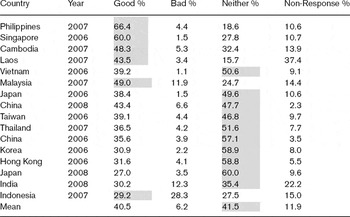
First, we investigate how aggregate perceptions of Australia vary by country. Table 1 shows average responses by country for respondents who see Australia's influence as ‘good’, ‘bad’, or ‘neither good nor bad’. We also include non-response rates. Countries are ordered using the average of responses that Australia's influence is good, indicating a ranking of its favorability by country. Modal values are shaded.
Perceptions of Australian Influence by Country

Notes: AsiaBarometers, 2006–2008; Modal values are shaded; “Good” is the total percentage of responses that Australian influence is “good” and “rather good”. “Bad” is the total percentage of responses that Australian influence is “bad” and “rather bad”.
Despite concerns by some commentators that foreign publics in Asia have negative perceptions of Australia, Table 1 indicates that the frequency of responses that Australian influence is ‘good’ is far greater than the frequency of responses that its influence is ‘bad’. Negative responses only approach the level of positive ones in Indonesia, Australia's nearest Asian neighbor. Positive perceptions of Australia's influence range from 66% in the Philippines to 29% in Indonesia, while negative perceptions range from 28% in Indonesia to 1% in Vietnam. The surveys clearly show that Australia is viewed far more favorably than unfavorably in Asian societies.
Table 1, however, also suggests that a large percentage of respondents are indifferent to Australia and its foreign policy with an average of 41% of ‘neither good nor bad’ responses. This ranged from 60% in Japan in 2008 to 15.7% in Laos. Importantly, it was the modal response in ten of 16 surveys. The countries/societies with the largest percentages of ‘neither good nor bad’ responses tended to be in Northeast Asia – Japan (49.6% in 2006 and 60.0% in 2008), South Korea (58.94%), Hong Kong (58.8%), and China (57.1% in 2006 and 47.7% in 2008). Given Australia's proximity to Southeast Asia and greater distance from Northeast Asia, it is perhaps not surprising that it is viewed as more influential in the former but not in the latter. It is interesting though to find such ambivalent perceptions in societies that are politically and economically important for Australia, such as Japan, South Korea, Hong Kong, and China. If non-response rates are also considered, then relative indifference to Australia in the region seems generally high.
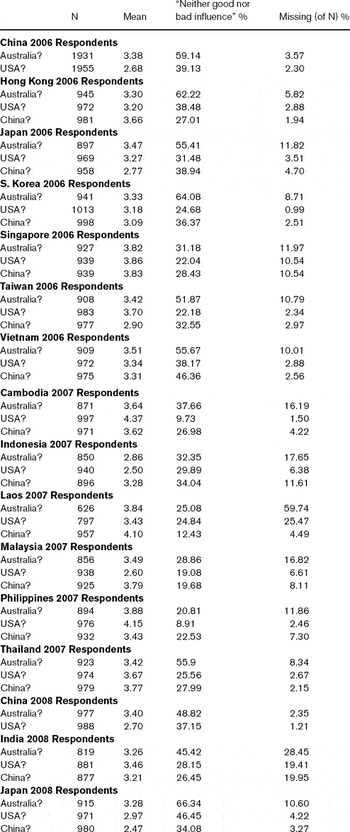
This interpretation is reinforced by examining responses to the same question for the US and China. Table A in the appendix shows that, although the mean scores of valid responses for Australia, China, and the US are often similar within countries, there are almost always (Indonesia and the Philippines are the exceptions) considerably more respondents choosing the neutral option, ‘neither good nor bad’ for Australia than for either of the two major powers. There are also almost always double or triple the proportion of non-responses for Australia as for the other countries. We interpret this as evidence that Australia is simply not a salient country for many people in the region.
Overall, these aggregate statistics suggest that while Australia is viewed far more favorably than unfavorably in Asia, large percentages of people in each society are relatively indifferent to it – or at least to its relations with their country. Apart from Indonesia, the evidence does not suggest that negative views of Australian influence are common. Next, we investigate the reasons for people's views of Australia by considering our expectations as presented in the previous section.
Within-country individual-level analysis
The purpose of this analysis is to identify which factors most consistently explain individual views of the nature of Australia's influence on their countries in Asia. A variable is interpreted as having a consistent effect if it is statistically significant in at least half of the models in which it is included. First, using the AsiaBarometer data, we estimated a series of models for each country/jurisdiction that capture the effects of national pride, religiosity, traditional morality, religious affiliation, political values, education, international travel, Internet use, age, gender, and standard of living, on perceptions of Australia's influence. Next, we estimated a series of models that in addition to estimating the effects of these variables also estimated the effects of perceptions of the influence of the great powers in Asia on perceptions of Australia's influence.
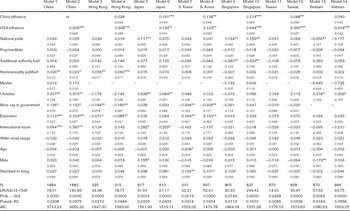
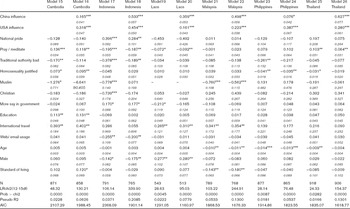
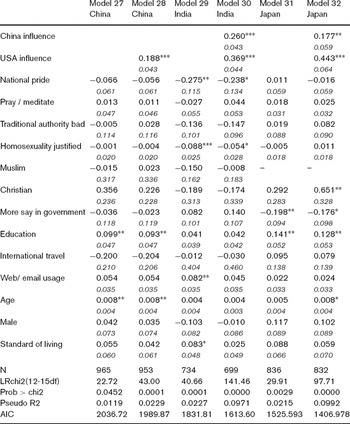
Since the dependent variable is ordinal, we use ordered probit estimation (Aldrich and Nelson, Reference Aldrich and Nelson1984; Long, Reference Long1997). The results for each model show coefficients with standard errors and statistical significance for surveys conducted in 2006 (Table 2), 2007 (Table 3), and 2008 (Table 4). A positive sign suggests that a particular variable is associated with more favorable perceptions of Australian influence, controlling for other factors, while a negative sign suggests that it is associated with more unfavorable perceptions. All coefficients that were statistically significant by even a loose (p < 0.10) criterion (which we interpret as suggesting a weak effect) are included in our assessment of consistency. We also include model-fit statistics, in particular pseudo R2 and the AIC.Footnote 8
Correlates of Perceived Australian Influence, 2006 AsiaBarometer: Australia Good or Bad Influence on Your Country?

Notes: Table shows ordered probit coefficients and standard errors (small italics); *** p <.001, ** p < .05, * p < .10; – variable dropped; question: “Q26 Do you think the following countries have a good influence or a bad influence on your country?”; xx question not asked in this country.
Correlates of Perceived Australian Influence, 2007 AsiaBarometer: Australia Good or Bad Influence on Your Country?

Notes: Table shows ordered probit coefficients and standard errors (small italics); *** p <.001, ** p < .05, * p < .10; – variable dropped; question: “Q27 Do you think the following countries have a good influence or a bad influence on your country? Please select the response closest to your opinion for each country listed.”; Population weights applied to Indonesia, Philippines, and Thailand;
Correlates of perceived Australian influence, 2008 AsiaBarometer: Australia good or bad influence on your country?

Notes: Table shows ordered probit coefficients and standard errors (small italics); *** p <.001, ** p < .05, * p < .10; – variable dropped; question: “Q28 Do you think the following countries have a good influence or a bad influence on your country? Please select the response closest to your opinion for each country listed.”; Population weights applied to China, India, and Japan;
Although Tables 2, 3, and 4 suggest that several of our hypotheses are supported in particular cases, only two variables met our definition of a consistent effect. The inconsistency of the sign and significance of coefficients for all variables except views about the influence of China and the US led us to conclude that our models do not reflect a general structure of foreign policy beliefs about Australia. The considerably larger pseudo R2 statistics, and more importantly the smaller AIC statistics, suggest that the models including items for views about China and the US provide a much better fit to the data than those without. This is consistent with an interpretation that most respondents in the surveys did not have substantively meaningful views about Australia's influence on their country, but based their responses on top-of-the-head reactions to the survey item influenced by general internationalist or isolationist sentiments and/or views about great powers.
The overall weak results for all of our expectations other than the effects of views about China and the US cannot be explained by multicollinearity in the models. Variance inflation factors (VIFs) for all variables are never above 2.2 in any model. Neither is there a direct correspondence between answers to the three questions regarding the influence of Australia, China, or the US. Correlations among these are always positive, but rarely above 0.35. These moderate positive associations support our contention about general internationalist and isolationist orientations among respondents, in particular. Fewer respondents choose the middle value, ‘neither good nor bad’, for China or the US than for Australia. These less neutral opinions about the great powers also support our contention that respondents are likely to have clearer views about great powers active in their region than about smaller countries with less impact or visibility.
The most striking result is that, consistent with the expectation that perceptions of powerful states influence perceptions of smaller ones, the coefficient for perceptions of China was positive and significant in 12 of 14 models and the coefficient for perceptions of the United States was positive and significant in all 16 models. In general, perceptions of the influence of the two major powers are associated with more favorable perceptions of Australia.
While other hypotheses found support in some of the models, none of the effects met our standard of consistency. Contrary to predictions, individuals’ core values do not influence their views of Australia in more than a few countries. None of national pride, frequency of prayer, the belief that homosexual behavior could be justified, or the belief that greater respect for traditional authority would be good had a consistent effect.
Identity also does not appear to be significant in shaping perceptions of Australia. Although religious identity was expected to influence perceptions of Australia, this was not consistently the case. Contrary to expectations, the effect of being a Christian was positive and significant in only four models and the effect of being a Muslim was significant in just a single one. Although we expected that Australia would be well-respected for its political system, the effect of democratic values was positive and statistically significant only in China and Indonesia. The fact that the only places where democratic values were significant were in an authoritarian one-party state and a transitional democracy suggests that Australia may actually be viewed with respect for its political system by those living under undemocratic political conditions. Overall, however, identity does not appear to be a consistent factor in predicting how people in Asia view Australia.
Neither does it appear that more information leads to more favorable views of Australia. While the expected positive effect of education – a proxy for greater attentiveness and knowledge of foreign affairs – was found to be significant in one-third of cases, this still falls below our 50% threshold for consistency. This variable does stand out, however, in the reduced models discussed below.
The hypothesis that international travel has a positive effect did find support in five countries, a moderately consistent pattern. While it is possible that the effects of travel may have been underestimated because the measure for international travel included in the AsiaBarometer does not tell us the frequency with which a respondent travels abroad (it only asks whether they had traveled abroad in the past three years) or where they have visited, the fact that this was still positive and significant in almost one-third of cases suggests that a more precise measure might have a more robust effect.
Internet use was found to have a negative effect only in Indonesia. Controlling for other factors that might be expected to lead one to access nationalistic or religious websites where anti-Western or anti-Australian information could be found, just surfing the web or sending emails does not lead to significantly different views of Australia than those of people who do not. In sum, though there is some evidence suggesting that education and international travel have an effect on views of Australia in particular national contexts, the finding that neither of the measures used here, nor Internet use, is significant in at least 50% of the models suggests that information is not a major reason for the generally positive views of Australia throughout Asia.Footnote 9
Finally, though we expected a person's demographic characteristics to influence their views of Australia, none of the variables had a consistent effect. Age, gender, and standard of living were each significant in three models or less. While demographic characteristics do shape views of Australia in a few particular countries, they are not a robust explanation. The lack of a significant effect for standard of living is especially important in suggesting a lack of meaningful opinion about Australia since one would expect wealthier individuals to have greater affinity for a country that is so focused on regional economic interdependence.
In order to assess whether greater parsimony might improve the performance of particular variables, and/or the performance of the models overall, we chose eight indicators which performed best in the models in Tables 2, 3, and 4. These were national pride, moral traditionalism (belief about homosexuality), Muslim or Christian identity, education, age, and of course the influence of China and the US. We ran 32 models, as in Tables 2–4, including the China and US variables in 16 and dropping them in the other 16. To save space we do not report the full results. The indicators for China and US influence remained highly significant and robust, with sign and significance very close to that in Tables 2–4. The variable which showed a clear improvement in performance was that for education. It was positive and significant at the 95% level and robust to the inclusion of Chinese and US influence indicators in 2006 in China, Japan, South Korea, and Vietnam; in 2007 in Cambodia; and in 2008 in China and Japan. It was positive and significant at the 90% level and robust to the inclusion of Chinese and US influence indicators in Hong Kong and Taiwan (2006); Laos and Thailand (2007). Thus, we are moderately confident that education levels across the region are associated with more positive perceptions of Australian foreign policy. However, we remain cautious about the role of education due to the higher AIC statistics for these models, indicating poorer overall fit, as noted above, compared to those in Tables 2–4.
Marginal effects
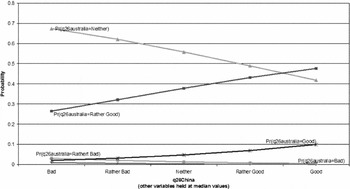
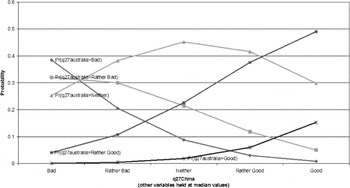
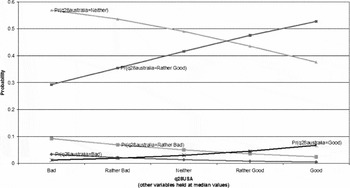
Because the interpretation of probit coefficients is not straightforward, we estimated predicted probabilities for perceptions of Australia's influence for Japan, Indonesia, and China. Figures 1 and 2 show the impact of perceptions of China in Japan and Indonesia, and Figure 3 shows the impact perceptions of the US in China. This was done using 1,000 Monte Carlo simulations for each model and produced with Clarify software (Tomz et al., Reference Tomz, Wittenberg and King2003). Each line represents the probability of the designated response regarding Australia, given a respondent's response regarding China (or the US). For example, in Figure 1 the probability that a respondent will answer ‘Neither good nor bad’ regarding Australia's influence on her country would be nearly 0.7 if that respondent also answered that China's influence was ‘Bad’, but it declines steadily as respondents’ views of China's influence improve, such that if a respondent sees China's influence as ‘Good’, the probability that that respondent would see Australia's influence as ‘Neither good nor bad’ would be just above 0.4, while the probability that the respondent would see Australia's influence as ‘Rather good’ would be higher, just under 0.5. All other independent variables were set at their median values, a reasonable way to approximate a ‘typical’ respondent in each country.
Japan 2006: Marginal Effects (q26China on q26Australia)

Indonesia 2007: Marginal Effects (q27China on q27Australia)

China 2008: Marginal Effects (q28USA on q28Australia)

Figures 1–3 clearly show that in these three cases, the relationship between perceptions of Australia and perceptions of the two great powers in Asia was positive for the ‘median’ respondent. However, of more interest is the dominance of the neutral ‘neither good nor bad’ response regarding Australia in each instance. In Japan (Figure 1), respondents choosing four of the five possible responses regarding China's influence were most likely to choose the ‘Neither’ response for Australia. Only those who saw China's influence as ‘Good’ were most likely to see Australia's as ‘Rather good’. Similarly, three of five possible responses in Indonesia (Figure 2) and China (Figure 3) were dominated by neutral views of Australia. This further supports our contention that views about Australia's influence in Asia tend to be ambivalent.
Discussion
Our analysis has compared perceptions of Australia's influence in a number of Asian countries and examined what factors shape those perceptions. The aims were to assess whether Australia is viewed mainly positively or negatively in the region, and to see which factors consistently explain individuals’ views of Australia across a range of countries.
Our findings contradict the claim that anti-Australian sentiment is widespread in Asia. With the exception of about a third of respondents in Indonesia, we found little evidence of negative perceptions about Australia's influence in the region. But many people do appear indifferent to Australia and its foreign policy.
This study has also contributed to understanding the causes of favorable views of Australia at the individual level. What is most important to note when comparing the individual-level results of our analysis is their heterogeneity across countries. Despite theoretical expectations, few variables had a significant effect in more than a handful of societies, suggesting that perceptions of Australia are influenced considerably by national context.
Apart from Indonesia, no evidence was found of sizable levels of anti-Australian sentiment likely to threaten the country's political and economic interests. In fact, our analysis leads us to question the assumption that Australia and its foreign policy are salient issues among the average person in the region. Until now, the discussion of Asian engagement has not considered the possibility that many people in the region might be indifferent to, or have no opinion about, Australia and what the implications of this might be. To gain a more accurate view of ‘Australia's image in Asia’, then, we suggest that in addition to focusing on the types of issues that attract high levels of media coverage, such as anti-Australian sentiment among particular interest groups and criticism by political and business elites, analysts should also give attention to the attitudes of typical citizens in the region.
Australian diplomacy has been admonished for its role in the supposed decline of the country's standing in the region (Trood, Reference Trood1998: 186). The Economist (2008), for instance, reported that Australia continues to be seen as an outsider ‘preaching Western values to neighbors it does not fully understand’ suggesting that this should be a worry among its policy makers. A Lowy Institute report cautions that Australia's public diplomacy has many weaknesses such as a lack of funding and, therefore, proposes ‘major investments in new media – following the lead of some of the more innovative nations in public diplomacy practice’ (Oliver, Reference Oliver2009). Our findings challenge the claim that concern about Australia's image in Asia, at least among the average person, should be a major foreign policy issue. Since it appears to be the case that Australia is seen by typical citizens in the region either favorably or with indifference, it is unlikely that regional leaders will feel pressure from their publics when deciding on their level of cooperation with Australia. Our analysis suggests that regional leaders face few constraints to cooperation with Australia from mass publics.
It is important to mention a limitation of this study. Although the item asking respondents about their perceptions of Australia is a valid measure for the concept we are interested in, it is nonetheless a single survey item asking only about Australia's ‘influence’. The interpretation of what respondents mean when they say Australia's influence is ‘good’, ‘bad’, or ‘neither good nor bad’ is potentially ambiguous. Future studies including valid measures that distinguish between general views of Australia and its specific foreign policies would clearly be useful. Similarly, our analysis does not address the importance of a positive image among specific potentially important types of respondents, for example political and business elites, or potential students and tourists.
Nevertheless, our analysis leads us to have considerable confidence in four conclusions about mass-public perceptions of Australia in Asia: (1) with the exception of Indonesia, there is little negative perception of Australia's influence in Asian countries; (2) there is general indifference towards Australia's relations with countries in the region among the citizens of those countries; (3) rather than well-considered opinions about Australia, people in Asia probably form their views of its foreign policy based on heuristics such as their impressions of regional major powers and/or their general internationalist or isolationist inclinations, and (4) at the individual level the most consistent factor related to perceptions of Australia's foreign policy among Asians is their level of education: those with more education are more favorable while those with less education are more negative.
Without wishing to sound flippant, we might say to Australian foreign policy makers and public diplomats concerned about their country's image: ‘no worries’. People in the region seem to have a reasonably positive impression of the land down under, but they do not exaggerate, and perhaps underestimate, its regional role. For students of public opinion and foreign policy, we suggest that foreign policy beliefs on less-salient items, like perceptions of ‘middle-power’ countries, might borrow their structure from beliefs about issues that are more salient or general principles which are, accurately or not, connected to these less-salient issues in people's minds.
About the authors
Benjamin E. Goldsmith is Associate Professor in the Department of Government and International Relations at the University of Sydney. He holds a Ph.D. in political science (Michigan 2001). His articles have appeared in leading academic journals including European Journal of International Relations, Journal of Conflict Resolution, Journal of Peace Research, Journal of Politics, and World Politics. He has recently received major research grants from the Australian Research Council and the Asia Pacific Centre for the Responsibility to Protect to investigate regional patterns of interstate conflict, and to develop forecasting models for genocide, respectively.
Matthew Linley is an Assistant Professor in Political Science at Temple University Japan. He holds a Ph.D. in Political Science (Australian National University 2009), an L.L.M. (Nagoya University 2002) and an M.A. (University of Victoria 1998). He has been a recipient of a Monbukagakusho Scholarship (1998–2002) from the Japanese Government and two Japan Foundation Fellowships (1997, 2006–2007).
Appendix: Measurement of independent variables
Major powers / internationalism
Perceptions of great powers (Influence of China, Influence of US): Two ordinal variables for perceptions of China and perceptions of the United States coded on 5-point scale, with 1 = Bad, 5 = Good.
Core values
National pride: Ordinal variable indicating pride in being from one's country coded on 5-point scale, with 1 = Do not consider being from one's country, 5 = Very proud.
Religiosity (frequency of prayer/meditation): Ordinal variable indicating frequency of prayer/meditation coded on 5-point scale, with 1 = Never, 5 = Daily.
Moral traditionalism (Belief – greater respect for authority would be a good thing, Belief – homosexuality can be justified): One dummy variable asking whether respondent believes greater respect for authority would be a good thing 1 = Yes, 0 = No; One ordinal variable asking whether homosexuality can ever be justified on a 10-point scale, with 1 = Never justified, 10 = Justified and asking support for traditional authority
Identity
Religion (Christian, Muslim): Two dummy variables indicating whether respondent is Christian (1 = Christian, 0 = Non-Christian) and Muslim (1 = Muslim, 2 = Non-Muslim).Footnote 10
Political values (People should have a greater say in government): Dummy variable, with 1 = Important to give people more say in government, 0 = Not important
Information
Education: Ordinal variable coded on a 5 point scale, with 1 = No formal education, 5 = University/Graduate school.
International travel: Dummy variable indicating international travel in the past three years on holiday or for business, with 1 = Yes, 0 = No
Internet usage: Ordinal variable coded on a 5-point scale taking an average of two items asking respondents how often they view Internet web pages by computer and how often they read or write emails by computer, with 1 = Never, 5 = Almost everyday.
Demographic characteristics
Age: Interval variable measured in years.
Gender (Male): Dummy variable, with 1 = Male, 0 = Female.
Standard of living: Ordinal variable indicating self-evaluation of standard of living on a 5-point scale, with 1 = low, 5 = high.
Good or Bad Influence on Your Country?