Lactose is the primary disaccharide in mammalian milk, and also in a broad range of dairy products and processed foods such as ice cream and confectionery. β-galactosidase (lactase) is located at the brush border of enterocytes, where it hydrolyses lactose into glucose and galactose (Gilat et al. Reference Gilat, Russo, Gelman-Malachi and Aldor1972). The interest in lactose hydrolysis has been driven mainly by the fact that more than 70% of the world's population continuously loses the ability to produce lactase after weaning that may result in lactose intolerance (Harrington & Mayberry, Reference Harrington and Mayberry2008). Symptoms of lactose intolerance include flatulence, abdominal pain and diarrhoea or even muscle pain and loss of concentration (Casellas et al. Reference Casellas, Varela, Aparici, Casaus and Rodriguez2009). Peroral microbial-derived lactase preparations, such as tablets and capsules, has proven successful in alleviating the gastrointestinal (GI) symptoms caused by lactose uptake (Ramirez et al. Reference Ramirez, Lee and Graham1994; Montalto et al. Reference Montalto, Nucera, Santoro, Curigliano, Vastola, Covino, Cuoco, Manna, Gasbarrini and Gasbarrini2005). However, the so far available preparations are only effective when administered in large doses immediately with the lactose-containing food as they have to confront acidic denaturation and enzymatic degradation in the GI tract (Lin et al. Reference Lin, Dipalma, Martini, Gross, Harlander and Savaiano1993; Montalto et al. Reference Montalto, Curigliano, Santoro, Vastola, Cammarota and Manna2006). Thereupon, a desirable lactase preparation which could efficiently protect the enzyme in the GI tract is worthy of study.
Polymeric nanocapsules (NCs), mainly composed of poly(lactic acid) (PLA) or poly(lactide-co-glycolide) (PLGA), are biocompatible, biodegradable and semi-permeable, allowing small molecules to penetrate, but proteins/enzymes to cut off (Dziubla et al. Reference Dziubla, Shuvaev, Hong, Hawkins, Madesh, Takano, Simone, Nakada, Fisher, Albelda and Muzykantov2008; Sheng et al. Reference Sheng, Liu, Yuan, Zhang, Shan and Xu2009a). Conceivably, encapsulation of lactase in the PLA/PLGA NCs permeable to lactose but impermeable to proteases could be effectively resistant to enzymatic degradation. Enteric coating is an effective technology for the specific intestinal release of cargo after oral administration, which is based on pH-sensitive polymers, including hydroxypropyl methylcellulose phthalate (HPMCP, HP55) (Cui et al. Reference Cui, Tao, Cun, Zhang and Shi2007), polymethacrylic acid (Sajeesh et al. Reference Sajeesh, Vauthier, Gueutin, Ponchel and Sharma2010), and so on. Based on these aspects, our idea in here was to develop an enteric-coated capsule containing PLA NCs as a carrier for the oral delivery of lactase. The basic concept is that the enteric-coated capsule remains intact in the highly acidic environment of stomach, but dissolved rapidly to release lactase-loaded PLA NCs in the neutral or slightly basic environment of small intestine.
For this purpose, lactase-loaded PLA NCs were firstly prepared by water-in-oil-in-water (w1/o/w2) solvent diffusion/evaporation method. The enzyme from Kluyveromyces (K.) lactis was chosen, which exhibits optimum activity in the small intestine. Effects of preparation parameters on the enzyme activity were investigated. Thereafter, the prepared NCs were freeze-dried and their physicochemical characteristics were examined. Then, the freeze-dried NCs were filled in hard gelatin capsules and subsequently coated with pH-sensitive enteric polymer, HP55 (complex capsule). To verify their ability to protect the encapsulated lactase from acidic denaturation and enzymatic degradation in the GI tract, the enzyme stability of complex capsules in the simulated gastric and intestinal fluids was determined, respectively. Finally, in vitro milk lactose hydrolysis in the simulated intestinal fluid was examined.
Materials and methods
Materials
PLA (Mw 80k) was supplied by DaiGang Biotechnology (Jinan, China). Lactase from K. lactis (Lactozym®; ⩾3000 U/ml) and o-nitrophenyl-β-D-galactopyranoside (ONPG) were bought from Sigma-Aldrich (Shanghai, China). HP55 was purchased from Ruitai Chemical Co., Ltd. (Tai'an, China). Polyvinylalcohol (PVA) (1750±50 DP, 87–89% hydrolysed) and sucrose were supplied by Sinopharm Chemical Reagent Co., Ltd. (Shanghai, China). Poloxamer 188 was obtained from Shenyang Pharmaceutical University (Shenyang, China). Hard gelatin capsule (size 9) was purchased from Torpac Inc. (NJ, USA). Millipore water (Bedford, USA) was used throughout the experiment. All other reagents and solvents were of analytic grade.
Preparation of lactase-loaded PLA NCs
Lactase-loaded PLA NCs were prepared by the w1/o/w2 solvent diffusion/evaporation method (Sheng et al. Reference Sheng, Yuan, Liu, Tao, Shan and Xu2009b) with some modifications. Briefly, 0·5 ml diluted Lactozym® solution (⩾600 U/ml) (w1) was emulsified in 5 ml organic solvent (o) containing 10 mg PLA by ultrasonic (JYD-900, Zhixin Instrument Co., Ltd., China) for 15 s. Thereafter, the primary emulsion was poured into 50 ml 0·5% PVA aqueous solution (w2) followed by two steps of re-emulsification to obtain the double emulsion. The double emulsion was subsequently diluted into 150 ml 0·5% PVA aqueous solution (w2) and then vacuumed to completely remove the solvents. The NCs were collected by centrifugation (GL-21M, Shanghai Centrifuge Institutes Co., Ltd., China) at 20 000 g for 30 min at 4 °C and washed three times with Millipore water before lyophilisation.
Preparation of freeze-dried NCs
The above-obtained NCs were freeze-dried. To prevent aggregation, mannitol with certain concentration was used as a cryoprotectant during the freeze-drying process. In brief, an aqueous NC suspension was mixed with an equal volume of aqueous cryoprotectant. This mixture was frozen in a refrigerator and then lyophilised using a freeze dryer (Boyikang instrument company, Beijing, China) to obtain the NCs in powder form.
Morphology and particle size of NCs
The morphology of freeze-dried NCs was observed under scanning electron microscopy (SEM) (JSM-6360LV/Falcon, Japan) and transmission electron microscopy (TEM) (JEM-2010, Japan). Particle size and polydispersity (PI) were determined at 25 °C by Dynamic Light Scattering (DLS) using Zetasizer® Nano ZS (Malvern Instrument Ltd., UK).
Lactase activity assay
Activities of free lactase and lactase encapsulated in PLA NCs were determined by a direct kinetic spectrophotometric assay based on the enzymatic cleavage of ONPG and the colorimetric detection of the resulting yellow o-nitrophenolate (ONP) (Wang et al. Reference Wang, Luo, Bai, Wang, Yang, Shi, Zhang, Fan and Yao2009) with some modifications. Sodium phosphate buffer (2 ml, 0·1 m, pH 6·8) containing 5 mm ONPG was heated to 37 °C for 10 min. Upon the addition of 0·5 ml lactase solution or NC dispersion, the mixture was incubated at 37 °C in a water bath for 15 min and the concentration of ONP was monitored verses time by measuring the absorbance at 420 nm using a UV-vis spectrophotometer (U-2001, Hitachi). One unit of enzyme activity was defined as 1 μm ONP formed/min.
Preparation of HP55-coated capsules containing lactase-loaded PLA NCs
Hard gelatin capsules were filled with lactase-loaded PLA NCs as the manufacturer's instructions. The capsules were then immersed into HP55 solution (15% w/v) of dichloromethane (DCM) and acetone (4 : 1, v/v) followed by air drying at room temperature.
Enzyme stability under simulated gastric and intestinal conditions
HP55-coated capsules containing lactase-loaded PLA NCs were incubated in the simulated gastric fluid (SGF, United State Pharmacopoeia XXVI, pH 1·2, pepsin 0·32% w/v) and simulated intestinal fluid (SIF, United State Pharmacopoeia XXVI, pH 6·8, pancreatin 1% w/v), respectively, at a concentration of 1 mg/ml and shaken (37 °C, 100 rpm) using a constant-temperature shaker (Jinghong Laboratory Instrument Co. Ltd., China). For SGF test, at defined time intervals, the capsules were taken, washed three times and then resuspended in the SIF under the condition (37 °C, 100 rpm, 1 h) to dissolve the enteric coating. Subsequently, the released NCs were collected by centrifugation (20 000 g , 10 min) to determine the encapsulated lactase activity. For SIF test, at defined time intervals, the released NCs were collected to determine the encapsulated lactase activity. The test sample was directly suspended in the SIF for 1 h and then collected to determine the encapsulated lactase activity, which was the initial 100% activity. Free lactase and lactase-loaded PLA NCs were used as control.
In vitro lactose hydrolysis
Lactose hydrolysis by lactase encapsulated in PLA NCs was determined according to Kwak et al. (Reference Kwak, Kwon, Lee and Ahn2002) with some modifications. Briefly, the PLA NCs (10 mg) were suspended in the SIF (10 ml) and shaken (37 °C, 100 rpm). Then 2 ml milk containing 4·8% lactose was added. At defined interval of enzymatic lactose hydrolysis, 0·5 ml sample was taken and the reaction was stopped by adding 1 ml perchloric acid (1 m). After centrifugation (20 000 g , 4 °C, 10 min), the supernatant was neutralised and then filtered for measuring the lactose content by high-performance liquid chromatograph. A standard curve was constructed by injecting lactose standards, which yielded a linear curve. The lactose content was quantitatively determined by comparing with the standard curve. Free lactase was used as control.
Statistical analysis
Results were expressed as mean±sd. All data were generated in three independent experiments. Statistical analysis was performed with one-way analysis of variance (ANOVA). Differences were considered to be significant at a level of P<0·05.
Results and discussion
Preparation parameters affecting lactase activity
w1/o/w2 solvent diffusion/evaporation technique has been chosen as one of the most appropriate methods for the encapsulation of water-soluble proteins. During the encapsulation process, polymers, emulsifiers and other adjuvants used are all approved by U.S. Food and Drug Administration. Even when such a relatively mild method is applied, proteins are exposed to organic solvents and mechanic stress, which can lead to structural and/or chemical degradation of sensitive proteins (Li et al. Reference Li, Zhang, Yan, Jia, Yuan, Deng and Huang2000). Optimisation of preparation parameters and addition of enzyme stabilisers are usually thought of effective means for the retention of enzyme activity.
As we know, organic solvent may easily change the high-grade structure of proteins and eventually cause denaturation. DCM and ethyl acetate (EA) are the commonly used solvents in the w1/o/w2 technique. The effect of solvent composition on the activity of lactase encapsulated in PLA NCs was investigated. Compared with the pure solvent DCM, when binary solvent DCM/EA was adopted, the lactase activity was increased significantly (P<0·05). The activity retention of lactase in the case of DCM, DCM/EA (2 : 1, v/v) and DCM/EA (1 : 1, v/v) was (43·16±4·07)%, (68·05±1·50)% and (79·29±3·11)%, respectively. With further increasing the ratio of EA/DCM, the NCs were hardly formed (data not shown). Compared with DCM, EA induced less loss of enzyme activity, which was similar to the results observed by Sturesson & Carlfors (Reference Sturesson and Carlfors2000). However, Gander et al. claimed that neither EA nor DCM had any detrimental effect on bovine serum albumin (Gander et al. Reference Gander, Wehrli, Alder and Merkle1995). Thus, we can speculate that different proteins/enzymes have different sensitivities to solvent exposures.
During the second-emulsification procedure to form the w1/o/w2, proteins/enzymes may be subjected to fierce stirring. Ultrasonic and high-pressure homogenisation are the most frequently used techniques for the emulsion formation. Our previous experiments have optimised that ultrasonic (80 W, 3 min) and high-pressure homogenisation (150 bar, 3 min) could obtain the comparable nanometer-sized capsules. Compared with ultrasonic (59·32±4·55)%, higher activity retention of lactase was achieved by high-pressure homogenisation (77·18±3·71)% (P<0·05). It has been demonstrated that with the similar droplet diameters, lower energy density was produced by high-pressure homogenisation when compared with ultrasonic (Schultz et al. Reference Schultz, Wagner, Urban and Ulrich2004), which may avoid the enzyme aggregation and instability.
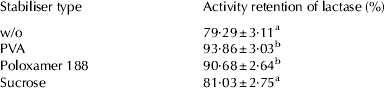
The presence of additives in the internal aqueous phase was reported to be beneficial for reducing the breakdown of structural integrity and hence the loss of protein/enzyme activity during the preparation process (Li et al. Reference Li, Zhang, Yan, Jia, Yuan, Deng and Huang2000). As shown in Table 1, both PVA and Poloxamer 188 had a pronounced stabilising effect on the lactase, exhibiting the activity retention of (93·86±3·03)% and (90·68±2·64)%, respectively. Partially hydrolysed PVA, which is well-known for its desirable surface active property, could probably prevent enzyme adsorption onto the water/solvent interface. It was reported that poloxamer formed a micellar structure from which the hydrated water was excluded as the temperature was elevated, causing the micellar entanglement and gel formation (Schmolka, Reference Schmolka1991). Therefore, lactase was supposed to be entrapped in this hydrated network and thus protected from the interaction with organic solvents. By contrast, sucrose did not exert any stabilising effect on the lactase. The disaccharide sucrose stabilises proteins against unfolding through the preferential hydration mechanism (Weert et al. Reference Weert, Hoechstetter, Hennink and Crommelin2000). It is plausible that sucrose is preferentially excluded from the water/solvent interface and thus unable to prevent emulsion-induced denaturation of lactase.
Effect of stabilizer in the internal aqueous phase on the activity of lactase encapsulated in PLA NCs

All values indicate mean±sd for n=3 independent experiments
a,bMeans in the same column with different superscript letters differ significantly (P<0·05)
Characterisation of the PLA NCs
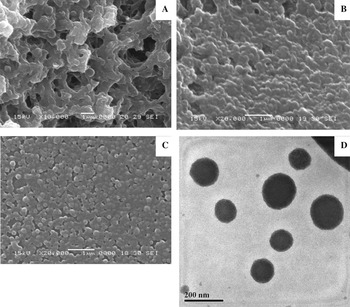
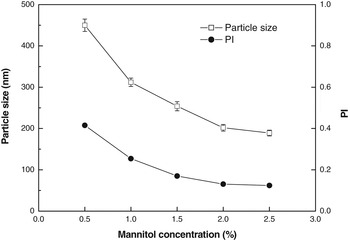
It is well-known that freeze-drying process could induce the irreversible aggregation and/or fusion of NCs by the stress of freezing and dehydration (Abdelwahed et al. Reference Abdelwahed, Degobert, Stainmesse and Fessi2006a). Cryoprotectants are usually added into the NC suspension before freezing to protect their structural integrity and bioactivity of proteins encapsulated (Abdelwahed et al. Reference Abdelwahed, Degobert and Fessi2006b). In this study, the effect of mannitol as a cryoprotectant at varying concentrations was evaluated during the process of freeze-drying NCs. Physicochemical characteristics of the prepared PLA NCs before and after freeze-drying were investigated and compared in Figs. 1 & 2. Before freeze-drying, the PLA NCs had a mean particle size of (198±5) nm with PI of 0·129. After freeze-drying, the NCs without the addition of mannitol resulted in the formation of NC aggregates (Fig. 1a). By contrast, spherical boundary could be observed in the presence of mannitol (Fig. 1b). With up to 2% mannitol, NCs were found to be embedded in a matrix (Fig. 1c) and could be readily resuspended in water. TEM images revealed that the NCs were relatively well monodispersed with a well-defined spherical shape (Fig. 1d). The particle size and PI of NCs before and after freeze-drying in the presence of 2% mannitol were comparable (Fig. 2). It is generally accepted that mannitol forms hydrogen bonds with the test NCs in lieu of water molecules during freezing stage (Shi et al. Reference Shi, Wang, Li and Adhikari2012), which could prevent the aggregation of NCs and protect them against the mechanical stress of ice crystals. Hence, the freeze-dried PLA NCs prepared in the presence of 2% mannitol were selected for further evaluations.
SEM image of freeze-dried lactase-loaded PLA NCs (a) without mannitol; (b) with 0·5% mannitol; (c) with 2% mannitol; (d) TEM image of freeze-dried lactase-loaded PLA NCs.

Influences of freeze-drying process with different concentrations of mannitols on the particle size and PI of lactase-loaded PLA NCs.

Enzyme stability in simulated gastric and intestinal fluids
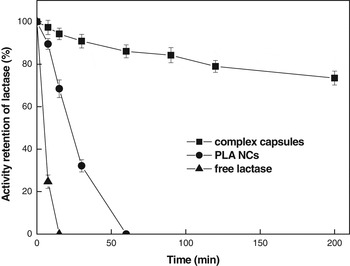
The GI tract presents a unique microenvironment of enzymes and ionic strength, which impact both the chemical and colloidal stability of oral delivery systems (Gamboa & Leong, Reference Gamboa and Leong2013). The stability of complex capsules in the GI tract was determined by measuring the remaining activity of encapsulated lactase. As shown in Fig. 3, the remaining activity of lactase in complex capsules achieved (73·46±3·28)% after 200 min incubation in the SGF, whereas the control free lactase and lactase-loaded PLA NCs lost their activities soon under the same condition (P<0·05). It is well-known that the stomach contains pepsin and hydrochloric acid, which degrade proteins (Lain, Reference Lain2009). PLA NCs impermeable to pepsin could protect the fragile lactase from enzymatic degradation but failed to prevent acidic denaturation since micromolecular hydrochloric acid could penetrate through the semi-permeable NCs. PLA NCs, further enveloped into the enteric-coated capsule, could withstand the harsh acidic environment due to the compact enteric coating, preventing the direct contact of lactase with hydrochloric acid molecules as well as pepsins.
Activity variations of free lactase and lactase encapsulated in PLA NCs or complex capsules incubated in pepsin-containing artificial gastric juice at 37 °C as a function of time. Data represent mean±sd, n=3.

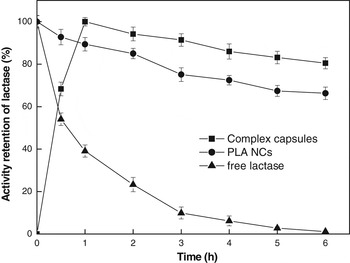
Our preliminary experiments have demonstrated that the enteric coating could completely dissolve in the SIF within 1 h at 37 °C and 100 rpm. As shown in Fig. 4, the remaining activity of lactase in PLA NCs and complex capsules achieved (66·28±2·93)% and (80·47±2·63)%, respectively, after 6 h incubation in the SIF, whereas the control free lactase was almost completely degraded under the same condition (P<0·05). The small intestine contains pancreatic juices like pancreatin, which breaks peptide bonds (Lain, Reference Lain2009). Above results indicated that the complex capsules were stable when they stayed in the stomach and dissolved rapidly to release the PLA NCs after they went down to the small intestine. Thereafter, the released PLA NCs were impermeable to proteins/enzymes and thus protected the encapsulated lactase from action of pancreatin. From the data presented here it seems reasonable to conclude that lactase nested in the complex capsules could be better protected from acidic denaturation and enzymatic degradation in the GI tract and hence the efficacy of lactase could be further enhanced.
Activity variations of free lactase and lactase encapsulated in PLA NCs or complex capsules incubated in pancreatin-containing artificial intestinal juice at 37 °C as a function of time. Data represent mean±sd, n=3.

Lactose hydrolysis
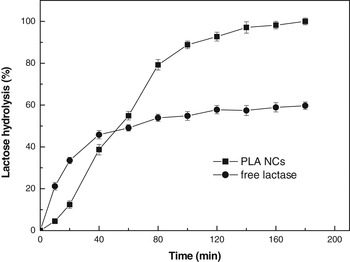
The time-dependent enzymatic lactose hydrolysis in the SIF was shown in Fig. 5. The lactose hydrolysis by free lactase showed a biphasic profile, an initial rapid hydrolysis followed by a slow and nearly static state, indicating that the free lactase was enzymatically degraded and lost its activity soon. By comparison, the lactose hydrolysis by lactase-loaded PLA NCs had an obvious retardation during the initial minutes followed by a sustained and progressive process, suggesting that lactose could diffuse through the PLA NCs and consequently be hydrolysed by the encapsulated lactase. Notably, nearly 100% of lactose in milk was hydrolysed by lactase-loaded PLA NCs, whereas free lactase only hydrolysed (61·7±1·8)% of milk lactose after 180 min incubation. The results suggested that this lactase preparation could exert excellent hydrolytic activity on milk lactose and thus has the potential of efficiently alleviating the symptoms associated with lactose intolerance. The next step was to investigate their in vivo enzymatic lactose hydrolysis.
Hydrolysis pattern of lactose by free lactase and lactase encapsulated in PLA NCs during incubation in pancreatin-containing artificial intestinal juice at 37 °C. Data represent mean±sd, n=3.

HP55-coated capsule containing lactase-loaded PLA NCs was prepared in the present study. The obtained NCs were homogeneously sized (100–200 nm) and high activity retention of lactase was achieved by optimising the preparation parameters. The HP55-coated capsule prevented the nested lactase from contacting the highly acidic gastric medium, thereby against rapid acidic denaturation. Lactase encapsulated in the PLA NCs was well protected from enzymatic degradation and exert high hydrolytic activity on the permeable lactose under the simulated intestinal condition. Based on the above results, the double-capsule delivery system developed in this study might have potential for efficient lactose hydrolysis in the GI tract as well as oral delivery of other proteins with high bioavailability.
The authors wish to express their gratitude to the financial supports from National Natural Science Foundation of China (No. 31300789) and Natural Science Foundation of Shandong Province (No. ZR2013CQ016).