Implications
Feeding piglets with dried chicory roots has been suggested as a promising non-chemical approach to reduce infection levels of gastrointestinal pathogens, such as helminths and bacteria, in pigs. If successful, chicory feeding may reduce or even eliminate the need for medicines. This is of particular relevance for organic pig production.
Introduction
In conventional pig production, piglets experience major stress at weaning, often accompanied by transitory anorexia and diarrhoea, caused by, for example, Eschericia coli (Pluske et al., Reference Pluske, Hampson and Williams1997). Animal welfare is supposedly promoted in both free-range and organic pig production systems. However, due to the increased exposure to parasitic and bacterial pathogens in outdoor production, diarrhoea and other diseases still represent a problem (Thamsborg and Roepstorff, Reference Thamsborg and Roepstorff2003; Jensen et al., Reference Jensen, Lodal and Baggesen2004). For example, Campylobacter jejuni, the major source of human campylobacteriosis was found in 29% of 48 organic pigs tested (Jensen et al., Reference Jensen, Dalsgaard, Baggesen and Nielsen2006) and the presence of this foodborne pathogen and others such as Salmonella may impair the food safety associated with pork. Consequently, the restrictions on the use of medical treatments in organic pig farming necessitate alternative strategies to prevent diarrhoea and other diseases including a means to reduce the load of human pathogens. Feeding piglets chicory root is a promising non-medical strategy due to the prebiotic effect of fructans (Grizard and Barthomeuf, Reference Grizard and Barthomeuf1999; Bosscher et al., Reference Bosscher, Loo and Franck2006). For example, experimental inulin diets reduced the worm burdens of Oesophagostomum dentatum and Trichuris suis in pigs by 97% and 71%, respectively (Petkevičius et al., Reference Petkevičius, Bach Knudsen, Murrell and Wachmann2003 and Reference Petkevičius, Thomsen, Bach Knudsen, Murrell, Roepstorff and Boes2007), and a recent study has demonstrated a marked effect of crude chicory on Ascaris suum (Mejer, Reference Mejer2006). Furthermore, a fructan-rich diet was successful in preventing the development of swine dysentery (Thomsen et al., Reference Thomsen, Bach Knudsen, Jensen, Christensen, Møller and Roepstorff2007), and inulin-supplemented diets reduced the incidence of post-weaning diarrhoea in conventional-weaned pigs (Halas et al., Reference Halas, Hansen, Hampson, Mullan, Wilsen and Pluske2009).
This study aimed to assess whether dietary supplementation with chicory helps to alleviate the severity of post-weaning diarrhoea in piglets experimentally exposed to enterotoxigenic E. coli and intestinal helminths. Furthermore, it aimed to assess whether chicory affects the intestinal microbiota, particularly bifidobacteria, and whether chicory may serve as a means to reduce the load of the important human pathogen Campylobacter.
Methods
Pigs and paddocks
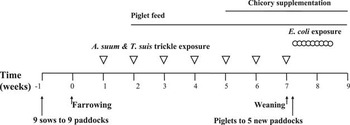
Nine helminth-free gestant Danish Landrace/Yorkshire sows all mated with Duroc boars were purchased from a specific pathogen-free indoor herd. Upon arrival at the research farm early July 2006, the sows were placed in a common clover-grass paddock (15 × 30 m, house 24.8 m2) to allow for 39 ± 0.6 (s.e.) days to adapt to the outdoor environment before farrowing. The sows were vaccinated twice (5 to 6 and 2 to 3 weeks before farrowing) against colibacillosis (Toxicol®, Orion Pharma, Nivå, Denmark), dewormed with fenbendazole (Panacur®, Intervet, Skovlunde, Denmark) 12 ± 0.6 (s.e.) days before farrowing, and subsequently allocated to individual farrowing paddocks (10 × 24 m, farrowing hut 4.8 m2) 1 week before the expected farrowing (Figure 1). After farrowing (week 0), the 4 to 11 piglets in each of the nine litters (in total 67 piglets) were allocated randomly to treatments (see below) within litters and stayed with the sow for 7 weeks before removal of the sow (weaning). After another 2 days in the farrowing paddocks, piglets were relocated into five weaning paddocks (4 × 15 m, house 24.8 m2) according to experimental treatments. None of the paddocks had ever been used for pigs before. All pigs had free access to water, an insulated house with straw bedding and a wallowing area. The experiment was performed according to the law on animal experimentation and approved by the Danish Animal Experimental Inspectorate (license: 2005/561-1060).
Time scale for the study, which included nine sows and their litters. All piglets were provided piglet feed from 2 weeks of age. From 5 to 7 weeks of age, four out of nine litters had chicory added to the piglet feed, and these piglets continued on a chicory-supplemented feed after reallocation into five new paddocks after weaning. In each litter, 29% to 56% of the piglets were trickle infected with Ascaris suum and Trichuris suis in weeks 1 to 7. Pigs in all but one paddock were trickle infected with Eschericia coli after weaning.

Experimental protocol
The experimental design is outlined in Figure 1. During the suckling period, 29% to 56% of the piglets in each of the nine litters (31 piglets in total) were trickle-infected orally with A. suum (25 eggs/kg live weight per day) and T. suis (10 eggs/kg live weight per day) once a week when aged 1 to 7 weeks. In total, each piglet was given 7 doses containing a total of 13 000 A. suum and 5300 T. suis eggs. The A. suum eggs were isolated from the uteri of female worms recovered at an abattoir and embryonated in 0.05 M H2SO4 (pH = 1). The T. suis strain was originally isolated from faeces collected from an organic herd, embryonated in vermiculite and stored in 0.005 M H2SO4 (pH = 2). The strain has been passed through pigs several times since the initial strain was obtained.
All 67 piglets were provided with piglet feed (control feed, see details below) from 2.5 weeks of age and onwards. From week 5, this feed was supplemented with chicory (see details below) for four out of the nine litters (30 piglets in total).
Two days after removal of the sow, piglets (7 weeks and 2 days old) were moved to the five weaning paddocks according to their feeding regimens (groups fed chicory v. control feed referred to as CHIC and CTRL, respectively) and parasite (groups with parasite exposure v. no exposure referred to as +PAR and −PAR, respectively) resulting in the following four main groups: (i) CTRL + PAR, 15 piglets; (ii) CTRL − PAR, 13 piglets; (iii) CHIC + PAR, 16 piglets; (iv) CHIC − PAR, 14 piglets. On the day of reallocation of the piglets 2 days post-weaning, all piglets in groups 1 to 4 were given an infection dose equivalent to 108 CFU E. coli O138:F18 challenge strain 9910297-2STM (Frydendahl et al., Reference Frydendahl, Kåre Jensen, Strodl Andersen, Fredholm and Evans2003) per piglet in the morning meal, which was repeated daily the following 9 days. One additional group (Group 5, CTRL − PAR − E. coli) consisted of nine piglets on control feed without exposure to parasites or E. coli, thereby serving as a non-E. coli control for spontaneous post-weaning diarrheoa. At 9 weeks of age, the piglets were euthanized by stunning with a captive bolt and exsanguination, followed by parasite recovery, E. coli detection and general bacterial DNA extraction.
Feeding and feed analyses
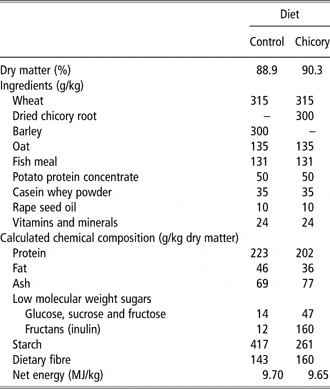
All sows were given a feed consisting of a commercial supplement (33%) for sows and ground barley (67%) throughout the study. The sows were fed restrictively up to farrowing, thereafter feeding was gradually increased to ad libitum. All nine litters were given ad libitum access to feed during weeks 2.5 to 5, which consisted of a commercial pelleted feed for piglets (70%) and ground barley (30%; standard feed; Table 1). However, in weeks 5 to 7, the barley was substituted with dried chicory roots (30%) for four litters. After weaning (weeks 7 to 9), three out of the five experimental groups (Groups 1, 2 and 5) continued on the control feed (37 piglets in total), whereas two groups (Groups 3 and 4) continued on the chicory feed (30 piglets in total). This feed was administered twice daily according to live weight. All feed components were organically produced, including dried chicory roots (Hansen et al., Reference Hansen, Mejer, Thamsborg, Byrne, Roepstorff, Karlsson, Hansen-Møller, Jensen and Tuomola2006). The composition of protein, fat ash, low molecular weight sugars (sucrose, fructose, glucose and fructans), starch and dietary fibres (non-starch polysaccharides and klason lignin) in the control and chicory feed was analysed as described by Thomsen et al. (Reference Thomsen, Bach Knudsen, Jensen, Christensen, Møller and Roepstorff2007) and presented in Table 1. The total energy content was estimated as by Thomsen et al. (Reference Thomsen, Petkevičius, Bach Knudsen and Roepstorff2005) and also shown in Table 1.
Ingredients and chemical composition of two diets fed ad libitum to piglets weeks 5 to 9 of age; weaning week 7

Sampling of faeces and clinical examination
Rectal faecal samples for enumeration of Campylobacter spp. were collected when the piglets were 4, 7 and 9 weeks old, whereas samples for parasite faecal egg counts were collected when the piglets were 6, 6.5, 7, 8 and 9 weeks old. Rectal faecal samples for enumeration of E. coli were collected daily during the 9 days of E. coli challenge.
The consistency of faeces from each piglet was visually assigned a score from 0 to 3 as follows: (0) normal/firm, (1) soft, (2) liquid/runny and (3) watery. The piglets were weighed weekly from time of birth until the age of 9 weeks. All piglets were observed daily for clinical symptoms during the whole study.
Parasitological examination
Faecal egg counts were enumerated using the concentration McMaster technique of Roepstorff and Nansen (Reference Roepstorff and Nansen1998). The flotation fluid (saturated NaCl with 500 g glucose monohydrate/l) had a high specific gravity (ρ = 1.27 g/ml) and the lower detection limit was 20 eggs/g faeces.
For recovery of A. suum, the small intestine was opened and emptied. The mucus was scraped off the intestinal mucosa, which was washed in 0.9% NaCl solution. The combined contents, mucus and saline were embedded 1 : 1 in 2% agar followed by incubation in 0.9% NaCl at 37°C (Slotved et al., Reference Slotved, Barnes, Eriksen, Roepstorff, Nansen and Bjorn1997) for 3 h. The A. suum that migrated out of the agar were collected using a 20 μm sieve and stored in 70% ethanol.
For recovery of T. suis, the large intestine was opened and washed in 0.9% NaCl. The contents and saline were mixed and diluted with water to a total volume of 10 l. A 10% subsample was washed on a 212 μm sieve for recovery of lumen-dwelling T. suis. The sieved material was stored in iodine (80 g iodine and 400 g potassium iodine in 800 ml distilled water) and decolourised by 30% sodium thiosulphate before examination. Immature T. suis were recovered from the intestinal mucosa by incubation of the intestinal tissue in 10 mM EDTA in 0.9% NaCl solution (pH 7) at 37°C overnight (Kringel et al., Reference Kringel, Roepstorff and Murrell2002). Released larvae were collected using a 90 μm sieve and stored in 70% ethanol.
Enumeration and isolation of E. coli and Campylobacter spp.
The faecal samples for enumeration of the E. coli O138 challenge strain were cooled during transport to the laboratory and subsequently stored at −18°C until testing according to Frydendahl et al. (Reference Frydendahl, Kåre Jensen, Strodl Andersen, Fredholm and Evans2003). The faecal material was suspended in phosphate buffered saline (10 ml/g) and homogenised by stomaching. Serial 10-fold dilutions were prepared and 100 μl plated on blood agar with streptomycin (Sigma-Aldrich Denmark A/S, Brøndby, Denmark) 100 μg/ml. After aerobic incubation at 37°C overnight, the number of CFU was determined. From each positive sample, two colonies were confirmed as O138 by slide agglutination.
The faecal samples for enumeration of Campylobacter spp. (from 4, 7 and 9-week-old piglets) were stored at 4°C until testing the next day. Tenfold dilution series of faeces (1 g) were cultured by direct plating on modified charcoal-cefoperazone-deoxycholate agar plates (mCCDA; Campylobacter Blood Free Selective Agar Base, Oxoid, Basingstoke, UK) with CCDA Selective Supplement (Oxoid, SE155E, UK). After incubation of mCCDA plates (48 h at 41.5°C; microaerobic conditions), Campylobacter spp. colonies (based on colony and cell morphology by microscopy) from direct plating were counted (detection limit 100 CFU/g).
DNA extraction
Total DNA was extracted from the ileal content of the 56 piglets in the four groups trickle-infected with E. coli by the stool DNA extraction kit (Qiagen GmbH, Hilden, Germany) according to the manufacturer's instructions except for an added bead beating step. Essentially, 200 mg of intestinal content were suspended in 1.4 ml of Buffer ASL (Qiagen) and homogenised with 400 mg of 100 μm Zirconia-silica beads (BioSpec Products Inc., Bartlesville, USA) using a minibead-beater at high speed for 3 min (Biospec Products Inc.). Subsequently, the suspension was centrifuged (20 000× g, 1 min), the supernatant was transferred to a new Eppendorf tube, and the stool kit procedure continued after the lysis step in the protocol where the InhibitEX tablet is added. The DNA was stored at −20°C until further analysis.
Terminal restriction fragment length polymorphism analyses
Terminal restriction fragment length polymorphism (T-RFLP) profiles and analyses were performed as described by Mølbak et al. (Reference Mølbak, Thomsen, Jensen, Bach Knudsen and Boye2007). In short, extracted total DNA was adjusted by spectrophotometry to a concentration of 5 μg of DNA/ml. Four replicate 50-μl PCR mixtures were made from each sample using the universal bacterial primers S-D-Bact-0008-a-S-20 (5′-AGAGTTTGATCMTGGCTCAG-3′; Leser et al., Reference Leser, Amenuvor, Jensen, Lindecrona, Boye and Moller2002) and S-D-Bact-0926lam-a-A-20 (5′-CCGTCAATTCCTTTRAGTTT-3′; Mølbak et al., Reference Mølbak, Thomsen, Jensen, Bach Knudsen and Boye2007). Primer S-D-Bact-0926lam-a-A-20 was 5′FAM (carboxy-fluorescein-N-hydroxysuccinimide-ester-dimethyl-sulfoxide) labelled. Purified PCR products (200 ng) were digested with 20 U of HhaI (Boehringer, Mannheim, Germany) restriction enzyme in 20-μl reaction mixtures for 3 h at 37°C. The four PCR replicates were pooled into two samples, which were analysed by electrophoresis on an automatic sequence analyzer (ABI-PRISM-373-DNA-Sequencer; PE Biosystems, Foster City, CA, USA). ABI traces were imported into BioNumerics version 4.5 (Applied Maths, Sint-Martens-Latem, Belgium) and aligned using internal standards. Terminal-restriction fragments (T-RFs) were found by autosearch at a position tolerance of 0.2, and only T-RFs between 35 and 625 bp observed in both PCR duplicates were included in the succeeding analysis. The mean relative intensity of each T-RF within a sample was calculated by dividing the area of that individual peak with the total area of all peaks on the electropherogram. To identify possible bacterial species corresponding to the individual T-RFs in this study, a virtual digest was done on a previously published 16S rRNA gene bacterial clone library from pigs (Leser et al., Reference Leser, Amenuvor, Jensen, Lindecrona, Boye and Moller2002) by inserting the primer sequences and restriction enzymes used in this study into the online program silico MiCA virtual digest (Shyu et al., Reference Shyu, Soule, Bent, Foster and Forney2007). The 16S rRNA gene sequences matching significant T-RFs for either treatment group were classified to bacterial groups by using the classifier function in RDP Release 10 (http://rdp.cme.msu.edu/classifier/classifier.jsp). The Shannon–Weaver diversity index (H′) was calculated for each treatment group as H′ = −Σpiln(pi), where pi is the number of different T-RFs in each animal.
Quantitative real-time PCR of target groups of organisms
The DNA amounts of E. coli O138:F18, Bifidobacterium spp. and total bacteria in samples from ileum were measured according to published quantitative real-time PCR (qPCR) assays, using the same primers and similar PCR conditions (Frydendahl et al., Reference Frydendahl, Imberechts and Lehmann2001; Palmer et al., Reference Palmer, Bik, DiGiulio, Relman and Brown2007; Delroisse et al., Reference Delroisse, Boulvin, Parmentier, Dauphin, Vandenbol and Portetelle2008). For each analysis, 10 ng of total DNA was used as template. The samples were run in triplicates. In each assay, a standard curve with known DNA concentrations was used, and sterile, filtrated water (0.2 μm) was used as negative controls. In the qPCR assays, measuring the E. coli O138:F18 and the total amount of bacteria, respectively, 10-fold serial dilutions of DNA from E. coli O138:F18 was used for the standard curve. In the bifidobacteria qPCR assay, DNA from B. thermophilium was used. The relative amount of bacteria was estimated from the C t values compared with the standard curves.
Statistical analysis
The effect of chicory supplementation on worm counts was analysed using logistic regression taking litter variation into account using the generalised estimating equation (GEE) approach with the working independence assumption (Liang and Zeger, Reference Liang and Zeger1986).
Logistic regression was also used to analyse diarrhoea, taking into account that we had multiple measurements per pig using GEE with the working independence assumption. The included factors were time, chicory (treatment), parasites, sex and baseline. It was not possible to run the model when including interactions with time, and hence only main effects were considered. Time and parasites were the only significant factors and therefore kept in the model, whereas the other factors were removed. For testing the effect of chicory on Campylobacter excretion levels, a mixed model of analysis was applied with random piglet and litter effects. For the repeated measurements on growth, we also applied a linear mixed model with ante (1) as the best fitting model (Diggle et al., Reference Diggle, Liang and Zeger1994). These statistical analyses were performed by SAS version 9.1.3 (SAS Institute Inc., Cary, NC, USA). For comparison between the individual T-RFs from the four main groups and between the chicory and control treatments and piglets exposed or not exposed to parasites, we used two-tailed Monte Carlo estimates from the nonparametric analysis (Mann–Whitney U-test and Kruskal–Wallis tests). T-RFs smaller than 35 bp and larger than 625 bp were excluded as these fragments were outside the range of the standards. This statistical analysis was performed by SAS Enterprise Guide 3 (SAS Institute Inc.).
Analysis of variance (ANOVA) was used to test if the DNA concentration measured by real-time qPCR assays of either total bacterial DNA or bifidobacteria DNA were different between treatments. ANOVA was performed in Microsoft Office Excel 2003 (Microsoft Denmark APS, Hellerup, Denmark). α = 0.05 was used as the critical level of significance.
Results
Clinical observations and production results
At weaning, the nine litters were composed of 4, 6, 6, 7, 7, 8, 9, 9 and 11 piglets, with a total of 67 piglets, of which three piglets from group 2, 3 and 5, respectively, were euthanized because they were moribund approximately 1 week before termination of the experiment at 9 weeks of age. The weight gain of the piglets between 5 to 9 weeks of age tended to be negatively affected by parasite exposure (P = 0.059) and to some degree by chicory supplementation (P = 0.1). The parasite infected pigs on the CTRL and CHIC diet gained 450 g/day and 400 g/day, respectively, while the non-parasite pigs on the CTRL or CHIC diet gained 470 g/day and 430 g/day, respectively.
Post-weaning E. coli challenge
Before the first challenge with E. coli all piglets were negative for haemolytic E. coli. During the 9 days of challenge and at termination of the study, E. coli O138 was only reisolated once from each of the five pigs (with 6.5 × 10² CFU/g as a maximum) from the groups CTRL − PAR (two pigs, days 2 and 7), CHIC − PAR (two pigs, day 5) and CTRL − PAR−E. coli (one pig, day 5), and was not detected in the small intestine by real-time PCR analysis at the termination of the study. In addition, none of the challenged piglets developed watery diarrhoea (faecal score 3) nor showed other clinical symptoms of post-weaning diarrhoea.
Parasitology
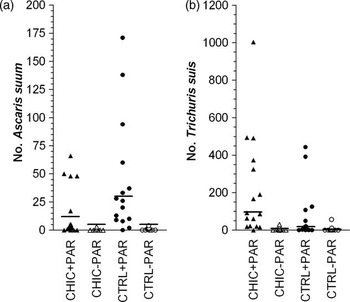
Neither A. suum nor T. suis eggs were recorded in any of the faecal samples during the study. Worm counts within the four main treatment groups are shown in Figure 2a (A. suum) and 2b (T. suis). A low level of contamination of the uninfected piglets was noted; 52% and 70% of piglets in groups CTRL − PAR and CHIC − PAR harboured low numbers of A. suum (mean abundance: one worm/pig) and T. suis (mean abundance: six worms/pig), respectively. In groups CTRL + PAR and CHIC + PAR, 84% to 87% of piglets harboured much higher worm burdens (A. suum mean abundance: 29 worms/pig; T. suis mean abundance: 148 worms/pig).
Individual Ascaris suum (a, P = 0.034) and Trichuris suis (b, P = 0.016) worm burdens of 9-week-old pigs (n = 58) given different treatments. Initially, all four groups were given the same control feed, but from the age of 5 to 9 weeks, two groups were given a chicory-supplemented feed. One group of each feed treatment was trickle infected with parasites from 1 to 7 weeks of age. Horizontal bars show the geometric mean.

Inclusion of dried chicory roots in the piglets’ feed reduced the A. suum mean abundance by 64% as compared with no chicory (P = 0.034) and the odds ratio (OR) indicated an overall 4.3 95% CI = (1.1, 16.8) times lower risk of piglets having A. suum, if given chicory. Apart from one female (17 cm), all of the recovered A. suum were immature (most worms measured only 0.5 to 1 cm). Similarly, almost all T. suis were immature. However, the risk of having T. suis was 3.5 95% CI = (1.3, 9.6) times higher for piglets fed chicory (group CTRL + PAR v. CHIC + PAR: P = 0.016; equal to a 63% higher mean abundance) according to OR.
Faecal consistency scores
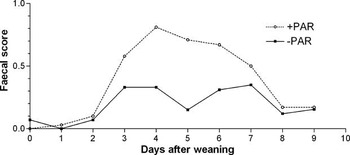
Clinical post-weaning diarrhoea did not develop, but a softening of the faeces was observed and the highest frequency of animals with scores >0 was recorded on days 4 to 7 post-weaning. Overall, 64% of piglets not experimentally infected with parasites (groups CTRL − PAR and CHIC − PAR) had faecal scores >0 at one or more occasions after weaning, whereas the same was the case for 94% of the infected piglets (group CTRL + PAR and CHIC + PAR). The OR correspondingly indicated a 2.5 times higher risk for softer faeces after weaning, if the piglet had been experimentally exposed to A. suum and T. suis (P = 0.005). The mean faecal scores for non-exposed piglets (groups CTRL − PAR and CHIC − PAR) and exposed piglets (groups CTRL + PAR and CHIC + PAR) are depicted in Figure 3.
Mean faecal consistency scores after weaning (7 weeks of age) of piglets experimentally infected weekly with Ascaris suum and Trichuris suis from age 1 to 7 weeks (+PAR, n = 31) or uninfected (−PAR, n = 36). Scores were visually assigned from 0 to 3 as follows: (0) normal/firm, (1) soft, (2) liquid/runny and (3) watery.

T-RFLP and real-time PCR analysis of the microbiota
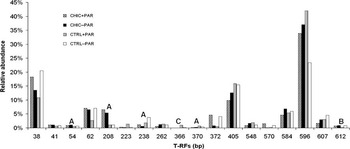
The bacterial microbiota in the ileum of piglets from the four different treatments was assessed by T-RFLP analysis. A total of 59 T-RFs were found in the range of 38 to 612 bp, of which the 18 most abundant T-RFs are shown in Figure 4. The average number of T-RFs in the four different treatment groups were 27 (CTRL + PAR), 25 (CTRL − PAR), 18 (CHIC + PAR) and 20 (CHIC − PAR). Fewer T-RFs were observed in the piglets fed chicory when compared with the piglets on the control diet (P = 0.02). Furthermore, the two groups of piglets fed chicory had a lower Shannon–Weaver diversity index compared with the control groups (CTRL + PAR H′ = 3.95; CTRL − PAR H′ = 3.87; CHIC + PAR H′ = 3.74; CHIC − PAR H′ = 3.75).
Average relative abundance of specific terminal-restriction fragments (HhaI T-RFs) as measured by the T-RFLP analyses of the piglets from four different treatments (n = 56). The figure presents only T-RFs found with a frequency higher than 1% of the total intensity. The medians of the T-RFs were different (P < 0.05) (a) between the pigs fed chicory or control diets, (b) between the pigs exposed or not exposed to parasites and (c) across the four treatment combinations. See Table 2 for further information about the potential strain matches of the individual T-RFs.

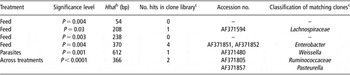
The T-RFLP is a semi-quantitative analysis in which the peak of each T-RF reflects the abundance of the current bacteria group represented by that T-RF. For the most abundant bacteria, there were no differences between the four treatments (Figure 4). In contrast, the composition of six of the less-abundant bacterial groups depended on the treatment (Figure 4). Five of these T-RF bacterial groups (54, 208, 238, 366 and 370 bp) were affected by the chicory diet, while two bacterial groups (T-RF: 366 and 612 bp) were affected by the parasites (Table 2). The chicory feeding led to a reduction of T-RF 370 bp, which according to the clone library of pigs’ intestinal bacteria (Leser et al., Reference Leser, Amenuvor, Jensen, Lindecrona, Boye and Moller2002) matches Enterobacter belonging to the enterobacteria (Table 2). T-RF 208 was more abundant in piglets fed chicory compared with control piglets (P = 0.03) and Table 2 shows that the T-RF 208 bp matches the Lachnospiraceae family, which includes the typically fermenting genera: Butyvibrio, Reseburia and Ruminococcus.
T-RFLP identification of differences in potential intestinal bacterial groups in 9-week-old pigs depending on their feed and parasite exposure (treatment)Footnote a

T-RFLP = terminal restriction fragment length polymorphism.
a Pigs were fed two different diets from weeks 5 to 9 (chicory v. control), and were either exposed (+PAR) or non-exposed (−PAR) to parasites (Ascaris suum and Trichuris suis; see Figure 4 for further details).
b HhaI base pairs detected through T-RFLP analysis that vary significantly (week 9) between treatmentsa depending on either feed type, exposure to parasites or across the four treatment combinations.
c The T-RFs potential matches were found from a search in a previous published 16S rRNA gene pig clone library (Leser et al., Reference Leser, Amenuvor, Jensen, Lindecrona, Boye and Moller2002).
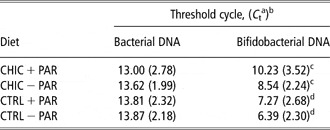
The total number of bacteria, as quantified by qPCR, was not significantly different among the four treatment groups, whereas quantification of Bifidobacterium spp. in the ileum by qPCR showed a higher level of these bacteria in the chicory-fed piglets (P = 0.001; Table 3).
Real-time PCR quantification of bacterial DNA and bifidobacterial DNA in ileum of pigs fed with CHIC or CTRL feed and either exposed or not exposed to parasites (+/−PAR)

aC t threshold cycle reflects the cycle number at which the fluorescence generated within the PCR reaction crosses the threshold. C t is inversely correlated to the logarithm of the initial copy number.
bThe number in parentheses is s.e. of the mean.
c,dC t means with different superscripts differ (P < 0.001).
Campylobacter spp. excretion level
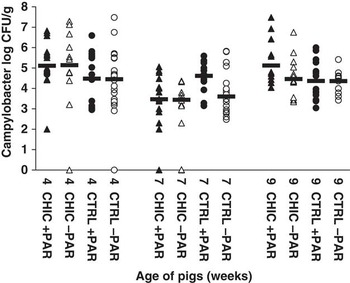
Campylobacter spp. was found in 161 of the 172 samples (93.6%) examined in total from the piglets at 4, 7 (58 piglets) and 9 weeks (56 piglets) of age. By the end of the experiment, all piglets except one (which was euthanized at 8 weeks of age as it was moribund) had been Campylobacter positive at least once; the excretion levels are shown in Figure 5. The effect of chicory on the Campylobacter excretion level interacted with time, though not significant at the 5% level (P = 0.058). However, this interaction showed that the Campylobacter excretion at 7 weeks of age had decreased by 1 log in the piglets that have been fed with chicory for 2 weeks as compared with the control diet (P = 0.029). After another 2 weeks of feeding with chicory, at 9 weeks of age, the Campylobacter excretion in the chicory-fed piglets was similar to that found in the pigs fed the control feed (P = 0.93).
Campylobacter spp. excretion levels in piglets at 4, 7 and 9 weeks of age grouped according to feeding (chicory or control feed from 5 to 9 weeks of age) and parasite exposure (Ascaris suum and Trichuris suis infection from 1 to 7 weeks of age (+PAR) or no infection). There was an effect of chicory, time and parasites (P < 0.05), with an interaction between time and chicory (P = 0.058). Horizontal bars show the geometric mean.

Piglets experimentally infected with A. suum and T. suis (+PAR) showed a higher Campylobacter excretion level (+0.31 log CFU/g) than non-infected piglets (−PAR; P = 0.017).
Discussion
This study found that the fructan-rich (dried chicory roots) diet lowered the small intestinal A. suum worm burden and increased the large intestinal T. suis worm burden in 9-week-old weaners, reduced the faecal Campylobacter excretion at 7 weeks of age and had a positive bifidogenic effect in the ileum. Furthermore, inoculations according to an otherwise well-established E. coli O138:F8 infection model (Frydendahl et al., Reference Frydendahl, Kåre Jensen, Strodl Andersen, Fredholm and Evans2003) did not give rise to infections in piglets weaned at 7 weeks of age and there were no signs of weaning diarrhoea.
The overall energy content was identical in the two feed types, and the current dietary level of 30% dried chicory did not impair the growth significantly, which is in agreement with previous observations (Hansen et al., Reference Hansen, Mejer, Thamsborg, Byrne, Roepstorff, Karlsson, Hansen-Møller, Jensen and Tuomola2006). The protein level was slightly lower (20.2%) in the chicory diet when compared with the control diet (22.3%). This difference in the protein level was unintended and may theoretically have influenced the results by reducing the immune responses of the chicory groups, as previously demonstrated for induced long-term severe protein deficiency (51% reduction in the diets protein level), on T. suis and A. suum infections (Pedersen et al., Reference Pedersen, Saeed, Michaelsen, Friis and Murrell2002). However, because the chicory-fed piglets still reached an almost optimal protein level, this difference is considered of minor importance.
A. suum and T. suis infections
The growth of the piglets appeared to be affected by the parasite infections, though this was not significant. In contrast, other studies have demonstrated marked effects by both T. suis and A. suum on feed conversion and growth (Hale and Stewart, Reference Hale and Stewart1979; Hale et al., Reference Hale, Stewart and Marti1985), which may be due to a heavier parasite exposure and more large worms than in this study, in which the large majority of worms were small, immature worms.
Inclusion of 30% dried chicory root in the diet (≈16% fructans) reduced the number of immature A. suum recovered from the small intestine by 64% in the current trickle-exposure study. Similarly, immature A. suum worm burdens have previously been reduced by 55% to 73% by crude chicory root (≈14% fructans), dried chicory root (≈16% fructans) or inulin (commercial purified fructans, ≈17% fructans) in pigs slaughtered 13 to 15 days after a single A. suum dose (Mejer, Reference Mejer2006). As suggested for the large intestinal parasites O. dentatum and T. suis (Petkevičius et al., Reference Petkevičius, Murrell, Bach Knudsen, Jørgensen, Roepstorff, Laue and Wachmann2004; Thomsen et al., Reference Thomsen, Petkevičius, Bach Knudsen and Roepstorff2005), A. suum may have been negatively affected by changes in the physico-chemical conditions (e.g. higher production of short-chain fatty acids (SCFA) and lower pH) in the caecum and proximal colon, as these sites are where the newly hatched larvae invade the mucosa before migrating through the liver and lungs and returning to the small intestine (Murrell et al., Reference Murrell, Eriksen, Nansen, Slotved and Rasmussen1997). These changes of living conditions are likely to occur as the caecum and proximal colon are also the main sites for bacterial degradation of carbohydrates, yielding substances such as SCFA and lactic acids (Jensen and Jørgensen, Reference Jensen and Jørgensen1994). O. dentatum has thus been shown to be almost eliminated from the intestinal tract after infusion of purified SCFA and LA directly into the caecum (Petkevičius et al., Reference Petkevičius, Murrell, Bach Knudsen, Jørgensen, Roepstorff, Laue and Wachmann2004).
The effect of easily fermentable carbohydrates on T. suis infections has in previous studies varied from insignificant (H. Mejer, unpublished data) to different degrees of adverse effects resulting in reduced parasite establishment, persistence, growth and/or fecundity (Thomsen et al., Reference Thomsen, Petkevičius, Bach Knudsen and Roepstorff2005 and Reference Thomsen, Bach Knudsen, Jensen, Christensen, Møller and Roepstorff2007; Petkevičius et al., Reference Petkevičius, Thomsen, Bach Knudsen, Murrell, Roepstorff and Boes2007). However, in this study, the T. suis infection levels increased in piglets fed chicory. This overall variable effect on T. suis may partly reflect that levels and sources of fermentable carbohydrates as well as the other feed components varied between studies. Fermentation patterns may therefore have varied accordingly, thus comparisons between studies are complicated. In addition, it should be noted that the regulation of T. suis as well as A. suum infections is very complex. Both parasites are highly immunogenic so that a high initial establishment of even a single infection is followed by a host-mediated expulsion of the large majority of A. suum worms (Roepstorff et al., Reference Roepstorff, Eriksen, Slotved and Nansen1997) or all T. suis worms (Kringel and Roepstorff, Reference Kringel and Roepstorff2006).
In this study, the infection levels and the population composition in the control groups indicated that the onset of acquired resistance (i.e. expulsion of worms) had begun by the time of slaughter. The current higher recovery of T. suis in chicory-fed piglets could thus potentially be the result of a low initial establishment (because of the chicory feeding) causing a delayed onset of those immune mechanisms, which are required to expel the worms. In addition, it has been demonstrated that both T. suis and O. dentatum worms can be severely stunted by a diet supplemented with easily fermentable carbohydrates (Thomsen et al., Reference Thomsen, Petkevičius, Bach Knudsen and Roepstorff2005; Mejer, Reference Mejer2006). Therefore, the apparent higher T. suis worm burdens in this study may possibly result from a delay in the gradual development and emergence of larvae from the intestinal mucosa before establishment in the intestinal lumen.
Infecious E. coli has mainly been found adhered to the small intestinal mucosa in the gastrointestinal tract (Kenworthy and Crabb, Reference Kenworthy and Crabb1963), and in a study by Halas et al. (Reference Halas, Hansen, Hampson, Mullan, Wilsen and Pluske2009), they found a prebiotic effect of an 8% inulin diet given to pigs infected with E. coli O149:K91;K88 by improving the faecal consistency and reducing the incidence of post-weaning diarrhoea. In this study, faecal bacterial excretion and weaning diarrhoea did not develop after repeated inoculations with E. coli O138:F18, an infection model established by Frydendahl et al. (Reference Frydendahl, Kåre Jensen, Strodl Andersen, Fredholm and Evans2003), even though the piglets were expected to be susceptible to the infection and they received daily infection doses of 108 CFU E. coli O138:F18 for nine consecutive days post-weaning. It is not the aim of this study to experimentally identify the reasons for this lack in establishment of the E. coli challenge infections among the piglets. However, it may be speculated to be a combination of microbial colonisation resistance against E. coli O138:F18 and a more developed immune system of free-range piglets weaned at 7 weeks of age compared with conventional piglets weaned at a younger age. The lack of establishment and thus lack of induction of post-weaning diarrhoea made it impossible to measure any potential effect of chicory and intestinal helminth infections on E. coli O138:F18 excretion and clinical course.
The bacterial community structure was described by using the well-established method, T-RFLP. Since each terminal-restriction fragment (T-RF) ideally represents a single species or taxonomic group of bacteria, it is possible to relate the empirically found T-RFs to theoretically digested 16S rRNA genes of bacteria. The T-RFLP analysis only showed a moderate effect of the fructan-rich diet on the microbiota in the ileum. However, several of the less abundant T-RFs (54, 208, 238, 366 and 370 bp) showed significant differences in peak intensities among the groups. In a previous study, it has been shown that pigs fed a fructan-rich diet had a higher proportion of Bifidobacterium thermacidophilum and Megasphaera elsdenii in the colon (Mølbak et al., Reference Mølbak, Thomsen, Jensen, Bach Knudsen and Boye2007). In this study, we found 10 times or more bifidobacteria in the ileum of the piglets fed the fructan-rich diet (16.0% fructan) compared with the other diet (1.2% fructan). This is to the best of our knowledge the first time a bifidogenic effect is seen in the ileum of pigs. Bach Knudsen and Hessov (Reference Bach Knudsen and Hessov1995) found that the recovery of inulin from the small intestine in seven human subjects with ileostomy was 87%. They argued that the 13% loss of inulin during passage through the small intestine was due to hydrolysis by either acids or enzymes and to microbial degradation by the microbiota permanently colonizing the ileum. The suggestion of a microbial degradation was supported by our findings in the chicory-fed piglets, which had an increase in both Bifidobacteria and bacteria belonging to Lachnospirace, which contains Butyrivibrio spp. and Roseburia spp. that previously have been reported to degrade fructans (Duncan et al., Reference Duncan, Aminov, Scott, Louis, Stanton and Flint2006, Falony et al., Reference Falony, Vlachou, Verbrugghe and De Vuyst2006). It is difficult to say how efficiently these bacteria fermented the chicory in the ileum, what the end metabolites were, and to what extent they provided energy to the epithelial cells. However, it is interesting that Megasphera was not involved in the fermentation as we previously have seen in the colon. Therefore, this study indicated that the fermentation of chicory taking place in the ileum is different from the fermentation known from colon. Future experiments could elucidate whether this difference in fermentation is due to the intestinal environments, diets or experimental set up. Halas et al. (Reference Halas, Hansen, Hampson, Mullan, Wilsen and Pluske2009) showed that the inulin diet considerably increased the total concentration of LA in the caecum and colon of the pigs. Although the concentration of LA was not measured in this study, an increase in LA concentration in the ileum is plausible, which would cause a drop in pH. Such a restricted intestinal environment may explain why the chicory-fed piglets in this study had a lower microbial diversity as compared with the non-chicory-fed piglets. This reduced bacterial diversity may also partly be due to a higher ileal colonisation resistance against potential pathogenic organisms such as enterobacteria, which according to the T-RFLP analysis were reduced in the chicory-fed piglets (T-RF 370 bp in Table 2).
Campylobacter spp.
All but one piglet in this study was Campylobacter spp. positive at least once. This is in concordance with the general finding of high Campylobacter spp. prevalence in pigs and that colonisation may occur within the first day of life (Young et al., Reference Young, Harvey, Anderson, Nisbet and Stanker2000; Jensen et al., Reference Jensen, Dalsgaard, Baggesen and Nielsen2006). However, in the 7-week-old piglets fed chicory for 2 weeks, the Campylobacter spp. excretion had decreased by 10-fold as compared with the control piglets. To our knowledge, the effect of chicory on Campylobacter spp. excretion has not previously been tested in pigs, but chickens fed with fructooligosaccharides have been shown to have a lower C. jejuni colonisation (Schoeni and Wong, Reference Schoeni and Wong1994). However, the potential Campylobacter-reducing effect of chicory, observed after 2 weeks of chicory feeding, seemed to disappear over time; after 4 weeks of feeding, the Campylobacter spp. excretion level had returned to the level found in the control piglets. Campylobacter only constituted a minor part of intestinal microbiota as it was not among the 59 T-FRs derived from the ileum at the time of slaughter, although Campylobacter has been shown to reside there (Weijtens et al., Reference Weijtens, Bijker, Van der Plas, Urlings and Biesheuvel1993). The specific mechanism behind the transitory Campylobacter reduction is unknown. Campylobacter numbers were probably affected by the changing microbiota and fermentation patterns, but adaptations to these changes may have occurred. It has been suggested that bifidobacteria excrete an anti-microbial substance that affects Campylobacter and other bacteria (Gibson and Wang, Reference Gibson and Wang1994). Furthermore, administration of Bifidobacteria longum to poultry as a probiotic for 2 weeks was shown to reduce their C. jejuni concentration within that period (Santini et al., Reference Santini, Baffoni, Gaggia, Granata, Gasbarri, Di Gioia and Biavati2010).
The experimental parasite infection lead to an increased Campylobacter spp. excretion level, which supports previous suggestions that parasites can facilitate pathogen invasion. Germ-free piglets given co-infections of C. jejuni and T. suis thus had more severe diarrhoea and pathology than pigs with single infections (Mansfield et al., Reference Mansfield, Gauthier, Abner, Jones, Wilder and Urban2003). Although diarrhoea was absent in this study, the helminth-inoculated piglets had softer faeces than non-inoculated piglets. These findings may indicate the importance of controlling single pathogen infections, although seemingly insignificant, because interactions of multiple infections may aggravate the conditions.
Conclusions
In this study, inclusion of fructan-rich dried chicory root in the diet of weaning piglets altered their intestinal bacterial and helminth communities as demonstrated by a strong bifidogenic effect, a reduced A. suum worm burden and the increased number of T. suis worms at necropsy. However, interpretations of these results should probably be cautious due to the high variation observed between individual pigs and the generally accepted complexity of whipworm regulation. The expected assessment of the effect of chicory on weaning diarrhoea was not feasible because the previously proven E. coli O138:F8 infection model did not establish in the piglets. It is speculated that the late weaning (7 weeks) may have promoted resistance against the challenge strain. The Campylobacter spp. excretion level seemed to be affected by chicory. Accordingly, feeding of piglets with chicory may also serve as an animal-friendly strategy to reduce the risk of carcass contamination at slaughter and thereby improve the food safety of pork.
Acknowledgements
Technicians at The Danish Centre for Experimental Parasitology, DTU-Vet and DTU-Food are gratefully acknowledged for their valuable assistance. The work was supported by the Danish Research Centre of Organic Farming (DARCOF III).