Introduction
Research over the past decades has established that the brain and the immune system are intimately linked and capable of bi-directional communication (Reference Butts and Sternberg1–Reference Gil, Schwarz and Muller5). This body of evidence supports a role for psychosocial stressors in modulating immune function and disease processes (Reference Linn, Linn and Jensen6–Reference Anisman10). However, findings from life event studies indicate that the individual's perception and appraisal of the stressor, the intensity of subjective distress and the style of coping with the challenge can be more important than the exposure to adverse events per se in influencing immune status (Reference Linn, Linn and Jensen6,Reference Smith, Vollmer-Conna, Bennett, Hickie and Lloyd8,Reference Temoshok, Waldstein and Wald11,Reference Segerstorm, Kemeny, Laudenslager, Ader, Felten and Cohen12). A clearer understanding of the potentially negative health effects of psychosocial stressors therefore requires examination of the complex interactions of multiple factors which operate in real life.
In human research it is difficult to separate the effects of coping and the amounts of stress experienced in association with a negative event, but this difficulty can be reduced by choosing a well-defined physical stressor against which the effects of psychological processes can be evaluated. Elective surgery represents such a stressor, as the amount of physical stress associated with a given surgical procedure is, presumably, similar for all patients. The choice of elective surgery as a stressor provides several additional advantages. First, since the date of surgery is known, patients can be followed prospectively with measures taken during the time leading up to the event, throughout recovery and at a follow-up assessment. Second, in dealing with stressful events the affected person may not be able to eat or sleep well, and may engage in coping behaviours such as smoking and excessive use of alcohol. Hospitalisation permits some control over these extraneous variables which can affect immune function in their own right Reference Smith, Vollmer-Conna, Bennett, Hickie and Lloyd(8,Reference Krueger and Karnousky13), thereby complicating interpretations of research findings. Finally, there is substantial evidence that stressful life events and emotional distress are associated with changes in immune function, but little or no evidence as to whether such stress-induced immunological changes influence susceptibility to disease (e.g. Reference Kiecolt-Glaser, Glaser and Gravenstein(14,Reference Vedhara, Cox and Wilcock15)). In fact, several authors have recently pointed out that after decades of enquiry into the effects of stress on human immune function and disease, there is an appalling lack of actual evidence supporting the model of psychological dysfunction leading to immunological changes, which, in turn, increase the likelihood of disease Reference Segerstrom and Miller(16,Reference Friedman17). By using elective surgery as a stressor, it is possible to monitor patients' progress throughout the recovery process. Therefore, the clinical significance of changes in immune parameters consequent to the surgical trauma can be evaluated with respect to post-surgical complications (e.g. wound infection, pneumonia) and any illness incurred during a follow-up period after discharge from hospital.
Much of the research in the field of psychoneuroimmunology has employed research strategies that assume simple causal relations. Statistical analyses typically involve comparisons of group means on parameters of interest, or simple predictor-outcome correlations. Such research strategies have provided useful information but cannot adequately capture the importance of individual differences in the response to complex life stressors or the intricate relations among the variables of interest.
To evaluate the clinical relevance of behavioural influences on immune function, it is essential to use research strategies that follow from a conceptual model of integrated processes of adaptation and a multi-determined concept of health and disease. Hence, in the research reported here, patients undergoing elective cholecystectomy were studied using a longitudinal within-subject design, and the complex interrelations (in terms of direct and mediating effects) between psychological factors, immune function and recovery from surgery were examined using a structural modelling approach. We hypothesize that the level of subjective emotional distress will emerge as the critical psychosocial determinant of clinically relevant changes in immune responses associated with a surgical stressor.
Methods
Subjects
Twenty-nine women between 30 and 85 years of age [mean 53.4, standard deviation (SD ) = 14], undergoing surgery for the first time in at least five years, were recruited from patients scheduled for elective, open cholecystectomy at a public hospital in Sydney, Australia. To evaluate differences in immune status prior to surgery, 29 age-matched, healthy women (mean age = 52.6, SD = 16) were recruited from community volunteers. Patients and control subjects were invited to participate in the study if they were free from any other significant illness (such as diabetes, auto-immune diseases, chronic infection or cancer), recent infection and were not taking immunosuppressive drugs (in particular corticosteroids and non-steroidal anti-inflammatory drugs). Subjects with a history of recognized psychiatric illness were also excluded. Screening for suitability for inclusion into the study was conducted by the medical specialists (B. Y. and P. T.) during the initial intake interview. Blood samples were obtained from control subjects at the same time of day and in parallel to initial samples drawn from the patients undergoing surgery. Written informed consent was obtained from all participants. The study was approved by the institutional Human Research Ethics Committee.
Procedure
Two weeks prior to surgery, the first blood sample was obtained and immunity was assessed using a delayed-type hypersensitivity (DTH) skin test (see below). In addition, each patient completed a number of self-report measures assessing current mood states and attributional style (see below), and a structured interview which included specific questions regarding medical history and demographic data, health behaviours (see below). To limit the burden associated with completing numerous questionnaires, and in view of the demonstrated validity and robustness of global self-assessments and interview-derived coping assessments (Reference Idler and Benyamini18–Reference Lazarus20), we obtained information regarding significant chronic and acute life stressors, patients' worries in relation to the operation and specific coping strategies the patients utilised to prepare themselves for the impeding surgery. On admission to hospital, the patient's emotional state was again assessed by means of the questionnaire. The patients were monitored on a daily basis post-operatively. On day three a second blood sample was obtained, a second DTH skin test performed and the patient's emotional state was again assessed. One month after discharge patients returned for a final interview, assessment of their emotional state, a blood sample and DTH skin test. All interviews and assessments (with the exception of the initial screening of exclusion criteria of the patients) were conducted by the same researcher (U. V. C.), who is a qualified psychologist.
Psychological and general health measures
In order to reduce the number of variables for statistical analysis, three psychological composite measures, termed ‘Distress’, ‘Stressors’ and ‘Coping’, and one measure of ‘General Health’ were constructed from interview data as well as the scores obtained from the Depression-Anxiety-Stress (DAS) Scale a measure of current mood states Reference Lovibond and Lovibond(21), and the Attributional Style Questionnaire (ASQ) which assesses explanatory style for negative events Reference Peterson, Semmel, Von-Baeyer, Abramson, Metalsky and Seligman(22). Composite components were standardized (as Z scores) and added with equal weights throughout as suggested by Wainer Reference Wainer(23,Reference Wainer24). The composition and derivation of each of these measures is set out below.
Distress. A pre-operative distress composite was derived for each patient by adding the standardised scores on measures contributing to the overall experience of pre-operative distress. These included the scores on the three DAS subscales (Depression, Anxiety and Stress), the ASQ and a self-rated measure (on a 5-point scale) of the intensity of the patient's worries related to the impending surgery. Subsequent distress measures were based on negative emotional states as assessed by the DAS scale alone. For clarity, the more extensive, pre-operative distress composite will be referred to as ‘Distress’, and the follow-up distress measure will be labelled ‘Negative Mood’.
Stressors. As part of the structured interview, patients were asked to report major stressful life events experienced during the last year that had a significant negative impact on their emotional state [adapted from Reference Holmes and Rahe(25)]. Patients were similarly asked to indicate any ongoing problems (chronic stressors) such as financial worries, marital disharmony or loneliness, as such chronic stressors may also influence immune status Reference Kiecolt-Glaser, Glaser and Gravenstein(14,Reference Vedhara, Cox and Wilcock15). A stressor composite score was derived by adding the number of significant acute and chronic life stressors for each patient.
Coping. Two weeks prior to surgery, as part of the structured interview patients were asked: ‘Is there anything that you can actively do to maximise the success of this operation?’ Active coping strategies that were reported included losing weight, reducing smoking, obtaining information about the surgical procedure and discussing their concerns with their doctor, family members or friends. Coping behaviour was rated on a 3-point scale (0 = no active coping; 1 = one active strategy; 2 = more than one active strategy). In addition, patients rated their perceived ‘importance and efficacy’ of active coping efforts on a 5-point scale. A composite active coping score was obtained by adding standardised scores on these two variables. Patients who nominated ‘trusting in their doctor's ability’ as their only strategy scored low on this measure as this constituted a passive coping strategy.
General Health. Information relating to demographic factors and health behaviours which may affect immune function and recovery from surgery was obtained via the structured interview. The variables of interest were: age, smoking (cigs/day), alcohol consumption (standard drinks/week), exercise (hours /week), the number of previous hospital admissions and general health issues (e.g. neck and lower back pain, sleep disturbances, allergies, obesity). A composite reflecting ‘General Health Risk’ was constructed by adding standardized scores across variables for each patient.
Immunological measures
Blood samples were collected by venipuncture between 9 and 12 a.m. from all subjects to avoid the effect of diurnal variation in T cell numbers and function Reference Ritchie, Ostwald and Micklem(26). The same immune tests were repeated for all subjects at each measurement occasion.
Assessment of cell-mediated immunity. Lymphocyte subset analysis was performed using a fluorescence-activated flow analyser (Becton Dickinson, San Jose, CA, USA) and commercially prepared monoclonal antibodies, directed against the CD2, CD4, CD8, CD19, CD16 (Ortho Diagnostic Systems; Raritan, NJ, USA) to enumerate the total T lymphocyte population, the inducer, the suppressor/cytotoxic subpopulations, B lymphocytes, natural killer cells and activated mononuclear cells, respectively. Lymphocyte stimulation with phytohaemagglutinin (PHA; Phaseolus spp, Burroughs Wellcome, Dartford, UK) was performed using a standard method Reference Maluish, Strong, Rose, Friedman and Fahey(27). The plateau response (at 0.375 μg/ml) was selected from the response curves for statistical comparison. DTH skin testing was performed using a commercially available kit (Mulittest CMI; Merieux, Marcy l’Etoile, France) which allows simultaneous testing of DTH to seven preloaded antigens (tetanus, diphtheria, streptococcus, tuberculin, candida, tricophyton and proteus) in a uniform and convenient manner. The cumulative induration diameter for the test was calculated as the sum of the individual reactions at each site, provided the glycerine control was negative. Results of the DTH skin testing were categorised according to previously determined reference ranges generated from healthy adult populations Reference Kniker, Anderson, Mcbryde, Roumiantzeff and Lesourd(28).
Assessment of humoral immunity. Total immunoglobulin (IgG, IgA and IgM) levels were assayed by nephelometry. The levels of IgG subclasses were measured by radial immuno-diffusion by means of a commercially available kit (Binding Site, Birmingham , UK).
Derivation of in vitro and in vivo measures of immune status
From the available measures, six immune parameters, thought to best reflect the patient's broad immune function, were selected, a priori, for statistical analysis. The in vitro parameters were the absolute numbers of T (helper) cells (CD 4+ lymphocytes ), of B cells (CD 19+ lymphocytes ) and of natural killer cells (CD 16+), the total serum IgG level and the response to PHA. The sixth measure consisted of the sum (in mm) of the diameters of all positive reactions obtained from the DTH skin testing. This test provides an in vivo assessment of the ability of ‘memory’ immune cells to recall prior exposure and appropriately respond to common antigens Reference Joreskog and Sorbom(29).
Surgery
The two surgeons (B. W. Y. and P. G. T.) developed a standard protocol covering pre-operative proceedings and medication, details of the operation, anaesthesia, and post-operative medication and care specifically for this project. All patients underwent elective cholecystectomy and operative cholangiogram. More extensive surgery (e.g. cystic and/or common bile duct explorations) was necessary for five patients. There were no statistically significant differences in the post-operative complications experienced by those patients who received more extensive surgery as compared to those who did not (t = 0.13, p = 0.897), and all patients were, therefore, retained in the analysis.
Index of post-operative complications. Problems noted during the recovery period included fever, delayed oral feeding, respiratory and urinary tract infections, bile leak, wound haematoma, wound infection and skin allergies. There were no life-threatening complications. Each surgeon evaluated independently the seriousness of the profile of complications for each patient (coded and blinded) on a scale ranging from 0 to 5. The surgeons' ratings were highly correlated (r = 0.92) and were used as an index of post-operative complications.
Statistical analyses
Preliminary data analysis. The pre-operative immune status of patients in this study was comparable to that of healthy, age-matched control subjects (Table 1). Changes in immune responses after surgery reflect a decline in immune responses from pre- to post-operative assessment which is followed, in most cases, by an increase in values at the follow-up period. Mean B cell numbers and DTH skin test responses, however, show a further decline at follow-up. These changes were statistically significant for the absolute numbers of T4 (F (2,27) = 12.4, p < 0.001; multivariate-model repeated measures ANOVA), B (F (2,27) = 6.4, p < 0.005) lymphocytes, the total serum IgG (F (2,27) = 31.6, p < 0.001) and the sum in mm of all positive reactions from DTH testing (F (2,27) = 4.4, p < 0.02).
Pre-operative immune status of surgical patients (N = 29) compared to healthy control subjects (N = 29) and changes in immune status across the different measurement occasions

Means and SDs (in parentheses) of immune measures obtained from surgical patients at 2 weeks prior to surgery (pre-op), day 3 after surgery (post-op) and at 1 month follow-up. p values for group comparisons were derived from two-tailed t-tests; ANOVA was used to assess differences across repeated measures.
cpm, counts per minute; NK, natural killer.
Data reduction for structural modelling. To minimise the extent to which the model fitting capitalises on chance, the number of variables was reduced by forming linear combinations of measures as indicators of broad rather than narrow constructs. After consultation with the clinical immunologist (D. W.), immune status was defined operationally as a composite in which equal weight was assigned to two components: an in vivo component obtained from DTH skin testing, and an in vitro component which included the absolute number of T4 and B lymphocytes and the total serum IgG. A standard rationale is available for the derivation of a composite score from DTH skin test results (Multitest CMI: Merieux, Marcy l’Etoile, France), but not for combining in vitro measures, some of which may be unreliable. The method adopted in this study was to include only those measures whose mean scores were sensitive to the surgical intervention, as determined by ANOVA. Although the definition of the in vitro component depends on the data, it is independent of the features of data used for structural modelling. Structural models are concerned only with individual differences, and therefore with differential change rather than mean change.
The measure termed ‘General Health Risk’ (which controls for age, medical history and health behaviours) was excluded from the model because it was not related to scores on any of the other variables (multiple correlation analysis: adjusted R 2 = 0.008, F (9,19) = 1.02, p = 0.46], probably because of the relative homogeneity in the patients' background and life style.
The model. A structural model gives an account of relationships between variables in terms of direct effects of some variables on others (effects not mediated by other variables in the model), and indirect or mediated effects Reference Joreskog and Sorbom(29). It is generally appropriate to fit structural models to covariance rather than correlation matrices. The plausibility of causal inferences derived from a structural model depends on whether (a) the model fits the data, and (b) alternative well-fitting models can be excluded a priori. In this particular case, the model is recursive Reference Cohen and Cohen(30), that is, all of the variables listed in Table 2 are assumed to have no effect (direct or indirect) on any of the preceding variables in the list. In most cases the justification for the assumed direction of causality in the model depends on chronology. In some cases the assumed flow of causality is based on theoretical grounds so that life stressors, for example, are assumed to influence, but not to be influenced by pre-operative distress.
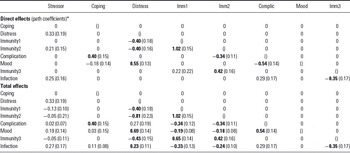
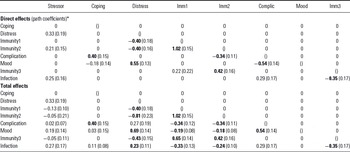
Estimates of the magnitude of direct and total effects in the model

Coefficients indicate the average change (in SD units) to be expected in the row variable following an increase of 1 SD in the column variable, when all preceding variables are held constant. Immunity1, 2 and 3 refer to immune function pre-operatively, post-operatively and at follow-up, respectively.
* Coefficients in bold typeface are statistically significant (p < 0.05), the number in parenthesis is the standard error.
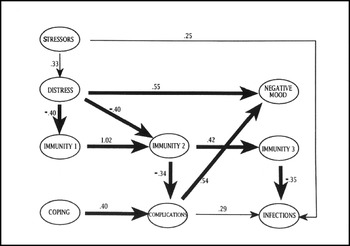
Path coefficients (estimates of the magnitude of direct effects) are shown in Table 2. The entries above the diagonal are zero by assumption, while the sub-diagonal zero entries represent effects omitted from the final version of the model because their inclusion would complicate the model without improving its fit to the data. Coefficients in bold typeface are statistically significant at or beyond the 0.05 level. Each non-zero coefficient is scaled in SD units, with the Immunity variable being standardised on the pre-operative data. Each coefficient may be interpreted as the average change (in SD units) to be expected in the row variable following an increase of one SD in the column variable, when all preceding variables are held constant. Interpretation of the pattern of direct effects is facilitated by the construction of a path diagram (Fig. 1) provided that the diagram is not unnecessarily complex.
Path diagram showing only direct effects that are either greater than 0.25 SD units in absolute value, or statistically significant at or beyond the 0.05 level. Nine of the 15 path coefficients meet both these criteria (shown as thick arrows). Immunity1, 2 and 3 refer to immune function pre-operatively, post-operatively and at follow-up, respectively.

Results
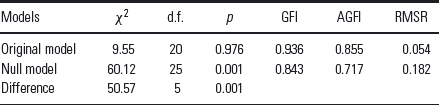
The LISREL goodness of fit statistics (GFI = 0.94, AGFI = 0.86) indicate that this model fits the data well.
Direct effects. Pre-operative Distress had a negative effect on immune status both before (−0.40) and after surgery (−0.40) (Table 2). Distress also contributed substantially to the level of negative mood reported at follow-up (0.55). Active coping increased the risk of post-operative complications (0.40). Pre-operative immune status (termed Immunity1) had a large effect on immune status after surgery [termed Immunity2 (1.02)] which, in turn, substantially influenced immune status at follow-up [termed Immunity3 (0.42)], and the rate of post-operative complications (−0.34). The rate of complications strongly contributed to Negative Mood reported at follow-up (0.54). Finally, immune status at follow-up affected the frequency of infective illness (−0.35). The substantial effect of Immunity2 on Immunity3 suggests that infective illness may have resulted from persisting low immune function.
Indirect and total effects. Some variables which were at least moderately correlated were not directly connected by a path in Fig. 1. For example, pre-operative immune status (Immunity1) had no direct effect on Complications after surgery, although these two variables were moderately correlated (r = −0.342). Immunity1 did, however, have an indirect effect on Complications because Immunity1 had a positive effect on Immunity2 (1.02), which in turn had a negative effect on Complications (−0.34). The indirect effect of Immunity1 on Complications was thus mediated by Immunity2, and is calculated as the product of these two coefficients (i.e. 1.02 ×−0.34 = −0.34). The total effect of one variable on another consists of the direct effect plus the sum of its indirect effects.
According to the model, the total effect of pre-operative Distress on immune status after surgery (Immunity2) was −0.81. Because the direct effect of Distress on Immunity2 was −0.40, the magnitude of its indirect effect(s) must be −0.41. Figure 1 shows that this indirect effect was entirely mediated by the substantial direct effect of Distress on Immunity1, because Immunity1 was the only mediating variable. More information is thus implied by the path diagram, particularly in cases where the indirect effects make a substantial contribution to the total effect of a variable. Indirect effects are no less important than direct effects, as it is only by examining these indirect effects that something can be learned about mediating variables and, thus potentially about underlying processes. For example, some of the sub-diagonal zero entries in Table 2, indicating minimal direct effects in these cases, are replaced by statistically significant total effects in Table 2. This pattern was evident in the case of Distress and its effects on Immunity3 (−0.43) and Infections at follow-up (0.23), as well as for the variables Immunity1 and Immunity2 and their respective effects on Negative Mood (−0.19 and −0.18) and Infections (−0.33 and −0.24) at follow-up. By examining the paths in Fig. 1, it is evident that Immunity and Complications were important mediating variables in the effect of Distress on Infections at follow-up. Further, the effects of immune status (Immunity1 and Immunity2) on Negative Mood at follow-up were mediated by post-operative Complications.
A test of the importance of psychological variables in the model
The model just described constitutes one of a number of plausible models that may fit the data. A critical feature of the present model is its emphasis on the importance of psychological factors in modulating immune status and influencing medical outcome variables. To test whether such an emphasis is justified, we constructed an alternative model which did not permit any effects of the psychological factors on immune status or medical outcome variables (i.e. the paths connecting the variables Stressors, Coping and Distress to Immunity1, 2 or 3, Complications and Infections were deleted). The path coefficients produced by this alternative, null model for the remaining paths were very similar to those of the original model, with the largest discrepancy being an increase of 0.14 in the direct effect of Immunity1 on Immunity2. Nevertheless, the null model was much less successful in fitting the data than the original model. First, both the GFI and the adjusted GFI are lower, and the root mean square residual (RMSR) is much higher for the null model compared to the original model (Table 3). In particular, the null model produced very high standardized residuals for the deleted paths between the variables Distress and Immunity1 (−2.974), Distress and Immunity2 (−3.892), as well as between Coping and Complications (3.056). Therefore, the parameters reflecting the effects of psychological variables on medical outcome variables make a substantial contribution of the fit of the model to the data. Second, and critically, the difference in Chi-square values between the original and the null model [χ2(5)− = 50.57, p < 0.001] is so large that the null model clearly cannot account for the relationships in the data. While it does not follow that the original model is correct in every detail, it can be concluded that, in order to fit the present data well, any plausible, alternative model must incorporate the potential influence of psychological factors on immunity and/or recovery variables.
LISREL goodness of fit statistics for the o model and a null model (without psychological variables)
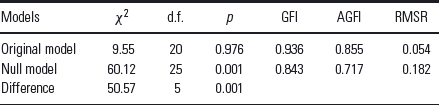
GFI, goodness of fit index; AGFI, adjusted goodness of fit index; RMSR, root mean square residual.
Discussion
There is wide acceptance that psychosocial stressors affect immune responses which, in turn, increase the likelihood of disease. However, there are practically no studies that have evaluated all three aspects of this model. The results reported here are important in that they provide evidence that links psychological factors to immunological changes and disease processes.
Specifically, our results document a central role for psychological factors and immune function in a patient's recovery from major surgery. The model revealed that pre-operative immune status had a major effect on immune function measured after surgery which, in turn, substantially affected immune status at follow-up. Individual differences in immune function were highly stable over measurement occasions, even though the mean composite score was reduced by 0.94 pre-test SD units subsequent to surgery. Post-operative immune status directly influenced the rate of complications but also mediated the indirect effect of pre-operative immune status on this variable. Although none of the women suffered life-threatening complications, nine received a score between 3 and 5 on the severity index (the maximum score is 5) indicating moderate to severe complications such as bile leak, wound haematoma, wound infection, prolonged atelectasis and persistent fever. Three women suffered no post-operative complications.
The strongest effect exerted by the variable Complications in the model was to significantly increase the level of negative mood over the 1-month follow-up. Notably, the average level of negative mood reported by the nine women with moderate to severe complications was 2.2 SDs above the mean of the remaining group. In addition to its direct effect on negative mood, the variable Complications mediated the indirect effects of immune status on mood disturbance and the rate of infectious illness after discharge from hospital. The rate of infectious illness was high, with 14 of the 29 women reporting at least one infection for which they had consulted their local doctor in the month since leaving the hospital. These included upper respiratory infections, influenza, middle ear infection, cystitis and gastro-intestinal infections. The nine patients who had a more complicated recovery in hospital were more than twice as likely to contract an infection during the follow-up period as those who had only mild or no complications.
Of the psychological factors included in the model, the variables Distress and Coping produced the most significant results. Pre-operative distress exerted direct effects on immune function both before and after surgery, and contributed substantially to the level of negative mood at follow-up. Distress also had a considerable indirect effect on immune function after surgery, which was mediated by its effect on pre-operative immune status. The reduction in post-operative immune function related to Distress was the second largest effect (−0.81; Table 2) surpassed only by that of pre-operative immune status on immune function after surgery. Thus the substantive total effects of Distress on follow-up measure including disturbed mood and infections (Table 2) are closely linked to its impact on immune function. This finding provides support for the widely accepted, but not rigorously tested notion that (di)stress-induced changes in immune function have clinical relevant outcomes (Reference Linn, Linn and Jensen6,Reference Anisman10,Reference Kiecolt-Glaser, Glaser and Gravenstein14,Reference Vedhara, Cox and Wilcock15). Recognition of the importance of emotional distress in the context of medical illness is reflected in the recent advocacy for considering distress as the sixth vital sign in the assessment of patients with cancer Reference Chaturvedi and Venkateswaran(3,Reference Holland and Bultz31).
Although Distress substantially influenced immune function, the number of concurrent life stressors (Stressor) exerted neither direct nor indirect immunosuppressant effects. These results are important because the terms ‘stressor’, ‘distress’ and ‘stress’ are often used interchangeably. This usage reflects the assumption that stressful events cause negative emotional states and, hence, reflect different stages of the same underlying process presumed to modulate immune function Reference Cohen and Williamson(32). The results of our study confirm earlier observations that the intensity of subjective distress is a better predictor of immunosuppression than either the number or the severity of recent life stressors Reference Butts and Sternberg(1,Reference Cohen and Williamson32). Negative life event and distress measures are not interchangeable because an individual's response to adverse events is shaped by prior experience, and enduring behavioural and personality characteristics which affect the appraisal of the current situation and, consequently, the intensity of subjective distress (Reference Smith, Vollmer-Conna, Bennett, Wakefield, Hickie and Lloyd9,Reference Friedman17,Reference Lazarus and Folkman35). A distress measure in preference to, or combined with one of life stressors should be included in future research of stress effects on immune function.
Active coping efforts by the patient seeking to maximize the success of the operation was directly associated with a significant increase in the risk of post-operative complications. This seems counter-intuitive as the term ‘coping’ is typically equated with successful adaptation Reference Cohen and Lazarus(33). However, similar results have been reported; for example, patients who used denial or avoidance strategies were found to have less complicated recoveries from surgery than those with active, vigilant coping dispositions Reference Cohen and Lazarus(33,Reference Shelley and Pakenham34).
The widely held notion of active, problem-focused coping as a defence strategy inherently more useful than emotion-focused strategies (e.g. denial and avoidance) disregards the fact that not all life stressors are amenable to mastery, or can be accommodated within a problem-solving framework Reference Lazarus(20,Reference Lazarus and Folkman35). Major surgery along with inevitable loss, aging and natural disasters are examples of such ‘uncontrollable’ stressors, where the most effective strategy may well be that which allows the person to tolerate, minimize, accept or ignore what cannot be mastered. In fact, some cognitive processes that have been classified as denial may be better understood as efforts at positive thinking, managing emotions or maintaining self-esteem that function to sustain morale (Reference Lazarus20,Reference Cohen and Lazarus33,Reference Lazarus and Folkman35,Reference Cooper, Katona, Orrell and Livingston36). Patients with low active coping scores in our study typically responded with some puzzlement to the idea that anything could or should be done to maximize the success of the surgery beyond ‘putting their trust in their surgeon’.
That a more passive coping disposition may be advantageous in the context of surgery is further suggested by our observations relating to patients who did suffer complications. Of those with moderate to severe complications, patients with the highest active coping scores (> 1 SD above the mean) uniformly reported at the follow-up interview that their experience was far worse than they had expected. Moreover, their level of negative effect at that time was also more than 1 SDs above the group mean. In contrast, patients with moderate to severe complications but with comparatively lower coping scores (0.27 SD above the mean) did not report that their experience was unexpectedly bad, and their mood state at follow-up was not different from the rest of the sample. This suggests that the more intensely patients embrace a strategy of actively trying to master a situation which is largely out of their control, the more they may experience a state of helplessness when their efforts are unsuccessful. Recent research on the emotional effects of coping strategies employed by family caregivers of Alzheimer's patients supports this notion Reference Cooper, Katona, Orrell and Livingston(36). Caregivers who embraced a problem-solving strategy regardless of whether the situations could actually be changed had significantly higher levels of anxiety 1 year later than those who employed problem-solving strategies only when the situation was amenable to change and otherwise preferred emotion-focused strategies Reference Cooper, Katona, Orrell and Livingston(36).
The underlying process responsible for the effect of coping on postoperative complications cannot be determined from this study, as the effect was direct and not mediated by other variables such as immune function. Future research should explore the possibility that patients with an active coping disposition may be more likely to engage in behaviours during recovery that are not conducive to the healing process.
As our sample size was limited, the present analysis should be viewed as exploratory. Further investigations with larger patient samples are needed in order to substantiate our findings. Nevertheless, these data support the view that psychological factors can contribute substantively to disease processes, and that their impact is in part mediated by changes in immune responses. The inclusion of a ‘null model’ analysis, which abrogated any effects of psychological variables, and the results obtained from this exercise provide support for the validity of our findings. Overall, the results from this study suggest that recovery from surgery is likely to be optimal in patients with a well-functioning immune system, a low level of pre-operative distress and an emotion-focused, trusting coping disposition.
Acknowledgements
We thank participating clinicians, laboratory staff and patients for their important contributions to this research.