Introduction
The increasing rates of inappropriate, non-emergent use of Emergency Medical Services (EMS) systems present a significant public health challenge to communities around the country. Over-utilization of EMS affects the communities these systems serve by limiting their resources and placing additional strain on emergency personnel.Reference Michelen, Martinez, Lee and Wheeler 1 This issue has resulted in a variety of adverse effects on ambulance companies, emergency departments (EDs), and the health care system as a whole.Reference Beck, Craig and Beeson 2 Mobile integrated community health (MICH) is an emerging health services delivery model in which the traditional role of paramedics is expanded to address gaps in access to care amongst vulnerable populations that lead to frequent 911 use, system over-loading, and rising health costs. This new paradigm represents one potential method of combating service over-utilization by caring for medically vulnerable patients in the field and helping them to better understand and navigate the complex health care system.Reference Smith 3
Rise in Non-Emergent EMS Use
The challenges of non-emergent EMS use and subsequent ED over-crowding have been major subjects of debate at the forefront of health care reform in the United States (US).Reference Gindi, Black and Cohen 4 , Reference Smulowitz, Honigman and Landon 5 Many policymakers believe that resolving these issues will result in significant systemic cost savings.Reference Smulowitz, Honigman and Landon 5 , Reference LaCalle and Rabin 6 The root cause of non-emergent EMS use is often misattributed to uninsured individuals who come to the ED in search of primary care services, when studies have shown that most patients who are classified as “frequent EMS users” have both insurance coverage and a regular primary care physician (PCP).Reference Hunt, Weber, Showstack, Colby and Callaham 7 , Reference Hansagi, Olsson, Sjoberg, Thomson and Goransson 8 It is important to note that the US does not have a national insurance program, thus health insurance coverage varies between private industry and government entitlement programs, while some individuals do not have health insurance coverage at all. These findings indicate that there are other factors leading to the over-use of emergency services. Research has shown that these individuals are heavy users of all health services and typically have unmet social and psychological needs in addition to one or more serious chronic diseases.Reference Hansagi, Olsson, Sjoberg, Thomson and Goransson 8 , Reference Tangherlini, Pletcher, Covec and Brown 9 A significant number of studies attribute recurrent use of emergency services to factors such as homelessness, substance abuse issues, mental health disorders, low socioeconomic status, and old age.Reference LaCalle and Rabin 6 , Reference Hunt, Weber, Showstack, Colby and Callaham 7 , Reference Tangherlini, Pletcher, Covec and Brown 9 , Reference Norman, Mello and Choi 10
In addition to non-emergent EMS use, the primary care shortage is a major driver of ED over-crowding.Reference Uscher-Pines, Pines, Kellermann, Gillen and Mehrotra 11 , Reference Bodenheimer and Pham 12 The growing income gap between primary and specialty care, combined with the mounting clinical responsibilities associated with primary care, has led many US medical graduates to favor careers in specialty fields rather than in primary care; these issues have greatly contributed to the current PCP shortage seen today.Reference Bodenheimer 13 This shortage has resulted in reduced access to primary care services for many patients who may ultimately choose to seek care in an ED if their condition escalates. 14 , Reference Richman, Clark, Sullivan and Camargo 15
One study found that up to 25% of patients visiting the ED at any given time cite EMS as their “usual source of care,” and many mention reasons such as unavailability of PCP appointments, lack of weekend or extended primary care hours, and convenience as motives for utilizing the ED in this manner.Reference Smulowitz, Honigman and Landon 5 Another survey found that among recent ED users:
46% of respondents felt that the problem that brought them to the emergency department could have been handled in a primary care setting, and of that 46%, two-thirds of respondents would have preferred to see a PCP rather than using the emergency department had they been able to obtain an appointment.Reference Bodenheimer and Pham 12
Emergency Department Over-Crowding/System Cost
High-frequency 911 use has been consistently identified as a major contributor to ED over-crowding and the negative impacts over-crowding can have on quality and cost of care.Reference Beck, Craig and Beeson 2 , Reference Scott, Strickland, Warner and Dawson 16 , Reference Hoot and Aronsky 17 This issue often results in diminished quality of care, which may lead to poor patient outcomes, crowding, long waits, and additional stress on staff.Reference Norman, Mello and Choi 10 , Reference Sun, Burstin and Brennan 18
National ED visit volumes have risen sharply in recent years from nearly 110 million visits per year in 2001 to over 133 million visits in 2010; a 23% increase. 19 Further, studies have shown that a significant portion of ED visits could be categorized as avoidable, resulting from “patients seeking non-urgent care or ED care for conditions that could have been treated and/or prevented by prior primary care….” 14 According to a 2010 study by the RAND Corporation (Santa Monica, California USA):
Between 14 and 27 percent of all ED visits are for non-urgent care and could take place in a different setting, such as a doctor’s office, an after-hours clinic, or a retail clinic, resulting in potential cost savings of $4.4 billion annually.Reference Weinik, Burns and Mehrotra 20
When the emergency system is consistently over-loaded by high-frequency users, the resources necessary for true medical emergencies become scarce.Reference Pines, Asplin and Kaji 21 This is a situation that is “likely to result in an increasing burden to an already stretched health care safety net resource.”Reference Tangherlini, Pletcher, Covec and Brown 9
The emergency system is the only health access point in the United States that is required by federal law to be operational 24 hours a day, 365 days a year, where patients and providers have access to a full range of services and advanced medical technologies within the hospital facility. 14 , 19 Blood-work, radiographic scans, and various other diagnostic services are readily available through the ED; patients would need to seek and locate those services elsewhere if they went to a local clinic with fewer service capabilities. Though the ED offers patients a one-stop-shop for medical services, many experts believe that the episodic nature of ED care “cannot provide the continuity of care that the primary care system offers,” and further results in increasingly fragmented care, potentially redundant services, and increased costs.Reference Smulowitz, Honigman and Landon 5 , Reference LaCalle and Rabin 6 , Reference Sun, Burstin and Brennan 18 , 19
Development of Mobile Integrated Community Health
To address unmet needs of high-frequency users and the cascading impacts of EMS over-utilization on communities, EMS agencies and local health departments around the country have begun to search for new and innovative solutions to this complex and multi-faceted problem; MICH is an emerging health services delivery model in which the traditional role of paramedics is expanded to address the gaps in access to care amongst vulnerable populations that lead to frequent 911 use, system over-loading, and rising health costs. 22 Similar programs established in the UK, Austria, and Australia have demonstrated significant decreases in costs while also increasing the patients’ sense of satisfaction with their health care.Reference Dixon, Mason and Knowles 23 , Reference Machen, Dickinson, Williams, Widiatmoko and Kendall 24
Programs are tailored to meet the needs of their individual communities and are cooperative, multi-agency initiatives involving stakeholders across the care continuum, including local health departments, hospitals, public health agencies, and emergency medical systems. 22 Primarily, MICH focuses on preventing injury, illness, and the exacerbation of existing disease by targeting the underlying service deficiencies in a community.Reference Choi, Blumberg and Williams 25 Though these programs have become more popular in recent years, there are few empirical studies analyzing their effectiveness and their impacts on the health and wellness of patients. Substantial research efforts are required to support future policy decisions and funding opportunities.
In Maryland, the Queen Anne’s County EMS system initiated a pilot program to provide community outreach, education, and improve patient navigation.Reference Smith 3 Their goal is to connect high-frequency 911 users with local resources and PCPs that can work to not only improve their physical health status, but also their mental and social health.Reference Smith 3 , 26 The MICH operation is a partnership between the Queen Anne’s County Department of Health and Mental Hygiene (Centreville, Maryland USA), Queen Anne’s County Commissioners, and Queen Anne’s Department of Emergency Services, University of Maryland Shore Regional Health System (Chestertown, Maryland USA).Reference Smith 3 , 26 The MICH team is comprised of an experienced paramedic and a registered community health nurse or nurse practitioner. The teams visit enrollees in their homes to provide information on services that may benefit them and educate patients on how to advocate for their own health.
The providers also perform a basic medical assessment and a safety evaluation of the home to assess each patient’s current health status and to prevent future injury.Reference Smith 3 One of the primary goals of the MICH Program is to improve patient navigation and health literacy skills. Patient navigation is the process by which the MICH team identifies and breaks down barriers to care by connecting patients to existing social, medical, mental health, transportation, and nutrition resources that may better serve their needs. Studies have shown that persons with regular primary care or a “usual source of care” are more likely to receive preventative services and less likely to frequent EDs or be admitted when they do use emergency services.Reference Bodenheimer and Pham 12 , Reference DeVoe, Fryer, Phillips and Green 27 Thus, by connecting frequent users with alternative resources at a lesser cost instead of simply transporting them to the hospital, there is potential for systemic cost savings, effective resource utilization, and improved overall health for the patients and their communities.
This research study aims to identify the most prevalent medical conditions in the Queen Anne’s County MICH Program and to determine the prevalence of comorbid or multi-diagnosis patients in the program.
Methods
Study Design
This was a retrospective secondary analysis of existing data from the Queen Anne’s County MICH Program. The population of interest was adult residents of Queen Anne’s County (≥18 years) who have five or more 911-service activations in a six-month period. Given the varied standards for the metric of frequent EMS use in the literature, this study’s metric was the determined average.Reference LaCalle and Rabin 6 , Reference Hunt, Weber, Showstack, Colby and Callaham 7 , Reference Tangherlini, Pletcher, Covec and Brown 9 , Reference Norman, Mello and Choi 10 , Reference Scott, Strickland, Warner and Dawson 16 , Reference Sun, Burstin and Brennan 18 , Reference Hall, Raven and Hall 28 – Reference Mandelberg, Kuhn and Kohn 30 The study methods outlined below were reviewed and approved by the University of Maryland, Baltimore County Institutional Review Board (Baltimore, Maryland USA).
Setting and Selection of Participants
Queen Anne’s County is a predominantly rural jurisdiction of Maryland that spans 371.91 square miles on the eastern shore of the Chesapeake Bay. As the 17th most populated of the state’s 24 counties, Queen Anne’s is home to an estimated 48,900 residents and has a population density of 128.5 persons per square mile. 31 Queen Anne’s County has a higher percentage of population aged 65 and older as compared to Maryland overall (17.8% and 14.1%, respectively). 31 According to the Centers for Disease Control and Prevention (CDC; Atlanta, Georgia USA), nearly two-thirds of all health care costs in the United States are for treating chronic illnesses, and among health care costs for older individuals, 95% are for chronic diseases. 32
Geography, transportation, and availability of service providers each impact the ability of residents of Queen Anne’s to access local health care in their county. According to a 2016 community health needs assessment conducted by Shore Regional Health System, the top three barriers to accessing health care in the region, as reported by residents, include unaffordability, lack of transportation, and a shortage of specialists and providers in the area. 33 The three most significant health problems listed in this report included access to care, transportation, and preventive care. 33 Queen Anne’s County is one of two counties in the state without a hospital in its jurisdiction, though there is a single, free-standing ED in the southern part of the county.Reference Smith 3 Additionally, it is one of 136 Health Professional Shortage Areas and one of 55 Medically Underserved Areas in the state of Maryland, indicating that there is a lack of primary medical care, dental, or mental health providers within the county. 34 The study population was composed of all adults (≥18 years) who: (1) had five or more 911 call activations in a six-month interval; and (2) were residents of Queen Anne’s county. Those excluded were patients younger than 18 years, patients already receiving other home health services, and patients who refused to participate in the MICH Program.
Data Collection and Processing
The data used for this study were collected as part of the Queen Anne’s County MICH Program to document each patient’s information and progress in the program. Demographic, diagnostic, and treatment data were collected as part of medical record keeping through in-person MICH provider contact with the patients.
Access to the MICH Program data was granted by the Queen Anne’s County Department of Emergency Services (Centreville, Maryland USA), as well as the MICH Program Director. Data obtained in the MICH records include pertinent de-identified patient demographics, insurance data, as well as primary and secondary diagnosis information for 97 MICH participants who were enrolled from August 2014 through January 2017. No cases were excluded from the study as all patient records contained the required information for the present study. As the program data were collected by medical professionals trained in appropriate and accurate medical record keeping techniques with the intention of future analysis and program evaluation, these data were deemed to be a reliable source of patient information. Original program data from the AllScripts database (AllScripts; Raleigh, North Carolina USA) were cleaned, aggregated, and recoded using the statistical data management software STATA 14 (Stata Corp.; College Station, Texas USA). 35 Data cleaning consisted of systematic imputation of disease codes and patient information into a consolidated dataset, as well as the correction of typos and spelling errors.
Outcome Measures
The primary outcome measure was the diagnosis prevalence among MICH Program participants; MICH personnel recorded patient’s diagnoses during the process of medical record keeping and patient assessment. The major categories of disease, determined according to the ICD-9, among program participants were reported. Categories used for analysis include behavioral/mental health, cardiovascular, cerebrovascular, dermatologic, gastrointestinal, genitourinary, immunologic, metabolic, musculoskeletal, neurological, oncologic, pulmonary, and “other.”
The secondary outcome measure was disease comorbidity. Comorbidity was measured as the number of distinct ICD-9 codes associated with diagnoses in a patient’s record. 36 Comorbidity was recorded as a dichotomous variable such that a patient who had multiple diagnoses was reported as comorbid and a patient who had a single diagnosis was reported as not comorbid. National averages for comorbidity status were obtained from publicly available CDC reports. 37 – Reference Gerteis, Izrael and Deitz 39
Primary Data Analysis
Statistical analyses were performed using STATA 14. 35 For all analyses, an α=0.05 level of significance was used. Analysis consisted of reviewing patient records and aggregating diagnosis and demographic information of program participants. The disease prevalence, degree of comorbidity, insurance coverage, and demographic characteristics among program participants were assessed using basic descriptive statistics including frequency distributions and measures of spread. Multiple linear regression models and chi-squared tests were used to assess the association between age, sex, race, and comorbidity. These models were further applied to investigate the relationship between the 13 diagnosis categories and the number of comorbidities present among patients enrolled in the MICH Program.
Results
Characteristics of Study Sample
There were 97 total enrollees in the MICH Program during the project time frame and no cases were dropped from the current study due to missing or incomplete data (Table 1). The sample consisted of 41 male participants (42.27%) and 56 female participants (57.73%). Ages ranged from 30 to 96 years of age with a mean age of 71.42 years (SD=14.64). Nearly one-third of the patients enrolled in the MICH Program during the study period were younger than 65 years of age (29.90%). African Americans made up 20.62% of the sample population while 79.38% of enrollees identified as non-Hispanic whites. No other races or ethnicities were represented among the MICH Program enrollee sample.
Sample Characteristics

Frequency tabulations of insurance coverage found that 83.51% of program participants had Medicare, a government-based entitlement insurance for the elderly, as a primary insurance provider, while 7.22% were covered by Medicaid, a government entitlement insurance for low-income individuals. An additional 7.21% of participants were covered by private or employer-based insurance plans and 2.06% were self-pay or had no insurance provider. Approximately one-quarter (24.74%) of participants were covered by multiple insurance providers. Over fourteen percent (14.43%) of enrollees received secondary insurance benefits from private insurers, 8.25% had secondary coverage through Medicaid, while both Veterans insurance and Medicare each provided secondary coverage for one participant (1.03%). Of those patients who were younger than 65 years of age, 51.72% received insurance benefits through Medicare and 24.14% were covered by Medicaid.
Diagnosis Prevalence
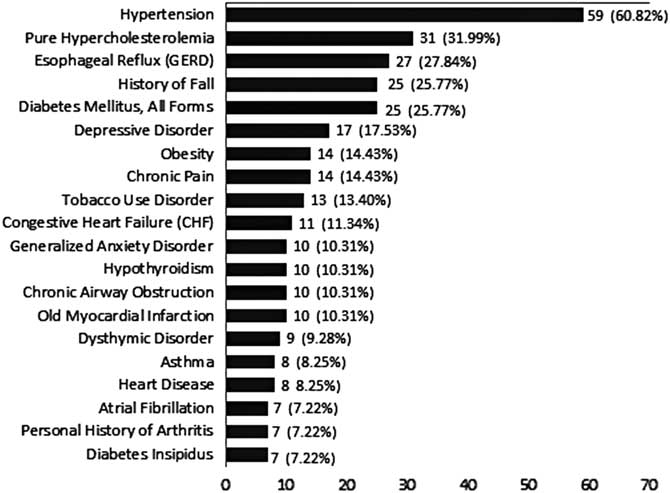
Analysis of diagnosis prevalence among program participants found that there were 194 diagnoses among the 97 MICH Program enrollees. It was hypothesized that chronic conditions would be the most prevalent morbidities among program participants. The 20 most common diagnoses overall among program participants, in descending order of frequency, included: hypertension (60.82%), pure hypercholesterolemia (31.95%), esophageal reflux (GERD; 27.84%), history of fall (25.77%), diabetes mellitus (25.77%), depressive disorder (17.53%), obesity (14.43%), chronic pain (14.43%), tobacco use disorder (13.40%), congestive heart failure (CHF; 11.34%), generalized anxiety disorder (10.31%), hypothyroidism (10.31%), chronic airway obstruction (10.31%), a history of myocardial infarction (10.31%), dysthymic disorder (9.28%), asthma (8.25%), heart disease (8.25%), atrial fibrillation (7.22%), personal history of arthritis (7.22%), and diabetes insipidus (7.22%). A visual representation of these prevalent conditions is shown in Figure 1.
The 20 Most Common Diagnoses Overall Among Program Participants.

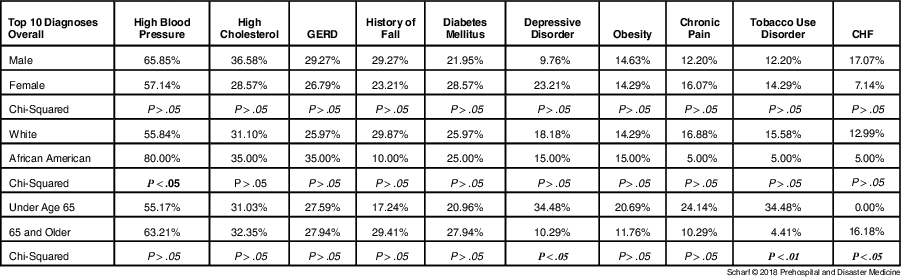
The two most prevalent diagnoses among both males and females were hypertension (M=65.85%; F=57.14%) and high cholesterol (M=6.58%; F=28.57%). For men, these conditions were followed by GERD (29.26%), personal history of fall (29.26%), and diabetes mellitus (21.95%), whereas for women, the next most prevalent conditions were diabetes mellitus (28.57%), GERD (26.78%), and depressive disorder (23.21%). While the prevalence of these conditions descriptively differed by sex, a chi-square analysis found that the prevalence of these conditions between men and women was not statistically different (P>.05).
Among African American patients, the most prevalent diagnoses included hypertension (80.00%), GERD (35.00%), high cholesterol (35.00%), diabetes mellitus (25.00%), and obesity (15.00%). The most common conditions among non-Hispanic white participants were hypertension (55.84%), high cholesterol (31.10%), personal history of fall (29.87%), GERD (25.97%), and diabetes mellitus (25.97%). The most frequent diagnoses among those younger than age 65 were hypertension (55.17%), tobacco use disorder (34.50%), depressive disorder (34.50%), high cholesterol (31.03%), and GERD (27.59%), while the most prevalent conditions among those older than age 65 included hypertension (63.21%), high cholesterol (32.35%), personal history of fall (29.41%), GERD (27.94%), and diabetes mellitus (27.94%).
A descriptive table of the 10 most prevalent diagnoses and their statistical significance is presented in Table 2. As stated above, there was no statistically significant difference between the prevalence of these conditions among men and women in the program. While the majority of conditions were not statistically significantly different between non-Hispanic white participants and African American participants, there was a significant difference found in the prevalence of hypertension between these two groups (P<.05). Finally, chi-square goodness of fit tests revealed that there was a statistically significant difference between the prevalence of depressive disorder (P<.05), tobacco use disorder (P<.01), and CHF (P<.05) in participants over age 65 and participants younger than age 65. No other diagnoses had a statistically significant difference.
Top 10 Diagnoses Descriptive Table

The proportion of patients in each ICD-9 diagnosis category was also assessed. This analysis found 73.20% of enrollees had a cardiovascular diagnosis, 68.04% of patients had a metabolic disease, 46.39% had a neurologic diagnosis, 44.33% of patients had a behavioral/mental health diagnosis, 29.90% had a gastrointestinal diagnosis, 29.90% had a musculoskeletal diagnosis, 27.84% had pulmonary diagnosis, 18.56% had a genitourinary diagnosis, 16.49% of enrollees had an oncologic disorder, 13.40% had a cerebrovascular-related diagnosis, 13.40% had a immunologic disease, 7.22% had a dermatologic condition, and finally 31.96% of program enrollees had a diagnosis classified as “other.”
Comorbidity Analysis
Measures of frequency distribution and spread were computed to assess the degree of comorbidity among MICH Program participants. It was hypothesized that there would be a high prevalence of comorbid patients in the MICH Program compared to national averages. These analyses found that 94.85% of the study population had two or more comorbidities, while only 5.15% of participants had a single diagnosis. The number of diagnoses ranged from one to 13 comorbid conditions and the average number of comorbidities among all program participants was 5.88 diagnoses (n=97; SD=2.74). The mean comorbidity among all male participants was 6.15 diagnoses (SD=3.07) while all women in the program had an average of 5.68 diagnoses (SD=2.47). On average, those over 65 years old had 1.01 fewer diagnoses (m=5.57; SD=2.65) than those younger than 65 years old (m=6.59; SD=2.85). African American enrollees had an average of 5.75 diagnoses (SD=3.09) while non-Hispanic white participants were found to have 5.91 diagnoses (SD=2.66). It was hypothesized that there would be increased comorbidity among female participants, patients over age 65, and among non-white program enrollees. Chi-squared analyses found no statistically significant associations between those factors and comorbidity among program participants.
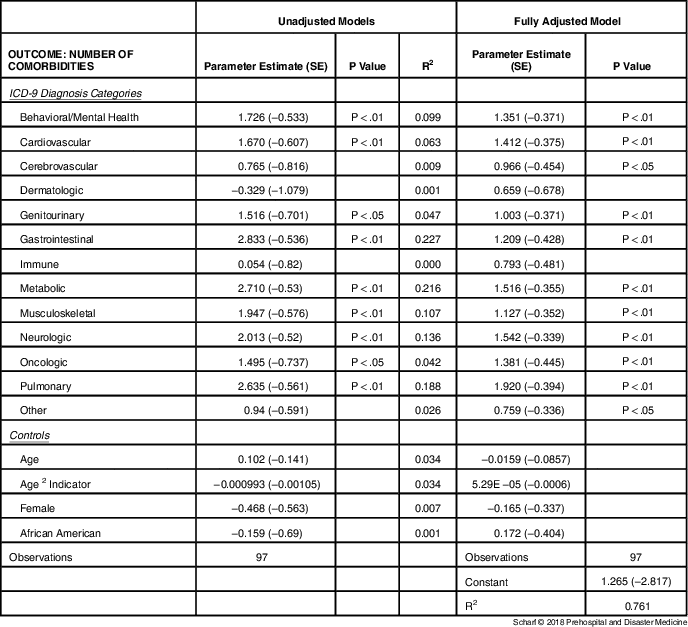
Multiple linear regression analysis was used to examine which ICD-9 diagnosis groups were associated with a higher likelihood of a greater number of comorbidities while controlling for participant’s age, sex, and race. The age variable was squared prior to analysis to reduce skewness. A correlation matrix was constructed to test for multi-collinearity among the predictor variables and no significant collinearity was found. Table 3 shows unadjusted and adjusted regression coefficients predicting comorbidity. Standard errors are reported in parentheses and R2 values are reported for each regression model.
Multiple Linear Regression Analysis Models (N=97)

Note: Each row in the unadjusted models column represents an individual regression model that was ran without adjusting for control measures and depicts the raw association of each diagnosis category and comorbidity. Because of this, R2 is reported for each row. The fully adjusted model represents a single model that controls for the effect of diagnoses present in multiple diagnosis categories, age, sex, and race.
Results for all models shown in Table 3 included the full set of control variables (age, sex, and race). The fully adjusted model controlled for the presence of disease in multiple disease categories while also adjusting for age, sex, and race. The unadjusted linear models showed a greater impact of individual disease categories on comorbidity. Coefficients ranged from -0.33 to 2.83 diagnoses in the unadjusted models.
The fully adjusted model controlling for the presence of diagnoses in different disease categories and adjusting for age, sex, and race found that the number of comorbidities was significantly correlated with the presence of one or more diagnoses in the multiple diagnosis categories. The behavioral/mental health group was a significant predictor of comorbidity, such that those with a behavioral/mental health diagnosis had 1.35 more comorbidities than those in the sample without a mental health diagnosis (P<.001). The cardiovascular category was significant in predicting comorbidity. Those with a cardiovascular-related diagnosis had 1.41 more comorbidities than those without a cardiovascular diagnosis (P<.01). Cerebrovascular disease was significant in predicting comorbidity, such that those with a cerebrovascular diagnosis had 0.97 more diagnoses than those without cerebrovascular disease (P<.05). The genitourinary category was significant in predicting comorbidity as those with genitourinary diagnoses had 1.003 more diagnoses compared to those without genitourinary conditions (P<.01).
On average, participants with diagnoses in the gastrointestinal category had 1.21 more comorbidities compared to those without a gastrointestinal diagnosis (P<.01). The metabolic category was highly significant in predicting comorbidity, such that those with a metabolic diagnosis had 1.52 more comorbidities compared to participants without a metabolic condition (P<.001). On average, patients with a neurological diagnosis had 1.38 more comorbidities than participants who did not have a neurological diagnosis (P<.001). The pulmonary category was highly significant in predicting comorbidity, such that patients in the MICH Program with a pulmonary diagnosis had 1.90 more conditions than patients without a pulmonary diagnosis (P<.001). Finally, participants with a diagnosis in the “other” category had 0.76 more diagnoses compared to those who did not have a diagnosis in the “other” category (P<.05).
Demographic variables age, sex, and race, as well as the presence of disease in the immunologic and dermatologic categories, were not significant in predicting comorbidity among program participants. The full regression model accounted for 76.10% of the variance in comorbidity: F (17, 79)=14.77; P<.001; R2=.761; 95% CI, 0.62-0.77.
Discussion
This study evaluated the diagnosis prevalence and comorbidity among MICH Program participants to understand potential patient populations served by community health programs like MICH. Hypertension was the most prevalent diagnosis across all groups in the study population (60.82%). According to the CDC, one in three American adults have high blood pressure and only 54% of those diagnosed with hypertension maintain control of their blood pressure. 40 Though this condition is highly prevalent in the US population, there are many steps that can be taken to prevent or control high blood pressure. These maintenance strategies include eating a healthy diet, prioritizing physical activity, and avoiding the use of tobacco products. 40 , 41 Monitoring the status of MICH patients’ hypertension and assisting them to better manage it through health education is one way that MICH providers can contribute to reducing their risk of complications associated with this condition.
One particularly intriguing finding was the prevalence of personal history of falls among MICH participants. This diagnosis was the second most frequent primary diagnosis and the fourth most prevalent diagnosis overall among MICH patients. Falls continue to be the most common cause of unintentional injuries as well as the most common cause of accidental death in individuals over age 65 in the US.Reference Bergen, Stevens and Burns 42 Furthermore, the medical sequelae from falls are often costly and could require extended recovery time, resulting in significant disruption to an individual’s life and their ability to care for themselves.Reference Bergen, Stevens and Burns 42 The risk of these negative events occurring could easily be mitigated by a home-based community intervention program, similar to MICH, which performs fall-risk assessments and home safety evaluations during home visits.
It was anticipated that patients enrolled in the program would have a high prevalence of both chronic conditions and comorbidity. These predictions were supported by the results of the study: 94.85% of patients were comorbid and the most prevalent diagnoses were chronic conditions (hypertension, high cholesterol, GERD, and diabetes mellitus). The number of comorbidities per patient ranged from one to 13 with a mean of 5.88 diagnoses per patient (SD=2.74). Contrary to the predicted outcome examining the relationship between comorbidity and the demographic variables age, sex, and race, the results of the regression analysis found no association between these characteristics. This finding may be due to the small sample size of this project. However, the analysis did find statistically significant associations between the various disease categories and increased comorbidity. For instance, on average, patients who have a diagnosis in the cardiovascular category had 1.41 more comorbidities than patients who did not have a cardiovascular disease (P<0.1; 95% CI, 0.665-2.15). Interestingly, many of the categories that were found to be statistically significant (P<.001) in predicting increased comorbidity contain diseases such as heart disease and hypertension, asthma, and diabetes which have each been identified as a primary focus of community health interventions. 34 , 37 Those similar to MICH initiatives could be an effective manner of addressing these priority diagnoses among those who may have difficulty accessing traditional treatment.
An unexpected finding from this study was the proportion of patients younger than 65 years old enrolled in the program. Nearly one-third of the patients enrolled in the MICH Program were younger than 65 years old, and of those, 51.72% receive insurance through Medicare, indicating that they receive government disability entitlement insurance. One possible explanation for this finding may be that these younger patients have debilitating conditions that qualified them for Medicare, and prior to enrollment, they were frequently using 911 to access the health care system. If this is the case, these findings provide evidence that, in alignment with its mission, the MICH Program is addressing the needs of individuals in the community who may require additional resources but are not receiving them elsewhere.
These diagnosis prevalence and comorbidity data reflect the high burden of chronic disease and comorbidity as well as the potential for MICH initiatives to complement the preventive care patients receive in the health care system. Chronic conditions such as heart disease, stroke, diabetes, and asthma are among the leading causes of death and health care cost spending in Maryland. 34 Furthermore, a report from the CDC found that: “one in four American adults has multiple chronic conditions…that number rises to three in four Americans aged 65 and older.” 37 The presence of multiple medical conditions increases an individual’s risk of hospitalization and premature death. 38 Studies have shown that approximately “71% of the total health care spending in the United States is associated with care for the Americans with more than one chronic condition.” 38 , Reference Gerteis, Izrael and Deitz 39 In order to mitigate the risk and cost associated with comorbid patients, innovative multi-disciplinary health care and public health interventions, such as those offered by MICH programs, are necessary.
Limitations
A few limitations must be considered when interpreting the results of this study. There was little variation in the race and ethnicity of program participants, which limited the ability of the analysis to comprehensively evaluate the impact of race on comorbidity. Furthermore, the data collected for this study lacked economic and educational indicators for patients, thus no measure of socioeconomic status was included as an adjustment factor. Another major limitation of this study is the potential for self-selection bias. Upon referral to the Queen Anne’s County MICH Program, patients could accept or refuse the program referral. Because those who refused services were never admitted to the program, it is impossible to know what characterized those patients or how they may have differed from those who accepted the service. Additionally, because of the small sample size, this study lacks external validity in that the results are not generalizable to a larger population. The intention of this study is to provide information regarding this specific patient population to contribute actionable knowledge for future development of this program in Queen Anne’s County and research into MICH initiatives in general.
Conclusion
Overall, the results of this study indicate that the patients in the MICH Program were decidedly medically complex and these initiatives provide one possible mechanism of providing additional care and resources to the sickest members of a community. In doing so, there is potential to reduce unnecessary hospitalizations and re-admissions, to improve patients’ health and well-being, to connect patients to under-utilized social and public health resources, and to decrease the immense health care spending associated with this patient population. Further, the breadth of medical conditions found among the MICH participants and absence of collinearity among disease categories may suggest that there is a wide spectrum of medical and public health issues that may be ameliorated by this type of community-based intervention. Future research to evaluate the clinical efficiency and cost effectiveness of programs such as the Queen Anne’s County MICH Program will be instrumental in expanding and directing the reach of these services.