Clostridioides difficile infection (CDI) is an urgent public health threat, accounting for an estimated 223,900 infections and 12,800 deaths in hospitalized patients in 2017. 1 The severity of CDI ranges from uncomplicated diarrhea to pseudomembranous colitis, toxic megacolon, septic shock, and death, 2 and most symptomatic patients require antibiotics to treat the infection. Reference McDonald, Gerding and Johnson3
The Centers for Disease Control and Prevention (CDC) National Healthcare Safety Network (NHSN), the nation’s most widely used tracking system for healthcare-associated infections (HAIs), allows healthcare facilities to collect and use data on HAIs and adherence to clinical practices known to prevent HAIs. 4 The NHSN uses surveillance data to generate a variety of metrics on HAIs and antimicrobial usage for interfacility comparisons and quality improvement activities. The NHSN identifies CDI through reporting of laboratory-identified (LabID) events, which allows for the use of laboratory testing data without clinical evaluation of the patient, facilitating less labor-intensive CDI tracking. Data collected through LabID event reporting provide a proxy for measuring the burden of CDI.
The NHSN Antimicrobial Use (AU) Option, part of the Antimicrobial Use and Resistance (AUR) Module, is an electronic AU surveillance system that allows hospitals to report and track AU at hospital and individual unit levels. The AU Option enables risk-adjusted inter- and intrafacility AU benchmarking, and the evaluation of AU over time at the hospital and national level. 4
Updated clinical practice guidelines of the Infectious Diseases Society of America (IDSA) and Society for Healthcare Epidemiology of America (SHEA), published in 2018, recommended oral vancomycin or fidaxomicin as first-line treatment for CDI in adults, moving away from metronidazole as the recommended treatment for initial mild-to-moderate CDI. Reference McDonald, Gerding and Johnson3 With the exception of use for treatment of a few rare conditions, such as staphylococcal enterocolitis, Reference Patel, Preuss and Vancomycin5 oral vancomycin and fidaxomicin are almost exclusively prescribed for the treatment of CDI. Although oral vancomycin or fidaxomicin can be prescribed empirically for fulminant CDI based on clinical symptoms, laboratory testing is still recommended to confirm the diagnosis of toxin-producing C. difficile infection. Reference McDonald, Gerding and Johnson3 Conversely, laboratory testing for C. difficile in patients without clinical symptoms of CDI often results in false-positive results or detection of colonization Reference Fang, Polage and Wilcox6 and is therefore not recommended. Hence, if oral vancomycin and fidaxomicin are consistently used as the first-line treatment for CDI, we would expect to see a correlation between the hospital-level rate of oral vancomycin or fidaxomicin use and the burden of laboratory-confirmed CDI in acute-care hospitals.
In this analysis, we evaluated the hospital-level variation in practices for testing and treating CDI based on rate of diagnosis of LabID CDI by assessing the association between hospital burden of inpatient LabID CDI events and the use of oral vancomycin or fidaxomicin. Additionally, we identified and characterized hospitals with extreme discordance between the disease burden and antibiotic treatment for CDI.
Methods
Data sources and inclusion criteria
The NHSN defines a nonduplicate LabID CDI event as a positive laboratory test result for C. difficile toxin A and/or toxin B (includes molecular assays and/or toxin assays), or detection of toxin-producing C. difficile organisms by culture or other laboratory means on an unformed stool specimen. 4 LabID CDI events can be monitored from all inpatient locations physically located in the hospital, outpatient emergency departments and 24-hour observation locations, as well as all outpatient locations affiliated with the facility where encounters are captured. 4
We merged hospital-level LabID CDI data collected via the NHSN Multidrug-Resistant Organism and Clostridioides difficile Infection (MDRO/CDI) Module with the NHSN AU Option data submitted from January through December 2019. These 2 data sources, restricted to hospitals reporting from inpatient locations, were merged using hospital ID data and reporting month. AU Option data were restricted to vancomycin or fidaxomicin administered via the “digestive” route. Hospitals were included if CDI test type, reported on a quarterly basis, was nucleic acid amplification test (NAAT) or toxin enzyme immunoassay (EIA). Hospitals that submitted <6 months of LabID CDI or AU Option data in 2019 were excluded. Hospitals were also excluded if the denominator data on patient admissions or days present were zero or were missing in either data set. The reported total annual hospital-level patient days and admissions from the 2019 NHSN Patient Safety Component Annual Hospital Survey were used to calculate hospital length of stay. All data used for analysis were extracted from the NHSN database in November 2020.
Definitions
Hospital-level inpatient LabID prevalence rates of CDI were calculated by dividing the number of LabID CDI events per patient per year (as well as per quarter for quarterly hospital-level analysis) by the number of patient admissions, and multiplying by 100. 4 In this analysis, LabID CDI events were reported as either healthcare facility-onset, community-onset, or community-onset healthcare facility associated. Rates of CDI AU were defined as days of therapy (DOTs) per 1,000 days present, calculated by dividing the aggregate sum of days for which oral and rectal vancomycin or fidaxomicin was administered to patients by the number of hospital days present, and multiplying by 1,000. 4
In this analysis, CDI test type was classified as NAAT or EIA, depending on whether the testing method ended with “NAAT” or “EIA.” For instance, NAAT consisted of NAAT alone or multistep testing algorithm of glutamate dehydrogenase (GDH) plus NAAT or GDH plus EIA followed by NAAT for discrepant results. Toxin EIA included EIA alone or multistep algorithm of GDH plus EIA or NAAT plus EIA.
Statistical analysis
The correlation between annual hospital-level CDI prevalence per 100 patient admissions and CDI AU in DOTs per 1,000 days present was first evaluated using Pearson’s linear correlation. To further examine this relationship. We used negative binomial regression, a generalization of Poisson regression suitable for analysis of overdispersed count data. Reference Hilbe7 DOTs per 1,000 days present was defined as the outcome to evaluate the following independent variables for risk adjustment: quarterly hospital-level CDI prevalence (in ordinal deciles) and CDI test type (reported quarterly and analyzed as NAAT vs EIA). Due to the inclusion of multiple data points from the same hospitals, we accounted for clustering of outcomes within hospitals. Each of these independent variables was first evaluated to identify optimal parameterization for inclusion in the model. Variables with P < .05 in univariable analysis were assessed in the multivariable model.
To identify and characterize hospitals with extreme discordance between prevalence rate of LabID CDI and rate of CDI AU, an annual hospital-level AU ratio with associated 95% confidence intervals (CIs) was developed. AU ratios were calculated by dividing the aggregate observed DOTs by aggregate predicted DOTs across all hospitals. The negative binomial regression model described here produced the parameter estimates needed to calculate predicted values. Hospitals with extreme discordance were defined as having a 95% CI outside the intervigintile range, which represents the distance between the estimated fifth and 95th percentiles of AU ratios. Based on this criterion, hospitals with lower-than-expected CDI AU were defined as having an AU ratio in which the upper limit of the 95% CI was smaller than the fifth percentile value, whereas hospitals with higher-than-expected CDI AU had an AU ratio in which the lower limit of the 95% CI was greater than the 95th percentile value. Among hospitals with extreme discordance, frequencies and distributions were calculated by hospital characteristics, including hospital bed size, hospital average length of stay, and medical school teaching affiliation. Data analyses were conducted using SAS version 9.4 software (SAS Institute, Cary, NC). For all tests, a 2-tailed P < .05 was considered statistically significant.
Results
Participating hospitals
Of 3,739 acute-care hospitals reporting LabID CDI events to NHSN in 2019, 963 met the inclusion criteria for this analysis. Among these hospitals, the median CDI prevalence was 0.38 per 100 patient admissions (interquartile range [IQR], 0.23–0.56) and the median CDI AU was 8.61 DOTs per 1,000 days present (IQR, 5.86–11.89). The included hospitals reported data for 3,647 hospital quarters, during which 2,678 (73%) used NAAT and 969 (27%) used toxin EIA as the CDI test type.
Pearson’s linear correlation
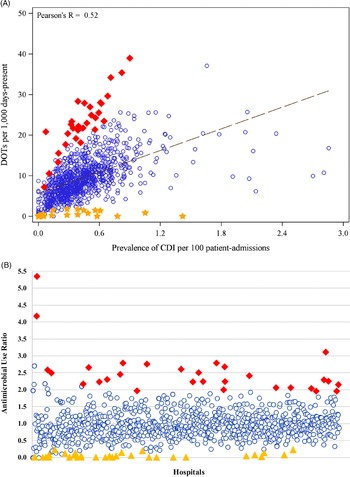
In a linear correlation plot, the prevalence rate of CDI and CDI AU demonstrated a moderately positive correlation (r = 0.52) (Fig. 1A).
Hospitals reporting laboratory-identified Clostridioides difficile infection (CDI) events to the National Healthcare Safety Network in 2019 (n = 963): (A) Correlation of annual hospital-level CDI prevalence and antimicrobial use (AU) for CDI.a (B) Distribution of hospital-level AU ratios.b Note. DOTs, days of therapy; CDI, Clostridioides difficile infection; AU, antibiotic use. aHospitals with extreme discordance are defined with an AU ratio outside of intervigintile range (n = 61). Yellow stars (n = 31) represent hospitals with lower-than-expected CDI AU and red diamonds (n = 30) represent hospitals with higher-than-expected CDI AU. b Hospitals with extreme discordance are defined with an AU ratio outside of intervigintile range (n = 61). Yellow triangles (n = 31) represent hospitals with lower-than-expected CDI AU and red diamonds (n = 30) represent hospitals with higher-than-expected CDI AU.

Negative binomial regression
The independent variables for analysis (CDI prevalence and CDI test type) are summarized in Table 1. Both variables were significantly associated with CDI AU in univariable analysis and were included in the multiple regression model. Hospital-level CDI prevalence, controlling for CDI test type, showed a positive dose–response relationship with CDI AU. On average, hospitals in the tenth or the highest decile, used oral or rectal vancomycin and fidaxomicin at a rate 5.64 times (95% CI, 5.10–6.23; P < .001) higher compared with hospitals in the lowest decile. Rate ratios were 1.79, 2.29, 2.64, 2.97, 3.22, 3.56, 3.94, 4.48 and 5.64 for CDI prevalence deciles 2 through 10, respectively. After adjusting for CDI prevalence, compared with hospitals utilizing NAAT for diagnostic testing, hospitals using toxin EIA tests had higher use of oral or rectal vancomycin or fidaxomicin (rate ratio, 1.16; 95% CI, 1.11–1.23; P < .001).
Negative Binomial Regression to Evaluate the Effect of CDI Test Type on the Association of Quarterly Hospital-Level Prevalence of Clostridioides difficile Infection (CDI) and Antimicrobial Use for CDI Among Hospitals Reporting Laboratory-Identified CDI Events to the National Healthcare Safety Network, 2019 (n = 3,647)

Note. CDI, Clostridioides difficile infection; NAAT, nucleic acid amplification test; EIA, enzyme immunoassay.
a Hospital-level CDI prevalence and CDI test type are independent variables used for risk adjustment.
Distribution of AU ratio
The aggregate AU ratio estimate was 1.03, with overall pooled observed and predicted values of 775,096 and 755,852 DOTs, respectively. For hospital-level AU ratios, the median was 0.93 (IQR, 0.68–1.20) and mean was 0.98 (range, 0–5.34); the values of the estimated fifth and 95th percentile of AU ratios were 0.275 and 1.769, respectively. A distribution of hospital-level AU ratios is shown in Figure 1B.
Characteristics of hospitals with extreme discordance
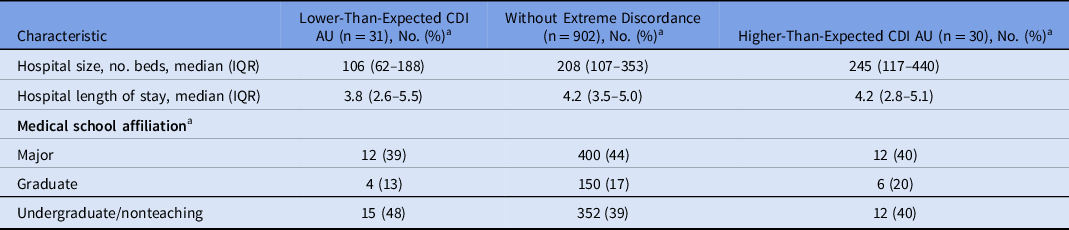
Using this AU ratio metric, we identified 61 hospitals with extreme discordance between CDI prevalence and CDI AU (Table 2). Of these, 31 had lower-than-expected CDI AU (upper limit of AU ratio 95% CI < 0.275), whereas 30 had higher-than-expected CDI AU (lower limit of AU ratio 95% CI > 1.769). Compared with hospitals without extreme discordance (n = 902), hospitals with lower-than-expected CDI AU, on average, had fewer beds (median, 106 vs 208), shorter hospital length of stay (median, 3.8 vs 4.2 days), and higher proportion of undergraduate or nonteaching medical school affiliation (48% vs 39%). In contrast, when compared with hospitals without extreme discordance, hospitals with higher-than-expected CDI AU, on average, had more beds (median, 245 vs 208) but similar length of stay (median, 4.2 vs 4.2 days), and similar likelihood of being an undergraduate or non-teaching hospital (40% vs 39%).
Characteristics of Hospitals With and Without Extreme Discordance Between Annual Hospital-Level Prevalence of Clostridioides difficile Infection (CDI) and Antimicrobial Use (AU) for CDI Among Hospitals Reporting Laboratory-Identified CDI Events to the National Healthcare Safety Network, 2019 (n = 963)

Note. IQR, interquartile range.
a Units unless otherwise indicated.
b Major: facility trains medical students and/or nursing students, and postgraduate medical residents/fellows; graduate: facility trains only postgraduate medical residents or fellows; undergraduate: facility trains current medical students and/or nursing students.
Discussion
This is the first analysis to combine NHSN MDRO/CDI module data and AU Option data to evaluate the association between prevalence of LabID CDI and antibiotic treatment for CDI. This represents an important evolution of the NHSN CDI surveillance work because it enables ongoing surveillance to assess the hospital-level variation in practices for testing and treating CDI. These results demonstrate a positive dose–response relationship between prevalence rate of CDI and rate of oral or rectal vancomycin and fidaxomicin use. Nevertheless, we identified that the prevalence rate of CDI and CDI AU demonstrated only a moderate correlation, which suggests substantial variability in diagnostic and treatment practices for CDI. In addition, we found evidence that providers were more likely to prescribe oral or rectal vancomycin or fidaxomicin based on a positive toxin EIA than a positive NAAT.
We identified a group of hospitals with high CDI prevalence and relatively low use of oral or rectal vancomycin or fidaxomicin, and these hospitals had fewer beds and shorter length of stay than other hospitals in our analysis. Previous research has revealed that smaller hospitals have similar or even higher rates of CDI compared with larger hospitals Reference Stenehjem, Hyun and Septimus8 and that they are less likely to have an established active antimicrobial stewardship program and pharmacy support. Reference Johannsson, Beekmann, Srinivasan, Hersh, Laxminarayan and Polgreen9–Reference Pollack, Van Santen, Weiner, Dudeck, Edwards and Srinivasan12 One possible explanation for the disproportionately low CDI AU is healthcare providers not using vancomycin or fidaxomicin as primary antibiotics for CDI as recommended by the updated IDSA/SHEA guidelines. Smaller hospitals could lack financial resources or access to infectious diseases clinical expertise, Reference Vaughan and Edwards13 and could rely more on metronidazole for treating CDI, which is substantially less expensive than vancomycin or fidaxomicin. Reference Peng, Ling and Stratton14,Reference Gallagher, Reilly, Navalkele, Downham, Haynes and Trivedi15 Furthermore, disease severity could play a role as smaller hospitals may have patients with less severe conditions, which correspond to shorter length of stay. Therefore, it is possible that relatively more patients treated in smaller hospitals are not completing the course of antibiotic treatment prior to discharge, making smaller hospitals appear to have lower usage of CDI AU. In addition, patients with severe conditions who require additional resources for a higher level of care, or prolonged treatment for CDI, may require interfacility transfer. As a result, patients may have been transferred from smaller to larger hospitals for treatment after being diagnosed with CDI, without completing the course of antibiotic treatment at the initial hospital.
Novosad et al Reference Novosad, Mu and Winston16 analyzed 2013–2015 CDI treatment data collected through the CDC’s Emerging Infections Program and identified low provider adherence (47%) to guideline-recommended therapy for severe CDI in outpatient settings. Reference Cohen, Gerding and Johnson17 Their findings on infrequent use of vancomycin monotherapy and fidaxomicin may reflect a lack of provider confidence in the improved efficacy of oral vancomycin and fidaxomicin over metronidazole, and concerns were raised that adherence could continue to be poor. Reference Novosad, Mu and Winston16 Clinician awareness and implementation of treatment practices recommended in the updated IDSA/SHEA guidelines may take time, potentially causing a lag between issuance of guideline updates and changes in clinical practice. Following the release of the updated IDSA/SHEA guidelines, some clinicians have continued to advocate for the use of metronidazole as a first-line therapeutic option for patients with mild CDI who are at low risk of disease complications. Reference Fabre, Dzintars, Avdic and Cosgrove18 Because some hospitals may provide care primarily for patients with milder CDI, they may not have yet adjusted their practices to reflect the updated guidelines.
There are also plausible explanations for hospitals identified as having high use of oral or rectal vancomycin or fidaxomicin despite a low burden of CDI. One possible reason is that clinicians may prescribe antibiotics for CDI without ordering diagnostic tests and instead treat based on clinical suspicion of CDI rather than laboratory test confirmation. In 2010, the Affordable Care Act established 2 value-based incentive programs that linked hospital rates for HAIs with financial incentives and penalties. 19,20 Because data collected via the NHSN MDRO/CDI module are used as HAI performance measures that are tied to incentive payment, laboratory testing for CDI might be less frequently used in some facilities than others, leading to an underestimate of CDI events in those facilities.
After controlling for CDI prevalence in multivariable analysis, hospitals using toxin EIA for CDI diagnostic testing had, on average, higher use of CDI AU in our study. This finding was unexpected because toxin EIA is widely known to have lower sensitivity than NAAT. Reference Madden, German Mesner and Cox21 Therefore, hospitals using toxin EIA as the final testing method would be expected to have lower CDI prevalence. However, it is possible that among some toxin EIA hospitals that also utilized NAAT (eg, NAAT plus EIA), antibiotics were still prescribed for patients who tested NAAT-positive and/or EIA-negative due to suspicion of false-negative results using EIA.
This analysis had several limitations. First, the disease burden of CDI and CDI AU were aggregated and evaluated at the hospital level, and no patient-level clinical data such as symptoms, disease severity, indication for recurrent CDI, and indication for treatment, as well as patient-level demographic information including payer type and socioeconomic status were available for analysis. Therefore, we were not able to determine the appropriateness of diagnostic testing and antibiotic treatment for CDI. Second, because metronidazole can be used to treat a wide variety of infections and indications for the use of antibiotics are not part of NHSN AU Option reporting, we were not able to evaluate the potential contribution of metronidazole use to CDI treatment. Third, we calculated AU ratios to identify hospitals with extreme discordance between CDI prevalence and first-line antibiotics for CDI. However, hospitals with under- or overdiagnosis along with under- or overtreatment for CDI concordantly would not be detected using this metric. Furthermore, AU Option data for all hospitals may not have been accurately reported for all geographic locations. Missing data have the potential to introduce bias and should be considered as a possible rationale for the extreme data. Lastly, because data on laboratory testing methods for CDI were submitted to NHSN quarterly, a small number of hospitals might have been misclassified if they changed testing methods during the data reporting quarter.
Our approach identified a subset of hospitals with extreme dicordance for which CDI prevalence was not aligned with the amount of CDI AU; outreach by the NHSN team to better understand the potential sources of these discrepancies may present opportunities for improving the quality of data reported to the NHSN. One such example is to perform outreach to assess whether LabID CDI and AU data are being collected and submitted using the appropriate NHSN definitions and criteria. In addition, our findings support increased diagnostic stewardship initiatives in hospitals to reduce unnecessary testing, for example, utilizing electronic medical record alerts to help clinicians avoid ordering a test when the patient has had a recent laxative or does not have clinically significant diarrhea. Reference Rock, Pana and Leekha22 The results of this analysis also support the need for hospital antimicrobial stewardship efforts that focus on improving the quality of CDI treatment; this need may increase with further updates in clinical guidance calling for the first-line use of fidaxomicin over even vancomycin. Reference Johnson, Lavergne and Skinner23
In conclusion, the prevalence rate of LabID CDI had a significant dose–response association with first-line antibiotics prescribed for treating CDI in US acute-care hospitals. Our findings identified hospitals with extreme discordance between CDI prevalence and use of first-line antibiotic for CDI. Among these hospitals, consideration should be given to performing additional data validation to assess adherence to standard NHSN reporting protocols. Our findings also highlight potential opportunities for hospitals to improve testing and treatment practices for CDI.
Acknowledgments
The authors thank Nora Chea, MD, MSc, Alice Guh, MD, Margaret Dudeck, MPH, Allan Nkwata, MPH, Nicola Thompson, PhD, Shelley Magill, MD, PhD, and Cheri Grigg, DVM, from the Centers for Disease Control and Prevention for their support of this study. The findings and conclusions in this report are those of the author(s) and do not necessarily represent the official position of the Centers for Disease Control and Prevention.
Financial support
No financial support was provided relevant to this article.
Conflicts of interest
All authors report no conflicts of interest relevant to this article.