Introduction
Self-rated health (SRH) offers a valid means of assessing the overall health and well-being of individuals and populations. Self-reported health is a strong predictor of mortality (Idler & Benyamini, Reference Idler and Benyamini1997; Shadbolt et al., Reference Shadbolt, Barresi and Craft2002; Walker et al., Reference Walker, Maxwell, Hogan and Ebly2004), disability (Mansson & Rastam, Reference Mansson and Rastam2001), health-related behaviour (Manderbacka et al., Reference Manderbacka, Lahelma and Martikainen1998; Cott et al., Reference Cott, Gignac and Badley1999) and factors that affect the health care system, including health care access and utilization (Pinquart, Reference Pinquart2001; Prus, Reference Prus2011). Unmet health care needs may be defined as the difference between the health care services deemed necessary to address a particular health problem and the actual services received (Sanmartin et al., Reference Sanmartin, Houle, Tremblay and Berthelot2002; Marshall, Reference Marshall2011). The phenomenon has been identified as a critical indicator of access to care within health care systems (Chen & Hou, Reference Chen and Hou2002; Sanmartin et al., Reference Sanmartin, Gendron, Berthelot and Murphy2004), and is used to compare access levels across different health care systems (Donelan et al., Reference Donelan, Blendon, Schoen, Davis and Binns1999; Lasser et al., Reference Lasser, Himmelstein and Woolhandler2006). Unmet needs may result from the lack of availability of health care services when and where they are required; individual accessibility problems, such as cost and transportation; or from problems of acceptability, including attitudes towards, and knowledge about, utilizing health care (Nelson & Park, Reference Nelson and Park2006; Sibley & Glazier, Reference Sibley and Glazier2009). While previous studies have examined the association between unmet health care needs and self-perceived health, they have not investigated the relationship between unmet needs and self-rated health in the context of a universal health care system that implements a mandatory social health insurance policy. Earlier studies have explored the association between perceived health and unmet health care needs, including surveys conducted in the United States (Ryan et al., Reference Ryan, Millstein, Greene and Irwin1996; Yu et al., Reference Yu, Bellamy, Schwalberg and Drum2001; Reinhardt et al., Reference Reinhardt, Hussey and Anderson2002) and Canada (Sanmartin et al., Reference Sanmartin, Gendron, Berthelot and Murphy2004; Nelson & Park, Reference Nelson and Park2006; Quail et al., Reference Quail, Addona, Wolfson, Podoba, Lévesque and Dupuis2007; Vingilis et al., Reference Vingilis, Wade and Seeley2007). Furthermore, those studies have rarely factored age differences into this association, having typically focused on particular groups, such as adolescents (Ryan et al., Reference Ryan, Millstein, Greene and Irwin1996; Vingilis et al., Reference Vingilis, Wade and Seeley2007), young adults (Nelson & Park, Reference Nelson and Park2006; Marshall, Reference Marshall2011) or the elderly (Quail et al., Reference Quail, Addona, Wolfson, Podoba, Lévesque and Dupuis2007). In addition, health care utilization has been determined as a predictor of perceived health, particularly regarding the use of preventive health care services. Earlier studies have indicated that an increased likelihood of recent medical check-ups was associated with poorer self-rated health in the US (Culica et al., Reference Culica, Rohren, Ward, Hilsenrath and Pomrehn2002) and the UK (Labeit et al., Reference Labeit, Peinemann and Baker2013). However, the association between medical check-ups and self-perceived health under the universal health care system has not hitherto been investigated. South Korea’s National Health Insurance system provides free health check-ups for the entire population every 2 years, while routine check-ups, which take place in schools and workplaces, are required for younger and middle-aged adults. The impact of attendance at medical check-ups on an individual’s self-perceived health may vary according to age; for example, middle-aged adults may be more likely to engage in regular medical check-ups than are young adults, as the gradual decline of health beginning in midlife may induce concerns for one’s well-being, leading to the use of preventive health care services (Brim et al., Reference Brim, Ryff and Kessler2004; Lachman, Reference Lachman2004). Nonetheless, previous studies have rarely investigated the role of age difference in the association between attendance at medical check-ups and perceived health but have tended to focus on individual age groups (Culica et al., Reference Culica, Rohren, Ward, Hilsenrath and Pomrehn2002; Labeit et al., Reference Labeit, Peinemann and Baker2013).
South Korea’s universal health care system was established in 1989 to ensure reasonable access to health services for all citizens, regardless of their ability to pay. South Korea introduced mandatory social health insurance for industrial workers in 1977 and subsequently extended it to the self-employed before it was eventually made applicable to the entire population in 1989. It is noteworthy that, from the initial introduction of social health insurance, it took a mere 12 years for South Korea to achieve universal coverage across its population (Kwon, Reference Kwon2009; Jeon & Kwon, Reference Jeon and Kwon2013). In 2015, the total number of people covered exceeded 50 million – that is, over 97.1% of the entire population – while the remaining 2.9% were supported by the Medical Aid Program (Health Insurance Corporation, 2015). Meanwhile, despite these measures, many South Koreans continue to encounter obstacles in their attempts to access health care. Out-of-pocket expenses levels are high because of the co-payments required for insured services, full payments for non-insured services and health care-provider reimbursements for fee-for-service payments. Additionally, health care delivery in Korea is heavily reliant on the private sector, with only around 10% of hospitals being public (Jeong, Reference Jeong2011).
The objective of this study was to assess the influence of health care access and use of preventive health care services on perceived health among young and middle-aged adults. Two major hypotheses guide this study. First, there is a significant relationship between perceived poor health and both unmet health care needs resulting from failure to access health care services and attendance at medical check-ups. Second, there is an age difference in the association between poor self-rated health and unmet health care needs and attendance at medical check-ups among young adults and middle-aged adults.
Methods
Subjects
Young adults (N = 1242) aged 20–39 years and middle-aged adults (N = 2389) aged 40–64 years were recruited through the Korea National Health and Nutrition Examination Survey 2015 (KNHANES) performed by the Korea Centers for Disease Control and Prevention. The mean age of the young adults was 30.3±5.8 years while that of the middle-aged adults was 52.4±7.1 years.
Procedures
Following the implementation of the National Health Promotion Act, KNHANES was conducted at 3- to 4-year intervals beginning in 1998, and annually since 2007, targeting a representative sample to extrapolate Korea’s overall national health levels and practices. KNHANES 2015, a cross-sectional study, comprised four sections: Health Interview, Health Attitude and Behaviour, Health Examination and Nutrition.
To obtain a representative sample of the population, this study used a stratified multistage clustered probability sampling method based on age, sex and geographical areas using the 2010 Korean National Census Registry. Based on administrative regions (seven metropolitan cities/nine provinces) and housing types (conventional houses/apartments), 192 primary sampling units (PSUs) were drawn from the whole country. A PSU consisted of an average of 60 households, and 20 final target households were sampled for each PSU using systematic sampling (Kweon et al., Reference Kweon, Kim, Jang, Kim and Kim2014; Ministry of Health and Welfare of Korea, 2016). Investigators selected 3153 households to include a total study population of 9505 individuals from the PSUs. Between January and December 2015, a total of 6704 individuals participated in face-to-face interviews, representing a response rate of 70.5%.
The KNHANES used weighting methodology that allows unbiased national estimates to be produced for the representative Korean population. The participants’ data were assigned weights to adjust for unequal probabilities of selection, non-response and oversampling (Kweon et al., Reference Kweon, Kim, Jang, Kim and Kim2014). The population of 6704 individuals included 1525 aged <20 years, 1242 young adults (20–39 years of age), 2389 middle-aged adults (40–64 years of age) and 1548 older adults (≥65 years). The data analysis was limited to the weighted population of young adults and middle-aged adults.
Measures
Outcome measure
Self-rated health was selected as an outcome measure for this analysis and assessed using a single-item measure of subjective health: ‘How would you rate your current health status in general?’ Five options, as recommended by the World Health Organization (WHO) (World Health Organization, 1996), were offered: ‘very good’, ‘good’, ‘fair’, ‘poor’ or ‘very poor’. Self-rated health responses were dichotomized for statistical analysis as follows: good (very good/good) and fair and poor (fair/poor/very poor).
Health care access and utilization measures
Access to health care was measured by health insurance status and whether care requirements were met. Health care access and utilization were measured using four variables, including health insurance coverage, private health insurance status, unmet health care needs and routine medical check-ups. A lack of health insurance and unmet health care needs resulting from the inability to access health care services have been identified as significant predictors of poor self-perceived health (Chen & Hou, Reference Chen and Hou2002; Sanmartin et al., Reference Sanmartin, Houle, Tremblay and Berthelot2002; Marshall, Reference Marshall2011). Health insurance coverage was determined by self-reported access to National Health Insurance (NHI) or Medical Aid. Private health insurance status was evaluated according to whether individuals had private health insurance. The extent of unmet health care needs was assessed by the following question: ‘During the past 12 months, was there ever a time when you felt that you needed health care services (excluding dental care) but you didn’t receive it?’ A ‘yes’ response was defined as an unmet need. Those who responded in the affirmative were asked then to respond to a second question: ‘Why didn’t you get the required health care services?’ Respondents could select one reason from the following options: (1) service unavailable at time of requirement owing to clinic or hospital opening hours; (2) waiting time too long; (3) couldn’t afford due to cost; (4) problems with transportation; (5) preferred to manage oneself; (6) other. These reasons for unmet health care needs may be classified into three broader categories: barriers to availability (service unavailability, long waiting time), accessibility (cost, transportation) and acceptability (attitude towards management of illness) (Chen & Hou, Reference Chen and Hou2002; Sibley & Glazier, Reference Sibley and Glazier2009). The use of medical check-ups was evaluated by the following question: ‘During the past 2 years, did you ever attend health check-ups?’ Responses were divided into two categories: ‘yes’ and ‘no’.
Sociodemographic measures
Marital status was classified as married or unmarried. The ‘married’ group comprised legally married couples, while the ‘unmarried’ group included single, divorced, separated and widowed individuals. Educational attainment was classified as middle-school or lower, high school graduate and college graduate and above. Occupations were classified into ‘unemployed’, ‘manual or blue collar’ and ‘non-manual or white collar’. Total household monthly income was classified into three categories as follows: ‘low’ (first quartile), ‘medium’ (second and third quartile) and ‘high’ (fourth quartile). The quartiles were calculated based on equivalized income, which was total household income divided by the square root of the numbers of household members.
Measures of health behaviours
Health behaviours measured included smoking habits, alcohol use, limitations experienced in performing daily activities, physical activity, stress and experience of depressed feelings for a minimum of 2 weeks. Smoking habits were classified as non-smoker, ex-smoker and current smoker. Alcohol use levels were classified into ‘low’ (less than once per week), ‘moderate’ (one to three times per week) and ‘high’ (nearly every day). The experience of limitations in performing daily activities was evaluated by asking ‘Do you have functional disability in daily activities due to physical illness or impairment now?’ Response options included ‘yes’ or ‘no’. Physical activity was assessed in terms of two levels: moderate-intensity physical activity and vigorous-intensity physical activity. The practice of moderate-intensity physical activity was evaluated by asking ‘Do you usually perform moderate-intensity physical activity that causes you to become a little breathless and elevates your heart rate slightly (e.g. table tennis, volleyball, badminton, swimming or any other activity, excluding walking) for more than 10 minutes?’ The practice of vigorous-intensity physical activity was assessed by asking ‘Do you usually engage in vigorous-intensity physical activity that causes you to become very breathless and elevates your heart rate significantly (e.g. running, soccer, basketball, mountain climbing or similar aerobic activities) for more than 10 minutes?’ Response options included ‘yes’ (practice) or ‘no’ (no practice). Perceived stress levels were evaluated by asking whether respondents felt ‘light or no’ stress or ‘some or heavy’ stress as a result of everyday events or circumstances (0 = no or nearly no stress, 1 = some or very much stress). Feelings of depression were evaluated by asking ‘Have you experienced continuous feelings of sadness or depression that have affected everyday life for two weeks or longer during the past year?’ using a 2-point answer scale: ‘yes’ or ‘no’.
Data analysis
Bivariate analyses using the chi-squared statistic were performed to evaluate poor self-rated health according to health care access and utilization, health behaviours and sociodemographic variables. Chi-squared tests were conducted to evaluate the disparities in the coefficients between young adults and middle-aged adults. These assessments were followed by multivariate logistic regression analyses to evaluate the influence of independent variables on poor self-rated health. The odds ratio (OR) was used as a measure of association. All statistical analyses were conducted using SPSS (version 20.0, SPSS, Inc., Chicago, IL).
Results
Overall, 64.1% of young adults reported that their health was fair (n = 625; 50.3%), poor (n = 159; 12.8%) or very poor (n = 13; 1.0%), while 35.8% reported that their health was very good (n = 78; 6.3%) or good (n = 367; 29.5%). Meanwhile, 71.0% of middle-aged adults reported that their health was fair (n = 1254; 52.5%), poor (n = 368; 15.4%) or very poor (n = 74; 3.1%), while 29% reported that their health was very good (n = 107; 4.5%) or good (n = 586; 24.5%).
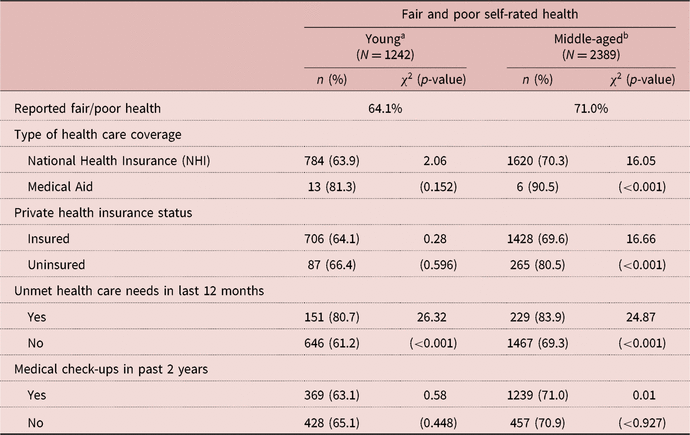
Table 1 illustrates the prevalence of fair and poor self-rated health with respect to health care access and utilization. Among middle-aged adults, Medical Aid recipients and those not privately insured were more likely to rate their health as poor. A history of unmet health care needs during the past 12 months was negatively associated with self-rated health.
Fair and poor self-rated health among young and middle-aged adults in South Korea by health care access and utilization

a Young: 20–39 years;
b middle-aged: 40–64 year.
Calculated using χ 2 tests for categorical variables.
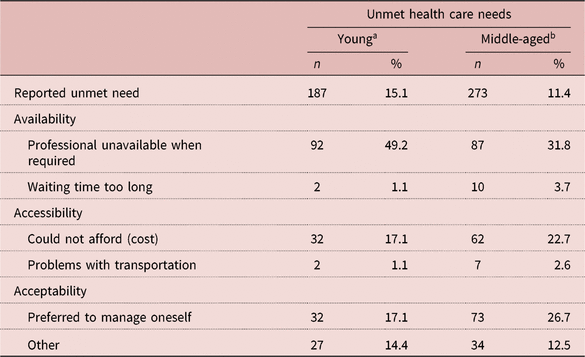
Table 2 illustrates that health care requirements that went unmet due to service availability, such as not being available at the time of requirement, were most frequent (49.2% among young adults; 31.8% among middle-aged adults). The proportion of unmet health care needs resulting from service accessibility and acceptability was lower than that of unmet needs relating to service availability among both young and middle-aged adults (accessibility problems: 17.1% among young adults and 22.7% among middle-aged adults; acceptability concerns: 17.1% among young adults and 26.7% among middle-aged adults).
Reasons for self-perceived unmet health care needs in young and middle-aged adults in South Korea
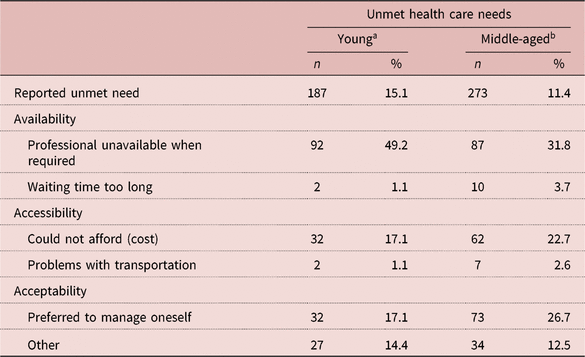
a Young: 20–39 years;
b middle-aged: 40–64 years.
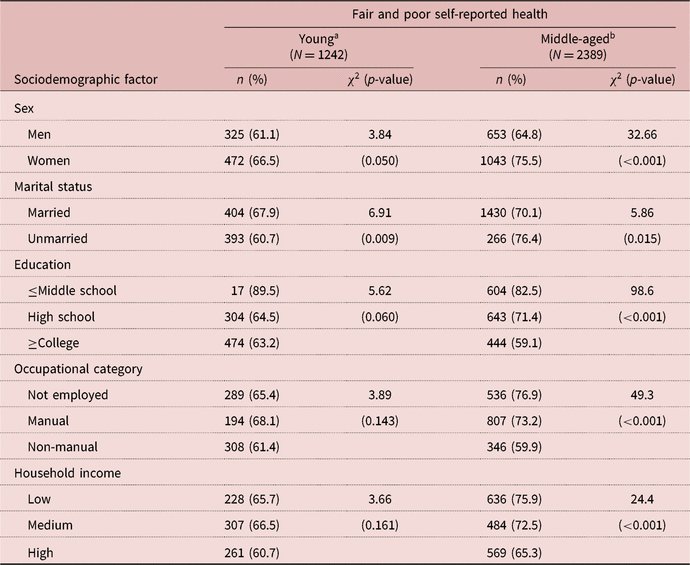
The relationship between sociodemographic status and self-reported fair and poor health was statistically significant (Table 3). Young adults who had spouses perceived their health to be poorer than did those who were unmarried, whereas unmarried middle-aged adults perceived their health to be poorer than did their married peers. Poor education, unemployment, being female and lower household income were all factors that were associated with fair and poor self-rated health, but only among middle-aged adults.
Prevalence of fair and poor self-rated health among young and middle-aged adults in South Korea by sociodemographic status

a Young: 20–39 years;
b middle-aged: 40–64 years.
Calculated using χ 2 tests for categorical variables.
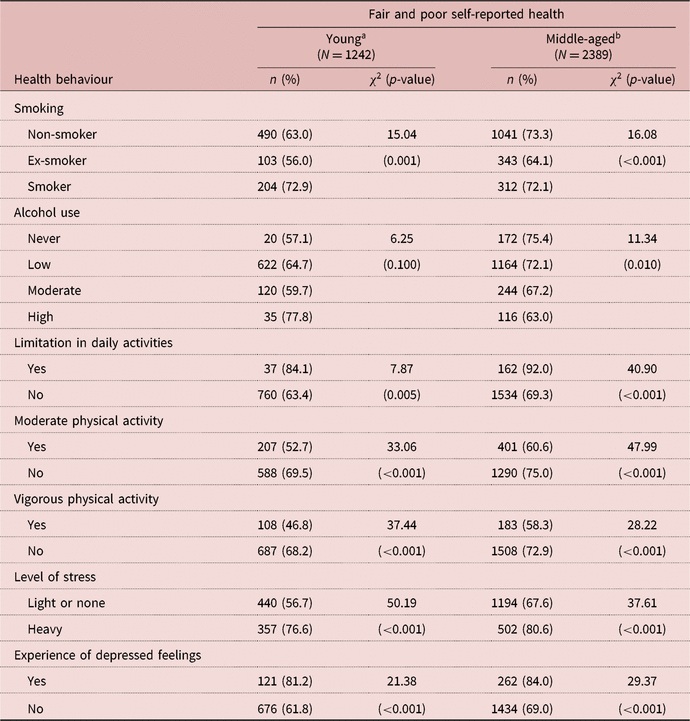
Table 4 demonstrates that fair and poor self-rated health was significantly associated with health behaviours. Young adult smokers perceived their health to be poorer than did non-smokers or ex-smokers. However, middle-aged non-smokers perceived their health as fair and poor in comparison to that of ex-smokers or current smokers. Abstinence from alcohol was significantly related to fair and poor self-rated health among middle-aged adults. Across all age groups, limitations experienced in performing daily activities, lack of engagement in moderate and vigorous physical activity, perceived high stress levels, and the experience of depressive feelings for 2 weeks or longer were negatively associated with self-rated health.
Prevalence of fair and poor self-rated health by health behaviours among young adults and middle-aged adults in South Korea

a Young: 20–39 years;
b middle-aged: 40–64 years.
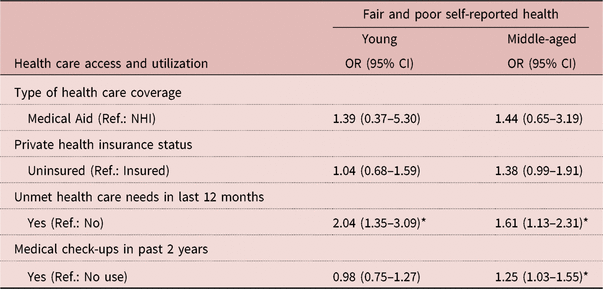
To specifically assess the relationship between health care use and poor self-rated health, multivariate logistic regression analyses were performed (Table 5). After controlling for the effect of other covariates, the results revealed that unmet health care needs stemming from failure to receive required medical treatment during the previous 12 months were independently associated with fair and poor self-rated health among both young (OR = 2.04, confidence interval [CI] = 1.35–3.09) and middle-aged adults (OR = 1.61, CI = 1.13–2.31). Attendance at medical check-ups during the previous 2 years was significantly associated with fair and poor self-rated health, especially among middle-aged adults (OR = 1.25, CI = 1.03–1.55).
Adjusted odds ratios (95% confidence intervals) for fair and poor self-rated health by health care access and utilization among young and middle-aged adults in South Korea

Adjusted for participants’ sociodemographic factors and health behaviours, sex, marital status, educational attainment, occupational category, household income, smoking, alcohol use, limitation in daily activities, moderate physical activity, vigorous physical activity, level of stress and depressive feelings.
* p < 0.05.
Discussion
The purpose of this study was to investigate the contribution of health care access and use of preventive health care services to self-perceived health among young and middle-aged adults. The findings supported both of the study’s hypotheses, in that they revealed significant associations between fair and poor self-rated health and unmet health care needs resulting from lack of health care access and attendance at medical check-ups, and significant differences pertaining to these associations according to age. The most notable finding of the study concerned the significant influence of unmet health care needs on fair and poor perceived health, especially among young adults. Attendance at medical check-ups was significantly associated with fair and poor self-rated health among middle-aged adults.
Relationship between unmet health care needs and fair and poor self-rated health among young adults
The multivariate analysis indicated that a history of unmet health care requirements during the past 12 months was strongly associated with fair and poor self-rated health, especially among young adults. This finding has at least three potential explanations.
First, needs that go unmet owing to lack of service availability may have a negative impact on adults’ self-rated health, particularly among young adults. In this study, lack of service availability, including lack of availability at a suitable time, was observed to be the most prevalent cause of unmet health care needs among all subjects (50.3% among young adults; 35.5% among middle-aged adults). Previous studies have demonstrated that unmet needs related to lack of service availability were strongly associated with poor self-rated health (Sanmartin et al., Reference Sanmartin, Houle, Tremblay and Berthelot2002, Reference Sanmartin, Gendron, Berthelot and Murphy2004; Nelson & Park, Reference Nelson and Park2006). For example, 6.6% of people who claimed to be in poor or fair health reported unmet health care needs due to availability problems, in contrast to a mere 2.2% of people in good, very good or excellent health (Chen & Hou, Reference Chen and Hou2002) who reported the same.
Second, the financial cost associated with accessing health care services may result in the correlation between unmet health care needs and fair and poor self-rated health, especially among young adults. Although the majority of the population are covered by the universal health insurance system, the Korean insured individual is required to pay relatively high co-payments for insured health care services, such as 34% of treatment fees in physician clinics and 50% for hospitals (Kwon, Reference Kwon2009; Song, Reference Song2009). Young adults are more likely to be in less stable and less financially secure environments, in comparison with those at later stages of life. Generally, young adults have finished school, left their parental homes and become economically independent, but have experienced less employment security (Shanahan, Reference Shanahan2000; Arnett, Reference Arnett2004; Marshall, Reference Marshall2011). It may be presumed that the financially insecure environments in which young adults find themselves directly or indirectly affect the perceived association between unmet health care needs and poorer health.
Third, although the determination of a distinct pathway between unmet health care needs and fair and poor self-perceived health is challenging, the imbalance between the propensity towards greater needs for health care services and frustrated efforts to access medical services may cause needs to go unmet among young adults with fair and poor self-rated health. These young adults may define themselves as ill and therefore experience greater health care needs than those reporting good self-perceived health. Previous studies have indicated that individuals with poorer self-rated health are more likely to visit physicians (Vingilis et al., Reference Vingilis, Wade and Seeley2007), and that this propensity is significantly associated with higher levels of unmet health care needs (Sanmartin et al., Reference Sanmartin, Houle, Tremblay and Berthelot2002, Reference Sanmartin, Gendron, Berthelot and Murphy2004; Saxena et al., Reference Saxena, Eliahoo and Majeed2002; Marshall, Reference Marshall2011). Individuals reporting fair and poor self-rated health were found to be around three times more likely to experience unmet health care needs than those reporting good self-rated health, after adjustment for confounding factors (Newacheck et al., Reference Newacheck, Hughes, Hung, Wong and Stoddard2000).
Relationship between medical check-ups and fair and poor perceived health in middle-aged adults
This study found that middle-aged adults who had attended medical check-ups during the preceding 2 years reported poorer self-rated health. Three possible explanations for this may be posited.
First, considering the perceived benefit of preventive measures, middle-aged adults who report poorer self-rated health may be more likely to attend regular medical check-ups, compared with individuals who report good self-rated health. From the perspective of the Health Belief Model (Rosenstock, Reference Rosenstock1966), individuals are more likely to engage in a given health-related behaviour when they believe that the intervention will be effective, and when they anticipate few obstacles to utilizing the intervention (Henshaw & Freedman-Doan, Reference Henshaw and Freedman-Doan2009; Carpenter, Reference Carpenter2010). Middle-aged adults who report poor self-rated health may be more likely to perceive themselves as susceptible to negative health outcomes and to recognize the benefits of engaging in preventive measures such as regular medical check-ups. Moreover, the free health check-ups available in South Korea may diminish any perceived obstacles to attending routine medical check-ups. As previously mentioned, all South Korean citizens are eligible for free health check-ups every 2 years through the National Health Insurance programme. Earlier studies have demonstrated that comprehensive health insurance coverage for preventive services is associated with a greater likelihood of attending medical check-ups (Saver & Peterfreund, Reference Saver and Peterfreund1993; Faulkner & Schauffler, Reference Faulkner and Schauffler1997; Culica et al., Reference Culica, Rohren, Ward, Hilsenrath and Pomrehn2002).
Second, self-awareness of one’s ageing process may have an impact on the relationship between regular health check-ups and poorer self-rated health among middle-aged adults. Middle-aged individuals generally have keen awareness of themselves as ageing, owing to various changes that their lives and environments might undergo, including early retirement or retirement, unemployment and bereavement (Weiss, Reference Weiss2005; Alavinia & Burdorf, Reference Alavinia and Burdof2008; Cornwell & Waite, Reference Cornwell and Waite2009). These changes in midlife may induce concerns for one’s health or poor self-perceived health and thereby lead to engagement in preventive health behaviours, including regular attendance at medical check-ups. Earlier studies have demonstrated that retirement and unemployment are both associated with poor self-rated health (Bartley et al., Reference Bartley, Sacker and Clarke2004; Karpansalo et al., Reference Karpansalo, Manninen, Kauhanen, Lakka and Salonen2004; Cai & Kalb, Reference Cai and Kalb2006). Furthermore, one study has suggested that middle-aged adulthood is the stage of life during which one is most likely to engage in preventive health behaviours (Levy & Myers, Reference Levy and Myers2004).
Third, while the elucidation of a direct pathway between attendance at medical check-ups during the preceding 2-year period and poorer self-rated health is challenging, the results of this study nonetheless indicate that chronic conditions may indirectly affect the association between routine health check-ups and perceived fair and poor health in middle-aged adults. Earlier studies have reported that chronic illnesses were significantly associated with poor self-perceived health among adults (Saver & Peterfreund, Reference Saver and Peterfreund1993; Fontana et al., Reference Fontana, Baumann, Helberg and Love1997; Labeit et al., Reference Labeit, Peinemann and Baker2013; McDaid et al., Reference McDaid, Hanly, Richardson, Kee, Kenny and Savva2013), especially in middle-aged adults (Cott et al., Reference Cott, Gignac and Badley1999; Molanius & Janson, Reference Molanius and Janson2002; Jonnalagadda & Diwan, Reference Jonnalagadda and Diwan2005; Latham & Peek, Reference Latham and Peek2013). Additionally, sustained contact with the health care system through outpatient health services due to chronic conditions may result in the use of preventive services, including regular health examination (Faulkner & Schauffler, Reference Faulkner and Schauffler1997).
Three limitations can be identified in this investigation. First, the self-reported nature of the information regarding unmet health care requirements may be open to interpretation. Despite the face validity of the findings regarding self-reported unmet needs, the data were not verified through clinical or other sources. Therefore, self-reported instances of unmet health care needs may be over- or underestimated. More objective determinations of whether necessary care was available and accessed might be made by health professionals through a process of clinical examination (Newacheck et al., Reference Newacheck, Hughes, Hung, Wong and Stoddard2000; Chen & Hou, Reference Chen and Hou2002; Nelson & Park, Reference Nelson and Park2006). Future research should consider both perceived and evaluated health care service needs as measured by professional assessment. Second, the possibility of selection bias cannot be ruled out because the subjects were limited to 3631 adults aged 20–64 years. These were selected from the total population following the exclusion of older adults aged ≥65 years, and this exclusion may have resulted in a biased study sample. Third, various medical problems may affect the association between unmet health care service needs and poor perceived health among young adults. It may be assumed that individuals with medical problems are those most in need of health care services, and as such are also likely to recognize health care service deficiencies (Chen & Hou, Reference Chen and Hou2002). Future analyses should consider the influence of various physical or mental health problems when investigating the association between unmet health care needs and poor perceived health among young adults.
In conclusion, this study’s findings suggest that, despite South Korea’s universal public insurance system, there remains the need to improve access to health care services, especially among young adults. Considering that health care use patterns are established in young adulthood, the phenomenon of health care requirements remaining unmet must be resolved, and this measure may, in turn, safeguard against undesirable health consequences for older adults. As a health improvement strategy, it is imperative that measures be taken to promote the availability of health care services when they are required and to solve any of the various individual accessibility problems, such as cost, particularly with young adults in mind. To address the problem of health care needs going unmet as a result of lack of service availability, health care institutions, including primary clinics and hospitals, should consider flexible and convenient operating schedules, facilitating, for example, access to care in the mornings before work commences, during lunch breaks or in the evening after work, particularly targeted at younger adults. Health care facilities must aim to provide the various information, counselling, diagnostic, treatment and care services that address the full spectrum of young adults’ health care needs. Additionally, financial support aimed at reducing the burden of health care costs should be made readily available to young adults.
Funding
This research received no specific grant from any funding agency in the public, commercial, or not-for- profit sectors.
Conflicts of Interest
The authors have no conflicts of interest to declare.
Ethical Approval
Informed consent was obtained from all participants. The authors assert that all procedures contributing to this work comply with the ethical standards of the relevant national and institutional committees on human experimentation and with the Helsinki Declaration of 1975, as revised in 2008. Approval to conduct a study of human subjects was awarded by the Korea Centers for Disease Control and Prevention research committee.