Introduction
Cover crops and bio-waste compost are key components of sustainable fertility practices aiming at improving fertilization efficiencyReference Wezel, Casagrande, Celette, Vian, Ferrer and Peigne 1 . The combination of the two components improves soil organic carbon (C) and nitrogen (N)Reference Messiga, Sharifi, Hammermeister, Gallant, Fuller and Tango 2 , meets crops N and phosphorus (P) requirements, and improves soil quality and healthReference Sharifi, Lynch, Hammermeister, Burton and Messiga 3 , Reference Wang, Radovich, Pant and Cheng 4 . The role of cover crops in the system, however, depends on the quantity and quality of plant biomass including above and below ground residues incorporated into the soilReference Teasdale, Abdul-Baki and Park 5 , Reference Kramberger, Gselman, Janzekovic, Kaligaric and Bracko 6 . In addition, studies have shown that there is a positive interaction between cover crops and organic amendmentsReference Messiga, Sharifi, Hammermeister, Gallant, Fuller and Tango 2 , Reference Lynch, Sharifi, Hammermeister, Burton, He, Larkin and Honeycutt 7 .
Cover crops have the potential to positively influence agroecosystems environmentally. In low-inputs and organic farming systems, legume cover crops represent an important source of N for cash cropsReference Thorup-Kristensen, Magid and Jensen 8 . In conventional agriculture, N inputs from legume cover crops can reduce the use of N fertilizers, thus decreasing the cost of crop production and reducing the environmental footprints of cropping systemsReference Gan, Liang, Chai, Lemke, Campbell and Zentner 9 . Non-legume cover crops are known to be efficient at preventing soil erosion, trapping N and reducing N leaching to the water tableReference Sanchez, Harwood, Willson, Kizilkaya, Smeenk, Parker, Paul, Knezek and Robertson 10 , Reference Constantin, Beaudoin, Laurent, Cohan, Duyme and Mary 11 .
Mixing legumes and non-legumes can be an efficient tool to take advantage of the benefits of a single species in farming practiceReference Ranells and Wagger 12 . The mixtures of vetch (Vicia villosa) and barley (Hordeum vulgare L.) or field bean (Vicia faba) and rapeseed (Brassica napus) have shown that they allow the control of N supply and release for the succeeding maize or tomatoReference Boldrini, Guiducci, Benincasa, Tosti and Tei 13 , Reference Benincasa, Tosti, Tei and Guiducci 14 . In Italy, it has been recently demonstrated that a mixture of vetch and barley can buffer the agroecosystems in Mediterranean conditions by acting as N trapping crop able to reduce N leachingReference Tosti, Benincasa, Farneselli, Tei and Guiducci 15 . In Slovenia, Italian ryegrass (Lolium multiflorum Lam.)-based mixtures containing high proportions of crimson clover (Trifolium incarnatum) can sustain maize yields and N contents similar to those produced by pure crimson clover in addition to a suite of ecological advantagesReference Kramberger, Gselman, Kristl, Lesnik, Sustar, Mursec and Podvrsnik 16 . Other research studies, however, have shown variable yields of cash crops following cover crop mixtures compared with legume pure standsReference Kramberger, Gselman, Janzekovic, Kaligaric and Bracko 6 , Reference Kuo and Jellum 17 , Reference Tonitto, David and Drinkwater 18 .
Bio-wastes products can be considered valuable resources to promote fertility if they are applied according to good practices taking into account the needs of the soil, its use and the climate conditionsReference Diacono and Montemurro 19 , Reference Martinez-Blanco, Lazcano, Christensen, Munoz, Rieradevall, Moller, Anton and Boldrin 20 . The diversion of these valuable bio-waste products on cropland avoids utilization of non-renewable resources, treatment and landfill disposalReference Mondini and Sequi 21 . Recently, the main factors affecting the range, performance and degree of proof of agronomic benefits associated with the use of bio-waste composts were reviewed and relevant non-significant results were also highlightedReference Martinez-Blanco, Lazcano, Christensen, Munoz, Rieradevall, Moller, Anton and Boldrin 20 .
During the past decades, diverse cover crop mixtures combined with bio-waste composts have been implemented in various cropping systems in Nova Scotia, CanadaReference Messiga, Sharifi, Hammermeister, Gallant, Fuller and Tango 2 , Reference Sharifi, Lynch, Hammermeister, Burton and Messiga 3 , Reference Lynch, Sharifi, Hammermeister, Burton, He, Larkin and Honeycutt 7 . The ability to improve soil quality and N cycling and the influence on crop yields was compared with synthetic fertilizers and contrasting results were obtainedReference Messiga, Sharifi, Hammermeister, Gallant, Fuller and Tango 2 , Reference Sharifi, Lynch, Hammermeister, Burton and Messiga 3 , Reference Lynch, Sharifi, Hammermeister, Burton, He, Larkin and Honeycutt 7 . Visual observations indicated differences in plant biomass produced by the cover crops and returned to soil as a result of organic amendment application, but little effort has been made to assess their quantity and quality due to associated management constraintsReference Wezel, Casagrande, Celette, Vian, Ferrer and Peigne 1 . Thus, it is not clear how cover crop mixtures interact with bio-waste composts and whether variations observed in their fertilization efficiency could be associated with the quantity and quality of plant biomass they produce. We hypothesized that combinations of cover crops and bio-waste composts will: (1) increase plant biomass and total nutrient uptake and (2) reduce synthetic fertilizer inputs. The objective of this study was to assess the effect of combining cover crops and bio-waste composts on: (a) the quantity of above and below ground plant biomass and total nutrients uptake including N, P and K and (b) the residual soil available P and K contents.
Materials and Methods
General characteristics of municipal solid food waste (MSFW) compost and soil
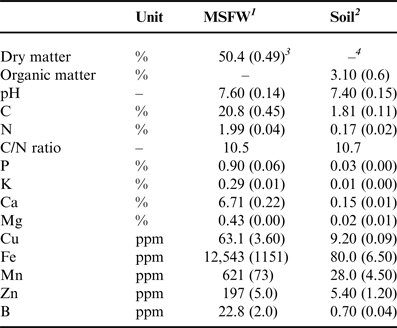
MSFW compost was obtained from Lunenburg Regional Community Recycling Centre, Nova Scotia, Canada. The Centre is jointly owned by the Municipality of Lunenburg and the Towns of Mahone Bay and Bridgewater, serving a population of about 34,000 residents. The Centre manages around eight different waste streams, ensuring as much material being recycled as possible. Wastes include organics, recyclables, papers and garbage, household hazardous wastes, construction and demolition wastes, woodchips, drywalls, asphalt shingles and metals, were all treated in the waste diversion facility of the Centre. Table 1 shows the elemental composition and physical characteristics of MSFW used in this study.
The average chemical characteristics of source separated MSFW compost and soil used in the greenhouse experiment.

1 Total element analysis was used to determine element content of MSFW.
2 Mehlich-3 extraction was used to determine available macro- and micronutrients content of the soil.
3 Values in parentheses represent standard deviation of the mean (n = 3).
4 Not measured.
Soil (0–20 cm) was collected in November 2010 using a shovel from the Petite Riviere St. Mary's Vineyard located in Crousetown, Nova Scotia, Canada (44′86°N, 64′75°W) in the LaHave River Valley Wine Region. The soil is a Bridgewater loam-drumlin phase soil (Cryorthods under the US Soil Taxonomy) 22 characterized by light texture, low organic matter content, low fertility status and low water-holding capacity. The gravelly sandy clay loam soil was developed on slate-derived till overlying a granite batholithReference Webb and Marshall 23 . It is moderately well-drained, shallow and stony. Lunenburg County is characterized by an undulating to rolling drumlinized till plain that slopes in a southeasterly direction toward the Atlantic Ocean. Elevations range from a high of about 270 m inland. Table 1 shows selected general properties of the soil.
Greenhouse trial: experimental design and treatments
Twelve combinations of three organic amendment treatments [control (CONT), synthetic fertilizer (FERT), and MSFW] and four cover crop mixtures [oat (Avena sativa) (Fig. 1a), oat combined with hairy vetch (OHV) (Fig. 1b), oat combined with red clover (Trifolium pretense) (ORC) (Fig. 1c); and triple mix (TM) (Fig. 1d) consisting of mixture of 70% timothy (Phleum pretense) + 15% red clover + 15% alsike (Trifolium hybridum)] were assigned to a completely randomized design replicated three times. Control plots received 83 kg K ha−1 as potassium sulfate (K2SO4) fertilizers based on local soil test recommendations. The FERT treatment consisted of a mixture of 20 kg N ha−1 as ammonium nitrate (NH4NO3) and 83 kg K ha−1 as K2SO4. MSFW was applied at the rate 65 Mg ha−1 supplemented with 83 kg K ha−1 as K2SO4 based on the assumption that 15% N will be available during the growing season and that K content of MSFW was negligible (Table 1). Average Mehlich-3 soil test P (PM3) was 250 kg ha−1 corresponding to the optimum range and therefore fertilizer P was not applied to the soil.
General view of potted cover crops [(a) oat alone, (b) oat and hairy vetch, (c) oat and red clover and (d) Triple mix (timothy and alzike clover and red clover)] as influenced by fertility treatments in the greenhouse in March 14, 2011.

Pots (12.5 cm diameter and 30 cm height) were filled with 200 g of washed gravel to facilitate drainage. One kg of air-dried soil (sieved at 4.75 mm) was mixed with the respective amount of synthetic fertilizer or MSFW and filled back into the pots. Cover crops were seeded on December 22, 2010 in germination trays. After germination, seedlings were transplanted to prepared pots based on the seeding rates for mixtures. The rates were doubled plus 1–2 plants, to ensure enough plants survived the transplant. Two to three weeks after transplanting, plants were thinned, so that the number of plants per pot equalled two times the recommended plant density for each species in the mixture to ensure enough plants survived until harvest. Pots were rotated geographically on a weekly basis to minimize the effects of greenhouse architecture on plant growth (i.e., shading). Plants were watered two to three times per week based on pot weights to maintain soil moisture content at approximately 55% water filled pore space. Weed control was performed when necessary and uprooted weeds were returned to the pots. Greenhouse temperature was adjusted to 18–22°C and relative humidity and air CO2 concentration were kept at 75 and 40% to maintain optimal vapor pressure deficit at 3.3–4.3 gm m−3. The day/night length and light intensity were kept at the ratio 16/8 h and 400/500 ppm using supplemental 400 W light source.
Plants were harvested twice with the first harvest on March 14, 2011 and the second harvest on April 19, 2011. For the second harvest, the whole plant was separated into above ground and below ground parts. All plant samples (above ground biomass for the first and second harvest and below ground biomass for the second harvest) were oven-dried at 60°C for 48 h and dried shoots and roots were weighed for biomass. Shoot DM weight was calculated as the sum of its values from first and second harvests, while root DM weight was considered as the value of second harvest. Oven-dried shoot and root were ground using a ball mill fitted with a 1-mm screen. Nitrogen concentrations of shoot and root were analyzed using a LECO CNS-1000 analyzer (LECO Corporation, St. Joseph, MI, USA). Phosphorus and K concentrations were determined using the dry ash methodReference Westerman 24 . Briefly, a 1.0-g sample was heated at 550°C for 4 h, extracted with 10-ml 2 N hydrochloric acid and brought to 50-ml volume using deionized distilled water and filtered through Whatman no. 42 filter paper. The P and K concentrations in the extracts were analyzed by inductively coupled plasma mass spectrometry (ICP-MS) and contents were calculated by multiplying the P and K concentrations by DM weight. The N, P and K contents of shoot were calculated as the sum of their values from first and second harvests, while those of root were considered as the values of second harvest. The N, P and K uptakes were calculated as the sum of shoot and root contents. The P and K uptakes were assessed to determine whether they would be driven by DM weight and to some extent N uptake or MSFW P and K availability affected by their uptake. Soil samples from each pot were collected after final harvest, air-dried, ground and passed through a 2-mm sieve. Processed soil samples were extracted by Mehlich-3 solutionReference Ziadi, Tran, Carter and Gregorich 25 and PM3 and Mehlich-3 extractable K (KM3) in the extracts were determined using ICP-MS. The PM3 and KM3 were assessed to determine whether MSFW application resulted in accumulation of the available forms of these nutrients in the soil.
Statistical analysis
Data were tested for normality using the univariate procedure and analysis of variance for shoot and root DM weights, N, P and K uptakes, PM3 and KM3 were performed using Proc Mixed of SAS, version 9.3 26 with replicates as random effects, cover crops, fertility treatments and two-way interactions as fixed effects. Differences among least-square means (LSMEANS) for all treatment pairs were tested at a significance level of P = 0.05. In addition, standard error of the means (SEM) were calculated.
Results and Discussion
Shoot and root DM
Cover crops exhibited differences in shoot and root DM weights as expected. The highest shoot DM weight was obtained with ORC × MSFW combination followed by ORC × CONT, TM × MSFW and ORC × FERT combinations, but the lowest was obtained with combinations involving only oat (Fig. 2a). Shoot DM produced by ORC increased by 30% with the addition of MSFW compared with CONT, but decreased by 6% with the addition of FERT. Shoot DM produced by TM increased by 36% with the addition of MSFW compared with CONT, but remained constant with the addition of FERT. Shoot DM produced by OHV was not influenced by MSFW or FERT; however, oat shoot DM was significantly increased only by FERT (41%).
Dry matter of (a) shoot (sum of two cuts) and (b) root of various cover crops following application of MSFW compost and synthetic fertilizer (FERT). OHV (mixture of oats–hairy vetch), ORC (mixture of oats–red clover), TM (mixture of 70% timothy and 15% alsike and 15% red clover), CONT (Control). Error bar represents the SEM for comparing all values (n = 36; 24 df).

The highest root DM weight were obtained with ORC × CONT, TM × FERT, and TM × MSFW followed by ORC × MSFW combinations, while the lowest root DM weights were also obtained with oat (Fig. 2b). Root DM weight produced by ORC was decreased by 11% with the addition of MSFW compared with CONT, but 33% with FERT. In contrast, root DM weight of TM was increased by 20% with the addition of MSFW and FERT compared with CONT, while no significant differences were observed with oat.
Shoot DM weights measured in this study can be considered representative of trends found in the literature: increased DM weight in grass-legume cover crop mixtures compared with pure standsReference Tosti, Benincasa, Farneselli, Tei and Guiducci 15 , Reference Lithourgidis, Vasilakoglou, Dhima, Dordas and Yiakoulaki 27 . Among the cover crop mixtures, those including clovers [ORC (red clover) and TM (15% red clover and 15% alsike clover)] produced the highest shoot DM weight compared with hairy vetch (OHV) (Fig. 2a). Root DM weights followed a similar pattern with mixtures including clovers having the highest values and pure stand of oat the lowest. Differences in DM weight between cover crop mixtures could be explained by growth characteristics and proportion of legume species in the mixture. Clovers are more versatile than vetch. At two sites in the USA, crimson clover DM yield was numerically greater compared with hairy vetchReference Liang, Grossman and Shi 28 . A study using benefit–cost analysis found that the contribution to soil organic matter was greater with crimson clover compared with hairy vetchReference Pratt, Tyner, Muth and Kladivko 29 . In a long-term experiment in the USA, the contribution to soil organic C was greater with crimson clover compared with hairy vetch in 2 out of 4 yearsReference Sainju, Singh and Whitehead 30 . The high proportion of timothy (70%) in TM could also partly explain the greater DM weight in TM compared with OHV mixture. A comparison of several cover crop mixtures at three sites in Sweden showed that differences in DM weight were due to the proportion of red clover and timothy in the mixturesReference Lindström, Frankow-Lindberg, Sigrun Dahlin, Watson and Wivstad 31 .
The higher biomass yielding capacity of cover crop mixtures including grasses and legumes compared with pure stands was highlighted in a three-year study in Italy where higher DM weight was obtained with barley-vetch mixture compared with pure barley or hairy vetchReference Benincasa, Tosti, Tei and Guiducci 14 . In Greece, some authors also found that oat-vetch mixtures provided greater biomass yield than pure hairy vetchReference Lindström, Frankow-Lindberg, Sigrun Dahlin, Watson and Wivstad 31 . In Nova Scotia and elsewhere, the use of cover crop mixtures including legumes and non-legumes species is a strategy to take advantage of the benefits promoted by each. Our results demonstrate that ORC, TM and to a lesser extent OHV are promising cover crop mixtures to be used in cropping systems for their above and below ground characteristics. In the oat- and timothy–legume-based mixtures, oat and timothy as non-legume species are mainly useful to prevent soil erosion, trap N and reduce its leaching to the water table, while legume companions supply relevant amount of N derived from atmosphere to the systemReference Benincasa, Tosti, Tei and Guiducci 14 . In addition, oats can also provide structural support for vetch to climb. The cover crop mixtures with their high biomass could be beneficial for major cropping systems in Nova Scotia including vineyards and potatoes as the first are generally established on sloping and coarse-textured soils susceptible to erosion and the second on sandy soils with low organic matterReference Messiga, Sharifi, Hammermeister, Gallant, Fuller and Tango 2 , Reference Sharifi, Lynch, Hammermeister, Burton and Messiga 3 , Reference Lynch, Sharifi, Hammermeister, Burton, He, Larkin and Honeycutt 7 . Our study was conducted in a greenhouse and therefore cover crops were not exposed to some environmental constraints found on-farm situations. For example, for most annual crops, there is not enough time and growing degrees days to get a cover crop established after harvest and during winter in cool temperate climates. Interseeding cover crops into crop stands early in the growing season allows cover crop establishment and biomass productionReference Uchino, Iwama, Jitsuyama, Ichiyama, Sugiura, Yudate, Nakamura and Gopal 32 , Reference Uchino, Iwama, Jitsuyama, Yudate and Nakamura 33 . Interseeding cover crops is a good option for weed control particularly in organic management systemsReference Uchino, Iwama, Jitsuyama, Ichiyama, Sugiura and Yudate 34 . Some constraints, however, are associated with interseeding cover crops including competition with main crops for light, nutrient and water. An understanding of cover crop's characteristics and proper management is therefore necessary to take advantage of the benefits of this practice. Cover crop species and cultivars, growth pattern, interactions with herbicides, cost of seed, rapidness of seedling establishment and sowing date are important factors that should be taken into account.
Our results showed that cover crops that include clover in their mixture (ORC and TM) were highly responsive to MSFW, but were less responsive to N fertilizer. This observation has important implications on synthetic fertilizer management. Introducing interseeding cover crops into cropping systems may result in competition for nutrients, water and light between cover crops and the main cropReference Marques, García-Muñoz, Muñoz-Organero and Bienes 35 – Reference Rodrigues, Correia, Claro, Ferreira, Barbosa, Moutinho-Pereira, Bacelar, Fernandes-Silva and Arrobas 37 . Increase in nutrients input rate due to cover crop inclusion might result in a low adoption rate of this practice by farmers regardless of the potential benefitsReference Gan, Liang, Chai, Lemke, Campbell and Zentner 9 , Reference Epie, Cass and Stoddard 38 , Reference Poeplau and Don 39 . Our study demonstrates that MSFW compost could supplement synthetic fertilizers as a source of nutrients to ensure the growth of cover crops that include clover in their mixtures without negative effects on the targeted cash crop in conventional production systems. In Nova Scotia, a study showed that annual legume green manures and off-farm composts can be used to satisfy potato N requirement and maintain soil quality in organic potato rotationsReference Sharifi, Lynch, Hammermeister, Burton and Messiga 3 . In a vineyard production system in Nova Scotia, researchers have also demonstrated that combinations of cover crops and organic or industrial wastes provide comparable soil mineral N supply and available P with fertilized treatments while improving soil physical and biological properties and overall soil qualityReference Messiga, Sharifi, Hammermeister, Gallant, Fuller and Tango 2 . Off-farm composts can therefore ensure cover crops’ needs for nutrients and improve the growth of cover crops and cash crops. Thus, combining cover crops and off-farm organic wastes including MSFW can reduce the reliance of cropping systems on inorganic fertilizersReference Wezel, Casagrande, Celette, Vian, Ferrer and Peigne 1 , Reference Sharifi, Lynch, Hammermeister, Burton and Messiga 3 . Constraints to the use of MSFW and other bio-wastes as source of nutrient and soil conditioners in agriculture have been addressed in the literature including buildup of trace elementsReference Pinamonti, Nicolini, Dalpiaz, Stringari and Zorzi 40 , Reference Zheljazkov and Warman 41 and other persistent organic pollutantsReference Logan, Henry, Schnoor, Overcash and McAvoy 42 . However, current regulations by Canadian Environmental Quality Guidelines only permit application of MSFW if the metal concentrations are below the recommended threshold.
Nutrients uptake by cover crops
Cover crops exhibited differences in nutrients uptake (N, P and K) with the lowest amounts in oat (Fig. 3a). For N, the highest uptakes were obtained with ORC × MSFW combination followed by ORC × CONT and TM × MSFW combinations (Fig. 3a). Nitrogen uptake by ORC was increased by 22% with the addition of MSFW compared with CONT, but decreased by 22% with FERT due principally to decreased shoot and root DM weight. Nitrogen uptake by TM was increased by 34% with the addition of MSFW compared with CONT, but only 5% with FERT. In contrast, there was a decreasing trend of N uptake by OHV with additions of MSFW (13%) and FERT (6%) compared with CONT. Nitrogen uptake by oat was increased by 30% with additions of MSFW and 14% with FERT compared with CONT.
Uptake of (a) nitrogen, (b) phosphorus and (c) potassium by various cover crops following application of municipal solid waste food compost (MSFW) and synthetic fertilizer (FERT). OHV (mixture of oats–hairy vetch), ORC (mixture of oats–red clover), TM (mixture of 70% timothy and 15% alsike and 15% red clover), CONT (Control). Error bar represents the SEM for comparing all values (n = 36; 24 df).

For P, the highest uptakes for all cover crops were obtained with additions of MSFW, while the lowest uptakes were obtained with FERT except for oat (Fig. 3b). The FERT treatment resulted in low P uptake across cover crops because it did not contain P. The P uptake by ORC was increased by 30% with addition of MSFW compared with CONT, but decreased by 17% with FERT. The P uptake by TM was increased by 50% with the addition of MSFW compared with CONT, but remained constant with FERT. The P uptake by OHV was increased by 16% with the addition of MSFW compared with CONT, but decreased by 11% with FERT. The P uptake by oat was increased by 67% with additions of MSFW and 40% with FERT compared with CONT.
For K, the highest uptakes were obtained with additions of MSFW except for oat where MSFW and FERT resulted in similar uptake (Fig. 3c). The K uptake was increased with additions of MSFW by 93% for TM, 60% for ORC, 43% for OHV and only 23% for oat in comparison with CONT. The K uptake was also increased with additions of FERT by 28% for oat and 11% for OHV compared with CONT, but remained constant for ORC and TM.
Whole plant N uptake varied widely between cover crop mixtures and pure stand of oat (Fig. 3a). These differences could be explained by the presence of legumes in the mixtures due to atmospheric N fixation and the associated DM weight. Studies have shown that introduction of legume cover crops in cropping systems can increase retention of post-harvest surplus inorganic N, improve N use efficiency and reduce nitrate leachingReference Dinnes, Karlen, Jaynes, Kaspar, Hatfield, Colvin and Cambardella 43 . In a maize experiment with mixtures and pure stands of crimson clover and ryegrass it has been shown that the amount of soil mineral N was lowest in pure ryegrass while mixtures of crimson clover and ryegrass were among the highestReference Kramberger, Gselman, Kristl, Lesnik, Sustar, Mursec and Podvrsnik 16 . The addition of MSFW compost also increased whole plant N content among cover crop mixtures including clovers relative to synthetic fertilizers. The ability of cover crops including clover in their mixtures (ORC and TM) to accumulate more N under MSFW compost is important because this N can be returned to the soil upon mowing and incorporation of cover crop biomass in the soil. The greater N uptake under MSFW compared with FERT treatment which was also translated into high cover crop biomass can be explained by differences in N inputs to the soil. We applied MSFW at the rate 65 Mg ha−1 based on the assumption that 15% of N present will be available during the first year. The N content of MSFW was 2% and therefore we assume that up to 195 kg N ha−1 was potentially available compared with only 24 kg N ha−1 applied with FERT treatment.
Whole plant P uptake was greater under OHV followed by mixtures including clovers (ORC and TM) showing that among cover crop mixtures, plant P concentration and not DM weight drives P accumulations (Fig. 3b). The reason for the different concentrations is probably that hairy vetch, an annual species, needs to put more effort into reproduction than clovers considered as bi-annual, and therefore needs a higher concentration of P for cell division and the growing pointsReference Garnier 44 .
Whole plant K uptake was greater under OHV and ORC as observed with plant P, showing that among cover crop mixtures, plant K concentration and not DM weight drives K accumulations (Fig. 3c). For both P and K, addition of MSFW increased whole plant uptakes relative to synthetic fertilizers and as for N, these elements can be returned to the soil upon mowing and mixing of cover crop biomass with soil.
Mehlich-3 extractable phosphorus and potassium
The soil of pots exhibited differences among cover crops for PM3 and KM3 at the end of the greenhouse experiment (Fig. 4). The highest PM3 values were obtained with additions of MSFW, while the lowest were obtained with FERT (Fig. 4a). The PM3 increased with additions of MSFW by 48% for oat, 39% for TM, 25% for ORC and 18% for OHV compared with CONT, but decreased with additions of FERT by 24% for OHV and ORC, 17% for oat and 11% for TM compared with CONT.
Effect of various cover crops and municipal solid waste food compost (MSFW) and synthetic fertilizer (FERT) on Mehlich-3 extractable (a) P and (b) K. OHV (mixture of oats–hairy vetch), ORC (mixture of oats–red clover), TM (mixture of 70% timothy and 15% alsike and 15% red clover), CONT (Control). Error bar represents the SEM for comparing all values (n = 36; 24 df).

The KM3 showed similar trends as PM3. The highest values were obtained with additions of MSFW and the lowest values with FERT (Fig. 4b). The KM3 increased with additions of MSFW by 85% for OHV, 69% for oat, 37% for TM and 9% for ORC compared with CONT, but decreased with additions of FERT by 47% for oat, 34% for OHV, 21% for ORC and 3% for TM.
The PM3 (Fig. 4a) and KM3 (Fig. 4b) in the potted soils reflected the effects of whole plant P and K uptakes. The MSFW maintained higher PM3 and KM3 even though whole plant P and K uptakes were higher, indicating that the amount of P and K added with MSFW were greater than cover crop needs. Our results are consistent with the literature showing that bio-wastes or manure applied on N basis result in soil P and K buildup with time with subsequent potential inputs of P in urban and rural wastewater discharges and agricultural and urban runoffReference Martinez-Blanco, Lazcano, Christensen, Munoz, Rieradevall, Moller, Anton and Boldrin 20 . It has been suggested that potential for excessive application of P and N resulting from the use of N for compost dosage calculation be included in the life-cycle assessment modeling through more thorough mass balancing of the nutrientsReference Martinez-Blanco, Lazcano, Christensen, Munoz, Rieradevall, Moller, Anton and Boldrin 20 . In contrast, PM3 and KM3 decreased with synthetic fertilizers addition, but at a rate not explained by DM weight and whole plant P and K uptakes. The reasons for this decrease could not be provided by our data, which probably constitute a limitation of this study.
Studies have shown that seeding of cover crops with cash crops requires additional fertilizer inputs to account for the needs of both crops and therefore limit competition for nutrientsReference Uchino, Iwama, Jitsuyama, Ichiyama, Sugiura and Yudate 34 . This experiment showed that among the cover crops, those including clover in their mixtures can perform well when they receive low C/N ratio organic amendments, thus reducing the needs for synthetic fertilizer. The N, P and K uptakes were all enhanced following additions of MSFW compared with synthetic fertilizers.
Conclusions
Our results showed that cover crop mixtures yield higher DM weight and N, P and K uptakes in plants compared with pure oat. The highest DM weight was obtained in cover crop mixtures of oat and red clover (15 g pot−1) or timothy and red clover and alsike clover (11 g pot−1). Despite the high yield of cover crop mixtures, an understanding of a cover crop's features and proper management is necessary to take advantage of the benefits of this practice and limit the adverse effects that could result from competition with the main cash crop for nutrient, water and light. Our results also indicate that despite high yield of cover crop mixtures, addition of MSFW can be generally recommended if reducing synthetic fertilizer inputs is targeted. However, it is important to optimize the input rates of MSFW to limit the risk of soil P accumulation and potential inputs of P in wastewater discharges and runoff. We conclude that cover crop mixtures can be a source of biomass inputs to agricultural soils and the extent can be increased by addition of MSFW compost.
Acknowledgments
Funding for this project was provided by the Natural Sciences and Engineering Research Council of Canada (NSERC) under the Engage program. Support by industry partner, Petite Reviere Vineyards, are greatly appreciated. Special thanks to Nova Scotia Department of Agriculture and Fishery, and Dalhousie University, Faculty of Agriculture (former name: Nova Scotia Agricultural College) for supporting the Nutrient Management Research Chair position previously held by Dr. Mehdi Sharifi at the Environmental Sciences Department.