Implications
Intramuscular fat (IMF) is a main factor in meat quality because it affects sensory properties of meat. Genetic selection for IMF in rabbits modifies liver size and lipogenic activity, particularly the activity of the enzyme glucose-6-phosphate dehydrogenase (G6PDH). Our study shows that liver plays a main role in the genetics of IMF deposition in rabbits.
Introduction
Intramuscular fat has a large effect in the sensory properties of meat. A high IMF content has been associated with tender, juicy and flavourful meat in sheep, cattle and pig (Wood et al., Reference Wood, Enser, Fisher, Nute, Sheard, Richardson, Hughes and Whittington2008). In rabbits, Hernández et al. (Reference Hernández, Ariño, Grimal and Blasco2000) reported a positive relationship between IMF and juiciness. Intramuscular fat can be easily modified by genetic selection, although there are only three selection experiments for IMF published (Schwab et al., Reference Schwab, Baas, Stalder and Nettleton2009 in pigs, Sapp et al., Reference Sapp, Bertrand, Pringle and Wilson2002 in cattle and Zhao et al., Reference Zhao, Chen, Zheng, Wen and Zhang2007 in chickens). In the Universitat Politècnica de València we are performing a divergent selection experiment for IMF in rabbits (Martínez-Álvaro et al., Reference Martínez-Álvaro, Agha, Blasco and Hernández2016).
Liver tissue is a major site of lipogenesis in some species such as chickens (O’ Hea and Leveille, Reference O’ Hea and Leveille1969), rats (Ballard et al., Reference Ballard, Hanson and Kronfield1969) and growing rabbits (Gondret et al., Reference Gondret, Hocquette and Herpin1997). In these species, IMF deposition may depend not only on the metabolism of intramuscular adipocytes, but also on metabolic activity of liver. Differences on lipogenic activities in liver have been related to differences in IMF in chickens (Cui et al., Reference Cui, Zheng, Liu, Zhao, Chen and Wen2012), and to differences in fat depots in rats (Smith and Kaplan, Reference Smith and Kaplan1980; Turkenkopf et al., Reference Turkenkopf, Olsen, Moray, Greenwood and Johnson1980) and pigs (Muñoz et al., Reference Muñoz, Tor and Estany2013). Our hypothesis is that the different IMF deposition in the divergent rabbit lines of our experiment would be related to different lipogenic activities in liver. To test this hypothesis, we propose to measure in both lines lipogenic enzyme activities in liver, and plasma metabolites that are related to lipogenesis. The advantage of comparing divergent lines selected for IMF is that they only differ in IMF and correlated traits; therefore, differences between lines can be only attributed to differences in IMF metabolism.
Material and methods
Animals
A divergent selection experiment for IMF in muscle longissimus dorsi (LD) was performed in rabbits. A male and a female from the first parity of each doe were slaughtered at 9 weeks of age and evaluated for IMF, and the average between these two values was calculated. Then, all dams were ranked according to this average, and selection for high or low IMF was performed on rabbits from the second parity. All females of the ~20% best dams were selected for next generation. As each sire was mated with five dams, only one male of its best dam was selected. This selection within male family was performed in order to reduce inbreeding. Normally, the first parity was used to collect the IMF data and the second parity to select the rabbits for next generation, although exceptionally some IMF measurements were made on the second or third parity. Lines selected for high IMF and low IMF were reared contemporary at the farm of the Universitat Politècnica de València. The housing had a constant photoperiod of 16:8 h and controlled ventilation. Litters were homogenized by performing adoptions at birth up to 9 kits per litter. From weaning to slaughter, rabbits were reared collectively and fed ad libitum. More details of this experiment can be found in Martínez-Álvaro et al. (Reference Martínez-Álvaro, Agha, Blasco and Hernández2016).
This study was performed with 175 rabbits from the eighth generation of this selection experiment, 83 from the high-IMF line and 92 from the low-IMF line. Body weight was recorded at 9 weeks of age. Then, all rabbits were fasted at least 19 h before slaughtering by electrical stunning and exsanguination. Carcasses were prepared according to the norms of the World Rabbit Science Association (Blasco and Ouhayoun, Reference Blasco and Ouhayoun1996). Carcasses were chilled for 24 h at 4°C and the weight of the chilled carcass was recorded. Perirenal fat depot was excised from the carcass and weighed. Muscle LD was excised, minced, freeze-dried and scanned with NIRS (model 5000; FOSS NIRSystems Inc., Hilleroed, Denmark). Intramuscular fat was determined in g/100 g of muscle applying the calibration equations previously developed by Zomeño et al. (Reference Zomeño, Hernández and Blasco2011). The calibration reported for IMF had a high precision and accuracy, according to the statistics R 2 (0.98) and residual predictive deviation (7.57).
A subsample of 63 rabbits (30 from the high-IMF and 33 from the low-IMF line) was taken to study the liver lipogenic activity and plasma metabolites. Animals were slaughtered as described before. Blood samples were collected at slaughter from the jugular vein in 1 ml lyophilized lithium heparin (0.04 mg/ml) tubes (TapVal Aquisel, Barcelona, Spain) and plasma was prepared by centrifugation at 3000 r.p.m. for 10 min and then stored at −80°C. Liver was dissected from the carcass and weighed immediately after slaughter. A liver sample was frozen in liquid nitrogen, vacuum packed and stored at −80°C for lipogenic enzyme assays.
All experimental procedures involving animals were approved by the Universitat Politècnica de València Research Ethics Committee, according to council directive 2010/63/EU (European Commission Directive, 2010).
Lipogenic activities measurements
Activity of enzymes G6PDH (EC 1.1.1.49), malic enzyme (ME1; EC 1.1.1.40) and fatty acid synthase (FASN; EC 2.3.1.85) were measured. For ME1 and G6PDH measurements, 1 g of liver was homogenized in 5 ml of ice-cold 0.25 M sucrose solution, whereas for FASN measurement 0.5 g of liver was homogenized in 2.5 ml of ice-cold 0.25 M sucrose solution containing 1 mM dithiothreitol and 1 mM ethylenediaminetetraacetic acid. Homogenates were centrifuged at 12 000 g for 1 h at 4°C and supernatants were filtered through glass wool and collected for enzyme assays. Lipogenic activities were assessed at 37°C using a spectrophotometric analyzer Fluostar Galaxy (BMG Lab Technologies, Offenburg, Germany) at 340 nm, according to the method described by Zomeño et al. (Reference Zomeño, Blasco and Hernández2010) with some modifications. Enzyme activities were expressed in nmols of NADP produced (G6PDH and ME1) or oxidized (FASN) per minute and g of fresh tissue. Soluble protein was determined in liver supernatant using the bicinchoninic acid Protein Assay Kit provided by Thermo Fisher Scientific (Rockford, IL, USA), and enzyme activities were also expressed in a soluble-protein basis.
Plasma metabolites measurements
Fasting plasma concentrations (mg/dl) of glucose, total cholesterol and triglycerides were determined by enzymatic colorimetric methods. Glucose was determined by the Trinder glucose oxidase method, triglycerides were measured by the glycerol phosphate dehydrogenase – peroxidase method and total cholesterol was measured by the cholesterol oxidase – peroxidase method. Concentrations of bilirubin (mg/dl), albumin (g/dl) and total protein (g/dl) were determined by dimethyl sulfoxide, Bromocresol Green and Biuret colorimetric methods, respectively. Finally, plasma concentrations (UI/l) of enzymes aspartate transaminase (AST; EC 2.6.1.1), alanine transaminase (ALT; EC 2.6.1.2) and alkaline phosphatase (ALP; EC 3.1.3.1) were measured by photometric methods. All the methods employed are described in Kaplan et al. (Reference Kaplan, Pesce and Kazmierczak2009). All the methodologies were integrated in an automatic chemistry analyser model Spin 200E (Spinreact, Girona, Spain).
Statistical analysis
Descriptive statistics were estimated after correcting data by the fixed effects of line and sex. Month-season and parity order fixed effects were additionally included for IMF, BW, chilled carcass and perirenal fat weights analysis. Direct and correlated responses to selection were estimated as the differences between high-IMF and low-IMF lines. All the differences were estimated with a model including the fixed effects of line, sex, month-season and parity order (as described before) and common litter random effect. Phenotypic correlations of IMF and perirenal fat weight with liver weight, liver lipogenic activities and plasma metabolites were estimated after correcting data for line and sex.
Bayesian inference was used (Blasco, Reference Blasco2017). Common litter effect and residuals of the models were assumed to be independently normally distributed. Bounded flat priors were assumed for all fixed effects and variances. Marginal posterior distributions were estimated using Gibbs sampling. Descriptive statistics and differences between lines were performed with programme ‘Rabbit’, developed by the Institute for Animal Science and Technology (Valencia, Spain). After some exploratory analyses, results were based on Monte Carlo Markov chains runs consisting of 60 000 iterations, with a burn-in period of 10 000, and only one of every 10 samples were saved for inferences. Phenotypic correlations were computed with the software TM (Legarra et al., Reference Legarra, Varona and López de Maturana2008). In this case, after some exploratory analyses results were based on Monte Carlo Markov chains runs consisting of 1 000 000 iterations, with a burn-in period of 200 000, and only one of every 100 samples were saved for inferences. Convergence was tested using the Z criterion of Geweke and Monte Carlo sampling errors were computed using time-series procedures.
The parameters obtained from the marginal posterior distributions of the differences between lines and phenotypic correlations were: the median, the highest posterior density region at 95% (HPD95%) and the probability of the difference or correlation being greater than 0 when the median is positive or lower than 0 when the median is negative (P 0). Additionally, we considered one-third of the SD of a trait as a relevant value (r) and we calculated the probability of relevance (probability of the difference between lines being greater than r when the median is positive or lower than r when the median is negative) (P r ). A more detailed description of these features can be found in Blasco (Reference Blasco2017).
Results
Response to selection and correlated responses in carcass traits
Table 1 shows descriptive statistics and differences between lines for IMF and carcass traits. Direct response to selection estimated as the difference between lines in the eighth generation was 0.34 g/100 g of LD (P r=1.00) with a HPD95% from 0.30 to 0.39. Expressed in units of SD, direct response was 2.7 SD of the trait. Selection for IMF showed a positive correlated response in the carcass adiposity. High-IMF line showed greater perirenal fat weight (P 0=1.00) than low-IMF line, and the difference between lines was relevant (P r=1.00). We did not find differences between lines in BW and chilled carcass weight.
Descriptive statistics and differences between high- and low-intramuscular fat (IMF) rabbit lines in IMF and carcass traits (g)

1 Median of the marginal posterior distribution of the difference between high-IMF and low-IMF lines.
2 Highest posterior density region at 95% of probability.
3 Probability of the difference being greater than 0 when D>0 or lower than 0 when D<0.
4 Relevant value, proposed as one-third of the SD of the trait.
5 Probability of relevance (probability of the difference being greater than r when D>0 or lower than r when D<0).
Liver weight and lipogenic activities
Table 2 shows descriptive statistics and differences between lines for liver weight and liver lipogenic activities. The greatest lipogenic activity in liver was G6PDH. High-IMF line showed greater liver weight than low-IMF line (P 0=0.99) and the probability of the difference between lines being relevant was P r=0.87. Besides, high-IMF line showed greater G6PDH (P 0=1.00) and ME1 activities (P 0=0.92) than low-IMF line. The only relevant difference between lines was for G6PDH activity (P r=1.00), showing a difference of 1182 nmol/min and g, or 1.51 SD of the trait. We did not find differences between lines for FASN activity. Results were similar when activities were expressed in a soluble-protein basis (data not shown).
Descriptive statistics and differences between high- and low-intramuscular fat (IMF) rabbit lines in liver weight and liver lipogenicFootnote 1 activities

1 Activities of the lipogenic enzymes glucose-6-phosphate dehydrogenase (G6PDH), malic enzyme (ME1) and fatty acid synthase (FASN) are expressed in nmol/min and g of tissue.
2 Median of the marginal posterior distribution of the difference between high-IMF and low-IMF lines.
3 Highest posterior density region at 95% of probability.
4 Probability of the difference being greater than 0 when D>0 or lower than 0 when D<0.
5 Relevant value, proposed as one-third of the SD of the trait.
6 Probability of relevance (probability of the difference being greater than r when D>0 or lower than r when D<0).
Plasma metabolites related to liver
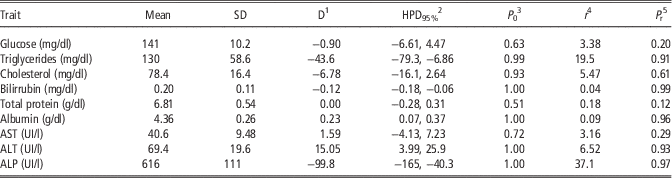
Table 3 reports descriptive statistics and differences between IMF rabbit lines for plasma metabolites related to liver. Low-IMF line showed greater plasma concentration of triglycerides, cholesterol, bilirubin and ALP than high-IMF line and all the differences between lines were relevant, except for cholesterol concentration, in which P r was very low. High-IMF line showed greater albumin and ALT concentrations (P 0=1.00), and differences between lines were relevant. We did not observe differences between lines for glucose, total protein and AST plasma concentrations.
Descriptive statistics and differences between high- and low-intramuscular fat (IMF) rabbit lines in plasma metabolites related to liver

AST=aspartate transaminase; ALT=alanine transaminase; ALP=alkaline phosphatase.
1 Median of the marginal posterior distribution of the difference between high and low-intramuscular fat lines.
2 Highest posterior density region at 95% of probability.
3 Probability of the difference being greater than 0 when D>0 or lower than 0 when D<0.
4 Relevant value, proposed as one-third of the standard deviation of the trait.
5 Probability of relevance (probability of the difference being greater than r when D>0 or lower than r when D<0).
Relationships between fat and liver traits
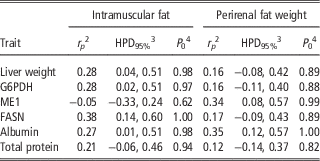
Table 4 shows phenotypic correlations between fat traits (IMF and perirenal fat weight) and liver traits (liver weight, lipogenic activities and plasma metabolites). Intramuscular fat was positively correlated with liver weight (P0 = 0.98) and with G6PDH (P0 = 0.97) and FASN (P0 = 1.00) activities, correlations ranging from 0.28 to 0.38. We do not have enough evidence to state the sign of the correlation between IMF and ME1 activity. Perirenal fat weight was positively correlated with ME1 activity (0.34, P0 = 1.00). The correlations between perirenal fat weight and G6PDH and FASN activities and between perirenal fat and liver weights were also positive, but with lower evidence (P 0 between 0.88 and 0.89) and showing lower values (from 0.16 to 0.17).
Phenotypic correlations of intramuscular fat and perirenal fat weight with liver weight, lipogenicFootnote 1 activities and plasma metabolites concentrations related to liver in rabbits

1 Activities of the lipogenic enzymes glucose-6-phosphate dehydrogenase (G6PDH), malic enzyme (ME1) and fatty acid synthase (FASN) measured in nmol/min and g of tissue.
2 Median of marginal posterior distribution of the phenotypic correlation.
3 Highest posterior density region at 95% of probability.
4 Probability of the phenotypic correlation of being greater than 0 when r p >0 or lower than 0 when r p <0.
Albumin concentration in plasma was positively correlated with IMF (0.27) and with perirenal fat weight (0.35) (Table 4). Total protein plasma concentration had a low positive correlation with IMF (0.21, P 0=0.94). Phenotypic correlations between IMF and perirenal fat weight and the other plasma metabolites measured were weak (data not shown).
Discussion
Divergent selection for IMF in rabbits was successful, as previously observed in Martínez-Álvaro et al. (Reference Martínez-Álvaro, Agha, Blasco and Hernández2016). The genetic progress was approximately one-third of the SD of the trait per generation. Selection for IMF showed a positive and relevant correlated response in perirenal fat weight, which is the main carcass fat depot in rabbits (Hernández et al., Reference Hernández, Pla, Oliver and Blasco2006). Other selection experiments for IMF also found a positive correlated response in the carcass adiposity (Schwab et al., Reference Schwab, Baas, Stalder and Nettleton2009 in pigs and Zhao et al., Reference Zhao, Chen, Zheng, Wen and Zhang2007 in chickens), and the positive genetic correlation between intramuscular and carcass fat is widely documented (Martínez-Álvaro et al., Reference Martínez-Álvaro, Agha, Blasco and Hernández2016 in rabbits and Ciobanu et al., Reference Ciobanu, Lonergan and Huff-Lonergan2011 in a pig review). High-IMF line showed greater liver size than low-IMF line, which should be related to its greater fat deposition, since liver is the tissue with the greatest lipogenic activity in growing rabbits (Gondret et al., Reference Gondret, Hocquette and Herpin1997).
Divergent selection for IMF allows studying the lipid metabolism strictly underlying IMF deposition, since the selected lines have the same genetic background and only differ in genes involved in IMF and correlated traits. Differences in the fat deposition of the high-IMF and low-IMF lines can be explained by different G6PDH and ME1 lipogenic activities in liver. Differences between lines were particularly great (1.51 SD) and relevant for G6PDH, which was the main lipogenic activity in rabbit liver, in agreement with other studies in rabbits (Gondret et al., Reference Gondret, Hocquette and Herpin1997 and Reference Gondret, Mourot and Bonneau2004). We did not observe differences between lines for FASN activity, although these results should be taken with caution because of large HPD95%. Both G6PDH and ME1 enzymes generate NADPH for the support of fatty acid and steroid biosynthesis, G6PDH by the hexose monophosphate shunt and ME1 by the citric acid cycle. In a previous study of the lipogenic activities in LD, semimembranosus proprius muscle and perirenal fat of the lines, Martínez-Álvaro et al. (Reference Martínez-Álvaro, Hernández and Blasco2017) observed greater lipogenic activities in the high-IMF line at 13 weeks, but not at 9 weeks, in all tissues. Moreover, differences between lines at 13 weeks were particularly great in the G6PDH activity of LD. Results after selection for IMF reveal the important role of G6PDH activity in the genetic variability on fat deposition in rabbits. Enzyme G6PDH also serves to produce NADPH which is included in oxidative/antioxidant metabolism (Ying, Reference Ying2008). However, the oxidative capacity in the liver of rabbit lines remains to be analyzed to evaluate its relationship with G6PDH activity.
Liver lipogenic activities have been previously measured in breeds with different IMF; however, this is the first work that studies liver lipogenic activities in animals with the same genetic origin, divergently selected for IMF. Greater FASN gene expression in liver has been related to greater IMF in a comparison between two chicken breeds (Cui et al., Reference Cui, Zheng, Liu, Zhao, Chen and Wen2012). However, breeds can differ in a wide set of traits, which made difficult to attribute the causes of the differences in IMF. Several studies show that animals with greater carcass fat deposition have greater liver weight (Wise et al., Reference Wise, Young and Pond1993 and Pond et al., Reference Pond, Insull, Mersmann, Wong, Harris, Cross, Smith, Heath and Kömüves1992 in pigs divergently selected for plasma total cholesterol) and greater G6PDH, ME1 and FASN activities in liver (Turkenkopf et al., Reference Turkenkopf, Olsen, Moray, Greenwood and Johnson1980 and Smith and Kaplan, Reference Smith and Kaplan1980 in fat genotyped Zucker rats). In pigs, Muñoz et al. (Reference Muñoz, Tor and Estany2013) observed that selection for decreased backfat thickness at constant IMF was accompanied by a reduction of FASN expression in liver, suggesting that hepatic lipogenesis might affect fat partitioning in pigs (Muñoz et al., Reference Muñoz, Tor and Estany2013).
Our lines showed normal concentrations of all plasma metabolites except for ALP, in which both lines showed concentrations above normal levels for rabbits (Washington and Van Hoosier, Reference Washington and Van Hoosier2012). However, Melillo (Reference Melillo2007) suggested that high plasma concentration of ALP in healthy rabbits is a common finding, since ALP is the sum of three different isoenzimes (two isoenzimes produced in the liver and one in the intestine) with a wide range of variation. Besides, growing rabbits show particularly high ALP concentrations caused by its high osteoblastic activity, since ALP is involved in the precipitation of calcium phosphate in bones (Melillo, Reference Melillo2007). To our knowledge, our results are the first reports of plasma metabolites in animals selected for IMF.
Circulating plasma concentrations of glucose, triglycerides and cholesterol are the result of the production and uptake by lipogenic tissues. We did not find differences between lines for glucose concentration, although the HPD95% of the difference between lines was large. Low-IMF line had greater plasma triglycerides and cholesterol concentrations than high-IMF line in spite of its lower liver lipogenic activity. A study in rats observed that high plasma concentrations of triglyceride-rich lipoproteins played a regulation role inhibiting hepatic FASN (Lakshmanan et al., Reference Lakshmanan, Muesing, Cook and Veech1977). In animals selected for different criterions, it has been observed a negative relationship between plasma lipids and carcass fat deposition (Bakke, Reference Bakke1975 selecting for BW gain and carcass leanness and Pond et al., Reference Pond, Insull, Mersmann, Wong, Harris, Cross, Smith, Heath and Kömüves1992 selecting for plasma cholesterol, both in pigs). The lower fat deposition of the low-IMF line suggests that its increased concentration of lipids in plasma is not taken up by muscles and fat depots in a similar rate than in the high-IMF line. The release of plasma lipids to muscle and fat tissues are limited by the activity of the enzyme lipoprotein lipase, which has been suggested as a good indicator of lipid deposition in pigs (Allen et al., Reference Allen, Beitz, Cramer and Kauffman1976). Further studies would be necessary to examine the lipoprotein lipase activity of the IMF lines.
Bilirubin is a subproduct of haemolysis and it is taken up from plasma by the liver (Wang et al., Reference Wang, Roy Chowdhury and Roy Chowdhury2006). Low-IMF line showed relevantly greater plasma concentration of bilirubin than the high-IMF line. In healthy humans, greater body fat percentage is related with lower plasma concentration of bilirubin (Jenko-Praznikar et al., Reference Jenko-Praznikar, Petelin, Jurdana and Ziberna2013). This is explained because obesity is associated with an increased oxidative stress and inflammation states, and bilirubin, which has antioxidant and anti-inflammatory properties, is greatly consumed in obese individuals (Jenko-Praznikar et al., Reference Jenko-Praznikar, Petelin, Jurdana and Ziberna2013).
Albumin is synthetized in liver and represents the main part of the total protein concentration in plasma (Washington and Van Hoosier, Reference Washington and Van Hoosier2012). It transports many plasma metabolites, including bilirubin and free fatty acids. High-IMF line showed relevantly greater albumin concentration than low-IMF line, which can indicate greater transport fluxes of these metabolites in plasma. Although we did not find difference between lines in total protein, this result was estimated with a large HPD95%.
Plasma concentrations of ALT, AST and ALP enzymes are used clinically as indicators of liver damage, which was not the case of none of our lines. High-IMF line showed relevant greater ALT concentration than the low-IMF line. This enzyme is involved in the amino acids metabolism (Frayn, Reference Frayn1998). By other side, plasma concentration of ALP was relevantly greater in the low than in the high-IMF line. We did not find information about the relationship of IMF with ALT, AST and ALP plasma concentrations, but pigs with higher carcass adiposity showed greater ALT, AST and lower ALP plasma concentrations with respect to leaner pigs, in a selection experiment for plasma cholesterol (Pond et al., Reference Pond, Su and Mersmann1997).
Intramuscular fat and perirenal fat weight were both positively correlated with liver weight and lipogenic activities although the correlations were low. These results suggest that fat deposition in rabbits, both in muscle and carcass, is partially explained by the liver lipogenic activity. However, all the correlation estimates showed a wide HPD95% and we cannot make precise statements about their actual values. To our knowledge, there is no literature about the correlations between intramuscular and carcass fat and liver lipogenic activities.
Correlations between IMF and plasma metabolites may have a particular interest in meat production, because they could be used as potential biomarkers of IMF. However, we did not find any strong correlation between IMF and studied plasma metabolites. Plasma metabolites have been previously studied as blood indicators of IMF in pigs (Muñoz et al., Reference Muñoz, Estany, Tor and Doran2012) and cattle (Adachi et al., Reference Adachi, Kawano, Tsuno, Nomura, Yamamoto, Arikawa, Tsuji, Adachi, Onimaru and Ohwada1999) with no significant results. These findings suggest the complex biological mechanisms involved in the regulation of IMF deposition, making difficult to find one specific biomarker strongly correlated to IMF.
Conclusions
Liver plays an important role in the fat deposition of the lines divergently selected for IMF, high-IMF line showing greater liver weight and liver lipogenic activities (G6PDH and ME1) than low-IMF line, particularly for G6PDH. Liver size and liver lipogenic activities were positively correlated with fat deposition in muscle (except for ME1) and carcass, although phenotypic correlations were estimated with low accuracy. Selection for IMF affected some plasma metabolites related to liver metabolism, low-IMF line showing greater concentration of triglycerides, cholesterol, bilirubin and ALP but lower concentrations of albumin and ALT than high-IMF line. Nevertheless, none of these plasma metabolites showed a strong correlation with IMF.
Acknowledgements
This work was supported by project AGL2014-55921-C2-01-P from the Spanish National Research Plan. M.M.A. acknowledges a FPI (grant no: BES-2012-052655) from the Economy Ministry of Spain. The authors thank Federico Pardo for its technical assistance.