Buffalo (Bubalus bubalis) dominates the agricultural economy in many countries and regions by providing milk, meat, and drought power. Buffalo population in the world is estimated to be 194 million (http://faostat.fao.org/) with more than 12% of the population located in China. Although buffalo have better adaptability to hot and humid climate than cattle, they exhibit signs of great distress when exposed to direct solar radiation or when working in the sunlight during hot weather.
Changes in homeostasis caused by high-temperature climate can be quantified by measuring physiological traits including rectal temperature (RT), respiratory rate (RR) and body surface temperature (BT) (Marai & Haeeb, Reference Marai and Haeeb2010). The respiratory mechanism is essential for heat dissipation and maintenance of thermal neutrality to avoid excessive temperature rise during heat exposure. RR and RT act as markers of heat stress in buffalo (Manjari et al. Reference Manjari, Yadav, Ramesh, Uniyal, Rastogi, Sejian and Hyder2015). The heat shock proteins (HSPs) are a group of highly conserved proteins, which are classified into several families according to molecular size and amino acid sequence. Heat shock protein 70 (HSP70) act as characteristic cellular marker of heat stress in buffalo (Manjari et al. Reference Manjari, Yadav, Ramesh, Uniyal, Rastogi, Sejian and Hyder2015), and salivary HSP70 may be a potential tool in further studies of heat adaptation in cows (Lamy et al. Reference Lamy, Jurkovich, Rodrigues, Geraldo, Cachucho, Silva, Matos, Capela, Pinheiro and Könyves2017). HSP90 (90-kDa heat shock proteins) are essential molecular chaperones involved in cell cycle control, signal transduction, stress management, folding and degradation, and transport of proteins. Adrenal corticoids, especially cortisol, give rise to physiological adjustments which enable animals to tolerate stressful conditions, and plasma cortisol level has been used as a physiological marker of stress in buffalo (Dimri et al. Reference Dimri, Ranjan, Sharma and Varshney2010) and cattle (Chaiyabutr et al. Reference Chaiyabutr, Chanpongsang and Suadsong2008). White blood cells (WBCs), haemoglobin (Hb), haematocrit (Hct) and red blood cells (RBCs), as indicators of body immunity, are adversely affected by heat stress (Marai & Haeeb, Reference Marai and Haeeb2010).
To our knowledge, there are a limited number of studies regarding heat tolerance of different buffalo breeds, so the aim of the present study was to analyse and compare the effects of season and breed on some physiological and blood parameters in buffalo.
Materials and methods
Experimental design
Crossbred buffalo (Nili-Ravi × Murrah, n = 30) and Mediterranean buffalo (n = 14) between 5 and 6 years old, weighing 550 ± 26·2 kg on average, were used in this study. These animals were selected from the JINNIU Buffalo Farm in China. The physiological traits (RT, BT and RR) and blood samples of the crossbred buffalo were collected in December, April and August and those of Mediterranean buffalo in August, respectively. The ambient temperature (AT) and relative humidity (RH) were recorded from 7:00 am to 7:00 pm, once every two hours, which lasted for five days during December and April, and twenty-three days in August. THI was calculated by the formula of Kendall & Webster (Reference Kendall and Webster2009):
 $${\rm THI} = ({\rm 1}.{\rm 8}{^\ast}{\rm AT} + {\rm 32}) \!-\! (0.{\rm 55} \!-\! 0.00{\rm 55}{^\ast}{\rm RH}){^\ast}({\rm 1}.{\rm 8}{^\ast}{\rm AT} \!-\! {\rm 26}).$$
Physiological parameters
RT was measured by inserting a mercury thermometer into the rectum for three minutes and expressed in °C; RR was obtained by observing three consecutive minutes of abdominal fluctuations and presented as breaths per minute; BT was measured by keeping the sensitive point of a digital thermometer in close contact with buttocks without hair area and expressed in °C. RT, BT and RR were recorded at 1:00–3:00 pm, which lasted for five days during December, April and August to measure their variations along with seasons change, and lasted for twenty-three days in August to compare heat resistance between two breeds.
Blood collection and plasma separation
Ten millilitres of blood was collected from the external jugular vein using 18 gauge sterilised disposable needles and plastic syringes in duplicate prepared with and without ethylene diamine tetraacetic acid (EDTA), which was used for plasma separation and haematological examination, respectively. Blood samples were centrifuged (3000 rpm for 15 min) to separate the plasma. The separated plasma samples were stored at −20 °C before analysis. The Ethical Animal Care and Use Committee of HuaZhong Agricultural University approved the experimental design and animal treatment protocols.
Estimation of HSP70, HSP90 and cortisol levels and hematological parameters examination
Plasma HSP70, HSP90, and cortisol levels were measured using bovine HSP70 (Cat. No., ml503474, Shanghai, China), HSP90 (Cat. No., ml503479, Shanghai, China), and cortisol ELISA test kits (Cat. No., ml713407, Shanghai, China) following manufacturer's instructions. The inter- and intra-assay coefficient of variations of these kits were in the same range (<15 and <10%). The whole blood samples were analysed for haematological parameters such as WBCs, Hb, Hct and RBCs by blood routine apparatus (Sysmex Shanghai Ltd., China).
Statistical analysis
In the present study, the descriptive statistics were calculated for RT, BT, RR, HSP70, HSP90, cortisol levels, and WBCs, Hb, Hct and RBCs with all means is presented as Mean ± sem, and the heat resistance between breeds and the parameters variations along with seasons change were compared by t-test and one way ANOVA analysis, respectively.
Results and discussion
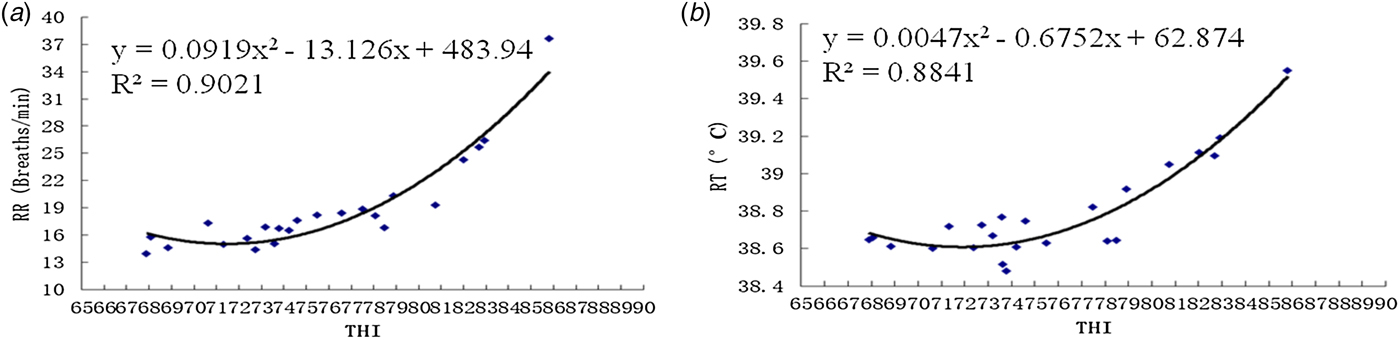
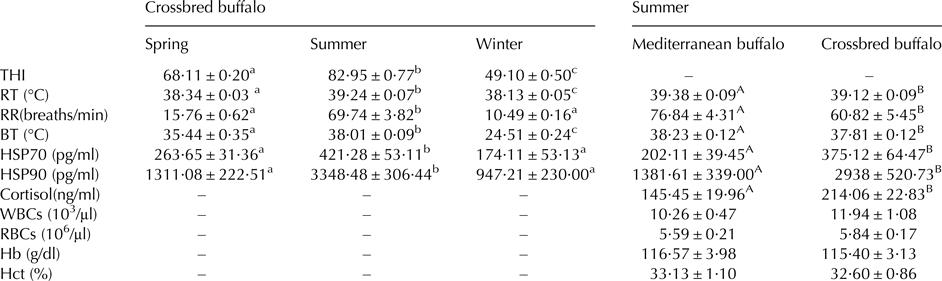
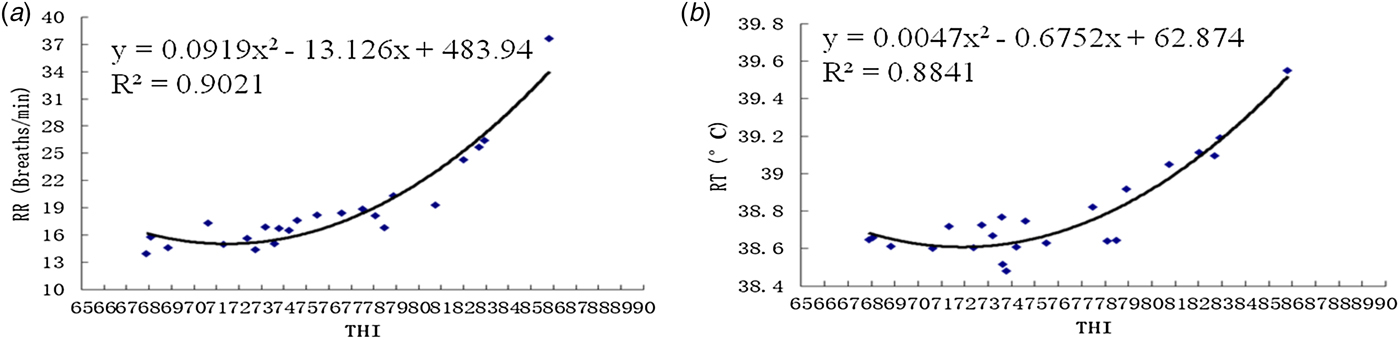
In summer, a significant correlation between THI and some physiological parameters in crossbred buffaloes, such as, RT (r = 0·81) and RR (r = 0·84) was found, coinciding with the previous study (Bouraoui et al. Reference Bouraoui, Lahmar, Majdoub, Djemali and Belyea2002), which showed that the THI is positively correlated to RR (r = 0·89) and RT (r = 0·85) in dairy cows. Collier et al. (Reference Collier, Hall, Rungruang and Zimbleman2012) reported that the THI threshold of heat stress for lactating dairy cows producing more than 35 Kg of milk per day is 68. In contrast, our findings showed that when the THI is 68, the RT and RR are in the normal range (Fig. 1). However, due to the difference in milk production levels between crossbred buffaloes and dairy cows and given the strong negative correlation between heat tolerance and milk production levels (Nguyen et al. Reference Nguyen, Bowman, Hailemariam, Pryce and Hayes2016), so the relative levels of heat tolerance in buffalo and dairy cows requires further investigation.
The RT and RR changes with the increase of THI. Data for crossbred buffalo.
Here, the increase in THI from winter or spring to summer resulted in an increase in RT from 38·13 or 38·34 to 39·24 °C and RR from 10·49 or 15·76 to 69·74 breaths/min (Table 1), which were similar to the results by Kamal & Ibrahim (Reference Kamal and Ibrahim1969). Moreover, Manjari et al. (Reference Manjari, Yadav, Ramesh, Uniyal, Rastogi, Sejian and Hyder2015) reported higher RR and RT during summer as compared to winter in buffalo. The RT, RR, and BT of the crossbred Buffalo were significantly (P < 0·05) lower than those of Mediterranean buffalo during summer (Table 1), coinciding with the previous study (Garner et al. Reference Garner, Douglas, Williams, Wales, Marett, Nguyen, Reich and Hayes2017), which showed that heat tolerant dairy cattle have lower RT, BT, and RR as compared to heat sensitive breeds. Such response changes are adaptive mechanisms initiated by the buffalo in an attempt to restore its thermal balance.
Physiological and blood parameters comparative between breeds and seasons (Mean ± sem)
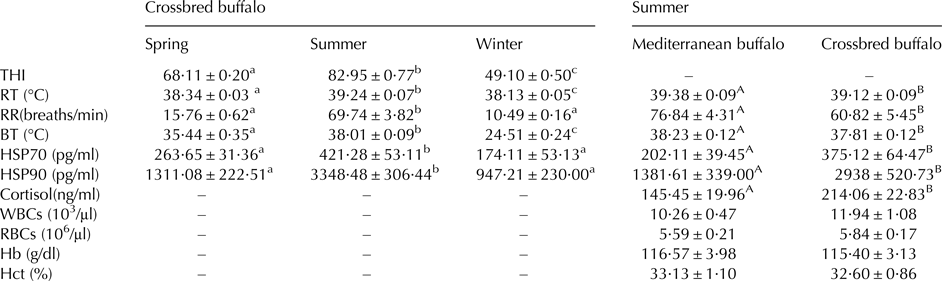
a, b: The different superscripts within different season groups show significant difference (P < 0·05)
A, B: The different superscripts between buffalo groups in the same season show significant difference (P < 0·05)
The plasma HSP70 levels in crossbred buffaloes were found to be significantly higher during summer as compared to spring and winter (Table 1), which was supported by Manjari et al. (Reference Manjari, Yadav, Ramesh, Uniyal, Rastogi, Sejian and Hyder2015), who showed that the relative expression values of HSP70 in Tarai buffalo were significantly higher during summer as compared to winter. The plasma HSP70 levels in the crossbred Buffalo were significantly higher than Mediterranean buffalo, whereas another study showed that the HSP70 expression level in dermal fibroblast of heat tolerant cow (Tharparkar) was significantly lower as compared to heat sensitive cow (Karan-Fries) (Singh et al. Reference Singh, Upadhyay, Malakar, Kumar and Singh2014). We showed that the HSP90 level in summer was highest, this result is consistent with earlier finding (Dangi et al. Reference Dangi, Gupta, Maurya, Yadav, Panda, Singh, Mohan, Bhure, Das and Bag2012), where increased HSP90 expression was observed in caprine peripheral blood mononuclear cells owing to heat stress. Increased HSP90 expression during summer may be due to the fact that heat stress could initiate the transcription and translation of HSP90 to protect cells from heat stress. Heat stress increased the plasma HSP90 levels more markedly in the crossbred buffalo than in Mediterranean buffalo (Table 1), and the results were similar to observations in cattle, in which higher HSP90 expression has been reported after heat stress in thermo-tolerant breeds as compared to thermo-sensitive breeds (Deb et al. Reference Deb, Sajjanar, Singh, Kumar, Singh, Sengar and Sharma2014).
Adrenocorticotropic hormone acts on the cortex of adrenal glands to stimulate the synthesis and secretion of glucocorticoids like cortisol during heat stress (Abilay et al. Reference Abilay, Johnson and Madan1975). Higher cortisol levels observed in the crossbred buffalo than in Mediterranean buffaloes after heat stress challenge in the present study is consistent with those reported by Burdick Sanchez et al. (Reference Burdick Sanchez, Chaffin, Carroll, Chase, Coleman and Spiers2013) in heat tolerant Romosinuano (RO) and heat-sensitive Angus (ANG) heifers after LPS challenge, and Hammond et al. (Reference Hammond, Olson, Chase, Bowers, Randel, Murphy, Vogt and Tewolde1996) in RO and ANG heifers after heat stress, which both showed that the cortisol levels in RO (thermo-tolerant) were significantly higher than in ANG (thermo-sensitive). No significant correlations of WBCs, Hb, Hct and RBCs between crossbred and Mediterranean buffalo were found, which may be indicate that the THI was not enough to cause variation in these indicators between breeds.
Conclusions
Higher THI was associated with significant increase in RT, RR, BT, and HSP70, HSP90 and cortisol levels, and the crossbred buffalo were more heat tolerant than Mediterranean buffalo. A significant correlation between THI and RT (r = 0·81) and RR (r = 0·84) in crossbred were found. Further research should be carried out to explore the THI thresholds which elicit physiological and production performance disorders in buffalo.
This work was supported by the Earmarked Fund for Modern Agro-industry Technology Research System [CARS-37-04B].
Conflict of interest
The authors declare that they have no conflict of interest.