



1. Introduction and main results
The eikonal equation,
 $\sum _{i=1}^n(\frac {\mathit{\partial} u}{{\mathit\partial} x_i})^2=1$
, (
 $u\,:\,\mathbb{R}^n\rightarrow \mathbb{R}$
) is one of the main equations of geometric optics and wave propagation, see for example [Reference Calin and Chang1, Reference Courant and Hilbert3, Reference Garabedian4]. In 1995, Khavinson was interested in the complex-analytic solutions of this equation and considered an entire solution
 $u$
of the eikonal equation in two variables
 \begin{equation} u_{z_1}^2+u_{z_2}^2=1. \end{equation}
Khavinson [Reference Khavinson7] showed that any entire solution of (1.1) is a linear function. Later on, the result was obtained by Li [Reference Li11] and Saleeby [Reference Stoll13] with different ways, respectively. Further, Li [Reference Li8–Reference Li11] described entire solutions of some variations of the eikonal equation (1.1), such as
 $u_{z_1}^2+u_{z_2}^2=p$
,
 $u_{z_1}^2+u_{z_2}^2=e^g$
, where
 $p, g$
are polynomials in
 $\mathbb{C}^2$
. Some other studies on variations of the eikonal equation of (1.1) can be found in [Reference Chen and Han2, Reference Lü12]. In [Reference Khavinson7, Reference Li11], with the linear transformation
 $x = z_1 + iz_2$
and
 $y =z_1 - iz_2$
, equation (1.1) reduces to
 \begin{equation} u_xu_y=1. \end{equation}
In [Reference Khavinson7, Reference Li11], it is noted that (1.2) can be turned to a Monge–Ampére equation by a variable change and differentiation. Recently, Xu-Liu-Xuan [Reference Xu, Liu and Xuan16] considered entire solutions of a more general form of (1.2) as
 \begin{equation} \prod _{i=1}^3\left (a_{i 1} u_{z_1}+a_{i 2} u_{z_2}+a_{i 3} u_{z_3}\right )=1. \end{equation}
Let
 \begin{equation*} \mathcal{A}=\left(\begin{array}{c@{\quad}c@{\quad}c} a_{11} & a_{12} & a_{13} \\ a_{21} & a_{22} & a_{23} \\ a_{31} & a_{32} & a_{33} \end{array}\right), \end{equation*}
where
 $a_{ij}$
(
 $i,j=1,2,3$
) is a constant. Then, their result can be stated as follows.
Theorem A. Let
 $|\mathcal{A}| \neq 0$
. Then equation (1.3) does not have any finite order transcendental entire solution.
Here,
 $|\mathcal{A}|$
is the determinant of
 $\mathcal{A}$
and the order of a meromorphic function
 $u$
in
 $\mathbb{C}^n$
is defined as
 \begin{equation*} \rho (u)=\limsup _{r\rightarrow \infty }\frac {\log T(r,u)}{\log r}, \end{equation*}
where
 $T(r,u)$
is the characteristic function in Nevanlinna theory, see e.g., [Reference Saleeby14, Reference Vitter15].
In [Reference Xu, Liu and Xuan16], Xu-Liu-Xuan offered several examples to show that the condition
 $|\mathcal{A}| \neq 0$
is necessary. In the same paper, they posed the following problem.
Problem Is the conclusion of Theorem A still valid for equation (1.3) with
 $n(\geq 4)$
complex variables.
In the following, we assume that
 \begin{equation} \prod _{i=1}^n\left (a_{i 1} u_{z_1}+a_{i 2} u_{z_2}+\cdots +a_{i n} u_{z_n}\right )=1, \end{equation}
and a matrix
 \begin{align*} \mathcal{A}=\left(\begin{array}{c@{\quad}c@{\quad}c@{\quad}c} a_{11} & a_{12} & \cdots & a_{1n} \\ a_{21} & a_{22} & \cdots & a_{2n} \\ \cdots & \cdots & \cdots & \cdots \\ a_{n1} & a_{n2} & \cdots & a_{nn} \end{array}\right). \end{align*}
In this paper, we give an affirmative answer to the above problem by the following result.
Main theorem Let
 $|\mathcal{A}| \neq 0$
. Then equation (1.4) does not have any finite order transcendental entire solution.
From Main theorem, we immediately obtain the following corollary, which is a generalization of [Reference Khavinson7,Theorem 1] in some sense.
Corollary Let
 $|\mathcal{A}| \neq 0$
and
 $u$
is a finite order entire solution of (1.4). Then
 $u$
is a linear function.
Remark 1. In [Reference Hemmati5], for partial differential equations in two variables, Hemmati derived a more general result as follows: Let
 $u$
be an entire solution in
 $\mathbb{C}^2$
of
 $F(u_{z_1},u_{z_2})=0$
, where
 $F$
is an entire function whose zero set
 $\{(p,q)\in \mathbb{C}^2 \, : \,F(p,q)=0\}$
does not contain any complex lines, that is
 $F$
does not have a linear factor. Then
 $u(z_1,z_2)$
is a linear function.
In [Reference Hemmati5,Remark (3)], Hemmati also showed that the theorem fails in higher dimensions by the following example. Consider (cf. [Reference Khavinson7])
 $u(z_1,z_2,z_3)=z_3+f(z_1+z_2)$
which solves
 $u_{z_1}^2-u_{z_2}^2+u_{z_3}-1=0$
, where
 $f$
is an entire function in
 $\mathbb{C}$
. Therefore, Main theorem and Corollary can be regarded as complements to Hemmati’s theorem in higher dimensions.
2. Proof of main theorem
For the proof, we need the following result.
Lemma 1. ([Reference Hu, Li and Yang6,Theorem 1.106]). Suppose that
 $a_0(z), a_1(z), \ldots , a_n(z)(n \geq 1)$
are meromorphic functions on
 $\mathbb{C}^m$
and
 $g_0(z), g_1(z), \cdots , g_n(z)$
are entire functions on
 $\mathbb{C}^m$
such that
 $g_j(z)-g_k(z)$
are not constants for
 $0 \leq j\lt k \leq n$
. If the following conditions
 \begin{equation*} \sum _{j=0}^n a_j(z) e^{g_j(z)} \equiv 0,\,\,\hbox{and}\,\,\| T\left (r, a_j\right )=o(T(r)), \quad j=0,1, \ldots , n \end{equation*}
hold, where
 $T(r)=\min _{0 \leq j\lt k \leq n} T\left (r, e^{g_j-g_k}\right )$
, then
 $a_j(z) \equiv 0,\,(j=0,1,2, \ldots , n)$
.
Now, based on the idea in [Reference Xu, Liu and Xuan16], we give the proof of Main theorem. Assume the contrary, suppose that
 $u$
is a finite order transcendental entire solution of (1.4). Below, we will derive a contradiction. It follows from (1.4) that for any
 $i\in \{1,..,n\}$
,
 $ a_{i 1} u_{z_1}+a_{i 2} u_{z_2}+\cdots +a_{i n} u_{z_n}$
has no zeros and poles. Together with that
 $u$
is of finite order, we can assume that
 \begin{equation} a_{i 1} u_{z_1}+a_{i 2} u_{z_2}+\cdots +a_{i n} u_{z_n}=e^{\alpha _i}, \,\,(i=1,..,n) \end{equation}
where
 $\alpha _i$
is a polynomial in
 $\mathbb{C}^n$
and
 \begin{equation} \alpha _1+\alpha _2+\cdots +\alpha _n=2k_0\pi i, \end{equation}
with a fixed integer
 $k_0$
. The condition
 $|\mathcal{A}|\neq 0$
and (2.1) yields
 \begin{equation} u_{z_i}=\frac {1}{|\mathcal{A}|}\sum _{j=1}^n A_{ji}e^{\alpha _j},\,\,(i=1,..,n) \end{equation}
where
 $A_{i j}$
, (
 $i, j=1,2,\ldots ,n$
) is the cofactor of
 $a_{i j}$
for
 $|\mathcal{A}|$
. Then, for any
 $i,k\in \{1,2,\ldots ,n\}$
, we have
 \begin{equation*} u_{z_iz_k}=\frac {1}{|\mathcal{A}|}\sum _{j=1}^n A_{ji}\frac {\mathit{\partial} \alpha _j}{\mathit{\partial} z_k}e^{\alpha _j}=\frac {1}{|\mathcal{A}|}\sum _{j=1}^n A_{jk}\frac {\mathit{\partial} \alpha _j}{\mathit{\partial} z_i}e^{\alpha _j}=u_{z_kz_i}, \end{equation*}
which implies that
 \begin{equation} \sum _{j=1}^n [A_{ji}\frac {\mathit{\partial} \alpha _j}{\mathit{\partial} z_k}-A_{jk}\frac {\mathit{\partial} \alpha _j}{\mathit{\partial} z_i}]e^{\alpha _j}=0. \end{equation}
For the set
 $I=\{1,\ldots ,n\}$
, there must exist a partition
 $I=\cup _{s=1}^l I_s$
for any
 $i\in I_s$
and
 $j\in I_t$
such that
 \begin{equation*} \left \{ \begin{aligned} &\alpha _j-\alpha _i \,\hbox{is a constant,}& \hbox{if}\,\,1\leq s=t\leq l, \\ &\alpha _j-\alpha _i \,\hbox{is not a constant,} & \hbox{if}\,\,1\leq s\neq t\leq l.\\ \end{aligned} \right . \end{equation*}
Without loss of generality, we assume that
 $I_s=\{s_1,\ldots ,s_{m_s}\},\,\,(s=1,\ldots ,l)$
. We also assume that
 $\alpha _{s_t}=\alpha _{s_1}+\beta _{s_t}$
for
 $t=1,\ldots ,m_s$
, where
 $\beta _{s_t}$
is a constant. Clearly,
 $\beta _{s_1}=0$
. So,
 \begin{equation*}e^{\alpha _{s_t}}=e^{\beta _{s_t}}e^{\alpha _{s_1}}=b_{s_t}e^{\alpha _{s_1}},\,\,\frac {\mathit{\partial} \alpha _{s_t}}{\mathit{\partial} {z_j}}=\frac {\mathit{\partial} \alpha _{s_1}}{\mathit{\partial} {z_j}}, \,\,(j=1,\ldots ,n).\end{equation*}
Obviously,
 $b_{s_1}=e^{\beta _{s_1}}=1$
. Thus, from (2.4), we get
 \begin{equation} \sum _{s=1}^l [C_{s_1i}\frac {\mathit{\partial} \alpha _{s_1}}{\mathit{\partial} z_k}-C_{s_1 k}\frac {\mathit{\partial} \alpha _{s_1}}{\mathit{\partial} z_i}]e^{\alpha _{s_1}}=0. \end{equation}
where
 \begin{equation} C_{s_1 i}=\cup _{j=s_1}^{s_{m_s}} A_{ji}b_{j},\,\,C_{s_1k}=\cup _{j=s_1}^{s_{m_s}} A_{jk}b_{j}. \end{equation}
If
 $l\geq 2$
, it follows from Lemma1 that
 \begin{equation} C_{s_1i}\frac {\mathit{\partial} \alpha _{s_1}}{\mathit{\partial} z_k}-C_{s_1 k}\frac {\mathit{\partial} \alpha _{s_1}}{\mathit{\partial} z_i}=0,\,\,i,k\in \{1,\ldots ,n\}. \end{equation}
It follows from (2.5) that (2.7) also holds if
 $l=1$
. So,
 \begin{equation} \frac {\dfrac {\mathit{\partial} \alpha _{s_1}}{\mathit{\partial} z_k}}{C_{s_1 k}}=\frac {\dfrac {\mathit{\partial} \alpha _{s_1}}{\mathit{\partial} z_i}}{C_{s_1i}},\,\, i,k\in \{1,\ldots ,n\}. \end{equation}
Then,
 \begin{equation} \frac {\dfrac {\mathit{\partial} \alpha _{s_1}}{\mathit{\partial} z_1}}{C_{s_1 1}}=\frac {\dfrac {\mathit{\partial} \alpha _{s_1}}{\mathit{\partial} z_2}}{C_{s_12}}=\cdots =\frac {\dfrac {\mathit{\partial} \alpha _{s_1}}{\mathit{\partial} z_n}}{C_{s_1 n}}. \end{equation}
By solving the first partial differential equation
 $\frac {\frac {\mathit{\partial} \alpha _{s_1}}{\mathit{\partial} z_1}}{C_{s_1 1}}=\frac {\frac {\mathit{\partial} \alpha _{s_1}}{\mathit{\partial} z_2}}{C_{s_12}}$
in (2.9), we can get
 \begin{equation} \alpha _{s_1}=f(C_{s_1 1}z_1+C_{s_1 2}z_2,z_3,\ldots ,z_n), \end{equation}
where
 $f(t_1,\ldots ,t_{n-1})$
is a polynomial in
 $\mathbb{C}^{n-1}$
. The equation
 $\frac {\frac {\mathit{\partial} \alpha _{s_1}}{\mathit{\partial} z_1}}{C_{s_1 1}}=\frac {\frac {\mathit{\partial} \alpha _{s_1}}{\mathit{\partial} z_3}}{C_{s_13}}$
yields that
 \begin{equation} \frac {\mathit{\partial} f}{\mathit{\partial} t_1}=\frac {\dfrac {\mathit{\partial} f}{\mathit{\partial} t_2}}{C_{s_13}}. \end{equation}
Then, solving (2.11) yields to
 \begin{equation} f(t_1,\ldots ,t_{n-1})=g(t_1+C_{s_13}t_2, t_3,t_4,\ldots ,t_{n-1}), \end{equation}
where
 $g(\beta _1,\beta _2,\ldots , \beta _{n-2})$
is a polynomial
 $\mathbb{C}^{n-2}$
. Therefore, combining (2.10) and (2.12) yields
 \begin{equation*} \alpha _{s_1}=f(C_{s_1 1}z_1+C_{s_1 2}z_2,z_3,\ldots ,z_n)=g(C_{s_1 1}z_1+C_{s_1 2}z_2+C_{s_13}z_3, z_4,\ldots ,z_{n}). \end{equation*}
Repeat the argument yields that
 \begin{equation*} \alpha _{s_1}=\gamma _s(C_{s_1 1}z_1+C_{s_1 2}z_2+\cdots +C_{s_1 n}z_n), \,\,(s=1,\ldots ,l) \end{equation*}
where
 $\gamma _s(z)$
is a polynomial in
 $\mathbb{C}$
. From (2.2), one has
 \begin{equation} \sum _{s=1}^l \lambda _s\alpha _{s_1}=C, \end{equation}
where
 $\lambda _s$
is a positive integer and
 $C$
is a constant. Assume that
 $m=\max _{1\leq s\leq l}\deg {\gamma _s}$
. If
 $m=0$
, then any
 $\alpha _i$
 $(i=1,\ldots ,n)$
is a constant, so is
 $u_{z_i}$
. It follows that
 $u$
is a polynomial, which is a contradiction. So,
 $m\geq 1$
. Suppose that
 \begin{equation*} \gamma _s(z)=B_{sm}z^m+B_{s(m-1)}z^{m-1}+\cdots +B_{s0}. \end{equation*}
Obviously, at least one of
 $B_{sm}$
(
 $s\in \{1,\ldots ,l\}$
) is nonzero. Without loss of generality, assume that
 $B_{1m}\neq 0$
. Then, it follows from (2.13) that
 \begin{equation} \begin{aligned} 0=&\sum _{s=1}^l \lambda _s B_{sm}(C_{s_1 1}z_1+C_{s_1 2}z_2+\cdots +C_{s_1 n}z_n)^m\\ =&\sum _{s=1}^l \delta _s (C_{s_1 1}z_1+C_{s_1 2}z_2+\cdots +C_{s_1 n}z_n)^m, \end{aligned} \end{equation}
where
 $\delta _s=B_{sm}\lambda _s$
. Obviously,
 $\delta _1\neq 0$
. Observe that
 \begin{equation*} (C_{s_1 1}z_1+C_{s_1 2}z_2+\cdots +C_{s_1 n}z_n)^m=\sum _{k_1+\cdots +k_n=m}\frac {m!}{(k_1)!\cdots (k_n)!}\prod _{j=1}^n C_{s_1 j}^{k_j} z_j^{k_j}, \end{equation*}
where
 $k_j\geq 0$
 $(j=1,\ldots , n)$
is integer. Further,
 \begin{equation*} \begin{aligned} 0=&\sum _{s=1}^l\delta _s\sum _{k_1+\cdots +k_n=m}\frac {m!}{(k_1)!\cdots (k_n)!}\prod _{j=1}^n C_{s_1 j}^{k_j} z_j^{k_j}=\sum _{k_1+\cdots +k_n=m}\frac {m!}{(k_1)!\cdots (k_n)!}\sum _{s=1}^l\delta _s\prod _{j=1}^n C_{s_1 j}^{k_j} z_j^{k_j}\\ =&\sum _{k_1+\cdots +k_n=m}\frac {m!}{(k_1)!\cdots (k_n)!}[\sum _{s=1}^l\delta _s\prod _{j=1}^n C_{s_1 j}^{k_j}]\prod _{j=1}^n z_j^{k_j}, \end{aligned} \end{equation*}
which implies that
 \begin{equation} \sum _{s=1}^l\delta _s\prod _{j=1}^nC_{s_1 j}^{k_j}=0, \end{equation}
for any fixed integers
 $k_1$
,…,
 $k_n$
with
 $k_1+\cdots +k_n=m$
.
Set
 $\mu _{i}=(A_{i 1}, A_{i 2}, \ldots , A_{i n})$
 $(i=1,\ldots ,n)$
,
 $\nu _{s_1}=(C_{s_1 1}, C_{s_1 2}, \ldots , C_{s_1 n})$
 $(s=1,\ldots ,l)$
. Then
 \begin{equation} \nu _{s_1}=(C_{s_1 1}, C_{s_1 2}, \ldots , C_{s_1 n})=\left(\cup _{j=s_1}^{s_{m_s}} A_{j1}b_{j},\cup _{j=s_1}^{s_{m_s}} A_{j2}b_{j},\ldots , \cup _{j=s_1}^{s_{m_s}} A_{jn}b_{j}\right)=\cup _{j=s_1}^{s_{m_s}} \mu _{j}b_{j}. \end{equation}
Below, we will prove that
 $\nu _{1_1}$
,…,
 $\nu _{l_1}$
are linear dependent over
 $\mathbb{C}$
.
Suppose that
 $m=1$
. From (2.15), we derive
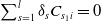 $\sum _{s=1}^l\delta _s C_{s_1 i}=0$
for any
 $i\in \{1,\ldots ,n\}$
. Then,
 \begin{align*} (\delta _1,\ldots ,\delta _l)\left(\begin{array}{c@{\quad}c@{\quad}c@{\quad}c} C_{1_1 1} & C_{1_1 2} & \cdots & C_{1_1 n} \\ C_{2_1 1} & C_{2_1 2} & \cdots & C_{2_1 n} \\ \cdots & \cdots & \cdots & \cdots \\ C_{l_1 1} & C_{l_1 2} & \cdots & C_{l_1 n} \end{array}\right)=(\delta _1,\ldots ,\delta _l)\begin{pmatrix} \nu _{1_1} \\ \nu _{2_1} \\ \cdots \\ \nu _{l_1} \end{pmatrix}=0, \end{align*}
which shows that
 $\nu _{1_1}$
,…,
 $\nu _{l_1}$
are linear dependent over
 $\mathbb{C}$
.
Suppose that
 $m\gt 1$
. We can assume that one of
 $C_{1_1 1}, C_{1_1 2}, \ldots ,C_{1_1 n}$
is nonzero. Otherwise,
 $\nu _{1_1}$
,…,
 $\nu _{l_1}$
are linear dependent over
 $\mathbb{C}$
, which is the desired result. Without loss of generality, assume that
 \begin{equation} C_{1_1 1}\neq 0. \end{equation}
Take
 $k_1=m$
and
 $k_2=\cdots =k_n=0$
in (2.15), we have
 \begin{equation} \sum _{s=1}^l\delta _s C_{s_1 1}^{m}=0. \end{equation}
Take
 $k_1=m-1$
,
 $k_i=1$
for some
 $i\neq 1$
and
 $k_j=0$
for
 $j\in \{1,\ldots ,n\}\backslash \{1,i\}$
in (2.15), we have
 \begin{equation} \sum _{s=1}^l\delta _s C_{s_1 1}^{m-1}C_{s_1 i}=0. \end{equation}
Combining (2.18) and (2.19) yields that
 \begin{equation*} (\delta _1,\ldots ,\delta _l)\left(\begin{array}{c@{\quad}c@{\quad}c@{\quad}c} C_{1_1 1}^m & C_{1_1 1}^{m-1}C_{1_1 2} & \cdots & C_{1_1 1}^{m-1}C_{1_1 n} \\ C_{2_1 1}^m & C_{2_1 1}^{m-1}C_{2_1 2} & \cdots & C_{2_1 1}^{m-1}C_{2_1 n} \\ \cdots & \cdots & \cdots & \cdots \\ C_{l_1 1}^m & C_{l_1 1}^{m-1}C_{l_1 2} & \cdots & C_{l_1 1}^{m-1}C_{l_1 n} \end{array}\right)=0, \end{equation*}
which implies that
 \begin{equation*} (\delta _1C_{1_1 1}^{m-1},\ldots ,\delta _lC_{l_1 1}^{m-1} )\left(\begin{array}{c@{\quad}c@{\quad}c@{\quad}c} C_{1_1 1} & C_{1_1 2} & \cdots & C_{1_1 n} \\ C_{2_1 1} & C_{2_1 2} & \cdots & C_{2_1 n} \\ \cdots & \cdots & \cdots & \cdots \\ C_{l_1 1} & C_{l_1 2} & \cdots & C_{l_1 n} \end{array}\right)=(\delta _1C_{1_1 1}^{m-1},\ldots ,\delta _lC_{l_1 1}^{m-1} )\begin{pmatrix} \nu _{1_1} \\ \nu _{2_1} \\ \cdots \\ \nu _{l_1} \end{pmatrix}=0. \end{equation*}
So,
 $\nu _{1_1}$
,…,
 $\nu _{l_1}$
are linear dependent over
 $\mathbb{C}$
.
Clearly,
 $\mathcal{A}^*=(\mu _1,\mu _2,\ldots ,\mu _n)^T$
, where
 $\mathcal{A}^*$
is the adjoint matrix of
 $\mathcal{A}$
. After elementary row transformation of
 $\mathcal{A}^*$
, one gets a matrix
 $\mathcal{B}$
as follows
 \begin{equation*}\mathcal{B}=(\nu _{1_1}, \nu _{2_1}, \ldots , \nu _{l_1}, \mu _{\tau _{l+1}}, \ldots , \mu _{\tau _{n}})^T,\end{equation*}
where
 $\tau _{l+1},\ldots , \tau _{n}\in \{1,2,\ldots , n\}\backslash \{1_1, 2_1,\ldots , l_1\}$
. So,
 $rank (\mathcal{A}^*)=rank (\mathcal{B})$
. The fact that
 $\nu _{1_1}$
,…,
 $\nu _{l_1}$
are linear dependent over
 $\mathbb{C}$
leads that
 $rank (\mathcal{B})\lt n$
. So
 $rank (\mathcal{A}^*)\lt n$
and
 $|\mathcal{A}^*|=0$
, which implies that
 $|\mathcal{A}|=0$
, a contradiction.
This finishes the proof of Main theorem.
Remark 2. For
 $n=3$
, it is pointed out that both in [Reference Xu, Liu and Xuan16] and this paper, the key point is to derive
 $|\mathcal{A}^*|=0$
, where
 \begin{equation*} \mathcal{A}^*=\left(\begin{array}{c@{\quad}c@{\quad}c} A_{11} & A_{12} & A_{13} \\ A_{21} & A_{22} & A_{23} \\ A_{31} & A_{32} & A_{33} \end{array}\right) \end{equation*}
is the adjoint matrix of
 $\mathcal{A}$
. Set
 $E=\{A_{ij} \, : \,i,j=1,2,3\}$
. In [Reference Xu, Liu and Xuan16], in order to get
 $|\mathcal{A}^*|=0$
, Xu-Liu-Xuan considered the cases that there are
 $l$
 $(l=0,1,2,3,4,5)$
elements in
 $E$
are zeros. In each case, by careful analysis and calculation, Xu-Liu-Xuan derived
 $|\mathcal{A}^*|=0$
. In the present paper, we consider all the above cases simultaneously. In fact, we prove that
 \begin{equation*} (\delta _1,\delta _2,\delta _3)\left(\begin{array}{c@{\quad}c@{\quad}c} A_{11} & A_{12} & A_{13} \\ A_{21} & A_{22} & A_{23} \\ A_{31} & A_{32} & A_{33} \end{array}\right)=(\delta _1,\delta _2,\delta _3)\mathcal{A}^*=0, \end{equation*}
for a certain vector
 $(\delta _1,\delta _2,\delta _3)\neq (0,0,0)$
, which implies that
 $|\mathcal{A}^*|=0$
.
Acknowledgments
The authors are grateful to the reviewer for valuable suggestions and comments. The research supported by Natural Science Foundation of Shandong Province (ZR2022MA014).
Competing interests
The authors declare no competing interests.




