Introduction
Twin and adoption studies have shown that externalizing (EXT) disorders (substance use disorders and antisocial behavior) are influenced by common genetic factors (Krueger et al. Reference Krueger, Hicks, Patrick, Carlson, Iacono and McGue2002; McGue et al. Reference McGue, Iacono and Krueger2006; Prescott et al. Reference Prescott, Madden and Stallings2006; Haberstick et al. Reference Haberstick, Zeiger, Corley, Hopfer, Stallings, Rhee and Hewitt2011; Hicks et al. Reference Hicks, Foster, Iacono and McGue2013). The heritability of a general EXT factor that indexes the common genetic influences among multiple EXT disorders has been estimated to fall between 40% and 60% (Rhee & Waldman, Reference Rhee and Waldman2002; Hicks et al. Reference Hicks, Foster, Iacono and McGue2013). Heritability estimates, however, are influenced by environmental context. Gene–environment interplay refers to the notion that genes influence exposure to specific environments (gene–environment correlation; rGE) and that genetic influence varies as a function of the environmental context (gene–environment interaction; GxE) (Moffitt, Reference Moffitt2005; Dick, Reference Dick2011). Several studies have reported that genetic risk for EXT is greater under conditions of poorer parent–child and family relationships relative to more positive relationships (Feinberg et al. Reference Feinberg, Button, Neiderhiser, Reiss and Hetherington2007; Button et al. Reference Button, Lau, Maughan and Eley2008; Hicks et al. Reference Hicks, South, Dirago, Iacono and McGue2009b ). More generally, Hicks et al. (Reference Hicks, South, Dirago, Iacono and McGue2009b ) found the same pattern of a greater genetic influence on EXT in the context of greater adversity across family, peer and academic environments, suggesting a general and robust mechanism of GxE interaction in the development of adolescent EXT.
Additionally, genetic influences have been shown to contribute to the association between parent–child relationship quality and EXT in adolescence (Neiderhiser et al. Reference Neiderhiser, Reiss, Hetherington and Plomin1999; Shelton et al. Reference Shelton, Harold, Fowler, Rice, Neale, Thapar and van den Bree2008; Narusyte et al. Reference Narusyte, Neiderhiser, Andershed, D'Onofrio, Reiss, Spotts, Ganiban and Lichtenstein2011). This is often interpreted as evidence of rGE, which refers to the notion that exposure to environments is not random, but rather is influenced by an individual's genetic predispositions (for a review, see Dick, Reference Dick2011). For example, adolescents may evoke a negative response from their parents as a result of their genetically influenced EXT traits (i.e. evocative rGE), or parenting behaviors such as monitoring, discipline and interpersonal warmth may be influenced by parents' genetically influenced EXT traits (i.e. passive rGE). Supporting the notion of child-driven effects, or evocative rGE, Burt et al. (Reference Burt, McGue, Krueger and Iacono2005) demonstrated that both parent–child conflict and EXT at age 11 years predicted the other at age 14 years. Such results have been reported elsewhere (Larsson et al. Reference Larsson, Viding, Rijsdijk and Plomin2008), suggesting that evocative rGE is evident in the relationship between parenting and child EXT.
Much of the research on gene–environment interplay for EXT, however, has been limited to cross-sectional findings in childhood and adolescence (Cadoret et al. Reference Cadoret, Yates, Troughton, Woodworth and Stewart1995; Burt et al. Reference Burt, McGue, Krueger and Iacono2005; Tuvblad et al. Reference Tuvblad, Grann and Lichtenstein2006; Feinberg et al. Reference Feinberg, Button, Neiderhiser, Reiss and Hetherington2007; Button et al. Reference Button, Lau, Maughan and Eley2008, Larsson et al. Reference Larsson, Viding, Rijsdijk and Plomin2008; Legrand et al. Reference Legrand, Keyes, McGue, Iacono and Krueger2008; Hicks et al. Reference Hicks, South, Dirago, Iacono and McGue2009b ). Thus, several important questions remain unanswered regarding the dynamics and limits of gene–environment interplay for EXT over time. For example, there is evidence for long-term associations between adolescent parent–child relationship quality and adult EXT (Bailey et al. Reference Bailey, Hill, Meacham, Young and Hawkins2011; Epstein et al. Reference Epstein, Hill, Bailey and Hawkins2013), but it is unclear if adolescent parent–child relationship quality continues to moderate genetic influence on adult EXT. Relatedly, there is evidence of associations between adults' reports of relationship quality with their parents and their own psychosocial development (Crook et al. Reference Crook, Raskin and Eliot1981; Amato, Reference Amato1994; Riggio, Reference Riggio2004; Seiffge-Krenke, Reference Seiffge-Krenke2006), but it is unclear if the quality of parent–child relationships in adulthood moderates genetic influence on adult EXT, or whether such effects are limited to childhood and adolescence. Questions such as these are important to address to better understand the role of development in the etiology of EXT.
The few studies that have taken development into account in evaluations of GxE interaction are somewhat contradictory. Two studies suggest at least some long-lasting effects of GxE mechanisms on EXT phenotypes. Dick et al. (Reference Dick, Viken, Purcell, Kaprio, Pulkkinen and Rose2007) found that less parental monitoring at age 12 years was associated with greater genetic influence on smoking at ages 14 and 17 years. Using a sample of female twins, Agrawal et al. (Reference Agrawal, Balasubramanian, Smith, Madden, Bucholz, Heath and Lynskey2010) found that a greater number of substance-using peers in adolescence was associated with a greater genetic influence on substance use in adulthood. In contrast, Kendler et al. (Reference Kendler, Gardner and Dick2011) showed that while the genetic influence on EXT was greater as a function of a greater degree of alcohol availability, deviant peers and less parental monitoring in early adolescence (ages 12–14 years), these GxE effects decreased slightly in magnitude in mid-adolescence (ages 15–17 years), and were essentially non-existent past age 18 years, suggesting that GxE effects are more influential earlier in development.
To extend this research, we evaluated the concurrent and prospective relationships between parent–child relationship problems in EXT in adolescence and young adulthood. First, we expected to demonstrate the cross-sectional GxE effect in adolescence. Specifically, we hypothesized that the genetic influence on EXT would be greater in the context of a greater degree of parent–child relationship problems at age 18 years. We also evaluated the cross-sectional relationship between parent–child relationship problems and EXT at age 25 years and the prospective association between parent–child relationship problems at age 18 years and EXT at age 25 years, controlling for EXT at age 18 years. We anticipated that GxE interaction influences would be temporarily limited and dependent on the developmental context (Moffitt et al. Reference Moffitt, Caspi and Rutter2005). Rather than a GxE interaction, we predicted that rGE (as evidenced by common genetic influences) would account for the prospective association between adolescent parent–child relationship problems and EXT at age 25 years.
Method
Participants
Participants were twins from the Minnesota Twin Family Study, a twin study designed to investigate the development and etiology of substance use and related behaviors (Iacono et al. Reference Iacono, Carlson, Taylor, Elkins and McGue1999). The study included two age cohorts: the younger cohort, first assessed at age 11 years, and the older cohort, first assessed at age 17 years. Follow-up assessments were conducted every 3–5 years in both cohorts. Families were identified based on birth certificates that are public in the state of Minnesota (birth years 1972 to 1984) and were located using public databases. Approximately 90% of twin families were located. Study eligibility included living within a day's drive to the university laboratories, and neither twin having a mental or physical handicap that would impair participation in the assessments. All participating families included twins who were the biological offspring of their parents. Among eligible families, 17% declined to participate. This project was approved by the University of Minnesota's Institutional Review Board.
The sample included 1382 same-sex (665 male, 717 female) twin pairs [902 monozygotic (MZ), 480 dizygotic (DZ)]. Consistent with the Minnesota demographics in the relevant birth years, almost all participants (96%) were of European ancestry. All twins provided informed consent or assent (depending on their age of assessment, parents consented for children to participate). For this study, we used data from the intake and the second follow-up assessments for the older cohort and the second and fourth follow-up assessments for the younger cohort. We refer to these as the ages 18 and 25 years assessments, which are the average ages of participants at these assessments across cohorts (age 18 years assessment: mean age = 17.8, s.d. = 0.69, range = 16.55–20.34 years, 80% of the sample was between the ages of 17.0 and 18.7 years; age 25 years assessment: mean age = 25.0, s.d. = 0.90, range = 22.6–29.3 years, 80% of the sample was between the ages of 23.9 and 26.1 years). Parent–child relationship problems and EXT measures were obtained at the same within-age assessment. Zygosity was determined using a questionnaire administered to parents concerning the resemblance of twin pairs, and with an algorithm comparing twins on anthropometric characteristics and fingerprint ridge counts; if results were not in agreement using these two measures, DNA was analysed to resolve zygosity.
Measures
Parent–child relationship problems at ages 18 and 25 years
At the age 18 years assessment, parent–child relationship problems were assessed using the adolescent report of the Parent Environment Questionnaire (Elkins et al. Reference Elkins, McGue and Iacono1997), a 50-item self-report questionnaire that assesses multiple dimensions of the parent–child relationship. Due to high intercorrelations (r's range 0.52–0.70, p's < 0.001), ratings of the mother–child and father–child relationship were averaged at the scale level. Scales included parent–child conflict (e.g. ‘My [mother/father] and I often get into arguments’, α's = 0.85–0.93), involvement (e.g. ‘My [mother/father] tries to keep up with how well I do in school and/or in my the job’, α's = 0.80–0.92), parent's positive regard for child (e.g. ‘My [mother/father] loves me no matter what I do’, α's = 0.86–0.94) and child's positive regard for parent (e.g. ‘I am really proud of my [mother/father]’, α's = 0.77–0.90); each item was answered on a scale of 1 = definitely true to 4 = definitely false. Prior to computing the composite score, all scales were coded in the same direction with higher scores indicative of a greater degree of parent–child relationship problems. The mean z-score across the scales was then used for the measure of parent–child relationship problems at age 18 years (the mean r between all pairs of the z-scored scales = 0.67).
At the age 25 years assessment, parent–child relationship problems were assessed using a six-item scale from the Social Adjustment Interview (‘I have what I consider to be a close relationship with my mother/father’, ‘I confide in/talk about personal things with my mother/father’, ‘I have problems getting along with my mother/father’). Prior to computing the composite score, items were coded in the same direction (a higher score indicated a greater degree of parent–child relationship problems). Items were standardized and averaged for the measure of parent–child relationship problems at age 25 years (α = 0.77).
EXT at ages 18 and 25 years
EXT was measured using the same assessment tools at both 18 and 25 years. Structured diagnostic interviews were conducted by trained staff to assess symptoms of adult antisocial behavior (AAB; criterion A symptoms of Antisocial Personality Disorder), nicotine dependence (NCD), alcohol dependence (ALD), and illicit drug abuse and dependence (DRUG). Interviews were reviewed by at least two individuals with advanced clinical training, who reached consensus prior to assigning symptoms. AAB symptoms were assessed using an interview comparable with the Structured Clinical Interview for DSM-III-R Axis II (Spitzer et al. Reference Spitzer, Williams and Gibbon1987). Substance use disorder symptoms were assessed using the Substance Abuse Module (Robins et al. Reference Robins, Babor and Cottler1987) of the Composite International Diagnostic Interview. κ Coefficients indexing diagnostic reliability were > 0.90 for all substance use disorders and 0.79 for AAB. The mean z-score across the symptom count measures was used to calculate an EXT composite score (the mean r between all pairs of the z-scored scales = 0.54 and 0.40 at the ages of 18 and 25 years).
Analysis plan
Structural equation modeling was used to examine gene–environment interplay between parent–child relationship problems and EXT using Mx software (Neale, Reference Neale2006). Mx software handles missing data using full information maximum likelihood (FIML), shown to be superior to other ways of handling missing data (Enders & Bandalos, Reference Enders and Bandalos2001; Johnson & Young, Reference Johnson and Young2011). Consistent with previous research, sex, age, age2, and age × sex were covaried out of all phenotypes prior to modeling. Also, EXT at ages 18 and 25 years was log-transformed to better approximate normality. Univariate models were fit to estimate the additive genetic (A), shared environmental (C) and non-shared environmental (E) influences on each variable. ACE parameters were estimated by comparing the relative similarity of MZ and DZ twin pairs. Additive genetic effects are inferred when rMZ > rDZ. Shared environmental effects are inferred when rDZ > ½ rMZ. Non-shared environmental effects are inferred when rMZ < 1.0.
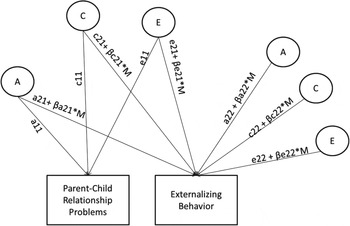
Fig. 1 illustrates a bivariate decomposition, including moderation effects on the ACE parameters. This analysis, based on Purcell's (Reference Purcell2002) model of GxE in the presence of rGE, decomposes the ACE contributions to the covariance between parent–child relationship problems and EXT (e.g. a11 × a21) and the variance unique to EXT (e.g. a22). Standardizing the genetic and environmental covariance gives the genetic (rA) and environmental correlations (rC, rE), which index the degree to which the two phenotypes share the same latent genetic and environmental influences. ACE parameters are derived from the bivariate model and are adjusted for direction and the size of the moderation (β) and the level of the moderator (M). Moderation can occur on ACE effects in common between parent–child relationship problems and EXT (e.g. a21 + βa21 × M) or ACE effects unique to EXT (e.g. a22 + βa22 × M). We extended the bivariate GxE model into a trivariate model that accounted for moderation in the relationship between parent–child relationship problems at age 18 years and EXT at age 25 years, adjusting for moderation in the relationship between parent–child relationship problems at age 18 years and EXT at age 18 years. Due to figure/table constraints, we have provided a figure describing this model in more detail as well as accompanying Mx script in the online Supplementary material. We describe this model in more detail after reporting the bivariate GxE results (from which the trivariate model was based) in the Results section.
Model of gene–environment interplay. Separate models were evaluated for externalizing behavior (EXT) at age 18 and age 25 years. A refers to genetic influences, C refers to shared environmental influences, and E refers to non-shared environmental influences. Parameters a11, c11 and e11 refer to the genetic and environmental influences on the moderator (parent–child relationship problems). Parameters a21, c21 and e21 refer to the genetic and environmental influences on the moderator (parent–child relationship problems) in common with the dependent variable (externalizing behavior). Parameters a22, c22 and e22 refer to the unique genetic and environmental influence on the dependent variable (externalizing behavior). β Describes the magnitude and direction of the moderation effect; M indicates the level of the moderator. Moderation can influence both/either the common or unique variance with externalizing.

Model fit was evaluated by using −2 × log-likelihood (−2lnL) and calculating the likelihood ratio test between comparison models. Model fit was also evaluated using several information theoretic fit indices that balance overall fit with parsimony by incorporating a penalty for the number of parameters including the Akaike information criterion, the sample size-adjusted Bayesian information criterion, and the deviance information criterion. Lower values for each information theoretic index indicate better fit (Spiegelhalter et al. Reference Spiegelhalter, Best, Carlin and Van Der Linde2002; Kenny, Reference Kenny2012). For model comparisons, we first compared the full ACE moderation model with the no ACE moderation model. Additionally, fit of the full ACE moderation model was compared with a scalar moderation model, wherein M terms were constrained to be equal across the three ACE variance components. If there was evidence for full ACE moderation, follow-up comparisons were made by dropping unnecessary moderation parameters [i.e. 95% confidence intervals (CIs) included zero in the full ACE moderation model] to identify the most parsimonious, best-fitting model.
Ethical standards
The authors assert that all procedures contributing to this work comply with the ethical standards of the relevant national and institutional committees on human experimentation and with the Helsinki Declaration of 1975, as revised in 2008.
Results
Preliminary analyses
As expected for a community sample, the sample overall reported relatively low levels of clinical EXT symptoms (prevalence of diagnoses at age 18 years: AAB = 4.5%, NCD = 15.1%, ALD = 7.8%, DRUG = 5.2%; age 25 years: AAB = 4.8%, NCD = 22.2%, ALD = 14.2%, DRUG = 6.8%). Following this, an evaluation of the descriptive statistics of the scales used to assess parent–child relationship problems indicated that the scales were generally positively skewed (after recoding so the higher the score, the more the relationship problems); standardized skewness ranged from 0.44 to 1.52 for scales at age 18 years and 0.63 for the scale at age 25 years. Due to table/figure limitations, additional descriptive statistics on the raw variables are available in the online Supplementary material.
Phenotypic correlations among the variables are presented in Table 1 (all p's < 0.01). There was substantial stability in EXT from 18 to 25 years (r = 0.58) and moderate stability in parent–child relationship problems over time (r = 0.35). Parent–child relationship problems at age 18 years were significantly correlated with EXT at ages 18 years (r = 0.26) and 25 years (r = 0.24). Parent–child relationship problems at age 25 years were weakly (but significantly) correlated with EXT at age 25 years (r = 0.15).
Phenotypic correlations a

Data are given as correlation (95% confidence interval).
a All correlations are significant at p < 0.01.
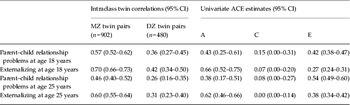
Twin correlations and univariate ACE estimates are provided in Table 2. EXT at ages 18 and 25 years exhibited large genetic and moderate non-shared environmental influence, but little to no shared environmental influence. At both ages, parent–child relationship problems had moderate genetic and non-shared environmental influences, and small and non-significant shared environmental influences.
Intraclass twin correlations and univariate ACE estimates a

CI, Confidence interval; A, additive genetic variance; C, shared environmental variance; E, non-shared environmental variance; MZ, monozygotic; DZ, dizygotic.
a The estimate is significantly different from zero if the 95% CI does not cross zero.
Common genetic and environmental influences on parent–child relationship problems and EXT in late adolescence and young adulthood
Before testing for GxE, we evaluated the zero-order genetic and environmental influences on the associations between parent–child relationship problems and EXT across time. The genetic correlation between parent–child relationship problems at age 18 years and EXT at age 18 years was significant and moderate in effect (rA = 0.32, 95% CI 0.09–0.54), much like the genetic correlation for the longitudinal association between parent–child relationship problems at age 18 years and EXT at age 25 years (rA = 0.27, 95% CI 0.03–0.52). The genetic correlation for the cross-sectional association at age 25 years was weaker in magnitude and not significantly different from zero (rA = 0.15, 95% CI −0.11 to 0.41). The non-shared environmental correlations were small in effect for the cross-sectional relationship between EXT and parent–child relationship at age 18 years (rE = 0.12; 95% CI 0.05–0.20) and the longitudinal relationship (rE = 0.13, 95% CI 0.05–0.21), and not significantly different from zero for the cross-sectional relationship at age 25 years (rE = 0.07, 95% CI −0.00 to 0.14). The shared environmental correlations were not significantly different from zero for all bivariate associations.
G × E interaction between parent–child relationship problems and EXT in late adolescence and young adulthood
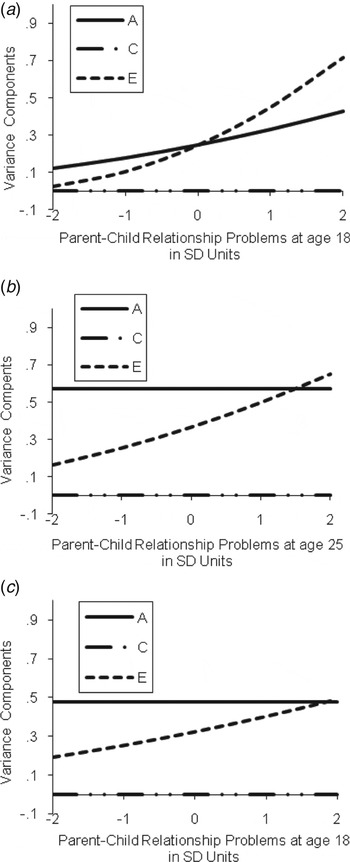
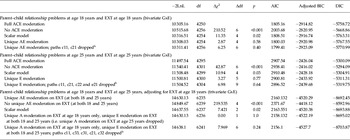
Fit statistics for both cross-sectional and longitudinal GxE interaction models are presented in Table 3. Fig. 2 provides visual illustrations of the moderation effects for the best-fitting models. For the cross-sectional model at age 18 years, fit statistics indicated that the no ACE moderation model (dropping all ACE moderation parameters common to parent–child relationship quality and EXT as well as those unique to EXT) fit significantly worse than the full ACE moderation model (keeping all ACE moderation parameters common to parent–child relationship quality and EXT as well as those unique to EXT) as evidenced by a significant likelihood ratio test and greater values for each information theoretic fit index. An evaluation of the 95% CIs of all ACE moderation parameters from the full ACE moderation model showed evidence of moderation on the A and E paths that are unique to EXT only; all other moderation parameters were not significantly different from zero. Additionally the c11 and c21 parameters could be dropped without worsening model fit; thus, this was considered the best-fitting model (see Table 3). This model allowed moderation on unique AE variance only, after accounting for AE correlations between parent–child relationship problems and EXT. As illustrated in Fig. 2 a, the genetic variance of EXT at age 18 years was greater under conditions of a greater degree of parent–child relationship problems. The same pattern of effects was found for the non-shared environmental influence that was unique to EXT.
Estimates of genetic and environmental variance components at different levels of parent–child relationship problems across time. Changes in the unstandardized ACE variance components [in standard deviation (SD) units] of externalizing are given as a function of parent–child relationship problems for the best-fitting models. A, Additive genetic influence; C, shared environmental influences; E, non-shared environmental influences. Parent–child relationship problems are measured such that the higher the score, the greater degree of parent–child relationship problems. (a) Cross-sectional results: parent–child relationship problems at age 18 years moderating genetic and environmental influences on externalizing at age 18 years (bivariate gene–environment interaction). (b) Cross-sectional results: parent–child relationship problems at age 25 years moderating genetic and environmental influences on externalizing at age 25 years (bivariate gene–environment interaction). (c) Longitudinal results: parent–child relationship problems at age 18 years moderating genetic and environmental influences on externalizing at age 25 years, adjusting for externalizing at age 18 years (trivariate gene–environment interaction).

Fit statistics for gene–environment interplay models of parent–child relationship problems and EXT a

EXT, Externalizing; −2LnL, −2 × log-likelihood; df, degrees of freedom; Δχ 2, χ 2 change; Δdf, degrees of freedom change; AIC, Akaike's information criterion; BIC, Bayesian information criterion; DIC, deviance information criterion; GxE, gene–environment interaction; A, additive genetic effects; C, shared environmental effects; E, non-shared environmental effects.
a The baseline model of comparison used in χ 2 difference tests is the full ACE moderation model, which allows for ACE moderation on all common and unique parameters. Scalar models refer to models that held moderators constant across genetic and environmental variance, rather than allowing moderators specific to genetic and environmental variance. Lower values across fit statistics indicate better fit. The change in χ 2 is the difference between the −2LnL in the baseline model (full ACE moderation) compared with the other modes tested.
b Considered the best-fitting model.
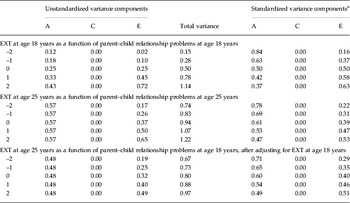
Table 4 provides both the unstandardized and standardized variance components of EXT at age 18 years as a function of parent–child relationship problems at age 18 years. While a GxE interaction was only detected in the cross-sectional results at age 18 years (such that genetic variance was greater in the context of a greater degree of parent–child relationship problems), all analyses showed that the heritability (i.e. proportion of total variance accounted for by genetic variance) of EXT was greater under conditions of fewer parent–child relationship problems. This ‘flip’ in findings arises because the total EXT variance increases with greater parent–child relationship problems and although both the non-shared and genetic contributions to variance increase with increasing environmental adversity, the former increases more rapidly than the latter, leading to declines in heritability. In other words, the standardized results concealed absolute changes in genetic and non-shared environmental variance.
Unstandardized and standardized variance components for the best-fitting models

A, Additive genetic influence; C, shared environmental influence; E, non-shared environmental influence; EXT, externalizing.
a Unlike the unstandardized variance components, the standardized variance components add up to 1.0.
In contrast to the cross-sectional analyses at age 18 years, dropping the genetic moderation parameters for the cross-sectional analysis at age 25 years did not worsen model fit. Thus, parent–child relationship problems at age 25 years did not moderate the genetic influence on EXT at age 25 years (see Table 3). However, there was significant moderation of the unique E on EXT at age 25 years. Additionally, paths c11, c21, c22, and e21 could be dropped without worsening model fit; thus this parsimonious model was considered the best-fitting model (see Table 3). As illustrated in Fig. 2 b, unique non-shared environmental influences on EXT were greater under conditions of a greater degree of parent–child relationship problems at age 25 years.
Do parent–child relationship problems at age 18 years moderate the genetic and environmental influences on EXT at age 25 years?
Next, we evaluated whether parent–child relationship problems at age 18 years moderated genetic and environmental influences on EXT at age 25 years, after adjusting for the moderating influence of parent–child relationship problems at age 18 years on EXT at age 18 years. Based on the best-fitting bivariate results that documented unique AE moderation at age 18 years and unique E moderation at age 25 years, we evaluated a trivariate model that tested for unique AE moderation on EXT at 18 and 25 years (for a figure describing this model and for Mx script, see the online Supplementary material). As described in the fit statistics in Table 3, unique A moderation on EXT at age 18 years and unique E moderation on EXT at ages 18 and 25 years were evident, but unique A moderation on EXT at age 25 years could be dropped without reducing model fit; thus there was no evidence of genetic moderation on adult EXT by adolescent parent–child relationship problems. Paths c11, c33, c31, c21 and c32 could additionally be dropped without reducing model fit (see Table 3 for details); thus this parsimonious model was considered the best fitting. As illustrated in Fig. 2, the unique E moderation effect on EXT at age 25 years by parent–child relationship problems at age 18 years was consistent with the pattern of non-shared environmental moderation of the cross-sectional relationships at the ages of 18 and 25 yearsFootnote 1 Footnote †.
Discussion
The goal of this study was to evaluate developmental changes in gene–environment interplay between parent–child relationship problems and EXT. As in our previous analysis and consistent with other studies, we detected a GxE interaction in adolescence (Feinberg et al. Reference Feinberg, Button, Neiderhiser, Reiss and Hetherington2007; Button et al. Reference Button, Lau, Maughan and Eley2008; Hicks et al. Reference Hicks, South, Dirago, Iacono and McGue2009b ), such that genetic influence on adolescent EXT was greater in the context of a greater degree of parent–child relationship problems. There was no evidence for this GxE interaction between parent–child relationship problems and EXT at age 25 years, or for the longitudinal relationship between parent–child relationship problems at age 18 years and EXT at age 25 years. Moreover, while the cross-sectional association was weak in adulthood, the longitudinal association between parent–child relationship problems at age 18 years and EXT at age 25 years was moderate and predominately accounted for by common genetic influences, which is consistent with a rGE hypothesis. In summary, results indicate that the moderating influence of adolescent parent–child relationship quality on the genetic influence of EXT is specific to the developmental context of adolescence (Moffitt et al. Reference Moffitt, Caspi and Rutter2005).
Johnson (Reference Johnson2007) suggested that models of GxE interaction in the presence of rGE can be interpreted to support a primarily social causation versus social selection explanation for the relationship between parent–child relationship problems and EXT. Social causation refers to the hypothesis that unfavorable environments (e.g. poor parenting) trigger genetic predisposition for mental illness and behavior problems (e.g. EXT). Social selection refers to the hypothesis that biological predispositions result in drift towards or creation of unfavorable environments (e.g. children have a greater degree of parent–child relationship problems as a result of their EXT). Our pattern of results appears to be consistent with both explanations, as both GxE and rGE were detected at age 18 years. However, the direction of effects remains unclear, as both EXT and parent–child relationship problems were measured at the same time point at the age 18 years assessment (i.e. rather than parent–child relationship problems triggering genetic risk for EXT, it could be that greater EXT triggers genetic risk for greater parent–child relationship problems).
Unlike the cross-sectional results in adolescence, we failed to detect a longitudinal moderating influence of adolescent parent–child relationship problems on EXT in adulthood. Rather, results supported rGE between adult EXT and prior parent–child relationship problems. Together, findings from this study and others (Burt et al. Reference Burt, McGue, Krueger and Iacono2005; Dick et al. Reference Dick, Viken, Purcell, Kaprio, Pulkkinen and Rose2007; Larsson et al. Reference Larsson, Viding, Rijsdijk and Plomin2008) generally support a developmental cascade theory of EXT, such that a genetic predisposition towards EXT is associated with greater environmental risk through processes of evocative and active rGE (demonstrated by common genetic influences; e.g. Neiderhiser et al. Reference Neiderhiser, Reiss, Hetherington and Plomin1999; Burt et al. Reference Burt, McGue, Krueger and Iacono2005). Above and beyond these effects, environmental context may additionally buffer or amplify genetic influence on EXT (Dick et al. Reference Dick, Viken, Purcell, Kaprio, Pulkkinen and Rose2007; Feinberg et al. Reference Feinberg, Button, Neiderhiser, Reiss and Hetherington2007; Button et al. Reference Button, Lau, Maughan and Eley2008); however, our results suggest such GxE interaction effects may be temporally and developmentally limited, at least for parent–child relationship problems. Additional longitudinal GxE analyses are needed to evaluate the impact of other key environmental influences in adolescence and young adulthood.
We presented moderation results for both the unstandardized and standardized variance components. Unstandardized variance components are necessary to evaluate for GxE because standardized variance components can conceale absolute changes in genetic and non-shared environmental variance. Nonetheless, standardized results can be useful to compare with prior cross-sectional research documenting EXT heritability estimates in childhood and adolescence. The pattern of results in Table 4 suggests that studies documenting substantial heritability estimates of EXT may have used samples that had less environmental stress (on average) than studies documenting markedly low heritability estimates (on average). It is useful to note that Rhee & Waldman's (Reference Rhee and Waldman2002) meta-analysis confirmed moderate heritability estimates (h 2) for EXT for children (h 2 = 0.46), adolescents (h 2 = 0.43) and adults (h 2 = 0.41), but decreasing shared environmental estimates (c 2) and increasing non-shared environmental estimates (e 2) with age (children: c 2 = 0.20, e 2 = 0.34; adolescents: c 2 = 0.16, e 2 = 0.41; c 2 = 0.09, e 2 = 0.50).
Some study limitations should be noted. Although representative of the state from which they were sampled, study participants were almost all of European ancestry; results may or may not generalize to other populations. Second, the measurement of parent–child relationship problems at age 25 years was not as extensive as the measurement at age 18 years. Nonetheless, the correlation of our measures for parent–child relationship problems from ages 18 to 25 years was moderate in magnitude (r = 0.35), supporting the notion that these measures tap into a related construct at both ages. Notably, parent–child relationship problems at age 18 years do not probably represent the beginning of a causal model, as it was probably affected by earlier child EXT problems and parent–child dynamics throughout childhood and adolescence (Burt et al. Reference Burt, McGue, Krueger and Iacono2005; Larsson et al. Reference Larsson, Viding, Rijsdijk and Plomin2008). Finally, we do not know how results might apply to other forms of psychopathology (such as internalizing disorders; Hicks et al. Reference Hicks, DiRago, Iacono and McGue2009a ), nor do we know how results might apply to clinical populations. Study strengths include the use of a genetically informed design, a large community-based sample, the use of prospective data, and the inclusion of both males and females.
This study demonstrated notable changes in the influence of gene–environment interplay in the development of EXT over time. First, we showed that while GxE interaction effects on EXT may be evident during childhood and adolescence, such effects may be temporarily limited and specific to developmental context. Second, we demonstrated that the influence of environmental variables changes over the course of development (i.e. parent–child relationship problems in adulthood are a less salient predictor of adult EXT than parent–child relationship problems in adolescence). Finally, results are consistent with the notion that rGE is a pervasive mechanism that accounts for person–environment associations during this developmental period spanning late adolescence to young adulthood. Altogether, this study is one of few (Agrawal et al. Reference Agrawal, Balasubramanian, Smith, Madden, Bucholz, Heath and Lynskey2010; Kendler et al. Reference Kendler, Gardner and Dick2011) that have evaluated long-term influences of gene–environment interplay. It remains important for future research to continue to identify what may potentially exacerbate or ameliorate genetic risk of EXT and related psychopathology in adulthood, particularly using longitudinal models that account for childhood and adolescent risk factors relevant for EXT over the life-course.
Supplementary material
For supplementary material accompanying this paper visit http://dx.doi.org/10.1017/S0033291714001445
Acknowledgements
This research was supported by grant DA05147 from the National Institute on Drug Abuse and grant AA09367 from the National Institute of Alcohol Abuse and Alcoholism. D.R.S. was also supported by the National Institute of Mental Health (postdoctoral training grant MH017069). B.M.H. was supported by K01 DA025868. The content is solely the responsibility of the authors and does not necessarily represent the official views of the National Institutes of Health.
Declaration of Interest
None.