












1. Introduction
Study of the interaction between geometric properties of a projective variety  $X \subset {\mathbb {P}}^{n}$ and structural properties of its defining ideal
 $I(X)$ is one of the central issues in algebraic geometry. Over the past few decades, the problem of establishing conditions to guarantee that
 $I(X)$ is generated by quadrics and that the first few syzygy modules are generated by linear syzygies has attracted considerable attention (e.g. [Reference GreenGre84b, Reference GreenGre84c, Reference Green and LazarsfeldGL88, Reference Ein and LazarsfeldEL93, Reference Gallego and PurnaprajnaGP99, Reference InamdarIna97]). Another important approach to studying structures of defining equations of
 $X$ is to examine whether
 $I(X)$ is defined by
 $2$-minors of one or several linear determinantal presentations (see [Reference Eisenbud, Koh and StillmanEKS88, Reference PucciPuc98, Reference HàHa02, Reference BernardiBer08, Reference Sidman and SmithSS11], among others). In such a situation,
 $I(X)$ admits a generating set consisting of quadrics of rank less than or equal to
 $4$. The main purpose of this paper is to exhibit cases where
 $I(X)$ is generated by quadrics of rank
 $3$. In particular, we prove that every Veronese embedding of
 ${\mathbb {P}}^{n}$ by
 $\mathcal {O}_{{\mathbb {P}}^{n}} (d)$ has this property unless
 ${\rm char}\, \Bbbk = 3$.
To state our results precisely, we begin with some notation and definitions. Let  $X \subset {\mathbb {P}}^{n}$ be any projective scheme over an algebraically closed field
 $\Bbbk$. Throughout this paper, we assume that
 ${\rm char}\,\Bbbk \neq 2$, since the rank of a quadric is not well-defined over characteristic
 $2$ (e.g.
 $xy$). We say that
 $X \subset {\mathbb {P}}^{n}$ satisfies property
 $\mathsf {QR} (k)$ if
 $I(X)$ is generated by quadrics of rank at most
 $k$. For a very ample line bundle
 $L$ on a projective scheme
 $X$, we will say that
 $L$ satisfies property
 $\mathsf {QR} (k)$ when the linearly normal embedding
 $X \subset {\mathbb {P}} H^{0} (X,L)$ does so.
We can reinterpret property  $\mathsf {QR} (k)$ as follows. Let
 ${\mathbb {P}}^{N}$, with
 $N={{n+2} \choose {2}}-1$, be the space of quadrics in
 ${\mathbb {P}}^{n}$, and let
 $\Phi _k$, with
 $1\leqslant k\leqslant n$, denote the variety of all quadrics of rank at most
 $k$. Now consider the subspace
 ${\mathbb {P}} (I(X)_2 )$ of
 ${\mathbb {P}}^{N}$ and
 $\Phi _k (X) := \Phi _k \cap {\mathbb {P}} (I(X)_2 )$ as a projective algebraic set in
 ${\mathbb {P}} (I(X)_2 )$. In this framework,
 $X$ satisfies property
 $\mathsf {QR} (k)$ if and only if
 $\Phi _k (X)$ is nondegenerate in
 ${\mathbb {P}} (I(X)_2 )$.
There are many examples of property  $\mathsf {QR} (4)$ in the literature. First, let
 $\mathcal {L}$ be a line bundle of degree
 $d$ on a smooth curve
 $\mathcal {C}$ of genus
 $g$. In [Reference Saint-DonatSai72], B. Saint-Donat proved that if
 $d \geqslant 2g+2$ then
 $\mathcal {C} \subset {\mathbb {P}} H^{0} (\mathcal {C}, \mathcal {L})$ satisfies property
 $\mathsf {QR} (4)$. When
 $\mathcal {C}$ is non-hyperelliptic, non-trigonal and not isomorphic to a plane quintic, M. Green [Reference GreenGre84a] reproved the classical Torelli's theorem by showing that the canonical embedding
 $\phi _{K_{\mathcal {C}}} ( \mathcal {C}) \subset {\mathbb {P}}^{g-1}$ satisfies property
 $\mathsf {QR} (4)$; see also [Reference PetriPet23, Reference Saint-DonatSai73, Reference Arbarello and HarrisAH81]. Many classical constructions in projective geometry, such as rational normal scrolls, Veronese varieties and Segre varieties of two projective spaces, are determinantally presented in the sense that their homogeneous ideals are generated by
 $2$-minors of a
 $1$-generic matrix of linear forms (see, e.g., [Reference Eisenbud, Koh and StillmanEKS88, Reference HarrisHarr92, Reference PucciPuc98, Reference HàHa02]). Furthermore, any Segre–Veronese variety is defined ideal-theoretically by
 $2$-minors of several linear determinantal presentations, which are also called ‘flattenings’ (see [Reference BernardiBer08]). Recently, Sidman and Smith proved in [Reference Sidman and SmithSS11] that every sufficiently ample line bundle on a projective connected scheme is determinantally presented; therefore, they all satisfy property
 $\mathsf {QR} (4)$.
Our first main theorem is about the property  $\mathsf {QR} (3)$ of the Veronese variety
 $V_{n,d} := \nu _d ({\mathbb {P}}^{n} ) \subset {\mathbb {P}}^{N}$,
 $N={{n+d} \choose {n}}-1$, which is unexpected(!).
Theorem 1.1 Let  $d$ and
 $n$ be any positive integers and suppose that
 ${\rm char}\,\Bbbk \neq 2,3$. Then
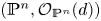
 $({\mathbb {P}}^{n} , \mathcal {O}_{{\mathbb {P}}^{n}} (d))$ satisfies property
 $\mathsf {QR} (3)$.
For the proof of this result, see Theorem 4.2.
To prove Theorem 1.1, the first step is to find many quadratic equations of rank  $3$ in
 $I(V_{n,d})$. To this end, we use two methods. To explain the first one, let
 $f:H^{0}({\mathbb {P}}^{n} ,\mathcal {O}_{{\mathbb {P}}^{n}} (d)) \rightarrow H^{0}({\mathbb {P}}^{N} ,\mathcal {O}_{{\mathbb {P}}^{N} }(1))$ be the natural isomorphism. Then we obtain the map
 \[ Q : H^{0} ({\mathbb{P}}^{n} ,\mathcal{O}_{{\mathbb{P}}^{n}} (1)) \times H^{0} ({\mathbb{P}}^{n} ,\mathcal{O}_{{\mathbb{P}}^{n}} (1)) \times H^{0} ({\mathbb{P}}^{n} ,\mathcal{O}_{{\mathbb{P}}^{n}} (d-2)) \rightarrow I(V_{n,d})_2 \]
defined by
 \[ Q(s,t,h) = f(s \otimes s \otimes h) f(t \otimes t \otimes h) - f(s \otimes t \otimes h )^{2} . \]
This map is well-defined since  $Q(s,t,h)$ is either
 $0$ or a rank
 $3$ quadratic equation of
 $V_{n,d}$. The second method uses the natural group action of
 $\operatorname {PGL}_n (\Bbbk )$ on
 $I(V_{n,d})_2$, under which the rank is preserved; that is, any
 $Q \in I(V_{n,d})_2$ of rank
 $3$ and any
 $\sigma \in \operatorname {PGL}_n (\Bbbk )$ give us a new element
 $\sigma (Q) \in I(V_{n,d})_2$ of rank 3.
We prove Theorem 1.1 by double induction on  $n \geqslant 1$ and
 $d \geqslant 2$. So we first prove our theorem for the cases where
 $n=1$ (Corollary 2.4) and
 $d=2$ (Theorem 3.1). Then we complete the proof by combining the induction hypothesis and the above two methods. In fact, this step is not straightforward and we must deal with more than
 $10$ partial cases.
Let  $W$ be the subspace of
 $I(V_{n,d})$ spanned by the image of the above
 $Q$-map. In Theorem 2.2, we provide an explicitly defined finite subset
 $\Gamma$ of the image of the
 $Q$-map that spans
 $W$. See Notation and Remarks 2.1 for the definition of
 $\Gamma$. In the proof of Theorem 1.1, it is shown that
 $I(V_{n,d})$ is generated by
 $\Gamma$. In particular, the property
 $\mathsf {QR} (3)$ of
 $({\mathbb {P}}^{n} , \mathcal {O}_{{\mathbb {P}}^{n}} (d))$ is induced by the decomposition
 $\mathcal {O}_{{\mathbb {P}}^{n}} (d) = \mathcal {O}_{{\mathbb {P}}^{n}} (1)^{2} \otimes \mathcal {O}_{{\mathbb {P}}^{n}} (d-2)$.
Our second main result is the following.
Theorem 1.2 Suppose that  ${\rm char}\,\Bbbk = 3$. Then
(1)
 $({\mathbb {P}}^{1} , \mathcal {O}_{{\mathbb {P}}^{1}} (d))$ satisfies property $\mathsf {QR} (3)$ for all $d \geqslant 2$;
(2)
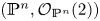
$({\mathbb {P}}^{n} , \mathcal {O}_{{\mathbb {P}}^{n}} (2))$ satisfies property $\mathsf {QR} (3)$ if and only if $n \leqslant 2$.


For the proof of this result, see Theorem 3.1.
For the cases of  $n=1$ and
 $n=d=2$, our proof of Theorem 1.1 is indeed characteristic-free. In proving the failure of property
 $\mathsf {QR} (3)$ of
 $({\mathbb {P}}^{n} , \mathcal {O}_{{\mathbb {P}}^{n}} (2))$ for
 $n \geqslant 3$, a crucial point is that any quadratic equation of
 $\nu _2 ({\mathbb {P}}^{n} )$ of rank
 $3$ is obtained from the above
 $Q$-map. Then, for
 $n=3$, we find a subset
 $\Gamma$ of
 $I (\nu _2 ({\mathbb {P}}^{n} ))$ with
 $|\Gamma |=19$ that generates the subspace spanned by the image of the
 $Q$-map. Since
 $I (\nu _2 ({\mathbb {P}}^{n} ))_2$ is of dimension 20, this shows that
 $({\mathbb {P}}^{3} , \mathcal {O}_{{\mathbb {P}}^{3}} (2))$ fails to satisfy property
 $\mathsf {QR} (3)$. For
 $n \geqslant 4$, the proof comes from the fact that
 $\nu _2 ({\mathbb {P}}^{n} )$ contains
 $\nu _2 ({\mathbb {P}}^{3} )$ as an ideal-theoretic linear section (see Remark 5.1).
When  ${\rm char}\,\Bbbk = 3$,
 $n \geqslant 2$ and
 $d \geqslant 3$, we do not know yet whether
 $({\mathbb {P}}^{n} , \mathcal {O}_{{\mathbb {P}}^{n}} (d))$ satisfies property
 $\mathsf {QR} (3)$ or not.
Our third main result concerns the asymptotic nature of the rank of quadratic equations of the Veronese re-embedding of  $(X,L)$ when
 $X$ is an arbitrary projective scheme and
 $L$ is a very ample line bundle on
 $X$. The first result in this direction is due to D. Mumford, who proved in [Reference MumfordMum70, Theorem 1] that if
 $X \subset {\mathbb {P}}^{n}$ is a nondegenerate irreducible projective variety, then for all
 $d \geqslant \deg (X)$,
(i) the
$d$th Veronese re-embedding of $X$ is set-theoretically defined by quadrics; and(ii) those quadrics can be chosen as quadrics of rank at most
$4$.


Since the publication of [Reference MumfordMum70] there have been several interesting generalizations. In [Reference GreenGre84b] and [Reference GreenGre84c], Green treated the quadratic generation of the homogeneous ideal as the first step towards understanding higher syzygies. So far, numerous results have been reported in this direction. Based on the work of Green and Lazarsfeld in [Reference Green and LazarsfeldGL88], we say that  $L$ satisfies condition
 $\mathrm {N}_p$ for some
 $p \geqslant 1$ if
 $X \subset {\mathbb {P}} H^{0} (X,L)$ is projectively normal and ideal-theoretically cut out by quadrics such that the first
 $p-1$ steps of the minimal free resolution of
 $I(X)$ are linear. In [Reference Ein and LazarsfeldEL93], Ein and Lazarsfeld proved that if
 $X$ is a complex smooth variety and
 $L$ is a very ample line bundle on
 $X$ of degree
 $d_0$,then
 $L^{d}$ satisfies condition
 $\mathrm {N}_{d+1-d_0}$ (see also [Reference Gallego and PurnaprajnaGP99]). Thus this result generalizes statement (i) above. Also, statement (ii) has been widely extended by many results on the determinantal presentation of projective varieties, as mentioned above.
Along this line, our third main result is as follows.
Theorem 1.3 Suppose that  ${\rm char}\,\Bbbk \neq 2,3$ and let
 $L$ be a very ample line bundle on a projective scheme
 $X$ defining the linearly normal embedding
 \[ X \subset {\mathbb{P}} H^{0} (X,L). \]
If  $m$ is an integer such that
 $X$ is
 $j$-normal for all
 $j \geqslant m$ and
 $I(X)$ is generated by forms of degree at most
 $m$, then
 $(X,L^{d} )$ satisfies property
 $\mathsf {QR} (3)$ for all
 $d \geqslant m$.
For the proof of this result, see the beginning of § 5.
In Theorem 1.3, we can take  $m$ to be the regularity of
 $X \subset {\mathbb {P}} H^{0} (X,L)$ in the sense of Castelnuovo and Mumford.
As an immediate application of Theorem 1.3, suppose that  $(X,L)$ satisfies Green and Lazarsfeld's condition
 $\mathrm {N}_1$. Then one could take
 $m=2$ and
 $(X,L^{d} )$ would satisfy property
 $\mathsf {QR} (3)$ for all
 $d \geqslant 2$ (see Corollary 5.2). This approach can be applied to the Grassmannian manifolds (see Example 5.5). In § 5 we provide a few examples illustrating how to apply Theorem 1.3 to specific varieties.
Remark 1.4 Let  $X$ be a projective scheme. Our main results in this paper show that there is a significant correlation between a certain positive nature of the very ample line bundle
 $L$ on
 $X$ and the property
 $\mathsf {QR}(3)$ of
 $(X,L)$, just as in many works on the Green–Lazarsfeld condition
 $\mathrm {N}_p$ and the Eisenbud–Koh–Stillman determinantal presentation of very ample line bundles. We will discuss this aspect further in § 6.
The paper is structured as follows. In § 2 we develop a method to generate rank  $3$ quadratic equations of
 $X \subset {\mathbb {P}} H^{0} (X,L)$. We also prove that every rational normal curve satisfies property
 $\mathsf {QR}(3)$. In § 3 we study property
 $\mathsf {QR}(3)$ of the second Veronese embedding
 $({\mathbb {P}}^{n} , \mathcal {O}_{{\mathbb {P}}^{n}} (2))$. In § 4 we prove that every Veronese embedding
 $({\mathbb {P}}^{n} , \mathcal {O}_{{\mathbb {P}}^{n}} (d))$ satisfies property
 $\mathsf {QR}(3)$ unless
 ${\rm char}\, \Bbbk = 2,3$. In § 5 we study the asymptotic behavior of the property
 $\mathsf {QR}(3)$ of
 $(X,L^{d} )$ when
 $X$ is an arbitrary projective scheme and
 $L$ is a very ample line bundle on
 $X$. We also present some applications of the results to complete intersections, Grassmannian manifolds, Abelian varieties, Enriques surfaces and K3 surfaces. We finish the paper by giving relevant examples and discussing some problems for further research in § 6.
2. Rank $3$ quadratic generators

This section introduces our method for generating rank  $3$ quadrics in the ideal of a projective scheme.
Notation and Remarks 2.1 Let  $X$ be a projective scheme and
 $L$ a very ample line bundle on
 $X$. Suppose that
 $L$ is decomposed as
 $L=L_1^{\otimes 2}\otimes L_2$ where
 $L_1$ and
 $L_2$ are line bundles on
 $X$ such that
 \[ p := h^{0} (X,L_1 ) \geqslant 2 \quad \mbox{and} \quad q := h^{0} (X,L_2 ) \geqslant 1. \]
(1) The linearly normal embedding
$X\subset {\mathbb {P}} H^{0}(X,L)={\mathbb {P}}^{r}$ induces an isomorphism
\[ f:H^{0}(X,L) \rightarrow H^{0}({\mathbb{P}}^{r},\mathcal{O}_{{\mathbb{P}}^{r}}(1)). \](2) Define the map
by\[ Q = Q_{L_1 , L_2} : H^{0} (X,L_1 ) \times H^{0} (X,L_1 ) \times H^{0} (X,L_2 ) \rightarrow I(X)_2 \]This map is well-defined since the restriction of\[ Q(s,t,h) = f(s \otimes s \otimes h) f(t \otimes t \otimes h) - f(s \otimes t \otimes h )^{2} . \]$Q(s,t,h)$ to $X$ becomes
(cf. [Reference EisenbudEis05, Proposition 6.10]). Thus,\[ (s\otimes s\otimes h)|_X \times(t\otimes t\otimes h)|_X - (s\otimes t\otimes h)|_X ^{2} =0 \]$Q(s,t,h)$ is either $0$ or a rank $3$ quadratic equation of $X$ (see also Lemma 2.3).(3) (A sufficient way to guarantee
$\mathsf {QR}(3)$) Let $\mathfrak {Q} = \mathfrak {Q}_{L_1 ,L_2}$ be the ideal generated by the image of the map $Q_{L_1 , L_2 }$. Then $\mathfrak {Q} \subseteq I(X)$ and $(X,L)$ satisfies property $\mathsf {QR}(3)$ if the equality $\mathfrak {Q}= I(X)$ is attained.(4) (Featured subsets of
$W_{L_1 ,L_2}$) Let $\{s_1,s_2,\ldots , s_p\}$ and $\{h_1,h_2,\ldots ,h_q\}$ be any chosen bases for $H^{0} (X,L_1 )$ and $H^{0} (X,L_2 )$, respectively. Also, let
For the problem of finding a spanning set of\[ \begin{cases} \Delta_1 := \{ (i,j)~|~ i,j \in \{1,\ldots ,p \},~i< j \},\\ \Delta_2 := \{ (i,j,k) ~|~ (i,j) \in \Delta_1 ,~k \in \{1,\ldots ,p \},~k \neq i,j \},\\ \Delta_3 := \{ ( i,j,k, l)) ~|~ (i,j),(k, l) \in \Delta_1 ,~i< k ,~ j \neq k,l \}, \\ H := \{ h_1 , \ldots , h_q \} \cup \{ h_i + h_j ~|~ 1 \leqslant i < j \leqslant q \}. \end{cases} \]$W=W_{L_1 ,L_2}$, the subspace of $I(X)_2$ spanned by the image of the map $Q_{L_1 , L_2 }$, we define three types of finite subsets of $W$ as follows:
Let\[ \begin{cases} \Gamma_{11}=\big\{Q(s_i,s_j,h) ~|~ (i,j) \in \Delta_1 , ~h \in H \big\},\\ \Gamma_{12}=\big\{Q(s_i + s_j , s_k,h)~|~ (i,j,k) \in \Delta_2 , ~h \in H \big\},\\ \Gamma_{22}=\big\{Q(s_i+s_j,s_k +s_l,h )~|~ (i,j,k,l) \in \Delta_3 , ~h \in H \big\}. \end{cases} \]$\Gamma (L_1 , L_2)$ be the union $\Gamma _{11}\cup \Gamma _{12} \cup \Gamma _{22}$. Then it can be checked that
(2.1)\begin{equation} |\Gamma (L_1 , L_2)| \leqslant {{{{p} \choose {2}}+1} \choose 2} \times {q+1 \choose 2}. \end{equation}


Our main result in this section is the following.
Theorem 2.2 With the notation defined in Notation and Remarks 2.1,
 \[ \textrm{the subspace } W_{L_1 , L_2 } \text{ is spanned by }\Gamma(L_1 ,L_2) \text{ as a }\Bbbk\text{-vector space.} \]
To prove Theorem 2.2, we begin with the following lemma.
Lemma 2.3 With the notation defined in Notation and Remarks 2.1, the following properties hold.
(1) For any
$s,t\in H^{0}(X,L_1)$, $h\in H^{0}(X,L_2)$ and constant $\lambda \in {\Bbbk }$,
and\[ Q(s,s,h)=0, \quad Q(s,t,h)=Q(t,s,h),\quad Q(s,s+t,h)=Q(s,t,h) \]\[Q(\lambda s,t,h)=Q(s,t,\lambda h)=\lambda^{2} Q(s,t,h). \](2) For
$s,t,u\in H^{0}(X,L_1)$, $g,h \in H^{0}(X,L_2)$ and $a,b \in \Bbbk$,
and\[ Q(s,at+bu,h) = (a^{2} -ab) Q(s,t,h) + (b^{2} -ab) Q(s,u,h) + ab Q(s,t+u,h) \]\[ Q(s,t,ag+bh) = (a^{2} -ab) Q(s,t,g) + (b^{2} -ab) Q(s,t,h) + ab Q(s,t,g+h). \](3) For
$m\geqslant 3$, let $s,t,t_1 , \ldots , t_m \in H^{0}(X,L_1)$ and $h,g_1 , \ldots , g_m \in H^{0}(X,L_2)$. Then
and\[ Q(s,t_1+t_2+\cdots+t_m,h)=\sum_{1\leqslant i< j\leqslant m} Q(s,t_i+t_j,h) -(m-2)\sum_{i=1}^{m} Q(s,t_i,h) \]\[ Q(s,t,g_1+g_2+\cdots+g_m)=\sum_{1\leqslant i< j\leqslant m} Q(s,t,g_i+g_j) -(m-2)\sum_{i=1}^{m} Q(s,t,g_i). \](4) For
$s,t,u\in H^{0}(X,L_1)$ and $h \in H^{0}(X,L_2)$,
\begin{align*} Q(s+u,t+u,h) &= Q(s,u,h)+Q(t,u,h)+Q(s+u,t,h)+Q(t+u,s,h) \\ &\quad -Q(s,t,h) -Q(s+t,u,h). \end{align*}


Proof. (1) Note that  $f(s\otimes t\otimes h)=f(t\otimes s\otimes h)$. Then the statement can easily be shown by using the definition of the map
 $Q$.
(2) One can check that
 \[ Q(s,at+bu,h)= a^{2} Q(s,t,h) +b^{2} Q(s,u,h) +2ab P(s,t,u,h) \]
where  $P(s,t,u,h) := f(s \otimes s \otimes h) f(t \otimes u \otimes h)-f(s \otimes t \otimes h)f(s \otimes u \otimes h)$. In particular,
 \[ Q(s,t+u,h)= Q(s,t,h) + Q(s,u,h) +2P(s,t,u,h). \]
Thus we have
 \[ Q(s,at+bu,h)= a^{2} Q(s,t,h) +b^{2} Q(s,u,h) +ab \{ Q(s,t+u,h)- Q(s,t,h) - Q(s,u,h)\}, \]
which shows the first formula. Similarly, one can prove that
 \[ Q(s,t,ag+bh) = a^{2} Q(s,t,g) + b^{2} Q (s,t,h)+ab R(s,t,g,h) \]
where  $R(s,t,g,h) := f(s \otimes s \otimes g)f(t \otimes t \otimes h)+ f(s \otimes s \otimes h)f(t \otimes t \otimes g)$
 $-2f(s \otimes t \otimes g)f (s \otimes t \otimes h)$. Then we have
 \[ Q(s,t, g+ h) = Q(s,t,g) + Q (s,t,h)+ R(s,t,g,h) \]
and hence
 \[ Q(s,t,ag+bh)= a^{2} Q(s,t,g) +b^{2} Q(s,t,h) +ab \{ Q(s,t, g+ h)- Q(s,t,g)- Q (s,t,h) \}, \]
which shows the second formula.
(3) We will prove the first equality by using induction on  $m \geqslant 3$. The second one can be shown in a similar way. For simplicity, let
 $g(s,t):=f(s\otimes t\otimes h)$ in this proof. For
 $m=3$,
 \begin{align*} Q(s,t_1+t_2+t_3,h) &= g(s,s)g(t_1+t_2+t_3,t_1+t_2+t_3)-g(s,t_1+t_2+t_3)^{2}\\ & = g(s,s)\big\{g(t_1,t_1)+g(t_2,t_2)+g(t_3,t_3)+2g(t_1,t_2)+2g(t_1,t_3)\\ &\quad +2g(t_2,t_3)\big\}-\big\{g(s,t_1)^{2}+g(s,t_2)^{2}+g(s,t_3)^{2}+2g(s,t_1)g(s,t_2)\\ &\quad +2g(s,t_1)g(s,t_3)+2g(s,t_2)g(s,t_3)\big\}. \end{align*}
Since for  $1\leqslant i< j\leqslant 3$ one has
 \begin{align*} Q(s,t_i+t_j,h) &= g(s,s)g(t_i+t_j,t_i+t_j)-g(s,t_i+t_j)^{2} \\ & = g(s,s)\big\{g(t_i,t_i)+g(t_j,t_j)+2g(t_i,t_j)\big\}-\big\{g(s,t_i)^{2}+g(s,t_j)^{2}+2g(s,t_i)g(s,t_j)\big\}, \end{align*}
we can calculate the difference
 \begin{align*} &Q(s,t_1+t_2,h)+Q(s,t_1+t_3,h)+Q(s,t_2+t_3,h)-Q(s,t_1+t_2+t_3,h) \\ &\quad = g(s,s)\big\{g(t_1,t_1)+g(t_2,t_2)+g(t_3,t_3)\big\}-\big\{g(s,t_1)^{2}+g(s,t_2)^{2}+g(s,t_3)^{2}\big\}\\ &\quad = Q(s,t_1,h)+Q(s,t_2,h)+Q(s,t_3,h). \end{align*}
Hence the statement holds for  $m=3$.
For  $m \geqslant 4$, let us denote
 $Q(s,t,h)$ by
 $F(t)$ for simplicity. By the induction hypothesis we have
 \begin{align*} F(t_1 + \cdots + t_m ) & = F(t_1 + \cdots + (t_{m-1} + t_m ) ) \\ & = \sum_{1\leqslant i< j\leqslant m-2} F(t_i+t_j) + \sum_{i=1}^{m-2} F(t_i+t_{m-1}+t_m)\\ &\quad -(m-3)\bigg\{\sum_{i=1}^{m-2} F(t_i) +F(t_{m-1}+t_m)\bigg\} \end{align*}
and
 \[ F(t_i+t_{m-1}+t_m) = F(t_i + t_{m-1} ) + F(t_i + t_m ) + F(t_{m-1} +t_m ) - F(t_i ) - F (t_{m-1} ) - F(t_m ) \]
for each  $1 \leqslant i \leqslant m-2$. Hence, by combining these identities, we get the desired formula for
 $Q(s,t_1+t_2+\cdots +t_m,h)$.
(4) From Lemma 2.3(1) and (3), we have
 \begin{align*} Q(s+t,u,h) & = Q(s+t,s+t+u,h) \\ & = Q(s+t,s+u,h)+Q(s+t,t+u,h)-2Q(s,t,h) -Q(s+t,u,h) \end{align*}
and hence
 \begin{equation} Q(s+t,s+u,h)+Q(s+t,t+u,h) =2Q(s,t,h)+2Q(s+t,u,h). \end{equation}
Upon permuting  $s,t$ and
 $u$ in (2.2), it follows that
 \begin{equation} Q(s+t,s+u,h)+Q(s+u,t+u,h)=2Q(s,u,h)+2Q(s+u,t,h) \end{equation}
and
 \begin{equation} Q(s+t,t+u,h)+Q(s+u,t+u,h)=2Q(t,u,h)+2Q(t+u,s,h). \end{equation}
The desired identity then comes from (2.2), (2.3) and (2.4).
Now we are ready to prove Theorem 2.2.
Proof of Theorem 2.2 Consider a general member
 \[ G := Q (a_1 s_1 + \cdots + a_p s_p , b_1 s_1 + \cdots + b_p s_p , c_1 h_1 + \cdots + c_q h_q ) \]
of the image of the map  $Q_{L_1 ,L_2}$, where
 $a_1 ,\ldots , a_p , b_1 , \ldots , b_p , c_1 , \ldots , c_q$ are from
 $\Bbbk$. By applying Lemma 2.3(1) and (3) repeatedly, one can see that
 $G$ is a
 $\Bbbk$-linear combination of quadratic equations of the form
 \[ Q( \alpha_1 s_i + \beta_1 s_j , \alpha_2 s_k + \beta_2 s_l , \alpha_3 h_m + \beta_3 h_n ) \]
where  $\alpha _u , \beta _v \in \Bbbk$. Then, by Lemma 2.3(2), we may assume that
 $\alpha _u , \beta _v \in \{ 0,1 \}$. Finally, Lemma 2.3(4) enables us to exclude the cases where
 $\{i,j \} \cap \{k,l \}$ is not empty.
We finish this section by applying Theorem 2.2 to the rational normal curves.
Corollary 2.4 For every  $d \geqslant 2$, let
 $\mathcal {C}_d \subset {\mathbb {P}}^{d}$ be the standard rational normal curve of degree
 $d$. Then
 $I(\mathcal {C}_d)$ is generated by
 $\Gamma (\mathcal {O}_{{\mathbb {P}}^{1}} (1),\mathcal {O}_{{\mathbb {P}}^{1}} (d-2))$. In particular, every rational normal curve satisfies property
 $\mathsf {QR}(3)$.
Proof. Consider the  $Q$-map about the decomposition
 \[ \mathcal{O}_{{\mathbb{P}}^{1}} (d) = \mathcal{O}_{{\mathbb{P}}^{1}} (1)^{{\otimes} 2} \otimes \mathcal{O}_{{\mathbb{P}}^{1}} (d-2). \]
Let  $\{s,t \}$ be a basis for
 $H^{0} ({\mathbb {P}}^{1} ,\mathcal {O}_{{\mathbb {P}}^{1}} (1))$, so
 $\{ s^{d-2-i} t^{i} ~|~ 0 \leqslant i \leqslant d-2 \}$ is a basis for
 $H^{0} ({\mathbb {P}}^{1} ,\mathcal {O}_{{\mathbb {P}}^{1}} (d-2))$. Then
 $\Gamma := \Gamma (\mathcal {O}_{{\mathbb {P}}^{1}} (1) ,\mathcal {O}_{{\mathbb {P}}^{1}} (d-2))$ is equal to
 \[ \big\{ Q(s ,t , s^{d-2-i} t^{i}) ~|~ 0 \leqslant i \leqslant d-2 \big\} \cup \big\{ Q(s,t,s^{d-2-i} t^{i} + s^{d-2-j} t^{j}) ~|~ 0 \leqslant i< j\leqslant d-2 \big\}. \]
Note that  $\Gamma (\mathcal {O}_{{\mathbb {P}}^{1}} (1) ,\mathcal {O}_{{\mathbb {P}}^{1}})=\{ Q(s,t,1)=f(s^{2})f(t^{2})-f(st)^{2}=z_0 z_2 - z_1^{2} \}$. Now we will show that
 $\Gamma$ has exactly
 $\binom{d}{2}$ quadrics of rank
 $3$ and that they are
 $\Bbbk$-linearly independent. Let
 $z_0 , z_1 , \ldots , z_d$ be the homogeneous coordinates of
 ${\mathbb {P}}^{d}$. Then
 \[ F_i:=Q(s ,t , s^{d-2-i} t^{i}) = z_i z_{i+2} - z_{i+1} ^{2} \]
and
 \[ G_{i,j}:=Q(s,t,s^{d-2-i} t^{i} + s^{d-2-j} t^{j}) = (z_i + z_j ) (z_{i+2} + z_{j+2} ) - (z_{i+1} + z_{j+1} )^{2} . \]
Let  $G_{i,j}':=G_{i,j}-F_i-F_j=z_iz_{j+2}+z_jz_{i+2}-2z_{i+1}z_{j+1}$. The leading terms of the
 $F_i$ are
 $z_iz_{i+2}$ and those of the
 $G_{i,j}'$ are
 $z_i z_{j+2}$ in the standard lexicographic order. They are all distinct, because
 $i< j$. This means that all the
 $F_i$ and
 $G_{i,j}'$ are
 ${\Bbbk }$-linearly independent and
 \[ |\Gamma (\mathcal{O}_{{\mathbb{P}}^{1}} (1) ,\mathcal{O}_{{\mathbb{P}}^{1}} (d-2))| = (d-1)+\binom{d-1}{2}=\binom{d}{2} = {\dim}_{\Bbbk}~I(\mathcal{C}_d )_2 . \]
Consequently,  $\Gamma$ generates
 $I(\mathcal {C}_d )$.
3. Second Veronese embeddings
This section is devoted to solving the problem of whether the second Veronese variety satisfies property  $\mathsf {QR}(3)$ or not. It is interesting that the answer to this question depends on the characteristic of the base field
 $\Bbbk$.
Theorem 3.1 Let  $n$ be any positive integer. Then the following hold.
(1) Suppose that
${\rm char}\,\Bbbk \neq 2,3$. Then $I(V_{n,2})$ is generated by $\Gamma (\mathcal {O}_{{\mathbb {P}}^{n}} (1),\mathcal {O}_{{\mathbb {P}}^{n}})$. In particular, $({\mathbb {P}}^{n} , \mathcal {O}_{{\mathbb {P}}^{n}} (2))$ satisfies property $\mathsf {QR}(3)$.(2) If
${\rm char}\,\Bbbk =3$, then $({\mathbb {P}}^{n} , \mathcal {O}_{{\mathbb {P}}^{n}} (2))$ satisfies property $\mathsf {QR}(3)$ if and only if $n \leqslant 2$.


We begin with fixing some notation related to the Veronese embedding of projective spaces, which we will use throughout the rest of this paper.
Notation and Remarks 3.2 Denote by  ${\mathbb {N}}_{0}$ the set of non-negative integers. For integers
 $n \geqslant 1$ and
 $d \geqslant 2$, consider the Veronese variety
 \[ V_{n,d} := \nu_d ({\mathbb{P}}^{n} ) \subset {\mathbb{P}}^{N(n,d)}, \quad \mbox{where} \ N(n,d) = {{n+d} \choose {n}} -1. \]
For  $A(n,d) := \{ (a_0 , \ldots ,a_n )~|~ a_i \in {\mathbb {N}}_0 \mbox { and } a_0 + \cdots + a_n = d \}$, let
 \[ B(n,d) := \{ z_I ~|~ I \in A(n,d) \} \]
be the set of standard homogeneous coordinates of the projective space  ${\mathbb {P}}^{N(n,d)}$.
(1) The homogeneous ideal of
$V_{n,d}$ in ${\mathbb {P}}^{N(n,d)}$ is generated by the set of quadrics
In particular,\[ \mathcal{Q} (n,d) := \{ z_I z_J - z_K z_L ~|~ I,J,K,L \in A(n,d) \mbox{ and } I+J = K+L \}. \]$({\mathbb {P}}^{n} , \mathcal {O}_{{\mathbb {P}}^{n}} (d))$ always satisfies $\mathsf {QR}(4)$.(2) For
$I =(a_0 , a_1 , \ldots ,a_n ) \in A(n,d)$ and $k \in \{0,1,\ldots , n \}$, we will denote $a_k$ by $I_k$ and $\sum _{i=0}^{n} a_i$ by $|I|$.(3) For each
$0 \leqslant k \leqslant n$, consider the inclusion map from $A(n-1,d)$ into $A(n,d)$ defined by inserting $0$ at the $k$th location. This map identifies $B(n-1,d)$ with a subset of $B(n,d)$; also, it induces an inclusion map
Moreover,\[ \iota_k : I( V_{n-1,d} )_2 \rightarrow I(V_{n,d} )_2 . \]$\iota _k$ maps the subset $\Gamma (\mathcal {O}_{{\mathbb {P}}^{n-1}} (1) ,\mathcal {O}_{{\mathbb {P}}^{n-1}} (d-2))$ into $\Gamma (\mathcal {O}_{{\mathbb {P}}^{n}} (1) ,\mathcal {O}_{{\mathbb {P}}^{n}} (d-2))$.(4) Suppose that
$d \geqslant 3$. For each $0 \leqslant k \leqslant n$, consider the inclusion map from $A(n,d-1)$ into $A(n,d)$ defined by adding $1$ to the $k$th location. This corresponds to the multiplication map by $x_i$ of the homogeneous coordinate ring of ${\mathbb {P}}^{n}$. This map identifies $B(n,d-1)$ with a subset of $B(n,d)$; also, it induces the map
Moreover,\[ \delta_k : I(V_{n,d-1})_2\rightarrow I(V_{n,d})_2. \]$\delta _k$ maps the subset $\Gamma (\mathcal {O}_{{\mathbb {P}}^{n}} (1) ,\mathcal {O}_{{\mathbb {P}}^{n}} (d-3))$ into $\Gamma (\mathcal {O}_{{\mathbb {P}}^{n}} (1) ,\mathcal {O}_{{\mathbb {P}}^{n}} (d-2))$.


The following proposition plays a crucial role in the proof of Theorem 3.1.
Proposition 3.3 If  $I(V_{2d-1 ,d})$ is generated by
 $\Gamma (\mathcal {O}_{{\mathbb {P}}^{2d-1}} (1),\mathcal {O}_{{\mathbb {P}}^{2d-1}} (d-2))$, then
 $I(V_{n ,d})$ is generated by
 $\Gamma (\mathcal {O}_{{\mathbb {P}}^{n}} (1),\mathcal {O}_{{\mathbb {P}}^{n}} (d-2))$ for all
 $n \geqslant 2d-1$.
Proof. We use induction on  $n \geqslant 2d-1$. The
 $n = 2d-1$ case is done by our assumption.
Suppose that  $n \geqslant 2d$ and let
 $Q = z_I z_J-z_K z_L$ be an element of
 $\mathcal {Q} (n,d)$. We need to show that
 $Q$ is a linear combination of quadratic equations in
 $\Gamma (\mathcal {O}_{{\mathbb {P}}^{n}} (1),\mathcal {O}_{{\mathbb {P}}^{n}} (d-2))$. Since
 $n \geqslant 2d$, by the pigeonhole principle there exists
 $0\leqslant k\leqslant n$ such that
 $I_k = J_k = K_k = L_k =0$. Now, by using the inclusion map
 \[ \iota_k : I(V_{n-1,d} )_2 \rightarrow I(V_{n,d} )_2 , \]
we can regard  $Q$ as an element of
 $I( V_{n-1 , d})$. By the induction hypothesis,
 $Q$ is a linear combination of elements in
 $\Gamma (\mathcal {O}_{{\mathbb {P}}^{n-1}} (1),\mathcal {O}_{{\mathbb {P}}^{n-1}} (d-2))$. Then, by Notation and Remarks 3.2(3),
 $Q$ is also a linear combination of elements in
 $\Gamma (\mathcal {O}_{{\mathbb {P}}^{n}} (1),\mathcal {O}_{{\mathbb {P}}^{n}} (d-2))$. This completes the proof.
We can now prove Theorem 3.1.
Proof of Theorem 3.1 (1) By Proposition 3.3, it is enough to check the statement for the cases of  $n=2$ and
 $n=3$. So consider the
 $Q$-map about the decomposition
 \[ \mathcal{O}_{{\mathbb{P}}^{n}}(2)= \mathcal{O}_{{\mathbb{P}}^{n}}(1)^{{\otimes} 2}\otimes \mathcal{O}_{{\mathbb{P}}^{n}}. \]
Let  $\{ x_0,\ldots ,x_n \}$ and
 $\{ 1 \}$ be bases of
 $H^{0}({\mathbb {P}}^{n} , \mathcal {O}_{{\mathbb {P}}^{n}}(1))$ and
 $H^{0}({\mathbb {P}}^{n} , \mathcal {O}_{{\mathbb {P}}^{n}})$, respectively. Thus the
 $\Bbbk$-vector space
 $W_{\mathcal {O}_{{\mathbb {P}}^{n}}(1),\mathcal {O}_{{\mathbb {P}}^{n}}}$ defined in Notation and Remarks 2.1(3) is generated by the union
 $\Gamma :=\Gamma (\mathcal {O}_{{\mathbb {P}}^{n}} (1),\mathcal {O}_{{\mathbb {P}}^{n}})= \Gamma _{11} \cup \Gamma _{12} \cup \Gamma _{22}$ where
 \[ \begin{cases} \Gamma_{11}=\big\{F_{i,j} := Q(x_i,x_j,1) ~|~ (i,j) \in \Delta_1 \big\},\\ \Gamma_{12}=\big\{G_{i,j,k} := Q(x_i , x_j + x_k,1)~|~ (i,j,k) \in \Delta_2 \big\}, \\ \Gamma_{22}=\big\{H_{i,j,k,l} := Q(x_i +x_j,x_k +x_l,1 )~|~ (i,j,k,l) \in \Delta_3 \big\}. \end{cases} \]
For  $n=2$,
 $\Gamma (\mathcal {O}_{{\mathbb {P}}^{2}} (1),\mathcal {O}_{{\mathbb {P}}^{2}})$ consists of the following six elements:
 \[ \begin{cases} F_{0,1} := Q(x_0,x_1,1)=z_{200}z_{020}-z_{110}^{2}, \\ F_{0,2} := Q(x_0,x_2,1)=z_{200}z_{002}-z_{101}^{2}, \\ F_{1,2} := Q(x_1,x_2,1)=z_{020}z_{002}-z_{011}^{2}, \\ G_{0,1,2} := Q(x_0,x_1+x_2,1)=z_{200}(z_{020}+2z_{011}+z_{002})-(z_{110}+z_{101})^{2}, \\ G_{1,0,2} := Q(x_1,x_0+x_2,1)=z_{020}(z_{200}+2z_{101}+z_{002})-(z_{110}+z_{011})^{2}, \\ G_{2,0,1} := Q(x_2,x_0+x_1,1)=z_{002}(z_{200}+2z_{110}+z_{020})-(z_{101}+z_{011})^{2}. \end{cases} \]
One can easily check that the following three identities hold:
 \[ \begin{cases} G_{0,1,2} = F_{0,1} + F_{0,2} +2(z_{200}z_{011}-z_{110}z_{101}),\\ G_{1,0,2} = F_{0,1} + F_{1,2} +2(z_{020}z_{101}-z_{110}z_{011}),\\ G_{2,0,1} = F_{0,2} + F_{1,2} +2(z_{002}z_{110}-z_{101}z_{011}). \end{cases} \]
Since  ${\rm char}\,\Bbbk \neq 2$, this verifies that the homogeneous ideal
 \[ I(V_{2,2}) = \langle F_{0,1} , F_{0,2} , F_{1,2} , z_{200}z_{011}-z_{110}z_{101} , z_{020}z_{101}-z_{110}z_{011} , z_{002}z_{110}-z_{101}z_{011} \rangle \]
is generated by  $\Gamma (\mathcal {O}_{{\mathbb {P}}^{2}} (1),\mathcal {O}_{{\mathbb {P}}^{2}})$.
For  $n=3$, note that
 $\dim _{\Bbbk }I(V_{3,2})=20$ and
 $I(V_{3,2})$ is generated by the
 $2$-minors of the
 $4\times 4$ symmetric matrix
 \[ A=\begin{pmatrix} z_{2000} & z_{1100} & z_{1010} & z_{1001}\\ z_{1100} & z_{0200} & z_{0110} & z_{0101}\\ z_{1010} & z_{0110} & z_{0020} & z_{0011}\\ z_{1001} & z_{0101} & z_{0011} & z_{0002} \end{pmatrix}. \]
For each  $i \in \{1,2,3,4 \}$, let
 $A_i$ be the principal submatrix of
 $A$ obtained by eliminating the
 $i$th row and column. Then the
 $2$-minors of
 $A_i$ are contained in
 $\iota _i (I(V_{2,2})_2 )$, so they can be handled by the previous case. The remaining generators not coming from these principal submatrices are
 \[ R_1=z_{1100}z_{0011}-z_{1010}z_{0101}, \quad R_2=z_{1100}z_{0011}-z_{1001}z_{0110} , \quad R_3=z_{1010}z_{0101}-z_{1001}z_{0110}. \]
Note that  $R_3=-R_1 +R_2$. Thus it suffices to show that
 $R_1$ and
 $R_2$ are
 $\Bbbk$-linear combinations of elements in
 $\Gamma =\Gamma (\mathcal {O}_{{\mathbb {P}}^{3}} (1),\mathcal {O}_{{\mathbb {P}}^{3}})$. Consider the set
 \[ \Gamma_{22} = \{H_{0,1,2,3},H_{0,2,1,3} , H_{0,3,1,2} \}. \]
Letting  $H'_{0,1,2,3}=4z_{1100}z_{0011}-2z_{1010}z_{0101}-2z_{1001}z_{0110}$, we have
 \begin{align*} H_{0,1,2,3} &= (z_{2000}+2z_{1100}+z_{0200})(z_{0020}+2z_{0011}+z_{0002})-(z_{1010}+z_{1001}+z_{0110}+z_{0101})^{2} \\ &=G_{0,2,3}+G_{1,2,3}+G_{2,0,1}+G_{3,0,1}-F_{0,2}-F_{0,3}-F_{1,2}-F_{1,3} + H'_{0,1,2,3} . \end{align*}
Then it follows that the element  $H'_{0,1,2,3}$ is contained in
 $W_{\mathcal {O}_{{\mathbb {P}}^{3}}(1),\mathcal {O}_{{\mathbb {P}}^{3}}}$. Similarly, one can show that the two elements
 \[ H'_{0,2,1,3}=4z_{1010}z_{0101}-2z_{1100}z_{0011}-2z_{1001}z_{0110} \]
and
 \[ H'_{0,3,1,2}=4z_{1001}z_{0110}-2z_{1100}z_{0011}-2z_{1010}z_{0101} \]
are also contained in  $W_{\mathcal {O}_{{\mathbb {P}}^{3}}(1),\mathcal {O}_{{\mathbb {P}}^{3}}}$. Since
 \begin{equation} H'_{0,1,2,3}=2R_1+2R_2,\quad H'_{0,2,1,3}={-}4R_1+2R_2 \quad \mbox{and} \quad H'_{0,3,1,2}=2R_1-4R_2 \end{equation}
and since  ${\rm char}\,\Bbbk \neq 2,3$, it follows that
 \[ R_1=\frac{1}{6}(H'_{0,1,2,3}-H'_{0,2,1,3}) \quad \mbox{and} \quad R_2=\frac{1}{6}(H'_{0,1,2,3}-H'_{0,3,1,2}) \]
are contained  $W_{\mathcal {O}_{{\mathbb {P}}^{3}}(1),\mathcal {O}_{{\mathbb {P}}^{3}}}$. This completes the proof that the ideal
 $I (V_{3,2})$ is generated by
 $\Gamma$ and hence
 $({\mathbb {P}}^{3}, \mathcal {O}_{{\mathbb {P}}^{3}}(2))$ satisfies property
 $\mathsf {QR}(3)$.
(2) Suppose that  ${\rm char}\,\Bbbk = 3$. First note that Corollary 2.4 for
 $({\mathbb {P}}^{1}, \mathcal {O}_{{\mathbb {P}}^{1}}(2))$ and the proof in
 $(1)$ for
 $({\mathbb {P}}^{2}, \mathcal {O}_{{\mathbb {P}}^{2}}(2))$ are still valid in
 ${\rm char}\,\Bbbk =3$. Thus, it is enough to show that
 $({\mathbb {P}}^{n}, \mathcal {O}_{{\mathbb {P}}^{n}}(2))$ fails to satisfy property
 $\mathsf {QR}(3)$ if
 $n \geqslant 3$.
When  $n=3$, we will first show that
 $W := W_{\mathcal {O}_{{\mathbb {P}}^{3}}(1),\mathcal {O}_{{\mathbb {P}}^{3}}}$ is a proper subset of
 $I(V_{3,2})_2$. Indeed,
 $W = \langle \Gamma \rangle$ by Theorem 2.2 and
 $\Gamma$ has at most
 $21$ elements by (2.1). Furthermore,
 \[ \Gamma_{22} = \{ H_{0,1,2,3} , H_{0,2,1,3} , H_{0,3,1,2} \} \]
and  $\Gamma _{11} \cup \Gamma _{12}$ has at most
 $18$ elements. From (3.1) we obtain
 \[ H'_{0,1,2,3}= H'_{0,2,1,3}= H'_{0,3,1,2} \]
since  ${\rm char}\,\Bbbk = 3$. In particular, the image of
 $\Gamma _{22}$ in the quotient space
 $W / \langle \Gamma _{11} \cup \Gamma _{12} \rangle$ has at most one nonzero element. As a consequence,
 \[ \dim_{\Bbbk} W \leqslant | \Gamma_{11} \cup \Gamma_{12} | +1 = 19. \]
This shows that  $W$ is strictly smaller than
 $I(V_{3,2})_2$ since
 $\dim _{\Bbbk } I(V_{3,2})_2 = 20$. Next, let
 $W'$ be the
 $\Bbbk$-vector space spanned by all rank
 $3$ elements in
 $I(V_{3,2})_2$. We claim that
 $W' = W$ and hence any quadric of rank
 $3$ in
 $I(V_{3,2})$ is contained in
 $W$. Obviously, this completes the proof. That is,
 $({\mathbb {P}}^{3}, \mathcal {O}_{{\mathbb {P}}^{3}}(2))$ fails to satisfy property
 $\mathsf {QR}(3)$ since
 $W'$ is a proper subspace of
 $I(V_{3,2})_2$. To see that the claim is true, consider the ring homomorphism
 \[ \nu_2^{\#}: \Bbbk [z_0 , z_1 , \ldots , z_9 ] \to \Bbbk[x_0,\ldots,x_3] \]
corresponding to the Veronese embedding  ${\rm {\mathbb P}}^3\buildrel {\; \nu _2} \over \hookrightarrow V_{3,2}\subset {\rm {\mathbb P}}^9$. Note that there is no rank
 $2$ element in
 $I(V_{3,2})$. If there exists a nonzero rank
 $2$ element
 $L_1^{2}+L_2^{2}\in I(V_{3,2})$, then
 $\nu _2^{\#}(L_1^{2}+L_2^{2})=q_1^{2}+q_2^{2}=0$ and, since
 $\Bbbk [x_0,\ldots ,x_3]$ is a unique factorization domain, it means that
 $q_1=\pm i q_2$ for
 $i \in \Bbbk$ such that
 $i^{2}=-1$. This implies that
 $L_1=\pm i L_2$, which contradicts the assumption that
 $L_1^{2}+L_2^{2}$ is nonzero. Let
 $\Theta = L_1^{2}-L_2L_3 \in I(V_{3,2})$ be a nonzero quadric of rank
 $3$ where
 $L_1 , L_2 , L_3 \in \Bbbk [z_0 , z_1 , \ldots , z_9 ]$ are linear forms. We may assume that every rank
 $3$ quadric is of this form via the transform
 $L_1^{2}+L_2^{2}+L_3^{2}\mapsto L_1^{2}-(L_2+i L_3)(-L_2+i L_3)$. Then
 $\nu _2^{\#}(L_1)=q_1$,
 $\nu _2^{\#}(L_2)=q_2$ and
 $\nu _2^{\#}(L_3)=q_3$ for some quadratic forms
 $q_1 , q_2 , q_3\in \Bbbk [x_0,\ldots ,x_3]$ such that
 \[ \nu_2^{\#}(\Theta) = q_1 ^{2} - q_2 q_3 = 0. \]
We can check that  $q_1$ is not proportional to
 $q_2$ (or to
 $q_3$), since if it is then the original quadric
 $L_1^{2}-L_2L_3$ has rank
 $2$, which is a contradiction. From the unique factorization domain property of
 $\Bbbk [x_0,\ldots ,x_3]$, it follows that
 $q_1=l_1l_2$,
 $q_2=l_1^{2}$ and
 $q_3=l_2^{2}$ for some linear forms
 $l_1$,
 $l_2$ and
 $l_3$. Consequently,
 $\Theta = -Q(l_1,l_2,1)$ is an element of
 $W$.
For  $n \geqslant 4$, choose a hyperplane
 $H={\mathbb {P}}^{n-1}$ of
 ${\mathbb {P}}^{n}$. Then one can check that
 $V_{n-1,2} = \nu _2 (H)$ in
 ${\mathbb {P}}^{N(n-1,2)}$ is an ideal-theoretic linear section of
 $V_{n,2} \subset {\mathbb {P}}^{N(n,2)}$ (cf. [Reference Choi and ParkCP15, Proposition 2.1]). In particular, if
 $({\mathbb {P}}^{n-1} , \mathcal {O}_{{\mathbb {P}}^{n-1}} (2))$ fails to satisfy property
 $\mathsf {QR}(3)$ then so does
 $({\mathbb {P}}^{n} , \mathcal {O}_{{\mathbb {P}}^{n}} (2))$. This completes the proof that
 $({\mathbb {P}}^{n}, \mathcal {O}_{{\mathbb {P}}^{n}}(2))$ fails to satisfy property
 $\mathsf {QR}(3)$ for all
 $n \geqslant 3$.
Remark 3.4 From Theorem 2.2, one may ask whether all the members of  $\Gamma$ are
 $\Bbbk$-linearly independent or not.
 $(1)$ For
 $({\mathbb {P}}^{2} , \mathcal {O}_{{\mathbb {P}}^{2}} (2))$, it is shown in the proof of Theorem 3.1 that
 $\Gamma$ is a basis for
 $I(V_{2,2})$.
 $(2)$ For
 $({\mathbb {P}}^{3} , \mathcal {O}_{{\mathbb {P}}^{3}} (2))$, suppose that
 ${\rm char}~\Bbbk \neq 2,3$. In the proof of Theorem 3.1, it is shown that
 $\Gamma$ spans the
 $20$-dimensional vector space
 $I(V_{3,2})_2$. Since
 $|\Gamma | \leqslant 21$, there exists at most one non-trivial
 $\Bbbk$-linear relation among the elements of
 $\Gamma$. Note that the identity
 \begin{equation} H'_{0,1,2,3}+H'_{0,2,1,3}+H'_{0,3,1,2}=0 \end{equation}
provides one such relation. Therefore, (3.2) is essentially the unique linear relation among the elements of  $\Gamma$.
4. Higher Veronese embeddings
This section is devoted to the proof of Theorem 1.1, so we assume that  ${\rm char}\,\Bbbk \neq 2,3$. We require some more notation and definitions.
Notation and Remarks 4.1 (Continued from Notation and Remarks 3.2)
Let
 \[ V_{n,d} := \nu_d ({\mathbb{P}}^{n} ) \subset {\mathbb{P}}^{N }, \quad \mbox{where } N= N(n,d) = {{n+d} \choose {n}} -1, \]
be the  $d$th Veronese embedding of
 ${\mathbb {P}}^{n}$ for some
 $n \geqslant 1$ and
 $d \geqslant 2$.
(1) For
$0 \leqslant i \leqslant n$, let $e_i$ denote the $i$th coordinate vector. Thus $A(n,1)=\{e_i ~|~ 0 \leqslant i \leqslant n \}$.(2) For
$I \in A(n,d)$, we define $\operatorname {Supp}(I)$ as the set $\{ k ~|~ 0 \leqslant k \leqslant n, \, I_k >0 \}$.(3) For simplicity, we denote the monomial
$z_Iz_J$ by $[I,J]$. For example, an element $z_Iz_J-z_Kz_L$ of $\mathcal {Q} (n,d)$ is denoted by $[I,J]-[K,L]$.(4) Throughout this section, we use the map
$Q$, the ideal $\mathfrak {Q}$ and the finite set $\Gamma := \Gamma (L_1 , L_2)$ from Notation and Remarks 2.1 for the pair $(L_1 ,L_2 ) =(\mathcal {O}_{{\mathbb {P}}^{n}} (1),\mathcal {O}_{{\mathbb {P}}^{n}} (d-2))$. By Theorem 2.2, we know that $\mathfrak {Q}$ is generated by $\Gamma$.(5) Let
$q$ and $q'$ be two homogeneous quadratic equations. We say that they are equivalently related and write $q\sim q'$ if $q-q'$ can be represented by a sum of elements in $\Gamma$ or, equivalently, if $q-q'$ is contained in $\mathfrak {Q}$. So a quadratic equation $q$ is equivalent to $0$ if and only if $q \in \mathfrak {Q}$.(6) From Notation and Remarks 3.2(1), one can see that the following three statements are equivalent.
(i)
$[I,J] \sim [K,L]$ for any $I,J,K,L \in A(n,d)$ satisfying $I+J = K+L$;(ii)
$I(V_{n,d}) = \mathfrak {Q}$;(iii)
$I(V_{n,d})$ is generated by $\Gamma$.
$({\mathbb {P}}^{n} , \mathcal {O}_{{\mathbb {P}}^{n}} (d))$ satisfies property $\mathsf {QR}(3)$ if one of (i)–(iii) holds.


We will prove the following result.
Theorem 4.2 The ideal  $I(V_{n,d})$ is generated by
 $\Gamma = \Gamma (\mathcal {O}_{{\mathbb {P}}^{n}} (1),\mathcal {O}_{{\mathbb {P}}^{n}} (d-2))$.
As mentioned in Notation and Remarks 4.1(6), Theorem 4.2 implies Theorem 1.1.
In order to prove Theorem 4.2, we will use double induction on  $n$ and
 $d$. Indeed, Theorem 4.2 has already been proven for
 $n=1$ in Corollary 2.4 and for
 $d=2$ in Theorem 3.1. From now on, let
 $n \geqslant 2$ and
 $d\geqslant 3$. We also assume that
- $({\dagger} )$ the statement of Theorem 4.2 is true for $({\mathbb {P}}^{n'} , \mathcal {O}_{{\mathbb {P}}^{n'}} (d'))$ whenever $n' < n$ and $d' < d$.


With these assumptions, we first prove some lemmas.
Lemma 4.3 Suppose that  $d \geqslant 3$ and let
 $I$ and
 $J$ be two elements in
 $A(n,d-2)$. Then
(1)
$[2e_i+I,2e_j+I]\sim [e_i+e_j+I,e_i+e_j+I];$(2)
$[2e_i+I,e_j+e_k+I]\sim [e_i+e_j+I,e_i+e_k+I];$(3)
$[e_i+e_j+I,e_k+e_l+I]\sim [e_i+e_k+I,e_j+e_l+I];$(4)
$[2e_i+I,2e_j+J]+[2e_j+I,2e_i+J]\sim 2[e_i+e_j+I,e_i+e_j+J];$(5)
$[2e_i+I,e_j+e_k+J]+[e_j+e_k+I,2e_i+J] \\ \sim [e_i+e_j+I,e_i+e_k+J]+[e_i+e_k+I,e_i +e_j+J];$(6)
$[e_i+e_j+I,e_k+e_l+J]+[e_k+e_l+I,e_i+e_j+J]\\ \sim [e_i+e_k+I,e_j+e_l+J]+[e_j+e_l +I,e_i+e_k+J].$


Proof. To use the  $Q$-map about the decomposition
 $\mathcal {O}_{{\mathbb {P}}^{n}} (d) = \mathcal {O}_{{\mathbb {P}}^{n}} (1)^{\otimes 2} \otimes \mathcal {O}_{{\mathbb {P}}^{n}} (d-2)$, let
 $\{x_0 , x_1 , \ldots , x_n \}$ be a basis of
 $H^{0} ({\mathbb {P}}^{n} ,\mathcal {O}_{{\mathbb {P}}^{n}} (1))$.
(1) For an element in  $\Gamma _{11}$,
 \begin{align*} Q(x_i,x_j,\mathbf{x}^{I}) & = f(x_i^{2}\mathbf{x}^{I})f(x_j^{2}\mathbf{x}^{I})-f(x_ix_j\mathbf{x}^{I})^{2} \\ & = [2e_i+I,2e_j+I]-[e_i+e_j+I,e_i+e_j+I]\in \mathfrak{Q} \end{align*}
Hence the relation  $(1)$ holds.
(2) For an element in  $\Gamma _{12}$,
 \begin{align*} &Q(x_i,x_j+x_k,\mathbf{x}^{I}) = f(x_i^{2}\mathbf{x}^{I})f((x_j+x_k)^{2}\mathbf{x}^{I})-f(x_i(x_j+x_k)\mathbf{x}^{I})^{2} \\ &\quad = [2e_i+I,2e_j+I]+2[2e_i+I,e_j+e_k+I]+[2e_i+I,2e_k+I] \\ &\qquad -[e_i+e_j+I,e_i+e_j+I]-2[e_i+e_j+I,e_i+e_k+I] -[e_i+e_k+I,e_i+e_k+I] . \end{align*}
Using the equivalence relation  $(1)$ for each pair
 $(i,j)$ and
 $(i,k)$, this is equivalent to
 $2[2e_i+I,e_j+e_k+I]-2[e_i+e_j+I,e_i+e_k+I]$. Since
 ${\rm char}(\Bbbk ) \neq 2$, the relation
 $(2)$ follows.
(3) For an element in  $\Gamma _{22}$,
 \begin{align*} & Q(x_i+x_j,x_k+x_l,\mathbf{x}^{I}) = f((x_i+x_j)^{2}\mathbf{x}^{I})f((x_k+x_l)^{2}\mathbf{x}^{I})-f((x_i+x_j)(x_k+x_l)\mathbf{x}^{I})^{2} \\ &\quad=[2e_i+I,2e_k+I]-[e_i+e_k+I,e_i+e_k+I]+[2e_i+I,2e_l+I]\\ &\qquad -[e_i+e_l+I,e_i+e_l+I]+[2e_j+I,2e_k+I]-[e_j+e_k+I,e_j+e_k+I]\\ &\qquad +[2e_j+I,2e_l+I]-[e_j+e_l+I,e_j+e_l+I]+2[2e_i+I,e_k+e_l+I]\\ &\qquad -2[e_i+e_k+I,e_i+e_l+I]+2[2e_j+I,e_k+e_l+I]-2[e_j+e_k+I,e_j+e_l+I]\\ &\qquad +2[e_i+e_j+I,2e_k+I]-2[e_i+e_k+I,e_j+e_k+I]+2[e_i+e_j+I,2e_l+I]\\ &\qquad -2[e_i+e_l+I,e_j+e_l+I]+4[e_i+e_j+I,e_k+e_l+I]-2[e_i+e_k+I,e_j+e_l+I]\\ &\qquad -2[e_i+e_l+I,e_j+e_k+I]. \end{align*}
We can eliminate the above eight equations using the relations  $(1)$ and
 $(2)$. Then the only remaining equivalent part is
 \begin{equation} 4[e_i+e_j+I,e_k+e_l+I]-2[e_i+e_k+I,e_j+e_l+I]-2[e_i+e_l+I,e_j+e_k+I]. \end{equation}
By exchanging  $j$ and
 $k$, we also obtain the relation
 \begin{align} Q(x_i+x_k,x_j+x_l,\mathbf{x}^{I}) &\sim 4[e_i+e_k+I,e_j+e_l+I]-2[e_i+e_j+I,e_k+e_l+I]\nonumber\\ &\quad -2[e_i+e_l+I,e_j+e_k+I].\end{align}
By subtracting (4.2) from (4.1) and dividing by  $6$, it can be shown that
 \[ {[e_i+e_j+I,e_k+e_l+I]}\sim {[e_i+e_l+I,e_j+e_k+I]}.\]
To do this, we require the assumption that  $\mbox {char}(\Bbbk ) \neq 2,3$.
(4) For an element in  $\Gamma _{11}$,
 \begin{align*} &Q(x_i,x_j,\mathbf{x}^{I}+\mathbf{x}^{J}) = f(x_i^{2}(\mathbf{x}^{I}+\mathbf{x}^{J}))f(x_j^{2}(\mathbf{x}^{I}+\mathbf{x}^{J}))-f(x_ix_j(\mathbf{x}^{I}+\mathbf{x}^{J}))^{2}\\ &\quad= [2e_i+I,2e_j+I]+[2e_i+J,2e_j+J]+[2e_i+I,2e_j+J]+[2e_i+J,2e_j+I]\\ & \qquad -[e_i+e_j+I,e_i+e_j+I]-[e_i+e_j+J,e_i+e_j+J]-2[e_i+e_j+I,e_i+e_j+J]. \end{align*}
Using the relation  $(1)$ for
 $I$ and
 $J$, one can show that the above equation is equivalent to
 \[ [2e_i+I,2e_j+J]+[2e_j+I,2e_i+J]- 2[e_i+e_j+I,e_i+e_j+J]. \]
Hence the relation  $(4)$ holds.
(5) For an element in  $\Gamma _{12}$,
 \begin{align*} &Q(x_i,x_j+x_k,\mathbf{x}^{I}+\mathbf{x}^{J}) \\ &\quad= f(x_i^{2}(\mathbf{x}^{I}+\mathbf{x}^{J}))f((x_j+x_k)^{2}(\mathbf{x}^{I}+\mathbf{x}^{J}))-f(x_i(x_j+x_k)(\mathbf{x}^{I}+\mathbf{x}^{J}))^{2}\\ &\quad= [2e_i+I,2e_j+I]-[e_i+e_j+I,e_i+e_j+I]\\ &\qquad+[2e_i+I,2e_k+I]-[e_i+e_k+I,e_i+e_k+I]\\ &\qquad+[2e_i+J,2e_j+J]-[e_i+e_j+J,e_i+e_j+J]\\ &\qquad+[2e_i+J,2e_k+J]-[e_i+e_k+J,e_i+e_k+J]\quad\textrm{(first 4 lines } \sim 0 \text{ by (1))}\\ &\qquad+2[2e_i+I,e_j+e_k+I]-2[e_i+e_j+I,e_i+e_k+I]\\ &\qquad+2[2e_i+J,e_j+e_k+J]-2[e_i+e_j+J,e_i+e_k+J]\quad\textrm{(next two lines }\sim 0 \text{ by (2))}\\ &\qquad+[2e_i+I,2e_j+J]+[2e_i+J,2e_j+I]-2[e_i+e_j+I,e_i+e_j+J]\\ &\qquad+[2e_i+I,2e_k+J]+[2e_i+J,2e_k+I]-2[e_i+e_k+I,e_i+e_k+J]\\ &\qquad\qquad\textrm{(these two lines }\sim 0 \text{ by (4))}\\ &\qquad+2[2e_i+I,e_j+e_k+J]+2[2e_i+J,e_j+e_k+I]-2[e_i+e_j+I,e_i+e_k+J]\\ &\qquad-2[e_i+e_k+I,e_i+e_j+J] \quad\textrm{(the only remaining part).} \end{align*}
Thus, we have
 \begin{align*} &[2e_i+I,e_j+e_k+J]+[e_j+e_k+I,2e_i+J]-[e_i+e_j+I,e_i+e_k+J]\\ &\quad -[e_i+e_k+I,e_i+e_j+J]\in \mathfrak{Q}. \end{align*}
Hence the relation  $(5)$ holds.
(6) For an element in  $\Gamma _{22}$,
 \begin{align*} & Q(x_i+x_j,x_k+x_l,\mathbf{x}^{I}+\mathbf{x}^{J})\\ &\quad = f((x_i+x_j)^{2}(\mathbf{x}^{I}+\mathbf{x}^{J}))f((x_k+x_l)^{2}(\mathbf{x}^{I}+\mathbf{x}^{J})) -f((x_i+x_j)(x_k+x_l)(\mathbf{x}^{I}+\mathbf{x}^{J}))^{2}\\ &\quad= [2e_i+I,2e_k+I]-[e_i+e_k+I,e_i+e_k+I]+[2e_i+I,2e_l+I]-[e_i+e_l+I,e_i+e_l+I]\\ &\qquad+[2e_j+I,2e_k+I]-[e_j+e_k+I,e_j+e_k+I]+[2e_j+I,2e_l+I]-[e_j\!+\!e_l+I,e_j+e_l+I]\\ &\qquad+[2e_i+J,2e_k+J]-[e_i\!+\!e_k+J,e_i+e_k+J]+[2e_i+J,2e_l+J]-[e_i+e_l+J,e_i+e_l+J]\\ &\qquad+[2e_j+J,2e_k+J]-[e_j+e_k+J,e_j+e_k+J]\!+\![2e_j+J,2e_l\!+\!J]-[e_j\!+\!e_l+J,e_j+e_l+J]\\ &\qquad\qquad\textrm{(the above 4 lines are equivalent to } 0 \text{ by (1))} \\ &\qquad+2[2e_i+I,e_k+e_l+I]-2[e_i+e_k+I,e_i+e_l+I]+2[2e_i+J,e_k+e_l+J]\\ &\qquad-2[e_i+e_k+J,e_i+e_l+J]+2[2e_j+I,e_k+e_l+I]-2[e_j+e_k+I,e_j+e_l+I]\\ &\qquad+2[2e_j+J,e_k+e_l+J]-2[e_j+e_k+J,e_j+e_l+J]+2[e_i+e_j+I,2e_k+I]\\ &\qquad-2[e_i+e_k+I,e_j+e_k+I]+2[e_i+e_j+J,2e_k+J]-2[e_i+e_k+J,e_j+e_k+J]\\ &\qquad+2[e_i+e_j+I,2e_l+I]-2[e_i+e_l+I,e_j+e_l+I]+2[e_i+e_j+J,2e_l+J]\\ &\qquad-2[e_i+e_l+J,e_j+e_l+J]\qquad\textrm{(the above 4 lines are equivalent to } 0 \text{ by (2))}\\ &\qquad+[2e_i+I,2e_k+J]+[2e_i+J,2e_k+I]-2[e_i+e_k+I,e_i+e_k+J]\\ &\qquad+[2e_i+I,2e_l+J]+[2e_i+J,2e_l+I]-2[e_i+e_l+I,e_i+e_l+J]\\ &\qquad+[2e_j+I,2e_k+J]+[2e_j+J,2e_k+I]-2[e_j+e_k+I,e_j+e_k+J]\\ &\qquad+[2e_j+I,2e_l+J]+[2e_j+J,2e_l+I]-2[e_j+e_l+I,e_j+e_l+J]\\ &\qquad\qquad\textrm{(the above 4 lines are equivalent to } 0 \text{ by (4))}\\ &\qquad+2[2e_i+I,e_k+e_l+J]+2[2e_i+J,e_k+e_l+I]-2[e_i+e_k+I,e_i+e_l+J]\\ &\qquad-2[e_i+e_l+I,e_i+e_k+J]+2[2e_j+I,e_k+e_l+J]+2[2e_j+J,e_k+e_l+I]\\ &\qquad-2[e_j+e_k+I,e_j+e_l+J]-2[e_j+e_l+I,e_j+e_k+J]+2[e_i+e_j+I,2e_k+J]\\ &\qquad+2[e_i+e_j+J,2e_k+I]-2[e_i+e_k+I,e_j+e_k+J]-2[e_j+e_k+I,e_i+e_k+J]\\ &\qquad+2[e_i+e_j+I,2e_l+J]+2[e_i+e_j+J,2e_l+I]-2[e_i+e_l+I,e_j+e_l+J]\\ &\qquad-2[e_j+e_l+I,e_i+e_l+J]\qquad\textrm{(the above 4 lines are equivalent to } 0 \text{ by (5))}\\ &\qquad+4[e_i+e_j+I,e_k+e_l+I]-2[e_i+e_k+I,e_j+e_l+I]-2[e_i+e_l+I,e_j+e_k+I]\\ &\qquad+4[e_i+e_j+J,e_k+e_l+J]-2[e_i+e_k+J,e_j+e_l+J]-2[e_i+e_l+J,e_j+e_k+J]\\ &\qquad\qquad\textrm{(the above 2 lines are equivalent to } 0 \text{ by (3))}\\ &\qquad+4[e_i+e_j+I,e_k+e_l+J]+4[e_k+e_l+I,e_i+e_j+J]-2[e_i+e_k+I,e_j+e_l+J]\\ &\qquad-2[e_j+e_l+I,e_i+e_k+J]-2[e_i+e_l+I,e_j+e_k+J]-2[e_j+e_k+I,e_i+e_l+J]\\ &\qquad\qquad\textrm{(the only remaining part).} \end{align*}
Hence we see that  $Q(x_i+x_j,x_k+x_l,\mathbf {x}^{I}+\mathbf {x}^{J})$ is equivalent to
 \begin{align} &4[e_i+e_j+I,e_k+e_l+J]+4[e_k+e_l+I,e_i+e_j+J] -2[e_i+e_k+I,e_j+e_l+J] \nonumber\\ &\quad -2[e_j+e_l+I,e_i+e_k+J]-2[e_i+e_l+I,e_j+e_k+J]-2[e_j+e_k+I,e_i+e_l+J]. \end{align}
By exchanging  $j$ and
 $k$, we also obtain the relation
 \begin{gather} Q(x_i+x_k,x_j+x_l,\mathbf{x}^{I}+\mathbf{x}^{J})\nonumber\\ \sim 4[e_i+e_k+I,e_j+e_l+J]+4[e_j+e_l+I,e_i+e_k+J]-2[e_i+e_j+I,e_k+e_l+J] \nonumber\\ -\,2[e_k+e_l+I,e_i+e_j+J]-2[e_i+e_l+I,e_j+e_k+J]-2[e_j+e_k+I,e_i+e_l+J]. \end{gather}
By subtracting (4.4) from (4.3) and dividing by  $6$, it can be shown that
 \begin{align*} &[e_i+e_j+I,e_k+e_l+J]+ [e_k+e_l+I,e_i+e_j+J]\\ & \quad \sim [e_i+e_k+I,e_j+e_l+J] +[e_j+e_l+I,e_i+e_k+J]. \end{align*}
Here, we require again the assumption that  ${\rm char}(\Bbbk ) \neq 2,3$.
Lemma 4.4 Let  $I,J,K, L \in A(n,d)$ be such that
 $I+J=K+L$. Under the assumption
 $({\dagger} )$ (just after Theorem 4.2), if
 \[ \operatorname{Supp}(I)\cap \operatorname{Supp}(J)\cap \operatorname{Supp}(K) \cap \operatorname{Supp}(L)\quad \mbox{or}\quad \operatorname{Supp}(I)^{c}\cap \operatorname{Supp}(J)^{c}\cap \operatorname{Supp}(K)^{c} \cap \operatorname{Supp}(L)^{c} \]
is nonempty, then  $[I,J]\sim [K,L]$.
Proof. The case where  $\operatorname {Supp}(I)^{c}\cap \operatorname {Supp}(J)^{c}\cap \operatorname {Supp}(K)^{c} \cap \operatorname {Supp}(L)^{c}$ is nonempty was already dealt with in the proof of Proposition 3.3, by induction on
 $n$.
Next, suppose that  $\operatorname {Supp}(I)\cap \operatorname {Supp}(J)\cap \operatorname {Supp}(K) \cap \operatorname {Supp}(L)$ has an element, say
 $i$. Note that the four elements
 \[ I'=I-e_i,\quad J'=J-e_i,\quad K'=K-e_i \quad \mbox{and} \quad L'=L-e_i \]
of  $A(n,d-1)$ satisfy the condition
 $I'+J'=K'+L'$. By the induction hypothesis on
 $d$, we have that
 $(I',J')\sim (K',L')$. Now, by using the map
 $\delta _i:I(V_{n,d-1})_2\rightarrow I(V_{n,d})_2$ induced from multiplication by
 $x_i$, we can conclude that
 $[I,J]\sim [K,L]$.
Using the above two lemmas, we can prove the following lemmas.
Lemma 4.5 Suppose that  $I_0\geqslant 3$ and that
 $J_1\geqslant 1$ and
 $J_2\geqslant 1$. Then
 \[ [I,J]\sim [{-}2e_0+e_1+e_2+I,\, 2e_0-e_1-e_2+J]. \]
Proof. By Lemma 4.3(5), we have
 \begin{align*} &[2e_0+(I-2e_0),e_1+e_2+(J-e_1-e_2)]+[e_1+e_2+(I-2e_0),2e_0+(J-e_1-e_2)] \\ & \quad \sim [e_0+e_1+(I-2e_0),e_0+e_2+(J-e_1-e_2)]\!+\![e_0+e_2+(I-2e_0),e_0+e_1+(J-e_1-e_2)]. \end{align*}
Since  $I_0-2e_0>0$, by Lemma 4.4 we have that
 \[ [e_1+e_2+(I-2e_0),2e_0+(J-e_1-e_2)]\sim [e_0+e_1+(I-2e_0),e_0+e_2+(J-e_1-e_2)] \]
and
 \[ [e_1+e_2+(I-2e_0),2e_0+(J-e_1-e_2)]\sim [e_0+e_2+(I-2e_0),e_0+e_1+(J-e_1-e_2)]. \]
As a consequence,
 \[ [I,J]=[2e_0+(I-2e_0),e_1+e_2+(J-e_1-e_2)]\sim [e_1+e_2+(I-2e_0),2e_0+(J-e_1-e_2)]. \]
Here we have used the property that if  $a+b\sim c+d$,
 $b\sim c$ and
 $b\sim d$, then
 $a\sim b$.
Lemma 4.6 If  $I_0,I_1,J_2,J_3\geqslant 1$ and
 $I_1$ or
 $J_2$ is at least
 $2$, then
 \[ [I,J] \sim [{-}e_0+e_3+I,\, e_0-e_3+J]. \]
Proof. Let  $I'=e_2+e_3+(I-e_0-e_1)$ and
 $J'=e_0+e_1+(J-e_2-e_3)$. Then it follows from Lemma 4.3(6) that
 \begin{align*} [I,J]+ [I',J'] &= [e_0+e_1+(I-e_0-e_1),e_2+e_3+(J-e_2-e_3)]\\ & \quad +[e_2+e_3+(I-e_0-e_1),e_0+e_1+(J-e_2-e_3)] \\ & \sim [e_0+e_2+(I-e_0-e_1),e_1+e_3+(J-e_2-e_3)]\\ & \quad +[e_1+e_3+(I-e_0-e_1),e_0+e_2+(J-e_2-e_3)] \\ &= [{-}e_1+e_2+I,e_1-e_2+J]+[{-}e_0+e_3+I,e_0-e_3+J]. \end{align*}
Since  $I_1\geqslant 2$ or
 $J_2\geqslant 2$, we have that
 $I'_1=I_1-1\geqslant 1$ and
 $J'_1=J_1+1\geqslant 1$, or
 $I'_2=I_2+1\geqslant 1$ and
 $J'_2=J_2-1\geqslant 1$. Therefore
 \[ [I',J']\sim [{-}e_1+e_2+I,e_1-e_2+J] \]
by Lemma 4.4. In conclusion, it is shown that
 \[ [I,J]\sim [{-}e_0+e_3+I,e_0-e_3+J] \]
by the above equivalence relation of  $[I,J]+ [I',J']$.
Recall that the automorphism group  ${\rm Aut} (V_{n,d} , {\mathbb {P}}^{N} )$ of the Veronese variety
 $V_{n,d}$ in
 ${\mathbb {P}}^{N}$ is defined as
 \[ \textrm{Aut} (V_{n,d} , {\mathbb{P}}^{N} ) := \{ \sigma \in \operatorname{PGL}_N ({\Bbbk}) ~|~ \sigma (V_{n,d} ) = V_{n,d} \}. \]
There is a natural group action of  ${\rm Aut} (V_{n,d} , {\mathbb {P}}^{N} )$ on the homogeneous ideal
 $I(V_{n,d} )$. In particular, it acts on the
 ${\Bbbk }$-vector space
 $I(V_{n,d})_2$ and the rank is preserved under this action. Since there is a natural isomorphism between
 $\operatorname {PGL}_n({\Bbbk })$ and
 ${\rm Aut} (V_{n,d} , {\mathbb {P}}^{N} )$, the group
 $\operatorname {PGL}_n({\Bbbk })$ acts on the homogeneous coordinate rings of
 ${\mathbb {P}}^{n}$ and
 ${\mathbb {P}}^{N}$. Also, it acts on
 $I(V_{n,d})_2$, by which the rank is preserved. Moreover, this action commutes with the
 $Q$-map in the sense that for any
 $\sigma \in \operatorname {PGL}_n({\Bbbk })$,
 \[ \sigma (Q(s,t,h)) = Q (\sigma (s) , \sigma (t) , \sigma (h)). \]
By using this observation, we can prove the following.
Lemma 4.7 If  $I_0=I_1 =K_0= K_1 = 1$ and
 $J_0= J_1=L_0= L_1=0$, then
 $[I,J]\sim [K,L]$.
Proof. Let  $I'=(2,0,I_2 ,\ldots , I_n )$,
 $I''=(0,2,I_2 ,\ldots , I_n )$,
 $K'=(2,0,K_2 ,\ldots , K_n )$ and
 $K''=(0,2,K_2 ,\ldots , K_n )$. By Lemma 4.4, we have
 \[ [I',J]\sim[K',L] \quad \mbox{and} \quad [I'',J]\sim[K'',L]. \]
Now, consider the automorphism  $\sigma$ of
 ${\mathbb {P}}^{n}$ induced by the homogeneous coordinate change
 \[ (x_0 , x_1 , \ldots , x_n ) \mapsto (x_0 + x_1 , x_1 , \ldots , x_n ). \]
From this change of coordinates  $x_0^{2}$ is sent to
 $(x_0+x_1)^{2}=x_0^{2}+2x_0x_1+x_1^{2}$, which shows that
 $\sigma (z_{I'})=z_{I'}+2z_I+z_{I''}$. Then it follows that
 \[ 0 \sim \sigma ([I',J]-[K',L]) = [I',J]+2[I,J]+[I'',J] -[K',L]-2[K,L]-[K'',L]. \]
Therefore,  $[I,J]\sim [K,L]$ holds.
Now we are ready to prove Theorem 4.2.
Proof of Theorem 4.2 As mentioned in Notation and Remarks 4.1(5), we need to show that  $[I,J]\sim [K,L]$ for any choice of
 $I,J,K,L \in A(n,d)$ with
 $I+J=K+L$. There are three cases to consider.
Case 1:  $\operatorname {Supp}(I)\cap \operatorname {Supp}(J) \neq \emptyset$ and
 $\operatorname {Supp}(K) \cap \operatorname {Supp}(L)\neq \emptyset$.
Case 2:  $\operatorname {Supp}(I)\cap \operatorname {Supp}(J) = \emptyset$ and
 $\operatorname {Supp}(K) \cap \operatorname {Supp}(L) \neq \emptyset$.
Case 3:  $\operatorname {Supp}(I)\cap \operatorname {Supp}(J)=\emptyset$ and
 $\operatorname {Supp}(K) \cap \operatorname {Supp}(L) =\emptyset$.
We will deal with these three cases in turn.
Case 1. In Lemma 4.4 we already dealt with the case where  $\operatorname {Supp}(I)\cap \operatorname {Supp}(J)\cap \operatorname {Supp}(J)\cap \operatorname {Supp}(K)$ is nonempty. So, without loss of generality, we can assume that
 \[ 0\in\operatorname{Supp}(I)\cap\operatorname{Supp}(J) \quad \mbox{and} \quad 1\in\operatorname{Supp}(K)\cap\operatorname{Supp}(L). \]
If  $K_0$ and
 $L_0$ are both nonzero, then by Lemma 4.4 we are done. Therefore, one of them is zero. Similarly, one of
 $I_1$ and
 $J_1$ is zero. So we may assume that
 \[ J_1 = L_0 = 0, \quad \mbox{and hence} \quad K_0=I_0+J_0 \quad \mbox{and} \quad I_1=K_1 +L_1 . \]
Then it is true that
 \[ J_2 + \cdots + J_n = d-J_0 = d- K_0 + I_0 = I_0 + K_1 + \cdots + K_n > K_1, \]
since  $I_0 > 0$. Thus there exist non-negative integers
 $J_2 ' , \ldots , J_n '$ such that
(i)
$J_i \geqslant J_i '$ for every $2 \leqslant i \leqslant n$, and(ii)
$J_2 ' + \cdots + J_n ' = K_1$.


We define two elements  $M$ and
 $N$ in
 $A(n,d)$ by
 \[ M := (I_0 , L_1 , I_2 + J_2 ' , \ldots , I_n + J_n ' ) \quad \mbox{and} \quad N := (J_0 , K_1 , J_2 - J_2 ' , \ldots , J_n - J_n ' ). \]
Then
 \begin{align*} |M| = I_0 + I_2 + \cdots + I_n + L_1 + J_2 ' + \cdots + J_n ' = d-I_1 + L_1 + K_1 = d, \end{align*}
 \[ |N| = J_0 + J_2 + \cdots + J_n + K_1 - (J_2 ' + \cdots + J_n ' ) = J_0 + J_2 + \cdots + J_n = d\]
and
 \[ M+N = (I_0 + J_0 , L_1 + K_1 , I_2 + J_2 , \ldots , I_n + J_n ) = I+J = K+L. \]
Therefore  $[I,J]-[M,N]$ and
 $[K,L]-[M,N]$ are contained in
 $I(V_{n,d})$. Also,
 $[I,J] \sim [M,N]$ (respectively,
 $[K,L] \sim [M,N]$) since
 $I_0$,
 $J_0$,
 $M_0$ and
 $N_0$ (respectively,
 $K_1$,
 $L_1$,
 $M_1$ and
 $N_1$) are nonzero (cf. Lemma 4.4). Hence we have
 $[I,J] \sim [K,L]$.
Case 2. In this case, without loss of generality, we may assume that  $K_0\geqslant 1$,
 $L_0\geqslant 1$,
 $I_0=K_0+L_0$ and
 $J_0=0$. Then
 $I_0\geqslant 2$.
Case 2-1. Suppose that
$|\operatorname {Supp}(I)|=1$. Since $I_0$ is already nonzero, $I_0=d \geqslant 3$ and $I_i=0$ for all $1\leqslant i\leqslant n$.
Case 2-1-1. If
$J_i =0$ for some $i\neq 0$, then $I_i=J_i=0$ and we are done by Lemma 4.4.Case 2-1-2. Suppose that
$J_i \neq 0$ for all $1\leqslant i\leqslant n$. Since $n \geqslant 2$, we have $J_1\geqslant 1$ and $J_2\geqslant 1$. By Lemma 4.5,
Since\[ [I,J]\sim [I',J']=[{-}2e_0+e_1+e_2+I,2e_0-e_1-e_2+J]. \]$I'_0=I_0-2e_0 \geqslant 1$, $J'_0=J_0+2e_0 \geqslant 1$, $K_0 \geqslant 1$ and $L_0\geqslant 1$, it follows from Lemma 4.4 that $[I',J']\sim [K,L].$ Therefore it is true that $[I,J]\sim [K,L]$.
Case 2-2. Suppose that
$| \operatorname {Supp} (I)| \geqslant 2$. Without loss of generality, we may assume that $I_1 \geqslant 1$ and $J_1 = 0$.
Case 2-2-1. Suppose that
$|\operatorname {Supp}(J)|=1$. Then we may assume that $J_2=d\geqslant 3$. By Lemma 4.5 with indices $I$ and $J$ permuted, we have that
Since\[ [I,J]\sim[{-}e_0-e_1+2e_2+I,e_0+e_1-2e_2+J]. \]$I_0-1\geqslant 1$, $J_0+1\geqslant 1$, $K_0\geqslant 1$ and $L_0\geqslant 1$, it follows from Lemma 4.4 that $[I,J]\sim [K,L]$.Case 2-2-2. Suppose that
$|\operatorname {Supp}(J)|\geqslant 2$. Then we may assume that $J_2\geqslant 1$ and $J_3\geqslant 1$.
Case 2-2-2-1. Suppose that
$I_1\geqslant 2$ or $J_2\geqslant 2$. By Lemma 4.6, $[I,J]\sim [-e_0+e_3+I,e_0-e_3+J]$. Since $I_0-1\geqslant 1, J_0+1\geqslant 1, K_0\geqslant 1$ and $L_0\geqslant 1$, it follows from Lemma 4.4 that $[I,J]\sim [K,L]$.Case 2-2-2-2. The only remaining case is where all nonzero entries of
$I$ and $J$ other than $I_0$ are equal to $1$. After reordering, we can obtain the following form, where $\vec {1}_a$ and $\vec {0}_b$ mean respectively the lists of $a$ ones and $b$ zeros:
\begin{gather*} I=(I_0,\vec{1}_s,\vec{1}_t,\vec{0}_u,\vec{0}_v),\quad J=(0,\vec{0}_s,\vec{0}_t,\vec{1}_u,\vec{1}_v), \\ K=(K_0,\vec{1}_s,\vec{0}_t,\vec{1}_u,\vec{0}_v), \quad L=(L_0,\vec{0}_s,\vec{1}_t,\vec{0}_u,\vec{1}_v) \end{gather*}Case 2-2-2-2-1. If one of
$s,t,u$ and $v$ is greater than or equal to $2$, then we can apply Lemma 4.7 to show that $[I,J]\sim [K,L]$.Case 2-2-2-2-2. If
$s,t,u,v\leqslant 1$, then $d=|J|=u+v\leqslant 2$. So this reduces to the case where $d\leqslant 2$ and contradicts the assumption.


Case 3. For the third case, by reordering the indices we can represent  $I,J,K$ and
 $L$ by the tuples
 $S,T,U$ and
 $V$ with nonzero entries of lengths
 $s,t,u$ and
 $v$, respectively, as follows:
 \begin{equation} I=(S,T,\vec{0}_u,\vec{0}_v),\quad J=(\vec{0}_s,\vec{0}_t,U,V),\quad K=(S,\vec{0}_t,U,\vec{0}_v),\quad L=(\vec{0}_s,T,\vec{0}_u,V), \end{equation}
where the maximum entry of each of  $S,T,U$ and
 $V$ is moved to the first place in each of
 $S,T,U$ and
 $V$ (namely
 $S_0, T_0, U_0$ and
 $V_0$). Note that we can freely exchange the roles of
 $S,T,U$ and
 $V$ in the format (4.5) by permuting indices.
Case 3-1. Suppose that one of
$s,t,u$ and $v$ is zero. Without loss of generality, we may assume that $s=0$. Then $d=|I|=|T|$ and $d=|L|=|T|+|V|=d+|V|$. Hence $|V|=0$. This means that $I=(T,\vec {0}_u)=L$ and $J=(\vec {0}_t,U)=K$, which is a trivial case.Case 3-2. Suppose that
$s,t,u,v\geqslant 1$. First, note that (after further re-indexing, if needed) we can write the relation $[I,J]\sim [K,L]$ as
(4.6)where\begin{align} &[(S_0,T_0,0,0,\vec{0}_{n-3})+I',(0,0,U_0,V_0,\vec{0}_{n-3})+J']\nonumber\\ &\quad\sim[(S_0,0,U_0,0,\vec{0}_{n-3})+K',(0,T_0,0,V_0,\vec{0}_{n-3})+L'], \end{align}$I',J',K'$ and $L'$ are the remaining parts of $I,J,K$ and $L$ whose first four entries are all zero.
Case 3-2-1. Now let us treat the case where at least two of
$S_0,T_0,U_0$ and $V_0$ are greater than or equal to $2$. By exchanging the roles of $S,T,U$ and $V$, we may assume that $S_0\geqslant 2$ and $T_0\geqslant 2$ or $S_0\geqslant 2$ and $U_0\geqslant 2$ in (4.5). For $S_0\geqslant 2$ and $T_0\geqslant 2$, by Lemma 4.6 we first have
Then, again by Lemma 4.6 with indices permuted as\begin{align*} &[(S_0,T_0,0,0,\vec{0}_{n-3})+I',(0,0,U_0,V_0,\vec{0}_{n-3})+J']\\ &\quad\sim [(S_0-1,T_0,0,1,\vec{0}_{n-3})+I',(1,0,U_0,V_0-1,\vec{0}_{n-3})+J']. \end{align*}$(0,1,2,3)\mapsto (0,2,1,3)$, we obtain
Since\begin{align*} &[(S_0,0,U_0,0,\vec{0}_{n-3})+K',(0,T_0,0,V_0,\vec{0}_{n-3})+L']\\&\quad\sim [(S_0-1,0,U_0,1,\vec{0}_{n-3})+K',(1,T_0,0,V_0-1,\vec{0}_{n-3})+L']. \end{align*}$S_0-1\geqslant 1$, we have
by Lemma 4.4 since the first entry belongs to the common support. From the expression (4.6), using the equivalence relation, we can deduce that\begin{align*} &[(S_0-1,T_0,0,1,\vec{0}_{n-3})+I',(1,0,U_0,V_0-1,\vec{0}_{n-3})+J']\\&\quad\sim[(S_0-1,0,U_0,1,\vec{0}_{n-3})+K',(1,T_0,0,V_0-1,\vec{0}_{n-3})+L'] \end{align*}$[I,J]\sim [K,L]$. For the other case of $S_0\geqslant 2$ and $U_0\geqslant 2$, we can similarly apply Lemma 4.6 with permuted indices and Lemma 4.4 to obtain the same result.Case 3-2-2. Suppose that at most one of
$S_0,T_0,U_0$ and $V_0$ is greater than or equal to $2$. Without loss of generality, we may assume that $T_0, U_0,V_0\leqslant 1$. Then, since the maximum entry is less than or equal to $1$, all the entries of $T,U$ and $V$ are $1$ in (4.5).
Case 3-2-2-1. If
$t,u$ or $v$ is greater than or equal to $2$ (i.e. at least two consecutive indices corresponding to zeros and ones), then by re-indexing such indices to the first places, we obtain that $[I,J]\sim [K,L]$ by Lemma 4.7.Case 3-2-2-2. When
$t$, $u$ and $v$ are all less than or equal to $1$, we have $d=|J|=u+v\leqslant 2$. This contradicts our assumption of $n\geqslant 2$ and $d\geqslant 3$.


This completes the proof.
5. Property $\mathsf {QR}(3)$ of arbitrary projective schemes

Our purpose in this section is to prove Theorem 1.3 about the asymptotic behavior of the rank of quadratic generators of the Veronese re-embedding and to provide various applications of it.
Theorem 1.3 Suppose that  ${\rm char}\,\Bbbk \neq 2,3$ and let
 $L$ be a very ample line bundle on a projective scheme
 $X$ defining the linearly normal embedding
 \[ X \subset {\mathbb{P}} H^{0} (X,L). \]
If  $m$ is an integer such that
 $X$ is
 $j$-normal for all
 $j \geqslant m$ and
 $I(X)$ is generated by forms of degree less than or equal to
 $m$, then
 $(X,L^{d} )$ satisfies property
 $\mathsf {QR} (3)$ for all
 $d \geqslant m$.
Recall that  $X$ is
 $j$-normal if the natural map
 $\textit {Sym}^{j} H^{0}(X,L) \rightarrow H^{0}(X,L^{j})$ is surjective.
Proof of Theorem 1.3 Let  $X_d \subset {\mathbb {P}}^{r(d)} := {\mathbb {P}} H^{0} (X,L^{d} )$ be the linearly normal embedding of
 $X$ by the complete linear series
 $|L^{d}|$. Since
 $X \subset {\mathbb {P}}^{n} := {\mathbb {P}} H^{0} (X,L)$ is
 $d$-normal and
 ${\mathbb {P}}^{N(n,d)} = {\mathbb {P}}\,\textit {Sym}^{d} H^{0}(X,L)$, we can regard
 ${\mathbb {P}}^{r(d)}$ as a subspace of
 ${\mathbb {P}}^{N(n,d)}$ by the surjective map
 $\textit {Sym}^{d} H^{0}(X,L) \rightarrow H^{0}(X,L^{d})$. Then
 $X_d$, the embedding of
 $X$ by
 $|L^{d}|$, is precisely equal to the image
 $\nu _d (X)$ where
 $\nu _d : {\mathbb {P}}^{n} \rightarrow {\mathbb {P}}^{N(n,d)}$ denotes the
 $d$th Veronese embedding of
 ${\mathbb {P}}^{n}$ (cf. [Reference HartshorneHart77, Exercise II.5.13]). We first show that
 $X_d$ is ideal-theoretically the intersection of
 $V_{n,d} =\nu _d ({\mathbb {P}}^{n} )$ and
 ${\mathbb {P}}^{r(d)}$ in
 ${\mathbb {P}}^{N(n,d)}$. Let
 $\mathcal {J}$ be the ideal sheaf of
 $V_{n,d}$ in
 ${\mathbb {P}}^{N(n,d)}$. Also let
 $\mathcal {I}_{X_d}$ and
 $\mathcal {J}_{X_d}$ be respectively the ideal sheaves of
 $X_d$ in
 $V_{n,d}$ and in
 ${\mathbb {P}}^{N(n,d)}$. Thus there is an exact sequence
 \begin{equation} 0 \rightarrow \mathcal{J} \rightarrow \mathcal{J}_{X_d} \rightarrow \mathcal{I}_{X_d} \rightarrow 0 \end{equation}
of coherent sheaves on  ${\mathbb {P}}^{N(n,d)}$. Since
 $V_{n,d}$ is projectively normal, we obtain the short exact sequence
 \[ 0 \rightarrow I(V_{n,d}/{\mathbb{P}}^{N(n,d)} ) \rightarrow I(X_d / {\mathbb{P}}^{N(n,d)} ) \rightarrow E:= \mathop{\bigoplus}\limits_{j \geqslant 0} H^{0} ({\mathbb{P}}^{n} , \mathcal{I}_{X} (dj)) \rightarrow 0 \]
of graded modules on  ${\mathbb {P}}^{N(n,d)}$. Note that
 $E$ is generated by
 $E_1$ as a graded module on
 ${\mathbb {P}}^{N(n,d)}$ since
 $I(X)$ is generated by forms of degree at most
 $d$. Also
 $I({\mathbb {P}}^{r(d)} /{\mathbb {P}}^{N(n,d)})$ is contained in
 $I(X_d / {\mathbb {P}}^{N(n,d)})$ and
 \[ I({\mathbb{P}}^{r(d)} /{\mathbb{P}}^{N(n,d)})_1 = I(X_d / {\mathbb{P}}^{N(n,d)})_1 \cong E_1 . \]
Obviously,  $I({\mathbb {P}}^{r(d)}/{\mathbb {P}}^{N(n,d)})$ is generated by its degree one piece. Therefore
 \[ I(X_d / {\mathbb{P}}^{N(n,d)}) = I(V_{n,d} /{\mathbb{P}}^{N(n,d)} ) + I({\mathbb{P}}^{r(d)}/{\mathbb{P}}^{N(n,d)}), \]
which shows exactly that  $X_d$ is the ideal-theoretic intersection of
 $V_{n,d} =\nu _d ({\mathbb {P}}^{n} )$ and
 ${\mathbb {P}}^{r(d)}$.
Now,  $X_d \subset {\mathbb {P}}^{r(d)}$ satisfies property
 $\mathsf {QR}(3)$ since the Veronese variety
 $V_{n,d} \subset {\mathbb {P}}^{N(n,d)}$ satisfies property
 $\mathsf {QR}(3)$ and
 $X_d$ is its linear section.
Remark 5.1 (An ideal-theoretic version of Mumford's fundamental observation in [Reference MumfordMum70])
Let  $X \subset {\mathbb {P}}^{n}$,
 $m$ and
 $X_d \subset {\mathbb {P}}^{r(d)}$ be as in Theorem 1.3 and its proof. It is shown in the above proof that
 $X_d$ is an ideal-theoretic linear section of the Veronese variety
 $V_{n,d}$ for all
 $d \geqslant m$. Obviously, this implies that various structural properties of
 $V_{n,d}$ are inherited by
 $X_d$. For example, it is shown in [Reference PucciPuc98, Corollary 3.5] that
 $V_{n,d}$ is determinantally presented by
 $(1,d-1)$-type symmetric flattening. Therefore
 $(X, L^{d} )$ is also determinantally presented for all
 $d \geqslant m$. More precisely, let
 $\Omega (L,L^{d-1})$ be the matrix of linear forms on
 ${\mathbb {P}}^{r(d)}$ obtained from the natural map
 \[ H^{0} (X,L) \otimes H^{0} (X,L^{d-1}) \rightarrow H^{0} (X,L^{d} ). \]
Then the homogeneous ideal of  $X_d \subset {\mathbb {P}}^{r(d)}$ is generated by
 $2$-minors of
 $\Omega (L,L^{d-1})$ (cf. Theorem 1.1 in [Reference Sidman and SmithSS11]).
Theorem 1.3 and Remark 5.1 imply several geometric consequences that we aim to establish.
Corollary 5.2 Suppose that  ${\rm char}\,\Bbbk \neq 2,3$. Let
 $L$ be a very ample line bundle on a projective scheme
 $X$ which satisfies condition
 $\mathrm {N}_1$. Then
 $(X,L^{d} )$ is determinantally presented and satisfies property
 $\mathsf {QR}(3)$ for all
 $d \geqslant 2$.
Proof. By our assumption on  $L$, the linearly normal embedding
 $X \subset {\mathbb {P}} H^{0} (X,L)$ is
 $j$-normal for all
 $j \geqslant 2$ and its homogeneous ideal is generated by forms of degree at most
 $2$. Thus the assertions come immediately from Remark 5.1 and Theorem 1.3, respectively.
In a similar manner, we can obtain a more general statement as follows.
Corollary 5.3 Suppose that  ${\rm char}\,\Bbbk \neq 2,3$. Let
 $A$ be an ample line bundle on a projective connected scheme
 $X$. Then there exists a number
 $d_0=d_0(X,A)$ such that if
 $d$ has a proper divisor greater than or equal to
 $d_0$, then
 $A^{d}$ satisfies property
 $\mathsf {QR}(3)$. In particular,
 $A^{d}$ satisfies property
 $\mathsf {QR}(3)$ if
 $d$ is even and
 $d \geqslant 2d_0$.
Proof. Note that a sufficiently ample line bundle on  $X$ satisfies condition
 $\mathrm {N}_1$ (cf. [Reference Sidman and SmithSS11, Proof of Theorem 1.1]). This implies that there exists a number
 $d_0$ such that
 $A^{d}$ satisfies condition
 $\mathrm {N}_1$ for every
 $d \geqslant d_0$. Now, suppose that
 $d$ has a proper divisor
 $\ell \geqslant d_0$ and write
 $d = \ell \times k$ where
 $k \geqslant 2$ is an integer. Then
 $A^{d} = (A^{\ell })^{k}$ satisfies property
 $\mathsf {QR}(3)$ since
 $A^{\ell }$ satisfies condition
 $\mathrm {N}_1$ (cf. Corollary 5.2).
We finish this section by presenting a few applications of Theorem 1.3 to some classical varieties in the literature.
Example 5.4 Let  $X \subset {\mathbb {P}}^{n}$ be a smooth complete intersection of hypersurfaces
 $F_1 , \ldots , F_{c}$ of degrees
 $d_1 \geqslant \cdots \geqslant d_c \geqslant 2$. Also let
 $L:=\mathcal {O}_X (1)$. Thus
 $X$ is projectively normal and its homogeneous ideal is generated by forms of degree less than or equal to
 $d_1$.
 $(1)$ By Theorem 1.3,
 $L^{d}$ satisfies property
 $\mathsf {QR}(3)$ for all
 $d \geqslant d_1$.
 $(2)$ Recall that
 $K_X = \mathcal {O}_X (d_1 + \cdots + d_c -n-1)$. Thus, if
 $c \geqslant 2$ and
 $d_2 + \cdots + d_c \geqslant n+1$, then the canonical embedding of
 $X$ satisfies property
 $\mathsf {QR}(3)$ by
 $(1)$.
 $(3)$ If
 $n \geqslant 5$ and
 $X$ is a curve, then it is always true that
 $d_2 + \cdots + d_{n-1} \geqslant n+1$. Thus, by
 $(2)$, we can see that there are infinitely many canonical curves which satisfy property
 $\mathsf {QR}(3)$ (see also Example 6.2).
Example 5.5 Let  $X={\rm Gr}(k,V)$ be the Grassmannian manifold of
 $k$-dimensional subspaces of the
 $n$-dimensional
 $\Bbbk$-vector space
 $V$, where
 $n \geqslant 3$ and
 $1 \leqslant k \leqslant n-2$. Also, let
 $L$ be the generator of
 ${\rm Pic}\,X$,which defines the Plücker embedding of
 $X$.
 $(1)$ Let
 ${\rm Gr}(k,n) \subset {\mathbb {P}} ({\bigwedge} ^{k} V)$ be the Plücker embedding. Then it contains
 ${\rm Gr}(2,4)$ as a linear section (cf. [Reference HarrisHarr92, Chapter 6]). Thus
 $L$ fails to satisfy property
 $\mathsf {QR}(5)$ since
 ${\rm Gr}(2,4) \subset {\mathbb {P}}^{5}$ is a hyperquadric of rank
 $6$. On the other hand, it is shown in [Reference Kasman, Pedings, Reiszl and ShiotaKPRS08] that
 ${\rm Gr}(k,n)$ is set-theoretically cut out by quadratic equations of rank
 $6$.
 $(2)$ It is well known that
 $L$ satisfies condition
 $\mathrm {N}_2$ (cf. Proposition 3.8 and Remark 3.9(1) in [Reference Eisenbud, Green, Hulek and PopescuEGHP05]). Therefore it follows from Theorem 1.3 that
 $({\rm Gr}(k,n),L^{d} )$ satisfies property
 $\mathsf {QR}(3)$ for all
 $d \geqslant 2$.
In the remainder of this section, we assume that the characteristic of  $\Bbbk$ is zero.
Example 5.6 Let  $X$ be an abelian variety and let
 $A$ be an ample line bundle on
 $X$. The main theorem in [Reference PareschiPar00] implies that
 $A^{d}$ satisfies condition
 $\mathrm {N}_{d-3}$ for all
 $d \geqslant 4$. Then it follows from Corollary 5.3 and its proof that
 $(X,A^{d} )$ satisfies property
 $\mathsf {QR}(3)$ whenever
 $d \geqslant 8$ and neither
 $d \neq 9$ nor
 $d$ is a prime (that is,
 $d$ has a proper divisor greater than or equal to
 $4$).
Example 5.7 Let  $S \subset {\mathbb {P}}^{g-1}$ be a linearly normal Enriques surface and let
 $L:=\mathcal {O}_S (1)$. It is well known that
 $g \geqslant 6$. Also,
 $(S,L)$ is called a Reye polarization if
 $g=6$ and
 $S$ fails to be
 $2$-normal, or equivalently if it lies on a quadric. In [Reference Giraldo, Lopez and MuñozGLM02], the authors prove the following results.
(a) If
$(S,L)$ is a Reye polarization, then $S \subset {\mathbb {P}}^{5}$ is $4$-regular and its homogeneous ideal is generated by forms of degree less than or equal to $3$.(b) If
$(S,L)$ is not a Reye polarization, then $S \subset {\mathbb {P}}^{g-1}$ is $3$-regular.


Thus Theorem 1.3 shows that  $(S,L^{d} )$ satisfies property
 $\mathsf {QR}(3)$ for all
 $d \geqslant 3$.
Example 5.8 Let  $S \subset {\mathbb {P}}^{g}$ be a linearly normal K3 surface and let
 $L:=\mathcal {O}_S (1)$. Recall that a general hyperplane section
 $\mathcal {C} \subset {\mathbb {P}}^{g-1}$ of
 $S$ is a canonical curve of genus
 $g$. Thus
 $S$ is projectively normal and its homogeneous ideal is generated by quadratic and cubic equations. Now, Theorem 1.3 shows that
 $(S,L^{d} )$ satisfies property
 $\mathsf {QR}(3)$ for all
 $d \geqslant 3$. In particular, any general hyperplane section of
 $S \subset {\mathbb {P}} H^{0} (S,L^{d})$ is a canonical curve satisfying property
 $\mathsf {QR}(3)$.
6. Further discussion and open problems
In this final section, we discuss some open questions related to the main results in the present paper.
Positivity and rank  $3$ quadratic generation. Let
 $L$ be a very ample line bundle on a projective scheme
 $X$. There are many interesting results showing that the positivity of
 $L$ is reflected in the defining equations of
 $X \subset {\mathbb {P}} H^{0} (X,L)$ and the syzygies among them. More precisely, following [Reference GreenGre84c, Definition 3.1], we say that a property
 $\mathcal {P}$ holds for every sufficiently ample line bundle on
 $X$ if there exists a line bundle
 $A$ on
 $X$ such that
 $\mathcal {P}$ holds for all line bundles
 $L \in {\rm Pic}(X)$ for which
 $L \otimes A^{-1}$ is ample. For example, let
 $p$ be a positive integer. Theorem 1 in [Reference Ein and LazarsfeldEL93] shows that when
 $X$ is a smooth complex variety, every sufficiently ample line bundle on
 $X$ satisfies condition
 $\mathrm {N}_p$. Recently, Sidman and Smith proved in [Reference Sidman and SmithSS11] that every sufficiently ample line bundle on a connected scheme is determinantally presented. In this direction, our main results in this paper allude to a significant correlation between some positive nature of the very ample line bundle
 $L$ on
 $X$ and the property
 $\mathsf {QR}(3)$ of
 $(X,L)$, just as in many works on condition
 $\mathrm {N}_p$ and determinantal presentation of projective embeddings. For instance, a sufficiently ample line bundle on a projective connected scheme
 $X$ satisfies condition
 $\mathrm {N}_1$ (cf. [Reference Sidman and SmithSS11, Proof of Theorem 1.1]). For all those sufficiently ample line bundles
 $L$, it follows from Corollary 5.2 that
 $(X,L^{2} )$ satisfies property
 $\mathsf {QR} (3)$. This observation leads naturally to the following conjecture.
Conjecture 6.1 Every sufficiently ample line bundle on a projective scheme satisfies property  $\mathsf {QR}(3)$.
 $(1)$ The above conjecture is shown to be true by Theorems 1.1 and 1.3 when
 $\mbox {Pic}(X)$ is generated by a very ample line bundle (e.g.
 $X={\mathbb {P}}^{n}$ or a Grassmannian manifold).
 $(2)$ In a forthcoming paper by Euisung Park about curves of high degree, the above conjecture is proved for any projective integral curve
 $\mathcal {C}$ of arithmetic genus
 $g$ by showing that property
 $\mathsf {QR}(3)$ holds for
 $(\mathcal {C},\mathcal {L})$ whenever
 $\deg (\mathcal {L}) \geqslant 4g+4$. Note that if
 $\mathcal {L} = \mathcal {M}^{2}$ and
 $\deg (\mathcal {M}) \geqslant 2g+2$, then
 $(\mathcal {C},\mathcal {L})$ satisfies property
 $\mathsf {QR}(3)$ by Corollary 5.2 since
 $(\mathcal {C},\mathcal {M})$ satisfies condition
 $\mathrm {N}_{1}$.
 $(3)$ Among the aforementioned classical varieties, we plan to deal with Segre–Veronese embeddings and rational normal scrolls in a forthcoming paper by Hyunsuk Moon and Euisun Park. Let
 $X = {\mathbb {P}}^{n_1} \times \cdots \times {\mathbb {P}}^{n_k}$ where
 $k \geqslant 2$ and
 $n_1 , \ldots , n_k \geqslant 1$. Every very ample line bundle on
 $X$ satisfies property
 $\mathsf {QR}(4)$. In the forthcoming paper, we prove that
 $\mathcal {O}(d_1 , \ldots , d_k )$ (with
 $d_1 , \ldots , d_k \geqslant 1$) fails to satisfy property
 $\mathsf {QR}(3)$ if
 $d_i =1$ for some
 $1 \leqslant i \leqslant k$. This means that all line bundles on the boundary of the ample cone of
 $X$ fail to satisfy property
 $\mathsf {QR}(3)$.
Property  $\mathsf {QR}(3)$ of canonical curves. Let
 $\mathcal {C} \subset {\mathbb {P}}^{g-1}$ be a smooth canonical curve of genus
 $g$ satisfying condition
 $\mathrm {N}_1$. Green proved in [Reference GreenGre84a] that property
 $\mathsf {QR}(4)$ holds. Regarding property
 $\mathsf {QR}(3)$, we have a computational example of a canonical curve of
 $g=6$ which fails to satisfy property
 $\mathsf {QR}(3)$; see Example 6.2. On the other hand, our main results produce infinitely many examples of canonical curves satisfying property
 $\mathsf {QR}(3)$ (cf. Examples 5.4 and 5.8). Thus, whether property
 $\mathsf {QR}(3)$ holds for canonical curves of sufficiently large genus seems an interesting open question.
Example 6.2 (A canonical curve without property  $\mathsf {QR}(3)$)
Let  $S:=\mathbb {K}[x_1,x_2,x_3,x_4,x_5,x_6]$ be the homogeneous coordinate ring of
 ${\mathbb {P}}^{5}$. Consider the homogeneous ideal
 $I =\langle Q_1 ,Q_2 ,Q_3 ,Q_4 ,Q_5 , Q_6 \rangle$ of
 $S$ where
 \[ \begin{cases} Q_1 ={-}x _2^{2} +x _3 x _1 +x _3^{2} -2x _4 x _2 +2x _5 x _1 +2x _5 x _3 -2x _5 x _4 -3x _6 x _1 -x _6 x _2\\ \quad\quad\;\: -\, 3x _6 x _3 +4x _6 x _4 + 3x _6 x _5 -8x _6^{2} ,\\ Q_2 ={-}x _3 x _2 +2x _3^{2} +x _4 x _1 -3x _4 x _2 +4x _5 x _1 +4x _5 x _3 +2x _5 x _4 +x _6 x _1 +5x _6 x _2\\ \quad\quad\;\: -\,8x _6 x _3 +7x _6 x _4 +2x 6 x _5 +5x _6^{2} ,\\ Q_3 ={-}2x_3^{2} +2x_4 x_2 +x_4 x_3 -3x_5 x_1 -4x_5 x_3 -3x_5 x_4 -4x_6 x_1 -6x_6 x_2 \\ \quad\quad\;\: +\,6x_6 x_3 -4x_6 x_4 -x_6 x_5 -10x_6^{2} ,\\ Q_4 ={-}x_3 ^{2} +x_4 x_2 +x_4 ^{2} -x_5 x_1 -3x_5 x_3 -3x_5 x_4 -6x_6 x_1 -5x_6 x_2 +3x_6 x_3 \\ \quad\quad\;\:-\,x_6 x_4 +x_6 x_5 -6 x_6 ^{2},\\ Q_5 ={-}x_3 ^{2} +x_4 x_2 -x_5 x_1 +x_5 x_2 +2x_5 x_4 +7x_6 x_1 +3x_6 x_2 +4x_6 x_3 \\ \quad\quad\;\: -\,6x_6 x_4 -2x_6 x_5 +6x_6 ^{2},\\ Q_6 = x_5^{2} -x_6 x_1 +2x_6 x_2 +x_6 x_3 -2x_6 x_4. \end{cases} \]
Then  $\mathcal {C} := Z(I) \subset {\mathbb {P}}^{5}$ is a curve of genus
 $6$ and degree
 $10$. Indeed, it is the canonical embedding of the modular curve
 $X_0 (58)$. Furthermore, up to scalar multiplication,
 $Q_6$ is the only quadratic equation of rank
 $3$ in
 $I$. Therefore
 $\mathcal {C}$ fails to satisfy property
 $\mathsf {QR}(3)$. All computations are done with the computer algebra system Macaulay2 [Reference Grayson and StillmanGS10].
Acknowledgements
We would like to thank Daeyeol Jeon for Example 6.2. Kangjin Han was supported by a National Research Foundation of Korea (NRF) grant funded by the Korean government (Ministry of Science and ICT, no. 2017R1E1A1A03070765) and the DGIST Start-up Fund (Ministry of Science, ICT and Future Planning, no. 2016010066). Wanseok Lee was supported by the Basic Science Research Program through NRF funded by the Ministry of Education (no. 2020R1F1A1A01049999). Hyunsuk Moon was supported by a National Research Foundation of Korea (NRF) grant funded by the Korean government (MSIT, no. 2017R1E1A1A03070765). Euisung Park was supported by a Korea Research Foundation grant funded by the Korean government (no. 2018R1D1A1B07041336). The computer algebra software Macaulay2 [Reference Grayson and StillmanGS10] was very useful for many related experiments. We are grateful to the anonymous referee for careful reading and valuable suggestions.



