Introduction
Selenium (Se) is an essential trace mineral for livestock and is involved in multiple metabolic pathways. It is an important component of the enzyme glutathione peroxidase (GPx), which assists in cellular defence mechanisms against oxidative damage. Se is not only restricted to an antioxidant role but is also a component of other selenoproteins, such as iodothyronine deiodinases, which is responsible for metabolism of thyroid hormones, and the enzyme thioredoxin reductases (TrxR), which reduces thioredoxin and are thus involved in many cell functions including cell growth, control of apoptosis and maintenance of cellular redox state (reviewed by Rooke et al., Reference Rooke, Robinson and Arthur2004).
Selenium deficiencies have been reported in soils, herbages and consequently in livestock blood concentrations in USA (Van Metre and Callan, Reference Van Metre and Callan2001), Australia (Tinggi, Reference Tinggi2003), New Zealand (Watkinson, Reference Watkinson1983) and also within the UK (Blaxter, Reference Blaxter1963; Anderson et al., Reference Anderson, Berrett and Patterson1979; Wang et al., Reference Wang, Van Dorst and Thornton1987) and Ireland (Mee et al., Reference Mee, O’Farrell and Rogers1994). In Northern Ireland in particular, McMurray and Rice (Reference McMurray and Rice1982) have reported the Se status of livestock to be highly deficient with 85% of beef herds being below the threshold of what is considered adequate. Diseases associated with Se deficiencies have been widely documented and include liver necrosis, exudative diathesis and white muscle disease (nutritional muscular myopathy) (Van Metre and Callan, Reference Van Metre and Callan2001). Subclinical Se deficiencies have also been reported, generally resulting in loss of production (reviewed by Tinggi, Reference Tinggi2003).
Research carried out over the last decade has identified Se as a key element in improving animal nutrition, health and well being (Surai, Reference Surai2006). Sheep have a general requirement of Se of 0.1 to 0.2 mg Se per kg dry matter (DM) (National Research Council, 1985). This becomes more critical during gestation, as this is the time when demand for nutrients is greatest. Selenium is transferred from dam to offspring through placental transport and also through colostrum and milk digestion (Hostetler et al., Reference Hostetler, Kincaid and Mirando2003). Although Se supplementation of ewes in general is not specifically carried out by farmers, Se is a component of concentrate diets (with added vitamin and minerals). These diets are fed during late pregnancy, a practice that is widespread among Northern Ireland farmers. However, early and mid-pregnancy are critical for fertilisation, implantation, growth and development of the future offspring. Selenium supplementation, with its protective properties, may have a role to play during this period. The objective of the current study was to evaluate the effect of supplementation with an organic source of Se from immediately prior to mating and during early and mid-pregnancy on ewe reproduction and rearing of lambs.
Material and methods
The work described in this paper, in particular all procedures involving animals, were conducted in accordance with the requirements of the UK Animals (Scientific Procedures) Act 1986.
Animals
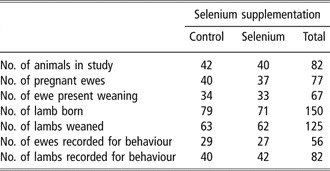
A total of 82 multiparous crossbred ewes of more than 3 years of age were used in the study (Table 1). The breeds of the ewes were Greyface (Border Leicester × Scottish Blackface) and Texel × Greyface. Fifteen rams from two different breeds were used in the study – Charolais and Texel. Prior to the commencement of the study all animals had ad libitum access to fresh pasture. The mean ± s.d. live weight (LW) and body condition score (BCS) of the ewes at the start of the study were 77.9 ± 8.0 kg and 3.8 ± 0.2, respectively.
Number of ewes and lambs involved in the study

Experimental design
The experiment was carried out at the Agri-Food and Biosciences Institute, Hillsborough. All ewes were housed in individual pens on wooden slat floors at the start of the study, where they remained throughout pregnancy. The ewes were randomly allocated to treatments and subsequently balanced for LW, BCS, ewe breed and sire breed. The ewes were naturally mated once following a synchronisation regime as described by Muñoz et al. (Reference Muñoz, Carson, McCoy, Dawson, O’Connell and Gordon2008). Treatments were applied from day −14 to day 90 post mating and consisted of control; receiving no supplement; and Se supplement receiving 1 g of Selplex® (Alltech, Belfast, NI, UK), an organic source of Se, providing an intake of 0.5 mg Se per ewe per day. Selplex® was provided daily to each ewe by mixing it with barley, a component of the diet.
Diets were based on grass nuts, offered at one of three levels (high, medium or low plane of nutrition), during the first 39 days of gestation and at one of two levels (medium or high) during mid-pregnancy (day 40 to day 90) as described by Muñoz et al. (Reference Muñoz, Carson, McCoy, Dawson, O’Connell and Gordon2008). Selenium content of the grass-based diet was determined by atomic absorption spectrophotometry with vapour generation and reached 0.07 mg Se per kg DM. During the treatment period, the diets were supplemented daily with 25 g of barley (Se content of 0.07 mg/kg DM), as a vehicle for the intake of Se, and 25 g of straw (Se content of 0.01 mg/kg DM) as a source of fibre.
After day 90 of gestation, all ewes were offered increasing levels of grass nuts to meet individual energy and protein requirements for late pregnancy calculated in accordance with their LW and expected litter size (Agriculture and Food Research Council, 1993). From day 105 of gestation onwards, diets were supplemented with 100 g/day of Sopralin® (Trouw Nutrition, Belfast, NI, UK), and with 25 g/day of VMC Sheep® (Trouw Nutrition) a vitamin/mineral supplement which supplied per kg: vitamin A, 400 000 IU; vitamin D3, 80 000 IU; vitamin E, 600 IU; Se, 10 mg; Ca, 170 g; P, 40 g; NaCl, 320 g; and Mg, 60 g. Both supplements provided an Se intake from day 105 to lambing of 0.27 mg per ewe per day, supplied in an inorganic form. The total daily feed allocation was offered in a single feed at 0930 h. Pregnancy status of the ewes was determined by ultrasound scanning on day 55 of gestation. All non-pregnant animals were removed from the study and their data were included in the analysis only up to day 55. Supplementary feeding of ewes ended at turnout (48 h after lambing) when ewes and lambs returned to pasture. Creep concentrate feeding (metabolisable energy (ME) 12.3 MJ/kg DM; crude protein (CP) 204 g/kg DM; and vitamin A, 400 000 IU; vitamin D3, 66 667 IU; vitamin E, 1000 IU; Se, 17 mg; Ca, 100 g; P, 3.1 g; and NaCl, 500 g per kg product) was introduced to lambs from triplet suckling ewes at 4 weeks of age and continued until weaning at 16 weeks.
Measurements
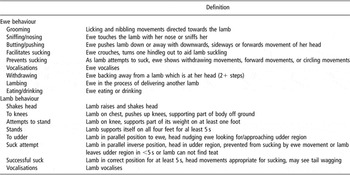
Data on maternal and neonatal behaviour were collected in situ immediately following parturition for the first 30 min after the birth of each lamb, using hand-held data recorders and the Observer software system for behaviour research (Noldus information Technology, Wageningen, The Netherlands). The first lamb born from each ewe was prioritised for observation in order to maximise the number of replicates measured (Table 1). The behaviours recorded for ewes and lambs were as previously described by Dwyer and Lawrence (Reference Dwyer and Lawrence1998) and by Dwyer et al. (Reference Dwyer, Lawrence, Brown and Simm1996), respectively (Table 2).
Definition of ewe and lamb behaviours

Blood samples were taken 2 h 30 min after feeding at fortnightly intervals from the jugular vein into 10 ml heparinised tubes throughout pregnancy and at weaning for all ewes to determine Se status. The activity of enzyme glutathione peroxidases (GPx) was measured on whole blood using a Randox GPx kit on a Hitachi 917 (Roche Diagnostics Ltd, Burgess Hill, West Sussex, UK) and Olympus AU640 clinical chemistry analysers (Olympus UK Ltd, Middlesex, UK). Plasma Se concentrations were measured by atomic absorption spectrophotometry with graphite furnace attachment and Zeeman background correction on a PerkinElmer AAnalyst 600 (PerkinElmer, Waltham, MA, USA).
At lambing, records were kept of lambing date, litter size, lambing difficulty (0 = no assistance, 1 = assistance), birth presentation (normal or abnormal position), birth weight and sex for all lambs. Lambs were weighed at 24 h post partum, at 3 and 6 weeks of age, and thereafter at fortnightly intervals until weaning (16 weeks). Twenty-four hours after birth, two jugular blood samples, one heparinised and one without anticoagulant, were taken from each lamb as described by Muñoz et al. (Reference Muñoz, Carson, McCoy, Dawson, O’Connell and Gordon2008) to assess immune status, serum free tri-iodothyronine (free T3), serum thyroxine (T4) and Se status. Immune status was estimated by zinc sulphate turbidity analyses (McEwan et al., Reference McEwan, Fisher, Selman and Penhale1970). Free T3 was measured using a Free T3 kit (Siemens Medical Solutions Diagnostics, Tarrytown, NY, USA) on a Centaur Analyser (Bayer Healthcare LLC, Diagnostics Division, Tarrytown, NY, USA). Thyroxine concentrations were measured using a T4 Dri kit (Microgenics Corporation, Fremont, CA, USA) on an Olympus AU640 analyser. Six weeks after parturition, and at weaning, blood sampling procedure was repeated on all lambs for the evaluation of Se status. Records of lamb and ewe mortality were kept throughout the study.
Statistical analysis
Due to the unbalanced nature of the experimental design the quantitative data were analysed using Genstat REML (residual maximum likelihood) procedure in a 3 (planes of nutrition in early pregnancy) × 2 (planes of nutrition in mid-pregnancy) × 2 (selenium supplementation) factorial design. The model used, evaluated the main effects of the treatments while adjusting for the effect of ewe and ram breed. Ewe blood biochemistry data were corrected by adjusting to mean metabolite concentration from day −14, by covariance. For analysis of lamb birth weight and LW gain (calculated using linear regression) litter size, lamb sex, post-lambing group and age of the lamb were also included as covariates where appropriate. Categorical data were analysed by binary logistic regression using LogXact (Cytel Inc., Cambridge, MA, USA). Behaviour data were analysed using Stata survival analysis on the lamb latencies, and the Tobit method (Amemiya, Reference Amemiya1973) for the analysis of the frequency of presentation and duration of lamb behaviours.
Results
There were few interactions between Se supplementation and plane of nutrition in early and mid-pregnancy. The effects of plane of nutrition in early and mid-pregnancy are reported in an accompanying paper (Muñoz et al., Reference Muñoz, Carson, McCoy, Dawson, O’Connell and Gordon2008).
Ewe selenium status
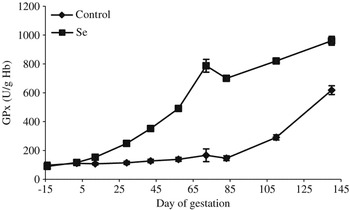
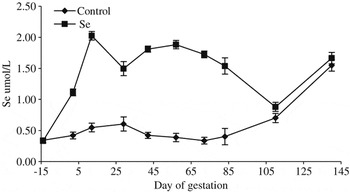
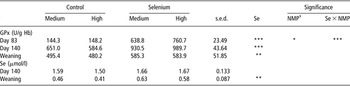
Whole blood GPx activity and plasma Se concentrations of ewes during treatment period are presented in Figures 1 and 2, respectively. The initial mean ± s.e. GPx activity values at the start of the study for the ewes were 93.2 ± 11.16 U/g Hb and the initial mean ± s.e. values of plasma Se concentrations were 0.34 ± 0.019 μmol/l. Ewes supplemented during early and mid-pregnancy showed higher (P < 0.001) GPx activity throughout the treatment period. Likewise, plasma Se concentration (P < 0.001) increased following supplementation, differences between the two groups being evident at mating, i.e. 14 days after the beginning of the study. There was an interaction between Se supplementation and mid-pregnancy nutrition at day 83 of gestation, with Se-treated ewes on high plane diets in mid-pregnancy having higher GPx levels compared with supplemented ewes on a medium plane diets (Table 3). Ewes that were supplemented with Se had higher (P < 0.001) GPx activity at lambing than control ewes, although plasma Se concentrations were similar for both groups. At weaning, ewes that were supplemented during early and mid-gestation had higher (P < 0.01) Se status measured either directly in plasma or through GPx activity.
Effect of selenium supplementation of ewes in early and mid-pregnancy on mean ± s.e.d. whole blood GPx activity.

Effect of selenium supplementation of ewes in early and mid-pregnancy on mean ± s.e.d. plasma Se concentration.

Effect of selenium supplementation in early and mid-pregnancy and plane of nutrition during mid-pregnancy of mature ewes on selenium status at day 90 of gestation, at parturition and at weaning

*Significant at the 5% level, **significant at the 1% level, ***significant at the 0.1% level.†NMP = plane of nutrition in mid-pregnancy.
Ewe reproductive performance
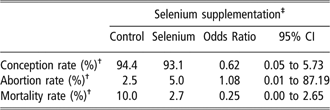
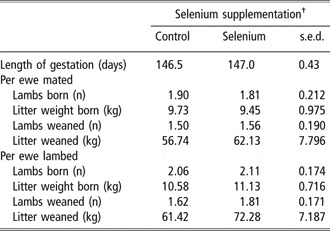
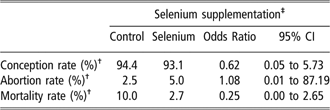
Conception rates were similar for both treatment groups with an average value of 94 ewes pregnant per 100 ewes mated (Table 4). The incidence of abortion and mortality of the ewes throughout the study was not affected (P > 0.05) by treatments. Selenium supplementation had no effect (P > 0.05) on gestation length (146.8 (s.d. 1.8) days) of the ewes (Table 5). Ewe litter size and litter weight at birth was not affected (P > 0.05) by treatment, expressed either on a per-ewe-mated or on a per-ewe-lambed basis. Likewise, supplementation with Se had no effects (P > 0.05) on either the number or weight of lambs weaned on a per-ewe-lambed or on a per-ewe-mated basis.
Effect of selenium supplementation of mature ewes in early and mid-pregnancy on conception rate, abortion rate and mortality rate
†Number of ewes pregnant, aborted, and/or died, respectively out of the total number of ewes included in the study×100.
‡There was no statistical significance between treatments.
Effect of selenium supplementation of ewes in early and mid-pregnancy on length of gestation, prolificacy and lamb output

†There was no statistical significance between treatments.
Ewe and lamb behaviour data
The frequency and the duration of ewe maternal behaviours including grooming, maternal rejection, response to sucking and vocal attitude were not affected (P > 0.05) by supplementation with Se during either early or mid-gestation.
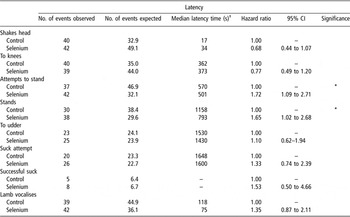
With regard to lamb behaviour, Se supplementation affected the frequency and duration of the behaviour ‘stands’, with lambs born from ewes that were supplemented presenting this behaviour more frequently (7.2 v. 4.8 times in 30 min; P < 0.05) and with a longer duration (20.7% v. 13.8% of the observation period; P < 0.05) than lambs born from ewes on the control diet. Lambs born from supplemented ewes tended to have a higher frequency of vocalisations than control lambs (78.6 v. 58.2 bleating vocalisation in 30 min; P = 0.080). The latency for the lambs to perform the behaviour ‘attempts to stand’ and ‘stands’ after delivery (Table 6) was affected by Se treatment, with lambs born from control ewes taking longer (P < 0.05) to stand than lambs born from ewe that received Se supplementation. The frequency, duration and latency of lamb behaviours shakes head, to knees, to udder, suck attempt and successful suck, were not affected (P > 0.05) by treatments.
Effect of selenium supplementation of dams in early and mid-pregnancy on offspring latency to perform behaviours in the first 30 min after birth

*Significant at the 5% level.†It was not possible to calculate median latency times if more than 50% of animals did not present the behaviour within the observation period.
Lamb blood biochemistry
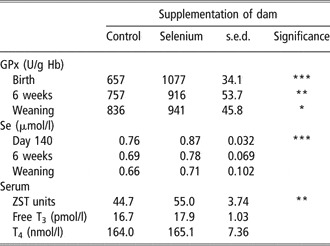
GPx activity and plasma Se concentrations of lambs born to Se-treated ewes (Table 7) were higher (P < 0.001) than those born to the control ewes; however, these differences were not sustained to weaning (P > 0.05). There were no clinical signs of Se deficiency (nutritional muscular myopathy) exhibited in the lambs born to ewes fed either diet.
Effect of selenium supplementation of dams in early and mid-pregnancy on offspring selenium status at parturition and at weaning, and on offspring concentrations of thyroid hormones and immune status 24 h after birth

*Significant at the 5% level, **significant at the 1% level, ***significant at the 0.1% level.
Lamb blood biochemistry at 24 h post partum was affected by treatments, with lambs born from supplemented ewes having higher (P < 0.01) immune status, than control lambs. Thyroid hormone (free T3 and T4) concentrations were not affected by treatments (P > 0.05).
Lamb viability and performance
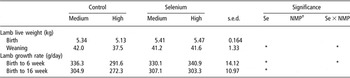
Lamb birth weight (Table 8) was not affected by Se supplementation (P > 0.05) of ewes. The growth rate of the lambs from birth to weaning was affected by Se supplementation, being greater (P < 0.05) in lambs born from ewes which received Se compared with the control lambs. Consequently, lambs born from Se ewes were heavier (P < 0.05) at weaning than control lambs. There was an interaction observed for growth rate to 6 weeks and lamb weaning weight between mid-pregnancy nutrition and Se supplementation (P < 0.05), with lambs born from control ewes that received a high plane of nutrition during mid-pregnancy being lighter and attaining less daily weight gains up to 6 weeks than lambs born from control ewes on a medium plane of nutrition. In contrast, there were no differences in weight between the two mid-pregnancy diets for the lambs born from ewes that received Se supplementation.
Effect of selenium supplementation in early and mid-pregnancy and of plane of nutrition in mid-pregnancy of dams on offspring birth weight, live weight and live-weight gains to weaning

*Significant at the 5% level.†NMP = plane of nutrition in mid-pregnancy.
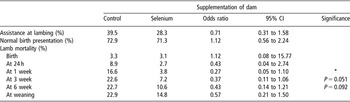
Lamb birth presentation and assistance required at parturition were not affected (P > 0.05) by Se treatment (Table 9). Lambs born from ewes supplemented with Se showed a decrease (P < 0.05) in the incidence of mortality at 1 week of age, compared with the control lambs. This effect decreased progressively towards weaning, although at 6 weeks of age Se lambs still tended to have lower (P = 0.09) incidences of mortality. At weaning, there were no differences in lamb mortality between the two treatment groups (P > 0.05).
Effect of selenium supplementation of dams in early and mid-pregnancy on lambing ease, lamb birth presentation and mortality rates

*Significant at the 5% level.
Discussion
Offering concentrate diets supplemented with Se to ewes during late pregnancy is a standard practice on most farms across Northern Ireland. The current study is unique in that it examines the merits of extending Se supplementation of ewes with marginal Se status throughout gestation.
Glutathione peroxidases activity of the ewes at the start of the study, was 93.2 (s.e. 11.16) U/g Hb. Reference values for GPx activity (<270 U/g Hb) were determined in the lab using the relationship of whole blood GPx with whole blood Se (Puls, Reference Puls1994). Because the procedures used in GPx assays differ between workers, the results are frequently not comparable. Ewe plasma Se concentrations at the start of the study were 0.34 (s.e. 0.019) μmol/l. Reference values for blood Se concentrations include: <1.52 μmol/l (Stowe and Herdt, Reference Stowe and Herdt1992), <1.00 μmol/l (Puls, Reference Puls1994), <0.95 μmol/l (Anderson et al., Reference Anderson, Berrett and Patterson1979), and for lamb blood Se concentrations <0.13 μmol/l (Langlands et al., Reference Langlands, Donald, Bowles and Smith1994; Grace and Knowles, Reference Grace and Knowles2002).
Therefore, the assessment of Se status depends on the reference values used. The Se status of the ewes from the present study is representative and comparable with the Se status of sheep reported for six commercial hill farms from Northern Ireland with mean ± s.d. values for GPx of 359 ± 249 U/g Hb and mean ± s.d. plasma Se values of 0.92 ± 0.5 μmol/l (Muñoz et al., 2007), and is best described as marginal. Selenium status of control and supplemented ewes throughout gestation reflects the feeding regimes imposed. It is interesting to observe that in the supplemented ewes plasma Se concentrations rapidly decreased as soon as supplementation ended (day 90) and only increased again once supplementation recommenced after day 105. GPx activity, which is an indicator of long-term Se status (McMurray and Rice, Reference McMurray and Rice1982), did not show this depression.
The Se requirement of sheep estimated on the basis of experimental data is 0.1 to 0.2 mg/kg DM, with maximum tolerable levels of 2 (National Research Council, 1985). The grass-based diets offered to ewes had a basal Se content of 0.07 mg/kg DM. In Ireland, Se concentrations in uncontaminated herbage range from 0.02 to 0.20 mg/kg DM with a mean value of 0.09 (Culleton et al., Reference Culleton, Parle, Rogers, Murphy and Murphy1997). To compensate for the low Se content of the diets and the initial marginal Se status of the ewes, the level of organic Se supplementation utilised in this study was 0.5 mg per ewe per day. Other studies providing Se supplementation range from of 0.3 p.p.m. (Rock et al., Reference Rock, Kincaid and Carstens2001) to 0.9 mg per head per day (Menzies et al., 2005). The productive responses obtained in the present study may have been different, had the control ewes been offered diets with higher Se contents.
In the present study, the administration of Se prior to mating and during early and mid-pregnancy had no effects on the reproductive performance of mature ewes expressed either as fertility, prolificacy or lamb output at weaning. This finding contrasts with earlier studies (reviewed by Hostetler et al., Reference Hostetler, Kincaid and Mirando2003) where Se supplementation dramatically increased lambing percentage of ewes. In those studies, the reduced fertility obtained in the untreated groups was attributable to embryonic mortality at about 3 to 4 weeks post conception. Scales (1974) recorded that in three of four studies where Merino ewes were given orally 5 mg of Se as sodium selenate approximately 20 days before mating, the proportion of barren ewes was reduced by 17% (cited by Hemingway et al., Reference Hemingway, Parkins and Ritchie2001). More recently, Se supplementation of hill ewes with a marginal Se status 6 weeks prior to mating led to a 5% increase in the proportion of pregnant ewes (Muñoz et al., 2007). The findings from our study and the evidence from the literature suggest that a minimum period of supplementation of at least 20 days is required prior to mating in order to obtain improvements in reproductive performance of ewes with marginal Se status.
In the current study, supplementation during early and mid-gestation, the critical period for foetal differentiation and development (Robinson, Reference Robinson1983), resulted in lambs with behaviour that is associated with improved survival. Dwyer et al. (Reference Dwyer, Lawrence, Bishop and Lewis2003) have described that even a moderate level of undernutrition impairs the attachment between ewes and lambs affecting behaviours expressed at birth. To our knowledge, this is the first study that addresses the effect of prenatal maternal Se supplementation on lamb neonate behaviour. In the present study, the improved vigour observed for lambs born to supplemented ewes, was independent of changes in maternal behaviours and therefore inherent to the lamb. A faster progression to sucking is related to improved survival rates in lambs (Dwyer et al., Reference Dwyer, Lawrence and Bishop2001) which is in agreement with the findings of the present study.
The current study demonstrated that supplementation of ewes with Se in early and mid-pregnancy leads to an increase in the Se status of their offspring. This effect was observed even though both treatment groups received Se supplementation during the late pregnancy period. Newborn lambs are dependent upon their dams for transfer of Se via the placenta and the mammary gland (Hidiroglou, Reference Hidiroglou1980; Hostetler et al., Reference Hostetler, Kincaid and Mirando2003). The observed differences in Se status of the offspring may be partially explained by the longer duration of the supplementation period of Se ewes, compared with the control group. Davis et al. (Reference Davis, McDowell, Wilkinson, Buergelt, Van Alstyne, Weldon and Marshall2006), reported that when Se is supplemented to ewes at equivalent concentrations, colostrum Se may be increased if animals are supplemented for a more extended period of time. The current study indicates the benefits of extending Se supplementation throughout pregnancy when ewes are fed grass-based diets with initially marginal Se status.
In the present study, the higher Se status of the lambs was positively associated with improved lamb immune status. This finding is consistent with the study of Rock et al. (Reference Rock, Kincaid and Carstens2001) who reported that prenatal Se supplementation increased serum immunoglobulin G (IgG) concentrations in lambs, by enhancing the lamb’s ability to absorb IgG from the small intestine and, was therefore not related to an inherent problem with the ewe colostrum. This foetal programming effect (altered colostral IgG absorption efficiency) has also been reported by Boland et al. (Reference Boland, Brophy, Callan, Quinn, Nowakowski and Crosby2004) when evaluating the effects of high mineral intakes in late pregnancy.
The improved Se status of lambs born from supplemented ewes was not associated with changes in concentrations of T4 or free T3. These results contrast with the findings of Donald et al. (Reference Donald, Langlands, Bowles and Smith1994) who found increased serum concentration of T3 and decreased serum concentration of T4, in newborn lambs from dams supplemented with Se. The lower T4 : T3 ratio found in lambs from supplemented dams in that study suggests that activity of deiodinases was impaired by prenatal Se deficiency. Lack of treatment effect on the lamb serum concentrations of thyroid hormones in the present study may reflect the fact that neither ewes nor lambs were Se deficient at lambing, shown by GPx and plasma Se values at parturition. This is not surprising as all ewes received Se supplemented concentrates during late pregnancy. This finding is in agreement with Rock et al. (Reference Rock, Kincaid and Carstens2001) who reported similar results as this study and also attributed the lack of effect on thyroid hormone metabolism to the fact that the newborn lambs were not clinically deficient in Se.
In the current study, higher Se and immune status 24 h after birth were associated with decreased lamb mortality at 1 week of age. The incidence of mortality at weaning recorded in the present study is in general agreement with data obtained by survey studies in the UK and Ireland which reported a range of 11% to 22% of lamb mortality form birth to weaning (Carson et al., Reference Carson, Dawson, Irwin and Kilpatrick2004). The reduced mortality encountered by lambs born from supplemented ewes may be a consequence of the higher immune status of these lambs and/or of the higher growth rates they achieved and/or of the improved neonatal lamb vigour they obtained. Nevertheless, it would be desirable to maintain the productive advantage reached by Se lambs throughout lactation. Rooke et al. (Reference Rooke, Robinson and Arthur2004), in reviewing the literature, reported a range for LW gain responses to Se-responsive illthrift of 100 g per head per day to a more modest 2 kg at weaning (as observed in the current study). This wide range may be explained by the fact that as lambs grow older, there is a gradual increase of grass intake in their diet and consequently a reduced reliance on maternal milk Se. This is more critical still in multiple litters where Se dilution among the lambs occurs. Direct and/or additional supplementation of the lambs may need to be considered.
Selenium supplementation of control dams during the last 8 weeks of gestation most likely influenced viability and performance of control lambs. Therefore, the differences observed on lamb viability and performance between the two treatment groups in the current study may have been exacerbated had the study tested Se supplementation v. no supplement during the whole of pregnancy.
An organic source of Se was used in the present study. The greater bioavailability of organic forms of Se such as selenised yeast, has been reported by several research studies (Rock et al., Reference Rock, Kincaid and Carstens2001), although some investigators have demonstrated superior absorption and retention of inorganic forms (Van Metre and Callan, Reference Van Metre and Callan2001). Productive responses to Se supplementation using inorganic forms of Se have also been reported. Hill ewes with a marginal Se status supplemented with barium selenate 4 to 6 weeks prior to mating had increased conception rates, LW and BCS maintenance, lamb output per ewe and lamb growth rate to 6 weeks, while the incidence of abortion was reduced (Muñoz et al., 2007).
Conclusion
The results of the present study show that there are further benefits for ewes and their offspring when sustaining long-term Se supplementation from 14 days prior to mating and throughout early and mid-pregnancy. These benefits included a more vigorous lamb at birth, expressed in lambs being quicker to stand than control lambs. Improved neonatal lamb behaviours were associated with a better immune status of lambs 24 h after birth and a reduced incidence of mortality at 1 week of age. Lambs born from supplemented ewes had higher growth rates to weaning than lambs born from control ewes.
Acknowledgements
The authors thank D. McBride at Ulster Hospital for thyroid hormone analysis. Also, D. Irwin, E. Doyle and J. Wilson from AFBI-Hillsborough for technical assistance and the laboratory staff at the Veterinary Science Division for the lab analyses. This study was supported by Programme Alβan, the European Union Programme of High Level Scholarships for Latin America, scholarship No. E04D047780CL and the Department of Agriculture and Rural Development of Northern Ireland.