Public health policy-makers are increasingly recognizing the psychological impact of natural disasters on children (eg, anxiety, post-traumatic stress disorder [PTSD])Reference La Greca, Silverman and Vernberg 1 - Reference Kar and Bastia 4 and are incorporating mental health responses into disaster recovery. Severe natural disasters affect families through disrupted community infrastructure, destruction of personal property, unemployment, and stressed social relations.Reference Sastry and VanLandingham 5 - Reference McFarlane, Policansky and Irwin 8 Children rely on caregivers to provide critical mental health protection in these settings.Reference Bokszczanin 9 , Reference La Greca, Lai and Llabre 10
THE 2010 CHILEAN EARTHQUAKE
The February 2010 Chilean earthquake and tsunamis killed 526 people and left extensive property damage. Nearly 80% of the buildings were destroyed in the seaside town of Dichato (population 4000), forcing over 400 families into temporary housing for nearly 4 years. The damage and displacement disproportionately affected families with preexisting psychological and socioeconomic vulnerabilities. Six months after the disaster, a survey of the town’s children documented persistently high levels of PTSD symptoms: 30% for girls and 15% for boys (aged 9–16 years).Reference Cova, Valdivia and Rincón 11
RECUPERA CHILE
The David Rockefeller Center of Latin American Studies (DRCLAS) of Harvard University maintains a regional office in Santiago, Chile, that sponsors academic programming for Harvard students and faculty in conjunction with local partners in academia and government. In 2010, DRCLAS collaborated with many of the preexisting and several new partners to mount a coordinated disaster recovery response, entitled Recupera Chile (RC) (www.recuperachile.org). RC addresses 4 dimensions of recovery: (1) social systems (health, mental health, social services, education), (2) physical environment (built and natural environments), (3) economic systems (employment, training and entrepreneurial capacity building, financial security), and (4) cultural/heritage restoration and preservation. RC employs an interdisciplinary, interdependent, “whole community” 12 and “place-based” approach, customizing interventions based on local knowledge over the course of long-term recovery.Reference Cutter and Finch 13
PROGRAM IMPLEMENTATION: CHILD MENTAL HEALTH RESPONSE
The RC team recognized community members as the authentic experts on their own recovery and sponsored multiple opportunities to learn from families about their needs, concerns, strengths, and resources. In January and June 2012, the RC health team conducted formal needs assessments, following the SAFE model,Reference Betancourt, Fawzi and Bruderlein 14 reviewing (1) safety and protection, (2) access to health care, (3) family and connection to others, and (4) education, livelihood, and sense of future. Interviews with families, health, education, religious, and governmental leaders unearthed information about the initial emergency experience and ongoing social-emotional stresses. Community members requested programming for young children (aged 3–6 years) because they felt that these children, their families, and schoolteachers were highly affected and underserved. In response, RC developed an approach of (1) case management, (2) resource development, and (3) monitoring and evaluation.
Case Management
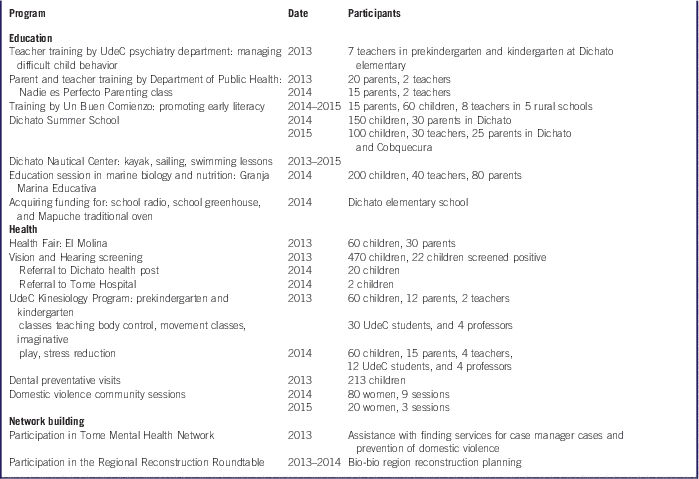
In 2012, RC obtained support from DRCLAS to hire a local psychologist as a case manager. She assisted families in navigating the reemerging health and social systems to deal with health, mental health, and domestic violence (Table 1). In one case example, the case manager advocated for 2 years to help a child whose surgeon needed a specific surgical instrument that had been lost during the earthquake. Obtaining the instrument solved the problem, not only for one child, but also for more than 200 children waiting for the same surgery.
Recupera Chile Programs, January 2012 to August 2015Footnote a
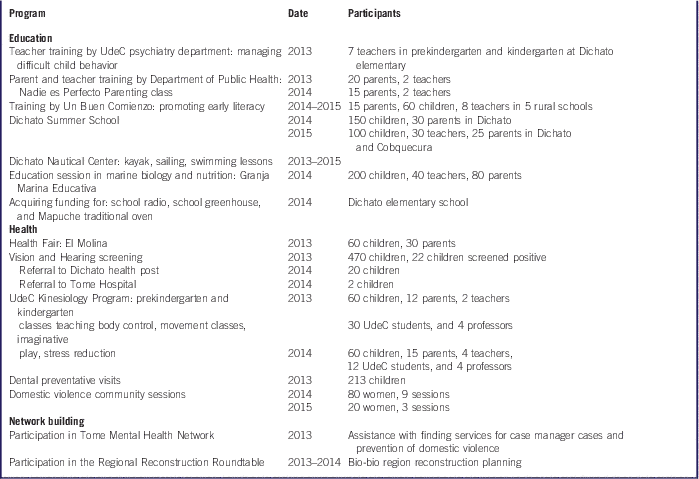
a Abbreviations: UdeC, Universidad de Concepcion.
Resource Development: Building Partnerships
Through the case management program, the case manager identified a reservoir of social resources and was able to strengthen existing service structures, improve access, and catalyze new community programs. Key partners included the public elementary school’s director and teachers, the local Ministry of Health clinic, and volunteers from the Universidad de Concepcion. RC played a critical role in identifying and applying for post-disaster government funding to support the ongoing work of these partners. Bringing services to working or socially isolated parents and their children presented a common challenge. In response, programs were developed and implemented in partnership with the elementary school, resulting in the transformation of the local school into a “model school” for the region called La Escuela Basada en Realidad.
Current Programming
Over time, La Escuela Basada en Realidad developed an infrastructure for multiple programs focusing on (1) health and mental health, (2) language and literacy, and (3) love of the sea. The idea of “Love of the Sea” was a direct response to the fear described by community members. In Dichato, the sea literally rose up to destroy the town—sweeping away homes, belongings, and history. Yet, the community’s identity and livelihood are deeply interwoven with the sea. Activities designed to address the psychological and cultural relationship with the sea included swimming classes in the municipal pool, travel to a local island on a national navy ship, and building a nautical center for kayaking and sailing classes for children. Exposure to aquaculture aquariums brought the sea into the classrooms and made linkages to new aquaculture economic opportunities and programs (Granjeros del Mar).
The creation of the model school infrastructure allowed RC to respond to community-driven requests for improved child health and mental health services. RC partners organized an annual summer school, vision and hearing screenings, the building of a school greenhouse, teacher trainings for managing child behavior problems, promoting early literacy and personal wellness, and parent mental health promotion (Table 1). The school greenhouse was a source of pride for the school as well as a refuge for stressed children. Children benefited from caring for living plants, cultivating growth, and improving their diet. Kinesiology programs also successfully reduced the frequency of aggressive behaviors in preschool classrooms. Reaching children in the summer presents a persistent challenge because the school is closed and tourism takes priority for many families. The summer school partially addresses this concern.
Ongoing Monitoring and Evaluation
The case manager maintains detailed progress notes about all services. In addition, a school-based survey by the University of Concepcion in 2014 confirmed a high percentage of children aged 3 to 6 years with conduct problems (46%) and peer problems (53%), nearly double the US national average. 15 The significant transformation of the town over the 4 years after the disaster with respect to governmental and nongovernmental initiatives, including relocation to permanent housing, made the assessment of individual programs challenging with respect to family health and mental health outcomes.
In June 2014, RC conducted in-depth interviews to understand caregiver perceptions of child behavior. Two primary themes emerged as underlying explanations for observed changes in child behavior and conduct: (1) lack of community unity due to increased competition following the earthquake and (2) increased child exposure to violence in temporary housing. Interviewees described a sequential progression of changes in behavior beginning with increased competition around limited resources shortly after the disaster, then stressed family dynamics and exposure to family conflict in the tight quarters of the temporary housing compounds, followed by the development of aggressive behaviors in children. Finally, as all families relocated by May 2014, there was an improved sense of security in permanent housing. Nonetheless, interviewees uniformly contrasted the greater advancement in the physical rebuilding process with the limited resolution of interpersonal conflict and stress.
LESSONS LEARNED AND FUTURE DIRECTIONS
Disaster Recovery is a Long Process
Communities benefit from a multi-year view of recovery, particularly with respect to mental health. For organizations committed to the long-term recovery process, the first years may be spent developing trust with families in vulnerable states. The full fruits of case management and social investment often do not emerge for 4 to 5 years after a disaster. The involvement of local universities and the preexisting history of global academic collaborations naturally facilitated a long-term vision for the RC coalition.
Persistence of Social and Mental Health Problems
Displacement into camps and temporary housing may lead to a lack of privacy and the disruption of natural communities. Unequal distribution of limited resources fuels jealousy and interpersonal violence. Families may become separated or develop anxieties about returning to areas affected by the disaster. Response to these challenges is frequently late and hampered, because social agencies may be impaired by the disaster, leaving them understaffed and overtaxed. These challenges also make it difficult for families to engage and take advantage of economic and social service opportunities. Service providers must recognize and adapt to these post-traumatic environments. Useful strategies include identifying creative partners with knowledge of community strengths and integrating services into areas and activities where families already spend the majority of their time.
Resources, Partnerships, and Creativity
Visionary, resilient, entrepreneurial citizen leaders find ways to rebuild their communities and to support families and children. In RC’s case, the community discovered valuable resources within the local universities and the case manager helped to organize, fund, and launch new programs. The Dichato school served as the central hub of community recovery. Schools around the world can provide a powerful convening force, bringing together families and connecting families to resources through the central government or large institutions such as universities. The search for creative service opportunities will likely lead to some dead ends. For example, RC attempted unsuccessfully to bring surgical care to Dichato through a mobile naval hospital. Learning from these failures and taking some risks is an important part of recovery, as long as organizations are cautious in communicating realistic expectations to the community.
Recovery is an organic process. There is no prescription for exactly how a community will come together nor how the recovery will progress. Successful programs may actually happen totally by surprise and failures will provide valuable lessons along the way. Communities that are open to change can recover, and with time, even find themselves in a better place than they were before the disaster.
Acknowledgments
We thank Ned Strong and Marcela Renteria of the Harvard University’s David Rockefeller Center for their support of Recupera Chile initiatives.
Funding
David Rockefeller Center for Latin American Studies.