Introduction
Dinoflagellates are one of the most important groups of Southern Ocean plankton (Umani et al. Reference Umani, Monti, Bergamasco, Cabrini, de Vittor, Burba and del Negro2005, Kopczyńska et al. Reference Kopczyńska, Savoye, Dehairs, Cardinal and Elskens2007). Although they occur as both primary and secondary producers, they are particularly significant within the Southern Ocean ecosystem in their role as protozooplankton, and hence occupy a key role in the food web carbon flux (Umani et al. Reference Umani, Monti, Bergamasco, Cabrini, de Vittor, Burba and del Negro2005, Sherr & Sherr Reference Sherr and Sherr2007). One of the main adaptive strategies which have enabled dinoflagellates to effectively survive and thrive in polar environments such as the Southern Ocean is the formation of sexually-produced, organic-walled resting stages (“dinocysts”; Armand & Leventer Reference Armand and Leventer2010). After being produced by motile (planktonic) dinoflagellates in the upper water column, cysts sink to the seabed and potentially become incorporated into the fossil record (Esper & Zonneveld Reference Esper and Zonneveld2007, Armand & Leventer Reference Armand and Leventer2010).
Dinocysts are considered valuable tracers of both modern and palaeoenvironmental parameters such as sea-surface temperature, salinity, and sea ice cover, and their significance has long been recognized in the temperate and northern Atlantic (e.g. Marret & Zonneveld Reference Marret and Zonneveld2003, de Vernal et al. Reference De Vernal, Eynaud, Henry, Hillaire-Marcel, Londeix, Mangin, Matthiessen, Marret, Radi, Rochon, Solignac and Turon2005). In the climatically sensitive and hydrographically important Southern Ocean however, this potential has hitherto remained largely untapped. This is probably due to the high abundance and diversity of diatoms in Antarctic sediments (Armand & Leventer Reference Armand and Leventer2010), in combination with the logistical difficulties associated with retrieving material from the region. Consequently, few studies have focused on dinocyst distributions in Antarctic surface sediments, cores, and sediment traps (Marret & de Vernal Reference Marret and de Vernal1997, Harland et al. Reference Harland, FitzPatrick and Pudsey1998, Reference Harland, Pudsey, Howe and FitzPatrick1999, Harland & Pudsey Reference Harland and Pudsey1999, Marret et al. Reference Marret, de Vernal, Benderra and Harland2001, Esper & Zonneveld Reference Esper and Zonneveld2007). The various Antarctic sub-environments created by seasonal sea ice fluctuation (pack ice, fast ice, marginal ice zone) have also largely remained unstudied in regard to dinocysts, except for several studies focused on the fast- and pack-ice dinocyst Polarella glacialis Montresor (Stoecker et al. Reference Stoecker, Buck and Putt1991, Thomson et al. Reference Thomson, Wright, Bolch, Nichols, Skerratt and McMinn2004). Moreover, despite the climatic importance of Antarctic ice shelves (Lemke et al. Reference Lemke, Ren, Alley, Allison, Carrasco, Flato, Fujii, Kaser, Mote, Thomas and Zhang2007), little work has been conducted on dinoflagellates and their cysts occupying subice shelf waters and sediments (Roberts et al. Reference Roberts, Craven, Cai, Allison and Nash2007, Pieńkowski et al. Reference Pieńkowski, Marret, Thomas, Scourse and Dieckmann2009). Given the (palaeo)environmental potential of dinocysts, more information on their distribution in Southern Ocean environments is pertinent. This will not only expand our current biogeographical understanding of this group, but will ultimately improve Quaternary environmental reconstruction based on fossil dinocysts.
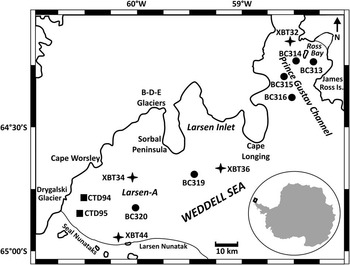
Here we present new data on modern dinocyst distributions and assemblage structures north-east of the Antarctic Peninsula (Fig. 1). This region is of interest because it was formerly occupied by Prince Gustav Channel (PGC) and Larsen-A (LA) ice shelves, which both collapsed during the 1990s (Rott et al. Reference Rott, Skvarca and Nagler1996, Pudsey & Evans Reference Pudsey and Evans2001). We describe dinocyst assemblages from an array of surface sediment samples derived from six box cores retrieved in the area, along with environmental parameters measured by CTD (conductivity-temperature-depth) and XBT (expendable bathythermograph). We also document the presence of other organic-walled microfossils (non-pollen palynomorphs (NPPs)). Sedimentological (grain size, total organic carbon (TOC)) and micropalaeontological (foraminifera, diatoms) characteristics of the box cores used in this study have previously been described by Murray & Pudsey (Reference Murray and Pudsey2004). Although limited, our data provide an important initial description of dinocyst communities in areas that, until recently, have been occupied by ice shelves. Furthermore, this work represents a first attempt to classify and detail Antarctic Quaternary NPPs, a microfossil group which may hold considerable (palaeo)environmental potential in high latitude settings.
Map of study area, showing sampling sites and locations of CTD (conductivity-temperature-depth) and XBT (expendable bathythermograph) measurements. Refer to Table I for details.

Materials and methods
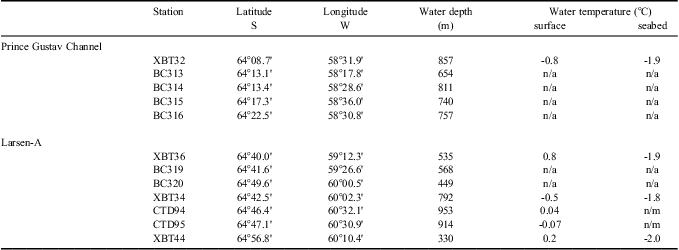
Surface sediment (0–1 cm) samples were obtained from six box cores collected by the British Antarctic Survey (BAS) during summer 2002, along with regional CTD and XBT data (Fig. 1, Table I; Pudsey et al. Reference Pudsey, Allen, Dowdeswell, Evans, Lens, Morris, Nicholls, O'Cofaigh, Pike, Preston and Skinner2002) in PGC and the LA area (Fig. 1). Our small sample size is a function of the general availability of surface sediments from this area, as well as the limited sampling (box coring) during the 2002 BAS cruise, which primarily focused on geophysics and the late Quaternary (glacial-interglacial) marine geology of the region (Pudsey et al. Reference Pudsey, Allen, Dowdeswell, Evans, Lens, Morris, Nicholls, O'Cofaigh, Pike, Preston and Skinner2002).
Sample locations and physical characteristics of sampling sites and CTD (conductivity-temperature-depth) and XBT (expendable bathythermograph) measurements.
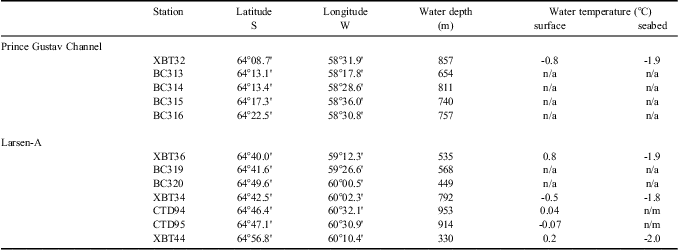
n/a = not applicable, n/m = not measured.
For palynological analysis, known volumes (10 cm3) of sediment were wet-weighed, oven-dried (40°C), dry-weighed, and subsequently wet-sieved at 10 μm. The > 10 μm fraction was processed for palynomorphs following standard protocols (e.g. Marret & Zonneveld Reference Marret and Zonneveld2003). This entailed repeated treatments with cold hydrochloric (10%) and hydrofluoric (49%) acids for carbonate and (fluoro)silicate digestion, and subsequent sieving at 10 μm. Dinocyst and NPP concentrations (per dry g sediment) were determined by marker grain (Lycopodium clavatum) addition prior to first wet sieving. Residues were mounted in safranin-stained glycerine jelly, and slides were scanned systematically under high-power light microscopy (x 400, Nikon Eclipse E200). At least 300 dinocysts, wherever possible, were counted, and all other co-occurring NPPs were noted. Species identifications of organic-walled microfossils were mainly derived from Marret & de Vernal (Reference Marret and de Vernal1997), Head et al. (Reference Head, Harland and Matthiessen2001), Roncaglia (Reference Roncaglia2004), and Pieńkowski et al. (Reference Pieńkowski, Mudie, England, Smith and Furze2011, Reference Pieńkowski, England, Furze, Marret, Eynaud, Vilks, MacLean, Blasco and Scourse2012). Some dinocyst taxa, such as Brigantedinium spp., could not be confidently identified to species level due to folding or obscuring of the cyst opening, and were therefore grouped together. Within Islandinium minutum we distinguished unexcysted specimens containing protoplasm, assumed to have been viable (alive) at time of collection. Spinose cysts which could not be confidently identified as I. minutum were grouped as cf. Islandinium minutum (large, faintly brown cell wall, wall surface granulate?, numerous thin, non-branching processes). Another type of spinose cyst distinguished by a dark brown, smooth cell wall with numerous non-branching processes (thicker at the base, thinning at the tip) was grouped under Echinidinium cf. transparantum. Within Polykrikos we differentiated an unknown species (“sp. A”), similar to Polykrikos? sp. A of Pieńkowski et al. (Reference Pieńkowski, Mudie, England, Smith and Furze2011, Reference Pieńkowski, England, Furze, Marret, Eynaud, Vilks, MacLean, Blasco and Scourse2012). We note that Polykrikos schwartzii may also encompass Polykrikos kofoidii Chatton, as noted by Matsuoka et al. (Reference Matsuoka, Kawami, Nagai, Iwataki and Takayama2009). Within the tintinnid loricae found, we distinguished a prominent form here referred to as “Tintinnid A”. All microfossil slides are archived at the Micropalaeontology Laboratory at School of Ocean Sciences, Bangor University.
Results
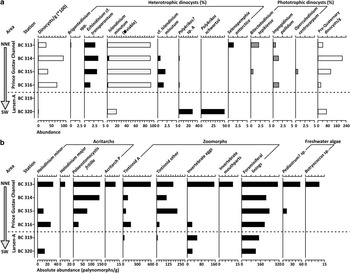
Dinocysts were present in most samples, with maximum concentrations of 9096 cysts g-1 (average 3763 cysts g-1). However, there were pronounced differences between samples from the two study areas: dinocysts were abundant in PGC, but sparse to absent in LA (Figs 2a & 3). The highest dinocyst concentrations were found at BC314 (9096 cysts g-1), whereas the remaining PGC stations had lower values (≤ 2026 cysts g-1). In contrast, one LA station (BC319) was devoid of dinocysts, while the other (BC320) showed very low concentrations (318 cysts g-1, count < 100 cysts).
Results of organic-walled microfossil analyses north-east of the Antarctic Peninsula. a. Dinoflagellate cysts. b. Other non-pollen palynomorphs.

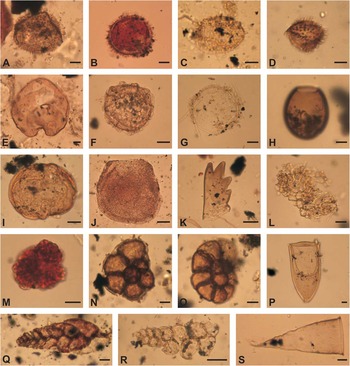
Photographs of selected dinoflagellate cysts (A.–F.) and other non-pollen palynomorphs (G.–S.) from the north-western Weddell Sea. Sampling station, sample number, and England Finder co-ordinates are given in parentheses. All scale bars denote 10 μm except in Q.–S. where they denote 20 μm. A.Islandinium minutum (BC313; 51/4_II; P24/3). B. a viable specimen of Islandinium minutum (BC314; 51/1_V; W57/3). C. cf. Islandinium minutum (BC314; 51/1_A; S46/1). D.Echinidinium cf. transparantum (BC320; 51/2; M31/2). E.Selenopemphix antarctica (BC313; 51/4_II; F29/3). F.Polykrikos sp. A (BC314; 51/1_A; P30/2). G.Halodinium minor (BC313; 51/4_IA; H23/3). H.Palaeostomocystis fritilla (BC315; 51/5; F39/2). I. Acritarch P (BC316; 51/5_B;V25/1). J. invertebrate egg (BC313; 51/4_II;Q50/3). K. invertebrate mouthpart (BC313; 51/4_IA; M35/4). L.Pediastrum? sp. (BC315; 51/5; R41/3). M.Botryococcus sp. (BC313; 51/4_IA; V66/2). N. & O., Q. & R. foraminiferal linings (all BC316, 51/6_B; N: F32/4; O: F44/1; Q: N41/1; R: D51/3). P. tintinnid lorica grouped under “Tintinnid other” (BC315; 51/5; W62/2). S. Tintinnid A (BC314; 51/1_A; L54/4).

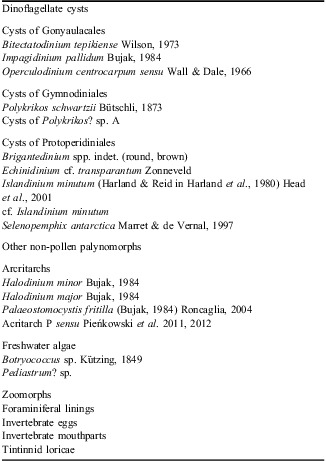
Dinocyst species diversity was low at both study areas, with a maximum of six taxa found at any one site (Fig. 2a, Table II). The assemblages were dominated by Islandinium minutum, which was present as both dead (excysted) and, to a lesser extent, live individuals (max. c. 334 ind. g-1). Other dinocyst taxa were rare, constituting a minor proportion of the assemblage. Accompanying taxa included Echinidinium cf. transparantum, Impagidinium pallidum and Bitectatodinium tepikiense, whereas Brigantedinium spp., Polykrikos? sp. A, Polykrikos schwartzii, Operculodinium centrocarpum, and Selenopemphix antarctica occurred sporadically. An exception to the general dominance of I. minutum occurred in BC320 where Polykrikos species were more abundant than I. minutum (Fig. 2a). However, the dinocyst concentration in BC320 was extremely low (181 cysts g-1) and fewer than 100 cysts were counted from this sample. Results from this sample should therefore be interpreted with caution.
Taxonomy of organic-walled microfossils found in the present study.
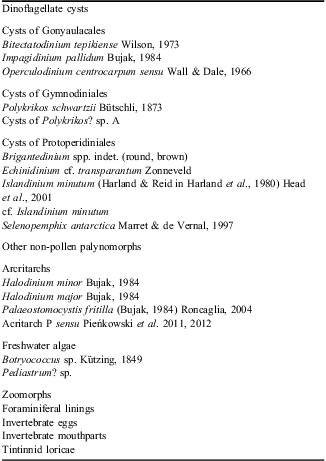
Non-pollen palynomorphs included acritarchs, zoomorphs, and freshwater algae (Figs 2b & 3, Table II). Tintinnid loricae (predominantly Tintinnid A) were most abundant (max. 800 g-1), followed by foraminiferal linings (max. 320 g-1) and the acritarch Palaeostomocystis fritilla (max. 150 g-1). Halodinium minor was present at most stations (max. 30 g-1), except for BC314 and BC319. The acritarch Halodinium major and invertebrate mouthparts only occurred in BC313. Freshwater algae, namely Botryococcus sp. and Pediastrum? sp., showed sporadic presences in BC313 and BC315. Overall, station BC313 showed the most diverse NPP assemblages and highest NPP concentrations (Fig. 2b). Although many individual NPPs did not show any clear trends in their distribution, collective NPP abundances were generally lower in PGC than in LA, with some palynomorphs (e.g. P. fritilla, Tintinnid A) displaying a similar abundance pattern to the dinocysts. Notably, the LA station devoid of dinocysts (BC319), showed the presence of sparse zoomorphs, including tintinnid loricae, invertebrate eggs, and foraminiferal linings, at low concentrations (< 149 ind. g-1; Fig. 2b).
Discussion
General trends: Prince Gustav Channel vs Larsen-A
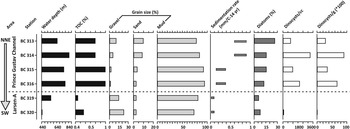
Whereas dinocysts were generally abundant in PGC, they were poorly represented at LA stations (Fig. 2a). This is surprising given the similar water column characteristics prevailing at both areas (Fig. 4, Table I). At the time of sampling, seabed temperatures were near uniform (around -2°C), and sea-surface temperature varied only slightly between the two areas (PGC: -0.8°C, LA: -0.5 to 0.8°C). Likewise, surface and seabed average salinities were similar (33.9 and 33.6, respectively). This suggests the influence of similar water masses in both areas, most probably Modified Weddell Deep Water at depth beneath seasonally variable Antarctic Surface Water (Murray & Pudsey Reference Murray and Pudsey2004, Nicholls et al. Reference Nicholls, Pudsey and Morris2004). Differences between the two study sites do, however, exist. In particular, LA sites are shallower, and surface sediments show lower TOC values, higher gravel content, and lower diatom abundances compared to the PGC stations (Fig. 4; Murray & Pudsey Reference Murray and Pudsey2004, Buffen et al. Reference Buffen, Leventer, Rubin and Hutchins2007).
Microfossil content and physical characteristics of the box core samples used in the present study. Total organic carbon (TOC) values, grain size, sedimentation rates, and diatom content are from Murray & Pudsey (Reference Murray and Pudsey2004).

The absence or scarcity of dinocysts in the LA area could be due to either non-deposition or non-preservation of dinocysts. Cysts may not be produced in sufficient quantities to be present in the sediment due to sparse motile dinoflagellate populations in the upper water layer, given the patchiness of phytoplankton (McKenzie & Cox Reference McKenzie and Cox1991, Kopczyńska et al. Reference Kopczyńska, Savoye, Dehairs, Cardinal and Elskens2007). This may explain the overall scarcity of palynomorphs and the absence of viable Islandinium minutum in LA. If cysts are being produced at LA sites, current velocities may also be sufficient to prevent cysts from sinking, keeping them in suspension and advecting them from the area. Although regional current velocity measurements are unavailable, the high gravel content (Fig. 4) at LA sites indicates seabed winnowing and consequent limited fine-grained sediment deposition, including palynomorphs (cf. Cearreta & Murray Reference Cearreta and Murray2000). This high energy, in turn, may be occasioned by shallower water depths at LA sites (449–568 m) compared to PGC stations (654–811 m; Fig. 4) and may be reflected in the thinner Holocene sediment sequence (Pudsey et al. Reference Pudsey, Allen, Dowdeswell, Evans, Lens, Morris, Nicholls, O'Cofaigh, Pike, Preston and Skinner2002) and markedly lower sedimentation rates (Murray & Pudsey Reference Murray and Pudsey2004; Fig. 4) at LA vs PGC stations.
Our findings are in keeping with the scarcity of diatoms in LA surface sediments (Murray & Pudsey Reference Murray and Pudsey2004, Buffen et al. Reference Buffen, Leventer, Rubin and Hutchins2007). However, they contrast with core top sediment foraminifera, which show the reverse trend: low standing crops of live foraminifera, and low absolute abundances of dead foraminifera at PGC sites in contrast to high abundances at LA sites. This is surprising given the low TOC and diatom content at LA sites, and the high phytoplankton abundances in surface waters in PGC, but may be a result of water depth, sediment flux, and sediment accumulation rates according to Murray & Pudsey (Reference Murray and Pudsey2004).
Dinocyst assemblages
Assemblages were dominated by the heterotroph I. minutum, a bipolar high latitude species tolerant of extensive sea ice cover (up to 12 months per year) and low sea-surface temperatures (-2°C; Harland & Pudsey Reference Harland and Pudsey1999, Head et al. Reference Head, Harland and Matthiessen2001, Marret & Zonneveld Reference Marret and Zonneveld2003). Although rare in the present study, other dinocysts, including Impagidinium pallidum, Bitectatodinium tepikiense, Operculodinium centrocarpum and Brigantedinium spp., have been previously reported from the Southern Ocean (e.g. Harland et al. Reference Harland, Pudsey, Howe and FitzPatrick1998, Esper & Zonneveld Reference Esper and Zonneveld2007). Of these particular taxa, Brigantedinium spp. (“round brown cysts”) is a cosmopolitan complex encompassing several species with a consequently wide salinity and temperature range, similar to the globally distributed O. centrocarpum (Marret & Zonneveld Reference Marret and Zonneveld2003). The phototrophic I. pallidum has been reported only from polar environments of both Northern and Southern hemispheres (Harland et al. 1989, Marret & de Vernal Reference Marret and de Vernal1997, Kunz-Pirrung Reference Kunz-Pirrung1998, Esper & Zonneveld Reference Esper and Zonneveld2007), and is considered characteristic of polar, sea-ice influenced environments (Marret & Zonneveld Reference Marret and Zonneveld2003). Both B. tepikiense and cysts produced by the genus Polykrikos are relatively rare in the Southern Ocean (Marret & Zonneveld Reference Marret and Zonneveld2003, Esper & Zonneveld Reference Esper and Zonneveld2007). For example, Esper & Zonneveld (Reference Esper and Zonneveld2007), in their database of Southern Ocean (predominantly offshore) surface sediments, found P. kofoidii and B. tepikiense to each constitute < 5% of the total dinocyst assemblage. In contrast, E. transparantum has primarily been reported from upwelling regions of the low to mid-latitude Indian and Atlantic oceans (Marret & Zonneveld Reference Marret and Zonneveld2003, and references therein). The soft-crested Polykrikos cyst found in the present study, Polykrikos? sp. A, has previously only been documented from the Canadian high Arctic (Pieńkowski et al. Reference Pieńkowski, Mudie, England, Smith and Furze2011, Reference Pieńkowski, England, Furze, Marret, Eynaud, Vilks, MacLean, Blasco and Scourse2012). It may constitute another polar variant of this genus, similar to Polykrikos morphotypes M1 and M2 described from the Northern Hemisphere (Kunz-Pirrung Reference Kunz-Pirrung1998). Surprisingly, the “typical” Southern Ocean dinocyst associated with cold water and seasonal sea ice cover, Selenopemphix antarctica (Marret & de Vernal Reference Marret and de Vernal1997, Marret & Zonneveld Reference Marret and Zonneveld2003, Crouch et al. Reference Crouch, Mildenhall and Neil2010), was present at only one PGC station (BC313), while other indicators of seasonal sea ice cover, such as Protoperidinium conicoides (Paulsen) Balech 1973 (Harland et al. Reference Harland, FitzPatrick and Pudsey1999) were absent.
Overall, the dinocyst assemblages found in our samples correspond only partially to other studies conducted in the Southern Ocean. For example, southern Indian Ocean surface sediment dinocyst assemblages are dominated by S. antarctica or Brigantedinium spp. but I. minutum are absent (Marret & de Vernal Reference Marret and de Vernal1997). Closer to our study site in the Weddell Sea, Harland et al. (Reference Harland, Pudsey, Howe and FitzPatrick1998) found similar dinocyst species in core tops (I. pallidum, I. minutum, S. antarctica) together with taxa absent from the present study (e.g. Pentapharsodinium dalei?), whereas Protoperidinium spp. and S. antarctica dominated sediment traps in the Weddell, Scotia, and Bellingshausen seas (Harland & Pudsey Reference Harland and Pudsey1999). Quaternary sediments in the Atlantic sector of the Southern Ocean appear to be dominated by Protoperidinium spp. (“round browns”), S. antarctica, Nematosphaeropsis labyrinthus (Ostenfeld) Reid 1974, and Impagidinium spp. (Esper & Zonneveld Reference Esper and Zonneveld2007). Overall, the co-dominance of S. antarctica and Brigantedinium spp. appear typical for Southern Ocean sediments, in contrast to the results of the present study.
Dominance of Islandinium minutum
The striking dominance of I. minutum found in the north-west Weddell Sea corresponds solely to one core top from the Falkland Trough analysed by Harland et al. (Reference Harland, FitzPatrick and Pudsey1999). This discrepancy suggests geographically distinct dinocyst assemblages produced in situ by distinct planktonic dinoflagellate populations, an assumption supported by the occurrence of viable I. minutum in the present study. Furthermore, the aforementioned studies (Marret & de Vernal Reference Marret and de Vernal1997, Harland et al. Reference Harland, Pudsey, Howe and FitzPatrick1998, Harland & Pudsey Reference Harland and Pudsey1999, Marret et al. Reference Marret, de Vernal, Benderra and Harland2001, Esper & Zonneveld Reference Esper and Zonneveld2007, Crouch et al. Reference Crouch, Mildenhall and Neil2010) were conducted in open water rather than in close vicinity to the Antarctic continent or ice shelves so that differences in dinocyst assemblages may exist between these two settings. Ice shelf environments may be preferentially inhabited by protoperidinoid dinoflagellates (Pieńkowski et al. Reference Pieńkowski, Marret, Thomas, Scourse and Dieckmann2009), which produce I. minutum. Given its tolerance for widely fluctuating physical parameters, I. minutum may also preferentially colonize recently ice-free areas such as LA and PGC. Sedimentation rates are relatively low in the study area (< 1 mm/radiocarbon year, Fig. 4; Murray & Pudsey Reference Murray and Pudsey2004) so that the top centimetres of surface sediments probably reflect at least the last few decades, including ice shelf occupation, subsequent collapse, and ice-free conditions, with a time-averaged microfossil content. Although limited, our data suggest I. minutum may preferentially inhabit ice shelf proximal environments and/or areas recently occupied by ice shelves, similar to deglacial environments in other high latitude settings (Pieńkowski et al. Reference Pieńkowski, England, Furze, Marret, Eynaud, Vilks, MacLean, Blasco and Scourse2012). However, more studies of dinocyst assemblages near Antarctic ice shelves are needed to assess how representative the assemblages found in the present study are for ice shelf environments as a whole.
The dominance of Islandinium minutum could also be a result of the excessive production of its motile affinity under certain conditions. The planktonic affinity of I. minutum is unknown, but is thought to be of the genus Protoperidinium (Head et al. Reference Head, Harland and Matthiessen2001), whose members are predominantly heterotrophic (Kjaeret et al. Reference Kjaeret, Naustvoll and Paasche2000). Certain environmental conditions (water temperatures, light regimes) known to induce cyst formation in several other dinoflagellate species (Ellegaard et al. Reference Ellegaard, Kulis and Anderson1998), or alternatively highly abundant food sources such as diatoms (cf. Kjaeret et al. Reference Kjaeret, Naustvoll and Paasche2000) may trigger this unusually high production of I. minutum.
On the other hand, the seemingly low species diversity and the dominance of I. minutum in our study may also be a function of similar cyst morphologies produced by different Protoperidinium species, as observed for the genus Polykrikos (Matsuoka et al. Reference Matsuoka, Kawami, Nagai, Iwataki and Takayama2009). Dinocyst assemblages within high latitude Quaternary sediments are often characterized by one or two generalist, hardy taxa highly adapted to large fluctuations in physical parameters even though motile dinoflagellate assemblages are comparatively diverse (e.g. Mudie & Rochon Reference Mudie and Rochon2001 vs Riedel et al. Reference Riedel, Michel, Poulin and Lessard2003). Given the relative high diversity of protoperidinoid dinoflagellates in ice shelf environments (Pieńkowski et al. Reference Pieńkowski, Marret, Thomas, Scourse and Dieckmann2009), more diverse surface sediment dinocyst assemblages would be expected. Morphologically similar dinocysts produced by multiple dinoflagellate species may obscure the true diversity of the dinoflagellate assemblage, implying potential problems in the indicator role of dinocysts and their use as (palaeo)environmental proxies, especially in high latitude settings. However, this remains speculative until the cyst-theca relationship of I. minutum becomes established.
Other non-pollen palynomorphs
Although generally abundant in high latitude sediments (Roncaglia Reference Roncaglia2004, Pieńkowski et al. Reference Pieńkowski, Mudie, England, Smith and Furze2011, Reference Pieńkowski, England, Furze, Marret, Eynaud, Vilks, MacLean, Blasco and Scourse2012), NPPs are still a largely enigmatic group of microfossils, and their (palaeo)environmental linkages are only qualitatively understood. Even though Palaeozoic data are available (Hannah Reference Hannah2006, Warny et al. Reference Warny, Askin, Hannah, Mohr, Raine and Harwood2009), literature on Quaternary NPP distributions in the Southern Ocean is extremely limited, so that comparisons between our study and other findings are not possible. Nevertheless, palynomorphs found in the present study generally followed the trends seen in dinocysts (sparse to absent NPPs at LA sites, more abundant at PGC sites), and many of the NPPs found in our study have been described from Northern Hemisphere high latitude environments. For example, the acritarchs Palaeostomocystis fritilla, Acritarch P, and Halodinium minor have been recorded from Quaternary marine sediments in Greenland, Alaska, and the Canadian high Arctic (Roncaglia Reference Roncaglia2004, Pieńkowski et al. Reference Pieńkowski, Mudie, England, Smith and Furze2011, Reference Pieńkowski, England, Furze, Marret, Eynaud, Vilks, MacLean, Blasco and Scourse2012). Furthermore, the presence of foraminiferal linings in the present study is in keeping with the abundance of foraminiferal tests at the study sites, even at sites barren of dinocysts (Murray & Pudsey Reference Murray and Pudsey2004). Tintinnids can be prolific at the sea ice edge (Buck et al. Reference Buck, Garrison and Hopkins1992) and have also been reported from the study area (Boltovskoy et al. Reference Boltovskoy, Dinofrio and Alder1990, Caron & Gast 2010). The abundant tintinnid loricae in the present study are thus probably a reflection of the importance of this microzooplankton group in the Southern Ocean ecosystem (Thompson & Alder Reference Thompson and Alder2005). The prominence of both foraminifera and tintinnid zoomorphs, as well as the presence of invertebrate eggs and mouth parts, in the present study is in agreement with the abundant zooplankton remains found in surface sediments near the Amery Ice Shelf, although many of the palynomorphs there are reworked (Storkey Reference Storkey2006).
Southern Ocean organic-walled microfossils
The present study provides an initial description of the surface sediment distribution of dinoflagellate cysts and co-occurring NPPs in Southern Ocean environments which until recently have been occupied by ice shelves. Given the scarcity of Southern Ocean dinocyst studies close to the Antarctic continent, more research is needed to evaluate whether the dinocyst assemblage structures and distributions found in the present study are characteristic of the Southern Ocean in general and Antarctic ice shelf environments in particular. Nevertheless, in light of the differences between dinocyst assemblage structures in the present study and previously published investigations, our data raise important questions regarding the indicator potential of dinocysts in Antarctic settings, particularly in ice shelf environments. In addition, this study highlights the abundance of NPPs in Antarctic sediments, a group which may hold considerable palaeoenvironmental potential for high latitude biostratigraphical and palaeoceanographical research. As such, this study provides a springboard for future research into Antarctic ice shelf environments and their associated organic microfossils.
Conclusions
The following conclusions can be drawn from this investigation:
• The two study areas showed pronounced differences, dinocysts being absent or extremely rare at LA sites (0–20 cysts g-1) but abundant at PGC sites (range: 2600–9100 cysts g-1, average: c. 3800 cysts g-1). Given the similar water mass distribution in both areas (Antarctic Surface Water overlying Modified Weddell Deep Water), such differences may be due to low biological productivity (including dinocysts), limited sediment accumulation and/or constrained fine-grain deposition at shallow-water LA sites compared to deeper-water PGC stations.
• Although other taxa (Echinidinium cf. transparantum, Impagidinium pallidum, Bitectatodinium tepikiense, Operculodinium centrocarpum, Brigantedinium spp., Selenopemphix antarctica, Polykrikos? sp. A, Polykrikos schwartzii) were present, Islandinium minutum dominated dinocyst assemblages, and occurred in both excysted and viable forms. Such an assemblage structure is unusual compared to previously published Southern Ocean studies. High proportions of I. minutum may characterize Antarctic ice shelf environments and/or identify the colonization of recently ice-free environments by this prolific and hardy taxon highly adapted to large fluctuations in physical parameters. However, the dominance of I. minutum may also be due to other factors, including: excessive production facilitated by environmental factors and/or abundant food sources, or the production of similar cyst morphologies by different motile (planktonic) dinoflagellate species. If the latter scenarios are the case, potential problems in the indicator role of dinocysts and their use as (palaeo)environmental proxies in high latitude settings are implied.
• Non-pollen palynomorphs included remains of animals (zoomorphs), acritarchs, and freshwater algae. The most abundant NPPs were tintinnids (max. 800 g-1), foraminiferal linings (max. 320 g-1), and the acritarch Palaeostomocystis fritilla (max. 150 g-1). Collectively, NPPs were most abundant in PGC but sparse, to rare, in LA.
Acknowledgements
We thank Carol Pudsey (formerly British Antarctic Survey) for enabling access to core materials, and for help with core subsampling. We are grateful to Brian Long (Bangor University) for help with sample processing for organic-walled microfossils. Dave Reynolds (Bangor University) provided help with microfossil photography. A. Pieńkowski thanks Mark Furze (Grant MacEwan University) for help with figures and for the many fruitful discussions surrounding Antarctic ice shelves. We thank two anonymous reviewers and R.V. Azanza whose comments improved this paper. Walker Smith is thanked for editorial handling of this manuscript.