INTRODUCTION
Traumatic brain injury (TBI) is often referred to as the “signature injury” of Operation Enduring Freedom and Operation Iraqi Freedom (OEF/OIF). In a telephone study using a probability sample of 1965 previously deployed individuals, 19% reported a probable TBI during deployment (Schell & Marshall, Reference Schell, Marshall, Tanielian and Jaycox2008). Other researchers have estimated that 15–30% of troops engaged in active combat in Afghanistan and Iraq may have suffered a mild TBI, many as a result of blasts from explosive devices (Hoge, McGurk, Thomas, Cox, Engel, & Castro, Reference Hoge, McGurk, Thomas, Cox, Engel and Castro2008; Terrio et al., Reference Terrio, Brenner, Ivins, Cho, Helmick and Schwab2009).
The majority of patients with mild TBI have cognitive deficits and symptoms immediately after injury, but these symptoms are typically transient with resolution in days to weeks post injury in the vast majority of patients. Some, however, have persistent and at times disabling symptoms (Carroll et al., Reference Carroll, Cassidy, Peloso, Borg, von Holst and Holm2004). The prevalence of persistent symptoms varies across studies from approximately 18% to 30% (Rimel, Giordani, Barth, Boll, & Jane, Reference Rimel, Giordani, Barth, Boll and Jane1981; Vanderploeg, Curtiss, Luis, & Salazar, Reference Vanderploeg, Curtiss, Luis and Salazar2007). Frequently, these complaints involve a constellation of physical, emotional, and cognitive symptoms collectively known as postconcussion syndrome (PCS), although the existence of an actual syndrome is questionable (Arciniegas, Anderson, Topkoff, & McAllister, Reference Arciniegas, Anderson, Topkoff and McAllister2005). Common symptom complaints include headaches, balance problems, dizziness, fatigue, depression, anxiety, irritability, and memory and attention difficulties, often without demonstrable structural changes to the brain or neuropsychological dysfunction. Some have suggested that these persisting symptom complaints may be due to subtle neurological dysfunction allegedly beneath the detection threshold of routine diagnostic procedures such as computed tomography, magnetic resonance imaging, and electroencephalogram (Hayes & Dixon, Reference Hayes and Dixon1994). Of interest, these “postconcussion” symptoms are not unique to mild TBI and are frequently reported in other medical conditions such as chronic pain and depression (Gunstad & Suhr, Reference Gunstad and Suhr2004; Smith-Seemiller, Fow, Kant, & Franzen, Reference Smith-Seemiller, Fow, Kant and Franzen2003) as well as normal, non–head-injured individuals (Mittenberg, DiGiulio, Perrin, & Bass, Reference Mittenberg, DiGiulio, Perrin and Bass1992; Vanderploeg et al., Reference Vanderploeg, Curtiss, Luis and Salazar2007). Some authors argue that, while neurological factors likely play a role in early postconcussion symptoms, psychological factors play a role in the ongoing maintenance of symptoms. As such, early intervention might be of some utility.
In those with mild TBI, postconcussive symptom reporting is not significantly related to duration of posttraumatic amnesia (Ponsford et al., Reference Ponsford, Willmott, Rothwell, Cameron, Kelly and Nelms2000) or Glasgow Coma Scale score (Chamelian & Feinstein, Reference Chamelian and Feinstein2006). Postconcussive symptoms may develop following a TBI of any severity. However, recent literature has demonstrated that those with mild TBI tend to endorse significantly more symptoms than those with moderate to severe TBI (Gordon, Haddad, Brown, Hibbard, & Sliwinski, Reference Gordon, Haddad, Brown, Hibbard and Sliwinski2000) and also rate themselves as being less competent (Sawchyn, Mateer, & Suffield, Reference Sawchyn, Mateer and Suffield2005). Mild TBI has also been associated with greater emotional distress (Leininger, Kreutzer, & Hill, Reference Leininger, Kreutzer and Hill1991), more chronic pain complaints (Uomoto & Esselman, Reference Uomoto and Esselman1993), more self-perceived difficulties (Hanks, Temkin, Machamer, & Dikmen, Reference Hanks, Temkin, Machamer and Dikmen1999), and higher frequency of concurrent pain problems (Uomoto & Esselman, Reference Uomoto and Esselman1993) relative to more severely injured patients. Other studies, however, have found more symptom complaints in those with more severe injuries (Johansson, Ronnkvist, & Fugl-Meyer, Reference Johansson, Ronnkvist and Fugl-Meyer1991; Masson et al., Reference Masson, Maurette, Salmi, Dartigues, Vecsey and Destaillats1996; McLean, Dikmen, & Temkin, Reference McLean, Dikmen and Temkin1993), typically on specific symptoms such as dizziness (Johansson et al., Reference Johansson, Ronnkvist and Fugl-Meyer1991).
Symptom complaints in those with mild TBI have been a recent area of interest within military populations returning from OEF/OIF. However, this has been a difficult area of study due to the presence of comorbid conditions that may present with similar symptoms. For example, Hoge et al. (Reference Hoge, McGurk, Thomas, Cox, Engel and Castro2008) report that more than 40% of soldiers who had symptoms associated with mild TBI with loss of consciousness (LOC) also met criteria for posttraumatic stress disorder (PTSD). However, after adjusting for PTSD and depression, mild TBI was no longer significantly associated with postconcussion symptoms (except headache) or physical health outcomes. These authors suggest that the high rates of physical health problems reported by soldiers with mild TBI are mediated largely or entirely by PTSD or depression, rather than the mild TBI.
The purpose of this study is to (1) examine the relationship between postconcussion symptom complaints and TBI severity in a large OEF/OIF sample, and (2) examine the influence of PTSD symptoms on postconcussion symptom reporting.
METHODS
Participants
Consecutively assessed individuals at either the Tampa VA Medical Center or Walter Reed Army Medical Center (WRAMC) agreed to participate. Patients were categorized into one of two groups: mild TBI or moderate-to-severe TBI. Severity of TBI was based on self-report and/or documentation of LOC and length of posttraumatic amnesia (PTA) from battlefield or early medical records when possible. Reliance on self-report of PTA is often necessary in returning combat personnel due to the lack of detailed medical records from the theater. Furthermore, self-report is typically the only means of assessment in mild TBI. LOC is generally documented, although again momentary LOC is often only ascertained through questioning the patient about the events surrounding the injury. Only participants who had LOC of less than 30 min and PTA of less than 24 hr were included in the mild TBI group (n = 134). This categorization is based on widely accepted criteria of mild TBI (Kay et al., Reference Kay, Harrington, Adams, Anderson, Berrol, Cicerone, Dahlberg, Gerber, Goka, Harley, Hilt, Horn, Lehmkuhl and Malec1993). Participants experiencing LOC greater than 30 min and/or PTA greater than 24 hr were included in the moderate–severe TBI group (n = 91). Patients who were classified as having a mild TBI but who had positive neuroimaging findings were categorized as “moderate-to-severe” (n = 32) based on data suggesting that “complicated mild” injuries have outcomes more similar to those with moderate TBI (Lange, Iverson, & Franzen, Reference Lange, Iverson and Franzen2009; Williams, Levin, & Eisenberg, Reference Williams, Levin and Eisenberg1990). The final sample (n = 225) consisted primarily of male (97%) returning active-duty or veteran military personnel who were injured in Afghanistan or Iraq (i.e., 89% were active duty). Participants were consented under a research protocol approved by the local university-based Institutional Review Board (Tampa) or the WRAMC Institutional Review Board. A roughly equal number of participants came from each facility (49% from the Tampa VA and 51% from WRAMC).
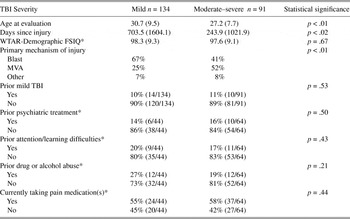
Demographic breakdowns as a function of TBI severity are presented in Table 1. The mild TBI group was significantly older at the time of evaluation (p < 0.004), and had significantly longer time since injury (p < .05). For the Tampa participants, there were no differences in terms of prior psychiatric history, prior attention/learning difficulties, or prior drug/alcohol problems between the mild TBI group and the moderate–severe TBI group.
Demographic variables by TBI severity

Note
Statistical tests were t test for continuous variables and χ2 for dichotomous. WTAR = Wechsler Test of Adult Reading; FSIQ = Full-Scale IQ; MVA = motor vehicle accident; TBI = traumatic brain injury.
* Data available only on Tampa participants with frequency data in parentheses.
Procedures
The participants in Tampa were administered a battery of neuropsychological tests, as well as a self-report measure of current posttraumatic symptomatology, the PTSD Checklist (PCL; Weathers, Huska, & Keane, Reference Weathers, Huska and Keane1991) and a measure of postconcussion symptom complaints, the Neurobehavioral Symptom Inventory (NSI) (Cicerone & Kalmar, Reference Cicerone and Kalmar1995). In addition, they were asked a series of questions about prior conditions. Specifically, they were asked if (1) prior to their TBI, they had ever received psychiatric or psychological care, (2) they had ever received special education services for a learning disability and/or treatment for ADHD, and (3) prior to their TBI, they perceived problem drug/alcohol use and/or had a documented history as such. The WRAMC sample was administered the PCL and NSI as part of routine clinical screening and evaluation.
The NSI is a 22-item postconcussive symptom questionnaire on which patients are asked to rate each symptom on a scale of 1–5 (none, mild, moderate, severe, and very severe) with three different types of symptoms: affective/psychological/stress, somatic/physical, and cognitive. The PCL is a 17-item self-report measure of current posttraumatic symptoms (Weathers et al., Reference Weathers, Huska and Keane1991). Each item corresponds to current diagnostic criteria of PTSD, and each symptom is rated in terms of severity. The three items that are on both scales were removed from each scale for analyses (poor concentration, difficulty falling/staying asleep, and irritability). Total scores, which represent the sum of the items, were used in the analyses for both the NSI and PCL.
Statistics
To examine the relationship between severity of postconcussion symptom complaints and TBI severity, we conducted an analysis of covariance (ANCOVA) to examine differences between groups (mild vs. moderate–severe TBI) on the NSI. Age, time since injury, and mechanism of injury (blast vs. nonblast) were entered as covariates. A second ANCOVA was also done with total PCL score entered as an additional covariate. These analyses were repeated using the three factors of the NSI (Schwab, Caplan, Poole, & Vanderploeg, Reference Schwab, Caplan, Poole and Vanderploeg2009) as dependent measures.
RESULTS
On the PCL, significantly more severe PTSD symptomatology (F = 39.38; p < .0001) was endorsed by the mild TBI group (Mean = 35.4; SD = 16.8) as compared to the moderate–severe TBI group (Mean = 23.5; SD = 13.7). Mechanism of injury (blast vs. nonblast) also differentiated the groups (χ2 = 15.5; p < .001) such that mild TBI was associated with more frequent blast injury (67%), as compared to moderate–severe TBI (41%). Finally, on the NSI, significantly more severe postconcussion symptoms (F = 23.49; p < .0001) were endorsed by the mild TBI group (Mean = 25.6; SD = 15.3) as compared to the moderate–severe TBI group (Mean = 16.3; SD = 12.4).
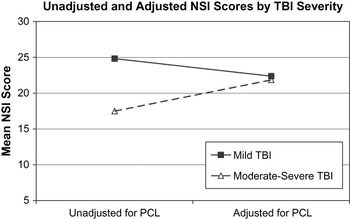
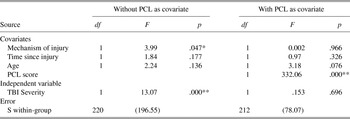
After controlling for age, time since injury, and mechanism of injury, TBI severity continued to be significantly related to postconcussion complaints on the NSI (F = 13.07; p < .001). However, after controlling for these same variables, along with PTSD symptom severity (as measured by the PCL), there no longer were differences between the TBI severity groups (F = .15; p > .70) (See Figure 1). That is, patients with mild TBI did not endorse significantly more postconcussion complaints (NSI adjusted mean = 22.4) than the moderate-to-severe group (NSI adjusted mean = 21.8).Footnote 1 See Table 2 for the effects of the various covariates in these ANCOVA analyses. The same pattern of results and statistical significance findings were obtained for each factor of the NSI (i.e., somatic, cognitive, and emotional).
Mean Neurobehavioral Symptom Inventory (NSI) scores by traumatic brain injury (TBI) severity group adjusted and unadjusted for Posttraumatic Stress Disorder Checklist (PCL) scores.
Note. Age, time since injury, and mechanism of injury served as covariates in all of these plotted adjusted scores.

Analysis of covariance results with and without the PCL entered as a covariate

Note
Values expressed in parentheses represent mean square errors. S = subjects; PCL = PTSD Checklist; TBI = traumatic brain injury.
*p < .05. **p < .01.
DISCUSSION
Postconcussion symptom complaints in those with TBI have been an area of interest within military populations returning from OEF/OIF. However, this has been a difficult area of study due to the presence of comorbid conditions that may present with similar symptoms (Hoge et al., Reference Hoge, McGurk, Thomas, Cox, Engel and Castro2008; Schell & Marshall, Reference Schell, Marshall, Tanielian and Jaycox2008). Similar to Hoge et al. (Reference Hoge, McGurk, Thomas, Cox, Engel and Castro2008), we found that mild TBI is associated with PTSD symptom complaints, and that a blast-related mechanism of injury is associated with increased levels of postconcussion symptom complaints. The current study revealed that while mild TBI patients report significantly more postconcussion symptoms than moderate-to-severely injured patients, this difference is no longer significant once variance due to PTSD symptom-reporting is statistically controlled. Furthermore, the findings were not mediated by premorbid factors such as prior alcohol/drug abuse, intelligence, or prior psychiatric conditions, at least in a subsample, nor were they mediated by mechanism of injury (i.e., blast vs. nonblast). Other authors have found similar results in civilian cases controlling for depression (Chamelian & Feinstein, Reference Chamelian and Feinstein2006). The current findings on the NSI were observed not only overall and on the emotional symptom cluster, but also on somatic and cognitive clusters, suggesting that emotional symptom expression associated with PTSD may be manifested in a broader range of ways than simply emotional distress.
Using a covariate in a situation in which the covariate is related to the grouping variable is controversial (Miller & Chapman, Reference Miller and Chapman2001). In the current study, TBI status was related to PTSD symptom severity. Under these circumstances, it is difficult to tease apart what might be a very complex set of relationships. Both TBI and PTSD result from a trauma exposure, one physical to the brain and the other psychological. However, in combat-related or blast-related TBI the physically traumatic event is also psychologically traumatic, and the two overlap and coexist. This is not to say that PTSD symptoms or diagnosis in this patient population is always due to the same event that caused the TBI – most military personnel have been exposed to multiple psychological traumas during their deployment(s) preceding and following the event(s) that resulted in a TBI. Regardless of sequencing and timing, PTSD and TBI both serve to influence functional outcome and symptom presentation, and potentially interact. In a correlational study such as this one, it is impossible to determine causality, and difficult to determine independent and/or interactive effects. However, a recent study of an independent sample (Vanderploeg, Belanger, & Curtiss, Reference Vanderploeg, Belanger and Curtiss2009) demonstrated that PTSD and mild TBI have separate and noninteracting effects on symptom presentation and, consistent with the current findings, show that PTSD has a more potent effect. Nonetheless, in the current study, it is possible that the distress (which was assessed using a PTSD measure) is general psychological distress that covaries with TBI and is not independent from it. For example, psychological distress may be a reaction to the injury or changes in emotional responsiveness could be due to underlying physiological changes as a result of the TBI.
A limitation of this study is that medical records, while almost always available on moderate–severe cases, were frequently not available for the mild cases. As such, reliance on self-report is largely confounded with TBI severity. Reliance on self-report of PTA is often necessary in returning combat personnel due to the lack of detailed medical records from the theater. Furthermore, self-report is typically the only means of assessment in mild TBI. Nonetheless, this is a weakness of this and many other studies of combat-related mild TBI.
In addition, 35% of the moderate–severe TBI group was comprised of individuals who met criteria for mild TBI in terms of loss/alteration of consciousness but who had positive clinical neuroimaging. These cases, often called “complicated mild TBI,” may have mitigated the findings somewhat. To the extent that they may have been similar to the mild TBI group in terms of symptom complaints and PTSD, the group differences found on symptom complaints may actually be greater than revealed in this study. Given the literature suggesting that their outcomes are more similar to those with moderate TBI (Williams et al., Reference Williams, Levin and Eisenberg1990; Lange et al., Reference Lange, Iverson and Franzen2009), this grouping seems appropriate.
Data regarding timing of the mild TBI in relation to potential development of PTSD symptoms were not available; consequently conclusions about causality are not possible. Although not conclusive, findings of the current study suggest that many of the symptom complaints in mildly injured patients may be due to the emotional distress of PTSD or that elevations on both scales (i.e., NSI and PCL) reflect general levels of distress. Successful treatment of PTSD-related symptoms may reduce not only PTSD symptoms but also other emotional, physical, and cognitive symptoms often associated with or attributed to mild TBI.
ACKNOWLEDGMENTS
The research reported here was supported by the Department of Veterans Affairs, Veterans Health Administration (VHA), and the Defense and Veterans Brain Injury Center (DVBIC). Further support was provided by the James A. Haley Veterans’ Hospital. The views expressed herein are those of the authors and do not necessarily reflect the views or the official policy of the Department of Army, Department of Defense, Department of Veterans Affairs, or U.S. Government.