Implications
The low palatability of the invasive weed medusahead has been attributed to its low nutritional value. This study revealed that the apparent digestibility of medusahead was similar or greater than digestibilities observed in palatable feedstuffs. However, and in contrast to palatable feedstuffs, the digestible organic matter (DOM) of medusahead declined as particle size of the substrate increased. In addition, medusahead exhibited slow fermentation rates. Thus, an inhibition in particle size reduction and the kinetics of fermentation of medusahead contribute to explain it low utilization by sheep.
Introduction
Medusahead (Taeniatherium caput-medusae ssp. asperum) is an invasive Eurasian grass that entails a significant problem for the structure and function of natural ecosystems in the western United States (Duncan and Clark, Reference Duncan and Clark2005). Methods of control such as prescribed grazing by sheep have not been successful due to the low and variable intake of medusahead, even under supplementation programs (Hamilton et al., Reference Hamilton, Burritt and Villalba2015; Villalba and Burritt, Reference Villalba and Burritt2015).
The low palatability of medusahead could be explained by its low nutritional value; however, the CP and fiber content of this weed are similar to values reported for nutritive grasses that are highly palatable (National Research Council, 2007; Villalba and Burritt, Reference Villalba and Burritt2015). In contrast, medusahead is particularly high in silica content, with values ranging from 12% to 19% on a DM basis (depending on plant phenology and plant part), present in the form of amorphous silica in the cell walls of the epidermis (Swenson et al., Reference Swenson, Tourneau and Erickson1964; Mutch and Philpot, Reference Mutch and Philpot1970). Thus, different authors, that is Young (Reference Young1992) and Hamilton et al. (Reference Hamilton, Burritt and Villalba2015) attribute the low palatability of medusahead to this variable as silica is an anti-nutritional factor that could limit the mechanical breakdown of cell walls (Hunt et al., Reference Hunt, Dean, Webster, Johnson and Ennos2008) and degradation of organic constituents in grasses (Van Soest and Jones, Reference Van Soest and Jones1968; Mayland and Shewmaker, Reference Mayland and Shewmaker2001). Nevertheless, such effect is not reported for all grasses with high silica content (Van Soest, Reference Van Soest1993). In addition, Shawrang and Nikkhah (Reference Shawrang and Nikkhah2005) reported digestibility values for medusahead >65%, which are not in line with a constraint in the degradability of the plant in the rumen.
In vitro gas production is a simple and indirect procedure for determining the rate an extent of degradation of feed, which is achieved by monitoring the production of fermentation gas of batch cultures inoculated with rumen fluid (Menke and Steingass, Reference Menke and Steingass1988; Theodorou et al., Reference Theodorou, Wiiliams, Dhanoa, McAllan and France1994); Menke et al. (Reference Menke, Raab, Salewski, Steingass, Fritz and Schneider1979) reported a high correlation between in vitro gas production and in vivo apparent digestibility. In addition, Blümmel et al. (Reference Blümmel, Cone, Van Gelder, Nshalai, Umunna, Makkar and Becker2005) found that forages with high voluntary DM intake have high gas volume at early incubation times, but low gas production at later times of incubation. Thus, the in vitro gas production technique is used to explain ruminant feed preferences and intake through the evaluation of fermentation kinetics.
We hypothesized that plant phenology, silica content, nutrients and particle size influence the ruminal degradability of medusahead, which in turn affect food intake and palatability. Thus, the goals of this study were to measure the apparent digestibility and fermentation kinetics of medusahead relative to more palatable forages at different phenological stages and different particle sizes, and when associated with supplemental nutrients.
Material and methods
Substrates
Experiment 1: digestibility of medusahead at different phenological stages relative to that of other forages and concentrates
Medusahead samples were collected in June 2013, from medusahead-infested natural vegetation (Mountain Big Sagebrush; Wadman, Reference Wadman2012) located in Mantua, UT, USA (41° 29'51" N and 111° 56'32" W). Medusahead was harvested at the ground level at three spots in 1.35-ha area, taken to the laboratory and homogenized to create representative samples from different stages of maturity: (a) late vegetative (June 1; M1), (b) mid reproductive (June 11; M2), (c) late reproductive (June 17; M3), (d) senescent (June 27; M4) and (e) thatch (dead matter from previous years; T) (June 27). In addition, a proportion of M3 sample was manually sorted into inflorescence (M3I), which included the spike and 5 mm of peduncle, and leaves+stems (M3L).
Two palatable forages, alfalfa (Medicago sativa) hay (AH) and endophyte-free tall fescue (Festuca arundinacea) hay (FH), and two similar energy concentrates were used as controls. Forages were harvested when plants were in the late vegetative/early reproductive phenological stages. The concentrates were: (1) beet pulp, barley grain and Ca-propionate (Sigma-Aldrich, St. Louis, MO, USA), mixed in a 66 : 30 : 4 as-fed ratio (CaP), and (2) beet pulp, barley grain, and yeast culture (Saccharomyces cerevisiae fermentation product: Diamond V XP; Diamond V Mills, Cedar Rapids, IA, USA), mixed in a 65 : 30 : 5 as-fed ratio (YC). These feedstuffs were chosen because they were used in previous pen studies as a basal diet (FH and AH) or supplement (concentrates) to explore the influence of nutrients on medusahead use by sheep (Hamilton et al., Reference Hamilton, Burritt and Villalba2015; Villalba and Burritt, Reference Villalba and Burritt2015). All samples were dried in a forced air oven at 60°C for 48 h and ground to pass a 1-mm screen (Wiley Mill; Thomas Scientific, Swedesboro, NJ, USA), according to the common particle size for in vitro gas production measurement (Menke and Steingass, Reference Menke and Steingass1988; Theodorou et al., Reference Theodorou, Wiiliams, Dhanoa, McAllan and France1994).
Experiment 2: digestibility of substrates at different particle sizes
Grinding the samples to 1 mm of size could counter the negative effect of the silicified epidermis on plant digestibility; thus, to avoid such effect, digestibility was estimated from substrates at different particle sizes. Alfalfa hay, FH and M2 samples were cut manually to 5, 10 and 20 mm of length, and used, including the 1-mm particle size to determine forage apparent digestibility and fermentation kinetics. Medusahead at mid reproductive stage was selected for its intermediate chemical quality (Villalba and Burritt, Reference Villalba and Burritt2015) across samples collected.
Experiment 3: digestibility of medusahead mixtures: associative effects
Medusahead (M2) was mixed with AH or CaP to test for associative effects. Mixtures of M2 : AH and M2 : CaP (1 mm particle size) were prepared to measure digestibility and fermentation kinetics: M2 was mixed with AH or CaP in proportions of 100 : 0, 50 : 50, 70 : 30, 90 : 10 and 0 : 100, respectively. These mixtures simulated diets with AH and CaP as minor components (i.e. supplements; Villalba and Burritt, Reference Villalba and Burritt2015).
In vitro gas production
Two ruminally cannulated commercial yearling cross-bred wethers were handled according to procedures approved by the Utah State University Institutional Animal Care and Use Committee (Approval # 1551). Rumen liquid was collected 4 h post-feeding from both animals, which were fed daily at 0700 h ad libitum amounts of endophyte-free tall fescue grass hay (≈2.5 kg/day). Rumen liquid was vacuumed from each sheep and transferred to two pre-warmed (39°C) thermal flasks (500 ml each). Samples were immediately transported to the laboratory, strained through four layers of cheesecloth, mixed in equal proportions, and kept in a water bath at 39°C (Theodorou et al., Reference Theodorou, Wiiliams, Dhanoa, McAllan and France1994). The pH of rumen liquid was 6.7±0.2 (Potentiometer HI 991002; Hanna Instruments, Woonsocket, RI, USA). The buffer medium was prepared using deionized water in proportions according to Menke and Steingass (Reference Menke and Steingass1988). The buffer medium was a mixture of macro and microminerals solutions, artificial saliva, reducing solution and resazurin. All reagents were from Sigma-Aldrich, Milwaukee, WI, USA.
Substrates were prepared to determinate the kinetics of gas production according to in vitro methodology described by Theodorou et al. (Reference Theodorou, Wiiliams, Dhanoa, McAllan and France1994). Dry matter substrate of 400 mg were placed in a 125-ml serum bottle (Wheaton, Boston, MA, USA), with the addition of 40 ml of buffer. Serum bottles were flushed with CO2 and sealed with 20 mm butyl rubber stoppers and an aluminum crimp cap (Wheaton). Serum bottles with substrate and buffer medium were stored overnight at 4°C. During the next morning, the serum bottles were warmed in an incubator at 39°C and then injected with 20 ml of rumen liquid. Blanks were used to correct for gas release and residual fermentation resulting directly from the inoculum and buffer medium.
Gas pressure measurements (psi unit) were made with a USB output pressure transducer (PX409-015GUSBH; Omega Engineering Inc., Stamford, CT, USA) at 2, 4, 6, 8, 12, 18, 24, 36, 48 and 72 h of incubation (experiment 1), or at 2, 4, 6, 8, 12, 18, 24, 36 and 48 h (experiments 2 and 3). Fermentation was stopped after the last reading by placing the serum bottles into a fridge at 4°C. The digestion residues were collected by vacuum filtration through pre-weighted filter paper of 11-μm of pore size (Whatman, Kent, England). Residues were dried at 60oC for 48 h to obtain values of DM.
Gas pressure values were transformed to gas volume using the equation reported by Frutos et al. (Reference Frutos, Hervás, Ramos, Giráldez and Mantecón2002) (Gas volume (ml)=5.3407×gas pressure (psi)). Gas production kinetics was parameterized using the single phasic model of Groot et al. (Reference Groot, Cone, Williams, Debersaques and Lantinga1996; equation (1)) and fitted by minimum sums of squares.
 $$G\,{\equals}\,\mathop{\sum}\limits_{i{\equals}1}^n {} {{A_{i} } \over {1{\plus} {{B_{i}^{{C_{i} }} } \over {t^{{C_{i} }} }}}}$$
where G is the amount of gas produced (ml) per gram of DOM, at time t after the beginning of the incubation; A i (ml/g DOM) the asymptotic gas production; B i (h) the time after starting incubation at which half of the asymptotic amount of gas has been formed; C i the constant determining the sharpness of the switching characteristics of the curve, as the value of C increases, the curve becomes sigmoidal with increasing slope, and i the number of phases in the profile (i=1). Both paramenter B and C indicate the fermentation rate of the substrates.
Chemical analyses
Feedstuffs were analyzed for CP, NDF, ADF, ash and silica concentration. Ash concentration was also measured in the fermentation residues. Crude protein was calculated by measuring the nitrogen concentration of the samples (Wiles et al., Reference Wiles, Gray and Kissling1998) and then by multiplying this concentration by 6.25. Neutral detergent fiber and ADF were measured according to Van Soest et al. (Reference Van Soest, Robertson and Lewis1991) and expressed including residual ash; NDF was assayed after pre-treatment with heat stable amylase and ADF was not sequential of NDF. Ash concentration was obtained by burning samples at 550°C for 6 h (Allen, Reference Allen1989) and the concentration of organic matter (OM) was calculated (OM (g)=DM (g)−ash (g)). Silica is quantitatively recovered in the ADF residues (Van Soest, Reference Van Soest1994); thus, ADF residues were incinerated to measure silica concentration in the samples (550°C for 6 h).
Statistical analyses
Substrates and blanks were run twice per treatment (experimental units), each run was conducted on a different day with three serum bottles (measurement units) per treatment. Digestible dry matter, DOM and fermentation kinetics parameters (A, B and C) for medusahead harvested at different maturity stages, anatomical parts of M3, AH, FH, CaP and YC (experiment 1) were computed using a one-way ANOVA with type of substrate as the main factor. Digestible dry matter, DOM, fermentation kinetics parameters, and gas production per time lapse during incubation (0 to 2, 2 to 4, 4 to 6, 6 to 8, 8 to 12, 12 to 18, 18 to 24, 24 to 36 and 36 to48 h) of M2, AH and FH at four different particle sizes (experiment 2) were computed using a two-way ANOVA with forage species, particle size and their interaction as the main factors. Linear regressions were performed to test the relationship between particle size and digestibility of each forage species. Digestible dry matter, DOM and fermentation kinetics parameters of (a) mixtures of M2 : CaP and (b) mixtures of M2 : AH (experiment 3) were computed using a one-way ANOVA with mixture rate as the main factor. The digestible dry matter, DOM and gas production parameters in the mixtures (M2 : CaP and M2 : AH) were estimated from values obtained from pure substrates and then compared with the observed values using one-way ANOVA. The model diagnostics included testing for a normal distribution and homoscedasticity, and transformed when needed according to the Box-Cox method; non-transformed means±SEM are reported. Means were analyzed using Tukey’s multiple comparison test when F-ratios were significant (P<0.05). A tendency was considered when 0.05<P<0.10. Analyses were computed using SAS (version 9.4 for Windows; SAS Institute Inc., Cary, NC, USA).
Results
Chemical composition of substrates
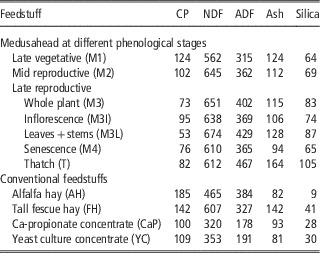
Chemical composition of the substrates assayed is shown in Table 1. Medusahead declined in nutritional quality with plant maturity. Inflorescences in medusahead (M3I) showed better nutritional quality than the whole plant (M3) or leaves+stems (M3L).
Chemical composition of the feeds and forages assayed (g/kg DM)

CaP=mixture of beet pulp, barley grain, and Ca-propionate in a 66 : 30 : 4 as-fed ratio; YC=mixture of beet pulp, barley grain, and yeast culture in a 65 : 30 : 5 as-fed ratio.
Experiment 1: digestibility of medusahead at different phenological stages relative to that of other forages and concentrates
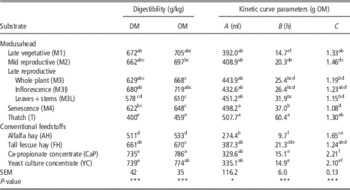
Substrates had different digestible dry matter (DDM) after 72 h of incubation (Table 2). Concentrates (CaP and YC), M1-M3, M3I and FH had similar DDM values. Alfalfa hay and T had the lowest values of DDM, with value for T being lower than that recorded for AH. Regarding anatomical parts in M3, leaves (M3L) had lower DDM than inflorescences (M3I). Medusahead substrates, except thatch, had greater DOM than AH and similar DOM to FH (Table 2). The youngest stage of medusahead assayed (M1) had similar DOM than feed concentrates (Table 2).
Apparent digestibility and fermentation kinetic curve parameters of different substrates (experiment 1) incubated for 72 h

A=asymptote for the gas production curve; B=time after starting incubation at which half of the asymptotic amount of gas has been formed; C=is a constant determining the sharpness of the switching characteristics of the curve; OM=organic matter; CaP=mixture of beet pulp, barley grain, and Ca-propionate in a 66 : 30 : 4 as-fed ratio; YC=mixture of beet pulp, barley grain, and yeast culture in a 65 : 30 : 5 as-fed ratio.
a,b,c,d,e,fMeans in a column with different characters differ (P<0.05).
*P<0.05, **P<0.01, ***P<0.001.
The asymptotic gas production (A parameter) was different between substrates (Table 2). Differences were also detected in the time it took the incubation of different substrates to reach half the amount of gas produced (B parameter) during the 72-h fermentation period (Table 2). It took a shorter time for the AH to reach the B value than for the other assayed substrates, except for M1 which only tended to differ from AH (P=0.06). In contrast, thatch was the substrate with the greatest B value. Curves of gas production presented different shape (C parameter; Table 2). Both concentrates and AH showed the greatest C values. The lowest values for C were observed in the most mature stages of medusahead from the same growing season (M3 and M4).
Experiment 2: digestibility of substrates at different particle sizes
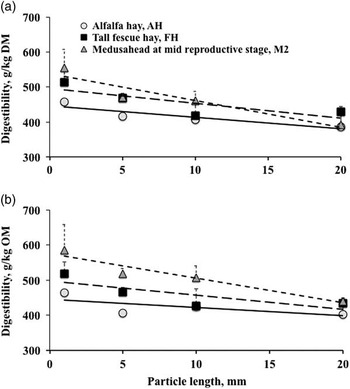
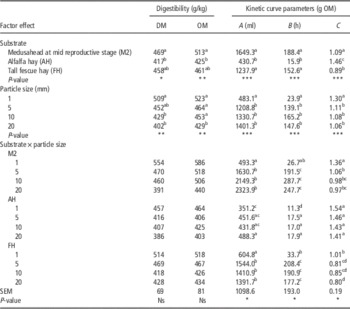
Values of DDM and DOM for plant species, particle sizes, and plant species at different particle size after 48 h of incubation are shown in Table 3. Plant species and particle size affected both DDM and DOM, with no interaction between plant species and particle size. Medusahead had greater DDM and DOM than AH, and FH tended to show greater DDM than AH (P=0.08). Particles of 1 mm had greater DDM and DOM than particles of 20 mm. Particles of 1 mm also showed greater DDM than particles of 10 mm and tended to be greater on an OM basis (P=0.07). When looking at the linear relationship between digestibility and particle size, greater particle sizes led to lower DDM for AH and medusahead (Figure 1a). An increment in particle size did not have effect on OM digestibility of AH and FH, but it reduced DOM of medusahead (Figure 1b).
Linear regressions between different particle sizes (mm) and apparent digestibility (mean±SEM). (a) Digestible dry matter (DM): AH (y=−0.32832x+446.1; R 2=0.59; P=0.02); FH (y=−0.42557x+495.9; R 2=0.41; P=0.09), and M2 (y=−0.76871x+538.1; R 2=0.70; P<0.01). (b) Digestible organic matter (OM): AH (y=−0.2329x+44.55; R 2=0.31; P=0.14), FH (y=−0.40436x+497.7; R 2=0.36; P=0.11), and M2 (y=−0.69896x+575.6; R 2=0.57; P=0.03). Substrate incubation was conducted for 48 h.

Apparent digestibility and fermentation kinetic curve parameters of three substrates at different particle size (experiment 2) incubated for 48 h

A=asymptote for the gas production curve; B=time after starting incubation at which half of the asymptotic amount of gas has been formed; C=is a constant determining the sharpness of the switching characteristics of the curve; OM=organic matter.
a,b,c,dMeans in each factor effect with different characters differ (P<0.05).
*P<0.05, **P<0.01, ***P<0.001, Ns=non-significant (P>0.05).
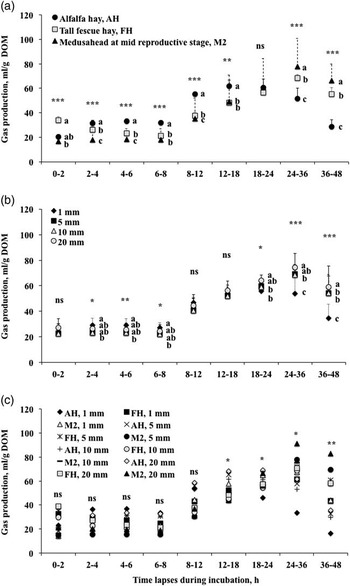
The parameters A, B, and C of fermentation kinetics are depicted in Table 3. Alfalfa hay and particle size of 1 mm had lower A and B parameters and greater C parameter than any other substrate or particle size. The interaction of substrate and particle size showed that 1-mm AH had the lowest A and B values. While medusahead of 1 mm and AH⩾5 mm had similar A and B values. The most sigmoid-shaped curves (C parameter) were observed in AH of all lengths and medusahead of 1 mm. Gas production (ml/g DOM) at different time lapses of incubation (Figure 2a) showed that medusahead had the lowest gas production at time lapses from the beginning to 18 h of incubation, but showed the greatest gas production at time lapses after 36 h of incubation. The greatest gas productions were observed in particles of 1 mm of length at time lapses from 2 to 8 h, while the greatest gas productions at time lapses from 18 to 48 h was observed in particles of 20 mm (Figure 2b). Plant species×particle size interaction had effect at time lapses from 12 to 48 h (Figure 2c).
Gas production (ml/g digestible organic matter (DOM)) per time lapse between gas readings of substrates incubated for 48 h. (a) Effect of plant species; (b) effect of particle size, and (c) effect of plant species×particle size. Bars mean SEM. *P<0.05, **P<0.01, ***P<0.001, ns=non-significant. Values with different letters are significantly different within time lapse (P<0.05).

Experiment 3: digestibility of medusahead mixtures: associative effects
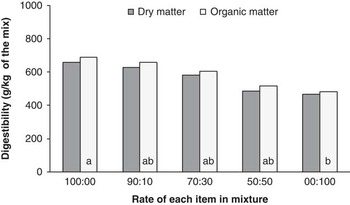
Medusahead : CaP mixtures did not had differences in DDM (P=0.79) or DOM (P=0.16); average values were 663±5 g DDM/kg DM and 706±10 g DOM/kg OM. Mixtures of medusahead with AH had different DOM (P=0.02; Figure 3), but the difference was just between pure substrates (P=0.03). Mixtures of medusahead with AH also had different DDM (P=0.04; Figure 3); however, the post hoc test did not show significant differences between mixtures. No significant differences in digestibility were detected when comparing observed values for the mixtures v. estimated values from pure substrates (P>0.05).
Digestibility (mean±SEM) of different mixtures of medusahead (M2) : alfalfa hay (AH). Substrate incubation was conducted for 48 h. Values with different letters are significantly different (P<0.05).

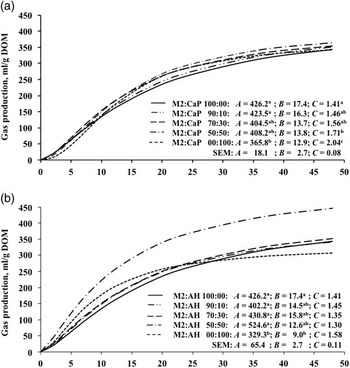
Gas production curves and parameters of medusahead : CaP mixtures are shown in Figure 4a. Pure CaP produced less gas than mixtures with 0% and 10% of CaP (P<0.05). Mixtures had an effect on the C parameter (P<0.01); the value of C increased as the ratio of CaP in the mixtures increased (P<0.05). Fermentation curves and parameters of medusahead : AH mixtures are shown in Figure 4b. Curves show that mixtures influenced the parameter A (P=0.05) and B (P=0.04), and that mixtures tended to have an effect on parameter C (P=0.08), but such differences were only between pure substrates (P<0.05). No significant differences in kinetic parameters were detected when observed values were compared with calculated values from pure substrates (P>0.05).
Gas production curves and parameters A, B and C (mean±SEM) of different mixtures. Mixtures: (a) medusahead at mid reproductive stage (M2) : Ca-propionate concentrate (CaP), CaP was a mixture of beet pulp, barley grain, and Ca-propionate in a 66 : 30 : 4 as-fed ratio, and (b) M2 : alfalfa hay (AH). A represents the asymptotic gas production, ml/kg of digestible organic matter (DOM); B is the time after starting incubation at which half of the asymptotic amount of gas has been formed, and C is a constant determining the sharpness of the switching characteristics of the curve. Substrate incubation was conducted for 48 h. Curve parameters with different letters are significantly different (P<0.05).

Discussion
Medusahead digestibility and nutritional value relative to other feeds
Consistent with prior research (Van Soest and Jones, Reference Van Soest and Jones1968; Kenney and Black, Reference Kenney and Black1984), our results show that the apparent digestibility of alfalfa was lower than that of grasses, including medusahead. Digestibility values of medusahead found in this study were consistent with values (>65%) reported for T. caput-medusae (unknown ssp.) by Shawrang and Nikkhah (Reference Shawrang and Nikkhah2005). These values of digestibility are relatively high when considering that medusahead contains high content of silica, an antinutritional factor in forages (Van Soest, Reference Van Soest1994); Van Soest and Jones (Reference Van Soest and Jones1968) and Smith et al. (Reference Smith, Nelson and Boggino1971) estimated for grasses that there is a decrease in one to three units of DM digestibility per unit of increase in silica content. We did not find a significant reduction in DM and OM digestibility for medusahead (ground at 1 mm of particle size) with increments in silica content, which occurred as medusahead matured from the late vegetative stage to the late reproductive stage. In addition, tall fescue hay and medusahead at the mid reproductive stage had similar digestibilities of DM and OM, but medusahead had 59% more silica content than tall fescue hay. This suggests that the decline in digestibility due to silica content may not always be proportional to a 3 : 1 ratio as suggested by Van Soest and Jones (Reference Van Soest and Jones1968). More studies also support this notion as Van Soest (Reference Van Soest1993) reports additional studies for grasses where silica did not affect digestibility.
The relatively high values of apparent digestibility found in medusahead are in stark contrast with intake values (Hamilton et al., Reference Hamilton, Burritt and Villalba2015; Villalba and Burritt, Reference Villalba and Burritt2015) or utilization during grazing (Montes-Sánchez et al., Reference Montes-Sánchez, Van Miegroet and Villalba2017) reported for this weed by sheep. In fact, the ground substrate collected during the late vegetative and mid-reproductive stages of medusahead had values of DM and OM digestibility similar to those found in concentrates. Medusahead intake by sheep is typically low at all stages of maturity during the growing season (Hamilton et al., Reference Hamilton, Burritt and Villalba2015; Villalba and Burritt, Reference Villalba and Burritt2015), even when consumption of the weed by sheep is greater in younger than in older plants (Hamilton et al., Reference Hamilton, Burritt and Villalba2015). In general, as reported in this study, fiber content is lower and CP content greater in younger medusahead plants. In addition, the inflorescence in medusahead showed greater CP content and digestibility values than those found in the whole plant. Consistent with these findings, lambs display greater preference for inflorescences than for leaves and stems when offered in a choice test (Villalba and Burritt, Reference Villalba and Burritt2015).
In contrast to plants from the current growing season, the low digestibility of thatch matches its low intake by lambs (Hamilton et al., Reference Hamilton, Burritt and Villalba2015); although, lambs in a previous study ate more thatch than medusahead in the reproductive phenological stage (Hamilton et al., Reference Hamilton, Burritt and Villalba2015). This pattern may be explained by the fact that thatch in the present study had greater silica and lower NDF and ADF contents than those reported by Hamilton et al. (Reference Hamilton, Burritt and Villalba2015). The silica content in plant tissues varies according to availability of soluble silica in the seedbed (Massey and Hartley, Reference Massey and Hartley2006) and to the evaporation rate of different plant tissues (Raven, Reference Raven2003).
Fermentation kinetics and intake
The voluntary DM intake of roughage by ruminants has a direct correlation with gas production between 2 and 8 h of in vitro incubation (e.g. related to the fermentation of feed solubles), and with low amounts of gas production at later times of incubation (e.g. related to fermentation of structural carbohydrates) (Blümmel et al., Reference Blümmel, Cone, Van Gelder, Nshalai, Umunna, Makkar and Becker2005). Therefore, the more gas produced at the beginning of fermentation, the greater the value of voluntary intake, which agrees with the relatively small values for the parameter B found in alfalfa (the time it took the incubation of alfalfa to reach half the total amount of gas produced during fermentation) and the greatest gas production per time lapse showed by alfalfa and tall fescue hays from the beginning to 18 h of incubation. In contrast, medusahead had a slower rate of fermentation (longer time to reach half the amount of gas production), which became much slower as medusahead matured. For example, substrate from medusahead collected at mid reproductive stage required 72% more time to reach half the amount of gas produced than medusahead harvested at the vegetative stage with the same potential gas production (parameter A) for both substrates. Furthermore, the fermentation of medusahead was extended over time relative to more palatable forages and concentrates. The greater gas production observed for medusahead after 24 h of incubation was due to fermentation of structural carbohydrates, which can be seen at different rates in different forages with different types and amounts of cell wall (Blümmel et al., Reference Blümmel, Cone, Van Gelder, Nshalai, Umunna, Makkar and Becker2005). In addition, the structure of plant cell walls can change with maturity and as a consequence impact forage digestibility. For instance, Van Dyne (Reference Van Dyne1962) found that isolated cellulose from immature medusahead plants had greater in vitro digestibility (79% to 82%) than cellulose from mature medusahead (70% to 72%), mature mixed annual rangeland (67%) and alfalfa (51%).
Digestibility of rice straw (rich in silica) is limited to damaged regions of the cuticle and edges of feed particles (Bae et al., Reference Bae, McAllister, Kokko, Leggett, Yanke, Jakober, Ha and Chen1997). This limitation likely occurs in medusahead, suggesting that the slow fermentation rate observed was caused by the slow exposure and release of structural and soluble fermentable compounds induced by medusahead’s physical characteristics. Medusahead has smaller stems and leaves than tall fescue and presents long silicified awns (Swenson et al., Reference Swenson, Tourneau and Erickson1964; Stubbendreck et al., Reference Stubbendreck, Hatch and Landholt2003). Thus, medusahead should have more silicified epidermis than the same amount (on a weight or volume basis) of tall fescue. Furthermore, larger edges in chewed leaves and empty stems in tall fescue should give more unprotected area for bacterial colonization and degradation. This may explain why lambs eat more and show greater preference for tall fescue than for medusahead (Villalba and Burritt, Reference Villalba and Burritt2015), even when both grasses have similar digestibilities. This is why we hypothesized that particle size reduction may play a significant role at explaining medusahead intake and palatability.
Fermentation kinetics and particle size
Particle size may have a significant impact on medusahead digestion given that silica is present on the epidermis (Swenson et al., Reference Swenson, Tourneau and Erickson1964), acting as a physical barrier (Van Soest and Jones, Reference Van Soest and Jones1968; Mayland and Shewmaker, Reference Mayland and Shewmaker2001). This prevents microbial attachment and/or colonization of plant cell walls and thus enzymatic degradation of structural carbohydrates, an effect less evident in tall fescue with moderate content of silica. The rate of digestion depends on reduction of particle size and the increment of ‘unprotected’ areas by silica that allows for greater surface area and thus more access to colonizing rumen bacteria. In turn, particle size reduction depends on rumination rate and resistance to fracture of the substrate (Van Soest, Reference Van Soest1994). Considering that chewing is probably the major force in reducing particle size (Van Soest, Reference Van Soest1994; Allen, Reference Allen1996), and the effect of cell wall composition (i.e. cellulose and lignin) on forage breakup, alfalfa may shatter into shorter particles, while grasses might break into more needle-like particles (Van Soest, Reference Van Soest1994). Furthermore, silica can decrease the mechanical disruption of the chlorenchyma cell walls in grasses, which contain high levels of soluble carbohydrates and protein (Hunt et al., Reference Hunt, Dean, Webster, Johnson and Ennos2008).
In vitro digestibility trials have the limitation of not being able to evaluate the rate of mechanical reduction of particle size as substrates are typically ground to 1 mm (Menke and Steingass, Reference Menke and Steingass1988; Theodorou et al., Reference Theodorou, Wiiliams, Dhanoa, McAllan and France1994). This limitation is key as particle size reduction is of major importance in the alleviation of rumen fill and, consequently, has a significant impact on feed intake (Allen, Reference Allen1996); Welch (Reference Welch1967) found that wethers showed a 30% reduction in the voluntary DM intake of chopped alfalfa hay when 150 g of 7-cm long polypropylene fibers were inserted into the reticulorumen. Intake decreased immediately after insertion of the fibers and gradually increased as the fibers were reduced in size by rumination and passed through the digestive tract (Welch, Reference Welch1967). Therefore, medusahead with its inherent chemical (i.e. silicified epidermis) and anatomical characteristics might have a similar fill effect and reduction of passage rate, requiring more time and energy for chewing and reducing the medusahead particles to increase the area exposed to microbial activity. Consistent with these ideas, we found a stronger impact of particle size on digestibility of medusahead than on the digestibility of forages (i.e. alfalfa and tall fescue hay) that typically lead to greater intake values by sheep. For instance, particle size did not have an influence on DOM in alfalfa, but greater particles inhibited DOM and DDM in medusahead.
Palatability is a complex process that integrates odor, taste, and texture with the post-ingestive effects of nutrients and toxins (Provenza, Reference Provenza1995). Gustatory, olfactory and tactile sensory receptors interact with the visceral receptors that respond to nutrients and toxins (chemo-receptors), osmolality (osmo-receptors) and distension (mechano-receptors) (Provenza, Reference Provenza1995). Collectively, these neurally mediated sensorial–digestive process interactions enable animals to discriminate among foods, each of which possesses a distinct utility, and they encourage animals to eat a variety of foods and to forage in a variety of locations (Provenza et al., Reference Provenza, Villalba, Dziba, Atwood and Banner2003). Aversions become pronounced when foods contain high levels of toxins, low level of nutrients or nutrient imbalances (Provenza et al., Reference Provenza, Villalba, Dziba, Atwood and Banner2003). Medusahead does not cause aversion in lambs (Hamilton et al., Reference Hamilton, Burritt and Villalba2015). However, the slow particle size reduction in medusahead may result in a slow release of nutrients and energy from this weed, which will negatively influence preferences and intake.
Fermentation of medusahead mixtures
The addition of alfalfa hay or the energy concentrate to medusahead did not lead to positive associative effects as expected. Digestibility values of the mixes were in general a linear combination of the digestibilities found in the pure substrates. This result is consistent with the fact that supplementation programs have weak or non-significant effects on medusahead intake and preference (Hamilton et al., Reference Hamilton, Burritt and Villalba2015; Villalba and Burritt, Reference Villalba and Burritt2015). On the other hand, medusahead mixed with alfalfa or CaP did not cause significant negative associative effects on digestibility. It is expected that the silicified epidermis of medusahead just affects the digestibility of the plant’s own constituents.
Conclusion
Despite the constraint of high contents of silica – an antinutritional factor – the apparent digestibility of medusahead was comparable to values observed in more palatable substrates (e.g. tall fescue hay, energy concentrates) and even greater than values observed in a palatable legume (e.g. alfalfa). By using particles of different sizes this study revealed a much greater inhibitory effect of particle size on digestibility for medusahead than for the rest of the forages assayed. In addition, fermentation kinetics of medusahead showed a delayed gas production relative to more palatable forages like alfalfa, another factor explaining the low palatability of the weed. No associative effects were found by mixing medusahead with alfalfa or with an energy concentrate. Thus, the supplements did not overcome or compensate the limitation of the physical barrier of silica (which prevents bacterial colonization and degradation) on medusahead fermentation, consistent with the observed lack of positive effects of supplements on medusahead intake by sheep.
Acknowledgments
This research was supported by grants from the National Institute of Food and Agriculture (NIFA), USDA (agreement no. 2011-38415-31187). This paper is published with the approval of the Director, Utah Agricultural Experiment Station, and Utah State University, as journal paper number 8892. The authors acknowledge R. Stott for veterinary services, K. Price for technical support, and K. Bear and J. Pfister for laboratory space.