In dialect contact situations that involve rural and urban forms, one would expect the urban forms to prevail as they are considered in most cultures to be the national or more prestigious norms. In general, it is expected that rural children will acquire the local forms (Chambers, Reference Chambers2002; Labov, Reference Labov, Meyerhoff and Nagy2008, Reference Labov2012) first, and then learn the incoming urban forms (Cornips & Corrigan, Reference Cornips and Corrigan2005:4). This study presents a different situation where, despite exposure to both urban and rural forms, rural children acquire, presumably from their out-of-town mothers, and mostly produce, the urban forms first and then, as they grow up, start using their local, rural forms. To illustrate this reverse situation, this study examines the variation and change in the use of the rural vowel variables (o), (o:), (e), and (e:) in the vernacular Arabic of rural, nonmigrant children and adolescents in the village of Oyoun A-Wadi in Syria.
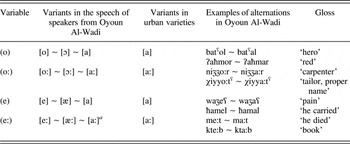
These variables are of interest because they are very distinctive of the rural variety under investigation, particularly in relation to their urban counterparts. They are realized in Oyoun Al-Wadi and in major urban centers such as Damascus and Hims as shown in Table 1, with examples of alternation from the speech of speakers in Oyoun Al-Wadi.
Realization of the variables (o), (o:), (e), and (e:) in the speech of speakers from Oyoun Al-Wadi and in urban varieties and examples of alternations in the speech of speakers from Oyoun Al-Wadi

aIt is worth noting that there are words that contain [o:] and [e:] in this variety that correspond to the Standard Arabic diphthongs [aw] and [ay], respectively, and they occur in closed syllables, for example, [lo:n] ‘color’ and [be:t] ‘house’. In this case, the vowels [o:] and [e:] also occur as [o:] and [e:] in major urban dialects such as Damascene and Himsi Arabic. Thus, these words are not included in the data in this study because they have the same corresponding vowels in urban varieties. Only words that correspond to the urban [a:] are included in the data and the analysis.
It is worth noting that length is phonemic in all Arabic varieties (Al-Nassir, Reference Al-Nassir1993:29, 31; Brustad, Reference Brustad2000:XV; Cowell, Reference Cowell1964). Thus, the short vowels [o], [e], [a] and the corresponding long vowels [o:], [e:] and [a:], respectively, form minimal pairs, for example, qatal ‘he killed’ and qa:tal ‘he fought with’; ħaro:m ‘it is a petty’ and ħarom ‘campus/deprive’; and ʒamel ‘camel’ and ʒame:l ‘beauty’. Hence, there are four distinct variables.
In this study, the first two variants of each variable in the variety of Oyoun Al-Wadi are collapsed in all the quantitative analyses for the following reasons. First, either is indicative of a rural variety as opposed to [a] and [a:] which are indicative of an urban pronunciation. Second, the variants [æ], [æ:], [ɔ], and [ɔ:] occur in limited numbers such that adding their numbers to [e], [e:], [o], and [o:], respectively, does not affect the results of the quantitative analyses. Third, whereas the distinction between [e] and [æ] or [o] and [ɔ], for example, is sometimes blurred, the distinction between [e] and [æ], on the one hand, and [a], on the other, can be made very clearly impressionistically. The same applies to other collapsed and noncollapsed vowels. Furthermore, the study is mainly concerned with the phenomena of rounding, raising, and backing or the fronting and raising of [a] and [a:] in different linguistic environments.
While in some Syrian dialects, [o:] originated from Aramaic (Arnold & Behnstedt, Reference Arnold and Behnstedt1993), the vowels [o], [o:], [e], [e:] may have been brought to Oyoun Al-Wadi around AD 1700 by the father of the village, Sabiq Suleiman Ma‘louf from his hometown, Kafr ‘Oqab, which may have round vowels or emphaticized [a:] like the nearby Lebanese city Tripoli (Al-Nassir, Reference Al-Nassir1993:103). Emphaticized [a:] is assumed to have some similar qualities to the round vowels (Al-Nassir, Reference Al-Nassir1993:103; see Habib, Reference Habib2012:54–56, on the round and front mid vowels in various Arabic dialects).
The front mid vowels are known as ’imala vowels in Arabic; ’imala vowels seem to be more widespread in Syria than the round vowels, although not to the same extent as the urban vowels, and they are considered mainly rural like the round vowels despite their use in a couple of Syrian cities, Aleppo in North Syria (Cowell, Reference Cowell1964:15; Versteegh, Reference Versteegh1997:153) and Qaryateen, northeast of Damascus (Behnstedt, Reference Behnstedt1997). ’Imala is also used in several central Syrian dialects, which include the variety spoken in Oyoun Al-Wadi and some surrounding villages (Behnstedt, Reference Behnstedt1997; Versteegh, Reference Versteegh1997:153). ’Imala is typical of Lebanese dialects particularly in northern Lebanon including Tripoli and its vicinities (Cowell, Reference Cowell1964:15).
The present study shows that there is widespread use of the urban vowels among the different age groups of the children of Oyoun Al-Wadi. Rural forms are used much more at later stages in those children's lives, starting at the age of 9 and above. There is a reversal in the acquisition of forms, that is, urban forms are acquired first, and then rural forms are acquired with the rules associated with them. The reverse acquisition of the village's forms is attributed to social psychological factors and to the growing sociolinguistic competence of those children and their awareness of their variable linguistic environment. Gender differences are observed and attributed to the different identities and characteristics that males and females project and to the degree of connection and sense of belonging to the village.
Research questions
The study seeks to answer the following research questions:
1. What are the patterns of use of the variables (o), (o:), (e), and (e:)?
2. Why do children and adolescents who are initially almost categorical users of urban vowels use more rural vowels later on in life?
3. What do the vowel patterns and their distributions tell us about the directionality of change and the sociolinguistic situation in the village?
4. How can this study inform linguistic variation and child dialect acquisition theories?
The locale of Oyoun Al-Wadi
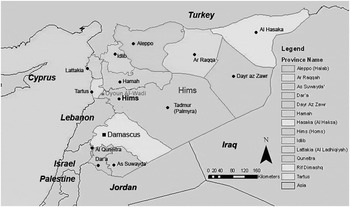
Oyoun Al-Wadi ‘The Springs of the Valley’ is a majority Christian village in the northwest of the Hims Governorate and on the border of the Tartus Governorate (Figure 1). It is centrally located among three major cities: Hims (approximately 67 km), Tartus (approximately 62 km), and Hamah (approximately 70 km). It is administratively under the city of Hims, which conduces to constant contact with various governmental offices and businesses there. The population of Oyoun Al-Wadi according to the 2005 civil registration bureau statistics is 2600 (collected and presented on www.Mshtawy.com, the website of the neighboring town, Mashta Al-Helou, by Zakhour Shahem, the current mayor of Oyoun Al-Wadi). However, due to internal migration to urban centers and external immigration to the Americas, Europe, and the Gulf region, this number is expected to be lower, especially in the winter (Habib, Reference Habib2010a, Reference Habib2011a).
Map of Syria. Oyoun Al-Wadi is on the border between Hims and Tartus.

The variety of Oyoun Al-Wadi is often characterized as harsh, rough, tough, etc. This is largely due to rural sounds such as the voiceless uvular stop [q] and the round vowels; the forceful tone in which the variety is spoken; and the loudness of the people when they speak. These variety characteristics distinguish males from Oyoun Al-Wadi and make them recognizable in various places. The males' vigorous demeanor and virile attitude are seen as inherited from the father of Oyoun Al-Wadi, Sabiq Ma‘louf, and transmitted from generation to generation through oral anecdotes about the strength, courage, bravery, and fights of the father of the village, his sons, and other males of the village to instill pride in the village in the minds of the consecutive generations, even those who lived or continue to live in urban centers or abroad. These attributes and a strong sense of belonging to the village are manifested in the boys’ linguistic behavior, for example, their shift after age 8 from the use of the urban form [ʔ] to the use of the local form [q] (Habib, Reference Habib2011a).
Oyoun Al-Wadi and the neighboring villages have witnessed in the past 20 to 30 years increased commuting to urban centers and a great increase in tourism, particularly internal tourism, leading to economic and infrastructure developments such as building more hotels and paving roads. It also led to increased contact with urban features and exposed the local people to new norms and ideologies. Internal migration to urban centers and increased education have also played roles in increasing contact with urban features. All of these factors also led to more marriages to women from outside the village, most of which use urban features. At the time the data were collected in spring 2010, there were 435 out-of-town women compared to 90 local women married to men in the village (J. Habib, 2010, personal communication). The out-of-town women could be urban or urbanized through birth in or migration to urban centers in childhood or could be from rural areas that may use the urban features explored in this study or ones that still retain some rural vowels in their original varieties. At the same time, many (377) local women are married to men from outside the village. In other words, the past 20 to 30 years demonstrated a great population shift in Oyoun Al-Wadi.
The new norms and ideologies about language varieties, referred to earlier, did not seem to exist prior to these extensive cultural and demographic changes. In the past, the out-of-town women could not influence their children's local speech or the variety of the village, not only due to being the minority, but also because the people of the village had less contact with urban features and other varieties and felt that their variety is the best and the only one that should be learned and used. Hence, they criticized out-of-town women who did not use the village's variety (Al-Ma‘louf, Reference Al-Ma‘louf2008:93), and children adopted their fathers’ local features. In contrast, in recent times, the newcomers, the out-of-town mothers, have greatly influenced language use in the village, although newcomers are usually expected to adopt the local norms. This resulted in a mixture of dialects and forms along a continuum, though any degree of use of the village's features identifies the speaker as a rural individual (cf. De Houwer, Reference De Houwer2003:336).
In contact situations such as the one here, it is expected that urban forms would influence local forms (Trudgill, Reference Trudgill1974). However, what is observed is that while urban features are spreading rapidly, the younger generation shows later-in-life adoption of the local forms. Is it a reaction to these visible cultural changes in the area? Is it the social meanings attached to the urban and rural forms? Or is it fear of losing one's identity?
In brief, the linguistic situation observed in Oyoun Al-Wadi could be attributed to cultural changes in the country as a whole leading to greater mixing among the population. Among these cultural changes, besides nonlocal women's influence, are the increase of internal migration, the increase in education, the progress in communication and media that led to extensive watching of TV serials and programs that are broadcast in Damascene Arabic, the increase of commuting and transportation, and the development of rural areas (some of which have become more developed than cities because of their touristic atmosphere or the presence of many of their members in foreign countries). In the case of Oyoun Al-Wadi, many of the construction and road projects are funded by immigrants who either still live abroad or have returned to the village.
Thus, internal migration has helped in education and job improvement and led to the mixing of population and dialects, and external immigration helped in boosting the economy of the village and in infrastructure development. One can rarely find a family in the village that does not have at least one member of it in a foreign country or/and in an urban center. Most of the families are financially secure because they were abroad or a member of their family is abroad or they have some land that has a good annual return. Though there are probably some financial differences among people, these differences are not always noticeable (Habib, Reference Habib2010b, Reference Habib, Mallinson, Childs and Herk2013:29–30). Most people are related somehow and are on equal footings. Thus, one cannot observe clear class divisions among the people of the village.
CHILD DIALECT ACQUISITION, LOCAL IDENTITY, AND GENDERED SOCIAL MEANINGS
According to studies on child acquisition of a second dialect, it is hard for children to acquire the rules of the new dialect after the age of 8 (e.g., Chambers, Reference Chambers1992; Kerswill, Reference Kerswill1996; Payne, Reference Payne and Labov1980; Straw & Patrick, Reference Straw and Patrick2007; Tagliamonte & Molfenter, Reference Tagliamonte and Molfenter2007). Chambers' (Reference Chambers2002) proposal that children born in a locale of non-native parents would block their parents' non-native features and exclusively acquire the local dialect eliminates the influence of non-native caregivers and assumes mainly influence of peers and the local community (Kerswill & Williams, Reference Kerswill and Williams2000:94; Labov, Reference Labov1972:304; Romaine, Reference Romaine1995). Other studies highlight the influence of native caregivers and parents (e.g., De Houwer, Reference De Houwer2003; Foulkes, Docherty, & Watt, Reference Foulkes, Docherty and Watt2005; Kerswill, Reference Kerswill1996; Romaine, Reference Romaine1995; Stanford, Reference Stanford2008; Van Hofwegen, Reference Van Hofwegen2010).
However, Poplack (Reference Poplack1978) did not find such influence on second-generation Puerto Rican children in North Philadelphia. Labov (Reference Labov2010, Reference Labov2012) believed that children learn the speech pattern they perceive as the most acceptable, representative, and common in their speech community. Nevertheless, Sharma and Sankaran (Reference Sharma and Sankaran2011:420) found that “the acquisition of local and foreign dialect systems can be quite independent” among U.K.-born Indians, and that intense competing social pressures lead immigrant communities to use both transmission, that is, child acquisition (of non-native parents' features), and diffusion (Labov, Reference Labov2007), that is, adult acquisition (of U.K. features).
Eckert (Reference Eckert2008:462) indicated that “variables that historically come to distinguish geographic dialects can take on interactional meanings based in local ideology.” The influence of local identity on the choice of a linguistic code has been remarked in a number of variationist studies (e.g., Haddican, Reference Haddican2007; Labov, Reference Labov1972 [1963]). Stanford (Reference Stanford2008:567) argued, based on the Sui clan-based community in China, that “children learn and construct dialect identity as a process of distinction between several groups.” In the early years, Sui children use the language of their mother's clan. As they grow older, they start converting to the use of the language of the father's clan (i.e., patrilect) even when they are addressed in their mother's matrilect, eliminating all mothers' features by the ages of 5 to 7 years.
“Children learn to walk, talk, and gesture the way their social group says girls and boys should” (Lorber, Reference Lorber and Matson2012:5). Once gender is ascribed, individuals are held to certain norms and expectations, and whenever there is a division in the social roles of women and men, speech differences are expected (Gal, Reference Gal and Coates1998:147; on performance of gender identity, see Kiesling, Reference Kiesling2008; Shire, Reference Shire, Cornwall and Lindisfarne1994). Membership in the male group depends on display of physical prowess, skill, confidence (Bucholtz, Reference Bucholtz1999; Kiesling, Reference Kiesling1998), toughness, and roughness (Eckert, Reference Eckert1990; Eckert & McConnell-Ginet, Reference Eckert, McConnell-Ginet, Hall and Buchholtz1995; Eisikovits, Reference Eisikovits and Coates1998; Trudgill, Reference Trudgill and Coates1998), which are usually performed linguistically.
Socializing children to different linguistic norms according to how they are expected to present themselves as boys and girls is observed in a number of studies (e.g., Foulkes, Docherty, & Watt, Reference Foulkes, Docherty and Watt2005; Roberts, Reference Roberts, Chambers, Trudgill and Schilling-Estes2002). Walters (Reference Walters, Comrie and Eid1991:213) attributed the difference in the linguistic behavior between males and females in Korba Arabic to “norms of gender appropriateness.” This is not surprising as the association of certain variants with masculinity and femininity in the Arab world has been observed (Abd-el-Jawad, Reference Abd-el-Jawad1986:58–59; Al-Wer & Herin, Reference Al-Wer and Herin2011:71&73; Hachimi, Reference Hachimi2012:331). Women in most sociolinguistic studies showed higher use of urban or prestigious forms, whereas men showed higher use of rural or less prestigious forms (e.g., Abu-Haidar, Reference Abu-Haidar, Broselow, Eid and McCarthy1992; Daher, Reference Daher, Benmamoun, Eid and McCarthy1998; Miller, Reference Miller2005). Gender differences can also be observed in relation to expressing local identity. For example, Ladegaard (Reference Ladegaard1998) found in a rural community in Denmark that boys use more nonstandard forms than girls do because they are proud of their regional dialect, want to stay in the local community, and are concerned with the local vernacular and culture.
METHODS AND DATA
Data collection and speech sample
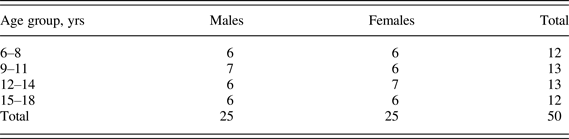
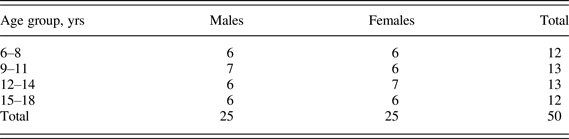
The fieldwork for this study was carried out in the spring of 2010. As an in-group member, the author easily entered the community and was able to collect a very naturalistic set of data from approximately 160 speakers from different age cohorts through informal interviews and casual conversations among groups. Of these 160 speakers, 88 speakers were ages 6 to 18, that is, about 70% of the children of these ages in the village.Footnote 1 The speech for the present study is from 50 speakers ages 6 to 18 years (those who were fully transcribed and coded), who could be considered a good representative sample of the village's children as this number of participants constitutes 40% of the village's children ages 6 to 18 at the time of recording. The sample was carefully balanced to include an almost equal number of participants in each age group and an equal number of females and males in general and in each age group (see Table 3). In addition, children who have some speech impairment such as lisping or stammering were excluded from the study, though they were recorded so that they would not feel left out. A final criterion was the clarity and length of the recording.
The author went initially to schools to acquaint children and adolescents with her. The author also participated in activities in the village, including church activities for children. This participation enabled the author to ask the children informal questions and elicit information about some general linguistic observations among their family members, friends, and classmates. The author's involvement in a number of the children's activities generated discussions between the parents and their kids. Children were talking about the author to their parents and were excited about the prospect of having someone record their speech.
The informal interviews with the participants lasted 30 to 45 minutes. They were carried out in colloquial Arabic in a naturalistic setting in the presence of one or more friends and/or one or more family members to elicit the most naturalistic speech. A description of the social culture of the village would give a clearer picture of how interviews were carried out. In Oyoun Al-Wadi, as in many other areas in Syria, people visit each other unexpectedly without prior notice. Even if the interviewer explains to the household ahead of time that she needs to spend some time recording members of the family and she needs as much quietness as possible, so the recordings can be clear and comprehensible, these wishes could not be honored, not because they did not want to honor them, but because of the social and familial culture of the people. People would be coming in and out. Phones would ring and people would respond to them while the interview was taking place. Members of the household could not be rude to visitors or they themselves could not keep still and quiet. This is not to mention that in some situations parents, siblings, or friends like to interject and give their opinion, start a relevant story, or merely give an answer instead of the speaker. Although this atmosphere may have affected the clarity of the recordings, it has the advantage of obtaining the most naturalistic speech possible. The presence of other people in the room stimulated topics or stories for the interviewee. It also diminished attention to the recording. In some situations when the author felt that the recordings would really be problematic, she asked parents to send their children to her home with one or more of their friends to record them. Most of those asked were willing to do so.
The interviews were very natural and did not follow any preconceived format. In the interviews, the interviewer's speech contained some variation between the urban and rural vowels especially regarding the front mid vowels. Her speech could be characterized as heavily influenced by urban vowels, having lived most of her life in the city of Hims. Different questions often arose during the conversations. Interviewees were sometimes asked initially about themselves and their families; the linguistic features used by family members, friends, and classmates; their connection to urban centers and people living in urban centers; their degree of contact with speakers that use urban features, including their length of visits to relatives in urban centers and the length of their relatives' visit to them from urban centers; and the TV programs they watched that use urban forms, mainly Damascene. Because it is hard to go into deep discussions with young speakers, most of the participants in this study were asked to tell stories or jokes or talk about some event or story that affected them (see Habib, Reference Habib2011a:83–84, for further discussion of data collection). Sometimes they were asked about what they like most in their village and what they would like to change about their village.
Data: Distribution of the dependent variables
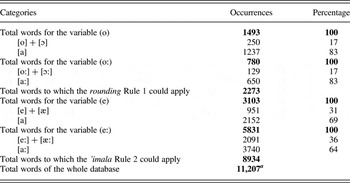
The dataset consists of 11,207 tokens. Table 2 gives the distribution (i.e., the token count and percentage) of each variant and variable. The rural round vowels [o] + [ɔ], [o:] + [ɔ:] are used 17% of the time in comparison to the use of their urban counterparts at 83%, or four times more often. Regarding the rural front mid vowels [e] + [æ], [e:] + [æ:], we observe a slightly different pattern. There is a greater use of these vowels (about double) than the round vowels, although both types of vowels are rural. The greater use of the front mid vowels compared to the round vowels will become clear in the upcoming discussion.
Distribution of variants and variables in the speech of the 50 participants
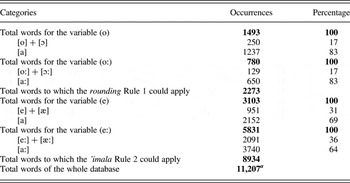
Note: Bold indicates the total for each variable, each rule, and all variables combined.
aThere are six tokens of [e] for the variable (o) and one token of [e:] for the variable (o:) that are excluded from the table and the quantitative analyses because they are considered pronunciation errors.
Social factors
The social factors that are considered in this study are gender (25 males, 25 females) and age (Table 3; individuals are listed in the Appendix). The sample is divided into four age groups: 6 to 8, 9 to 11, 12 to 14, and 15 to 18 years. This division corresponds to the children's physical movement from one school to another and to the change in the boys' linguistic patterns toward the rural forms starting at the fourth grade according to the general comments and observations of the community. Because boys start shifting to the rural forms in the fourth grade, the primary school period in the village is divided into two age groups: 6 to 8 years includes mostly grades 1 to 3 and 9 to 11 years includes mostly grades 4 to 6. After grade 6, children move to another school in the village for grades 7 to 9, which are mostly included in age group 12 to 14 years. For their secondary education, that is, grades 10 to 12, children move to another school mostly in the neighboring village, Mashta Al-Helou; these children are mostly included in the age group 15 to 18 years. This age division is comparable to a certain extent to the division in previous studies, especially regarding age 8, which is considered by most studies as the critical age after which second dialect acquisition becomes difficult or imperfect (e.g., Chambers, Reference Chambers1992; Payne, Reference Payne and Labov1980; Trudgill, Reference Trudgill1986), preadolescence, and the evolving stages of adolescence (Eckert, Reference Eckert1988; Kerswill, Reference Kerswill1996).
Distribution of the 50 speakers by age and gender
Linguistic factors
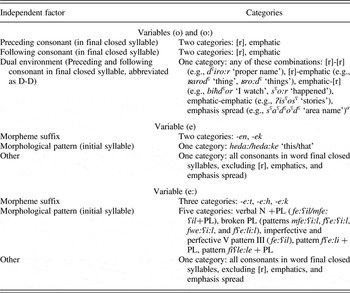
It was established in Habib (Reference Habib2012) that the use of rounding (i.e., [o] and [o:]) and ’imala (i.e., [e] and [e:]) in this village's variety is determined by two phonological rules and some morphological and lexical conditioning. The very few words that show lexical conditioning are excluded from the quantitative analyses. These words do not exhibit ’imala where similar words do. Rather, they retain the [a] or [a:] for one of the following reasons: (1) they are borrowings from Standard Arabic, (2) the word has a different meaning from a homonym that exhibits ’imala, or (3) the word belongs to a different part of speech in the variety under investigation. Habib (Reference Habib2012) examined the linguistic environment of the 11,207 tokens in which the village's variants [e, e:, o, o:] occur or can occur. She discovered the following. Round vowels occur in word-final closed syllables in the environment of a preceding or following [r] or emphatic sound [tˁ, dˁ, sˁ, zˁ] and words that contain emphatics and show rightward spread of emphasis to the final syllable (Al-Khatib, Reference Al Khatib and Jones2008; Al-Omar, Reference Al-Omar2009; Davis, Reference Davis1995; Habib, Reference Habib2008, Reference Habib and Spencer2010c, Reference Habib2011b, Reference Habib2012; Watson, Reference Watson1999; Zawaydeh, Reference Zawaydeh, Benmamoun, Eid and Haeri1998). The common phonetic feature of [r] and emphatics [tˁ, dˁ, sˁ, zˁ] is the low frequency of the second formant (F2), an acoustic feature of emphasis (Bin-Muqbil, Reference Bin-Muqbil2006; Hoberman, Reference Hoberman and Goldsmith1995; Shahin, Reference Shahin2002; Yeou, Reference Yeou1997) that is also characteristic of [r] not only in Syrian Arabic but also in other varieties of Arabic (e.g., Card, Reference Card1983; Cowell, Reference Cowell1964; Younes, Reference Younes, Eid, Cantarino and Walters1994), and hence the use of +LowF2 and –LowF2 in Rules 1 and 2. On the other hand, the ’imala vowels occur in all other word-final closed syllables, in the initial syllables of certain morphological patterns, and in certain morpheme suffixes even when they are suffixed to a word that ends with [r] or an emphatic. Hence, rounding (i.e., [o] and [o:]) and ’imala (i.e., [e] and [e:]) can be accounted for mainly by two phonological rules (Rules 1 and 2) and some morphological conditioning (Table 4).
 $${\rm Rule}\, 1.\, \lsqb +\, {\rm back}\, \comma \; +\, {\rm low}\rsqb \to \lsqb +\, {\rm round}\, \comma \; - {\rm low}\rsqb /\left\{{\matrix{ {{\rm C}\_{{\rm C}_{ + {\rm LowF}2}}\# } \cr {{{\rm C}_{ + {\rm LowF}2}\_}{{\rm C}}\# } \cr } } \right\}$$
 $${\rm Rule}\, 2.\, \lsqb +\, {\rm back}\comma \; +\, {\rm low}\rsqb \to \lsqb - {\rm back}\comma \; - {\rm low}\rsqb /{{\rm C}_{ - {\rm LowF}2}}\_{{\rm C}_{ - {\rm LowF}2}}\#$$
Coding of the linguistic factors for the round and ’imala vowels

aThe nonitalized [ˁ] indicates the real emphatic, and the italized [ˁ] indicates the sounds to which emphasis has spread and caused rounding in the word-final syllable.
Rule (1) states that short and long round vowels occur in the environment of [r] or the emphatic sounds [tˁ, dˁ, sˁ, zˁ] in word-final closed syllables. Rule (2) states that short and long front mid vowels occur in the environment of other consonants in word-final closed syllables.
As to the morphological conditioning of the long and short ’imala—[e:] and [e] respectively—the short ’imala vowel [e] occurs in the suffixes -en (indefinite accusative case marker, also considered an adverbial marker, e.g., tˁabʕ-en ‘of course’) and -ek (second-person singular masculine possessive pronoun, e.g., waqt-ek ‘your (M) time’) even when a word ends with an [r] or the emphatic sounds [tˁ, dˁ, sˁ, zˁ] and in the initial syllable of the demonstrative pronouns heda:/heda:ke ‘this/that’. The long ’imala vowel [e:] occurs in the suffixes -e:t (feminine plural marker, e.g., ward-e:t ‘flowers’), -e:h (third-person singular masculine object pronoun, e.g., war-e:h ‘after/behind him’), and -e:k (second-person singular masculine object pronoun, e.g., war-e:k ‘after/behind you’) even when a word ends with an [r] or the emphatic sounds [tˁ, dˁ, sˁ, zˁ], and in the initial syllable of the following morphological patterns: verbal nouns (patterns fe:ʕil and mfe:ʕil, e.g., se:miʕ ‘he has heard/is hearing’ and mse:miħ ‘he has forgiven/is forgiving’, respectively), pattern fʕe:li (e.g., χze:ni ‘cupboard’), and pattern fiʕle:le (e.g., tiħte:ne ‘lower/from the lower’) (Behnstedt, Reference Behnstedt1997:108–109, 118–119, Maps 54 and 59), and the plural of all these patterns; other broken plurals (patterns mfe:ʕi:l, fʕe:ʕi:l, fʕe:li:l, and fwe:ʕi:l, e.g., mfe:ti:ħ ‘keys’, ske:ki:n ‘knives’, kre:ti:n ‘boxes’, and χwe:ri:f ‘sheep (PL)’ respectively); and the perfective and imperfective of the verb patterns III (fe:ʕil and yfe:ʕil respectively, e.g., ze:ʕil ‘he got upset with, defriended’ and yze:ʕil ‘he gets upset with/defriends’, respectively) (Habib, Reference Habib2012:63–65) and VI (Behnstedt, Reference Behnstedt1997:122–125, Maps 61 and 62) (tfe:ʕil and ytfe:ʕil respectively, e.g., tze:ʕil ‘he got upset with, defriended’ and ytze:ʕil ‘he gets upset with/defriends’ respectively) (see Habib, Reference Habib2012, for details).
Based on linguistic environments of the round and ’imala vowels, the linguistic factors are coded as shown in Table 4. All tests were carried out in the Statistical Package for the Social Sciences 20 (SPSS 20).Footnote 2
RESULTS
Correlation among rural vowels
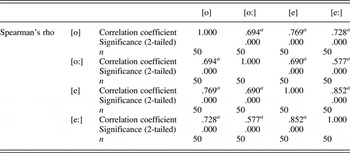
To discover if participants use a specific rural form or as many rural forms as possible to sound rural, a chi-squared bivariate correlation test was performed among the rural forms. This procedure shows significant positive correlation among the four rural vowel variants [o], [o:], [e], and [e:]. For all of the variants, p = .000 and R is higher than .5, and in most cases it approaches 1 (Table 5). This positive correlation indicates that those who use any of the rural vowels in their speech tend to use the other rural vowels as well, to sound as rural as possible.
Correlations among the rural vowels

aCorrelation is significant at the .01 level (2-tailed).
Distributions of variants according to social factors
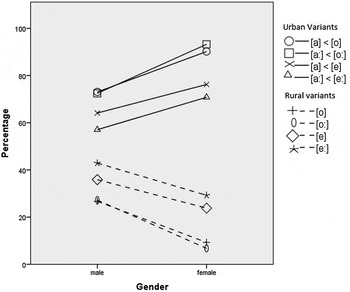
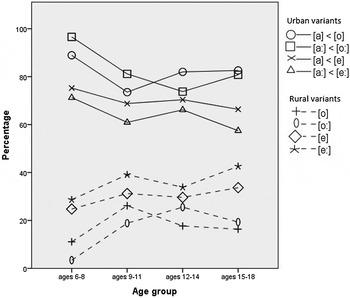
Figures 2 and 3 show the distribution of variants according to gender and age group, respectively. The symbol (<) indicates to which rural vowels the urban vowels [a] and [a:] correspond. Figure 2 shows that both males and females use the urban vowels more than the rural forms. In general, females use more urban forms than males do.
Distribution of vowel variants according to gender.

Distribution of vowel variants according to age group.

Figure 3 shows that the youngest age group (6 to 8 years) shows the highest use of urban forms and the least use of rural forms, particularly of [o] and [o:], which have a very restrictive linguistic environment. The use of rural forms increases in the older age groups, but also shows ups and downs. The second age group shows the most use of the vowel [o] among all age groups. This age group also shows a tremendous increase in the use of [o:]. The third age group shows the highest use of [o:]. The use of [o:] drops slightly in the oldest age group (15 to 18 years), but it is maintained at about the same level as the 9 to 11 years age group. Thus, regarding the round vowels, particularly [o:], age shows a curvilinear pattern instead of a monotonic change (Labov, Reference Labov2010 [2001]:31–33). The two age groups in the middle show more use of [o:] than the youngest and the oldest age groups do. This could be an indication of a change in progress toward the use of the rural form [o:] and to a certain extent [o]. Regarding [e] and [e:], there is fluctuation throughout the age groups. The second and oldest age groups show slightly higher use of these two vowels than do the other two age groups, the youngest and the third age group (12 to 14 years). In general, the pattern of distribution of the front mid vowels among the four age groups indicates an age-grading effect (Kerswill & Williams, Reference Kerswill and Williams2000; Labov, Reference Labov2001:46). It is not a monotonic change in one particular direction. This change across the age groups requires explanation. What influences this age-related change, and why is it more apparent in the preadolescent age group 9 to 11 particularly in relation to some vowels (i.e., round vowels) more than others (i.e., front mid vowels)?
Binary logistic regression tests: Main effects of gender and age and their interaction
Table 6 summarizes the results of four separate binary logistic regression tests examining the main effects of gender and age on the use of each of the variables (o), (o:), (e), and (e:). While gender has a significant effect on all four variables, age shows significance only regarding the variable (o:). According to the coefficients (B) and their exponentials (Exp(B)), malesFootnote 3 are more likely than females are to use the rural vowels [o], [o:], [e], and [e:] ([o]: p = .000; B = 1.234; Exp(B) = 3.434; [o:]: p = .000; B = 1.761; Exp(B) = 5.815); [e]: p = .007; B = .619; Exp(B) = 1.858); and [e:]: p = .005; B = .686; Exp(B) = 1.985). The youngest age group is less likely to use the round vowel [o:] (p = .017; B = –1.789; Exp(B) = .167).
Main effects of gender and age on the use of the variables (o), (o:), (e), and (e:)

Note: The p values are significant at the .05 level.
a Male is the reference category in all tests.
bAge group 6 to 8 years is the reference category.
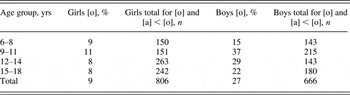
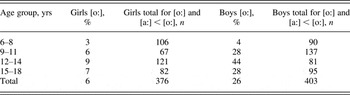
The results of the regression tests indicate mainly gendered linguistic behavior in addition to some age difference and raise an important question regarding whether boys and girls follow different patterns in their use of the rural forms in the different age groups. To address this, gender and age are cross-tabulated for each rural vowel, and its urban vowel counterpart, in Tables 7 to 10. Tables 7 and 8 show that, generally, boys use more round vowels than do girls (18% more for [o] and 20% more for [o:]) and in all age groups. In the first age group, 6 to 8 years, both boys and girls start with lower percentages of round vowels with boys slightly leading. In subsequent age groups, girls' pattern of use can be described as mainly retaining a very low percentage of the round vowels and almost categorical use of urban forms throughout the older age groups. In contrast, boys show a drastic increase in the use of [o] and [o:] in the 9 to 11 age group. Although this use declines slightly in the next two age groups for [o] and in the 15 to 18 age group for [o:], it is clear that their use of the urban forms generally declines with age. The boys' drastic change in the 9 to 11 age group may be indicative of some kind of social awareness that is escalating in this stage of the boys' life, as we do not see a similar change in the girls' linguistic behavior.
Gender and age group differences in the rate of rural [o] vs. urban [a] < [o]

Gender and age group differences in the rate of the rural [o:] vs. urban [a:] < [o:]

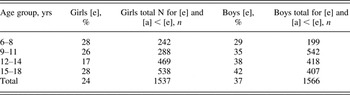
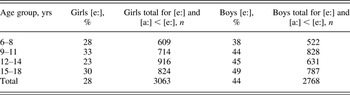
The situation is not much different regarding the front mid vowels, [e] and [e:], except that boys and girls show slightly higher use of them than of the round vowels. Tables 9 and 10 show that boys and girls start in the 6 to 8 age group with higher percentages of the front mid vowels than of the round vowels (Tables 7 and 8) with boys slightly leading. They show that, in general, boys use [e] and [e:] more than girls do (13% more for [e] and 16% more for [e:]) and in all age groups. Girls show no increase in use with age regarding [e] and slight increase in the 9 to 11 and 15 to 18 age groups regarding [e:]. They drop their use of [e] and [e:] in the 12 to 14 age group. However, girls generally show a pattern of retention of similar percentages of [e] and [e:] throughout the older age groups. In contrast, boys increase their use of [e] and [e:] in the 9 to 11 age group and continue to increase their use of these vowels with age. This further indicates that there is something about this age group specifically among boys that makes them increase their use of the rural variants. There must also be something special about these vowels, which makes boys and girls use them more than the round vowels.
Gender and age group differences in the rate of the rural [e] vs. urban [a] < [e]

Gender and age group differences in the rate of the rural [e:] vs. urban [a:] < [e:]

These cross-tabulations are complemented with a two-way interaction regression test in Table 11, which shows significant interaction between age and gender only regarding the use of round vowels. The coefficients (B) and exponentials (Exp(B)) for the interactions that show significance are reported here to clarify the results. Only the reference category male shows interaction with certain age groups and only regarding the round vowels. Regarding the use of [o], there are interactions between males and age group 2 (9 to 11 years) (p = .001; B = 1.864; Exp(B) = 6.448) and age group 3 (12 to 14 years) (p = .034; B = 1.354; Exp(B) = 3.875). The same interactions are found regarding the use of [o:] as well as with age group 4 (15 to 18 years) (with age group 2: p = .045; B = 1.581; Exp(B) = 4.862; with age group 3: p = .004; B = 2.316; Exp(B) = 10.133; and with age group 4: p = .048; B = 1.615; Exp(B) = 5.029). No interactions are found between females and the different age groups or regarding the use of [e] and [e:]. These findings correlate with the cross-tabulations (Tables 7 to 10) where males show more drastic increase in their use of the round vowels than in their use of the front mid vowels in the 9 to 11 and 12 to 14 age groups.
Interaction between gender and age

Note: The p values are significant at the .05 level.
Frequency of occurrence of rural vowels in the various linguistic environments
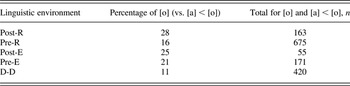
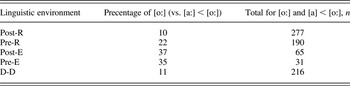
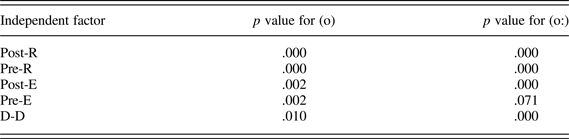
To observe which environment is the most inducing of rounding or ’imala, the occurrences and percentages of each variant in each coded linguistic environment are calculated. Tables 12 and 13 display the linguistic environments of rounding: Post-R(hotic), Pre-R(hotic), Post-E(mphatic), Pre-E(mphatic), and dual environment (D-DFootnote 4). The dual environment or the two inducing environments (i.e., environments favorable to the variants [o] and [o:]) could be a preceding and following [r], a preceding and following emphatic, or an [r] and an emphatic in a preceding and following position.Footnote 5 [o] occurs more frequently in the order of environments shown in (3) and [o:] as shown in (4), based on Tables 12 and 13, respectively.
(3) Post-R >> Post-E >> Pre-E >> Pre-R >> DoD
(4) Post-E >> Pre-E >> Pre-R >> Do:D >> Post-R
Rate of [o] (vs. [a]<[o]) in the environment of [r] and emphatics

Rate of [o:] (vs. [a:] < [o:]) in the environment of [r] and emphatics

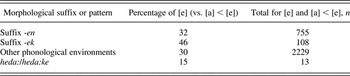
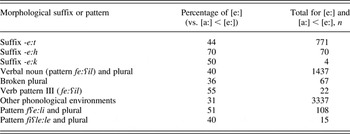
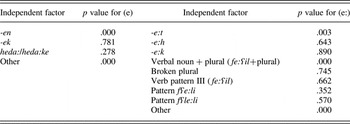
Table 14 shows that [e] occurs in the following decreasing frequency order: the category “other,” the suffix -en, the suffix -ek, and the category “heda:/heda:ke.” Table 15 shows that [e:] occurs in the following decreasing frequency order: the category “other”; verbal nouns (pattern fe:ʕil/mfe:ʕil) and the plural of them, the suffix -e:t; pattern fʕe:li and the plural of it; the suffix -e:h; broken plurals; the perfective and imperfective of the verb pattern III (fe:ʕil); pattern fiʕle:le and the plural of it; and the suffix -e:k.
Rate of [e] (vs. [a] < [e]) in specific morphological suffixes and patterns

Rate of [e:] (vs. [a:] < [e:]) in specific morphological suffixes and patterns

Binary logistic regression tests: Main effects of linguistic environments
The linguistic environments in Table 16 seem to play a major role in the use of the round vowels: all linguistic environments show significant effects with the exception of Pre-E, the use of [o:] before emphatics. This means that the round vowels are used to almost the same extent in all the inducing phonological environments and that the phonological rules of round vowels are acquired and used by at least some speakers. In other words, the significance indicates that children have acquired the rules of the round vowels. This is also clear from not using round and front mid vowels in each other's environment.
Main effects of linguistic environments on the use of the round vowels
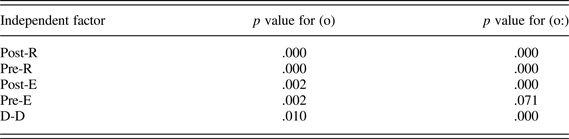
Note: The p values are significant at the .05 level.
Table 17 shows that the categories “other” and the indefinite accusative marker suffix -en are significant regarding the use of [e]. “Other” in Table 17 refers to all the phonological environments in which the front mid vowels occur. It is not surprising that they are significant as the number of occurrences of [e] in these categories is the largest. The suffix -ek and the demonstrative pronouns heda:/heda:ke show no significant role. This could be due to their limited number of occurrences. The feminine plural suffix -e:t, the verbal noun category, and the “other” category play significant roles in the use of [e:]. The quantitative results in Tables 16 and 17 are consistent with the manually calculated rankings in which the round and front mid vowels occur.
Main effects of the phonological and morphological linguistic environments on the use of the front mid vowels

Note: The p values are significant at the .05 level.
DISCUSSION
Generally, the quantitative analyses have shown the following, which answers the first research question about the patterns of use of the four variables (o), (o:), (e), and (e:). The youngest age group shows the lowest use of the rural vowels (Figure 3, Tables 7 to 10). There is a greater use of rural forms by the older age groups, particularly among boys. This situation indicates that children initially acquire their mothers' urban forms and that rural forms are acquired later in life. In other words, there is a reversal in the acquisition of rural and urban forms. Boys use more rural vowels than girls do, particularly round vowels (Figure 2, Tables 7 to 10). Most of the linguistic environments favoring round vowels emerge as significant as well as those in which [e] and [e:] occur most frequently (Tables 16 and 17). While exposure and input play a role in the acquisition of the rural vowels, the observed gendered linguistic behavior alludes to certain social awareness (cf. Barbu, Nardy, Chevrot, & Juhel, Reference Barbu, Nardy, Chevrot and Juhel2013; Smith, Durham, & Richards, Reference Smith, Durham and Richards2013). Both genders are exposed to urban and rural forms from an early age, but they show different patterns of usage. Because exposure and input are not the major factors in the observed gender differences, it is essential to seek further explanation of the results relying on ethnographic information and knowledge of linguistic, dialectal, social, and cultural aspects of the locale that encourage gender and linguistic differences. Numerous questions were asked to elicit the attitudes, ideologies, and thoughts that children and adults have toward the use of urban and rural forms.Footnote 6 This information will show that social psychological factors such as local identity, masculinity, and femininity, as well as norms of appropriate linguistic behavior and culturally ascribed gender roles, are essential in explaining the observed linguistic differences.
First, the restrictiveness of the linguistic environment of Rule 1 makes the round vowels a more distinctive feature of the village's variety. Another reason they are distinctive features of Oyoun Al-Wadi is that they are not common to many areas in Syria (Cantineau, Reference Cantineau1951:78ff.), while [e] and [e:] are used in many other villages and areas in Syria (Behnstedt, Reference Behnstedt1997; Cowell, Reference Cowell1964; Versteegh, Reference Versteegh1997). This may be the reason why [e] and [e:] are acquired more than [o] and [o:] are from an early age by both boys and girls, and why girls show higher use of them than of [o] and [o:] (Tables 7 to 10), although all these vowels are rural. One would expect that all rural vowels would be used to the same extent or that round vowels would be used more because their conditioning environments are not as complex or as numerous as the conditioning environments of the front mid vowels (Table 4, Rules 1 and 2). Front mid vowels have lexical and morphological conditioning environments in addition to the numerous phonological conditioning environments. Based on Chambers' (Reference Chambers1992) principle three, “simple phonological rules progress faster than complex ones,” children should learn the round vowels first as they occur in specific phonological environments. In Payne (Reference Payne and Labov1980), children had a hard time acquiring the Philadelphia short-a rule because of its complexity. In contrast, the degree of acquisition or use of the round and ’imala vowels is not based on the complexity of the rules, but on the distinctiveness of certain features of the village, which indicate membership in this specific village. Because the ’imala vowels are not limited to Oyoun Al-Wadi, their use is expected to be more frequent than that of round vowels in general even among some out-of-town mothers. Their higher frequency leads to higher acquisition of them in general (Bybee, Reference Bybee2001; Tomasello, Reference Tomasello2003). This is also why their acquisition seems to start earlier than the acquisition of round vowels as is apparent in their more frequent use by the youngest age group (Tables 7 to 10). The distinctiveness of the round vowels to this village and the higher frequency of the ’imala vowels also explain the age-grading pattern of the ’imala vowels and the curvilinear pattern of the round vowels (Figure 3). These different patterns of acquisition of the rural vowels are indicative of accelerated awareness of the social meanings of these vowels (particularly of the round vowels) among boys in the preadolescent 9 to 11 age group (Tables 7 and 8). The distinctiveness of [o] and [o:] of the village's variety makes them also distinctive of the village's identity to which boys are highly loyal (Habib, Reference Habib2011a). In the case of the ’imala vowels, boys also accelerate their use in the age group 9 to 11 years compared to the slight increase or maintenance of similar usage that girls exhibit throughout their preadolescence and adolescence (Tables 9 and 10). Boys seem to accelerate their use of these vowels at the same age that they accelerate their use of the round vowels, presumably to further stress their local identity.
Furthermore, the round vowels are associated with masculine characteristics such as roughness and toughness Excerpt (1), which boys like to project vigorously in public. Thus, the reversal in the acquisition of rural and urban forms is not only influenced by local identity but also by masculine attributes. To the boys of this village, masculinity is inherited from generation to generation through acts and narratives of power, strength, and prowess. Masculinity and membership in the male group of the village is a daily act and is often manifested in the demeanor of males in the village and in their reversion to the village's traditional linguistic forms (Habib, Reference Habib2011a). This is not surprising, as the influence of narratives on the gender development of boys and girls has been emphasized (Kanitkar, Reference Kanitkar, Cornwall and Lindisfarne1994).
Excerpt (1) by a 49-year-old father shows that the rural vowels are highly indicative of a rural identity and are associated with roughness, particularly the round vowels, and that a person who uses them will sound rough in an environment outside the village. Hence, avoiding the use of rural forms will project a speaker as more refined, soft, and gentle, characteristics that are expected of girls in the village (cf. Eckert, Reference Eckert1990). The association of rural vowels with rural identity and roughness explains why boys adopt these vowels later in life much more so than girls do. Apparently, their awareness of the social meanings of the rural vowels increases after the age of 8 and after they have heard more stories about the bravery and toughness of the males in the village. The appeal, softness, and refinement that are associated with the urban forms explain the lower use of the rural vowels, particularly the round vowels, by girls. This highlights the children's understanding of the appropriate linguistic norms to their gender.
Excerpt (1) Footnote 7Munther: … maybe our dialect is slightly rough …. In a specific environment … a general complete environment away from the village … one may change some words. For example, he should not [ydˤəmm] ‘he rounds’ a lot … . Instead of saying [ʔaħmor] ‘red’, … say [ʔaħmar], for example … . That is, maybe, now, in the city, we encounter these things. Sometimes we feel that a word … that may not be understood much in our language … you can give it a form, or, for example, if it should be [maftu:ħa] ‘with an [a] instead of an [o] or [e]’, we should not [ndˤəmm] ‘round’ the mi:m ‘the sound [m]’, for example, in [ʔaħmor]. That is, for example, we should not say [be:b] ‘door’ … they say [be:b] …
Other comments by children and parents provide similar support regarding boys' and girls' use of rural vowels. Jabour, a 10-year-old boy, tells the author that he uses the village's variety because he wants to be “a man like [his] father.” His eldest 15-year-old sister, his neighbor who is the mother of one of his female classmates, and his teacher reported the same thing about him. He also mentioned in front of his neighbor and the author that he uses the village's variety because “this is our language” as opposed to using any other variety. Similarly, Rami, an 11-year-old boy, indicates in Excerpt (2) why he changed his speech toward the rural forms and why he sounds different from his mother and siblings, and he indicates during the same conversation that rural forms make him feel “more masculine.”
Excerpt (2) Rami: I do not— I do not know. I like the village's talk more …
Furthermore, in Excerpt (3), a 45-year-old local mother who lived most of her life in urban centers complains about her two teenage sons who started using the rural vowels after moving from the city of Hims to the village. When they moved, one of them was in the first grade and the other one was in the third grade. She indicates in the excerpt the grades (i.e., around 8 to 9 years of age) at which one of her boys started changing from urban to rural forms. Now when she corrects their use of the rural vowels in certain words, they reject her correction, refuse reusing the urban forms, and respond to her comments in a sarcastic way. Her husband also complained about his sons' extreme use of rural vowels. She and her husband do not want their sons to talk in a very rural manner because they will be subject to ridicule if they go to the city. However, the boys are adamant in their use of the rural forms even after they attended high school in the neighboring village, Mashta Al-Helou, and mixed with students from different backgrounds who do not necessarily use Oyoun Al-Wadi's forms. This adamancy strongly pertains to their strong sense of belonging to their village and to their masculine and vigorous attitude. They describe boys who use similar forms to those used in Mashta Al-Helou as “soft,” “urban” or “from the city,” “Mishtawe” ‘a person from Mashta Al-Helou’, or “tant” ‘lit. aunt, but it is used to mean gay’ because they consider themselves stronger than boys in that village.
Excerpt (3) Rose: … For example, the other day, “Mom, by God, we stood on [lmqe:ʕid] ‘the desks’” …
…
Rose: … I told him [maqa:ʕid] ‘desks’. He said, “Mom, we should say [maqa:ʕid]?” I told him this is the pronunciation. It is not because, for example, it is a word from the village or because this is from the city or because this is [naħawe] ‘lit. grammatical, but it is used to refer to urban pronunciation’ or other reason, but because it is the more correct word. We should not say [mqe:ʕid]. [maqa:ʕid], not because I, for example, I like to speak [naħawe] or speak Homsi ‘Himsi’ or Shami ‘Damascene’, but the pronunciation… . Now wherever you go and you tell them [mqe:ʕid], they are going to laugh at you. He said, “No, Mom, we do not like to speak different from this.” That is, it could be the influence of the environment they live in. It [environment] is what made him [change]. They-my children, did not use to talk like this … now sometimes they come and say [ʔaħmor] ‘red’, [ʔaχdˤor] ‘green’. I tell them, my children, for God's sake … it does not mean I do not know how to say [ʔaħmor]. That is, I say [ʔaħmar], [ʔaχdˤar], [ʔasˤfar] ‘yellow’, and so on … . They say, “Mom, [ʔaħmar]?” …
The girls, on the other hand, seem to make a contrasting conscious linguistic choice, and that is maintaining very high usage of the more refined, gentler urban forms and lower use of the rural forms. In this way, girls participate as much as boys do in the linguistic differentiation process between the two genders. Excerpt (4) by a 13-year-old girl shows that this girl, although capable of switching occasionally to the ’imala vowels with her friends, is not willing to use the village's variety. For her, speaking “normally” means using urban forms rather than rural forms.
Excerpt (4) Roma: … I mean, I like it, the Oyouni dialect, but I do not think I will speak it. I mean— I mean, I will speak normally. Sometimes … I intentionally break my speech (i.e., use ’imala), that is, in front of my friends, I break my speech a little.
…
Roma: … but sometimes spontaneous words come out from me not broken (i.e., without ’imala) like here in Oyoun.
Similarly, Ola, a 15-year-old girl, in Excerpt (5) strongly rejects using the village's variety and indicates preference to use the urban vowels.
Excerpt (5) Ola: … my dialect is not at all like that of people from Oyoun….
Rania: … ok, why did you choose … like now Mona and Jabour are saying that you talk Himsi? How did this happen with you?
Ola: I do not know. I do not like the speech of the people of the village. I hate it a lot.
R: Yes. I mean, what do you feel with it? …
Ola: Old fashion.
These comments among others suggest that children intentionally choose their speech code, insinuating a conscious choice to sound local or not. Boys choose to use the rural forms because they want to sound like the locale, that is, rural as opposed to urban, and different from girls, that is, masculine. Girls choose to maintain the urban forms. They are not as passionate about sounding local. These conflicting attitudes are reflected in their linguistic behavior.
Moreover, the disparity between males and females regarding the use of the rural vowels could be attributed to other social and cultural views regarding gender roles in addition to the projection of masculinity and local identity. In general, in Syrian culture, males are the carriers of the family name and are expected to stay closer to the parents. They are required more so than girls are to take their parents in and take care of them in their old age. This is not surprising in a culture like the one in Oyoun Al-Wadi in which most of the inheritance, if not all (including money and properties), goes to the sons, not the daughters. Although the law allows women to get a share of their parents' inheritance, it would be shameful and demeaning in this village if the girl asked for her right of inheritance. In general, girls are expected to get married and be uprooted from their families. Men can live with their wives with their parents after marriage, but this is unheard of regarding girls. The separation of the girl from her family after marriage is more acceptable as she is not expected or required to support or take care of her parents when they grow old. Girls are expected to have more responsibilities to their husbands' families than to their own families. Thus, there is the sense that girls will leave the local community one day and will become attached to their husbands' communities more than to their birthplace. It is common to hear people say, “one day she will get married and leave.” One may also anticipate that the family may not see the girl in a long time, a year or more based on where her husband is from. These cultural aspects of the community under investigation may have consequences on the linguistic behavior of girls and boys in the village as well as the ideology affecting this linguistic behavior. The stronger connection to the locale that is expected of boys (Bucholtz, Reference Bucholtz1999; Kiesling, Reference Kiesling1998, Reference Kiesling2008; Lorber, Reference Lorber and Matson2012; Shire, Reference Shire, Cornwall and Lindisfarne1994) and their need for membership not only in the local group but also in the guys' group (Matson, Reference Matson2012:XI) enforce the need for sounding more local, and thus using the more distinctive features of the village.
CONCLUSIONS
This study deals with vowel variation in the speech of nonmigrant rural kids who are exposed to and are in contact with urban features through various sources. Among these sources are their out-of-town mothers, relatives, and friends who live in urban centers or who use urban forms, and television shows and serials that are broadcasted with urban forms, mainly Damascene Arabic. This observed vowel variation is the result of the acquisition of two different sets of rules. Initially, kids exhibit non-local caregiver's effects, that is, they acquire their mothers' urban forms. Subsequently, they acquire the vowel markers of their home village and the rules associated with them as they become more exposed to them and more aware of their importance to their local identity. Thus, there is a kind of reversal in the acquisition of rural and urban forms, which leads to the observed inter- and intraspeaker variations. In answering the second research question, the study highlights the role of social psychological factors in the reversal of the acquisition of urban and rural forms. What makes children change their speech from their nonlocal caregiver's forms toward the rural forms is not that they hear their peers speak differently. Most of their peers are like them; they are initially influenced by their mothers' speech. It is more than linguistic peer influence; peer influence is manifested in the acquisition and sharing of knowledge of the prevalent ideology that is built on historical events and stories; on their understanding of the social meanings of the various variants; on their awareness of the importance of certain variants to project a certain identity; on their understanding of gender-appropriate norms, that is, what a male and a female should sound like (Kiesling, Reference Kiesling1998, Reference Kiesling2008; Lorber, Reference Lorber and Matson2012; Shire, Reference Shire, Cornwall and Lindisfarne1994) and what a person from Oyoun Al-Wadi should sound like; and on parents', peers', and general comments in the community regarding sounding this way or the other.
In answering the fourth research question, the study offers a number of contributions to the fields of child dialect acquisition and linguistic variation, in that children do not stop acquiring certain dialectal features after the age of 8 (Payne, Reference Payne and Labov1980) and do not necessarily acquire the simple rules faster than complex ones (Chambers, Reference Chambers1992). Rather, higher exposure to [e] and [e:] leads to higher acquisition of them than of [o] and [o:], although the former have more complex conditioning environments. In addition, social psychological factors, such as local identity and masculinity, lead to change in the linguistic patterns of use among children who are older than 8 years. Thus, it is not necessarily the age of exposure to these forms that leads to their acquisition to a greater degree. The increase in the use of rural forms, particularly among boys, in the older age groups is not determined by the critical age of acquisition as much as by the influence of social meanings and ideologies associated with the rural and urban vowels.
Second, preadolescence emerges, in this study, as a more sensitive period than adolescence in which children seem to be very active emotionally in building a social identity (cf. Eckert, Reference Eckert1988:206; Habib, Reference Habib2011a; Kerswill, Reference Kerswill1996:198). This study shows that the use of the local forms increases tremendously in the age group 9 to 11 years, particularly among males, which means that the acquisition of the rules of the local vowels progresses rapidly after the age of 8. Furthermore, the linguistic behavior of boys and girls in this age group grows apart, particularly in the case of the round vowels, which indicates higher awareness of the societal gender differences, the gendered social meanings of the variants, and the importance of distinguishing their speech from each other. While the males' drastic increase of the rural forms in the age group 9 to 11years may indicate higher active involvement in building a social identity than females, females cannot be excluded from this distinguishing process and cannot be considered as less involved. In other words, this linguistic differentiation is sought by both males and females. The slight increase or maintenance of lower use of the rural forms exhibited by females is a way of conforming to the general expectations of females in the community and asserting their feminine and soft identity as opposed to the males' assertion of their masculine identity.
Third, this study challenges Chambers' (Reference Chambers2002) view that non-local women's features are blocked by children. In this study, although the father is from the locale, most of the mothers are from outside the village. The mothers could be considered in a sense migrants to the village. The challenge to Chambers' (Reference Chambers2002) view lies in the fact that children who are born to these out-of-town mothers do not block their parents' nonlocal features, and at the same time, do not exclusively acquire the local dialect. In this study, features that entered the community either through out-of-town mothers or through other external influences are not lost in the locally born children (cf. Sankoff, Reference Sankoff, Chambers, Trudgill and Schilling-Estes2002). Rather, children initially show use of those external forms, and later on, they acquire the local features after they start realizing their importance to their local identity. In addition, the initial effect of nonlocal parents is recorded in later stages of the children's life/development in this study in contrast to previous studies (Labov, Reference Labov, Meyerhoff and Nagy2008). That is, this initial effect is maintained in the children of this study, while it is eliminated in previous studies. What is more challenging in this study is the internal struggle that is observed in the younger generation between retaining the nonlocal features of their caregivers and adopting the local features. This struggle accords with Sharma and Sankaran's (Reference Sharma and Sankaran2011) findings regarding competing social pressures that lead to the acquisition of two independent dialect systems.
Regarding the third research question and the directionality of change and the sociolinguistic situation in the village, it is worth referring to Haeri's (Reference Haeri, Guy, Feagin, Schiffrin and Baugh1996:102) generalization that “fronting has the iconic value ‘female,’ while backing has the iconic value ‘male.’” In this study, the males' higher use of the round vowels than females' use accords with Haeri's generalization. However, boys also show higher use of the front mid vowels than girls do. Thus, in this study, the use of the back round and front mid vowels is not mainly related to whether the speaker is male or female. Rather, it is related to the identity and meaning of these vowels. Both the round and front mid vowels are rural variables that are adopted more often by boys to project a local and masculine identity. The curvilinear pattern of the round vowels (Figure 3) and the higher use of these vowels by males (Tables 8 and 9) indicate a change in progress led by young males in the preadolescent age group 9 to 11 years. The age-grading pattern of the front mid vowels (Figure 3) indicates that the use of these vowels is mainly associated with acquisition. However, in the cross-tabulations (Tables 10 and 11), males show higher use of these variants than girls do, major increase in the age group 9 to 11 years, and constant increase with age. This pattern exhibited by boys can be described as a monotonic change that is progressing toward higher use of [e] and [e:] with age, and this change is also led by the male age group 9 to 11 years. Both changes can be considered as changes from above the level of consciousness (Labov, Reference Labov1972) because of the apparent conscious choices that boys make in using these vowels (Excerpts (2) and (3)).
Besides these observations, there is a broader observation regarding linguistic change in Oyoun Al-Wadi that includes two antagonistic folds. First, there is a general widespread of the use of urban forms, which is expected based on the increased mixing and contact situation between urban and rural areas and people; the general cultural and demographic changes that are sweeping this rural region in Syria; the positive evaluation of urban forms; and the universal expectations that widely spread urban forms usually prevail over local and less common forms. The first fold could be considered the first change that has been affecting the village's variety. Second, there is an ongoing trend toward adopting the rural forms at later stages of the children's linguistic development, which is unexpected due to the abovementioned reasons that promote linguistic urbanization; the importance of the use of urban forms for future college education and mobility purposes; and the awareness among the population of the village that sounding urban is more refined and acceptable especially for females (Habib, Reference Habib2011a). The second fold could be considered the second change or reversal of the first change that has been affecting the village. The emergence of the second fold can be interpreted as a struggle against the first fold, in other words, the encroachment of urbanization, and thus protection of one's local identity. The presence of these two concurrent changes: urbanization and deurbanization (i.e., reversion to rural forms) makes it hard to predict which form will prevail in the community.
APPENDIX
Social distribution of individual speakers