


From the former Canal Zone in Panama to Ramstein Air Base in Germany, a U.S. military presence has long been a reality for people throughout the world. The United States has maintained overseas deployments of hundreds of thousands of military personnel during the postwar period. Unprecedented in their breadth and activism, these deployments became central to the U.S. policy of deterrence and to the maintenance of the liberal international order. Despite their importance, there is much to learn about the consequences of U.S. military deployments, particularly regarding their effects on host country’s populations.
This study examines how social and economic interactions with U.S. military personnel affect individuals’ views of the U.S. military presence, the U.S. population, and the U.S. government. We evaluate the effects of the U.S. military presence on individuals’ attitudes through two main channels: (1) social capital and (2) economic interests. First, we argue that individuals’ attitudes toward the U.S. military may improve through interactions with U.S. military personnel, thereby increasing U.S. soft power. Second, we argue that the flow of economic resources into the host state that accompany U.S. military deployments has a positive effect on attitudes. In both cases, we explore the effect of direct contact and the direct receipt of economic benefits, as well as the indirect effects of these factors as transmitted through social networks.
This study builds on previous research by exploring the microfoundations of hierarchical relations between states (Lake Reference Lake2013). It focuses on the determinants of public attitudes toward the United States, which can influence policy outcomes. Research suggests that one of the primary challenges to maintaining long-term overseas deployments is widespread public opposition among host country citizens to the presence of the U.S. military (Calder Reference Calder2007; Cooley Reference Cooley2008; Holmes Reference Holmes2014; Vine Reference Vine2015). These studies moved the field forward in important ways, but we still require a better understanding of the determinants of individual-level opinion formation on these topics. Using original data from a survey of 14 host countries, we explore how exposure to, and interactions with, U.S. military personnel affect individuals’ attitudes toward the U.S. military’s presence in a country. This study sheds new light on the correlates of cross-national attitudes toward the U.S. military. Focusing on noncombat settings, we show that U.S. personnel act as agents of public diplomacy, improving public attitudes and building U.S. soft power through the development of social capital and economic activity. Our argument stands in contrast to others regarding the relationship between the size of a U.S. military deployment and its effects on attitudes within the host country. Given the importance of public opinion to the maintenance of the United States’ overseas military presence, this study has pivotal implications for one of the central pillars of postwar U.S. foreign policy.
RESEARCH ON MILITARY DEPLOYMENTS
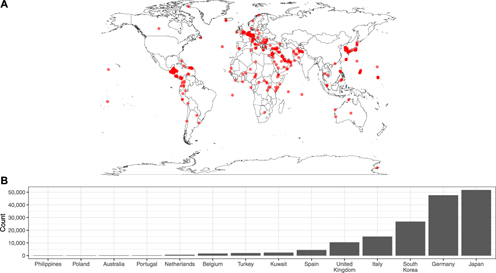
The projection of military power is a fundamental tool of world politics. Contemporary scholarship on international relations focuses on understanding conflict in domestic and international settings (e.g., Bueno de Mesquita et al. Reference Bueno de Mesquita, Smith, Morrow and Siverson2005; Hudson Reference Hudson2005; Putnam Reference Putnam1988). Integral to these processes is the mobilization and deployment of military personnel abroad (Reveron Reference Reveron2010). The most prominent example—the United States—has, for over 70 years, kept approximately 15–30% of its military personnel throughout Western Europe and East Asia, with smaller deployments in dozens of other countries. Figure 1 shows the location of U.S. military facilities around the globe (Panel A) and the size of the deployments in the 14 countries examined in this study (Panel B).
Global Locations of U.S. Military Facilities and 2017 Counts of U.S. Military Personnel in Surveyed Countries.
Note : Panel A shows the locations of U.S. military facilities around the globe. Data originally collected by Vine (Reference Vine2015) and supplemented with independent research. Panel B shows the number of active duty, guard, reserve, and DOD civilian U.S. military personnel deployed to select countries covered in this study as of December 30, 2017. Data obtained from the Defense Manpower Data Center (2019).

Scholars have long debated the effect of such deployments in terms of state-to-state relations (Davis Reference Davis2011; Harkavy Reference Harkavy1989; Ikenberry Reference Ikenberry2004; Lake Reference Lake2009a; Wohlforth Reference Wohlforth1999) and specific political, economic, and social outcomes (Allen, Flynn, and VanDusky-Allen Reference Allen, Flynn and VanDusky-Allen2017; Braithwaite and Kucik Reference Braithwaite and Kucik2017; Bell, Clay, and Martinez Machain Reference Bell, Clay and Martinez Machain2017; Biglaiser and DeRouen Jr Reference Biglaiser and DeRouen2009; Heo and Ye Reference Heo and Ye2017; Jones and Kane Reference Jones and Kane2012; Martinez Machain and Morgan Reference Martinez Machain and Morgan2013; Nieman Reference Nieman2016). Related to the concept of hierarchy, some argue that the maintenance of a large overseas presence has been crucial to sustaining the liberal international economic order (Ikenberry Reference Ikenberry2011; Lake Reference Lake2009b). Although informative, existing work has important limits. First, theory often focuses on deployments as representative of more abstract theoretical concepts and tends to focus less on the effects of the deployments themselves on the host environment. Second, although statistical analyses have advanced our understanding on a number of outcomes, they tend to utilize more general cross-national time series frameworks. This approach can pose a difficulty in establishing linkages between the U.S. military and outcomes of interest, like economic growth, anti-U.S. protests, crime, or public opinion, as ecological inference problems often emerge from using highly aggregated data.
Existing studies are also unable to explore questions concerning the formation of individuals’ attitudes toward the U.S. presence within a country. These questions carry great importance—if U.S. military activities diminish public support in the host state, then the United States’ ability to maintain a military presence becomes impaired. For example, domestic activists have long contested the U.S. military presence throughout Asia (Chanlett-Avery and Rinehart Reference Chanlett-Avery and Rinehart2012). Alternatively, U.S. military deployments can create economic interests in support of the U.S. presence (Holmes Reference Holmes2014). In short, military deployments have characteristics that plausibly lead to both positive and negative attitudes among host state residents.
The lack of systematic work on the relationship between U.S. military deployments and mass attitudes also poses challenges for the development of macro-level theories of international order. Lake (Reference Lake2013) argues that the United States has established a series of “contractual” relationships with other states, the sustainability of which relies on public opinion toward the U.S. military presence. In such cases, subordinate states cede authority over foreign policy making to the United States in exchange for the provision of security. Although these theoretical arguments advance our understanding of the international order, they leave the microfoundations of that order unexplored.
The idea of governments ceding foreign policy making authority to the United States in exchange for security guarantees affects domestic political processes. U.S. security guarantees, and any accompanying policy concessions, typically require some level of domestic consent. The potential for public opinion to influence U.S. security cooperation is particularly important, given that democracies rank among the largest hosts of overseas U.S. military personnel. Even in non-democracies, public opinion may limit the degree to which host governments can cooperate with the United States. Where public opposition to a foreign military presence increases, the cost to host state political elites for maintaining these relationships also increases.
THEORETICAL EXPECTATIONS
Our theoretical focus is on how the U.S. military presence in a state shapes attitudes toward U.S. actors. We evaluate the effects of the U.S. military presence through two main channels: (1) social capital and (2) economic interests—both of which increase U.S. soft power. We argue that individuals’ attitudes toward the U.S. military may improve simply through interactions with U.S. military personnel, which allow locals to overcome negative stereotypes of Americans. Second, we argue that the flow of economic resources into the host state that accompany U.S. military deployments will also improve public attitudes. In both cases, we explore the effect of direct contact and the direct receipt of economic benefits, as well as the effects of these factors as transmitted through social networks.
Interactions with U.S. military personnel are distinct from other interactions with U.S. citizens for a few fundamental reasons. U.S. military personnel represent a state security apparatus, which alters the basic character of their interactions as compared with private individuals. Military personnel may be armed, are constrained by two sets of bureaucratic institutions (the United States and the dictates of the Status of Forces Agreement), and are enmeshed in a broader unit, base, and culture. Although these factors may be similar to a diplomatic attachè, military deployments are more numerous, larger in the footprint they require, and represent the state’s capacity for force instead of negotiation. These combined factors make military—civilian interactions unique relative to other U.S.—host-state civilian interactions.
Recent research examines how the military, a traditional hard power tool, can act as a tool of soft power (Atkinson Reference Atkinson2014). Nye (Reference Nye2004, 5–6) defines soft power as obtaining a desired outcome through shaping the preferences of others rather than using coercion or economic payments to obtain concessions. For example, cultural and economic influence can reshape actors’ preferences to become aligned with those of a major power. Though the Unites States primarily deploys military personnel for security, the military also often engages in what Cull (Reference Cull2008, xv) referred to as public diplomacy, “an international actor’s attempt to conduct its foreign policy by engaging with foreign publics.” Public diplomacy is thus a soft power tool that state actors can use to influence the preferences of the public in other states (Goldsmith and Horiuchi Reference Goldsmith and Horiuchi2009; Melissen Reference Melissen and Melissen2005).
The preferences of host state publics matter because they constitute the microfoundations of state preferences. Scholars frame much of the soft power literature around the idea that states become “socialized” to have preferences more aligned with those of the state engaging in soft power projection (Atkinson Reference Atkinson2014; Finnemore Reference Finnemore1996). The preferences of states and policy makers are not determined purely by external actors—many of them originate from the preferences of individuals (Putnam Reference Putnam1988). In the context of postwar U.S. foreign policy, the spread of U.S. culture to individuals within foreign populations played a pivotal role in creating support for the growth and maintenance of liberal political and economic institutions backed by the United States. Traditionally regarded exclusively as an instrument of hard power, the U.S. military has played an important role in these socialization processes, shaping mass attitudes and opinions within host countries through a variety of mechanisms.
Our first argument is that, in a non-combat setting, a U.S. military presence can serve as a tool of public diplomacy, creating more positive perceptions of U.S. actors. Contacts with U.S. personnel can create “social capital” that can invest the local population in the welfare of their U.S. military neighbors. As Putnam (Reference Putnam2001, 42) states, “merely nodding at someone in the hall generates visible, measurable forms of reciprocity.” In host states, American personnel and their dependents can be deeply enmeshed in the local community by marrying into local families, children attending local schools, and establishing local friendships. These types of interactions create both “bridging” and “bonding” opportunities between U.S. personnel and host state citizens (Woolcock and Narayan Reference Woolcock and Narayan2000). Especially in states where an American presence has existed for decades, these repeated personal interactions serve as a tool of public diplomacy by creating a sense of shared identity or experience. These interactions can be a counterweight to the heavily politicized ethno-nationalist identities that Posen (Reference Posen2014, 53) describes, and may mitigate their effects among populations that use them to create the impression that U.S. forces unduly influence the host state.
Individuals interacting with U.S. personnel gain exposure to members of the military as individuals rather than as an abstract concept. One journalist in Lima, Peru, noted that, for many locals, there existed a stereotype of members of the American military as “muscular men with tattoos waving around the flag and yelling about liberty and democracy” (Interview with Peruvian Journalist 2018). These stereotypes are often influenced by media portrayals but are likely to weaken through direct personal or indirect network contact. Interviews that we conducted with civilian and military personnel reinforce this point. A U.S. Government Relations Officer at a U.S. Army base in Germany noted that she offers tours of the base for local council members to dispel myths about Americans. She noted that “[the Germans] all think we are spies and trashy people; they think we don’t sort our trash,” so she includes the base’s recycling facilities in her tours to dispel that myth (Government Relations Officer Interview 2019). A German anti-base activist admitted difficulties with mobilizing support for the cause because local communities have a deep, long-lasting relationship with the U.S. military. He noted that they have common parties, public events, and “friendship meetings,” which enhance the local military–community relationship (Interview with German Peace Activist 2019).
Although we argue that interactions will lead to more positive attitudes, there is a long history of social and economic ills associated with the presence of U.S. military forces, and interactions with members of the U.S. military can in fact be negative. Perceptions of the U.S. presence in Japan, South Korea, and Germany have often become entangled with cases of sexual assault, drug use, and other crimes (Moon Reference Moon1997; Nelson Reference Nelson1987). More recently, the Philippines experienced several high profile crimes by U.S. service members against locals, including a murder in 2002, a rape in 2005, and the crash of a drone in a civilian community (Simbulan Reference Simbulan2009). However, it is not clear that such interactions are the norm—the benign day-to-day interactions between U.S. personnel and host state population are likely far more numerous than these sorts of negative experiences. As Allen and Flynn (Reference Allen and Flynn2013) show that although particularly egregious crimes involving U.S. personnel garner significant public attention, they do not appear to represent typical patterns of interactions between military personnel and host state civilians. We argue that these more frequent interactions should constitute a much stronger determinant of individual attitudes than more isolated incidents.
This logic leads to our first hypothesis:
Hypothesis 1a. Individuals who have had direct contact with a member of the U.S. military will be more likely to express positive views of the American presence/government/people.
We also expect an individual’s interactions with U.S. military personnel will affect the attitudes of other people in that individual’s social network by decreasing the network’s prejudice (Liebkind and McAlister Reference Liebkind and McAlister1999). There is a long line of research that shows an individual’s social network can influence their political opinions (Levine Reference Levine and Zuckerman2005). This happens through the construction of political identities within the family (Jennings, Stoker, and Bowers Reference Jennings, Stoker and Bowers2009) and also within the context of an individual’s chosen social network of friends (Zuckerman Reference Zuckerman2005). Individuals within a social network take cues from others within the group about the value and importance of issues and the likelihood of threats from outside groups.
Individuals use networks as shortcuts to gather information (Huckfeldt Reference Huckfeldt2001). Given that a clear majority of individuals in our survey have not had direct contact with U.S. military personnel, we argue that they will look to social networks to gain information about the U.S. military that will then shape their attitudes toward the U.S. military presence within a host country. Those individuals who do interact with U.S. personnel possess more information regarding the U.S. military presence and thus serve as an important bridge between the U.S. military community and the broader host state communities in which they are embedded. Existing work also finds that contact with more knowledgeable members of the social network helps to avoid ambivalent attitudes (McClurg Reference McClurg2006).
As with direct personal contact, having members of one’s network interact with the U.S. military should also lead to more positive views of Americans (Wright et al. Reference Wright, Aron, McLaughlin-Volpe and Ropp1997). Research on the contact hypothesis finds that having (in-group) friends who interact with out-groups leads to decreased amounts of prejudice and therefore more positive views of out-groups, by creating an environment of tolerance (Liebkind and McAlister Reference Liebkind and McAlister1999; Pettigrew et al. Reference Pettigrew, Christ, Wagner and Stellmacher2007). Network interactions have the added benefit of decreasing prejudice without the associated anxiety that interacting with a member of an out-group would produce, while also being generalizable to the out-group as a whole (as opposed to a single individual) (Paolini et al. Reference Paolini, Hewstone, Cairns and Voci2004; Wright et al. Reference Wright, Aron, McLaughlin-Volpe and Ropp1997). Indirect contact also has the added benefit of being less affected by self-selection—it is easier for individuals to select themselves into or out of contact with the Americans than it is to control their network’s interactions with the U.S. military. We refer to this dynamic as a network contact and derive our second contact-based hypothesis:
Hypothesis 1b. Individuals who have had network contact with a member of the U.S. military will be more likely to express positive views of the American presence/government/people.
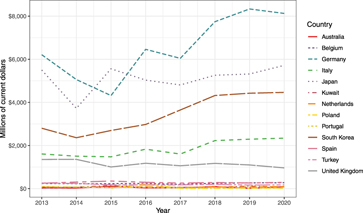
Our second causal channel is that a U.S. presence will affect individuals’ attitudes through the distribution of economic benefits to the population. U.S. military deployments often involve the transfer of substantial economic resources. Figure 2 shows the annual cost of maintaining the U.S. military presence in the countries we examine, with total costs for fiscal year 2020 ranging from $23 million (Poland) to $8.1 billion (Germany). Of these transfers, substantial amounts often flow to local contractors who provide services to help maintain the U.S. presence. Salaries paid to U.S. personnel also often flow into the local economy as U.S. personnel and their families spend money in local businesses.
Annual Costs of Maintaining U.S. Military Presence in Select Countries, 2013–20.
Note : Millions of current U.S. dollars. Fiscal years 2019 and 2020 use budget estimates. Department of Defense records exclude information on the Philippines. Data obtained from the Office of the Under Secretary of Defense (Comptroller)/Chief Financial Officer (Various Years).

Research shows that economic interests play an important role in shaping foreign policy attitudes at both the mass and elite levels. Fordham and Kleinberg (Reference Fordham and Kleinberg2011) demonstrate that international trade affects individuals’ attitudes on foreign policy issues, and whether they perceive other countries to be friendly or threatening. Individuals who benefit from economic exchange with a country tend to express positive attitudes toward that country and, when individuals stand to lose from trade with a country, they tend to view it as more threatening. The capital flows resulting from the U.S. presence in many countries (e.g., Germany or Japan) are often substantial, and host country firms receive tens of millions of dollars from the U.S. military every year for their services.
We expect such capital flows to exert a positive effect on mass attitudes toward the United States in a way that is similar to foreign aid. Research on foreign aid suggests that recipients of aid view donor states more favorably, and at times as more effective, than their own governments (Milner and Tingley Reference Milner and Tingley2013).Footnote 1 As Goldsmith, Horiuchi, and Wood (Reference Goldsmith, Horiuchi and Wood2014, 88) argue, “targeted, sustained, effective, and visible” aid is most effective at influencing perceptions of the donor. Likewise, a U.S. presence can be effective as a form of aid. When it comes to foreign aid, misattribution can be a problem that impedes the use of aid to shape positive perceptions of the donor—those individuals who benefit from the aid may not know who is providing that benefit (Goldsmith, Horiuchi, and Wood Reference Goldsmith, Horiuchi and Wood2014). For example, someone who received medical care from a foreign physician may not know the nationality of that physician. A U.S. military presence that provides economic benefits to the host state can be an effective way of solving the attribution problem because people can easily identify U.S. military personnel with the United States (Flynn, Martinez Machain, and Stoyan Reference Flynn, Martinez Machain and Stoyan2019).
We argue that the U.S. military presence in a country will have a positive effect on perceptions of the United States in individuals who see tangible economic benefits from that presence. In the case of noncombat deployments, the beneficiaries of either a service that the U.S. military provides (vaccinating children during outreach engagements) or an economic benefit (members of the military patronizing local businesses) will be most likely to hold positive views of the United States and its military.
The economic effects of a U.S. military presence are typically felt across income levels. Elite actors are more likely to hold business interests that benefit from contracts with the U.S. military or that benefit from the consumption of U.S. personnel (Interview with Panamanian Journalist and Former Government Official 2018). Lower income individuals may be employed by businesses that provide services to U.S. facilities and are more likely to benefit from humanitarian services provided by the U.S. military. One U.S. embassy official noted that when the USNS Comfort carried out a mission in Colombia in 2007, locals treated it as a festive occasion and came out to welcome the U.S. personnel who were bringing aid. The interview subject noted that the locals knew that these were members of the U.S. military and attributed the aid to the U.S. military (Interview with Embassy Staff #4 2018). Given the crosscutting nature of economic and humanitarian activity from a U.S. presence, we expect it to have a general effect on attitudes. We thus derive our next hypothesis:
Hypothesis 2a. Individuals who have received direct economic benefits from the U.S. military will be more likely to express positive views of the American presence/government/people.
Like interpersonal contact, we also expect that if someone in an individual’s social network has benefited economically from the U.S. military, the individual is more likely to think positively of the United States. As with individuals’ more general experiences, we expect individuals to exhibit more favorable attitudes toward the U.S. military when they have knowledge of friends or family members who receive economic benefits from the U.S. military presence. We refer to this phenomenon as network benefits. We thus derive our final hypothesis:
Hypothesis 2b. Individuals whose social networks have benefited economically from the U.S. military will be more likely to express positive views of the American presence/government/people.
RESEARCH METHODOLOGY
We conducted a survey in 14 countries, with ≈1,000 respondents in each country.Footnote 2 We administered the surveys online, using two firms, to approximately nationally representative populations based on gender, age (over the age of 18), and income. The survey contained 50 questions with estimated completion times at 10–15 minutes. We made the surveys available in each national language in the country surveyed (Arabic, Dutch, English, Filipino, French, German, Italian, Japanese, Portuguese, and Turkish). Respondents completed the surveys across a two-month time period from early September until early November of 2018.Footnote 3
Dependent Variables
To examine the relationships among contact, economic benefits, and individual attitudes, we focus on three outcome variables of interest. For our primary dependent variable, we ask about respondent’s attitudes toward the presence of U.S. military personnel. We asked respondents the following question “In general, what is your opinion of the presence of American military forces in [respondent’s country]?” The answers correspond to a six-point scale: (1) “Very favorable,” (2) “Somewhat unfavorable,” (3) “Neutral,” (4) “Somewhat favorable,” (5)“Very favorable,” and (6) “Don’t know/Decline to answer.”
Our theoretical argument focuses in part on U.S. military personnel as agents of public diplomacy. Although our primary focus is on how different types of contact with U.S. personnel affect attitudes toward the U.S. military presence, we expect that these same forms of contact may also influence views of other actors. A country’s people are not synonymous with their government, and while a government’s policies and actions might be unpopular with international audiences, that unpopularity may not transfer to its people (McGillivray and Smith Reference McGillivray and Smith2018). We explore this proposition by analyzing whether factors that predict views of the U.S. presence extend to the American government and people.
Accordingly, we include two additional dependent variables. We first asked respondents, “In general, what is your opinion of the American government?” Then, to get at attitudes toward the American people we asked, “In general, what is your opinion of the American people?” We measure these variables using the same six response categories we use to measure attitudes toward the U.S. military presence. For estimation purposes, we collapse the dependent variable responses down to four categories: (1) Positive, (2) Negative, (3) Neutral, and (4) Don’t know/Decline to answer.
Main Independent Variables: Interactions
Our four primary variables of interest relate to respondents’ interactions with the U.S. military. First, we ask respondents “Have you personally had direct contact with a member of the American military in [respondent’s country]?” Second, we ask if a close friend or a family member “had direct contact with a member of the American military stationed in [respondent’s country]?” Our expectation is that both direct and network contacts will correlate with more favorable views of the U.S. military presence.
To measure economic benefits, we asked respondents two questions. For direct benefits, we asked “Have you personally received a direct economic benefit from the American military presence in [respondent’s country]? Examples include employment by the U.S. military, employment by a contractor that does business with the U.S. military, or ownership/employment in a business that frequently serves U.S. military personnel.” We asked the same question about whether a family member or a close friend received these benefits.Footnote 4
Demographics and Attitudes
We included a series of questions to capture the particular demographic attributes of the respondents that can influence perceptions of the United States and its military.
We include the respondent’s age as measured by a six-point ordinal scale, starting with an 18–24 bracket, increasing in 10 year increments up to ≥65. Age can be a strong determinant of attitudes. Across qualitative interviews, one recurring comment was that students were the most likely to mobilize against the presence of U.S. forces (Interview with Panamanian Journalist 2018). Given that students tend to belong to younger age cohorts, we expect that age will positively correlate with positive perceptions of the United States.Footnote 5
We also adjust for the respondent’s self-identified gender. We asked respondents “What is your gender?,” providing four response options, including “Male,” “Female,” “Non-binary,” and “None of the above.”Footnote 6 Given previous findings on women’s attitudes toward militarism, and the greater negative effects that conflict can have on women, we expect women are less likely to be supportive of a U.S. military presence (Hudson and Leidl Reference Hudson and Leidl2015).
We asked for the respondent’s left-right ideological orientation by priming them on what the left-right spectrum is, and then asking them to place themselves on a left-right political spectrum that ranged from 1 (far-left) to 10 (far-right). Across qualitative interview subjects, many mentioned that those most likely to mobilize against a U.S. presence or to generally have negative perceptions of the U.S. military were individuals who identified as leftist (Interview with Embassy Staff 2018; Interview with Former President 2018; Public Affairs Officer Interview 2018).
Respondents self-reported their annual income by placing themselves in income percentile brackets for their country.Footnote 7 Given competing narratives about the relationship between income and support for the United States and the crosscutting nature of different types of U.S. economic activity in host states, we remain agnostic about our expectations here.
We also adjust for respondents’ educational attainment. We gave respondents an open prompt to fill in the number of years of formal education they had completed. Previous surveys indicate that further education tends to lead individuals to become more leftist in their political orientation (Gouldner Reference Gouldner1979; Pew Research Center 2016). Whether education has its own independent effect on views of the United States is thus unclear, and the results will shed some light on this connection between education and political leanings.Footnote 8
We include the respondent’s religion. We asked “What is your religion, if any?” The options available were Christianity (Protestant), Catholicism, Islam, Agnostic/Atheist, Hinduism, Buddhism, Shinto, Judaism, Mormonism, Local Religion, Decline to Answer, and “Other,” which allowed a free form box to explain. We expect some religious affiliations to affect individuals’ attitudes, particularly where they tap into aspects of social conservatism or political cleavages that elicit anti-American sentiment. For example, we expect that Muslims will have more negative perceptions of the United States, given recent history of U.S. foreign policy and the multiple ongoing wars in predominantly Muslim countries (Nisbet et al. Reference Nisbet, Nisbet, Scheufele and Shanahan2004).
We also include a series of attitudinal responses. Attitudes regarding the U.S. military presence in a country, as well as the U.S. government and people, may reflect more general views held by individual respondents. First, we include a question asking respondents “In general, how important is it to you that you live under a democratic government?” Given the long history of democracy promotion in U.S. foreign policy, we expect responses to this question to positively correlate with perceptions of the United States. Second, we include two questions that capture respondents’ attitudes toward U.S. influence in their country. We asked respondents to judge the amount of influence the United States has on their country. We also asked respondents to evaluate whether that influence was good or bad. Although this question relates to those that comprise the dependent variables, it is different enough to warrant inclusion in the model. It is possible for individuals to have a negative evaluation of the American influence in their specific country but to generally view the U.S. military (as well as the U.S. government and population) in a positive way.Footnote 9
Next, we asked about respondents’ minority status: “Do you identify as a racial, ethnic, or religious minority?” We expect that because of the historical U.S. promotion of human rights, minority groups (which may be at greater risk for repression) will be more supportive of a U.S. military presence in their country, which respondents may see as protecting them against repression by the host government (Bell, Clay, and Martinez Machain Reference Bell, Clay and Martinez Machain2017). Further, U.S. military bases are often located in communities with high minority populations, and members of these populations often work on or near military bases and receive economic benefits from the presence. This dynamic may lead minority populations to have more positive perceptions of the United States because of positive contractual relationships.
Finally, we include a series of variables measured at the country and subnational levels that may affect individuals’ attitudes. First, we expect some individuals to have greater opportunities to interact with or benefit from a U.S. military presence. To help adjust for variation in opportunities to interact with U.S. personnel, we also include a binary variable indicating whether there is a U.S. military facility located within a given province/region (1 = Yes; 0 = No).Footnote 10 We also include the log of the number of U.S. military and civilian personnel deployed to the country as of December 2017. This variable corresponds to overall opportunities for interaction, as well as aggregate financial flows (Defense Manpower Data Center 2019).
Using publicly available data on U.S. military construction spending at overseas locations, we constructed a spatially weighted province/region-level indicator of U.S. military spending within each country. We spatially weight this variable using the sum of all U.S. military construction spending within a country, combining the total amount of spending within a given province/region with the inverse distance weighted sum of spending in all other provinces/regions. This provides us with a more objective measure of the economic benefits that accompany a U.S. military presence, while also allowing us to address the possibility that there may be spillover effects from such spending on attitudes in neighboring provinces/regions (U.S. Department of Defense Various Years).
We expect states facing more challenging security environments to be more favorably disposed to the U.S. presence. We include a measure of each state’s “threat environment” as a means of assessing differences in baseline opinions across countries. Using the measure developed by Leeds and Savun (Reference Leeds and Savun2007) as a rough guide, we used United Nations (UN) ideal point data for all dyads in 2017. We begin with UN ideal point distance data for each state in our sample and all possible dyad pairings with those states (Voeten, Strezhnev, and Bailey Reference Voeten, Strezhnev and Bailey2009, v21.0). We calculate the median absolute distance in ideal points for all dyads. We then drop all dyads where (1) the absolute ideal point distance is less than or equal to the median value and (2) the two states belong to a mutual defense pact. Finally, we sum the 2017 military expenditures values for all remaining states to provide a picture of the total military expenditures for non-allied states that are not closely aligned with the referent state, according to the UN voting data (Stockholm International Peace Research Institute [SIPRI] 2019). We use the log of this variable in our models.
We also expect political institutions to affect attitudes toward the United States. We adjust for two such institutions herein. First, we include a binary variable indicating whether the country in which the respondent resides is in an active defense pact with the United States (1 = Yes; 0 = No) (Leeds et al. Reference Leeds, Ritter, Mitchell and Long2002, v4.01). Second, we adjust for the respondent’s country’s level of democracy using the Polity 21-point regime type indicator (Marshall, Jaggers, and Gurr Reference Marshall, Jaggers and Gurr2011, v2017).
We also adjust for economic conditions and relationships between the United States and the respondent’s country. We include a measure of each country’s GDP in 2017 dollars. This variable was obtained from the World Bank’s World Development Indicators (2018). We also adjust for the level of total bilateral trade between the United States and the respondent’s country in 2017. These data were obtained from the International Monetary Fund’s (IMF) Direction of Trade Statistics (2018). We use the log of both GDP and trade in our models.
Last, to account for between-country variation in the probability of encountering U.S. citizens, we include the log of the total number of U.S. exchange students to the country in 2017 (Institute for International Education 2018).
Estimation Strategy
We estimate our models using a series of multilevel categorical Bayesian logistic regressions. Multilevel models allow us to treat observations as nested within groups—for this study, individuals nested within countries. For example, it is possible that perceptions of the U.S. military are generally less favorable in Turkey than they are in the United Kingdom. The multilevel model allows us to account for these between-group differences by treating group-level intercepts as a random variable for the model to estimate.
Collapsing the original six-category variable into four general categories and fitting a choice model also offers us a number of analytical and inferential advantages. It is possible that contact with U.S. personnel may increase both positive and negative sentiments. Though we hypothesize contact should correlate with more favorable attitudes, historical and media accounts of U.S. military personnel overseas are full of references of crime, environmental degradation, and other social ills. Further, the primary alternative—turning the response variable into ordered outcome variables—would require that we drop “Don’t know/Decline to answer” responses from our model. These responses account for approximately 4.5% of our total sample and are substantively interesting in their own right. Previous research points to the insight that researchers can gain by modeling survey response categories like “Don’t know” (Kleinberg and Fordham Reference Kleinberg and Fordham2018). Including them in our models allows us to better understand the relationship between our variables of chief theoretical interest and individuals’ attitudes. Figures and tables providing further descriptive information on our independent variables can be found in the supplementary online appendix.Footnote 11
RESULTS
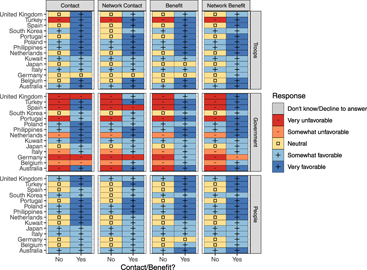
Figure 3 previews how contact with and the receipt of economic benefits from U.S. military personnel relate to attitudes toward the U.S. military personnel, government, and people. These questions ask about (1) having personal contact with U.S. military personnel, (2) having a friend or family member who had personal contact with U.S. military personnel, (3) receiving personal economic benefits from the U.S. military presence in a country, or (4) having a friend or family member who has received an economic benefit from U.S. military presence. Response options were “Yes,” “No,” or “Don’t know/Decline to answer.” Each tile represents the modal response in each country for each question-based subgroup (e.g., the modal response for individuals in Germany responding “Yes” to whether they have had personal contact with U.S. military personnel). Red indicates “Very unfavorable” as the modal response, whereas dark blue indicates a “Very favorable” modal response.Footnote 12
Modal Response Toward Reference Group (Row) by Respondent Country and Type of Contact With U.S. Military (Column Headers)

Some notable patterns emerge. First, among those who responded “No” to any of the questions, we find generally neutral to somewhat favorable attitudes toward U.S. military personnel and the U.S. people. Turkey is the lone exception; we find a modal response of “Very negative” for individuals’ attitudes toward the U.S. military presence in their country. Alternatively, we find largely negative attitudes toward the U.S. government across all four questions. Poland, the Philippines, and Kuwait stand out as the only countries where the modal response among individuals responding “No” to the contact and benefits questions is positive. In nearly half of the countries surveyed, those reporting no contact or benefit predominantly expressed “Very unfavorable” attitudes toward the U.S. government. This is noteworthy, given that the “No” category is the clear modal category for both contacts and benefits.
Second, those who responded “Yes” to the contact and/or benefits questions yield a modal response of either “Somewhat favorable” or “Very favorable” in nearly all countries for each of the three outcome variables. When looking at the contact questions in the United Kingdom, Germany, and Belgium, the modal response was either “Somewhat unfavorable” or “Very unfavorable” for attitudes toward the U.S. government. Regarding economic benefits, we find “Neutral” as the modal response in Germany and Japan for attitudes toward the U.S. military. For the network benefits question, we find the modal response in both Germany and Japan is “Somewhat favorable.”
Overall, Figure 3 suggests that direct and network contact with U.S. military personnel, economic benefits, and network benefits, correlate with more positive attitudes toward the three groups of interest. The relatively unfavorable attitudes expressed by residents of some of the United States’ closest allies are noteworthy. This figure provides a preliminary snapshot of the relationship between contact and benefits and mass attitudes.
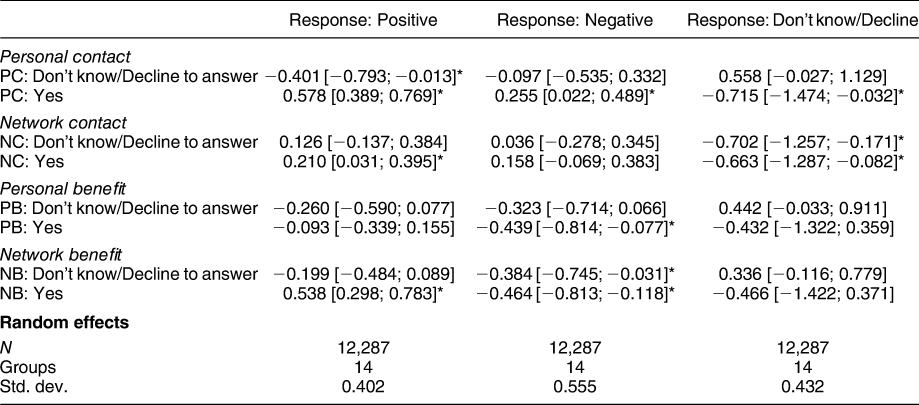
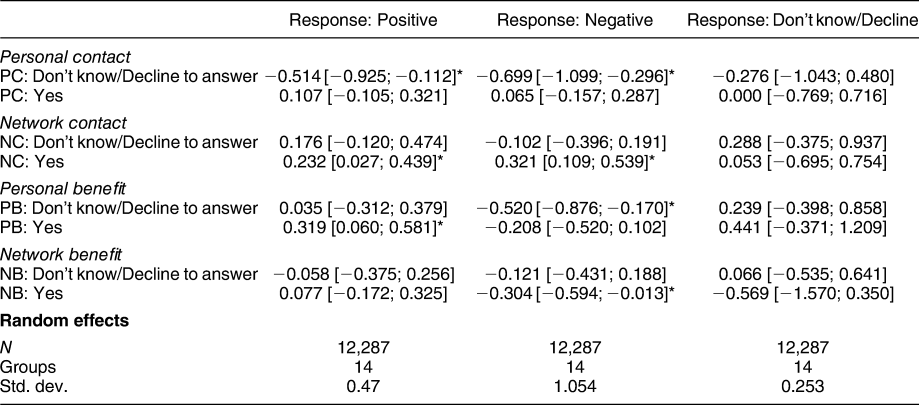
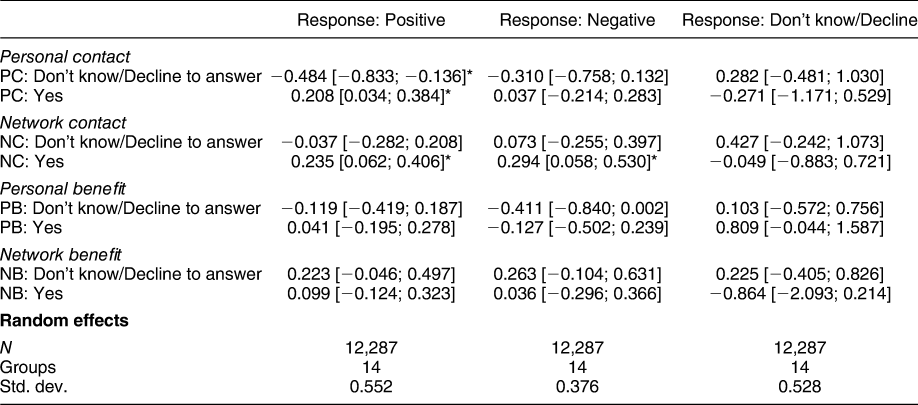
The descriptive analysis is a useful starting point, but there are other variables that contribute to shaping individuals’ attitudes toward the groups of interest. Tables 1–3 show the results of our multilevel categorical logit models. Each table looks at attitudes toward the U.S. military presence, U.S. government, and U.S. people, respectively.Footnote 13 Each column shows the results of one of the three possible responses, with “Neutral” serving as the reference category in each table.
Multilevel Categorical Bayesian Logistic Regression Models Predicting Attitudes Toward U.S. Troops. Neutral Attitudes are the Reference Category

Note: Asterisks indicate that 95% credible intervals do not overlap with 0. Model diagnostics can be found in a separate diagnostic appendix.
Multilevel Categorical Bayesian Logistic Regression Models Predicting Attitudes Toward American Government. Neutral Attitudes are the Reference Category

Note: Asterisks indicate that 95% credible intervals do not overlap with 0. Model diagnostics can be found in a separate diagnostic appendix.
Multilevel Categorical Bayesian Logistic Regression Models Predicting Attitudes Toward American People. Neutral Attitudes are the Reference Category

Note: Asterisks indicate that 95% credible intervals do not overlap with 0. Model diagnostics can be found in a separate diagnostic appendix.
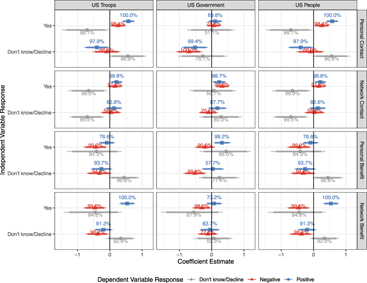
To facilitate interpretation of our primary variables, Figure 4 plots the coefficients from these models. Each column represents one of the three groups of interest. Each facet row represents the coefficients associated with one of the contact/benefit variables. The plotted coefficients correspond to one of the three choice equations from each model predicting attitudes toward one of the three groups (e.g., positive or negative attitudes toward U.S. military personnel). The percentage values next to each coefficient represent the percentage of the coefficient’s total distribution that falls above/below 0. We focus primarily on “Yes” responses to the contact and benefits questions, as well as the positive/negative responses to the dependent variable categories.

A “Yes” response to the personal contact variable correlates positively with both positive and negative attitudes toward both the U.S. military and the U.S. people. Compared with most of the other coefficients, these are relatively large, roughly equal to an increase of 15% in the probability of a positive response. These individuals are also generally less likely to give a response of “I don’t know/Decline to answer.” In all these cases, >98% of the coefficient distributions fall above or below 0. Alternatively, we find that direct contact with U.S. military personnel does not correlate strongly with attitudes toward the U.S. government. In the case of both positive and negative responses, both coefficients are close to 0, though 70−84% of their distributions fall above 0. These results suggest that direct interpersonal contact does not uniformly correlate with more positive views of all U.S. actors but appears to create more informed judgments toward certain groups. Personal contact yields a larger coefficient in predicting positive attitudes compared with negative attitudes, suggesting that although contact may increase both, it is more strongly correlated with positive attitudes. Notably, the correlation holds even after adjusting for subjective and objective indicators of economic benefits.
We also find that network contact correlates clearly with a higher probability of expressing a positive attitude across all three groups, although the coefficients are generally smaller in magnitude compared with direct contact. Similarly, we find evidence of a positive correlation between network contacts and negative attitudes, with ≥90% of the coefficient distributions falling above 0. As with direct contact, network contacts appear to increase the probability of both positive and negative responses. Unlike the direct contact variable, we also see positive coefficients when individuals are asked about the U.S. government. Again, knowing someone who has had contact with U.S. military personnel seems to move people away from the “Neutral” category and decreases the probability that individuals respond “I don’t know/Decline to answer.” Overall, the magnitude of these coefficients is fairly small compared with the positive coefficients we see for direct contact.
Individuals who report having received a direct economic benefit from the U.S. military presence are more likely to express a positive attitude toward the U.S. government, but this does not correlate strongly with a shift in positive attitudes toward either the U.S. people or the U.S. military. In these cases, 75−99% of the coefficient distributions fall below 0, contrary to our expectations. Personally receiving an economic benefit from the U.S. military does appear to correlate with a reduced probability of a negative response. Across all three models/groups, we see ≥90% of the coefficient distributions falling below 0. These results suggest that individuals deriving personal economic benefits from a U.S. military presence are less likely to express negative attitudes toward other U.S. actors but are only more likely to express positive assessments of the U.S. government.
Last, knowing someone who received an economic benefit correlates with an increase in the probability of expressing a positive assessment of the U.S. people and military presence within a state but does not correlate with more positive attitudes toward the U.S. government. The magnitude of these coefficients is relatively large compared with the others and is similar in size to the personal contact variable. We also find that network benefits correlate with a lower probability of a negative response across all three groups. In the case of the troops and people models, this effect is fairly large by comparison, equating to an approximate 13% reduction in the probability of a negative response.
That the coefficient for network benefits is larger than for direct benefits may seem counterintuitive, but it is consistent with existing work on the contact hypothesis. Indirect benefits may lead to greater harmony across groups because indirect interactions are unlikely to have the negative side effect of provoking the anxiety that sometimes accompanies interactions with out-groups. It is easier to generalize positively from an indirect benefit because the benefit is attributed to the out-group as a whole as opposed to the out-group individual involved in the interaction (Paolini et al. Reference Paolini, Hewstone, Cairns and Voci2004).
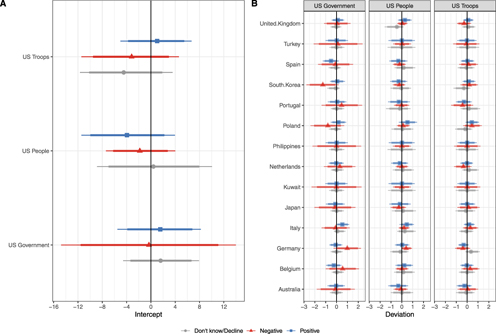
Figure 5 provides information about the distribution of the model’s estimates of varying intercepts. Panel A shows the population-level intercepts for the three outcome variables and the three response equations associated with each. Panel B shows country-level error for each model/group and response. In Panel A, we can see that the baseline probability of receiving a positive evaluation of the U.S. military presence across all countries is slightly higher than the baseline probability of a negative evaluation, although there is overlap in the distributions. For the U.S. people estimates, we find that the median population-level intercept is slightly lower for positive evaluations than for negative, but we again see overlap between the distributions. For the U.S. government model, we find that the median intercept values are roughly equivalent, but the distribution of the negative equation intercept is substantially larger than either of the other equations. This suggests that the baseline probability of receiving a negative evaluation of the U.S. government varies considerably more across countries than other evaluation categories for the other groups of interest. This matches the basic descriptive statistics—the rate of negative evaluations varies more across countries than positive evaluations.

Panel B shows the median country-level error and corresponding credible intervals. Overall, we do not typically observe large country-level error values. South Korea and Poland stand out as having a relatively low baseline for negative evaluations of the U.S. government, as compared with other countries. Conversely, Germany has a relatively high baseline for these negative attitudes. We generally observe greater dispersion in the negative attitude error values for the U.S. government model than for other groups/models. When looking at the U.S. troops model, we can see that some countries, like Portugal and Germany, have lower baselines for both positive and negative attitudes toward U.S. personnel stationed within their borders. In other cases, like Poland and South Korea, we see slightly higher baselines for “informed opinions” toward U.S. personnel. Overall, our findings reflect varying attitudes toward the U.S. government, particularly when compared with other U.S. actors, and respondents drawing distinctions between these different groups.
A Note on Selection Bias
In evaluating the contact hypotheses, it is important to take into account that those who choose to interact with members of an out-group are often the individuals who hold the least amount of prejudice (Pettigrew Reference Pettigrew1998). Those individuals who have had contact with members of the American military may have selected themselves into that situation because they already held more positive views of the United States, whereas those with negative views regarding the United States may choose to avoid these interactions. If this were the case, then this would bias our results.
Although this is a possibility, our qualitative interviews suggest that a large variety of people interact with the U.S. military. For example, it is often those with the largest grievances who select themselves into (negative) personal interactions with members of the U.S. military. A U.S. government relations officer at a military base in Germany noted that it is not uncommon for bar fights to break out between members of the U.S. military and foreign nationals who approach the Americans with grievances regarding U.S. military interventions abroad (Government Relations Officer Interview 2019). In addition, some of the settings in which locals may interact with Americans, like town hall meetings that are attended by representatives from the U.S. military, are often ones in which locals choose because they have grievances against the Americans. A member of the Lakenheath Parish Council in England noted that whenever there are any issues related to the nearby U.S. Air Force base, the local Air Commander will attend a parish council meeting. Thus, the people with grievances will select themselves into this interaction not because they have positive views of the Americans, but because they have a grievance (Interview with Local Council Member #1 2019).
In addition, many of the military installations are located near smaller towns, where there is a limited number of businesses that both locals and members of the U.S. military can frequent, making interactions more likely regardless of people’s preferences. For example, Lakenheath, England, is a village with a population of less than 5,000. Although there are certainly businesses that market themselves as U.S.-friendly (e.g., by putting U.S. flag stickers on their doors), there are also other businesses, such as supermarkets, that tend to be visited by most members of the population (Public Affairs Officer Interview 2019). Given limited economic opportunities, it can be difficult for people to relocate to another town even if they dislike the American military presence. One of the constant themes we observed in our interviews in both England and Germany was that locals were bothered by the sound of military aircraft, although it seems notable that despite this being a problem, people were still willing to live in the area.
Our use of the choice model alleviates this problem to a certain extent, although not completely. When considering these selection issues, ordered or binary measures of respondent attitudes (e.g., Positive/Not Positive) would mask the fact that contact can generate variation between various nonpositive categories. For example, we find that contact often correlates with a higher probability of positive and negative attitudes, but a reduction in the probability of receiving a “Don’t know/Decline to answer” response.Footnote 14 Even where we observe both positive and negative views increasing, the correlations are often not symmetric–with personal contact, for example, the coefficient for contact is larger in the positive equation than in the negative equation.
In accordance with contact hypothesis literature, we believe that a positive network effect is evidence that this relationship is not driven solely by a selection effect (Paolini et al. Reference Paolini, Hewstone, Cairns and Voci2004; Wright et al. Reference Wright, Aron, McLaughlin-Volpe and Ropp1997). Although individuals who hold more pro-American views may be more willing and likely to interact with members of the U.S. military in either personal or business relations, they are unlikely to be able to control whether people in their social network interact with the Americans. Thus, observing a positive correlation between network contact and positive attitudes is evidence against the relationship being caused by selection bias. Although we need to do more to establish that contact or benefits can actually bring about a causal change in individuals’ views, this research suggests that individuals with preexisting positive attitudes toward the U.S. military are not the only ones selecting into interactions with them.
CONCLUSIONS
This research marks the first of its kind in studying mass attitudes toward the U.S. military deployments in their host countries. Surveying over 14,000 people across 14 countries, we find important trends with implications for both foreign policy making and international relations theory. We argue that U.S. leadership during the postwar era relied not only on government policies but also on the acceptance of foreign populations. The U.S. military, traditionally considered an instrument of hard power, also plays a part in building soft power and influencing perceptions of U.S. actors. Our results suggest that contact with members of the U.S. military may reduce prejudice against U.S. actors and build more positive perceptions of them. This relationship exists even when taking into account the effect of economic benefits.
Interpersonal contact may increase both positive and negative views. Intuitively, this finding makes sense—media and historical accounts of the U.S. military’s presence in other countries are full of stories of social ills, including crime, environmental degradation, and more. Our findings also indicate that these negative accounts may suffer from selection bias and, in line with contact theory, show that interactions with U.S. military personnel correlate with more positive attitudes of U.S. actors. Alternatively, the economic benefits that flow from the U.S. military presence in a state correlate with a reduced probability that individuals express negative views of various U.S. actors, and in some cases also correlate with a higher probability that individuals express positive views.
This work represents an important contribution to international relations theory and our understanding of the microfoundations of U.S. leadership and the domestic underpinnings of hierarchical and contractual security relationships. In particular, our results suggest that U.S. military deployments may help build support for the U.S. government and its policies through the transfer of economic resources. Governments and leaders may have slack when negotiating away sovereignty to the U.S. in various areas of foreign policy, but that slack may be substantially reduced when foreign publics hold more negative views of the United States and its agents. This analysis represents a critical step insofar as it establishes the correlates of mass attitudes toward U.S. military deployments, but more work is required to better understand how, and when, such attitudes translate into actual pressure on government officials. Large, long-term military deployments represent significant investments by both the United States and host country, and these considerations must be balanced against host politicians’ short-term political realities and the likelihood that initially narrow public grievances may develop into something greater.
These findings also have substantive policy implications. Given the centrality of global military deployments to U.S. foreign policy, understanding mass attitudes toward those deployments can aid policy makers in better understanding the sources of support and opposition foreign leaders face among their publics when dealing with the U.S. Fostering positive perceptions of its military personnel could allow the U.S. government to more easily establish favorable basing and status of force agreements with foreign states. Cooley and Nexon (Reference Cooley and Nexon2013) note that the U.S. basing network exists due to common security interests and shared values. Where those interests and values are viewed as lacking, host governments may be more resistant to U.S. wishes. One strategy that the United States has pursued is to create stakeholders that go beyond the government. Thus, promoting more positive views of the United States among foreign publics may contribute to the creation of favorable agreements. These results stand in contrast with Goldsmith and Horiuchi (Reference Goldsmith and Horiuchi2009, 872) who find that high-level U.S. efforts at public diplomacy are not effective at countering negative images and news coverage. Our results suggest that lower-level and “unintended” efforts at public diplomacy may yield different results.
At present no other state rivals the United States in size and scope of its overseas military presence. As other countries like China begin to expand their military influence abroad, they will likely have to deal with many of the same concerns as the United States. Until now, members of the general public in states where the U.S. has had a military presence, view China as having economic, not military, interests (Interview with Panamanian Journalist 2018). This is likely to change as China expands its global military footprint. As one British Member of Parliament noted during our interviews, regarding British inaction with respect to the Chinese taking control of the port of Piraeus in Greece, “Are we mad? How stupid do we have to be?” (Interview with British Member of Parliament #1 2019). Countries like Djibouti, which hosts military forces from the United States, China, France, Germany, Italy, Spain, and Japan, provide interesting early opportunities for examining how mass attitudes toward foreign military deployments vary by sender country.
Future research should focus on better evaluating the causal relationship between various forms of contact and benefits and opinion formation. Researchers should also look to better understand how different types of events and interactions serve to condition the possible causal effects of interpersonal contact and economic benefits. It is possible that some events often associated with a U.S. military presence, like crime, support for ongoing military operations, or the disruption of normal social or economic activities, may condition the relationships we find. If so, future research should analyze how strong and long-lasting such conditioning effects may be. High-profile negative events or unpopular policy changes can provide openings for domestic opposition to the U.S. presence. For example, a German peace activist we interviewed noted that having U.S. drones based in Germany increased anti-base sentiment (Interview with German Peace Activist 2019). Thus, to truly reap the cooperative benefits of public diplomacy by the military, the United States should focus on reducing the incidence of negative events.
SUPPLEMENTARY MATERIAL
To view supplementary material for this article, please visit https://doi.org/10.1017/S0003055419000868.
Replication materials can be found on Dataverse at: https://doi.org/10.7910/DVN/VCE7KN.




Comments
No Comments have been published for this article.