1. Introduction
The North China Craton (NCC) was formed by welding several Archaean micro-continents along a marine closed greenstone belt (Zhai & Santosh, Reference Zhai and Santosh2011; Yang et al. Reference Yang, Santosh, Collins and Teng2016; Tang & Santosh, Reference Tang and Santosh2017; Yang & Santosh, Reference Yang and Santosh2017). A large number of ∼2.5 Ga rock units were preserved in the NCC (Wu et al. Reference Wu, Geng, Shen, Wang, Liu and Song1998; Zhai & Bian, Reference Zhai and Bian2000; Zhai, Reference Zhai2010). The NCC covers a vast area of eastern China (Wu et al. Reference Wu, Xu, Gao and Zheng2008), which includes two ancient continental cores of c. 3.8 Ga age (Jahn & Bai, Reference Jahn and Bai1983; Huang et al. Reference Huang, Bi and DePaolo1986; Liu, Reference Liu1991; Liu et al. Reference Liu, Nutman, Compston, Wu and Shen1992, Reference Liu, Nutman, Williams, Compston, Wu and Shen1994; Song et al. Reference Song, Allen, Liu and Wu1996; LQ Wang et al. Reference Wang, Qiu, McNaughton, Groves, Luo, Huang, Miao and Liu1998; Zheng et al. Reference Zheng, Griffin and O’Reilly2004; Gao et al. Reference Gao, Zhao, Wang, Zhao, Ma and Yang2005; Shen et al. Reference Shen, Geng, Song and Wan2005; Wan et al. Reference Wan, Liu and Song2005; Geng et al. Reference Geng, Yang, Wang, Ren, Du and Zhou2007; HL Wang et al. Reference Wang, Chen, Sun, Liu, Xu, Chen, Zhang and Diwu2007; Diwu et al. Reference Diwu, Sun, Yuan, Wang, Zhong and Liu2008; Chen et al. Reference Chen, Diwu and Wang2009; Zhang et al. Reference Zhang, Liu, Wang, Liu and Dai2009). The NCC was finally cratonized in the Late Palaeoproterozoic, thus recording a complex Precambrian evolution history. All crustal fragments gathered in the unified NCC were merged into the Columbia supercontinent (Santosh, Reference Santosh2010; Zhao & Zhai, Reference Zhao and Zhai2013). In addition, the NCC underwent an extensional regime between 2.5 and 2.45 Ga (Zhai & Peng, Reference Zhai and Peng2007), leading to basement uplift, formation of rift-related troughs, and major anorogenic magmatism represented by the emplacement of granitoid suites (e.g. Song et al. Reference Song, Allen, Liu and Wu1996) and mafic dykes. The events related to the emplacement of the mafic dykes can provide important information about the formation and evolution of the early crust. To date, more than 100 Proterozoic (<2.5 Ga) mafic dykes have been found in the NCC including those in the Hebei, Shanxi and Shandong area with ages ranging from 800 to 600 Ma, 820 Ma, 900 Ma, 925 Ma, 1.78 Ga and 2.4 to 1.6 Ga. They have been widely studied (Li et al. Reference Li, He and Qian1997; Zhai & Bian, Reference Zhai and Bian2000; Peng et al. Reference Peng, Zhai, Zhang and Guo2005, Reference Peng, Zhai, Guo, Kusky and Zhao2007, Reference Peng, Zhai, Li, Wu and Hou2008, Reference Peng, Guo, Zhai and Bleeker2010, Reference Peng, Bleeker, Ernst, Söderlund and McNicoll2011 a, b; Hou et al. Reference Hou, Liu and Li2006; Peng, Reference Peng2010; Hou, Reference Hou2012; Li, Reference Li2014). Nevertheless, only a few investigations of the Archaean mafic dykes (>2.5 Ga) have been carried out in the NCC.
At present, the western part of Shandong province has been the focus of several studies related to the Early Precambrian evolutionary history of the NCC (Hou, Reference Hou2012). Approximately 95 % of the Early Precambrian crystalline basement in western Shandong is dominated by granulites, greenstones, Trondhjemite-Tonalite-Granodiorite (TTG) gneisses, gneissic monzogranite, dioritic to granodioritic intrusions, and mafic dyke swarms (Wang, Reference Wang1990; Hou et al. Reference Hou, Li, Lin and Qian2004; Ju et al. Reference Ju, Hou and Zhang2014). In addition, the TTG series rocks and gneissic monzogranites in this area have been divided into two stages (2.5–2.6 Ga, 2.45–2.56 Ga; Jahn, Reference Jahn1988; Wang, Reference Wang1991, Reference Wang1993). The mafic dykes in western Shandong province are generally NE–SW-trending and are mainly located in the Tai’an, Laiwu and Mengyin regions (Hou, Reference Hou2012).
Herein, we present new zircon 207Pb/206Pb ages, and petrological, whole-rock geochemical and Nd–Hf isotopic data on the mafic dykes studied from western Shandong province, northeastern NCC. Our results constrain the emplacement ages and the origin of the dykes and provide insights into the tectonic significance of the NCC during the Neoarchaean.
2. Geological setting and petrography
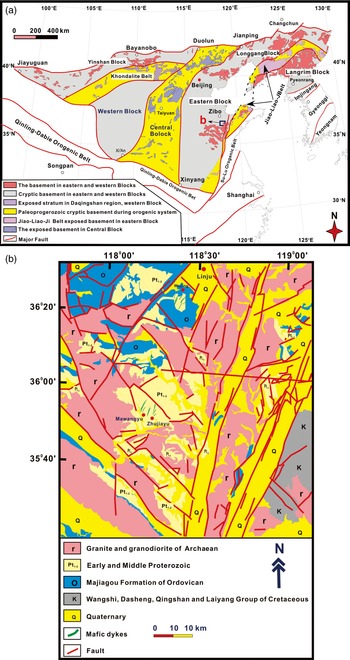
As a part of the Sino-Korean Craton, the Precambrian crustal evolution history of the NCC and the extensive Mesozoic redemption events have attracted global attention (Griffin, Reference Griffin1992; Griffin et al. Reference Griffin, Zhang, O’Reilly, Ryan, Flower, Chung, Lo and Lee1998; O’Reilly et al. Reference O’Reilly, Griffin, Poudjom Djomani and Morgan2001; Xu, Reference Xu2001; Zhang et al. Reference Zhang, Sun, Zhou, Zhou, Fan and Zheng2003; Zhai & Santosh, Reference Zhai and Santosh2011, Reference Zhai and Santosh2013; Zhao & Zhai, Reference Zhao and Zhai2013; Deng et al. Reference Deng, Wang and Li2017; Li & Santosh, Reference Li and Santosh2017). The NCC is bounded by the Early Palaeozoic Qilianshan Orogen to the west, the Late Palaeozoic Tianshan – Inner Mongolia – Daxinganling Orogen of the Central Asian Orogenic Belt to the north and the Mesozoic Qinling–Dabie–Sulu high/ultrahigh-pressure metamorphic belt to the south (Zhao, Reference Zhao2013).
According to the structural subdivision view of the NCC, it is composed of two north–south-trending Palaeoproterozoic (1.85 Ga) eastern and western crustal blocks welded across the North China Orogenic Belt (Zhao et al. Reference Zhao, Wilde, Cawood and Sun2001, Reference Zhao, Sun, Wilde and Li2005; Wilde et al. Reference Wilde, Zhao and Sun2002; Guo et al. Reference Guo, Sun, Chen and Zhai2005). The Eastern Block experienced obvious lithospheric thinning in the Late Mesozoic, and it contains many world-class gold deposits (Goldfarb & Santosh, Reference Goldfarb and Santosh2014; Li & Santosh, Reference Li and Santosh2017). It separates the Longgang Block from the Langlin Block and retains the oldest continental crust of the NCC (Fig. 1; Li et al. Reference Li, Zhao, Sun, Han, Zhao and Hao2006, Reference Li, Zhao, Santosh, Liu, Lai, Suo, Song and Wang2012; Li & Zhao, Reference Li and Zhao2007; Luo et al. Reference Luo, Sun, Zhao, Ayers, Li, Xia and Zhang2008; Zhou et al. Reference Zhou, Zhao, Wei, Geng and Sun2008; Tam et al. Reference Tam, Zhao, Liu, Zhou, Sun and Li2011, Reference Tam, Zhao, Sun, Li, Iizukac, Ma, Yin, He and Wu2012 a, b, c; Dan et al. Reference Dan, Li, Guo, Liu and Wang2012, Reference Dan, Li, Wang, Wang and Liu2014; Zhang et al. Reference Zhang, Gong, Yu and Li2013). The Western Block has thick lithospheric roots across Shanxi, Shaanxi, Inner Mongolia and Northern Gansu provinces. It has become the most stable part of the NCC (Santosh, Reference Santosh2010). It is a collage of the Northern Yinshan and Southern Ordos Blocks along the Inner Mongolia Suture Zone, merging the Palaeoproterozoic Khondalite Belt (Fig. 1; Xia et al. Reference Xia, Sun, Zhao, Wu, Xu and Zhang2008; Yin et al. Reference Yin, Zhao, Sun, Xia, Wei, Zhou and Leung2009, Reference Yin, Zhao, Guo, Sun, Zhou, Zhang, Xia and Liu2011; Santosh, Reference Santosh2010; Li et al. Reference Li, Yang, Zhao, Grapes and Guo2011; Wang et al. Reference Wang, Li, Chu and Zhao2011; Dan et al. Reference Dan, Li, Guo, Liu and Wang2012, Reference Dan, Li, Wang, Wang and Liu2014; Zhang et al. Reference Zhang, Gong, Yu and Li2013; Yang et al. Reference Yang, Santosh, Collins and Teng2016). The southern and northern edges of the NCC are marked by the Indosinian Qinling Dabie and Hercynian Yinshan Yanshan Orogenic Belts. Its western edge borders Helan Qilian Orogenic Belt, and its eastern edge is located in Korea. The NCC is composed of uniform Precambrian crystalline basement, which is covered by younger overburden (Zhao et al. Reference Zhao, Wilde, Cawood and Sun2001) and invaded by the Precambrian and Mesozoic mafic dyke swarms (e.g. Li et al. Reference Li, He and Qian1997; Zhai and Bian, Reference Zhai and Bian2000; Hou et al. Reference Hou, Li, Lin and Qian2004, Reference Hou, Liu and Li2006; Liu et al. Reference Liu, Hu, Zhao and Feng2004, Reference Liu, Hu, Zhao, Feng, Zhong, Cao and Shi2005, Reference Liu, Hu, Gao, Feng, Qi, Wang, Feng and Coulson2008 a, b, Reference Liu, Hu, Gao, Feng, Yu, Feng, Qi, Wang and Coulson2009, Reference Liu, Hu, Gao, Feng, Coulson, Feng, Qi, Yang, Yang and Tang2012 a, b, Reference Liu, Feng, Jahn, Hu, Gao, Feng, Lai, Yang, Qi and Coulson2013 b; Peng et al. Reference Peng, Zhai, Zhang and Guo2005, Reference Peng, Zhai, Guo, Kusky and Zhao2007, Reference Peng, Zhai, Li, Wu and Hou2008, Reference Peng, Guo, Zhai and Bleeker2010, Reference Peng, Bleeker, Ernst, Söderlund and McNicoll2011 a, b; Peng, Reference Peng2010; Hou, Reference Hou2012). Another model suggests that the NCC is composed of several Archaean micro-continental blocks and these blocks have been proliferated into large continental fragments (Zhai & Bian, Reference Zhai and Bian2000; Zhao, Reference Zhao2009; Zhai & Santosh, Reference Zhai and Santosh2011; Dan et al. Reference Dan, Li, Guo, Liu and Wang2012, Reference Dan, Li, Wang, Wang and Liu2014; Zhang et al. Reference Zhang, Gong, Yu and Li2013; Yang et al. Reference Yang, Santosh, Collins and Teng2016; Yang & Santosh, Reference Yang and Santosh2017).
(a) Location of the study area within the northeastern NCC. (b) Geological map of the study area, showing the distribution of mafic dykes studied and the location of samples collected during this study.

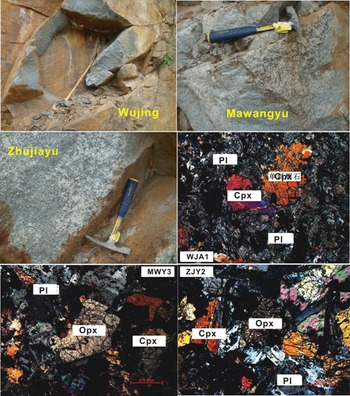
The fresh near-vertical mafic dykes in the study area are NE–SW-trending and intruded into luxiwu well in northeast North Carolina. The Early and Middle Proterozoic strata in the Mawangyu and Zhujiayu areas (Tables 1–5) have dykes extending from 3.0 to 9.0 km and a width range of 25–1.0 m. The rock types include gabbro, dolerite and diabase porphyry. Wujing dykes phenocrysts (WJA1–8, WJB1–8) include medium-grained clinopyroxene (2.5–6.5 mm) and tabular plagioclase (2.0–5.5 mm), and the matrix is composed of clinopyroxene (0.04–0.05 mm), plagioclase (0.03–0.06 mm), a small amount of magnetite (0.02–0.03 mm), secondary chlorite (0.03–0.05 mm) and auxiliary zircon composition (Fig. 1). The dyke phenocrysts of Mawangyu and Zhujiayu (MWY1–7, ZJY1–7) include medium-sized clinopyroxene (2.5–5.0 mm) and tabular plagioclase (2.0–5.0 mm), and the matrix consists of clinopyroxene (0.04–0.06 mm), plagioclase (0.03–0.05 mm), secondary magnetite with auxiliary zircon and apatite (0.02–0.03 mm) and secondary chlorite (0.04–0.06 mm) (Figs 1, 2).
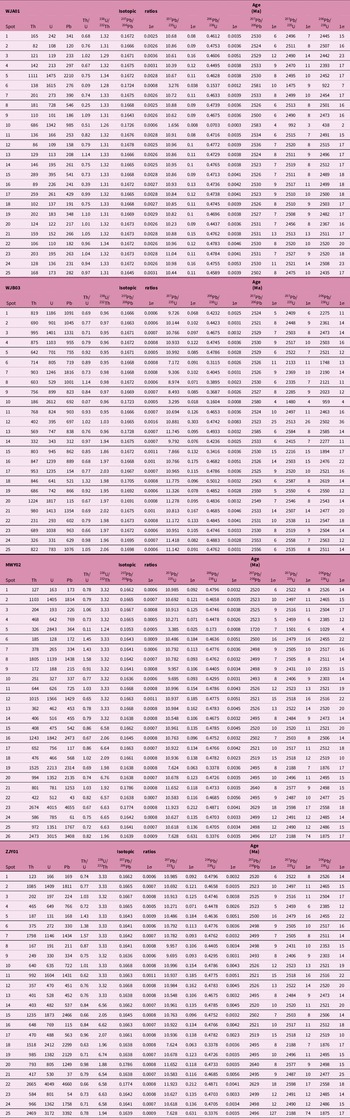
Zircon LA-ICP-MS U–Pb isotope data for the mafic dykes studied within western Shandong province, northeastern NCC

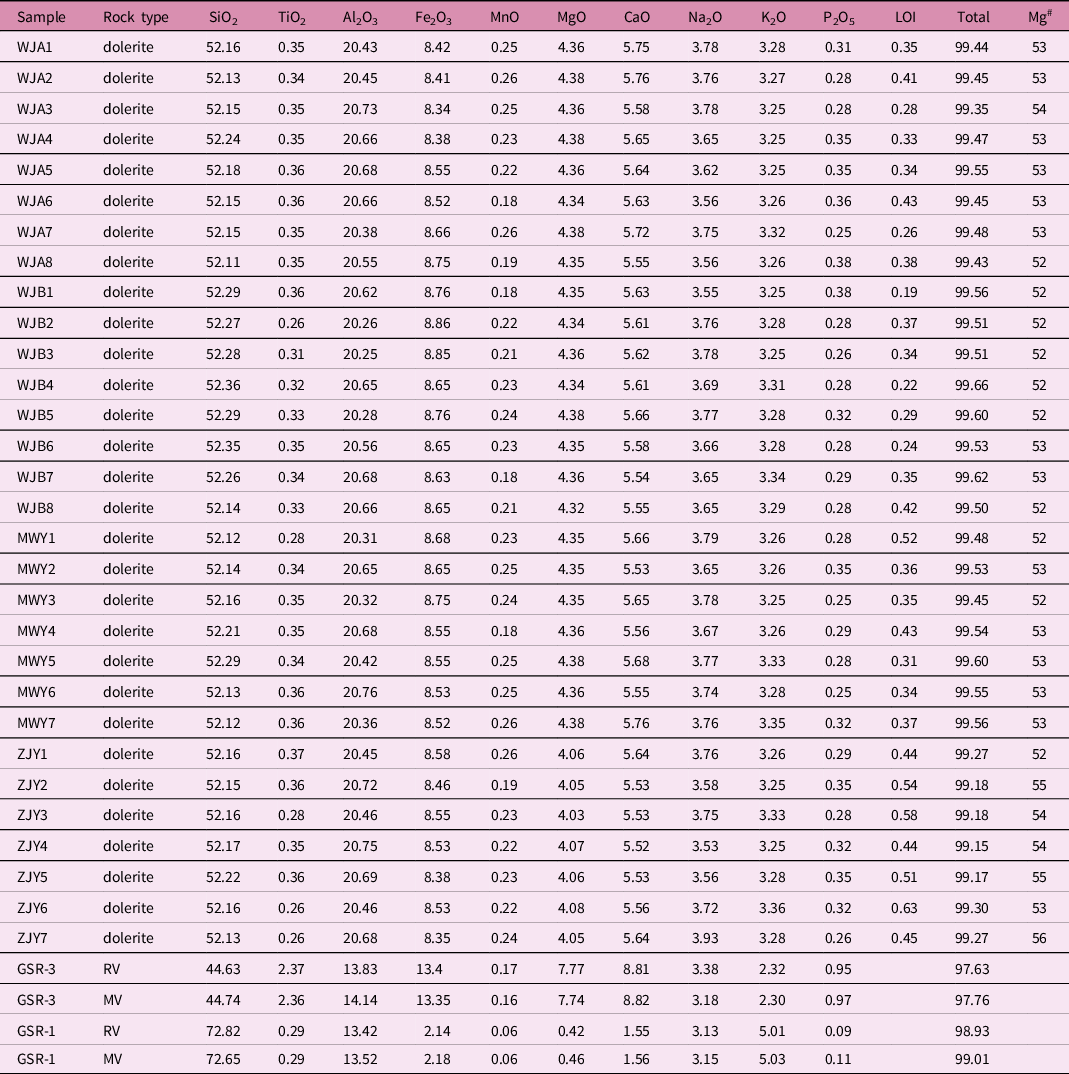
Major element concentrations (wt %) for the mafic dykes studied. LOI = loss on ignition; Mg# = 100Mg/(Mg + Fe) in atomic proportions; RV = recommended values; MV=measured values. Values for GSR-1 and GSR-3 are from Wang et al. (Reference Wang, Gao, Han and Wang2003)

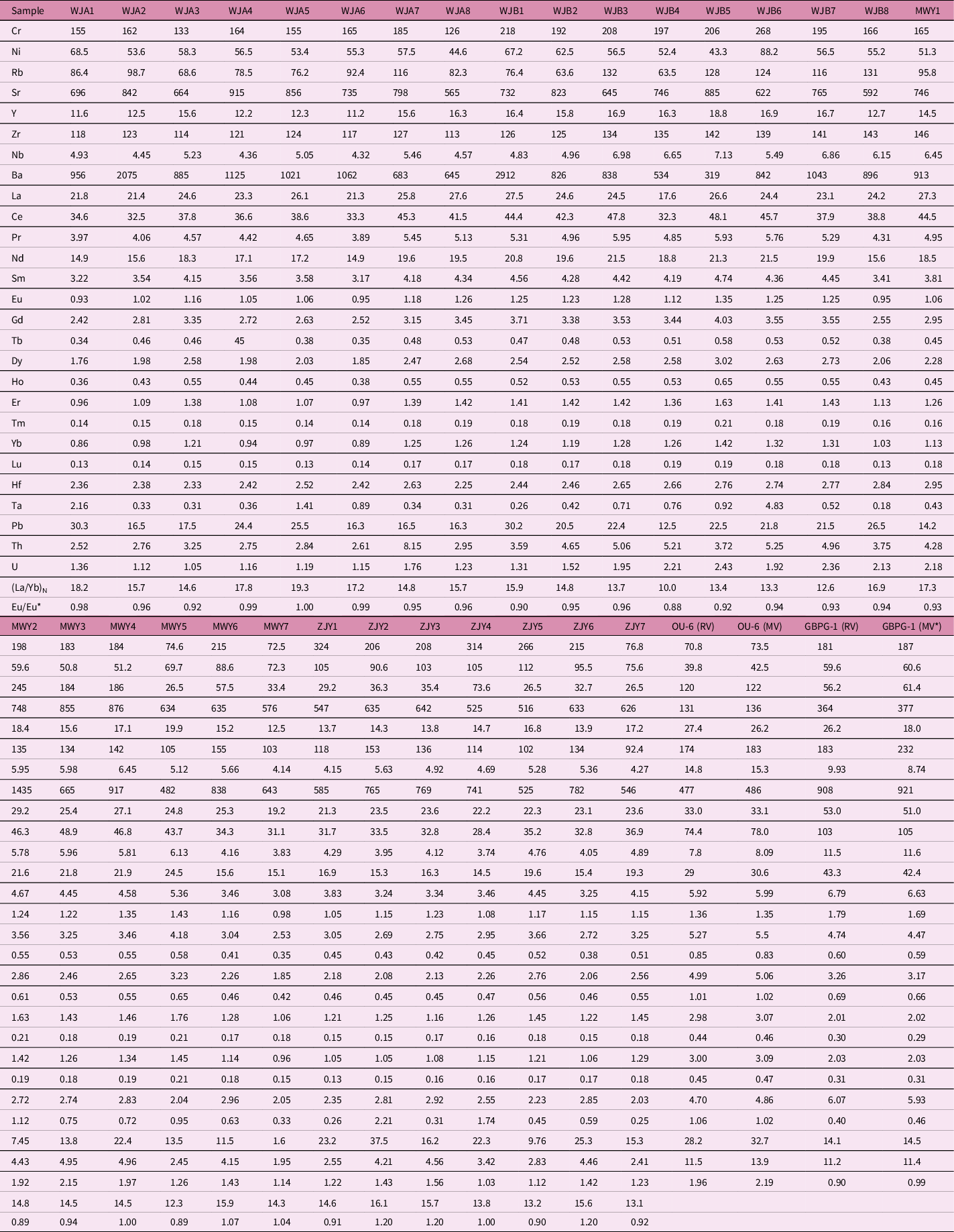
Trace element compositions (ppm) of the mafic dykes studied. RV = recommended values; MV = measured values. Values for GBPG-1 and OU-6 are from Thompson et al. (Reference Thompson, Potts, Kane and Wilson2000) and Potts and Kane (Reference Potts and Kane2005), respectively.

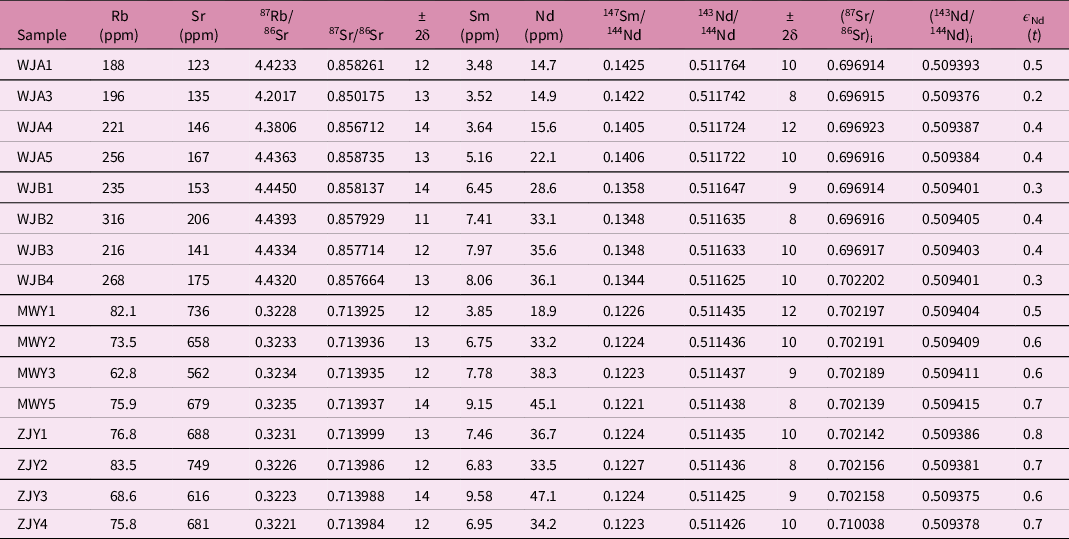
Sr–Nd isotopic compositions of the mafic dykes studied. The compositions were calculated using Chondrite Uniform Reservoir values and decay constants of λ Rb = 1.42 × 10⁻¹¹ year–1 (Steiger & Jäger, Reference Steiger and Jäger1977) and λ Sm = 6.54 × 10⁻¹² year–1 (Lugmair & Harti, Reference Lugmair and Harti1978)

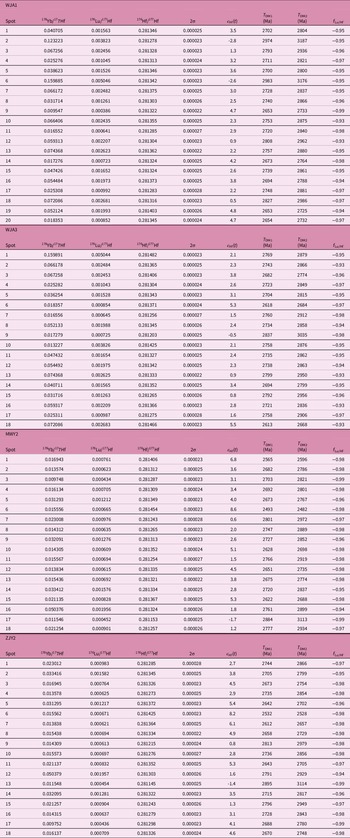
Hf isotopic compositions of representative samples studied in western Shandong province

The field and microscopic photos of the mafic dykes studied. Pl – plagioclase; Cpx – clinopyroxene.

3. Sampling and analytical techniques
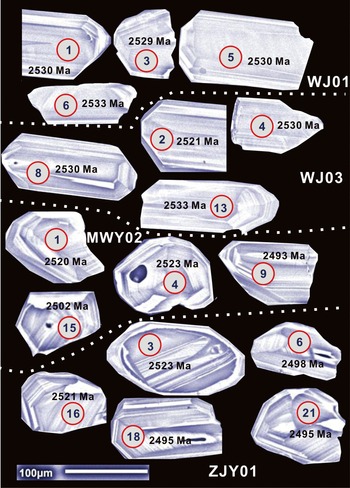
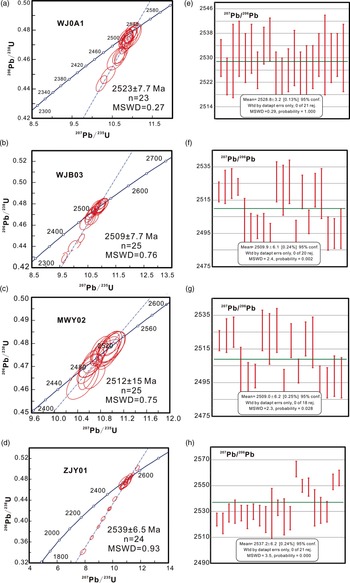
Thirty samples were collected from the mafic dykes (Fig. 1). Zircon grains were separated from four samples (WJA1, WJB3, MWY2 and ZJY1) using conventional heavy liquid and magnetic techniques at the Langfang Regional Geological Survey, Hebei province, China. After separation and mounting, the morphology and internal structure of the zircons were imaged using transmitted and reflected light and by cathodoluminescence (CL) techniques at the State Key Laboratory of Continental Dynamics (SKLCD), Northwest University, Xi’an (Fig. 3). Prior to zircon U–Pb dating, grain mount surfaces were washed in dilute HNO3 and pure alcohol to remove any potential lead contamination. Zircon U–Pb and 207Pb/206Pb weighted average ages were determined by LA-ICP-MS (Table 1; Fig. 4) using an Agilent 7500a ICP-MS instrument equipped with a 193 nm excimer laser at the SKLCD. The zircon standard 91500 was used for quality control, and a NIST 610 standard was used for data optimization. A spot diameter of 24 μm was used during analysis, employing the methodologies described by Liu et al. (Reference Liu, Hu, Zong, Gao, Gao, Xu and Chen2010 a). Common Pb correction was undertaken following the approach of Andersen (Reference Andersen2002), and the resulting data were processed using GLITTER and ISOPLOT (Ludwig, Reference Ludwig2003; Table 1; Fig. 4). Uncertainties on individual LA-ICP-MS analyses are quoted at the 95 % (1σ) confidence level.
Representative CL images of zircon grains from samples from the mafic dykes studied.

Zircon LA-ICP-MS U–Pb concordia diagrams and the 207Pb/206Pb weighted mean ages from the mafic dykes studied.

In situ zircon Hf isotope analysis was performed on Nu plasma Human Resource (HR) MC-ICP-MS equipped with a geolas 2005 193 nm ArF excimer laser ablation system. Analyses were carried out using a spot size of 44 μm, and He was used as the carrier gas. The laser repetition rate is 10 Hz and the energy density applied is between 15 and 20 J cm−2. During the analysis, the 176Hf/177Hf ratio of the standard zircon (91500) was 0.282295 ± 0.000027 (n = 14; 2σ), which is in good agreement with the recommended 176Hf/177Hf ratios within 2σ (0.282308 ± 58, 2σ; 0.282015 ± 0.000029, 2σ) (Griffin et al. Reference Griffin, Pearson, Belousova and Saeed2006; Wu et al. Reference Wu, Walker, Yang, Yuan and Yang2006). All the above analysis was performed at the SKLCD.
Whole-rock chemistry was completed at the State Key Laboratory of Deposit Geochemistry (SKLDG, Xi’an, Shaanxi Province), Institute of Geochemistry, Chinese Academy of Sciences. Using a molten glass disc, the analytical accuracy was better than 5 % according to Chinese national standard GSR-3 (Table 2). Loss on ignition was obtained using 1 g powder heated up to 1100 °C for 1 h. Trace element analysis was performed with an ELAN 6000 ICP-MS at the SKLDG, following procedures described by Qi et al. (Reference Qi, Hu and Grégoire2000). The discrepancy between triplicate analyses is less than 5 % for all elements. Analyses of international standards OU-6 and GBPG-1 are in good agreement with recommended values (Table 3). During Rb–Sr and Sm–Nd isotopic analysis, the sample powder was added with mixed isotopic tracer and dissolved in a polytetrafluoroethylene capsule with HF + HNO3 (Zhang et al. Reference Zhang, Sun, Lu, Zhou, Zhou, Liu and Zhang2001). Isotopic measurements were performed using a Finnigan Triton Ti thermal ionization mass spectrometer at the SKLDG. Procedural blanks yielded concentrations of <200 pg for Sm and Nd and <500 pg for Rb and Sr, and mass fractionation corrections for Sr–Nd isotopic ratios were based on 86Sr/88Sr = 0.1194 and 146Nd/144Nd = 0.7219, respectively. Analysis of the NBS987 and La Jolla standards yielded values of 87Sr/86Sr = 0.710246 ± 16 (2σ), and 143Nd/144Nd = 0.511863 ± 8 (2σ), respectively.
4. Results
4.a. Zircon U–Pb ages
Euhedral zircons in samples WJA1, WJB3, MWY2 and ZJY1 are clean and prismatic and show clear oscillatory magmatic zoning (Fig. 3). Twenty-three zircon grains from sample WJA1 yielded a weighted mean 206Pb/238U age of 2523 ± 7.7 Ma (1σ, 95 % confidence interval; Table 1; Fig. 4a) and weighted mean 207Pb/206Pb age of 2538 ± 3.2 Ma (2σ, 95 % confidence interval; Table 1; Fig. 4e). Twenty-five zircon grains from sample WJB3 yielded a weighted mean 206Pb/238U age of 2509 ± 7.7 Ma (1σ, 95 % confidence interval; Table 1; Fig. 4b), and weighted mean 207Pb/206Pb age of 2510 ± 6.1 Ma (2σ, 95 % confidence interval; Table 1; Fig. 4f). Twenty-five zircon grains from sample MWY2 yielded a weighted mean 206Pb/238U age of 2512 ± 12 Ma (1σ, 95 % confidence interval; Table 1; Fig. 4c) and weighted mean 207Pb/206Pb age of 2509 ± 6.2 Ma (2σ, 95 % confidence interval; Table 1; Fig. 4g). Twenty-four zircon grains from sample ZJY1 yielded a weighted mean 206Pb/238U age of 2539 ± 6.5 Ma (1σ, 95 % confidence interval; Table 1; Fig. 4d) and weighted mean 207Pb/206Pb age of 2537 ± 6.2 Ma (2σ, 95 % confidence interval; Table 1; Fig. 4h). These age data provide the best estimates of the crystallization ages of dykes (207Pb/206Pb weighted average c. 2.5 Ga) within the study area. No major zircon inheritance was observed in any of the samples.
4.b. Major and trace element geochemistry
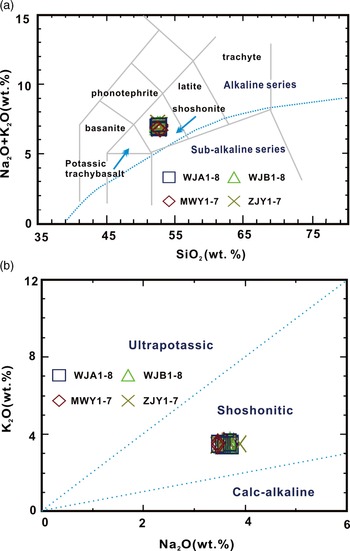
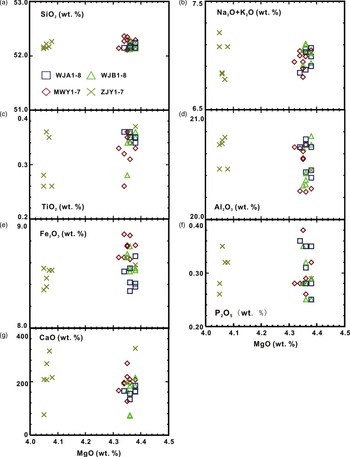
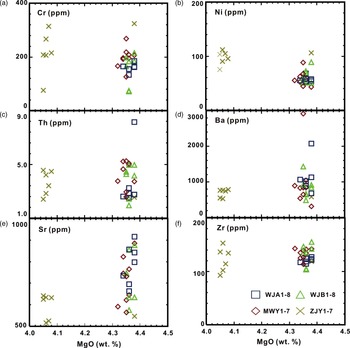
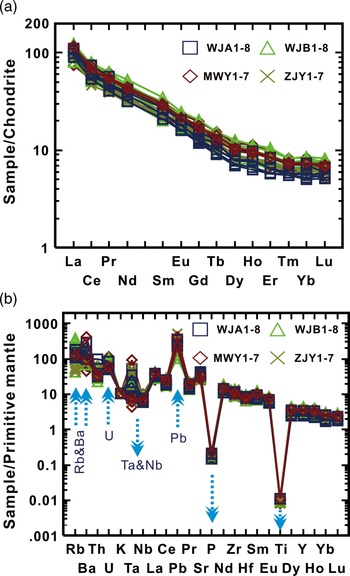
The dykes studied appear quite evolved and show SiO2 (52.11–52.36 wt %), TiO2 (0.26–0.37 wt %), Al2O3 (20.25–20.68 wt %), Fe2O3 (8.34–8.86 wt %), MnO (0.18–0.26 wt %), MgO (4.03–4.38 wt %), CaO (5.52–5.76 wt %), Na2O (3.55–3.93 wt %), K2O (3.23–3.36 wt %) and P2O5 (0.25–0.38 wt %) (Table 2). All the dykes studied are classified as alkaline (shoshonites) on the total-alkali silica diagram (Figs. 5a and 6) and as shoshonites in a Na2O vs K2O diagram (Figs. 5b and 6). They are characterized by enrichment in (La/Sm)N (1.57–2.57) and depletion in (Dy/Yb)N (1.30–1.42), with a variation range in (La/Yb)N (7.17–8.55), and the Eu/Eu* ratios appears slightly positive (1.12–1.27) (Table 3; Figs. 7 and 8a, b, modified based on comments). Furthermore, the mafic dykes are enriched in Ba, K, Pb, Sr, Eu, Dy and Lu; with negative U, Nb, Ta, Pr, P, Nd and Ti anomalies in primitive-mantle-normalized multi-element variation diagrams (Figs. 7 and 8a, b).
Classification of the mafic dykes studied. (a) Total-alkali silica (Middlemost, Reference Middlemost1994; Le Maitre, Reference Le Maitre2002) using major element concentrations recalculated to 100 % volatile-free compositions. (b) variations in K2O vs Na2O concentrations (Menzies & Kyle, Reference Menzies, Kyle and Menzies1972).

Variations in major element concentrations vs MgO ( wt %) for the mafic dykes studied.

Variations in trace element concentrations vs MgO ( wt %) for the mafic dykes studied.

(a) Chondrite-normalized REE and (b) primitive-mantle-normalized multi-element variation diagrams for the mafic dykes studied. Concentrations are normalized to chondrite composition of Sun and McDonough (Reference Sun, McDonough, Saunders and Norry1989).

4.c. Whole-rock Sr–Nd and zircon Hf isotopes
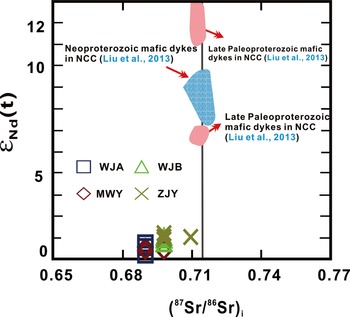
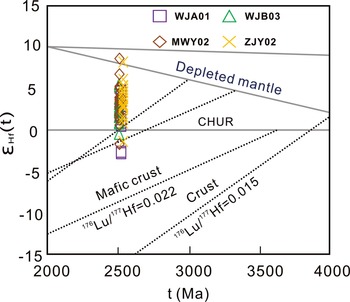
The Sr–Nd isotopic compositions of 16 representative dykes were determined (Table 4; Fig. 9). They have a relatively narrow range of (87Sr/86Sr)i ratios (∼0.6969) and have positive ϵ Nd(t) values (0.2–0.8), implying an isotope-depleted magma source. The mean Nd model age is 2.73 Ga (DePaolo, Reference DePaolo1981). The initial isotopic values of Sr are lower than those of BABI (Basaltic Achondrite Best Initial) (0.69899), for two main reasons (1) at least two mantle end elements (depleted mantle and enriched mantle) are involved in the genetic process (Zhou & Armstrong, Reference Zhou and Armstrong1982; Zhi, Reference Zhi1990; Zou et al., Reference Zou, Zindler, Xu and Qi2000); (2) high melting depth, homogeneity of source area and difference in lithosphere thickness (Niu et al., Reference Niu, Wilson, Humphreys and O’Hara2011; Ye et al., Reference Ye, Lambert, Grimwood, Roczo-Farkas, Nimmo, Sloots, Kirkwood and Whiley2015). The Hf isotopic compositions of zircon from the mafic dykes were also determined (Table 5; Fig. 10). Twenty spot analyses were obtained for sample WJA1, yielding ε Hf(t) values (−2.8 to 4.8) corresponding to T DM1 model ages (2.98–2.65 Ga, mean T DM1 = 2.75 Ga). Eighteen spot analyses were obtained for sample WJB3, and the results show ε Hf(t) values (−0.5 to 5.5) corresponding to T DM1 model ages (2.8–2.61 Ga, mean T DM1 = 2.73 Ga). Eighteen spot analyses were obtained for sample MWY2, yielding a range of ε Hf (t) values (−1.7 to 8.6) corresponding to T DM1 model ages (2.88–2.49 Ga, mean T DM1 = 2.70 Ga). Eighteen spot analyses in zircon grains from sample ZJY2 show ε Hf(t) values (−1.4 to 8.2) corresponding to T DM1 model ages (2.9–2.53 Ga, mean T DM1 = 2.71 Ga). The mean T DM1 of the four zircons is 2.73 Ga, which is similar to the Nd model age.
Variations in initial 87Sr/86Sr vs ϵ Nd(t) values for the mafic dykes studied. The field delineates the composition of Proterozoic mafic dykes within the NCC (Liu et al. Reference Liu, Feng, Jahn, Hu, Gao, Feng, Lai, Yang, Qi and Coulson2013 b). The mafic dykes analysed during this study plot within the isotope-depleted mantle source field.

Plots of zircon ages vs ϵ Hf(t) values for the mafic dykes studied.

5. Discussion
Based on zircon geochronology, whole-rock geochemistry and Nd–Hf isotopic evidence, this study reasonably limits the source area of mafic dykes, crustal contamination, fractional crystallization and magmatic evolution.
5.a. Mantle source and the origin
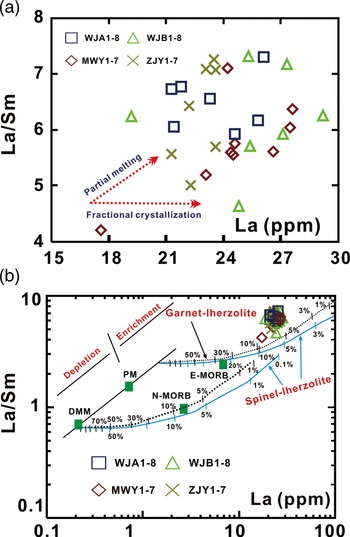
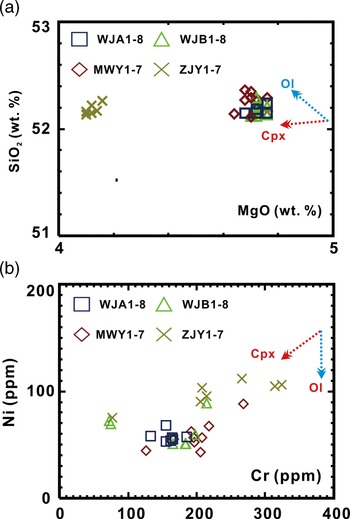
The mafic dykes studied are quite evolved, and the SiO2 content is quite high (52.11–52.36 wt %; Table 2), implying an ultra-basic source for these rocks. An ultra-basic source is also supported by the relatively high Mg# values (52–56; Table 1). It is unlikely that the magma that formed these dykes had any contribution from crustal rocks (Hirajima et al. Reference Hirajima, Ishiwatari, Cong, Zhang, Banno and Nozaka1990; Zhang et al. Reference Zhang, Meng and Lai1995; Kato et al. Reference Kato, Nami and Zhai1997; Rapp et al. Reference Rapp, Shimizu and Norman2003), as lower crustal intermediate granulites (Gao et al. Reference Gao, Luo, Zhang, Zhang, Han, Zhao and Hu1998 a, b) would produce high-Si and low-Mg# melts. Moreover, the Zr/Nb (10–16) and Rb/Sr ratios (0.04–0.20) of the dykes studied (Table 3) suggest magma derivation from a depleted mantle source (Weaver, Reference Weaver1991). The dykes also show positive but variable ϵ Nd(t) (0.2–0.8; Table 4) and ϵ Hf (t) values (0.5–8.6), both of which are consistent with derivation from an isotope-depleted mantle (Liu et al. Reference Liu, Hu, Gao, Feng, Yu, Feng, Qi, Wang and Coulson2009). In addition to the evidence outlined above, plots La/Sm vs La, and Sm/Yb vs Sm (Fig. 11a, b) suggest that the magma was sourced from an isotope-depleted garnet–lherzolite mantle through a moderate degree of partial melting (10–20 %). And during the diagenetic process, the separation crystallization mainly occurs with clinopyroxene (Fig. 12). In primitive-mantle-normalized spider plots (Fig. 8b), all the dykes studied show distinct negative anomalies for Nb and Ta, indicating the involvement of crustal components in the mantle source (Zhang et al. Reference Zhang, Sun, Zhou and Ying2005). The depleted mantle source can be further supported by the zircons from mafic dykes studied, because zircons are obviously recycled and should come from the fusion of depleted mantle sources.
Variations in La vs La/Sm and Sm vs Sm/Yb of the mafic dykes studied.

The correlative plots MgO vs SiO2 (a) and Cr vs Ni (b) for the mafic dykes studied.

5.b. Crustal contamination
Crustal pollution can lead to the enrichment of Sr–Nd isotopic composition of the basaltic rocks (Guo et al. Reference Guo, Fan, Wang and Li2004). The positive K, Pb and Zr, negative Nb, Ta and Ti anomalies, low Nb/Ta ratios (3.36–4.88; average 4.18) and relatively uniform La/Nb and higher Ba/Nb ratios (3.5–6.0, 94–466) (Table 3) suggest the contribution of a mantle source related to or contaminated by subducted material (Fig. 8a, b; Guo et al. Reference Guo, Guo, Wang, Fan, Li, Zhao, Li and Li2013). Although the dolerites studied had a small Sr isotopic composition (∼0.6969) and positive ϵ Nd(t) and ϵ Hf(t) values (0.2–0.8, 0.5–8.6, except for a few samples), the possibility that the genetic process is affected by crustal contamination cannot be ruled out. In the related diagrams of Nb/Ta vs La/Yb, Ce/Nb vs Th/Nb, Th/Nb vs Ta/Yb and La/Nb vs Ce/Pb (not shown), there are obvious projection laws of the mafic dyke swarms studied, further implying that the genetic process was affected by obvious crustal contamination. The low Ce/Pb (1.64–6.22) and Nb/U ratios (4.38–10.2) and higher La/Nb (1.28–1.65), Zr/Nb (9.97–15.9) and Rb/Nb ratios (2.61–12.3) also imply this. Crustal contamination would result in significant variation in Sr and Nd isotope compositions. Although there is no obvious correlation between MgO and (87Sr/86Sr)i, positive correlations between MgO and ε Nd(t) values are obvious from the dykes studied (Fig. 8b; Taylor & McLennan, Reference Taylor and McLennan1985). Therefore, there was clearly crustal contamination during the formation of these dykesThe mafic dykes are characterized by depletion in Th relative to La (Fig. 8b), eliminating the possibility of significant upper-middle crustal contamination (Taylor & McLennan, Reference Taylor and McLennan1985). A likely candidate for the contamination might be lower crust.
5.c. Genetic model and tectonic significance
The mafic dykes studied provide possible evidence for the extension of Neoarchaean lithosphere and the evolution of the lower mantle beneath the NCC. Herein, we propose a genetic model of the dykes studied and the tectonic significance.
Geochemical characteristics show that the parent magma forming the mafic dykes comes from the melting of an isotope-depleted garnet lherzolite mantle (10–20 %). However, all the dykes have significant negative high-field-strength elements (HFSE; e.g. Nb, Ta, P and Ti) and positive Pb and K anomalies in the normalized multi-element plots compared to the original mantle (Table 3; Fig. 8a, b). In general, HFSE deficiency (i.e. Nb, Ta) is interpreted as rutile fractionation (Table 3; Fig. 8b; Zhang et al. Reference Zhang, Sun, Zhou and Ying2005). In addition, the positive anomaly of Pb and K is considered to be the result of mixing and metasomatism of fluids from subducted oceanic plates in the mantle source region (Nelson, Reference Nelson1992; Rogers & Setterfle, Reference Rogers and Setterfle1994; Chung et al. Reference Chung, Wang and Crawford2001; Muller et al. Reference Muller, Franz, Herzig and Hunt2001).
The high Ba/Nb ratios (51–215; Table 3) of these dykes are different from most intraplate volcanic rocks (i.e. ocean island basalt, alkaline basalt and kimberlite), and their Ba/Nb ratios are very low (from 1.0 to 20; Jahn et al. Reference Jahn, Wu, Lo and Tsai1999). Therefore, the above data suggest that the mantle-derived magma that generated these has assimilated possible crustal contamination.
Many processes related to plume-related magmatism and mantle chemical heterogeneity (Arndt & Goldstein, Reference Arndt and Goldstein1989; Kay & Kay, Reference Kay and Kay1991; Rudnick & Fountain, Reference Rudnick and Fountain1995; Jull & Kelemen, Reference Jull and Kelemen2001; Gao et al. Reference Gao, Rudnick, Yuan, Liu, Liu, Xu, Ling, Ayers, Wang and Wang2004; Elkins-Tanton, Reference Elkins-Tanton, Foulger, Natland, Presnall and Anderson2005; Lustrino, Reference Lustrino2005; Anderson, Reference Anderson2006) are closely related to the subsidence of continental lower crust to convective mantle. As eclogite has higher density than peridotite of lithospheric mantle (Rudnick & Fountain, Reference Rudnick and Fountain1995; Jull & Kelemen, Reference Jull and Kelemen2001; Anderson, Reference Anderson2006; Levander et al. Reference Levander, Niu, Lee and Cheng2006), eclogite material will be easier to recycle into the mantle (Arndt & Goldstein, Reference Arndt and Goldstein1989; Kay & Kay, Reference Kay and Kay1991; Jull & Kelemen, Reference Jull and Kelemen2001; Gao et al. Reference Gao, Rudnick, Yuan, Liu, Liu, Xu, Ling, Ayers, Wang and Wang2004, Reference Gao, Rudnick, Xu, Yuan, Liu, Walker, Puchtel, Liu, Huang, Wang and Yang2008). Moreover, if the eclogite is silicon-saturated, it can hybridize with the overlying mantle peridotite and produce olivine-free pyroxene. The subsequent melting of these pyroxenes in the mantle can produce basaltic magma (Kogiso et al. Reference Kogiso, Hirschmann and Frost2003; Sobolev et al. Reference Sobolev, Hofmann, Sobolev and Nikogosian2005, Reference Sobolev, Hofmann, Kuzmin, Yaxley, Arndt, Chung, Danyushevsky, Elliott, Frey, Garcia, Gurenko, Kamenetsky, Kerr, Krivolutskaya, Matvienkov, Nikogosian, Rocholl, Sigurdsson, Sushchevskaya and Teklay2007; Herzberg et al. Reference Herzberg, Asimow, Arndt, Niu, Lesher, Fitton, Cheadle and Saunders2007; Gao et al. Reference Gao, Rudnick, Xu, Yuan, Liu, Walker, Puchtel, Liu, Huang, Wang and Yang2008). Therefore, this model has been used to explain the origin of the mafic dyke parent magmas in the NCC (Liu et al. Reference Liu, Hu, Gao, Feng, Qi, Wang, Feng and Coulson2008 a, b, Reference Liu, Hu, Gao, Feng, Yu, Feng, Qi, Wang and Coulson2009, Reference Liu, Feng, Jahn, Hu, Gao, Feng, Lai, Yang, Qi and Coulson2013 b).
In general, mafic dyke swarms can provide significant scientific information for the time and stage of extensional tectonics, and are ideal objects for studying mantle plume activity and lithospheric extension (Hou, Reference Hou2012). Previous studies in the NCC focused on Mesozoic, Cenozoic and Proterozoic mafic dykes and documented three episodes of lithospheric extension during the Proterozoic (i.e. from 1.8 to 1.6 Ga, 1.3 to 1.2 Ga, and 0.8 to 0.7 Ga). Nevertheless, study of the extension of NCC Archaean (age > 2.5 Ga) lithosphere is still very weak (Chen & Shi, Reference Chen and Shi1983, Reference Chen, Shi and Qian1994; Chen et al. Reference Chen, Shi and Jia1992; Shao & Zhang, Reference Shao and Zhang2002; Zhang & Sun, Reference Zhang and Sun2002; Peng et al. Reference Peng, Zhai, Zhang and Guo2005, Reference Peng, Zhai, Guo, Kusky and Zhao2007, Reference Peng, Zhai, Li, Wu and Hou2008, Reference Peng, Guo, Zhai and Bleeker2010, Reference Peng, Bleeker, Ernst, Söderlund and McNicoll2011 a, b; Hou et al. Reference Hou, Liu and Li2006; Yang et al. Reference Yang, Wu, Wilde and Liu2007; Li et al. Reference Li, Zhai, Peng, Chen and Guo2010; Peng, Reference Peng2010). The age data and genetic model in this paper are of considerable significance for basaltic magma activities in the lower crust related to the extension of the Archaean lithosphere. It has been suggested that the large-scale continental accretion and Archaean cratonization (2.5–2.6 Ga) occurred in the southwest and northeast of present-day Shandong province (Wang et al. Reference Wang, Zhuang and Xu1999; Hou et al. Reference Hou, Li, Lin and Qian2004). Generally, the thickened crust will undergo eclogite, and then sink and recycle back to the underlying mantle (Arndt & Goldstein, Reference Arndt and Goldstein1989; Kay & Kay, Reference Kay and Kay1991; Jull & Kelemen, Reference Jull and Kelemen2001; Gao et al. Reference Gao, Rudnick, Yuan, Liu, Liu, Xu, Ling, Ayers, Wang and Wang2004). The foundered eclogite has a higher density than that of the mantle peridotite (Rudnick & Fountain, Reference Rudnick and Fountain1995; Jull & Kelemen, Reference Jull and Kelemen2001; Anderson, Reference Anderson2006; Levander et al. Reference Levander, Niu, Lee and Cheng2006), but its melting temperature is lower than that of mantle peridotite (Yaxley & Green, Reference Yaxley and Green1998; Rapp et al. Reference Rapp, Shimizu, Norman and Applegate1999; Yaxley, Reference Yaxley2000; Kogiso et al. Reference Kogiso, Hirschmann and Frost2003; Sobolev et al. Reference Sobolev, Hofmann, Sobolev and Nikogosian2005, Reference Sobolev, Hofmann, Kuzmin, Yaxley, Arndt, Chung, Danyushevsky, Elliott, Frey, Garcia, Gurenko, Kamenetsky, Kerr, Krivolutskaya, Matvienkov, Nikogosian, Rocholl, Sigurdsson, Sushchevskaya and Teklay2007). This means that the heating of silicon-saturated eclogite will produce an intermediate acid solution assemblage (from tonalite to trondhjemite), rather than basic solution. These melts can be hybridized with mantle peridotite overlying areas to varying degrees. Subsequently, decompression melting of mixed mantle can produce basaltic melt (Kogiso et al. Reference Kogiso, Hirschmann and Frost2003; Sobolev et al. Reference Sobolev, Hofmann, Sobolev and Nikogosian2005, Reference Sobolev, Hofmann, Kuzmin, Yaxley, Arndt, Chung, Danyushevsky, Elliott, Frey, Garcia, Gurenko, Kamenetsky, Kerr, Krivolutskaya, Matvienkov, Nikogosian, Rocholl, Sigurdsson, Sushchevskaya and Teklay2007; Herzberg et al. Reference Herzberg, Asimow, Arndt, Niu, Lesher, Fitton, Cheadle and Saunders2007; Gao et al. Reference Gao, Rudnick, Xu, Yuan, Liu, Walker, Puchtel, Liu, Huang, Wang and Yang2008). Nevertheless, the lithospheric mantle in western Shandong province is not highly enriched, which may be the result of limited hybridization between the mantle and the subsidence lower crust. Subsequently (∼2.5 Ga), the partial melting of the slightly mixed mantle will produce the parent magma of the dykes studied. These magmas intruded into the Earth’s crust and formed these mafic dykes between ∼2.51 Ga and 2.54 Ga. The layered model is further supported by the geochemical composition, which is similar to that of the igneous rocks derived from the layered dynamic model: enrichment in Ba, K, Pb, Sr and Zr, negative HFSE (Nb, Ta and Ti), (La/Yb)N (7.17–8.55), relatively low ϵ Nd(t) (0.2–0.8) and ϵ Hf(t) ratios (−2.8 to 8.6) (Tables 3–5; Figs 7–9; Wedepohl, Reference Wedepohl1991; Gao et al. Reference Gao, Zhang, Luo, Li and Gao1992; Budnick, Reference Budnick1995; Gao & Jin, Reference Gao and Jin1997; Feng et al. Reference Feng, Liu, Zhong, Feng, Coulson, Qi, Yang and Yang2012; Qi et al. Reference Qi, Hu, Liu, Coulson, Qi, Tian, Feng and Wang2012; Liu et al. Reference Liu, Zou, Hu, Zhao and Feng2006, Reference Liu, Hu, Gao, Feng, Qi, Wang, Feng and Coulson2008 a, b, Reference Liu, Hu, Gao, Feng, Yu, Feng, Qi, Wang and Coulson2009, Reference Liu, Su, Hu, Feng, Gao, Coulosn, Wang, Feng, Tao and Xia2010 b, Reference Liu, Hu, Gao, Feng, Feng, Coulson, Li, Wang and Qi2010 c, Reference Liu, Hu, Gao, Feng, Zhong, Qi, Wang, Feng and Yang2011, Reference Liu, Hu, Gao, Feng and Tang2012 b, Reference Liu, Feng, Jahn, Hu, Gao, Coulson, Feng, Lai, Yang and Yang2013 a, Reference Liu, Feng, Jahn, Hu, Gao, Coulson, Feng, Lai, Yang and Tang2013 c, Reference Liu, Feng, Jahn, Hu, Zhai and Lai2014, Reference Liu, Feng, Hu, Zhai, Gao, Lai, Yan, Coulson and Zou2015, Reference Liu, Feng, Zhai, Hu and Yan2016, Reference Liu, Feng, Feng, Xu, Coulson, Guo, Guo, Peng and Feng2017, Reference Liu, Feng, Santosh, Feng, Coulson, Xu, Guo, Guo, Peng and Feng2018; Luo et al. Reference Luo, Wei, Xin, Zhang, Ke and Li2006), intense lithosphere thinning (Liu et al. Reference Liu, Hu, Gao, Feng, Qi, Wang, Feng and Coulson2008 a, b), massive contemporaneous magmatic activity (Regional Geology of Shandong Province, 1995) and large-scale mineralization appear in the NCC (Regional Geology of Shandong Province, 1995). All of the above phenomena can be explained by the foundering of lithosphere.
6. Conclusions
-
1. Zircon LA-ICP-MS U–Pb dating indicates that the mafic dykes from Shandong province in the northeastern NCC formed between 2509 ± 6.1 and 2537 ± 6.2 Ma, indicative of a Neoarchaean mafic magmatic event.
-
2. These mafic dykes are alkaline and shoshonitic. They are characterized by high light rare earth element (LREE) concentrations ((La/Yb)N between 7.17 and 8.55), positive Eu (Eu/Eu* between 1.12 and 1.27), Ba, K, Pb and Sr anomalies, and negative Nb, P, Ta and Ti anomalies. The dykes have low initial (87Sr/86Sr)i values of ∼0.6969, high ϵ Nd(t) (0.2–0.8) and ϵ Hf(t) values (0.5–8.6, except for a few samples). They were likely derived from melting (10–20 %) of an isotope-depleted garnet–lherzolite mantle that was hybridized by foundered lower crustal material.
-
3. The mantle-derived parent magma of the basic vein in the study area was affected by crustal pollution to a certain extent during the magma ascent.
Acknowledgements
This research was supported by the Most Special Fund of the State Key Laboratory of Continental Dynamics, Northwest University, the National Natural Science Foundation of China (41373028, 41573022) and Shaanxi Provincial Natural Science Basic Research Program Project (2023-JC-ZD-16). The authors thank Honglin Yuan and Liang Qi for assistance during zircon Hf isotope, Sr–Nd isotope and trace element analyses, and the zircon U–Pb dating.