In 2015, 13,355 ha of fresh-market tomato were grown in Florida (Anonymous 2017). This acreage represents 35% of the total U.S. acreage, and the estimated value for the harvested fruit was just over $453 million. Nearly 100% of all tomato produced in Florida is grown using the plasticulture production system. Growers rely on fumigants, PRE herbicides such as metribuzin and S-metolachlor, and POST herbicides such as halosulfuron for weed control (Freeman et al. Reference Freeman, Vallad and Dittmar2016; Snodgrass et al. Reference Snodgrass, Ozores-Hampton, MacRae and Noling2013). A combination of 1,3-dichloropropene and chloropicrin (Pic-Clor 60) is the most widely adopted fumigant in Florida, and it can suppress weeds such as purple nutsedge (Gilreath and Santos Reference Gilreath and Santos2004), but suppression tends to be inconsistent over time and space. Dimethyl disulfide provides more consistent nutsedge control than many other fumigants (McAvoy and Freeman Reference McAvoy and Freeman2013) but does not adequately control broadleaf weeds or grasses.
A large number of PRE and POST herbicides have been evaluated for efficacy on purple nutsedge and yellow nutsedge (Cyperus esculentus L.) (Pereira et al. Reference Pereira, Crabtree and William1987). PRE herbicides such as halosulfuron (Haar et al. Reference Haar, Fennimore, McGiffen, Lanini and Bell2002), S-metolachlor (Devkota et al. Reference Devkota, Norsworthy and Rainey2013), EPTC (Wallace et al. Reference Wallace, Culpepper, MacRae, Sosnoskie and Grey2012), and fomesafen (Boyd Reference Boyd2015) suppress nutsedge species and are registered for use on tomato. Unfortunately, they only tend to provide inconsistent (Boyd Reference Boyd2015) and short-term nutsedge suppression (Dittmar Reference Dittmar2013). POST-directed herbicides such as imazosulfuron, halosulfuron, and trifloxysulfuron can be safely applied to tomato (Jennings Reference Jennings2010). In Florida, halosulfuron is the most common POST-directed herbicide applied for nutsedge control in tomato, but crop tolerance can vary with cultivar (Mohseni-Moghadam and Doohan Reference Mohseni-Moghadam and Doohan2017).
Combinations of PRE and POST herbicides are frequently recommended to sustain season-long nutsedge control. For example, Adcock et al. (Reference Adcock, Foshee, Wehtje and Gilliam2008) reported that S-metolachlor followed by (fb) halosulfuron suppressed yellow nutsedge. Devkota et al. (Reference Devkota, Norsworthy and Rainey2013) reported 90% yellow nutsedge control with PRE S-metolachlor fb POST trifloxysulfuron plus halosulfuron. Herbicide programs that include PRE and POST-directed herbicides have largely been developed for yellow nutsedge control, but purple nutsedge is more common in many Florida fields. In addition, the authors have observed that purple nutsedge tends to be less susceptible to many herbicides than yellow nutsedge is. Research is needed to identify the most effective POST-directed herbicide or herbicide tank-mix for purple nutsedge control in tomato.
The objective was to determine tomato (cultivars ‘Amelia’, ‘Charger’, and ‘Florida 47’) tolerance and purple nutsedge response to POST-directed herbicides and herbicide tank-mixes.
Materials and Methods
Experiment 1
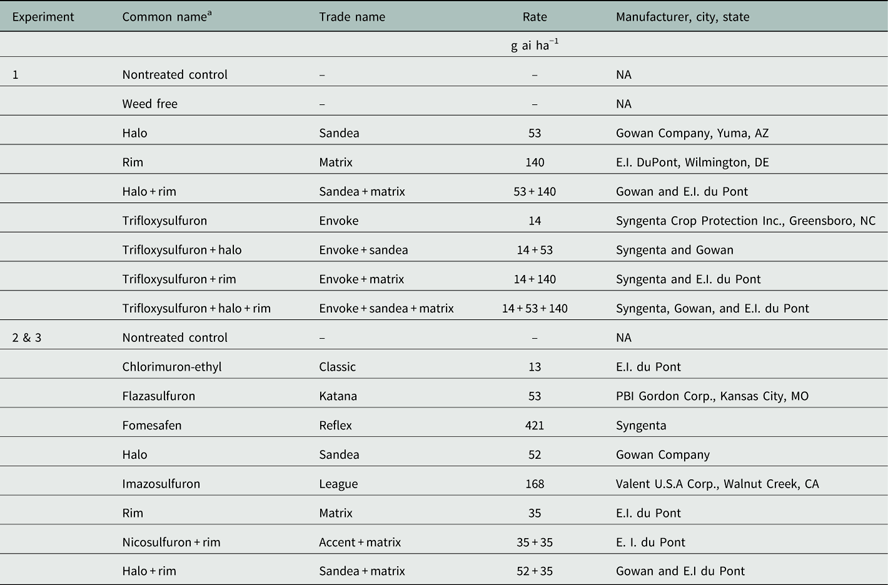
Experiments were conducted in spring 2011 and 2012 at the Plant Science Research and Education Center in Citra, Florida. The treatment list can be found in Table 1. Experiments were randomized complete block designs with four blocks. Plot size was a single raised (20-cm-tall) bed that was 0.81 m wide at base and 6.1 m long. Soil was a Hague sand (loam, siliceous, semiactive, hyperthermic Arenic Hapludalfs) with pH 6.8. Tomato (Amelia) was transplanted in the center of the bed with 46-cm spacing between plants on April 4, 2011, and March 20, 2012. Herbicides were applied on May 17, 2011, and April 19, 2012, in a water volume of 280 L ha−1 with a backpack sprayer (Bellspray Inc., Opelousa, LA) equipped with a single 8003VS nozzle (Teejet Technologies, Wheaton, IL). Herbicides were applied on both sides of the bed and directed at the base of the tomato plants with an overlap in the center of the bed. A significant portion of the lower foliage came in contact with the herbicide spray. Percent nutsedge control was evaluated on 14, 27, and 41 days after treatment (DAT). Tomatoes were irrigated and fertilized as per industry standards in the region (Freeman et al. Reference Freeman, Vallad and Dittmar2016) and were harvested on June 20 and 27 in 2011 and June 6 and 13 in 2012. Tomatoes were graded prior to weighing as small (<5.4 cm diameter), medium (5.4 cm<diameter<6.4 cm), large (6.4 cm<diameter<7.1 cm), or extra large (>7.1 cm) (Anonymous 1991).
Herbicide treatments applied postemergence-directed at the base of tomato plants after purple nutsedge had emerged at the Plant Science Research and Education Center in Citra, Florida in 2011 and 2012 (Experiment 1) and at the Gulf Coast Research and Education Center in Balm, Florida in 2013 and 2014 (experiments 2 and 3).

a Abbreviatons: Halo, halosulfuron; NA, not applicable; rim, rimsulfuron.
Experiment 2
Experiments were conducted in spring and fall 2013 at the Gulf Coast Research and Education Center (27°N, 82°W) in Balm, FL, to evaluate POST-directed to base herbicides in tomato. The treatment list can be found in Table 1. The experimental design was a randomized complete block design with four blocks. Plot size was a single raised (20-cm-tall) bed that was 0.81 m wide at base by 6.1 m long. Soil was a Myakka fine sand (sandy, siliceous hyperthermic Oxyaquic Alorthod) with pH 7.6 and 0.8% organic matter. All beds were fumigated with 308 kg ha−1 of 39% 1,3-dichloropropene plus 59.6% chloropicrin (Pic-Clor 60, Trical Inc., Hollister, CA) in January 2013 for the spring crop and in July 2013 for the fall crop. Fumigants were applied with a fumigation rig (Kennco Mfg., Ruskin, FL) equipped with three back-swept shanks set at a 20-cm depth in the bed. Two rows of drip tape with emitter spacing of 30 cm and a flow rate of 0.95 L min−1 per 30 m (Jain Irrigation Inc., Haines City, FL) were buried 2.5 cm beneath the soil surface of each bed and the beds were covered with virtually impermeable film (VIF, Berry Plastics Corp., Evansville, IN). Tomato cultivars Charger and Florida 47 were purchased from a commercial transplant house and transplanted on February 19, 2013, and August 26, 2013, with 61-cm spacing between transplants. Tomato was irrigated and fertilized according to industry standards in Central Florida (Freeman et al. Reference Freeman, Vallad and Dittmar2016). Herbicides were applied on April 11, 2013, for the spring crop and on September 27, 2013, for the fall crop. Sedges were 11 to 13 cm tall with an average of five leaves per shoot when the herbicides were applied. In the spring, the average tomato height at application was 51 and 40 cm for the Charger and Florida 47 cultivars, respectively. In the fall, the average tomato height at application was 62 and 54 cm for the Charger and Florida 47 varieties, respectively. Tomato transplants were flowering but had not produced fruit at the time of application. All herbicides were applied with a backpack sprayer (Bellspray Inc., Opelousa, LA) with a pressure of 0.24 MPa. The boom was fitted with a single 8002VS nozzle (Teejet Technologies, Wheaton, IL) and herbicides were applied in a water volume of 187 L ha−1. Herbicides were applied on both sides of the bed and directed at the base of the tomato plants with an overlap in the center of the bed. A significant portion of the lower foliage came in contact with the herbicide spray.
The height (soil surface to tallest leaf) of five tomato plants selected from the center of each plot was measured every 30 days beginning one month after transplant and ending at the final harvest. Percent tomato damage was estimated 2, 4, and 8 weeks after herbicide application using a 0 (no damage) to 100 (complete top kill) scale. The number of nutsedge shoots that punctured the plastic mulch was counted on April 14, May 14, and June 11 in the spring crop and September 25 and October 3 in the fall crop. Tomato fruit were harvested on May 14 and June 4 in the spring crop and November 12 and 25 in the fall crop. Tomatoes were graded prior to weighing as small (<5.4 cm diameter), medium (5.4 cm<diameter<6.4 cm), large (6.4 cm<diameter<7.1 cm), or extra large (>7.1 cm) (Anonymous 1991).
Experiment 3
Experiments were conducted at two separate field sites in spring 2013 at the Gulf Coast Research and Education Center to evaluate the efficacy of POST herbicides on purple nutsedge. Treatments, site management, and experimental design were the same as described in experiment 1 for spring 2013. Herbicides were applied on January 18 at site 1 and February 1 at site 2. No crop was planted in experiment 2. Data collection consisted of whole-plot nutsedge counts and control ratings as described above 2, 4, and 8 weeks after treatment.
Data for all experiments were checked for normality and constant variance prior to analysis. Data for experiments 1 and 2 were analyzed in SAS (version 9.2, SAS Institute Inc., Cary, NC) using the mixed procedure with block as the random factor. In experiment 1, years were analyzed separately. In experiment 2, the sites were analyzed separately. Means were compared using the least squares means statement in SAS with the Tukey adjustment at P=0.05. Data collected on multiple dates, such as tomato heights, nutsedge counts, and damage ratings were analyzed using the repeated statement. For experiment 3, the data were analyzed with GLM and means were compared using Fisher’s protected LSD at P=0.05.
Results and Discussion
Experiment 1
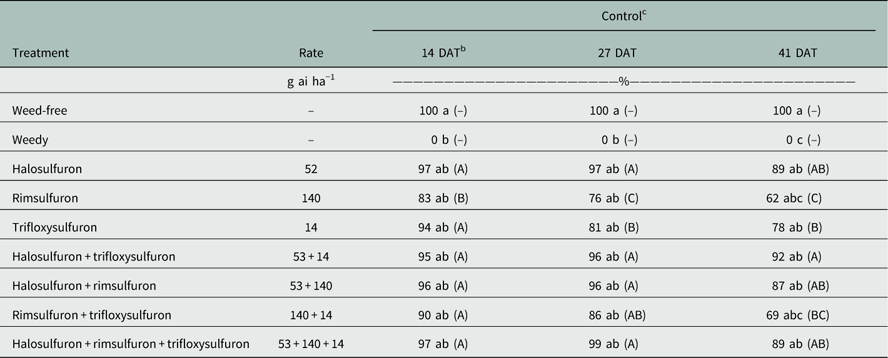
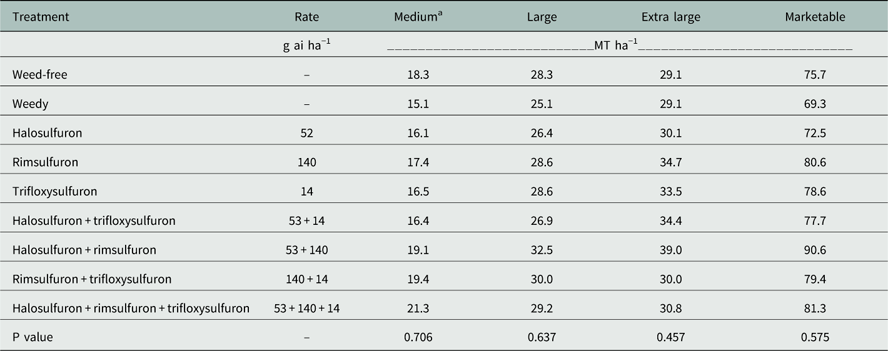
Percent nutsedge control ranged from 83% to 97% at 14 DAT, with similar control levels with all herbicides (Table 2). At 41 DAT, control ranged from 62% to 92%. Removing the weed-free and weedy control treatments allows for detection of differences. Halosulfuron or tank-mixes with halosulfuron were the most effective. None of the tank-mixes provided any added benefit over halosulfuron alone. Rimsulfuron had the lowest nutsedge control and was similar to rimsulfuron plus trifloxysulfuron. None of the herbicides evaluated damaged tomato or had any impact on yield (Table 3).
Nutsedge control 14, 27, and 41 days after treatment (DAT) by halosulfuron, rimsulfuron, and trifloxysulfuron postemergence-directed in tomato in experiment 1 at the Plant Science Research and Education Unit in Citra, Florida in 2011 and 2012.Footnote a

a Population was a mix of purple and yellow nutsedge.
b Visual control ratings were completed at 10, 24, and 27 DAT in 2011 and at 14, 27, and 41 DAT in 2012.
c Means followed by different letters are significantly different by Fisher’s Protected LSD (P ≤ 0.05). Lowercase letters represent mean separation including the weed-free and weedy control treatments; uppercase letters represent mean separation excluding these treatments.
Effect of postemergence-directed halosulfuron, trifloxysulfuron, and rimsulfuron on tomato yield in experiment 1 at the Plant Science Research and Education Unit in Citra, Florida in 2011 and 2012.

a Tomatoes were graded prior to weighing as medium (5.4 cm<diameter<6.4 cm), large (6.4 cm<diameter<7.1 cm) or extra large (>7.1 cm). Marketable yield is the sum of the three fruit grades.
Experiment 2
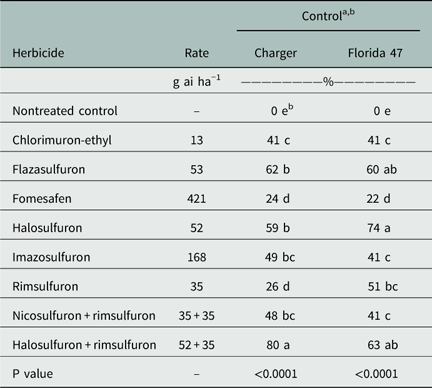
There was no season by treatment interaction (P=0.0751), but there was a tomato cultivar by treatment interaction (P=0.0196) on sedge control ratings. In both varieties, the greatest nutsedge control tended to occur where halosulfuron, halosulfuron tank-mixed with rimsulfuron, or flazasulfuron was applied (Table 4). Fomesafen was the least effective treatment. In one of the two experiments, the halosulfuron plus rimsulfuron tank-mix was more effective than either product alone. Purple nutsedge shoot control never exceeded 80%, and density did not differ between treatments (data not shown). Our results indicate that suppression, but not control, is achieved with the herbicides evaluated. Halosulfuron is the most common POST-directed herbicide utilized by Florida tomato growers POST-transplant, but flazasulfuron was as effective in both seasons and could be considered for registration in tomato.
Effect of postemergence-directed herbicide applications on percent nutsedge control in experiment 2 averaged across seasons and measurement dates in two tomato cultivars (Charger and Florida 47) at the Gulf Coast Research and Education Center in Balm, Florida, in 2013.

a Visual control ratings based on a 0 (no damage) to 100 (complete shoot death) scale.
b Means within columns followed by different letters are significantly different at P≤0.05 based on Tukey adjusted means comparisons.
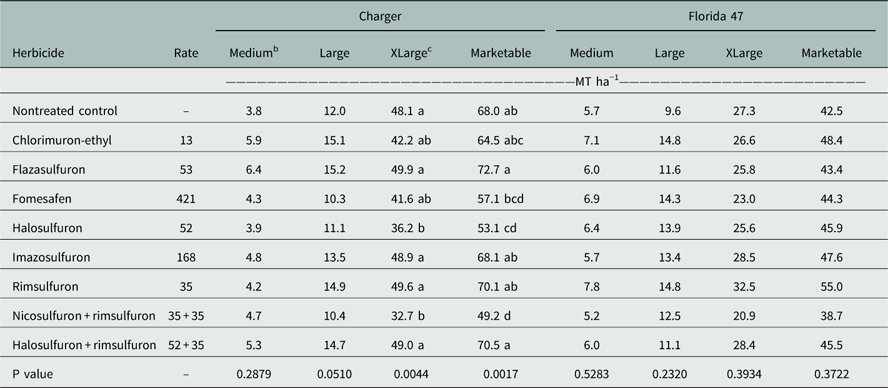
No crop damage was observed in any of the herbicide treatments in either cultivar in either season (data not shown). Herbicide treatments had no effect on the yield of Florida 47 (Table 5). However, where halosulfuron or nicosulfuron plus rimsulfuron was applied to the Charger cultivar, the total marketable yield was 22% to 28% lower than it was in the nontreated control. This difference appears to be primarily due to a reduction in the yield of extra large fruit; there were no differences in yield in the medium and large grade. The yield reduction was unexpected, as previous research has shown that halosulfuron is safe for use in fresh-market tomato (Dittmar et al. Reference Dittmar, Monks, Jennings and Booker2012; Jennings Reference Jennings2010), but crop tolerance has been shown to vary with cultivar (Mohseni-Moghadam and Doohan Reference Mohseni-Moghadam and Doohan2017). The halosulfuron label specifically instructs against applying following bloom unless crop shields are in place or the spray is directed away from the plant (Anonymous 2015). In experiment 2, herbicide applications were made after the crop had begun to flower, and although applications were directed to the base of the transplant, crop shields were not used and excessive exposure may have caused the yield reduction.
Tomato yields (cultivars Charger and Florida 47) in experiment 2, averaged across harvests in the spring and fall of 2013 following postemergence-directed herbicide applications at the Gulf Coast Research and Education Center in Balm, Florida.Footnote a

a Means within columns followed by different letters are significantly different by Tukey adjusted means comparisons at P≤0.1.
b Tomatoes were graded prior to weighing as medium (5.4 cm<diameter<6.4 cm), large (6.4 cm<diameter<7.1 cm) or extra large (>7.1 cm). Marketable yield is the sum of the three fruit grades.
c Abbreviation: Xlarge, extra large.
Experiment 3
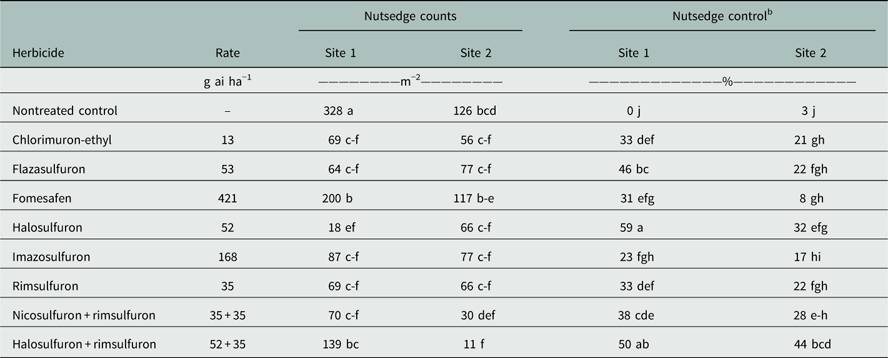
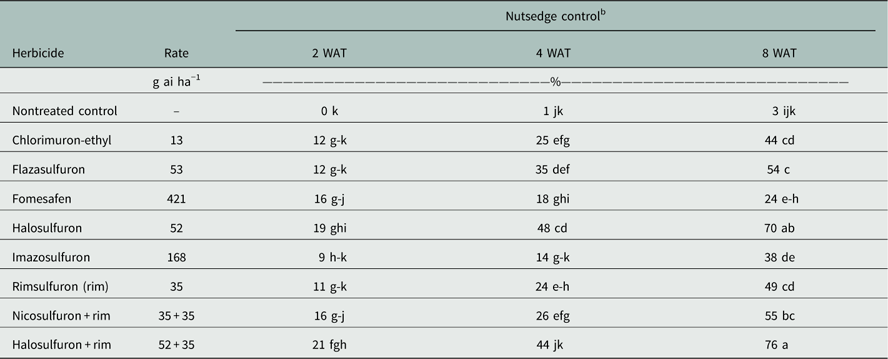
There was a significant site by treatment interaction for control ratings (P=0.0119) and nutsedge counts (P=0.0279). As was observed in experiment 2, nutsedge control tended to be highest in the halosulfuron or halosulfuron plus rimsulfuron treatments (Table 6). Control ratings were higher for the halosulfuron plus rimsulfuron tank-mix than they were for halosulfuron alone at one of the two sites. Control ratings were consistently lower at site 2 versus site 1. Sedge plants were on average 18 cm tall at site 1 when the herbicides were applied, which was taller than plants at site 2, which were on average 15 cm tall. Beds were formed and plastic mulch installed on the same date at both locations, but herbicides were applied 14 days later at site 2 than site 1. Although nutsedge shoots were shorter at site 2, a significant proportion of the plants were flowering whereas no flowers were observed when herbicides were applied at site 1. We speculate that the reduction in control observed at site 2 is due to the increased physiological maturity of the nutsedge plants. Other authors have reported similar trends with reduced efficacy of 2,4-D on more physiologically mature tissue (Pazmino et al. Reference Pazmino, Rodriguez-Serrano, Romero-Pueras, Archilla-Ruiz, Del Rio and Sandalio2011). There was a significant interaction between herbicide and the date the control ratings were collected (P=0.0005). Control tended to increase from 2 to 8 weeks in all treatments, with few differences between treatments at 2 WAT (Table 7). At 4 WAT, control in the halosulfuron and halosulfuron plus rimsulfuron treatments was greater than it was in any other treatment. At 8 WAT, 70% and 76% control was observed in the halosulfuron and halosulfuron plus rimsulfuron treatments, respectively.
Effect of postemergence-directed herbicide applications on purple nutsedge counts and percent control in experiment 3 at two sites at the Gulf Coast Research and Education Center in 2013.Footnote a

a Means within categories followed by different letters are significantly different at P≤0.05.
b Visual control ratings based on a 0 (no damage) to 100 (complete shoot death) scale.
Purple nutsedge control 2, 4, and 8 weeks after treatments (WAT) in experiment 3 with POST-directed herbicides at the Gulf Coast Research and Education Center in Balm, Florida, in 2013.Footnote a

a Means followed by different letters are significantly different at P≤0.05.
b Visual control ratings based on a 0 (no damage) to 100 (complete shoot death) scale.
Unlike experiment 2, nutsedge density was reduced significantly by all herbicides at site 1 (Table 6). Though not significant, a similar trend was observed at site 2. The reason for the difference between experiments 2 and 3 is unknown but not surprising; purple nutsedge susceptibility to herbicides is known to vary (Boyd Reference Boyd2015). For example, Blum et al. (Reference Blum, Isgrigg and Yelverton2000) reported a 33% to 70% reduction in purple nutsedge density following a single halosulfuron application in turf, whereas Grichar et al. (Reference Grichar, Besler and Brewer2003) reported a 77% to 95% purple nutsedge reduction following a single halosulfuron application in potato (Solanum tuberosum L.). In this experiment, halosulfuron reduced nutsedge density by 95% at site 1. At site 2, halosulfuron plus rimsulfuron reduced nutsedge density by 91%, and this was the only treatment significantly different from the nontreated control. Halosulfuron was the most effective herbicide in terms of control and density reduction at site 1, but at site 2 a tank-mix of halosulfuron and rimsulfuron was more effective.
Halosulfuron tended to provide the greatest nutsedge control across all experiments. Tank-mixes that contained halosulfuron were as effective but tended not to provide any added benefit over halosulfuron alone. Tomato susceptibility to POST-directed halosulfuron and nicosulfuron plus rimsulfuron varied with cultivar when applied at flowering, with a 22% to 28% yield reduction observed with the Charger cultivar and no yield reduction observed with Florida 47 or Amelia cultivars. POST-directed applications of chlorimuron-ethyl, fomesafen, imazosulfuron, rimsulfuron, nicosulfuron, and trifloxysulfuron applied POST-directed to the base of the crop did not cause crop damage, but were less effective on nutsedge than halosulfuron. These products should be further evaluated for broadleaf weed control in tomato. Flazasulfuron provided similar purple nutsedge suppression to halosulfuron and was safe for use on tomato.