Of course, we all ‘know’ why the children and the teacher are there in the classroom. We know because we have learnt about schooling by taking part in the game. . . . For us this has become invisible knowledge. (Barnes 1975, in van Lier Reference van Lier1988: xiii)
A major point of teacher education is to . . . make the tacit explicit. (Larsen-Freeman & Anderson Reference Larsen-Freeman and Anderson2011: xi)
In order to improve teaching, we must first have an adequate description of the teaching act. (Allen Reference Allen2000: 169)
If you wish to converse with me, first define your terms. (Voltaire, in Stevenson Reference Stevenson1967: 428)
1. Problem statement
As I grow old and ponder the state of SLT, I'm struck by how methods-oriented we (still) are. By ‘methods’ I mean ‘how-to’ systems – not just teaching methods per se. Teaching methods are part of a larger ‘methods discourse,’ defined here as a language-including social practice which has a dominant how-to/technical focus, and which therefore constructs SLT in a highly particular way (Pennycook Reference Pennycook1989).
Although my concerns go beyond methods per se, the pervasiveness of the term itself in SLT is a good place to start. Thus, the foundation course in teaching English as a second language (TESOL)/English language teaching (ELT) master's programs is commonly entitled ‘Methods,’ and the textbooks used there often include substantial methods discussion. Likewise, prominent scholars basically define SLT as methods, e.g. Keith Johnson's (Reference Johnson2008: 9) section title: ‘Language teaching: A variety of methods,’ or assume such a definition implicitly. Even in a hoped-for ‘postmethod condition’ (Kumaravadivelu Reference Kumaravadivelu2003), the point of departure – and perhaps the ghost in the machine – is still methods.
Going beyond the term ‘methods’ itself, much of what we do in SLT, or at least much of what we teach our master's students to do, is described in terms of ‘how to,’ apparently at the expense of ‘what is.’ Thus, needs analysis, curriculum development, task design, classroom management, teaching techniques, and assessment are often presented in such highly procedural terms that it starts to appear that procedures themselves, designed and implemented properly, can guarantee sound teaching and learning.
I believe that this emphasis is techno-scientisticFootnote 1 in nature. It assumes that there are one or a few technical solutions to the ‘problem’ of SLT. Consider, for instance, the influential teaching approach known as task-based language teaching (TBLT). In his authoritative chapter in the Handbook of second language teaching (Long & Doughty Reference Long and Doughty2011), Norris (Reference Norris, Long and Doughty2011: 581) presented TBLT as a kind of super-method:
Drawing on several decades of discussion and research, TBLT emerged as much more than a language teaching ‘method’. . . . At its most complete TBLT applies available understandings and evidence to the comprehensive design of entire language education programs. Though several task-based architectures have been proposed. . ., most subscribe to the following elements. . . .
The six elements that follow – needs analysis, task selection and sequencing, materials and instruction development, teaching, assessment, and program evaluation – are presented in highly procedural terms. Thus, teaching:
facilitate[s] the essential link between instructional materials and their use with learners in classrooms. In task-based teaching, learners must be schematized to the expected procedures and outcomes of tasks, monitored in their performance of tasks, and offered enhanced understandings of language use throughout. (p. 582)
The procedural emphasis in this description aligns closely with the dominant cognitivist paradigm in second language acquisition (SLA) studies, on which TBLT is largely based (Long Reference Long2015). In this view SLA is computational data processing, which can be optimized by manipulating features of the input and providing corrective feedback on the output, which is then re-input into the language learning computer (Atkinson Reference Atkinson and Atkinson2011). Such uniform learning processes practically demand uniform pedagogical procedures.Footnote 2
I was once a young language teacher myself, and I remember searching desperately for ‘how-to’ methods. Yet now when I teach my master's students, I want them to consider not just how to teach, but what teaching is at a basic level – what fundamental activity they're engaged in. Put simply, a ‘how’ requires a ‘what.’ This is not to suggest that the real meaning of teaching is easily definable, if at all. But to adequately educate students in a complex human activity with a long evolutionary history, shouldn't critical thinking and extended discussion about that activity itself be required?
An exploratory search of the book literature since 2000 for titles containing ‘language teaching,’ ‘second language teaching,’ ‘English language teaching,’ ‘Teaching English to Speakers of Other Languages,’ and acronyms ‘LT,’ ‘SLT,’ ‘ELT,’ and ‘TESOL’ yielded the following results:Footnote 3 82% of these publications did not define teaching per se, appearing rather to assume an implicit, often methods-oriented definition. Of the 18% that did make definitional gestures, these were mostly indirect and brief, leading away from concerted discussion. In sum, the great majority of publications sampled did not define teaching per se, and those that did usually did so briefly and indirectly.Footnote 4
To conclude this introduction, let me state as clearly as possible that I am not arguing for a ban on ‘how-to’ methods in SLT. In fact, I believe that learning ‘how-to’ is essential for successful SLT education. What I'm arguing for instead is that knowing how to do something should entail thoughtful consideration of what that something is, or may be. If master concepts like teaching are left substantially undefined or undeveloped in our field, it may be impossible to enrich and improve our practice.
2. Defining teaching
So what is teaching? How can we (start to) define it? Let me begin with a working definition. My goal, please note, is not to define teaching in a single, ‘truthful’ way. Instead, I want to promote critical reflection and discussion.
Teaching, at a first approximation, is shaping situational contexts in ways that promote durable environmental adaptation. By ‘situational contexts’ I mean immediate contexts of ecosocial action – something like Malinowski's (Reference Malinowski, Ogden and Richards1923) ‘context of situation’ but without the specifically linguistic focus; by ‘durable environmental adaptation’ I mean forming new, non-transient relationships between environment and organism which promote the latter's survival. Let me now develop this definition by discussing its key terms – which can also be viewed as key areas of difference between humans and animals – in more detail, and then ending with the concept of teaching. This is not to suggest, however, that only humans teach, as will be seen.
2.1 ‘Adaptation’
In the classical evolutionary model, adaptation signifies changes in living organisms due to environmental pressures which enhance their ecological fitness. Most animals are largely preformed by evolution to fit their ecological niches, and after brief infancies can survive independently in them. Many of their adaptations are therefore evolutionary – coded in their DNA. Humans, in contrast, are born relatively unformed, or, more accurately, born to adapt. In Harari's (Reference Harari2015: 10) words:
Most mammals emerge from the womb like glazen earthenware emerging from the kiln – any attempt at remoulding will only scratch or break them. Humans emerge from the womb like molten glass from a furnace. They can be spun, stretched, and shaped with a surprising degree of freedom. That's why today we can educate children to become Christian or Buddhist, capitalist or socialist, warlike or loving.
Humans, in other words, are the world's champion adapters. They have innate instincts like other animals, but some of these are more like machine tools (i.e. tools for making tools) than tools designed for use in prespecified environments (Evans & Levinson Reference Evans and Levinson2009). As a result, the diversity of physical environments humans have inhabited over the last 50,000–80,000 years, when we first left Africa, is unprecedented among mammals: we now live almost everywhere on earth in relative safety and comfort. Thus, compared even to our closest primate cousins, the chimpanzees, our ability to adapt to varied environments is unparalleled.
2.2 ‘Environment’
As just mentioned, most animals exist in and adapt to the physical environments nature provides them. True, exceptions exist – spiders, beavers, and earthworms, for instance, radically reshape their environments adaptively – but compared to humans their achievement is modest. Thus, in contrast to a spider's web, strung between two trees and exposed to wind, rain, large animals walking into it, and other forms of destruction, virtually nothing in this room in which I'm talking to you right now is ‘natural’ – i.e. untouched by human action – or directly exposed to nature. This podium, this stage, these walls and chairs, this lighting, the floor underfoot and ceiling overhead are all artificial human constructions. Even the air we're breathing is pumped in, filtered, and heated or cooled. Human environments are quintessentially artificial constructions – we adapt to nature by reconfiguring it so radically that little that is natural remains.
Spiders spin their webs instinctively: even a spider that has never seen a web can build one because its web-building skills are innate. Humans also have innate skills for environment-building – evolved skills for tool use, for instance – but most of our environmental adaptations are cultural, not genetic (Odling-Smee & Laland Reference Odling-Smee and Laland2011). Thus, the Arctic-dwelling Inuit people historically thrived in their harsh environment not because they evolved thick coats of fur or better instincts for hunting and fishing, but because they developed complex and effective cultural technologies and transmitted them to their offspring (Boyd, Richerson & Henrich Reference Boyd, Richerson and Henrich2011). ‘Culture,’ as used here, simply means the non-innate technologies developed by humans (and a few other species) to help them adapt to their environments, which they then transmit to future generations. These technologies are not merely transmitted in the case of humans, however: they are actively improved and transformed.
2.3 ‘Shaping’
Humans shape their natural environments in at least two basic ways. First, as already mentioned, we reconfigure our environments in ways and to a degree not found in other species. We do this hardly in passing: it is our species’ main adaptive strategy. It is also a very complex strategy – evolutionary in that it is an innate adaptive ability, cultural in that its technological products are (unlike a spider's) not inscribed in our genes but instead transmitted culturally across generations.Footnote 5 Let us call this evolved ability to produce cultural technologies first-order environmental shaping.
The second way humans shape their environments is directly related to the first. Human cultural technologies are highly contrived and artificial; they also develop and change relatively quickly since they're not subject to incremental evolutionary forces. As a result, cultural technologies are ‘cognitively opaque’ (Csibra & Gergely Reference Csibra and Gergely2011) – not learnable simply through observation, imitation, or trial-and-error learning. Thus, whereas young chimpanzees apparently learn all they need to know in order to survive by following their mothers (and occasionally others) closely for eight to ten years (Lonsdorf Reference Lonsdorf2006),Footnote 6 human learning is not so straightforward. Something is needed to fill the gap between the evolved learning abilities of naive social members and the complex edifice of a million-plus years of cultural innovation and production. Let us call this gap-filler second-order environmental shaping. To summarize: Second-order shaping is a suite of evolved adaptive abilities that provides access to the ‘cognitively opaque’ cultural technologies humans need to be able to operate in order to survive.
2.4 Teaching
At base, second-order environmental shaping is teaching. Humans are evolutionarily adapted to adapt, and one powerful adaptive tool is our ability to shape our environments so novices can learn to function in them. Because we relentlessly (re)design our environments in ways that dramatically increase both our ability to survive in them and the difficulty of learning how to do so, we must actively teach novices how to use them. This shaping is not necessarily intentional, based as it is on deeply evolved abilities both to teach and learn (Csibra & Gergely Reference Csibra and Gergely2011). Yet intentionally or not most animals don't teach because their young can survive without it. The only animals that appear to teach are those: (1) whose adaptive tools are (at least partly) non-genetic; (2) whose adaptive tools are complex or risky enough not to be straightforwardly learnable; and (3) whose teaching provides survival benefits, such as youngsters achieving independence quicker and thus requiring less time and energy to nurture and protect.
In sum, teaching is evolutionary and ecological – a deeply evolved ability enabling adaptive action by learners vis-à-vis their environments. Although by no means uniquely human, it appears to be uncommon in other animals (Kline Reference Kline2015). In humans, however, it takes on critical importance because our main route to species survival requires it. Toilet training, food preparation, appropriate language use, moral/ethical norms, and acceptable social behavior are complex, culturally developed, and cross-generationally transmitted and transformed pan-human technologies. Navigation, farming, swimming, literacy, survival in harsh climates, driving, formal schooling, and computer use, although not pan-human, are critical, environment-specific survival skills for substantial parts of the world's population. None of the foregoing is learnable simply through exposure alone – they all require teaching. Exactly how teaching creatures shape their environments for learning is explored in the next section.
3. Teaching in animals and humans
So far, I've focused mainly on human teaching. To understand human teaching better, however, a comparative perspective is needed. I therefore review findings on teaching in animals and humans in this section – findings which suggest substantial continuities between them. This is not to deny that vast differences also exist, e.g. in terms of language and social and cognitive abilities (e.g. Tomasello Reference Tomasello2014), but a focus on similarities may highlight the shared roots and mechanisms of human and animal teaching.
Whether and how much a species teaches obviously depends, in part, on how teaching is defined by researchers studying that species. Caro & Hauser's (Reference Caro and Hauser1992) operational definition of teaching has been widely adopted in animal studies. Here, an animal can be said to teach if: (1) it produces teaching behavior ‘only in the presence of a naive observer’ (p. 153); (2) this behavior is costly (or at least not immediately beneficial) to the teacher; and (3) the learner learns more effectively than otherwise, or learns things it couldn't otherwise have learned.
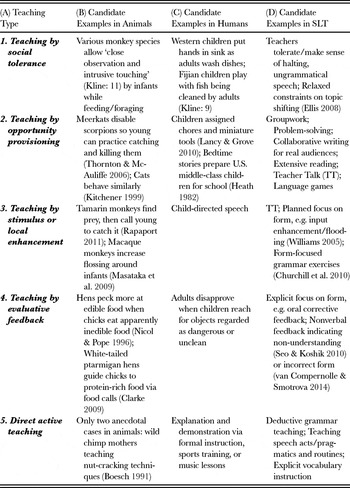
Kline (Reference Kline2015) presented a taxonomy of teaching behaviors based partly on Caro & Hauser (Reference Caro and Hauser1992). This taxonomy is culled from three major research traditions in human and animal learning – psychological, anthropological, and functional – and ‘differentiates between teaching types according to the specific adaptive problems each type solves’ (p. 1). Kline's taxonomy therefore complements my own working definition by describing particular behaviors or mechanisms by which adaptation-oriented teaching is achieved. I will use this taxonomy to introduce candidate teaching behaviors in animals and humans in this section, and then again to categorize SLT behaviors in Section 5. Table 1 presents teaching types (Column A), followed by candidate examples in animals (Column B), humans (Column C), and SLT (Column D).
Kline's (Reference Kline2015) taxonomy of teaching types, with candidate examples from Kline, other researchers, and present author's experience

Kline's first teaching type is teaching by social tolerance. Social tolerance occurs when novices insert themselves into mature group members’ activities, but ‘the teacher does not stop the pupil's close and intrusive’ (p. 7) involvement. This type of teaching represents the lower boundary of teaching types in Kline's taxonomy because it requires the least amount of teacher effort and accommodation. By my own definition, it is teaching only to the degree that it reshapes the learning environment. Teaching by social tolerance is nonetheless likely a major form of teaching in both animals and humans because it allows for early modeling, imitation, and participation in complex social activities, and therefore stimulates adaptive learning and early independence. Many animals’ young explore their environments actively, and teaching by social tolerance must be built on such instincts.
Social tolerance is exhibited frequently by primates. Thus, captive capuchin monkeys universally tolerate their infants’ intrusive observation during nut-cracking, even letting them ‘steal’ the resulting edibles (Fragaszy, Feuerstein & Mitra Reference Fragaszy, Feuerstein and Mitra1997). Chimpanzees, although they apparently do little else to facilitate learning in their offspring, readily allow them to interfere with tool use, e.g. termite fishing (Lonsdorf Reference Lonsdorf2006).
Candidate examples of social tolerance in humans include children intrusively observing and attempting to participate in housework, such as cooking and cleaning. Gaskins & Paradise (Reference Gaskins, Paradise, Lancy, Bock and Gaskins2010) found such learning ‘in virtually every ethnographic description [they examined] of children's lives from around the world. . . . In many of these cultures, it is the primary teaching/learning strategy’ (p. 90, emphasis added). This seems especially apparent in ‘traditional’ village-based societies, where adults commonly work in the presence of children. Unlike in many schools, children reportedly exhibit high degrees of independence and intrinsic motivation while learning in this way.
Kline's second teaching type is teaching by opportunity provisioning. Here, adults provide youngsters learning opportunities that would otherwise be difficult to obtain. Adult meerkats, for instance, supply scorpions to pups in ways that allow them to learn how to catch, kill, and eat them safely and efficiently (Thornton & McAuliffe Reference Thornton and McAuliffe2006): Infants first receive dead scorpions with stingers removed; next, they receive live but partly immobilized scorpions, again with stingers removed; finally, they receive intact scorpions, but adults monitor the situation, immobilizing or retrieving the scorpions as needed. The graded nature of this behavior is keyed to differences in infant vocalizations rather than direct sensitivity to developmental level, with younger infants’ calls eliciting more conservative provisioning strategies. Opportunity provisioning also occurs in the cat family (Kitchener Reference Kitchener, Box and Gibson1999), where mothers seem to have direct and thus presumably more flexible sensitivity to offspring's developing hunting skills.
Examples of opportunity provisioning are common in humans and are sometimes combined with other forms of teaching. Prominent examples in the anthropological literature include chore provisioning, wherein ‘the road to mastery often pass[es] through play’ (Lancy & Grove Reference Lancy, Grove, Lancy, Bock and Gaskins2010: 155). Miniature versions of work tools are therefore provided in some societies: Mayan girls, for instance, use ‘a winding tool, called the toy loom,. . . adapted to younger girls who are first learning to wind a warp, and a winding tool, called a warping frame,. . . adapted to older girls who have some experience in weaving’ (Maynard & Greenfield Reference Maynard and Greenfield2003: 492).
A second example of human opportunity provisioning is the bedtime stories American middle-class parents read to their children. Heath (Reference Heath1982) found that such stories provide highly repetitive opportunities to learn school-valued language practices, including: (1) answering specialized question types children will encounter in school; (2) ‘routines which parallel. . . classroom interaction’ (p. 56); (3) displaying knowledge appropriately in academic settings; and (4) talking in a decontextualized ‘academic’ style. Socialization to such practices often helps middle-class children look like little geniuses when they enter school; in reality, they have been in training since infancy.
Kline's third teaching type is teaching by stimulus or local enhancement. Here teachers focus learners’ attention on learning targets, in what has also been called ‘education of attention’ (Ingold Reference Ingold2000). One oft-cited animal example is wild golden lion tamarin monkeys, which extract small prey animals from tree knotholes and dense foliage (Rapaport Reference Rapaport2011). Adults sometimes emit distinctive calls when doing so, effectively inviting their young to feed. As the youngsters mature, however, adults call less frequently after catching prey, but begin to call after simply locating it. The offspring then appear and catch the prey themselves. Youngsters exposed to this behavior improve their rate of prey-catching, and adults show sensitivity to youngsters’ developing ability by changing the function and frequency of their calls. A second example of possible stimulus enhancement in animals is increased flossing by wild macaque monkeys when offspring are present (Masataka et al. Reference Masataka, Koda, Uraspon and Watanabe2009).
An exemplary instance of human teaching through stimulus enhancement is child-directed speech (CDS). By performing a limited set of (apparently automatic) linguistic operations on adult speech, e.g. vowel lengthening, exaggerated intonation, slower tempo, repetition, and syntactic and lexical simplification, adults produce a conventionalized speech style which, as firmly established in recent research (e.g. Ramírez-Esparza, García-Sierra & Kuhl Reference Ramírez-Esparza, García-Sierra and Kuhl2014), promotes child language development.
The fourth type of teaching in Kline's framework is teaching by evaluative feedback. Here, too, animals provide possible examples, appearing to promote or discourage survival-impacting behavior in their young. Domestic chicken infants, for instance, preferentially peck at the same food as their mothers. Nicol & Pope (Reference Nicol and Pope1996) separated mothers and chicks and trained them independently on two colors of feed: yellow and blue. For the mothers, however, the blue feed was rendered inedible, while both colors were edible for the chicks. Mother and chicks were then placed in the same enclosure, but separated by a transparent barrier, and provided the same colors and kinds of feed they had been trained on. When the chicks pecked at the blue feed, the mothers increased their rate of pecking at the yellow feed, apparently to demonstrate that the blue feed was inedible. Other bird species also appear to teach food preferences: thus, white-tailed ptarmigan hens emit food calls when feeding on high-protein plants in their young's presence, leading the latter to feed preferentially on such plants. They continue to do so once they become independent (Clarke Reference Clarke2009).
Human children pervasively experience teaching by evaluative feedback. In the anthropological literature on child socialization, negative evaluation, often accompanied by physical enforcement, is described as a major teaching strategy across societies (Lancy & Grove Reference Lancy, Grove, Lancy, Bock and Gaskins2010). I personally observed two instances of teaching by evaluative feedback at U.S. airports in summer 2016, which I recorded in fieldnotes. In the first case, an older caregiver, who I guessed was the child's grandmother, successively pulled a toddler's hand out of two seat cupholders (commonly used in that airport as trash receptacles) while repeating ‘No, dirty!’ each time. In the second case, I overheard a male caregiver (who I assumed was the child's father) tell a young boy while positioning him at an adult-sized urinal in a men's restroom: ‘Don't touch. Dirty. Just pee.’
Kline's fifth and final teaching type is direct active teaching. This occurs when: (1) Teachers actively introduce students to learning targets and/or how to achieve them; and (2) Learners actively interpret teachers’ behavior as introducing something to be learned (p. 8). The key requirement in direct active teaching is therefore ‘“direct” or “explicit” communication of information’ (p. 8). Direct active teaching solves the adaptive problem of not being able to attend or be exposed to information or skills potentially relevant to learners’ well-being.
Direct active teaching is generally believed to be unique to human beings, although Boesch (Reference Boesch1991) described two cases (across nearly ten years of observation) of wild chimpanzee mothers actively teaching offspring nut-cracking techniques. While no further evidence of direct active teaching in animals exists, it is common in humans (but see below for qualifications). Schools and informal teaching situations such as tutoring centers, sports clubs, and music lessons thrive on direct explanation and demonstration, but are by no means limited to them. At the same time, formal schooling is a recent invention in our species history, and only in the 21st century has it begun to approach universality at the primary level, although 59 million children remain out of school (UNICEF 2016). Anthropologists have even claimed, as reviewed and evaluated in the next section, that neither formal schooling nor direct active teaching are universal at all.
4. Teaching across human societies
Kline (Reference Kline2015) asserted that ‘cultural anthropologists studying childhood and learning in diverse societies claim that teaching is unique to western cultures and absent elsewhere’ (p. 2).Footnote 7 I here review the four studies cited to support this assertion. Three are major reviews of the anthropological literature; the fourth examined hunter-gatherer societies to test whether teaching exists among them. This is important because hunter-gatherers have the longest evolutionary history by far among human groups.
Lancy & Grove (Reference Lancy, Grove, Lancy, Bock and Gaskins2010) reviewed hundreds of ethnographic accounts of child socialization from the ‘traditional’ (i.e. village-scale, non-industrialized) societies represented in the Human Relations Area Files, one of the world's largest collections of ethnological material. They concluded that most ‘ethnotheories of child socialization include that children learnt best on their own, and that this initiative frees up adults from serving as teachers’ (p. 164). Likewise, most things children needed to learn were freely available through participation in community life, along the lines of legitimate peripheral participation (Lave & Wenger Reference Lave and Wenger1991). Overt teaching, glossed briefly as teaching ‘in the explanatory, didactic sense’ (Lancy & Grove Reference Lancy, Grove, Lancy, Bock and Gaskins2010: 146), was virtually absent from the ethnographic record.
Gaskins & Paradise (Reference Gaskins, Paradise, Lancy, Bock and Gaskins2010) found observational learning (OL) ‘in virtually every ethnographic description [they reviewed] of children's lives from around the world. . . . In many of these cultures, it is the primary teaching/learning strategy’ (p. 90). Yet OL's importance is often overlooked in school-oriented societies. In societies where members are not segregated by age, labor, or formal education, however, and are thus typically co-present during everyday activities, OL takes on profound importance. This is because highly valued social practices are openly available for observation and participation, and children actively, agentively, and enthusiastically engage in them. Yet OL also co-occurs with various types of teaching: (1) ‘direct instruction;’ (2) ‘learning while working;’ (3) teaching ‘through narrative;’ and (4) teaching ‘from feedback’ (p. 104).
Paradise & Rogoff (Reference Paradise and Rogoff2009) reviewed research on informal learning (InL), i.e. learning that occurs through participating in community activities, much as described just above. InL is a pan-human and evolutionarily long-lived phenomenon which tends to get marginalized in learning research, either because it seems so natural and mundane or because it is treated as ‘conceptual[ly] or cognitive[ly]’ (p. 102) inferior to classroom learning. Yet InL is an effective and broad-ranging learning approach which often outshines formal education, characterized by Paradise & Rogoff as ‘assembly-line education.’Footnote 8 ‘Keen attention,’ intrinsic motivation to join the group, agency, and implicit understanding of the value and relevance of the activities being learned stimulate higher levels of engagement than are often found in schools. Learners are largely responsible for their own learning, and thus often learn without expert guidance, although the latter also features in InL. As a paradigm example of the breadth and depth of informal learning, the authors cite first language acquisition.
Finally, Hewlett et al. (Reference Hewlett, Fouts, Boyette and Hewlett2011) summarized their research on social learning and teaching among the Bonfi and Aka of central Africa – two of the few remaining hunter-gatherer groups in the world. They did so to test claims that teaching was absent in traditional societies, since virtually all such societies studied to that point had been agriculture-based, whereas hunting-gathering ‘characterized 99 per cent of human history and constituted the [universal] environment(s) of evolutionary adaptation’ (p. 1168). Findings indicated that, different from agricultural groups, the Bonfi and Aka are highly egalitarian and place great value on individual autonomy. As a result, group members are ‘not likely to feel that they know what is best. . . for a child and are generally unlikely to initiate, direct or intervene in a child's social learning’ (p. 1173). Children, for their part, are self-motivated and engaged learners. At the same time, group members reported learning most practical and cultural knowledge from their parents. Based on this somewhat mixed picture, the researchers concluded that teaching occurs reliably in hunter-gatherer societies, particularly for younger children, but is ‘relatively rare’ (p. 1176).
Based on this review, I conclude that Kline's (Reference Kline2015: 2) characterization of the anthropological literature as claiming that ‘teaching is unique to western cultures and absent elsewhere’ is inaccurate. According to these sources, teaching is not absent across traditional societies, although it may be relatively rare. It is also clear that anthropologists have been working from loose and substantially intuitive definitions of teaching. An additional limitation of this research, fully acknowledged by Gaskins & Paradise (Reference Gaskins, Paradise, Lancy, Bock and Gaskins2010), is that teaching in traditional societies is difficult to study ethnographically since it typically occurs in subtle, highly organic ways.
5. ‘Teaching’ in SLT
I have ranged widely in this paper, moving far beyond the SLT field. My main reason for doing so was that teaching has been so lightly and inadequately defined in the field that one is forced to look elsewhere for useful definitions. But let me return now to SLT.
SLT must be a very ancient phenomenon. Kelly's (Reference Kelly1976) volume 25 centuries of language teaching begins only in 550 bce, but in how many earlier millennia was second language learning actively facilitated? As evolutionarily adaptive behavior, SLT must be very old indeed, and major continuities must exist across its past and present incarnations. If CDS, for instance, is an evolutionary adaptation facilitating mother-child bonding as well as long-term acquisition of social-linguistic competence (Fernald Reference Fernald, Barlow, Cosmides and Tooby1992), couldn't ‘foreigner talk’ be an evolutionary adaptation too? Recent research (e.g. Bryant & Barrett Reference Bryant and Barrett2007) seems to suggest this possibility.
As mentioned above, formal education is a recent human innovation: educational historians usually trace it back no farther than ancient Greece (e.g. Tehie Reference Tehie2007). Clearly, classrooms are exemplary products of cultural evolution, creating highly developed technological/cultural niches (Boyd et al. Reference Boyd, Richerson and Henrich2011) which enable at least some of our species to adapt to a modern, globalized, highly technological world. Combined with other recent cultural innovations – e.g. literacy, mathematics, science, and modern economic and political systems – formal education has reconfigured many human environments virtually beyond recognition; it is certainly one of the major social institutions of modernity. The pervasive methods focus in SLT mentioned at the beginning of this paper is in this sense clearly a result of the technological nature of formal education – one cannot be a professional educator without knowing how to operate its complex cultural tools.
Yet many of the things we do in SL classrooms must have deeper evolutionary roots. Classrooms-as-technologies were not innovated from nothing, but, like all existing technologies, bootstrapped from pre-existing abilities and practices. This can be shown, I believe, by applying Kline's taxonomy of teaching types to current classroom practices in SLT (Table 1, Column D).
Thus, teaching by social tolerance is a central pillar of SLT: the very notion of the classroom itself as a space apart from the ‘real world’ suggests greater latitude for error – a place where one can practice/simulate the skills being learned. SL teachers tend to be highly tolerant of halting, ungrammatical, phonologically inaccurate language use in lower-level language classes. As Breen (Reference Breen1985) explained, the rules of everyday language use do not apply in SL classrooms.
Similarly, Kline's second teaching type – opportunity provisioning – pervades SL classrooms. SLT's communicative curriculum focuses largely on providing ‘real-life’ communication opportunities. Of course, such communication is undertaken primarily for the sake of learning, and in that sense is simulated. Yet good communicative classrooms often narrow the gap between simulated and everyday communication, e.g. through groupwork planning of class outings, collaborative writing of letters to the editor, or extensive reading. Whether simulated or not, however, communicative activities are important opportunity-provisioning tools. Like meerkats, we teach by providing novices structured learning opportunities they wouldn't otherwise receive.
This also applies to Kline's third type of teaching: stimulus/local enhancement . Teacher talk (TT), for instance, may be a mixed case of opportunity provisioning – language provided in modified form to make it more accessible – and stimulus enhancement, wherein repetition, slower speech rate, fewer contractions, exaggerated intonation, gesture use, etc. make linguistic form more salient. If Goldschneider & DeKeyser (Reference Goldschneider and DeKeyser2001) concluded correctly that perceptual salience determines the morpheme acquisition order found in early SLA research, then shouldn't perceptual salience also be afforded by TT? Certain kinds of planned focus on form (FonF – Williams Reference Williams and Hinkel2005), such as input flooding, may also powerfully educate attention. Likewise, traditional grammar exercises (e.g. fill-in-the-blank, sentence translation) are basically attention-educating machines (Churchill et al. Reference Churchill, Nishino, Okada and Atkinson2010).
Kline's fourth teaching type – teaching by evaluative feedback – is a mainstay in current SLT. Thus, a primary purpose of the FonF movement is to provide corrective feedback in cases where a form is meaningful but inaccurate. Explicit correction may have been a major SLT strategy from time immemorial, but FonF suggests how long-lived cultural traditions undergo progressive transformation. Recent research on nonverbal aspects of pedagogical interaction suggests that head movements and gestures are also powerful tools for providing meaning-based (Seo & Koshik Reference Seo and Koshik2010) and form-based (van Compernolle & Smotrova Reference van Compernolle and Smotrova2014) feedback. These embodied communicative tools doubtless predate language (Levinson Reference Levinson, Enfield and Levinson2006), and may therefore have served as teaching tools for a very long time.
Finally, direct active teaching has been the traditional bread-and-butter of classroom teachers. Deductive grammar teaching, direct pragmatics instruction, and explicit vocabulary instruction are just three of many manifestations of direct teaching in current SLT. Without a doubt, this is the teaching type that depends most fully on language, which appears to exist at a complex level only in humans. At the same time, as I hope I have indicated here, direct active teaching is just one of several teaching types, and not one considered particularly effective (at least in communicatively oriented SLT) in recent decades.
6. Implications and future directions
As stated at the beginning of this paper, my goal has not been to provide a definitive definition of teaching in SLT. Rather, I've made a preliminary attempt to engage in what, in my opinion, is a critical endeavor: shouldn't understanding the complex and long-lived ecosocial activity called SLT adequately – answering, at a certain depth, the classic social science question, ‘What is going on here?’ – entail trying to define it seriously? That is what I hope I have begun to do here. At the same time, it is reasonable to ask what implications and future directions the ideas presented here might suggest.
Regarding teaching, it is my belief that the definitions of teaching and taxonomy of teaching behaviors presented here can spark heuristic thinking on what we do when we teach. Certainly, teaching is not simple or uniform, but rather complex and multidimensional: multiple types of activity that provide multiple types of learning opportunities. If we are prompted to think in more detail about what we do as teachers – about what teaching actually is – it can help us to take a more knowledgeable, thoughtful approach to teaching.
Regarding research, the first and most general question is similar to the one just raised: how to promote further research regarding what ‘teaching’ actually means in our field. Teaching methods – our adaptive cultural technologies – are critical to our practice, but the larger question of what human activity we are engaged in when enacting them must also be investigated. In educational circles, this question is at least on the table (e.g. Lave Reference Lave1996; Wenger Reference Wenger1998; Smith Reference Smith2016); in SLT circles, as far as I know, it has yet to arrive. What additional perspectives can be brought to bear on what teaching actually is, including those of classroom research?
Second, the muddy question of how much intentionality figures in human teaching arises. If teaching is a deeply evolved human ability, might not much of it occur simply in the course of daily interaction, as proposed in the theory of natural pedagogy (Csibra & Gergely Reference Csibra and Gergely2011)? Hewlett & Roulette (Reference Hewlett and Roulette2016) found that teaching episodes among the hunter-gatherers they studied were brief and highly integrated into ongoing community life, e.g. an adult guiding a child (in learning to dance, for instance) might alter the child's movement by a slight shift of their own weight. Yet by focusing by and large on highly intentional teaching situations– those of formal education– have we arbitrarily limited our scope? Even in classrooms, much – perhaps most – pedagogical activity may occur below the level of consciousness. Consider, for example, the place of gestures and body movement in SL teaching/learning, a topic that has received increased attention in recent years (e.g. Churchill et al. Reference Churchill, Nishino, Okada and Atkinson2010; van Compernolle & Smotrova Reference van Compernolle and Smotrova2014). Few if any SLA researchers would claim that gesturing is consciously planned or executed to accomplish a discrete teaching task, although there is interest in teaching teachers how to do so.
Third – and closely related to the first two questions – what is the relationship between teaching and learning from an adaptive perspective? An evolved instinct for learning mirrors an evolved instinct for teaching in some senses, and both need to be present, at least in some situations, for effective learning to occur. Shared foci of attention and cooperative alignment suggest the ecological unity of learning and teaching acts, the final test of which is, of course, effective learning. Ecological and sociocognitive approaches to learning (e.g. Atkinson Reference Atkinson2014) view teachers and learners as ecological units, rather than separate entities.
Fourth and finally, and closely related to the foregoing, if both learning and teaching are ultimately forms of adaptive behavior – if we teach in order to promote survival, and learn in order to survive – then our views of teaching and learning need to fully account for this. Conceptualizations of teaching and learning that locate them substantially in actors’ heads (e.g. teacher cognition, cognitivist SLA) do not do justice to the adaptive, integrative nature of human intelligence. One does not cognize – including learn and teach – in order to re-present the outer world cognitively, but rather to bring cognition to bear on providing those most basic of human needs: survival and prosperity in the outer world.
Acknowledgements
For their generous sociocognitive involvement in this project, I thank Christine Casanave, Juhyun Do, James Paul Gee, Samuel Gee, Lee Jung Huang, Robert B. Kaplan, Hayriye Kayi-Aydar, Aya Matsuda, Paul Kei Matsuda, Takako Nishino, Jonathon Reinhardt, Elena Shvidko, Tetyana Smotrova, Christine Tardy, and Steve Thorne.
Dwight Atkinson is an applied linguist and second language educator who is currently a professor of English at the University of Arizona. His research interests range widely, including second language acquisition, second language writing, theories of culture, qualitative research methods, and the learning of English by first-generation college students in India. Recent work has appeared in The Modern Language Journal (Douglas Fir Group 2016), Journal of Second Language Writing, Handbook of Second and Foreign Language Writing, and Routledge Handbook of Language and Culture.