Written and conceived by Jesusa Rodríguez and Liliana Felipe, El Maíz (Corn) was performed at the Los Angeles Theater Center on 23 November 2008, as the closing event of the Actions of Transfer conference. Performed in Spanish with Nahuatl excerpts and English supertitles, El Maíz works through a fractured narrative that weaves songs with theatrical action and ritual to explore issues of indigeneity, gender, transnational/global encounters, labour, violence and access to material resources.
Dubbed one of the most important women in Mexico for her artistic, political and social work, Jesusa Rodríguez is widely recognized as one of the country's most creative and controversial artists/activists. Her espectáculos (spectacles) defy easy categorization, as she works across several artistic traditions including pre-Columbian cosmology, sketch comedy, teatro de carpa (Mexican travelling theatre), revue, cabaret, opera, Greek tragedy and sociopolitical acts of protest. In 1980, Rodríguez began a lifelong partnership and collaboration with famed Argentine actress, singer, pianist and composer Liliana Felipe when they established an alternative creative and cultural space, El Cuervo (the Raven), a theatre-bar in Coyoacán, Mexico City. In 1990 they opened a second theatre-bar, El Hábito (word-play on a nun's habit) and the adjacent theatre La Capilla (the Chapel). From 1980 to 2005, together with Divas, a theatre collective they formed in 1983, Rodríguez and Felipe staged over two hundred shows ranging from farces, musicals and soap operas to shepherds’ plays, as well as over thirty cabaret shows directed by Rodríguez for which Felipe wrote and performed the music.Footnote 1 Over the years, El Hábito hosted frequent gatherings by political groups such as the Zapatista rebels, non-government organizations and feminist and political activists, as well as local citizens who sought a forum to express their discontent and practise civic resistance. In 2006, Rodríguez and Felipe founded Resistencia Creativa (Creative Resistance), an organization committed to raising awareness about the political and electoral fraud that ravaged Mexico during the 2006 presidential elections.Footnote 2 Central to the couple's work has been a fierce commitment not only to exploring the symbolic value of women central to Mexican historical and cultural narratives, including the Aztec goddess Coatlicue, La Malinche, Sor Juana Inéz de la Cruz and Frida Khalo, but also to employing performance as a political tool to resist the many forms of institutionalized corruption both locally, in Mexico, and globally.
Jesusa Rodríguez in the early scenes of El Maíz as ancient indigenous woman, preparing for a voyage into the underworld. (Photo by Julio Pantoja, Hemispheric Institute Encuentro, 2005, Belo Horizonte, Brazil.)

Rodríguez and Felipe created El Maíz as a response to Mexico's increasing dependence on imported corn from primarily US-based transnational corporations and to the threat posed by genetically modified seeds to Mexican crops. Blending ritual, cabaret, activist performance and object theatre, the performance decries the damaging impact of transnational agribusiness on Mexico and highlights the cultural significance of corn to the country's identity. The piece was originally conceived for the Guggenheim Museum's 2004 exhibition The Aztec Empire, and was subsequently performed in Belo Horizonte, Brazil (2005); Cadiz, Spain (2006); Mexico City, Mexico (2007) and Chiapas, Mexico (2008). Framed by the conference, El Maíz invited a consideration of the female body as the locus both for interrogating ideological, economical, political and social discourses, and for the transference of ideas, histories, myths, traditions and, ultimately, actions. As Roselyn Costantino has argued, in Rodríguez's work ‘women's bodies function simultaneously as the vehicle and the message . . . the myth of the origin is literally mapped and weighted onto [Rodríguez's] body’.Footnote 3
Semi-naked, covered in body paint, and wearing only a taparrabo (loincloth) and a jade mask, Rodríguez fills an otherwise empty stage with a strip of butcher paper, pots of coloured powder, and incense. At the piano, and visible onstage throughout the performance, Felipe accompanies Rodríguez through her journey into the underworld to reactivate the myth of the origins of corn (Fig. 2).
Liliana Felipe performing songs from El Maíz. (Photo by Julio Pantoja, Hemispheric Institute Encuentro, 2005, Belo Horizonte, Brazil.)

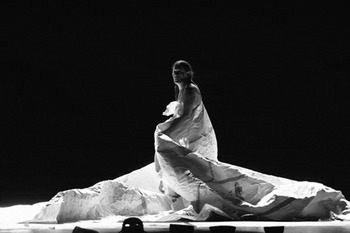
Rodríguez traces this journey by painting her feet and marking her path to the underworld on a large sheet of paper that results in a spiral, conch-like image. Echoed by Felipe's blowing of a conch shell, the performance blends elements of ancient Mayan and Aztec ritual while making poignant reference to Mexico's modern indigenous populations. Rodríguez symbolically enters the underworld by climbing underneath the butcher paper and emerges wrapped within it, metamorphosing into the form of a large shell that resembles a caracol (snail).
Through the image of the caracol, the best-known symbol of the Zapatista movement which lays claim to autonomous government in the face of globalization, Rodríguez not only aligns her performance with the struggle of the indigenous populations of Mexico, but in so doing also intervenes artistically, through her own mestiza body,Footnote 4 to bridge the gap between two common treatments of indigeneity: the mythical and romanticized view that relegates the indigenous to the past, and the self-representation and affirmation of culture, land, and rights by contemporary indigenous peoples. Similar to the celebration of indigenismo in the early Chicana/o theatre movement,Footnote 5El Maíz engages with representations of indigenous ritual, myth and iconography. However, rather than mobilizing these links to an ancient heritage and ancestry as a means to understanding a hybrid, US–mestizo identity, El Maíz performs hemispherically, addressing contemporary social and political issues which directly affect indigenous and non-indigenous communities across the hemisphere.
Blending physical comedy with minimalist staging, Rodríguez re-enacts the moment of human creation achieved through the blood sacrifice of the Aztec deity Quetzalcóatl, and the nourishment he provides through his gift of corn. When she returns to the earth's surface as La Muerte (Death), Rodríguez finds herself in a world full of violence, death and aberration, as Quetzalcóatl's seed of humanity has been genetically modified and commodified by transnational corporations. While Rodríguez embodies the myths of two important historical and cultural icons, Quetzalcóatl and La Muerte, she eschews any kind of romantic or cultural nationalistic sense of ritual and myth. Key in this regard is the way in which Rodríguez's performance is partnered by Felipe's transgressive political librettos to reflect on the chaos and destruction of the natural world, exemplified in the title song ‘El Maíz’:
(Popcorn used to be made of corn and we humans had roots, today it's transgenic, genetic, cloned, biotechnical, modified. Now it's a parasite, an enhanced freak, a contaminated pharma-crop. No, there isn't even corn, there is no more corn, our roots have dried up.)Footnote 6
Jesusa Rodríguez emerging from the underworld. (Photo by Julio Pantoja, Hemispheric Institute Encuentro, 2005, Belo Horizonte, Brazil.)

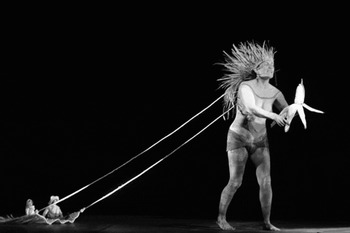
Jesusa Rodríguez as Aztec deity Quetzalcóatl, animating the myth of human creation. (Photo by Julio Pantoja, Hemispheric Institute Encuentro, 2005, Belo Horizonte, Brazil.)

Ultimately, El Maíz is more than a celebration of corn: it serves as a call to action against the threat to contaminate and homogenize the three hundred or more varieties of corn in Mexico. As a cultural worker, Rodríguez expertly marks the centrality of corn to the needs and cultural imaginary of the Mexican people, and likens the actions of transnational companies to a modern colonization of Mexico – its civilization again endangered by los bárbaros del norte (the barbarians of the North). Attacked by a serpent prop (another reference to Quetzalcóatl), for instance, her body symbolizes a Mexico strangled by transgenic corn.
Rather than a lament, however, Rodríguez's cabaret and activist aesthetics constitute an action of transfer itself. As the audience is left with the image of La Muerte being pummeled by dried corn kernels that fall from above, and planting one of the kernels in a pile of dirt, they are symbolically entrusted with the task of seeding the future. ‘You didn't hear it from me,’ Rodríguez says in an earlier comic scene involving a word play with the Spanish verb decir (‘to tell’), but ‘planting’ the information in her audience, she leaves them with the social responsibility of acting in the shared interests, locally and globally, of ‘growing’ less (com)modified, damaged futures.