INTRODUCTION
The body size of any organism influences all aspects of its life, its evolution being correlated with those of most life-history traits (Morand and Sorci, 1998). For parasites in particular, the host body size constitutes another crucial variable influencing their ecology and evolution. The effects of host body size on its parasite burdens have been known since the middle of the past century (Dogiel, 1964). During the last decades the influence of host body size/age on both demographic parameters and community structure of parasites has been one of the central topics of parasite ecology (e.g. Guégan et al. 1992; Saad-Fares and Combes, 1992; Poulin, 1995a, 2000; Lo, Morand and Galtzin, 1998; Poulin and Valtonen, 2001; Duerr, Dietz and Eichner, 2003, Luque, Mouillot and Poulin, 2004). However, a comparatively lower number of studies have investigated the evolution of the body size of parasites themselves (Price, 1980; Poulin, 1995b,c,d,e, 1996a; Poulin and Hamilton, 1995; Poulin and Morand, 1997) and a few others have related both parasite and host sizes from an evolutionary perspective (Harvey and Keymer, 1991; Poulin, 1996b; Morand et al. 1996, 2000, 2002; Sorci, Morand and Hugot, 1997; Arneberg, Skorping and Read, 1998; Morand and Sorci, 1998; Sasal et al. 1999; Simková et al. 2001).
Most previous studies on parasite body size have been carried out in a comparative way, e.g. by analyses across species or by comparing the body size of parasites with those of either their extinct free-living ancestors or their closest free-living relatives. However, there are very few studies on within species relationships between host and parasite sizes.
The host population is a supply of patches that vary genetically and physiologically only within the limits of the host species (Janovy, Snyder and Clopton, 1997). However, ontogenetic changes in the ‘habitat’, such as an increasing size as the host grows, should be expected to have some consequences on their parasites. Gills of fish, in particular, are variable structures whose spatial heterogeneity is in part due to the increase in size of the fish (Caltran and Silan, 1996).
In a recent paper, Timi (2003) showed that the copepod Lernanthropus cynoscicola Timi et Etchegoin, 1996 (Lernanthropidae) displays a sequential displacement over the gill arches and differential preferences for specific gill sections of its fish host Cynoscion guatucupa (Cuvier, 1829) (Sciaenidae) in response to an increasing host size, probably as a consequence of a host size-related cline of optimal conditions where fitness is improved. In the present paper, another aspect of this host/parasite system is analysed to evaluate the effects of the size of C. guatucupa on the size of their parasitic copepod L. cynoscicola and their relationships with demographic parameters of the parasites.
MATERIALS AND METHODS
A total of 854 specimens of a coastal marine species, the striped weakfish C. guatucupa, collected at irregular intervals from 1992 to 2004, were examined for parasitic copepods; fish were obtained from commercial catches, landed at Mar del Plata Port (38 ° 08′S – 57 ° 32′ W) by the coastal fleet, composed of small trawlers which only catch fish close to the coast, from July, 1992 to March, 2004, with specimens smaller than 30 cm being obtained as accidental catches of prawn fishery.
Each fish was measured (total length in centimetres). Gill arches were excised, placed in a Petri dish and examined using a stereoscopic microscope. Copepods were counted and sexed. Prevalence, mean abundance and mean intensity of infestation (sensu Bush et al. 1997) were calculated for male and female copepods in relation to the host body size, arbitrarily divided in 11 intervals of 5 cm. As host sample sizes were unequal among size classes, their variations were controlled by Spearman's rank correlation analysis between sample size and prevalence for each parasite sex (Zar, 1984).
Body length (excluding legs) of 174 females and 54 males of L. cynoscicola was measured. The coefficient of variability (CV) in female copepod length, i.e. the standard deviation divided by the mean, was calculated for either the total sample of adult female copepods and for each host harbouring 2 or more adult females (n=36).
The relationships between host size and intensity were analysed by Spearman's rank correlation coefficients. Parametric correlation analyses were performed between coefficients of variability and both host length and number of females per host, as well as between host length and copepod length. Two variables, coefficient of variability and number of conspecifics per host, did not meet the assumptions of parametric tests and were log-transformed (Sokal and Rohlf, 1979).
Additional data on body length of both 219 L. cynoscicola (24 males and 195 females) and their hosts, obtained from a single catch of C. guatucupa during a research cruise at Uruguayan coasts (35 °38′S – 53 °19′W) in July 15th, 1993 were used for correlation analyses between host length and copepod length. Data were analysed separately to avoid the possible effect of locality on copepod size. As most fish were of similar size, no division in size classes was made because small and large fish were under-represented.
RESULTS
A total of 262 copepods was found (prevalence: 18·2%, mean abundance: 0·3±0·8, mean intensity: 1·7±1·2, range: 1–9), including 59 males (prevalence: 5·7%, mean abundance: 0·07±0·3, mean intensity: 1·2±0·4, range: 1–2) and 203 females (prevalence: 15·6%, mean abundance: 0·2±0·7, mean intensity: 1·5±1·0, range: 1–8), 4 of them juvenile. Host lengths ranged between 3 and 63 cm. Lernanthropus cynoscicola was only detected on fish longer than 12 cm, therefore fish smaller than 13 cm (n=263) were excluded from subsequent analyses.
About 98% of fish parasitized by female copepods and all hosts harbouring male copepods, harboured 1 or 2 parasites. The maximum intensity recorded, 9 (1 male and 8 females) was observed in a single fish of 22 cm total length. All parasites were found attached to the gill filaments, except a male that was attached to the genital complex of a female.
No significant correlations were observed across the 11 fish size classes between sample size and prevalence for either male copepods (r=−0·19, n=11, P=0·58) and female copepods (r=−0·34, n=11, P=0·31), therefore no corrections for sampling effort were made.
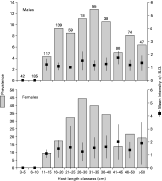
The prevalence showed an increase in host from 11–15 to 31–35 cm of total length for males and to 26–30 cm for females, and then decreased in longer fish, whereas the mean intensity was relatively low in all the length classes and showed no clear pattern in relation to host length (Fig. 1). In fact, intensity of copepods showed no relationship with the host length for males (r=0·24, n=49, P=0·09) and females (r=0·11, n=133, P=0·18).

Fig. 1. Prevalence and mean intensity of males and females of Lernanthropus cynoscicola in various size-classes of Cynoscion guatucupa. Number of hosts per size class is indicated over each bar.
The CV in the total sample of adult female copepods (n=174) was 0·27. The mean CV in hosts harbouring 2 or more females was 0·064±0·04. CV was independent of both the number of females per host (r=0·049, n=36, P=0·77) and host length (r=0·047, n=36, P=0·78).
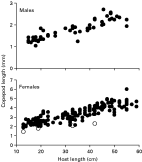
For Argentinean sample, body lengths of L. cynoscicola and C. guatucupa were significantly correlated with each other for males (r=0·89, n=54, P<0·01) and females (r=0·87, n=170, P<0·01, excluding juveniles) (Fig. 2). Two out of the 4 juvenile female copepods found in fish of 33 and 42 cm respectively, were longer than adult females (some of them ovigerous) recovered from smaller hosts (Fig. 2). Body length of copepods from Uruguay was also significantly correlated with host size for male (r=0·92, n=24, P<0·01) and female (r=0·89, n=195, P<0·01) parasites.

Fig. 2. Relationships between length of Cynoscion guatucupa and length of both males and females Lernanthropus cynoscicola. Full circles: adult copepods, open circles: juvenile females.
DISCUSSION
The variability of ectoparasite load on the gills of fish hosts is thought to be influenced by a myriad of interacting processes. The variability among fish in both the activity levels and initial parasite load, as well as host size-related factors, such as surface area and ventilation volume, can affect the probability of acquiring parasitic copepods (Poulin, Rau and Curtis, 1991; Poulin, Curtis and Rau, 1991). Therefore the probability of infection is, to a certain degree, host age-dependent.
Whatever the causes of host ontogenetic changes in parasite load, a higher prevalence and/or intensity of parasitic copepods on larger or older hosts has been commonly reported in the literature (Cressey and Collete, 1970; Boxshall, 1974; Rawson, 1976; Kabata, 1981; Etchegoin and Sardella, 1990). However some authors have also observed that lower levels of parasitism may occur in the largest hosts (Shotter, 1973; Kabata, 1981; Etchegoin and Sardella, 1990). Similarly, the prevalence of L. cynoscicola showed an initial increase from the host size-class 11–15 to classes of intermediate length, but then decreased in longer fish. On the other hand, parasite intensities were very low across the sample and independent of host size; this is not surprising given that low parasite burdens are a consistent feature of fish/ectoparasite relationships (Rohde, 1991). A threshold at approximately 13 cm of host length, below which copepods were absent, was observed. In the study area, segregation of C. guatucupa in age classes has been observed, however fish of all size classes inhabit the same areas (Cordo, 1986; Cousseau et al. 1986). Therefore, the absence of L. cynoscicola from fish smaller than 13 cm cannot be due to a differential habitat or behavioural patterns of juvenile with respect to adult fish.
Different processes have been postulated as potential causes of decreasing levels of parasitism by copepods in longer fish. Noble, King and Jacobs (1963) offered the explanation that older fish may develop some immunity to infestation. However, although a gradual development of acquired immunity of fish could generate the observed decline in prevalence, it does not explain its initial increase in smaller hosts.
On the other hand, Kabata (1959) concluded that distribution of copepods can be affected by the activity of the fish, the area of its gills chamber and the size of its gape; this suggests that an increase in these factors may be responsible for a decrease in parasite number, probably as a consequence of an increase in the strength of the respiratory current in older fish (Shotter, 1973; Etchegoin and Sardella, 1990). Another plausible explanation for changes in infestation levels with host size was postulated by Cressey, Collette and Russo (1983) for pseudocycnid copepods of scombrid fishes. The authors found an apparent ‘optimum’ host size with about twice the infestation rates of smaller and larger hosts. They attributed this pattern to mechanical factors: in smaller fish the gill filaments may be too small for a secure attachment of adult copepods, and as the fish grows, the filament may become too large for the parasite to remain attached.
The decreasing prevalence in larger hosts could be the result of a combination of both processes mentioned above. However, all these hypotheses consider parasites as mere ‘products’ of pressures imposed by their hosts, with parasite size as the outcome of host-related constraints. This perspective, however, does not take into account the size variability inherent to parasite populations themselves. In this sense, the concomitant increase observed between host and copepod sizes shed some light on the possible effect of the different variables in contributing to the distribution pattern of prevalence among host size classes, reinforcing these hypotheses. Both males and females of L. cynoscicola attach to gill filaments by clasping with prehensile second antennae, thus, as pointed out by Cressey et al. (1983), changes in filament size could affect their attachment capability. In fact, the body architecture of copepods belonging to the genus Lernanthropus is believed to have evolved to minimize the resistance to hydrodynamic forces (host respiratory currents) flowing over their body (Ho and Do, 1985), with their shape and size constrained by the possibility of being detached. Therefore only parasites of an ‘adequate’ size can be securely attached to a fish of a given size, avoiding the possibility of being dislodged by the force of respiratory currents. Similar relationships between host size and the dimensions of attachment devices have been observed in across-species comparative studies of other host-ectoparasite systems, such as pocket gophers and their chewing lice (Morand et al. 2000) and cyprinid fish and specialist species of dactylogyrid monogeneans (Simková et al. 2001). Although these studies measured interspecific differences in anatomical features, intraspecific differences in the gill size of C. guatucupa of different ages could affect the attachment capability within the population of copepods. This kind of ‘lock-and–key’ relationship, as designated by Morand et al. (2000), between anatomical features of hosts and parasites may explain the lowest limit of size of the fish population exploited by L. cynoscicola. It is probable that copepods, even the smallest ones, are too large to clasp securely the gill filaments of smaller fish to avoid dislodgement. On the other hand, the intraspecific size variability allows copepods to exploit the entire population of C. guatucupa larger than 13 cm.
Other studies, such as those by Van Damme et al. (1993) have shown that the size of parasitic copepods is host-size dependent. However, these kinds of relationships have been taken as evidence of developmental plasticity in size, instead of being a ‘lock-and–key’ relationship, with individual parasites attaining a size proportional to the size of their host (Poulin, 1995b). In this sense, it can be argued that any copepod offspring can attach to any fish and then could ‘adjust’ its final size in response to various pressures, i.e. a copepod infecting a large fish, with abundant resources and few constraints on the size it can achieve, could grow to larger sizes than another on a smaller fish, where constraints are more severe. It can also be argued that long-lived hosts would harbour long-lived, and consequently larger, parasites, such as postulated in a comparative analysis for endoparasitic nematodes (Morand et al. 1996). However these hypotheses are clouded by the following findings in the present study. (1) A host-size dependence of juvenile females size, some of them being larger than adult females on smaller fish. (2) Male copepods, with similar attachment devices to females, but markedly smaller in size and, therefore, less limited by space constraints, also show a significant host-size dependence of their size. (3) Larger (older) host are expected to harbour a higher number of copepods of different age, some of them ‘adjusting’ to them. However, the coefficient of variability on copepod size was not related to host size or number of congeners, and was markedly smaller that the coefficient of variability of the total sample. Indeed, it seems more likely that only larger infective stages were successful in attaching to larger hosts, instead of being solely a phenomenon related to phenotypic plasticity or parasite age; specially taking into account that larger females of L. cynoscicola produce larger eggs (Timi, Lanfranchi and Poulin, 2005), and therefore there must be size differences between infective stages within the copepod population.
Specimens from Mar del Plata were obtained during a long period, including samples from different seasons. However, because of the significant correlations observed between host and parasite sizes in the sample from Uruguay, were all fish were obtained from a single catch, the possibility of influence of temperature as well as of depth of capture on parasite development and/or size is disregarded.
In this scenario an alternative explanation for the observed peak of prevalence in fish of intermediate lengths arises. Some morphological features of biological populations are the result of a number of factors (genetic and environmental) interacting, with an additive effect, to produce a bell-shaped distribution of frequencies, e.g. the normal or Gaussian distribution (Sokal and Rohlf, 1979). The body size, in particular, of any species is determined by several genes, thus genetic factors only are enough to produce this kind of distribution curves, with values near the mean as the most frequent (Klug and Cummings, 1999). Therefore the observed distribution of prevalence along a ‘host-ontogenetic’ axis could merely reflect the frequency distribution of sizes in the population of L. cynoscicola. In other words, within the population of copepods there are more individuals with size near the average length than at the ends of the range, and they only can attach safely to fish of intermediate length, producing the observed bell shaped distribution of prevalence. Similarly, Van Damme et al. (1993), who found a significant positive relationship between the sizes of Lernaeocera lusci and of their host Callyonimus lyra, observed higher prevalence in intermediate host size-classes than at the extremes of the size range.
However, other forces could be helping to determine the bell shaped distribution of prevalence of L. cynoscicola. In this species, body size is positively correlated with fecundity (Timi et al. 2005) that, in turn, is a determinant of transmission success for parasitic organisms (Poulin, 1995b). Assuming that the outcome of body size evolution in L. cynoscicola is the offspring size necessary to ensure transmission, the extent of transmission success relies on the number of available hosts that an infective stage can find and attach to, which in turns depends of the population size and/or density of fish hosts. Due to natural mortality, young cohorts in fish populations are much more numerous than old fish. Therefore the number of available potential hosts is not limiting for the transmission of smaller copepods, which in turn can be constrained by their smaller production of infective stages. On the other hand, larger copepods, which produce almost 5 times more eggs than small specimens (Timi et al. 2005), are constrained by a low probability of encounter with the rare larger fish.
Morand et al. (2000) stated that parasitic organisms face size constraints dictated by the physical dimensions of their habitat, which determines the lower and upper limits of their specific body size. In the light of the present results, it can also be postulated that, whereas intraspecific size variability of L. cynoscicola increases the range of hosts available to be exploited, the lower and upper boundaries of its size distribution can also be reinforced by transmission success, which in turn is constrained by both low parasite fecundity and low number of available hosts at the opposite ends of its range.
In conclusion, the apparent ‘optimum’ host size for L. cynoscicola could merely be the adequate size for most copepods (those of intermediate length) in the population, and therefore depends on a populational attribute of parasites. On the other hand its location along the host size range could be the result of a balance between parasite fecundity and number of available hosts, which increases and decreases, respectively, with both host and parasite size.
We are grateful to Dr Robert Poulin (University of Otago, New Zealand) for his critical comments and valuable suggestions on an earlier version of the manuscript. Financial support was provided by grants from Universidad Nacional de Mar del Plata (No. 15 E/225) and FONCYT (PICT 2003 No. 15192).