


1 Introduction
The goal of this paper is to construct and study an
$A_{ {\mathrm {inf}}}$
 -cohomology theory associated to a morphism of p-adic formal schemes. The absolute case was initiated by Bhatt-Morrow-Scholze [Reference Bhatt, Morrow and ScholzeBMS18]. However, extending their theory to the relative setting is not a straightforward procedure and requires the consideration of an intermediary topos where the décalage functor operates. We recall the setup and (main) results of [Reference Bhatt, Morrow and ScholzeBMS18]. Let C be a complete algebraically closed nonarchimedean extension of
$\mathbb {Q}_p$
 with ring of integers
$\mathcal {O}$
 and residue field k. Let
$\mathfrak {X}$
 be a proper smooth formal scheme over
$\mathcal {O}$
 . As usual, let
$\mathcal {O}^{\flat }$
 be the tilt of
$\mathcal {O}$
 and
$A_{ {\mathrm {inf}}} := W(\mathcal {O}^{\flat })$
 be one of the period rings of Fontaine. Then the authors of [Reference Bhatt, Morrow and ScholzeBMS18] construct an object
$A\Omega _{\mathfrak {X}}$
 which lives in
$D^{\geq 0}(\mathfrak {X}_{ {\mathrm {Zar}}}, A_{ {\mathrm {inf}}})$
 . The main result (cf. Theorem 1.8 in loc. cit.) is that the
$A_{ {\mathrm {inf}}}$
 -cohomology complex
$R\Gamma _{A_{ {\mathrm {inf}}}}(\mathfrak {X}) := R\Gamma (\mathfrak {X}_{ {\mathrm {Zar}}}, A\Omega _{\mathfrak {X}})$
 interpolates
-
(1) the absolute crystalline cohomology of the mod p reduction of $\mathfrak {X}$
 and
-
(2) the integral p-adic étale cohomology of the rigid-analytic fiber of $\mathfrak {X}$
.


In particular,
$R\Gamma _{A_{ {\mathrm {inf}}}}(\mathfrak {X})$
 also interpolates the de Rham cohomology of
$\mathfrak {X}$
 and the crystalline cohomology of the special fiber of
$\mathfrak {X}$
 .
Originally the construction of
$A\Omega _{\mathfrak {X}}$
 in [Reference Bhatt, Morrow and ScholzeBMS18] lacked the framework of a site. This was addressed and solved in [Reference Bhatt and ScholzeBS22] with the definitions of the q-crystalline and prismatic sites. Since the introduction of the q-crystalline site, it is more natural to directly compare
$A_{ {\mathrm {inf}}}$
 -cohomology to q-crystalline cohomology (or to prismatic cohomology, depending on taste), and to refine (1) as (cf. Theorem 17.2 in loc. cit.)
-
(1)′ $R\Gamma _{A_{ {\mathrm {inf}}}}(\mathfrak {X})$
is isomorphic to the q-crystalline cohomology of
$\mathfrak {X}$
.


This is indeed a refinement as the absolute crystalline cohomology is the base change of the q-crystalline cohomology (cf. Theorem 1.8(5) and Theorem 16.14 in loc. cit.). From this viewpoint, (2) may be regarded as a form of the étale comparison for the q-crystalline cohomology (or the prismatic cohomology).
Let us mention at this point, generalizing the work of [Reference Bhatt, Morrow and ScholzeBMS18], Česnavičius and one of the authors [Reference Česnavičius and KoshikawaCK19] were able to drop the smoothness assumption in
$\mathfrak {X}$
 and work with a semistable modelFootnote
1
. The generalization of (1)′ to the semistable setting was solved in [Reference KoshikawaKos21] (cf. Theorem 8.1 in loc. cit.).
In this paper we deal with the analogues of (1)′ and (2) in the relative setting under the smoothness assumption. The setup is as follows. Let
$f \colon \mathfrak {X} \to \mathfrak {Y}$
 be a proper smooth morphism of flat p-adic formal schemes over
$\mathcal {O}$
 . The flatness assumption is natural as
$A_{ {\mathrm {inf}}}$
 -cohomology theory only remembers information coming from the generic fiber. There should be some assumptions on
$\mathfrak {Y}$
 so that the adic generic fibers X and Y of
$\mathfrak {X}$
 and
$\mathfrak {Y}$
 , respectively, can be defined, but let us ignore this point for now. We construct an object
$A\Omega _{\mathfrak {X}/\mathfrak {Y}}$
 (depending on f) and study the induced relative
$A_{ {\mathrm {inf}}}$
 -cohomology complex
$R\Gamma _{A_{ {\mathrm {inf}}}}(\mathfrak {X}/\mathfrak {Y})$
 . Before we discuss the construction of these objects (including where they should live), let us make what information
$R\Gamma _{A_{ {\mathrm {inf}}}}(\mathfrak {X}/\mathfrak {Y})$
 should capture more precise. For (2), as integral coefficients (e.g.
$\mathbb {Z}_p$
 ) are not a good coefficient theory for the étale topology, it is more convenient to work in the pro-étale setting. So the relative version of (2) becomes
-
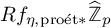
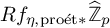
(2)rel $R\Gamma _{A_{ {\mathrm {inf}}}}(\mathfrak {X}/\mathfrak {Y})$
captures
$Rf_{\eta , {\mathrm {pro\acute {e}t}} *}\widehat {\mathbb {Z}}_p$
,

where
$f_{\eta } \colon X \to Y$
 is the induced morphism on the adic generic fibers, and
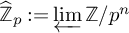
$\widehat {\mathbb {Z}}_p := \varprojlim \mathbb {Z}/p^n$
 as sheaves on the pro-étale site. For (1)′ and ignoring the notion of a q-PD pair for the moment, [Reference Bhatt and ScholzeBS22] construct a (big, global) site
$q-\mathrm {CRYS}(\mathfrak {X}/A_{ {\mathrm {inf}}})$
 equipped with a structure sheaf
$\mathcal {O}_{q-\mathrm {CRYS}}$
 (idem. for
$\mathfrak {Y}$
 ). The morphism f induces a cocontinuous functor of sites

and so the relative version of (1)′ becomes
-
(1)rel ′ $R\Gamma _{A_{ {\mathrm {inf}}}}(\mathfrak {X}/\mathfrak {Y})$
captures
$Rf_{q-\mathrm {CRYS}*}\mathcal {O}_{q-\mathrm {CRYS}}$
.


Let us now briefly review the construction of
$A\Omega _{\mathfrak {X}}$
 (in the setting of [Reference Bhatt, Morrow and ScholzeBMS18]), keeping in mind that it should be a complex whose cohomology interpolates between (1) and (2). On the site
$X_{ {\mathrm {pro\acute {e}t}}}$
 , there is the sheaf
$W(\widehat {\mathcal {O}}^{+, \flat }_X)$
 defined as the usual Fontaine period ring on affinoid perfectoid objects in
$X_{ {\mathrm {pro\acute {e}t}}}$
 (cf. [Reference ScholzeSch13, Definition 6.1]). For technical reasons one works with the derived p-adic completion of
$W(\widehat {\mathcal {O}}^{+, \flat }_X)$
 , denoted by
$\mathbb {A}_{ {\mathrm {inf}},X}$
 . There is a natural morphism of sites

and an initial approximation for
$A\Omega _{\mathfrak {X}}$
 is the pushforward
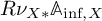
$R\nu _{X*}\mathbb {A}_{ {\mathrm {inf}},X}$
 . For an explanation of how to arrive at this approximation we refer the reader to [Reference Bhatt, Morrow and ScholzeBMS18, §1.4]. As a consequence of the primitive version of a comparison theorem (cf. [Reference ScholzeSch13, Theorem 1.3]), this complex almost captures the integral p-adic étale cohomology of X in a technical sense. One way to obtain a result on the nose is to invert a single element in
$A_{ {\mathrm {inf}}}$
 whose image in
$W(k)$
 is zero and this is essentially the content of [Reference Bhatt, Morrow and ScholzeBMS18, Theorem 1.8(iv)]. Regarding the (q-)crystalline side, it will be important to modify
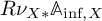
$R\nu _{X*}\mathbb {A}_{ {\mathrm {inf}},X}$
 . To see why, let us review the ‘local’ part of the argument of (1)/(1)′. The local computations are made in the case when
$\mathfrak {X}$
 has a description by tori-coordinates and can be summarized by the following schematic:

In this case, the upshot is that there is an explicit pro-(finite étale) affinoid perfectoid cover of the generic fiber (by repeatedly taking degree p Kummer extensions) and Faltings’ almost purity theorem means that
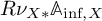
$R\nu _{X*}\mathbb {A}_{ {\mathrm {inf}},X}$
 can be almost computed by the Koszul complex associated to the Galois group acting on the explicit cover [Reference Bhatt, Morrow and ScholzeBMS18, (2) in p. 230]. On the other hand, an explicit (Koszul-like) complex calculating q-crystalline cohomology (in the context of (1)′) is the q-de Rham complexFootnote
2
. In order to compare the Koszul complex almost representing
$R\nu _{X*}\mathbb {A}_{ {\mathrm {inf}},X}$
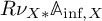 and the similarly shaped q-de Rham complex one must kill the non-integral contributionFootnote
3
of the Koszul complex. To achieve this, we need a special element of
$A_{ {\mathrm {inf}}}$
 . Fix a compatible system of primitive p-power roots of unity
$\xi _{p^r} \in \mathcal {O}$
 . The system
$(1, \xi _p, \xi _{p^2}, \ldots )$
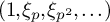 defines elements
$\epsilon \in \mathcal {O}^{\flat }$
 ,
$\mu = [\epsilon ] - 1 \in A_{ {\mathrm {inf}}}$
 , and let
$L\eta _{\mu }$
 be the associated décalage functor. Then, in the case
$\mathfrak {X}$
 is a torus, for instance, taking cohomology of the previous almost approximation and applying
$L\eta _{\mu }$
 gives an honest quasi-isomorphism:

with the source identifying with the q-de Rham complex. This is one way of motivating the construction of

and the passage from
$R\nu _{X*}\mathbb {A}_{ {\mathrm {inf}},X} \rightsquigarrow A\Omega _{\mathfrak {X}}$
 is the main novelty of the approach of Bhatt-Morrow-Scholze. Let us also mention that several key inputs (albeit in a different setting) mentioned so far stretch back to works of Faltings [Reference FaltingsFal88, Reference FaltingsFal02].
Let us now return to the relative situation. To get an idea of where
$A\Omega _{\mathfrak {X}/\mathfrak {Y}}$
 should live, say in some sort of space
$?$
 , the following two observations are key:
-
(a) Since the (relative) cohomology of $A\Omega _{\mathfrak {X}/\mathfrak {Y}}$
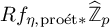
should capture
$Rf_{\eta , {\mathrm {pro\acute {e}t}} *}\widehat {\mathbb {Z}}_p$
, one idea is that there should be a map
$? \to Y_{ {\mathrm {pro\acute {e}t}}}$
. -
(b) By taking modulo $q-1$
, the q-de Rham complex identifies with the usual de Rham complex. So we see that the (relative) cohomology of
$A\Omega _{\mathfrak {X}/\mathfrak {Y}}$
should capture the usual de Rham complex
$\Omega ^{\bullet }_{\mathfrak {X}/\mathfrak {Y}}$
. As
$\Omega ^{\bullet }_{\mathfrak {X}/\mathfrak {Y}}$
lives in
$D(\mathfrak {X}_{ {\mathrm {Zar}}})$
, there should be a map
$? \to \mathfrak {X}_{ {\mathrm {Zar}}}$
.



So far (a)-(b) give us two maps
$? \to Y_{ {\mathrm {pro\acute {e}t}}}$
 and
$? \to \mathfrak {X}_{ {\mathrm {Zar}}}$
 . Moreover, as
$A\Omega _{\mathfrak {X}/\mathfrak {Y}}$
 should in principle only depend on
$f: \mathfrak {X} \to \mathfrak {Y}$
 , these two maps should be compatible with their projections to
$\mathfrak {Y}_{ {\mathrm {Zar}}}$
 . Finally it goes without saying that
$A\Omega _{\mathfrak {X}/\mathfrak {Y}}$
 should be some kind of relative cohomology of
$\mathbb {A}_{ {\mathrm {inf}},X}$
 coming from
$X_{ {\mathrm {pro\acute {e}t}}}$
 . So there should be a map
$X_{ {\mathrm {pro\acute {e}t}}} \to ?$
 . In summary there should be a commutative diagram (of topoi):

The shape of the diagram (1.1) means that one candidate for ? is some kind of product of the topoi
$Y_{ {\mathrm {pro\acute {e}t}}}$
 ,
$\mathfrak {X}_{ {\mathrm {Zar}}}$
 and
$\mathfrak {Y}_{ {\mathrm {Zar}}}$
 . Indeed, such a notion exists and is expounded in [Reference Illusie, Laszlo and OrgogozoILO14, Exposé XI]. Moreover we choose to work with étale sites of
$\mathfrak {X}$
 and
$\mathfrak {Y}$
 (although the same arguments work with the Zariski sites), so we take
$? := Y_{ {\mathrm {pro\acute {e}t}}} \times _{\mathfrak {Y}_{ {\mathrm {\acute {e}t}}}} \mathfrak {X}_{ {\mathrm {\acute {e}t}}}$
 . This leads to the following definition:

We caution the reader that in general, we can only prove that
$A\Omega _{\mathfrak {X}/\mathfrak {Y}}$
 is almost derived p-adically complete.
Having established where the décalage functor should operate, we define relative
$A_{ {\mathrm {inf}}}$
 -cohomology as

We can now state our first comparison result:
Theorem 1.1 (Comparison with the pro-étale pushforward)
Let
$\mathfrak {X}$
 and
$\mathfrak {Y}$
 be flat p-adic formal schemes locally of finite type over
$\mathcal {O}$
 , and let
$f \colon \mathfrak {X} \to \mathfrak {Y}$
 be a proper smooth morphism. Then

where
$R\Gamma _{A_{ {\mathrm {inf}}}}(\mathfrak {X}/\mathfrak {Y})^{\wedge }$
 means the derived p-adic completion of
$R\Gamma _{A_{ {\mathrm {inf}}}}(\mathfrak {X}/\mathfrak {Y})$
 .
The proof of Theorem 1.1 follows the same lines as its absolute analogue and the relevant relative comparison result was already proved by Scholze (cf. the morphism (3.12) which was proved to be an almost isomorphism in the proof of [Reference ScholzeSch13, Theorem 8.8]). The additional technical difficulty present in the relative case is proving that
$Rf_{\eta , {\mathrm {pro\acute {e}t}}*}\widehat {\mathbb {Z}}_p \otimes _{\widehat {\mathbb {Z}}_p}^{\mathbb {L}} \mathbb {A}_{ {\mathrm {inf}},Y}$
 is derived p-adically complete. In the absolute case (cf. the proof of [Reference Bhatt, Morrow and ScholzeBMS18, Theorem 5.7]) the underlying objects are modules and integral étale cohomology is a perfect complex of
$\mathbb {Z}_p$
 -modules. It turns out that
$Rf_{\eta , {\mathrm {pro\acute {e}t}}*}\widehat {\mathbb {Z}}_p$
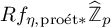 has enough finiteness properties so that the tensor product can still be controlled. It is based on the local constancy of
$R^{i}f_{\eta , {\mathrm {\acute {e}t}}*}\mathbb {F}_p$
 proved in [Reference Scholze and WeinsteinSW20, Theorem 10.5.1]. This is also the source of the ‘locally of finite type’ assumption on
$\mathfrak {X}$
 and
$\mathfrak {Y}$
 in Theorem 1.1.
Without further mention, for the rest of the introduction we work in the setting of Theorem 1.1. Although in the body of the paper we work with more general
$\mathfrak {X}$
 and
$\mathfrak {Y}$
 , the main obstacles are already present in the current setting.
We now push on with the comparison with
$Rf_{q-\mathrm {CRYS}*}\mathcal {O}_{q-\mathrm {CRYS}}$
 . First note that
$R\Gamma _{A_{ {\mathrm {inf}}}}(\mathfrak {X}/\mathfrak {Y})$
 is a complex of
$W(\widehat {\mathcal {O}}^{+, \flat }_Y)$
 -modules living in
$Y_{ {\mathrm {pro\acute {e}t}}}$
 and this immediately raises the question of where this comparison should take place. Recall that there is the site
$q-\mathrm {CRYS}(\mathfrak {Y}/A_{ {\mathrm {inf}}})$
 and the object
$Rf_{q-\mathrm {CRYS}*}\mathcal {O}_{q-\mathrm {CRYS}}$
 lives in the associated topos
$(\mathfrak {Y}/A_{ {\mathrm {inf}}})_{q-\mathrm {CRYS}}$
 . We construct a morphism of topoi

which sends an affinoid perfectoid object to its pro-infinitesimal thickening given by Fontaine’s period ring (a q-PD pair). A similar morphism is used in the work of [Reference Morrow and TsujiMT20] when they relate relative Breuil-Kisin-Fargues modules with prismatic crystals (cf. proof of Theorem 5.15 in loc. cit.). It is along
$\mu _{ {\mathrm {pro\acute {e}t}}}$
 that we make the comparison of
$R\Gamma _{A_{ {\mathrm {inf}}}}(\mathfrak {X}/\mathfrak {Y})$
 and
$Rf_{q-\mathrm {CRYS}*}\mathcal {O}_{q-\mathrm {CRYS}}$
 . The next theorem represents the bulk of our work.
Theorem 1.2 (Comparison with the q-crystalline pushforward)
There is a canonical functorial morphism

in
$D(Y_{ {\mathrm {pro\acute {e}t}}}, W(\widehat {\mathcal {O}}^{+, \flat }_Y))$
 compatible with the Frobenius such that the cohomology sheaves of the cone of (1.3) are killed by
$[\mathfrak {m}^{\flat }] \subset A_{ {\mathrm {inf}}}$
 (where
$\mathfrak {m}^{\flat } \subset \mathcal {O}^{\flat }$
 is the maximal ideal).
We now discuss the proof of Theorem 1.2. The starting point is constructing the q-crystalline analogue of the complex
$A\Omega _{\mathfrak {X}/\mathfrak {Y}}$
 . As a first attempt it is natural to consider the product of topoi
$(\mathfrak {Y}/A_{ {\mathrm {inf}}})_{q-\mathrm {CRYS}} \times _{\mathfrak {Y}_{ {\mathrm {\acute {e}t}}}} \mathfrak {X}_{ {\mathrm {\acute {e}t}}}$
 and for the ‘q-analogue’ of
$\nu _f$
 (coming from the universal property of the product of topoi):

one defines

The issue is that the underlying site of
$(\mathfrak {Y}/A_{ {\mathrm {inf}}})_{q-\mathrm {CRYS}} \times _{\mathfrak {Y}_{ {\mathrm {\acute {e}t}}}} \mathfrak {X}_{ {\mathrm {\acute {e}t}}}$
 is difficult to describe due to the first projection
$(\mathfrak {Y}/A_{ {\mathrm {inf}}})_{q-\mathrm {CRYS}} \to \mathfrak {Y}_{ {\mathrm {\acute {e}t}}}$
 essentially coming from a cocontinuous functor of sites. In particular it is difficult to describe the (local) sections of
$q\Omega _{\mathfrak {X}/\mathfrak {Y}}$
 . The fix is to work with the oriented product
$(\mathfrak {Y}/A_{ {\mathrm {inf}}})_{q-\mathrm {CRYS}} \overleftarrow {\times }_{\mathfrak {Y}_{ {\mathrm {\acute {e}t}}}} \mathfrak {X}_{ {\mathrm {\acute {e}t}}}$
 , which, at least heuristically, takes into account the asymmetric nature of the two projections to
$\mathfrak {Y}_{ {\mathrm {\acute {e}t}}}$
 . We make this precise by describing an explicit site for
$(\mathfrak {Y}/A_{ {\mathrm {inf}}})_{q-\mathrm {CRYS}} \overleftarrow {\times }_{\mathfrak {Y}_{ {\mathrm {\acute {e}t}}}} \mathfrak {X}_{ {\mathrm {\acute {e}t}}}$
 , and it allows us to study
$q\Omega _{\mathfrak {X}/\mathfrak {Y}}$
 (now defined with the oriented product in place of the usual product in the target of
$\nu _{f}^{q}$
 ).
With the correct setup in place, the next step in the proof of Theorem 1.2 is to compare both
$q\Omega _{\mathfrak {X}/\mathfrak {Y}}$
 and
$A\Omega _{\mathfrak {X}/\mathfrak {Y}}$
 . The morphism of topoi (1.2) extends to a morphism between the relevant products

and the comparison between
$q\Omega _{\mathfrak {X}/\mathfrak {Y}}$
 and
$A\Omega _{\mathfrak {X}/\mathfrak {Y}}$
 takes the form:
Theorem 1.3. There is a canonical functorial isomorphism

in the relevant derived category compatible with the Frobenius.
The proof of Theorem 1.3 follows the same lines as its absolute analogue [Reference Bhatt and ScholzeBS22, Theorem 17.2]. One key ingredient is the comparison of
$A\Omega _{\mathfrak {X}/\mathfrak {Y}}$
 with the de Rham complex. However, in the relative situation, one has to work harder in order to compare the cohomological Koszul complex coming from continuous group cohomology with the (local) sections of
$A\Omega _{\mathfrak {X}/\mathfrak {Y}}$
 . In particular, we show that affinoid perfectoid objects over Y are ‘rigid’ (in the sense that they satisfy Lemma 5.1 below), guaranteeing that the relevant continuous group cohomology groups have no non-zero almost-zero elements.
Returning to the proof of Theorem 1.2, the morphism (1.3) is then obtained from pushing forward (1.4) to the pro-étale site
$Y_{ {\mathrm {pro\acute {e}t}}}$
 , composed with a base change morphism. This base change morphism involves both products of topoi and is difficult to study on its own. However, after reducing coefficients from
$A_{ {\mathrm {inf}}}$
 to
$\mathcal {O}$
 , the situation becomes more manageable. In particular, one has Hodge-Tate comparisons for both
$q\Omega _{\mathfrak {X}/\mathfrak {Y}}$
 and
$A\Omega _{\mathfrak {X}/\mathfrak {Y}}$
 and it suffices to study two different base change morphisms, one for each of the product topoi. These two base change morphisms both involve the sheaf of Kähler differentials on
$\mathfrak {X}_{ {\mathrm {\acute {e}t}}}$
 . Both base change morphisms turn out to be almost isomorphisms and this, in short, ends the proof of Theorem 1.2. Along the way we prove that the source of (1.3) is a perfect complex of
$W(\widehat {\mathcal {O}}^{+, \flat }_Y)$
 -modules. As we are unable to do the same for
$R\Gamma _{A_{ {\mathrm {inf}}}}(\mathfrak {X}/\mathfrak {Y})$
 , we cannot speculate whether (1.3) can be improved to an actual isomorphism.
We now discuss some applications of our comparison results: Theorems 1.1–1.2. One immediate consequence is that relative q-crystalline/prismatic cohomology recovers the étale pushforward after inverting
$\mu $
 :
Theorem 1.4. There is a quasi-isomorphism

where
$(\mu _{ {\mathrm {pro\acute {e}t}}}^{-1}Rf_{q-\mathrm {CRYS}*}\mathcal {O}_{q-\mathrm {CRYS}})^{\wedge }$
 denotes the derived p-adic completion of
$\mu _{ {\mathrm {pro\acute {e}t}}}^{-1} Rf_{q-\mathrm {CRYS}*}\mathcal {O}_{q-\mathrm {CRYS}}$
 .
To the best of our knowledge, this seems to be a version of an étale comparison which does not follow directly from [Reference Bhatt and ScholzeBS22, Theorem 1.8(4) and Theorem 1.16(4)] and is possibly one advantage of the theory constructed in this paper over prismatic cohomology. However, the statement obtained by base changing (1.5) to a statement over
$W(C^{\flat })$
 is closer to loc. cit. due to [Reference Bhatt and ScholzeBS23, Proposition 3.6].
Another application is obtained by imitating the strategy used in [Reference Abbes and GrosAG24], we are able to prove a relative Hodge-Tate spectral sequence:
Theorem 1.5. Suppose that for any
$i,j \geq 0$
 ,
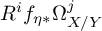
$R^{i}f_{\eta *}\Omega ^{j}_{X/Y}$
 is locally free of finite type over
$\mathcal {O}_{Y}$
 .Footnote
4
Then there is an
$E_2$
 -spectral sequence

and it degenerates.
In their work, Abbes-Gros consider the ‘
topos de Faltings relatif
’ (cf. §3.4 in loc. cit.) which plays a similar role to that of
$Y_{ {\mathrm {pro\acute {e}t}}} \times _{\mathfrak {Y}_{ {\mathrm {\acute {e}t}}}} \mathfrak {X}_{ {\mathrm {\acute {e}t}}}$
 . The spectral sequences established in [Reference Caraiani and ScholzeCS17, Corollary 2.2.4] and [Reference Abbes and GrosAG24, Théorème 1.4.5], together with Theorem 1.5 now give, a priori, three different Hodge-Tate filtrations on the rational p-adic étale higher direct images, albeit in different mutually non-exclusive settings. The generic analogue
$Y_{ {\mathrm {pro\acute {e}t}}} \times _{Y_{ {\mathrm {\acute {e}t}}}} X_{ {\mathrm {\acute {e}t}}}$
 of our product of topoi can potentially be used to check the compatibility of the filtrations by Caraiani-Scholze and that of Theorem 1.5. This would also involve checking the compatibility of the relative de Rham comparison in [Reference ScholzeSch13, Theorem 8.8] and the one hypothetically implied by relative
$A_{ {\mathrm {inf}}}$
 -cohomology theory, which we decided not to work out. One approach is to generalize the argument of [Reference Bhatt, Morrow and ScholzeBMS18, Theorem 13.1] using
$Y_{ {\mathrm {pro\acute {e}t}}} \times _{Y_{ {\mathrm {\acute {e}t}}}} X_{ {\mathrm {\acute {e}t}}}$
 .
Finally, regarding torsion in the relative étale pushforward given that the de Rham pushforwards are locally free, we refer the reader to Theorem 7.4. We give a proof which is based on the relative
$A_{ {\mathrm {inf}}}$
 -cohomology theory (in particular Theorem 1.4), however as noted by Takeshi Tsuji, the result essentially follows from the absolute case (cf. Remark 7.5). We are not sure how to obtain a degree-wise result like in [Reference Bhatt, Morrow and ScholzeBMS18, Theorem 14.5(ii)].
Outline
We briefly explain the contents of the different sections. In Section 2 we describe a basis for the fiber product
$Y_{ {\mathrm {pro\acute {e}t}}} \times _{\mathfrak {Y}_{ {\mathrm {\acute {e}t}}}} \mathfrak {X}_{ {\mathrm {\acute {e}t}}}$
 . In Section 3 we establish some properties of lisse
$\widehat {\mathbb {Z}}_p$
 -sheaves on the pro-étale site in the context of complexes, and use this to prove Theorem 1.1. In Section 4 we perform the local computations relating continuous group cohomology and framed sections of
$A\Omega _{\mathfrak {X}/\mathfrak {Y}}$
 . In Section 5 we use these local computations to relate
$A\Omega _{\mathfrak {X}/\mathfrak {Y}}$
 to the relative de Rham complex
$\Omega _{\mathfrak {X}/\mathfrak {Y}}^{\bullet }$
 . In Section 6 we introduce the q-crystalline analogue
$(\mathfrak {Y}/A_{ {\mathrm {inf}}})_{q-\mathrm {CRYS}} \overleftarrow {\times }_{\mathfrak {Y}_{ {\mathrm {\acute {e}t}}}} \mathfrak {X}_{ {\mathrm {\acute {e}t}}}$
 of
$Y_{ {\mathrm {pro\acute {e}t}}} \times _{\mathfrak {Y}_{ {\mathrm {\acute {e}t}}}} \mathfrak {X}_{ {\mathrm {\acute {e}t}}}$
 , and together with the results in Section 5, use this to prove Theorem 1.2. Finally, in Section 7, we prove some consequences including Theorems 1.4–1.5.
Additional notation
Given C and
$\mathcal {O}$
 as in the introduction, let
$\mathfrak {m} \subset \mathcal {O}$
 be its maximal ideal. We let
$W(-)$
 denote the p-typical Witt vectors of a (not necessarily unital) ring so that
$A_{ {\mathrm {inf}}} := W(\mathcal {O}^{\flat })$
 is Fontaine’s ring. For instance we often consider the non-unital ring
$W(\mathfrak {m}^{\flat })$
 . The ring
$A_{ {\mathrm {inf}}}$
 comes equipped with the Frobenius
$\varphi \colon A_{ {\mathrm {inf}}} \xrightarrow {\sim } A_{ {\mathrm {inf}}}$
 and de Rham specialization map
$\theta \colon A_{ {\mathrm {inf}}} \twoheadrightarrow \mathcal {O}$
 . Its kernel
$\ker (\theta ) \subset A_{ {\mathrm {inf}}}$
 is generated by a single element
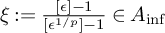
$\xi := \tfrac {[\epsilon ] - 1}{[\epsilon ^{1/p}]-1} \in A_{ {\mathrm {inf}}}$
 and we denote
$\tilde {\xi } := \varphi (\xi )$
 . For X a locally noetherian adic space over
$ {\mathrm {Spa}}(\mathbb {Q}_p, \mathbb {Z}_p)$
 we use the pro-étale site
$X_{ {\mathrm {pro\acute {e}t}}}$
 constructed in [Reference ScholzeSch13]. We use the various structure sheaves on
$X_{ {\mathrm {pro\acute {e}t}}}$
 given in [Reference Bhatt, Morrow and ScholzeBMS18, Definition 5.4]Footnote
5
. However, we write
$W(\widehat {\mathcal {O}}_{X}^{+, \flat })$
 for
$W(\widehat {\mathcal {O}}^+_{X^{\flat }})$
 . So,
$\mathbb {A}_{ {\mathrm {inf}}, X}$
 is the derived p-adic completion of
$W(\widehat {\mathcal {O}}_{X}^{+, \flat })$
 .
2 Preliminaries
The main goal of this section is to review the construction of the fiber product of topoi given in [Reference Illusie, Laszlo and OrgogozoILO14, Exposé XI] (cf. [Reference Abbes, Gros and TsujiAGT16, Chapter VI]), relevant to our context. We also describe a suitable basis for the underlying site, which will facilitate extending the local computations performed in §4 to sheaf-theoretic results such as the Hodge-Tate specialization in §5. The main result is Proposition 2.16. We only urge the reader to understand the definition of relative
$A_{ {\mathrm {inf}}}$
 -cohomology (cf. Definition 2.17) and skip the remaining contents of this section upon first viewing.
2.1 Product of topoi:
$Y_{ {\mathrm {pro\acute {e}t}}}\times _{\mathfrak {Y}_{ {\mathrm {\acute {e}t}}}}\mathfrak {X}_{ {\mathrm {\acute {e}t}}}$

In this section, unless otherwise stated,
$\mathfrak {X}$
 and
$\mathfrak {Y}$
 will be any p-adic formal schemes of type (S)(b) over
$\mathcal {O}$
 , as in [Reference HuberHub96, §1.9]. This means that for all
$y \in \mathfrak {Y}$
 there exists an open affine neighborhood
$\mathfrak {U} \subseteq \mathfrak {Y}$
 of y such that the topology on
$\mathcal {O}_{\mathfrak {Y}}(\mathfrak {U})$
 is p-adic and
$\mathcal {O}_{\mathfrak {Y}}(\mathfrak {U})[p^{-1}]$
 is strongly noetherian (idem. for
$\mathfrak {X}$
 ). Let
$f \colon \mathfrak {X} \to \mathfrak {Y}$
 be any
$ {\mathrm {Spf}}(\mathcal {O})$
 -morphism. Note that in this situation the adic generic fibers X and Y of
$\mathfrak {X}$
 and
$\mathfrak {Y}$
 , respectively, are locally noetherian adic spaces. In particular the framework established in [Reference ScholzeSch13, §3] applies. We begin by recalling the construction of the fiber product of topoi
$Y_{ {\mathrm {pro\acute {e}t}}}\times _{\mathfrak {Y}_{ {\mathrm {\acute {e}t}}}}\mathfrak {X}_{ {\mathrm {\acute {e}t}}}$
 following the treatment in [Reference Illusie, Laszlo and OrgogozoILO14, Exposé XI]. As explained in the introduction, this will be a crucial ingredient for our definition of relative
$A_{ {\mathrm {inf}}}$
 -cohomology (cf. Definition 2.17). We begin with a simple reality check on the objects involved.
Lemma 2.1.
-
(1) The sites $Y_{ {\mathrm {pro\acute {e}t}}}$
,
$\mathfrak {Y}_{ {\mathrm {\acute {e}t}}}$
and
$\mathfrak {X}_{ {\mathrm {\acute {e}t}}}$
admit finite projective limits. -
(2) The natural functors $\mathfrak {Y}_{ {\mathrm {\acute {e}t}}} \to Y_{ {\mathrm {pro\acute {e}t}}}$
(obtained by taking the adic generic fiber) and
$\mathfrak {Y}_{ {\mathrm {\acute {e}t}}} \to \mathfrak {X}_{ {\mathrm {\acute {e}t}}}$
commute with finite projective limits and induce morphisms of sites
$\nu _Y \colon Y_{ {\mathrm {pro\acute {e}t}}} \to \mathfrak {Y}_{ {\mathrm {\acute {e}t}}}$
and
$f_{ {\mathrm {\acute {e}t}}} \colon \mathfrak {X}_{ {\mathrm {\acute {e}t}}} \to \mathfrak {Y}_{ {\mathrm {\acute {e}t}}}$
.






Proof.
-
(1) Firstly $Y_{ {\mathrm {pro\acute {e}t}}}$
admits finite projective limits due to [Reference ScholzeSch13, Lemma 3.10(vii)]. By [Reference HuberHub96, §3.5], there is an equivalence of sites
$\mathfrak {Y}_{ {\mathrm {\acute {e}t}}} \cong \mathfrak {Y}_{\text {red}, {\mathrm {\acute {e}t}}}$
(idem. for
$\mathfrak {X}_{ {\mathrm {\acute {e}t}}}$
), where
$\mathfrak {Y}_{\text {red}} = (\mathfrak {Y}, \mathcal {O}_{\mathfrak {Y}}/\mathscr {I})$
is the reduced scheme underlying
$\mathfrak {Y}$
(here
$\mathscr {I}$
is the vanishing sheaf of ideals of
$\mathcal {O}_{\mathfrak {Y}}$
). Now
$\mathfrak {Y}_{\text {red}, {\mathrm {\acute {e}t}}}$
has a final object (namely
$\mathfrak {Y}_{\text {red}}$
) and fiber products exist. Thus by [Sta18, Tag 04AS, Lemma 4.18.4(1)
$\kern2.00em \iff \kern2.00em$
(3)]
$\mathfrak {Y}_{ {\mathrm {\acute {e}t}}}$
(idem. for
$\mathfrak {X}_{ {\mathrm {\acute {e}t}}}$
) admits finite projective limits. -
(2) Both functors preserve final objects and commute with fiber products. Therefore they also commute with finite projective limits. With the identification $\mathfrak {Y}_{ {\mathrm {\acute {e}t}}} \cong \mathfrak {Y}_{\text {red}, {\mathrm {\acute {e}t}}}$
(idem. for
$\mathfrak {X}_{ {\mathrm {\acute {e}t}}}$
) from (1), we get a morphism of sites
$\mathfrak {X}_{ {\mathrm {\acute {e}t}}} \to \mathfrak {Y}_{ {\mathrm {\acute {e}t}}}$
by [Sta18, Tag 04I0]. There is a natural morphism of sites
$\nu \colon Y_{ {\mathrm {pro\acute {e}t}}} \to Y_{ {\mathrm {\acute {e}t}}}$
, so it suffices to show that the natural functor
$\mathfrak {Y}_{ {\mathrm {\acute {e}t}}} \to Y_{ {\mathrm {\acute {e}t}}}$
induces a morphism of sites
$Y_{ {\mathrm {\acute {e}t}}} \to \mathfrak {Y}_{ {\mathrm {\acute {e}t}}}$
. This is [Reference HuberHub96, Lemma 3.5.1(ii)].












Lemma 2.1 guarantees that we can use the formalism in [Reference Illusie, Laszlo and OrgogozoILO14, Exposé XI] to describe the underlying site for our product (cf. §1.1 in loc. cit.). This will not be the case for the q-crystalline (oriented) product which we deal with in Section 6. Let D be the following site:
-
(i) As a category, the objects of D are commutative diagrams
where $\mathfrak {U} \to \mathfrak {Y}$
and
$\mathfrak {V} \to \mathfrak {X}$
are étale,
$W \to Y$
is pro-étale, and
$W \to \mathfrak {U}$
(resp.
$Y \to \mathfrak {Y}$
) denotes the morphism
$W \to U$
(resp.
$ {\mathrm {id}} \colon Y \to Y$
) of objects in
$Y_{ {\mathrm {pro\acute {e}t}}}$
where U is the adic generic fiber of
$\mathfrak {U}$
. We explain the commutativity condition. We demand the right-most square to be a commutative diagram of formal schemes. For the left-most square we demand that the diagram in
$Y_{ {\mathrm {pro\acute {e}t}}}$
: is commutative. For brevity we denote such an object by $(W \to \mathfrak {U} \leftarrow \mathfrak {V})$
.Given two such objects $(W_1 \to \mathfrak {U}_1 \leftarrow \mathfrak {V}_1)$
and
$(W_2 \to \mathfrak {U}_2 \leftarrow \mathfrak {V}_2)$
, a morphism from
$(W_1 \to \mathfrak {U}_1 \leftarrow \mathfrak {V}_1)$
to
$(W_2 \to \mathfrak {U}_2 \leftarrow \mathfrak {V}_2)$
is the datum of three morphisms
$W_1 \to W_2$
,
$\mathfrak {U}_1 \to \mathfrak {U}_2$
and
$\mathfrak {V}_1 \to \mathfrak {V}_2$
such the diagrams are commutative (here $U_1 \to U_2$
is the induced morphism on the adic generic fibers of
$\mathfrak {U}_1 \to \mathfrak {U}_2$
). For brevity, we will denote such a morphism by the following diagram: -
(ii) We equip D with the topology generated by coverings
$$\begin{align*}\left\{ (W_i \to \mathfrak{U}_i \leftarrow \mathfrak{V}_i) \to (W \to \mathfrak{U} \leftarrow \mathfrak{V}) \right\}_{i \in I} \end{align*}$$
of the following types:
-
(a) $\mathfrak {U}_i=\mathfrak {U}, \mathfrak {V}_i = \mathfrak {V} \text { }$
for all
$i \in I$
and
$(W_i \to W)_{i \in I}$
is a covering in
$Y_{ {\mathrm {pro\acute {e}t}}}$
, -
(b) $W_i=W, \mathfrak {U}_i = \mathfrak {U} \text { }$
for all
$i \in I$
and
$(\mathfrak {V}_i \to \mathfrak {V})_{i \in I}$
is a covering in
$\mathfrak {X}_{ {\mathrm {\acute {e}t}}}$
, -
(c) I is a singleton and a commutative diagram
-
(d) I is a singleton and a commutative diagram
-















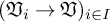


Beware that the maps
$\mathfrak {U}' \to \mathfrak {U}$
 in (c) and (d) are not necessarily covers.
Notation. We will refer to coverings of the above by ‘type (a)’, ‘type (b)’, ‘type (c)’ and ‘type (d)’, respectively.
Let
$\widetilde {D}$
 be the topos of sheaves of sets in D. The following is an instance of [Reference Illusie, Laszlo and OrgogozoILO14, Exposé XI, Définition 3.3].
Definition 2.2. The topos
$\widetilde {D}$
 is called the fiber product of
$\widetilde {Y_{ {\mathrm {pro\acute {e}t}}}}$
 and
$\widetilde {\mathfrak {X}_{ {\mathrm {\acute {e}t}}}}$
 above
$\widetilde {\mathfrak {Y}_{ {\mathrm {\acute {e}t}}}}$
 , which we denote (via an abuse of languageFootnote
6
) by
$Y_{ {\mathrm {pro\acute {e}t}}}\times _{\mathfrak {Y}_{ {\mathrm {\acute {e}t}}}}\mathfrak {X}_{ {\mathrm {\acute {e}t}}}$
 .
One can verify the sheaf condition on D as follows.
Lemma 2.3 [Reference Illusie, Laszlo and OrgogozoILO14, Exposé XI, §3.1]
Let
$\mathscr {F}$
 be a presheaf on D. For
$\mathscr {F}$
 to be a sheaf, it suffices to verify the usual conditions of exactness for coverings of type (a) and (b), and for all covering families
$Z' \to Z$
 of type (c) and (d),
$\mathscr {F}(Z) \to \mathscr {F}(Z')$
 is an isomorphism.
By construction there are natural projections of topoi

which are given by

for W an object in
$Y_{ {\mathrm {pro\acute {e}t}}}$
 and
$\mathfrak {V}$
 an object in
$\mathfrak {X}_{ {\mathrm {\acute {e}t}}}$
 . Moreover the diagram of topoi

admits a canonical 2-isomorphism

given by an isomorphism of functors
$(fq)_{*} \to (\nu _{Y}p)_{*}$
 defined as follows: for
$\mathscr {F}$
 a sheaf on D and
$\mathfrak {V}$
 an object in
$\mathfrak {Y}_{ {\mathrm {\acute {e}t}}}$
 (with generic fiber V),

is the composition

where the first isomorphism is induced by a covering of type (d) and the second isomorphism is induced by a covering of type (c). In the above diagram, we hope the reader does not find it confusing that we continue to use f and
$\nu _Y$
 to denote the induced morphisms of topoi. We can now state the universal property that
$Y_{ {\mathrm {pro\acute {e}t}}}\times _{\mathfrak {Y}_{ {\mathrm {\acute {e}t}}}}\mathfrak {X}_{ {\mathrm {\acute {e}t}}}$
 satisfies:
Theorem 2.4 [Reference Illusie, Laszlo and OrgogozoILO14, Exposé XI, Théorème 3.2]
Let T be any topos equipped with morphisms
$a \colon T \to Y_{ {\mathrm {pro\acute {e}t}}}$
 and
$b \colon T \to \mathfrak {X}_{ {\mathrm {\acute {e}t}}}$
 and an isomorphism
$t \colon fb \xrightarrow {\sim } \nu _{Y}a$
 . Then there exists a triple
$(h \colon T \to Y_{ {\mathrm {pro\acute {e}t}}}\times _{\mathfrak {Y}_{ {\mathrm {\acute {e}t}}}}\mathfrak {X}_{ {\mathrm {\acute {e}t}}}, \alpha \colon ph \xrightarrow {\sim } a, \beta \colon qh \xrightarrow {\sim } b)$
 , unique up to unique isomorphism, such that the composition

is equal to t. Moreover for
$Z = (W \to \mathfrak {U} \leftarrow \mathfrak {V})$
 an object in D,

where
$a^{-1}W \to b^{-1}(\mathfrak {U} \times _{\mathfrak {Y}} \mathfrak {X})$
 is the composition
$a^{-1}W \to a^{-1}U \xrightarrow {t} b^{-1}(\mathfrak {U} \times _{\mathfrak {Y}} \mathfrak {X})$
 , where U is the generic fiber of
$\mathfrak {U}$
 .
Applying Theorem 2.4 to the topos
$X_{ {\mathrm {pro\acute {e}t}}}$
 equipped with the natural morphisms
$f_{\eta } \colon X_{ {\mathrm {pro\acute {e}t}}} \to Y_{ {\mathrm {pro\acute {e}t}}}$
 and
$\nu _X \colon X_{ {\mathrm {pro\acute {e}t}}} \to \mathfrak {X}_{ {\mathrm {\acute {e}t}}}$
 gives a morphism of topoi

where

Definition 2.5. We define the completed integral structure sheaf on D by the p-adically completed tensor product

and denote it by
$\widehat {\mathcal {O}}^+_D$
 .
Remark 2.6. A word of explanation for the definition of
$\widehat {\mathcal {O}}_{D}^{+}$
 . The morphism
$p^{-1}\nu _{Y}^{-1}\mathcal {O}_{\mathfrak {Y}, {\mathrm {\acute {e}t}}} \to p^{-1}\widehat {\mathcal {O}}^{+}_Y$
 comes via the natural map of sheaves of rings
$\nu _{Y}^{-1}\mathcal {O}_{\mathfrak {Y}, {\mathrm {\acute {e}t}}} \to \widehat {\mathcal {O}}^{+}_{Y}$
 . By (2.1), there is a canonical isomorphism
$p^{-1}\nu _{Y}^{-1}\mathcal {O}_{\mathfrak {Y}, {\mathrm {\acute {e}t}}} \xrightarrow {\sim } q^{-1}f^{-1}\mathcal {O}_{\mathfrak {Y}, {\mathrm {\acute {e}t}}}$
 . One then composes the latter isomorphism with the morphism
$q^{-1}f^{-1}\mathcal {O}_{\mathfrak {Y}, {\mathrm {\acute {e}t}}} \to q^{-1}\mathcal {O}_{\mathfrak {X}, {\mathrm {\acute {e}t}}}$
 (coming from the natural map of sheaves of rings
$f^{-1}\mathcal {O}_{\mathfrak {Y}, {\mathrm {\acute {e}t}}} \to \mathcal {O}_{\mathfrak {X}, {\mathrm {\acute {e}t}}}$
 ). This procedure produces the morphism
$p^{-1}\nu _{Y}^{-1}\mathcal {O}_{\mathfrak {Y}, {\mathrm {\acute {e}t}}} \to q^{-1}\mathcal {O}_{\mathfrak {X}, {\mathrm {\acute {e}t}}}$
 .
By construction the projections p and q extend to morphisms of ringed topoi:

We delay extending
$\nu _f$
 to a morphism of ringed topoi to §5.2 (cf. Proposition 5.7).
Proposition 2.7.
-
(1) The family of objects of the form $Z:= (\varprojlim _{i \in I} {\mathrm {Spa}}(S_{i}, S_{i}^{+}) \to {\mathrm {Spf}}(S) \leftarrow {\mathrm {Spf}}(R))$
is generating for D, where
$\varprojlim _{i \in I} {\mathrm {Spa}}(S_{i}, S_{i}^{+})\to Y$
is a pro-étale presentation as in [Reference ScholzeSch13, Definition 3.9]. Moreover the family is stable under fiber products. -
(2) All objects as in (1) are quasi-compact.
-
(3) All objects as in (1) are coherent and the topos $Y_{ {\mathrm {pro\acute {e}t}}}\times _{\mathfrak {Y}_{ {\mathrm {\acute {e}t}}}}\mathfrak {X}_{ {\mathrm {\acute {e}t}}}$
is algebraic (cf. [SGA4, Exposé VI, Définition 2.3]). -
(4) Assume that $f \colon \mathfrak {X} \to \mathfrak {Y}$
is qcqs. Then the projection morphism
$p \colon Y_{ {\mathrm {pro\acute {e}t}}}\times _{\mathfrak {Y}_{ {\mathrm {\acute {e}t}}}}\mathfrak {X}_{ {\mathrm {\acute {e}t}}} \rightarrow Y_{ {\mathrm {pro\acute {e}t}}}$
is a coherent morphism (cf. [SGA4, Exposé VI, Définition 3.1]) of algebraic topoi.





Proof.
-
(1) Choose any object $T = (W \to \mathfrak {U} \leftarrow \mathfrak {V})$
in D and fix an affine covering
$\{\mathfrak {U}_i \}$
of
$\mathfrak {U}$
in
$\mathfrak {U}_{ {\mathrm {\acute {e}t}}}$
. Then
$\{\mathfrak {U}_i \times _{\mathfrak {U}} \mathfrak {V} \}$
is a covering of
$\mathfrak {V}$
in
$\mathfrak {V}_{ {\mathrm {\acute {e}t}}}$
. Therefore $$\begin{align*}\{(W \to \mathfrak{U} \leftarrow \mathfrak{U}_i \times_{\mathfrak{U}} \mathfrak{V}) \} \end{align*}$$
is a covering of T of type (b). Then by using coverings of type (d):
where U and $U_i$
are the adic generic fibers of
$\mathfrak {U}$
and
$\mathfrak {U}_i$
, respectively, we can assume
$\mathfrak {U}$
is affine. Using coverings of type (b) again, we can assume
$\mathfrak {V}$
is affine. Finally, by using coverings of type (a) and [Reference ScholzeSch13, Lemma 3.12(ii)], proves that the family is generating. For the last part, note that taking the adic generic fiber commutes with fiber products of formal schemes. Therefore fiber products in D are calculated component-wise and now it is clear that the family is stable under fiber products. -
(2) By part (1), the objects appearing there are generating, so we can consider the site whose objects are the objects appearing in (1) together with the coverings generated by types (a)-(d). This is a site of definition for $Y_{ {\mathrm {pro\acute {e}t}}}\times _{\mathfrak {Y}_{ {\mathrm {\acute {e}t}}}}\mathfrak {X}_{ {\mathrm {\acute {e}t}}}$
. By [Reference ScholzeSch13, Lemma 3.12(i)],
$\varprojlim _{i \in I} {\mathrm {Spa}}(S_{i}, S_{i}^{+})$
is a quasi-compact object in
$Y_{ {\mathrm {pro\acute {e}t}}}$
, and
$ {\mathrm {Spf}}(R)$
is quasi-compact in
$\mathfrak {X}_{ {\mathrm {\acute {e}t}}}$
. It follows that all covering families of type (a) or (b) of Z have a finite refinement. -
(3) By parts (1) and (2), and the criterion of [SGA4, Exposé VI, Proposition 2.1], all objects as in (1) are coherent. We check that (i ter) of Proposition 2.2 in loc. cit. is satisfied. For this we further restrict ourselves to objects of the form
$$\begin{align*}Z':= (\varprojlim_{i \in I} {\mathrm{Spa}}(S_{i}, S_{i}^{+}) \to {\mathrm{Spf}}(S) \leftarrow {\mathrm{Spf}}(R)) \end{align*}$$
such that $ {\mathrm {Spf}}(S) \to \mathfrak {Y}$
(resp.
$ {\mathrm {Spf}}(R) \to \mathfrak {X}$
) factors over an affine open subset
$\mathfrak {Y}' \subset \mathfrak {Y}$
(resp.
$\mathfrak {X}' \subset \mathfrak {X}$
). This is still a generating family for D and $$\begin{align*}Z' \times_{(Y \to \mathfrak{Y} \leftarrow \mathfrak{X})} Z' = Z'\times_{(Y ' \to \mathfrak{Y}' \leftarrow \mathfrak{X}')} Z', \end{align*}$$
where $Y'$
is the (affinoid) adic generic fiber of
$\mathfrak {Y}'$
. -
(4) By part (3) the topos $Y_{ {\mathrm {pro\acute {e}t}}}\times _{\mathfrak {Y}_{ {\mathrm {\acute {e}t}}}}\mathfrak {X}_{ {\mathrm {\acute {e}t}}}$
is algebraic. Moreover by [Reference ScholzeSch13, Proposition 3.12(iii)],
$Y_{ {\mathrm {pro\acute {e}t}}}$
is an algebraic topos. We use the criterion in [SGA4, Exposé VI, Proposition 3.2] to check that p is a coherent morphism. By [Reference ScholzeSch13, Proposition 3.12(ii)-(iii)], objects of the form
$\varprojlim _{i \in I} {\mathrm {Spa}}(S_{i}, S_{i}^{+})$
are coherent and are a generating family for
$Y_{ {\mathrm {pro\acute {e}t}}}$
. We can further restrict to the class
$\varprojlim _{i \in I} {\mathrm {Spa}}(S_{i}, S_{i}^{+})$
that have the additional property that
$\varprojlim _{i \in I} {\mathrm {Spa}}(S_{i}, S_{i}^{+}) \to Y$
factors over an open affinoid
$Y' \subset Y$
where
$Y'$
is the adic generic fiber of some open affine
$\mathfrak {Y}' \subset \mathfrak {Y}$
. This is still a generating family for
$Y_{ {\mathrm {pro\acute {e}t}}}$
. It suffices to check that (2.5) $$ \begin{align} p^{-1}(\varprojlim_{i \in I} {\mathrm{Spa}}(S_{i}, S_{i}^{+})) = (\varprojlim_{i \in I} {\mathrm{Spa}}(S_{i}, S_{i}^{+}) \to \mathfrak{Y} \leftarrow \mathfrak{X}) \end{align} $$
is a coherent object of $Y_{ {\mathrm {pro\acute {e}t}}}\times _{\mathfrak {Y}_{ {\mathrm {\acute {e}t}}}}\mathfrak {X}_{ {\mathrm {\acute {e}t}}}$
. For this we will use the criterion in [SGA4, Exposé VI, Corollaire 1.17]. We have a covering of type (c): Since the morphism $\mathfrak {X} \to \mathfrak {Y}$
is quasi-compact and quasi-separated, it follows that
$\mathfrak {X}' \subset \mathfrak {X}$
is quasi-compact and quasi-separated. Thus by using coverings of type (b), we obtain a finite covering of (2.5) $$\begin{align*}\{ Z_j:= (\varprojlim_{i \in I} {\mathrm{Spa}}(S_{i}, S_{i}^{+}) \to \mathfrak{Y}' \leftarrow \mathfrak{X}_j) \to (\varprojlim_{i \in I} {\mathrm{Spa}}(S_{i}, S_{i}^{+}) \to \mathfrak{Y} \leftarrow \mathfrak{X}) \}_{j \in J} \end{align*}$$
where each $\mathfrak {X}_j \subset \mathfrak {X}'$
is affine open (in particular by part (3) each
$Z_j$
is coherent). Moreover for
$j, k \in J$
(2.6) $$ \begin{align} Z_j \times_{(\varprojlim_{i \in I} {\mathrm{Spa}}(S_{i}, S_{i}^{+}) \to \mathfrak{Y} \leftarrow \mathfrak{X})} Z_k = (\varprojlim_{i \in I} {\mathrm{Spa}}(S_{i}, S_{i}^{+}) \to \mathfrak{Y}' \leftarrow \mathfrak{X}_j \cap \mathfrak{X}_k). \end{align} $$
Since $\mathfrak {X}'$
is quasi-separated,
$\mathfrak {X}_j \cap \mathfrak {X}_k$
is a finite union of affine opens. By using coverings of type (b) and [SGA4, Exposé VI, Proposition 1.3], it follows that the object in (2.6) is quasi-compact.







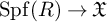













Next we describe a basis for the topology on D.
Proposition 2.8. The set of object of the form
$(\varprojlim _{i \in I} {\mathrm {Spa}}(S_{i}, S_{i}^{+}) \to {\mathrm {Spf}}(S) \leftarrow {\mathrm {Spf}}(R))$
 where
$W = \varprojlim _{i \in I} {\mathrm {Spa}}(S_{i}, S_{i}^{+}) \in Y_{ {\mathrm {pro\acute {e}t}}}$
 is some affinoid perfectoid form a basis for D.
Proof. This is proved in the same way as the first part of Proposition 2.7(1), except one uses that affinoid perfectoids form a basis for the pro-étale topology (cf. [Reference ScholzeSch13, Proposition 4.8]).
When
$f \colon \mathfrak {X} \to \mathfrak {Y}$
 is smooth, we will need a refinement of Proposition 2.8, in order to relate our upcoming definition of
$A\Omega _{\mathfrak {X}/\mathfrak {Y}}$
 and the relative de Rham complex, via the local computations of Section 4. For this reason we make the following definition and we assume f is smooth for the rest of this section.
Definition 2.9. We call an object
$Z = (W \to \mathfrak {U} \leftarrow \mathfrak {V}) \in D$
 good if it is of the form

where
-
(1) The object $W = \varprojlim _{i \in I} {\mathrm {Spa}}(S_{i}, S_{i}^{+}) \in Y_{ {\mathrm {pro\acute {e}t}}}$
is some affinoid perfectoid and it is a pro-étale presentation. -
(2) For some $d \geq 0$
, there is a
$ {\mathrm {Spf}}(S)$
-étale morphism $$\begin{align*}\mathfrak{V} = {\mathrm{Spf}} (R) \rightarrow {\mathrm{Spf}} (R^{\square}) =: \mathfrak{V}^{\square}, \end{align*}$$
where $R^{\square } := S \{t_1^{\pm 1}, \ldots , t_d^{\pm 1} \}$
.




If in addition
$(S_{\infty }[\tfrac {1}{p}])^{\circ } = S_{\infty }$
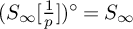 , then we call Z very good. Here
$S_{\infty }$
 is the p-adic completion of
$\varinjlim _{i \in I} S_i^{+}$
 .
Remark 2.10. The last condition ‘
$(S_{\infty }[\tfrac {1}{p}])^{\circ } = S_{\infty }$
 ’ of Definition 2.9 may appear somewhat odd at this stage, but is precisely what is required in order to match up (on the nose) the local computations of Section 4 regarding continuous group cohomology and the pushforward of
$\mathbb {A}_{ {\mathrm {inf}},X}$
 . Moreover it will turn out that under some finiteness assumptions on Y, this condition is always satisfied (cf. Lemma 2.13).
We will prove that under some mild assumptions, D has a basis consisting of very good objects. First we need some preparation.
Lemma 2.11. Suppose T is a perfectoid C-algebra. Then for each
$x \in \mathcal {O}$
 , the
$\mathcal {O}$
 -module
$T^{\circ }/x$
 has no nonzero
$\mathfrak {m}$
 -torsion.
Proof. This is essentially proven in [Reference ScholzeSch12, §5]. Recall that
$(-)^a$
 denotes the functor sending an
$\mathcal {O}$
 -module to the corresponding almost module, and
$(-)_*$
 is its right adjoint. Lemma 5.3(ii) in loc. cit. gives
$T^{\circ } \subset (T^{\circ a})_{*} \subset T$
 , which implies

By Proposition 5.5 in loc. cit.,
$T^{\circ a}$
 is a perfectoid
$\mathcal {O}^{a}$
 -algebra and so by Lemma 5.6 in loc. cit.

Therefore (2.7)-(2.8) give
$T^{\circ } = (T^{\circ a})_{*}$
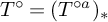 . Therefore by Lemma 5.3(iii) in loc. cit.

Finally by Proposition 4.4 in loc. cit.
$(T^{\circ a}/x)_{*} = {\mathrm {Hom}}_{\mathcal {O}^{a}}(\mathcal {O}^{a}, T^{\circ a}/x)$
 has no non-zero
$\mathfrak {m}$
 -torsion.
Remark 2.12. In the situation of Lemma 2.11, note that if
$(T, T^{+})$
 is an affinoid pair over
$(C,\mathcal {O})$
 with
$T^{+} \subsetneq T^{\circ }$
 and
$0 \not = x \in \mathfrak {m}$
 then
$T^{+}/x$
 does have nonzero
$\mathfrak {m}$
 -torsion. Indeed take
$y \in T^{\circ } \backslash T^{+}$
 . Then
$xy \in T^{+}$
 and its class in the quotient
$T^{+}/x$
 is nonzero
$\mathfrak {m}$
 -torsion.
We are now ready to control powerbounded elements in an affinoid perfectoid. For a related result, cf. [Reference Morrow and TsujiMT20, Example 1.6(iii)].
Lemma 2.13. Suppose that Y is locally of finite type over
$ {\mathrm {Spa}}(C, \mathcal {O})$
 . Then an affinoid perfectoid with pro-étale presentation
$\varprojlim _{i \in I} {\mathrm {Spa}}(S_{i}, S_{i}^{+}) \in Y_{ {\mathrm {pro\acute {e}t}}}$
 satisfies
$(S_{\infty }[\tfrac {1}{p}])^{\circ } = S_{\infty }$
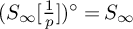 .
Proof. Since Y is locally of finite type over
$ {\mathrm {Spa}} (C, \mathcal {O})$
 , it follows that
$ {\mathrm {Spa}}(S_i, S_i^{+})$
 is topologically of finite type over
$ {\mathrm {Spa}} (C, \mathcal {O})$
 and so by [Reference HuberHub94, Lemma 4.4]
$S_i^{+} = S_i^{\circ }$
 . The idea of the proof is to modify the terms in the colimit
$\varinjlim _{i \in I} S_i^{\circ }$
 , so that the projection morphisms
$S_i^{\circ } \to S_{\infty }$
 become well behaved. A clue is that
$S_{\infty }$
 is reduced (as it is a perfectoid ring, cf.[Reference Bhatt, Morrow and ScholzeBMS18, p. 255]).
For each
$i \in I$
 , let
$S_{i, \text {red}}$
 be the quotient of
$S_i$
 by its nilradical. The quotient morphism
$S_i \to S_{i, \text {red}}$
 induces a morphism of adic spaces
$ {\mathrm {Spa}}(S_{i, \text {red}}, S_{i, \text {red}}^\circ ) \to {\mathrm {Spa}}(S_i, S_i^{\circ })$
 which is an isomorphism on the underlying topological spaces (note that
$S_{i, \text {red}}^{\circ }$
 is the integral closure of
$S_i^{\circ }$
 in
$S_{i, \text {red}}$
 ). Furthermore for sufficiently large
$j \geq i$
 we claim that the diagram

is cartesian; indeed we may assume the ring morphism
$S_i \to S_j$
 is finite étale (and so
$S_{j, \text {red}} = S_{i, \text {red}} \otimes _{S_i} S_j$
 ) and
$ {\mathrm {Spa}} (S_j, S_j^{\circ })\to {\mathrm {Spa}} (S_i, S_i^{\circ })$
 is surjective. Moreover, again by Lemma 4.4 in loc. cit.,
$S_{j, \text {red}}^{\circ }$
 is the integral closure of
$S_{i, \text {red}}^{\circ } \otimes _{S_i^{\circ }} S_j^{\circ }$
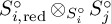 in
$S_{j, \text {red}}$
 . In particular the morphism
$ {\mathrm {Spa}}(S_{j, \text {red}}, S_{j, \text {red}}^\circ ) \to {\mathrm {Spa}}(S_{i, \text {red}}, S_{i, \text {red}}^\circ )$
 is surjective, as surjectivity is preserved by base change. This implies that for each
$n \geq 1$
 ,
$S_{i, \text {red}}^{\circ }/p^n \to S_{j, \text {red}}^{\circ }/p^n$
 is injectiveFootnote
7
and therefore after taking limits, the same is true for
$S_{i, \text {red}}^{\circ } \to S_{j, \text {red}}^{\circ }$
 (for each
$i \in I$
 ,
$S_{i, \text {red}}^{\circ }$
 is reduced and so by [Reference Bosch, Güntzer and RemmertBGR84, §6.2.4, Theorem 1],
$S_{i, \text {red}}^{\circ }$
 is bounded and in particular a ring of definition for
$S_{i, \text {red}}$
 equipped with the p-adic topology).
The morphisms
$S_i \to S_{\infty }[\tfrac {1}{p}]$
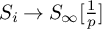 factor through
$S_{i, \text {red}}$
 (as
$S_{\infty }[\tfrac {1}{p}]$
 is a perfectoid C-algebra and in particular reduced [Reference ScholzeSch12, Proposition 5.8]). Therefore
$S_i^{\circ } \to S_{\infty }$
 factors through
$S_{i, \text {red}}^{\circ }$
 . We will need to compare
$\varinjlim _{i \in I} S_i^{\circ }$
 and
$\varinjlim _{i \in I} S_{i, \text {red}}^{\circ }$
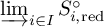 . For this we show:
Lemma 2.14. The ring morphism
$S_i^{\circ } \to S_{i, \text {red}}^{\circ }$
 is surjective.
Proof. Recall that the morphism
$ {\mathrm {Spa}}(S_{i, \text {red}}, S_{i, \text {red}}^\circ ) \to {\mathrm {Spa}}(S_i, S_i^{\circ })$
 is an isomorphism on topological spaces. The morphism
$S_i \to S_{i, \text {red}}$
 is surjective. For
$s \in S_i \backslash S_i^{\circ }$
 , there exists
$x \in {\mathrm {Spa}}(S_i, S_i^{\circ })$
 such that
$\lvert x(s) \lvert> 1$
 . The preimage
$x' \in {\mathrm {Spa}}(S_{i, \text {red}}, S_{i, \text {red}}^\circ )$
 of x has the property that
$\lvert x'(s') \lvert = \lvert x(s) \lvert>1$
 , where
$s' \in S_{i, \text {red}}$
 is the image of s. Therefore
$s' \in S_{i, \text {red}} \backslash S_{i, \text {red}}^{\circ }$
 and the induced morphism
$S_i^{\circ } \to S_{i, \text {red}}^{\circ }$
 is surjective.
By Lemma 2.14, it follows that
$S_{\infty }$
 coincides with the p-adic completion of
$\varinjlim _{i \in I} S_{i, \text {red}}^{\circ }$
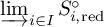 : indeed we obtain a surjection
$\varinjlim _{i \in I} S_i^{\circ } \to \varinjlim _{i \in I} S_{i, \text {red}}^{\circ }$
 which induces a surjection on the p-adic completions (cf. [Sta18, Tag 0315]). Finally the composition
$(\varinjlim _{i \in I} S_i^{\circ })^{\wedge } \to (\varinjlim _{i \in I} S_{i, \text {red}}^{\circ })^{\wedge } \to S_{\infty }$
 is an isomorphism.
Since
$S_{i, \text {red}}^{\circ }$
 is a subring of
$S_{i, \text {red}}$
 (a C-algebra), it follows that
$S_{i, \text {red}}^{\circ }$
 is torsionfree as an
$\mathcal {O}$
 -module and hence flat. Moreover by the finiteness theorem of Grauert-Remmert (cf. [Reference Bosch, Güntzer and RemmertBGR84, §6.4.1, Corollary 5]), it follows that
$S_{i, \text {red}}^{\circ }$
 is topologically of finite type over
$\mathcal {O}$
 (cf. [Reference ScholzeSch13, Theorem 9.4]). By a flattening theorem of Raynaud-Gruson, flatness together with topologically of finite type implies topologically of finite presentation (cf. [Reference BoschBos14, §7.3, Corollary 5]) and so
$S_{i, \text {red}}^{\circ }$
 is topologically of finite presentation over
$\mathcal {O}$
 .
Therefore, by [Reference Bhatt, Morrow and ScholzeBMS18, Lemma 8.10]Footnote
8
,
$S_{i, \text {red}}^{\circ }$
 is the p-adic completion of a free
$\mathcal {O}$
 -module. In particular for each
$0 \not = x \in \mathfrak {m}$
 , the
$\mathcal {O}$
 -modules
$S_{i, \text {red}}^{\circ }/x$
 have no nonzero
$\mathfrak {m}$
 -torsion. The surjectivity of
$ {\mathrm {Spa}}(S_{j, \text {red}}, S_{j, \text {red}}^\circ ) \to {\mathrm {Spa}}(S_{i, \text {red}}, S_{i, \text {red}}^\circ )$
 implies
$S_{i, \text {red}}^{\circ }/x \to S_{j, \text {red}}^{\circ }/x$
 is injectiveFootnote
9
. It follows that the direct limit
$\varinjlim _{i \in I} S_{i, \text {red}}^{\circ }/x$
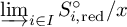 has no nonzero
$\mathfrak {m}$
 -torsion. Therefore
$S_{\infty }/x$
 has no nonzero
$\mathfrak {m}$
 -torsion. The result now follows from Remark 2.12.
Lemma 2.15. Suppose
$\mathfrak {V} \to {\mathrm {Spf}}(S)$
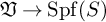 is a smooth morphism of p-adic formal schemes over
$\mathcal {O}$
 . Then locally for the Zariski topology on
$\mathfrak {V}$
 , the morphism factors as

where the first morphism is étale (for some
$d \geq 0$
 ).
Proof. This is essentially the same argument as [Reference BhattBha18, Lemma 4.9] (in the case
$S = \mathcal {O}$
 the argument in loc. cit. shows that it can be arranged so that the first morphism
$ {\mathrm {Spf}}(R) \to {\mathrm {Spf}}(S \{t_1^{\pm 1}, \ldots , t_d^{\pm 1} \})$
 is finite étale).
Proposition 2.16.
-
(1) The set of $Z \in D$
that are good forms a basis for D. -
(2) If in addition to (1), Y is locally of finite type over $ {\mathrm {Spa}} (C, \mathcal {O})$
, then a good object is very good.


2.2 The object
$A\Omega _{\mathfrak {X}/\mathfrak {Y}}$

In this section, let
$\mathfrak {X}$
 and
$\mathfrak {Y}$
 be any flat p-adic formal schemes of type (S)(b) over
$\mathcal {O}$
 , as in [Reference HuberHub96, §1.9]. Let
$f \colon \mathfrak {X} \to \mathfrak {Y}$
 be any
$ {\mathrm {Spf}}(\mathcal {O})$
 -morphism. Considering
$\nu _{f}$
 and p as the following morphisms of ringed topoi

respectively, we make the following definition. Recall from [Reference Bhatt, Morrow and ScholzeBMS18, Definition 5.4] the sheaf of complexes
$\mathbb {A}_{ {\mathrm {inf}}, X}$
 , which is the derived p-adic completion of
$W(\widehat {\mathcal {O}}_{X}^{+, \flat })$
 as in our ‘Additional notation’ section.
Definition 2.17. The relative complex
$A\Omega _{\mathfrak {X} / \mathfrak {Y}} \in D(Y_{ {\mathrm {pro\acute {e}t}}}\times _{\mathfrak {Y}_{ {\mathrm {\acute {e}t}}}}\mathfrak {X}_{ {\mathrm {\acute {e}t}}}, A_{ {\mathrm {inf}}})$
 is defined by

In addition we set
$R\Gamma _{A_{ {\mathrm {inf}}}}(\mathfrak {X}/\mathfrak {Y}) := Rp_{*}A\Omega _{\mathfrak {X} / \mathfrak {Y}}$
 , an object living in
$D(Y_{ {\mathrm {pro\acute {e}t}}}, A_{ {\mathrm {inf}}})$
 . We call
$R\Gamma _{A_{ {\mathrm {inf}}}}(\mathfrak {X}/\mathfrak {Y})$
 the (relative)
$A_{ {\mathrm {inf}}}$
 -cohomology.
We will sometimes need to upgrade Definition 2.17 and consider
$A\Omega _{\mathfrak {X}/\mathfrak {Y}}$
 as an object over the sheaf of Witt vectors. To make this precise we now consider
$\nu _f$
 and p as the following morphisms of ringed topoi

and

and we make the following definition (note that the ideal sheaf
$p^{-1}((\mu )) \subset p^{-1}W(\widehat {\mathcal {O}}^{+, \flat }_Y)$
 is invertible).
Definition 2.18. By considering p-adic derived completion taking place in the ringed site
$(X_{ {\mathrm {pro\acute {e}t}}}, W(\widehat {\mathcal {O}}^{+, \flat }_X))$
 we can consider
$\mathbb {A}_{ {\mathrm {inf}},X}$
 as an object of
$D(X_{ {\mathrm {pro\acute {e}t}}}, W(\widehat {\mathcal {O}}^{+, \flat }_X))$
 , in which case we denote it by
$\mathbb {A}_{ {\mathrm {inf}},X}^{W}$
 . The relative complex
$A\Omega _{\mathfrak {X} / \mathfrak {Y}}^{W} \in D(D, p^{-1}W(\widehat {\mathcal {O}}^{+, \flat }_Y))$
 is defined by

In addition we set
$R\Gamma ^{W}_{A_{ {\mathrm {inf}}}}(\mathfrak {X}/\mathfrak {Y}) := Rp^{W}_{*}A\Omega _{\mathfrak {X} / \mathfrak {Y}}^{W}$
 , an object living in
$D(Y_{ {\mathrm {pro\acute {e}t}}}, W(\widehat {\mathcal {O}}^{+, \flat }_Y))$
 .
We will now check that
$A\Omega _{\mathfrak {X}/\mathfrak {Y}}$
 and
$R\Gamma _{A_{ {\mathrm {inf}}}}(\mathfrak {X}/\mathfrak {Y})$
 are compatible with their W-variants (after which we will drop the superscript W from the notation when the context is clear). Let

and

be the natural morphisms of ringed topoi.
Lemma 2.19. There is a natural quasi-isomorphism
$A\Omega _{\mathfrak {X}/\mathfrak {Y}} \cong Rr_{*}A\Omega _{\mathfrak {X}/\mathfrak {Y}}^{W}$
 .
Proof. Note that
$Rs_{*}\mathbb {A}_{ {\mathrm {inf}},X}^{W} = \mathbb {A}_{ {\mathrm {inf}},X}$
 (as p-adic derived completion commutes with forgetting W) and since
$\nu _f \circ s = r \circ v_{f}^{W}$
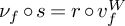 we obtain
$R\nu _{f*}\mathbb {A}_{ {\mathrm {inf}},X} = Rr_{*}R\nu _{f*}^{W}\mathbb {A}_{ {\mathrm {inf}},X}^{W}$
 . Therefore
$A\Omega _{\mathfrak {X}/\mathfrak {Y}} = L\eta _{\mu }Rr_{*}R\nu _{f*}^{W}\mathbb {A}_{ {\mathrm {inf}},X}^{W}$
 . Pick a
$p^{-1}((\mu ))$
 -torsion-free resolution
$C^{\bullet }$
 of
$R\nu _{f*}^{W}\mathbb {A}_{ {\mathrm {inf}},X}^{W}$
 in the sense of [Reference Bhatt, Morrow and ScholzeBMS18, pg. 288]. Since
$r_*$
 is an exact functor (because it is identity at the level of topoi), it follows that
$r_{*}C^{\bullet }$
 is a
$(\mu )$
 -torsion free complex representing
$Rr_{*}C^{\bullet }$
 . Thus
$L\eta _{\mu }Rr_{*}C^{\bullet }$
 is represented by the complex
$\eta _{\mu }r_{*}C^{\bullet }$
 . Finally note that
$\eta _{\mu }r_{*} = r_{*}\eta _{p^{-1}((\mu ))}$
 .
In the case f is smooth and
$\mathfrak {Y} = {\mathrm {Spf}}(\mathcal {O})$
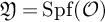 , we can compare our objects to those of [Reference Bhatt, Morrow and ScholzeBMS18]. We delay this to Section 5 after the local computations have been made, cf. Proposition 5.15.
2.3 Almost
$\mathcal {O}$
-sheaves

In this section, we will recall the notion of
$\alpha $
 -sheaves (or almost sheaves) as introduced in [Reference Abbes and GrosAG24, §2.6]. There is also recent work of [Reference ZavyalovZav24]. Throughout we will fix some site
$\mathscr {C}$
 and employ the notation in [Reference Gabber and RameroGR03]. The following is an instance of [Reference Abbes and GrosAG24, Définition 2.6.16].
Definition 2.20. We call the category of presheaves of
$\mathcal {O}^{a}$
 -modules (or almost
$\mathcal {O}$
 -presheaves) on
$\mathscr {C}$
 to be the category of presheaves on
$\mathscr {C}$
 whose values are in the category
$\mathcal {O}^{a}$
 . We denote this category by
$\widehat {\mathscr {C}}^{a}$
 . We call an isomorphism in
$\widehat {\mathscr {C}}^{a}$
 an almost isomorphism.
Armed with the notion of an almost
$\mathcal {O}$
 -presheaf, we now define almost
$\mathcal {O}$
 -sheaves, cf. Définition 2.6.24 in loc. cit.
Definition 2.21. An object
$\mathscr {F}$
 in
$\widehat {\mathscr {C}}^{a}$
 is called an almost
$\mathcal {O}$
 -sheaf if for each object X of
$\mathscr {C}$
 and for each covering family
$\{U_i\}_i$
 of X the canonical morphism

is an isomorphism. We denote by
$\widetilde {\mathscr {C}}^{a}$
 the full subcategory of
$\widehat {\mathscr {C}}^{a}$
 formed by the almost
$\mathcal {O}$
 -sheaves and
$\iota \colon \widetilde {\mathscr {C}}^{a} \to \widehat {\mathscr {C}}^{a}$
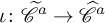 , the natural inclusion.
There is a natural sheafification functor, cf. Proposition 2.6.31 and Proposition 2.6.33 in loc. cit.
Proposition 2.22. The inclusion
$\iota \colon \widetilde {\mathscr {C}}^{a} \to \widehat {\mathscr {C}}^{a}$
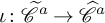 admits a left-adjoint

and is exact.
We will need to compare the categories
$\widetilde {\mathscr {C}}^{a}$
 and
$\widehat {\mathscr {C}}^{a}$
 to the usual categories of presheaves and sheaves of
$\mathcal {O}$
 -modules.
Definition 2.23. We denote by
$ {\mathrm {Mod}}_{\mathcal {O}}(\widehat {\mathscr {C}})$
 (resp.
$ {\mathrm {Mod}}_{\mathcal {O}}(\widetilde {\mathscr {C}})$
 ) the category of presheaves (resp. sheaves) in
$\mathcal {O}$
 -modules on
$\mathscr {C}$
 and
$i \colon {\mathrm {Mod}}_{\mathcal {O}}(\widetilde {\mathscr {C}}) \to {\mathrm {Mod}}_{\mathcal {O}}(\widehat {\mathscr {C}})$
 the natural inclusion.
The categories
$ {\mathrm {Mod}}_{\mathcal {O}}(\widehat {\mathscr {C}})$
 (resp.
$ {\mathrm {Mod}}_{\mathcal {O}}(\widetilde {\mathscr {C}})$
 ) together with their almost counterparts
$\widehat {\mathscr {C}}^{a}$
 (resp.
$\widetilde {\mathscr {C}}^{a}$
 ) are abelian; cf. [Sta18, Tag 01AG] and [Reference Abbes and GrosAG24, Corollaire 2.6.18, Proposition 2.6.34]. Thus one can define their associated derived categories. We will denote the derived category of
$\widetilde {\mathscr {C}}^{a}$
 by
$D(\mathscr {C}, \mathcal {O}^{a})$
 .
Definition 2.24. We call a morphism
$\mathscr {F} \to \mathscr {G}$
 in
$D(\mathscr {C}, \mathcal {O}^{a})$
 or
$D(\widehat {\mathscr {C}}^{a})$
 an almost isomorphism if it is a quasi-isomorphism. For
$\mathscr {F} \in D(\mathscr {C}, \mathcal {O})$
 , let
$\mathscr {F}^{a}$
 be its image in
$D(\mathscr {C}, \mathcal {O}^{a})$
 .
The localization functor

induces the exact functors

The next proposition says, in particular, that to verify whether a morphism of almost
$\mathcal {O}$
 -sheaves is an almost isomorphism, it suffices to verify it on the level of presheaves, cf. Proposition 2.6.36 in loc. cit.
Proposition 2.25. The diagram

is commutative, up to unique isomorphism (where
$a \colon {\mathrm {Mod}}_{\mathcal {O}}(\widehat {\mathscr {C}}) \to {\mathrm {Mod}}_{\mathcal {O}}(\widetilde {\mathscr {C}})$
 is the usual sheafification).
2.4 Miscellany
In this short section we collect some properties of the ring
$A_{ {\mathrm {inf}}}$
 (and its relative version) for which we could not find a reference.
Lemma 2.26. The tensor product
$W(\mathfrak {m}^{\flat }) \otimes _{A_{ {\mathrm {inf}}}, \theta \circ \varphi ^{-1}} \mathcal {O}$
 identifies with
$\mathfrak {m}$
 .
Proof. From the exact sequence

it suffices to show
$\text {Tor}_{A_{ {\mathrm {inf}}}}^1(W(k), A_{ {\mathrm {inf}}}/\tilde {\xi })$
 vanishes. The image of
$\tilde {\xi }$
 in
$W(k)$
 is p. Since
$W(k)$
 is p-torsion free, the result follows.
In addition to the site
$X_{ {\mathrm {pro\acute {e}t}}}$
 , we consider the site
$X_{ {\mathrm {pro\acute {e}t}}}^{\text {psh}}$
 , whose objects are affinoid perfectoids in
$X_{ {\mathrm {pro\acute {e}t}}}$
 , and coverings are isomorphisms. In this way, every presheaf is already a sheaf. We denote the associated topos by
$X_{ {\mathrm {pro\acute {e}t}}}^{\text {psh}}$
 . There is a morphism of topoi

for which
$\phi _{*}$
 is given by restricting sheaves on
$X_{ {\mathrm {pro\acute {e}t}}}$
 to
$X_{ {\mathrm {pro\acute {e}t}}}^{\text {psh}}$
 and
$\phi ^{-1}$
 sheafification.
Lemma 2.27. The
$R\phi _{*}\mathbb {A}_{ {\mathrm {inf}}, X}$
 is derived
$(p, \mu )$
 -adically complete in the presheaf topos.
Proof. By [Sta18, Tag 0BLX], it suffices to show that for each affinoid perfectoid
$U \in X_{ {\mathrm {pro\acute {e}t}}}$
 ,
$R\Gamma (U, \mathbb {A}_{ {\mathrm {inf}}, X})$
 is derived
$(p, \mu )$
 -adically complete. It is certainly derived p-adically complete by definition, so it suffices to show it is derived
$\mu $
 -adically complete. Since we are in the presheaf topos (it is replete), by [Reference Bhatt, Morrow and ScholzeBMS18, Lemma 6.15], it suffices to check each
$H^{i}(U, \mathbb {A}_{ {\mathrm {inf}},X})$
 is derived
$\mu $
 -adically complete. Now
$\mu \in W(\mathfrak {m}^{\flat })$
 and
$H^{i}(U, \mathbb {A}_{ {\mathrm {inf}},X})$
 is killed by
$W(\mathfrak {m}^{\flat })$
 for
$i>0$
 (cf. the statement just after [Reference Bhatt, Morrow and ScholzeBMS18, Lemma 5.6]). Therefore
$H^{i}(U, \mathbb {A}_{ {\mathrm {inf}},X})$
 is derived
$\mu $
 -adically complete for
$i>0$
 . For
$i = 0$
 , one has
$H^{0}(U, \mathbb {A}_{ {\mathrm {inf}},X}) = W(R^{\flat +})$
 where
$ {\mathrm {Spa}}(R,R^{+})$
 is the perfectoid space determined by U and this is even classically
$\mu $
 -adically complete.
Corollary 2.28. The object
$\mathbb {A}_{ {\mathrm {inf}},X}$
 is derived
$\tilde {\xi }$
 -adically complete.
Proof. Since
$\phi ^{-1} \circ R\phi _{*} \cong {\mathrm {id}}$
 , this is an immediate consequence of Lemma 2.27 (note that
$\tilde {\xi } \in (p,\mu )$
 ).
3 Relative p-adic étale comparison
In this section, we record the relative p-adic étale comparison (cf. [Reference Bhatt, Morrow and ScholzeBMS18, Theorem 14.3(iv)] and [Reference Česnavičius and KoshikawaCK19, Theorem 2.3]) in Theorem 3.15. The proof follows the same strategy as those in loc. cit., although in the current (relative) situation, the relevant statements are formulated in terms of complexes of sheaves rather than modules. For this reason we need to check certain complexes of
$\mathbb {Z}_p$
 -sheaves are well behaved and we begin with some preliminary work guaranteeing this.
3.1
Lisse
$\widehat {\mathbb {Z}}_p$
-sheaves

In this section, unless otherwise stated, X will temporarily denote a locally noetherian adic space over
$ {\mathrm {Spa}} (\mathbb {Q}_p, \mathbb {Z}_p)$
 . In [Reference ScholzeSch13, Definition 8.1], Scholze defines the notion of a lisse
$\widehat {\mathbb {Z}}_p$
 -sheaf on
$X_{ {\mathrm {pro\acute {e}t}}}$
 . Roughly speaking, a lisse
$\widehat {\mathbb {Z}}_p$
 -sheaf on
$X_{ {\mathrm {pro\acute {e}t}}}$
 is a literal projective limit of a classical lisse
$\mathbb {Z}_p$
 -sheaf appearing on the étale site
$X_{ {\mathrm {\acute {e}t}}}$
 (cf. Proposition 8.2 in loc. cit.). This is possible because (derived) limits on the pro-étale site are well behaved, in that they (usually) become limits. Much like in [Reference Bhatt and ScholzeBS15] where the authors define and study the notion of a constructible complex on the pro-étale site of a qcqs scheme, we will do the same for lisse
$\widehat {\mathbb {Z}}_p$
 -sheaves. We follow closely the framework developed in [Sta18, Tag 09C0].
Notation. For
$K \in D(X_{ {\mathrm {pro\acute {e}t}}}, \mathbb {Z}_p)$
 we set
$K_n := K \otimes ^{\mathbb {L}}_{\mathbb {Z}_p} \mathbb {Z}/p^n$
 . We write
$\underline {M}$
 for the image of
$M \in D(\mathbb {Z}_p)$
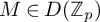 under the pullback
$D(\mathbb {Z}_p) \to D(X_{ {\mathrm {pro\acute {e}t}}}, \mathbb {Z}_p)$
 .
Definition 3.1. An object
$K \in D(X_{ {\mathrm {pro\acute {e}t}}}, \mathbb {Z}_p)$
 is called
lisse
if:
-
(1) K is p-adically derived complete and
-
(2) $K_1$
has finite locally constant cohomology sheaves and locally has finite tor dimension [Sta18, Tag 08FZ].

Remark 3.2. By [Reference ScholzeSch13, Proposition 8.2], local systems of
$\mathbb {Z}/p^n$
 -modules on
$X_{ {\mathrm {pro\acute {e}t}}}$
 are equivalent (via pullback) to local systems of
$\mathbb {Z}/p^n$
 -modules on
$X_{ {\mathrm {\acute {e}t}}}$
 . By Corollary 3.17(i) in loc. cit., the pushforward is a quasi-inverse. A detailed proof can be found in [Reference ZavyalovZav21, Theorem C.4]Footnote
10
.
Lemma 3.3. Suppose K is lisse and X is quasi-compact. There exists a and b such that
-
(1) each $K_n$
has tor-amplitude in
$[a,b]$
, -
(2) each $K_n$
has finite locally constant cohomology sheaves, -
(3) $H^{i}(K) = \varprojlim H^{i}(K_n)$
, -
(4) $H^{i}(K) = 0$
for
$i \notin [a,b]$
, -
(5) each $K_n$
is obtained via pullback of a bounded
$\mathbb {Z}/p^n$
-complex with finite locally constant cohomology sheaves from
$X_{ {\mathrm {\acute {e}t}}}$
.





Proof.
-
(1) Since X is quasi-compact and pro-étale morphisms are open, it follows that we can find $a \leq b$
such that
$K_1$
has tor amplitude in
$[a,b]$
. For the remaining
$K_n$
, the result follows from [Sta18, Tag 0942]. -
(2) The proof is the same as [Sta18, Tag 094I].
-
(3) Since K is p-adically derived complete, $K=R\varprojlim K_n$
. A priori, by part (2) each
$K_n$
has finite locally constant cohomology sheaves on
$X_{ {\mathrm {pro\acute {e}t}}}$
, but by Remark 3.2, they can be considered as finite locally constant sheaves on
$X_{ {\mathrm {\acute {e}t}}}$
. The result now follows from [Reference ScholzeSch13, Theorem 4.9] and [Sta18, Tag 0A09]. -
(4) This follows from parts (1) and (3).
-
(5) This is an application of [Sta18, Tag 0D7U] to Remark 3.2.


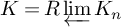


It will be useful to strengthen part (5) of Lemma 3.3 to
$X_{ {\mathrm {f\acute {e}t}}}$
 :
Lemma 3.4. Let
$X = {\mathrm {Spa}}(A, A^{+})$
 be an affinoid connected noetherian adic space over
$ {\mathrm {Spa}}(\mathbb {Q}_p, \mathbb {Z}_p)$
 . Suppose
$K \in D(X_{ {\mathrm {pro\acute {e}t}}}, \mathbb {Z}_p)$
 is lisse. Then each
$K_n$
 is obtained via pullback of a bounded
$\mathbb {Z}/p^n$
 -complex with finite locally constant cohomology sheaves from
$X_{ {\mathrm {f\acute {e}t}}}$
 .
Proof. Indeed by part (5) of Lemma 3.3, it suffices to verify the conditions of [Sta18, Tag 0D7U] (comparing finite locally constant sheaves on
$X_{ {\mathrm {\acute {e}t}}}$
 and
$X_{\text {f} {\mathrm {\acute {e}t}}}$
 ). This is achieved in [Reference ScholzeSch13, Theorem 4.9].
Definition 3.5. An object
$K \in D(X_{ {\mathrm {pro\acute {e}t}}}, \mathbb {Z}_p)$
 is called
adic lisse
if K is locally isomorphic to

where
$M \in D(\mathbb {Z}_p)$
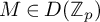 is a finite complex of finite free
$\mathbb {Z}_p$
 -modules.
For our next task, we want to compare the notions of lisse and adic lisse. It is not difficult to trivialize each
$K_n$
 one by one. The key idea, however, is to control these trivializations as one jumps from n to
$n+1$
 . For instance, in the setting of [Reference Bhatt and ScholzeBS15], this is achieved via the notion of w-strictly local affine scheme (cf. Lemma 6.6.8 in loc. cit.). In the current setup, we don’t quite have access to such a nice basis (it’s unlikely that
$X_{ {\mathrm {pro\acute {e}t}}}$
 gives rise to a replete topos), but nevertheless an analogue does exist via [Reference ScholzeSch13, Theorem 4.9].
Lemma 3.6. Let
$X = {\mathrm {Spa}}(A, A^{+})$
 be an affinoid connected noetherian adic space over
$ {\mathrm {Spa}}(\mathbb {Q}_p, \mathbb {Z}_p)$
 . Suppose
$K \in D(X_{ {\mathrm {pro\acute {e}t}}}, \mathbb {Z}_p)$
 is lisse. Then there exists a pro-(finite étale) cover
$U \to X$
 trivializing all
$K_n$
 (i.e. there are perfect complexes
$M_n \in D(\mathbb {Z}/p^n)$
 such that
$K_n \lvert _{U} \cong \underline {M_n} \lvert _{U}$
 ).
Proof. We will use the results of Lemma 3.3 without mention. The idea is to first trivialize
$K_1$
 for a finite étale covering
$U_1 \to X$
 and then construct a sequence of finite étale covers
$U_{n+1} \to U_n$
 trivializing
$K_{n+1}$
 . We proceed by induction on n.
Let us deal with
$K_1$
 first. We produce a finite étale cover
$U_{1} \to X$
 and a perfect complex of
$\mathbb {Z}/p$
 -modules
$M_1$
 such that
$K_1 \lvert _{U_{1}} \cong \underline {M_1}\lvert _{U_{1}}$
 . By Lemma 3.4, first note that
$K_1$
 comes (via pullback) of a complex in
$D(X_{ {\mathrm {f\acute {e}t}}}, \mathbb {Z}/p)$
 which has finite locally constant cohomology sheaves (in
$X_{ {\mathrm {f\acute {e}t}}}$
 ). By [Sta18, Tag 094G] we can choose a finite étale cover
$U_{1} \to X$
 (with
$U_{1}$
 affinoid connected) such that
$K_1 \lvert _{U_{1}} \cong \underline {M_{1}}\lvert _{U_{1}}$
 for some finite complex of finite
$\mathbb {Z}/p$
 -modules
$M_{1}$
 .
Suppose we have trivialized
$K_n$
 via surjective finite étale maps
$U_{n} \to U_{1}$
 with each
$U_{n}$
 affinoid connected. Then repeating the argument for
$K_1$
 with X replaced by
$U_n$
 , we produce a surjective finite étale map
$U_{(n+1)} \to U_{n}$
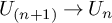 trivializing
$K_{n+1}$
 with
$U_{(n+1)}$
 affinoid connected.
In summary we have produced a sequence of finite étale connected (affinoid) covers
$U_{n+1} \to U_n$
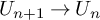 , trivializing
$K_{n+1}$
 . The pro-object
$U := \varprojlim U_n$
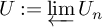 then gives a pro-(finite étale) cover trivializing all
$K_n$
 .
Recall that for X an affinoid connected noetherian adic space over
$ {\mathrm {Spa}} (\mathbb {Q}_p, \mathbb {Z}_p)$
 , there is a pro-object
$X_{\infty } := \varprojlim _i X_i \to X$
 constructed in [Reference ScholzeSch13, Theorem 4.9]Footnote
11
. This is called the universal cover of X (the
$X_i$
 are the Galois objects in
$X_{ {\mathrm {f\acute {e}t}}}$
 ) and it is indeed a cover in
$X_{ {\mathrm {pro\acute {e}t}}}$
 as explained in [Reference ScholzeSch16]. The point being that for G a profinite group, the map
$G \to *$
 is a cover in G-pfsets. One then uses [Reference ScholzeSch13, Proposition 3.5] to give a covering
$X_{\infty } \to X$
 in
$X_{ {\mathrm {pro\acute {e}t}}}$
 (even in
$X_{ {\mathrm {prof\acute {e}t}}}$
 ).
Corollary 3.7. In the situation of Lemma 3.6, the universal cover
$X_{\infty } \to X$
 of X trivializes all
$K_n$
 . Moreover in this case we have canonical trivializations:
$R\Gamma (X_{\infty }, K_n) \in D(\mathbb {Z}/p^n)$
 is a perfect complex and the canonical morphism

is a quasi-isomorphism.
Proof. For the first part, note that the universal cover
$X_{\infty }$
 covers U (appearing in Lemma 3.6). Thus by Lemma 3.6,
$K_n \lvert _{X_{\infty }} \cong \underline {M_n}$
 for some perfect complex
$M_n \in D(\mathbb {Z}/p^n)$
 . Fix such a trivialization. Then by naturality it suffices to show that the canonical morphism

is a quasi-isomorphism. This follows because taking sections of constant sheaves of
$\mathbb {Z}/p^n$
 -modules over
$X_{\infty }$
 is exact (cf. proof of [Reference ScholzeSch12, Theorem 4.9]) and
$X_{\infty }$
 is connected (i.e.
$H^{0}(X_{\infty }, \mathbb {F}_p) = \mathbb {F}_p$
 ). Finally, perfectness of
$M_n$
 implies the perfectness of
$R\Gamma (X_{\infty }, K_n)$
 .
The trivializations constructed in Lemma 3.6 are not necessarily compatible with the transition morphisms
$K_{n+1} \to K_n$
 . On the other hand, Corollary 3.7 provides a fix for this. The reason is that
$X_{\infty }$
 is at the same time connected and a kind of weakly contractible object for local systems of
$\mathbb {Z}/p^n$
 -modules. This simplicity is in contrast to the situation in [Reference Bhatt and ScholzeBS15], where weakly contractible objects are rarely connected. The authors in loc. cit. must therefore work harder in order to glue the trivializations (for each
$K_n$
 ) together and this is solved by Lemma 6.6.2 in loc. cit.
We now come to the main result of this section.
Proposition 3.8. Suppose
$K \in D(X_{ {\mathrm {pro\acute {e}t}}}, \mathbb {Z}_p)$
 is lisse. Then K is adic lisse.
Proof. Working locally, we can assume that
$X = {\mathrm {Spa}}(A, A^{+})$
 is affinoid connected. Then by Corollary 3.7,

By [Sta18, Tag 09AW] we can find a finite complex of finite free
$\mathbb {Z}_p$
 -modules M and isomorphisms
$M \otimes ^{\mathbb {L}}_{\mathbb {Z}_p} \mathbb {Z}/p^n \cong R\Gamma (X_{\infty }, K_n)$
 compatible with the transition map
$R\Gamma (X_{\infty }, K_{n+1}) \to R\Gamma (X_{\infty }, K_n)$
 . Therefore (3.2) implies

3.2 The comparison isomorphism
In this section we assume that
$f \colon \mathfrak {X} \to \mathfrak {Y}$
 is a proper morphism of p-adic formal schemes locally of finite type and flat over
$\mathcal {O}$
 such that the induced morphism on the adic generic fibers
$f_{\eta } \colon X \to Y$
 is smooth. Note that in this case X and Y are locally of finite type over
$ {\mathrm {Spa}} (C, \mathcal {O})$
 and are rigid spaces (considered as adic spaces). Moreover
$f_{\eta }$
 is also proper.
Remark 3.9. In fact if
$\mathfrak {X}'$
 and
$\mathfrak {Y}'$
 are formal schemes locally of finite type and flat over
$\mathcal {O}$
 , and
$f' \colon \mathfrak {X}' \to \mathfrak {Y}'$
 an
$\mathcal {O}$
 -morphism, then by [Reference HuberHub96, Remark 1.3.18(ii)], the properness of
$f'$
 is equivalent to the properness of
$f^{\prime }_{\eta }$
 .
With the framework established in §3.1, we are ready to prove the relative p-adic étale comparison (cf. Theorem 3.15).
Lemma 3.10. We have an identification

Proof. The localization morphism
$A_{ {\mathrm {inf}}} \to A_{ {\mathrm {inf}}}[\tfrac {1}{\mu }]$
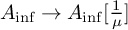 is flat, so the claim is a consequence of [Reference Bhatt, Morrow and ScholzeBMS18, Lemma 6.14].
For completeness we also record the following completed version, which will be useful when comparing q-crystalline cohomology with p-adic étale cohomology (cf. Theorem 6.36). By [Sta18, Tag 0A0G]
$R\nu _{f*}\mathbb {A}_{ {\mathrm {inf}}, X}$
 is p-adically derived complete and so the natural morphism
$A\Omega _{\mathfrak {X}/\mathfrak {Y}} \to R\nu _{f*}\mathbb {A}_{ {\mathrm {inf}}, X}$
 induces a morphism

where
$A\Omega _{\mathfrak {X}/\mathfrak {Y}}^{\wedge }$
 is the p-adic derived completion of
$A\Omega _{\mathfrak {X}/\mathfrak {Y}}$
 .
Lemma 3.11. The morphism

induced by (3.4) is a quasi-isomorphism.
Proof. This requires a slightly more delicate analysis compared to its uncompleted version in Lemma 3.10. Let
$C^{\bullet }$
 be the cone of the canonical morphism
$A\Omega _{\mathfrak {X}/\mathfrak {Y}} \to R\nu _{f*}\mathbb {A}_{ {\mathrm {inf}}, X}$
 given by [Reference Bhatt, Morrow and ScholzeBMS18, Lemma 6.10]. For each
$m \geq 0$
 , Lemma 6.9 in loc. cit. provides a map
$(\mu )^{\otimes m} \otimes _{A_{ {\mathrm {inf}}}} \tau ^{[0,m]}R\nu _{f*}\mathbb {A}_{ {\mathrm {inf}}, X} \to \tau ^{[0,m]}A\Omega _{\mathfrak {X}/\mathfrak {Y}}$
 which is part of the compositions

and

Moreover both (3.6)-(3.7) are just the identity tensored with the inclusion
$(\mu )^{\otimes m} \hookrightarrow A_{ {\mathrm {inf}}}$
 . Let
$C_m$
 be the cone of the truncated map
$\tau ^{[0,m]}A\Omega _{\mathfrak {X}/\mathfrak {Y}} \to \tau ^{[0,m]}R\nu _{f*}\mathbb {A}_{ {\mathrm {inf}}, X}$
 . Then by (3.6)-(3.7),
$H^{i}(C_m)$
 is killed by
$\mu ^{2m}$
 and so
$H^{m}(C^{\bullet })$
 is killed by
$\mu ^{2m+2}$
 . The Tor-spectral sequence then shows that
$H^{m}(C^{\bullet } \otimes _{\mathbb {Z}}^{\mathbb {L}} \mathbb {Z}/p^n)$
 is killed by
$\mu ^{4m+6}$
 for each
$n \geq 1$
 . By functoriality one obtains
$R^{i}\varprojlim _{n}(H^{m}(C^{\bullet } \otimes _{\mathbb {Z}}^{\mathbb {L}} \mathbb {Z}/p^n))$
 is also killed by
$\mu ^{4m+6}$
 for all
$i \geq 0, n \geq 1$
 . The spectral sequence

then shows that
$H^{m}(C^{\bullet \wedge })$
 is killed by some power of
$\mu $
 , where
$C^{\bullet \wedge }$
 is the derived p-adic completion of
$C^{\bullet }$
 . Finally note that the cone of (3.5) is
$C^{\bullet \wedge } \otimes ^{\mathbb {L}}_{A_{ {\mathrm {inf}}}} A_{ {\mathrm {inf}}}[\tfrac {1}{\mu }]$
 which is thus quasi-isomorphic to the zero complex.
For integral p-adic étale cohomology, we will use the framework established in [Reference ScholzeSch13, §8]. Recall the morphism
$f \colon \mathfrak {X} \to \mathfrak {Y}$
 gives rise to a morphism of pro-étale topoi on the generic fiber:

This gives rise to relative integral p-adic étale cohomology (cf. Proposition 8.2 in loc. cit.)

The following lemma says that the complex
$Rf_{\eta , {\mathrm {pro\acute {e}t}}*}\widehat {\mathbb {Z}}_p$
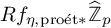 is well behaved.
Lemma 3.12. The complex
$Rf_{\eta , {\mathrm {pro\acute {e}t}}*}\widehat {\mathbb {Z}}_p \in D(Y_{ {\mathrm {pro\acute {e}t}}}, \mathbb {Z}_p)$
 is adic lisse (cf. Definition 3.5).
Proof. By Proposition 3.8, it suffices to show
$Rf_{\eta , {\mathrm {pro\acute {e}t}}*}\widehat {\mathbb {Z}}_p \in D(Y_{ {\mathrm {pro\acute {e}t}}}, \mathbb {Z}_p)$
 is lisse. We need to check that the conditions of Definition 3.1 are satisfied. By [Sta18, Tag 0A0G] it is p-adically derived complete. Moreover by the projection formula (cf. [Sta18, Tag 0944]) and [Reference ScholzeSch13, Corollary 3.17(ii)]

where
$\nu \colon Y_{ {\mathrm {pro\acute {e}t}}} \to Y_{ {\mathrm {\acute {e}t}}}$
 is the natural morphism of sites. By [Reference Scholze and WeinsteinSW20, Theorem 10.5.1],
$Rf_{\eta , {\mathrm {\acute {e}t}}*}(\mathbb {Z}/p)$
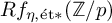 has finite locally constant cohomology sheaves. Furthermore by base change (cf. [Reference HuberHub96, Proposition 2.6.1]) and vanishing of cohomology in large enough degrees (cf. [Reference ScholzeSch13, Theorem 5.1]),
$Rf_{\eta , {\mathrm {\acute {e}t}}*}(\mathbb {Z}/p)$
 has finite tor-dimension. This proves the lemma.
We need an analogue of [Reference Bhatt, Morrow and ScholzeBMS18, Theorem 5.7]. First we need some preparation. For a complex
$\mathscr {C}^{\bullet }$
 of
$\mathbb {Z}_p$
 -modules (in a ringed site), denote by
$\mathscr {C}^{\bullet }_n := \mathscr {C}^{\bullet } \otimes ^{\mathbb {L}}_{\mathbb {Z}_p} \mathbb {Z}/p^n$
 .
Lemma 3.13. Suppose
$\mathscr {A}^{\bullet } \to \mathscr {B}^{\bullet }$
 is a morphism in
$D(Y_{ {\mathrm {pro\acute {e}t}}}, A_{ {\mathrm {inf}}})$
 of p-adically derived complete
$A_{ {\mathrm {inf}}}$
 -complexes such that the induced morphism

is an almost isomorphism (w.r.t.
$[\mathfrak {m}^{\flat }]$
 ) for all i,
$n \geq 1$
 , and
$U \in Y_{ {\mathrm {pro\acute {e}t}}}$
 . Then the cohomology sheaves of the cone of
$\mathscr {A}^{\bullet } \to \mathscr {B}^{\bullet }$
 are killed by
$W(\mathfrak {m}^{\flat })$
 .
Proof. Let
$\mathscr {C}$
 be the cone. We will prove the statement in four steps.
-
Step 1: ‘ $[\mathfrak {m}^{\flat }]$
kills
$H^{i}(\mathscr {C}^{\bullet }_n)(U)$
’. Note that
$H^{i}(\mathscr {C}^{\bullet }_n)$
sits in an exact sequence (3.9) $$ \begin{align} H^{i}(\mathscr{A}^{\bullet}_n) \to H^{i}(\mathscr{B}^{\bullet}_n) \to H^{i}(\mathscr{C}^{\bullet}_n) \to H^{i+1}(\mathscr{A}^{\bullet}_n) \to H^{i+1}(\mathscr{B}^{\bullet}_n). \end{align} $$
The kernel and cokernel presheaves of the first and last arrows of (3.9) are killed by $[\mathfrak {m}^{\flat }]$
. Since sheafification preserves the property (3.10) $$ \begin{align} `\text{local sections killed by } [\mathfrak{m}^{\flat}]' \end{align} $$
it follows that the cokernel of the first and last arrows is killed by $[\mathfrak {m}^{\flat }]$
. It is easy to check that (3.10) is also stable under extensions and this proves that
$[\mathfrak {m}^{\flat }]$
kills
$H^{i}(\mathscr {C}^{\bullet }_n)(U)$
. -
Step 2: ‘ $[\mathfrak {m}^{\flat }]$
kills
$H^{i}(U, \mathscr {C}^{\bullet }_n)$
’. By the Leray spectral sequence (cf. [Sta18, Tag 0732]) $$\begin{align*}H^{p}(U, H^q(\mathscr{C}^{\bullet}_n)) \implies H^{p+q}(U, \mathscr{C}^{\bullet}_n), \end{align*}$$
it suffices to show that each $H^{p}(U, H^q(\mathscr {C}^{\bullet }_n))$
is killed by
$[\mathfrak {m}^{\flat }]$
. Step 1 says that this is true for
$p = 0$
. In other words for
$m \in [\mathfrak {m}^{\flat }]$
, the multiplication map $$\begin{align*}m \colon H^q(\mathscr{C}^{\bullet}_n) \to H^q(\mathscr{C}^{\bullet}_n) \end{align*}$$
is zero. By functoriality, this implies that the induced map
$$\begin{align*}m \colon H^{p}(U, H^q(\mathscr{C}^{\bullet}_n)) \to H^{p}(U, H^q(\mathscr{C}^{\bullet}_n)) \end{align*}$$
is also zero.
-
Step 3: ‘ $W(\mathfrak {m}^{\flat })$
kills
$H^{i}(U, \mathscr {C}^{\bullet })$
’. By [Sta18, Tag 0A0G] and [Reference Bhatt, Morrow and ScholzeBMS18, Lemma 6.15],
$H^{i}(U, \mathscr {C}^{\bullet })$
is p-adically derived complete. Thus by [Reference Česnavičius and KoshikawaCK19, Lemma 3.17], it suffices to check that it is killed by
$[\mathfrak {m}^{\flat }]$
. This follows from Step 2 and [Sta18, Tag 0D6K] (note that the
$R^{1}\varprojlim $
of almost zero modules is almost zero). -
Step 4: ‘ $W(\mathfrak {m}^{\flat })$
kills
$H^{i}(\mathscr {C}^{\bullet })(U)$
’. This follows from Step 3 and the fact that
$H^{i}(\mathscr {C}^{\bullet })$
is the sheafification of
$ U \mapsto H^{i}(U, \mathscr {C}^{\bullet })$
.






Proposition 3.14. The morphism
$f_{\eta , {\mathrm {pro\acute {e}t}}}^{-1}\mathbb {A}_{ {\mathrm {inf}},Y} \to \mathbb {A}_{ {\mathrm {inf}}, X}$
 induces a morphism

such that the cohomology sheaves of its cone are killed by
$W(\mathfrak {m}^{\flat })$
 .
Proof. We check that the conditions of Lemma 3.13 are satisfied. By Lemma 3.12,
$Rf_{\eta , {\mathrm {pro\acute {e}t}}*}\widehat {\mathbb {Z}}_p$
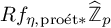 is an adic lisse complex on
$Y_{ {\mathrm {pro\acute {e}t}}}$
 . It follows that the LHS of (3.11) is p-adically derived complete. By [Sta18, Tag 0A0G] the RHS of (3.11),
$Rf_{\eta , {\mathrm {pro\acute {e}t}}*}\mathbb {A}_{ {\mathrm {inf}},X}$
 is p-adically derived complete.
Finally, after tensoring with
$\mathbb {Z}/p^n$
 and taking cohomology, (3.11) takes the shape

The proof of [Reference ScholzeSch13, Theorem 8.8] shows that (after taking sections) (3.12) is an almost isomorphism (w.r.t.
$[\mathfrak {m}^{\flat }]$
 ).
After inverting
$\mu $
 , the relative
$A_{ {\mathrm {inf}}}$
 -cohomology
$R\Gamma _{A_{ {\mathrm {inf}}}}(\mathfrak {X}/\mathfrak {Y})$
 (cf. Definition 2.17) and its derived p-adic completion capture (3.8). More precisely:
Theorem 3.15. We have the identifications

Proof. First we show the left-most quasi-isomorphism. Indeed Lemmas 3.10 and 3.11 imply that the canonical morphism

is a quasi-isomorphism. The result now follows from [SGA4, Exposé VI, Théorème 5.1] (applied to Proposition 2.7(4)) and [Sta18, Tag 0A0G].
It remains to compare the two outer terms. Since
$\mu \in W(\mathfrak {m}^{\flat })$
 , this is a consequence of Lemma 3.10, Proposition 3.14 and [SGA4, Exposé VI, Théorème 5.1] (again applied to Proposition 2.7(4)).
4 The local analysis of
$A\Omega _{\mathfrak {X} / \mathfrak {Y}}$

Let R and S be flat
$\mathcal {O}$
 -algebras equipped with the p-adic topology such that
$R[p^{-1}]$
 and
$S[p^{-1}]$
 are strongly noetherian. Moreover we assume R and S are complete. We assume throughout §4 that
$\mathfrak {Y} = {\mathrm {Spf}} (S)$
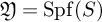 ,
$\mathfrak {X} = {\mathrm {Spf}} (R)$
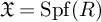 and
$f \colon \mathfrak {X} \to \mathfrak {Y}$
 is any smooth
$ {\mathrm {Spf}}(\mathcal {O})$
 -morphism such that for some
$d \geq 0$
 , there is an étale
$ {\mathrm {Spf}}(S)$
 -morphism

where
$R^{\square } := S \{t_1^{\pm 1}, \ldots , t_d^{\pm 1} \}$
 . Let
$f_{\eta } \colon X \to Y$
 denote the induced morphism on the adic generic fibers. Armed with Definition 2.17, the first goal of this section is to relate the cohomology of the complex
$Rf_{\eta *}\mathbb {A}_{ {\mathrm {inf}},X}$
 , in terms of continuous group cohomology (cf. [Reference Bhatt, Morrow and ScholzeBMS18, Lemma 1.16] in the smooth case and [Reference Česnavičius and KoshikawaCK19, Theorem 3.20] in the semistable case), particularly after killing
$\mu $
 -torsion. The origin of such a computation goes back to ideas of Faltings [Reference FaltingsFal88]. The main steps are analogous to those appearing in the absolute case (cf. [Reference Bhatt, Morrow and ScholzeBMS18, Lemma 1.16] in the smooth case and [Reference Česnavičius and KoshikawaCK19, Theorem 3.20] in the semistable case). The main difference in the current situation is that the pro-étale site of the target Y adds some extra technicalities.
4.1 The perfectoid cover
$X_{\infty }$

We use the setup in [Reference Bhatt, Morrow and ScholzeBMS18, §5.1] when dealing with the pro-étale site associated to a locally noetherian adic space. We fix some pro-étale morphism

where
$Y_{\infty }$
 is some affinoid perfectoid object in
$Y_{ {\mathrm {pro\acute {e}t}}}$
 . Set
$S_{\infty } := (\varinjlim _i S_i^{+})^{\wedge }$
 , where the completion is p-adic. We have the following fact which is implicit in loc. cit.:
Lemma 4.1.
$S_{\infty }$
 is a torsion-free
$\mathcal {O}$
 -module.
Proof. Note first that each
$S_i$
 is a C-vector space and
$S_i^{+} \subset S_i$
 is a subring and therefore
$S_i^{+}$
 is a torsion-free
$\mathcal {O}$
 -module. The direct limit of torsion-free
$\mathcal {O}$
 -modules is again torsion free and so
$\varinjlim _i S_i^{+}$
 is a torsion-free
$\mathcal {O}$
 -module. Since
$\mathcal {O}$
 is a valuation ring by [Sta18, Tag 0539], this is equivalent to
$\varinjlim _i S_i^{+}$
 being a flat
$\mathcal {O}$
 -module. One then applies [Reference Gabber and RameroGR03, Lemma 7.1.6(i)] to conclude that the p-adic completion
$S_{\infty }$
 is a flat and therefore a torsion-free
$\mathcal {O}$
 -module.
The pro-object
$Y_{\infty }$
 therefore determines the perfectoid space
$ {\mathrm {Spa}} (S_{\infty }[\tfrac {1}{p}], S_{\infty })$
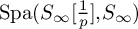 . Base changing along
$Y_{\infty }$
 , we will construct a perfectoid cover over
$X \times _{Y} Y_{\infty }$
 . More precisely, for each
$m \geq 0$
 , we consider the
$R^{\square }$
 -algebra

where the completion is p-adic. Explicitly, we have the p-adically completed direct sum decomposition

The corresponding R-algebras are

As a consequence of Lemma 4.1, we obtain:
Corollary 4.2.
$R_{\infty }$
 is a torsion free
$\mathcal {O}$
 -module.
Proof. By Lemma 4.1 (together with [Reference Gabber and RameroGR03, Lemma 7.1.6(i)]), it follows that
$R_{\infty }^{\square }$
 is a torsion free
$\mathcal {O}$
 -module. Since R is a p-completely étale
$R^{\square }$
 -algebra, it follows that R is the p-adic completion of an étale
$R^{\square }$
 -algebra
$R'$
 by [Sta18, Tag 04D1] and the topological invariance of étale maps. Therefore
$R' \otimes _{R^{\square }} R_{\infty }^{\square }$
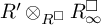 is a flat
$R_{\infty }^{\square }$
 -algebra. Hence,
$R' \otimes _{R^{\square }} R_{\infty }^{\square }$
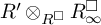 is a flat
$\mathcal {O}$
 -algebra. One then applies [Reference Gabber and RameroGR03, Lemma 7.1.6(i)] to conclude.
We collect some properties about the algebras
$R_m$
 and
$R_{m}^{\square }$
 .
Lemma 4.3. For all
$m \geq 0$
 ,
$R_m$
 is p-adically complete,
$R_{m}^{\square }$
 is integrally closed in
$R_{m}^{\square }[\tfrac {1}{p}]$
 , and
$R_m$
 is integrally closed in
$R_m[\tfrac {1}{p}]$
 .
Proof. The first part follows the same idea as the proof of Corollary 4.2 and in fact we use the algebra
$R'$
 appearing there. Indeed
$R' \otimes _{R^{\square }} R_{0}^{\square }$
 is a flat
$R_{0}^{\square }$
 -algebra. Hence by [Reference Gabber and RameroGR03, Lemma 7.1.6(i)], so is
$R \widehat {\otimes }_{R^{\square }}R^{\square }_0$
 . As
$R^{\square }_m$
 is a finitely presented
$R^{\square }_0$
 -module, the result follows from [Reference Gabber and RameroGR03, Lemma 7.1.6(ii)]. For the second part note that by [Sta18, Tag 03GG]
$S_{\infty }[t_1^{\pm 1/p^{m}}, \ldots , t_d^{\pm 1/p^{m}}]$
 is integrally closed in
$S_{\infty }[\tfrac {1}{p}][t_1^{\pm 1/p^{m}}, \ldots , t_d^{\pm 1/p^{m}}]$
 and we conclude by [Reference BhattBha17, Lemma 5.1.2]. The last part follows from the second part and a similar argument.
The summands in (4.2) with
$a_j \notin \mathbb {Z}$
 for some
$1 \leq j \leq d$
 comprise an
$R^{\square }$
 -submodule
$M^{\square }_{\infty }$
 of
$R^{\square }_{\infty }$
 and we set
$M_{\infty } := R \widehat {\otimes }_{R^{\square }} M_{\infty }^{\square }$
 . Thus, we have the
$R^{\square }$
 -module (resp. R-module) decomposition

The profinite group

acts
$(R^{\square } \widehat {\otimes }_S S_{\infty })$
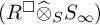 -linearly on
$R_{m}^{\square }$
 by scaling each
$t_{j}^{1/p^m}$
 by the
$\mu _{p^m}$
 -component of
$\epsilon _j$
 . The induced actions of
$\Delta $
 on
$R_{\infty }^{\square }$
 and
$R_{\infty }$
 are continuous, compatible, and preserve the decompositions (4.2) and (4.4).
After inverting p, for each
$m \geq 0$
 , we have

so
$R^{\square }_m [\frac {1}{p}]$
 is the
$(R^{\square } \widehat {\otimes }_S S_{\infty })[\tfrac {1}{p}]$
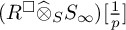 -algebra obtained by adjoining the
$(p^{m})^{\text {th}}$
 roots of
$t_1, \ldots , t_d \in \left ( (R^{\square } \widehat {\otimes }_S S_{\infty })[\tfrac {1}{p}] \right )^{\times }$
 , and hence is finite étale over
$(R^{\square } \widehat {\otimes }_S S_{\infty })[\tfrac {1}{p}]$
 . Therefore,
$\varinjlim _{m} \left ( R_m^{\square }[\tfrac {1}{p}] \right )$
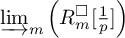 is a pro-(finite étale)
$\Delta $
 -cover of
$(R^{\square } \widehat {\otimes }_S S_{\infty })[\tfrac {1}{p}]$
 . By Lemma 4.3,
$R_m^{\square }$
 is integrally closed in
$R_m^{\square }[\tfrac {1}{p}]$
 and so we can consider the pro-objectFootnote
12

which is a pro-(finite étale)
$\Delta $
 -cover of the pro-object
$X^{\square } \times _{Y} Y_{\infty }$
 . Of course,
$X_{\infty }^{\square }$
 is an affinoid perfectoid object in the site
$X^{\square }_{ {\mathrm {pro\acute {e}t}}}$
 . Base changing the situation along
$X \to X^{\square }$
 we obtain the towerFootnote
13

which is a pro-(finite étale)
$\Delta $
 -cover of the pro-object
$X \times _{Y} Y_{\infty }$
 . As before
$X_{\infty }$
 becomes an affinoid perfectoid object in the site
$X_{ {\mathrm {pro\acute {e}t}}}$
 .
We end this section with a result that allows us to control powerbounded elements in the ring of functions of
$X_{\infty }$
 (or rather the adic space associated to
$X_{\infty }$
 ).
Lemma 4.4. Suppose that S is topologically of finite type over
$\mathcal {O}$
 . Then
$(R_{\infty }[\tfrac {1}{p}])^{\circ } = R_{\infty }$
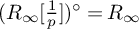 .
Proof. We have
$R_{\infty } \cong R \widehat {\otimes }_{R^{\square }} R_{\infty }^{\square }$
 and the completed direct sum decomposition (4.2) shows that
$R_{\infty }^{\square }$
 has a p-adically completed direct sum decomposition into free
$R^{\square }\widehat {\otimes }_{\mathcal {O}} S_{\infty }$
 -modules. Therefore
$R_{\infty }$
 has a p-adically completed direct sum decomposition into free
$R \widehat {\otimes }_{\mathcal {O}} S_{\infty }$
 -modules. Since S is topologically of finite type over
$\mathcal {O}$
 , so is R. Moreover R is topologically of finite presentation by [Reference BoschBos14, §7.3, Corollary 5] and therefore R is the p-adic completion of a free
$\mathcal {O}$
 -module by [Reference Bhatt, Morrow and ScholzeBMS18, Lemma 8.10] (cf. footnote 8). The result now follows from Lemma 2.13.
4.2 The cohomology of
$\widehat {\mathcal {O}}^{+}$
and continuous group cohomology

We prove a relative version of [Reference Bhatt, Morrow and ScholzeBMS18, Corollary 8.13(i)]. By [Reference ScholzeSch13, Proposition 3.5, Proposition 3.7(iii), Corollary 6.6] the Čech complex of the sheaf
$\widehat {\mathcal {O}}^{+}_X$
 with respect to the pro-(finite étale) affinoid perfectoid cover

is identified with the continuous cochain complex
$R\Gamma _{ {\mathrm {cont}}}(\Delta , R_{\infty })$
 . By [Sta18, Tag 01GY] this gives an edge map

By the almost purity theorem [Reference ScholzeSch13, Lemma 4.10(v)], the maximal ideal
$\mathfrak {m} \subset \mathcal {O}$
 kills the cohomology groups of
$\text {Cone}(e)$
 . Given an injective resolution
$\widehat {\mathcal {O}}^{+}_X \to \mathcal {I}^{\bullet }$
 , we have

The second and third points follow from [Sta18, Tag 0731] and [Sta18, Tag 072Z] when viewing
$\widehat {\mathcal {O}}^{+}_X$
 as an object of
$D(X_{\mathrm {pro{\acute{e}}t}}, \mathcal {O})$
 or
$D(X_{\mathrm {pro{\acute{e}}t}}, \widehat {\mathcal {O}}^{+}_X)$
 . By definition of the pushforward we get that
$\Gamma (X \times _{Y} Y_{\infty }, \mathcal {I}^{\bullet }) = \Gamma (Y_{\infty }, f_{\eta *}\mathcal {I}^{\bullet })$
 . Therefore the edge map can be rewritten as

viewed as a morphism in
$D(\mathcal {O})$
 .
We will now show that
$L\eta _{(\zeta _p - 1)}(e)$
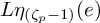 is an isomorphism, so that
$L\eta _{(\zeta _p - 1)}R\Gamma (Y_{\infty }, Rf_{\eta *}\widehat {\mathcal {O}}^{+}_X)$
 is computed in terms of continuous group cohomology. For this, we will use [Reference Bhatt, Morrow and ScholzeBMS18, Lemma 8.11(i)] (cf. [Reference Česnavičius and KoshikawaCK19, Lemma 3.4]). In preparation, first we need to control the
$\mathfrak {m}$
 -torsion in the group cohomology of
$R_{\infty }/x$
 for some
$x \in \mathcal {O}$
 .
Proposition 4.5. The element
$\zeta _{p}-1$
 kills the
$\mathcal {O}$
 -modules
$H^{i}_{ {\mathrm {cont}}}(\Delta , M_{\infty })$
 . If moreover
$(R_{\infty }[\tfrac {1}{p}])^{\circ } = R_{\infty }$
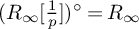 , then for each
$b \in \mathcal {O}$
 , the
$\mathcal {O}$
 -modules
$R_{\infty }/b$
 and
$H^{i}_{ {\mathrm {cont}}}(\Delta , R_{\infty }/b)$
 have no nonzero
$\mathfrak {m}$
 -torsion.
Proof. Firstly by Lemma 2.11, it follows that
$R_{\infty }/b$
 has no nonzero
$\mathfrak {m}$
 -torsion if
$(R_{\infty }[\tfrac {1}{p}])^{\circ } = R_{\infty }$
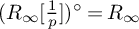 . With the same assumption, we will now show that
$H^{i}_{ {\mathrm {cont}}}(\Delta , R_{\infty }/b)$
 has no non-zero
$\mathfrak {m}$
 -torsion. As we are in the smooth case, we will have access to a decomposition of
$M_{\infty }$
 of which all of the terms will be
$R \widehat {\otimes }_{R^{\square }} R_{0}^{\square }$
 -modules of rank 1. This will allow us to treat each term one by one, analogous to the situation in [Reference Bhatt, Morrow and ScholzeBMS18, Proposition 8.9]. The semistable case handled in [Reference Česnavičius and KoshikawaCK19, Proposition 3.8] is slightly more delicate. With this in mind consider
$S_{\infty } \cdot t_{1}^{a_1} \cdots t_d^{a_d}$
 a summand of (4.2) and set
$T := R_{0}^{\square } \cdot t_{1}^{a_1} \cdots t_d^{a_d}$
 .
By [Reference Česnavičius and KoshikawaCK19, Lemma 3.7] (cf. [Reference Bhatt, Morrow and ScholzeBMS18, Lemma 7.3(ii)]) the
$\mathcal {O}$
 -module
$H^{i}_{ {\mathrm {cont}}}(\Delta , T/b)$
 is the i-th cohomology of the
$R_{0}^{\square }/b$
 -tensor product of d-complexes of the form
$R_{0}^{\square }/b \xrightarrow {\zeta -1} R_{0}^{\square }/b$
 for suitable p-power roots of unity
$\zeta $
 . By Lemma 4.1, one obtains

where M is a D-module for some discrete valuation ring
$D \subset \mathcal {O}$
 (the b is absorbed into the D-module M). Consider the decomposition

where the direct sum runs over those T which contribute to
$M_{\infty }$
 . In order to show that
$H^{i}_{ {\mathrm {cont}}}(\Delta , R_{\infty }/b)$
 has no non-zero
$\mathfrak {m}$
 -torsion, we need to show that both
$H^{i}_{ {\mathrm {cont}}}(\Delta , (R \widehat {\otimes }_S S_{\infty })/b)$
 and
$H^{i}_{ {\mathrm {cont}}}(\Delta , M_{\infty }/b)$
 have no non-zero
$\mathfrak {m}$
 -torsion.
Since R is
$R^{\square }$
 -flat, [Reference Gabber and RameroGR03, Lemma 7.1.6(i)] implies
$R \widehat {\otimes }_{R^{\square }}R^{\square }_0$
 is
$R^{\square }_0$
 -flat. Moreover
$(R \widehat {\otimes }_{R^{\square }}R^{\square }_0) \otimes _{R^{\square }_0} T$
 is p-adically complete and so [Reference Česnavičius and KoshikawaCK19, Lemma 3.7] (cf. [Reference Bhatt, Morrow and ScholzeBMS18, Lemma 7.3(ii)]) gives

Therefore by (4.7) and [Reference Česnavičius and KoshikawaCK19, Lemma 3.6], to show that
$H^{i}_{ {\mathrm {cont}}}(\Delta , M_{\infty }/b)$
 has no nonzero
$\mathfrak {m}$
 -torsion, it suffices to show that
$(R \widehat {\otimes }_{R^{\square }}R^{\square }_0) \otimes _{R^{\square }_0} (M \otimes _{D} R_{0}^{\square })$
 has no nonzero
$\mathfrak {m}$
 -torsion. This reduces to showing that
$(R \widehat {\otimes }_{R^{\square }}R^{\square }_0) \otimes _{R^{\square }_0} R^{\square }_0/d \cong (R \widehat {\otimes }_{R^{\square }}R^{\square }_0)/d$
 has no nonzero
$\mathfrak {m}$
 -torsion for some
$d \in D$
 . However

and since
$(R \widehat {\otimes }_S S_{\infty })/d$
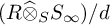 sits inside
$R_{\infty }/d$
 , it follows that
$(R \widehat {\otimes }_{R^{\square }}R^{\square }_0)/d$
 has no nonzero
$\mathfrak {m}$
 -torsion. Finally
$\Delta $
 acts trivially on
$(R \widehat {\otimes }_S S_{\infty })/b$
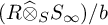 and so
$H^{i}_{ {\mathrm {cont}}}(\Delta ,(R \widehat {\otimes }_S S_{\infty })/b)$
 has no nonzero
$\mathfrak {m}$
 -torsion.
It remains to show
$\zeta _{p}-1$
 kills the
$\mathcal {O}$
 -modules
$H^{i}_{ {\mathrm {cont}}}(\Delta , M_{\infty })$
 , without assuming
$(R_{\infty }[\tfrac {1}{p}])^{\circ } = R_{\infty }$
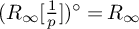 ; we argue similarly and use the same notation. If T contributes to
$M_{\infty }$
 , then as in the proof of [Reference Česnavičius and KoshikawaCK19, Proposition 3.8], we conclude

By (4.8)-(4.9) and [Reference Česnavičius and KoshikawaCK19, Lemma 3.6], we get the desired result.
Theorem 4.6. The edge map e defined in (4.6) induces an almost isomorphism

Similarly the induced map (coming from the inclusion
$i \colon R\widehat {\otimes }_S S_{\infty } \hookrightarrow R_{\infty }$
 )

is an almost isomorphism. Moreover if
$(R_{\infty }[\tfrac {1}{p}])^{\circ } = R_{\infty }$
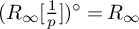 , then both almost isomorphisms are isomorphisms.
Proof. Recall by §4.2, the edge map e is an almost isomorphism. Therefore
$L\eta _{(\zeta _p - 1)}(e)$
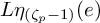 is an almost isomorphism. By Proposition 4.5, i induces an isomorphism

Therefore
$L\eta _{(\zeta _p - 1)}(R\Gamma _{ {\mathrm {cont}}}(i))$
 is an isomorphism and hence
$L\eta _{(\zeta _p - 1)}(e \circ R\Gamma _{ {\mathrm {cont}}}(i))$
 is an almost isomorphism.
Suppose now
$(R_{\infty }[\tfrac {1}{p}])^{\circ } = R_{\infty }$
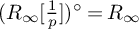 . To show that
$L\eta _{(\zeta _p - 1)}(e)$
 is an isomorphism, it is enough to show that
$L\eta _{(\zeta _p - 1)}(e \circ R\Gamma _{ {\mathrm {cont}}}(i))$
 is an isomorphism. We will apply [Reference Bhatt, Morrow and ScholzeBMS18, Lemma 8.11(i)] (cf. [Reference Česnavičius and KoshikawaCK19, Lemma 3.4]). Proposition 4.5 ensures that the
$\mathcal {O}$
 -modules
$H^{i}_{ {\mathrm {cont}}}(\Delta , R\widehat {\otimes }_S S_{\infty })$
 have no nonzero
$\mathfrak {m}$
 -torsion, while [Reference Česnavičius and KoshikawaCK19, Lemma 3.7] (cf. [Reference Bhatt, Morrow and ScholzeBMS18, Lemma 7.3(ii)]) and the triviality of action of
$\Delta $
 show that the quotient
$\tfrac {H^{i}_{ {\mathrm {cont}}}(\Delta , R\widehat {\otimes }_S S_{\infty })}{(\zeta _p -1)H^{i}_{ {\mathrm {cont}}}(\Delta , R\widehat {\otimes }_S S_{\infty })}$
 is a direct sum of
$\mathcal {O}$
 -modules of the form
$(R\widehat {\otimes }_S S_{\infty })/(\zeta _p -1)$
 . These also have no nonzero
$\mathfrak {m}$
 -torsion. Therefore
$L\eta _{(\zeta _p - 1)}(e \circ R\Gamma _{ {\mathrm {cont}}}(i))$
 is an isomorphism.
The main goal of this section is an analogue of Theorem 4.6 for the complex
$\mathbb {A}_{ {\mathrm {inf}},X}$
 (see Theorem 4.11). To prepare for it, in §4.3 and §4.4 we describe the values of the sheaves
$\widehat {\mathcal {O}}^{+, \flat }_X$
 and
$W(\widehat {\mathcal {O}}^{+, \flat }_X)$
 .
4.3 The tilt
$R_{\infty }^{\flat }$

We fix a system of compatible
$p^n$
 -power roots
$p^{1/p^{\infty }} := (p^{1/p^n})_{n \geq 0}$
 of p in
$\mathcal {O}$
 . Thanks to the explicit description (4.2) of the perfectoid ring
$R_{\infty }^{\square }$
 , its tilt
$(R_{\infty }^{\square })^{\flat } := \varprojlim _{y \mapsto y^p} (R_{\infty }^{\square }/p)$
 is described explicitly by the identification

where
$x_{i}^{1/p^m}$
 corresponds to the p-power compatible sequence
$(\ldots , t_i^{1/p^{m+1}}, t_i^{1/p^m})$
 of elements of
$R_{\infty }^{\square }$
 , where the completions are
$p^{1/p^{\infty }}$
 -adic, and the decomposition is as
$S_{\infty }^{\flat }$
 -modules. Thus,

is identified with the
$p^{1/p^{\infty }}$
 -adic completion of any lift of the étale
$R_{\infty }^{\square }/p$
 -algebra
$R_{\infty }/p$
 to an étale
$(R_{\infty }^{\square })^{\flat }$
 -algebra (such a lift exists by [Sta18, Tag 04D1]). By [Reference ScholzeSch13, Lemma 5.11(i)] the value on
$X_{\infty }$
 of the sheaf
$\widehat {\mathcal {O}}^{+, \flat }_X$
 is the ring
$R_{\infty }^{\flat }$
 .
By functoriality, the group
$\Delta $
 acts continuously and
$S_{\infty }^{\flat }$
 -linearly on
$(R_{\infty }^{\square })^{\flat }$
 and
$R_{\infty }^{\flat }$
 . Explicitly,
$\Delta $
 respects the completed direct sum decomposition and an element
$(\epsilon _1, \ldots , \epsilon _d) \in \Delta $
 scales
$x_{j}^{a_j}$
 by
$\epsilon _j^{a_j} \in \mathcal {O}^{\flat }$
 .
We will need the following analogue of [Reference Česnavičius and KoshikawaCK19, Lemma 3.12] for our analysis in §4.4 of the value on
$X_{\infty }$
 of the sheaf
$\mathbb {A}_{ {\mathrm {inf}}, X}$
 .
Lemma 4.7. Assume that
$(R_{\infty }[\tfrac {1}{p}])^{\circ } = R_{\infty }$
 . Then both
$R_{\infty }^{\flat }/b$
 and
$H^{i}_{ {\mathrm {cont}}}(\Delta , R_{\infty }^{\flat }/b)$
 for each
$b \in \mathcal {O}^{\flat } \backslash \{ 0\}$
 have no nonzero
$\mathfrak {m}^{\flat }$
 -torsion.
Proof. By using Frobenius we can assume that
$b \text { }\lvert \text { }p^{1/p^{\infty }}$
 in
$\mathcal {O}^{\flat }$
 . Then Proposition 4.5 and the
$\Delta $
 -isomorphism
$R_{\infty }^{\flat }/b \cong R_{\infty }/b^{\sharp }$
 for some
$b^{\sharp } \in \mathcal {O}$
 gives the claim.
4.4 The ring
$\mathbb {A}_{ {\mathrm {inf}}}(R_{\infty })$

By [Reference ScholzeSch13, Theorem 6.5(i)], the value of
$H^{0}(R\Gamma (X_{\infty }, \mathbb {A}_{ {\mathrm {inf}},X}))$
 is the ring

In general we will denote by
$\mathbb {A}_{ {\mathrm {inf}}}(P)$
 for a perfectoid ring P over
$\mathcal {O}$
 to be
$W(P^{\flat })$
 .
Lemma 4.8. Assume that
$(R_{\infty }[\tfrac {1}{p}])^{\circ } = R_{\infty }$
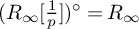 . Then each quotient

Proof. This follows from Lemma 4.7 (cf. [Reference Česnavičius and KoshikawaCK19, (3.14.1)]).
By the characterization of Witt vectors of perfect rings [Reference BhattBha18, 2.5], we have the explicit presentation

where the completions are
$(p, \mu )$
 -adic, the decomposition is as
$\mathbb {A}_{ {\mathrm {inf}}}(S_{\infty })$
 -modules and in terms of the notation in §4.3,
$X_i^{1/p^{m}} = [x_i^{1/p^{m}}]$
 . The summands for which
$a_i \in \mathbb {Z}$
 for all i comprise a subring

where the convergence is
$(p, \mu )$
 -adic. The remaining summands, that is, those for which
$a_i \notin \mathbb {Z}$
 comprise a
$A(R^{\square })$
 -submodule
$N^{\square }_{\infty } \subset \mathbb {A}_{ {\mathrm {inf}}}(R_{\infty }^{\square })$
 .
There is a canonical surjective ring homomorphism

whose kernel is a principal ideal, cf. [Reference Bhatt, Morrow and ScholzeBMS18, Lemma 3.10], such that

The p-completely étale map
$R^{\square } \to R$
 deforms uniquely (along (4.12)) to a
$(p,\mu )$
 -completely étale map
$A(R^{\square }) \to A(R)$
 , where
$A(R)$
 is
$(p, \mu )$
 -adically complete. By construction of
$A(R)$
 , the tilting equivalence, and the characterization of Witt vectors [Reference BhattBha18, 2.5], we have the identification

where the completion is
$(p, \mu )$
 -adic. Therefore, by setting
$N_{\infty } := N_{\infty }^{\square } \widehat {\otimes }_{A(R^{\square })} A(R)$
 , we arrive at the decompositions of
$\mathbb {A}_{ {\mathrm {inf}}}(R_{\infty }^{\square })$
 and
$\mathbb {A}_{ {\mathrm {inf}}}(R_{\infty })$
 into ‘integral’ and ‘nonintegral’ parts:

Modulo
$\xi $
 , these decompositions reduce to the decompositions in (4.4).
The Witt vector Frobenius of
$\mathbb {A}_{ {\mathrm {inf}}}(R_{\infty }^{\square })$
 preserves
$A(R^{\square })$
 ; explicitly: it is semilinear with respect to the Frobenius of
$\mathbb {A}_{ {\mathrm {inf}}}(S_{\infty })$
 and raises each
$X_i^{1/p^{m}}$
 to the p-th power. By construction,
$A(R)$
 inherits a Frobenius ring endomorphism from
$A(R^{\square })$
 , and the identification (4.13) is Frobenius-equivariant.
The natural
$\Delta $
 -action on
$\mathbb {A}_{ {\mathrm {inf}}}(R_{\infty })$
 is continuous and commutes with the Frobenius. Explicitly,
$\Delta $
 respects the completed direct sum decomposition (4.14) and an element
$(\epsilon _1, \ldots , \epsilon _d) \in \Delta $
 scales
$X_j^{a_j}$
 by
$[\epsilon _j^{a_j}] \in A_{ {\mathrm {inf}}}$
 . The
$\Delta $
 -action on
$A(R^{\square })$
 lifts uniquely to a necessarily Frobenius-equivariant
$\Delta $
 -action on
$A(R)$
 , which is trivial on the quotient
$A(R) \to R$
 . In particular,
$\Delta $
 acts trivially on
$A(R)/\mu $
 . The identifications (4.13)-(4.14) are
$\Delta $
 -equivariant.
4.5 The cohomology of
$\mathbb {A}_{ {\mathrm {inf}},X}$
and continuous group cohomology

Similarly to §4.2, the Čech complex of the sheaf
$W(\widehat {\mathcal {O}}^{+, \flat }_X)$
 with respect to the pro-(finite étale) affinoid perfectoid cover

is identified with the continuous cochain complex
$R\Gamma _{ {\mathrm {cont}}}(\Delta , \mathbb {A}_{ {\mathrm {inf}}}(R_{\infty }))$
 . Thus, by [Sta18, Tag 01GY], we obtain the map to the pro-étale cohomology of
$\mathbb {A}_{ {\mathrm {inf}},X}$
 (obtained by composing the edge map with
$R\Gamma _{{\text {pro}{\acute{\text {e}}}{\text {t}}}} (Y_{\infty }, Rf_{\eta *}W(\widehat {\mathcal {O}}^{+, \flat }_X)) \to R\Gamma _{{\text {pro}{\acute{\text {e}}}{\text {t}}}} (Y_{\infty }, Rf_{\eta *}\mathbb {A}_{ {\mathrm {inf}},X})$
 ):

By the almost purity theorem, more precisely, by [Reference ScholzeSch13, Theorem 6.5(ii)], the subset
$[\mathfrak {m}^{\flat }] \subset A_{ {\mathrm {inf}}}$
 that consists of the Teichmüller lifts of the elements in the maximal ideal
$\mathfrak {m}^{\flat } \subset \mathcal {O}_{C^{\flat }}$
 kills all the cohomology groups of
$\text {Cone}(e)$
 . In fact using [Reference Česnavičius and KoshikawaCK19, Lemma 3.17] and the fact that pushforwards preserve derived p-completions (cf. [Sta18, Tag 0A0G]), it follows that each
$H^{i}(\text {Cone}(e))$
 is killed by
$W(\mathfrak {m}^{\flat })$
 .
Proposition 4.9. For each
$i \in \mathbb {Z}$
 , the
$A_{ {\mathrm {inf}}}$
 -module
$H^i_{ {\mathrm {cont}}}(\Delta , \mathbb {A}_{ {\mathrm {inf}}}(R_{\infty })/\mu )$
 is p-torsion free and p-adically complete; moreover, the following natural maps are isomorphisms:

and

In addition, if
$(R_{\infty }[\tfrac {1}{p}])^{\circ } = R_{\infty }$
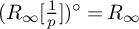 , then
$H^i_{ {\mathrm {cont}}}(\Delta , \mathbb {A}_{ {\mathrm {inf}}}(R_{\infty })/(\mu , p^n))$
 and
$H^i_{ {\mathrm {cont}}}(\Delta , \mathbb {A}_{ {\mathrm {inf}}}(R_{\infty })/\mu )$
 have no nonzero
$W(\mathfrak {m}^{\flat })$
 -torsion.
Proof. The first step is to use the decomposition (4.14) to reduce to proving the proposition for the ‘nonintegral’ part of
$\mathbb {A}_{ {\mathrm {inf}}}(R_{\infty })$
 . Since
$A(R)/\mu $
 is p-adically complete and has a trivial
$\Delta $
 -action (see [Reference Česnavičius and KoshikawaCK19, Lemma 3.13] and §4.4), [Reference Česnavičius and KoshikawaCK19, Lemma 3.7] (cf. [Reference Bhatt, Morrow and ScholzeBMS18, Lemma 7.3(ii)]) implies that
$H^i_{ {\mathrm {cont}}}(\Delta , A(R)/\mu )$
 is a direct sum of copies of
$A(R)/\mu $
 and likewise for
$H^i_{ {\mathrm {cont}}}(\Delta , A(R)/(\mu ,p^n))$
 . Furthermore, if
$(R_{\infty }[\tfrac {1}{p}])^{\circ } = R_{\infty }$
 then Lemma 4.8 implies that the rings
$A(R)/\mu $
 and
$A(R)/(\mu ,p^n)$
 have no nonzero
$W(\mathfrak {m}^{\flat })$
 -torsion. Thus we only need to establish all claims with
$N_{\infty }$
 in place of
$\mathbb {A}_{ {\mathrm {inf}}}(R_{\infty })$
 .
We now reduce the situation to that of [Reference Česnavičius and KoshikawaCK19, Proposition 3.19]. For this we will need to keep track of the
$S_{\infty }$
 appearing in the definition of
$N_{\infty }^{\square }$
 . Therefore it will be convenient to temporarily denote
$N_{\infty }^{\square }$
 by
$N_{\infty }^{\square }(S_{\infty })$
 . The identifications

are
$\Delta $
 -equivariant. Furthermore
$\mathbb {A}_{ {\mathrm {inf}}}(S_{\infty })/(\mu , p^n)$
 is
$A_{ {\mathrm {inf}}}/(\mu , p^n)$
 -flat (cf. Lemma 3.13 in loc. cit.) and
$A(R)/(\mu , p^n)$
 is
$A(R^{\square })/(\mu , p^n)$
 -flat (because
$A(R)$
 is a
$(\mu , p)$
 -completely étale
$A(R^{\square })$
 -algebra). Thus the short exact sequence [Reference Česnavičius and KoshikawaCK19, (3.19.9)] established, in particular, for
$N_{\infty }^{\square }(\mathcal {O})$
 holds also for
$N_{\infty }$
 :

for
$n>1$
 . The transition morphisms
$H^i_{ {\mathrm {cont}}}(\Delta , N_{\infty }/(\mu ,p^n)) \to H^i_{ {\mathrm {cont}}}(\Delta , N_{\infty }/(\mu ,p^{n-1}))$
 are in particular surjective and so
$R^{1}\varprojlim _{n}H^i_{ {\mathrm {cont}}}(\Delta , N_{\infty }/(\mu ,p^n))$
 vanishes. Therefore by [Sta18, Tag 0D6K], we obtain

which is the sought analogue of (4.17). The p-torsion freeness of
$H^i_{ {\mathrm {cont}}}(\Delta , N_{\infty }/\mu )$
 follows from (4.18)-(4.19). Therefore by [Reference Česnavičius and KoshikawaCK19, Lemma 3.7] (cf. [Reference Bhatt, Morrow and ScholzeBMS18, Lemma 7.3(ii)]) and [Sta18, Tag 061Z], we obtain

which is the sought analogue of (4.16).
It remains to show that each
$H^i_{ {\mathrm {cont}}}(\Delta , N_{\infty }/(\mu , p^n))$
 has no nonzero
$W(\mathfrak {m}^{\flat })$
 -torsion, under the assumption
$(R_{\infty }[\tfrac {1}{p}])^{\circ } = R_{\infty }$
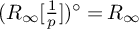 . The short exact sequence (4.18) and the exact sequence

show that
$H^i_{ {\mathrm {cont}}}(\Delta , N_{\infty }/(\mu , p^n))$
 is a successive extension of copies of
$H^i_{ {\mathrm {cont}}}(\Delta , N_{\infty }/(\mu , p))$
 . Now
$N_{\infty }/(\mu , p)$
 is a direct summand of
$\mathbb {A}_{ {\mathrm {inf}}}(R_{\infty })/(\mu , p) \cong R_{\infty }^{\flat }/\mu $
 . The result now follows from Lemma 4.7.
Remark 4.10. A remark about the proof of Proposition 4.9. We have

where the completion is
$(p,\mu )$
 -adic. Thus it would be natural to attempt to give a more direct reduction of Proposition 4.9 to [Reference Česnavičius and KoshikawaCK19, Proposition 3.19] where the statement is proved, in particular, for the ring
$A_{ {\mathrm {inf}}}\{X_1^{\pm 1}, \ldots , X_d^{\pm 1} \}$
 . However we do not know whether
$\mathbb {A}_{ {\mathrm {inf}}}(S_{\infty })$
 is a flat
$A_{ {\mathrm {inf}}}$
 -algebra and it is unclear how to bring the completed tensor product outside the cohomology groups.
Theorem 4.11. The edge map defined in (4.15) induces a morphism

such that the cohomology groups of
$\text {Cone}(L\eta _{\mu }(e))$
 are killed by
$W(\mathfrak {m}^{\flat }) \subset A_{ {\mathrm {inf}}}$
 . Moreover if
$(R_{\infty }[\tfrac {1}{p}])^{\circ } = R_{\infty }$
 , then this morphism is an isomorphism.
Proof. Recall by §4.5, the cohomology groups of
$\text {Cone}(e)$
 are killed by
$W(\mathfrak {m}^{\flat })$
 . Therefore
$L\eta _{\mu }(e)$
 satisfies the analogous claim.
Suppose now
$(R_{\infty }[\tfrac {1}{p}])^{\circ } = R_{\infty }$
 . By the projection formula [Sta18, Tag 0944],

Therefore by Proposition 4.9, the cohomology modules of
$R\Gamma _{ {\mathrm {cont}}}(\Delta , \mathbb {A}_{ {\mathrm {inf}}}(R_{\infty })) \otimes _{A_{ {\mathrm {inf}}}}^{\mathbb {L}} A_{ {\mathrm {inf}}}/\mu $
 have no nonzero
$W(\mathfrak {m}^{\flat })$
 -torsion. Thus the claim follows from [Reference Česnavičius and KoshikawaCK19, Lemma 3.18].
Later when we will compare
$A\Omega _{\mathfrak {X}/\mathfrak {Y}}$
 with q-crystalline cohomology (cf. Theorem 6.28) we will need to vary
$\Delta $
 in Theorem 4.11 to accommodate for the ‘all possible coordinates’ technique. The following remark will make this possible (cf. [Reference Česnavičius and KoshikawaCK19, Remark 3.21]).
Remark 4.12. For any profinite group
$\Delta '$
 equipped with a continuous surjection
$\Delta ' \twoheadrightarrow \Delta $
 and any pro-(finite étale) affinoid perfectoid
$\Delta '$
 -cover

compatibly with the surjection
$\Delta ' \twoheadrightarrow \Delta $
 , the edge map
$e'$
 defined analogously to (4.15) induces a morphism

which satisfies the same conditions as in Theorem 4.11. The same line of reasoning as in loc. cit. applies. In general, by the octahedral axiom the morphism

has cone whose cohomology groups are killed by
$[\mathfrak {m}^{\flat }]$
 and therefore by [Reference Česnavičius and KoshikawaCK19, Lemma 3.17], it is also killed by
$W(\mathfrak {m}^{\flat })$
 . If in addition
$(R_{\infty }[\tfrac {1}{p}])^{\circ } = R_{\infty }$
 , then (4.21) is an isomorphism.
5 The Hodge-Tate specialization of
$A\Omega _{\mathfrak {X} / \mathfrak {Y}}$

In this section we assume that
$\mathfrak {X}$
 and
$\mathfrak {Y}$
 are flat p-adic formal schemes of type (S)(b) over
$\mathcal {O}$
 , as in [Reference HuberHub94, §1.9], and
$f \colon \mathfrak {X} \to \mathfrak {Y}$
 is a smooth morphism. To state the results in this section, we will often have to resort to using the language of almost
$\mathcal {O}$
 -sheaves. This is particularly the case, outside of some finite type assumptions. For this we refer the reader to §2.3, and in particular the functor (cf. Definition 2.24)

With the local analysis of §4 at our disposal, we turn to the analysis of the Hodge-Tate specialization of
$A\Omega _{\mathfrak {X} / \mathfrak {Y}}$
 . Analogous to [Reference Bhatt, Morrow and ScholzeBMS18, §9.2], we consider a presheaf version of
$A\Omega _{\mathfrak {X} / \mathfrak {Y}}$
 .
5.1 The presheaf version
$A\Omega _{\mathfrak {X} / \mathfrak {Y}}^{\text {psh}}$

We begin this section with a result that good objects in D (cf. Definition 2.9) are, under some mild conditions, sufficiently well behaved. Following the notation of §2.1 and 4.1, for a good object

in D, one has the associated rings
$S_{\infty }$
 and
$R_{\infty }$
 (cf. (4.3)).
Lemma 5.1. If
$\mathfrak {Y}$
 is locally of finite type over
$\mathcal {O}$
 , then for every good object (cf. (5.1)), one has
$(R_{\infty }[\tfrac {1}{p}])^{\circ } = R_{\infty }$
 .
Proof. This is an immediate consequence of Lemma 4.4.
In addition to the site D constructed in §2.1, we consider the site
$D^{\text {psh}}$
 , whose objects are good objects in D, and coverings are isomorphisms. In this way, every presheaf is already a sheaf. We denote the associated topos by
$(Y_{ {\mathrm {pro\acute {e}t}}}\times _{\mathfrak {Y}_{ {\mathrm {\acute {e}t}}}}\mathfrak {X}_{ {\mathrm {\acute {e}t}}})^{\text {psh}}$
 . There is a morphism of topoi

for which
$\phi _{*}$
 is given by restricting sheaves on D to
$D^{\text {psh}}$
 and
$\phi ^{-1}$
 is given by sheafification. In particular, since any sheaf is the sheafification of its associated presheaf,
$\phi ^{-1}\circ \phi _{*} \cong {\mathrm {id}}$
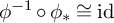 . We let

be the indicated composition of morphisms of topoi (with
$\nu _f$
 defined in (2.2)) and set

Since
$L\eta $
 commutes with pullback under flat morphisms of ringed topoi (cf. [Reference Bhatt, Morrow and ScholzeBMS18, Lemma 6.14])

Moreover, again by [Reference Bhatt, Morrow and ScholzeBMS18, Lemma 6.14],
$A\Omega _{\mathfrak {X} / \mathfrak {Y}}^{\text {psh}}$
 may be described explicitly: for every object
$Z = (W \to \mathfrak {U} \leftarrow \mathfrak {V})$
 of
$D^{\text {psh}}$
 , we have (cf. (2.3))

In particular, since, by [Reference Bhatt, Morrow and ScholzeBMS18, Lemma 6.19], the functor
$L\eta _{\mu }$
 preserves derived completeness when used in the context of a replete topos (such as the topos of sets), we see from (5.3) that
$A\Omega _{\mathfrak {X} / \mathfrak {Y}}^{\text {psh}}$
 is derived
$\xi $
 -adically (and also
$\tilde {\xi }$
 -adically) complete (cf. Lemma 2.27). Armed with the formalism of §5.1, we now identify the Hodge-Tate specialization of
$A\Omega _{\mathfrak {X} / \mathfrak {Y}}$
 .
Theorem 5.2. There exists a morphism in
$D(D, \mathcal {O})$


whose image in
$D(D, \mathcal {O}^a)$
 is an almost isomorphism. If in addition
$\mathfrak {Y}$
 is locally of finite type over
$\mathcal {O}$
 then (5.4) is already an isomorphism in
$D(D, \mathcal {O})$
 .
Proof. We will employ the language of §2.3. Let
$\theta _X \colon W(\widehat {\mathcal {O}}^{+, \flat }_X) \twoheadrightarrow \widehat {\mathcal {O}}^{+}_X$
 be the natural map so that the kernel of
$\theta _{X} \circ \varphi ^{-1} \colon W(\widehat {\mathcal {O}}^{+, \flat }_X) \twoheadrightarrow \widehat {\mathcal {O}}^{+}_X$
 is generated by the nonzero divisor
$\tilde {\xi }$
 . The projection formula (cf. [Sta18, Tag 0944]) provides the identification

By [Reference ZavyalovZav24, Lemma A.8]
$\widehat {\mathcal {O}}^{+}_X$
 is derived p-adically complete and so by [Sta18, Tag 0A0G], the RHS of (5.5) is derived p-adically complete. Thus there is no harm in replacing
$W(\widehat {\mathcal {O}}^{+, \flat }_X)$
 appearing on the LHS of (5.5) with its derived p-adic completion to obtain:

Since
$(\theta \circ \varphi ^{-1})(\mu ) = \zeta _p -1$
 , this induces the map (5.4) and likewise its presheaf version

Due to (5.2),
$\phi ^{-1}$
 brings (5.6) to (5.4), so by Proposition 2.25, it suffices to show that (5.6) is an almost isomorphism (if
$\mathfrak {Y}$
 is in addition locally of finite type over
$\mathcal {O}$
 , it suffices to show (5.6) is an isomorphism).
Consider an object
$Z = (W \to \mathfrak {U} \leftarrow \mathfrak {V}) = (\varprojlim _{i \in I} {\mathrm {Spa}}(S_{i}, S_{i}^{+}) \to {\mathrm {Spf}}(S) \leftarrow {\mathrm {Spf}}(R))$
 of
$D^{\text {psh}}$
 . The discussion and notation of §4 apply. In particular, Proposition 4.9 and (4.20) ensure that the cohomology of
$R\Gamma _{ {\mathrm {cont}}}(\Delta , \mathbb {A}_{ {\mathrm {inf}}}(R_{\infty })) \otimes _{A_{ {\mathrm {inf}}}}^{\mathbb {L}} A_{ {\mathrm {inf}}}/\mu $
 is p-torsion free. Thus, since
$\tilde {\xi } \equiv p \pmod {\mu }$
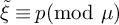 , [Reference BhattBha18, Lemma 5.16] implies that

Now Theorem 4.11 gives a morphism

whose cone has cohomology groups killed by
$W(\mathfrak {m}^{\flat }) \otimes _{A_{ {\mathrm {inf}}}, \theta \circ \varphi ^{-1}} \mathcal {O} \cong \mathfrak {m}$
 (cf. Lemma 2.26). Similarly Theorem 4.6 gives a morphism

whose cone has cohomology groups killed by
$\mathfrak {m}$
 . Since the edge maps (4.5) and (4.15) are compatible, (5.7)–(5.9) give the desired conclusion (if
$\mathfrak {Y}$
 is in addition locally of finite type over
$\mathcal {O}$
 , then by Lemma 5.1, (5.8)-(5.9) are isomorphisms).
5.2 The completed integral structure sheaf
$\widehat {\mathcal {O}}_{D}^{+}$

In this section, we compute the (local) sections of
$\widehat {\mathcal {O}}_{D}^{+}$
 for good objects, cf. Proposition 5.7. The strategy is as follows:
-
(1) Compute the sections of the pushforward $\nu _{f*}\widehat {\mathcal {O}}^{+}_{X}$
for good objects (cf. Lemma 5.3). -
(2) Show $\nu _{f*}\widehat {\mathcal {O}}^{+}_{X}$
is p-adically complete (cf. Lemma 5.5(iv)). -
(3) Compare $\nu _{f*}\widehat {\mathcal {O}}^{+}_{X}$
with
$\widehat {\mathcal {O}}_{D}^{+}$
.


Lemma 5.3. For a good object

we have
$\nu _{f*}\widehat {\mathcal {O}}^{+}_{X}(Z) = R \widehat {\otimes }_S S_{\infty }$
 .
Proof. We employ the notation of §4.1. By (4.4), recall that we have a decomposition

and since
$M_{\infty }^{\Delta }$
 is killed by
$(\zeta _p -1)$
 (cf. Proposition 4.5), we immediately obtain by Corollary 4.2,

The edge map (4.5) is an isomorphism in degree 0. Thus we get a natural isomorphism (in R, S and
$S_{\infty }$
 )

By (2.3), the RHS is precisely
$\nu _{f*}\widehat {\mathcal {O}}^{+}_{X}(Z)$
 .
Lemma 5.3 computes the sections of
$\nu _{f*}\widehat {\mathcal {O}}^{+}_{X}$
 for good objects. We now begin our comparison of
$\nu _{f*}\widehat {\mathcal {O}}^{+}_{X}$
 with
$\widehat {\mathcal {O}}_{D}^{+}$
 . This will involve showing that
$\nu _{f*}\widehat {\mathcal {O}}^{+}_X$
 is p-adically complete (as a sheaf). The following (slight) strengthening of the proof of [Reference ScholzeSch12, Proposition 7.13] will be useful.
Lemma 5.4. Let
$U_{\infty }$
 be an affinoid perfectoid space over
$ {\mathrm {Spa}} (C, \mathcal {O})$
 . Then for any covering
$\{U_i \to U_{\infty } \}$
 (with each
$U_i$
 affinoid) in
$U_{\infty , {\mathrm {\acute {e}t}}}$
 (in the sense of [Reference ScholzeSch12, Definition 7.1(iii)]), the complex

is exact.
Proof. The statement is proved in the proof of [Reference ScholzeSch12, Proposition 7.13] where in addition the covering is finite and each
$U_i \to U_{\infty }$
 is a composition of rational embeddings and finite étale maps. To obtain the general statement one takes a finite refinement
$\{ V_j \to U_{\infty }\}$
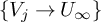 of
$\{U_i \to U_{\infty } \}$
 such that each
$V_j \to U_{\infty }$
 is a composition of rational embeddings and finite étale maps. The key point is that the Čech complex associated to the covering of
$\{ V_j \to U_{\infty }\}$
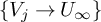 restricted to each
$U_{i_1} \times _{U_{\infty }} \ldots \times _{U_{\infty }} U_{i_p}$
 is almost exact (again by the proof in loc.cit.). By the same argument as [Reference Bosch, Güntzer and RemmertBGR84, §8.1.4, Corollary 3], this implies that the augmented Čech complex associated to
$\{V_j \to U_{\infty } \}$
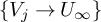 is almost exact iff the same is true for
$\{ U_{i} \to U_{\infty }\}$
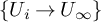 Footnote
14
.
We now show an analogue of [Reference ScholzeSch13, Lemma 4.10] for
$\nu _{f*}\widehat {\mathcal {O}}^{+}_{X}$
 .
Lemma 5.5. Let
$Z = (W \to \mathfrak {U} \leftarrow \mathfrak {V}) = (\varprojlim _{i \in I} {\mathrm {Spa}}(S_{i}, S_{i}^{+}) \to {\mathrm {Spf}}(S) \leftarrow {\mathrm {Spf}}(R)) \in D$
 be a good object. In the following, we use the almost setting w.r.t.
$\mathfrak {m} \subset \mathcal {O}$
 .
-
(i) We have $\nu _{f*}\widehat {\mathcal {O}}^{+}_{X}(Z)/p^n = (R \otimes _S S_{\infty })/p^n$
, and this is almost equal to
$((\nu _{f*}\widehat {\mathcal {O}}^{+}_X)/p^n)(Z)$
. -
(ii) The cohomology groups $H^{i}(Z, (\nu _{f*}\widehat {\mathcal {O}}^{+}_X)/p^n)$
are almost zero for
$i>0$
and
$n \geq 1$
. -
(iii) The image of $((\nu _{f*}\widehat {\mathcal {O}}^{+}_X)/p^{n+1})(Z)$
in
$((\nu _{f*}\widehat {\mathcal {O}}^{+}_X)/p^n)(Z)$
is
$(R \otimes _S S_{\infty })/p^n$
for all
$n \geq 1$
. -
(iv) The sheaf $\nu _{f*}\widehat {\mathcal {O}}^{+}_X$
is p-adically complete:
$\nu _{f*}\widehat {\mathcal {O}}^{+}_X = \varprojlim (\nu _{f*}\widehat {\mathcal {O}}^{+}_X)/p^n$
. -
(v) The cohomology groups $H^{i}(Z, \nu _{f*}\widehat {\mathcal {O}}^{+}_X)$
are almost zero for
$i>0$
. -
(vi) If in addition $\mathfrak {Y} = {\mathrm {Spf}}(\mathcal {O})$
, then the cohomology groups
$H^{i}(Z, \nu _{f*}\widehat {\mathcal {O}}^{+}_X)$
vanish on the nose for
$i>0$
.








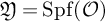


Proof. The equality
$\nu _{f*}\widehat {\mathcal {O}}^{+}_X(Z)/p^n = (R \otimes _S S_{\infty })/p^n$
 follows from Lemma 5.3. For parts (i)-(ii), by Proposition 2.25 and the exactness of
$\widetilde {\alpha } \colon {\mathrm {Mod}}_{\mathcal {O}}(\widetilde {\mathscr {C}}) \to \widetilde {\mathscr {C}}^{a}$
 (cf. §2.3) it suffices to show

is a sheaf of
$\mathcal {O}^{a}$
 -modules and
$H^{i}(Z, \mathscr {F}) = 0$
 for
$i>0$
 .
Let Z be covered by
$Z_{k} \to Z$
 , where
$Z_k$
 are objects as in Proposition 2.7(1). By Proposition 2.7(2) Z is quasi-compact, so we can assume that there are only finitely many
$Z_k$
 or a single T (by taking the disjoint union componentwise). After taking a refinement we can assume T is good (cf. Proposition 2.16(1)), and of the form

such that
-
(1) $W_j \to W_{j'}$
is finite étale surjective for
$j \geq j' \geq 0$
. -
(2) $\varprojlim W_j \to U_0$
factors as
$\varprojlim W_j \to W_0 \to U_0$
, where
$U_{0}$
is the adic generic fiber of
$\mathfrak {U}_0$
. -
(3) $\varprojlim W_j \to W$
factors as
$\varprojlim W_j \to W_{0} \to W$
.






In particular this implies that
$W_j \times _{U_{0}} V_{0} \to W \times _{U} V$
 is étale surjective for
$j \geq 0$
 , where
$V_0$
 is the adic generic fiber of
$\mathfrak {V}_0$
 . It suffices to check that the complex

is exact. Note that by Lemma 5.3
-
(1) $\mathscr {F}(Z) = (R \otimes _S S_{\infty })^{a}/p^n$
, and -
(2) $\mathscr {F}(T) = \widehat {\mathcal {O}}^{+}_X(\varprojlim W_j \times _{U_0} V_{0})^{a}/p^n = \varinjlim (\widehat {\mathcal {O}}^{+}_{X}(W_j \times _{U_{0}} V_0) )^{a}/p^n$
.


Moreover the values of
$\mathscr {F}(Z)$
 and
$\mathscr {F}(T)$
 determine the values of all the terms in (5.11) as each
$\underbrace {T \times _{Z} \ldots \times _Z T}_{ r \text { times}}$
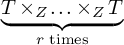 is good (good objects are stable under fiber products) and

Now
$R \widehat {\otimes }_S S_{\infty }$
 is not quite perfectoid, so the final step is to base change (5.11) to a sequence of perfectoid algebras.
Employing the notation in §4 we have the pro-(finite étale) cover
$U_{\infty } \to W \times _U V$
 in
$X_{ {\mathrm {pro\acute {e}t}}}$
 . Let
$U_{j, \infty } \to U_{j}$
 be the étale cover determined by
$W_j \times _{U_{0}} V_{0} \to W \times _{U} V$
 .
Lemma 5.6. The morphism
$R \widehat {\otimes }_S S_{\infty } \to R_{\infty }$
 is p-completely faithfully flat.
Proof. Note that each
$R_m$
 is nonzero and finite free over
$R \widehat {\otimes }_S S_{\infty }$
 and
$R_{\infty }$
 is the (derived) p-adic completion of
$\varinjlim R_m$
 .
So it suffices to show that the complex in (5.11) base changed along
$(R \widehat {\otimes }_S S_{\infty })^{a} \to R_{\infty }^{a}$
 :

is exact, where
$\widehat {U}_{\infty }$
 (resp.
$\widehat {U}_{j,\infty }$
 ) is the corresponding affinoid perfectoid space associated to
$U_{\infty }$
 (resp.
$U_{j, \infty }$
 ). This follows from Lemma 5.4.
We now show part (iii). Let
$f \in ((\nu _{f*}\widehat {\mathcal {O}}^{+}_{X})/p^{n+1})(Z)$
 . By part (1), there exists
$g \in R \widehat {\otimes }_S S_{\infty }$
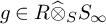 such that
$pf = g$
 in
$((\nu _{f*}\widehat {\mathcal {O}}^{+}_{X})/p^{n+1})(Z)$
 . This means that there exists a covering
$\{ Z_k \to Z \}$
 and
$f_k \in \nu _{f*}\widehat {\mathcal {O}}^{+}_{X}(Z_k)$
 such that

On the other hand we can write
$g = ph$
 for some
$h \in (R \widehat {\otimes }_S S_{\infty })[\tfrac {1}{p}]$
 . By (5.13), we get that
$h \in R \widehat {\otimes }_S S_{\infty }$
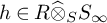 . As multiplication by
$p \colon (\nu _{f*}\widehat {\mathcal {O}}^{+}_{X})/p^{n} \to (\nu _{f*}\widehat {\mathcal {O}}^{+}_{X})/p^{n+1}$
 is an injection, we get that
$f = h$
 in
$((\nu _{f*}\widehat {\mathcal {O}}^{+}_{X})/p^{n})(Z)$
 . This completes the proof of part (iii).
Part (iv) is a consequence of part (iii). Part (v) is a consequence of parts (ii) and (iv) together with the almost version of [Reference ScholzeSch13, Lemma 3.18].
Finally we deal with part (vi) and let us introduce additional notation: for topological spaces A and B let
$C_c(A,B)$
 denote the space of continuous maps from A to B. We claim that it is enough to check the exactness of complex (5.11) for a singleton covering
$T \to Z$
 of type (a), (b), (c) and (d) individually with T good. First note that covers of type (a), (b), (c) and (d) are stable under pullback (i.e. a cover of type (a) under pullback remains a cover of type (a) and idem. for the other types). Secondly a typical cover is given by a composition of covers of type (a) to (d) and by temporarily moving to the subsite consisting of good objects (cf. Proposition 2.16(1)), we can suppose each object in the composition is good. Thus by [SGA4, Exposé Vbis, Proposition 3.3.1(d)] vanishing of higher Čech cohomology for covers of a specific type implies vanishing for all covers in the site. For covers of type (c) and (d) each term in (5.11) is just
$\mathcal {F}(Z)$
 (i.e. the values do not change) and the morphisms alternate between the zero morphism and isomorphisms. To see this it is enough to show the map
$\mathcal {F}(Z) \to \mathcal {F}(T)$
 is an isomorphism. This follows from (5.10) and functoriality of the edge map (4.5). It remains to check exactness for covers of type (a) and (b).
Consider first
$T \to Z$
 of type (a) so that
$T = (\varprojlim W_j \to \mathfrak {U} \leftarrow \mathfrak {V})$
 and
$\varprojlim W_{j} \to W$
 is a covering in
$ {\mathrm {Spa}}(C, \mathcal {O})_{ {\mathrm {pro\acute {e}t}}}$
 . Moreover, as
$\mathfrak {U} \to {\mathrm {Spf}}(\mathcal {O})$
 is étale,
$\mathfrak {U}$
 is a finite disjoint union of copies of
$ {\mathrm {Spf}}(\mathcal {O})$
 and so we can assume
$\mathfrak {U} = {\mathrm {Spf}}(\mathcal {O})$
 . As we are in the situation
$\mathfrak {Y} = {\mathrm {Spf}}(\mathcal {O})$
 the pro-étale topology of a point is completely described by profinite sets. More precisely the associated adic space
$ {\mathrm {Spa}}(S_{\infty }[\tfrac {1}{p}], S_{\infty })$
 to W is of the form
$ {\mathrm {Spa}} (C, \mathcal {O})\times \underline {P}$
 for some profinite set P. Then equipping
$C_c(P, C)$
 with the natural topological ring structure, we can write

by the proof of [Reference FarguesFar, Lemma 3.9.5]. In particular
$S_{\infty } \cong C_c (P, \mathcal {O})$
 . Moreover the pro-étale cover
$\varprojlim W_{j} \to W$
 is induced from a surjection of profinite sets
$P' \to P$
 . In this case the complex (5.11) is of the form

which is induced by the complex

where each term is considered as an
$\mathcal {O}$
 -module. Now for any profinite set H

where the second isomorphism follows from the discreteness of
$\mathcal {O}/p^{n}$
 and
$\mathbb {Z}$
 . Exactness of

follows from the proof of [Reference Clausen and ScholzeCS, Theorem 3.2]. Tensoring (5.16) with
$\mathcal {O}$
 preserves exactness (
$\mathcal {O}$
 is a flat
$\mathbb {Z}$
 -module) and moreover each term in the resulting sequence is a free
$\mathcal {O}$
 -module by Theorem 5.4 in loc. cit. Since
$\mathcal {O}$
 is a p-completely flat
$\mathbb {Z}$
 -algebra, its derived p-adic completion coincides with its classical completion. This implies the exactness of (5.15). Since R is p-completely flat
$\mathcal {O}$
 -algebra, by the same reasoning this implies the exactness of (5.14).
Now consider
$T \to Z$
 of type (b). Using a similar argument to the previous paragraph we can assume
$T = (W \to {\mathrm {Spf}}(\mathcal {O}) \leftarrow {\mathrm {Spf}}(R'))$
 with
$ {\mathrm {Spf}}(R') \to {\mathrm {Spf}}(R)$
 an étale surjection. In this case (5.11) is of the form

Now for each integer
$n \geq 1$
 , the complex

is exact by [Sta18, Tag 023M]. By taking p-adic completions and noting that
$R'$
 is a p-completely flat R-algebra we get the exactness of

which implies the exactness of (5.17) by similar arguments to the previous paragraph.
We can finally compare
$\nu _{f*}\widehat {\mathcal {O}}^{+}_{X}$
 and
$\widehat {\mathcal {O}}^{+}_{D}$
 and establish a morphism of ringed topoi.
Proposition 5.7. There is a morphism of ringed topoi

with
$\nu _{f}^{\sharp } \colon \widehat {\mathcal {O}}^{+}_D \xrightarrow {\sim } \nu _{f^{*}}(\widehat {\mathcal {O}}^{+}_X)$
 . Moreover for a good object

we have
$\widehat {\mathcal {O}}^{+}_D(Z) = R \widehat {\otimes }_S S_{\infty }$
 .
Proof. By definition

and so by Lemma 5.5(iv), it suffices to construct a morphism

which gives an isomorphism modulo
$p^n$
 . By definition the LHS of (5.18) is the sheafification of the presheaf
$Z \mapsto \mathscr {F}(Z) := R \otimes _S S_{\infty }$
 . Since
$\nu _{f*}(\widehat {\mathcal {O}}^{+}_{X})(Z) = R \widehat {\otimes }_S S_{\infty }$
 which is natural in R, S and
$S_{\infty }$
 (cf. Lemma 5.3 and its proof), we get a map
$\mathscr {F} \to \nu _{f*}(\widehat {\mathcal {O}}^{+}_{X})$
 of presheaves which is an isomorphism modulo
$p^n$
 . Sheafifying this map gives the sought-after (5.18).
Finally we conclude this section by comparing
$\widehat {\mathcal {O}}^{+}_{D}$
 with its derived p-adic completion
$R\varprojlim (\widehat {\mathcal {O}}^{+}_{D}/p^n)$
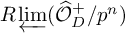 :
Lemma 5.8. The completed integral structure sheaf
$\widehat {\mathcal {O}}^{+}_{D}$
 is derived p-adically complete.
Proof. By Proposition 5.7 we identify
$\widehat {\mathcal {O}}^{+}_D$
 with
$\nu _{f^{*}}(\widehat {\mathcal {O}}^{+}_X)$
 and use the notation of Lemma 5.5. By a similar proof to [Reference ZavyalovZav24, Lemma A.8], it suffices to show
$R\Gamma (Z, \widehat {\mathcal {O}}^{+}_D)$
 is derived p-adically complete. By [Reference Bhatt, Morrow and ScholzeBMS18, Lemma 6.15], it suffices to show for each
$i \geq 0$
 ,
$H^{i}(Z, \widehat {\mathcal {O}}^{+}_{D})$
 is derived p-adically complete. For
$i = 0$
 , this follows from the second part of Proposition 5.7. For
$i \geq 1$
 , this follows from Lemma 5.5(v).
5.3 The object
$\widetilde {\Omega }_{\mathfrak {X} / \mathfrak {Y}}$

Armed with §5.2, to proceed further, we need to analyze the right side of (5.4), namely

First we show that the morphism of ringed topoi
$(\nu _f, \nu _{f}^{\sharp })$
 constructed in Proposition 5.7 satisfies the expected base change:
Lemma 5.9. Suppose the morphism
$f \colon \mathfrak {X} \to \mathfrak {Y}$
 sits in a commutative diagram

where
$\mathfrak {X}' \to \mathfrak {X}$
 and
$\mathfrak {Y}' \to \mathfrak {Y}$
 are étale. Then (5.19) induces a commutative diagram of ringed topoi:

and the base change morphism
$j^{*}R^{n}\nu _{f*}\mathscr {F} \to R^{n}\nu _{f'*}i^{*}\mathscr {F}$
 is an isomorphism (here
$\mathscr {F}$
 is an
$\widehat {\mathcal {O}}^{+}_X$
 -module).
Proof. The key point is that if

is a good object in
$Y^{\prime }_{ {\mathrm {pro\acute {e}t}}} \times _{\mathfrak {Y}^{\prime }_{ {\mathrm {\acute {e}t}}}} \mathfrak {X}^{\prime }_{ {\mathrm {\acute {e}t}}}$
 , then it is also a good object in
$Y_{ {\mathrm {pro\acute {e}t}}} \times _{\mathfrak {Y}_{ {\mathrm {\acute {e}t}}}} \mathfrak {X}_{ {\mathrm {\acute {e}t}}}$
 . The commutativity follows from the functoriality of the edge map (4.5) by the construction of morphisms of ringed topoi (cf. proofs of Proposition 5.7 and Lemma 5.3). For the isomorphism claim, one checks that both sides (of the base change morphism) are sheafifications of the presheaf

where as usual,
$U'$
 (resp.
$V'$
 ) is the adic generic fiber of
$\mathfrak {U}'$
 (resp.
$\mathfrak {V}'$
 ).
A basic property is that
$\widetilde {\Omega }_{\mathfrak {X} / \mathfrak {Y}}$
 behaves well with respect to base change:
Corollary 5.10. In the situation of Lemma 5.9,
$j^{*}\widetilde {\Omega }_{\mathfrak {X} / \mathfrak {Y}} \cong \widetilde {\Omega }_{\mathfrak {X}' / \mathfrak {Y}'}$
 .
Proof. The result follows by Lemma 5.9 together with the fact that
$L\eta $
 commutes with flat base change (cf. [Reference Bhatt, Morrow and ScholzeBMS18, Lemma 6.14]).
Proposition 5.11. We have
$H^{0}(\widetilde {\Omega }_{\mathfrak {X} / \mathfrak {Y}}) \cong \widehat {\mathcal {O}}^{+}_D$
 . For
$i \geq 1$
 , the
$\widehat {\mathcal {O}}^{+a}_D$
 -module
$H^{i}(\widetilde {\Omega }_{\mathfrak {X} / \mathfrak {Y}})^{a}$
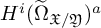 is Zariski locally on
$\mathfrak {X}$
 the pullback of a free
$\mathcal {O}_{\mathfrak {X}, {\mathrm {\acute {e}t}}}^{a}$
 -module of rank
$\binom {\dim _{x} f_{k}^{-1}(f_{k}(x))}{i}$
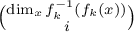 at a variable closed point x of
$\mathfrak {X}_{k}$
 . If in addition
$\mathfrak {Y}$
 is locally of finite type over
$\mathcal {O}$
 , then the almost can be dropped.
Proof. The isomorphism
$H^{0}(\widetilde {\Omega }_{\mathfrak {X} / \mathfrak {Y}}) \cong \widehat {\mathcal {O}}^{+}_D$
 is a consequence of Proposition 5.7. So assume
$i \geq 1$
 .
By Lemma 2.15 and Corollary 5.10, we can assume that
$\mathfrak {Y} = {\mathrm {Spf}} (S)$
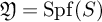 ,
$\mathfrak {X} = {\mathrm {Spf}} (R)$
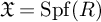 and for some
$d \geq 0$
 , there is an étale
$ {\mathrm {Spf}}(S)$
 -morphism

To achieve this, we can first shrink
$\mathfrak {X}$
 (as the statement depends Zariski locally on
$\mathfrak {X}$
 ) and then
$\mathfrak {Y}$
 as this does not change the sections of sheaves in the fibered topoi (cf. Lemma 2.3 for coverings of type (c)). Henceforth the discussion and notation of §4 apply. In particular, since R is
$R^{\square }$
 -flat and
$\Delta $
 acts trivially on
$R^{\square }$
 and R, [Reference Česnavičius and KoshikawaCK19, Lemma 3.7] (cf. [Reference Bhatt, Morrow and ScholzeBMS18, Lemma 7.3(ii)]) and Proposition 4.5 imply that

Theorem 4.6 shows that

is an almost isomorphism of free
$R \widehat {\otimes }_S S_{\infty }$
 -modules of rank
$\binom {d}{i}$
 . Consequently by Proposition 5.7 we get almost isomorphisms

to the effect that
$H^{i}(\widetilde {\Omega }_{\mathfrak {X} / \mathfrak {Y}})$
 is the pullback of an almost free
$\mathcal {O}_{\mathfrak {X}, {\mathrm {\acute {e}t}}}$
 -module of rank
$\binom {d}{i}$
 as desired. Finally if
$\mathfrak {Y}$
 is locally of finite type over
$\mathcal {O}$
 , then by Lemma 5.1, (5.22)-(5.23) are isomorphisms.
Remark 5.12. The proof of Proposition 5.11, specifically (5.22)-(5.23), shows that if
$\mathfrak {X}$
 and
$\mathfrak {Y}$
 are affine, then the presheaf assigning
$\frac {H^{i}(X' \times _{Y'} Y_{\infty }', \widehat {\mathcal {O}}^{+}_{X'})}{H^{i}(X' \times _{Y'} Y_{\infty }', \widehat {\mathcal {O}}^{+}_{X'})[\zeta _p -1]}$
 to a variable good object
$(\varprojlim _j Y_{j}' \to \mathfrak {Y}' \leftarrow \mathfrak {X}')$
 over
$(Y \to \mathfrak {Y} \leftarrow \mathfrak {X})$
 is an almost
$\mathcal {O}$
 -sheaf (as usual
$Y_{\infty }'$
 is the perfectoid affinoid determined by
$\varprojlim _j Y_j'$
 ). If in addition
$\mathfrak {Y}$
 is locally of finite type over
$\mathcal {O}$
 , then it is a sheaf, although we will not use this fact except when
$\mathfrak {Y}= {\mathrm {Spf}} (\mathcal {O})$
 .
Almost in the following corollary is w.r.t.
$[\mathfrak {m}^{\flat }]$
 .
Corollary 5.13. The object
$A\Omega _{\mathfrak {X}/\mathfrak {Y}}$
 is almost derived
$\xi $
 -adically complete (i.e. the canonical morphism
$A\Omega _{\mathfrak {X} / \mathfrak {Y}} \to R\varprojlim _{n}(A\Omega _{\mathfrak {X} / \mathfrak {Y}} \otimes ^{\mathbb {L}}_{A_{ {\mathrm {inf}}}} A_{ {\mathrm {inf}}}/\xi ^n)$
 is an almost isomorphism) and

is an almost isomorphism. If in addition
$\mathfrak {Y} = {\mathrm {Spf}}(\mathcal {O})$
 , then the almost can be dropped.
Proof. Since
$\phi ^{-1} \circ R\phi _{*} \cong {\mathrm {id}}$
 , to show that
$A\Omega _{\mathfrak {X}/\mathfrak {Y}}$
 is almost derived
$\xi $
 -adically complete, it suffices to show that

is an almost isomorphism. Since
$A\Omega _{\mathfrak {X} / \mathfrak {Y}}^{\text {psh}}$
 is derived
$\xi $
 -adically complete (cf. §5.1), we reduce to proving (5.24). We can assume
$\mathfrak {X}$
 and
$\mathfrak {Y}$
 are affine, and there is a framing as in (5.20). By the almost analogue of [Reference Bhatt, Morrow and ScholzeBMS18, Lemma 9.15] for the site
$D^{\text {psh}}$
 defined in §5.1 and the fact that
$A\Omega _{\mathfrak {X} / \mathfrak {Y}}^{\text {psh}}$
 is derived
$\tilde {\xi }$
 -adically complete, it suffices to show

is an almost isomorphism. By induction on n, we may assume
$n=1$
 and in this case by (5.6)

is an almost isomorphism. By Remark 5.12, the cohomology presheaves of the RHS of (5.25) are in fact almost
$\mathcal {O}$
 -sheaves (note that by Lemma 5.5(v),
$R^{i}\phi _{*}$
 of these almost
$\mathcal {O}$
 -sheaves are almost zero for
$i>0$
 ). Finally in the case
$\mathfrak {Y} = {\mathrm {Spf}}(\mathcal {O})$
 , these almost
$\mathcal {O}$
 -sheaves are sheaves by Remark 5.12. Moreover their
$R^{i}\phi _{*}$
 vanish for
$i> 0$
 by Lemma 5.5(vi).
Remark 5.14. In general, the ‘almost’ in Corollary 5.13 cannot be dropped even in the case
$\mathfrak {Y}$
 is locally of finite type over
$\mathcal {O}$
 . The issue is that even in this case,
$R^{i}\phi _{*}$
 of the sheaves appearing in Remark 5.12 are only almost zero in general.
Before we continue, we actually have enough at our disposal to compare our objects with the ones constructed in [Reference Bhatt, Morrow and ScholzeBMS18]. So let us take a brief detour to do this. Let
$r \colon \mathfrak {X}_{ {\mathrm {\acute {e}t}}} \to \mathfrak {X}_{ {\mathrm {Zar}}}$
 be the natural morphism of topoi and recall the projection morphism
$q \colon Y_{ {\mathrm {pro\acute {e}t}}} \times _{\mathfrak {Y}_{ {\mathrm {\acute {e}t}}}} \mathfrak {X}_{ {\mathrm {\acute {e}t}}} \to \mathfrak {X}_{ {\mathrm {\acute {e}t}}}$
 .
Proposition 5.15. Suppose
$\mathfrak {Y} = {\mathrm {Spf}}(\mathcal {O})$
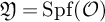 . Then there is a natural quasi-isomorphism

where
$A\Omega _{\mathfrak {X}} := L\eta _{\mu }(Rr_{*}Rq_{*}R\nu _{f*}\mathbb {A}_{ {\mathrm {inf}},X})$
 as defined in [Reference Bhatt, Morrow and ScholzeBMS18, Definition 9.1].
Proof. By [Reference Česnavičius and KoshikawaCK19, Corollary 4.21] it suffices to show that there is a natural quasi-isomorphism

where
$A\Omega _{\mathfrak {X}_{ {\mathrm {\acute {e}t}}}} := L\eta _{\mu }(Rq_{*}R\nu _{f*}\mathbb {A}_{ {\mathrm {inf}},X})$
 is the main object studied in [Reference Česnavičius and KoshikawaCK19]. Let
$q^{\text {psh}} \colon (Y_{ {\mathrm {pro\acute {e}t}}}\times _{\mathfrak {Y}_{ {\mathrm {\acute {e}t}}}}\mathfrak {X}_{ {\mathrm {\acute {e}t}}})^{\text {psh}} \to \mathfrak {X}_{ {\mathrm {\acute {e}t}}}^{\text {psh}}$
 denote the presheaf version of q. Then by (4.1.3) in loc. cit. and (5.3) we get

where
$A\Omega _{\mathfrak {X}_{ {\mathrm {\acute {e}t}}}}^{\text {psh}}$
 is the presheaf version of
$A\Omega _{\mathfrak {X}_{ {\mathrm {\acute {e}t}}}}$
 defined in (4.1.1) in loc. cit. However
$A\Omega _{\mathfrak {X}_{ {\mathrm {\acute {e}t}}}}^{\text {psh}}$
 is already a sheaf by (4.6.1) in loc. cit. It remains to show
$A\Omega _{\mathfrak {X}/ {\mathrm {Spf}}(\mathcal {O})}^{\text {psh}}$
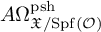 is also a sheaf. This follows from the last statement of Corollary 5.13.
In the spirit of [Reference Bhatt, Morrow and ScholzeBMS18, Theorem 8.3] and [Reference Česnavičius and KoshikawaCK19, Theorem 4.11], our next task is to identify
$H^{i}(\widetilde {\Omega }_{\mathfrak {X} / \mathfrak {Y}})$
 with the twists of the bundles given by (continuous) Kähler differentials. For this, in Proposition 5.16, we first express
$H^{i}(\widetilde {\Omega }_{\mathfrak {X} / \mathfrak {Y}})$
 as
$\bigwedge ^{i} H^{1}(\widetilde {\Omega }_{\mathfrak {X} / \mathfrak {Y}})$
 .
5.3.1 The cup product maps
By the same arguments as in [Sta18, Tag 068G], there are product maps

that satisfy
$x \cup y = (-1)^{jj'}y \cup x$
 (cf. [Sta18, Tag 0BYI]). By [Sta18, Tag 0B6C], there is a cup product map

These maps combine to give the cup product map (where the tensor product is over
$\widehat {\mathcal {O}}_D^{+}$
 )

Proposition 5.16. For each
$i> 0$
 , the map (5.26) induces an almost isomorphism

If in addition,
$\mathfrak {Y}$
 is locally of finite type over
$\mathcal {O}$
 , then the almost can be dropped.
Proof. By Proposition 5.11, each
$H^{i}(\widetilde {\Omega }_{\mathfrak {X} / \mathfrak {Y}})^{a}$
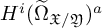 has no nonzero 2-torsion, so the antisymmetry of the map (5.26), in each pair of variables indeed induces the
$\widehat {\mathcal {O}}_D^{+a}$
 -module map (5.27). For the isomorphism claim, we may work étale locally (on
$\mathfrak {X}$
 ), so we put ourselves in the situation of (5.20) (cf. Corollary 5.10). Similar to the proof of [Reference Česnavičius and KoshikawaCK19, Proposition 4.8], the edge maps (4.5) are compatible with cup products by the hypercovering construction of the cup product. By Theorem 4.6 and Remark 5.12, it then remains to argue that via the cup product the identification

This follows from [Reference Bhatt, Morrow and ScholzeBMS18, Lemmas 7.3 and 7.5], which imply the Künneth formula for the continuous group cohomology (cf. [Reference Bhatt, Morrow and ScholzeBMS18, Proposition 8.14]).
The final statement follows from Lemma 5.1 and running the argument on the nose.
To relate
$H^{1}(\widetilde {\Omega }_{\mathfrak {X} / \mathfrak {Y}})$
 to Kähler differentials, we now review the needed material on cotangent complexes.
5.3.2 The completed cotangent complex
$\widehat {\mathbb {L}}_{\widehat {\mathcal {O}}_D^{+}/\widehat {\mathcal {O}}_Y^{+}}$

We will need to analyze a cotangent complex naturally appearing on our (fibered product) site D. To phrase results, however, we need two facts coming from [Reference Bhatt, Morrow and ScholzeBMS18, §8.2] (cf. [Reference Česnavičius and KoshikawaCK19, §4.9]):
-
(1) $\widehat {\mathbb {L}}_{\widehat {\mathcal {O}}^{+}_X / \mathcal {O}} \cong \widehat {\mathbb {L}}_{\widehat {\mathcal {O}}^{+}_Y / \mathcal {O}} \cong 0$
and -
(2) $\widehat {\mathbb {L}}_{\widehat {\mathcal {O}}_{X}^{+}/\mathbb {Z}_p} \cong \widehat {\mathcal {O}}^{+}_{X} \{ 1\}[1]$
.


We take some time to review them. Affinoid perfectoids form a basis of
$X_{ {\mathrm {pro\acute {e}t}}}$
 by [Reference ScholzeSch13, Proposition 4.8]. Therefore [Reference Bhatt, Morrow and ScholzeBMS18, Lemma 3.14] ensures that for the sheaf of rings
$\widehat {\mathcal {O}}_{X}^{+}$
 , the cotangent complex
$\mathbb {L}_{\widehat {\mathcal {O}}^{+}_X / \mathcal {O}}$
 , whose terms are
$\widehat {\mathcal {O}}_X^{+}$
 -flat and which give an object of
$D^{\leq 0}(\widehat {\mathcal {O}}_X^{+})$
 , satisfies

This shows (1). We now show (2). By [Reference Bhatt, Morrow and ScholzeBMS18, Definition 8.2], the completed cotangent complex
$\widehat {\mathbb {L}}_{\mathcal {O}/\mathbb {Z}_p}$
 is the (shifted) Breuil-Kisin-Fargues twist
$\mathcal {O}\{ 1\}[1]$
 and so the derived p-adic completion turns the canonical morphism

since by (1), the cone (of the said morphism)
$\widehat {\mathbb {L}}_{\widehat {\mathcal {O}}^{+}_X / \mathcal {O}} \cong 0$
 .
Armed with (1)-(2) we turn to our analysis of
$\widehat {\mathbb {L}}_{\mathcal {O}_D^{+}/\widehat {\mathcal {O}}_{Y}^{+}}$
 and compare it to the sheaf
$q^{*}\Omega ^{1}_{\mathfrak {X}/\mathfrak {Y}}$
 (cf. Proposition 5.18). We will need some preparation:
Lemma 5.17. For a good object
$Z = (\varprojlim _{i \in I} {\mathrm {Spa}}(S_{i}, S_{i}^{+}) \to {\mathrm {Spf}}(S) \leftarrow {\mathrm {Spf}}(R))$
 ,

Proof.
A priori
$q^{*}\Omega ^{1}_{\mathfrak {X}/\mathfrak {Y}}$
 is the sheaf associated to the presheaf
$Z \mapsto \widehat {\Omega }^{1}_{R/S} \otimes _R (R \widehat {\otimes }_S S_{\infty })$
 . On the other hand by [Reference Fujiwara and KatoFK18, Chapter I, Proposition 5.3.17],
$\widehat {\Omega }^{1}_{R/S}$
 is a finite free R-module. Since the Z-sections
$\widehat {\mathcal {O}}_D^{+}$
 are
$R \widehat {\otimes }_S S_{\infty }$
 (cf. Proposition 5.7), it follows that the presheaf is already a sheaf.
Proposition 5.18. The complex
$\widehat {\mathbb {L}}_{\mathcal {O}_D^{+}/\widehat {\mathcal {O}}_{Y}^{+}}$
 is quasi-isomorphic to
$q^{*}\Omega ^{1}_{\mathfrak {X}/\mathfrak {Y}}$
 placed in degree
$0$
 .
Proof. We use [Sta18, Tag 0D6K] and begin analyzing
$\mathbb {L}_{\widehat {\mathcal {O}}_{D}^{+}/\widehat {\mathcal {O}}_{Y}^{+}} \otimes _{\mathbb {Z}}^{\mathbb {L}} \mathbb {Z}/p^n$
 . By Lemma 4.1 (resp. Corollary 4.2) together with the fact that good objects form a basis for the topology on D (cf. Proposition 2.16),
$p^{-1}\widehat {\mathcal {O}}_{Y}^{+}$
 (resp.
$\widehat {\mathcal {O}}_{D}^{+}$
 ) is p-torsion free on local sections. Therefore there is a canonical quasi-isomorphism (cf. [Sta18, Tag 08QQ])

Now for a good object
$Z = (\varprojlim _{i \in I} {\mathrm {Spa}}(S_{i}, S_{i}^{+}) \to {\mathrm {Spf}}(S) \leftarrow {\mathrm {Spf}}(R))$
 ,
$H^{i}(\mathbb {L}_{(\widehat {\mathcal {O}}_{D}^{+}/p^n)/(\widehat {\mathcal {O}}_{Y}^{+}/p^n)})$
 is the sheaf associated to the presheaf (cf. [Sta18, Tag 08SW])

However, as
$R/p^n$
 is smooth over
$S/p^n$
 we obtain (again by [Sta18, Tag 08QQ])

is concentrated in degree 0. Therefore (5.28) implies
$\mathbb {L}_{\widehat {\mathcal {O}}_{D}^{+}/\widehat {\mathcal {O}}_{Y}^{+}} \otimes _{\mathbb {Z}}^{\mathbb {L}} \mathbb {Z}/p^n$
 is concentrated in degree 0. Hence by [Sta18, Tag 0D6K],
$\widehat {\mathbb {L}}_{\mathcal {O}_D^{+}/\widehat {\mathcal {O}}_{Y}^{+}}$
 is also concentrated in degree
$0$
 .
At degree 0,
$H^{0}(\mathbb {L}_{(R \otimes _S S_{\infty }/p^n)/(S_{\infty }/p^n)})$
 coincides with
$\Omega ^{1}_{(R \otimes _S S_{\infty }/p^n)/(S_{\infty }/p^n)}$
 (cf. [Sta18, Tag 08UR]). Thus by the description of
$H^{0}(\mathbb {L}_{\widehat {\mathcal {O}}_{D}^{+}/\widehat {\mathcal {O}}_{Y}^{+}} \otimes _{\mathbb {Z}}^{\mathbb {L}} \mathbb {Z}/p^n)$
 (cf. (5.29)),

We now analyze the RHS of (5.30). The sheaf
$\varprojlim _n \Omega ^{1}_{(\widehat {\mathcal {O}}_{D}^{+}/p^n)/(\widehat {\mathcal {O}}_{Y}^{+}/p^n)}$
 is associated to the presheaf
$Z \mapsto \widehat {\Omega }^{1}_{R \widehat {\otimes }_S S_{\infty }/S_{\infty }}$
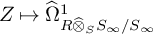 . By [Reference Fujiwara and KatoFK18, Chapter I, Proposition 5.1.5], there is a canonical isomorphism

Finally by lemma 5.17,
$\Omega ^{1}_{R/S} \widehat {\otimes }_S S_{\infty }$
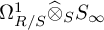 are precisely the Z-sections of
$q^{*}\Omega ^{1}_{\mathfrak {Y}/\mathfrak {X}}$
 .
Note that
$(q, q^{\sharp })$
 in (2.4) and the functoriality of cotangent complexes induces
$q^{*}\Omega ^{1}_{\mathfrak {Y}/\mathfrak {X}}\cong q^* \widehat {\mathbb {L}}_{\mathfrak {Y}/\mathfrak {X}}\to \widehat {\mathbb {L}}_{\mathcal {O}_D^{+}/\widehat {\mathcal {O}}_{Y}^{+}}$
 , and the computation above is compatible with this map.
5.3.3 The relation between
$\widetilde {\Omega }_{\mathfrak {X} / \mathfrak {Y}}$
and the sheaf of relative Kähler differentials

The functoriality of the cotangent complex supplies the pullback morphism

We first relate
$\widehat {\mathbb {L}}_{\widehat {\mathcal {O}}_D^{+}/\mathbb {Z}_p}$
 to the completed cotangent complex of the previous section:
$\widehat {\mathbb {L}}_{\mathcal {O}_D^{+}/\widehat {\mathcal {O}}_{Y}^{+}}$
 . Indeed
$\widehat {\mathbb {L}}_{\mathcal {O}/\mathbb {Z}_p}$
 is the (shifted) Breuil-Kisin-Fargues twist
$\mathcal {O} \{ 1\}[1]$
 (cf. [Reference Bhatt, Morrow and ScholzeBMS18, Definition 8.2]) and so

This implies
$H^{0}(\widehat {\mathbb {L}}_{\widehat {\mathcal {O}}^{+}_{D}/\mathbb {Z}_p}) \cong H^{0}(\widehat {\mathbb {L}}_{\widehat {\mathcal {O}}^{+}_{D}/\widehat {\mathcal {O}}^{+}_{Y}}) \cong q^{*}\Omega ^{1}_{\mathfrak {X}/\mathfrak {Y}}$
 , where the last isomorphism is Proposition 5.18. Therefore by applying
$H^{0}(-)$
 to (5.32) and twisting by
$\mathcal {O} \{-1 \}$
 we obtain:

Theorem 5.19. The composition (5.33) induces an
$\widehat {\mathcal {O}}_{D}^{+a}$
 -isomorphism (after dividing the map by
$\zeta _p-1$
 )

which by Proposition 5.11 (in particular
$H^{0}(\widetilde {\Omega }_{\mathfrak {X} / \mathfrak {Y}}) \cong \widehat {\mathcal {O}}^{+}_D$
 ) and Proposition 5.16, induces an
$\widehat {\mathcal {O}}_{D}^{+a}$
 -module identification

If in addition
$\mathfrak {Y}$
 is locally of finite type over
$\mathcal {O}$
 , then the almost can be dropped.
Proof. By Corollary 5.10 and Lemma 5.17 we may assume
$\mathfrak {X} = {\mathrm {Spf}} (R)$
 and
$\mathfrak {Y} = {\mathrm {Spf}} (S)$
 with
$R = S \{t_1^{\pm 1}, \ldots , t_d^{\pm 1} \}$
 . In this case
$\Delta = \mathbb {Z}_p(1)^{d}$
 is the natural group acting
$R \widehat {\otimes }_S S_{\infty }$
 -linearly on
$R_{\infty }$
 . The p-adic derived completion of the pullback morphism

supplies a morphism
$\widehat {\mathbb {L}}_{R \widehat {\otimes }_S S_{\infty }/\mathbb {Z}_p} \to \widehat {\mathbb {L}}_{R_{\infty }/\mathbb {Z}_p} \cong R_{\infty }\{1 \}[1]$
 . We remind the reader that the isomorphism
$\widehat {\mathbb {L}}_{R_{\infty }/\mathbb {Z}_p} \cong R_{\infty }\{1 \}[1]$
 is coming from the Breuil-Kisin-Fargues twist
$\widehat {\mathbb {L}}_{\mathcal {O}/\mathbb {Z}_p} = \mathcal {O} \{ 1\}[1]$
 . The
$\Delta $
 -equivariance of the map
$R \widehat {\otimes }_S S_{\infty } \to R_{\infty }$
 induces a map

The LHS of (5.36)
$H^{0}(\widehat {\mathbb {L}}_{R \widehat {\otimes }_S S_{\infty }/\mathbb {Z}_p}) = \widehat {\Omega }^{1}_{R \widehat {\otimes }_S S_{\infty }/S_{\infty }} \overset {(5.31)}{\cong } \Omega ^{1}_{R/S} \widehat {\otimes }_S S_{\infty }$
 is a free
$R \widehat {\otimes }_S S_{\infty }$
 -module of rank d generated by
$\tfrac {dt_i}{t_i}$
 . By the proof of [Reference Bhatt, Morrow and ScholzeBMS18, Proposition 8.15] (5.36) is an isomorphism onto

Note the equality of (5.37) follows from Proposition 4.5. The isomorphism sends
$\tfrac {dt_i}{t_i}$
 to

is the map on p-adic Tate modules induced by the map
$d\log _i \colon \mu _{p^{\infty }} \to \Omega ^{1}_{\mathcal {O}/\mathbb {Z}_p}$
 . The
$\mathbb {Z}_p(1)$
 in (5.38) corresponds to the ith component in
$\Delta $
 . The result now follows from Theorem 4.6.
5.4 The de Rham specialization of
$A\Omega _{\mathfrak {X}/\mathfrak {Y}}$

In this section, we relate the de Rham specialization of
$A\Omega _{\mathfrak {X}/\mathfrak {Y}}$
 to the relative de Rham complex, cf. [Reference Bhatt, Morrow and ScholzeBMS18, Theorem 14.1] and [Reference Česnavičius and KoshikawaCK19, Theorem 4.17]. The additional difficulty present in the relative situation is that in general, we only have almost isomorphisms (cf. (5.4)). This means we have to take care with the construction of the map (5.39). For the next theorem we abuse notation and define the complex
$q^{*}\Omega ^{\bullet }_{\mathfrak {X}/\mathfrak {Y}}$
 to have ith term
$q^{*}\Omega ^{i}_{\mathfrak {X}/\mathfrak {Y}}$
 and induced differentials.
Theorem 5.20. There is a morphism in
$D(D, \mathcal {O})$


whose image in
$D(D, \mathcal {O}^{a})$
 is an almost isomorphism. If in addition
$\mathfrak {Y}$
 is locally of finite type over
$\mathcal {O}$
 , then (5.39) is already an isomorphism in
$D(D, \mathcal {O})$
 .
Proof. We have

where the second isomorphism follows from [Reference Bhatt, Morrow and ScholzeBMS18, Lemma 6.11] and the identity
$\varphi (\mu ) = \tilde {\xi }\mu $
 . By [Reference Bhatt, Morrow and ScholzeBMS18, Proposition 6.12] the object
$L\eta _{\tilde {\xi }}(A\Omega _{\mathfrak {X}/\mathfrak {Y}}) \otimes ^{\mathbb {L}}_{A_{ {\mathrm {inf}}}, \theta \circ \varphi ^{-1}} \mathcal {O}$
 is identified with the complex
$C^{\bullet }$
 whose ith degree term is

and the differentials are given by Bockstein homomorphisms. By the proof of [Reference Česnavičius and KoshikawaCK19, Theorem 4.17],
$\tfrac {\ker (\theta \circ \varphi ^{-1})}{(\ker (\theta \circ \varphi ^{-1}))^{2}} \cong \mathcal {O} \{1 \}$
 . The complex
$C^{\bullet }$
 has a natural structure of a commutative differential graded
$\mathcal {O}$
 -algebra with multiplication induced by the composition:

where the first map is the cup product and the second map is induced from the lax symmetric monoidal structure on
$L\eta _{\mu }$
 (cf. [Reference Bhatt, Morrow and ScholzeBMS18, Lemma 6.7]) and the commutative algebra structure on
$R\nu _{f*}\mathbb {A}_{ {\mathrm {inf}},X}$
 .
The strategy now for producing a morphism
$q^{*}\Omega ^{\bullet }_{\mathfrak {X}/\mathfrak {Y}} \to C^{\bullet }$
 in
$D(D, \mathcal {O})$
 is as follows:
-
(1) Construct a morphism $\widehat {\mathcal {O}}_{D}^{+} \to C^{0}$
. -
(2) Construct a (compatible) morphism $q^{*}\Omega ^{1}_{\mathfrak {X}/\mathfrak {Y}} \to C^{1}$
(universal property of Kähler differentials). -
(3) Extend the morphism from (2) to higher forms using the differential graded $\mathcal {O}$
-algebra structure of
$q^{*}\Omega ^{\bullet }_{\mathfrak {X}/\mathfrak {Y}}$
and
$C^{\bullet }$
.

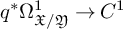


A problem arises in step (2), as we do not know in general whether
$H^{1}(A\Omega _{\mathfrak {X}/\mathfrak {Y}} \otimes ^{\mathbb {L}}_{A_{ {\mathrm {inf}}}, \theta \circ \varphi ^{-1}} \mathcal {O})$
 is (derived) p-adically complete. In the case
$\mathfrak {Y}$
 is locally of finite type over
$\mathcal {O}$
 however, this is indeed trueFootnote
15
. Moreover with regards to step (3), we do not know whether
$C^{2}$
 is 2-torsion free (in the case
$p =2$
 ), in order to pass to exterior algebras. A solution for these obstacles is to work with the (intermediary) group cohomology terms appearing as the source of (5.8). More precisely for each good object Z of the form (5.1) we have a map of complexes

where
$C^{i}_{Z} := H^{i}(L\eta _{\mu }R\Gamma _{ {\mathrm {cont}}}(\Delta , \mathbb {A}_{ {\mathrm {inf}}}(R_{\infty })) \otimes ^{\mathbb {L}}_{A_{ {\mathrm {inf}}}, \theta \circ \varphi ^{-1}} \mathcal {O})\{ i\}$
 . The top complex is a representative for the complex
$L\eta _{\tilde {\xi }}L\eta _{\mu }R\Gamma _{ {\mathrm {cont}}}(\Delta , \mathbb {A}_{ {\mathrm {inf}}}(R_{\infty })) \otimes ^{\mathbb {L}}_{A_{ {\mathrm {inf}}}, \theta \circ \varphi ^{-1}} \mathcal {O}$
 via [Reference Bhatt, Morrow and ScholzeBMS18, Proposition 6.12]. The vertical arrows are induced via (5.8) and the functoriality of the Bockstein homomorphism provides the map (5.40).
We now construct a morphism of complexes
$(q^{*}\Omega ^{\bullet }_{\mathfrak {X}/\mathfrak {Y}})(Z) \to C^{\bullet }_{Z}$
 (the complex
$(q^{*}\Omega ^{\bullet }_{\mathfrak {X}/\mathfrak {Y}})(Z)$
 has ith term
$(q^{*}\Omega ^{i}_{\mathfrak {X}/\mathfrak {Y}})(Z)$
 ) using the strategy outlined above.
-
(1) $\widehat {\mathcal {O}}^{+}_{D}(Z) = R \widehat {\otimes }_S S_{\infty } \overset {(5.21)}{=} \frac {H^{0}_{ {\mathrm {cont}}}(\Delta , R_{\infty })}{H^{0}_{ {\mathrm {cont}}}(\Delta , R_{\infty })[\zeta _p -1]} \xrightarrow {(5.7)^{-1}} C^{0}_{Z}$
. -
(2) Note that the complex $C^{i}_{Z}$
is a commutative differential graded
$\mathcal {O}$
-algebra (by a similar argument used to show
$C^{\bullet }$
is a commutative differential graded
$\mathcal {O}$
-algebra). By (5.7) and (5.21),
$C^{1}_{Z}$
is p-adically complete. Therefore to construct a compatible morphism
$(q^{*}\Omega ^{1}_{\mathfrak {X}/\mathfrak {Y}})(Z) \to C^{1}_Z$
, we need to check that the composition
$\widehat {\mathcal {O}}^{+}_{D}(Z) \to C^{0}_{Z} \to C^{1}_{Z}$
is
$S_{\infty }$
-linear (we endow
$C^{0}_Z$
and
$C^{1}_Z$
with their natural structure of
$S_{\infty }$
-modules via the identifications (5.7) and (5.21)). By definition the first map
$\widehat {\mathcal {O}}^{+}_{D}(Z) \to C^{0}_{Z}$
is
$S_{\infty }$
-linear. To see that the Bockstein homomorphism
$C^{0}_{Z} \to C^{1}_{Z}$
is
$S_{\infty }$
-linear, note that
$L\eta _{\mu }R\Gamma _{ {\mathrm {cont}}}(\Delta , \mathbb {A}_{ {\mathrm {inf}}}(R_{\infty }))$
has an explicit representation by a complex of
$\mathbb {A}_{ {\mathrm {inf}}}(S_{\infty })$
-modules involving Koszul complexes (cf. [Reference BhattBha18, Lemma 4.6]Footnote
16
and [Reference Bhatt, Morrow and ScholzeBMS18, Lemma 7.9]). This means that the Bockstein homomorphism is also
$S_{\infty }$
-linear. Note that the
$S_{\infty }$
-module structures put on
$C^0_Z$
and
$C^{1}_Z$
are compatible with the ones coming from the Koszul complexes. -
(3) By (5.7), (5.21) and Corollary 4.2, $C^{2}_{Z}$
is 2-torsion free. Thus the map constructed in (2) extends (compatibly) to higher forms.


We now show that the morphisms
$(q^{*}\Omega ^{\bullet }_{\mathfrak {X}/\mathfrak {Y}})(Z) \to C^{\bullet }_{Z} \to C^{\bullet }(Z)$
 are functorial in Z and the composite is independent of coordinates defining
$R_{\infty }$
 , and therefore glue together to give a morphism of complexes
$q^{*}\Omega ^{\bullet }_{\mathfrak {X}/\mathfrak {Y}} \to C^{\bullet }$
 . The functoriality of the first map follows from the universal property of Kähler differentials. The functoriality of the second map follows from the functoriality of (5.8), which in turn follows from the functoriality of the edge map (4.15). For the independence, it suffices to check the cases
$i=0, 1$
 . For
$i=0$
 , this is clear. For
$i=1$
 , we prove below that the composite (5.41) identifies with (5.34){1}, and this is indeed independent of coordinates.
It remains to show that the map of complexes
$q^{*}\Omega ^{\bullet }_{\mathfrak {X}/\mathfrak {Y}} \to C^{\bullet }$
 is an almost isomorphism (and an isomorphism in the case
$\mathfrak {Y}$
 is locally of finite type over
$\mathcal {O}$
 ). By Theorem 5.2 there is a morphism, for every i,

which is an almost isomorphism. We claim that the induced composition

identifies with (5.34){1}; this is enough to complete the proof as (5.35) is an almost isomorphism. We reduce to the case
$\mathfrak {X} = {\mathrm {Spf}} (R)$
 and
$\mathfrak {Y} = {\mathrm {Spf}} (S)$
 with
$R = S \{t_1^{\pm 1}, \ldots , t_d^{\pm 1} \}$
 (cf. Lemma 5.9). We consider the morphisms upon taking Z-sections with Z of the form (5.1). In this case, as shown in the proof of Theorem 5.19, (5.34){1} looks like (using the notation appearing there):

On the other hand, (5.41) fits into a diagram

where
$C^{1}_{Z} \to H^{1}_{ {\mathrm {cont}}}(\Delta , R \widehat {\otimes }_S S_{\infty })\{1 \} $
 is an isomorphism induced by (5.7). So we need to understand the morphism
$(q^{*}\Omega ^{1}_{\mathfrak {X}/\mathfrak {Y}})(Z) \to C^{1}_Z$
 (constructed by universality of Kähler differentials). For this we can assume
$d = 1$
 . By [Reference Bhatt, Morrow and ScholzeBMS18, Lemma 7.9], the complex
$L\eta _{\mu }R\Gamma _{ {\mathrm {cont}}}(\Delta , \mathbb {A}_{ {\mathrm {inf}}}(R_{\infty }))$
 is represented by explicit Koszul complexes:

where the completion is
$(p,\mu )$
 -adic (cf. [Reference BhattBha18, Lemma 4.6]). On grading of degree a, the Bockstein homomorphism (after trivializing the twist
$\{1 \}$
 by choosing
$\tilde {\xi }$
 as a generator of
$(\tilde {\xi })$
 ) looks like

Moreover
$t_1^{a} \in \widehat {\mathcal {O}}^{+}_D(Z)$
 is identified with
$1 \in H^{0}(K_a /\tilde {\xi })$
 and
$t_1^{a} \in H^{1}_{ {\mathrm {cont}}}(\Delta , R \widehat {\otimes }_S S_{\infty })$
 identifies with
$1 \in H^{1}(K_a /\tilde {\xi })$
 . The disappearance of
$\tfrac {d\log _1}{\zeta _p -1}$
 is explained by the fact that the image of
$\widetilde {\xi }$
 via the map
$\ker (\theta \circ \varphi ^{-1}) \to \tfrac {\ker (\theta \circ \varphi ^{-1})}{(\ker (\theta \circ \varphi ^{-1}))^{2}} \cong \mathcal {O} \{1\}$
 is
$\tfrac {d\log _1}{\zeta _p -1}$
 (cf. [Reference BhattBha18, Remark 6.9] and [Reference Bhatt, Morrow and ScholzeBMS18, Example 4.24]). For an explicit calculation, cf. [Reference BhattBha12, Remark 9.4]. The result now follows.
An important immediate consequence of the de Rham specialization is the following (almost is w.r.t.
$[\mathfrak {m}^{\flat }]$
 ):
Corollary 5.21. The object
$A\Omega _{\mathfrak {X}/\mathfrak {Y}}$
 is almost derived p-adically complete (i.e. the canonical morphism
$A\Omega _{\mathfrak {X}/\mathfrak {Y}} \to R\varprojlim (A\Omega _{\mathfrak {X}/\mathfrak {Y}} \otimes ^{\mathbb {L}}_{\mathbb {Z}} \mathbb {Z}/p^n)$
 is an almost isomorphism). Similarly for the object
$R\Gamma _{A_{ {\mathrm {inf}}}}(\mathfrak {X}/\mathfrak {Y})$
 .
Proof. First note that by Lemma 5.8,
$\widehat {\mathcal {O}}^{+}_{D}$
 is derived p-adically complete. This implies
$q^{*}\Omega ^{\bullet }_{\mathfrak {X}/\mathfrak {Y}}$
 is a bounded complex each of whose terms is derived p-adically complete and hence itself is derived p-adically complete (induction via stupid truncations). Thus by Theorem 5.20,
$A\Omega _{\mathfrak {X}/\mathfrak {Y}} \otimes ^{\mathbb {L}}_{A_{ {\mathrm {inf}}}, \theta } \mathcal {O}$
 is almost derived p-adically complete. By induction on n, one gets that
$A\Omega _{\mathfrak {X}/\mathfrak {Y}} \otimes ^{\mathbb {L}}_{A_{ {\mathrm {inf}}}} A_{ {\mathrm {inf}}}/\xi ^n$
 is almost derived p-adically complete. Moreover by Corollary 5.13,
$A\Omega _{\mathfrak {X}/\mathfrak {Y}}$
 is almost derived
$\xi $
 -adically complete. Therefore
$A\Omega _{\mathfrak {X}/\mathfrak {Y}}$
 is almost derived p-adically complete by the definition of derived completeness (cf. [Sta18, Tag 0999]). The last statement follows by [Sta18, Tag 0A0G].


5.5 Base change for
$Y_{ {\mathrm {pro\acute {e}t}}}\times _{\mathfrak {Y}_{ {\mathrm {\acute {e}t}}}}\mathfrak {X}_{ {\mathrm {\acute {e}t}}}$

In this section, in addition to the assumptions made in the beginning of §5, we assume that
$f \colon \mathfrak {X} \to \mathfrak {Y}$
 is proper. For later use, in particular for the comparison of
$A_{ {\mathrm {inf}}}$
 -cohomology with q-crystalline cohomology (cf. Theorem 6.33) we record a base change result, cf. Proposition 5.24. For a similar statement involving the Faltings’ topos, cf. [Reference Abbes and GrosAG24, Théorème 6.5.31]. Recall by (2.4), the projections p and q extend to morphisms of ringed topoi
$(p, p^{\sharp })$
 and
$(q, q^{\sharp })$
 . By taking modulo
$p^n$
 (of the structure sheaves), we denote the induced morphisms by
$(p_n, p_n^{\sharp })$
 and
$(q_n, q_n^{\sharp })$
 , respectively. Similarly we obtain
$f_n$
 and
$\nu _{Y,n}$
 . First we need some preparation.
Lemma 5.23. Let
$g \colon \mathfrak {X} \to \mathfrak {Y}$
 be a morphism of affine p-adic formal schemes of type (S)(b) over
$\mathcal {O}$
 . For each
$n \geq 1$
 , consider the commutative diagram of ringed topoi

Then the cohomology sheaves of the cone of the canonical base change map

are killed by
$\mathfrak {m}$
 .
Proof. Let
$\mathfrak {X} = {\mathrm {Spf}} (R)$
 ,
$\mathfrak {Y} = {\mathrm {Spf}} (S)$
 and
$Z := \varprojlim _{i \in I} {\mathrm {Spa}} (S_i, S_i^{+})$
 an affinoid perfectoid of
$Y_{ {\mathrm {pro\acute {e}t}}}$
 . By [Reference ScholzeSch13, Lemma 4.10(i)] the LHS of (5.42) is almost equal to the sheafification of the presheaf

where V is the adic generic fiber of
$\mathfrak {V}$
 and
$Z \to V$
 are morphisms over Y. Moreover by Lemma 5.5(i) and Proposition 5.7, the RHS of (5.42) is almost equal to the sheafification of the presheaf

Proposition 5.24. For each
$n \geq 1$
 , consider the commutative diagram of ringed topoi

and
$\mathscr {F}$
 a locally free
$\mathcal {O}_{\mathfrak {X}_{ {\mathrm {\acute {e}t}}}}/p^n$
 -module. Then the cohomology sheaves of the cone of the canonical base change map (cf. [Sta18, Tag 07A7])

are killed by
$\mathfrak {m}$
 .
Proof. The statement is local for the étale topology on
$\mathfrak {Y}$
 , so we can assume
$\mathfrak {Y}$
 is affine. The idea is to rewrite both sides of (5.43) as sheafified Čech complexes and then compare these Čech complexes via Leray’s acyclicity lemma.
We deal with the LHS of (5.43) first. Since
$f_n$
 is proper, we can choose a finite affine open covering
$\mathcal {U} : \mathfrak {X} = \bigcup \mathfrak {U}_i$
 , which trivializes
$\mathscr {F}$
 . Then we are in the set-up of [Sta18, Tag 01XL]. In particular since
$f_n$
 is flat we have an explicit K-flat resolution of
$Rf_{n*}\mathscr {F}$
 :
$\check {\mathcal {C}}^{\bullet }(\mathcal {U}, f_n, \mathscr {F})$
 , whose rth term is

where
$\mathfrak {U}_{i_{0}\ldots i_{r}} := \mathfrak {U}_{i_{0}} \cap \ldots \cap \mathfrak {U}_{i_{r}}$
 and
$f_{n, i_{0}\ldots i_{r}} \colon \mathfrak {U}_{i_{0}\ldots i_{r}} \to \mathfrak {Y}$
 is the restriction of
$f_n$
 to
$\mathfrak {U}_{i_{0}\ldots i_{r}}$
 and
$r_{i_{0}\ldots i_{r}}$
 is the rank of the restriction of
$\mathscr {F}$
 . Therefore the LHS of (5.43) is represented by a complex whose rth term is

By Lemma 5.23 the expression (5.44) is almost equal to

where
$p_{n, i_{0}\ldots i_{r}} \colon Y_{ {\mathrm {pro\acute {e}t}}}\times _{\mathfrak {Y}_{ {\mathrm {\acute {e}t}}}}\mathfrak {U}_{i_{0}\ldots i_{r}, {\mathrm {\acute {e}t}}} \to Y_{ {\mathrm {pro\acute {e}t}}}$
 is the obvious map (considered as a morphism of ringed topoi with the obvious structure sheaves modulo
$p^n$
 ).
We now deal with the RHS of (5.43), which is
$Rp_{n*}(q_{n}^{*}\mathscr {F})$
 . Let
$Z_i = (Y \to \mathfrak {Y} \leftarrow \mathfrak {U}_i)$
 . The covering
$\mathcal {U}$
 gives rise to a covering
$\widetilde {\mathcal {U}}: \{Z_i \to (Y \to \mathfrak {Y} \leftarrow \mathfrak {X}) \}_i$
 . We claim that
$q_{n}^{*}\mathscr {F}$
 has an (almost) resolution by a complex
$\check {\mathcal {C}}^{\bullet }(\widetilde {\mathcal {U}}, q_{n}^{*}\mathscr {F})$
 , whose rth term is

where
$g_{n,i_{0}\ldots i_{r}} \colon Y_{ {\mathrm {pro\acute {e}t}}}\times _{\mathfrak {Y}_{ {\mathrm {\acute {e}t}}}}\mathfrak {U}_{i_{0}\ldots i_{r}, {\mathrm {\acute {e}t}}} \to Y_{ {\mathrm {pro\acute {e}t}}}\times _{\mathfrak {Y}_{ {\mathrm {\acute {e}t}}}}\mathfrak {X}_{ {\mathrm {\acute {e}t}}}$
 (considered as a morphism of ringed topoi with the obvious structure sheaves modulo
$p^n$
 ). The differentials are the usual ones attached to a Čech complex and
$\varepsilon \colon q_{n}^{*}\mathscr {F} \to \check {\mathcal {C}}^{0}(\widetilde {\mathcal {U}}, q_{n}^{*}\mathscr {F})$
 is defined by taking the direct product of the natural maps
$q_{n}^{*}\mathscr {F} \to g_{n, i*}\widehat {\mathcal {O}}_{D}^{+}/p^n \lvert _{Y_{ {\mathrm {pro\acute {e}t}}}\times _{\mathfrak {Y}_{ {\mathrm {\acute {e}t}}}}\mathfrak {U}_{i, {\mathrm {\acute {e}t}}}}^{\oplus r_{i_{0}\ldots i_{r}}}$
 . The claim may appear standard but without a study of points for our fibered topos
$Y_{ {\mathrm {pro\acute {e}t}}}\times _{\mathfrak {Y}_{ {\mathrm {\acute {e}t}}}}\mathfrak {X}_{ {\mathrm {\acute {e}t}}}$
 (cf. the proof of [Sta18, Tag 02FU]), we rely on the almost vanishing of higher Čech cohomology, cf. proof of Lemma 5.5(i).
Lemma 5.25. The sequence of sheaves

is exact.
Proof. Let Z be a good object of
$Y_{ {\mathrm {pro\acute {e}t}}}\times _{\mathfrak {Y}_{ {\mathrm {\acute {e}t}}}}\mathfrak {X}_{ {\mathrm {\acute {e}t}}}$
 , which trivializes
$q_{n}^{*}\mathscr {F}$
 . Then it suffices to show that

is exact. Together with Proposition 5.7, this is proved in the proof of Lemma 5.5(i).
Returning to the proof of the proposition, again by almost vanishing of higher Čech cohomology, we have

are almost zero for
$s>0$
 . This implies
$R^{s}p_{n*}(g_{n,i_{0}\ldots i_{r}*}\widehat {\mathcal {O}}_{D}^{+}/p^n \lvert ^{\oplus r_{i_{0}\ldots i_{r}}}_{Y_{ {\mathrm {pro\acute {e}t}}}\times _{\mathfrak {Y}_{ {\mathrm {\acute {e}t}}}}\mathfrak {U}_{i_{0}\ldots i_{r}, {\mathrm {\acute {e}t}}}})$
 is almost zero for
$s>0$
 (because
$p_{n} \circ g_{n,i_{0}\ldots i_{r}} = p_{n,i_{0}\ldots i_{r}}$
 ). Therefore by Leray’s acyclicity lemma we have

Finally note that
$p_{n*} \check {\mathcal {C}}^{r}(\widetilde {\mathcal {U}}, q_{n}^{*}\mathscr {F})$
 gives the expression in (5.45). This completes the proof.
Corollary 5.26. In the situation of Proposition 5.24, assume in addition that for all
$i \geq 0$
 ,
$R^{i}f_{n*}\mathscr {F}$
 is locally free of finite type. Then the canonical base change map (5.43), induces morphisms

whose kernel and cokernel are killed by
$\mathfrak {m}$
 .
We also record a p-completed version of the base change.
Corollary 5.27. Let
$\mathscr {F}$
 be a locally free
$\mathcal {O}_{\mathfrak {X}_{ {\mathrm {\acute {e}t}}}}$
 -module. Then the cohomology sheaves of the cone of the canonical base change map

are killed by
$\mathfrak {m}$
 .
Proof. First note that by [Sta18, Tag 0A1H],
$Rf_{*}\mathscr {F} \otimes ^{\mathbb {L}}_{\mathcal {O}_{\mathfrak {Y}_{ {\mathrm {\acute {e}t}}}}} \mathcal {O}_{\mathfrak {Y}_{ {\mathrm {\acute {e}t}}}}/p^n$
 is a perfect object of
$D(\mathcal {O}_{\mathfrak {Y}_{ {\mathrm {\acute {e}t}}}}/p^n)$
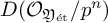 and its formation commutes with base change. Therefore by taking the derived limit we obtain
$Rf_{*}\mathscr {F}$
 itself is a perfect object of
$D(\mathcal {O}_{\mathfrak {Y}_{ {\mathrm {\acute {e}t}}}})$
 [Sta18, Tag 09AW]. Since
$\widehat {\mathcal {O}}^{+}_Y$
 is p-adically derived complete by [Reference ZavyalovZav24, Lemma A.8], we obtain
$L\nu _{Y}^{*}Rf_{*}\mathscr {F}$
 is p-adically derived complete. Moreover by Lemma 5.8 and [Sta18, Tag 0A0G],
$Rp_{*}Lq^{*}\mathscr {F}$
 is also derived p-adically complete. Therefore the result follows by taking the derived limit along
$n \geq 1$
 in Proposition 5.24 (note that the derived limit of almost zero objects is again almost zero).
Finally we establish a base change result for our de Rham complex
$q^{*}\Omega ^{\bullet }_{\mathfrak {X}/\mathfrak {Y}}$
 . We remind the reader that the complex is defined as a complex whose ith term is
$q^{*}\Omega ^{i}_{\mathfrak {X}/\mathfrak {Y}}$
 with induced differentials. In particular the differentials are non-linear so this complex lives in
$D(D, p^{-1}\widehat {\mathcal {O}}^{+}_{Y})$
 and not in
$D(D, \widehat {\mathcal {O}}^{+}_{D})$
 (even though each term is a
$\widehat {\mathcal {O}}^{+}_{D}$
 -module). Therefore the following result serves as an appropriate substitute for Proposition 5.24.
Corollary 5.28. For each
$n \geq 1$
 , consider the commutative diagram of ringed topoi

and
$\mathscr {F}$
 a bounded complex each of whose terms is locally free
$\mathcal {O}_{\mathfrak {X}_{ {\mathrm {\acute {e}t}}}}/p^n$
 -modules (with differentials
$f^{-1}\mathcal {O}_{\mathfrak {Y}_{ {\mathrm {\acute {e}t}}}}$
 -linear). Then the cohomology sheaves of the cone of the canonical base change map

are killed by
$\mathfrak {m}$
 . By taking derived limits (as n goes to
$\infty $
 ) a version of the statement also holds for a bounded complex each of whose terms is locally free
$\mathcal {O}_{\mathfrak {X}_{ {\mathrm {\acute {e}t}}}}$
 -modules (cf. Corollary 5.27).
Proof. By using stupid truncations, we immediately reduce to the case where
$\mathscr {F}$
 is a locally free
$\mathcal {O}_{\mathfrak {X}_{ {\mathrm {\acute {e}t}}}}/p^n$
 -module (viewed as an
$f^{-1}\mathcal {O}_{\mathfrak {Y}_{ {\mathrm {\acute {e}t}}}}/p^n$
 -module). In this case the LHS of (5.46) coincides with the LHS of (5.43). We now compare
$L\tilde {q}_{n}^{*}\mathscr {F}$
 and
$Lq_{n}^{*}\mathscr {F}$
 as sheaves. The key point is that the tensor product defining
$\widehat {\mathcal {O}}^{+}_{D}$
 (cf. Definition 2.5) is derived because f is flat.

Therefore the RHS of (5.46) coincides with the RHS of (5.43). The result now follows by Proposition 5.24.
6 q-crystalline site
The main goal of this section is to compare the objects
$A\Omega _{\mathfrak {X}/\mathfrak {Y}}$
 and
$R\Gamma _{A_{ {\mathrm {inf}}}}(\mathfrak {X}/\mathfrak {Y})$
 considered thus far with the q-crystalline site of Bhatt-Scholze. Let q be a formal parameter. We introduce a global (big) version of the q-crystalline site of [Reference Bhatt and ScholzeBS22, §16]. We advise the reader to familiarise themselves with the contents of §16 in loc. cit. before continuing. The logarithmic context is studied in [Reference KoshikawaKos21, §7].
As usual we denote by
$A = \mathbb {Z}_p [[q-1]]$
 (the
$(p,q-1)$
 -adic completion of
$\mathbb {Z} [q]$
 ) with
$\delta $
 -structure given by
$\delta (q) = 0$
 . Let
$[p]_{q} := \tfrac {q^p -1}{q-1}$
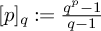 be the q-analogue of p. This gives the q-crystalline prism
$(A, ([p]_{q}))$
 . The q-analogue of divided power structures is handled by the following: if x is an element of a
$[p]_{q}$
 -torsion free
$\delta $
 -A-algebra D such that
$\phi (x) \in [p]_{q}D$
 , then we write

In order to define a big version of the q-crystalline site, we slightly modify the notion of a q-PD pair in [Reference Bhatt and ScholzeBS22] (cf. [Reference KoshikawaKos21, §7.1]).
Definition 6.1 (q-PD pair)
A q-PD pair is given by a derived
$(p, [p]_{q})$
 -complete
$\delta $
 -pair
$(D,I)$
 over
$(A, (q-1))$
 such that
-
(1) $(D, ([p]_{q}))$
is a bounded prism over
$(A, ([p]_{q}))$
(in particular D is
$[p]_q$
-torsion free), -
(2) $\phi (I) \subset [p]_{q}D$
and
$\gamma (I) \subset I$
, -
(3) $D/(q-1)$
is p-torsion-free with finite
$(p,[p]_{q})$
-complete Tor amplitude over D and -
(4) $D/I$
is p-adically complete.





Remark 6.2. As observed in [Reference KoshikawaKos21], the addition of condition (4) to [Reference Bhatt and ScholzeBS22, Definition 16.2] will be convenient to define the big q-crystalline site (without the use of some derived geometry).
The following lemma is a special case of [Reference KoshikawaKos21, Lemma 7.3].
Lemma 6.3. Let
$(D,I)$
 be a q-PD pair. If
$D/I \to \overline {E}$
 is p-completely étale, there exists a unique q-PD pair
$(E,J)$
 over
$(D,I)$
 lifting
$D/I \to \overline {E}$
 .
Proof. First note that there is a unique
$(p,[p]_q)$
 -completely étale lift
$D \to E$
 of
$D/I \to \overline {E}$
 (because for any
$i\in I$
 ,
$i^p \in (p,[p]_q)$
 ). The kernel J of the map
$E \to \overline {E}$
 is given by the
$(p,[p]_q)$
 -adic completion of
$IE$
 . We equip E with the unique
$\delta $
 -structure compatible with the one on D (cf. [Reference Bhatt and ScholzeBS22, Lemma 2.18]). It remains to check conditions (1)-(4) of Definition 6.1 for the
$\delta $
 -pair
$(E,J)$
 . Since E is
$(p,[p]_q)$
 -completely flat over D, it follows that conditions (1) and (3) are satisfied. Moreover by construction
$E/J = \overline {E}$
 is p-adically complete and so condition (4) is satisfied. It remains to check the first half of condition (2) (the second half is shown in the proof of [Reference KoshikawaKos21, Lemma 7.3]). Since
$D \to E$
 is a map of
$\delta $
 -rings over A, it follows that
$\phi (IE) \subset [p]_qE$
 . This implies that
$\phi (J) \subset [p]_qE$
 because
$[p]_qE$
 is closed for the
$(p,[p]_q)$
 -adic topology on E.
Fix a q-PD pair
$(D,I)$
 and let
$\mathfrak {Z}$
 be a p-adic formal scheme over
$D/I$
 . We can now define the big q-crystalline site
$q-\mathrm {CRYS}(\mathfrak {Z}/D)$
 (cf. [Reference KoshikawaKos21, Definition 7.5]) and its associated topos.
Definition 6.4 (The q-crystalline site and topos)
We define the (big) q-crystalline site
$q-\mathrm {CRYS}(\mathfrak {Z}/D)$
 as the opposite of the following category: an object is a q-PD pair
$(E,J)$
 over
$(D,I)$
 and a
$ {\mathrm {Spf}}(D/I)$
 -morphism of p-adic formal schemes
$ {\mathrm {Spf}} (E/J) \to \mathfrak {Z}$
 . Morphisms are the obvious ones. We endow it with the étale topology (by Lemma 6.3 there exist fiber products of q-PD pairs when one of the morphisms is étale in the obvious sense) with covers being singletons. The corresponding topos will be denoted by
$(\mathfrak {Z}/D)_{q-\mathrm {CRYS}}$
 . When
$\mathfrak {Z} = {\mathrm {Spf}}(T)$
 is affine we will denote the site and topos by
$q-\mathrm {CRYS}(T/D)$
 and
$(T/D)_{q-\mathrm {CRYS}}$
 , respectively.
The first version of Definition 6.4 (with the Zariski topology in place of the étale topology) appears in [Reference Bhatt and ScholzeBS22, Remark 16.15(2)].
Definition 6.5 (structure sheaf)
Let
$\mathcal {O}_{q-\mathrm {CRYS}}$
 and
$\overline {\mathcal {O}}_{q-\mathrm {CRYS}}$
 denote the structure presheaves
$(E,J) \mapsto E$
 and
$(E,J) \mapsto E/J$
 . These are sheaves by definition of coverings.
For
$\mathfrak {Z} = {\mathrm {Spf}} (T)$
 affine, there is the big q-crystalline topos
$(T/D)_{q-\mathrm {CRYS}}$
 with underlying site
$q-\mathrm {CRYS}(T/D)$
 defined in [Reference Bhatt and ScholzeBS22, Definition 16.12] with structure sheaf
$\mathcal {O}_{q-\mathrm {CRYS}}$
 . As a reality check, we show that in this case the cohomology does not depend on whether one uses the Zariski or étale topology.
Lemma 6.6. Suppose
$\mathfrak {Z} = {\mathrm {Spf}}(T)$
 . Then there exists a canonical isomorphism

Proof. The inclusion of sites
$q-\mathrm {CRYS}(T/D) \to q-\mathrm {CRYS}(T/D)$
 is continuous and induces a morphism of topoi

with
$g^{-1}\mathcal {O}_{q-\mathrm {CRYS}} = \mathcal {O}_{q-\mathrm {CRYS}}$
 . The morphism (6.2) induces the morphism (6.1). Choosing a weakly final object as in [Reference Bhatt and ScholzeBS22, Construction 16.13]Footnote
17
in
$q-\mathrm {CRYS}(T/D)$
 , one obtains a Čech-Alexander complex. This is an explicit representative for the RHS of (6.1). It is easy to check (by freeness) that this weakly final object is also weakly final in the big site
$q-\mathrm {CRYS}(T/D)$
 . Therefore by Čech theory the same Čech-Alexander complex is an explicit representative for the LHS of (6.1). Finally the formation of the Čech-Alexander complex is compatible with the morphism (6.1).
Recall the small étale site of
$\mathfrak {Z}$
 is denoted by
$\mathfrak {Z}_{ {\mathrm {\acute {e}t}}}$
 . We denote the big étale site of
$\mathfrak {Z}$
 by
$\mathfrak {Z}_{ {\mathrm {\acute {E}T}}}$
 and
$\mathfrak {Z}_{ {\mathrm {\acute {E}T}}}^{\text {Aff}}$
 the site consisting of affine p-adic formal schemes over
$\mathfrak {Z}$
 whose covers are singleton étale maps. If there is no confusion, we will use the same notation for their topoi
$\mathfrak {Z}_{ {\mathrm {\acute {e}t}}}$
 ,
$\mathfrak {Z}_{ {\mathrm {\acute {E}T}}}$
 and
$\mathfrak {Z}_{ {\mathrm {\acute {E}T}}}^{\text {Aff}}$
 , respectively.
As usual we have a cocontinuous and continuous functor (by Lemma 6.3):

which sits in a diagram of functors of sites

The last two functors induce morphisms of sites and applying [Sta18, Tag 00XO] to the first functor we obtain a diagram of topoi

which gives a map of topoi
$u^{q}_{\mathfrak {Z}} \colon (\mathfrak {Z}/D)_{q-\mathrm {CRYS}} \to \mathfrak {Z}_{ {\mathrm {\acute {e}t}}}$
 . In the next section we will construct an explicit underlying site for the oriented product of topoi

which will serve as the q-crystalline analogue of the fiber product
$Y_{ {\mathrm {pro\acute {e}t}}} \times _{\mathfrak {Y}_{ {\mathrm {\acute {e}t}}}} \mathfrak {X}_{ {\mathrm {\acute {e}t}}}$
 appearing in the pro-étale setting.
6.1 Product of topoi revisited
We now assume that we have a
$ {\mathrm {Spf}}(D/I)$
 -morphism
$f \colon \mathfrak {X} \to \mathfrak {Y}$
 of p-adic formal schemes. The oriented product (6.5) certainly exists by the universal property [Reference Illusie, Laszlo and OrgogozoILO14, Exposé XI, Théorème 1.4] and the fact that any morphism of topoi essentially comes from a morphism of sites (cf. [Sta18, Tag 03A2]). The difficulty in the current situation is that the morphism
$(\mathfrak {Y}/D)_{q-\mathrm {CRYS}} \to \mathfrak {Y}_{ {\mathrm {\acute {e}t}}}$
 is induced by some composition (6.4) (in particular it does not come directly from a morphism of the sites) and so the same construction for an underlying site (for the oriented product) given in [Reference Illusie, Laszlo and OrgogozoILO14, Exposé XI] does not work. However, it turns out that (6.4) has enough properties to recover an explicit site for (6.5).
Remark 6.7. Regarding the construction of an underlying site, the fact that the left edge morphism
$(\mathfrak {Y}/D)_{q-\mathrm {CRYS}} \to \mathfrak {Y}_{ {\mathrm {\acute {e}t}}}$
 does not come from a morphism of the sites forces us to work with an oriented product of topoi rather than a fiber product. Moreover the right edge morphism
$\mathfrak {X}_{ {\mathrm {\acute {e}t}}} \to \mathfrak {Y}_{ {\mathrm {\acute {e}t}}}$
 does come from a morphism of sites and so the choice of orientation (6.5) is a natural candidate over
$(\mathfrak {Y}/D)_{q-\mathrm {CRYS}} \overrightarrow {\times }_{\mathfrak {Y}_{ {\mathrm {\acute {e}t}}}} \mathfrak {X}_{ {\mathrm {\acute {e}t}}}$
 . This is in contrast to our work on the pro-étale side, where we had the freedom to work with the fiber product (in the case
$\mathfrak {X}$
 and
$\mathfrak {Y}$
 are of type (S)(b))
$Y_{ {\mathrm {pro\acute {e}t}}} \times _{\mathfrak {Y}_{ {\mathrm {\acute {e}t}}}} \mathfrak {X}_{ {\mathrm {\acute {e}t}}}$
 or either of the two oriented products.
For the time being we work in general with the setup being as follows:
$C_1$
 ,
$C_2$
 , E,
$E'$
 and D are five sites such that
-
(1) E is subcanonical, and $C_2$
and D admit finite projective limits, -
(2) there is a diagram of functors
(6.6) $$ \begin{align} C_1 \xrightarrow{g_1} E' \xrightarrow{a} E \xleftarrow{g} D \end{align} $$
where $g_1$
is both continuous and cocontinuous, and the last two functors induce morphisms of sites
$E \to E'$
and
$E \to D$
, -
(3) $E \to E'$
induces an equivalence of topoi, and -
(4) there is a functor $f_2 \colon D \to C_2$
commuting with finite projective limits, which induces a morphism of sites
$C_2 \to D$
.


Denote by
$f_1 \colon C_1 \to E$
 the composition
$a \circ g_1$
 . Let C be the category of 5-tuples

where
$U, V$
 and W are objects of
$C_1$
 ,
$C_2$
 and D, respectively, and
$f_1(U) \to g(W)$
 and
$V \to f_2(W)$
 are morphisms in E and
$C_2$
 , respectively. We will denote such an object by
$(U \to W \leftarrow V)$
 . Let
$(U \to W \leftarrow V)$
 and
$(U' \to W' \leftarrow V')$
 be two objects of D. A morphism from
$(U \to W \leftarrow V)$
 into
$(U' \to W' \leftarrow V')$
 is the datum of three morphisms
$U \to U'$
 ,
$V \to V'$
 and
$W \to W'$
 in
$C_1$
 ,
$C_2$
 and D, respectively, such that the diagrams

are commutative. We equip C with the topology generated by coverings

of the following three types:
-
(a) $V_i=V, W_i = W$
for all i and
$(U_i \to U)_{i \in I}$
is a covering. -
(b) $U_i=U, W_i = W$
for all i and
$(V_i \to V)_{i \in I}$
is a covering. -
(c) I is a singleton: $(U \to W \leftarrow V) \to (U' \to W' \leftarrow V')$
, with
$U = U'$
and
$V \to V'$
is induced by base change from
$W \to W'$
.

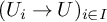





Denote the resulting topos by
$\widetilde {C}$
 .
Note that condition (4) gives a morphism of topoi
$\widetilde {C}_2 \to \widetilde {D}$
 and treating
$g_1$
 as a cocontinuous functor, conditions (2)-(3) naturally give a morphism of topoi
$\widetilde {C}_1 \to \widetilde {D}$
 (the morphism of topoi
$E' \to E$
 is given by the adjoint functors
$a^{s}$
 and
$a_{s}$
 ). One can therefore consider the oriented product of topoi
$\widetilde {C}_1 \overleftarrow {\times }_{\widetilde {D}} \widetilde {C}_2$
 . We now come to the main result of this section, which gives an explicit description of an underlying site for the said oriented product:
Proposition 6.8. There is a canonical equivalence of topoi
$\widetilde {C}_1 \overleftarrow {\times }_{\widetilde {D}} \widetilde {C}_2 \simeq \widetilde {C}$
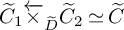 .
Proof. We first rewrite the objects of C which will make the comparison with the construction given in [Reference Illusie, Laszlo and OrgogozoILO14, Exposé XI, 1.1] easier. Since E is subcanonical, the datum of a morphism
$f_1(U) \to g(W)$
 in E is equivalent to giving a morphism in the topos
$\widetilde {E}$
 between the associated representable sheaves

By [Sta18, Tag 04D3], (6.7) takes the shape
$a_{s}g_{1,s}h_{U}^{a} \to g_{s}h_{W}^{a}$
 (where
$h_{U}^{a}$
 and
$h_{W}^{a}$
 are the associated sheaves of
$h_{U}$
 and
$h_{W}$
 , respectively, and
$(-)_s$
 is the functor defined in [Sta18, Tag 00WX]). Now
$a_s$
 is a left adjoint to
$a^{s}$
 and
$g_{1,s}$
 is left adjoint to
$g_{1}^{s}$
 (this is because both a and
$g_1$
 are continuous functors of sites). Thus (6.7) is equivalent to giving a morphism

Finally note that
$g_{1}^{s}a^{s}g_{s}$
 is precisely the pullback of the morphism of topoi
$\widetilde {C}_{1} \to \widetilde {D}$
 .
Having rewritten the objects of C, it remains to compare our construction of C with the construction in [Reference Illusie, Laszlo and OrgogozoILO14, Exposé XI, 1.1]. By [Sta18, Tag 03A2] we can enlarge the site
$C_1$
 to a site
$C'$
 such that the morphism of topoi
$\widetilde {C}_1 \to \widetilde {D}$
 is equivalent to a morphism of topoi
$\widetilde {C'} \to \widetilde {D}$
 induced from a morphism of sites
$C' \to D$
 . In fact we choose
$C' \subset \widetilde {C}_{1}$
 as in the proof of loc. cit. together with the inclusion of the final sheaf in the first inductive step (in particular
$C'$
 admits finite projective limits). Moreover
$C'$
 contains the objects
$h_{U}^{a}$
 . Let
$u \colon D \to C'$
 be the corresponding functor (it is given by
$W \mapsto g_{1}^{s}a^{s}g_{s}h_{W}^{a}$
 by the proof of [Sta18, Tag 03A2]). Note that u commutes with finite projective limits. Denote by
$\underline {C}$
 the underlying site of
$\widetilde {C}_1 \overleftarrow {\times }_{\widetilde {D}} \widetilde {C}_2$
 associated to the morphism of sites
$C' \to D$
 and
$C_2 \to D$
 , as given by [Reference Illusie, Laszlo and OrgogozoILO14, Exposé XI, 1.1]. There is a functor of sites

which is special cocontinuous (because
$C_1 \to C'$
 is special cocontinuous). The associated morphism of topoi induced by the cocontinuity of
$C \to \underline {C}$
 ,
$\widetilde {C} \to \widetilde {\underline {C}}$
 is then an equivalence by [Sta18, Tag 03A0].
We will denote the site C by
$C_1 \overleftarrow {\times }_{D} C_2$
 . As usual there are natural projections

Since
$C_1$
 may lack a final object, the description of
$p_2$
 given in [Reference Illusie, Laszlo and OrgogozoILO14, Exposé XI, §1.3] does not work. Nevertheless one can describe it as follows:
Lemma 6.9. Let
$e_{C_2}$
 and
$e_{D}$
 be the final objects of
$C_2$
 and D. Then
$p_1$
 and
$p_2$
 are induced by the functors of sites

respectively. The first functor induces a morphism of sites and the second functor is cocontinuous.
Proof. We use the notation in the proof of Proposition 6.8. Let
$e_{C'}$
 be the final object of
$C'$
 . Then the projections
$\widetilde {\underline {C}} \to \widetilde {C}'$
 and
$\widetilde {\underline {C}} \to \widetilde {C}_2$
 are induced by the functors of sites

respectively (cf. [Reference Illusie, Laszlo and OrgogozoILO14, Exposé XI, §1.3]). The second functor (and also the first) has a cocontinuous left adjoint given by

which by [Sta18, Tag 00XY] induces the same morphism of topoi as its continuous right adjoint. The claims for
$p_1$
 and
$p_2$
 now follow from the commutativity of the diagram of sites

respectively.
Let us now return to the situation of interest (compare (6.3) with (6.6)): the five sites under consideration are
$q-\mathrm {CRYS}(\mathfrak {Y}/D)$
 ,
$\mathfrak {X}_{ {\mathrm {\acute {e}t}}}$
 ,
$\mathfrak {Y}_{ {\mathrm {\acute {E}T}}}$
 ,
$\mathfrak {Y}_{ {\mathrm {\acute {E}T}}}^{\text {Aff}}$
 and
$\mathfrak {Y}_{ {\mathrm {\acute {e}t}}}$
 , respectively. We have verified in the previous section that these five sites satisfy the conditions (1)-(4). Thus by Proposition 6.8 we have constructed an explicit underlying site for the oriented product (6.5). By Lemma 6.9 we have a simple description for the natural projections

and there is a 2-map
$fp_2 \to u^{q}_{\mathfrak {Y}}p_1$
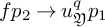 .
Definition 6.10. We define the structure sheaf on
$q-\mathrm {CRYS}(\mathfrak {Y}/D) \overleftarrow {\times }_{\mathfrak {Y}_{ {\mathrm {\acute {e}t}}}} \mathfrak {X}_{ {\mathrm {\acute {e}t}}}$
 by the p-adically completed tensor product

Remark 6.11. A word of explanation for the definition of
$\overline {\mathcal {O}}$
 . The morphism
$p_{1}^{-1}(u^{q}_{\mathfrak {Y}})^{-1}\mathcal {O}_{\mathfrak {Y}, {\mathrm {\acute {e}t}}} \to p_{1}^{-1}\overline {\mathcal {O}}_{q-\mathrm {CRYS}}$
 is induced by the map
$(u^{q}_{\mathfrak {Y}})^{-1}\mathcal {O}_{\mathfrak {Y}, {\mathrm {\acute {e}t}}} \to \overline {\mathcal {O}}_{q-\mathrm {CRYS}}$
 . The morphism
$p_{1}^{-1}(u^{q}_{\mathfrak {Y}})^{-1}\mathcal {O}_{\mathfrak {Y}, {\mathrm {\acute {e}t}}} \to p_{2}^{-1}\mathcal {O}_{\mathfrak {X}, {\mathrm {\acute {e}t}}}$
 is induced by the composition

By construction the projections
$p_1$
 and
$p_2$
 extend to morphisms of ringed topoi:

and

Lemma 6.12. The family of objects of the form

is generating for
$q-\mathrm {CRYS}(\mathfrak {Y}/D) \overleftarrow {\times }_{\mathfrak {Y}_{ {\mathrm {\acute {e}t}}}} \mathfrak {X}_{ {\mathrm {\acute {e}t}}}$
 . Moreover if
$f \colon \mathfrak {X} \to \mathfrak {Y}$
 is smooth, then in addition one can take
$ {\mathrm {Spf}} (R) \to {\mathrm {Spf}}(S)$
 satisfying condition (2) of Definition 2.9.
Proof. Choose any object
$T = ((E,J) \to W \leftarrow V)$
 in
$q-\mathrm {CRYS}(\mathfrak {Y}/D) \overleftarrow {\times }_{\mathfrak {Y}_{ {\mathrm {\acute {e}t}}}} \mathfrak {X}_{ {\mathrm {\acute {e}t}}}$
 . First we reduce to the case W is affine. Take an affine Zariski covering of W. Take further an affine Zariski covering of
$ {\mathrm {Spf}}(E/J)$
 refining its pullback. Since
$ {\mathrm {Spf}}(E/J)$
 is quasi-compact, we can take a finite subfamily of the latter, which still covers
$ {\mathrm {Spf}}(E/J)$
 . By taking a disjoint union of the elements of this finite subfamily we obtain an étale covering of
$ {\mathrm {Spf}}(E/J)$
 , which is a singleton. Applying Lemma 6.3 to this singleton cover gives a covering of
$(E,J)$
 , which factors through an affine
$ {\mathrm {Spf}}(S)$
 étale over W by construction. Finally by using coverings of type (c), we can assume W is affine. Coverings of type (b) give the desired generating family. In the case f is smooth one uses (a
$ {\mathrm {Spf}}(D/I)$
 -version of) Lemma 2.15 and coverings of type (b) to further refine.
As a reality check, we now turn to calculating the sections of
$\overline {\mathcal {O}}$
 .
Lemma 6.13. For Z of the form (6.9),
$\overline {\mathcal {O}}(Z) = E/J \widehat {\otimes }_{S} R$
 , where the completion is p-adic.
Proof. For each
$n\geq 1$
 , consider first the uncompleted version modulo
$p^n$
 :

Then
$\mathscr {F}_n$
 is the sheafification of the presheaf
$Z \mapsto (E/J \otimes _{S} R)/p^n$
 which is a sheaf by [Reference Illusie, Laszlo and OrgogozoILO14, Lemme 1.2]. The result now follows by taking the limit.
6.2 The object
$q\Omega _{\mathfrak {X}/\mathfrak {Y}}$

In this section we construct the relative version of the q-crystalline complex
$q\Omega _{\mathfrak {X}/\mathfrak {Y}}$
 living in our topos (6.5) and record a few of its properties.
Lemma 6.14. There is a functor of topoi

such that for any sheaf
$\mathscr {F}$
 in
$(\mathfrak {X}/D)_{q-\mathrm {CRYS}}$
 and any Z of the form (6.9)

Proof. In addition to the topos
$\widetilde {P}_{ {\mathrm {\acute {e}t}}}:= (\mathfrak {Y}/D)_{q-\mathrm {CRYS}} \overleftarrow {\times }_{\mathfrak {Y}_{ {\mathrm {\acute {e}t}}}} \mathfrak {X}_{ {\mathrm {\acute {e}t}}}$
 , the topoi

will also be useful. All three have explicit sites described by the formalism of §6.1,
$P_{ {\mathrm {\acute {e}t}}}$
 ,
$P_{ {\mathrm {\acute {E}T}}}$
 and
$P_{ {\mathrm {\acute {E}T}}}^{\text {Aff}}$
 , respectively. Consider the diagram of sites

where the first functor is given by
$(E,J) \mapsto ((E,J) \to {\mathrm {Spf}}(E/J) \leftarrow {\mathrm {Spf}}(E/J))$
 and the remaining two functors are induced by the natural inclusions

for
$\mathfrak {Z} \in \{ \mathfrak {X}, \mathfrak {Y} \}$
 . The functor
$\nu $
 is both continuous and cocontinuous, and i and j both induce morphisms of sites (moreover i induces an equivalence of topoi). Treating
$\nu $
 as a cocontinuous functor, (6.11) induces the morphism of topoi (6.10) (as usual, one switches the adjoints for the equivalence induced by i). It remains to describe the pushforward of this morphism given by
$j^{s}\circ i_{s}\circ {}_{s}\nu $
 (here
${}_{s}(-)$
 is defined in [Sta18, Tag 00XK]). We compute

where (i) is by definition of
$j^s$
 , (ii) because i induces an equivalence of topoi (
$j(Z)$
 is viewed as an object in
$P_{ {\mathrm {\acute {E}T}}}^{\text {Aff}}$
 hereafter), and (iii) is by definition of
${}_{s}\nu $
 . To give a morphism
$\nu ((E',J')) \to j(Z)$
 is equivalent to giving a morphism of q-PD pairs
$(E',J') \to (E,J)$
 in
$q-\mathrm {CRYS}(\mathfrak {Y}/D)$
 together with a compatible (over
$ {\mathrm {Spf}}(S)$
 ) morphism
$ {\mathrm {Spf}}(E'/J') \to {\mathrm {Spf}} (R)$
 in
$\mathfrak {X}_{ {\mathrm {\acute {E}T}}}^{\text {Aff}}$
 . Thus the limit calculates precisely the global sections functor of the topos
$((E/J \widehat {\otimes }_{S} R)/E)_{q-\mathrm {CRYS}}$
 for
$\mathscr {F}$
 . This finishes the proof.
Lemma 6.14 allows us to make the following definition:
Definition 6.15. We define the relative q-crystalline complex
$q\Omega _{\mathfrak {X}/\mathfrak {Y}} := R\nu _{f*}^{q}\mathcal {O}_{q-\mathrm {CRYS}}$
 . This is a D-algebra in
$(\mathfrak {Y}/D)_{q-\mathrm {CRYS}} \overleftarrow {\times }_{\mathfrak {Y}_{ {\mathrm {\acute {e}t}}}} \mathfrak {X}_{ {\mathrm {\acute {e}t}}}$
 equipped with a
$\phi _{D}$
 -semilinear endomorphism. In addition we set
$R\Gamma _{q-\mathrm {CRYS}}(\mathfrak {X}/\mathfrak {Y}) := Rp_{1*}q\Omega _{\mathfrak {X}/\mathfrak {Y}}$
 .
We now compare
$q\Omega _{\mathfrak {X}/\mathfrak {Y}}$
 with relative prismatic cohomology (cf. [Reference Bhatt and ScholzeBS22, Theorem 16.18] and [Reference KoshikawaKos21, Theorem 7.13]).
Theorem 6.16. Let Z be of the form (6.9) such that
$ {\mathrm {Spf}}(R) \to {\mathrm {Spf}}(S)$
 is a p-completely smooth
$ {\mathrm {Spf}}(D/I)$
 -morphism. Let
$(R \widehat {\otimes }_{S} E/J)^{(1)}$
 be the p-completed base change along the map
$E/J \to E/([p]_q)$
 induced by
$\phi _{E}$
 . Writing
${{\mathbb {\Delta }}}_{(R \widehat {\otimes }_S E/J)^{(1)}/E}$
 for the prismatic cohomology of
$(R \widehat {\otimes }_S E/J)^{(1)}$
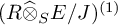 relative to the bounded prism
$(E, [p]_{q})$
 , there is a canonical isomorphism
${{\mathbb {\Delta }}}_{(R \widehat {\otimes }_S E/J)^{(1)}/E} \cong R\Gamma (Z, q\Omega _{\mathfrak {X}/\mathfrak {Y}})$
 .
Proof. The hard work is already done in [Reference Bhatt and ScholzeBS22, §16]. Indeed by Lemma 6.14

The result now follows by Theorem 16.18 in loc. cit. and the comparison made in Lemma 6.6.
Finally we close this section by recording perfectness for
$R\Gamma _{q-\mathrm {CRYS}}(\mathfrak {X}/\mathfrak {Y})$
 . In the q-crystalline setting one is able to obtain perfectness on the nose (without almost ambiguity). This is in contrast to the case of
$R\Gamma _{A_{ {\mathrm {inf}}}}(\mathfrak {X}/\mathfrak {Y})$
 (cf. Proposition 6.35) and is a ubiquitous defect of the pro-étale topos associated to the generic fiber.
Proposition 6.17. Assume that we have a proper smooth
$ {\mathrm {Spf}}(D/I)$
 -morphism
$f \colon \mathfrak {X} \to \mathfrak {Y}$
 of p-adic formal schemes. Then for each
$(E,J)$
 in
$(\mathfrak {Y}/D)_{q-\mathrm {CRYS}}$

-
(i) $R\Gamma ((E,J), R\Gamma _{q-\mathrm {CRYS}}(\mathfrak {X}/\mathfrak {Y}))$
is perfect in
$D(E)$
. -
(ii) $R\Gamma _{q-\mathrm {CRYS}}(\mathfrak {X}/\mathfrak {Y})\lvert _{(E,J)}$
is strictly perfect in
$D((\mathfrak {Y}/D)_{q-\mathrm {CRYS}}/(E,J), \mathcal {O}_{q-\mathrm {CRYS}}\lvert _{(E,J)})$
, i.e., quasi-isomorphic to a bounded complex of direct summands of finite free sheaves. -
(iii) $R\Gamma _{q-\mathrm {CRYS}}(\mathfrak {X}/\mathfrak {Y})$
is perfect in
$D((\mathfrak {Y}/D)_{q-\mathrm {CRYS}}, \mathcal {O}_{q-\mathrm {CRYS}})$
.






Proof. We first show (i). In this proof we will abuse notation and denote
$\mathcal {O}_{q-\mathrm {CRYS}}$
 for the structure sheaves on both
$(\mathfrak {Y}/D)_{q-\mathrm {CRYS}}$
 and
$(\mathfrak {X}/D)_{q-\mathrm {CRYS}}$
 . First note that f induces a cocontinuous functor of sites

and although
$R\Gamma _{q-\mathrm {CRYS}}(\mathfrak {X}/\mathfrak {Y})$
 was originally defined via the intermediate oriented product, we can also write it as
$Rf_{q-\mathrm {CRYS}*}\mathcal {O}_{q-\mathrm {CRYS}}$
 . Unwinding the definitions, we get

By a globalizationFootnote 18 of [Reference Bhatt and ScholzeBS22, Theorem 16.17] (obtained by sheafifying the result in loc. cit.) we get

where
$ {\mathrm {Spf}}(E/[p]_q) \times _{\mathfrak {Y}} \mathfrak {X}$
 is obtained by the p-completed base change of
$ {\mathrm {Spf}}(E/J) \times _{\mathfrak {Y}} \mathfrak {X}$
 along
$E/J \to E/[p]_q$
 induced by
$\phi _E$
 . Since
$f \colon \mathfrak {X} \to \mathfrak {Y}$
 was assumed to be proper, the RHS of (6.14) is a perfect complex in
$D(E)$
 by the Hodge-Tate comparison for prismatic cohomology (cf. Theorem 1.8(2) in loc. cit.). Thus (6.13) implies
$R\Gamma ((E,J), R\Gamma _{q-\mathrm {CRYS}}(\mathfrak {X}/\mathfrak {Y}))$
 is a perfect complex in
$D(E)$
 for each
$(E,J)$
 in
$(\mathfrak {Y}/D)_{q-\mathrm {CRYS}}$
 .
We now prove part (ii). This is a consequence of part (i) together with the quasi-coherence behaviour of prismatic/q-crystalline cohomology (cf. Theorem 1.8(5) in loc. cit.). Indeed these two points imply that the canonical morphism

is a quasi-isomorphism. Finally part (iii) is an immediate consequence of part (ii).
6.3 The Hodge-Tate comparison
In this short section, we record the Hodge-Tate comparison morphism in the setting of the q-crystalline site (cf. [Reference Bhatt and ScholzeBS22, Theorem 4.11] and [Reference KoshikawaKos21, Theorem 5.3]) in the affine case. We then glue these morphisms to obtain a global statement. This will be a formal consequence of the Hodge-Tate comparison morphism constructed in [Reference Bhatt and ScholzeBS22] together with Theorem 6.16. We assume
$f\colon \mathfrak {X} \to \mathfrak {Y}$
 is a smooth
$ {\mathrm {Spf}}(D/I)$
 -morphism of p-adic formal schemes.
Construction 6.18 (The Hodge-Tate comparison map: affine case)
Let Z be of the form (6.9). Denote by
$\Omega _{R/S}^{\bullet } \widehat {\otimes }_{S} E/[p]_{q}$
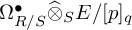 the complex whose i-th term is
$\Omega _{R/S}^{i} \widehat {\otimes }_{S} E/[p]_{q}$
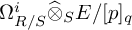 (the completion is p-adic) with induced differentials coming from the de Rham complex. Now by the comparison with prismatic cohomology and q-crystalline cohomology (cf. Theorem 6.16)

Moreover by [Reference Bhatt and ScholzeBS22, Theorem 4.11], we have an isomorphism of differential graded
$E/[p]_{q}$
 -algebras

where the differentials on the RHS are induced by the Bockstein construction. Moreover, by [Reference Fujiwara and KatoFK18, Chapter I, Proposition 5.1.5]

Finally (6.15)–(6.17) together with functoriality of the Bockstein construction gives the following:
Corollary 6.19 (Hodge-Tate comparison: affine case)
For Z of the form (6.9) the map

constructed above is an isomorphism of differential graded
$E/[p]_q$
 -algebras.
We end this section by recording the globalization of Corollary 6.19. In order to formulate the statement, we will need appropriately twisted structure sheaves to accommodate the twist appearing in Theorem 6.16. In particular we consider the variant
$\overline {\mathcal {O}}_{q-\mathrm {CRYS}}^{(1)}$
 defined by
$(E,J) \mapsto E/[p]_{q}$
 . There is a morphism of sheaves of rings
$\overline {\mathcal {O}}_{q-\mathrm {CRYS}} \to \overline {\mathcal {O}}_{q-\mathrm {CRYS}}^{(1)}$
 induced by Frobenius lifts. Similarly one defines
$\overline {\mathcal {O}}^{(1)}$
 as in Definition 6.10 with
$\overline {\mathcal {O}}_{q-\mathrm {CRYS}}^{(1)}$
 in place of
$\overline {\mathcal {O}}_{q-\mathrm {CRYS}}$
 and we get an induced morphism of sheaves of rings
$\overline {\mathcal {O}} \to \overline {\mathcal {O}}^{(1)}$
 . The morphism of sheaves of rings
$p_2^{\sharp }$
 giving a morphism of ringed topoi

Let
$p_2^{*}\Omega _{\mathfrak {X}/\mathfrak {Y}}^{\bullet }$
 denote the complex whose ith term is
$p_2^{*}\Omega _{\mathfrak {X}/\mathfrak {Y}}^{i}$
 and induced differentials (here
$p_2$
 is considered as the twisted morphism of ringed topoi (6.19)). For the next result, note that
$p_1^{-1}\overline {\mathcal {O}}^{(1)}_{q-\mathrm {CRYS}}$
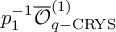 is the sheafFootnote
19
$Z \mapsto E/[p]_q$
 .
Corollary 6.20 (Hodge-Tate comparison: global case)
The maps
$\eta _{\mathfrak {X}/\mathfrak {Y}}^{q}(Z)$
 in Corollary 6.19 glue to give an isomorphism

of differential graded
$p_1^{-1}\overline {\mathcal {O}}^{(1)}_{q-\mathrm {CRYS}}$
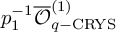 -algebras.
Proof. Unravelling the definitions,
$p_2^{*}\Omega ^{i}_{\mathfrak {X}/\mathfrak {Y}}$
 is the sheafification of the presheaf

In addition, by taking an injective resolution of
$q\Omega _{\mathfrak {X}/\mathfrak {Y}}$
 , one shows that
$H^{i}(q\Omega _{\mathfrak {X}/\mathfrak {Y}} \otimes ^{\mathbb {L}}_{D} D/[p]_q)\{i\}$
 is the sheafification of the presheaf

The result now follows from Corollary 6.19 (for the glueing, one uses the functoriality of (6.18)).
6.4 Base change for
$(\mathfrak{Y}/D)_{q-\mathrm{CRYS}} \overleftarrow{\times}_{\mathfrak{Y}_{\acute{e}t}}\mathfrak{X}_{\acute{e}t}$

In this section we record the relevant base change for later use, namely when comparing relative
$A_{ {\mathrm {inf}}}$
 -cohomology with q-crystalline cohomology. We continue to use the twisted sheaves developed in the previous section. For what follows we consider the commutative diagram of (twisted) ringed topoi

As usual we handle the affine case first.
Lemma 6.21. Suppose
$\mathfrak {X}$
 and
$\mathfrak {Y}$
 are in addition affine. Then for each
$n \geq 1$
 the canonical base change map induced by (6.20)

is an isomorphism.
Proof. Recall
$u^{q}_{\mathfrak {Y}}$
 is induced by the diagram of sites

and so
$(u^{q}_{\mathfrak {Y}})^{-1} = g_{1}^{s}a^{s}g_{s}$
 . Unravelling the definitions, the LHS of (6.21) is the sheafification of the presheaf

Since
$\mathfrak {X}$
 and
$\mathfrak {Y}$
 are affine, the expression inside the limit of (6.22) is in fact independent of W (for W affine) and so (6.22) simplifies to the sheafification of

We now deal with the RHS of (6.21). First note that
$p_{2}^{*}(\mathcal {O}_{\mathfrak {X}_{ {\mathrm {\acute {e}t}}}}/p^n)$
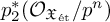 is the sheaf

where Z is of the form (6.9). Therefore
$p_{1*}p_{2}^{*}(\mathcal {O}_{\mathfrak {X}_{ {\mathrm {\acute {e}t}}}}/p^n)$
 is the sheaf

We will also need vanishing of cohomology.
Lemma 6.22. Let Z be of the form (6.9). The cohomology groups
$H^{i}(Z, \overline {\mathcal {O}}^{(1)}/p^n)$
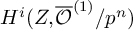 vanish for
$i>0$
 and
$n \geq 1$
 .
Proof. It suffices to observe that any covering of Z induces an étale covering of
$ {\mathrm {Spf}}(E/[p]_{q} \widehat {\otimes }_{S} R)$
 . The result now follows by vanishing of higher Čech cohomology for affine schemes.
Proposition 6.23. Suppose f is proper and smooth, and
$\mathscr {F}$
 a locally free
$\mathcal {O}_{\mathfrak {X}_{ {\mathrm {\acute {e}t}}}}/p^n$
 -module of finite type for some
$n \geq 1$
 . Then the canonical base change map induced by (6.20)

is a quasi-isomorphism.
Proof. The proof is very similar to the proof of the counterpart in the pro-étale setting (cf. Proposition 5.24) and so we omit the details. In the current situation, however, we get a result on the nose because:
-
(1) We know the sections of $\overline {\mathcal {O}}^{(1)}/p^n$
(in the pro-étale setting the sections of
$\widehat {\mathcal {O}}^{+}_{D}/p^n$
were only known up to almost ambiguity). This led us to a result on the nose in the affine case (cf. Lemma 6.21). -
(2) By the proof of Lemma 6.22 we know the vanishing of higher Čech cohomology of $\overline {\mathcal {O}}^{(1)}/p^n$
for coverings of Z of the form (6.9). The analogous result in the pro-étale setting (cf. the proof of Lemma 5.5(i)) was only known up to almost ambiguity.


6.5 q-crystalline vs pro-étale fibered products
In this section, we specialize to the case
$(D,I) = (A_{ {\mathrm {inf}}}, (\xi ))$
 and assume that we have a
$ {\mathrm {Spf}}(\mathcal {O})$
 -morphism
$f \colon \mathfrak {X} \to \mathfrak {Y}$
 of p-adic formal schemes of type (S)(b). In §6.1, we constructed the site

On the pro-étale side, in §2.1, we constructed a site D. Let
$D'$
 be the subsite of D consisting of objects appearing in Proposition 2.8. In this case, D and
$D'$
 have the same associated topoi:
$Y_{ {\mathrm {pro\acute {e}t}}} \times _{\mathfrak {Y}_{ {\mathrm {\acute {e}t}}}} \mathfrak {X}_{ {\mathrm {\acute {e}t}}}$
 . We want to compare the q-crystalline complex
$q\Omega _{\mathfrak {X}/\mathfrak {Y}}$
 (cf. Definition 6.15) and
$A\Omega _{\mathfrak {X}/\mathfrak {Y}}$
 . These two objects live in different topoi
$(\mathfrak {Y}/D)_{q-\mathrm {CRYS}} \overleftarrow {\times }_{\mathfrak {Y}_{ {\mathrm {\acute {e}t}}}} \mathfrak {X}_{ {\mathrm {\acute {e}t}}}$
 and
$Y_{ {\mathrm {pro\acute {e}t}}} \times _{\mathfrak {Y}_{ {\mathrm {\acute {e}t}}}} \mathfrak {X}_{ {\mathrm {\acute {e}t}}}$
 , respectively. So we need to first construct a morphism between the topoi.
Lemma 6.24. The functor

is cocontinuous.
Remark 6.25. We explain how the morphism
$ {\mathrm {Spf}}(S_{\infty }) \to {\mathrm {Spf}}(S)$
 is defined so that the RHS of (6.27) makes sense. Let
$S^{+}$
 be the integral closure of S in
$S[\tfrac {1}{p}]$
 . Then the LHS of (6.27) gives a morphism
$\varprojlim _{i \in I} {\mathrm {Spa}}(S_{i}, S_{i}^{+}) \to {\mathrm {Spa}}(S[\frac {1}{p}], S^{+})$
 in
$Y_{ {\mathrm {pro\acute {e}t}}}$
 . This gives a continuous morphism
$S^{+} \to \varinjlim S_i^{+}$
 . The composition
$S \to S^{+} \to \varinjlim S_i^{+} \to S_{\infty }$
 gives the desired morphism.
Proof. We show the cocontinuity for coverings of type (a) first. Let
$(E_1,J_1) \to (A_{ {\mathrm {inf}}}(S_{\infty }), (\xi ))$
 be a covering in
$q-\mathrm {CRYS}(\mathfrak {Y}/(A_{ {\mathrm {inf}}})$
 . We verify the cocontinuity condition for this cover. By definition we have a p-completely étale covering map
$ {\mathrm {Spf}}(E_1/J_1) \to {\mathrm {Spf}} (S_{\infty })$
 . So
$E_1/J_1$
 is the p-adic derived completion of an étale
$S_{\infty }$
 -algebra
$\tfrac {S_{\infty }[x_1, \dots , x_n]}{(f_1, \ldots , f_n)}$
 . Then

for some
$i_1 \in I$
 . Moreover by increasing
$i_1$
 if necessary, we can assume
$\tfrac {(S_{i_1}^{+}/p)[x_1, \dots , x_n]}{(\overline {f}_1, \ldots , \overline {f}_n)}$
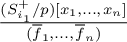 is faithfully flat over
$S_{i_1}^{+}/p$
 (cf. [Sta18, Tag 07RR]). By [Sta18, Tag 04D1] there exists some lift of
$\tfrac {(S_{i_1}^{+}/p)[x_1, \dots , x_n]}{(\overline {f}_1, \ldots , \overline {f}_n)}$
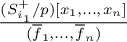 to an étale
$S_{i_1}^{+}$
 -algebra T. Then
$E_1/J_1$
 is the p-adic derived completion of
$T \otimes _{S_{i_1}^{+}} \varinjlim _{i \in I} S_i^{+}$
 . We claim that

where
$\widehat {T}$
 is the p-adic completion of T, and
$T'$
 is the integral closure of
$\widehat {T}$
 in
$\widehat {T}[\tfrac {1}{p}]$
 , is an étale covering map. Indeed it is étale by [Reference HuberHub96, Corollary 1.7.3(iii)]. It is also a covering because
$T/p$
 is faithfully flat over
$S_{i_1}^{+}/p$
 . It follows that the fiber product

exists in
$Y_{ {\mathrm {pro\acute {e}t}}}$
 and is a covering of
$\varprojlim _{i \in I} {\mathrm {Spa}}(S_i, S_i^{+})$
 . We can rewrite (6.28) as

where
${S^{\prime }_{i}}^{+}$
 is the integral closure of
$T' \otimes _{S_{i_1}^{+}} S_{i}^{+}$
 in
$\widehat {T}[\tfrac {1}{p}] \widehat {\otimes }_{S_{i_1}} S_i$
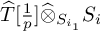 . Therefore we obtain a composition of maps

This verifies the cocontinuity condition for coverings of type (a).
Coverings of type (b) are trivial to handle. We now deal with coverings of type (c): let
$((A_{ {\mathrm {inf}}}(S_{\infty }), (\xi )) \to \mathfrak {Y}' \leftarrow \mathfrak {X}')$
 be such a cover of the RHS of (6.27). By using the argument in the proof of Lemma 6.12, we can refine this to a cover of the form
$((A_{ {\mathrm {inf}}}(S^{\prime }_{\infty }), (\xi )) \to {\mathrm {Spf}}(S') \leftarrow {\mathrm {Spf}}(R'))$
 where
$ {\mathrm {Spf}}(S^{\prime }_{\infty }) \to {\mathrm {Spf}}(S_{\infty })$
 is an étale covering. This is a covering of type (a) followed by a covering of type (c). Thus by the first part of this proof, we have reduced to checking the cocontinuity condition for the case where we have a cover of the form
$((A_{ {\mathrm {inf}}}(S_{\infty }), (\xi )) \to {\mathrm {Spf}}(S') \leftarrow {\mathrm {Spf}}(R'))$
 of type (c) of the RHS of (6.27). This means that
$ {\mathrm {Spf}}(S_{\infty }) \to {\mathrm {Spf}}(S)$
 factors through
$ {\mathrm {Spf}}(S') \to {\mathrm {Spf}}(S)$
 . It suffices to show that
$\varprojlim _{i \in I} {\mathrm {Spa}}(S_{i}, S_{i}^{+}) \to {\mathrm {Spa}}(S[1/p], S^+)$
 in
$Y_{ {\mathrm {pro\acute {e}t}}}$
 factors through
$ {\mathrm {Spa}}(S'[\tfrac {1}{p}], S^{\prime +}) \to {\mathrm {Spa}}(S[\tfrac {1}{p}], S^{+})$
 , where
$S^{\prime +}$
 is the integral closure of
$S'$
 in
$S'[\tfrac {1}{p}]$
 . Observe that a composition
$ {\mathrm {Spf}}(S_{\infty }) \to {\mathrm {Spf}}(S') \to {\mathrm {Spf}}(S)$
 is equivalent to a continuous S-morphism
$S' \to S_{\infty }$
 . Since
$S/p \to S'/p$
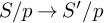 is of finite presentation, there exists
$i_1 \in I$
 such that
$S'/p \to \varinjlim _{i \in I} S^{+}_{i}/p$
 factors through
$S^{+}_{i_1}/p$
 . Moreover by increasing
$i_1$
 if necessary, we can assume
$S \to \varinjlim _{i \in I} S^{+}_i$
 factors through
$S_{i_1}^{+}$
 . Then for each
$n \geq 1$
 we have a commutative square

where the left vertical arrow is étale and so there is a unique map
$S'/p^n \to S_{i_1}^{+}/p^n$
 rendering the diagram commutative. Thus upon taking limits we obtain a continuous map
$S' \to S^{+}_{i_1}$
 compatible with the maps from S. The result now follows.
Lemma 6.24 induces a morphism of topoi

6.6 Comparison with q-de Rham cohomology
In this short section we compare
$q\Omega _{\mathfrak {X}/\mathfrak {Y}}$
 with a relative q-de Rham complex (cf. [Reference Bhatt and ScholzeBS22, Theorem 16.22] and [Reference KoshikawaKos21, Theorem 7.17]). We work locally and suppose
$ {\mathrm {Spf}}(R) \to {\mathrm {Spf}}(S)$
 is a smooth
$ {\mathrm {Spf}}(\mathcal {O})$
 -morphism. In addition we assume R is very small over S, i.e.
$R/p$
 is generated over
$S/p$
 by units. This means that there is a canonical functorial surjection
$P \to R \widehat {\otimes }_{S} S_{\infty }$
 with kernel J, where
$P := \mathbb {A}_{ {\mathrm {inf}}}(S_{\infty })[\{t_s\}_{s \in R^{\times }}]^{\wedge }$
 and the completions are
$(p, \tilde {\xi })$
 -adic. In this context
$q = [\epsilon ] \in A_{ {\mathrm {inf}}}$
 and in order to define q-de Rham cohomology in the case we need, we verify the following result.
Lemma 6.26.
$\mathbb {A}_{ {\mathrm {inf}}}(S_{\infty })$
 is a flat A-algebra.
Proof. By [Reference Bhatt, Morrow and ScholzeBMS18, Remark 4.31], it suffices to show that
$S_{\infty }^{\flat }$
 is
$(\epsilon -1)$
 -torsion free. This follows from Lemma 4.1 and [Reference Česnavičius and ScholzeCS19, (2.1.2.2)].
We may regard P as a
$\delta $
 -
$\mathbb {A}_{ {\mathrm {inf}}}(S_{\infty })$
 -algebra in a unique way by setting
$\delta (x_s)=0$
 for each
$s \in R^{\times }$
 . Let
$D_{J,q}(P)$
 be the q-PD envelope of
$P \to R \widehat {\otimes }_{S} S_{\infty }$
 . The main result is the following.
Theorem 6.27. Let Z be of the form of the RHS of (6.27) such that in addition R is very small over S. Then there is a canonical functorial quasi-isomorphism
$R\Gamma (Z, q\Omega _{\mathfrak {X}/\mathfrak {Y}}) \cong q\Omega ^{*, \square }_{D_{J,q}(P)/\mathbb {A}_{ {\mathrm {inf}}}(S_{\infty })}$
 .
Proof. As with the comparison with prismatic cohomology, the hard work is already done in [Reference Bhatt and ScholzeBS22, §16]. Indeed by Lemma 6.14

The result now follows by Theorem 16.22 in loc. cit. and the comparison made in Lemma 6.6.
6.7 Comparison with
$A\Omega _{\mathfrak {X}/\mathfrak {Y}}$

We specialize to the case
$(D,I) = (A_{ {\mathrm {inf}}}, (\xi ))$
 . Having established the following ingredients:
-
(1) a way to pass from the pro-étale setting to the q-crystalline setting (cf. (6.29)),
-
(2) the Hodge-Tate comparison for $q\Omega _{\mathfrak {X}/\mathfrak {Y}}$
(cf. Corollary 6.19), and -
(3) the Hodge-Tate comparison for $A\Omega _{\mathfrak {X}/\mathfrak {Y}}$
(cf. Theorem 5.19),


in this section we are now ready to compare
$q\Omega _{\mathfrak {X}/\mathfrak {Y}}$
 and
$A\Omega _{\mathfrak {X}/\mathfrak {Y}}$
 (cf. [Reference Bhatt and ScholzeBS22, Theorem 17.2] and [Reference KoshikawaKos21, Theorem 8.1]).
Theorem 6.28. Assume that we have a smooth
$ {\mathrm {Spf}}(\mathcal {O})$
 -morphism
$f \colon \mathfrak {X} \to \mathfrak {Y}$
 of p-adic formal schemes of type (S)(b). Suppose
$\mathfrak {X}$
 and
$\mathfrak {Y}$
 are flat over
$\mathcal {O}$
 . There is a canonical functorial morphism

in
$D(D, p^{-1}W(\widehat {\mathcal {O}}^{+, \flat }_Y))$
 compatible with the Frobenius such that the cohomology sheaves of the cone of (6.30) are killed by
$W(\mathfrak {m}^{\flat }) \subset A_{ {\mathrm {inf}}}$
 . If in addition
$\mathfrak {Y}$
 is locally of finite type over
$\mathcal {O}$
 , then (6.30) is an isomorphism.
Remark 6.29. We explain how to view the LHS and RHS of (6.30) as objects in
$D(D, p^{-1}W(\widehat {\mathcal {O}}^{+, \flat }_Y))$
 . For the RHS this is already explained in Definition 2.18 together with Lemma 2.19. For the LHS, first note that
$p^{-1}W(\widehat {\mathcal {O}}^{+, \flat }_Y) = \mu ^{-1}p_1^{-1}\mathcal {O}_{q-\mathrm {CRYS}}$
 . Moreover, by temporarily regarding
$\nu _{f}^{q}$
 as the following morphism of ringed topoi (we abuse notation and use
$\mathcal {O}_{q-\mathrm {CRYS}}$
 to denote the structure sheaves on both
$(\mathfrak {X}/D)_{q-\mathrm {CRYS}}$
 and
$(\mathfrak {Y}/D)_{q-\mathrm {CRYS}}$
 )

naturally equips
$q\Omega _{\mathfrak {X}/\mathfrak {Y}}$
 as an object in
$D(q-\mathrm {CRYS}(\mathfrak {Y}/D) \overleftarrow {\times }_{\mathfrak {Y}_{ {\mathrm {\acute {e}t}}}} \mathfrak {X}_{ {\mathrm {\acute {e}t}}}, p_1^{-1}\mathcal {O}_{q-\mathrm {CRYS}})$
 .
Proof. We follow the main ideas of the proof of [Reference Bhatt and ScholzeBS22, Theorem 17.2]. Let Z be of the form of the LHS of (6.27). One difference in the (current) relative case is that the derived Z-sections of the presheaf
$A\Omega _{\mathfrak {X}/\mathfrak {Y}}^{\text {psh}}$
 identify with the derived Z-sections of
$A\Omega _{\mathfrak {X}/\mathfrak {Y}}$
 only up to almost ambiguity (cf. (5.24)). For this reason (together with the fact that the derived Z-sections of the presheaf version are explicit), we will work directly with the presheaf.
We will use the notation developed in §5.1. In particular, in addition to the site D, the site
$D^{\text {psh}}$
 will be useful. In fact we will work with the subsites
$D_{\text {vs}} \subset D$
 and
$D^{\text {psh}}_{\text {vs}} \subset D^{\text {psh}}$
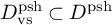 consisting only of good objects Z such that R is very small over S. Note that
$D_{\text {vs}}$
 and D induce the same topoi. We have
$\mu ^{-1}q\Omega _{\mathfrak {X}/\mathfrak {Y}} = \phi ^{-1}q\Omega _{\mathfrak {X}/\mathfrak {Y}}^{\text {psh}}$
 where
$q\Omega _{\mathfrak {X}/\mathfrak {Y}}^{\text {psh}}$
 is the complex of presheaves given by

where u is the functor in Lemma 6.24. By (5.2), it suffices to construct a canonical functorial morphism

in
$D(D^{\text {psh}}_{\text {vs}}, p^{-1}W(\widehat {\mathcal {O}}^{+, \flat }_Y))$
 compatible with the Frobenius, whose cone satisfies the relevant conditions (we abuse notation and denote
$p^{-1}W(\widehat {\mathcal {O}}^{+, \flat }_Y)$
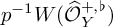 for the presheaf
$Z \mapsto \mathbb {A}_{ {\mathrm {inf}}}(S_{\infty })$
 ). We do this in several steps. We assume henceforth that R is very small over S.
Step 1: Constructing explicit representatives for
$R\Gamma (Z, q\Omega _{\mathfrak {X}/\mathfrak {Y}}^{\text {psh}})$
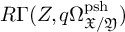 and
$R\Gamma (Z, A\Omega _{\mathfrak {X}/\mathfrak {Y}}^{\text {psh}})$
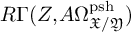 . We rewrite each term
$R\Gamma (Z, q\Omega _{\mathfrak {X}/\mathfrak {Y}}^{\text {psh}})$
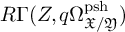 and
$R\Gamma (Z, A\Omega _{\mathfrak {X}/\mathfrak {Y}}^{\text {psh}})$
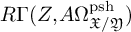 by explicit representatives of Koszul complexes. Strictly speaking this will be only up to almost ambiguity for the second term in general, and is one difference compared to the cases of [Reference Bhatt and ScholzeBS22] and [Reference KoshikawaKos21]. For the term
$R\Gamma (Z, q\Omega _{\mathfrak {X}/\mathfrak {Y}}^{\text {psh}})$
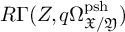 , this is made possible by comparison with the q-de Rham complex (cf. Theorem 6.27). Indeed
$R\Gamma (u(Z), q\Omega _{\mathfrak {X}/\mathfrak {Y}}) \cong q\Omega ^{*, \square }_{D_{J,q}(P)/\mathbb {A}_{ {\mathrm {inf}}}(S_{\infty })}$
 and by definition
$q\Omega ^{*, \square }_{D_{J,q}(P)/\mathbb {A}_{ {\mathrm {inf}}}(S_{\infty })}$
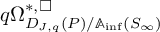 is the complex

defined as the term-wise
$(p,[p]_{q})$
 -completed filtered colimit over all finite subsets
$\Sigma \subset R^{\times }$
 of the corresponding cohomological Koszul complexes for
$\{\nabla _{q,s}\}_{s \in \Sigma }$
 , where
$\nabla _{q,s}$
 is defined in the same way as [Reference Bhatt and ScholzeBS22, Constructions 16.19, 16.20]. The treatment of the term
$R\Gamma (Z, A\Omega _{\mathfrak {X}/\mathfrak {Y}}^{\text {psh}})$
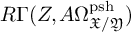 is slightly more delicate. We use the notation from §4. For each finite subset
$\Sigma \subset R^{\times }$
 containing
$t_1, \ldots , t_d$
 , there is a corresponding profinite group
$\Delta _{\Sigma } = \mathbb {Z}_p^{\Sigma }$
 with generators (over
$\mathbb {Z}_p$
 )
$\{\sigma _{s}\}_{s \in \Sigma }$
 and a pro-(finite étale) affinoid perfectoid
$\Delta _{\Sigma }$
 -coverFootnote
20

compatible with the natural surjection
$\Delta _{\Sigma } \twoheadrightarrow \Delta $
 . Consider now the complex

defined as the term-wise
$(p,[p]_{q})$
 -completed filtered colimit over all finite subsets
$\Sigma \subset R^{\times }$
 (containing
$t_1, \ldots , t_d$
 ) of the corresponding cohomological Koszul complexes. By Theorem 4.11, Remark 4.12 and (5.3), there is a morphism

whose cone has its cohomology groups killed by
$W(\mathfrak {m}^{\flat })$
 (if
$\mathfrak {Y}$
 is locally of finite type over
$\mathcal {O}$
 , then it is a quasi-isomorphism).
Step 2: Constructing a map
$R\Gamma (Z, q\Omega _{\mathfrak {X}/\mathfrak {Y}}^{\text {psh}}) \to R\Gamma (Z, A\Omega _{\mathfrak {X}/\mathfrak {Y}}^{\text {psh}})$
 . By (6.32)-(6.33), it is enough to construct a functorial comparison map

By [Reference Bhatt, Morrow and ScholzeBMS18, Lemma 7.9], there is a canonical isomorphism

and so to construct (6.34), it suffices to construct a canonical map

of
$\mathbb {A}_{ {\mathrm {inf}}}(S_{\infty })$
 -algebras that intertwines
$\sigma _{s}$
 and
$\gamma _{s}$
 (the completion appearing on the RHS is p-adic). We have a commutative diagram

where the top map is induced by mapping
$t_s$
 to
$[(\ldots , \tilde {t}_s^{1/p},\tilde {t}_s)]$
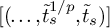 (where
$\tilde {t}_s^{1/p^m}$
 denotes the image of
$t_s^{1/p^m} \in R^{\square }_{\Sigma ,m}$
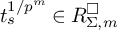 in
$(\varinjlim _{\Sigma } R_{\Sigma , \infty })^{\wedge }$
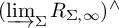 ). The action of
$\sigma _{s}$
 on
$\mathbb {A}_{ {\mathrm {inf}}}((\varinjlim _{\Sigma } R_{\Sigma , \infty })^{\wedge })$
 can be computed as in the last paragraph of §4.2 (where it is done in the case
$s = t_i$
 on
$\mathbb {A}_{ {\mathrm {inf}}}(R_{\infty })$
 ). This action clearly intertwines with the action of
$\gamma _{s}$
 on P. Moreover
$P \to \mathbb {A}_{ {\mathrm {inf}}}((\varinjlim _{\Sigma } R_{\Sigma , \infty })^{\wedge })$
 is a
$\delta $
 -map and so extends uniquely to a
$\delta $
 -map
$D_{J,q}(P) \to \mathbb {A}_{ {\mathrm {inf}}}((\varinjlim _{\Sigma } R_{\Sigma , \infty })^{\wedge })$
 . The uniqueness also implies that it intertwines
$\sigma _s$
 and
$\gamma _s$
 (to see this one considers the compositions
$P \xrightarrow {\gamma _s} P \to \mathbb {A}_{ {\mathrm {inf}}}(R_{\infty })$
 and
$P \to \mathbb {A}_{ {\mathrm {inf}}}(R_{\infty }) \xrightarrow {\sigma _s} \mathbb {A}_{ {\mathrm {inf}}}(R_{\infty })$
 ). In summary we have constructed the desired map (6.35).
Step 3: Showing the cone of the map
$R\Gamma (Z, q\Omega _{\mathfrak {X}/\mathfrak {Y}}^{\text {psh}}) \to R\Gamma (Z, A\Omega _{\mathfrak {X}/\mathfrak {Y}}^{\text {psh}})$
 from Step 2 satisfies the relevant conditions. It suffices to check that the map (6.34) has cone whose cohomology groups are killed by
$W(\mathfrak {m}^{\flat })$
 (and is a quasi-isomorphism if
$\mathfrak {Y}$
 is locally of finite type over
$\mathcal {O}$
 ). We use (a variant of) the criterion given in [Reference Bhatt and ScholzeBS22, Lemma 17.4]. Let
$K_1$
 and
$K_2$
 be the source and target of (6.34). By the Hodge-Tate comparison for
$q\Omega _{\mathfrak {X}/\mathfrak {Y}}$
 (cf. Corollary 6.19) there is an isomorphism

of differential graded
$\mathbb {A}_{ {\mathrm {inf}}}(S_{\infty })/[p]_{q}$
 -algebras. Let

be the morphism in degree 0. In the proof of the de Rham specialization (cf. Theorem 5.20) we constructed an isomorphism

Note that the twist appearing in
$\Omega _{R/S}^{\bullet } \widehat {\otimes }_{S} \mathbb {A}_{ {\mathrm {inf}}}(S_{\infty })/[p]_{q}$
 was implicit and is coming from (5.7). Moreover by Remark 4.12, there is a natural morphism

whose cone has its cohomology groups killed by
$W(\mathfrak {m}^{\flat })$
 (if
$\mathfrak {Y}$
 is locally of finite type over
$\mathcal {O}$
 then it is an isomorphism). Composing (6.37)–(6.38) gives

whose cone has cohomology groups killed by
$W(\mathfrak {m}^{\flat })$
 in general, and if
$\mathfrak {Y}$
 is locally of finite type over
$\mathcal {O}$
 , then it is an isomorphism. Let

be the morphism in degree 0 of (6.39). We remark that
$\eta _{K_2}$
 is
$S_{\infty }$
 -linear. To see this, note that (6.38) is clearly
$S_{\infty }$
 -linear in each degree and
$\widehat {\mathcal {O}}^{+}_D(Z) \to C^{0}_Z$
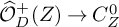 is
$S_{\infty }$
 -linear as mentioned in the proof of Theorem 5.20. One then checks that the composition induced by (6.34) and (6.36)

identifies with
$\eta _{K_2}$
 . This can be done by reducing to the case
$R = S \{ t_1^{\pm 1} \}$
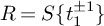 where one uses that the morphisms are
$S_{\infty }$
 -linear and keeps track of where the coordinate
$t_1$
 is mapped to. Finally by a similar argument to the proof of [Reference Bhatt and ScholzeBS22, Lemma 17.4] (where in place of derived Nakayama, one uses the almost version, cf. Lemma 6.30), one obtains that (6.34) has cone whose cohomology groups are killed by
$W(\mathfrak {m}^{\flat })$
 (and is a quasi-isomorphism if
$\mathfrak {Y}$
 is locally of finite type over
$\mathcal {O}$
 by loc. cit.).
In summary Steps 1-3 show that the morphism (6.34) constructed is functorial in Z and satisfies the relevant conditions. Similarly by fixing an injective resolution
$\mathbb {A}_{ {\mathrm {inf}},X} \to I^{\bullet }$
 in
$X_{ {\mathrm {pro\acute {e}t}}}$
 , the edge map (4.15) comes from a functorial morphism of actual complexes. This implies that (6.33) globalizes. This produces the map (6.31) as promised.
Almost in the next statement is w.r.t.
$[\mathfrak {m}^{\flat }] \subset A_{ {\mathrm {inf}}}$
 .
Lemma 6.30 (almost derived Nakayama)
Let
$(\mathscr {C}, A_{ {\mathrm {inf}}})$
 be a ringed site and suppose that
$\mathscr {A} \in D(\mathscr {C}, A_{ {\mathrm {inf}}})$
 is almost derived
$[p]_q$
 -adically complete. If
$\mathscr {A} \otimes ^{\mathbb {L}}_{A_{ {\mathrm {inf}}}} A_{ {\mathrm {inf}}}/[p]_q$
 is almost zero, then so is
$\mathscr {A}$
 .
Proof. By induction on
$n \geq 1$
 , one obtains that
$\mathscr {A} \otimes ^{\mathbb {L}}_{A_{ {\mathrm {inf}}}} A_{ {\mathrm {inf}}}/[p]_{q}^n$
 is almost zero. Hence by taking the derived limit, we get that
$R\varprojlim _{n} (\mathscr {A} \otimes ^{\mathbb {L}}_{A_{ {\mathrm {inf}}}} A_{ {\mathrm {inf}}}/[p]_{q}^n)$
 is almost zero. But by assumption the canonical morphism
$\mathscr {A} \to R\varprojlim _{n} (\mathscr {A} \otimes ^{\mathbb {L}}_{A_{ {\mathrm {inf}}}} A_{ {\mathrm {inf}}}/[p]_{q}^n)$
 is an almost quasi-isomorphism and so the result follows.
6.8 Comparison with
$R\Gamma _{A_{ {\mathrm {inf}}}}(\mathfrak {X}/\mathfrak {Y})$

In this section, we again specialize to the case
$(D,I) = (A_{ {\mathrm {inf}}}, (\xi ))$
 and, unless otherwise stated, assume that we have a
$ {\mathrm {Spf}}(\mathcal {O})$
 -morphism
$f \colon \mathfrak {X} \to \mathfrak {Y}$
 of p-adic formal schemes of type (S)(b). In addition we suppose
$\mathfrak {X}$
 and
$\mathfrak {Y}$
 are flat over
$\mathcal {O}$
 . We now move to the comparison between (relative) q-crystalline cohomology (
$R\Gamma _{q-\mathrm {CRYS}}(\mathfrak {X}/\mathfrak {Y})$
 , cf. Definition 6.15) and
$A_{ {\mathrm {inf}}}$
 -cohomology (
$R\Gamma _{A_{ {\mathrm {inf}}}}(\mathfrak {X}/\mathfrak {Y})$
 ). Let
$Y^{\prime }_{ {\mathrm {pro\acute {e}t}}} \subset Y_{ {\mathrm {pro\acute {e}t}}}$
 be the subsite consisting of affinoid perfectoid objects. By the proof of Lemma 6.24, the functor of sites

is cocontinuous and so induces a morphism of topoi

We now have a priori, two different morphisms of topoi
$u^{q}_{\mathfrak {Y}} \circ \mu _{ {\mathrm {pro\acute {e}t}}}$
 and
$\nu _{Y}$
 from
$Y_{ {\mathrm {pro\acute {e}t}}}$
 to
$\mathfrak {Y}_{ {\mathrm {\acute {e}t}}}$
 . As a reality check, we verify that they coincide.
Lemma 6.31. The two morphisms of topoi
$u^{q}_{\mathfrak {Y}} \circ \mu _{ {\mathrm {pro\acute {e}t}}} \colon Y_{ {\mathrm {pro\acute {e}t}}} \to \mathfrak {Y}_{ {\mathrm {\acute {e}t}}}$
 and
$\nu _Y \colon Y_{ {\mathrm {pro\acute {e}t}}} \to \mathfrak {Y}_{ {\mathrm {\acute {e}t}}}$
 are the same.
Proof. Indeed, for a sheaf
$\mathscr {F}$
 on
$Y_{ {\mathrm {pro\acute {e}t}}}$
 and
$\mathfrak {V}$
 an affine object in
$\mathfrak {Y}_{ {\mathrm {\acute {e}t}}}$


where the left-most limit is taking place along
$\mathfrak {Y}_{ {\mathrm {\acute {E}T}}}^{\text {Aff}}$
 and the middle limit along
$q-\mathrm {CRYS}(\mathfrak {Y}/A_{ {\mathrm {inf}}})$
 . Note that the direction of the morphism indexing the second limit
$(E,J) \to (\mathbb {A}_{ {\mathrm {inf}}}(S_{\infty }), (\xi ))$
 is that of q-PD pairs rather than the q-crystalline site (which is opposite). In these limits, it suffices to consider those with
$(E, J)=(\mathbb {A}_{ {\mathrm {inf}}}(S_{\infty }), (\xi ))$
 . As the category of perfect prisms is equivalent to the category of perfectoid rings, the RHS of (6.41) can be rewritten as

with the left-most limit taking place along
$\mathfrak {Y}_{ {\mathrm {\acute {E}T}}}^{\text {Aff}}$
 . The morphism
$ {\mathrm {Spf}}(S_{\infty }) \to \mathfrak {V}$
 is equivalent to giving a morphism on the generic fibers
$ {\mathrm {Spa}} (S_{\infty }[\tfrac {1}{p}],S_{\infty }) \to V$
 (in the category of adic spaces over Y) because
$S_{\infty }$
 is integrally closed in
$S_{\infty }[\tfrac {1}{p}]$
 . We claim that giving a morphism
$ {\mathrm {Spa}} (S_{\infty }[\tfrac {1}{p}],S_{\infty }) \to V$
 (in the category of adic spaces over Y) is equivalent to giving a morphism
$\varprojlim _{i \in I} {\mathrm {Spa}}(S_{i}, S_{i}^{+}) \to V$
 in
$Y_{ {\mathrm {pro\acute {e}t}}}$
 . This is similar to the proof of the last part in Lemma 6.24 and we omit the details.
Lemma 6.32. Assume that we have a proper smooth
$ {\mathrm {Spf}}(\mathcal {O})$
 -morphism
$f \colon \mathfrak {X} \to \mathfrak {Y}$
 of p-adic formal schemes of type (S)(b) with
$\mathfrak {X}$
 and
$\mathfrak {Y}$
 flat over
$\mathcal {O}$
 . Then the cohomology sheaves of the cone of the canonical morphism

are killed by
$[\mathfrak {m}^{\flat }] \subset A_{ {\mathrm {inf}}}$
 (the completion on the RHS is derived
$[p]_q$
 -adic).
Proof. Take a covering
$\{U_j \to Y \}_{j}$
 by affinoid perfectoid objects of Y and write
$U_j = \varprojlim _{i \in I_j} {\mathrm {Spa}}(S_{ij}, S_{ij}^{+})$
 . Then

By Proposition 6.17(ii),
$(R\Gamma _{q-\mathrm {CRYS}}(\mathfrak {X}/\mathfrak {Y})\lvert _{(\mathbb {A}_{ {\mathrm {inf}}}(S_{j,\infty }),(\xi ))}$
 is represented by a strictly perfect object in
$D((\mathfrak {Y}/A_{ {\mathrm {inf}}})_{q-\mathrm {CRYS}}/(\mathbb {A}_{ {\mathrm {inf}}}(S_{j,\infty }),(\xi )), \mathcal {O}_{q-\mathrm {CRYS}}\lvert _{(\mathbb {A}_{ {\mathrm {inf}}}(S_{j,\infty }),(\xi ))})$
 . Now an easy calculation gives
$\mu _{ {\mathrm {pro\acute {e}t}}}^{-1}\mathcal {O}_{q-\mathrm {CRYS}} = W(\widehat {\mathcal {O}}^{+, \flat }_{Y})$
 . Moreover the cone of the canonical morphism

has its cohomology sheaves killed by
$[\mathfrak {m}^{\flat }]$
 (cf. [Reference Bhatt, Morrow and ScholzeBMS18, Lemma 5.6]). Since
$\mathbb {A}_{ {\mathrm {inf}},Y}$
 is derived
$[p]_q$
 -complete by Corollary 2.28, the result follows.
Theorem 6.33. Assume that we have a proper smooth
$ {\mathrm {Spf}}(\mathcal {O})$
 -morphism
$f \colon \mathfrak {X} \to \mathfrak {Y}$
 of p-adic formal schemes of type (S)(b) with
$\mathfrak {X}$
 and
$\mathfrak {Y}$
 flat over
$\mathcal {O}$
 . There is a canonical functorial morphism

in
$D(Y_{ {\mathrm {pro\acute {e}t}}}, W(\widehat {\mathcal {O}}^{+, \flat }_Y))$
 compatible with the Frobenius such that the cohomology sheaves of the cone of (6.42) are killed by
$[\mathfrak {m}^{\flat }] \subset A_{ {\mathrm {inf}}}$
 .
Remark 6.34. We explain how to view the LHS and RHS of (6.42) as objects in
$D(Y_{ {\mathrm {pro\acute {e}t}}}, W(\widehat {\mathcal {O}}^{+, \flat }_Y))$
 . For the RHS this is already explained in Definition 2.18 together with Lemma 2.19. For the LHS, first note
$R\Gamma _{q-\mathrm {CRYS}}(\mathfrak {X}/\mathfrak {Y})$
 is naturally an object of
$D(q-\mathrm {CRYS}(\mathfrak {Y}/A_{ {\mathrm {inf}}}), \mathcal {O}_{q-\mathrm {CRYS}})$
 . Since
$\mu _{ {\mathrm {pro\acute {e}t}}}^{-1}\mathcal {O}_{q-\mathrm {CRYS}} = W(\widehat {\mathcal {O}}^{+, \flat }_{Y})$
 , we get that the LHS can be viewed as an object in
$D(Y_{ {\mathrm {pro\acute {e}t}}}, W(\widehat {\mathcal {O}}^{+, \flat }_Y))$
 .
Proof. The strategy is to work modulo
$[p]_q$
 and to gradually massage the LHS towards the RHS of (6.42). The following schematic diagram summarizes this ‘massage process’:

where steps (I) and (III) are combinations of the relevant Hodge-Tate comparisons, and step (II) is a combination of the base changes from the pro-étale and q-crystalline side. Finally after working modulo
$[p]_q$
 , one can lift the results as both sides of (6.42) are (almost) derived
$[p]_q$
 -adically complete. We now begin the proof.
We define (6.42) as the composition

where the first map is induced by the canonical base change map for the commutativeFootnote 21 diagram of ringed topoi

Note that since the morphism (6.30) is constructed in
$D(D, p^{-1}W(\widehat {\mathcal {O}}^{+, \flat }_Y))$
 , the morphism (6.42) is in
$D(Y_{ {\mathrm {pro\acute {e}t}}}, W(\widehat {\mathcal {O}}^{+, \flat }_Y))$
 .
By Corollary 5.13,
$A\Omega _{\mathfrak {X}/\mathfrak {Y}}$
 is almost derived
$[p]_q$
 -adically complete and so the same is true for
$R\Gamma _{A_{ {\mathrm {inf}}}}(\mathfrak {X}/\mathfrak {Y})$
 . Similarly by Lemma 6.32,
$\mu _{ {\mathrm {pro\acute {e}t}}}^{-1}R\Gamma _{q-\mathrm {CRYS}}(\mathfrak {X}/\mathfrak {Y})$
 is almost derived
$[p]_q$
 -adically complete. Therefore by almost derived Nakayama (cf. Lemma 6.30), it suffices to show that the induced morphism

is an almost quasi-isomorphism. The LHS of (6.44) can be rewritten as

We have a spectral sequence

whose terms on the second page satisfy

where (a) follows from the (global) Hodge-Tate comparison (cf. Corollary 6.20), (b) follows from base change (cf. Proposition 6.23), noting that
$\Omega ^{j}_{\mathfrak {X}/\mathfrak {Y}}$
 is a locally free
$\mathcal {O}_{\mathfrak {X}_{ {\mathrm {\acute {e}t}}}}$
 -module, and (c) is by definition of
$u^{q*}_{\mathfrak {Y}}$
 . We compute further

where (1) follows from Lemma 6.31, (2) follows from the fact that
$\mu ^{-1}_{ {\mathrm {pro\acute {e}t}}}\overline {\mathcal {O}}_{q-\mathrm {CRYS}}^{(1)}$
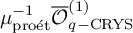 is the sheaf
$\varprojlim _{i \in I} {\mathrm {Spa}}(S_{i}, S_{i}^{+}) \mapsto \mathbb {A}_{ {\mathrm {inf}}}(S_{\infty })/[p]_q$
 , and (3) follows by definition upon viewing
$\nu _{Y}$
 as a morphism of ringed topoi
$(Y_{ {\mathrm {pro\acute {e}t}}}, \widehat {\mathcal {O}}^{+}_{Y}) \to (\mathfrak {Y}_{ {\mathrm {\acute {e}t}}}, \mathcal {O}_{\mathfrak {Y}_{ {\mathrm {\acute {e}t}}}})$
 .
By Corollary 5.27, the base change morphism

is an almost isomorphism (via the canonical map
$A_{ {\mathrm {inf}}} \to A_{ {\mathrm {inf}}}/\xi $
 ,
$[\mathfrak {m}^{\flat }]$
 is sent to
$\mathfrak {m}$
 ). Therefore the expression on the RHS of (3) is almost isomorphic to

Moreover by the Hodge-Tate comparison (cf. Theorem 5.19), there is an almost isomorphism

There is a spectral sequence (with second page terms)

By construction the morphism (6.30) was shown to be compatible with the Hodge-Tate comparisons on the q-crystalline side and the pro-étale side, and so we conclude that there is an almost quasi-isomorphism

compatible with (6.44). Finally by (5.4) the map

is an almost quasi-isomorphism (with the twist by
$\varphi $
 being implicit there). Combining (6.45)-(6.46), gives that (6.44) is an almost quasi-isomorphism.
6.9 Perfectness of
$R\Gamma _{A_{ {\mathrm {inf}}}}(\mathfrak {X}/\mathfrak {Y})$

In this short section we record (almost) perfectness of
$R\Gamma _{A_{ {\mathrm {inf}}}}(\mathfrak {X}/\mathfrak {Y})$
 together with base change (cf. Proposition 6.35 for the precise result). We will rely on the comparison with q-crystalline cohomology (cf. Theorem 6.33), however similar results can be obtained (albeit via a longer argument) using only the de Rham specialization of
$A\Omega _{\mathfrak {X}/\mathfrak {Y}}$
 (cf. Theorem 5.20). Almost in the next proposition is with respect to
$[\mathfrak {m}^{\flat }] \subset A_{ {\mathrm {inf}}}$
 .
Proposition 6.35. Assume that we have a proper smooth
$ {\mathrm {Spf}}(\mathcal {O})$
 -morphism
$f \colon \mathfrak {X} \to \mathfrak {Y}$
 of p-adic formal schemes with
$\mathfrak {X}$
 and
$\mathfrak {Y}$
 flat over
$\mathcal {O}$
 . Let
$U \in Y_{ {\mathrm {pro\acute {e}t}}}$
 be an affinoid perfectoid object determining the perfectoid space
$ {\mathrm {Spa}}(R,R^{+})$
 . Then
-
(i) $R\Gamma (U, R\Gamma _{A_{ {\mathrm {inf}}}}(\mathfrak {X}/\mathfrak {Y}))$
is almost quasi-isomorphic to a perfect object in
$D(W(R^{\flat +}))$
. -
(ii) $R\Gamma _{A_{ {\mathrm {inf}}}}(\mathfrak {X}/\mathfrak {Y})\lvert _{U}$
is almost quasi-isomorphic to a strictly perfect object in
$D(Y_{ {\mathrm {pro\acute {e}t}}}/U, W(\widehat {\mathcal {O}}^{+, \flat }_{Y}\lvert _{U}))$
. -
(iii) $R\Gamma _{A_{ {\mathrm {inf}}}}(\mathfrak {X}/\mathfrak {Y})$
is almost quasi-isomorphic to a perfect object in
$D(Y_{ {\mathrm {pro\acute {e}t}}}, W(\widehat {\mathcal {O}}^{+, \flat }_{Y}))$
. -
(iv) For a morphism of affinoid perfectoids $U' \to U$
(in
$Y_{ {\mathrm {pro\acute {e}t}}}$
) with
$U'$
determining the perfectoid space
$ {\mathrm {Spa}}(R', R^{\prime +})$
, the natural morphism $$\begin{align*}R\Gamma(U, R\Gamma_{A_{{\mathrm{inf}}}}(\mathfrak{X}/\mathfrak{Y})) \otimes^{\mathbb{L}}_{W(R^{\flat +})} W(R^{\prime\flat +}) \to R\Gamma(U', R\Gamma_{A_{{\mathrm{inf}}}}(\mathfrak{X}/\mathfrak{Y})) \end{align*}$$
has the cohomology groups of its cone killed by $[\mathfrak {m}^{\flat }]$
.







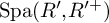


Proof. Parts (i)-(iii) are an immediate consequence of
-
(1) the analogous perfectness results of $R\Gamma _{q-\mathrm {CRYS}}(\mathfrak {X}/\mathfrak {Y})$
(cf. Proposition 6.17(i)-(iii)) and -
(2) the comparison of $R\Gamma _{A_{ {\mathrm {inf}}}}(\mathfrak {X}/\mathfrak {Y})$
with
$R\Gamma _{q-\mathrm {CRYS}}(\mathfrak {X}/\mathfrak {Y})$
(cf. Theorem 6.33).



Finally part (iv) follows from part (ii).
6.10 Comparison with relative p-adic étale cohomology
Assume that we have a proper smooth
$ {\mathrm {Spf}}(\mathcal {O})$
 -morphism
$f \colon \mathfrak {X} \to \mathfrak {Y}$
 of p-adic formal schemes locally of finite type and flat over
$\mathcal {O}$
 . In this section we compare
$R\Gamma _{q-\mathrm {CRYS}}(\mathfrak {X}/\mathfrak {Y})$
 with p-adic étale cohomology (i.e.
$Rf_{\eta , {\mathrm {pro\acute {e}t}}*}\widehat {\mathbb {Z}}_p$
 ). This will involve considering the derived p-adic completions as
$\mu \notin [\mathfrak {m}^{\flat }]$
 .
Theorem 6.36. We have an identification

where the completion on the LHS is derived p-adic.
Proof. Denote by
$R\Gamma _{A_{ {\mathrm {inf}}}}(\mathfrak {X}/\mathfrak {Y})^{\wedge }$
 the derived p-adic completion of
$R\Gamma _{A_{ {\mathrm {inf}}}}(\mathfrak {X}/\mathfrak {Y})$
 . Then Theorem 6.33 and [Reference Česnavičius and KoshikawaCK19, Lemma 3.17] induce a quasi-isomorphism

as
$\mu \in W(\mathfrak {m}^{\flat })$
 . The result now follows from Theorem 3.15.
7 Applications
7.1 Relative Hodge-Tate spectral sequence
In this section we record a relative Hodge-Tate spectral sequence in Theorem 7.2 and is independent of the q-crystalline section. This only uses the results developed in §5. In the context of a discretely valued complete nonarchimedean extension of
$\mathbb {Q}_p$
 with perfect residue field, such a sequence already exists by [Reference Caraiani and ScholzeCS17, Corollary 2.2.4] (cf. [Reference Abbes and GrosAG24, Remarque 1.4.7]). In the context of schemes, results have been obtained in [Reference Abbes and GrosAG24]. It is an interesting question to understand the compatibility of these spectral sequences. Our approach to establishing the relative Hodge-Tate spectral sequence mirrors that of loc.cit. (we both pass through a fiber product of topoi) of which the following table summarizes the similarities of the two approaches.
$ \begin {array}{ |l |l |} \hline \textbf {Our approach} & \textbf {Approach of Abbes-Gros} \\ \hline \mathrm {Use of pro-{\acute{e}}tale site} & \text {Use of Faltings' site} \\\hline\text {Hodge-Tate specialization of} A\Omega _{\mathfrak {X}/\mathfrak {Y}} & \text {Hodge-Tate comparison of the} structure \\ \text {(cf. Theorems 5.2 and 5.19)} & sheaf \text { of the relative Faltings' topos } \\& \mathrm {(cf. [AG24, Th{\acute{e}}or\acute{e}me 6.6.4])} \\\hline \text {Base change for fiber product of topoi} & \text {Base change for the relative Faltings' site} \\\text {(cf. Proposition 5.24)} & \mathrm {(cf. [AG24, Th{\acute{e}}or\acute{e}me 6.5.31])} \\\hline \end {array} $
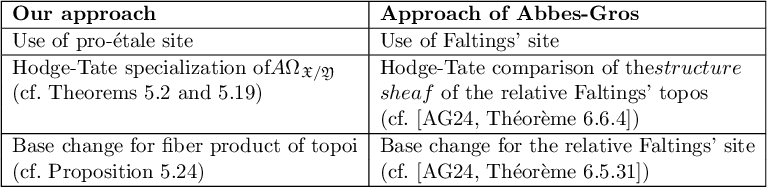
Let us mention that one difference between the two approaches is that we get rid of the ‘junk torsion’ (via the décalage functor) while Abbes-Gros do not.
We begin by comparing the sheaf of Kähler differentials on the special and generic fibers.
Lemma 7.1. Suppose
$f \colon \mathfrak {X} \to \mathfrak {Y}$
 is a proper smooth morphism of p-adic formal schemes of type (S)(b) over
$\mathcal {O}$
 . Suppose
$\mathfrak {X}$
 and
$\mathfrak {Y}$
 are flat over
$ {\mathrm {Spf}}(\mathcal {O})$
 and X and Y are locally of finite type over
$ {\mathrm {Spa}}(C, \mathcal {O})$
 . Consider the commutative diagram of ringed topoi

and
$\mathscr {F}$
 a locally free
$\mathcal {O}_{\mathfrak {X}}$
 -module. Then the canonical base change morphism

is a quasi-isomorphism.
Proof. First note that by [Sta18, Tag 0A1H],
$Rf_{ {\mathrm {Zar}}*}\mathscr {F} \otimes ^{\mathbb {L}}_{\mathcal {O}_{\mathfrak {Y}}} \mathcal {O}_{\mathfrak {Y}}/p^n$
 is a perfect object of
$D(\mathcal {O}_{\mathfrak {Y}}/p^n)$
 and its formation commutes with base change. Therefore by taking the derived limit we obtain that
$Rf_{ {\mathrm {Zar}}*}\mathscr {F}$
 itself is a perfect object of
$D(\mathcal {O}_{\mathfrak {Y}})$
 . Therefore
$L\text {sp}_{\mathfrak {Y}}^{*}Rf_{ {\mathrm {Zar}}*}\mathscr {F}$
 is a perfect object of
$D(\mathcal {O}_{Y})$
 .
The claim is local for the Zariski topology on
$\mathfrak {Y}$
 , so we can assume it is affine, say
$\mathfrak {Y} = {\mathrm {Spf}}(S)$
 . Let
$U \subseteq Y$
 be any open affinoid of Y such that
$L\text {sp}_{\mathfrak {Y}}^{*}Rf_{ {\mathrm {Zar}}*}\mathscr {F} \lvert _{U}$
 is strictly perfect. Then for any rational subset
$U' \subseteq U$
 , by Tate acyclicity

Moreover by Kiehl’s finiteness theorem [Reference KiehlKie67, Theorem 3.3]

Thus by Tate acyclicity and flatness of
$\mathcal {O}_{Y}(U')$
 over
$\mathcal {O}_{Y}(U)$
 (cf. [Reference HuberHub94, pg. 530]), (7.2) implies

Therefore (7.1) and (7.3) imply that it suffices to check that the induced morphism

is a quasi-isomorphism where in addition U comes from some affine open
$\mathfrak {U} \subseteq \mathfrak {Y}$
 .
We can assume without loss of generality that
$\mathfrak {U} = \mathfrak {Y}$
 and
$Rf_{ {\mathrm {Zar}}*}\mathscr {F}$
 is represented by a strictly perfect complex
$\mathscr {E}^{\bullet }$
 . In that case
$R\Gamma (U, L\text {sp}_{\mathfrak {Y}}^{*}Rf_{ {\mathrm {Zar}}*}\mathscr {F})$
 is represented by the complex
$\mathscr {E}^{\bullet }(\mathfrak {Y}) \otimes _S S[\tfrac {1}{p}]$
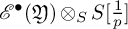 , which in turn is just
$R\Gamma (\mathfrak {Y}, Rf_{ {\mathrm {Zar}}*}\mathscr {F}) \otimes _{S}^{\mathbb {L}} S[\tfrac {1}{p}]$
 . Choose some finite open affine cover of
$\mathfrak {X}$
 . Then
$R\Gamma (\mathfrak {Y}, Rf_{ {\mathrm {Zar}}*}\mathscr {F})$
 is computed via the associated Čech complex
$C^{\bullet }$
 and
$R\Gamma (U, Rf_{\eta *}L\text {sp}_{\mathfrak {X}}^{*}\mathscr {F})$
 is computed by
$C^{\bullet } \otimes _{S} S[\tfrac {1}{p}]$
 . Since
$S[\tfrac {1}{p}]$
 is flat over S, the result now follows.
Theorem 7.2. Suppose
$f \colon \mathfrak {X} \to \mathfrak {Y}$
 is a proper smooth morphism of p-adic formal schemes of type (S)(b) over
$\mathcal {O}$
 . Assume that
$\mathfrak {X}$
 and
$\mathfrak {Y}$
 are flat over
$\mathcal {O}$
 . There is an
$E_2$
 -spectral sequence

in
$D(Y_{ {\mathrm {pro\acute {e}t}}}, \mathcal {O}^a)$
 . Moreover, if both
$\mathfrak {X}$
 and
$\mathfrak {Y}$
 are locally of finite type over
$\mathcal {O}$
 then upon inverting p, (7.4) takes the shape

in
$D(Y_{ {\mathrm {pro\acute {e}t}}}, C)$
 (here the
$f_{\eta *}$
 is pushforward between analytic topologies). In addition, if for any
$i,j \geq 0$
 ,
$R^{i}f_{\eta *}\Omega ^{j}_{X/Y}$
 is locally free of finite type over
$\mathcal {O}_{Y}$
 , then (7.5) takes the shape

and it degenerates.
Remark 7.3. Let K be a discretely valued complete nonarchimedean extension of
$\mathbb {Q}_p$
 with perfect residue field and ring of integers
$\mathcal {O}_K$
 . Then if
$f_{\eta }$
 comes from base change of a proper smooth morphism of smooth adic spaces over
$ {\mathrm {Spa}}(K, \mathcal {O}_K)$
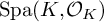 , then by [Reference ScholzeSch13, Theorem 8.8(ii)] and base change, for any
$i,j \geq 0$
 ,
$R^{i}f_{\eta *}\Omega ^{j}_{X/Y}$
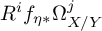 is locally free of finite type over
$\mathcal {O}_{Y}$
 .
Proof. By Theorem 5.2 and the projection formula (cf. [Sta18, Tag 0944]) we get a morphism in
$D(Y_{ {\mathrm {pro\acute {e}t}}}, \mathcal {O})$
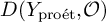

whose image in
$D(Y_{ {\mathrm {pro\acute {e}t}}}, \mathcal {O}^a)$
 is an almost isomorphism. Therefore we obtain an
$E_2$
 -spectral sequence (the Cartan-Leray spectral sequence)

in
$D(Y_{ {\mathrm {pro\acute {e}t}}}, \mathcal {O}^{a})$
 . By Theorem 5.19, we get a morphism
$R^{i}p_{*}q^{*}\Omega ^{j}_{\mathfrak {X}/\mathfrak {Y}}\{-j\} \to R^{i}p_{*}H^{j}(\widetilde {\Omega }_{\mathfrak {X} / \mathfrak {Y}})$
 in
$D(Y_{ {\mathrm {pro\acute {e}t}}}, \mathcal {O})$
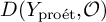 , whose image in
$D(Y_{ {\mathrm {pro\acute {e}t}}}, \mathcal {O}^a)$
 is an almost isomorphism. By Corollary 5.27, the morphism

is an almost isomorphism. This proves (7.4).
Suppose now both X and Y are locally of finite type over
$ {\mathrm {Spa}}(C, \mathcal {O})$
 . We now invert p and perform some yoga to obtain (7.5). Indeed

where (i) follows from localization being flat, (ii) is by definition of
$L\nu _{Y}^{*}$
 (we have dropped the
$\nu _Y^{-1}$
 ) and the fact that the cokernel of
$\mathcal {O}(1) \hookrightarrow \mathcal {O} \{1\}$
 is killed by
$p^{1/(p-1)}$
 , (iii) from the fact that coherent cohomology can be computed in the étale or Zariski site, and (iv) is a consequence of Lemma 7.1. The identification

follows from Theorem 3.15 (note that
$\mu $
 is invertible in
$A_{ {\mathrm {inf}}}/\tilde {\xi }[1/p]$
 ). This proves (7.5) of which (7.6) is a direct consequence.
We now prove degeneration of (7.6). By Lemma 3.12 the complex
$Rf_{\eta , {\mathrm {pro\acute {e}t}}*}\widehat {\mathbb {Z}}_p$
 is adic lisse and in particular it is locally a perfect complex of
$\widehat {\mathbb {Z}}_p$
 -modules. Thus

is a locally free
$\widehat {\mathcal {O}}_Y$
 -module. Recall that locally free
$\mathcal {O}_{Y}^+ /p$
 -sheaves of finite rank on
$Y_{ {\mathrm {pro\acute {e}t}}}$
 correspond to locally free
$\mathcal {O}_{Y}^+ /p$
 -sheaves of finite rank on the étale topology on Y by [Reference HeuerHeua, Proposition 1.3], [Reference ZavyalovZav24, Theorem 6.5.9]. So the rank (locally) of such objects is determined by the rank at geometric points of rank 1. Fix an integer
$m \geq 0$
 . By [Reference HuberHub96, Proposition 2.6.1] appliedFootnote
22
to
$R^{i+j}f_{\eta , {\mathrm {\acute {e}t}}*}(\mathbb {Z}/p^n)$
 for each n, commutation with arbitrary base change for the terms
$R^{i}f_{\eta *}\Omega ^{j}_{X/Y}$
 (by the local freeness assumption) and the degeneration of the Hodge-Tate spectral sequence (cf. [Reference Bhatt, Morrow and ScholzeBMS18, Theorem 13.3(ii)]), we get a covering
$\{U_{k} \to Y \}_{k}$
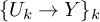 in
$Y_{ {\mathrm {pro\acute {e}t}}}$
 such that restricted to
$U_k$
 each term in the quadrant
$i+j \leq m$
 of the second page of (7.6) is free (as well as the abutment
$R^{i+j}f_{\eta , {\mathrm {pro\acute {e}t}} *}\widehat {\mathbb {Z}}_p \otimes _{\widehat {\mathbb {Z}}_p} \widehat {\mathcal {O}}_{Y}$
 ) and

for all k and any
$0 \leq l \leq m$
 . Since affinoid perfectoids form a basis for
$Y_{ {\mathrm {pro\acute {e}t}}}$
 , we can assume further that each
$U_k$
 is affinoid perfectoid and determines a perfectoid space
$ {\mathrm {Spa}}(S_{k}, S_{k}^{+})$
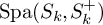 . Then by vanishing of higher cohomology (cf. [Reference ScholzeSch13, Lemma 4.10(v)]), taking the
$U_k$
 -sections of (7.6) gives a spectral sequence consisting of finite free
$S_k$
 -modules. It suffices to show that the resulting spectral sequence degenerates. Consider a differential
$d_{2}^{i,j} \colon E_{2}^{i,j}(U_k) = S_{k}^{a} \to E_{2}^{i+2, j-1}(U_k) = S_{k}^{b}$
 for any
$i+j \leq m-1$
 . Then for each minimal prime ideal
$\mathfrak {p}$
 of
$S_k$
 , the localization
$S_{k, \mathfrak {p}}$
 is a field as
$S_k$
 is reduced (cf. [Sta18, Tag 00EU]). Thus by (7.7),
$d_{2}^{i,j}$
 localized at
$\mathfrak {p}$
 is the zero morphism. Thus the induced morphism

where the products run over all minimal prime ideals of
$S_k$
 , is the zero morphism. Moreover
$S_k \to \prod _{\mathfrak {p} \text { minimal}} S_{k, \mathfrak {p}}$
 is an embedding (cf. [Sta18, Tag 00EW]). Therefore
$d_{2}^{i,j}$
 is the zero morphism. This proves degeneration.
7.2 Torsion in étale pushforward
The result in this section makes use of the q-crystalline theory from §6. Although one could avoid this by using the de Rham specialization for
$A\Omega _{\mathfrak {X}/\mathfrak {Y}}$
 (cf. Theorem 5.20), one would still need to prove a perfectness result such as Proposition 6.35.
In the following theorem and in particular its proof we will often be considering an affinoid perfectoid
$\varprojlim _{i \in I} {\mathrm {Spa}}(S_{i}, S_{i}^{+})$
 in
$Y_{ {\mathrm {pro\acute {e}t}}}$
 . What will turn out to be relevant is the algebra
$S_{\infty }$
 where
$ {\mathrm {Spa}}(S_{\infty }[\tfrac {1}{p}], S_{\infty })$
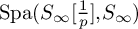 is the associated perfectoid space and not the terms in the formal limit. Therefore to ease notation (and also abuse it) we will write
$\overline {S}_{\infty }$
 for an affinoid perfectoid object in
$Y_{ {\mathrm {pro\acute {e}t}}}$
 with associated perfectoid space
$ {\mathrm {Spa}}(S_{\infty }[\tfrac {1}{p}], S_{\infty })$
 .
Theorem 7.4. Suppose
$f \colon \mathfrak {X} \to \mathfrak {Y}$
 is a proper smooth morphism of p-adic formal schemes locally of finite type and flat over
$\mathcal {O}$
 . Fix some
$j \geq 0$
 . Suppose that
$R^{i}f_{ {\mathrm {dR}}*}\mathcal {O}_{\mathfrak {X}}$
 is a finite locally free
$\mathcal {O}_{\mathfrak {Y}}$
 -module for all
$i \geq j$
 . Then for all
$i \geq j$

-
(1) $R^{i}f_{\eta , {\mathrm {pro\acute {e}t}} *}\widehat {\mathbb {Z}}_p$
is p-torsion free, -
(2) given $\overline {S}_{\infty }$
in
$Y_{ {\mathrm {pro\acute {e}t}}}$
, then
$H^{i}(R\Gamma ((\mathbb {A}_{ {\mathrm {inf}}}(S_{\infty }),(\xi )), R\Gamma _{q-\mathrm {CRYS}}(\mathfrak {X}/\mathfrak {Y})))$
is a finite locally free
$\mathbb {A}_{ {\mathrm {inf}}}(S_{\infty })$
-module and -
(3) if $\mathfrak {Y}$
is in addition smooth and
$(E,J)$
is any object in
$(\mathfrak {Y}/A_{ {\mathrm {inf}}})_{q-\mathrm {CRYS}}$
, then$H^{i}(R\Gamma ((E,J), R\Gamma _{q-\mathrm {CRYS}}(\mathfrak {X}/\mathfrak {Y})))$
is a finite locally free E-module.
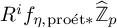







Remark 7.5. A slight variant of part (2) is also proved in [Reference Morrow and TsujiMT20, Lemma 1.38] by another method. The key point in the argument of loc. cit. is to take a judicious base change to a rank 1 perfectoid valuation ring, at which point the result of [Reference Bhatt, Morrow and ScholzeBMS18, Theorem 1.8] can be applied. We take a different approach and instead rely on the comparison with relative p-adic étale cohomology (cf. Theorem 6.36). T. Tsuji also pointed out that (1) immediately follows from the analogous result in [Reference Bhatt, Morrow and ScholzeBMS18, Theorem 14.5(ii)] (cf. Remark 14.4 in loc. cit.) together with [Reference HuberHub96, Proposition 2.6.1] and Lemma 3.12.
Proof. We first show part (2) and we use the notation from §6. We break the proof into several steps and provide the following diagram to serve the reader as a guide for what we will do:

An overview of the steps is as follows:
-
(a) In this step we will compare q-crystalline cohomology with de Rham cohomology. Since de Rham cohomology is free, we can choose a basis for it.
-
(b) We can then lift this basis using Nakayama’s lemma.
-
(c) From the previous step, we now have a generating set for $H^{i}(R\Gamma ((\mathbb {A}_{ {\mathrm {inf}}}(S_{\infty }),(\xi )), R\Gamma _{q-\mathrm {CRYS}}(\mathfrak {X}/\mathfrak {Y})))$
. -
(d) After inverting $\mu $
we can compare q-crystalline cohomology with pro-étale cohomology. The upshot is that our generating set from the previous step gives a basis for the pro-étale cohomology as it is free. -
(e) Finally as the base ring (in this case $\mathbb {A}_{ {\mathrm {inf}}}$
) is
$\mu $
-torsion free, we can conclude that the generating set must have been a basis.


Of course we will need to work locally, and so the above diagram should be interpreted as such. Moreover an important intermediate step will be to compare the ranks
$r_1$
 and
$r_2$
 appearing from the different theories. We use rational p-adic Hodge theory to do so and so we will need to invert p in step (d) when we are inverting
$\mu $
 . Fortunately this doesn’t change the outcome in step (e) as
$A_{ {\mathrm {inf}}}$
 is also p-torsion free.
Step (a): Let
$(E,J)$
 be an object in
$(\mathfrak {Y}/A_{ {\mathrm {inf}}})_{q-\mathrm {CRYS}}$
 . Then by the de Rham comparison with q-crystalline/prismatic cohomology (cf. [Reference Bhatt and ScholzeBS22, Corollary 15.4]) and (6.13)

Note that by Proposition 6.17(i), the RHS of (7.9) is already (p-adically derived) complete. Since
$R^{i}f_{ {\mathrm {dR}}*}\mathcal {O}_{\mathfrak {X}}$
 is a finite locally free
$\mathcal {O}_{\mathfrak {Y}}$
 -module for all
$i \geq j$
 and
$Rf_{ {\mathrm {dR}} *}\mathcal {O}_{\mathfrak {X}}$
 is a perfect complex and commutes with arbitrary base change,
$R^{i}f_{ {\mathrm {dR}}*}\mathcal {O}_{\mathfrak {X}}$
 commutes with arbitrary base change and so
$R^{i}f^{\prime }_{ {\mathrm {dR}}*}\mathcal {O}_{ {\mathrm {Spf}}(E/[p]_q) \times _{\mathfrak {Y}} \mathfrak {X}}$
 is a finite locally free
$\mathcal {O}_{ {\mathrm {Spf}}(E/[p]_q)}$
 -module (here
$f' \colon {\mathrm {Spf}}(E/[p]_q) \times _{\mathfrak {Y}} \mathfrak {X} \to {\mathrm {Spf}}(E/[p]_q)$
 is obtained from base change) for all
$i \geq j$
 . By affine vanishing of higher cohomology, it follows that
$H^{i}$
 of the LHS of (7.9) is a finite locally free
$E/[p]_q$
 -module for all
$i \geq j$
 . Therefore

is a finite locally free
$E/[p]_q$
 -module for all
$i \geq j$
 .
Steps (b)-(c): Denoting by
$(E,J) = (\mathbb {A}_{ {\mathrm {inf}}}(S_{\infty }), (\xi ))$
 , we now proceed by descending induction on
$i \geq j$
 to prove that

is a finite locally free E-module. Since
$R\Gamma ((E,J), R\Gamma _{q-\mathrm {CRYS}}(\mathfrak {X}/\mathfrak {Y}))$
 is a perfect complex in
$D(E)$
 (cf. Proposition 6.17(i)), it is quasi-isomorphic to a complex
$E^{\bullet }$
 of finite projective E-modules with
$E^{k} = 0$
 for
$k \geq m+1$
 for some
$m \geq i$
 . Then
$H^{m}$
 is a finite E-module and
$H^{m} \otimes _{A_{ {\mathrm {inf}}}, \theta } \mathcal {O}$
 coincides with (7.10) for
$i = m$
 . Assume without loss of generality
$H^{m} \otimes _{A_{ {\mathrm {inf}}}, \theta } \mathcal {O}$
 is a finite free
$E/[p]_q$
 -module and choose a basis
$\overline {B}$
 (this does not affect the form of
$(E,J)$
 , as it is enough to take a Zariski cover of
$\mathfrak {Y}$
 ). By Nakayama’s lemma, the basis
$\overline {B}$
 lifts to a generating set B of
$H^m$
 .
Steps (d)-(e): As already discussed, since
$\mathbb {A}_{ {\mathrm {inf}}}(S_{\infty })$
 is both p and
$\mu $
 -torsion free, it is enough to show B is a basis for
$H^m [\frac {1}{\mu }, \frac {1}{p}]$
 . We now write
$H^m [\frac {1}{\mu }, \frac {1}{p}]$
 in terms of pro-étale cohomology. By Proposition 6.17(ii), [Reference ScholzeSch13, Theorem 6.5(ii)] (in particular the sentence immediately following [Reference Bhatt, Morrow and ScholzeBMS18, Lemma 5.6]) and the equality
$\mu _{ {\mathrm {pro\acute {e}t}}}^{-1}\mathcal {O}_{q-\mathrm {CRYS}} = W(\widehat {\mathcal {O}}^{+, \flat }_{Y})$
 we get

By Theorem 6.36, (7.11) implies
$H^{m}[\tfrac {1}{\mu }, \tfrac {1}{p}]$
 is the
$E[\tfrac {1}{\mu }, \tfrac {1}{p}]$
 -module

and so it suffices to prove B is a basis of (7.12).
Since
$Rf_{\eta , {\mathrm {pro\acute {e}t}}*}\widehat {\mathbb {Z}}_p$
 is adic lisse we can trivialize it (locally on
$Y_{ {\mathrm {pro\acute {e}t}}}$
 ) and after applying base change [Reference HuberHub96, Proposition 2.6.1] as in footnote 22, (7.12) base changed to
$\mathbb {A}_{ {\mathrm {inf}}}(S_{\infty }')[\tfrac {1}{\mu }, \tfrac {1}{p}]$
 (where
$\overline {S'}_{\infty } \to \overline {S}_{\infty }$
 is a pro-étale map of affinoid perfectoids) is a free
$\mathbb {A}_{ {\mathrm {inf}}}(S_{\infty }')[\tfrac {1}{\mu }, \tfrac {1}{p}]$
 -module of rank

for any rank
$1$
 geometric point
$ {\mathrm {Spa}}(K, K^{\circ })$
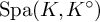 of Y which lies above
$\overline {S'}_{\infty }$
 . By the comparison of
$B^{+}_{ {\mathrm {dR}}}$
 -cohomology with étale cohomology (cf. [Reference Bhatt, Morrow and ScholzeBMS18, Theorem 13.1]) and the fact that
$B^{+}_{ {\mathrm {dR}}}$
 -cohomology specializes to de Rham cohomology (cf. the expression immediately after [Reference Bhatt, Morrow and ScholzeBMS18, Definition 13.18]), (7.13) is equalFootnote
23
to
$|\overline {B}|$
 . Now

is a sheaf on affinoid perfectoids in
$Y_{ {\mathrm {pro\acute {e}t}}}$
 . Since (7.13) equals
$|\overline {B}| = |B|$
 , the generating set B is a basis (pro-étale locally on
$\overline {S}_{\infty }$
 ) for the sections of (7.14). Therefore, it must be a basis for (7.12) as desired.
This proves the base case of the induction. For the inductive step, one repeats the argument noting that the locally finite freeness of
$H^{i}$
 for
$i> i' \geq j$
 implies
$H^{i'} \otimes _{A_{ {\mathrm {inf}}}, \theta } \mathcal {O}$
 coincides with (7.10) for
$i = i'$
 . Moreover since
$R\Gamma ((E,J), R\Gamma _{q-\mathrm {CRYS}}(\mathfrak {X}/\mathfrak {Y}))$
 is a perfect complex in
$D(E)$
 , the inductive step also shows
$H^{i'}$
 is a finite E-module. This proves (2).
Part (1) then follows from Theorem 6.36: indeed

is a finite locally free
$\mathbb {A}_{ {\mathrm {inf}}}(S_{\infty })[\tfrac {1}{\mu }]$
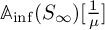 -module for all
$i \geq j$
 and so
$( R^{i}f_{\eta , {\mathrm {pro\acute {e}t}}*}\widehat {\mathbb {Z}}_p)(\overline {S}_{\infty })$
 is p-torsion free.
We now show part (3) by descent to the case of part (2). First we show the map
$S \to S_{\infty }$
 (cf. Remark 6.25) is quasisyntomic (for small enough Zariski neighbourhood
$ {\mathrm {Spf}}(S)$
 of
$\mathfrak {Y}$
 and a choice of
$S_{\infty }$
 ). Since
$\mathfrak {Y}$
 is assumed to be smooth, we can take S to be a small p-completely smooth
$\mathcal {O}$
 -algebra (recall this means that there is an étale map
$ {\mathrm {Spf}}(S) \to {\mathrm {Spf}}(\mathcal {O} \{t_1^{\pm 1}, \ldots , t_n^{\pm 1} \})$
 ). Above
$ {\mathrm {Spa}}(C\{t_1^{\pm 1}, \ldots , t_n^{\pm 1} \}, \mathcal {O} \{t_1^{\pm 1}, \ldots , t_n^{\pm 1} \})$
 , we have the affinoid perfectoid covering

The induced map
$\mathcal {O} \{t_1^{\pm 1}, \ldots , t_n^{\pm 1} \} \to \mathcal {O} \{t_1^{\pm 1/p^{\infty }}, \ldots , t_n^{\pm 1/p^{\infty }} \}$
 is quasisyntomic. The map
$S \to S_{\infty }$
 , induced by (p-completed) base change, is again quasisyntomic by [Reference Bhatt, Morrow and ScholzeBMS19, Lemma 4.16(2)]. Now suppose
$ {\mathrm {Spf}}(E/J) \to \mathfrak {Y}$
 factors through
$ {\mathrm {Spf}}(S)$
 . Then again by loc. cit. the induced map
$E/\tilde {\xi } \to S_{\infty } \widehat {\otimes }_{S^{(1)}} E/\tilde {\xi }$
 is quasisyntomic (the completion is p-adic and
$S^{(1)} := S \otimes _{A_{ {\mathrm {inf}}}/\xi , \varphi } A_{ {\mathrm {inf}}}/\tilde {\xi }$
 ). By [Reference Bhatt and ScholzeBS22, Proposition 7.11], there exists an object

and moreover the map
$S_{\infty } \widehat {\otimes }_{S^{(1)}} E/\tilde {\xi } \to E'/\varphi (\xi )$
 is p-completely faithfully flat. Therefore the composition
$E/\tilde {\xi } \to E'/\tilde {\xi }$
 is also p-completely faithfully flat. By universality (cf. Lemma 4.7 in loc. cit.), the induced map
$S_{\infty } \to E'/\tilde {\xi }$
 lifts uniquely to a map
$(\mathbb {A}_{ {\mathrm {inf}}}(S_{\infty }), \tilde {\xi }) \to (E', \tilde {\xi })$
 of prisms. Therefore by part (2)

is a finite locally free
$E'$
 -module. The expression (7.15) coincides with

where the completion is
$(p, \tilde {\xi })$
 -adic (to see this, identify q-crystalline cohomology with prismatic cohomology (6.13)-(6.14) and apply [Reference Bhatt and ScholzeBS22, Theorem 1.8(5)]). By a similar argument as the proof of [Reference Anschütz and Le BrasALB23, Proposition A.3] (in particular using Lemma A.1 of loc. cit.), one concludes that

is a finite locally free E-module. In general (in the case when the morphism
$ {\mathrm {Spf}}(E/J) \to \mathfrak {Y}$
 does not necessarily factor through
$ {\mathrm {Spf}}(S)$
 ), there is a covering
$(E', J') \to (E,J)$
 (i.e.
$ {\mathrm {Spf}}(E'/J') \to {\mathrm {Spf}}(E/J)$
 is a p-completely étale covering), such that
$H^{i}(R\Gamma ((E',J'), R\Gamma _{q-\mathrm {CRYS}}(\mathfrak {X}/\mathfrak {Y})))$
 is a finite locally free
$E'$
 -module. One then repeats the argument as the proof of [Reference Anschütz and Le BrasALB23, Proposition A.3], as before.
Remark 7.6. In the setting of Theorem 7.4, there is also a Frobenius structure on

and by the isogeny theorem (cf. [Reference Bhatt and ScholzeBS22, Theorem 1.8(6)]), the linearization morphism (induced by Frobenius) is an isomorphism after inverting
$\tilde {\xi }$
 . Together with part (2) of Theorem 7.4, the expression (7.16) gives rise to a relative Breuil-Kisin-Fargues module. This is made precise in [Reference Morrow and TsujiMT20], where various categories (e.g.
$\mu $
 -small generalized representations over
$\mathbb {A}_{ {\mathrm {inf}}}(S_{\infty })$
 for a particular
$S_{\infty }$
 and relative Breuil-Kisin-Fargues modules with Frobenius structure) are shown to be equivalent. In the language of loc. cit. (7.16) can be upgraded to a generalized representation over
$\mathbb {A}_{ {\mathrm {inf}}}(S_{\infty })$
 (with the
$\mathbb {Z}_p(1)^{d}$
 -actionFootnote
24
satisfying a certain triviality condition modulo
$\mu $
 ) with Frobenius structure.
7.3 The relative absolute crystalline comparison
Let
$f \colon \mathfrak {X} \to \mathfrak {Y}$
 be a smooth
$ {\mathrm {Spf}}(\mathcal {O})$
 -morphism of p-adic formal schemes of type (S)(b). Assume that
$\mathfrak {X}$
 and
$\mathfrak {Y}$
 are flat over
$\mathcal {O}$
 . In this section we prove a relative version of the absolute crystalline comparison isomorphism (cf. [Reference Bhatt, Morrow and ScholzeBMS18, Theorem 12.1]).
As usual let
$X := \mathfrak {X} \times _{ {\mathrm {Spf}}(\mathcal {O})} {\mathrm {Spec}} (\mathcal {O}/p)$
 and
$Y := \mathfrak {Y} \times _{ {\mathrm {Spf}}(\mathcal {O})} {\mathrm {Spec}}(\mathcal {O}/p)$
 be the fibers modulo p of
$\mathfrak {X}$
 and
$\mathfrak {Y}$
 , respectively. In addition let
$\mathrm {CRYS}(X/A_{\mathrm {CRYS}})$
 and
$\mathrm {CRYS}(Y/A_{\mathrm {CRYS}})$
 be the absolute (big) crystalline sites of X and Y, respectively. We denote the corresponding topoi by
$(X/A_{\mathrm {CRYS}})_{\mathrm {CRYS}}$
 (resp.
$(Y/A_{\mathrm {CRYS}})_{\mathrm {CRYS}}$
 ). Let
$\mathcal {O}^{\mathrm {CRYS}}_{X/\mathbb {Z}_p}$
 be the structure sheaf on
$(X/A_{\mathrm {CRYS}})_{\mathrm {CRYS}}$
 . The morphism f induces a functor of topoi

Let
$Y^{\prime }_{ {\mathrm {pro\acute {e}t}}} \subset Y_{ {\mathrm {pro\acute {e}t}}}$
 be the subsite consisting of affinoid perfectoid objects. By killing
$\mu = q - 1$
 in the target of
$u_{ {\mathrm {pro\acute {e}t}}}$
 in §6.8, we obtain a cocontinuous functor of sites

which induces a morphism of topoi

We can now state the absolute crystalline comparison in the current context:
Theorem 7.7. Assume that we have a smooth
$ {\mathrm {Spf}}(\mathcal {O})$
 -morphism
$f \colon \mathfrak {X} \to \mathfrak {Y}$
 of p-adic formal schemes of type (S)(b). Suppose in addition that
$\mathfrak {X}$
 and
$\mathfrak {Y}$
 are flat over
$\mathcal {O}$
 . There is a canonical functorial morphism (the completion on the target is derived p-adic)

in
$D(D, W(\widehat {\mathcal {O}}^{+, \flat }_Y))$
 compatible with the Frobenius such that the cohomology sheaves of the cone of (7.17) are killed by
$[\mathfrak {m}^{\flat }] \subset A_{ {\mathrm {inf}}}$
 .
Proof. Let
$r \colon (\mathfrak {Y}/A_{ {\mathrm {inf}}})_{q-\mathrm {CRYS}} \to (Y/A_{\mathrm {CRYS}})_{\mathrm {CRYS}}$
 be the natural morphism of topoi such that
$\mu _{ {\mathrm {pro\acute {e}t}}}^{\mathrm {CRYS}} = r \circ \mu _{ {\mathrm {pro\acute {e}t}}}$
 . Then by [Reference Bhatt and ScholzeBS22, Theorem 16.14]
$r^{-1}Rf_{*}^{\mathrm {CRYS}}\mathcal {O}^{\mathrm {CRYS}}_{X/\mathbb {Z}_p} \cong R\Gamma _{q-\mathrm {CRYS}}(\mathfrak {X}/\mathfrak {Y}) \widehat {\otimes }_{A_{ {\mathrm {inf}}}} A_{\mathrm {CRYS}}$
 . The result now follows from Theorem 6.33.
Acknowledgements
The second author found the approach to relative
$A_{ {\mathrm {inf}}}$
 -cohomology via the fiber product of topoi after conversations with Hiroki Kato during the ‘p-adic cohomology and arithmetic geometry 2018’ conference at Tohoku University, before we learned the work of Abbes-Gros. We thank him for the inspiration. We thank Ahmed Abbes, Bhargav Bhatt, Lars Hesselholt, Naoki Imai, Jean-Stefan Koskivirta, and Takeshi Tsuji for helpful discussions and communications. The first author would like to thank the University of Tokyo for its support during this project. This work was supported by JSPS KAKENHI Grant Number 20K14284.
Competing interests
None.
Data Availability
No data were generated or analysed in this study.