Introduction
The Egyptian Echinostoma caproni strain was used in this study. In nature this echinostome was first described parasitizing the bird Falcon newtoni, and although experimentally this intestinal fluke can attach to the mucosa of a wide range of rodents as definitive host (Richard & Brygoo, Reference Richard and Brygoo1978), its compatibility differs considerably. Toledo et al. (Reference Toledo, Espert, Carpena, Muñoz-Antoli, Fried and Esteban2004a) demonstrated that the course of infection of E. caproni in hamsters and rats was host species-dependent. Differences in host–parasite relationships were detected in the rate of infection, worm recovery, egg output and the morphology of the adult worms collected in each host species. Moreover, Toledo et al. (Reference Toledo, Espert, Muñoz-Antoli, Marcilla, Fried and Esteban2005) revealed that the course of E. caproni infection is similar in hamsters and mice, considering both species as hosts of high compatibility, whereas rats were considered to be hosts of low compatibility.
Toledo et al. (Reference Toledo, Muñoz-Antoli and Fried2007) revised the larval echinostome–host interactions and indicated that several topics still remain to be explored and could provide new approaches for transmission control. For example, information on the development and infectivity of the E. caproni eggs produced is scarce (Esteban & Muñoz-Antoli, Reference Esteban, Muñoz-Antoli, Fried and Toledo2009). In this sense, biological aspects such as the hatchability of the eggs produced in different definitive hosts and the infectivity of the miracidia produced, could contribute to explain differences in host–parasite relationships.
The aim of the present study was to shed light on the influence of the definitive host and the age of E. caproni adults on egg hatchability and miracidial infectivity. To this purpose, we subjected juvenile Biomphalaria glabrata snails to E. caproni miracidia originating from eggs collected from worms of different ages, raised in three definitive hosts (rats, hamsters or mice) to determine the influence of the origin of E. caproni eggs on the transmission of the parasite.
Materials and methods
Parasitological procedures
A total of nine BALB mice, nine Wistar rats and nine golden hamsters were used. Each mouse was infected with 75 metacercariae, while rats and hamsters were infected individually with 100 metacercariae of E. caproni by stomach tube. Nine animals, three of each species, were necropsied at 2, 4 or 6 weeks postinfection. Adult worms recovered from each definitive host species were pooled, and ten worms of similar size were chosen and their uteri were teased to discharge the eggs, so that these eggs were obtained from 2-, 4- or 6-week-old adult worms.
An average of 1000 eggs of the same age, were placed in vials containing 10 ml of spring water and incubated at 25°C in the dark. After 10 days of incubation, eggs were transferred to a Petri dish and were exposed to artificial light (60 W) for 2 h. The total hatched miracidia were counted and groups of five newly hatched miracidia were used to individually expose laboratory-reared specimens of B. glabrata (size range: 3–5 mm) in Petri dishes for 24 h in 3 ml of spring water at 20°C. This procedure was repeated three times, using an average of 90 snails, each postinfection week considered. After exposure, snails were maintained at 20°C and were fed with lettuce ad libitum. After 30 days postinfection, each snail was tested for shedding of cercariae.
Data analysis
The parameters studied were: egg hatchability (measured in terms of hatched miracidia) and miracidial infectivity (measured in terms of B. glabrata shedding cercariae). The amount of hatched miracidia and the percentages of snail infection, from eggs collected from worms of different ages, raised in three definitive hosts, were compared with the chi-square test; P< 0.05 was considered significant. Binary logistic regression analysis, with the age of adult worms and the host species as independent variables, was used for the infectivity study.
Results
All the mice, rats and hamsters experimentally exposed to metacercariae of E. caproni became infected. The mean numbers of worms recovered were 48.6 ± 0.5 in mice, 17.6 ± 1.5 in rats and 48.3 ± 1.1 in hamsters. All infected snails survived up to 30 days (mean length of prepatent period), and after, the mean duration of the snails' shedding period was 44 days.
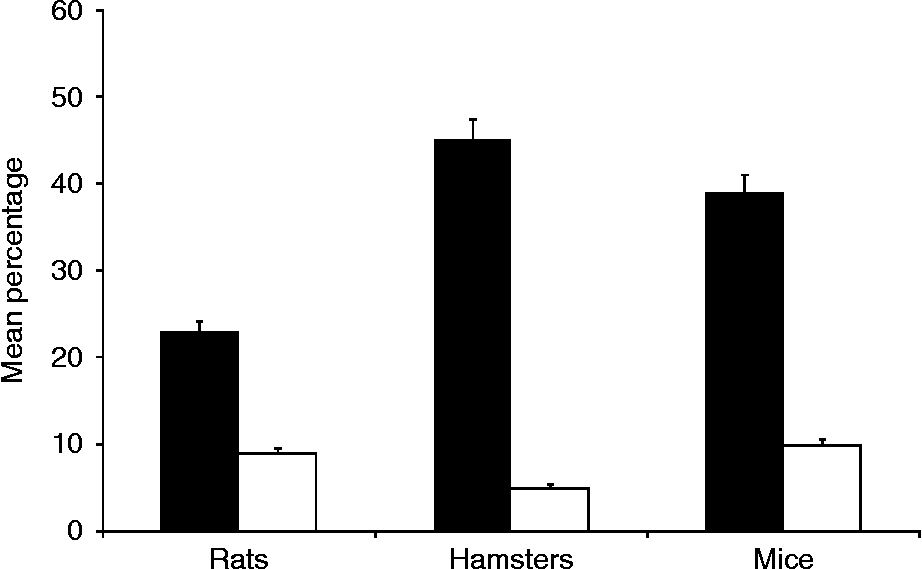
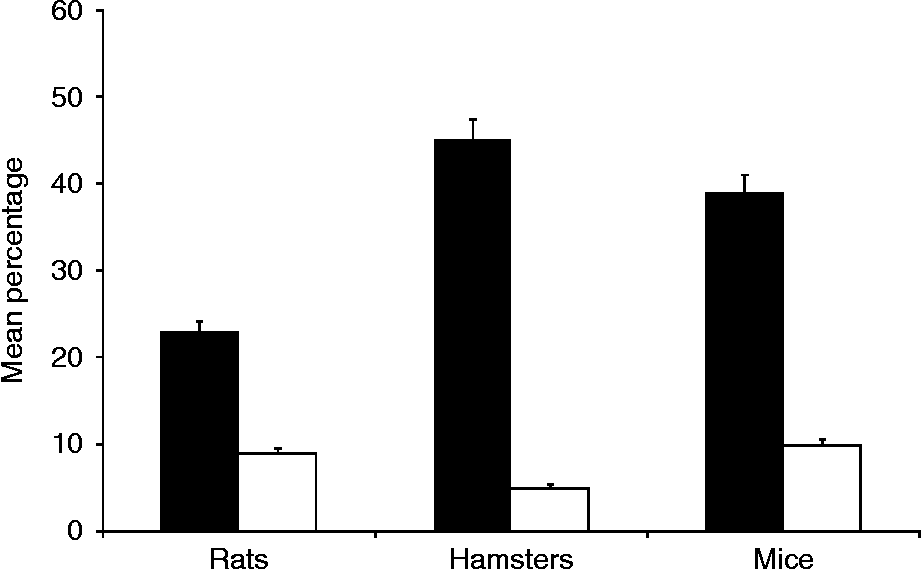
Values of egg hatchability and miracidial infectivity of E. caproni from rats, hamsters and mice are shown in fig. 1. No direct relationship between egg hatchability and miracidial infectivity and the host species of E. caproni was found. The level of hatchability observed in E. caproni eggs derived from rats was significantly lower than that observed in hamsters (χ2= 14.85, P< 0.05) and mice (χ2= 5.98, P< 0.05). In contrast, the level of miracidial infectivity from hamsters was significantly different from that of mice (χ2= 6.62, P< 0.05).
Mean percentage (%) of egg hatchability (black bars) and miracidial infectivity (white bars) of Echinostoma caproni obtained from rats, hamsters and mice. Vertical lines represent the 5% deviation.
Values of egg hatchability and miracidial infectivity after varying lengths of infection are shown in figs 2 and 3, respectively. Binary logistic regression analysis, with the age of adult worms and the host-species as independent variables, demonstrated that miracidial infectivity depends on both categories, but other variables must also have influenced in the infection.
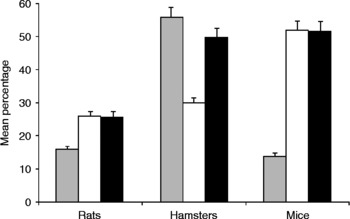
Mean percentage (%) of egg hatchability of Echinostoma caproni from rats, hamsters and mice after 2 (grey bars), 4 (white bars) and 6 (black bars) weeks of infection. Vertical lines represent the 5% deviation.

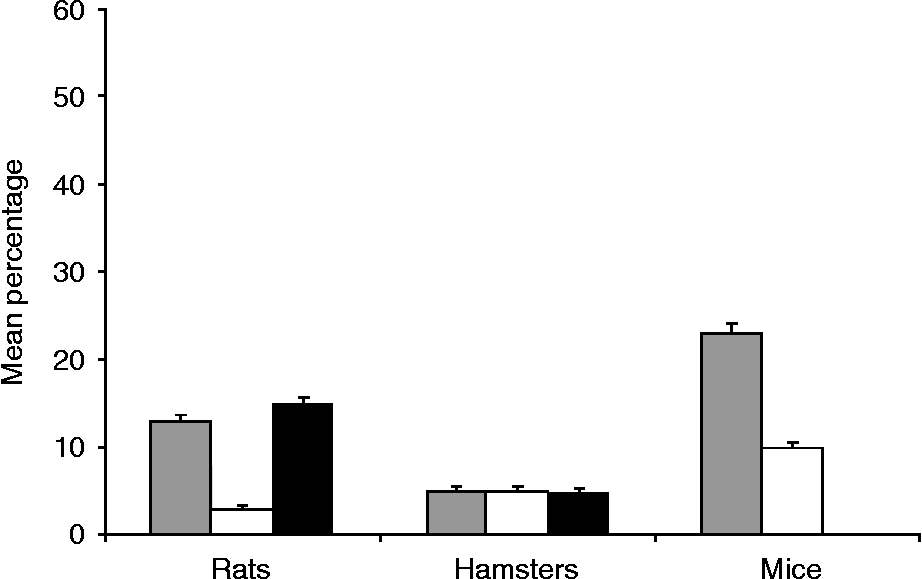
Mean percentage (%) of miracidial infectivity of Echinostoma caproni from rats, hamsters and mice after 2 (grey bars), 4 (white bars) and 6 (black bars) weeks of infection. Vertical lines represent the 5% deviation.
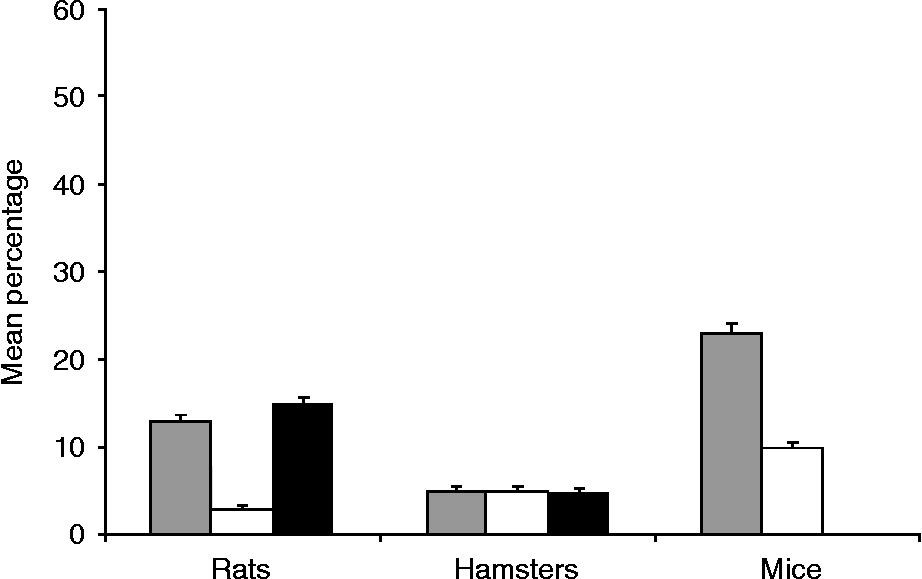
Egg hatchability showed a high level of variability, though this parameter does not seem to be affected by the age of E. caproni adult worms since no time-related pattern was observed. However, significant differences were detected between individual values. Eggs derived from 2-week-old E. caproni adults reared in hamsters (56%), showed a hatchability significantly higher than those obtained when using mice (14%) (χ2= 38.76, P< 0.05) or rats (16%) (χ2= 34.72, P< 0.05). Similarly, eggs derived from 4-week-old E. caproni adults reared in mice (52%) showed a significantly higher hatchability than those obtained from worms in hamsters (30%) (χ2= 10.00, P< 0.05) or rats (26%) (χ2= 14.20, P< 0.05). Eggs derived from 6-week-old E. caproni adults reared in mice (52%), developed higher hatchability than those obtained using rats (26%) as definitive host (χ2= 14.20, P< 0.05).
The miracidial infectivity was strongly influenced by both the age of adult worms and the host species. Infectivity of miracidia derived from mice was markedly affected by the age of the E. caproni adult worms. Miracidial infectivity was similar in eggs collected from 2- and 4-week-old adults, though the infectivity values decreased to 0 from eggs derived from 6-week-old adult worms (χ2= 8.51, P< 0.05). Although variability was observed in relation to the age of the adult worms collected from rats and hamsters, no significant differences were determined using the binary logistic regression analysis.
Considering simultaneously the host species and the time postinfection, several significant differences were observed. The miracidial infectivity detected in eggs derived from 2-week-old E. caproni adults reared in hamsters (5%) was significantly lower than that obtained using mice (23%) as definitive host (χ2= 12.58, P< 0.05). Despite the low amount of hatched miracidia collected from rats, the rate of infection using eggs from 6-week-old E. caproni adults (15%) was significantly higher than those using the other definitive hosts (χ2= 7.00 and 13.57, respectively; P< 0.05).
Discussion
Our results indicate that the hatchability of the eggs and the miracidial infectivity of E. caproni are markedly influenced by the host species and the age of the adults producing eggs.
An interesting relationship between the host compatibility with the parasite and the hatchability of the E. caproni eggs produced has been found. The eggs produced in hosts of high compatibility, such as hamsters and mice, reached a high level of hatchability compared to those produced in a host of low compatibility (rats). A similar situation was described for the related species E. friedi and the differential immune response in each host category was suggested as the cause of this feature (Muñoz-Antoli et al., Reference Muñoz-Antoli, Carpena, Espert, Esteban and Toledo2004). The immune response against the echinostomes may affect several particular functions, such as their fecundity or even egg viability (Toledo et al., Reference Toledo, Espert, Carpena, Muñoz-Antoli and Esteban2003).
Previous studies have shown that the hatchability of the eggs produced may be affected by the age of the adult digeneans from which they were derived (De Bont et al., Reference De Bont, Vercruysse and Massuku1996). However, our results indicate that egg hatchability does not seem to be affected by the age of the E. caproni adults from which eggs derived, at least within the studied age range. In the rat, eggs from worms of the three different ages studied never reached 50% hatchability, whereas eggs from E. caproni adults in hamsters and mice reached more than 50% hatchability and this was stable during the course of the experiment. A repeated study over a larger period of time might determine the effect of adult age on the hatchability of the eggs produced.
Echinostoma caproni miracidial infectivity did not seem to be affected by the host species, a similar rate of miracidial infectivity being reached when the hosts of E. caproni were rats, hamsters and mice. Mice were the definitive host with the highest miracidial infectivity. However, while infectivity of miracidia derived from E. caproni in hamsters was constant within the course of infection, the percentage of miracidial infectivity sharply decreased with time of infection of mice with E. caproni.
Toledo et al. (Reference Toledo, Espert, Carpena, Trelis, Muñoz-Antoli and Esteban2004b) measured E. friedi miracidial infectivity, in terms of percentage of infection in Lymnaea peregra snails, showing that it was significantly influenced by the age of adult worms from which the miracidia derived. Our results reveal that the age of the E. caproni adult worms affects the number of B. glabrata infected, at least when adult worms are grown in mice, because no infection was reached with eggs obtained from 6-week-old adult worms grown in mice. This is in contrast with the results of Fried & Bandstra (Reference Fried and Bandstra2005), who reported that the age of adult worms of E. caproni did not affect the development of miracidia, determined as the percentage of eggs that became fully developed when derived from 2- to 8-week-old adults grown in mice. This suggests that adult age specifically affects the ability of the miracidia to infect snails but not their development within the eggs.
The kinetics of miracidial infectivity was different in mice and hamsters. Derived from mice, the highest values were reached rapidly, then rapidly declined and became zero at 6 weeks postinfection. Whereas infectivity of miracidia derived from infection of hamsters, although with lower values, was stable over the course of the experiment.
Our results confirm the high-quality host–parasite relationship between hamsters and E. caproni, not only at the definitive host level but also at the larval stage. The long duration of the adult infection in hamsters, due to the high level of compatibility (Toledo et al., Reference Toledo, Espert, Muñoz-Antoli, Marcilla, Fried and Esteban2005), and the long period of miracidial infectivity during the time of infection, suggest hamsters as the most suitable definitive host for experimental development of the life cycle and maintaining parasite transmission.
Acknowledgements
This work was supported by the projects CGL2005-0231/BOS from the Ministerio de Ciencia e Innovación and FEDER (Fondo Europeo de Desarrollo Regional; European Union), SAF2010-16236 from Ministerio de Ciencia y Educación, PROMETEO/2009/081 from Conselleria d'Educació, Generalitat Valenciana (Valencia, Spain), PS09/02355 from the Fondo de Investigación Sanitaria (FIS) del Ministerio de Ciencia e Innovación (Madrid, Spain) and FEDER, and UV-AE-10- 23739 from the Universitat de València (Valencia, Spain). This research complies with the current laws for animal health research in Spain.