Introduction
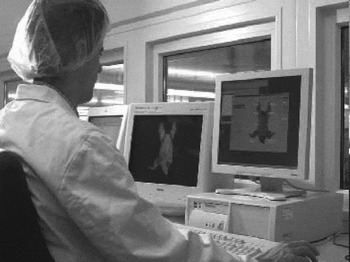
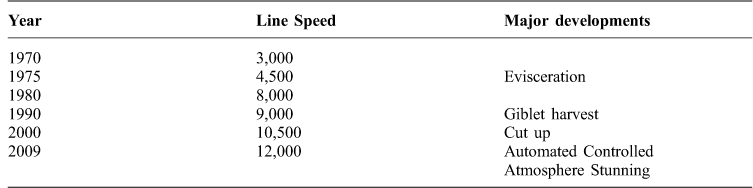
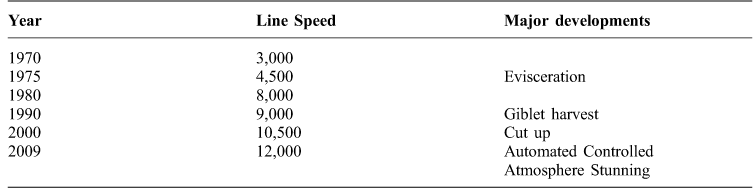
The increase in line speed has been possible due to advancements and research in poultry and other related areas, including developments in computer science, which have been translated to high speed data acquisition, and a substantial drop in price (e.g. a small new hand held telephone that costs a couple hundred dollars can do what a room full of computer components could do 40 years ago). This has helped manufacturing industries to implement the use of computers in every aspect of production. The use of machine vision to inspect and grade poultry (Figure 1) is a good example of affordable technology that made it possible to manage high speed lines (12,000 bph; Table 1). The equipment shown in Figure 1 can be programmed to automatically assign a grade to each carcass, flag / reject certain abnormalities, and be used for forward planning (e.g. make a decision about the end use: keep as a whole bird, or cut up).
Image analysis used in high speed line. System can be used for quality assessment, grading and assist in veterinary inspection. Courtesy of Stork Poultry Processing BV.

Historic data on poultry primary processing line speed and indication of some major equipment developments.
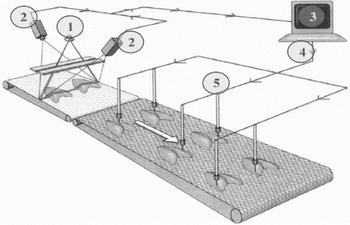
To get the full benefit of such a technology it is recommended to use an in-line process where birds are assigned an identification number at the beginning of the processes (see below). Robotics is another example of technology initially developed for the auto industry but which has been used in many applications in other repeated motion activities. Currently there are various robotic configurations used by the poultry industry. An example includes the Robo Batcher® that uses a lifting arm to pick up meat cuts moving on a conveyor belt and arrange them in trays. The robot sorts out the weights of a number of cuts, optimises the best combination of cuts to achieve a certain package weight, picks up the right cuts, and neatly positions them in a tray. Another example is the water jet cutting robot (Figure 2) that uses a three dimensional image analysis system to determine the volume of the cut and then optimise cutting weights and/or patterns.
High speed water jet cutting knife system using a 3D imaging to determine optimal portioning of meat cuts such as chicken breast fillets. (1) product loading, (2) product scanning with cameras to locate fat and determine shape, thickness and weight, (3) software optimises a trim strategy for each piece, (4) computer control the position of high-pressure water jet, (5) waterjet cutters move both parallel and perpendicular to the direction of product flow. Courtesy of JBTC Foodtech Inc.

In the area of muscle biology, scientists have gained better understanding of the process of muscle contraction and the relationships between protein structure and functionality. In terms of meat harvesting, such information helps to gain insight into rigor processes and proteolytic activities within the muscle prior to and after deboning. This knowledge has been crucial in the design of better and faster maturation processes, as will be discussed below.
Examples in the engineering area include developing and applying heat and mass transfer models to improve scalding, and chilling operations. Large chilling operations (water/air) require a lot of energy and good understanding is important for cost savings and protecting the environment. Another area is advances in metallurgy, where new plastics and metal alloys have been developed. The Revo-portioner® is an example of using the so called porous metal (made of small steel balls fused together) to produce a forming mould (e.g. for nuggets and burgers) that can operate at low pressure and therefore exert less pressure on the meat itself. This is an important point since lean fresh meat contains approximately 75% water.
Animal welfare is another area where buyers (e.g. supermarkets/fast food chains, individual consumers) demand high standards. An example from this area is provided below in the discussion section about poultry stunning.
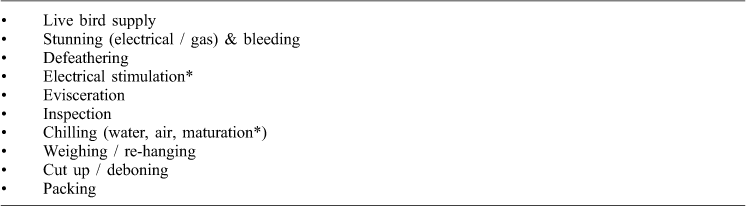
Overall, the major steps in broiler processing include: delivering the birds to the plant, stunning, bleeding, dressing, evisceration, chilling, and possible deboning (Table 2); all can have a great effect on meat quality and yield. As can be seen in Table 1, improvements and new innovations in certain areas contributed to the improvement in line speed.
The major steps in primary poultry processing (after Barbut, Reference BARBUT2002).
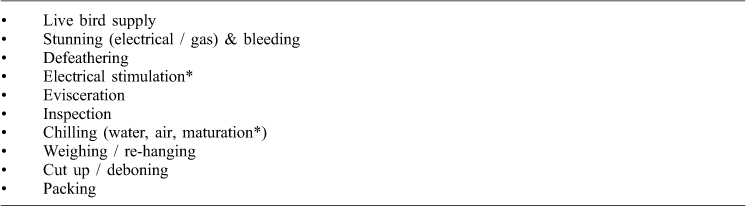
* Optional (new development required for accelerated deboning time)
Electrical stunning
There are currently two main systems which include electrical and gas stunning (NB: some processors do not use stunning e.g. in religious slaughtering). Within each system, one can find variations in the conditions applied (high versus low electrical voltage, different gas mixtures; respectively). Meat quality can be greatly affected by these processes, and the rate of pH decline as well as actual final (ultimate) pH depend on factors such as stress level prior to and during stunning (Gregory and Wilkins, Reference GREGORY and WILKINS1990; Barbut et al., Reference BARBUT, SOSNICKI, LONERGAN, KNAPP, CIOBANU, GATCLIFFE, HUFF-LONERGAN and WILSON2008). Currently, electrical stunning is the most widely used method around the world. Application is within a water bath, where the birds are moved on a shackle line and their heads come into contact with a brine solution. As indicated above, there are quite a few differences in the conditions used. For example, in North America the settings usually involve low voltage and high frequency (25-80 volts, and 400 to 1500 Hz). In Europe, higher voltages and lower frequencies (80 to 150 volts and 50 to 300 Hz), with longer dwell time, are typically used. These differences are related to regulations and meat quality issues (Prinz et al., Reference PRINZ, VANOIJEN, BESSEI, EHINGER and CIENEN2010; Raj et al., Reference RAJ, O'CALLAGHAN and KNOWLES2006; Hillebras et al., Reference HILLEBRAS, LAMBOOY and VEERKAMP1995). When high frequency stunning is used there is a greater effect on the central nervous system and lesser on the peripheral nervous system than at 50 Hz. This can reduce incidences of damage to fragile bones and reduce blood splashes in breast and thigh meat, which can later be translated to fewer trimmings. New proposed regulations in the European Union (Council Regulation on the Protection of Animals at the Time of Killing; EU, Reference EU2009) are now talking about achieving a certain mA per bird (Table 3) instead of only using voltage and frequency parameters. In addition, there is a discussion / proposal about using head to cloaca stunning with a minimum 111 mA value.
Suggestions for water bath electrical stunning requirements (mA) form the European Union regulation for 2013 (EU, Reference EU2009).

Controlled Atmosphere Stunning (CAS)
CAS was commercially introduced about a decade ago and is currently found in European plants where it is becoming increasingly popular, with most new large processing plants in Europe implementing this technology, even though it requires some design changes or modification to an existing plant to accommodate the equipment. In this stunning procedure, there are variations in the way it is applied. Some companies are using a single phase CAS (anoxia by applying argon/nitrogen with >2% oxygen; or hypercapnic anoxia by applying N2 with 30% CO2, and > 2% residual O2), while others use a two phase approach (first stage hypercapnic hyper-oxygenated anaesthetic phase with 40% CO2, 30% O2 and 30% N2, followed by a euthanasia phase with 80% CO2 in air). As discussed by Coenen et al. (Reference COENEN, LANKHAAR, LOWE and and MCKEEGAN D.E.F.2009), the two phase approach, and more specifically the presence of high O2 concentration in the first stage, is associated with an absence of potentially distressing behavioural responses (measured by electroencephalogram and analyzing the correlation dimension factor). This also translates to significant reduction in convulsions (measured as sever wing flapping under anoxia conditions; Abeyesinghe et al., Reference ABEYESINGHE, BEMMEL, KRANEN, WATHES, LANKHAAR, WHITE, MCLEMAN, MCKEEGAN, DEMMERS and LOWE2007) and consequently damage to meat quality. Overall, there are currently more of the two stage CAS installations on the market compared to the single phase approach. The new proposed EU regulations suggest the CO2 only stunning shall not be used to slaughter poultry in the future and propose a transition period.
Some of the advantages of CAS in terms of animal welfare are:
• No live bird shackling
• No interference of people (unloading)
• The claim that overall it is a more humane stunning method (e.g. smooth induction of unconsciousness; Coenen et al., Reference COENEN, LANKHAAR, LOWE and and MCKEEGAN D.E.F.2009).
The animal welfare issue is becoming more important and prominent today. Another example where it has had major implications is the egg industry where today 50% of the eggs sold in the UK are from non-battery caged hens, and all McDonald's fast food eggs are from non-battery caged hens. In the UK, consumers appear willing to pay more (0.66 Euro for a dozen battery cage eggs, 0.82 for barn eggs, and 0.98 for free-range eggs). In addition, there are discussions in the EU regarding banning all current style battery cages by 2012 (EU, Reference EU2007).
An example of the two stage system is shown in Figure 3. Such an integrated CAS system improves the entire operation by introducing automation (cages are emptied by tilting, so eliminate labour and handling), improving meat quality and yield. Overall, this is an important step in increasing on-line processing and efficiency as will be discussed below. The system also improves working conditions as there is no live bird handling (e.g. no resistance or wing flapping of live bird), better ergonomics (shorten lifting height of stunned birds), less dust in the hanging area, and the ability to use normal light conditions. The use of a two stage CAS system assists in reducing haemorrhages, bruises, and broken bones (wish bone, wings) caused by electrical stunning and live bird hanging and therefore results in less trimming during deboning.
Schematic of automated controlled atmosphere stunning (CAS) system showing automated cage advancement, tilting and the CAS module. Courtesy of Stork Poultry Processing BV.

Overall, future developments in poultry stunning should result in no contradiction between animal welfare standards and meat quality. The new guidelines and regulations should be used as an opportunity by the industry and not as a threat.
Electrical Stimulation (ES)
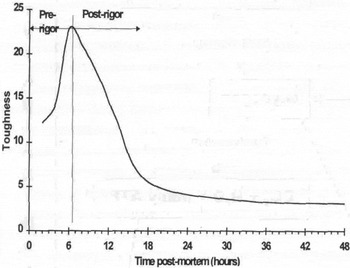
ES is currently used in numerous modern poultry processing lines. It is used to stimulate the muscle to contract by applying electrical pulses. This results in fast depletion of glycogen in the muscle, and can shorten the rigor mortis process. This is important to enable deboning the meat within a few hours of slaughter. Proper understanding of the process is essential in achieving high quality, and a tender product at the end of the line; under or over stimulation or incorrect timing will result in a significantly inferior product. The ES process has been used for over three decades by the red meat industry, and more specifically, by the beef meat industry where problems with tough meat and/or long rigor mortis times (12 to 24 hours) are encountered. Over the past 5-10 years the poultry industry has started to adapt ES, and today various new and existing plants are using it. The advantage for the poultry industry is the ability to debone the meat within 4 to 5 hours after slaughter and being able to obtain uniformity and acceptable meat tenderness. This is a very important point when buyers, (e.g. supermarket chains and fast food outlets) require a certain tenderness value (commonly measured as shear force) for a product such as chicken breast fillet. Overall, it should be emphasized that ES is only one part of the whole process which has to be synchronised with the rest. When integrated with CAS and maturation chilling (see below) it opens the possibility for an efficient in-line production of a tender, uniform product. A typical curve showing the development of rigor mortis (Figure 4) follows the increase in toughness.
Following rigor development in broilers after bleeding (based on Schreurs, Reference SCHREURS1999).

The curve represents the progression of energy depletion in the muscle up to the point where there is no more energy to breakdown the connections between actin and myosin; which results in very stiff muscles. Later, the activity of different proteolytic enzymes results in the so called ‘resolution of rigor mortis’ which is seen in Figure 4 as the decline in toughness over time (Barbut, Reference BARBUT2002). It should be mentioned that the rate of this process is temperature dependent and the Figure shown here describes regular chilling of a poultry muscle. Using ES can push the whole curve to the left and allow earlier deboning time. For example, Castaneda et al. (2005) reported that using ES (450mA, 450V, 2 seconds on, 2 seconds off for seven pulses) resulted in accelerated pH decline, faster adenosine triphosphate depletion, and prevented toughening of broiler breast meat when compared to no ES used. It should be indicated that if deboning is done prior to the completion of rigor mortis the resulting meat will also be tough.
Chilling
The two main approaches include water and air chilling, and some combinations of the two can be also found. Choosing one over the other depends on the plant location, availability and cost of water and electricity, yield desired, previous scalding temperature used, market requirements and so on. Understanding the biochemical changes taking place within the muscle, as well as the heat and mass transfer parameters, are very important in obtaining a consistent product (e.g. eliminating small variations in tenderness and deboning yield) as rigor mortis processes are still taking place during the chilling phase. Very fast chilling will result in cold-shortening, while too slow chilling rate will result in high microbial counts (Allen et al., Reference ALLEN, CORRY, BURTON, WHYTE and MEAD2000; Barbut, Reference BARBUT2002). The development of the maturation–air-chilling will be used here as an example to show how one can optimise meat quality when early deboning is required.
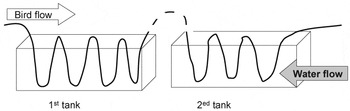
Water chilling can be applied in a few different ways. The first is just putting the birds in a water bath usually supplemented with ice and waiting for the temperature to drop (e.g. to around 4°C). Later developments, which have started to appear about 20-30 years ago include a counter-flow design (Figure 5) where a long, relatively narrow, water tank is used. The birds are being moved from one side to the other by an auger or pedals while clean cold water is being pumped from the other end towards the entry point. By doing so, the industry has achieved better hygienic quality as the clean water helps to remove more micro-organisms.
Schematic of a two tanks screw type water chiller using counter flow to improve hygienic conditions. The system can also be fitted with a bottom air bubble or a water jet agitation system to improve circulation and heat removal.

There have been several reviews describing the process and the reduction of micro-organisms (Mead et al., Reference MEAD, HUDSON and HINTON1993; Allen et al., Reference ALLEN, CORRY, BURTON, WHYTE and MEAD2000). Other developments that have been introduced over the last couple decades include a multi-stage chiller (two to three separate tanks) where the birds are moved through the tanks and the water from the previous tank is allowed to drip prior to introducing to the next tank. This also helped to increase the hygiene quality of the product. It should be mentioned that this approach has also been used in the scalding tank area (not discussed in this review). Another development has been the introduction of agitation which can be achieved by the introduction of air bubbles (from the bottom) or water jet streams along the tank. This helps to increase heat removal from the carcasses and result in a more efficient and faster process. In all water chill operations there is a requirement for adding a certain amount of fresh clean water for each new bird entering the chiller; regulations vary among countries and therefore not provided here.
Large scale commercial air chill is another development that started to appear 20 - 30 years ago, and today is very popular in Europe and other regions. As mentioned above, the decision to use water or air depends on the availability of water, cost for waste water treatment, etc. Currently in Europe those costs are high and the preference is to use air chilling. However, in places like Canada which has traditionally used water chilling, air chilling is becoming more popular today. Air chilling is applied as the birds are either moving on a shackle line or put on carts that are placed in an air chilling room. The air speed, temperature and relative humidity are very critical factors in determining the rate of chilling. In a typical air chilled poultry operation one can see a tunnel in which forced air is being circulated, sometimes complemented by moisturizing the carcasses at certain locations. Applying water spray at strategic location(s) is important in preventing moisture loss from the exposed surfaces. The basic air chilling operation is called down-flow where the carcasses are continuously being moved on the shackle line. The chilling area can be built to accommodate several levels or stories and hence saving costs. The line can extend to a few kilometres, depending on the size of the operation and speed required. When air chill is used, the birds have usually been exposed to a soft or semi-scald process so there are no or fewer problems with skin dehydration and discoloration.
The next development has been the so-called infra-chill where more cold air is directed towards the thicker parts and by that speeding up the process. The advantages of this process are faster chilling rate and more uniform temperature decline during the process. Later the industry developed the so-called Maturation-Chilling® which is divided into two stages. The first employs fast chilling of the surface by using fast air speed and low temperature for about 30 minutes. The second stage includes lower air speed and relatively higher temperature. This allows time for rigor mortis to proceed (under optimal biochemical conditions in the deep muscle) and achieve a more tender product ready for early deboning, while reducing chances for micro-organism growth (Allen et al., Reference ALLEN, CORRY, BURTON, WHYTE and MEAD2000), and the development of cold shortening (Barbut, Reference BARBUT2002). Overall, air chilling is considered by some to be a more hygienic process since there is not much cross-contamination among the birds as might happen when a common water bath is used. However, in the literature there is still some controversy about this, as some researchers have shown an improvement by using air chill while others have shown an advantage of using the washing effect of water (Huezo et al., Reference HUEZO, NORTHCUTT, SMITH, FLETCHER and INGRAM2007; Barbut et al., Reference BARBUT, MOZA, NATTRESS, DILTS and GILL2009).
Mechanical filleting
This area is becoming popular especially where labour cost and availability are an issue. Over the past decade significant improvements have also been made in enhancing the quality of the end product, line speed, yield, and efficiency. All are related to better designs and precise machining of the automated equipment (NB: numerous patents exist in this area).
The demand for mechanical filleting and deboning started to appear as soon as the market shifted towards more cut-up parts and deboned poultry meat. One of the most significant turning points was the introduction of the chicken nuggets where fast food operations requested certain boneless cuts (initially breast meat). At the beginning cutting was done manually where each worker was responsible for cutting all the parts. Later it was realized that a line approach, where each worker is responsible for one section, is faster and more economical. At that time the cone system and the low moving shackle line was introduced, where each worker was performing one or two cuts. This type of equipment is still being supplied by all poultry processing equipment manufacturers. However, increased labour costs and injury problems (e.g. carpal tunnel syndrome due to performing repetitive movements), has put pressure on the industry to develop and install more automated lines. The next development was the introduction of automated, modular cut up lines based on cutting and separating the carcass in pre-determined locations. This is usually done by stretching and bending a joint and cutting it in a certain location. The so-called eight/nine cut up machine has been developed to address the needs for parts requested by the fast food industry (e.g. KFC), where the line includes several cutting modules. Advanced lines also include sensors that enable the equipment to select birds of a certain weight range for cut up or by-passing the module. The next major step in development has been the actual deboning of meat, such as breast meat fillets and leg meat. This has required more sophistication and the use of carriers that can rotate at different angles to achieve high precision cutting / separation in order to obtain high quality end product (e.g. minimal bone content) as well as high yield. The introduction of such equipment was not without difficulties and at the beginning the processors were complaining about low yield or low quality (e.g. muscle fragmentation) as compared to hand deboning. However, further developments and the use of new technologies have helped to bring the automated deboners to a high precision level which translates to better efficiencies, reduced cost, and improved labour conditions. An example of a front-half deboner is a machine that can harvest fillets with / without the tenderloins. The key component of the machine is a flexible carrier that can rotate at different axes. Some of these machines can go up to deboning 4,000 halves per hour. Another challenge is to ensure that there are no bone particles in the meat. Development of x-ray machines, and / or sensors based on visible light, has been very helpful. However, it should be realized that the detection of bones in young broilers (6-7 weeks of age) is not always easy since not all the bones have been totally calcified, which fails to provide high contrast for those machines. In any case, development in sensors’ sensitivity and electronics has helped the poultry industry to increase the standards. Currently most large and medium sized processors have a few sensors on line. In other areas, or even in places where sensors are installed, some processors position a person at the last stage of meat removal from the carcass; by doing so the person is touching and palpating the meat to ensure that there are no bones present (e.g. wish bone, keel bone).
The area of leg meat deboning has also seen major developments where some machines are working based on pushing out the leg bone while others are designed to first introduce several strategic cuts prior to pulling the meat away from the bone. In most cases, the leg and thigh are separated and then deboned. However, there has been a development of a machine that can debone both at the same time and produce a cut which also includes the intact skin around the whole portion - which is a valuable cut for the Japanese market. However, at the moment this machine is very expensive due to the delicate multistage operation and is only used for a very specific market. Other important points that should be taken into account when using mechanical deboning are the characteristics of the meat and its temperature. If for example the meat is too cold, pulling it from the bone might result in muscle rupture and poor deboning. Therefore, a complete understanding of the relationship between the physical characteristics of the muscle and environmental conditions is essential.
In-line-processing
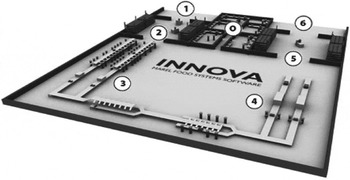
In-line-processing has been introduced as an approach to improve the plant's efficiency. At the same time it can provide an important tool for plant managers. Within such an integrated system, broilers or turkeys are loaded onto marked shackles, weighed, and evaluated (image analysis system prior to chilling; Figure 1). Decisions concerning cut up or whole bird marketing can be made a few hours prior to the actual cut up operation and therefore significantly enhance efficiency and plant's utilization. Figure 6 shows an example of an integrated computerised system to control the whole production line. The advantage of such a system is the ability to monitor any step in the process in real-time and act on it before the situation gets out of hand.
In a conventional poultry processing plant, data is usually collected during the day, summarised, and a picture of the entire production day is only available to the manager on the following day or week. The system shown in the Figure can also be equipped with a single worker's data collection station, so additional training can be provided as needed. The system can be programmed to include a traceability function; which is now a requirement from several large supermarket chains. As the system is used to monitor production (weight, temperature, time, etc.) it can also be used to optimise the process. The ideal operation for such a system is when all birds stay on the shackle line (or transfer to a subsequent shackle line right away) so data captured at the beginning of the process (see Figure 1 showing image analysis data), can be used for forward decision making. Overall, streaming and using in-line process eliminates the need to stop the sequence (e.g. dropping and re-hanging birds on the line), which result in bottlenecks where piles are accumulating (i.e. for an undisclosed amount of time, unpredicted temperature fluctuation, and pressure on birds at the bottom of the pile). The elimination of handling the product by workers can also result in less cross-contamination and the incidence of Salmonella and Campylobacter spreading. The system presented in Figure 6 is still not so common in the poultry industry but more processors are looking into it. In any case, every processor is using a quality control system(s) that cover different portions of the production line. Integrating the whole process obviously has advantages in terms of increasing productivity, efficiency, and yield.
A complete production control system: (1) receiving supplies, (2) raw material inventory, (3) processing, (4) packing, (5) final goods inventory (6) dispatch. Courtesy of Marel Inc.

Conclusions
Understanding ante- and post-mortem processes as well as their relation to meat quality is very important in designing equipment and processes for the poultry industry. As more emphasis is put today on quality, obtaining a consistent product at the end of a high speed line is essential in marketing (local, national, and international) whole and cut up poultry meat. The industry has progressed at a tremendous pace over the past four decades (about 400% in line speed), and is currently producing a diverse array of products designed for the fresh and further processed markets. Gains achieved so far would suggest that further improvements in line speed, and quality would continue in the future. These achievements will be best manifested by equipment manufacturers and processing companies capable of understanding the whole process, and manufacturers who can provide integrated solutions (farm to fork) to the meat processor.