


1. Introduction
The mathematical framework of inclusive fitness was first introduced by Hamilton (Reference Hamilton1963, Reference Hamilton1964) in order to help explain the evolution of social traits by kin selection and has helped to give new, intuitive explanations of a variety of traits including altruism, eusociality, parental care, and genomic imprinting (Grafen Reference Grafen1984; Marshall Reference Marshall2015, and references therein). In calculating inclusive fitness, one looks at the effects an organism has on other organisms’ reproductive success, rather than just looking at the organism’s own reproductive success. These effects are then weighted by the ‘relatedness’ of the organism to those organisms it affects.
In recent years, there has been an extensive debate surrounding inclusive fitness. Some authors argue that inclusive fitness calculations can be wrong (van Veelen Reference van Veelen2009), while others argue that it requires stringent assumptions and is less general than ‘standard’ natural selection (Nowak, Tarnita, and Wilson Reference Nowak, Tarnita and Wilson2010; Wilson Reference Wilson2012; Allen, Nowak, and Wilson Reference Allen, Nowak and Wilson2013). The response is that inclusive fitness calculations are not (merely by virtue of using the mathematical framework) susceptible to being wrong (Marshall Reference Marshall2011) and do not require stringent assumptions like weak selection (e.g., Abbot et al. Reference Abbot2011; Marshall Reference Marshall2015), additive payoffs (e.g., Queller Reference Queller1992; Taylor and Maciejewski Reference Taylor and Maciejewski2012; Birch Reference Birch2014b; Birch and Okasha Reference Birch and Okasha2015), pairwise interactions (e.g., Taylor, Wild, and Gardner Reference Taylor, Wild and Gardner2007; Abbot et al. Reference Abbot2011; Marshall Reference Marshall2011), or special population structures (e.g., Taylor and Frank Reference Taylor and Frank1996; Taylor et al. Reference Taylor, Wild and Gardner2007; Abbot et al. Reference Abbot2011; Taylor and Maciejewski Reference Taylor and Maciejewski2012; Marshall Reference Marshall2015).
Critics of inclusive fitness often propose evolutionary game theory or population genetics as alternatives to the inclusive fitness framework (Nowak et al. Reference Nowak, Tarnita and Wilson2010, Reference Tarnita and Wilson2011; Traulsen Reference Traulsen2010; Allen et al. Reference Allen, Nowak and Wilson2013; Allen and Nowak Reference Allen and Nowak2015). Often, the comparisons are made between very simple models in quantitative genetics, which abstract away from particular details of any given population, and more complex models arising out of population genetics, which often take into account more of the particular details. Here, we will look at how inclusive fitness can function in evolutionary game theory, which often makes idealizations rather than abstractions in order to achieve simple models. The difference between these two modeling strategies (using abstractions vs. using idealizations) and how this relates to the inclusive fitness debate will be discussed more in sections 3.3 and 5. Looking at the way inclusive fitness can be incorporated into evolutionary game theory will help show where some of the disagreements about inclusive fitness arise and when inclusive fitness calculations might be expected to have the limitations ascribed to them by critics. It will also demonstrate how we can think of some parts of the debate as arising from different sides emphasizing different methodologies, rather than as disagreements over inclusive fitness as a way of calculating fitness.
First, I introduce the framework of inclusive fitness and compare it to ‘neighbor-modulated’ fitness calculations in section 2. Then, in section 3, I discuss the debate that has arisen around the inclusive fitness framework, focusing on issues that can be understood as arising from the different sides of the debate emphasizing different methodologies. In section 4, I discuss how models using both neighbor-modulated and inclusive fitness are connected and provide a simple example to demonstrate these connections. Section 5 will provide a few ways to think about these connections and explain how they can help us understand some issues in the inclusive fitness debate. Finally, section 6 concludes.
2. Inclusive Fitness and Neighbor-Modulated Fitness
2.1. Basic Calculations
Inclusive fitness and the related concept of neighbor-modulated fitness were first proposed by Hamilton (Reference Hamilton1964). Roughly, the neighbor-modulated fitness of an organism is calculated by adding up the number of offspring the organism is expected to have from some social interaction of interest. Inclusive fitness is an alternative mathematical framework in which fitness calculations track the offspring caused by a particular organism, rather than tracking the offspring an organism actually has. The offspring caused by the organism are then weighted according to a ‘relatedness’ parameter, which is a measure of how likely it is that the focal organism and its social partner share genetic material, relative to the rest of the population. The two types of fitness calculations provide alternative ways of partitioning the causal structure of social interactions. A more concrete description of the equations used in both frameworks will be provided below.
The inclusive fitness framework might initially seem counterintuitive, so it is helpful to start with a basic observation: in general, a trait will increase in frequency when organisms with that trait have more offspring than the average organism in the population. To determine whether a trait of interest will increase in frequency, we want to see how many offspring organisms with that trait will have. Inclusive fitness gives us this information by telling us how many offspring are caused by an organism and how likely it is that these offspring are had by an organism with the trait of interest.
We can calculate inclusive fitness for a focal organism, i, by looking at the effects from all its social interactions relevant to our trait of interest. When i interacts with other organisms, it affects its own fitness by some amount (sii) and the fitness of another organism, j, by some amount (sij). The genotype of organism i also predicts, to a certain extent, the genotype of the social partner j. This relationship is described by rij. There will be more details on calculating rij in sections 2.2 and 4, but for now we can think of it as a measure of how likely it is that i and j share genetic material. We can then calculate inclusive fitness as follows:

This fitness calculation gives us information about how the population will evolve. It tells us how many offspring are had by organisms with the trait of interest, and since offspring tend to be like their parents, this gives us information about how the composition of a population is expected to change. Note that, although it is sometimes described this way, inclusive fitness is not calculated by counting the number of offspring an organism has and then adding all the offspring its relatives have (weighted by relatedness).
Compare the inclusive fitness approach to the neighbor-modulated fitness approach, where we look at an organism, i, and add up the effects of its social interactions on its own number of offspring. The neighbor-modulated fitness of organism i is then calculated as follows:

where sji is the effect i’s social interaction with j has on i’s fitness.Footnote 1 This gives us information about how many offspring i is expected to have and, since i’s offspring tend to be like i, about how the composition of a population is expected to change.Footnote 2
2.2. Hamilton’s Rule, the Price Equation, and Kin Selection
Hamilton’s rule, famously associated with inclusive fitness, gives a condition for the increase of an altruistic behavior, where an organism performs an action that decreases its own fitness and increases the fitness of another. (An example of a model of the evolution of altruistic traits will be given in sec. 4.2.) It says simply that if the relatedness-weighted benefit of a trait exceeds its cost, then we should expect selection to favor that trait. That is, the trait is favored when

where b is the benefit to the focal organism’s social partner and c is the cost to the focal organism.
Many results within the inclusive fitness framework, including Hamilton’s rule, are derived from the Price equation, which is a general description of evolutionary change. Let f be the fitness of a trait in the population, relative to the average fitness in the population. Then, the Price equation describes expected evolutionary change in the following way:

We can think of p as the average phenotypic value of the population, although p can actually represent anything a modeler might want to keep track of: phenotypic value, genetic value, frequency of a trait, and so on. The change in the average value is then  . The covariance term measures how fitness changes with differences in phenotype.Footnote 3
When fitness effects are additive, that is, when the fitness effects on the recipient do not depend on the recipient’s genotype/phenotype and fitness effects from all an organism’s social interactions can simply be added up, we can derive equations for both inclusive fitness and neighbor-modulated fitness from the Price equation.Footnote 4 These equations are discussed further in the appendix, but here we will look at Hamilton’s rule as derived from the Price equation. The inclusive fitness version of Hamilton’s rule is

When we can interpret the covariance between an organism’s phenotype and its own fitness (βsiip) as a ‘cost’ and the covariance between an organism’s phenotype and its social partner’s fitness ( ) as a ‘benefit’, we have Hamilton’s rule, where
 . This measure of relatedness compares the covariance between a focal organism’s phenotype, p, and its social partner’s genotype, g′, with the covariance between the focal organism’s phenotype and its own genotype, g (Orlove and Wood Reference Orlove and Wood1978). It is a measure of the degree to which the focal organism and its social partner are genetically related, or how likely it is that the fitness effects from a trait fall on organisms with the gene(s) encoding for the trait.
Section 4.1 and the appendix discuss how inclusive fitness results derived from the Price equation are related to the replicator dynamics, which is often used in game theoretic models, using methods drawn from Page and Nowak (Reference Page and Nowak2002). Section 4.2 will discuss how this definition of relatedness matches up with the definition of relatedness we will use in game theoretic models. Section 5.2 will discuss versions of Hamilton’s rule that do not rely on the assumption of additive fitness components in relation to the results discussed here.
Relatedness is commonly thought of as a measure of the average kinship between interacting organisms when talking about kin selection for a trait. However, it is widely acknowledged that R, and many methods for calculating R, can be thought of as general measures of correlation between types (Marshall Reference Marshall2015). In this case, R can measure how likely it is that altruists interact with other altruists regardless of whether that correlation is caused by interacting with kin or by some other mechanism, such as a green-beard effect where altruists are able to recognize and preferentially interact with other altruists.
Because inclusive fitness is often used in describing traits that evolve via kin selection, the terms ‘inclusive fitness’ and ‘kin selection’ are sometimes used interchangeably. However, it is important to distinguish inclusive fitness from kin selection. Inclusive fitness is a method of calculating fitness, as described above. Kin selection, however, refers to the selection of a trait because of benefits falling differentially on relatives. Inclusive fitness is a mathematical framework used to describe evolution of a trait; kin selection is a mechanism by which traits can evolve (e.g., Hamilton Reference Hamilton1975; Grafen Reference Grafen2007a).
Some of the critiques of inclusive fitness models are aimed at showing that kin selection has been less important as an evolutionary force than many inclusive fitness theorists presume (see, e.g., Wilson Reference Wilson2012). Other parts of the criticism are aimed at the mathematical framework of inclusive fitness itself, such as claims that there are mathematical difficulties with the calculations in inclusive fitness (Nowak et al. Reference Nowak, Tarnita and Wilson2010; Traulsen Reference Traulsen2010; Wilson Reference Wilson2012). This article will not discuss whether kin selection provides an adequate explanation of prosocial behavior. Instead, it looks at whether inclusive fitness can provide an adequate mathematical framework for use in evolutionary models. Kin selection is discussed only in considering how inclusive fitness can be used in models of traits evolving via kin selection. This focus will help us see which aspects of the debate are relevant to the inclusive fitness framework and which pertain to kin selection explanations of the evolution of particular traits. Section 5 will discuss this further.
3. The Debate Surrounding Methods
There are several critiques levied against the inclusive fitness framework. This article will address a couple of particularly important critiques that, as we will see, can be understood in light of an emphasis on different modeling techniques: the critiques that inclusive fitness requires the assumption of weak selection and cannot provide dynamically sufficient models. Here, I give a description of these critiques and a brief motivation for thinking of them as arising from different sides of the debate emphasizing different methodologies. Section 5 provides a more detailed argument for this conclusion using material that will be laid out in section 4.
3.1. Weak Selection
First, inclusive fitness has been critiqued for requiring the assumption of weak selection. In assuming that there is weak selection, we assume that gene frequencies are not changing or that the changes in gene frequencies are small enough to be ignored.Footnote 5 This assumption is used in various ways in inclusive fitness models: in employing estimation methods for calculating relatedness, in ignoring higher-order effects or certain types of population structure, and so on.
It is easy to see why certain methods of estimating relatedness require weak selection. For example, unless very special conditions hold, estimating relatedness using pedigrees, or family trees, requires that selection is weak. If gene frequencies are systematically changing in the population, the relatedness of an organism to its siblings, for example, will change as the genetic composition of its siblings changes (Grafen Reference Grafen1984). However, calculating relatedness does not, in general, require weak selection, and we can calculate how relatedness changes as gene frequencies change (Grafen Reference Grafen1985; Birch Reference Birch2014a; Marshall Reference Marshall2015).
The assumption of weak selection is also used because it allows one to ignore nonadditive fitness effects. That is, the assumption of weak selection has been used to ignore things like synergistic effects (where organisms receive additional benefits from cooperation if they both cooperate) or the effects of competition over resources. This is perhaps the more important use of the assumption of weak selection, as it allows one to separate the way an organism affects its own fitness (a self-effect) from the way it affects its social partner’s fitness (an other effect) in cases in which the simplifying assumption of additive fitness components is false. Note that this critique also applies to neighbor-modulated fitness, as the fitness effects are similarly separated into self- and other-effect components. At some points in the debate, it seems that critics argue against the use of inclusive fitness (and neighbor-modulated fitness) because it requires weak selection in order to achieve the separation of fitness components. That is, without the assumption of weak selection, one is restricted to a special case in which fitness effects are additive, leading to the conclusion that inclusive fitness is less general than ‘standard’ natural selection (Nowak et al. Reference Nowak, Tarnita and Wilson2010).
However, at some points it seems that critics want to claim that, whether or not fitness effects can be split into additive components, inclusive fitness calculations require weak selection. For instance, Nowak et al. (Reference Nowak, Tarnita and Wilson2010) claim that “inclusive fitness theory cannot even be defined for nonvanishing selection; thus the assumption of weak selection is automatic” (SI 14). It is this second, stronger, claim that will addressed here. In section 4, the claim will be shown to be clearly false using modeling techniques from evolutionary game theory, one of the preferred frameworks of critics of inclusive fitness. Section 5 will then discuss how, if we read the debate as about inclusive fitness theory as a set of methods rather than inclusive fitness theory as a framework for calculating fitness, we can make sense of this claim.
3.2. Dynamic Sufficiency
Inclusive fitness has also been criticized for not being able to provide dynamically sufficient models (Nowak et al. Reference Nowak, Tarnita and Wilson2010; Wilson Reference Wilson2012). In a dynamically sufficient model, information about the population at any particular time is enough to make predictions about the population at all future times. So, information about a population at some starting time is enough to be able to predict how the population will evolve at all future times. In a dynamically sufficient model, one can predict whether the population will reach an equilibrium, a state at which the population is no longer evolving, and what the population composition will be at the equilibrium should it reach one.Footnote 6 Critics of inclusive fitness argue that it cannot be used to describe the evolutionary trajectories or end points of evolution (Nowak et al. Reference Nowak, Tarnita and Wilson2010, SI 4).
One reason this criticism might be leveled against inclusive fitness is the general reliance on the Price equation, which is not dynamically sufficient.Footnote 7 More specifically, the Price equation itself is neither dynamically sufficient nor insufficient (because it merely expresses a mathematical identity), but it can be either, depending on what sort of model it is used with. When we do have a dynamically sufficient model, the Price equation will correctly describe evolutionary change in the model but will not itself give any additional predictions (van Veelen et al. Reference van Veelen, García, Sabelis and Egas2012).
Because many of the results in inclusive fitness theory, like Hamilton’s rule, are formulated in absence of a particular model, and because the focus is often on estimating the covariances rather than calculating them from an evolutionary model, we might not always get dynamically sufficient models within the framework. These estimations of parameters will only predict the evolutionary outcome if they do not change over time, which is not the case when selection is frequency dependent (Nowak et al. Reference Nowak, Tarnita and Wilson2010; Allen et al. Reference Allen, Nowak and Wilson2013). However, as we will see in section 4, the regression methods often emphasized in inclusive fitness theory are intimately connected with the sort of dynamically sufficient models preferred by critics of inclusive fitness.
3.3. The Debate over Methodologies
Critics of inclusive fitness often propose population genetics or evolutionary game theory as alternative frameworks in which one can provide models that are dynamically sufficient and that do not require stringent assumptions like weak selection (Nowak et al. Reference Nowak, Tarnita and Wilson2010, Reference Tarnita and Wilson2011; Traulsen Reference Traulsen2010; Allen et al. Reference Allen, Nowak and Wilson2013; Allen and Nowak Reference Allen and Nowak2015). It is not immediately clear how we should read this proposal, because although it is true that inclusive fitness tends to be used in quantitative genetics models (Frank Reference Frank2013) and is seen as primarily a quantitative method in spirit (Queller Reference Queller1992), it has been used in both game theoretic (e.g., Skyrms Reference Skyrms2002; van Veelen Reference van Veelen2009, Reference van Veelen2011) and population genetics models (e.g., Rousset Reference Rousset2002; Grafen Reference Grafen2007b; Lehmann and Rousset Reference Lehmann and Rousset2014). In fact, when Hamilton (Reference Hamilton1964) first proposed using inclusive fitness, he did so in the context of a population genetics model.
The methods used in quantitative genetics are designed to handle continuously varying traits, such as height or weight. In models of social behavior, a continuously varying trait could be the probability of performing an altruistic action. Models within quantitative genetics tend to emphasize simplicity and measurability. These models usually start with observations about phenotypes, or other easily measurable quantities, with few assumptions about the underlying genetics of a trait. This method of modeling involves abstractions, ignoring complicating details of the situation by merely leaving them out while still giving a description that is literally true (Godfrey-Smith Reference Godfrey-Smith2009). The Price equation is often used within this approach. As mentioned in section 2.2, many of the common results within inclusive fitness theory are derived from the Price equation.
By contrast, challenges to the inclusive fitness framework tend to come from population genetics (Frank Reference Frank2013, 1153). This is an approach that tends to start with specific assumptions (such as assuming we know the underlying genetics of a trait, the mutation rates, etc.) and make predictions based on those assumptions. Models within this approach tend to be dynamically sufficient, meaning that information about the population at any particular time is enough to make predictions about the population at all future times. The use of simplifying assumptions also means that these models make use of idealizations rather than abstractions. That is, they talk about populations that have features we know real populations do not have (e.g., infinite population size, no mutations) in order to provide a simple model. One way to think about models using idealizations is that they describe nonactual, fictional populations that we take to be similar to real populations in important ways (Godfrey-Smith Reference Godfrey-Smith2009). As mentioned, critics propose evolutionary game theory as an alternative to the inclusive fitness framework.Footnote 8 The replicator dynamics is often used within this approach. This dynamics requires many idealizing assumptions, which will be discussed in section 4.1.
The rest of this article will look more closely at the use of inclusive fitness in evolutionary game theory, focusing on the replicator dynamics. Since inclusive fitness is not as commonly used in evolutionary game theory, this will help us see the benefits and drawbacks of using inclusive fitness in highly idealized models. This article will also compare how inclusive fitness calculations can be used in evolutionary game theory with some of their uses in quantitative genetics. This comparison between the use of inclusive fitness within these two traditions for studying evolution will be helpful in understanding key issues in the debate, since they represent extremes of methodologies using idealizations and abstractions: the replicator dynamics of evolutionary game theory is highly idealized, while the Price equation often employed in quantitative genetics uses only abstractions. We will see how some of the disagreement arises out of the sides of the debate emphasizing different methodologies and how this relates to arguments over the usefulness of Hamilton’s rule.
It is important to note that, while this distinction between abstract models in quantitative genetics and idealized models in evolutionary game theory is illuminating for the present purposes, it does not capture the full variety of modeling techniques within the two methodological traditions. There are evolutionary game theoretic models that make the assumption of weak selection in order to abstract away from genetic details and fail to be dynamically sufficient. For instance, Taylor and Frank (Reference Taylor and Frank1996) employ a weak selection assumption, allowing them to approximate regression coefficients using partial derivatives, in order to use standard maximization techniques for finding evolutionarily stable strategies (28). This method can be used to derive ‘approximate’ versions of Hamilton’s rule, which will be described further in section 5.2.
This article focuses on the special case in which fitness effects are additive. This is a starting point to examine how inclusive fitness can be calculated in idealized evolutionary game theoretic models and to see whether there is any benefit to using inclusive fitness in this context. We will see that the assumption of weak selection is not essential to the calculation of inclusive fitness and that one can build dynamically sufficient models using inclusive fitness. There is, of course, further work to be done to see whether and how this can extend into the more complicated cases generally talked about in inclusive fitness theory. The relationship between these results and general versions of Hamilton’s rule, which do not require weak selection and do not assume additive fitness components, will be discussed in section 5.2. Note, however, that while the special case of additive fitness effects will not be applicable to many traits of interest in the real world, it is an important special case that has been studied extensively in a variety of contexts even outside of the inclusive fitness framework (e.g., Eliashberg and Winkler Reference Eliashberg and Winkler1981; Chakraborty and Harbaugh Reference Chakraborty and Harbaugh2007; Maciejewski, Fu, and Hauert Reference Maciejewski, Fu and Hauert2014).
4. Inclusive Fitness in Evolutionary Game Theory
Inclusive fitness and neighbor-modulated fitness are commonly viewed as ‘formally equivalent’ in that they yield the same predictions in terms of the direction of evolutionary change. That is, they give the same conditions for when a social trait is favored by evolution (see Birch [Reference Birch2016] and references therein). This section will show that, in the special case discussed above, we can prove further that they also give the same prediction for magnitude of evolutionary change. Section 4.1 will prove that the two calculations of fitness are equivalent when used with the replicator dynamics, a standard model from evolutionary game theory. These results are then compared to more common calculations of inclusive fitness in the appendix, which proves the equivalence between the replicator dynamics and both the neighbor-modulated and inclusive fitness calculations derived from the Price equation. Then, section 4.2 provides a simple example to illustrate the connections between these fitness calculations.
4.1. Inclusive Fitness and Neighbor-Modulated Fitness in Evolutionary Game Theory
In evolutionary game theoretic models, the replicator dynamics is a standard model of the evolutionary process. Under this dynamic, if the fitness of a trait is greater than the average fitness of the population, the frequency of the trait will increase. The traits of interest dictate behavior in some social interaction, so a trait’s fitness is determined by how well it does against the other possible traits in the population (in addition to the population composition). If xt is the frequency of the trait of interest, and ft(x) is its fitness in a population of composition x, the replicator dynamics is governed by the following equation:

where  is the average fitness in the population. There are a number of assumptions involved in using the replicator dynamics, notably that the population size is infinite and there are a finite number of traits.
Since we are trying to see whether the trait of interest is favored, we can calculate the fitness of organisms that have the trait and the fitness of those that do not in order to have a full description of evolutionary change according to the replicator dynamics. As mentioned, we will look at the case in which there are additive fitness effects. If we assume further that there are pairwise interactions, we can denote organism i’s social partner as −i. In this case, we can write the neighbor-modulated fitness of the organisms with the trait of interest as

where  is the probability an organism with the trait will interact with another organism that has the trait and where
 is the probability an organism with the trait will interact with an organism that does not have the trait. Similarly, the neighbor-modulated fitness of organisms without the trait of interest is

where  is the probability an organism that does not have the trait will interact with another organism that does have the trait.
The inclusive fitness of organisms with the trait of interest is (now using w for inclusive fitness to distinguish it from neighbor-modulated fitness, f)

and the inclusive fitness of not having the trait is 0. The relatedness between interacting organisms, R, is defined as a difference in conditional probabilities (Skyrms Reference Skyrms2002; van Veelen Reference van Veelen2009; Okasha and Martens Reference Okasha and Martens2016). The relatedness of a focal organism to its social partner is the probability that the social partner has a trait given the focal organism does minus the probability the social partner has the trait given that the focal organism does not:

This is a measure of the degree to which the focal organism’s phenotype predicts its social partner’s phenotype.Footnote 9 Since genotypes (to a certain extent) predict phenotypes, this can also be thought of as a measure of genetic relatedness.Footnote 10
If we start with the replicator dynamics with neighbor-modulated fitness as our measure of fitness, we can show that it is equivalent to using the replicator dynamics with inclusive fitness as our measure of fitness:

That is, neighbor-modulated fitness and inclusive fitness are equivalent when used with the replicator dynamics, a standard model of evolution used in evolutionary game theory.Footnote 11
The appendix shows further that, given the assumptions stated above, using the replicator dynamics is equivalent to the Price equation with either method of calculating fitness. That is, what follows are equivalent descriptions of evolutionary change:
1. The replicator dynamics used with neighbor-modulated fitness
2. The replicator dynamics used with inclusive fitness
3. The Price equation used with neighbor-modulated fitness
4. The Price equation used with inclusive fitness
The equivalence between 1 and 3 is demonstrated in appendix A. The general strategy is the same as the one used in Page and Nowak (Reference Page and Nowak2002). First, show that the Price equation used with neighbor-modulated fitness (3) is descriptive of a population evolving according to the replicator dynamics used with neighbor-modulated fitness (1); then, show that when there are a finite number of types, 3 is also descriptive of a population evolving according to 1. Using the same strategy, we can show that 2 and 4 are equivalent. This is done in appendix B. Note that these four ways of modeling evolutionary change are shown to be equivalent in that they give the same prediction for both the direction and magnitude of evolutionary change. This goes beyond what is commonly meant by the claim that neighbor-modulated fitness and inclusive fitness are equivalent, which is that they give the same prediction for the direction of evolutionary change (see Birch [Reference Birch2016] and references therein).
The next section provides a simple model using inclusive fitness in the context of evolutionary game theory. This simple illustrative example will let us see, in more concrete terms, the benefits and disadvantages of using inclusive fitness in such an idealized setting. Section 5 discusses how to understand these equivalences in the context of the inclusive fitness debate.
4.2. A Simple Model: Altruism with Haploid Siblings
This section will provide an idealized model using haploid siblings to show how one can dynamically model relatedness within the inclusive fitness framework when selection is not weak. We will assume that these organisms either have the altruistic trait or not, which is completely determined by whether they receive a certain gene from their parent. So that the relationship between this model and Hamilton’s rule is clear, we will assume that when an organism has the altruistic trait, it pays a cost c and bestows a benefit b on its social partner. When an organism lacks the altruistic trait, it does not pay the cost and does not benefit its social partner. In this model, an organism’s social partner is its sibling. On the basis of these assumptions, we can calculate the inclusive fitness of altruists to be

The inclusive fitness of nonaltruists is 0 because they do not perform any action (relevant to our trait of interest) that affects their own or their social partner’s reproduction. Thus, altruism will spread when  .
Since the relatedness of haploid siblings is determined by the genetic material they receive from their common parent, we can let p be the frequency of altruists in the parent generation and use this to calculate relatedness among the offspring. We will also account for a small mutation rate μ in the calculation of relatedness. Once we rewrite the probabilities (according to the definition of conditional probability) so that they are easier to calculate from the assumptions of the model, we can calculate the relatedness of an altruist to its haploid sibling in the following way:

Briefly, here is how to understand this calculation. The numerator of the first term is the probability of two haploid siblings both being altruists. Since there are two ways to get two altruistic offspring, we can calculate this as the probability the parent is an altruist (p) times the probability it has two offspring without mutations ( ) plus the probability the parent is a nonaltruist (
 ) times the probability it has two offspring that both have a mutation (μ2). The denominator of the first term is then the frequency of altruists in the offspring generation. These offspring can come from an altruist parent without mutation or from a nonaltruist parent with mutation. The second term is calculated similarly. The numerator is the probability that a focal nonaltruist will have an altruist sibling: the probability that the parent is an altruist and the focal organism mutates while its sibling does not plus the probability the parent is a nonaltruist and the focal organism does not mutate while its sibling does. This is divided by the frequency of nonaltruists in the offspring generation.
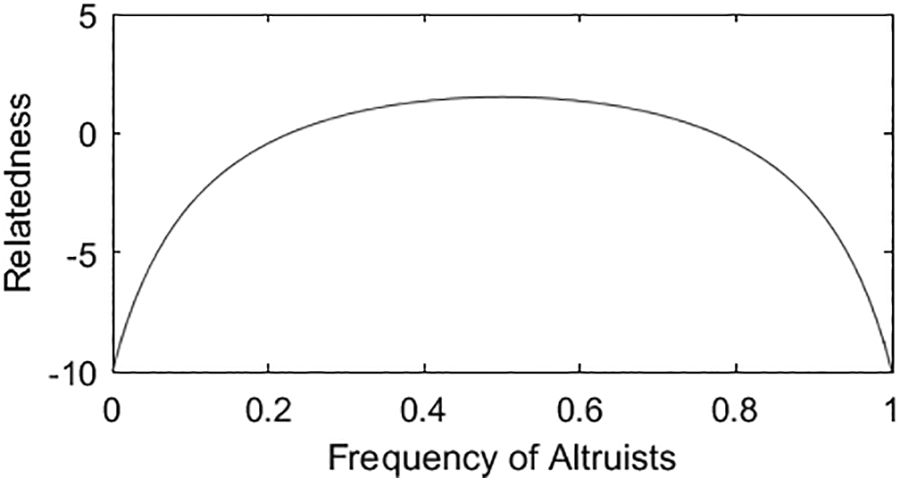
Figure 1 shows how R will change when the population’s composition changes.Footnote 12 In particular, it shows that relatedness decreases as the population becomes more uniform.Footnote 13 To see why this is the case, it is easiest to look at the extremes of  and
 . When
 , the parent population is entirely composed of nonaltruists. In the offspring generation, altruists only exist because of mutation. The probability an altruist has an altruist sibling is just μ, the probability that the sibling also has a mutation. However, the probability that a nonaltruist has an altruist sibling is also μ, the probability that the sibling has a mutation. So
 . Similar reasoning applies when
 . The parent population is composed entirely of altruists, so any nonaltruists in the offspring generation arise through mutation. This means that although altruists are likely to have altruist siblings, nonaltruists are equally likely to have altruist siblings. So although
 is high at
 ,
 is also
 , and
 .
Relatedness graphed over the frequency of altruists in the parent population, for  .

We can also calculate relatedness in this model using covariances or regressions. Since phenotypes in this idealized model are completely determined by genotypes (an organism with the altruistic gene is assumed to be an altruist), we can write

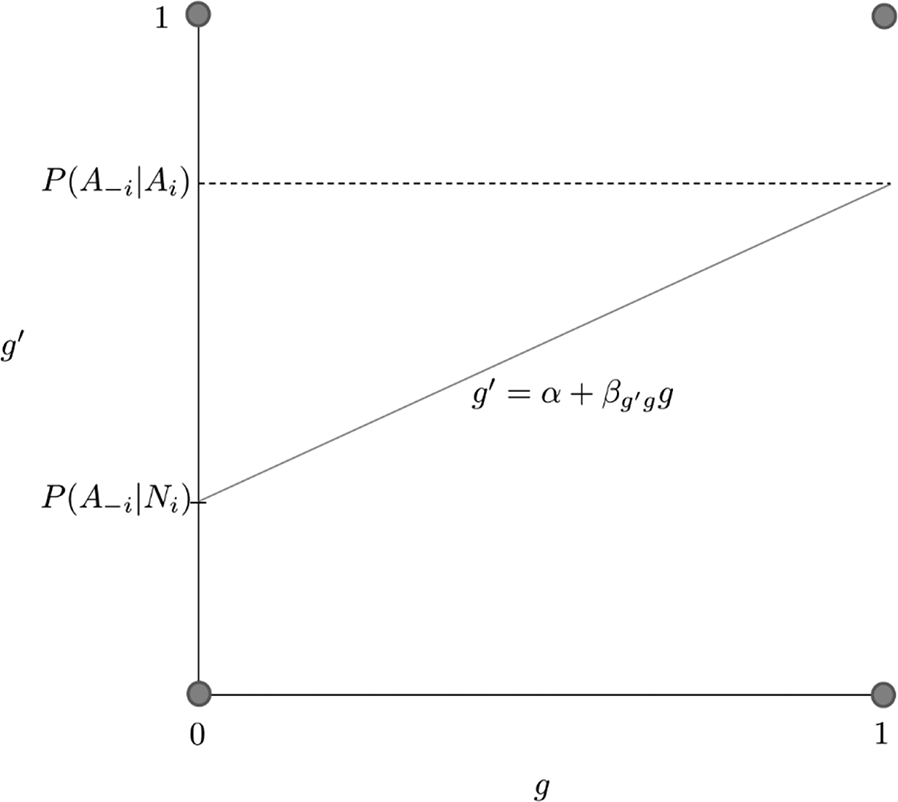
For any population composition, we can perform a regression to calculate the value of R, and it will give the same value of relatedness as the probabilistic definition of relatedness. Figure 2 gives a way to visualize why this is the case. In this model, an organism’s genetic value, g, is 1 if it has the gene for altruism and 0 if it does not. Thus, there are four possible places for data points on a graph of g versus g′: the four corners of the graph. Then, when we do a regression of g on g′, what matters is how many data points are in each of these locations. When the focal organisms’ genetic value is 1, its social partner’s genotype will on average be  . Similarly, when the focal organisms’ genetic value is 0, its social partner’s genotype will on average be
 . As shown in figure 2, this is the intercept of the regression, and the regression coefficient is
 .
Illustration of  and
 .

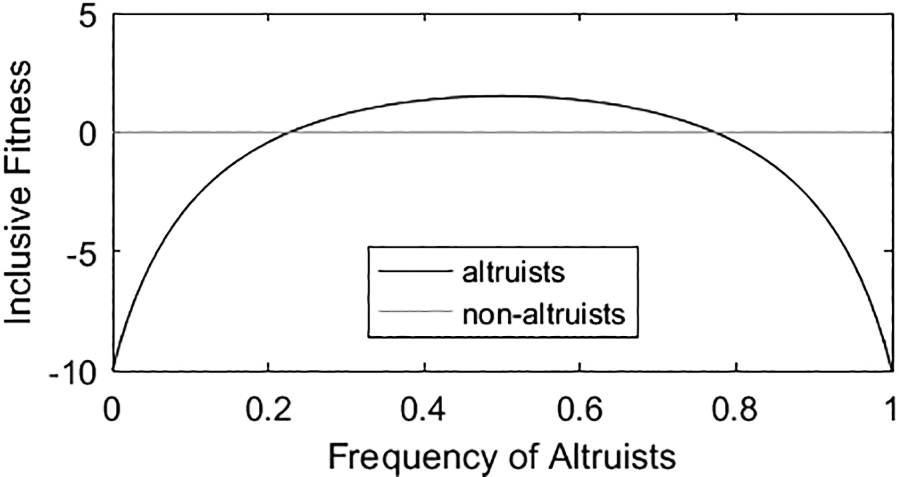
The inclusive fitness of altruists depends on R, so it also changes as the population composition changes. Figure 3 shows how the inclusive fitness of altruists compares with the inclusive fitness of nonaltruists over the possible population compositions, for  and
 . Since relatedness drops off as the population becomes uniform, the inclusive fitness of altruists drops off as the population becomes more uniform. For many possible values of b, c, and μ this means that altruists will have a fitness advantage for some area around
 , but their fitness will drop below the fitness of nonaltruists as the population becomes more uniform.
Inclusive fitness graphed over the frequency of altruists in the parent population, for  ,
 , and
 .

These calculations of relatedness and inclusive fitness can be used in a dynamic model where frequencies of genotypes are changing over time; we use these calculations with an appropriate dynamics to see how the population will evolve and to find the equilibria. For this model, we use the selection-mutation dynamics, which is just like the replicator dynamics except that there is an extra term that keeps track of mutations.Footnote 14
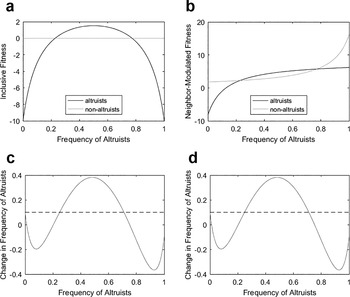
Figure 4 shows the dynamical analysis of this model, using both inclusive fitness and neighbor-modulated fitness. Figures 4a and 4b show, respectively, how inclusive fitness and neighbor-modulated fitness change as the population composition changes. Figures 4c and 4d show the evolutionary trajectories in the population, in terms of the change in frequency of altruists. When this change is positive (when the solid line is above the X-axis, which is represented by the dashed line in figs. 4c and 4d), altruists will increase in frequency. Likewise when the change is negative, altruists will decrease in frequency. Information about the magnitude of selective pressures is also represented; the further the solid line is from zero, the more selective pressure there is and the faster the population composition will change.
Comparison of inclusive fitness and neighbor-modulated fitness, for  ,
 , and
 . Comparing the calculations of inclusive fitness (a) and neighbor-modulated fitness (b) shows how the calculations of the two types of fitnesses differ. Comparing the change in the frequency of altruists found using inclusive fitness (c) and neighbor-modulated fitness (d) shows that the evolutionary trajectories are the same regardless of which calculation of fitness is used.

Comparing figures 4a and 4b shows that the two methods of calculating fitness do yield different numerical values of fitness. However, in comparing the evolutionary trajectory found using inclusive fitness in figure 4c with the trajectory calculated using neighbor-modulated fitness in figure 4d, one can see that the choice between these fitness measures makes no difference for predicting the evolution of the population, either for the quantitative predictions of the amount of evolutionary change over time or the qualitative predictions about the evolutionary outcomes based on the model. That is, in this simple model, inclusive fitness and neighbor-modulated fitness both give us the same answer when we ask how much altruists will increase or decrease in frequency, across all possible population compositions.
We can also use either type of fitness calculation to find when the change in altruists is zero, when frequencies are not changing and the population is at an equilibrium. With the values of μ, b, and c chosen here, there are four equilibria, two of which are stable: one at about 1% altruists and one at about 75% altruists.Footnote 15
5. Discussion
We can see from section 4 not only that inclusive fitness is perfectly well suited for use in evolutionary game theory but also that weak selection is not a necessary assumption for inclusive fitness calculations and that these calculations can be part of dynamically sufficient models. Some methods of calculating or estimating inclusive fitness may require stringent assumptions, but the calculations in general do not always require extra assumptions. How are we to understand this in the context of the debate over inclusive fitness?
5.1. Inclusive Fitness with Idealized Models
Some of the disagreement over inclusive fitness can be understood as arising from two sides of the debate emphasizing different methodologies. Recall from section 3.3 that inclusive fitness is seen as fundamentally within the quantitative genetics tradition, while critics of inclusive fitness tend to favor population genetics or evolutionary game theory. This means that inclusive fitness theorists tend to favor models that make use of abstractions, leaving details out while still providing literally true general claims about evolution. By contrast, evolutionary game theory, one of the preferred frameworks of the critics of inclusive fitness, tends to provide highly idealized models, making many assumptions that we know are not true of any real population but that allow us to develop a simple model of a fictional population that we think is similar to the real world in important ways.
As discussed in section 4.1, when there is an infinite population and a finite number of types, inclusive fitness calculations from quantitative genetics and evolutionary game theory are equivalent. Since quantitative methods are designed to handle continuously varying traits, assuming a finite number of types takes the methods out of the context in which they were developed and puts them into the context where dynamically sufficient models can be built. In doing so, we can get models with the kinds of properties valued by critics of inclusive fitness.
One way to think about this is that the regression methods developed by inclusive fitness theorists do not, in themselves, provide models with the properties the critics of inclusive fitness argue evolutionary models should have. However, we can formulate idealized models that are dynamically sufficient and that incorporate selection that is not weak. Then, when we abstract away from the particular details of genetic inheritance or population structure assumed by the simplified models, we arrive at the abstract equations based on the Price equation, which are often used in inclusive fitness theory. Section 4.1 (and the appendix) showed how, when we make simplifying assumptions commonly made in evolutionary game theory, the replicator dynamics and the versions of the Price equation often used in inclusive fitness theory are equivalent descriptions of evolutionary change.
Section 4.2 gives an example of how the regression methods commonly used in inclusive fitness can be seen as abstract descriptions of models within evolutionary game theory. In this simple model, we can track how  changes as the population evolves. Using covariances might seem a bit unnatural in this overly simplified case: because we can calculate the relatedness directly from the assumptions of the model, we do not need to estimate it using the methods of quantitative genetics.
In fact, one might wonder whether there is any benefit to be gained from inclusive fitness in this sort of simplified model. One of the main perceived benefits of inclusive fitness is that it allows modelers to track changes in traits rather than the genes encoding for these traits (which are very difficult to discover empirically) while accounting for genetics by using relatedness (which is often not too difficult to estimate in real populations; Queller Reference Queller1992). Because we abstract away from the mechanisms of genetic inheritance and how the genes encode for the trait of interest, summarizing this with a ‘relatedness’ parameter, we can develop a phenotypic model that still incorporates genetics in a way that can be empirically easy to measure. That is, one can account for genetics without knowing or making assumptions about the actual underlying genetics of a trait. When we switch to an evolutionary game theoretic or a population genetics model, like the replicator dynamics, we generally then must make assumptions about what these underlying genetics are. We no longer use relatedness to estimate genetic assortment; we can calculate the level of assortment directly.
So, to a certain extent one might think that it is appropriate that the debate over inclusive fitness is a debate over methods: although we can use inclusive fitness in the highly simplified models of evolutionary game theory, in doing so we lose some of the main benefits of the inclusive fitness framework. The statistical methods used in inclusive fitness make the framework particularly useful, although these methods may require weak selection to split fitness effects into additive components and do not provide dynamically sufficient models. Further, if we view the debate as being about the methods commonly used in quantitative genetics, we can see where these criticisms come from.Footnote 16 That is, since inclusive fitness has often been seen as fundamentally quantitative, and since one of the main benefits of inclusive fitness (incorporating genetics in a way that is easy to estimate in real populations) is generally tied up in the statistical methods arising out of quantitative genetics, it makes sense that the debate over inclusive fitness will be in part a debate over methods. However, the status of inclusive fitness should not be decided by a debate over the use of methods for which inclusive fitness is seen as particularly beneficial.
The model in section 4.2 demonstrates that there can still be some benefit to calculating inclusive fitness rather than neighbor-modulated fitness even in models that are highly idealized, where the level of assortment can be calculated directly. The explanation given for why the population does not evolve to a population composed entirely of altruists was that relatedness drops off as the population becomes more uniformly altruistic. This sort of intuitive explanation is not readily available when using neighbor-modulated fitness. Because the terms describing how the benefits of altruism fall differentially on altruists are split between two different fitness calculations (one for the fitness of altruists and one for the fitness of nonaltruists), there is no parameter that systemically changes as the population composition changes that we can point to in order to explain why the fitness of altruists drops off as the population becomes more uniform.Footnote 17
5.2. The Use of Hamilton’s Rule
Hamilton’s rule, the most famous result arising out of inclusive fitness theory, has been criticized for not being generally true, for not having any predictive power, and for being misleading in the absence of a particular model (Nowak et al. Reference Nowak, Tarnita and Wilson2010). There is some truth to these claims. To get Hamilton’s rule in the form  , where c and b are interpreted as costs and benefits as described in section 2.2, one has to assume additive fitness components as we have been doing throughout this article. If fitness components are not additive, then the rule will not give a correct description of a condition for the spread of a trait. Additionally, if we only have enough information to estimate b, c, and R at a particular point in time, we cannot predict the evolutionary outcome. Further, if
 when we estimate these parameters, we might even be misled into thinking that the population will eventually be entirely altruistic if we forget that the value of any of these parameters can change as the population evolves. However, inclusive fitness theorists will generally agree to this (see, e.g., Marshall Reference Marshall2015) but maintain that Hamilton’s rule has both predictive and explanatory power. It is not immediately clear where the disagreement lies.Footnote 18
The distinction between idealizations and abstractions can again be helpful in understanding part of the dispute. In particular, why should we expect Hamilton’s rule to be true in general? Results derived within population genetics and evolutionary game theory are never true in general, as they rely on idealizations to achieve their simplicity. By contrast, Hamilton’s rule is seen as a general result that is applicable to any real population one might wish to study. This fits well with its prominent role in quantitative genetics, relying on abstractions rather than idealizing assumptions to help provide “the general principles of social evolution theory” (Marshall Reference Marshall2015, xiv).
In this vein, there is emphasis on providing a version of Hamilton’s rule that is generally true. Hamilton’s rule can be given in a very general form in which we do not have to assume any particular population structure or additive payoff affects (Gardner, West, and Wild Reference Gardner, West and Wild2011). Birch (Reference Birch2014b) and Birch and Okasha (Reference Birch and Okasha2015) describe this in detail, but we can think of the ‘cost’ and ‘benefit’ terms in the rule as statistical associations between an organism’s fitness and its own genotype (a self-effect) and its social partner’s genotype (an other effect), respectively. This general version of Hamilton’s rule is true of any population. “In effect, this is because we are abstracting away from the complex causal details of social interaction to focus on the overarching statistical relationship between genotype and fitness” (Birch and Okasha Reference Birch and Okasha2015, 24).
The question is then whether this version of Hamilton’s rule has any predictive power. It can have predictive power if its components can be understood causally instead of just statistically. That is, if the self-effect and other-effect terms can be interpreted as ways in which the focal organism causally contributes to its own and its social partner’s fitness, we have a model that can be used to make predictions rather than just a statistical summary of evolution within a population. However, as Birch and Okasha (Reference Birch and Okasha2015) explain, it is not entirely clear when a causal interpretation can be provided.
There are, however, a variety of different rules that go under the name ‘Hamilton’s rule’, each of which follows from different assumptions about the evolutionary process. We can describe these versions of Hamilton’s rule as falling into three categories. There are ‘special’ versions of the rule (where the b and c terms are interpreted as payoffs in a model) and ‘approximate’ versions (which provide marginal approximations of the general versions of the rule) in addition to the ‘general’ version described above (Birch and Okasha Reference Birch and Okasha2015).
In the version of Hamilton’s rule in section 3.1, the b and c terms are interpreted as payoff from a game, or parameters in the model, so this can be thought of as a special version of Hamilton’s rule. The fact that we derived a condition  for the spread of altruism depends on the particular payoff structure of the model. If there were nonadditive payoffs, we would have derived a different condition for the spread of altruism. Section 4 (and the appendix) illustrated how these general versions of Hamilton’s rule describe the special versions from particular models. As mentioned in sections 3.1 and 3.3, there are also approximate versions of Hamilton’s rule that require the assumption of weak selection to calculate relatedness or in order to split fitness effects into additive components. Thus, these rules abstract away from the particular payoff structure and so describe a wider range of cases than special forms of the rule. The assumption of weak selection, then, provides some restriction on the conditions under which approximate versions of Hamilton’s rule will apply but allows us to give an approximately correct condition for the spread of a social behavior for arbitrary payoff structures. (See Birch and Okasha [Reference Birch and Okasha2015] for more discussion.)
Note that both general and approximate versions of Hamilton’s rule apply for arbitrary payoff structures, but neither is dynamically sufficient. They instead allow us to perform a static analysis, comparing fitnesses at specific points in the evolutionary process (usually the points of interest are equilibria). Since this article has looked at how inclusive fitness is used in the replicator dynamics compared with approaches based on the Price equation, it has focused on the contrast between abstract models in quantitative genetics and idealized models in evolutionary game theory. However, that the critics of inclusive fitness prefer dynamic models over these static modeling techniques is perhaps the more fundamental disagreement in the debate.
There is the additional issue of interpreting the R parameter in Hamilton’s rule. Although many inclusive fitness theorists recognize that R in inclusive fitness calculations can be thought of as a general measure of correlation, Hamilton’s rule is still usually presented as a condition for the evolution of a trait by kin selection. However, this is an additional opportunity for Hamilton’s rule to be misleading; a suggested biological or causal interpretation of the parameter might be unwarranted. Some criticisms seem to assume that Hamilton’s rule is only useful when R is a measure of kinship (Nowak et al. Reference Nowak, Tarnita and Wilson2010). The thought behind these sort of critiques of Hamilton’s rule seems to be that when R does not have an intuitive biological interpretation, it is not clear what explanatory power is gained from forcing terms into this particular inequality. The power of Hamilton’s rule then comes from using something like the statistical definitions of relatedness provided here and estimating relatedness using measures of kinship, like pedigrees.Footnote 19
Since the statistical definitions of relatedness are historically explained and used as measures of kinship, adopting Hamilton’s rule as a starting point might seem to suggest an interpretation in terms of kin selection and may lead to theorists ignoring other mechanisms that generate assortment between types. Connecting the statistical and probabilistic definitions here is one way of emphasizing how the association between ‘relatedness’ and R is contingent: R just measures differences in conditional probabilities of interacting with certain types in the population. In this context, Hamilton’s rule might be thought of as a convenient mathematical description of the fact that there must be sufficient assortment between types in order for a trait such as altruism to evolve, a general point that has been made without the use of Hamilton’s rule (see, e.g., Skyrms Reference Skyrms1996). A fully specified (but idealized) model, like the one in section 4.2, can connect R in Hamilton’s rule to kinship, giving it a meaningful biological interpretation.
This is in line with one suggestion to avoid wrongly interpreting results in terms of kin selection, advanced by Taylor and Frank (Reference Taylor and Frank1996) and Frank (Reference Frank2013), among others: formulate and analyze a model first, then afterward use Hamilton’s rule to give an intuitive explanation of the results if appropriate. This allows us to set up the model with whatever mechanism of assortment we think is plausible, then use Hamilton’s rule if it helps illuminate important aspects of the causal structure.
6. Conclusion
While there can be benefits to using inclusive fitness, this does not mean that it is always beneficial to do so. Whether inclusive fitness or Hamilton’s rule should be used depends on the model or the population one is studying. Many of the issues involved in deciding whether to use these methods were not addressed here. This article has discussed the use of inclusive fitness in a special type of evolutionary model, in which pairwise interactions, additive fitness effects, and a finite number of types were assumed. In doing so, this article focused the discussion on issues surrounding the different methodologies favored by the critics and proponents of inclusive fitness theory, in absence of conceptual and mathematical complexities that can arise in more complicated scenarios. Looking at this simple case helped to illuminate several features of the mathematical framework of inclusive fitness and the debate surrounding it.
While there may be difficulties with partitioning fitness effects into the form demanded by inclusive fitness when interactions become more complicated, we have seen that the specific causal partition used in inclusive fitness does not prevent one from building dynamically sufficient models, nor does it require weak selection. Criticisms of inclusive fitness claiming that it requires these stringent assumptions are best thought of as criticisms of the types of quantitative methods generally used by inclusive fitness theorists. One can use inclusive fitness calculations in the sort of population genetic or evolutionary game theoretic models favored by these critics. In these models much of the advantage of using inclusive fitness, such as providing terms that can be easy to estimate empirically, disappears, but its power as an intuitive explanation of the evolution of social traits remains.
Appendix A. Equivalence with Neighbor-Modulated Fitness
The Price Equation Describes the Replicator Dynamics
Following the definition provided in section 2.1, we can calculate the neighbor-modulated fitness of a pairwise interaction as follows:

Keeping track of probabilities of receiving payoffs was necessary in section 4.1 in order to show the connection between neighbor-modulated fitness and inclusive fitness, but since we are only dealing with neighbor-modulated fitness we can use this less complicated expression. In these calculations, we will track the change in g, genetic value.
By definition,  . As mentioned, for simplicity we assume that there is no transmission bias and set
 . Then, since the replicator dynamics provides us an equation for
 , we can plug the replicator dynamics into the Price equation:

This is the Price equation with fitness partitioned into two components, the effect the focal organism has on its own fitness and the effect the social partner has on the focal organism’s fitness. Theorists often derive this from the original Price equation in order to use neighbor-modulated fitness calculations and introduce relatedness calculations (see, e.g., Queller Reference Queller1992).
Hamilton’s rule can easily be derived from this equation. Since the way an organism affects the fitness of itself and others is (to a certain degree) predicted by its phenotype, we can write both fitness terms as the following regressions:


Since the α’s are the intercepts of the regression, they are constants and cannot covary with g. The ε’s are error terms, which do not covary with g when payoffs are additive (Queller Reference Queller1992). So, plugging (A3) and (A4) into the last line of (A2), we are left with

When we can interpret  as a cost c and
 as a benefit b, this gives us

where  is the neighbor-modulated fitness version of relatedness.
The Replicator Dynamics Describes the Price Equation
When there are a finite number of types, gi can be written as an indicator function:

For Page and Nowak (Reference Page and Nowak2002), who were considering phenotypes rather than genotypes, assuming a finite number of types was a restriction. Here, in considering genotypes, it is a natural assumption to make.
We can then use this indicator function in the Price equation with two fitness components derived above and simplify:

Since  when
 and 0 otherwise,
 , and this simplifies to yield the replicator dynamics.
Appendix B. Equivalence with Inclusive Fitness
The Price Equation Describes the Replicator Dynamics
This is done in the same way as appendix A, except we take into account that the genetic value of the focal organism times its relatedness to its social partner is a measure of the social partner’s genetic value:

This is again a version of the Price equation where the fitness effect is split into two components. Here, though, fitness is split into the effect the focal organism has on its own fitness and the effect the focal organism has on its social partner’s fitness.
In order to relate this to Hamilton’s rule, we can again notice that the fitness components are predicted by phenotype. Since in this case the focal organism causes the fitness effects, both for itself and its social partner, the phenotype of the focal organism predicts both fitness effects. So, we use the phenotype of the focal organism in both regressions:


We can then plug (B2) and (B3) into the last line of (B1) and rearrange to obtain the inclusive fitness version of Hamilton’s rule:

The Replicator Dynamics Describes the Price Equation
We can again let gi be an indicator function and write

Again, this simplifies to yield the replicator dynamics.


 μ=0.1
 α=P(A−i|Ni)
 βg′g=P(A−i|Ai)−P(A−i|Ni)
 μ=0.1
 b=18
 c=10
 μ=0.1
 b=18
 c=10


