The German Diagnosis-Related Groups system was developed in the year 2000 and has served as a basis for hospital reimbursement since 2004. It is a well-established model with only psychiatric, psychosomatic, and psychotherapeutic therapies still dodging its application. It currently includes 1193 reimbursement codes with specific cost-weight value and 150 additional compensations items.
At the end of the hospital stay, grouping software assigns a reimbursement code according to a classification algorithm in conformity with the main diagnosis and several parameters. For congenital heart surgery, three factors play a major role:
-
1. Age and weight. Patients are divided into two groups. The first group comprises neonates, that is, age under 28 days or infants with an admission weight under 2.5 kg. Their funding codes start with the letter P. Most surgical procedures performed with the aid of cardiopulmonary bypass in the neonatal period are attributed the P02 code. The second group comprises all other patients. Their codes begin usually with the letter F, or with the letter A, if the patients undergo at least 96 hours of mechanical ventilation. For example, valve repair is commonly assigned the F03 code. Operations in connection with the main diagnosis of transposition of the great arteries, single ventricle, atrial isomerism, common arterial trunk, totally anomalous pulmonary venous connection, double-outlet right or left ventricle, pulmonary atresia, and aortic atresia lead to F30Z grouping. Hospital stay with mechanical ventilation lasting 96 to 249 hours is funded according to the A13 code.
-
2. Duration of any mechanical ventilation. For example, the revenue code will be P02B for a neonate who needs postoperative mechanical ventilation for 144–480 hours.
-
3. Performed surgical procedures.
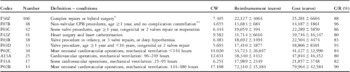
Basically, for each hospital stay, reimbursement is calculated by multiplying the cost-weight value attributed to each code by a “base-rate” lump sum, which currently amounts to 2912.65 euros in North Rhine-Westphalia. Remuneration is reduced if the duration of hospital stay is shorter than expected. It is parsimoniously increased if the patient stays longer in hospital than foreseen. Examples of cost-weight values can be found in Table 1, which displays the 10 most frequent funding codes mentioned in this study.
Cost and reimbursement according to the ten most frequent reimbursement codes.

C = cost; CW = cost-weight; R = reimbursement
*Such as main diagnosis of pulmonary atresia, common arterial trunk, double-outlet right ventricle, single ventricle, transposition of the great arteries, atresia of the aorta, atrial isomerism, totally anomalous pulmonary venous connection, and/or repair of tetralogy of Fallot, Norwood, Glenn and Fontan procedures, etc.
**Such as peritoneal drainage, dialysis/haemofiltration, resuscitation, massive transfusion of blood products, mechanical ventilation 48–95 hours, etc.
Data for the determination of the cost-weight value are collected from a sample of 332 hospitals. Participating hospitals must be able to calculate costs at the patient level by collecting information on services delivered to each patient. Cost-weights and “base-rate” lumps are updated annually. There is always a time lag of 2 years between the year of the data used to calculate cost weights and the year in which the cost weight for each funding code is established. Further information about the German Diagnosis-Related Groups system can be found in the publication of Quentin et al.Reference Quentin, Geissler, Scheller-Kreinsen and Busse 1
The Diagnosis-Related Groups method postulates that inpatient stays with similar levels of clinical complexity consume similar amounts of resources. The complexity of congenital heart surgery is soundly evaluated by the Aristotle complexity score.Reference Lacour-Gayet, Clarke and Jacobs 2 , Reference Heinrichs, Sinzobahamvya and Arenz 3 Accordingly, reimbursement should ideally correlate with the Aristotle score, in particular the Aristotle comprehensive complexity score, which has been demonstrated to highly correlate with costs involved in the surgical management of cardiac malformations.Reference Sinzobahamvya, Kopp and Photiadis 4 , Reference Sinzobahamvya, Photiadis and Kopp 5
This study analyses how the current German disease categorisation system compensates the costs associated with congenital heart surgery, according to different levels of surgical complexity.
Patients and methods
We reviewed a total of 480 hospital stays attributed to the cardiothoracic surgery unit in the year 2011. In all, 13 among them that did not report any operation and nine involving surgical procedures not recorded in the Aristotle score were excluded. Thus, 458 hospital stays were selected. These concerned 76% (458/603) of all primary surgical procedures that were carried out during the year 2011.
Estimation of cost and reimbursement of in-hospital stay
The costs of every hospital stay were estimated according to the guidelines of the Institute for the Hospital Remuneration System, an institute responsible for encoding hospital funding in Germany. Since the introduction of the Diagnosis-Related Grouping in Germany, our hospital contributes to the hospital cost calculation in conformity with the rules established by the above-mentioned institute, which controls the data gathered on a yearly basis. All aspects of each patient's management are extensively documented. In particular, operations times are recorded, as well as the duration of monitoring and mechanical ventilation at the intensive care unit. Costs are estimated according to computing algorithms pertaining to available human resources – doctors, nursing and technical staff, administration – and material – drugs, catering, sutures, special materials such as transplants or prostheses, etc.
The 2012 version of the grouping software was used to analyse patients’ data. These were already available in the hospital database (Orbis®). Funding codes were determined for basic reimbursement on the one hand and for the estimated additional compensations on the other, for each hospital stay. The sum of both amounts constituted hospital reimbursement for each case.
Estimation of levels of surgical complexity
Levels of complexity were evaluated in conformity with the Aristotle complexity score. This risk-adjusted model was designed to estimate surgical performance for congenital heart surgery. It defines complexity as the sum of potential for mortality, potential for morbidity, and expected surgical technique difficulty, attributing 0.5–5 points to each of these three parameters. The basic procedure-adjusted complexity score varies from 1.5 to 15 points. The patient-adjusted comprehensive score adds 0–10 points to the basic score, according to the patient's comorbidities and anatomic dissimilarities. It ranges therefore from 1.5 to 25 points. Surgical performance is defined as “complexity score times hospital survival”. In the original study introducing the Aristotle score, basic surgical performance ranged from 5.67 to 6.90, with a mean of 6.3 and standard deviation of 0.4, for 26 European centres.Reference Lacour-Gayet, Clarke and Jacobs 2 The Aristotle score is currently under revision to comply with observed mortality and morbidity from congenital databases of the European Association for Cardiothoracic Surgery and American Society of Thoracic Surgeons.Reference O'Brien, Clarke and Jacobs 6 , Reference Jacobs, O'Brien and Jacobs 7
Aristotle complexity scores were consistently available, as they are systematically determined for all patients operated upon in our unit since May 2005. The basic scores were independently verified by the database coordinator of the European Association of Cardio-Thoracic Surgery according to the Source Data Verification Protocol of its Congenital Database (www.eactscongenitaldb.org). The record of basic and comprehensive scores is sent each year to the Aristotle Institute, Denver, United States of America (http://www.aristotleinstitute.org), for validation of the Aristotle complexity score.
The Aristotle scores were grouped in six levels of comprehensive complexity as directed by the Aristotle model: that is, Level 1 = 1.5–5.9 points, Level 2 = 6.0–7.9 points, Level 3 = 8.0–9.9 points, Level 4 = 10.0–15.0 points, Level 5 = 15.1–20.0 points, and Level 6 = 20.1–25.0 points.Reference Lacour-Gayet, Clarke and Jacobs 2
Statistical analysis
Non-parametric correlation (Spearman's r coefficient) and regression were estimated between Aristotle comprehensive complexity levels and related hospital costs on the one hand and corresponding hospital reimbursement on the other. After computation, the functions with the highest goodness of Fit r2 were retained.
The means are given with standard deviation. The software Graphpad Prism (San Diego, California, United States of America) was utilised to perform the whole statistical analysis.
Before surgery, the patients or their parents gave their written consent for use of anonymous data for research, teaching purpose, and external quality control.
Results
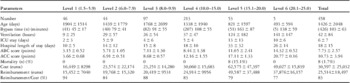
The main characteristics of the 458 hospital stays are displayed in Table 2. In all, 53 patients were neonates. The great majority of operations (93% = 426/458) were performed with the aid of cardiopulmonary bypass. The five most frequent procedures were total cavopulmonary anastomosis with external fenestrated conduit on 32 occasions; aortic valvuloplasty 25 times; primary closure of atrial septal defect in 25 cases; patch repair of ventricular septal defect on 23 occasions; and repair of complete atrioventricular septal defect in 21 cases.
Study characteristics according to levels of Aristotle comprehensive complexity score.

ABC = Aristotle basic complexity; ACC = Aristotle comprehensive complexity; ICU = intensive care unit
Most patients (58% = 266/458) were extubated, either immediately after surgery or within the first 24 post-operative hours. Mechanical ventilation lasted more than 96 hours in 11% (50/458) of the cases. In all, eight patients died: an early mortality of 1.7% (8/458). All belonged to the group of Level 5 complexity.
Mean basic and comprehensive Aristotle complexity reached 7.73 points with 2.57 standard deviation and 10.73 points with 3.94 standard deviation, respectively. With a survival rate of 98.3%, related surgical basic and comprehensive performances therefore attained 7.60 and 10.55 points. Almost half of the hospital stays (47% = 213/458) involved procedures with Level 4 complexity. Table 2 testifies to the increasing duration of cardiopulmonary bypass and post-operative mechanical ventilation. Longer stays at the intensive care unit and in the hospital were also observed, with levels of increasing Aristotle complexity.
Aristotle comprehensive complexity levels and actual hospital costs
Actual hospital cost ranged from 8896.26 to 193,671.94 euros per case. The mean cost amounted to 30,597 euros with a standard deviation of 25,032 euros. The cost varied between 16,449 euros (standard deviation = 8928 euros) for procedures with Level 1 complexity and 62,575 euros (standard deviation = 47,397 euros) for those with Level 5 complexity (Table 2).
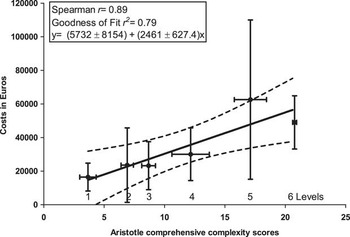
The figures highly correlated with complexity Levels, with Spearman's r coefficient reaching 0.89 value (p = 0.03). The best computed function was a linear regression with a corresponding goodness of Fit r2 of 0.79 as graphed by Figure 1.
Linear regression between scores of Aristotle comprehensive complexity levels (x) and hospital costs (y). The vertical and horizontal bars represent the standard deviation. The band shows the 95% confidence interval. The related Spearman's correlation coefficient (r), equation, and goodness of Fit (r2) are displayed.

Aristotle comprehensive complexity levels and hospital reimbursement
Hospital reimbursement per case ranged from 8,630.35 to 173,710.65 euros, with a mean of 25,514 euros (standard deviation = 18,497 euros). Reimbursement varied between 15,452 euros (standard deviation = 7040 euros) for procedures with Level 1 complexity and 49,587 euros (standard deviation = 37,488 euros) for those with Level 5 complexity (Table 2).
Figures also highly correlated with complexity levels, with Spearman's r amounting to 0.94 (p = 0.02). Linear regression again constituted the best function: goodness of Fit r2 = 0.76.
Hospital costs and hospital reimbursement
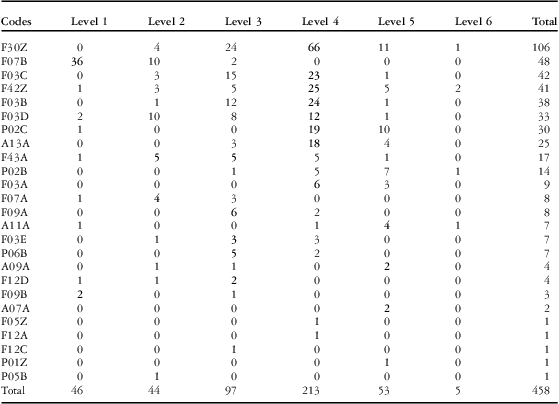
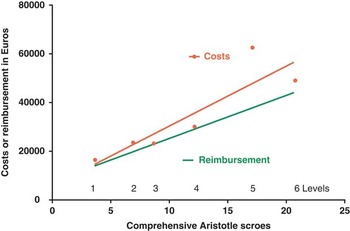
Overall cost for the 458 hospital stays amounted to 14,013,624.64 euros, whereas reimbursement only attained 11,685,519.46 euros: an underfunding of 2,328,105.18 euros. In other words, 83% of costs were compensated, with a deficit of 17% (Table 2). None of the hospital stays that were assigned the 10 most frequent reimbursement codes (Table 1) was entirely funded. In Table 3, all remuneration codes that were attributed to our unit are grouped according to procedures Aristotle complexity. As shown in Table 1, reimbursement was the highest (96%) for F07B, which was usually categorised in Level 1 complexity (Table 3). It was lowest (80%) for F42Z and A13A, codes that are typically situated in Level 4 complexity (Table 3). Reimbursement decreased from 94% of overall expenditure for Level 1 complexity procedures down to 77% for those in Level 6. As demonstrated by Figure 2, increasing procedures complexity was more and more penalised, receiving decreasing funding.
Repartition of reimbursement codes according to procedures Aristotle complexity.

The bold numericals indicates cases for which each reimbursement code was found to be most frequent
Linear regression between scores of Aristotle comprehensive complexity levels (x) and hospital costs on the one hand (red colour), and hospital reimbursement on the other (green colour). The lines diverge with increasing complexity.

Discussion
The fact that 24% (145/603) of the performed primary procedures were attributed to other departments – paediatric cardiology and neonatology – explains the limited number of procedures with Level 5 and Level 6 complexity in this study. For example, the Norwood operation, known to consume a great amount of human and material resources and credited with Level 5 and Level 6 complexity, was performed on 18 occasions in 2011, but only 12 hospital stays following the Norwood procedure were attributed to our unit. It is to be noted that cost per case for the other – not attributed – six Norwood hospital stays amounted to 189,947 euros (standard deviation: 127,791 euros), whereas reimbursement only attained 129,193 euros (standard deviation: 75,869 euros): an underfunding of 32%. The “missing” 145 hospital stays were not considered as they involved very different medical and nursing staff. The 458 studied cases constitute a homogeneous population for statistical analysis and plainly illustrate the spectrum of workload in our department in the year 2011.
The figures of hospital costs and corresponding revenue are accurate, as they are established by the institute responsible for encoding hospital reimbursement in Germany and controlled by the medical staff of insurance companies. The comprehensive Aristotle scores, part of validation of the Aristotle score, are also reliable. Thus, the results reported here deserve credibility.
This study first confirms the high correlation between hospital expenditure for the surgical management of congenital heart disease and Aristotle comprehensive complexity score, as previously published.Reference Sinzobahamvya, Kopp and Photiadis 4 , Reference Sinzobahamvya, Photiadis and Kopp 5 The related linear regression may therefore be used to calculate hospital costs.
Underfunding of repair of complex congenital heart disease has been reported, in particular for the Norwood procedure.Reference Mishra, Lindberg and Seem 8 This study further demonstrates that remuneration received by our hospital for performed operations never matched the recorded costs. The underfunding increased with procedures complexity. The compensation by the current German Diagnosis-Related Groups model penalises centres that manage complex heart lesions. Indeed, 59% (271/458) of our cases were classified in complexity Levels 4–6. Overall, this resulted in a financial deficit of 17%.
The German disease categorisation system aims to modulate expenditures in medical care. Many European countries now incorporate case-based payments into their hospital funding structures. The Diagnosis-Related Groups system is, at present, partially or totally applied by Austria, Finland, France, Hungary, The Netherlands, Norway, Poland, Slovakia, Sweden, Switzerland, and The United Kingdom. The European hospital reimbursement systems are summarized by Cylus and Irwin.Reference Cylus and Irwin 9 The paper by Casale et alReference Casale, Thomas and Gillam 10 clearly explains the current and emerging funding models in the United States of America. Regardless of the model applied, costs vary from institution to institution, but they always increase with the complexity of the treated lesion. In our setting, funding should be adjusted to surgical procedures complexity.
For the past 4 years, our unit has been performing the largest number of congenital heart operations in Germany. The infrastructure had to be adapted to the high complexity of the involved surgical procedures. This severity is confirmed by the mean Aristotle basic complexity score observed in 2011 (7.73 with a standard deviation of 2.57), which was higher than the score reported for 26 European centres (range: 5.70–7.16, mean: 6.7, standard deviation: 0.4).Reference Lacour-Gayet, Clarke and Jacobs 2 Presumably, departments managing lower complexity cases need to recruit less human and material resources. In this study, financial loss was limited to 6% for procedures with Level 1 complexity. Such deficit may be explained by the fact that less complex cases benefited from the increased staffing required to handle more complex lesions.
It clearly appears that cost-weight values of reimbursement codes pertaining to congenital surgical procedures with complexity 4–6 Levels are underestimated. This is due to the fact that the German Institute for the Hospital Remuneration system calculates the costs of heart surgery from data provided by departments performing operations with mainly Levels 1–3 complexity.
The most rational way to correct this underfunding would be to use the formula (y = 5732 + 2461x) in Figure 1 for reimbursement, y standing for reimbursement and x for Aristotle comprehensive complexity score. An alternative solution could be to attribute a revenue code with a specific cost-weight value to each Aristotle comprehensive complexity level, as proposed previously.Reference Sinzobahamvya, Photiadis and Arenz 11 In that way, the six new corresponding “complexity” funding codes might replace all current reimbursement codes as suggested by Table 3.
Such fundamental change ought to be discussed with the institute responsible for encoding hospital reimbursement in Germany. Meanwhile, granting additional compensation according to complexity levels should be considered to address this underfunding issue.
Conclusion
The restriction of resources to compensate inadequate remuneration endangers care quality and outcome of patients with complex cardiac malformations. Such conditions might lead to patients’ selection. This enduring situation requires rapid remedying. Performance should be rewarded, not penalised.
Acknowledgements
None.
Financial Support
None.
Conflicts of Interest
None.