





Introduction
Economic crises, political instability, and social upheaval have long served as catalysts for shifts in political preferences. The Great Recession, like the Great Depression before it, reshaped labor markets and changed individuals’ perceptions of security and status. Additionally, the rapid development of technologies such as artificial intelligence, along with the expansion of higher education, has exposed a wide range of occupations to new labor market risks. These changes have deepened economic insecurity, restructured occupational hierarchies, and affected individuals’ sense of stability and identity. Importantly, these labor market disruptions have been shown to heighten concerns about immigration (Anelli, Colantone and Stanig Reference Anelli, Colantone and Stanig2021; Kim and Hall Reference Kim and Hall2024; Pardos-Prado and Xena Reference Pardos-Prado and Xena2019). Despite these developments, there is still limited understanding of which occupations are most responsive to these changes and why.
This research note contributes to the literature by analyzing how occupation-specific skills (OSS) moderate the impact of changes in occupational labor markets on immigration attitudes. In short, the argument is as follows. Individuals with higher levels of OSS – defined as the amount of specific skills required to work in an occupation – develop stronger occupational attachments and therefore become more sensitive to changes in occupational labor markets (Huckfeldt Reference Huckfeldt2022; Serrano-Serrat Reference Serrano-Serrat2026; Zangelidis Reference Zangelidis2008). Building on political economy research that links perceptions of labor market competition and status threats to anti-immigration attitudes, this note argues that deteriorating occupational conditions amplify immigration concerns (Inglehart Reference Inglehart2020; Pardos-Prado and Xena Reference Pardos-Prado and Xena2019), and that this relationship is stronger when the amount of OSS is higher.
The proposed argument reconciles two competing theoretical accounts that make opposing predictions about skill specificity and immigration attitudes. Comparative political economy argues that relative increases in skill specificity – defined as increases in specific skills while holding expected income constant – heighten immigration concerns by raising occupational mobility costs through reduced skill transferability (Pardos-Prado and Xena Reference Pardos-Prado and Xena2019). In contrast, sociological accounts examine how absolute increases in specific skills shelter workers from job loss (Goldthorpe Reference Goldthorpe2000), thereby reducing anti-immigration attitudes (Polavieja Reference Polavieja2016). However, these latter accounts do not specify whether specific skills operate at the firm, industry, or occupation levels, obscuring how they moderate the effect of occupational labor market changes.
In this sense, the paper follows sociological accounts by analyzing absolute specific skills while integrating political economy insights about how OSS increase the costs of changing occupations and how this translates into anti-immigration preferences.Footnote 1 Integrating these approaches advances the debate by explaining when and for whom a deterioration in the occupational context leads to anti-immigration attitudes. Indeed, it yields a critical novel implication: Managers and Professionals are expected to be the most responsive occupations to shifts in their labor markets (Zangelidis Reference Zangelidis2008).
Given recent developments in political dynamics and labor markets, it is important to understand how and why highly skilled workers behave politically (Hausermann, Kurer and Schwander Reference Häusermann, Kurer and Schwander2015; Malhotra, Margalit and Mo Reference Malhotra, Margalit and Mo2013; Walter Reference Walter2017). For example, Webb (Reference Webb2019) shows that among the five occupations most exposed to artificial intelligence, four are (Associate) Professionals. This research note seeks to advance our understanding of the political reactions of highly skilled workers to these evolving economic conditions. It will be argued that the implications of the proposed argument differ from accounts that focus on task specificity – such as analyzing task overlap with other occupations – or on other skill dimensions, including general education, firm tenure, and type of training.
The argument is tested using 20 years of longitudinal data from the German Socio-Economic Panel (GSOEP), with models including several individual and occupation fixed effects (FEs). The results align with the theory and further suggest that the proposed heterogeneous effects of OSS are independent of task specificity measures and other skill dimensions.
Occupational labor markets, specific skills, and immigration concerns
Labor markets and immigration concerns: a brief overview
One of the main theories studying opposition to immigration is group conflict theory, which states that individuals who perceive themselves as competing with immigrants, for example in the labor market, are more likely to oppose immigration (Dehdari Reference Dehdari2022; Malhotra, Margalit and Mo Reference Malhotra, Margalit and Mo2013). However, recent research has challenged this assertion and argued that individuals’ values, rather than labor market competition, are the primary drivers of immigration concerns (Bansak, Hainmueller and Hangartner Reference Bansak, Hainmueller and Hangartner2016; Hainmueller and Hopkins Reference Hainmueller and Hopkins2014).
Partly in response to claims that labor markets are not related to anti-immigration sentiment, the literature has identified two nonexclusive arguments that could explain this relationship: fear of prospective competition with immigrants in the labor market and threats of status loss. The prospective competition framework holds that potential competition with immigrants in the labor market, rather than direct competition itself, fuels opposition to immigration (Pardos-Prado and Xena Reference Pardos-Prado and Xena2019). In particular, the authors argue that individuals in occupations with hard-to-transfer skills may fear competing with immigrants in the future, which could lead to an economic backlash against immigration (see also Kunovich (Reference Kunovich2013) and Polavieja (Reference Polavieja2016)).
Status loss arguments, on the other hand, emphasize how economic risks are related to status threats and demands for cultural homogeneity. In assessing the recent cultural backlash in Western countries, Inglehart states that ‘economic and physical insecurity are conducive to xenophobia, strong in-group solidarity, authoritarian politics, and rigid adherence to their group’s traditional cultural norms’ (Reference Inglehart2020: 8; see also Ballard-Rosa, Malik, Rickard et al., Reference Ballard-Rosa, Malik, Rickard and Scheve2021). Instead of analyzing labor market competition, this line of research argues that perceived subjective status is closely linked to anti-immigration attitudes (Gidron and Hall Reference Gidron and Hall2017), and that individuals perceive their societal status as connected to their occupations (Breyer Reference Breyer2025; Kurer Reference Kurer2020).
The argument
The argument developed here builds on and extends the literature examining the relationship between labor market risks and anti-immigration attitudes. Following sociological accounts, it is argued that possessing specific skills provides workers with income and job stability (Emmenegger Reference Emmenegger2009; Goldthorpe Reference Goldthorpe2000). However, these returns are contingent on occupational labor markets: when occupational unemployment rates (OUR) are high, firms can more easily replace workers without incurring training costs, reducing the protective effect of OSS against job loss (Jäger and Heining Reference Jäger and Heining2022; Serrano-Serrat Reference Serrano-Serrat2026). Additionally, workers may fear changing occupations because it entails income losses, as they cannot transfer OSS between occupations (Huckfeldt Reference Huckfeldt2022; Serrano-Serrat Reference Serrano-Serrat2026; Zangelidis Reference Zangelidis2008). A key assumption of the argument is that changing occupations involves substantial costs for both workers and firms, a fact recently documented in the literature (Huckfeldt Reference Huckfeldt2022; Jäger and Heining Reference Jäger and Heining2022).
Given the increased sense of insecurity, a reaction against immigration is to be expected (Anelli, Colantone and Stanig Reference Anelli, Colantone and Stanig2021; Kaihovaara and Im Reference Kaihovaara and Im2020; Pardos-Prado and Xena Reference Pardos-Prado and Xena2019). Drawing on previous discussion, it is argued that this can occur through increased perception of prospective labor market competition and/or through threats of status loss.Footnote 2 First, as indicated by the prospect competition framework, occupational hazards make workers fear potential competition with immigrants (Kunovich Reference Kunovich2013; Pardos-Prado and Xena Reference Pardos-Prado and Xena2019; Polavieja Reference Polavieja2016). When the labor market context deteriorates, people feel that the probability of job loss increases, especially for those with high levels of OSS. If they become unemployed, they would fear having to compete with immigrants in the general labor market, where OSS are not valued. This, in turn, increases concerns about immigration.
Second, formerly protected groups facing an anxious economic situation may become more concerned about their status in the social hierarchy (Baccini and Weymouth Reference Baccini and Weymouth2021; Kurer Reference Kurer2020; Petersen, Osmundsen and Arceneaux Reference Petersen, Osmundsen and Arceneaux2023), prompting a shift toward cultural and group-identity politics (Ansell, Hjorth, Nyrup et al., Reference Ansell, Hjorth, Nyrup and Larsen2022; Kurer Reference Kurer2020). According to the proposed argument, social recognition derived from OSS is expected to decline when the labor market deteriorates (Hall and Lamont Reference Hall and Lamont2013; Sørensen Reference Sørensen2000). As the prestige of an occupation falls, people compare their current unsatisfactory situation to an idealized past, reinforcing nostalgia and a willingness to regain status at the expense of immigrants through identity-related issues (Anelli, Colantone and Stanig Reference Anelli, Colantone and Stanig2021; Baccini and Weymouth Reference Baccini and Weymouth2021; Gest, Reny and Mayer Reference Gest, Reny and Mayer2018; Gidron and Hall Reference Gidron and Hall2017). These complementary mechanisms generate the following testable hypothesis:
H1: Occupational labor market deterioration increases anti-immigration attitudes, with stronger effects among workers with higher levels of occupation-specific skills.
The argument presented is analytically distinct from accounts that emphasize task specificity. In that line of research, greater specificity means fewer jobs performing comparable tasks (Lazear Reference Lazear2009). These accounts claim that as the number of available jobs requiring similar tasks increases, the costs associated with changing occupations decrease (Gathmann and Schonberg Reference Gathmann and Schönberg2010). This, in turn, may reduce the potential negative political reactions associated with labor market deterioration (Bisbee and Rosendorff Reference Bisbee and Rosendorff2025). However, occupational skills depend not only on tasks but also on specialized knowledge, and only by considering both can one account for the costs of mobility.Footnote 3 Indeed, Cortes and Gallipoli (Reference Cortes and Gallipoli2018) show that task similarity explains only a small share of the costs associated with occupational switching (about 6%). In contrast to accounts that analyze task specificity, OSS are specific because they are primarily usable within a given occupation – that is, their specificity does not depend on the broader labor market context (Lazear Reference Lazear2009; Streeck Reference Streeck, Busemeyer and Trampusch2011) – and greater OSS indicate higher skill levels.
H2a: The moderating role of OSS in H1 is distinct from and independent of task specificity, conceptualized as the availability of jobs performing similar tasks.
Furthermore, the proposed relationship operates independently of other skill dimensions, such as general skills, firm-specific skills, or possession of a vocational degree. First, general skills, by definition, are transferable across occupations and are therefore unlikely to moderate the effects of occupational labor markets. Thus, the proposed theory concerns not skill levels in general, but in particular the amount of OSS. Second, the argument also differs from perspectives that emphasize the role of firm-specific skills. Firm-specific skills, unlike OSS, may provide some protection to workers during economic downturns due to the reciprocal relationship and mutual investment between workers and firms (Pahontu Reference Pahontu2022; Tåhlin Reference Tåhlin2007). Finally, it is important to clarify that the focus is not on the type of training – whether general or vocational – but rather on the level of OSS required to effectively perform a job.
H2b: The proposed moderating role of OSS in H1 is distinct from and independent of alternative skill acquisition pathways, including general education, firm-specific experience, and vocational training.
Data and methods
Data
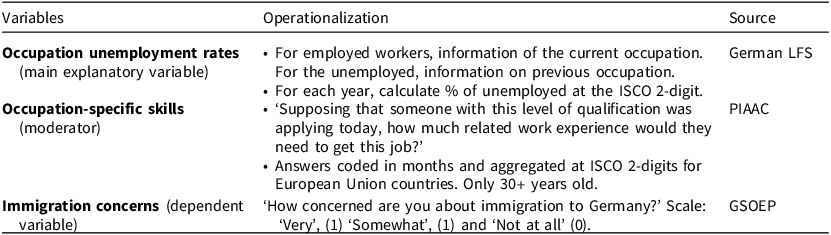
A summary of the operationalization of the main variables used in the paper is provided in Table 1.Footnote 4 Importantly, the GSOEP includes occupational identifiers, allowing occupational variables – obtained from external sources – to be linked to individuals.
Summary operationalization of variables

Table 1. Long description
A table with three columns labeled Variables, Operationalization, and Source, and three rows detailing the operationalization of variables. Row 1: Occupation unemployment rates, main explanatory variable. Operationalization: For employed workers, information of the current occupation. For the unemployed, information on previous occupation. For each year, calculate % of unemployed at the ISCO 2-digit. Source: German LFS. Row 2: Occupation-specific skills, moderator. Operationalization: Supposing that someone with this level of qualification was applying today, how much related work experience would they need to get this job? Answers coded in months and aggregated at ISCO 2-digits for European Union countries. Only 30+ years old. Source: PIAAC. Row 3: Immigration concerns, dependent variable. Operationalization: How concerned are you about immigration to Germany? Scale: Very, (1) Somewhat, (1) and Not at all (0). Source: GSOEP.
Occupational context is operationalized as OUR, a well-established measure in the literature (Pardos-Prado and Xena Reference Pardos-Prado and Xena2019; Rehm Reference Rehm2009; Rovny and Rovny Reference Rovny and Rovny2017). Data are drawn from the German Labor Force Survey (LFS) provided by Eurostat, which includes information on the previous occupation of unemployed workers. Unemployment rates are calculated for each occupation-year, aggregated at the International Standard Classification of Occupations (ISCO) 2-digit level.Footnote 5 Following Rehm (Reference Rehm2009), the variable is smoothed and winsorized at the 1 percent level.Footnote 6 Online Appendix A.1 details this transformation, presents the descriptive statistics – including the variation exploited in empirical analyses – and examines potential measurement error.
Occupation-specific skills have been theoretically defined as the amount of skills required to work in a particular occupation that cannot be transferred to other occupations. To measure this, scholars have used survey-based measures in which individuals self-report the difficulty or cost of learning their job (Polavieja Reference Polavieja2016; Serrano-Serrat Reference Serrano-Serrat2026). This research note uses the Survey of Adult Skills questionnaire from the Programme for the International Assessment of Adult Competencies (PIAAC), which includes a question about the amount of related experience required to work in a given job (Serrano-Serrat Reference Serrano-Serrat2026).Footnote 7 By asking about requirements in terms of related experience, this variable taps at the two analytical dimensions considered: the experience loss workers face if they change occupations and the costs firms incur when hiring someone without the required skills. A crucial element of the question is that it asks about required experience, assuming the individual already holds the formal qualifications to perform the job, which limits concerns that the variable simply captures education-based skill.
Individuals’ responses are coded in months and aggregated at the ISCO 2-digit level for European Union countries. Managers and Professionals are the occupations with the highest OSS, while Elementary Occupations have the lowest levels (see Appendix A.2). One concern with this variable is that it may simply reflect other aspects of occupations or skills. To address this, it will be shown that the observed relationship differs from task specificity measures and from other skill dimensions, such as years of education and firm tenure. Moreover, Appendix A.2 demonstrates that the variable captures the vertical dimension of social class (Goldthorpe Reference Goldthorpe2000), and Appendix D shows that the results hold when operationalizing OSS as the occupational mean wage.
Immigration concerns are drawn from the GSOEP (Ersanilli and Prag Reference Ersanilli and Präg2023; Pardos-Prado and Xena Reference Pardos-Prado and Xena2019). From 1999 to 2019, respondents were asked whether they are (somewhat or very) concerned about immigration. Answers indicating that respondents are not concerned at all about immigration are coded as 0, while those showing some degree of concern are coded as 1.Footnote 8 This variable has been shown to primarily reflect anti-immigrant sentiment rather than just saliency. Appendix A.3 shows that forty percent of individuals changed their preferences one to three times, and about five percent changed them more than three times during the period studied.
Method
It has been hypothesized that OUR are positively associated with anti-immigration attitudes, especially among individuals with high levels of OSS. This is tested using the following linear model:
 ${\rm Imm}{_{i,t}} = \alpha {\rm OUR}_{{o\left( {i,t} \right),t}} + \beta {\rm OUR}_{{o\left( {i,t} \right),t}} \times {\rm OSS}_{{o\left( {i,t} \right)}} + \delta {Z_{i,t}} + {\theta _{i,o\left( {i,t} \right)}} + {e_{i,t}}$
where Immi,t is immigration concerns of individual i in year t. The subindex o(i,t is a function that yields the occupation hold by individual i at time t. Thus, OUR o(i,t),t is the occupational unemployment rate faced by individual i in period t, who is employed in occupation o(t). This is similar for
 $OS{S_{o\left( {i,t} \right)}}$
; however, for a given occupation, OSS do not vary over time.Footnote
9
 $\beta $
is the parameter of interest, which is expected to be positive, indicating that increases in OUR leads to greater immigration concerns the higher the amount of OSS.
 ${Z_{i,t}}$
are controls, interacted with OSS (Blackwell and Olson Reference Blackwell and Olson2022), and
 ${\theta _{i,o\left( {i,t} \right)}}$
are individual-occupation FEs. Finally,
 ${e_{i,t}}$
are the individual errors. Since the variation of the interaction occurs at the occupational level, standard errors are clustered at the ISCO 2-digits (Abadie, Athey, Imbens et al., Reference Abadie, Athey, Imbens and Wooldridge2023).
In this regard, Equation (1) examines different sources of variation for OUR and OSS. For OUR, by including individual-occupation FEs, the analysis exploits aggregate changes in occupational labor market conditions over time. Each time an individual changes occupations, it is treated as a separate employment spell, so the analysis does not leverage variation from individuals endogenously changing occupations.Footnote 10 In contrast, OSS variation mainly reflects cross-sectional differences between workers rather than within-worker changes over time, so the estimates partly reflect selection into occupations (Keele and Stevenson Reference Keele and Stevenson2021). Importantly, the main sources of selection likely work against finding a positive interaction: if more able individuals – who are generally more sheltered from occupational unemployment – sort into high-OSS occupations, the estimates would be downwardly biased. Appendix D.2 explores narrower variation in OSS, including within ISCO 1-digit variation, finding similar results.
Finally, it should be noted that although the dependent variable is binary, the model is regressed via OLS. This is done because nonlinear models (eg logit) cannot estimate individual-occupation FEs due to the incidental parameters problem (Wooldridge Reference Wooldridge2010). Appendix D presents comparable results from (ordered) logit specifications using a Mundlak specification (Mundlak Reference Mundlak1978).
Results
Main results
The main results are summarized in Figure 1.Footnote 11 The aim of these analyses is to explore whether the association between OUR and immigration concerns differs across various OSS levels. In Panel A, the black line displays the marginal effects of OUR as a linear function of OSS, while the orange coefficients show the results of a binning specification that allows the association between OUR and immigration concerns to differ across terciles of OSS, that is, not assuming linear interactive effects (Hainmueller, Mummolo and Xu Reference Hainmueller, Mummolo and Xu2019).Footnote 12
Linear and binning estimates (Panel A) and effects by major ISCO groups (Panel B).
Note: Estimated association between OUR and concerns about immigration at different values of OSS. The left panel shows the results of a model that assumes linear interactive effects (black line and 95% confidence intervals in gray) and a binning specification (in orange). The histogram of OSS is also displayed. The right panel shows how OUR is related to immigration concerns for each ISCO 1-digit occupation (vertical axis) and how this relates to the average level of OSS in these occupations (horizontal axis). The size of the dots is proportional to the size of the occupations. The linear relationship is indicated by the dashed orange line.N = 181,852.

Both models indicate positive interactive effects. This can be seen because, at low OSS levels, the association between OUR and immigration concerns is close to zero, while the relationship becomes stronger as OSS levels increase. Specifically, at low OSS values, the binning estimates show that a 1 percentage point (p.p.) increase in OUR is associated with a 1 p.p. increase in the probability of being concerned about immigration for individuals with low OSS (those in the lowest OSS tercile), rising to 4 p.p. for individuals with high OSS (those in the highest OSS tercile). Moreover, the difference in the coefficients is significant (p-value < 0.01), indicating the presence of interactive effects (Hainmueller, Mummolo and Xu Reference Hainmueller, Mummolo and Xu2019). This is consistent with H1.
Panel B of Figure 1 examines the relationship for each ISCO 1-digit occupation. Specifically, immigration concerns are regressed on OUR for each major occupation, and the resulting coefficients (vertical axis) are plotted against their OSS levels (horizontal axis). The orange dashed line represents the linear relationship between the two variables. Consistent with previous analyses, there is a positive relationship between OUR coefficients and OSS. Additionally, the figure shows that (Associate) Professionals, as well as Managers and Clerical Support workers, are the occupations most sensitive to occupational labor markets. However, it should be noted that Managers appear less reactive to occupational labor markets than would be predicted based on their OSS. According to the International Labour Organization, managers ‘plan, direct, coordinate and evaluate the overall activities of enterprises’, which may make them more protected from occupational changes, as they tend to be more closely attached to the employer (Pahontu Reference Pahontu2022; Tåhlin Reference Tåhlin2007).Footnote 13
The results hold across a wide range of robustness checks, described in detail in Appendix D. Specifically, the results are robust: i) to different operationalizations of immigration concerns, OUR and OSS; ii) to different clustering of standard errors and specifications, including the estimation of (ordered) logit models; iii) when adding different sets of controls; iv) to the exclusion of each year and occupation, with results holding for different periods; and v) when exploring the reaction to robotization exposure analyzed by Anelli, Colantone and Stanig (Reference Anelli, Colantone and Stanig2021). Moreover, Appendix D presents three additional analyses that further support the validity of the specification. First, a placebo test shows that future OUR interacted with future OSS are not significantly related to anti-immigration attitudes (Elwert and Pfeffer Reference Elwert and Pfeffer2022). Second, the results are shown to be mainly driven by individuals who work in an occupation for which they were trained. The final exercise exploits different sources of variation in OSS, finding similar results.
The role of other dimensions of occupations and skills
After demonstrating the positive moderating role of OSS, this section compares it to other dimensions of occupations and skills discussed in the literature. Figure 2 presents the results of a regression that extends the main specification by including the interaction between OUR and various measures of task specificity, broadly defined as the availability of jobs requiring similar tasks. Specifically, the variables used are the inverse of occupational size, a measure of the degree of occupational specialization (Iversen and Soskice Reference Iversen and Soskice2001), and a variable capturing the availability of jobs using similar tasks (Bisbee and Rosendorff Reference Bisbee and Rosendorff2025).Footnote 14
The role of task specificity.
Note: The left panel shows the coefficient associated with the interaction between OUR and OSS after controlling for the interaction between OUR and task specificity. The right panel shows the interactive coefficients associated with OUR and task specificity.

Figure 2. Long description
The image contains two separate graphs. Panel A: A scatter plot titled Occupation-Specific Skills. The y-axis is labeled Interactive Coefficient ranging from -0.5 to 1.5. The x-axis is labeled OUR x OSS. The plot includes four data points represented by different symbols: a black circle labeled Main, a black triangle labeled Inverse Occ.Size, a gray square labeled Degree Specialization, and a gray diamond labeled Task Similarity. Each data point has an error bar indicating the range of the interactive coefficient. Panel B: A scatter plot titled Task Specificity. The y-axis is labeled Interactive Coefficient ranging from -0.5 to 1.5. The x-axis is labeled OUR x Task Specificity. The plot includes three data points represented by different symbols: a black triangle labeled Inverse Occ.Size, a gray square labeled Degree Specialization, and a gray diamond labeled Task Similarity. Each data point has an error bar indicating the range of the interactive coefficient.
The results in the left panel indicate that the proposed interactive effect remains virtually unchanged when controlling for the interaction between OUR and other dimensions related to task specificity. When directly analyzing the interaction between OUR and task specificity, the results in the right panel suggest there are no meaningful interactive effects. This indicates that the observed effects are not driven by how specific an occupation is in terms of size or the similarity of tasks compared to other occupations, but rather by the amount of OSS. This is consistent with H2a.
Turning to analyze the role of other skill dimensions, Figure 3 presents results from a model that interacts OUR with OSS, years of education, firm tenure, and type of training (vocational or not).Footnote 15 In this case, variation in OSS arises from individuals working in different occupations but with similar education, firm tenure, and type of training.
The role of other dimensions of skills.
Note: Marginal effects and 95% confidence intervals from a model that interacts OUR with these four dimensions of skills. OSS, education years and tenure are standardized: The results show effects of OUR at different values of a given skill, when other dimensions of skills are at their mean, and the individual does not hold a vocational training degree. b states for the coefficient of the interaction, with *p-value < 0.1, **p-value < 0.05, and ***p-value < 0.01.

There are two main takeaways from Figure 3. First, the interactive effect for OSS is independent of other skill types, decreasing only slightly when these other factors are included (a 4% decrease from 0.89 to 0.85). Second, other skill dimensions do not moderate the impact of OUR in the same way as OSS. The coefficient for the interaction between OUR and years of education is very close to zero and not statistically significant, suggesting that the finding is not simply driven by skill levels. For firm tenure, the interactive effects go in the opposite direction: the higher the amount of firm-specific skills, the lower the effect of OUR on anti-immigration attitudes. This is consistent with approaches that emphasize how tenure may reduce individuals’ labor market risks (Pahontu Reference Pahontu2022). Finally, when distinguishing between vocational and general training, there are almost no differences. Thus, in line with H2b, the moderating role of OSS is distinct from and independent of other skill dimensions.
Discussion and conclusion
This research note has examined how deteriorating occupational labor markets can trigger reactions against outgroups, focusing on the moderating role of OSS. The evidence supports the argument that individuals with higher levels of OSS are more attached to their occupations and therefore more sensitive to changes in occupational labor markets. OUR are especially associated with immigration concerns among Professionals, as well as Managers and Clerical workers. For those in Elementary and Service occupations, the effects are more muted. In this respect, the paper differs from – but does not contradict – previous accounts that examine why low- and middle-skilled workers constitute the main support base of anti-immigration parties (Gidron and Hall Reference Gidron and Hall2017; Kurer Reference Kurer2020). Importantly, it has been shown that the proposed interactive effect is distinct from accounts that focus on task specificity or other skill dimensions, such as years of education or firm tenure.
A potential limitation is that the dependent variable cannot distinguish between different mechanisms – specifically, between prospective labor market competition and perceptions of status threat. Adjudicating between these mechanisms is beyond the scope of this paper; however, there are reasons to believe that status threats play a relatively important role.Footnote 16 Given the economic and political transformations over the last four decades, along with the widespread adoption of competitive markets, individuals’ self-assessment of their social standing is closely linked to their position in the labor market (Hall and Lamont Reference Hall and Lamont2013; Sorensen Reference Sørensen2000). Consistent with this reasoning, Appendix F provides suggestive evidence that individuals facing higher OUR report lower subjective social status, and that this relationship is stronger when the amount of OSS is higher. This is shown using cross-sectional data from the International Social Survey Programme.
This paper contributes to the literature on the response of highly skilled workers to outgroups (Helbling Reference Helbling2011; Malhotra, Margalit and Mo Reference Malhotra, Margalit and Mo2013), as well as to recent scholarship examining how financially well-off individuals concerned about long-term opportunities tend to vote for radical parties (Häusermann, Kurer and Zollinger Reference Häusermann, Kurer and Zollinger2023). By analyzing immigration concerns and the role of OSS, the paper provides a mechanism through which affluent individuals may respond in this way. Indeed, high-skilled workers are experiencing significant occupational disruptions from robotization (Anelli,Colantone and Stanig Reference Anelli, Colantone and Stanig2021; Tafti Reference Tafti2022), international trade (Wren and Rehm Reference Wren and Rehm2014), and artificial intelligence (Webb Reference Webb2019), making it crucial to understand their political reactions to occupational change. Moreover, because they tend to be politically engaged, it is important to explore their political leanings. Future research could disentangle cyclical fluctuations in occupational unemployment from structural shifts that may permanently transform occupational labor markets and, potentially, shape occupational skills.
Supplementary material
The supplementary material for this article can be found at https://doi.org/10.1017/S147567652610156X
Data availability statement
The data used in this study come from the German Socio-Economic Panel (GSOEP) and are available upon request from the German Institute for Economic Research (DIW Berlin) at https://www.diw.de/en. The replication code to reproduce all results is available at https://osf.io/y4t2s.
Acknowledgments
Parts of this paper are included in my PhD dissertation. I thank Ignacio Jurado for his thoughtful advice. Cesc Amat, Alex Kuo, Sergi Pardos-Prados, and David Rueda provided valuable feedback that improved the current version of the manuscript. The paper has been presented at the Annual Meetings of the Society for the Advancement of Socio-Economics (2022), the American Political Science Association (2023), and the Council for European Studies (2024).
Competing interests
The author declares no competing interests.


 Open access

