Introduction
Middle and early upper Cambrian trilobite faunas and their biostratigraphy have only been documented in a few, widely separated places in Laurentia (e.g., Rasetti, Reference Rasetti1951, Reference Rasetti1965; Palmer, Reference Palmer1954, Reference Palmer1962; Robison, Reference Robison1964; Palmer and Halley, Reference Palmer and Halley1979; Pratt, Reference Pratt1992; Sundberg, Reference Sundberg1994, Reference Sundberg2005; Geyer and Peel, Reference Geyer and Peel2011, Reference Geyer and Peel2017). Their biofacies relationships and paleobiogeographic distributions are thus incompletely known. The Emigrant Formation of southwestern Nevada and the eastern California border area represents an outer shelf to slope environment and contains faunas from the uppermost Dyeran Stage (Waucoban Series; Stage 4, Series 2 of the Cambrian) to Skullrockian Stage (Ibexian Series; Tremadocian Stage, Early Ordovician; see McCollum and McCollum, Reference McCollum and McCollum2011; Sundberg, Reference Sundberg2011; Sundberg et al., Reference Sundberg, McCollum and McCollum2011). Although it is a condensed succession relative to its carbonate-dominated units on the coeval shallow-water shelf, it offers an opportunity to assemble a biostratigraphy in a single locality and accurately correlate lower Cambrian to Lower Ordovician strata to other regions of the Great Basin and internationally.
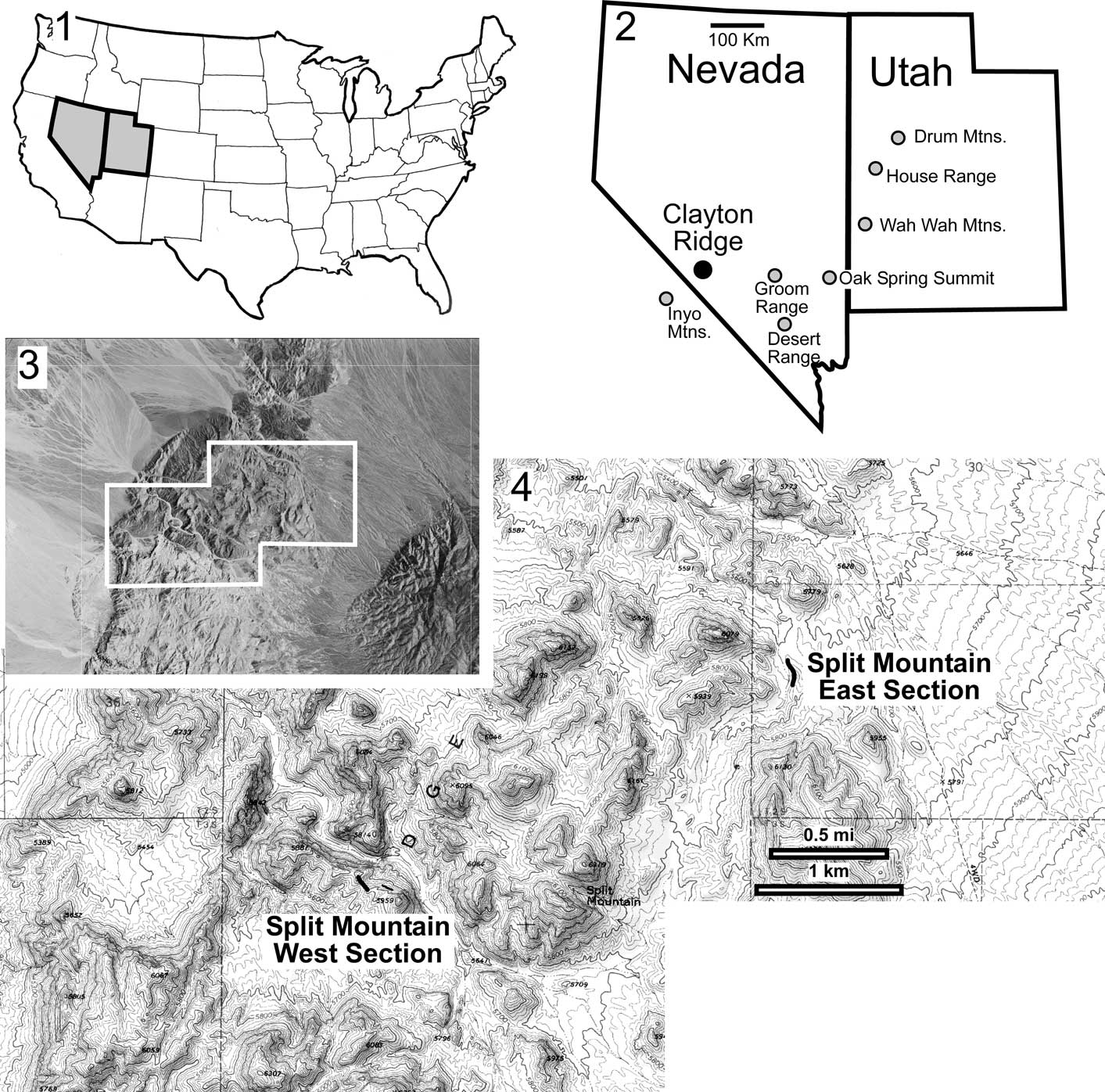
Detailed documentation of the faunas from the Emigrant Formation is generally lacking. Sundberg and McCollum (Reference Sundberg and McCollum1997, Reference Sundberg and McCollum2003b), Skovsted (Reference Skovsted2006), and Wotte and Sundberg (Reference Wotte and Sundberg2017) have illustrated the assemblages from the Bolbolenellus euryparia/Nephrolenellus multinodus (uppermost Dyeran Stage) to the Oryctocephalus indicus (lower Delamaran Stage) zones from the lowermost portion of the formation. Sundberg et al. (Reference Sundberg, Kurkewicz and Rooks2007) illustrated a fauna from the Elvinia Zone (Paibian Stage, Furongian Series) in the middle shale member. Other publications provided only faunal lists (e.g., McKee, Reference McKee1968; Palmer in Albers and Stewart, Reference Albers and Stewart1972; Sundberg et al., Reference Sundberg, McCollum and McCollum2011), which are insufficient to assess regional and international correlation. This study describes the trilobites from above the Oryctocephalus indicus Zone in the lower member from two closely spaced sections in Clayton Ridge, Nevada (Figs. 1, 2). These trilobites represent the Glossopleura walcotti/Ptychagnostus praecurrens (upper Delamaran Stage), Ehmaniella (Topazan Stage), and Cedaria selwyni and Cedaria brevifrons zones (Marjuman Stage; Guzhangian Stage).
Location map showing: (1, 2) location of Cambrian sections in California, Nevada, and Utah discussed in the text; (3) aerial photograph of a portion of Clayton Ridge showing the location of the topographic map; and (4) topographic map (part of the Split Mountain 7.5´ topographic quadrangle map, U.S. Geological Survey, 1991, 1:24,000 scale) showing the location of the Split Mountain East Section and the Split Mountain West Section, Clayton Ridge, Esmeralda County, Nevada, USA.

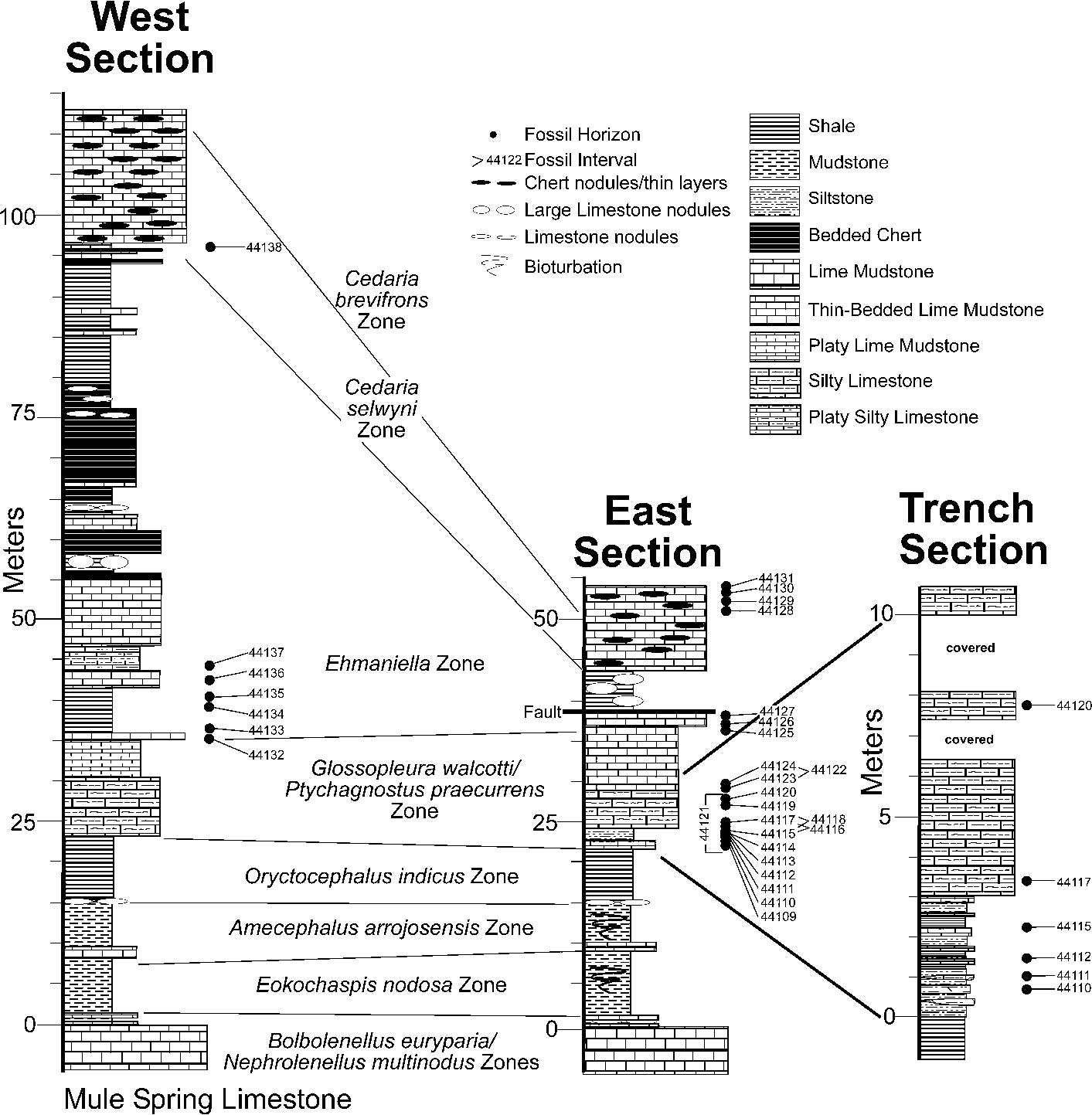
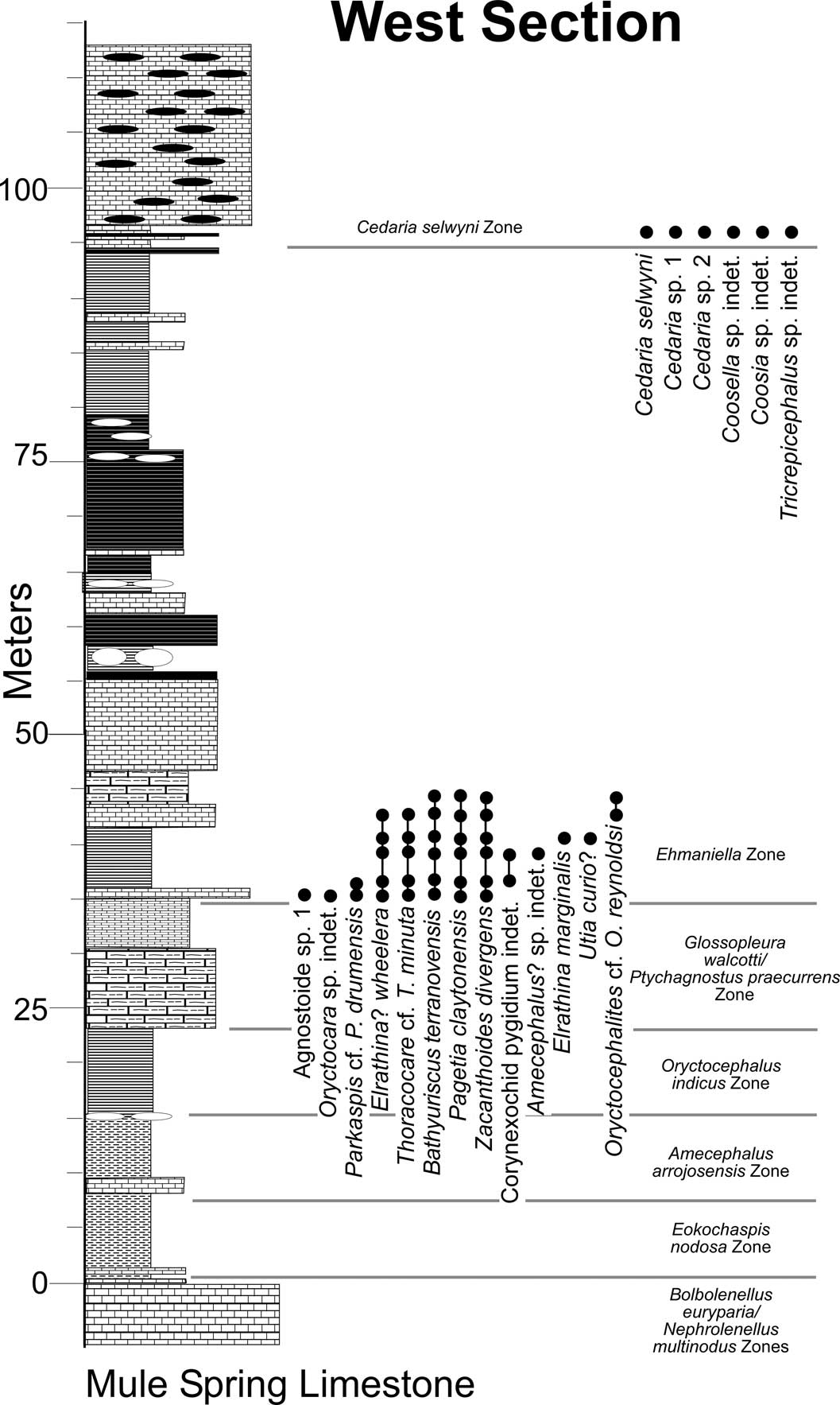
Stratigraphic sections of the lower member of the Emigrant Formation at the Split Mountain West and East sections and detailed stratigraphic section of a hand excavated trench at the lowermost portion of the Glossopleura walcotti/Ptychagnostus praecurrens Zone at the Split Mountain East Section, Clayton Ridge, Nevada.

Location
The Split Mountain East and Split Mountain West sections are located in western Esmeralda County, Nevada, USA. The Split Mountain East Section (Fig. 3.1) is 1.6 km NE of Split Mountain, Clayton Ridge, NW 1/4 Sec. 31, T2S, R41E, on the Split Mountain 7.5’ topographic quadrangle map (U.S. Geological Survey, 1970, 1:24,000 scale, Fig. 1); at ~37°43'27''N, 117°26’18”W. The section is on a low-lying ridge ~0.7 km N of an unnamed peak marked 6378, ~0.5 km SE of an unnamed peak marked 6079, and ~0.6 km S of an unnamed peak marked 5779 on the map. A supplementary trench section was collected ~20 m west of the East Section (Fig. 3.1, 3.2). This section documents 11 m of the transition from top of the gray shales through the orange, silty limestone beds. The Split Mountain West Section (Fig. 3.5–3.8) is 1.5 km E of Split Mountain, Clayton Ridge, unsurveyed area T3S and between R40E and R41E, on the Split Mountain 7.5’ topographic quadrangle map (U.S. Geological Survey, 1970, 1:24,000 scale, Fig. 1) and 3.3 km SW from the East Section; at ~37°42'38''N, 117°28'16''W. The section is on a ridge ~0.2 km NW of an unnamed peak marked 5959 and ~0.4 km S of an unnamed peak marked 5814 on the map.
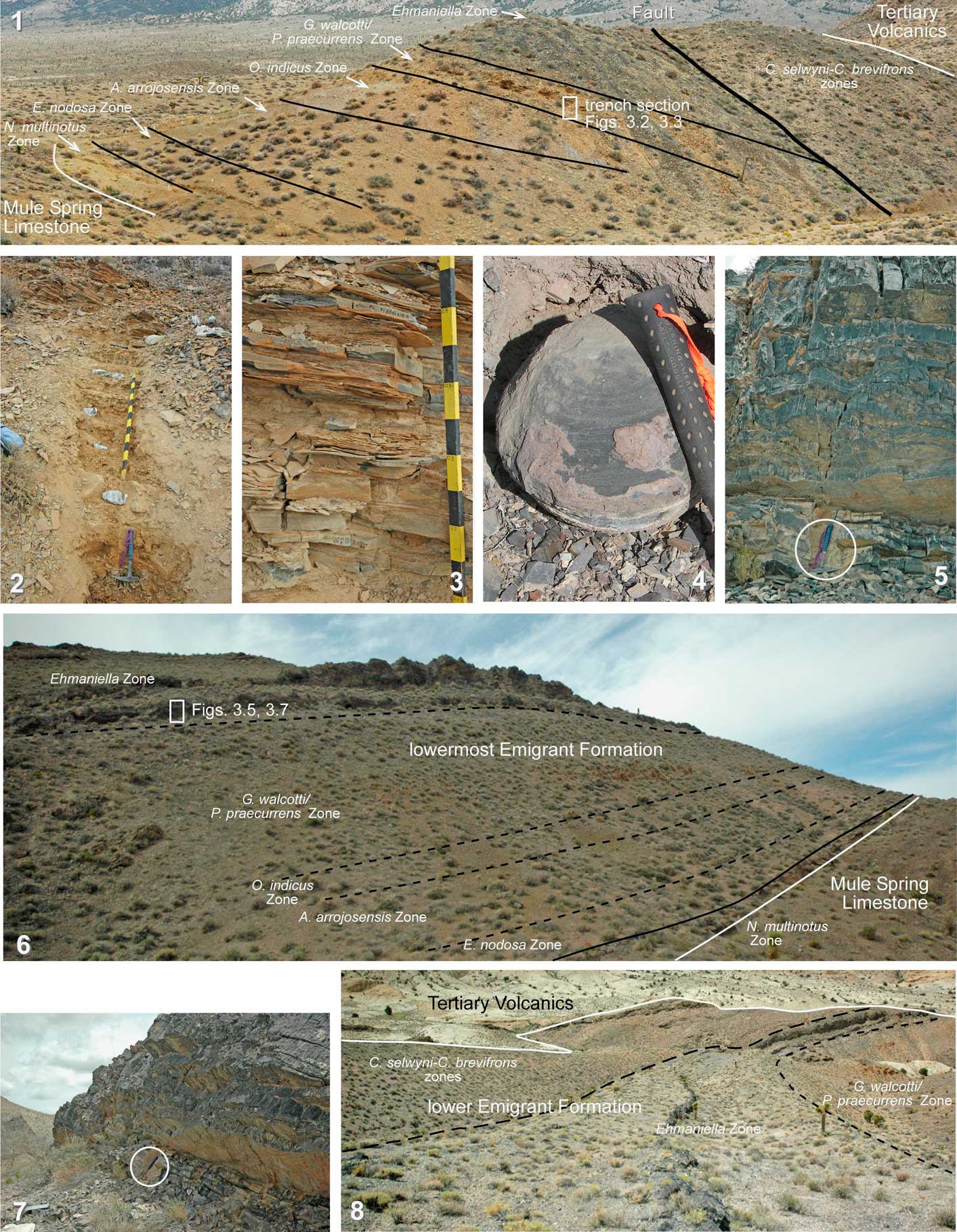
Outcrops of the lower member of the Emigrant Formation, Clayton Ridge, Nevada. (1–4) Split Mountain East Section: (1) section overview and location of additional trench section, majority of section measured along the top of ridge, view from the west looking east; (2) close-up of hand excavated trench at the base of the Glossopleura walcotti/Ptychagnostus praecurrens Zone (1.5 m Jacob Staff for scale); (3) thin to medium bedded, laminated, dark gray (N3), silty limestone with yellowish gray to grayish orange to silty beds in the upper part of the trench section (light/dark bands on Jacob Staff are 10 cm); (4) limestone concretion typical of the 40–45 m interval found between the faunas of the Ehmaniella and Cedaria selwyni zones. (5–8) Split Mountain West Section: (5, 7) close-up of medium bedded, medium dark gray (N4) ridge-forming limestone, the base of the Ehmaniella Zone (rock hammer for scale); (6) overview of the lower portion of the measured section and location of Figure 3.4 and 3.5, view from the northeast looking southwest; (8) overview of the upper portion of the measured section, view from the southeast looking northwest.

Stratigraphic and paleogeographic setting
Albers and Stewart (Reference Albers and Stewart1972, fig. 6) investigated sections outside of the Clayton Ridge that were incomplete and faulted, they estimated that the Emigrant Formation ranges from 1500 to 1800 m, based on carbonate platform shelfal sections inboard of Esmeralda County. However, well-exposed, unfaulted sections at Clayton Ridge (Fig. 1) and Paymaster Canyon have produced a much more reliable thickness of ~420 m (McCollum and McCollum, Reference McCollum and McCollum2011; Sundberg, Reference Sundberg2011; Sundberg et al., Reference Sundberg, McCollum and McCollum2011). Albers and Stewart (Reference Albers and Stewart1972) divided the Emigrant Formation into three informal members: lower limestone and siltstone, middle shale, and an upper limestone and chert members. In the Split Mountain West Section on Clayton Ridge, these members are 112 m, ~100 m, and 205 m in thickness, respectively. The faunas reported herein are only from the lower limestone and siltstone member. This member (Fig. 2) consists of a lower 20 m interval comprised of brown, green, to black shales, with minor limestone beds (Fig. 3.6); 20 m of black shales, thin silty limestones, and lime mudstones, overlain by 31 m of a mostly covered section with outcrops of lime mudstones and chert (Fig. 3.5, 3.7); and an upper 41 m of cherty limestones (Fig. 3.8). The Split Mountain East Section is ~55 m in thickness due to a fault that cuts out most of the lime mudstones and cherts below the cherty limestones (Figs. 2, 3.1).
The 420 m thick Emigrant Formation represents an outer shelf environment that is condensed (McCollum and McCollum, Reference McCollum and McCollum2011; Sundberg, Reference Sundberg2011; Sundberg et al., Reference Sundberg, McCollum and McCollum2011) when compared to temporally equivalent shelfal sections. The Emigrant Formation is only 14% the thickness of equivalent-age strata in the ~3000 m thick shelf section in the House Range, Utah (Hintze, Reference Hintze1988; Hintze and Kowallis, Reference Hintze and Kowallis2009) and the 3050 m thick shelf section in the Toano Range near Wendover, Nevada (McCollum and Miller, Reference McCollum and Miller1991). The lower member of the Emigrant Formation ranges only from 7–9% of thickness of sections in the Inyo Mountains, California; Groom Range, Oak Spring Summit, Desert Range, Toano Range, Nevada; and Wah Wah Mountains, House Range, and Drum Mountains, Utah (data from Merriam, Reference Merriam1964; Ross, Reference Ross1965; Barnes and Christiansen, Reference Barnes and Christiansen1967; Palmer and Halley, Reference Palmer and Halley1979; Dommer, Reference Dommer1980; Rees, Reference Rees1986; Sundberg, Reference Sundberg1990, Reference Sundberg1991, Reference Sundberg1994, Reference Sundberg2011; McCollum and Miller, Reference McCollum and Miller1991; Osleger et al., Reference Osleger, Montañez, Martin-Chivelet and Lehmann1996; Sundberg and McCollum, Reference Sundberg and McCollum1997, Reference Sundberg and McCollum2000, Reference Sundberg and McCollum2003a; Hintze and Kowallis, Reference Hintze and Kowallis2009; McCollum and McCollum, Reference McCollum and McCollum2011; Miller et al., Reference Miller, Evans and Dattilo2012). However, these percentages are relatively high as a result of these shelfal sections not having detailed biostratigraphy in the lower portions. If biozone thicknesses are compared, then it is apparent that the lower Delamaran Eokochaspis nodosa and Amecephalus arrojosensis zones are relatively thicker, with ~25% and 55%, respectively, of the thickest equivalent-age strata in the Pioche, Nevada area. This indicates that decreased sedimentation began with the flooding event at the beginning of the O. indicus biochron and the subsequent build-ups of the carbonate banks in shelfal environments in Nevada and Utah (Miller et al., Reference Miller, Evans and Dattilo2012).
Preservation
The trilobite material from the Eokochaspis nodosa to Oryctocephalus indicus zones in the lower third of the lower member (Sundberg and McCollum, Reference Sundberg and McCollum2003b) contain abundant, unbroken specimens in both shales and limestones. Articulated specimens also occur in these assemblages. In contrast, the trilobites studied herein from the Glossopleura walcotti/Ptychagnostus praecurrens to Cedaria brevifrons zones are rare, fragmented, disarticulated sclerites and commonly scattered on a single bedding plain. Eodiscoid cranidia and pygidia are commonly unfragmented due to their small size. In contrast, agnostoids, corynexochids, and ptychoparioids are fragmented. Despite the detailed sampling of the interval, the amount of identifiable material collected is limited due to this fragmentation and the general rarity of fossil-bearing horizons. For this reason, material not found in situ, but which can be assigned to a lithologic interval, are included herein.
Biostratigraphy
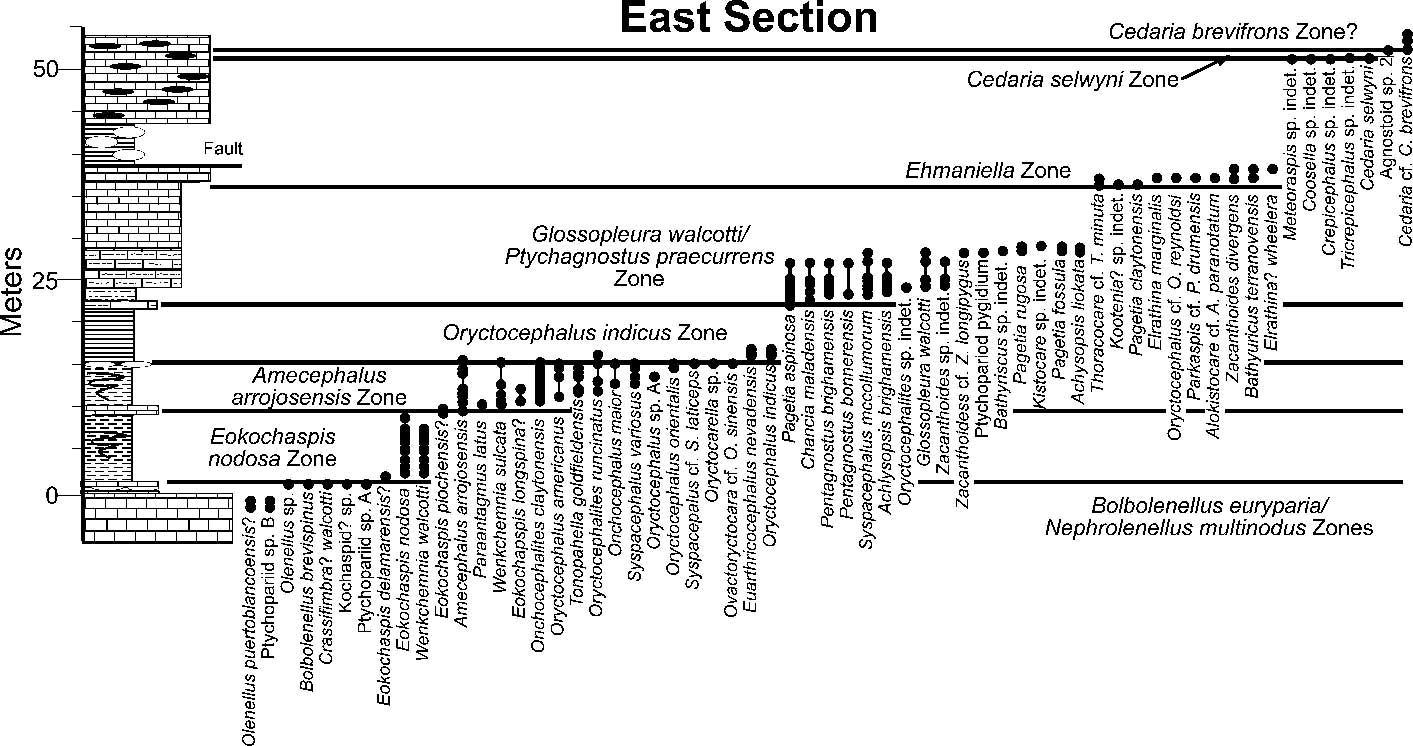
Faunas from the Clayton Ridge area indicate that the lower member of the Emigrant Formation ranges from the uppermost Stage 4, Series 2 (Laurentian Dyeran Stage: Bolbolenellus euryparia/Nephrolenellus multinodus zones, Sundberg and McCollum, Reference Sundberg and McCollum2003b; Sundberg et al., Reference Sundberg, McCollum and McCollum2011; Webster, Reference Webster2011) to Drumian Stage, Series 3 (Laurentian Marjuman Stage: Cedaria selwyni to C. brevifrons zones, Sundberg et al., Reference Sundberg, McCollum and McCollum2011). Sundberg and McCollum (Reference Sundberg and McCollum2003b) reported basal Delamaran trilobites from the Eokochaspis nodosa, Amecephalus arrojosensis, and Oryctocephalus indicus zones as defined by McCollum and Sundberg (Reference McCollum and Sundberg2007). Described herein (Figs. 4, 5) are the trilobite faunas from the upper Delamaran Stage (Glossopleura walcotti/Ptychagnostus praecurrens zones), Topazan Stage (Ehmaniella Zone), and the Marjuman Stage (Cedaria selwyni to C. brevifrons zones) that were originally reported by Sundberg et al. (Reference Sundberg, McCollum and McCollum2011).
Trilobite ranges in the lower member of the Emigrant Formation at the Split Mountain East Section, Clayton Ridge, Nevada. The biostratigraphic ranges of trilobites in the Bolbolenellus euryparia/Nephrolenellus multinodus to Oryctocephalus indicus zones are slightly modified from Sundberg and McCollum (Reference Sundberg and McCollum2003b). See Figure 2 for key.

Trilobite ranges in the lower member of the Emigrant Formation at the Split Mountain West Section, Clayton Ridge, Nevada. Placement of the Bolbolenellus euryparia/Nephrolenellus multinodus to Glossopleura walcotti/Ptychagnostus praecurrens zones are based on field inspections of fossiliferous material and lithological correlation to the Split Mountain East Section. See Figure 2 for key.

Glossopleura walcotti/Ptychagnostus praecurrens Zone.—McCollum and Sundberg (Reference McCollum and Sundberg2007) subdivided the Laurentian Delamaran Stage into open-shelf and restricted-shelf (=inner shelf of McCollum and McCollum, Reference McCollum and McCollum2011; Sundberg, Reference Sundberg2011) faunal zones based on species, each with its own distinctive assemblage. In ascending order, they are the open-shelf Eokochaspis nodosa and Amecephalus arrojosensis zones, followed by the open-shelf Oryctocephalus indicus and Ptychagnostus praecurrens zones, which temporally overlap with the inner-shelf Poliella denticulata, Mexicella mexicana, and Glossopleura walcotti zones. Assemblages from the 24–29 m interval of the Emigrant Formation contain several taxa that have been found in the Glossopleura walcotti Zone (Rasetti, Reference Rasetti1966; Fritz, Reference Fritz1968; Palmer and Halley, Reference Palmer and Halley1979; Sundberg, Reference Sundberg2011). These include Achlysopsis brighamensis (Resser, Reference Resser1939a), A. liokata Fritz, Reference Fritz1968, Chancia maladensis (Resser, Reference Resser1939b), Glossopleura walcotti Poulsen, Reference Poulsen1927, Pagetia fossula Resser, Reference Resser1938a, and Pagetia rugosa Rasetti, Reference Rasetti1966. The occurrence of Pentagnostus brighamensis (Resser, Reference Resser1939a) and P. bonnerensis (Resser, Reference Resser1938a) indicates the Ptychagnostus praecurrens Zone (see Sundberg, Reference Sundberg2011).
Ehmaniella Zone.—
Several fossil specimens have been recovered from the 34–45 m interval. Taxa such as Alokistocare cf. A. paranotatum Rasetti, Reference Rasetti1951, Bathyuriscus terranovensis Young and Ludvigsen, Reference Young and Ludvigsen1989, Elrathina marginalis Rasetti, Reference Rasetti1951, Elrathina? wheelera Sundberg, Reference Sundberg1994, Oryctocephalites cf. O. reynoldsi (Reed, Reference Reed1899), Parkaspis cf. P. drumensis Sundberg, Reference Sundberg1994, and Zacanthoides divergens Rasetti, Reference Rasetti1951, indicate the Altiocculus Subzone of the Ehmaniella Zone of Sundberg (Reference Sundberg1994). However, specimens of Oryctocara, Thoracocare, and Utia occur in the assemblage as well. These genera have previously been found only from the Spence Shale, upper Albertella and lower Glossopleura Zones in Idaho, Utah, and Nevada (Resser, Reference Resser1939a, Reference Resserb; Campbell, Reference Campbell1974; Robison and Campbell, Reference Robison and Campbell1974). The faunas from the uppermost portion of the Swasey Limestone and correlatives occur with a eustatic deepening event that progresses during deposition of the overlying Wheeler Shale and correlatives (Sundberg, Reference Sundberg1990, Reference Sundberg1991, Reference Sundberg1994). Most of the age-equivalent trilobites in the lower member of the Emigrant Formation are found in the incursions of open ocean environments, as in the Swasey–Wheeler transition and in the Spence Shale. The diversity of fossils in the Emigrant may indicate that taxa ranges are incompletely represented in the Swasey–Wheeler and Spence Shale sequences, and the trilobites in the Emigrant Formation may represent any of the subzones in the Ehmaniella Zone.
Cedaria selwyni to C. brevifrons zones.—
Few fossil specimens have been recovered from the 45–50 m interval at the Split Mountain section and the 95 m interval at the Split Mountain West Section that indicate the Cedaria selwyni to C. brevifrons zones. The vast majority of the specimens are fragmented, but diagnostic taxa include: Cedaria selwyni Pratt, Reference Pratt1992, Cedaria cf. C. brevifrons Palmer, Reference Palmer1962, Cedaria sp. indet., Crepicephalus sp. indet., Coosella sp. indet., Coosia sp. indet., Tricrepicephalus sp. indet., and Meteoraspis sp. indet. Cedaria selwyni is found at 47 m, whereas Cedaria cf. C. brevifrons occurs at 48–50 m in the Split Mountain section. This suggests the C. selwyni Zone occurs just below the C. brevifrons Zone (Pratt, Reference Pratt1992). These zones span the traditional upper Cedaria to Crepicephalus zones of the Great Basin of the Marjuman Stage (Ludvigsen and Westrop, Reference Ludvigsen and Westrop1985; Pratt Reference Pratt1992).
Materials and methods
Illustrated specimens have been coated with colloidal graphite and then ammonium chloride sublimate, unless otherwise mentioned.
Repositories and institutional abbreviations
Institutional abbreviations are: USNM=United States National Museum; USGS=United States Geological Survey; CO=Cambrian/Ordovician collections of the USGS; LACMIP=Los Angeles County Museum Invertebrate Paleontology; GSC=Geological Survey of Canada. All specimens discussed within this paper have been deposited at the USNM.
Systematic paleontology
Order Agnostida Salter, Reference Salter1864
Suborder Agnostina Salter, Reference Salter1864
Superfamily Agnostioidae M’Coy, Reference M’Coy1849
Family Peronopsidae Westergård, Reference Westergård1936
Genus Pentagnostus Lermontova, Reference Lermontova1940
Type species
Pentagnostus anabarensis Lermontova, Reference Lermontova1940, from the Anabar region (neither exact location nor formation listed on specimen labels or in text; E.L. Naimark, personal communication, 2017), Siberia, by original designation.
Pentagnostus brighamensis (Resser, Reference Resser1939a)
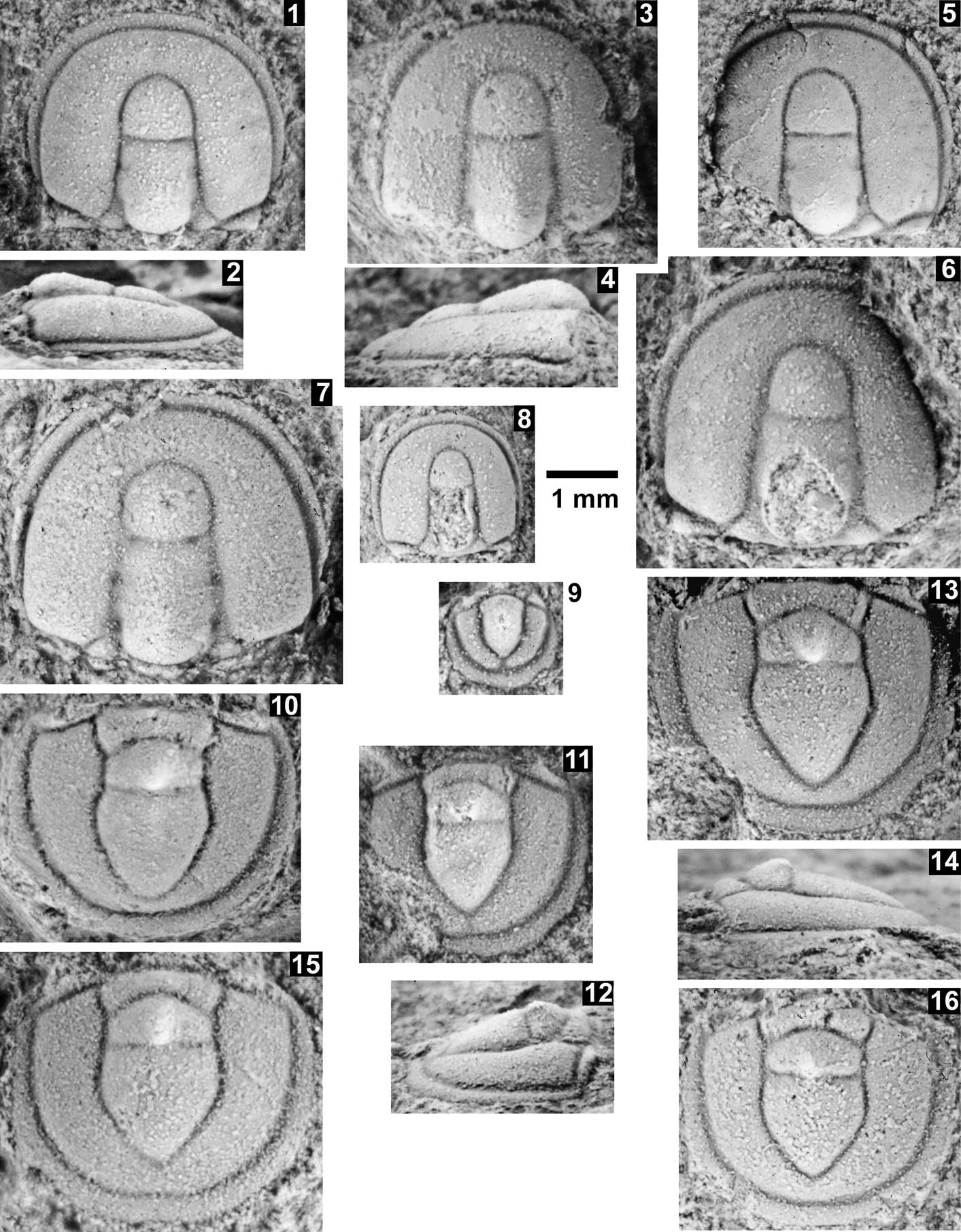
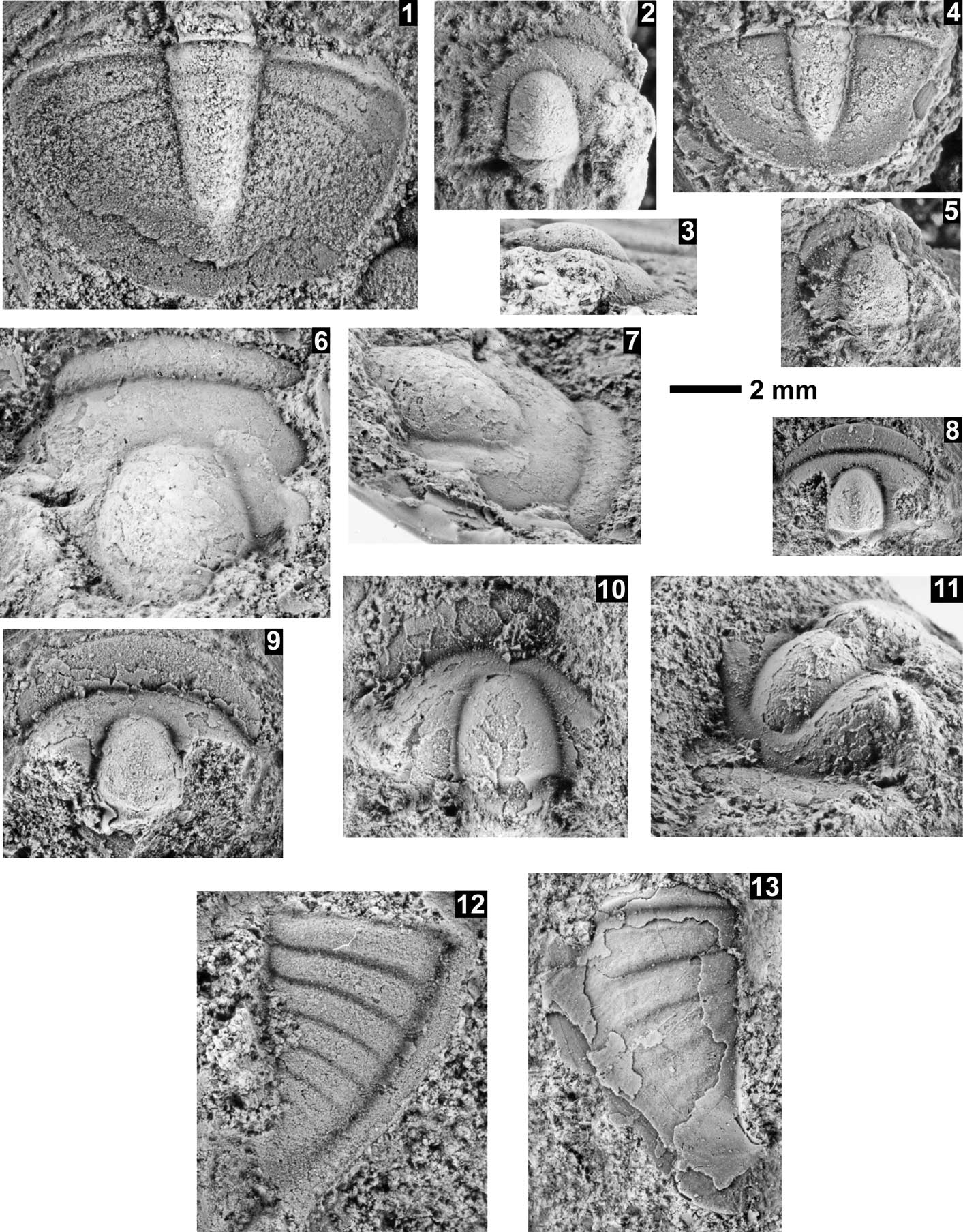
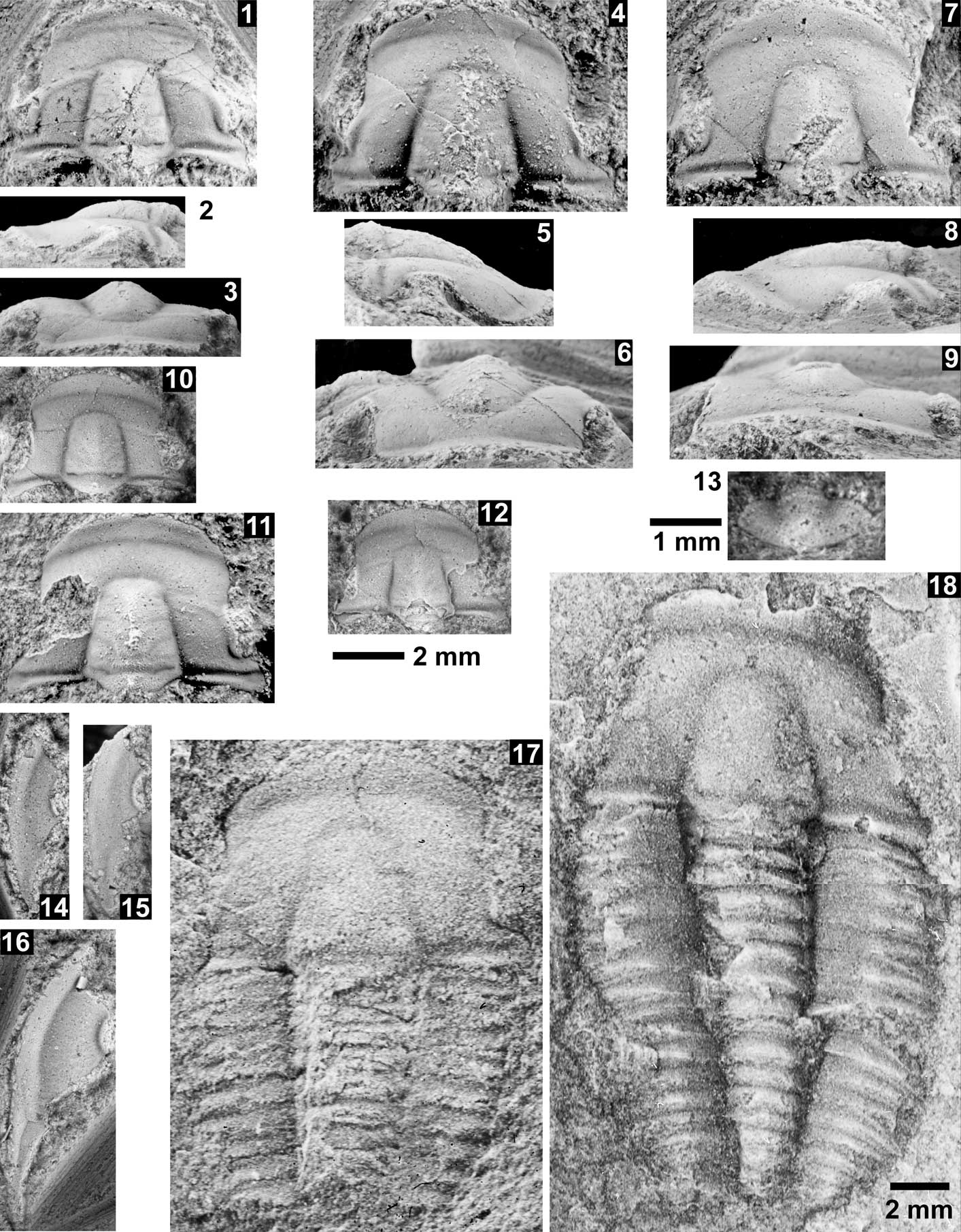
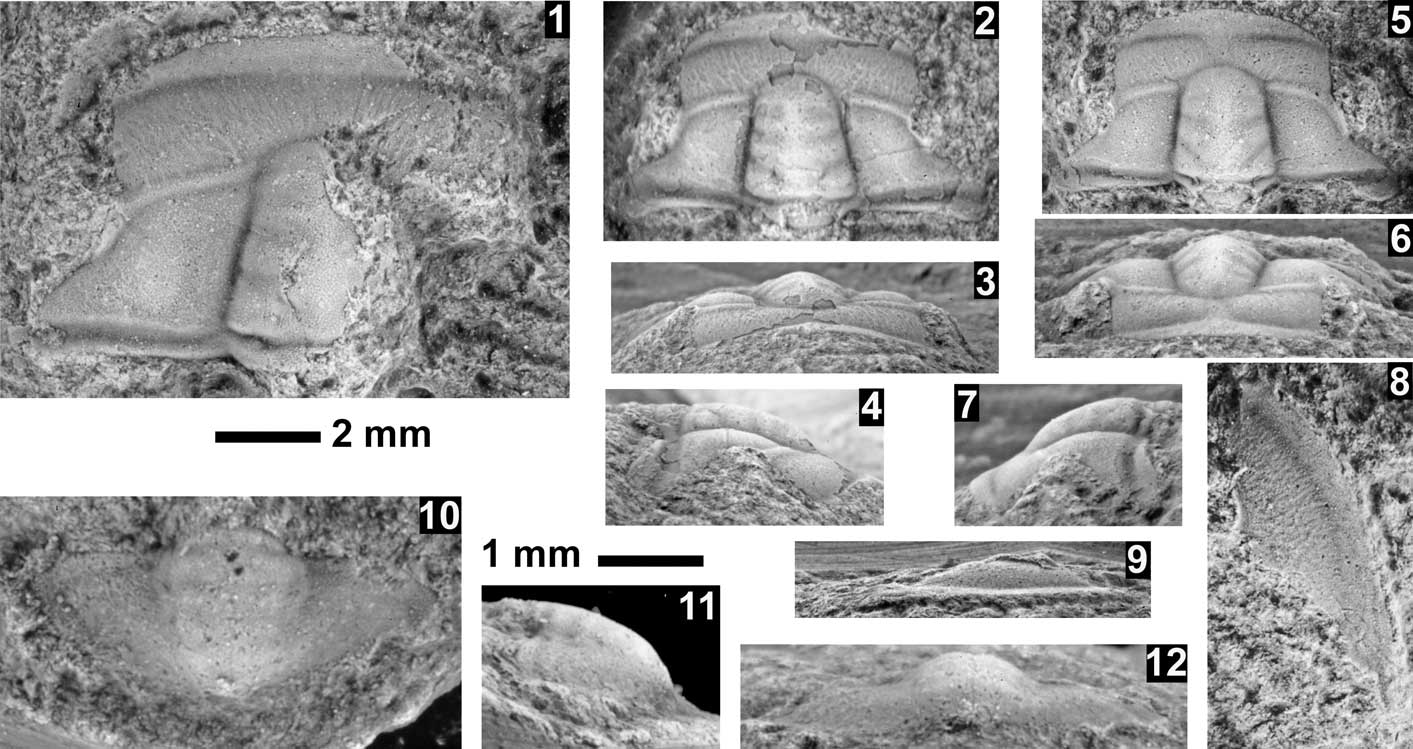
Pentagnostus brighamensis (Resser, Reference Resser1939a) from the Glossopleura walcotti/Ptychagnostus praecurrens Zone, Split Mountain East Section, Emigrant Formation, Clayton Ridge, Nevada. (1, 2) Testate cephalon USNM 644024 (USNM loc. 44119), plan and lateral view; (3, 4) partially testate cephalon USNM 644031 (USNM loc. 44113), plan and lateral view; (5) latex cast of testate cephalon USNM 644033 (USNM loc. 44119); (6) testate cephalon USNM 644030 (USNM loc. 44113); (7) testate cephalon USNM 644034 (USNM loc. 44118); (8) testate cephalon USNM 644025 (USNM loc. 44119); (9) small, testate pygidium USNM 644027 (USNM loc. 44119) illustrating post axial sulcus; (10) testate pygidium USNM 644029 (USNM loc. 44113); (11, 12) testate pygidium USNM 644022 (USNM loc. 44117) illustrating post axial sulcus, plan and lateral views; (13, 14) testate pygidium USNM 644023 (USNM loc. 44117), plan and lateral views; (15) testate pygidium USNM 644028 (USNM loc. 44113); (16) testate pygidium USNM 644036 (USNM loc. 44117).

1939a Agnostus brighamensis Reference ResserResser, p. 8, pl. 2, figs. 27–29.
1978 Peronopsis brighamensis; Reference RobisonRobison, pl. 1, figs. 7, 11, 14.
1979 Peronopsis? sp., Reference Palmer and HalleyPalmer and Halley, p. 76, pl. 12, fig. 7.
2004 Pentagnostus brighamensis; Reference LaurieLaurie, p. 228.
2012 Pentagnostus (Pentagnostus) brighamensis; Reference NaimarkNaimark, figs. 1, 4a, b.
Holotype
Pygidium (USNM 96500, includes paratypes) from the Spence Shale, Wasatch Mountains, Utah (USNM loc. 20x; Resser, Reference Resser1939a, pl. 2, fig. 27).
Occurrence
Spence Shale (Glossopleura walcotti Zone), Wasatch Mountains, Utah (Resser, Reference Resser1939a). Red Pass Limestone Member, Carrara Formation (Albertella Zone), Belted Range, Nevada (Palmer and Halley, Reference Palmer and Halley1979). Emigrant Formation (Glossopleura walcotti/Ptychagnostus praecurrens Zone), Split Mountain, Nevada.
Materials
Split Mountain East Section: USNM loc. 44113–14 cephala, seven pygidia; USNM loc. 44114–five cephala, four pygidia; USNM loc. 44116–three cephala, pygidium; USNM loc. 44117–cephalon, seven pygidia; USNM loc. 44118–cephalon; USNM loc. 44119–14 cephala, 17 pygidia; USNM loc. 44121–cephalon.
Remarks
Pentagnostus brighamensis is similar to P. bonnerensis, but differs in the pygidium having a shorter axis that does not reach the border furrow, absence of a postaxial median furrow, F1 without a pronounce medial shallowing, and F2 that is nearly straight. The pygidium illustrated by Palmer (in Palmer and Halley, Reference Palmer and Halley1979) shows the same characteristic as the pygidia illustrated here.
Naimark (Reference Naimark2008, p. 391) suggested that Pentagnostus proanabarensis Fedoseev, Reference Fedoseev1999, “is either a synonym of Peronopsis brighamensis, or is very closely related to the latter.” This relationship between the two species was later restated (Naimark, Reference Naimark2012, p. 957) as Pentagnostus proanabarensis “is probably a junior synonym of Peronopsis brighamensis,” although later in the same paper (p. 1006, 1043), she equated the two species. Pentagnostus proanabarensis, illustrated in Fedoseev (Reference Fedoseev1999, pl. 1, figs. 1, 3, 5–13), differs from P. brighamensis from the Spence Shale and Emigrant Formation in the cranidium being narrower (trans.), the glabella expanding posteriorly and having a nearly rounded anterior lobe and a deep F3 transglabellar furrow, and the pygidium being narrower (trans.) with a rounded outline of the posterior lobe and an absence of posterolateral border spines. Pentagnostus proanabarensis is not considered here as a junior synonym of P. brighamensis.
Naimark (Reference Naimark2006, Reference Naimark2012, fig. 1) illustrated the late meraspid of P. proanabarensis as having a median postaxial furrow from the end of the axis to the anterior border furrow. This furrow is also present on two samples from the Emigrant Formation (Fig. 6.8, 6.11). Laurie (Reference Laurie2004) and Naimark (Reference Naimark2012, p. 1006, 1012) also assigned this species to Pentagnostus (Pentagnostus) Lermontova, Reference Lermontova1940.
Pentagnostus bonnerensis (Resser, Reference Resser1938a)
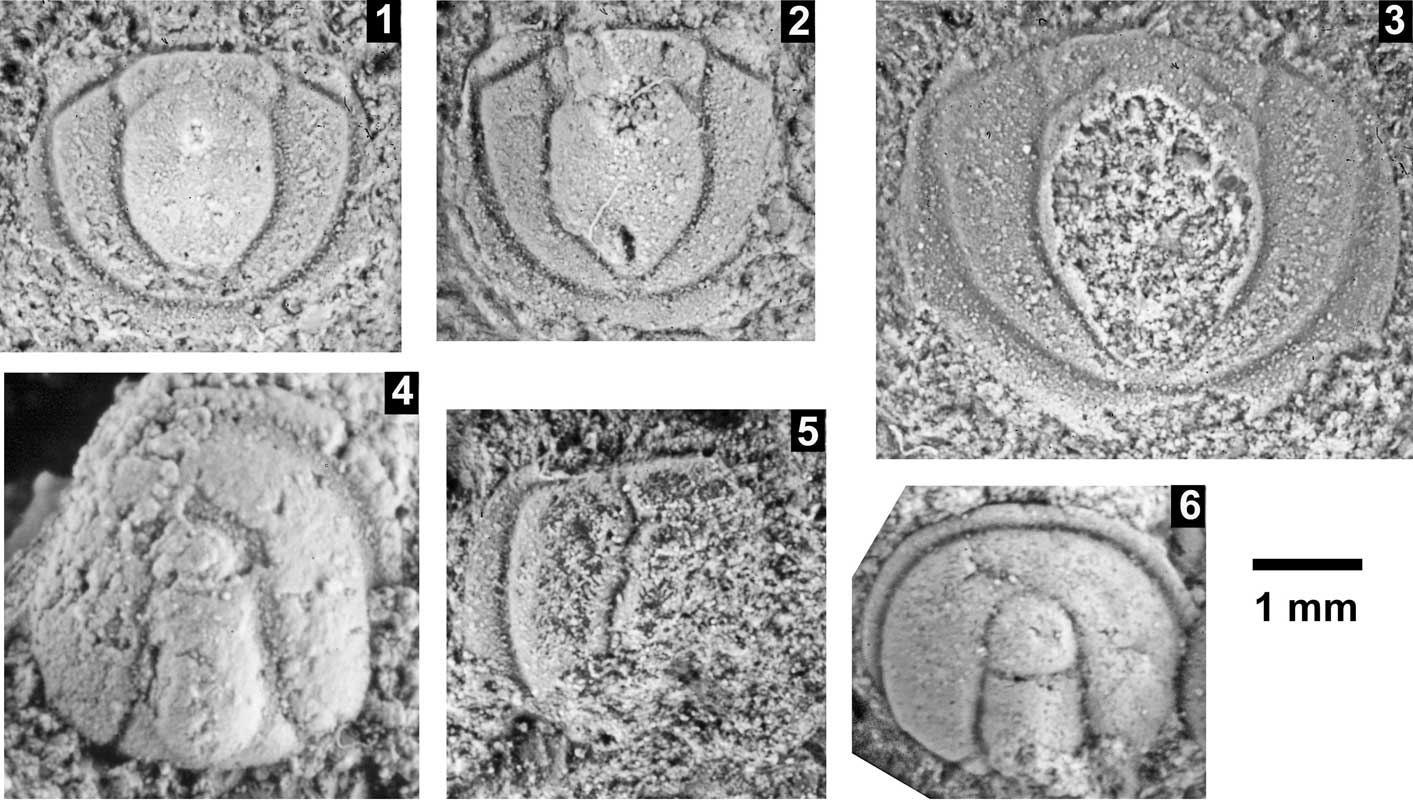
Agnostoid species from the Emigrant Formation, Clayton Ridge, Nevada. (1–3) Pentagnostus bonnerensis (Resser, Reference Resser1938a), Glossopleura walcotti/Ptychagnostus praecurrens Zone, Split Mountain East Section: (1) mostly exfoliated pygidium USNM 644032 (USNM loc. 44113); (2) mostly exfoliated pygidium USNM 644035 (USNM loc. 44119); (3) mostly testate pygidium USNM 644026 (USNM loc. 44119). (4) Agnostoid sp. 2, mostly testate cephalon USNM 644039, Cedaria brevifrons Zone, Split Mountain East Section, (USNM loc. 44129 ). (5, 6) Agnostoid sp. 1, Ehmaniella Zone, Split Mountain West Section, (USNM loc. 44132): (5) poorly preserved, fragmented pygidium USNM 644037; (6) testate cephalon USNM 644038.

1938a Agnostus bonnerensis Reference ResserResser, p. 1, pl. 1 figs. 16, 17.
1939a Agnostus bonnerensis; Reference ResserResser, p. 8, pl. 2, figs. 24–26.
1979 Peronopsis bonnerensis; Reference Palmer and HalleyPalmer and Halley, p. 76, pl. 12, figs 11, 15.
2012 Pentagnostus (Meragnostus) bonnerensis; Reference NaimarkNaimark, figs. 16a, b.
Holotype
USNM 95025, Lakeview Limestone, east shore of Pend Oreille Lake, Idaho (USNM loc. 37n; Resser Reference Resser1938a, pl. 1, fig. 17). Paratypes are also listed under USNM 95025.
Occurrence
Lakeview Limestone (Glossopleura walcotti Zone), Pend Oreille Lake, Idaho. Spence Shale (Glossopleura walcotti Zone), Wasatch Mountains, Utah (Resser, Reference Resser1939a; Campbell, Reference Campbell1974). Red Pass Limestone Member, Carrara Formation (Albertella Zone), Belted Range, Nevada (Palmer and Halley, Reference Palmer and Halley1979). Emigrant Formation (Glossopleura walcotti/Ptychagnostus praecurrens Zone), Split Mountain, Nevada.
Materials
Split Mountain East Section, USNM loc. 44113–pygidium; USNM loc. 44119–two pygidia.
Remarks
Three pygidia from the Split Mountain East Section have moderate-depth S1 furrows that are obsolescent medially, obscure or absent S2 furrows, a medially expanded posterior lobe, an axis nearly reaching the posterior border, short postaxial sulcus, and short marginal spines. These character states are identical to the type and topotype material of Pentagnostus bonnerensis. It is unclear which cephala belong to this species and some of the material illustrated as P. brighamensis (Fig. 6) may represent P. bonnerensis.
These specimens are also similar to ?Euagnostus aff. taijiangensis (Huang and Yuan, Reference Huang and Yuan1994) in Laure (2006, p. 148, fig. 20) with the exception of the development of the S1 furrow. However, Pentagnostus bonnerensis differs in the pygidium having a shorter axis that does not reach the border furrow, absence of a postaxial median furrow, F1 without a pronounced medial shallowing, and F2 that is nearly straight. Laurie (Reference Laurie2006, p. 150) did assign his material from Australia to ?E. taijiangensis due to the poor preservation of the type material. In addition, most specimens from the Kaili Formation of Guizhou, South China, are tectonically distorted, flattened, and preserved in shale (personal observation).
Agnostoid sp. 1
Occurrence
Emigrant Formation (Ehmaniella Zone), Split Mountain, Nevada.
Materials
Split Mountain West Section, USNM loc. 44132–cephalon, pygidium.
Remarks
A single cranidium and a poorly preserved pygidium occur in the Ehmaniella Zone. The specimens are similar to Pentagnostus brighamensis, but the pygidium is too poorly preserved to identify it to a species or genus.
Agnostoid sp. 2
Occurrence
Emigrant Formation (Cedaria brevifrons Zone), Split Mountain, Nevada.
Material
Split Mountain East Section, USNM loc. 44129–cephalon.
Remarks
A single, poorly preserved cranidium occurs in the Cedaria brevifrons Zone and cannot be identified to species or genus.
Suborder Eodiscina Kobayashi, Reference Kobayashi1939
Superfamily Eodiscoidea Raymond, Reference Raymond1913
Family Eodiscidae Raymond, Reference Raymond1913
Genus Pagetia Walcott, Reference Walcott1916b
Type species
Pagetia bootes Walcott, Reference Walcott1916b, from the Stephen Formation, Burgess Shale, Mount Field, British Columbia, by original designation.
Remarks
Pagetia is represented in the Clayton Ridge by four species: P. aspinosa n. sp.; P. claytonensis n. sp.; P. fossula Resser, Reference Resser1938a; and P. rugosa Rasetti, Reference Rasetti1966. The latter three species are typical of Pagetia. However, P. aspinosa differs from other species by the absence of a pygidial axial spine. The absence of this spine is one of the criteria for the identification of Pagetides Rasetti, Reference Rasetti1945; however, as discussed below, some taxa that have been assigned to Pagetides have extended the original concept of the genus to a range that appears to make it useless as a natural entity.
Pagetia is similar to Neopagetina Pokrovskaya, Reference Pokrovskaya1960, and Pagetides. The differentiation of these genera has been discussed by, among others, Rasetti (Reference Rasetti1967) and Palmer (Reference Palmer1968). The diagnosis of Pagetides Rasetti, Reference Rasetti1945, was redefined by Palmer (Reference Palmer1968, p. 36) as “Pagetidae that have a well-developed, strongly upturned occipital spine and well-defined palpebral furrows, and that lack significant development of axial pygidial spines.” Palmer and Gatehouse (Reference Palmer and Gatehouse1972, p. D11) discussed the variable development of the medially expanded cranidial boarder, which is present in the type species Pagetides elegans Rasetti, Reference Rasetti1945, but absent in some other species. This suggests that the only difference between Pagetides and Pagetia is the lack of an upturned occipital spine and the presence of a pygidial spine in the latter. This is further complicated in that Pagetides? antarcticus Palmer and Gatehouse, Reference Palmer and Gatehouse1972, does not have an upturned occipital spine. If this species is regarded as a species of Pagetides (also see discussion by Jell, Reference Jell1975, p. 19), then the only difference between the two genera is the presence of a pygidial spine. Given the variation in the strength and length of these pygidia spines in established species of Pagetia and their proposed loss within the Pagetia lineage (Jell, Reference Jell1975, p. 17, fig. 7), the absence of this spine appears to be of trivial significance. This is not to state that Pagetides and Pagetia should be synonymized, but that a phylogenetic study should be undertake to see if distinct clades can be formed from the Pagetides elegans to the Pagetia bootes morphologies or if the variety of species form a continuum, as seen in the genus Oryctocephalites Resser, Reference Resser1939b (Sundberg, Reference Sundberg2014). At present, the presence of the prominent swelling and medial expansion of the anterior boarder seen in Pagetides elegans, P. rupestris Rasetti, Reference Rasetti1967, P. minutus Rasetti, Reference Rasetti1967, P. leiopygus Rasetti, Reference Rasetti1967, and P. amplifrons Rasetti, Reference Rasetti1967 may be more important to defining a genus than the presence or absence of a pygidial axial spine.
Measurements of Pagetia cranidia differ from those of other trilobites given the unique morphology of eodiscoids. Glabellar tapering is based on the width (trans.) of L1 versus the width at the transglabellar furrow (S3). The preglabellar area is divided into three portions with measurements (sag.) of the anterior border, border furrow, and from the frontal lobe to the anterior edge of the anterior portion of the fixigena. Length (exsag.) and width (trans.) of the posterior region of the fixigena are measured from the glabellar furrow adjacent to the L1 to the posterior section of the facial suture below the palpebral lobe. The tapering of the pygidial axis is expressed by the width (trans.) of the anterior axial ring versus the greatest width of the terminal piece.
Diagnoses of Pagetia species have also been extended due to the multitude of species recognized. This allows for the complete comparison of species instead of just comparison to morphologically similar species, as typically given (e.g., Rasetti, Reference Rasetti1966; Jell, Reference Jell1975; Laurie, Reference Laurie2006).
Pagetia aspinosa new species
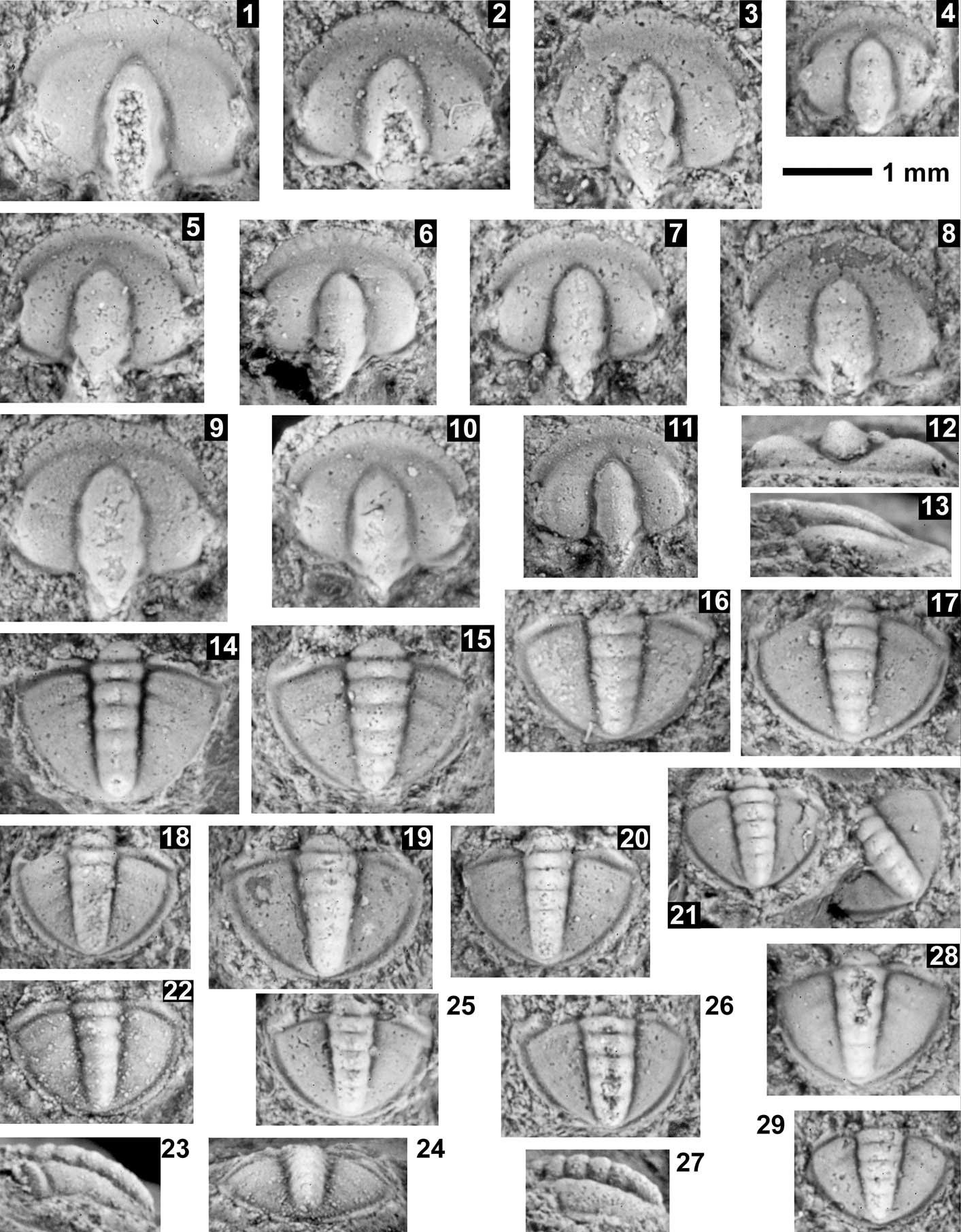
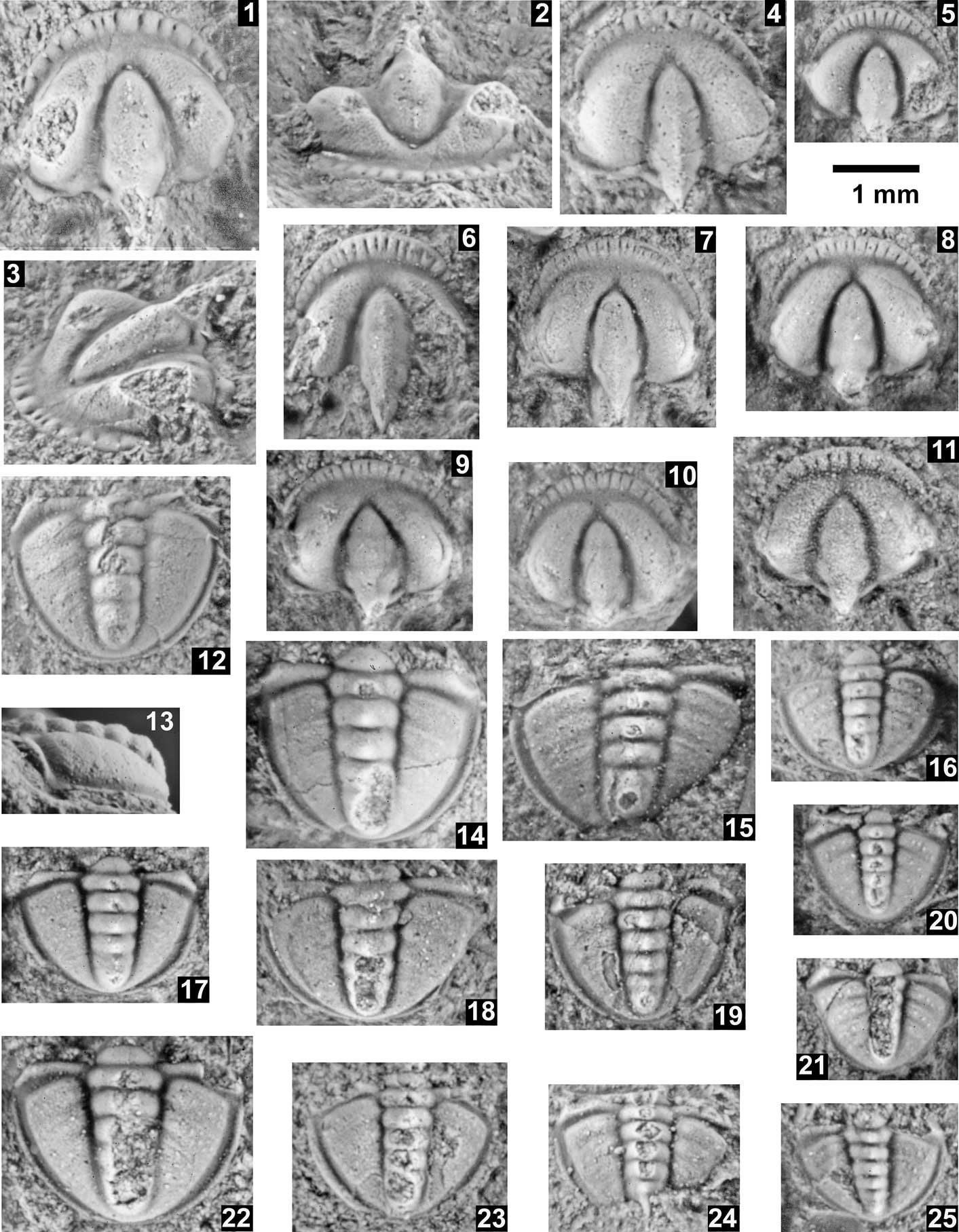
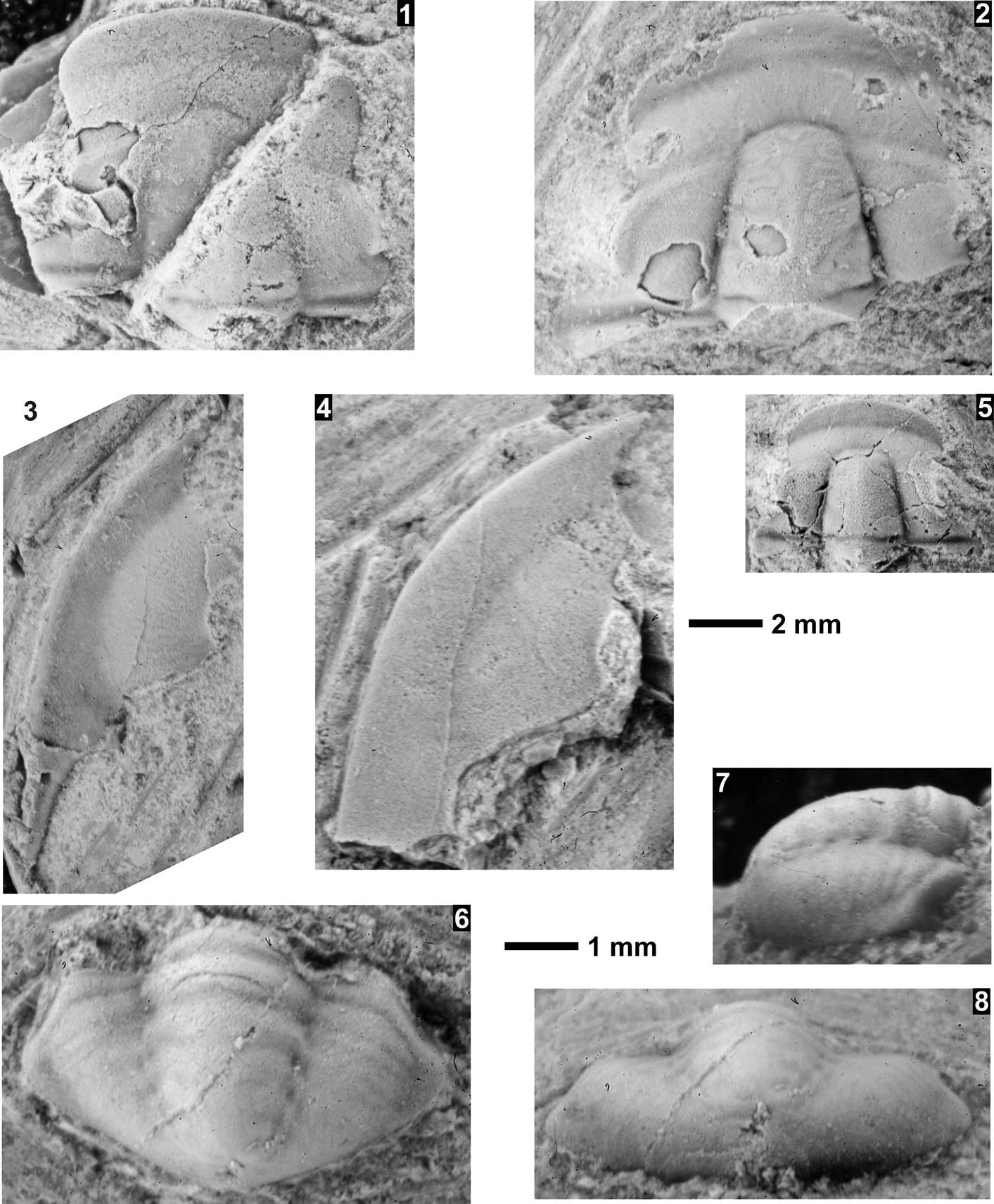
Pagetia aspinosa n. sp. from the Glossopleura walcotti/Ptychagnostus praecurrens Zone, Emigrant Formation, Clayton Ridge, Nevada. (1) Exfoliated paratype cranidium USNM 643850 (USNM loc. 44121); (2) mostly testate paratype cranidium USNM 643865 (USNM loc. 44119); (3) mostly testate paratype cranidium USNM 643872 (USNM loc. 44119); (4) mostly testate paratype cranidium USNM 643861 (USNM loc. 44119); (5) mostly testate paratype cranidium USNM 643875 (USNM loc. 44113); (6) mostly testate paratype cranidium USNM 643846 (USNM loc. 44121); (7) testate paratype cranidium USNM 643859 (USNM loc. 44119); (8) mostly testate paratype cranidium USNM 643860 (USNM loc. 44119); (9) mostly testate paratype cranidium USNM 643870 (USNM loc. 44119); (10) exfoliated paratype cranidium USNM 643871 (USNM loc. 44119); (11–13) mostly testate paratype cranidium USNM 643852 (USNM loc. 44116), plan, anterior, and lateral views; (14) exfoliated paratype pygidium USNM 643849 (USNM loc. 44121); (15) exfoliated paratype pygidium USNM 643855 (USNM loc. 44119); (16) mostly testate paratype pygidium USNM 643869 (USNM loc. 44119); (17) exfoliated paratype pygidium USNM 643867 (USNM loc. 44119); (18) exfoliated paratype pygidium USNM 643858 (USNM loc. 44119); (19) testate paratype pygidium USNM 643856 (USNM loc. 44119); (20) exfoliated paratype pygidium USNM 643857 (USNM loc. 44119); (21) exfoliated paratype pygidium USNM 643847 (left) and 643848 (right) (USNM loc. 44121); (22–24) testate holotype pygidium USNM 643843 (USNM loc. 44121), dorsal, lateral, and posterior views; (25) exfoliated paratype pygidium USNM 643863 (USNM loc. 44119); (26, 27) exfoliated paratype pygidium USNM 643853 (USNM loc. 44120), dorsal and lateral views; (28) testate paratype pygidium USNM 643851 (USNM loc. 44121); (29) exfoliated paratype pygidium USNM 643876 (USNM loc. 44113).

Holotype
Pygidium USNM 643843 (Fig. 8.22–8.24). Split Mountain East Section, Clayton Ridge, Nevada, lower part of the Emigrant Formation, USNM loc. 44121.
Paratypes
Split Mountain East Section, Clayton Ridge, Nevada, lower part of the Emigrant Formation: USNM loc. 44113–three cranidia, pygidium (USNM 643874–643876); USNM loc. 44116–cranidium (USNM 643852); USNM loc. 44117–pygidium (USNM 643877); USNM loc. 44119–10 cranidia, nine pygidia (USNM 643855–643873); USNM loc. 44120–pygidium (USNM 643853); USNM loc. 44121–three cranidia, five pygidia (USNM 643844–643851); USNM loc. 44122–pygidium (USNM 643854).
Diagnosis
Cranidium relatively moderate width, length (without occipital spine) 83±5% width; glabella moderate length (70±2% cranidial length), wide (58±3% cranidial width), anterior glabellar lobe subtriangular in outline, with poorly defined transglabellar furrow; with occipital ring spine, short (25±3% glabellar length), evenly tapered; fixigenal width moderately wide (80±10% glabellar width); palpebral lobes narrow, not overhanging lateral border, furrow very shallow; eye ridges weakly defined, straight; anterior border wide (47±6% preglabellar area length), slightly convex, outer rim not defined, present; scrobicules slit-shaped, faint, sometimes extending to anterior margin; cranidial border furrow poorly defined anteriorly, median preglabellar furrow poorly developed, deltoid depression present. Pygidium wide, semicircular (length 66±3% width), gradual change in direction of the articulating half-rib at the fulcral point; axis narrow, moderately tapering (57±4% anterior width), five axial rings, ring furrows shallow to obscure, small nodes on the axial rings, no terminal spine; a broad furrow separating the half-rib, pleural furrows absent or weakly developed; narrow border furrow defining a narrow border. Exoskeleton smooth.
Occurrence
Emigrant Formation (Glossopleura walcotti/Ptychagnostus praecurrens Zone), Split Mountain, Nevada.
Description
Cranidium small size, length 1.6±0.2 mm (N=17, without spine); semicircular, length 83±5% of width, with maximum width across posterior limbs of fixigenae, moderately low convexity (sag. and trans.); anterior margin evenly curved, slightly downsloping; posterior margin, excluding occipital ring, distally angled slightly anteriorly ~30°. Anterior branches of facial sutures strongly divergent to anterior margin; posterior branches strongly divergent. Glabella moderate length, 70±2% cranidial length; width 58±3% cranidial width; moderately tapered, width at anterior end 85±3% glabellar width; strong convexity (trans.); frontal lobe subtriangular in outline. Axial furrow deep, deeper anteriorly, slightly concave in outline and convergent; preglabellar furrow moderately depth. Lateral glabellar furrows very shallow, faint S1 lateral glabellar furrows directed posterior laterally, transglabellar furrow (S3) faint. Occipital ring elevated above glabella, forming continuous slope with glabella, moderate convexity; relatively small occipital spine, length 25±3% glabellar length, broad based, rapidly tapering, projecting slightly dorsally, forming continuous slope with glabella; posterior margin convex posteriorly. SO narrow, directed backwards from axial furrow, effaced across middle of glabella. Frontal area subequally divided; length 30±2% cranidial length. Preglabellar field flat to moderately curved laterally, downsloping, length 32±7% frontal area length; medially separated by moderately narrow median preglabellar furrow that diverges laterally forming a poorly developed deltoid depression. Anterior border poorly to moderately defined, slightly convex to nearly level, tapering laterally, length 47±6% preglabellar area length, scrobicules shallow to obscure, slightly deeper near anterior margin, some extending to margin. Anterior border furrow moderately defined, narrow 21±5% preglabellar area length; shallow to obscure medially, shallower than axial furrows. Fixigena moderately convex, with maximum height located posterolaterally, level, anterior area downsloping, lateral portions moderately downsloping; width 80±10% glabellar width. Palpebral lobes arcuate, downsloping, narrow and long, length 43±6% glabellar length; palpebral furrow shallow; anterior margin located opposite S3. Ocular ridge faint to obscure, straight, directed ~90° from glabella. Posterior area of fixigena subrectangular with rounded termination; length 18±3% glabellar length; width 51±6% glabella length. Posterior border narrow (exsag.), widening laterally to genal angle and then narrowing slightly to facial suture; genal angle narrowly rounded to obtusely angular; furrow narrow, shallow then broad, deep laterally, curving anterolaterally.
Librigena, rostral plate, hypostoma, and thorax unknown.
Pygidium small, length 1.4±0.4 mm (N=17), semicircular, length 66±3% width; margin smooth; anterior margin straight to slightly curved, projects laterally to slightly posterior laterally then posterior laterally nearly 30° to transverse line; anterolateral corners rounded, adjacent to axial L2; moderately convex (sag. and trans.). Axis moderately tapered, posterior width 57±4% anterior width, anterior width 30±2% pygidial width; length 94±2% pygidial length, moderate depth axial furrow, shallowing posteriorly; five, possibly six axial rings, moderately convex; terminal axial piece small, rounded; axial ring furrows well defined anteriorly, with furrows posteriorly fainter; small axial nodes present, no terminal spine. Pleural regions moderately convex, downsloping; anterior pleural furrow narrow and moderate depth, extending to border; additional pleural and interpleural furrows very shallow to obsolete. Border well defined, slightly convex, narrow, thinner at posterior margin level; border furrow moderate depth. Articulating half-rib narrow (exsag.) adaxially, widening gradually laterally, anterior border well defined, projects laterally to slightly posteriolaterally, then nearly 30% to transverse line; furrow moderate depth, deeper laterally. Ornamentation smooth.
Etymology
Named for the absence of a pygidial terminal axial spine.
Additional materials
Split Mountain East Section: USNM loc. 44109–five cranidia, pygidium; USNM loc. 44110–cranidium; USNM loc. 44111–cranidium; USNM loc. 44112–two cranidia; USNM loc. 44113–20 cranidia, nine pygidia; USNM loc. 44114–10 cranidia, 14 pygidia; USNM loc. 44115–two cranidia, eight pygidia; USNM loc. 44116–four cranidia, three pygidia; USNM loc. 44117–39 cranidia, pygidium; USNM loc. 44118–81 cranidia, 23 pygidia; USNM loc. 44119–95 cranidia, 69 pygidia; USNM loc. 44120–13 cranidia, six pygidia; USNM loc. 44121–45 cranidia, 19 pygidia.
Remarks
The specimens from Split Mountain lack any hint of a terminal axial spine (i.e., terminal piece with broken area where a small spine could be attached), which is typically used to separate Pagetia from Pagetides (see above). The eye ridges, glabellar furrows, palpebral lobe furrows, anterior border furrow, scrobicules, and pygidial pleural furrows are nearly effaced in larger specimens. Despite the absence of the terminal axial spine, this species is assigned to Pagetia because of its glabellar, fixigenal, anterior border, and pygidial similarity to Pagetia bootsi (type species), which has variable length terminal axial spine (e.g., P. taijiangensis Yuan et al., Reference Yuan, Zhao, Wang, Zhou and Cheng1997, which has a short terminal axial spine; and P. prolata Jell, Reference Jell1975, which has a long terminal axial spine).
Pagetia aspinosa is most similar to P. clytia in having a short preglabellar area, weak ocular furrows, moderately short cranidial spine, narrow pygidial axis, generally effaced pleural fields, axial nodes, and smooth surface. Pagetia aspinosa differs in having no pygidial spine (P. clytia has a short, thin spine) and that the scrobicules are commonly effaced. Jell (written communication, 1998; Sundberg et al., Reference Sundberg, Yuan, McCollum and Zhao1999) assigned the Split Mountain specimens to P. prolata. These specimens differ from the Australian form in having more subdued scrobicules, lacking long cranidial spine, and a terminal axial spine. The specimens from Split Mountain are more similar to P. taijiangensis with its subdued scrobicules, poorly defined anterior border, glabellar outline, subdued glabellar furrows, and moderate length cranidial spine, but differs in having no terminal axial spine, effaced to nearly effaced scrobicules. Palmer and Gatehouse (Reference Palmer and Gatehouse1972) named three species of Pagetides (P. granulosus, P. appolinis, and P. occidentalis), which are reassigned to Pagetia herein. Pagetia aspinosa is most similar to Pagetia occidentalis (Palmer and Gatehouse, Reference Palmer and Gatehouse1972), but differs in the cranidia with shallow, slit-like scrobicules and shallower F1, and pygidia with narrower axis.
Pagetia claytonensis new species
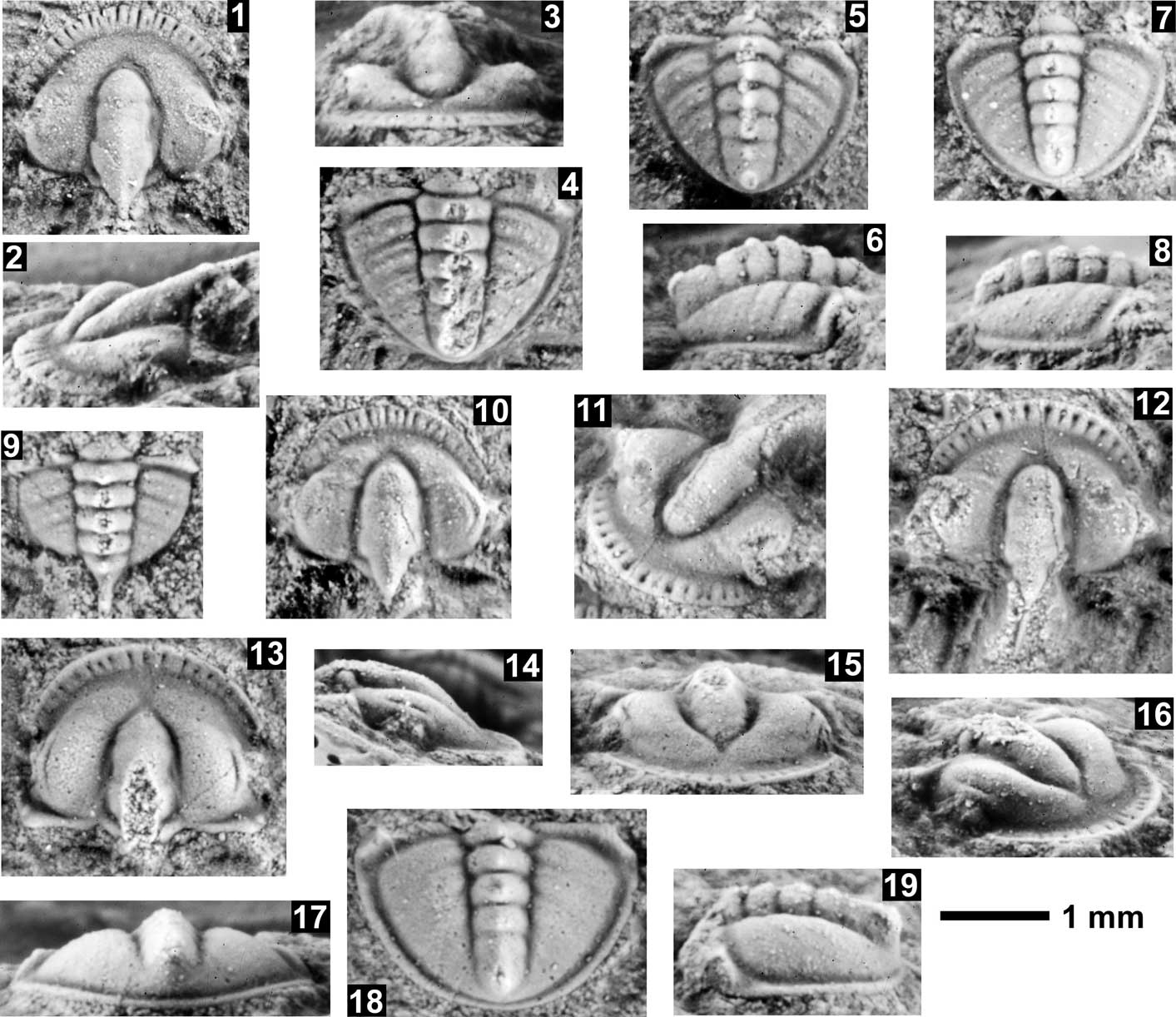
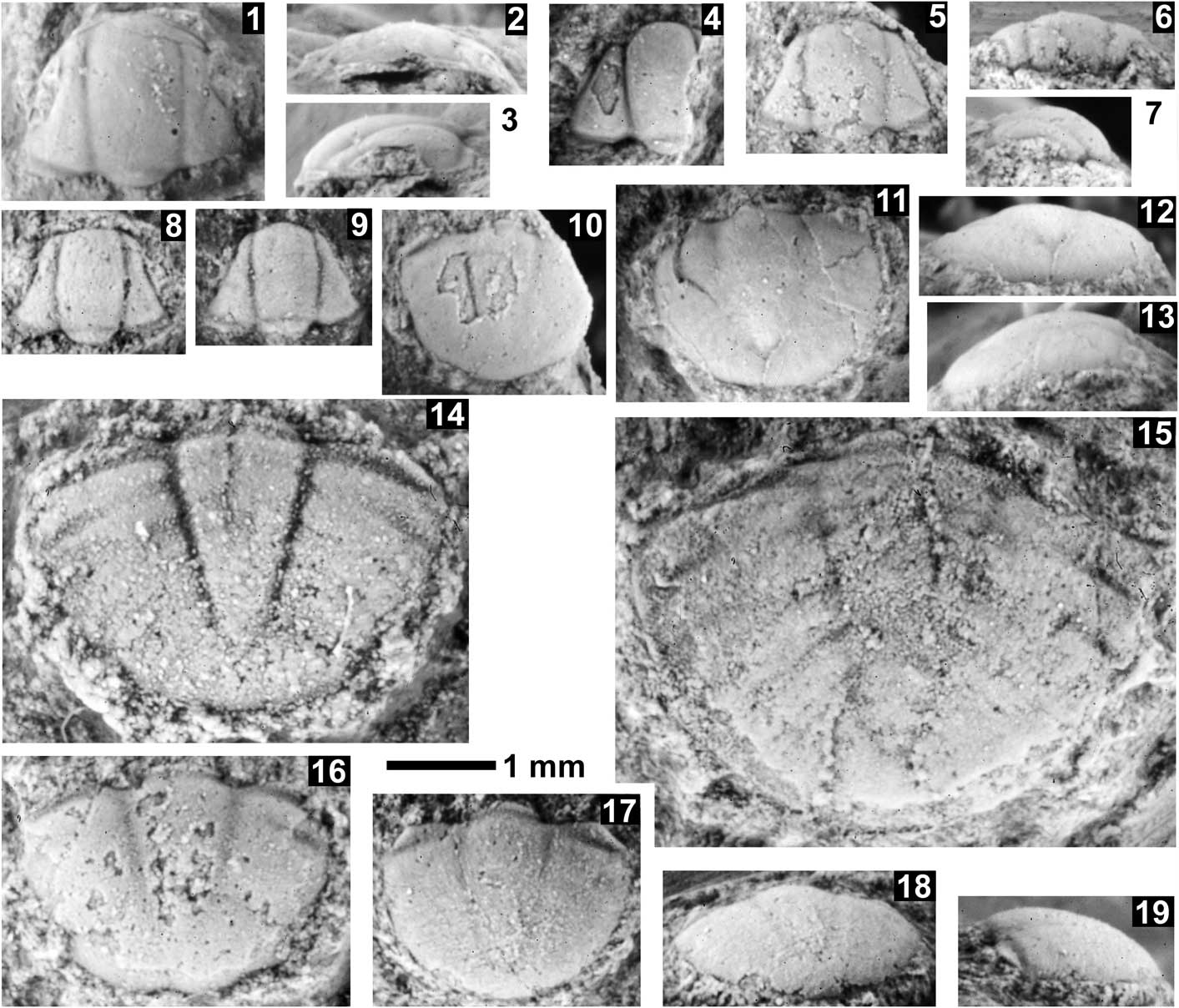
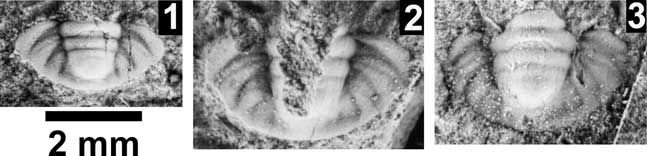
Pagetia claytonensis n. sp. from the Ehmaniella Zone, Emigrant Formation, Clayton Ridge, Nevada. Specimens from locality USNM 44134 are tectonically distorted. (1–3) Partially exfoliated paratype cranidium USNM 643899 (USNM loc. 44134), plan, anterior, and oblique views; (4) mostly testate paratype cranidium USNM 643898 (USNM loc. 44134); (5) exfoliated paratype cranidium USNM 643882 (USNM loc. 44132); (6) exfoliated paratype cranidium USNM 643904 (USNM loc. 44134); (7) mostly testate holotype cranidium USNM 643878 (USNM loc. 44132); (8) mostly testate paratype cranidium USNM 643886 (USNM loc. 44132); (9) mostly testate paratype cranidium USNM 643879 (USNM loc. 44132); (10) exfoliated paratype cranidium USNM 643884 (USNM loc. 44132); (11) exfoliated paratype cranidium USNM 643895 (USNM loc. 44126); (12, 13) exfoliated paratype pygidium USNM 643900 (USNM loc. 44134), plan and lateral views; (14) exfoliated paratype pygidium USNM 643891 (USNM loc. 44132); (15) latex cast of testate paratype pygidium USNM 643908 (USNM loc. 44134); (16) mostly testate paratype pygidium USNM 643881 (USNM loc. 44132) showing granules in pleural field; (17) testate paratype pygidium USNM 643885 (USNM loc. 44132); (18) mostly exfoliated paratype pygidium USNM 643906 (USNM loc. 44134); (19) mostly testate paratype pygidium USNM 643902 (USNM loc. 44134); (20) testate paratype pygidium USNM 643889 (USNM loc. 44132); (21) exfoliated paratype pygidium USNM 643890 (USNM loc. 44132) showing granules in pleural field; (22) exfoliated paratype pygidium USNM 643883 (USNM loc. 44132); (23) mostly testate paratype pygidium USNM 643893 (USNM loc. 44126); (24) testate paratype pygidium USNM 643903 (USNM loc. 44134) with terminal spine; (25) exfoliated paratype pygidium USNM 643897 (USNM loc. 44134) showing granules in pleural field.

Holotype
Cranidium USNM 643878 (Fig. 9.7). Split Mountain West Section, Clayton Ridge, Nevada, United States, lower part of the Emigrant Formation, USNM loc. 44132.
Paratypes
Split Mountain East Section, Clayton Ridge, Nevada, lower part of the Emigrant Formation: USNM loc. 44125–three cranidia, pygidium (USNM 643893–643896). Split Mountain West Section, Clayton Ridge, Nevada, lower part of the Emigrant Formation: USNM loc. 44132–six cranidia, eight pygidia (USNM 643879–643892); USNM loc. 44134–cranidium, pygidium (USNM 643897, 643898); USNM loc. 44135–four cranidia, six pygidia (USNM 643899–643908).
Diagnosis
Cranidium relatively wide, length 83±5% width; glabella moderately short (68±2% cranidial length), wide (58±4% cranidial width), anterior glabellar lobe subtriangular in outline, with poorly defined transglabellar furrow; occipital ring spine, short (25±3% glabellar length), evenly tapered; fixigenal width moderately wide (89±12% glabellar width); palpebral lobes narrow, not overhanging lateral border, furrow shallow; eye ridges weakly defined, straight; anterior border wide (44±5% preglabellar area length), convex, outer rim thin; scrobicules slit shaped, prominent, not extending to anterior margin; cranidial border furrow poorly defined anteriorly, median preglabellar furrow well developed, deltoid depression present. Pygidium wide, semiovate (length 70±5% width), abrupt change in direction of the articulating half-rib at the fulcral point; axis narrow, moderately tapering (66±7% anterior width), five axial rings, ring furrows deep, low, moderate nodes on the axial rings, terminal spine thin; a broad furrow separating the half-rib, pleural furrows absent or very weakly developed; broad border furrow defining a narrow border. Exoskeleton smooth.
Occurrence
Emigrant Formation (Ehmaniella Zone), Split Mountain, Nevada.
Description
Cranidium small size, length 1.9±0.3 mm (N=15, without spine); semicircular, length 84±5% of width, with maximum width across posterior limbs of fixigenae, moderate convexity (sag. and trans.); anterior margin evenly curved, level; posterior margin, excluding occipital ring, distally angled slightly anteriorly ~45°. Anterior branches of facial sutures strongly divergent to anterior margin; posterior branches strongly divergent. Glabella moderately short, length 69±2% cranidial length; width 58±4% cranidial width; moderately tapered, width at anterior end 78±5% glabellar width; strong convexity (sag. and trans.); frontal lobe subtriangular in outline. Axial furrow deep, deeper anteriorly, slightly curved in outline, convergent; preglabellar furrow moderate depth. Lateral glabellar furrows very shallow, faint S1 lateral glabellar furrows directed posterior laterally, transglabellar furrow (S3) faint to moderate depth (smaller specimens). Occipital ring elevated above glabella, forming continuous slope with glabella, moderate convexity; relatively small occipital spine, length 25±3% glabellar length, broad based, anteriorly parallel, posteriorly rapidly tapering, projecting slightly dorsally forming continuous slope with glabella; posterior margin convex posteriorly. SO narrow, directed backwards from axial furrow, effaced across middle of glabella. Frontal area subequally divided; length 31±2% cranidial length. Preglabellar field flat to moderately curved laterally, downsloping, length 36±7% frontal area length; medially separated by narrow to moderately wide median preglabellar furrow that diverges laterally forming a deltoid depression. Anterior border well defined, slightly convex, nearly level, tapering laterally, length 44±5% preglabellar area length, scrobicules deeper near anterior margin, some crossing to margin. Anterior border furrow well defined, narrow 22±5% preglabellar area length; shallower medially, shallower than axial furrows; moderate depth in larger specimens, moderately deep in small specimens. Fixigena convex, with maximum height located posterolaterally, level, anterior area downsloping, lateral portions strongly downsloping; width 90±12% glabellar width (K2). Palpebral lobes arcuate, level, narrow and long, length 43±6% glabellar length; palpebral furrow shallow; anterior margin located opposite S3. Ocular ridge faint to obscure, straight, directed ~90° from glabella. Posterior area of fixigena subrectangular with rounded termination; length 26±9% glabellar length; width 56±8% glabella length. Posterior border very narrow (exsag.), widening laterally to genal angle then narrowing slightly to facial suture; genal angle narrowly rounded to obtusely angular; furrow narrow, shallow then broad, deep laterally, curving anterolaterally.
Librigena, rostral plate, hypostoma, and thorax unknown.
Pygidium small, length 1.6±0.3 mm (N=14; without spine) semielliptical, length 70±5% width; margin smooth; anterior margin straight to slightly curved, projects laterally to slightly posterior laterally then posterior laterally nearly 45% to transverse line; anterolateral corners rounded, adjacent to axial L2; moderately convex (sag. and trans.). Axis moderately tapered, posterior width 66±7% anterior width, anterior width 31±2% pygidial width; length 93±3% pygidial length, moderate depth axial furrow; five axial rings, moderately convex; terminal axial piece small size, rounded; axial ring furrows well defined, posterior furrow faint shallow; moderate axial nodes present, short, horizontal, thin terminal spine. Pleural regions moderately convex, downsloping; anterior pleural furrow narrow and moderately deep, extending to border; additional pleural and interpleural furrows shallow to obsolete posteriorly. Border well defined, slightly convex, narrow, thinner at posterior margin level; border furrow moderate depth laterally, shallower posteriorly. Articulating half-rib narrow (exsag.) adaxially, widening gradually laterally, anterior border well defined, projects laterally to slightly posteriolaterally then nearly 45° to transverse line; furrow moderate depth, deeper laterally. Granular ornamentation obvious on only small specimens (Fig. 9.16, 9.20, 9.21, 9.25).
Etymology
Named for the species’ occurrence in Clayton Ridge.
Additional materials
Split Mountain East Section: USNM loc. 44125–pygidium. Split Mountain West Section: USNM loc. 44132–17 cranidia, nine pygidia; USNM loc. 44133–eight cranidia, two pygidia; USNM loc. 44134–19 cranidia, 20 pygidia; USNM loc. 44136–three cranidia, five pygidia; USNM loc. 44137–seven cranidia, two pygidia.
Remarks
Specimens from locality USNM 44134 in the Split Mountain West Section illustrate minor tectonic distortion, which can be seen in bilaterally asymmetrical specimens (e.g., Fig. 9.6, 9.15, 9.19). This tectonic distortion would also explain slight differences in length to width ratios seen in the specimens (e.g., Fig. 9.4 vs. 9.6).
Pygidia of Pagetia claytonensis are similar to P. fossula in their outline, relatively high convexity, wide axis, faint pleural furrows, axial width, and terminal spine. These specimens differ from P. fossula in their less-pronounced nodes, weaker furrows, and lack of granular ornamentation (granules seen only in smallest specimens, Fig. 9.16, 9.20, 9.21, 9.25). Cranidia show some of the same variation as seen in P. fossula and P. rugosa in the development of the preglabellar depression and development of the scrobicules (see below). A consistent difference to these species is the presence of an occipital spine that is constricted at the base forming a nearly parallel-sided spine base that tapers rapidly to a point posterior the occipital ring. This is similar to the spine development in P. rugosa, but this species does not have a parallel-sided spine base. Similar occipital spine configuration occurs in some specimens of P. fluitata Jell, Reference Jell1975 (pl. 8, fig. 12), P. polygnota Jell, Reference Jell1975 (pl. 10, fig. 1), P. thorntonensis Jell, Reference Jell1975 (pl. 22, fig. 9), and P. whitehousei Jell, Reference Jell1975 (pl. 23, figs. 6, 7, 11, 13). Pagetia claytonensis differs from these species in the cranidia’s thin to absent rim on the anterior border, slit-shaped scrobicules, wide anterior border furrow, presence of preglabellar depression, faint to obscure ocular ridges, and/or faint palpebral lobe furrows; and pygidia’s elongated outline, high convexity, 45° angle of anterior lateral corners, and/or shorter terminal spine.
Pagetia fossula Resser, Reference Resser1938a
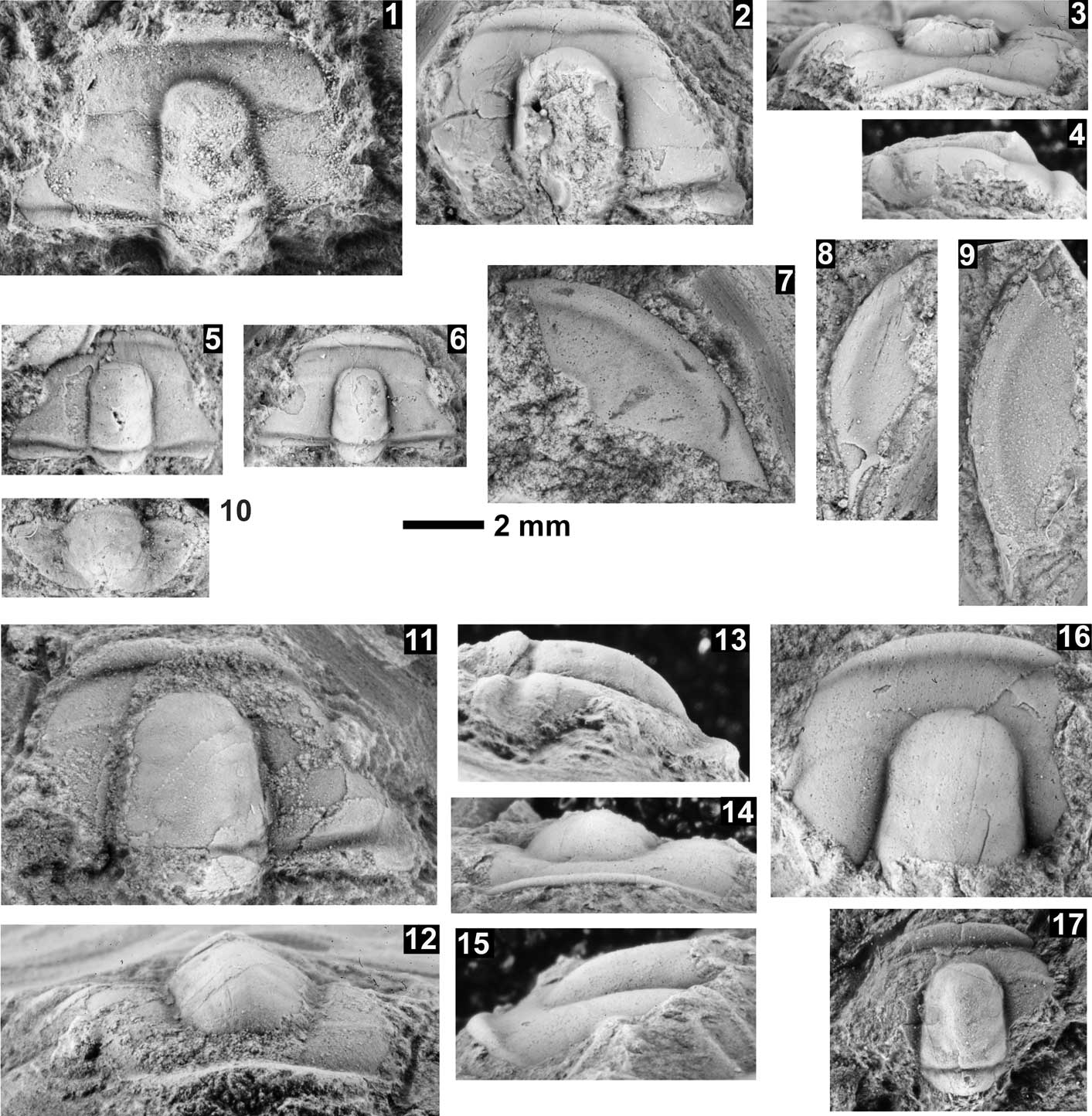
Pagetia spp. from the Glossopleura walcotti/Ptychagnostus praecurrens Zone, Emigrant Formation, Clayton Ridge, Nevada. (1–12) Pagetia fossula Resser, Reference Resser1938a: (1–3) testate cranidium USNM 643984 (USNM loc. 44123), plan, oblique, and anterior views; (4) testate pygidium USNM 643980 (USNM loc. 44123); (5, 6) pygidium USNM 643985 (USNM loc. 44122), plan and lateral views; (7, 8) pygidium USNM 643986 (USNM loc. 44122), plan and lateral views; (9) pygidium USNM 643981 (USNM loc. 44123) showing terminal spine; (10) cranidium USNM 643983 (USNM loc. 44123); (11, 12) cranidium USNM 643982 (USNM loc. 44123) showing long occipital spine, plan and oblique views. (13–19) Pagetia rugosa Rasetti, Reference Rasetti1966: (13–16) testate cranidium USNM 643987 (USNM loc. 44122), plan, lateral, anterior, and oblique views; (17–19) pygidium USNM 643988 (USNM loc. 44122), posterior, plan, and lateral views.

1938a Pagetia fossula Reference ResserResser, p. 6, pl. 1 figs. 8–11.
1966 Pagetia fossula; Reference RasettiRasetti, p. 507, pl. 59, figs. 22–28.
1968 Pagetia arenosa Reference FritzFritz, p. 189, pl. 43, fig. 10 [not fig. 11].
Cotypes
USNM 95026, Lakeview Limestone, east shore of Pend Oreille Lake, Idaho (USNM loc. 37n; Resser Reference Resser1938a, pl. 1, figs. 8–11).
Occurrence
Lakeview Limestone (Glossopleura walcotti Zone?), Pend Oreille Lake, Idaho. Carrara Formation, (Mexicella mexicana Zone=Albertella Zone), Nevada (Palmer and Halley, Reference Palmer and Halley1979). Pioche Shale (Glossopleura walcotti Zone?), northern Egan Range, Nevada (Fritz, Reference Fritz1968). Emigrant Formation (Glossopleura walcotti/Ptychagnostus praecurrens Zone), Split Mountain, Nevada.
Materials
Split Mountain East Section: USNM loc. 44122–cranidium, five pygidia; USNM loc. 44123–27 cranidia, 33 pygidia.
Remarks
There are two co-occurring species of Pagetia, neither of which is articulated, in the 29–30 m interval in the Split Mountain East Section. The pygidia assigned to P. fossula illustrate the relatively high convexity, prominent nodes, deeper pleural furrows, faint interpleural furrows, and coarse granules typical of the species. These specimens differ from the type material only in having a more pronounced fifth axial ring.
The Pagetia cranidia occurring with the pygidia show a range of morphologies that cross the two species assigned based on the pygidia. The cranidia assigned to P. fossula by Rasetti (Reference Rasetti1966) have a convex fixigena that approaches the height of the glabella, preglabellar area of the fixigena separated by a relatively narrow preglabellar depression, a pointed frontal lobe, straight and faint ocular ridges projecting nearly transversely, faint palpebral lobe furrows, scrobicules that terminate in pits, narrower anterior portion of the occipital spine, and a relatively smooth exoskeleton. In contrast, the cranidia assigned to P. rugosa by Rasetti (Reference Rasetti1966) have a low convexity of the fixigena, preglabellar area of the fixigena separated by a relatively wide preglabellar depression, a pointed frontal lobe, anteriorly arched and faint ocular ridges projecting nearly transversely, faint palpebral lobe furrows, scrobicules that terminate in pits, a uniformly tapering occipital spine, and a slightly pitted exoskeleton. Variability in these character states within the Emigrant Formation samples of P. rugosa to P. fossula illustrated by specimen USNM 643987 (Fig. 10.13) is typical of P. rugosa; specimen USNM 643983 (Fig. 10.10) differs in its moderately convex fixigenae; specimen USNM 643982 (Fig. 10.12) differs in its rounded frontal lobe, moderately convex fixigenae, and narrower anterior portion of the occipital spine; and specimen USNM 643984 (Fig. 10.1) is typical of P. fossula except for low convexity of the fixigenae, and scrobicules that cross the anterior border. Based on the limited material and the lack of articulated specimens, cranidia assignment to species is tentative and based on the curvature of the ocular ridge, depth of palpebral furrow, and development of the preglabellar depression. The fragmented cranidium illustrated as P. arenosa Fritz, Reference Fritz1968 (pl. 43, fig. 10), is characteristic of P. fossula.
Pagetia rugosa Rasetti, Reference Rasetti1966
1939b Pagetia maladensis Reference ResserResser, pl. 2, figs. 4 [part, pygidium in upper right corner), 5 (part, cranidia in upper left and upper center, and pygidium at lower right].
1966 Pagetia rugosa Reference RasettiRasetti, p. 509, pl. 60, figs. 1–7.
1968 Pagetia arenosa Reference FritzFritz, p. 189, pl. 43, fig. 11 [not fig. 10].
1979 Pagetia rugosa; Reference Palmer and HalleyPalmer and Halley, p. 77, pl. 12, figs. 9, 13.
1979 Pagetia sp., Reference Palmer and HalleyPalmer and Halley, p. 77, pl. 12, figs. 10, 14.
Holotype
Cranidium (USNM 146284), Langston Limestone, Two Mile Canyon, near Malad, Idaho (USNM loc. 54s; Rasetti, Reference Rasetti1966, pl. 60, fig. 1).
Occurrence
Upper portion of the limestone of the Langston Formation at Two Mile Canyon, near Malad, Idaho (Rasetti, Reference Rasetti1966). Pioche Shale (Glossopleura walcotti Zone?), northern Egan Range, Nevada (Fritz, Reference Fritz1968). Pyramid Shale member (Mexicella mexicana Zone=Albertella Zone), Carrara Formation, Belted Range, Nevada (Palmer and Halley, Reference Palmer and Halley1979). Emigrant Formation (Glossopleura walcotti/Ptychagnostus praecurrens Zone), Split Mountain, Nevada.
Materials
Split Mountain East Section: USNM loc. 44122–two cranidia, four pygidia; USNM loc. 44123–28 cranidia, 11 pygidia; USNM loc. 44124–two cranidia, pygidium.
Remarks
Discussion of the cranidia of Pagetia rugosa and P. fossula is presented above. Specimens illustrated as Pagetia sp. by Palmer and Halley (Reference Palmer and Halley1979) fall within the range of morphological variation of the specimens from Split Mountain. The cranidium identified as P. arenosa Fritz (Reference Fritz1968) is more typical of P. fossula than P. rugosa, as suggested in Palmer and Halley (Reference Palmer and Halley1979).
?Order Corynexochida Kobayashi, Reference Kobayashi1935
Remarks
Considering Corynexochida as a monophyletic group may be in error, and this taxon is probably polyphyletic, as suggested by Robison and Babcock (Reference Robison and Babcock2011) and Sundberg (Reference Sundberg2014).
Family Dolichometopidae Walcott, Reference Walcott1916b
Genus Bathyuriscus Meek, Reference Meek1873
Type species
Bathyurus (?) haydeni Meek, Reference Meek1873, from the near the Gallatin River, Montana, by original designation (see Young and Ludvigsen, Reference Young and Ludvigsen1989, p. 14 for discussion).
Bathyuriscus terranovensis Young and Ludvigsen, Reference Young and Ludvigsen1989
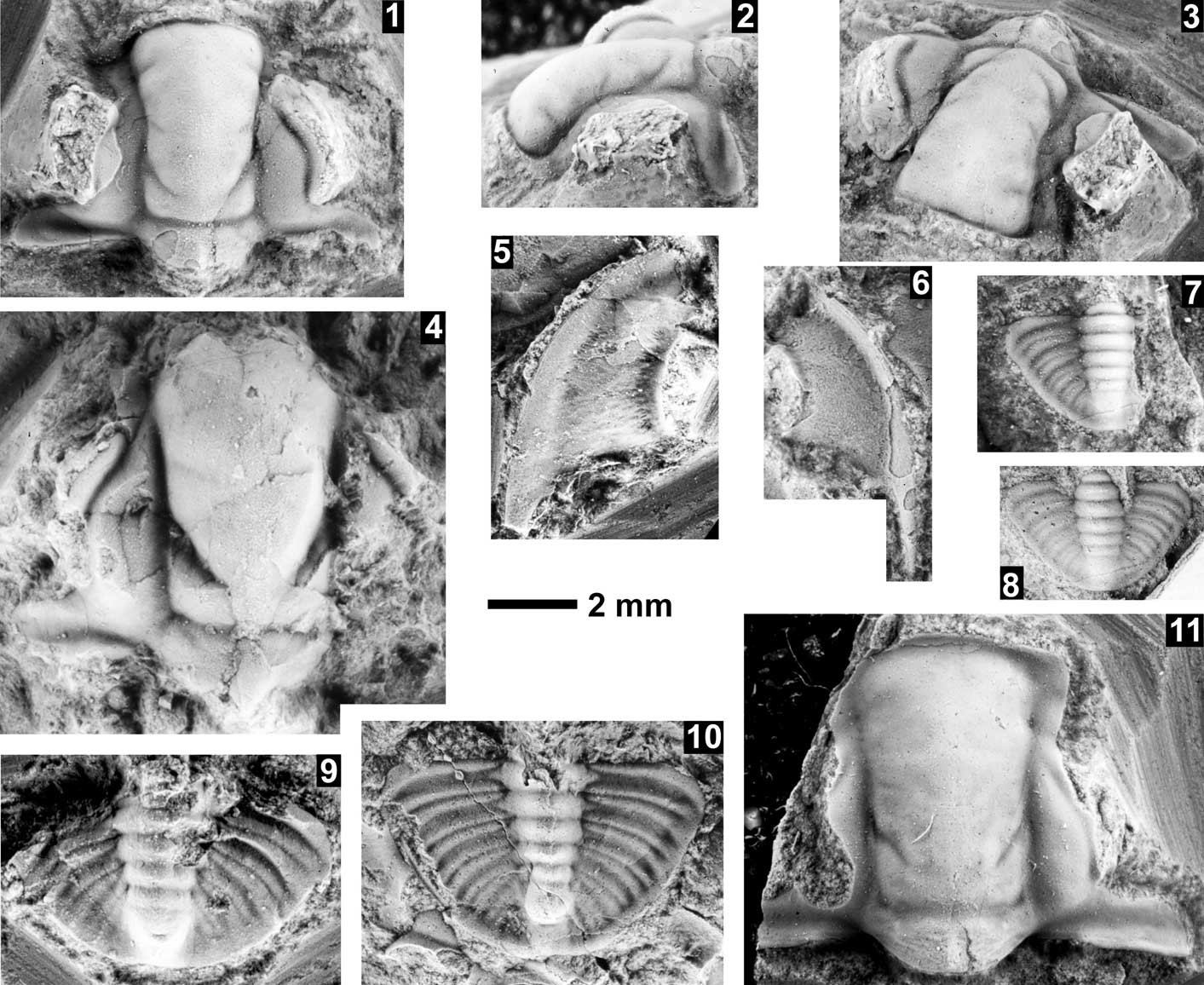
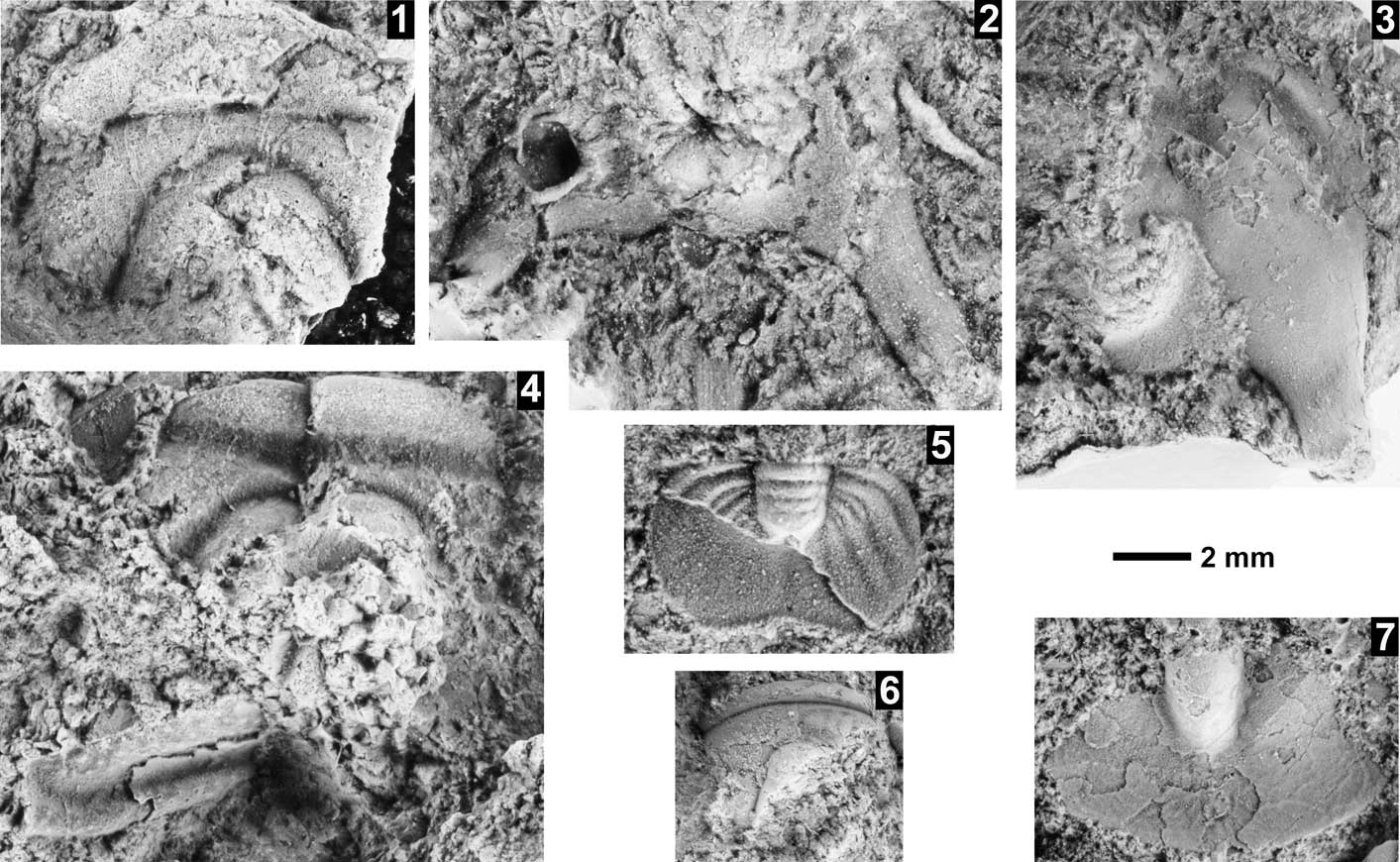
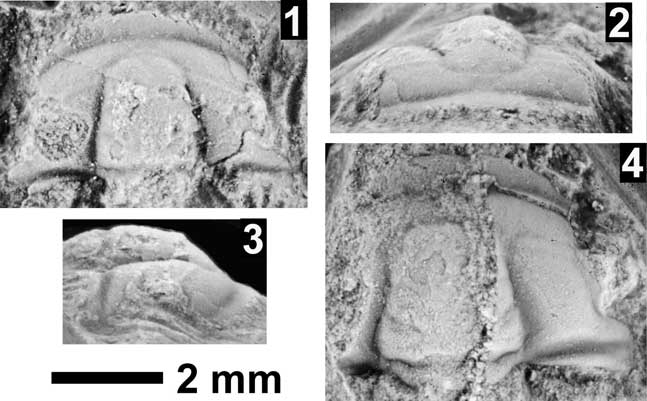
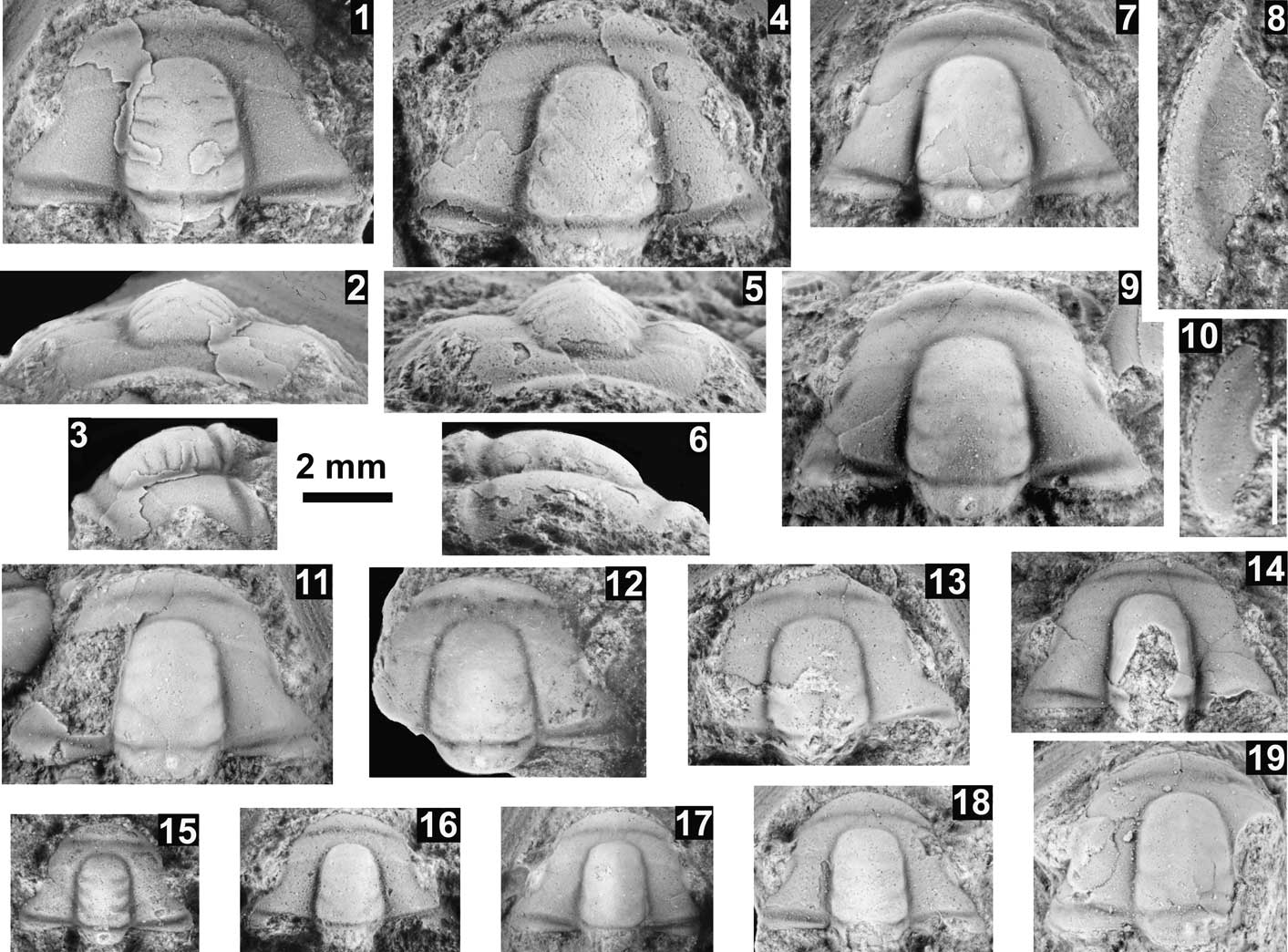
Bathyuriscus spp. from the Emigrant Formation, Clayton Ridge, Nevada. (1–10) Bathyuriscus terranovensis Young and Ludvigsen, Reference Young and Ludvigsen1989, Ehmaniella Zone: (1–3) testate cranidium USNM 643925 (USNM loc. 44126), plan (1) and slightly oblique (2, 3) photographic angles; (4) incomplete cranidium USNM 643929 (USNM loc. 44133); (5) mostly exfoliated librigena USNM 643930 (USNM loc. 44133); (6) mostly testate librigena USNM 643932 (USNM loc. 44135); (7) testate pygidium USNM 643926 (USNM loc. 44126); (8) latex cast of pygidium USNM 643931 (USNM loc. 44126); (9) mostly exfoliated pygidium USNM 643928 (USNM loc. 44133); (10) testate pygidium USNM 643927 (USNM loc. 44135). (11) Bathyuriscus sp. indet., testate cranidium USNM 643924 (USNM loc. 44123).

1989 Bathyuriscus terranovensis Reference Young and LudvigsenYoung and Ludvigsen, p. 15, pl. 3, figs. 6–12, text-fig. 5a.
Holotype
Cranidium (GSC 77340), from boulder 357 in the basal Downes Point Member, Shallow Bay Formation, Cow Head Group, Newfoundland (Young and Ludvigsen, Reference Young and Ludvigsen1989, pl. 3, figs. 8, 9).
Occurrence
Boulders (Zacanthoides gilberti Zone=Altiocculus Subzone, Ehmaniella Zone of Nevada and Utah [Sundberg, Reference Sundberg1994]) in the basal Downes Point Member, Shallow Bay Formation, Cow Head Group, Newfoundland (Young and Ludvigsen, Reference Young and Ludvigsen1989). Emigrant Formation (Ehmaniella Zone), Split Mountain, Nevada.
Materials
Split Mountain East Section: USNM loc. 44126–two cranidia, three pygidia; USNM loc. 44127–cranidium. Split Mountain West Section: USNM loc. 44132–four pygidia; USNM loc. 44133–six cranidia, librigena, six pygidia; USNM loc. 44134–cranidium; USNM loc. 44135–cranidium, librigena, six pygidia; USNM loc. 44136–two cranidia, pygidium; USNM loc. 44137–four cranidia, librigena, five pygidia.
Remarks
Most specimens are fragmented or small pygidia. These specimens have a small occipital node, wide posterior area of the ocular fixigena, and no pygidial spines; typical of the species. Some pygidia are similar to Bathyuriscus boscaputensis Young and Ludvigsen, Reference Young and Ludvigsen1989 in having a more transversely elongated pygidium with only four axial segments.
Some cranidia assigned to Bathyuriscus terranovensis may actually be Parkaspis cf. P. drumensis Sundberg, Reference Sundberg1994, which co-occurs in the Emigrant Formation. Rasetti (Reference Rasetti1951, p. 169) stated that “The species on which the genus [Parkaspis] is based closely resembles Bathyuriscus; in fact, the cranidia of Parkaspis endecamera and Bathyuriscus adaeus are so much alike that difficulty would have been encountered in assigning the proper shields to each species, if complete specimens had not been available.” However, as mentioned by Rasetti, the cranidia of Parkaspis bear a strong fixigenal spine, and the thorax and pygidium are considerably different. In the Split Mountain section, the distinctive pygidia of Parkaspis are present, but Parkaspis-like cranidia with a fixigenal spine have not been identified due to fragmentation.
Bathyuriscus sp. indet.
Occurrence
Emigrant Formation (Glossopleura walcotti/Ptychagnostus praecurrens Zone), Split Mountain, Nevada.
Material
Split Mountain East Section: USNM loc. 44123–cranidium.
Remarks
A single nearly complete cranidium is similar to Bathyuriscus brighamensis Resser, Reference Resser1939a, Reference Resserbut without a pygidium, specific identification is not possible.
Corynexochid pygidium indet.
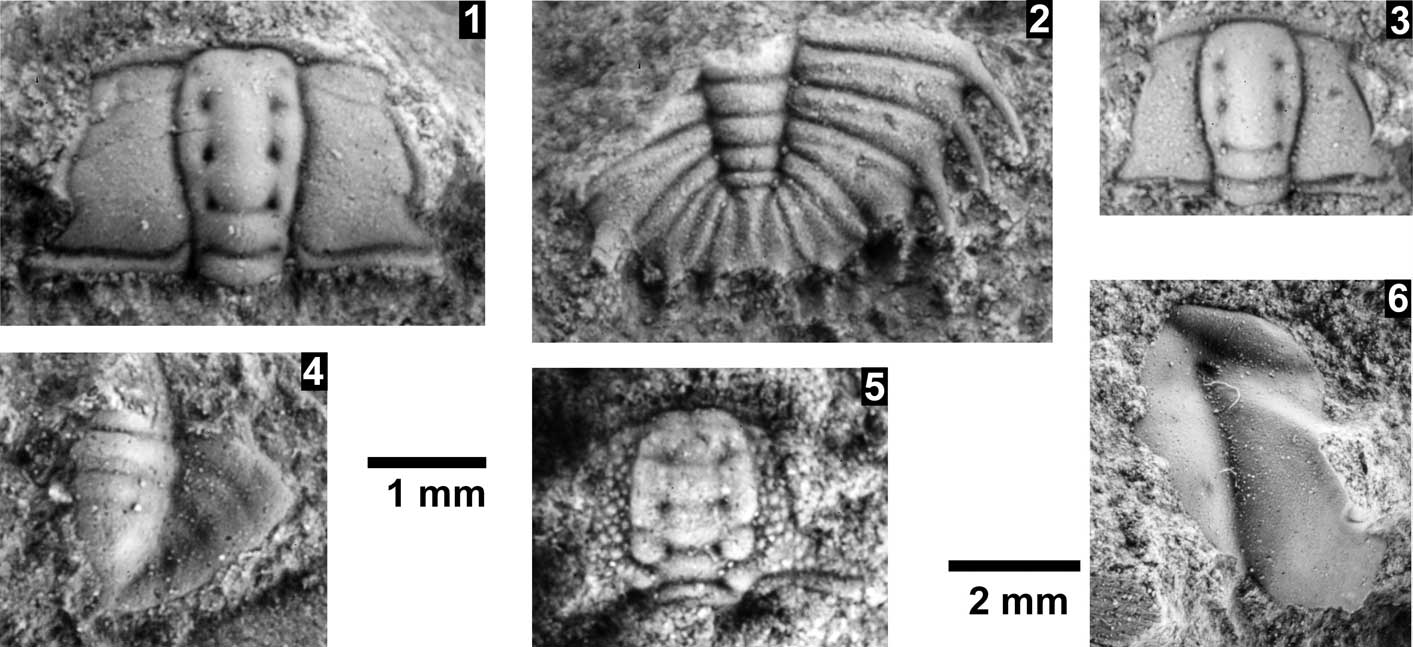
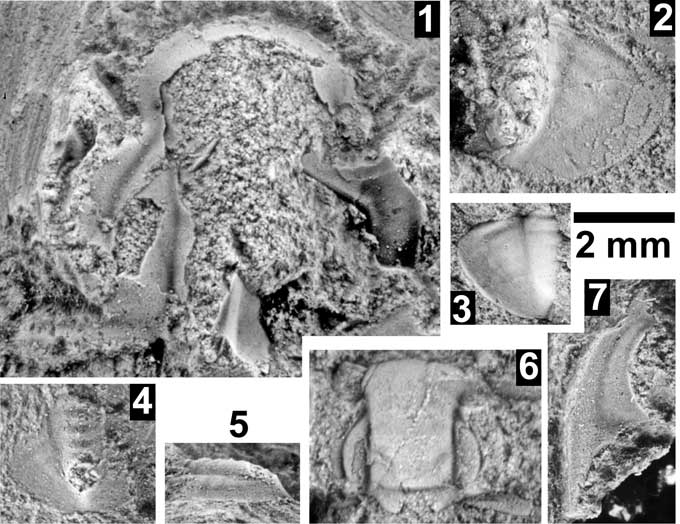
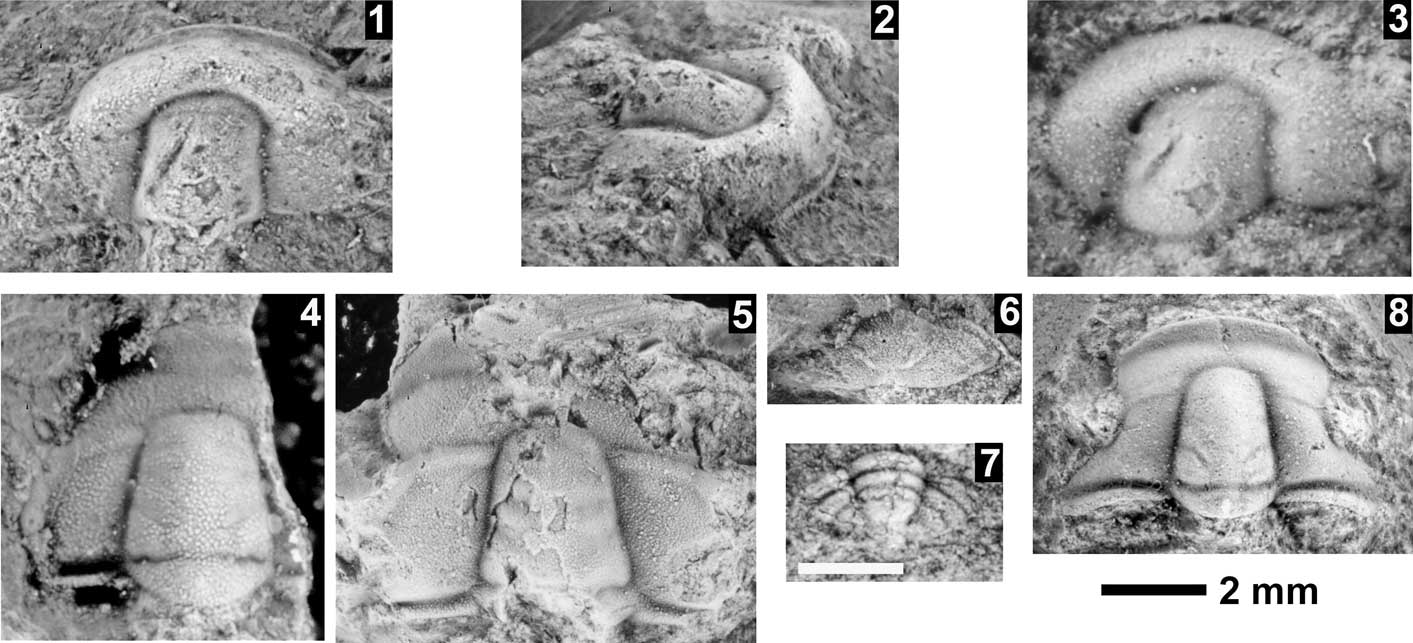
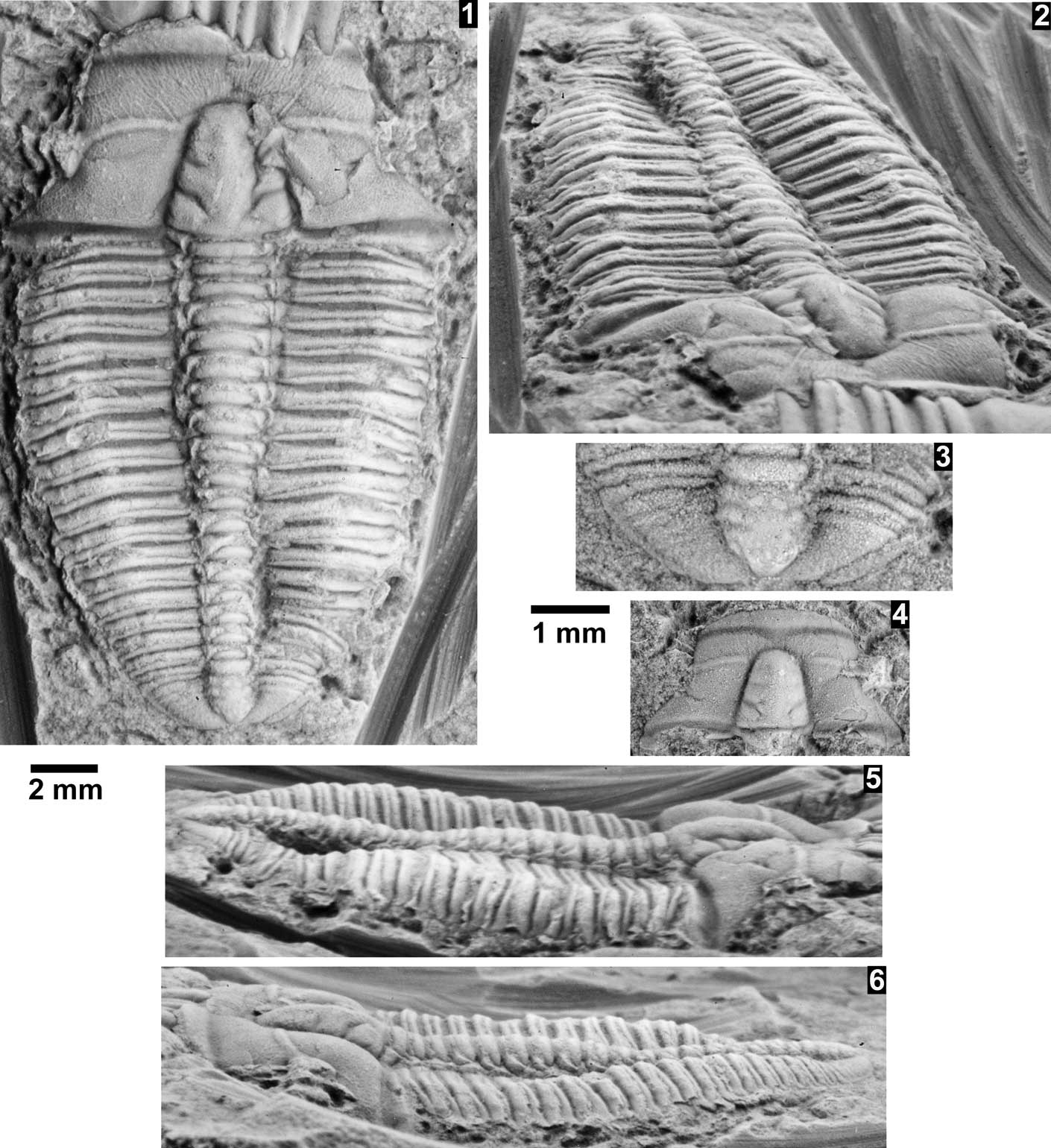
Miscellaneous corynexochoids from Split Mountain, Emigrant Formation, Clayton Ridge, Nevada. Figures 1–5 use 1 mm scale bar. (1, 2) Oryctocephalites cf. O. reynoldsi (Reed, Reference Reed1899) from the Ehmaniella Zone, Split Mountain East Section (USNM loc. 44126): (1) testate cranidium USNM 643977; (2) testate pygidium USNM 643978. (3) Oryctocephalites sp. indet. from the Glossopleura walcotti/Ptychagnostus praecurrens Zone, Split Mountain East Section; testate cranidium USNM 643979 (USNM loc. 44121). (4) Testate corynexochoid pygidium USNM 643953 (USNM loc. 44135) from the Ehmaniella Zone, Split Mountain West Section. (5) Oryctocara sp. indet. from the Ehmaniella Zone, Split Mountain West Section (USNM loc. 44132): testate cranidium USNM 643976 (USNM loc. 44121). (6) Kootenia? sp. indet. USNM 643974 (USNM loc. 44125) from the Ehmaniella Zone, Split Mountain West Section; 2 mm scale bar.

Occurrence
Emigrant Formation (Ehmaniella Zone), Split Mountain, Nevada.
Materials
Split Mountain West Section: USNM loc. 44133–pygidium; USNM loc. 44135–pygidium.
Remarks
The two partial pygidia are similar to Wenkchemnia Rasetti, Reference Rasetti1951, but without additional material, generic and specific identifications are not possible.
Genus Glossopleura Poulsen, Reference Poulsen1927
Type species
Dolichometopus boccar Walcott, Reference Walcott1916b, from the Stephen Formation, Mount Bosworth, British Columbia.
Glossopleura walcotti Poulsen, Reference Poulsen1927
Glossopleura walcotti Poulsen, Reference Poulsen1927 from the Glossopleura walcotti/Ptychagnostus praecurrens Zone, Split Mountain East Section, Emigrant Formation, Clayton Ridge, Nevada. (1) Mostly exfoliated cranidium USNM 643967 (USNM loc. 44114); (2) latex cast, mostly exfoliated pygidium USNM 643970 (USNM loc. 44121); (3) latex cast testate pygidium USNM 643971 (USNM loc. 29F); (4, 5) mostly exfoliated pygidium USNM 643968 (USNM loc. 44114), plan and lateral views; (6) testate cranidium USNM 643969 (USNM loc. 44121); (7) mostly testate librigena USNM 643972 (USNM loc. 44123).

1927 Glossopleura walcotti Reference PoulsenPoulsen, p. 268, pl. 16, figs. 20–30.
1927 Glossopleura expansa Reference PoulsenPoulsen, p. 269, pl. 16, figs. 31, 32.
1927 Glossopleura sulcata Reference PoulsenPoulsen, p. 272, pl. 16, fig. 39.
1927 Glossopleura longifrons Reference PoulsenPoulsen, p. 272, pl. 17, fig. 10 [not figs 8, 9].
1964 Glossopleura walcotti; Reference PoulsenPoulsen, p. 25, pl. 1, figs. 2–4.
1979 Glossopleura walcotti; Reference Palmer and HalleyPalmer and Halley, p. 79, pl. 16, figs. 6–8, 11–19.
1994 Glossopleura walcotti; Reference BabcockBabcock, p. 94, fig. 12.
1995 Glossopleura aff. leona Lochman; Reference Bordonaro and BanchigBordonaro and Banchig, pl. 2, figs. 14, 15.
2009 Glossopleura walcotti; Reference Benedetto, Vaccari, Waisfeld, Sánchez and FogliaBenedetto et al., fig. 2g.
2010 Glossopleura walcotti; Reference Foglia and VaccariFoglia and Vaccari, p. 434, fig. 4.10–4.23.
?2011 Glossopleura walcotti?; Reference FosterFoster, p. 106, fig. 4.4, 4.5.
Cotypes
Cranidia, librigena, hypostoma, pleural segment, and pygidia (no specimen numbers, originally deposited in the Mineralogical and Geological Museum of the University of Copenhagen) from the Cape Wood Formation, North-West Greenland (Poulsen, Reference Poulsen1927, pl. 16, figs. 20–30).
Occurrence
Cape Wood Formation (Glossopleura Zone), North-West Greenland (Poulsen, Reference Poulsen1927; Poulsen, Reference Poulsen1964) and Henson Gletscher Formation (Glossopleura Zone), Nyeboe Land, Greenland (Babcock, Reference Babcock1994). Soldano Member, La Laja Formation (Glossopleura walcotti Zone), San Juan, (Foglia and Vaccari, Reference Foglia and Vaccari2010). Desert Range Limestone Member (Glossopleura walcotti Zone), Carrara Formation, California and Nevada (Palmer and Halley, Reference Palmer and Halley1979). ?Bright Angel Shale (Glossopleura Zone), Grand Canyon, Arizona (Foster, Reference Foster2011). Emigrant Formation (Glossopleura walcotti/Ptychagnostus praecurrens Zone), Split Mountain, Nevada.
Materials
Split Mountain East Section: USNM loc. 44114–cranidium, pygidium; USNM loc. 44118–meraspid cranidium, librigena; USNM loc. 44119–four meraspid cranidia; USNM loc. 44121–cranidium, pygidium; USNM loc. 44123–pygidium.
Remarks
Only fragments or poorly preserved specimens have been found in the Split Mountain East Section. A small glabella (3 mm) has the deeper S1 furrows and expanding frontal lobe typical of the species. Three small pygidia illustrate the shallow axial ring furrows, low axial nodes, and/or wide pleural area.
Family Dorypygidae Kobayashi, Reference Kobayashi1935
Genus Kootenia Walcott, Reference Walcott1889
Type species
Bathyuriscus (Kootenia) dawsoni Walcott, Reference Walcott1889, from the Stephen Formation, Mount Stephen, British Columbia, by original designation.
Kootenia? sp. indet.
Occurrence
Emigrant Formation (Ehmaniella Zone), Split Mountain, Nevada.
Material
Split Mountain East Section: USNM loc. 44125–cranidial fragment.
Remarks
The fragmentary nature of the cranidium does not allow for a specific identification.
Family Oryctocaridae Hupé, Reference Hupé1953
Remarks
The relationship between spiny Oryctocephalidae (subfamilies Oryctocephalinae and Lancastriinae; see Sundberg, Reference Sundberg2014) and Oryctocaridae has not yet been determined in a phylogenetic study. A limited study of hypostomata (Sundberg, Reference Sundberg2008) suggested that the two families are sister clades and could be united in the superfamily Oryctocephaloidea Beecher, Reference Beecher1897 as suggested by Yuan et al. (Reference Yuan, Zhao and Li2001; see Sundberg, Reference Sundberg2014 for discussion).
Subfamily Oryctocarinae Hupé, Reference Hupé1953
Genus Oryctocara Walcott, Reference Walcott1908
Type species
Oryctocara geikiei Walcott, Reference Walcott1908, from the Spence Shale, Ute Formation, Danish Flat, Idaho, by original designation.
Oryctocara sp. indet.
Occurrence
Emigrant Formation (Ehmaniella Zone), Split Mountain, Nevada.
Material
Split Mountain West Section: USNM loc. 44132–cranidium.
Remarks
The single small cranidium does not allow for a specific identification.
Genus Thoracocare Robison and Campbell, Reference Robison and Campbell1974
Type species
Vistola? minuta Resser, Reference Resser1939a, from the Spence Shale, Bear River Range, Idaho.
Remarks
Robison and Campbell (Reference Robison and Campbell1974) tentatively assigned Thoracocare to Oryctocephalidae based on features of the meraspides of Oryctocara. In contrast, Jell and Adrain (Reference Jell and Adrain2003) assigned the genus to Zacanthoididae without justification. There are strong cranidial and pygidial similarities between Thoracocare and Ovatoryctocara spp. meraspides (see Geyer and Peel, Reference Geyer and Peel2011 and Naimark et al., Reference Naimark, Shabanov and Korovnikov2011 for the meraspids of the latter), as discussed by Robison and Campbell (Reference Robison and Campbell1974), and their subfamilial placement under Oryctocarinae is maintained.
Thoracocare cf. T. minuta (Resser, Reference Resser1939a)
Thoracocare cf. T. minuta (Resser, Reference Resser1939b) from the Ehmaniella Zone, Emigrant Formation, Clayton Ridge, Nevada. (1–3) Testate cranidium USNM 644000 (USNM loc. 44134) plan, anterior, and lateral views; (4) incomplete testate cranidium USNM 643996 (USNM loc. 44133); (5–7) testate cranidium USNM 643994 (USNM loc. 44132), plan, anterior, and lateral views; (8) testate cranidium USNM 643997 (USNM loc. 44132); (9) testate cranidium USNM 643999 (USNM loc. 44134); (10) mostly testate pygidium USNM 643995 (USNM loc. 44132); (11–13) mostly testate pygidium USNM 644001 (USNM loc. 44135), plan, posterior, and lateral views; (14) exfoliated pygidium USNM 643992 (USNM loc. 44126); (15) mostly exfoliated pygidium USNM 643998 (USNM loc. 44126); (16) testate pygidium USNM 643991 (USNM loc. 44126); (17–19) testate pygidium USNM 643993 (USNM loc. 44132), plan, posterior, and lateral views.

Occurrence
Emigrant Formation (Ehmaniella Zone), Split Mountain, Nevada.
Materials
Split Mountain East Section: USNM loc. 44126–two pygidia. Split Mountain West Section: USNM loc. 44132–six cranidia, three pygidia; USNM loc. 44133–two cranidia, pygidium; USNM loc. 44134–three cranidia; USNM loc. 44135–cranidium, pygidium; USNM loc. 44136–two cranidia, pygidium.
Remarks
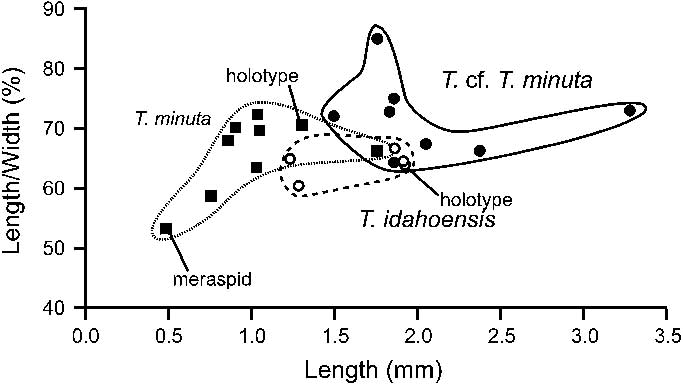
The cranidia and pygidia of Thoracocare cf. T. minuta from the Emigrant Formation are similar to the older T. minuta (Resser, Reference Resser1939a) from the Albertella and Glossopleura zones, Spence Shale, Utah (Robison and Campbell, Reference Robison and Campbell1974). The difference between the two species is that the former has a pygidium with an evenly tapered axial lobe and obscure (external, Fig. 14.10) to very shallow (internal molds, Fig. 14.14) pleural furrows. Smaller pygidia of T. minuta also have an evenly tapered axial lobe and pointed terminal piece, whereas larger specimens do not. The pygidia of T. cf. T. minuta from the Emigrant Formation are generally larger than the specimens from the Spence Shale illustrated by Robison and Campbell (Reference Robison and Campbell1974; Fig. 15); thus potentially making the morphological differences between the two group of specimens ontological.
Pygidial length/width vs. size of Thoracocare specimens from the Glossopleura walcotti Zone, Spence Shale illustrated by Robison and Campbell (Reference Robison and Campbell1974; T. minuta and T. idahoensis) and from the Ehmaniella Zone, Emigrant Formation, Clayton Ridge, Nevada.

Thoracocare idahoensis (Resser, Reference Resser1939b) (see Robison and Campbell, Reference Robison and Campbell1974, for additional information), also from the Glossopleura Zone, Spence Shale, Utah, differs from the Emigrant Formation specimens in having cranidia with effaced cranidial furrows and wider fixigenae and pygidia that have better defined pleural and interpleural furrows. One character state that Robison and Campbell (Reference Robison and Campbell1974) used to distinguish the two species is the length to width ratio of the pygidia (T. minuta having a ratio averaging 0.6 and T. idahoensis averaging 0.7). Measurements from their illustrated specimens, however, do not support this distinction (Fig. 15).
Family Oryctocephalidae Beecher, Reference Beecher1897
Subfamily Lancastriinae Kobayashi, Reference Kobayashi1935
Genus Oryctocephalites Resser, Reference Resser1939b
Type species
Oryctocephalites typicalis Resser, Reference Resser1939b, from the Ute Formation (Spence Shale), Wasatch Mountains, Idaho, by original designation.
Oryctocephalites sp. indet.
Occurrence
Emigrant Formation (Glossopleura walcotti/Ptychagnostus praecurrens Zone), Split Mountain, Nevada.
Material
Split Mountain East Section: USNM loc. 44121–cranidium.
Remarks
The single, small cranidium without an associated pygidium makes the taxonomic placement of this sample infeasible.
Oryctocephalites cf. O. reynoldsi (Reed, Reference Reed1899)
Occurrence
Emigrant Formation (Ehmaniella Zone), Split Mountain, Nevada.
Materials
Split Mountain East Section: USNM loc. 44126–cranidium and pygidium. Split Mountain West Section: USNM loc. 44136–cranidium; USNM loc. 44137–cranidium, pygidium.
Remarks
The cranidium preserved in limestone has similar outline and glabellar shape as Oryctocephalites reynoldsi found flattened in the Stephens Formation (Rasetti, Reference Rasetti1951; Whittington, Reference Whittington1995). The pygidium, however, has a narrower macrospine and pleural bands prompting the cf. identification. The specimens from USNM loc. 44136 and USNM loc. 44135 are too fragmentary to provide identification.
Family Zacanthoididae Swinnerton, Reference Swinnerton1915
Genus Zacanthoides Walcott, Reference Walcott1888
Type species
Embolimus spinosus Rominger, Reference Rominger1887, from the Stephen Formation, Mount Stephen, British Columbia.
Zacanthoides sp. indet.
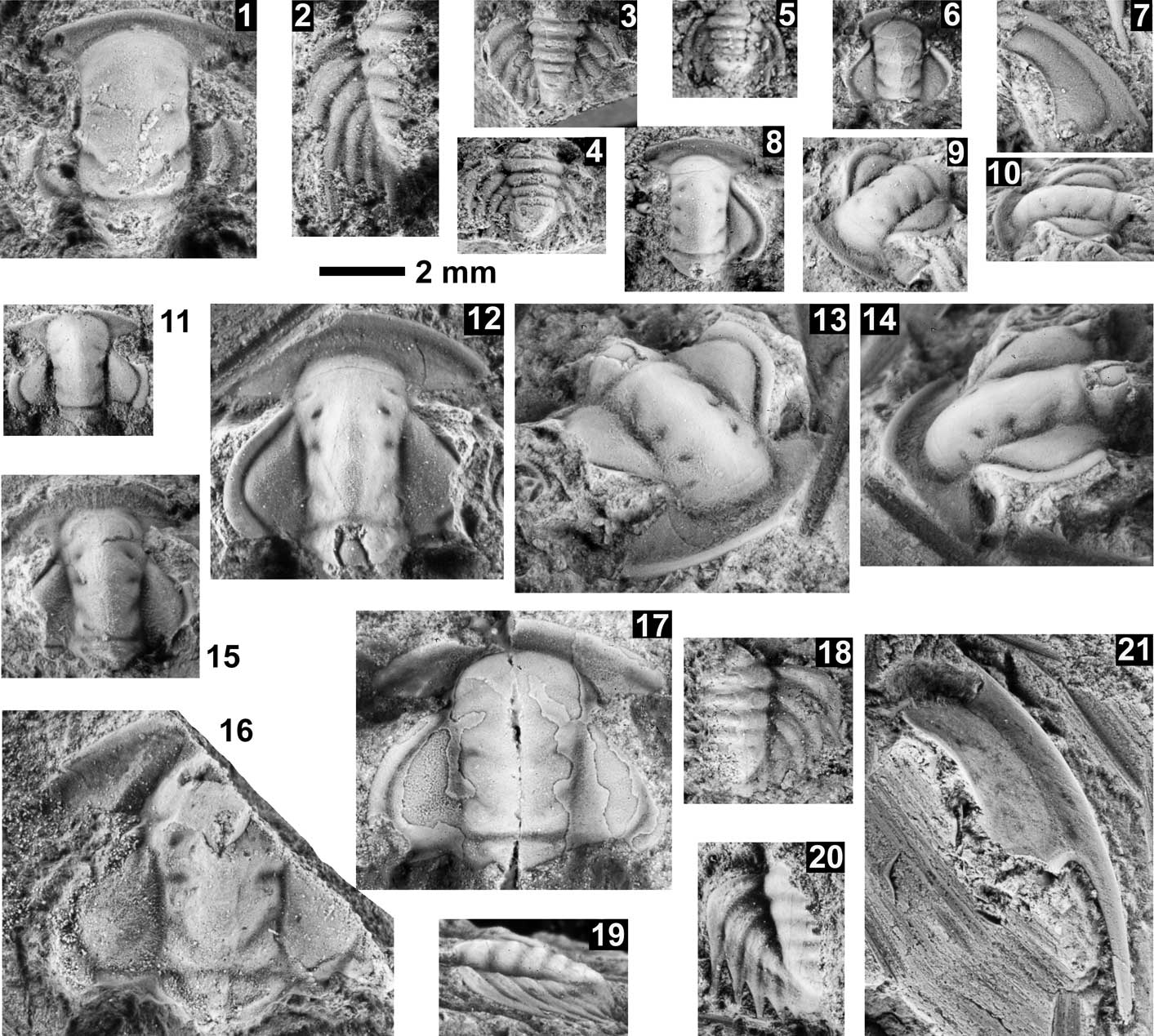
Zacanthoides spp. from the Emigrant Formation, Clayton Ridge, Nevada. (1–5) Zacanthoides sp. indet., Glossopleura walcotti/Ptychagnostus praecurrens Zone, Split Mountain East Section: (1) damaged cranidium USNM 644020 (USNM loc. 44119); (2) mostly testate pygidium USNM 644021 (USNM loc. 44119); (3) mostly testate pygidium USNM 644022 (USNM loc. 44119); (4) mostly testate pygidium USNM 644018 (USNM loc. 44114); (5) mostly testate pygidium USNM 644019 (USNM loc. 44116). (6–10) Zacanthoides cf. Z. longipygus Rasetti, Reference Rasetti1951, Ehmaniella Zone: (6) mostly testate cranidium USNM 644008 (USNM loc. 44123); (7) mostly testate librigena USNM 644007 (USNM loc. 44123); (8–10) mostly testate cranidium USNM 644006 (USNM loc. 44123), plan and slightly oblique photographic angles. (11–21) Zacanthoides divergens Rasetti, Reference Rasetti1951, Ehmaniella Zone, Split Mountain West Section: (11) testate cranidium USNM 644009 (USNM loc. 44010); (12–14) testate cranidium USNM 644011 (USNM loc. 44132), lateral and plan views; (15) exfoliated cranidium USNM 644016 (USNM loc. 44135); (16) exfoliated cranidium USNM 644014 (USNM loc. 44135); (17) partially testate cranidium USNM 644010 (USNM loc. 44126); (18) exfoliated pygidium USNM 644017 (USNM loc. 44136); (19, 20) testate pygidium USNM 644012 (USNM loc. 44132); (21) testate librigena USNM 644013 (USNM loc. 44134).

Occurrence
Emigrant Formation (Glossopleura walcotti/Ptychagnostus praecurrens Zone), Split Mountain, Nevada.
Materials
Split Mountain East Section: USNM loc. 44114–pygidium; USNM loc. 44116 pygidium; USNM loc. 44118–?pygidium; USNM loc. 44119–three cranidia, two pygidia; USNM loc. 44120–cranidium; USNM loc. 44121–cranidium.
Remarks
The fragmented or small specimens exclude an accurate assignment to a species. Cranidia are characterized by parallel-sided glabella, relatively short frontal area, moderately curved anterior border, and moderately divergent anterior facial sutures generating a relatively small frontal area with subtriangular outline adjacent to the frontal lobe. Larger pygidia are sagittally elongate where smaller specimens are more equal in length to width ratio. Pygidia have an elongated axis with four to five axial rings and a terminal piece, well-developed pleural lobes developed into five pairs of posteriorly directed spines. If the cranidia and pygidia belong to the same species, then they bear similarity to Zacanthoides from the Spence Shale named or reported by Resser (Reference Resser1939b; Z. abbreviatus, Z. adjunctus, Z. gradatus, Z. holopygus, Z. idahoensis Walcott, Reference Walcott1908, and Z. serratus), and Zacanthoides sp. indet. of Fritz (Reference Fritz1968) from the Pioche Shale.
Zacanthoides divergens Rasetti, Reference Rasetti1951 (s.l.)
1951 Zacanthoides divergens Reference RasettiRasetti, p. 146, pl. 32, figs. 8–10.
1991 Zacanthoides n. sp. Reference SundbergSundberg, p. 388, fig. 2.9.
1994 Zacanthoides divergensis; Reference SundbergSundberg, p. 46, fig. 29.1–29.7.
Occurrence
Stephen Formation (Bathyuriscus-Elrathina Zone), British Columbia, Canada (Rasetti, Reference Rasetti1951). Member E, Eldorado Formation and Pole Canyon Limestone, eastern Nevada, and Swasey Limestone and Trailer Limestone (all Altiocculus Subzone, Ehmaniella Zone) Utah (Sundberg, Reference Sundberg1994). Emigrant Formation (Ehmaniella Zone), Split Mountain, Nevada.
Materials
Split Mountain East Section: USNM loc. 44126–three cranidia, librigena; USNM loc. 44127–librigena. Split Mountain West Section: USNM loc. 44132–six cranidia, librigena, four pygidia; USNM loc. 44133–two cranidia, librigena, pygidium; USNM loc. 44134–two cranidia, librigena, two pygidia; USNM loc. 44135–six cranidia, librigena, two pygidia; USNM loc. 44136–four cranidia, librigena, four pygidia; USNM loc. 44137–three cranidia, two pygidia.
Remarks
The specimens from the Emigrant Formation have an expanding frontal lobe, glabellar furrows F2 and F3 developed as pits, F3 isolated from glabellar furrow, strongly divergent anterior branches (70–85° from exsagittal line) of the facial sutures and strongly curved anterior border. These features are similar to the subspecies of Zacanthoides divergens recognized by Sundberg, (Reference Sundberg1994, as Z. divergensis [sic.]). One specimen (USNM 644010, Fig. 16.17) is similar to Z. divergens divergens, whereas the other cranidia are similar to Z. divergens limbus. The development of the F2 and F3 as pits are similar to Z. divergens subspecies A of Sundberg, Reference Sundberg1994, but the Emigrant specimens have a shorter frontal area and lack the plectrum. The variation in cranidial features observed in the specimens from the Emigrant Formation preclude specimen assignment to a subspecies, and thus they are assigned to Z. divergens s.l.
Most species of Zacanthoides have a parallel-sided glabella without an expanding frontal lobe. The specimens of Z. divergens (s.l.) from the Emigrant Formation have a more concave outline of the glabella and the expanding glabella begins at the F2 furrow. Other species having these glabellar features include: Z. fronslicinus Sundberg, Reference Sundberg1994 (Ehmaniella Zone); Z. sampsoni Resser, Reference Resser1938a (Glossopleura walcotti Zone), Z. serratus, Resser, Reference Resser1939a (Glossopleura walcotti Zone); Z. sexdentatus Rasetti, Reference Rasetti1951 (Ehmaniella Zone); and Z. sp. indet. of Bordonaro et al. (Reference Bordonaro, Banchig, Pratt and Raviolo2008; Ehmaniella Zone). These taxa may form a grouping within Zacanthoides (as a subgenus) or a new genus, but a complete phylogenetic analysis of Zacanthoides is needed to determine the relationships of this group to other Zacanthoides species. Zacanthoides fronslicinus from the Swasey Limestone and Trailer Limestone, Utah, lacks the lateral glabellar furrows and strongly divergent anterior facial sutures. Zacanthoides sampsoni from the Lakeview Limestone, Idaho, lacks the widely expanding frontal lobe and F2 and F3 developed as pits (comparison based on topotype material). Zacanthoides serratus from the Spence Shale, Utah, lacks the strongly divergent anterior facial suture. Zacanthoides sexdentatus from the Cathedral Formation, British Columbia, also lacks the strongly divergent anterior facial suture and the glabellar furrows developed as pits. Zacanthoides sp. indet. of Bordonaro et al. (Reference Bordonaro, Banchig, Pratt and Raviolo2008), from the Soldano Member, La Laja Formation, Argentina, lacks the strongly divergent anterior facial suture.
Zacanthoides cf. Z. longipygus Rasetti, Reference Rasetti1951
Occurrence
Emigrant Formation (Glossopleura walcotii Zone), Split Mountain, Nevada.
Materials
Split Mountain East Section: USNM loc. 44123–two cranidia.
Remarks
The specimens from the Emigrant Formation have moderately divergent anterior branches of the facial sutures (~45–60° from exsagittal line), which differentiates them from Z. divergens and is similar to Z. longipygus Rasetti, Reference Rasetti1951, from the top of the Stephen Formation, British Columbia, Canada, from the Bathyuriscus-Elrathina Zone (=Altiocculus Subzone, Ehmaniella Zone; Sundberg, Reference Sundberg1994). These specimens differ from Z. longipygus in their longer frontal area. Pygidia have not been found associated with the two cranidia, thus establishing a new species is unwarranted at this time.
Genus Parkaspis Rasetti, Reference Rasetti1951
Type species
Parkaspis endecamera Rasetti, Reference Rasetti1951, from the Stephen Formation, Park Mountain, British Columbia, by original designation.
Parkaspis cf. P. drumensis Sundberg, Reference Sundberg1994
Parkaspis cf. P. drumensis Sundberg, Reference Sundberg1994, from the Ehmaniella Zone, Emigrant Formation, Clayton Ridge, Nevada. (1) Testate pygidium USNM 643989 (USNM loc. 44126); (2, 3) exfoliated and latex cast of pygidium USNM 643990 (USNM loc. 44133).

Occurrence
Emigrant Formation (Ehmaniella Zone), Split Mountain, Nevada.
Materials
Split Mountain East Section: USNM loc. 44126–pygidium. Split Mountain West Section: USNM loc. 44132–four pygidia; USNM loc. 44133–two pygidia.
Remarks
As discussed under Bathyuriscus terranovensis Young and Ludvigsen, Reference Young and Ludvigsen1989, the cranidia of Parkaspis and Bathyuriscus are similar, with the former having a strong fixigenal spine. In the Split Mountain sections, the distinctive pygidia of Parkaspis are present, but Parkaspis-like cranidia with a fixigenal spine have not been identified due to fragmentation. Some specimens listed as B. terranovensis may actually belong to P. cf. P. drumensis.
The pygidia of P. cf. P. drumensis have a tapered axis, three axial rings, and small marginal spines. They differ from P. drumensis in having much less-pronounced marginal spines. Parkaspis decamera Rasetti, Reference Rasetti1951, known from only a single sample of compressed specimens in shale, has a tapered pygidial axis and slightly larger marginal spines, but differs in having only two axial rings. Parkaspis endecamera Rasetti, Reference Rasetti1951, differs in having a non-tapered pygidial axis. Parkaspis caboti Young and Ludvigsen, Reference Young and Ludvigsen1989, differs in having long marginal spines and a stronger curved posterior margin.
Order Pychopariida Swinnerton, Reference Swinnerton1915
Suborder Ptychopariina Richter, Reference Richter1932
Superfamily Marjumiacea Kobayashi, Reference Kobayashi1935
Family Cedariidae Raymond, Reference Raymond1937
Genus Cedaria Walcott, Reference Walcott1924
Type species
Cedaria prolifica Walcott, Reference Walcott1924 from the Conasauga Formation, Alabama, by original designation.
Remarks
The specimens of Cedaria from the Clayton Ridge sections are commonly fragmented and rare, which makes the specific identification difficult. The limited number of cranidia does not allow for the determination of taxonomic variation. Slight differences in the cranidia from the type material may represent new species.
Cedaria selwyni Pratt, Reference Pratt1992
Cedaria spp. from the, Emigrant Formation, Clayton Ridge, Nevada. (1–7) Cedaria selwyni Pratt, Reference Pratt1992, Cedaria selwyni Zone: (1) mostly testate pygidium USNM 643938 (USNM loc. 44138); (2, 3) mostly exfoliated, partial cranidium USNM 643937 (USNM loc. 44138), plan and lateral views; (4) mostly testate pygidium USNM 643935 (USNM loc. 44128 ); (5) poorly preserved cranidium USNM 643936 (USNM loc. 44128 ); (6, 7) latex cast of partially exfoliated cranidium USNM 643939 (USNM loc. 44138), plan and slightly oblique lateral views; (8–11) Cedaria cf. C. brevifrons Palmer, Reference Palmer1962, Cedaria brevifrons Zone: (8) partially testate, fragmented cranidium USNM 643933 (USNM loc. 44130 ); (9–11) partially testate, fragmented cranidium USNM 643934 and (10, 11) latex cast of same specimen (USNM loc. 44131 ), plan and oblique views; (12) Cedaria sp. 1, exfoliated fragmented pygidium USNM 643940 (USNM loc. 44138); (13) Cedaria sp. 2, partially testate, fragmented pygidium USNM 643941 (USNM loc. 44138).

1954 ?Tricrepicephalus anarusconii Reference RusconiRusconi (part), p. 49, pl. 4, fig. 4 (only).
1992 Cedaria selwyni Reference PrattPratt, p. 82, pl. 31, figs. 6–19.
Holotype
Pygidium (ROM 46648d) from the Rabbitkettle Formation, Mackenzie Mountains, Northwest Territories (loc. N-97; Pratt, Reference Pratt1992, pl. 31, fig. 9).
Occurrence
Rabbitkettle Formation, Mackenzie Mountains, Northwest Territories (Pratt, Reference Pratt1992). Possibly Quebradita Oblícula, Cerro Aspero (Rusconi, Reference Rusconi1954; see Pratt, Reference Pratt1992). Emigrant Formation (Cedaria selwyni Zone), Split Mountain, Nevada.
Materials
Split Mountain East Section, USNM loc. 44128–three cranidia, five pygidia. Split Mountain West Section, USNM loc. 44138–two cranidia, three pygidia.
Remarks
The pygidia have a length to width ratio and faint pleural furrows similar to Cedaria selwyni. One larger pygidium (Fig. 18.1) has more-defined pleural furrows and is less transversely wide, similar to C. prolifica, has faint pleural furrows similar to C. selwyni, and may illustrate specific variation of C. selwyni or belong to C. cf. C. brevifrons. The cranidia have the long frontal area and a lower convexity similar to C. selwyni.
Cedaria cf. C. brevifrons Palmer, Reference Palmer1962
Occurrence
Emigrant Formation (Cedaria brevifrons Zone), Split Mountain, Nevada.
Materials
Split Mountain East Section, USNM loc. 44129–cranidium; USNM loc. 44130–cranidium; USNM loc. 44131–two cranidia.
Remarks
The cranidia have a strong convexity similar to Cedaria brevifrons Palmer, Reference Palmer1962, but a longer anterior border, similar to C. selwyni and may represent a new species.
Cedaria sp. 1
Occurrence
Emigrant Formation (Cedaria selwyni Zone), Split Mountain, Nevada.
Material
Split Mountain West Section, USNM loc. 44138–pygidium.
Remarks
A single fragmentary pygidium with pronounced interpleural furrows is most similar to Cedaria minor (Walcott, Reference Walcott1916b), as illustrated by Pratt (Reference Pratt1992, pl. 30, figs. 13, 17), but differs in having a well-defined pygidial border.
Cedaria sp. 2
Occurrence
Emigrant Formation (Cedaria selwyni Zone), Split Mountain, Nevada.
Material
Split Mountain West Section, USNM loc. 44138–pygidium.
Remarks
A single fragmentary pygidium with more-defined interpleural furrows and broad flat border without a border furrow are similar to the pygidia of Cedaria prolifica Walcott, Reference Walcott1924. However, the narrower pleural region is dissimilar to other species of Cedaria.
Family Crepicephalidae Palmer, Reference Palmer1954
Remarks
Pratt (Reference Pratt1992, p. 62) placed Coosella into Crepicephalidae and suppressed the family Coosellidae Palmer, Reference Palmer1954.
Genus Crepicephalus Kobayashi, Reference Kobayashi1935
Type species
Dikelocephalus iowensis Owen, Reference Owen1852, Eau Claire Formation, Minnesota.
Crepicephalus sp. indet.
Crepicephalidae from the Cedaria selwyni Zone, Emigrant Formation, Clayton Ridge, Nevada. (1, 2) Tricrepicephalus sp. indet. (USNM loc. 44128): (1) partial cranidium USNM 644002, mostly exfoliated; (2) latex cast of partial pygidium USNM 644003. (3) Meteoraspis sp. indet., latex cast of partial pygidium USNM 643975 (USNM loc. 44128 ). (4) Crepicephalus sp. indet., mostly exfoliated, partial, and crushed cranidium USNM 643954 (USNM loc. 44128 ); (5, 6) Coosella sp. indet.(USNM loc. 44128 ): (5) mostly testate pygidium USNM 643950; (6) mostly testate, fragmentary cranidium USNM 643951; (7) Coosia sp. indet., latex cast of partially testate, fragmented pygidium USNM 643952 (USNM loc. 44138).

Occurrence
Emigrant Formation (Cedaria selwyni Zone), Split Mountain, Nevada.
Material
Split Mountain East Section, USNM loc. 44128–cranidium.
Remarks
A single fragmentary cranidium shows the typical shape of the genus, possesses coarse granules, but lacks the anterior border pits typical of Tricrepicephalus.
Genus Coosella Lochman, Reference Lochman1936
Type species
Coosella prolifica Lochman, Reference Lochman1936, Bonneterre Dolomite, Missouri, by original designation.
Coosella sp. indet.
Occurrence
Emigrant Formation (Cedaria selwyni Zone), Split Mountain, Nevada.
Materials
Split Mountain East Section, USNM loc. 44128–cranidium, pygidium; Split Mountain West Section, USNM loc. 44138–pygidium.
Remarks
The pygidia are similar to Coosella sp. of Palmer (Reference Palmer1954) in possessing a broadly lobate posterior margin and short pygidial axis. The associated fragmented cranidium has a relatively long frontal area, but otherwise is similar to Coosella perplexus (Palmer, Reference Palmer1954).
Genus Coosia Walcott, Reference Walcott1911
Type species
Coosia superba Walcott, Reference Walcott1911, Conasauga Formation, Alabama, by original designation.
Coosia sp. indet.
Occurrence
Emigrant Formation (Cedaria selwyni Zone), Split Mountain, Nevada.
Material
Split Mountain West Section, USNM loc. 44138–pygidium.
Remarks
A single fragmentary pygidium with a short axial lobe and the absence of pleural and anterior border furrows is similar to the pygidia of Coosia alethes (Walcott, Reference Walcott1916b), as illustrated in Rasetti (Reference Rasetti1965, pl. 6, fig. 18), but due to the fragmentary nature of the specimen, assignment to this species is not possible.
Family Tricrepicephalidae Palmer, Reference Palmer1954
Genus Tricrepicephalus Kobayashi, Reference Kobayashi1935
Type species
Arionellus (Bathyurus) texanus Shumard, Reference Shumard1861, Riley Formation, Texas.
Tricrepicephalus sp. indet.
Occurrence
Emigrant Formation (Cedaria selwyni Zone), Split Mountain, Nevada.
Materials
Split Mountain East Section, USNM loc. 44128–two cranidia, pygidium; Split Mountain West Section, USNM loc. 44138–cranidium.
Remarks
The specimens from Clayton Ridge are fragmentary and cannot be assigned to a species.
Genus Meteoraspis Resser, Reference Resser1935
Type species
Ptychoparia? metra Walcott, Reference Walcott1890, from the Riley Formation, Packsaddle Mountain, Texas.
Meteoraspis sp. indet.
Occurrence
Emigrant Formation (Cedaria selwyni Zone), Split Mountain, Nevada.
Material
Split Mountain East Section, USNM loc. 44128–pygidium.
Remarks
The pygidium from Clayton Ridge is fragmentary and cannot be assigned to a species.
Superfamily Ptychopariacea Matthew, Reference Matthew1887
Family Alokistocaridae Resser, Reference Resser1939b
Genus Alokistocare Lorenz, Reference Lorenz1906 (emend. Sundberg, Reference Sundberg1999)
Type species
Concephalites subcoronatus Hall and Whitfield, Reference Hall and Whitfield1877, from the Ute Limestone, Bear River Range, Utah.
Alokistocare cf. A. paranotatum Rasetti, Reference Rasetti1951
Miscellaneous ptychoparoids from the Emigrant Formation, Clayton Ridge, Nevada. (1–3) Utia curio? Walcott, Reference Walcott1924, Ehmaniella Zone: (1, 2) damaged cranidium USNM 644004 (USNM loc. 44135), mostly exfoliated, plan and oblique views; (3) latex cast of testate cranidium USNM 644005 (USNM loc. 44135). (4) Kistocare sp. indet., Glossopleura walcotti/Ptychagnostus praecurrens Zone, partial, testate cranidium USNM 643973 (USNM loc. 44123). (5, 6) Amecephalus? sp. indet., Ehmaniella Zone: (5) damaged, mostly testate cranidium USNM 643922 (USNM loc. 44134); (6) testate pygidium USNM 643923 (USNM loc. 44134); (7) pygidium unident., Ehmaniella Zone: USNM 643955 (USNM loc. 44136), white scale bar=1 mm; (8) Alokistocare cf. A. paranotatum Rasetti, Reference Rasetti1951, Ehmaniella Zone, testate cranidium USNM 643921 (USNM loc. 44126).

Occurrence
Emigrant Formation (Ehmaniella Zone), Split Mountain, Nevada.
Materials
Split Mountain East Section, USNM loc. 44126–four cranidia.
Remarks
One complete and three fragmentary cranidia are most similar to Alokistocare paranotatum Rasetti, Reference Rasetti1951 in glabellar shape, posterior area of the fixigena, divergent anterior branch of the facial sutures, and flat anterior border. The specimens differ from the type material in having smaller palpebral lobes and narrower anterior border. These specimens differ from Alokistocare cf. A. paranotatum, reported as Pseudoalokistocare cf. P. paranotatum by Sundberg (Reference Sundberg1994), in having a weaker anterior border furrow, shorter (sag.) and narrower (trans.) anterior border, and weaker ocular ridges.
Family Unassigned
Genus Achlysopsis Fritz, Reference Fritz1968
Type Species
Achlysopsis liokata Fritz, Reference Fritz1968 from the Pioche Shale, East-central Nevada, by original designation.
Diagnosis
Cranidium with moderately low convexity, shallow furrows, length approximately equal to width across palpebral lobes. Glabella with low to moderate convexity, subquadrate shape with convergent sides and slightly curved frontal lobe, glabellar furrows deeper posteriorly to shallow anteriorly, lateral glabellar furrows faint. Palpebral lobes moderately long, narrow, slightly curved, slightly upsloping to downsloping, anterior end position near level of F2 glabellar furrow. Eye ridges faint, connecting to glabella, not entirely cut by glabellar furrows. Fixigena downsloping, low convexity. Frontal area downsloping, divided into equal or longer preglabellar area separated from anterior border with shallow furrow medially. Anterior facial sutures slightly divergent to slightly convergent, posterior facial suture moderately divergent. Posterior area of fixigena narrower than occipital ring (trans.). Occipital ring short (sag.), with medial shallow to shallow occipital furrow, occipital furrow deeper laterally forming deep slit-like structures adjacent to glabellar furrow, small occipital node present on posterior margin (emended from Fritz, Reference Fritz1968).
Remarks
The extended, emended diagnosis is due to the plethora of ptychoparioids missing distinct character states that can be used to quickly identify them. The diagnosis does not include the pygidium due to the lack of fully articulated shields or monospecific assemblages that provide assurance that a pygidium belongs to the taxon. Fritz (Reference Fritz1968) questionably assigned a pygidium to the type species and compared it to Tonkinella idahoensis Resser, Reference Resser1939a. The pygidia associated with Alokistocarella? cf. brighamensis Resser, Reference Resser1939b, by Palmer and Halley (Reference Palmer and Halley1979; here assigned to Achlysopsis) and the specimens from the Split Mountain East Section are unlike that assigned to the genus by Fritz (Reference Fritz1968). These pygidia are transversely elongated with the anterior lateral corners located below the pygidial axial midpoint, faint pleural and interpleural furrows, and an elongated axis extending to nearly the posterior margin. In this aspect, the pygidia are more similar to Mexicella obscurus (Palmer and Halley, Reference Palmer and Halley1979, pl. 7, figs. 13, 15; species reassigned by Sundberg, Reference Sundberg2004) and M. robusta Sundberg and McCollum, Reference Sundberg and McCollum2000 (fig. 13). The pygidia assigned here to A. brighamensis differ from both of these species in having sharper curvature of the anterior margin and anterior margin corner and from M. obscurus in its less-defined pleural and interpleural furrows.
Fritz (Reference Fritz1968) also noted that the cranidium of Achlysopsis is similar to that of Mexicella mexicana Lochman, Reference Lochman1948 (type species). Given the range of morphology of Mexicella species (M. grandoculus Palmer and Halley, Reference Palmer and Halley1979; M. obscurus, M. robusta, and M. granulata Eddy and McCollum, Reference Eddy and McCollum1998 [M. antelopea Sundberg and McCollum, Reference Sundberg and McCollum2000, is excluded here due to its placement outside the Mexicella clade; see Sundberg, Reference Sundberg2004]), there are several similarities between the two genera, including the shape and convexity of the cranidia and glabella, generally obscure glabellar furrows, downsloping of the preglabellar area, parallel to slightly convergent anterior facial sutures, and weak expression of the eye ridges. Achlysopsis differs in having a slightly deeper anterior border and palpebral lobe furrows, larger and generally more posteriorly located palpebral lobes, and generally lacking a boss on the preglabellar field. In addition, Achlysopsis has a librigena with a relatively long librigenal spine and pygidia with a sharper curvature of the anterior margin and anterior margin corner.
Fritz (Reference Fritz1968) also discussed Achlysopsis similarities with Onchocephalites Rasetti, Reference Rasetti1957 and Nanoqia Poulsen Reference Poulsen1964. Onchocephalites differs in having a glabella with convex outline facial sutures strongly convergent across the anterior border furrow, and an anterior border that is slightly convex and shows little change in slope from the preglabellar area. Nanoqia (Poulsen, Reference Poulsen1964, pl. 3, figs. 1–3) is similar in the depth of the furrows, the position of the palpebral lobes, and the low convexity of the cranidium, but differs in having slightly more divergent anterior sutures, which also persists at the same angle across the anterior border, and a convex and convergent glabellar furrow to the S3 position and then nearly parallel to the frontal lobe, giving the glabella a concave appearance, as reported by Fritz (Reference Fritz1968).
Achlysopsis brighamensis (Resser, Reference Resser1939b)
Figures 21.1–21.18, 22.1–22.8
Achlysopsis brighamensis (Resser, Reference Resser1939b). (1–16) Achlysopsis brighamensis from the Glossopleura walcotti/Ptychagnostus praecurrens Zone, Emigrant Formation, Split Mountain East Section, Clayton Ridge, Nevada: (1–3) exfoliated cranidium USNM 643912 (USNM loc. 44121); plan, lateral, and anterior views; (4–6) partially testate cranidium USNM 643913 (USNM loc. 44121); plan, lateral, and anterior views; (7–9) exfoliated cranidium USNM 643914 (USNM loc. 44121); plan, lateral, and anterior views; (10) mostly testate cranidium USNM 643915 (USNM loc. 44114); (11) exfoliated cranidium USNM 643911 (USNM loc. 44121); (12) mostly testate, small cranidium USNM 643920 (USNM loc. 44119); (13) exfoliated pygidium USNM 643919 (1 mm scale bar) (USNM loc. 44119); (14) mostly testate librigena USNM 643918 (USNM loc. 44118); (15) exfoliated librigena USNM 643917 (USNM loc. 44118); (16) mostly testate librigena USNM 643916 (USNM loc. 44118). (17, 18) Type specimens Alokistocarella brighamensis Resser (Reference Resser1939b) from the Ptarmigania fauna, Ute Formation, Wasatch Range, Nevada; material preserved in shale, not blackened with colloidal graphite, but whitened with ammonium chloride sublimate: (17) internal mold of paratype cranidium and thoracic segments USNM 98548 (USNM loc. 20x); (18) Photoshop-generated positive of exterior impression of holotype cranidium and thoracic segments USNM 98549 (USNM loc. 55e).

Achlysopsis brighamensis (Resser, Reference Resser1939b). Hypotype specimens of Alokistocarella? cf. brighamensis Resser (Reference Resser1939b) illustrated by Palmer and Halley (Reference Palmer and Halley1979, pl. 15, figs. 9–14) from the Desert Range Limestone (Glossopleura walcotti Zone), Carrara Formation, Nevada and California; material not blackened with colloidal graphite, but whitened with ammonium chloride sublimate. (1) Exfoliated cranidium USNM 208237 (USGS loc. 4155-CO); (2) testate cranidium USNM 208240 (USGS loc. 3690-CO); (3) testate librigena USNM 208241 (USGS loc. 3690-CO); (4) exfoliated librigena USNM 208236 (USGS loc. 4155-CO); (5) mostly testate, small cranidium USNM 208238 (USGS loc. 4155-CO); (6–8) testate pygidium with single thoracic segment attached; plan, lateral, and posterior views; USNM 208239 (USGS loc. 4155-CO).

1939b Alokistocarella brighamensis Reference ResserResser, p. 53, pl. 13, figs. 17, 18.
1979 Alokistocarella? cf. brighamensis; Reference Palmer and HalleyPalmer and Halley, p. 100, pl. 15, figs. 9–14.
Holotype
Cranidium and thoracic segments (mold and cast), USNM 98549, Ute Formation (possibly Spence Shale, Ptarmigania fauna), Box Elder Canyon, Wasatch Range, Utah (loc. 55e; Resser, Reference Resser1939b, pl. 13, fig. 18). Paratype cranidium and few thoracic segments (internal mold), USNM 98548, Ute Formation, Wasatch Range, Utah (Resser, Reference Resser1939b, pl. 13, fig. 17).
Occurrence
Ute Formation (possibly Spence Shale, Ptarmigania fauna), Box Elder Canyon, Wasatch Range, Utah (Resser, Reference Resser1939b). Desert Range Limestone Member, Carrara Formation (Glossopleura walcotti Zone), Funeral Mountains, California and Striped Hills, Nevada (Palmer and Halley, Reference Palmer and Halley1979). Emigrant Formation (Glossopleura walcotti/Ptychagnostus praecurrens Zone), Split Mountain, Nevada.
Materials
Split Mountain East Section, USNM loc. 44113–seven cranidium, two. librigena; USNM loc. 44114–18 cranidia, librigena; USNM loc. 44115–cranidium; USNM loc. 44117–11 cranidia; USNM loc. 44118–47 cranidia, four librigena; USNM loc. 44119–18 cranidia, two pygidia; USNM loc. 44120–four cranidia; USNM loc. 44121–38 cranidia, 11 librigena.
Remarks
The type material of Resser (Reference Resser1939b) and Palmer and Halley (Reference Palmer and Halley1979) is re-illustrated here (Figs. 21.16, 21.17, 22.1–22.8). In general, these specimens are larger than those in the Emigrant Formation and illustrate slight variations in morphology. Palmer and Halley (Reference Palmer and Halley1979) presented an adequate description of the species. The cranidia reported by Palmer and Halley (Reference Palmer and Halley1979) and herein agree well with the type cranidia, despite the type material being preserved in shale. Achlysopsis brighamensis is most similar to the type species, A. liokata Fritz, Reference Fritz1968, but differs in a stronger convexity of the glabella, a less-curved anterior border, an elongated boss on the anterior border, and level to slightly upsloping palpebral lobes. Achlysopsis brighamensis differs from A. cf. liokata of Sundberg (Reference Sundberg2005, pl. 6, fig. 7) in a stronger convexity of the glabella, less-curved anterior border, elongated boss on the anterior border, and slightly deeper glabellar furrows. Achlysopsis brighamensis differs from A. hermitora Fritz, Reference Fritz1968 in a weaker convexity of the glabella, wider (trans.) fixigena, less-curved anterior border, elongated boss on the anterior border, and level to slightly upsloping palpebral lobes.
Palmer and Halley (Reference Palmer and Halley1979, p. 100–101) separated the Carrara Formation specimens from the type material in having a slightly narrower fixigena and the palpebral lobes slightly more posteriorly set. The differences in the width of the fixigena and the position of the palpebral lobe are relatively minor and may be the result of compression of the type specimens.
Palmer and Halley (Reference Palmer and Halley1979) discussed the difficulty of recognizing this genus and thus their questionable generic placement of Alokistocarella? cf. brighamensis from the Carrara Formation of California and Nevada. Alokistocarella Resser, Reference Resser1938b, differs in having a more rounded frontal lobe, moderately divergent anterior branch of the facial suture, and eye ridges that do not connect with the glabella. This is based on photographs of the type specimens of A. typicalis Resser, Reference Resser1938b (type species), A. mexicana Lochman, Reference Lochman1952, A. occidens Resser, Reference Resser1939b, and A. fieldensis Rasetti, Reference Rasetti1951 accessible through the Smithsonian online data base (http://collections.si.edu/search). The type species is preserved as molds and casts in a fine-grained limestone that may exhibit some tectonic distortion. These specimens illustrate an increased rounding of the frontal lobe in larger specimens and a clear separation of the eye ridges from the glabella with the glabellar furrow cutting through the ridges. Alokistocarella occidens and A. mexicana are preserved in limestone and have a relatively flatter frontal lobe outline and eye ridges not connecting with the glabella. Alokistocarella fieldensis is preserved in shale, may also display some tectonic distortion, is also flattened, and shows compression cracks. The specimen illustrates a slightly rounded frontal lobe (less than the type species) and eye ridges not connected with the glabella. Alokistocarella spencei Resser, Reference Resser1939a, is preserved in shale, is also flattened, and shows compression cracks. This species differs from the other species assigned to this genus in having a convergent anterior branch of the facial suture and a more posterior-directed occipital furrow. Alokistocarella spencei is intermediate in morphology between the other species of Alokistocarella and Achlysopsis.
The absence of eye ridges connected with the glabella and the shape of the frontal lobe may be in part the result of compression or distortion. However, the type specimens of Achlysopsis brighamensis are preserved in shale, and they illustrate the same features as seen in the limestone specimens from the Split Mountain section. This illustrates that the features separating A. brighamensis from Alokistocarella are true.
Achlysopsis liokata Fritz, Reference Fritz1968
Achlysopsis liokata Fritz, Reference Fritz1968, from the Glossopleura walcotti/Ptychagnostus praecurrens Zone, USNM loc. 44123, Emigrant Formation, Split Mountain East Section, Clayton Ridge, Nevada. (1–3) Mostly exfoliated cranidium USNM 643909, plan, anterior, and lateral views; (4) mostly exfoliated cranidium USNM 643910.

1968 Achlysopsis liokata Reference FritzFritz, p. 219, pl. 42, figs. 17–19, 22 [non figs. 20, 21].
Holotype
Cranidium, USNM 153635, Pioche Formation, Campbell Ranch, Northern Egan Range, White Pine County, Nevada (loc. 18; Fritz, Reference Fritz1968, pl. 42, figs. 17–19). Paratype cranidium, USNM 153637, Pioche Formation, Campbell Ranch, Northern Egan Range, White Pine County, Nevada (Fritz, Reference Fritz1968, pl. 42, fig. 22).
Occurrence
Pioche Formation, (Glossopleura walcotti Zone) Northern Egan Range, White Pine County, Nevada (Fritz, Reference Fritz1968). Emigrant Formation (Glossopleura walcotti/Ptychagnostus praecurrens Zone), Split Mountain, Nevada.
Materials
Split Mountain East Section, USNM loc. 44123–four cranidia; USNM loc. 44124–two cranidia.
Remarks
The specimens available agree well with the type specimens of Achlysopsis liokata in their wider fixigena, frontal area construction, and low frontal lobe convexity, although they possess a slightly more pronounced glabella similar to A. hermitora.
Genus Chancia Walcott, Reference Walcott1924
Type Species
Chancia ebdome Walcott, Reference Walcott1924, from the Spence Shale, Danish Flat, Idaho, by original designation.
Chancia maladensis (Resser, Reference Resser1939b)
Figures 24.1–24.6, 25.1–25.12
Chancia maladensis (Resser, Reference Resser1939b) specimens from the Rachel Limestone, Groom Range, Nevada (USNM loc. 44139). (1–3, 5, 6) Testate, articulated specimen USNM 643948, plan (1), oblique (2) , lateral sides (5, 6), and close-up of pygidium (3) (1 mm scale bar); (4), testate cranidium USNM 643949.

Chancia maladensis (Resser, Reference Resser1939b) specimens from the Glossopleura walcotti/Ptychagnostus praecurrens Zone, Emigrant Formation, Split Mountain East Section, Clayton Ridge, Nevada. (1) Testate cranidium USNM 643943 (USNM loc. 44118); (2–4) testate cranidium USNM 643946 (USNM loc. 44119); plan, anterior, and lateral views; (5–7) testate cranidium USNM 643947 (USNM loc. 44119); plan, anterior, and lateral views; (8, 9) testate librigena USNM 643944 (USNM loc. 44118), plan and lateral views; (10–12) exfoliated pygidium USNM 643945 (USNM loc. 44118), plan, lateral, and posterior views (1 mm scale bar).

1939b Ehmaniella maladensis Reference ResserResser, p. 60, pl. 12, figs. 17–23.
non 1979 Chancia? maladensis ; Reference Palmer and HalleyPalmer and Halley, p. 103, pl. 15, fig. 4.
Holotype
Cranidium, USNM 98563a, Ptarmigania strata (=Spence Shale), Langston Limestone, Wasatch Mountains, Idaho (loc. 54s; Resser, Reference Resser1939b, pl. 12, figs. 20, 21). Paratype cranidia, USNM 98563b-5, Ptarmigania strata (=Spence Shale), Langston Limestone, Wasatch Mountains, Idaho (Resser, Reference Resser1939b, pl. 12, figs. 17–19, 22).
Occurrence
Ptarmigania strata (=Spence Shale), Langston Limestone, Wasatch Mountains, Idaho (Resser, Reference Resser1939b). Rachel Limestone, Groom Range, Lincoln County, Nevada. Emigrant Formation (Glossopleura walcotti/Ptychagnostus praecurrens Zone), Split Mountain, Nevada.
Description
Cranidium moderate size, length 4.7±1.3 mm (N=8); subtrapezoidal, moderate convexity (sag. and trans.); anterior margin unevenly curved, flatter medially, slightly arched dorsally; posterior margin, excluding occipital ring, distally curved slightly posterolaterally. Anterior branches of facial sutures slightly convergent to slightly divergent to anterior border, strongly convergent to anterior margin; posterior branches moderately divergent. Glabella moderately elongated, strongly tapered in larger specimens, width at anterior end 72±7% glabellar width; moderate convexity (sag. and trans.); frontal lobe moderately to strongly rounded; length 71±2% cranidial length; width 30±2% cranidial width. Axial furrows moderate depth, deeper medially, straight in outline, and convergent from SO to S4; preglabellar furrow moderate depth. Lateral glabellar furrows moderate depth to shallow, S1 bifurcated, directed posteriorly, S2 bifurcated, directed posteriorly to slightly posterior, S3 directed laterally, S4 faint to absent, directed slightly anteriorly. Occipital ring slightly elevated above glabella, low convexity; small occipital node; length 16±4% glabellar length; posterior margin convex posteriorly, less curved medially. SO slightly curved posteriorly and moderate depth, deeper laterally. Frontal area equally divided; length 29±2% cranidial length. Preglabellar field moderately convex, downsloping, length 52±6% frontal area length. Anterior border flat to slightly convex, nearly level, tapering laterally, length 14±2% cranidial length. Anterior border furrow moderately wide and moderately shallow, shallower medially, shallower than axial furrows. Fixigena slightly convex, level, anterior area moderately downsloping, lateral portions downsloping; width 67±8% glabellar width. Palpebral lobes slightly arcuate, slightly upturned, narrow and moderately short, length 29±3% glabellar length; anterior margin located opposite S3 or L4. Ocular ridges moderate to strong, straight to slightly arched, directed posterolaterally from glabella at 76±3° to axis. Posterior area of fixigena triangular with sharply rounded termination; length 58±7% glabellar length; width 87±8% glabella length.
Librigena moderate size, length ~7.5 mm (N=1); moderately wide, width ~40% length without spine; lateral margin moderately curved. Genal field moderately convex. Border slightly convex, wider posteriorly, width ~30% librigenal width; border furrow moderate depth, shallowing posteriorly. Librigenal spine moderately long, ~30% librigenal length, slightly curved and flattened.
Thorax multisegmented with a minimum of 18 segments in holaspid (N=1; Fig. 24.1), moderately decreasing in width posteriorly. Axial furrows well defined, moderately deep. Thoracic pleura projecting laterally to fulcrum, then moderately posterolaterally to distal end, width ~140–200% of axial width; anterior and posterior pleural bands uniform length, distal end forming sharply rounded end; posterior pleural band slightly greater in length to anterior pleural band; pleural furrow deep, moderately long, shorter distally, not extending to margin.
Rostral plate and hypostoma unknown.
Pygidium small, length 1.6–2.0 mm (N=2); suboval, length 30–40% width; margin smooth, anterior margin slightly curved posterolaterally; anterolateral corners sharply rounded, adjacent to axial anterior; posteromedial notch weakly developed; moderately convex (sag.). Axis slightly tapered, anterior width 30–35% pygidial width; length 90–95% pygidial length, three axial rings, moderately convex; terminal axial piece moderate size, rounded; axial ring furrows moderately shallow to shallow. Pleural regions slightly convex, downsloping laterally; anterior pleural furrow narrow and moderate depth to shallow, extending to border; two additional pleural furrows, shallow to very shallow; interpleural furrows shallow to very shallow, not joining with pleural furrows; first anterior and posterior pleural bands moderately developed, second and third sets weakly developed. Border narrow, wider at anterolateral corners, level; narrow next to terminal piece; border furrow shallow.
Exoskeleton with a fine granular surface.
Materials
Split Mountain East Section: USNM loc. 44113–five cranidia; USNM loc. 44115–cranidium; USNM loc. 44117–cranidium; USNM loc. 44118–seven cranidia, librigena, pygidium; USNM loc. 44119–five cranidia; USNM loc. 44121–five cranidia. Northern Groom Range, USNM loc. 44139–shield, cranidium.
Remarks
Palmer (in Palmer and Halley, Reference Palmer and Halley1979, p. 103) placed this species questionably into the genus due to the lack of complete specimens. A nearly complete shield, lacking librigena, from the Rachel Limestone, northern Groom Range, Nevada (Fig. 24.1–24.3, 24.5, 24.6) and the material from Split Mountain East Section allow for the redescription of the species. Of particular interest are the variation seen within the Groom Range, Split Mountain, and Wasatch Mountains (type) material in the presence or absence of a plectrum, curvature of the anterior border, course of the anterior facial suture, and curvature of the eye ridges. Some of the smaller specimens have a plectrum (Resser, Reference Resser1939b, pl. 12, figs. 17, 22; Figs. 24.3, 25.5), whereas in other specimens of same size, the plectrum is absent (Fig. 25.2). Smaller specimens also have a stronger curvature of the anterior border (Resser, Reference Resser1939b, pl. 12, figs. 17, 22, 23; Figs. 24.3, 25.2), whereas larger specimens have nearly straight anterior borders (Resser, Reference Resser1939b, pl. 12, figs. 19, 21; Figs. 24.1, 25.1). Specimens of any size group vary in the course of the anterior facial suture from slightly convergent (Resser, Reference Resser1939b, pl. 12, figs. 17, 21, 22; Fig. 24.1, 24.3) to parallel to slightly divergent (Resser, Reference Resser1939b, pl. 12, fig. 19; Fig. 25.1, 25.2, 25.5) and degree of curvature of the eye ridges from slightly arched (Resser, Reference Resser1939b, pl. 12, figs. 17, 22; Fig. 24.1) to nearly straight (Resser, Reference Resser1939b, pl. 12, figs. 19, 21, 23; Fig. 25.1). It is possible that these differences within collections may represent different species, but without larger collections and more articulated material, it is not possible to accurately determine the constraints on these possibly different taxa.
The illustrated sample of Palmer (in Palmer and Halley, Reference Palmer and Halley1979, pl. 15, fig. 4) differs from the samples dealt with here in having a wider cranidium, thinner anterior border, and fine and coarse granular surface. Resser (Reference Resser1939b, p. 60) referred to only a fine granular surface on exfoliated specimens, which is present on the testate specimens described here. Palmer’s specimens are not here considered C. maladensis.
Genus Elrathina Resser, Reference Resser1937
Type species
Conocephalites cordillerae Rominger, Reference Rominger1887, Stephen Formation, British Columbia, Canada.
Remarks
Geyer and Peel (Reference Geyer and Peel2017, p. 272) provided an emended diagnosis and review of Elrathina. Characters and states considered important in identifying Elrathina include: “(1) the shape of the glabella with subparallel sides or slightly tapering forward; (2) the pattern of three to four pairs of shallow lateral glabellar furrows, S1 with a long and strongly backward directed branch, S2 to S4 short and simple; (3) fairly small palpebral lobes located slightly anterior to the cephalon’s midlength and defined adaxially by a shallow and incompletely developed palpebral furrow; (4) eye ridges that originate near S4 and curve distinctly backward; (5) gently convex, never swollen fixigenae that are clearly wider (trans.) than half of the glabella’s maximum width; (6) a moderately broad, distinctly convex anterior border; (7) anterior branches of the facial suture being subparallel close to the eyes, but clearly convergent in its anterior course; (8) strongly diverging posterior branches of the facial suture [although note that this state should be restated as diverging ~45° to exsagittal line]; (9) librigenae with a rounded posterolateral corner or a short genal thorn or spine; (10) a multisegmented thorax composed of subequal segments of simple, typical ptychoparioid morphology and with only small pleural spines; (11) a pygidium of sublenticular outline with an entire, more or less uniformly curved posterior margin; (12) a broad and fairly long pygidial rhachis; (13) pygidial pleurae without a consistent segmentation with a multitude of recognizable furrows; and (14) pygidial border and border furrow obsolescent.”
The two species of Elrathina that are here recognized in the Clayton Ridge area agree well with the cranidial characters used by Geyer and Peel (Reference Geyer and Peel2017). However, thoracic and confidently assigned pygidial material is lacking for these two species in both the type material and that from Clayton Ridge, leaving the possibility that they may later be reassigned when complete material is discovered.
Elrathina marginalis Rasetti, Reference Rasetti1951
Elrathina from the Ehmaniella Zone, Emigrant Formation, Clayton Ridge, Nevada. (1–10) Elrathina? wheelera Sundberg, Reference Sundberg1994: (1) mostly exfoliated, flattened cranidium USNM 643960 (USNM loc. 44135); (2–4) testate, damaged cranidium USNM 643966 (USNM loc. 44133), plan, anterior, and lateral views; (5) testate cranidium USNM 643963 (USNM loc. 44132); (6) testate cranidium USNM 643962 (USNM loc. 44136); (7) exfoliated librigena USNM 643959 (loc. 44134); (8) testate librigena USNM 643965 (loc. 44132); (9) testate librigena USNM 643964 (USNM loc. 44132); (10) questionably assigned testate pygidium USNM 643961 (USNM loc. 44136); (11–17) Elrathina marginalis Rasetti, Reference Rasetti1951: (11–13) mostly exfoliated, damaged cranidium USNM 643956 (USNM loc. 44126), plan, anterior, and lateral views; (14–16) latex cast of fragmented testate cranidium USNM 643957 showing stronger curved anterior border (USNM loc. 44135), anterior, lateral, and plan views; (17) mostly testate, fragmentary cranidium USNM 643958 (USNM loc. 44135).

1951 Elrathina marginalis Reference RasettiRasetti, p. 224, pl. 34, figures 8–10, 15.
Holotype
Cranidium, USNM 116287, Stephen Formation, Mount Odaray, British Columbia (USNM loc. S61; Rasetti, Reference Rasetti1951, pl. 34, figs. 9, 10).
Occurrence
Stephen Formation (Tonkinella stephensis faunule, Bathyuriscus-Elrathina Zone=Altiocculus Subzone, Ehmaniella Zone [Sundberg, Reference Sundberg1994, p. 13]), Mount Odaray, British Columbia; Emigrant Formation (Ehmaniella Zone), Split Mountain, Nevada.
Materials
Split Mountain East Section, USNM loc. 44126–three cranidia; Split Mountain West Section, USNM loc. 44135–two cranidia.
Remarks
Three imperfectly and two poorly preserved cranidia are similar to Elrathina marginalis in their shape and convexity of the glabella and anterior border. One specimen (Fig. 26.7–26.9) has a stronger curvature of the anterior border, wider preglabellar area, less-elevated palpebral lobes than the other illustrated cranidia, and is questionably assigned to the species. These differences may be the result of specimen sizes.
Ehmaniella? wheelera Sundberg, Reference Sundberg1994
1991 Elrathina n. sp., Reference SundbergSundberg, p. 388, fig. 2.6.
1994 Elrathina wheelera Reference SundbergSundberg, p. 109, fig. 70.1–70.3, 70.5.
non 1994 Elrathina wheelera Reference SundbergSundberg, p. 109, fig. 70.4.
Holotype
Cranidium, LACMIP 11968, Wheeler Shale, House Range, Utah (LACMIP loc. 15519; Sundberg Reference Sundberg1994, fig. 70.1).
Occurrence
Wheeler Shale Altiocculus Subzone, Ehmaniella Zone (Sundberg, Reference Sundberg1994, p. 13), House Range, Utah. Emigrant Formation (Elrathina Zone), Split Mountain, Nevada.
Materials
Split Mountain East Section: USNM loc. 44127–cranidium, librigena; Split Mountain West Section: USNM loc. 44132–eight cranidia, nine librigena, pygidium?; USNM loc. 44133–cranidium, librigena; USNM loc. 44134–three fragmented cranidia, three librigena; USNM loc. 44135–two cranidia, three librigena; USNM loc. 44136–cranidia.
Remarks
The librigena illustrated by Sundberg (Reference Sundberg1994, fig. 7.4) has a completely different suture outline and border than the illustrated cranidia. This specimen probably belongs to a corynexochid. The specimens from the Split Mountain section are generally poorly preserved and somewhat flattened, but overall they show the same curvature of the anterior border, wide (trans.) fixigena and cranidia, and parallel-sided glabella. The librigena have a larger genal spine than the small type specimen (fig. 7.5). This species is here questionably placed into the genus based on its narrow glabella, short palpebral lobes, and posterior facial suture nearly intersecting the genal angle without a rounded genal angle. These characters are different to most taxa assigned to Elrathina (Geyer and Peel, Reference Geyer and Peel2017; G. Geyer, personal communication, 2017), and the absence of a pygidium prevents the confirmation of this species in Elrathina. A single Elrathina pygidium (Fig. 26.10) is questionably assigned to this species, although the specimen is relatively large and may belong to E. marginalis.
Genus Syspacephalus Resser, Reference Resser1936
Type species
Agraulos charops Walcott, Reference Walcott1917, Peyto Limestone Member, St. Piran Sandstone, British Columbia.
Remarks
As discussed above, Geyer and Peel (Reference Geyer and Peel2017, p. 272) provided a list of characters and states considered important in identifying Elrathina. These features also need to be considered in evaluating the similar genus Syspacephalus. Syspacephalus differs from Elrathina in the fixigena greater than one half the glabellar greatest width, and the anterior facial suture adjacent to the palpebral lobes not subparallel.
Twenty-one species have been assigned to Syspacephalus. Fifteen species are retained within the genus herein: S. aptus Repina (in Okuneva and Repina, Reference Okuneva and Repina1973); S. charops (Walcott, Reference Walcott1917) (type species); S. cadyi Shaw, Reference Shaw1957; S. crassus Rasetti, Reference Rasetti1951; S. gregarius (Rasetti, Reference Rasetti1951); S. laevigatus Rasetti, Reference Rasetti1951; S. laticeps Rasetti, Reference Rasetti1951; S. longus Palmer (in Palmer and Halley, Reference Palmer and Halley1979); S. kamyschovae Dalmatov (in Yazmir et al., Reference Yazmir, Dalmatov and Yazmir1975); S. mccollumorum n. sp.; S. perola (Walcott, Reference Walcott1917); S. tardus Rasetti, Reference Rasetti1951; S. vanus Romanenko (in Repina and Romanenko, Reference Repina and Romanenko1978); S. vapidus Fritz, Reference Fritz1972; and S. variosus Sundberg and McCollum, Reference Sundberg and McCollum2003b. However, these taxa are not uniform in character states that Geyer and Peel (Reference Geyer and Peel2017) use to differentiate Elrathina from similar genera and may eventually be subdivided based on a phylogenetic study. For example, S. charops does not have a tapered glabella or S1 furrow not strongly bent posteriorly, whereas some species retained in the genus do have these character states. In addition, in several taxa the librigena, thorax, and pygidium are unknown, including the type species.
Previously named species that should not be included in Syspacephalus are: S. virginicus Resser, Reference Resser1938b; S. asperoensis Rusconi, Reference Rusconi1952; S. obscurus Palmer (in Palmer and Halley, Reference Palmer and Halley1979); and S. werneckensis Fritz, Reference Fritz1991. Syspacephalus virginicus from the lower Cambrian of the Appalachians, despite the small photograph of a poorly preserved specimen (Resser, Reference Resser1938b, pl. 2, fig. 30), has a strongly tapered glabella, posteriorly set and long palpebral lobes, and thin (exsag.) lengths of the posterior areas of the fixigena. Syspacephalus asperoensis from Argentina, again despite its poor-quality photograph and questionable drawing (Rusconi, Reference Rusconi1952, pl. 5, figs. 4, 5), has a tapered glabella, divergent anterior branches of the facial sutures, apparently posterior-placed palpebral lobes (if the drawing is correct), narrow pygidial axis, and furrows on the pygidial pleural field. Poulsen (Reference Poulsen1958) placed this species in Amecephalus, with which Rusconi (Reference Rusconi1959) disagreed. However, Amecephalus is a more likely placement of the taxon. Syspacephalus obscurus, from the Delamaran Stage of Nevada, was reassigned by Sundberg (Reference Sundberg2004) into Mexicella based on a phylogenetic analysis. Syspacephalus werneckensis, from the lower Cambrian of Canada, has a strongly tapered glabella and relatively long palpebral lobes (Fritz, Reference Fritz1991, pl. 6, figs. 9–12). Syspacephalus? sp. (Egorova et al., Reference Egorova, Shabanov, Rozanov, Savitskiy, Chenysheva and Shishkin1976, pl. 40, fig. 1) from the Siberian Platform has deeper lateral glabellar furrows and too strongly tapered glabella to be placed into the genus. Syspacephalus aptus (Repina in Okuneva and Repina, Reference Okuneva and Repina1973, pl. 44, figs. 2–11) from Russia may belong to Syspacephalus, but it appears to have downsloping fixigenae, but this is difficult to tell due to the lack of side profiles and the tectonic distortion of the specimens. Syspacephalus cf. laticeps reported by Repina (Reference Repina1980, p. 49, pl. 7, figs. 7–10) from the Altay-Sayan Foldbelt, have narrow fixigenae, unlike the species S. laticeps or other species of the genus.
The single illustrated specimen of Syspacephalus kamyschovae from Russia (Dalmatov in Yazmir et al., Reference Yazmir, Dalmatov and Yazmir1975, pl. 33, fig. 5) appears to belong to the genus. The single specimen of this species reported by Butov et al. (Reference Butov, Korde, Dalmatov, Osadchaya, Neberikutina, Orlova, Minina, Vetluzhskikh and Chulkova2003, pl. 54, fig. 1) is too poorly illustrated to suggest a precise taxonomic placement.
Syspacephalus mccollumorum new species
Syspacephalus mccollumorum n. sp. from the Glossopleura walcotti/Ptychagnostus praecurrens Zone, Emigrant Formation, Split Mountain East Section, Clayton Ridge, Nevada. (1–3) Mostly exfoliated paratype cranidium USNM 643836 (USNM loc. 44113), plan, anterior, and lateral views; (4–6) mostly testate paratype cranidium USNM 643838 (USNM loc. 44113), plan, anterior, and lateral views; (7) testate paratype cranidium USNM 643827 (USNM loc. 44114); (8) exfoliated paratype librigena USNM 643830 (USNM loc. 44121); (9) testate holotype cranidium USNM 643819 (USNM loc. 44114); (10) testate paratype librigena USNM 643826 (USNM loc. 44114), white bar=1 mm; (11) testate paratype cranidium USNM 643822 (USNM loc. 44114); (12) testate paratype cranidium USNM 643839 (USNM loc. 44122); (13) testate paratype cranidium USNM 643832 (USNM loc. 44118); (14) testate paratype cranidium USNM 643824 (USNM loc. 44114); (15) mostly testate paratype cranidium USNM 643820 (USNM loc. 44114); (16) exfoliated paratype cranidium USNM 643837 (USNM loc. 44113); (17) testate paratype cranidium USNM 643825 (USNM loc. 44114); (18) testate paratype cranidium USNM 643842 (USNM loc. 44117); (19) testate paratype cranidium USNM 643823 (USNM loc. 44114).

Holotype
Cranidium USNM 643819 (Fig. 27.9). Split Mountain East Section, Clayton Ridge, Nevada, lower part of the Emigrant Formation, USNM loc. 44114.
Paratypes
Split Mountain East Section, Clayton Ridge, Nevada, lower part of the Emigrant Formation: USNM loc. 44113–three cranidia (USNM 643836–643838); USNM loc. 44114–seven cranidia, librigena (USNM 643820–643827); USNM loc. 44117–three cranidia (USNM 643840–643842); USNM loc. 44118–four cranidia (USNM 643831–643835); USNM loc. 44121–two cranidia, librigena (USNM 643828–643830); USNM loc. 44122–cranidium (USNM 643839).
Diagnosis
Cranidium with glabella slightly rounded in outline, wider (36±2% glabellar width vs. cranidial width), slightly tapered (84±5%); shallow glabellar furrows. Fixigena narrower (49±6% anterior vs. posterior cranidial width), posterior portion moderately narrow (63±3% posterior limb length to glabellar length), eye ridge nearly straight. Anterior border moderately tapered, curved and wide (56±4% anterior vs. posterior cranidial width). Librigenal with rounded genal corner. Exoskeleton with fine granular surface.
Occurrence
Emigrant Formation (Glossopleura walcotti/Ptychagnostus praecurrens Zone), Split Mountain, Nevada.
Description
Cranidium small size, length 4.0±0.8 mm (N=22); subtrapezoidal, moderate convexity (sag. and trans.); anterior margin unevenly curved, slightly arched dorsally; posterior margin, excluding occipital ring, distally curved slightly posterolaterally and then anterolaterally at distal edges. Anterior branches of facial sutures moderately convergent to anterior margin; posterior branches moderately divergent. Glabella moderately elongated, slightly tapered, width at anterior end 84±5% glabellar width (K2); moderate convexity (sag. and trans.); frontal lobe rounded to slightly bluntly rounded; length 78±2% cranidial length; width 36±2% cranidial width. Axial furrow moderate depth, deeper posteriorly, slightly laterally bowed in outline and slightly convergent from SO to S4; preglabellar furrow moderately shallow. Lateral glabellar furrows shallow to nearly effaced, S1 bifurcated posterior branch directed to center of occipital furrow, S2–S4 not bifurcated, directed laterally to slightly anterior, S4 very faint or absent. Occipital ring moderately elevated above glabella, moderate convexity; moderate occipital node; length 18±2% glabellar length; posterior margin convex posteriorly, straighter medially. SO gently curved anteriorly, nearly straight and shallow, deeper laterally. Frontal area nearly equally divided, length 22±2% cranidial length. Preglabellar field slightly convex, downsloping, length 45±5% frontal area length. Anterior border convex, nearly level, stronger curve medially, straighter laterally, slightly tapering laterally, slight medial swelling and expansion, length 12±1% cranidial length. Anterior border furrow shallow, shallower medially, shallower than axial furrows. Fixigena slightly convex, level, anterior area slightly downsloping, lateral portions downsloping; width 49±6% glabellar width. Palpebral lobes slightly nearly straight, level, narrow, moderately long, length 28±4% glabellar length; anterior margin located opposite L3. Ocular ridge faint to very faint, straight, directed moderately posterolaterally from glabella at 79±3° to axis. Posterior area of fixigena triangular, sharply rounded termination; length 60±6% glabellar length; width 63±3% glabella length.
Exoskeleton with a fine granular surface.
Librigena small size, length 2.2–6.5 mm (N=2); moderately wide, width ~40% length; lateral margin moderately curved. Genal field slightly convex. Border slightly convex, wider posteriorly, width ~20% librigenal width; border furrows shallow depth to absent in smaller specimens. Librigenal spine absent, rounded genal corner.
Rostral plate, hypostoma, thorax and pygidium unknown.
Etymology
Named for Linda and Mike McCollum for their work on the Cambrian of the Great Basin and their constant assistance in the author’s studies.
Additional materials
Split Mountain East Section: USNM loc. 44113–cranidium; USNM loc. 44114–four cranidia; USNM loc. 44117–three cranidia; USNM loc. 44118–19 cranidia; USNM loc. 44119–three cranidia; USNM loc. 44120–two cranidia; USNM loc. 44121–cranidium.
Remarks
Syspacephalus mccollumorum n. sp. is most similar to S. laticeps illustrated by Rasetti (Reference Rasetti1951, pl. 7, figs. 1–6), but the glabella of the larger specimens differs in its slightly more rounded outline, being wider (36±2% vs. 29% [N=2] glabellar width vs. cranidial width), and with shallower lateral furrows; narrower fixigena (49±6% vs. 63±5% [N=3] anterior vs. posterior cranidial width); less-curved eye ridges; and the anterior border being less tapered and wider (56±4% vs. 48% [N=2] anterior vs. posterior cranidial width). Ptychopariid sp. indet. 6 of Palmer and Halley (Reference Palmer and Halley1979, pl. 15, fig. 6) is a small specimen that is similar to small specimens of S. mccollumorum n. sp. (Fig. 25.17), although the latter has shallower glabellar furrows. Syspacephalus mccollumorum n. sp. reported here from the Glossopleura walcotti/Ptychagnostus praecurrens Zone is similar S. cf. laticeps reported by Sundberg and McCollum (Reference Sundberg and McCollum2003b) from the Amecephalus arrojosensis Zone, however they differ in having shorter posterior limb length (63±3% vs. 66–74% [N=2] posterior limb length to glabellar length) and less-tapered glabella (84±5% vs. 71–76% [N=2]).
Syspacephalus mccollumorum n. sp. is also similar to Elrathina idahoensis (Resser, Reference Resser1938a; based on observation of type and topotype material), but differs in its stronger curved anterior border, weak posterior flexing of the anterior border towards the frontal lobe, narrower preglabellar area, and a slightly more rounded outline of the lateral sides of the larger glabella.
Genus Amecephalus Walcott, Reference Walcott1924
Type species
Ptychoparia piochensis Walcott, Reference Walcott1886, from the Chisholm Shale, Mount Ely, Pioche, Nevada.
Amecephalus? sp. indet.
Occurrence
Emigrant Formation (Ehmaniella Zone), Split Mountain, Nevada.
Materials
Split Mountain West Section: USNM loc. 44134–cranidium, pygidium.
Remarks
The flat anterior border, glabellar tapering, glabellar furrows, palpebral lobes, and ocular ridges of the single cranidium are similar to Amecephalus althea (Walcott, Reference Walcott1916a), but it differs in a narrower preglabellar area. The crushed and broken preglabellar area of the specimen prevents a more accurate taxonomic determination. The presence of a preglabellar swelling cannot be determined in the broken specimen.
Genus Kistocare Lochman, Reference Lochman1948
Type species
Kistocare corbini Lochman, Reference Lochman1948, from the Arrojos Formation, Arrojos Hills, Sonora, by original designation.
Kistocare sp. indet.
Occurrence
Emigrant Formation (Glossopleura walcotti/Ptychagnostus praecurrens Zone), Split Mountain, Nevada.
Material
Split Mountain East Section: USNM loc. 44123–cranidium.
Remarks
The single partial cranidium is similar to Kistocare corbini Lochman, Reference Lochman1948, the type species of the genus, in its relatively wider fixigena and less-upturned palpebral lobes, which characterizes K. campbellensis Fritz, Reference Fritz1968. The incomplete cranidia prevent a more accurate taxonomic determination.
Ptychoparioid pygidium unident.
Occurrence
Emigrant Formation (Glossopleura walcotti/Ptychagnostus praecurrens Zone), Split Mountain, Nevada.
Material
Split Mountain East Section: USNM loc. 44123–pygidium.
Remarks
The single, small pygidium cannot be taxonomically placed. Its overall shape is similar to some taxa in Alokistocariidea, but its parallel pleural and interpleural furrows are dissimilar to taxa in this family.
Family Utiidae Kobayashi, Reference Kobayashi1935
Genus Utia Walcott, Reference Walcott1924
Type species
Utia curio Walcott, Reference Walcott1924, from the Spence Shale, Ute Formation, Bear River Range, Idaho, by original designation.
Utia curio? Walcott, Reference Walcott1924
1924 Utia curio Reference WalcottWalcott, p. 60, pl. 13, fig. 3.
1925 Utia curio; Reference WalcottWalcott, p. 119, pl. 15, figs. 11–14.
1938a Utia curio; Reference ResserResser, p. 9, pl. 1, figs. 19, 20 [not 21=Oryctocara].
1939a Utia curio; Reference ResserResser, p. 21, pl. 2, fig. 3.
Holotype
Cranidium, USNM 70235, Spence Shale, Ute Formation, west of Montpelier, Bear Lake County, Bear River Range, Idaho (USNM loc. 55c; Walcott, Reference Walcott1924, pl. 13, fig. 3; Walcott, Reference Walcott1925, pl. 15, fig. 11 [photograph], 12 [side profile drawing]).
Occurrence
Spence Shale (Glossopleura Zone), Bear River Range, Idaho (Walcott, Reference Walcott1924, Reference Walcott1925; Resser, Reference Resser1939a); Antimony Canyon, Wellsville Mountains, Utah (Campbell, Reference Campbell1974). Lakeview Limestone (Glossopleura Zone), Pend Oreille Lake, Idaho (Resser, Reference Resser1938a). Gordon Shale (Glossopleura Zone), Libby, Lincoln County, Montana (Schwimmer, Reference Schwimmer1973). Emigrant Formation (Ehmaniella Zone), Split Mountain, Nevada.
Materials
Split Mountain West Section: USNM loc. 44135–two partial cranidia.
Remarks
The two examined specimens have a nearly parallel-sided glabella, concave outline of the glabellar furrow and weak ocular ridges that places these specimens into Utia and separates them from the similar genus Yuknessaspis Rasetti, Reference Rasetti1951 (also see Sundberg, Reference Sundberg1994). The type species is the only named species of Utia, and the two incomplete cranidia differ from the type species in their slightly convex outline of the glabellar furrows and may represent a new species. Specimens of U. curio from the Gordon Shale (Schwimmer, Reference Schwimmer1973) agree well with the material from the Emigrant Formation. Additional specimens from the Spence Shale, Ute Limestone, illustrated by Campbell (Reference Campbell1974), match well with the type material from the same member. Additional material is needed from the Emigrant Formation for a more accurate taxonomic determination.
Acknowledgments
The vast majority of paleontological collecting and measuring of sections was done during projects lead by L.B. and M.B. McCollum (Eastern Washington University, Cheney, WA; supported by NSF RUI EAR grant 9218892 and NSF grant EAR9973180). Their constant help and support has been always appreciated. Field work was also supported and assisted by P.G. Scholten (Show Low, AZ). Taxonomic discussions provided by L.E. Babcock, G. Geyer, E.B. Naimark, J. Laurie, T. Pegel’, and B.R. Pratt were very helpful in refining this paper. M. Florence and C. Labandeira (USNM) provided the loan of type materials, which was generously arranged by J. Gillette and D. Gillette (Museum of Northern Arizona). Constructive formal reviews were provided by G. Geyer and B.R. Pratt.