Introduction
The fall armyworm, Spodoptera frugiperda J. E. Smith (Lepidoptera: Noctuidae), is a voracious pest native to the tropical and subtropical regions of the Americas (Sparks, Reference Sparks1979). Spodoptera frugiperda preferentially attacks maize, but has been reported on 353 plant species across 76 families (Montezano et al., Reference Montezano, Specht, Sosa-gómez, Roque-specht, Sousa-silva, Paula-moraes, Peterson and Hunt2018). Larvae cause damage to leaves, stems, and cob kernels at the dough stage. In the absence of adequate control methods, S. frugiperda can cause enormous yield losses (Overton et al., Reference Overton, Maino, Day, Umina, Bett, Carnovale, Ekesi, Meagher and Reynolds2021). Eschen et al. (Reference Eschen, Beale, Bonnin, Constantine, Duah, Finch, Makale, Nunda, Ogunmodede, Pratt, Thompson, Williams, Witt and Taylor2021) estimated that, in Africa alone, it causes annual yield losses of USD 9.4 billion. In most African countries, S. frugiperda is managed by various methods, including cultural, biological, and physical controls, but the main one remains the use of synthetic insecticides, many of which are not officially registered for use against this pest (Rwomushana et al., Reference Rwomushana, Bateman, Beale, Beseh, Cameron, Chiluba, Clottey, Davis, Day and Early2018; Sisay et al., Reference Sisay, Simiyu, Mendesil, Likhayo, Ayalew, Mohamed, Subramanian and Tefera2019). The extensive use of chemical insecticides against S. frugiperda poses risks to human health and the environment, and increases the risk of insecticide resistance in the pest, as has been the case in America (Gutiérrez-Moreno et al., Reference Gutiérrez-Moreno, Mota-sanchez, Blanco, Whalon, Terán-santofimio, Rodriguez-maciel and DiFonzo2019).
Sustainable management of S. frugiperda requires the development of environmentally friendly crop protection methods (Nyamutukwa et al., Reference Nyamutukwa, Mvumi and Chinwada2024). Biological control, which involves the use of parasitoids, predators, and bioinsecticides, is an alternative for the sustainable and effective management of S. frugiperda (Kenis, Reference Kenis2023). Biological control methods contribute to better human and environmental health while conserving biodiversity. Studies in West Africa have identified several species of indigenous parasitoids associated with S. frugiperda (Tendeng et al., Reference Tendeng, Labou, Diatte, Djiba and Diarra2019; Agboyi et al., Reference Agboyi, Goergen, Beseh, Mensah, Clottey, Glikpo, Buddie, Cafà, Offord, Day, Rwomushana and Kenis2020; Koffi et al., Reference Koffi, Kyerematen, Eziah, Agboka, Adom, Goergen and Meagher2020; Ahissou et al., Reference Ahissou, Sawadogo, Bonzi, Baimey, Somda, Bokonon-ganta and Verheggen2021; Kenis et al., Reference Kenis, Benelli, Biondi, Calatayud, Day, Desneux, Harrison, Kriticos, Rwomushana, van den Berg, Verheggen, Zhang, Agboyi, Ahissou, Ba, Bernal and Wu2023). From these studies, it appears that the most promising species in terms of parasitic capacity are the egg-larval endoparasitoid Chelonus bifoveolatus Szépligeti, the larval endoparasitoid Coccygidium luteum (Brullé) (both Hymenoptera: Braconidae), and the egg parasitoid Telenomus remus (Nixon) (Hymenoptera: Scelionidae). The braconid wasp C. bifoveolatus belongs to the subfamily Cheloninae, which includes over 700 described species worldwide, all parasitoids of Lepidoptera (Huddleston and Walker, Reference Huddleston and Walker1994). Several parasitoid species of the genus Chelonus attack S. frugiperda worldwide (Kenis, Reference Kenis2023; Calcetas et al., Reference Calcetas, Joshi, Goergen, Varshney and Venugopal2024), and there are numerous associations between the genus Chelonus and other important species of Spodoptera around the world, such as S. exigua, S. litura, and S. eridania (Jones, Reference Jones1985). This affinity, combined with their natural presence in countries invaded by S. frugiperda, has sparked interest in their use as biological control agents against this pest. Studies conducted in Zambia showed that C. bifoveolatus can reach a parasitism rate of 95.75%, a cocoon formation rate of 76.75%, and an adult emergence rate of 84.50% under laboratory conditions (Shen et al., Reference Shen, Zang, Dai, Xu, Nkunika and Zang2023).
There is also interest in using C. bifoveolatus and other parasitoids in augmentative or conservation biological control programmes against S. frugiperda in Burkina Faso (Ganou et al., Reference Ganou, Sankara, Agboyi, Dao, Dabire, Nebie, Zida, Wangrawa and Somda2024a, Reference Ganou, Sankara, Dao, Wangrawa, Zida, Agboyi, Nebie, Dabire and Somda2024b). But for this, biological parameters for their rearing and development need to be studied more thoroughly, particularly under typical local indoor conditions that are usually not controlled for temperature and humidity and that follow outdoor climatic variations. Burkina Faso is known for its remarkable changes in humidity and temperatures throughout the year. Environmental conditions and host plant species can significantly influence the development and performance of S. frugiperda and its parasitoids (Ganou, Reference Ganou2025). Variations in larval diet can affect host and parasitoid survival, development time, and emergence, while seasonal fluctuations in temperature and humidity can alter the biological characteristics of the insects, even under laboratory conditions (Ganou, Reference Ganou2025). However, no studies have evaluated the combined effects of different cereal host plants and different times of year on native parasitoids such as C. bifoveolatus under West African conditions. This study aimed to assess the biological parameters of C. bifoveolatus on S. frugiperda reared on maize, millet, and sorghum, three widely available plants that are also the crops most affected by S. frugiperda in Burkina Faso (Yaméogo et al., Reference Yaméogo, Latévi, Ouattara, Agboyi, Dabiré, Zallé, Kenis, Gnankiné and Nacro2024), during different times of the year under standard laboratory conditions in Burkina Faso.
Materials and methods
Experimental site and laboratory conditions
Experiments on the development of C. bifoveolatus were conducted in the entomology section of the LaBASE laboratory at the Université Nazi BONI on the Nasso campus. The village of Nasso (11°12′ N latitude and 4°26′ W longitude) is located approximately 15 km from the town of Bobo-Dioulasso, in Burkina Faso (fig. 1).
Study area showing Burkina Faso, the region and Municipality of Bobo and the location of the study site.

Figure 1 Long description
The map consists of two sections. The top section shows the outline of Burkina Faso with internal divisions. The bottom section highlights the Municipality of Bobo in green, located within the Province Houet and Region of Hauts-Bassins. The legend indicates symbols for Nasso (triangle) and Nazi Boni University (circle). The detailed map on the right shows the Municipality of Bobo with surrounding areas labeled as Bama, Satiri, Lena, Karangasso-Vigue and Peni. Coordinates are marked along the borders and a scale bar indicates distances up to 10 kilometers. Nasso and Nazi Boni University are marked within the Municipality of Bobo. The map is sourced from BNDT 2012 and dated September 2024, authored by Ganou Fatoumata.
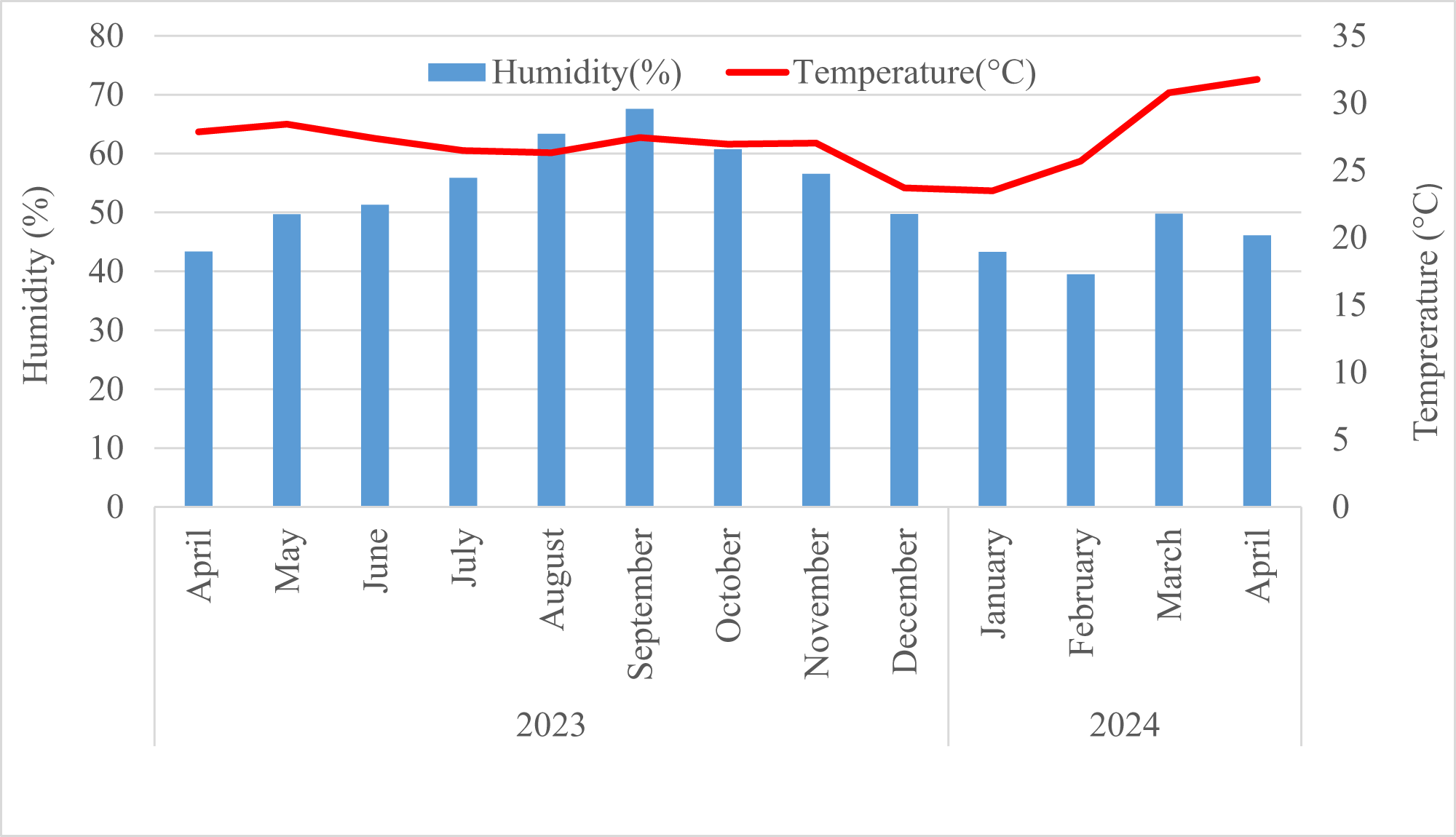
The study was carried out from April 2023 to March 2024. Experimental trials were repeated across the following periods: April–May 2022, June–July 2023, August–September 2023, October–November 2023, December 2023–January 2024, and February–March 2024. All experiments were conducted in a laboratory, where temperature, humidity, and light were not controlled and varied with outdoor conditions, except in April when temperatures went too high, and air conditioning had to be switched on. Temperatures and Relative Humidity (RH) in the laboratory were measured daily at 8:00, 12:00, and 15:00, and the data were averaged monthly. Mean temperatures varied between 22°C and 32°C, and mean RH varied between 39% and 68% (fig. 2).
Variations in temperature and relative humidity under laboratory conditions in Nasso. Data represent averages of daily temperatures and humidity. Air conditioning was used to cool the laboratory in April.

Spodoptera frugiperda rearing
Spodoptera frugiperda larvae were collected from farmers’ fields in the village of Nasso, Burkina Faso. These larvae were reared in the laboratory on maize leaves, and a population was established for the study. Each larva was placed in a 35 ml rearing dish with fresh maize leaves, which were replaced every 48 h until pupation. The resulting pupae were divided into 3 batches of 30 each, placed in a separate Petri dish and transferred to 3 rearing cages (35 cm × 35 cm) until adult emergence. Each cage contained a pot of maize (Zea mays L.), millet (Pennisetum glaucum L.), or sorghum (Sorghum bicolor L.) plants, providing suitable oviposition sites for the adults. The adults were supplied with water in a trough and with absorbent cotton that had previously been soaked with pure honey in a Petri dish, with the honey replaced every 2 days. Eggs laid by the adults were collected each day using the leaf on which they were deposited. These eggs were then placed in a plastic container with moistened cotton to keep the leaf fresh until hatching. Upon hatching, the larvae were fed with leaves (at least 2 weeks old) from their original host plants until pupation. This procedure was adopted to avoid potential effects of host switching on larval development and parasitoid performance, since larval diet can influence the nutritional quality and physiological characteristics of the host insect. The breeding of S. frugiperda was maintained to ensure a continuous supply of eggs for parasitoid exposure.
Establishment of the colony and rearing of Chelonus bifoveolatus
To start the rearing, several field collections of S. frugiperda egg masses and larvae at the L1, L2, and L3 stages were made. Larvae were placed in individual rearing boxes in the laboratory and fed with maize leaves until the formation of cocoons of C. bifoveolatus. The resulting parasitoid cocoons were closely monitored until adult emergence. The emerging adults were then transferred to rearing cages and provided with pure honey and water in a drinking trough. Two days after parasitoid emergence, S. frugiperda egg masses, placed on a cut piece of leaf, were deposited in Petri dishes containing moistened cotton and placed in the rearing cages for exposure. The egg masses were changed every 24 h until the females died. The exposed egg masses (approximately 30 per female, per day) were then placed in 150 ml plastic boxes, covered with muslin cloth and secured with an elastic band for hatching. Upon hatching, the larvae were fed with maize leaves. Seven days after hatching, the larvae were separated and placed in individual rearing boxes on a rearing shelf. Leaves were then changed every 48 h until cocoons of C. bifoveolatus or pupae of S. frugiperda were formed. Upon emergence from the cocoons, the parasitoids were placed in rearing cages for the various experiments.
Biological parameters of Chelonus bifoveolatus on Spodoptera frugiperda
To study the biological parameters of C. bifoveolatus, 24 h-old egg masses from S. frugiperda reared on maize, millet, and sorghum plants were used. A total of 15 C. bifoveolatus females were selected for exposure in boxes, with 5 females exposed to egg masses on each crop. Although sexing of C. bifoveolatus adults can be performed based on the shape of the abdomen and the size and number of antennal segments, live C. bifoveolatus females are difficult to distinguish from males in cages with the naked eye, and without hurting them by manipulation under a stereomicroscope. Therefore, to isolate females, egg masses of S. frugiperda were introduced into the rearing cages of C. bifoveolatus 2 days after adult emergence. The behaviour of adults was monitored, and each time a female landed on an egg mass, remained on it, and showed oviposition behaviour, she was immediately removed from the cage with the egg mass and placed in an exposure box. This procedure was repeated until all fifteen females were obtained. Each female was kept in its own box (20 cm × 15 cm), provided with honey-soaked cotton, and the egg masses were changed every 24 h until the females died. The boxes had a cover, the centre of which was cut and covered with a muslin cloth to allow the box to aerate. The egg masses, which contained between 40 and 200 eggs, were numbered for each female and clutch. Seven days after hatching, the larvae were separated and placed in individual rearing boxes, where they were fed with leaves from their original substrate (maize, millet, or sorghum). Leaves were changed every 48 h. Daily observations were made until the formation of either C. bifoveolatus cocoons or S. frugiperda pupae. Host larvae that died up to the fourth instar were dissected to search for a parasitoid larva. Host larvae that died as mature instars, and were thus not parasitised, were considered as pupae. Cocoons were monitored until adult emergence. Six parameters were specifically monitored in this experiment: parasitism rate, cocoon formation rate, parasitoid emergence rate, the duration of the parasitic phase (from egg laying to cocoon formation), the duration of the cocoon phase, and sex ratio. The durations of the parasitic and cocoon phases and the sex ratio were assessed only in the maize rearing. The sex ratio was assessed in the offspring of 1 female per period, and durations of the parasitic and cocoon phases were calculated for 20 offspring from 1 female per period.
To assess the lifespan of adult parasitoids with and without food, 20 adults emerging on the same day were grouped together in a rearing cage and fed exclusively with honey, while another group of 20 were placed in a separate cage and fed with sugar water. The number of dead parasitoids was recorded daily until all adults died. The experiments were conducted under laboratory conditions with ambient temperature ranging from 23°C to 32°C and relative humidity from 39% to 68%. They were conducted across six periods (April, June, August, October, and December 2023 and February 2024), and the study period was considered a factor in the analyses.
Data analysis
The following biological parameters were studied:
- Parasitism rate: (∑ parasitized larvae)/(∑ larvae)*100
- Cocoon formation rate: (∑cocoons)/(∑parasitized larvae)*100
- Parasitoid emergence rate: (∑ emerged cocoons)/(∑ cocons)*100
- Sex ratio: Number of females: Number of males
- Duration of parasitic phase: ∑ nixi/ N
- Duration of cocoon phase: ∑ nixi/ N
- Adult lifespan in relation to food source: ∑ nixi/N
With ni = number of individuals; xi = number of days; N = total number of individuals.
The independent variables considered in this study were host plant species, study period, and adult food source, while the dependent variables included parasitism rate, cocoon formation rate, emergence rate, sex ratio, duration of the parasitic and cocoon phases, and adult longevity. All statistics were conducted using R software (R Core Team), version 4.2.1. For parasitism rate, cocoon formation rate, and parasitoid emergence rate, data were collected and averaged for each of the 15 females and for each study period. The sex ratio of offspring was determined for each female and each clutch; the durations of parasitic and cocoon phases were calculated for 20 offspring from the same female. The average adult lifespan, based on their food source, was determined for 20 individuals per substrate.
The data were first tested for normality using the Shapiro–Wilk test. Since all data were normally distributed, an analysis of variance was performed, and when a significant difference was detected, Tukey’s HSD test was used to separate the means at the 5% significance level. In addition, a two-way ANOVA was performed to evaluate the effects of host plant species, study period, and their interaction on the biological parameters of C. bifoveolatus.
Results
Influence of host plants on the parasitism rate of Chelonus bifoveolatus
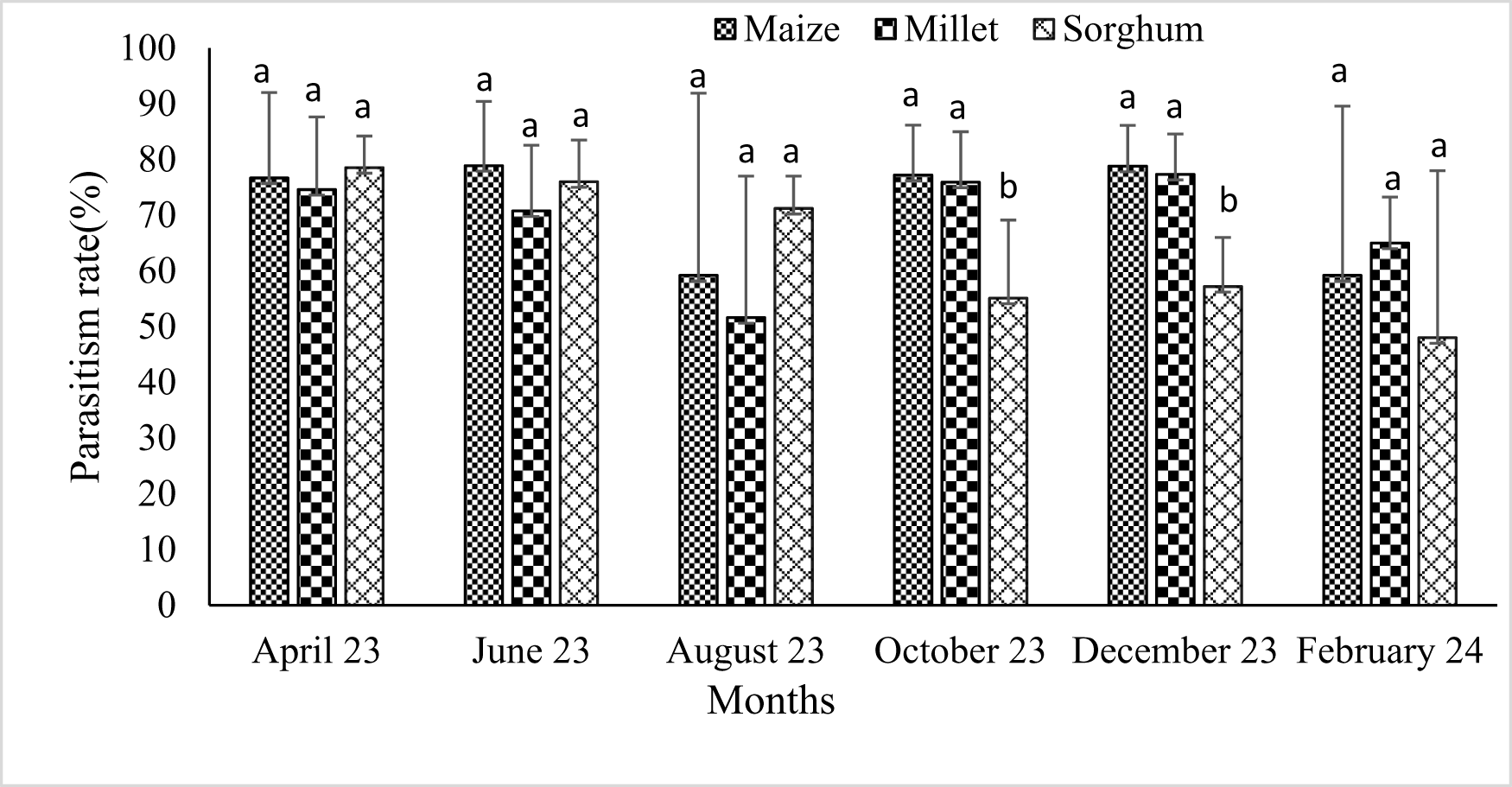
Parasitism rates are illustrated in fig. 3. Parasitism rates were high on all host plants, ranging from 48% to 80%, depending on the host plant and month. The highest average parasitism rate was recorded on larvae reared on maize leaves in June (80.00%) and December (79.00%). The lowest parasitism rates were observed on larvae reared on sorghum leaves in October (55.00%) and February (48.00%). Statistical analysis showed significant differences in parasitism rates among the different cereals in October (F = 6.45; df = 2; p = 0.01) and December (F = 11.90; df = 2; p = 0.001), when rates were significantly lower on sorghum than on the two other cereals. No significant differences in parasitism rates were observed among the cereals in April (F = 0.22; df = 2; p = 0.90), June (F = 0.73; df = 2; p = 0.50), August (F = 1.52; df = 2; p = 0.47), and February (F = 0.97; df = 2; p = 0.61).
Variation in parasitism rate by Chelonus bifoveolatus according to the host plants on which its host larvae were reared and the months of rearing.

Figure 3 Long description
Parasitism rate left parenthesis percent right parenthesis by Months. X axis label Months, categories April 23, June 23, August 23, October 23, December 23, February 24. Y axis label Parasitism rate left parenthesis percent right parenthesis, range 0 to 100. Legend: Maize, Millet, Sorghum. April 23: Maize 77, Millet 75, Sorghum 79. Letter above each bar: a, a, a. June 23: Maize 79, Millet 71, Sorghum 76. Letter above each bar: a, a, a. August 23: Maize 59, Millet 51, Sorghum 72. Letter above each bar: a, a, a. October 23: Maize 78, Millet 77, Sorghum 55. Letter above each bar: a, a, b. December 23: Maize 80, Millet 78, Sorghum 57. Letter above each bar: a, a, b. February 24: Maize 59, Millet 65, Sorghum 48. Letter above each bar: a, a, a. Each bar includes a vertical error bar with a top cap.
The two-factor ANOVA (study period and host plants) showed that the effect of periods on parasitism rate was highly significant (F = 3.34; df = 5; p = 0.008); April and June were significantly different from the other periods. However, the effects of host plants (F = 1.63; df = 2; p = 0.20) and interactions (F = 1.53; df = 10; p = 0.15) were not significant.
Rate of cocoon formation in Chelonus bifoveolatus
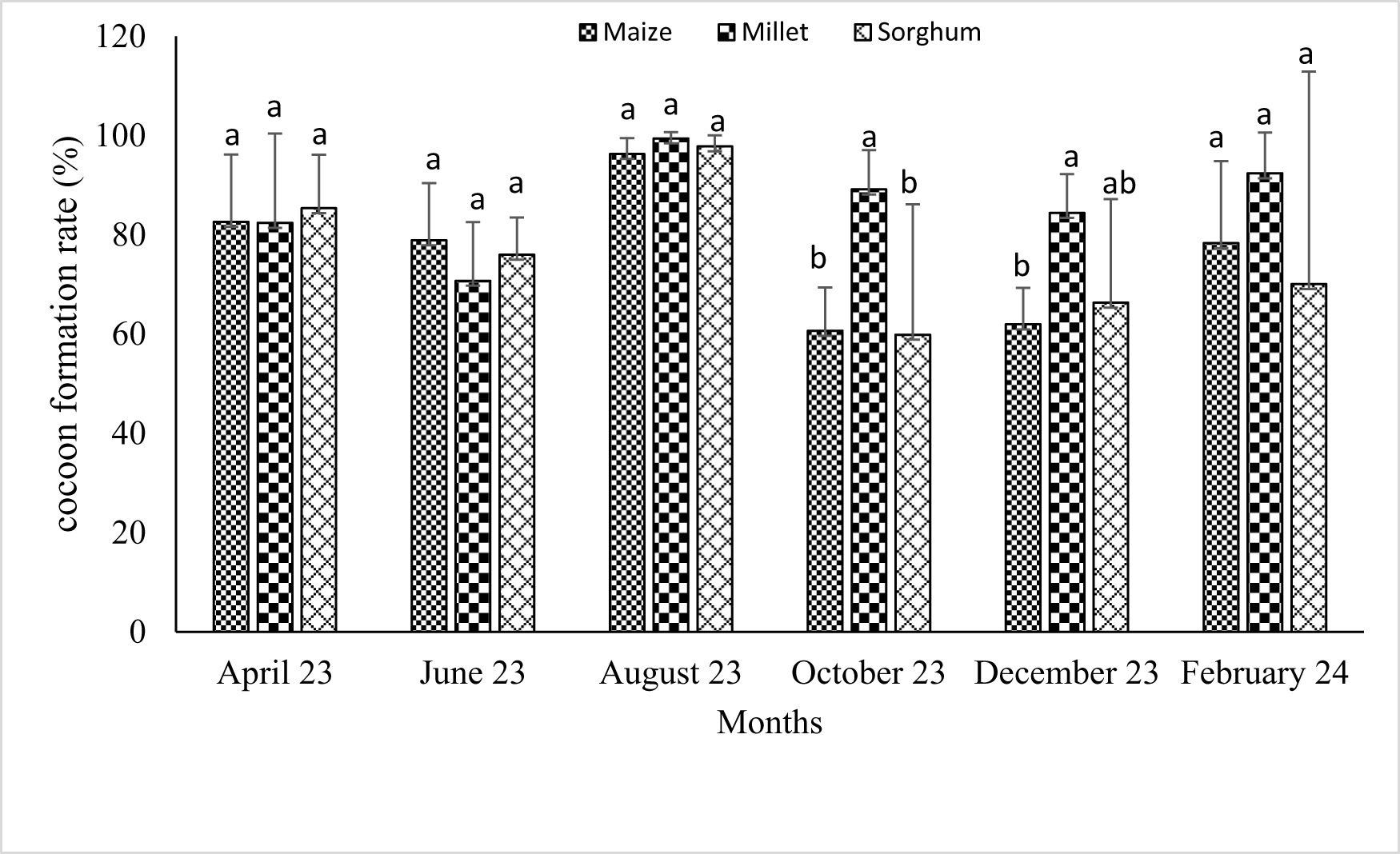
Cocoon formation rates are shown in fig. 4. Overall, cocoon formation rates ranged from 48.00% to 99.43%. Statistical analysis revealed significant differences in October (F = 5.04; df = 2; p = 0.03) and December (F = 3.86; df = 2; p = 0.05), with the rate higher for larvae reared on millet. There was no significant difference between cocoon formation rates in April (F = 0.07; df = 2; p = 0.94), June (F = 0.66; df = 2; p = 0.54), August (F = 3.72; df = 2; p = 0.16), and February (F = 2.26; df = 2; p-value = 0.32). The two-factor ANOVA (factors period and host plants) showed a highly significant effect of host plants on cocoon formation rates (F = 6.22; df = 2; p = 0.003). The effect of the study period was also highly significant (F = 6.82; df = 5; p ˂ 0.0001), the cocoon formation rate being significantly higher in August compared to the other periods, while interactions showed no significant difference (F = 1.06; df = 10; p = 0.41).
Variation in cocoon formation rate in Chelonus bifoveolatus according to the host plants on which its host larvae were reared and the months of rearing.

Figure 4 Long description
Grouped bar graph with error bars and letter annotations above bars. Legend entries: Maize, Millet, Sorghum. Horizontal axis label: Months. Categories, left to right: April 23, June 23, August 23, October 23, December 23, February 24. Vertical axis label: cocoon formation rate left parenthesis percent right parenthesis. Scale shows 0 to 120. April 23: Maize about 83; Millet about 83; Sorghum about 86. Letters above bars: a, a, a. June 23: Maize about 79; Millet about 71; Sorghum about 76. Letters above bars: a, a, a. August 23: Maize about 97; Millet about 99; Sorghum about 98. Letters above bars: a, a, a. October 23: Maize about 61; Millet about 89; Sorghum about 60. Letters above bars: b, a, b. December 23: Maize about 62; Millet about 85; Sorghum about 67. Letters above bars: b, a, ab. February 24: Maize about 79; Millet about 93; Sorghum about 70. Letters above bars: a, a, a.
Emergence rate of Chelonus bifoveolatus adults
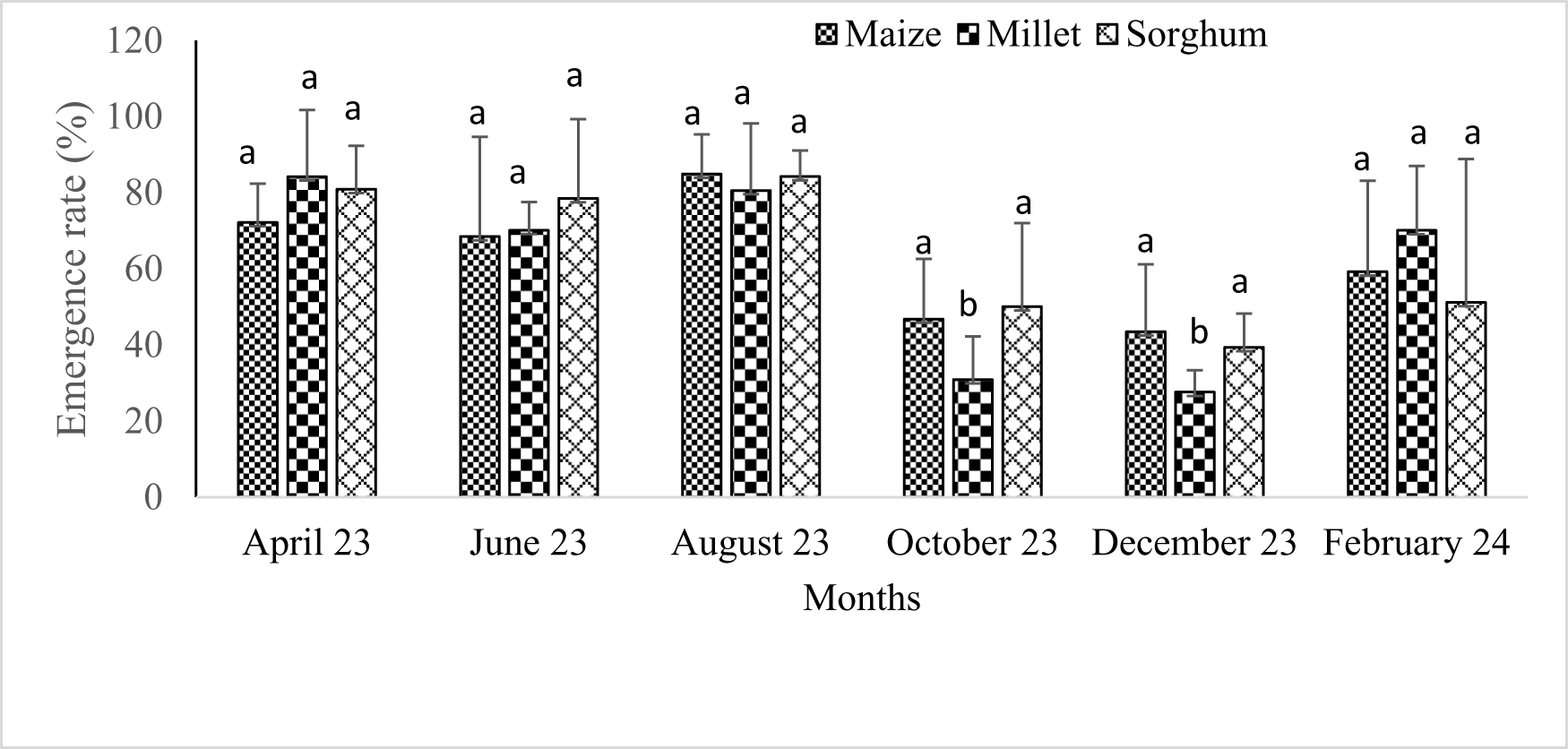
The histograms in fig. 5 illustrate the average emergence rates of C. bifoveolatus adults across different study periods. Overall, the emergence rate ranged from 27.60% to 84.91%. Statistical analysis showed no significant difference in emergence rates across host plants in April (F = 1.78; df = 2; p = 0.21), June (F = 0.36; df = 2; p = 0.70), August (F = 0.17; df = 2; p = 0.84), and February (F = 0.59; df = 2; p = 0.57). Statistical analysis showed significant differences in emergence rates among the different cereals in October (F = 1.84; df = 2; p = 0.02) and December (F = 2.40; df = 2; p = 0.01), with lower emergence rates observed in C. bifoveolatus reared from larvae on millet than in the two other cereals.
Variation in emergence rate of Chelonus bifoveolatus according to the host plants on which its host larvae were reared and the months of rearing.

The two-factor ANOVA (study period and host plants) showed a highly significant effect of the study period on emergence rates (F = 18.21; df = 5; p ˂ 0.0001), with August showing significantly higher emergence rates than the other periods. However, the effects of host plant (F = 0.30; df = 2; p = 0.75) and the interaction between study period and host plant (F = 1.04; df = 10; p = 0.42) were not significant.
Sex ratio of Chelonus bifoveolatus
Table 1 shows the proportion of males and females of C. bifoveolatus across different observation periods. The results show a sex ratio largely in favour of males, with more than two males for every female throughout the year.
Variation in sex ratio (F:M) of Chelonus bifoveolatus offspring by study period

Table 1 Long description
Sex ratio of Chelonus bifoveolatus offspring is reported by study period as females relative to males. All periods are male-biased, with roughly one female for every two to three males. April 2023 is about one female per 2.5 males, June 2023 about one per 2.1, and August 2023 about one per 3.1. November 2023 is about one per 2.6, and February 2024 about one per 2.2. The most male-skewed period is August 2023, while the least male-skewed is June 2023. Values fluctuate over time rather than showing a steady increase or decrease, and no sample sizes or uncertainty are provided to judge how precise these ratios are.
Longevity of Chelonus bifoveolatus
The lifespan of C. bifoveolatus adults according to food type is shown in Table 2. The longest lifespan was recorded for adults fed on honey, followed by those fed sugar water, but the difference between the two was not significant. Parasitoids had a much shorter lifespan when fed only water.
Longevity (days ± SE) of adult C. bifoveolatus when fed different diets

Table 2 Long description
Adult C. bifoveolatus lifespan in days is compared across three diets, reported as mean with standard error. Honey produced the longest average lifespan, about 13.34 days with a standard error of 4.60. Sugar water was slightly lower at about 10.22 days with a standard error of 3.74. Water alone resulted in a much shorter lifespan, about 1.43 days with a standard error of 0.22. Honey and sugar water are grouped together as not meaningfully different from each other, while water is clearly lower. The overall diet effect is reported as very highly significant, with a probability value below 0.0001.
Notes: Means followed by the same letter are not significantly different at the 5% probability level, according to the Tukey test. VHS, very highly significant.
Durations of the parasitic and cocoon phases in Chelonus bifoveolatus
The analysis of the durations of the parasitic phase and cocoon phase by study period is shown in Table 3. The results showed that the duration of the parasitic phase and the cocoon phase of C. bifoveolatus varied significantly across periods. Specifically, the parasitic phase duration was shortest in April and June 2023, whereas it increased significantly in August, October, and February, reaching its highest value in December 2023. Concerning the cocoon stage, no significant differences were observed among April, June, August, and October 2023, during which the durations remained relatively low. However, the cocoon duration increased significantly in February 2024 and peaked in December 2023.
Variation in post-embryonic and cocoon development times (days ± SE) of Chelonus bifoveolatus according to study period

Table 3 Long description
Post-embryonic and cocoon development times for Chelonus bifoveolatus are listed by study period, reported as mean days with standard error. Post-embryonic time is lowest in April and June 2023 at about 14 days, rises to about 21 to 22 days in August and October 2023, peaks in December 2023 at about 28.5 days, then drops to about 20.8 days in February 2024. Cocoon time stays near 9 to 11 days from April through October 2023, increases to about 16 days in February 2024, and is highest in December 2023 at about 21.3 days. Letter groupings indicate which periods differ within each column: April and June share the lowest post-embryonic group, August, October, and February form a middle group, and December is highest; for cocoon time, April through October are lowest, February is intermediate, and December is highest. Reported probability values indicate statistically significant differences across periods for both measures, with stronger evidence for post-embryonic time than for cocoon time.
Notes: In a given column, means followed by the same letter are not significantly different at the 5% probability level, according to the Tukey test. VHS, very highly significant; HS, highly significant.
Discussion
This study shows that C. bifoveolatus can be reared in a basic laboratory, in the conditions of Burkina Faso, on S. frugiperda and widely available plants, which are also the three main crops attacked in the country, i.e. maize, sorghum, and millet. Rearing performance varied only slightly among host plants. In some months, parasitism rates were significantly lower on sorghum, cocoon formation was significantly higher in millet, and adult emergence rate was significantly lower in millet. However, these differences were not consistent throughout the year. All previous studies with C. bifoveolatus or closely related Chelonus spp. on S. frugiperda in the laboratory were conducted on maize and artificial diet (Rezende et al., Reference Rezende, Cruz and Lucia1995; Gupta et al., Reference Gupta, Lalitha, Varshney, Shylesha and van Achterberg2020; Roque-Romero et al., Reference Roque-Romero, Cisneros, Rojas, Ortiz-carreon and Malo2020; Shen et al., Reference Shen, Zang, Dai, Xu, Nkunika and Zang2023; Onjura et al., Reference Onjura, Peter, Asudi, Gicheru, Mohamed, Bruce and Tamiru2025). We did not find any laboratory data on the performance of C. bifoveolatus and other Chelonus spp. comparing maize with millet or sorghum. Padilla-Cortes and Martinez-Martinez (Reference Padilla-Cortes and Martínez-martínez2022) compared the development of C. insularis on S. frugiperda reared on maize and castor bean and found only minor differences.
It remains to be seen whether parasitism success would be similar on the different host plants in the field. Again, field parasitism data for C. bifoveolatus have been overwhelmingly gathered on maize. To our knowledge, there are no quantitative data on C. bifoveolatus parasitism on millet, and only one study on sorghum in Ethiopia, where Kebede et al. (Reference Kebede, Degaga, Goftishu, Amenta, Gurmu, Fite, Haile and Lalisa2026) found C. bifoveolatus on both maize and sorghum, with parasitism rate varying across sites rather than between host plants (0–20% on maize and 0–15% on sorghum). In West Africa, nearly all field data on parasitism have been collected from maize fields only (Agboyi et al., Reference Agboyi, Goergen, Beseh, Mensah, Clottey, Glikpo, Buddie, Cafà, Offord, Day, Rwomushana and Kenis2020; Koffi et al., Reference Koffi, Kyerematen, Eziah, Agboka, Adom, Goergen and Meagher2020; Ahissou et al., Reference Ahissou, Sawadogo, Bonzi, Baimey, Somda, Bokonon-ganta and Verheggen2021; Adjaoke et al., Reference Adjaoke, Yotto and Adandonon2023). Winsou et al. (Reference Winsou, Tepa-yotto, Thunes, Meadow, Tamò and Sæthre2022) sampled S. frugiperda and its parasitoids on several wild and cultivated plants, but no quantitative data were provided, and C. bifoveolatus was not recorded on sorghum, whereas no host larvae were collected on millet. While there is little doubt that C. bifovelotatus would also parasitise S. frugiperda on sorghum and millet in Burkina Faso, it would be important to assess potential variations in parasitism success by this and other parasitoid species on these three important crops.
Some of the parasitoid performance indicators were more influenced by the period of the year. This is not surprising since temperature and, especially, humidity varied considerably during the experimental period. Temperature is known to directly influence insect development, including Chelonus species (García-Martín et al., Reference García-Martín, Gámez, Torres-ruiz and Cabello2008) and was surely a key factor in explaining the slower development in December, when temperatures are lowest. However, our experiments showed that C. bifoveolatus can be easily produced in a basic laboratory, even at low relative humidity during the dry season (November–May). This is reassuring, as humidity is a critical factor in insect rearing that determines survival, growth rates, size, and reproductive success, including in Spodoptera species and its parasitoids (Corrêa De Melo et al., Reference Corrêa De Melo, Coelho, Gomes Garcia and Roberto Postali Parra2024; Maharjan et al., Reference Maharjan, Hong, Yoon, Jang and Park2024). Air conditioning had to be used only on the warmest days of the year, in April, because extremely high temperatures are known to be detrimental to Chelonus spp. (García-Martín et al., Reference García-Martín, Gámez, Torres-ruiz and Cabello2008).
In general, rearing performances were similar to those observed in other rearing experiments with C. bifovelolatus (Shen et al., Reference Shen, Zang, Dai, Xu, Nkunika and Zang2023, Reference Shen, Chen, Huang, Tariq, Tang, Wei, Bai, Kamfwa, Ramírez-romero, Monticelli and Zang2025, Reference Shen, Huang, Tariq, Wei, Kamfwa, De Freitas Bueno, Tang and Zang2026) or closely related species on S. frugiperda, e.g. Chelonus formosanus (Gupta et al., Reference Gupta, Lalitha, Varshney, Shylesha and van Achterberg2020) and Chelonus insularis (Rezende et al., Reference Rezende, Cruz and Lucia1995; Padilla-Cortes and Martinez-Martinez, Reference Padilla-Cortes and Martínez-martínez2022). However, in their laboratory rearing of C. bifoveolatus on S. frugiperda in Zambia, Shen et al. (Reference Shen, Zang, Dai, Xu, Nkunika and Zang2023) obtained a higher parasitism rate (95.75%) and a higher adult emergence rate from cocoons (84.50%), as compared to us. Thus, there is clearly room for improving performance in our rearing system. We also had a male-biased sex ratio, which is very common in parasitoid rearing, for various reasons (King, Reference King1987). Other attempts to rear Chelonus species resulted in a largely male-biased sex ratio (Rechav and Orion, Reference Rechav and Orion1975; Morel et al., Reference Morel, Sánchez-ramos, Medina and Dáder2024). However, Shen et al. (Reference Shen, Zang, Dai, Xu, Nkunika and Zang2023) reported a balanced sex ratio in their rearing of C. bifoveolatus in Zambia. Factors that may affect sex ratio in our rearing and should be further studied include the frequency of mating, the age of females, the age of the host eggs, the density of females and/or hosts, and environmental factors such as temperature, humidity and light (King, Reference King1987). It should also be noted that recent work by Shen et al. (Reference Shen, Chen, Huang, Tariq, Tang, Wei, Bai, Kamfwa, Ramírez-romero, Monticelli and Zang2025, Reference Shen, Huang, Tariq, Wei, Kamfwa, De Freitas Bueno, Tang and Zang2026) has shown that the Spodoptera litura and the rice borer moth, Corcyra cephalonica, can be used as alternative hosts for C. bifoveolatus. While some performances were better with Spodoptera spp., they concluded that the use of C. cephalonica eggs proved to be more cost-effective with a view to mass rearing.
Conclusion
This study showed that C. bifoveolatus, the most abundant parasitoid of S. frugiperda in Burkina Faso, can be rather easily produced in a basic laboratory in natural environmental conditions on its three main host crops. Further investigations should be conducted to improve the rearing method and allow the parasitoid to be produced and field-released as an augmentative biological control agent in a cost-effective manner. Improvements should focus, among other things, on maximising the parasitism rate, improving the sex ratio, and reducing costs through testing on other hosts, host plants, and group-rearing containers. If cheap production methods are available, augmentative biological control approaches could then be used in the field, i.e. through widespread inoculative releases at the beginning of the season, or through inundative releases when S. frugiperda adult populations reach a certain threshold. Further studies should also include the development of application methods in the field, methods to enhance its presence and efficacy as a biological control agent, and potential positive or negative interactions with other natural enemies and management methods currently in use.
Financial support
This study was supported by the Projet d’Appui à l’Enseignement Supérieur (PAES). The participation of MK was funded by the Foreign, Commonwealth and Development Office (FCDO), UK, the Directorate General for International Cooperation (DGIS), Netherlands, the European Commission Directorate-General for International Cooperation and Development (DEVCO), and the Swiss Agency for Development and Cooperation (SDC) through the CABI Plantwise Plus Programme.
Competing interests
The authors declare that they have no known competing financial interests or personal relationships that could have appeared to influence the work reported in this paper.