

High-quality education and care promotes strong foundations for life and provides beneficial opportunities for children who might otherwise be at substantial risk, including risk to their social-emotional (SE) wellbeing (Batra, Reference Batra, Peters, Cowie and Menter2017; Becker, Gallagher, & Whitaker, Reference Becker, Gallagher and Whitaker2017; Campbell et al., Reference Campbell, Conti, Heckman, Seong, Pinto, Pungello and Pan2014). Individual and community benefits from early education have been demonstrated in many aspects of life (Fearon, Bakermans-Kranenburg, Van IJzendoorn, Lapsley, & Roisman, Reference Fearon, Bakermans-Kranenburg, Van IJzendoorn, Lapsley and Roisman2010; Yang, Datu, Lin, Lau, & Li, Reference Yang, Datu, Lin, Lau and Li2019), especially in interrelated progress in both academic and prosocial-emotional skills (Denham, Bassett, Zinsser, & Wyatt, Reference Denham, Bassett, Zinsser and Wyatt2014; Durlak, Weissberg, Dymnicki, Taylor, & Schellinger, Reference Durlak, Weissberg, Dymnicki, Taylor and Schellinger2011; McCormick, Cappella, O’Connor, & McClowry, Reference McCormick, Cappella, O’Connor and McClowry2015).
When young children attend early years programs, their relationships, experiences, and SEB learning opportunities expand to include (a) relating to unfamiliar adults, (b) sharing adult attention in groups of varying sizes, (c) relating to many different but similarly aged peers, and (d) joining in play activities with fluctuating groups of peers. Thus, children’s SEB learning is central to early years’ service delivery as a central focus of educators’ activities and is rated by educators as more important than pre-academic learning for ‘school readiness’ (Niklas et al., Reference Niklas, Cohrssen, Vidmar, Segerer, Schmiedeler, Galpin and Tayler2018). When promoting children’s SEB skills and wellbeing, high-quality early education counts (Hall et al., Reference Hall, Sylva, Sammons, Melhuish, Siraj-Blatchford and Taggart2013).
Most early educational policies and curricula feature SE development prominently (Pramling & Pramling Samuelsson, Reference Pramling, Pramling Samuelsson, Fleer and van Oers2018), showing positive relationships between service quality and children’s outcomes (Landry et al., Reference Landry, Zucker, Taylor, Swank, Williams, Assel and Klein2014; Perlman et al., Reference Perlman, Falenchuk, Fletcher, McMullen, Beyene and Shah2016; Tayler et al., Reference Tayler, Cloney, Adams, Ishimine, Thorpe and Nguyen2016). High-quality educator–child relationships and programs have been associated with positive outcomes for all aspects of development, with effects throughout life and intergenerationally (Heckman & Raul, Reference Heckman and Raul2016; Sylva, Melhuish, Sammons, Siraj-Blatchford, & Taggart., Reference Sylva, Melhuish, Sammons, Siraj-Blatchford and Taggart2011).
Early educational initiatives developed overseas have often been cautiously welcomed in Australia, being viewed dually as potential practice improvements and potential burdens on practitioners (Nuttall & Edwards, Reference Nuttall, Edwards, Georgeson and Payler2013). Despite local caution, overseas programs have not always been thoroughly reviewed before their introduction into Australia (Moore, Reference Moore2014). Intercountry cultural differences, differing support systems, and educator–community readiness for change have not always been highlighted (Spencer-Rodgers, Williams, & Peng, Reference Spencer-Rodgers, Williams and Peng2010).
The Pyramid Model
The Pyramid Model (PM) provides a graduated framework of evidence-based teaching strategies and resources, which are collectively designed to assist educators, families, and communities to foster all young children’s SE learning, irrespective of need (Hemmeter, Fox, & Hardy, Reference Hemmeter, Fox, Hardy, Reichow, Boyd, Barton and Odom2016). A graduated, response-to-intervention approach expands the teaching supports to children in a manner determined by the extent of children’s learning from lower intensity teaching. In its approach to SE learning, the PM treats SEB learning consistently with academic learning as competencies to be developed.
The PM uniquely and coherently integrates in three tiers high-quality but apparently differing approaches to SE education. These are (a) responsive relationships and environments, (b) intentional teaching (incidental and planned), and (c) positive behaviour support (Fox, Dunlap, Hemmeter, Joseph, & Strain, Reference Fox, Dunlap, Hemmeter, Joseph and Strain2003; Fox & Hemmeter, Reference Fox, Hemmeter, Sailor, Dunlap, Sugai and Horner2009). At Tier 1, PM SE foundations promote high-quality relationships and experiences for all children; at Tier 2, the PM offers intentionally developed and delivered SE experiences and teaching for many children, and at Tier 3, positive behaviour support is explicitly planned, coordinated, and provided for the few children for whom Tiers 1 and 2 programs were insufficient.
At the universal level (Tier 1), PM educators systematically create responsive relationships with children, families, and each other, along with purposeful program organisation and environmental arrangements to foster children’s SE understanding, security, and learning opportunities. Then (Tier 2) educators observe children’s behaviour (individual and group) to guide incidental and planned intentional teaching of SE skills for most young children. For example, when children have difficulty with sharing, turn-taking, or social problem-solving, educators teach about these skills using puppets, role-play, and visuals (to large or small groups or individuals) and then refer the children to the techniques they have learned, incidentally in the moment when SE issues arise. For any remaining children with behavioural challenges (Tier 3), educators, families, and consultants collaborate to develop and implement positive behaviour support plans, which are reviewed through data collation and reflection (Hemmeter, Snyder, Fox, & Algina, Reference Hemmeter, Snyder, Fox and Algina2011).
The PM has been adapted to suit diverse American circumstances, early childhood settings (0–8 years), and teaching styles. Within a PM framework, educational teams have created unique programs based around their particular groups, communities, teaching approaches, personalities, and team members’ values. Training in PM implementation has incorporated evidence-based adult learning and behaviour change approaches for individuals, teams, and systems. The framework therefore represents a coherent but flexibly implemented, evidence-based means to facilitate all children’s SE development and inclusion irrespective of social-behavioural need (Buysse, Reference Buysse, Pianta, Barnett, Justice and Sheridan2012; Hemmeter & Conroy, Reference Hemmeter, Conroy, Pianta, Barnett, Justice and Sheridan2012; Hemmeter, Snyder, Fox, & Algina, Reference Hemmeter, Snyder, Fox and Algina2016).
The model’s theory of adult-to-child behaviour change has led to (a) the creation of freely accessible information and resources for organisations, educators, families, and communities (https://challengingbehavior.cbcs.usf.edu/Pyramid/overview/resources.html); (b) training and practice-based coaching for early educators; (c) systems support to promote and sustain practice leadership; and (d) data gathering and collation processes to evaluate educator-team progress and child outcomes. Leadership systems support team and individual practice development (Mincic, Smith, & Strain, Reference Mincic, Smith and Strain2009) using training and practice-based coaching cycles (Snyder, Hemmeter, & Fox, Reference Snyder, Hemmeter and Fox2015), team data collation, review, and reflection.
Pyramid Model evidence
Substantial evidence has been gathered on the PM’s implementation, as 33 American states now use the PM in Headstart, Pre-K, or care services. Two large randomised control trials have been commissioned (Hemmeter, Fox, & Hardy, Reference Hemmeter, Fox, Hardy, Reichow, Boyd, Barton and Odom2016; Hemmeter, Fox, Snyder, & Algina, Reference Hemmeter, Fox, Snyder and Algina2012) using many types of data, including educator/coach ratings, independent observation, and children’s behaviour change (Hemmeter, Fox, & Hardy, Reference Hemmeter, Fox, Hardy, Reichow, Boyd, Barton and Odom2016; Hemmeter, Fox, & Snyder, Reference Hemmeter, Fox, Snyder, Buysse and Peisner-Feinberg2013b). Outcomes have suggested that the PM promoted children’s SE learning (Hemmeter et al., Reference Hemmeter, Snyder, Fox and Algina2011), reduced challenging behaviour (Hemmeter et al., Reference Hemmeter, Snyder, Fox and Algina2011), increased parental engagement and information uptake (Cummings, Reference Cummings2017), increased educator skills (Hemmeter et al., Reference Hemmeter, Fox, Snyder, Buysse and Peisner-Feinberg2013b; Hemmeter, Snyder, & Fox, Reference Hemmeter, Snyder and Fox2018), and increased educator satisfaction and retention (Hemmeter et al., Reference Hemmeter, Snyder, Fox and Algina2011). Despite all PM practices having well-established evidence bases, and a significant body of evidence collected about the PM framework, to date there has been no large-scale independent evaluation of PM implementation.
The PM framework has also been beneficial in intercultural, early school, and infant–toddler settings. For example, Branson and Demchak (Reference Branson and Demchak2011) found that teachers of toddlers benefited from PM training. Before training, these educators were not using key PM practices, such as making environments secure and predictable for toddlers with visuals and by intentionally teaching SEB skills. Likewise, when Chinese early educators were initially observed, they were not using many important aspects of PM practices. Coaching in addition to formal PM practice training was essential, as despite self-reports to the contrary, Chinese educators’ behaviour did not change substantially without both (Luo, Snyder, Clark, & Hong, Reference Luo, Snyder, Clark and Hong2017). Results highlight that practice change has been shown when educators were supported with both training information and coaching.
Pyramid Model in Australia
Australian educators commenced using PM practices after 2011 (Swalwell, Reference Swalwell2016). They ‘translated’ and collated local resources and established PM Australia (https://www.pyramidmodel.org.au/). Australia’s introduction to the PM generally coincided with its first national early education policies (Early Years Learning Framework; Department of Education, Employment and Workplace Relations, 2009; Victorian Early Years Learning and Development Framework; Victorian Department of Education and Early Childhood Development & Victorian Curriculum and Assessment Authority, 2009) and practice standards (National Quality Framework; Australian Children’s Education and Care Quality Authority, 2012). Anecdotally, Australian educators report that the PM’s use assists educators’ efforts in turning these policies into practice. However, to date, the PM’s implementation in Australia does not appear to have been studied.
American–Victorian preschool differences
Victorian preschools for 4–5-year-olds differ from American (Pre-K) services in significant ways. Victorian preschools are generally not in schools and are often under the auspices of community organisations (e.g., church, welfare, local government). Victorian staff–child ratios (1:11, with up to 33 per group) are substantially higher than American ratios. Preschool attendance is almost universal in Victoria. Groups often use indoor–outdoor programming, which subdivides the group and preserves ratios. Practice differences have been documented, with Australian educators reportedly using more responsive strategies, but fewer intentional teaching strategies, than American educators (Tayler, Reference Tayler2012; Tayler et al., Reference Tayler, Cloney, Adams, Ishimine, Thorpe and Nguyen2016).
Study Purpose
In the current research, Victorian implementation of the PM was investigated. The process commenced after the participant organisations’ leaders attended PM orientation sessions and subsequently requested training for their educators. Hence, studies were initiated and conducted with these leaders, informed and supported by American researchers. One Australian researcher provided results to leaders and educators annually, and research plans were developed collaboratively with the leadership teams throughout.
Research questions
Questions guiding the study were as follows:
-
1. To what extent did educators trained and coached in the PM (the intervention group [IG]) implement the model with fidelity?
-
2. Did PM implementation fidelity increase and was any increase sustained over time in the PM-trained educators?
-
3. Were there measurable differences in behaviour change between the intervention and contrast group (CG) educators?
-
4. Did educators’ perceptions of the importance of children’s SE skill building change over time with PM intervention?
-
5. Did the PM intervention promote the SE skills of preschool children as measured using the Social Skills Improvement System Rating Scales?
Method
Preschool Settings
Preschool cluster-group leaders provided support for educators in the services studied. Three of the preschools were community based, standalone, and purpose built. The fourth was a childcare centre within a family and community service. The IGs were randomly selected and located in the community-based preschool and a standalone municipality-based service.
Participants
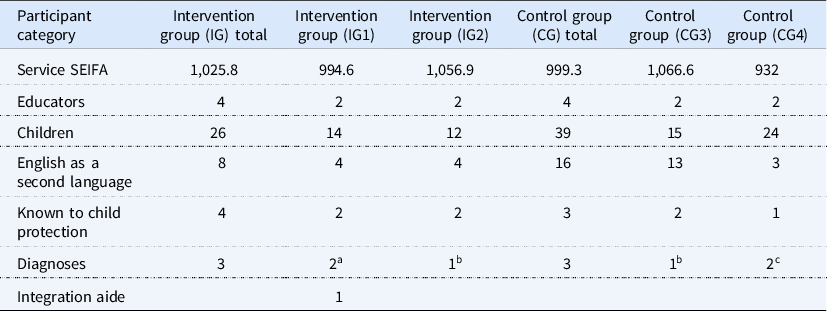
Eight educators (a lead teacher and co-educator for each of two IG and CG preschools) and 65 4–5-year-old children from four metropolitan preschools in two Melbourne preschool cluster groups participated. Of the 81 children attending the preschools, 78 families consented to participate in the research; however, 10 relocated and three children were non-attendees during the study and observations. All educators (teachers and assistants) had more than 10 years’ experience except for one IG educator who was in her second year of teaching having had a prior career. Substantial numbers of children in each group were from bilingual backgrounds or had English as a second language (see Table 1).
Participant Characteristics
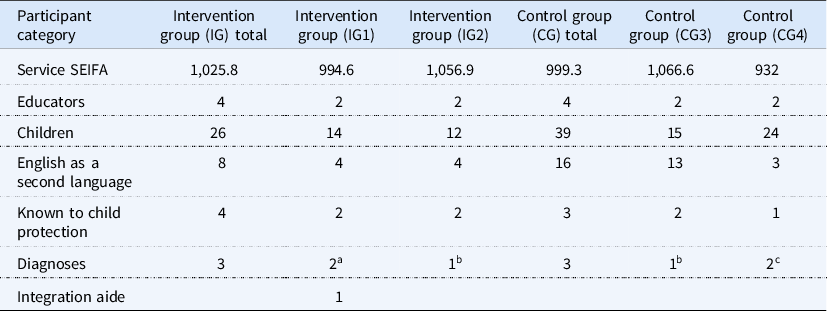
Note. SEIFA = Socio-Economic Indexes for Areas.
a One diagnosis of autism spectrum disorder (ASD) plus intellectual disability and one participant with ASD. bOne participant with ASD. cOne participant with attention-deficit/hyperactivity disorder and one with a stutter.
Research Design
A concurrent assessment design was used to evaluate educators’ implementation fidelity and children’s outcome scores (Snyder, Hemmeter, Fox, Bishop, & Miller, Reference Snyder, Hemmeter, Fox, Bishop and Miller2013). These results report on the quantitative data only. A trained independent assessor used direct observation to rate educators’ skills as teams. Child assessments were conducted by the lead educators in consultation with their co-educators.
Measures
The Teaching Pyramid Observation Tool
The Teaching Pyramid Observation Tool (TPOT; Hemmeter, Fox, & Snyder, Reference Hemmeter, Fox and Snyder2013a) was used to assess educator implementation fidelity. The TPOT has 31 items, comprising 14 Key Practice items (KP; each with five to 10 indicators, totalling 114 indicators), 16 Red Flag (RF) items, and one Using Effective Strategies to Respond to Challenging Behavior item (UEF; three indicators). Data for most KP items, for RF, and for UEF are collected through observation. However, respecting that not all practices are present every day, data collection of intentional teaching–related items (e.g., Teaching Problem-Solving) is through a combination of observations and interviews. Additionally, information about practices unlikely to be evident during group times is obtained by interview only (e.g., connecting with families). The scores for the three subscales KP, RF, and UEF are calculated separately and then expressed as a percentage of the total score. The TPOT, which assesses educator PM-related practice quality, was validated against the Early Childhood Environment Rating Scale – Revised Edition (ECERS-R; Harms, Clifford, & Cryer, Reference Harms, Clifford and Cryer2005), the Classroom Assessment Scoring System (CLASS; Pianta, La Paro, & Hamre, Reference Pianta, La Paro and Hamre2008), and the Preschool-Wide Evaluation Tool (PreSET; Steed & Pomerleau, Reference Steed and Pomerleau2012), which each measure preschool educator practice quality. Small to moderate correlations were reported for the relationship between the TPOT key practices and each of the above (ECERS-R, r = 0.43–0.55; CLASS, r = 0.21–0.63; PreSET, r = 0.29–0.33).
Social Skills Improvement System Rating Scales
Children’s outcomes were assessed using the Social Skills Improvement System (SSIS) Rating Scales (Gresham & Elliott, Reference Gresham and Elliott2008), which is an age-appropriate questionnaire targeting children’s SE skills in preschools. This SSIS has been used extensively in similar research. Importantly, it was deemed acceptable to these early educators, who were seeking a measure with positive skill-building application. Skills on the SSIS are measured on three dimensions: the Social Skills Scale (SS; 46 items: Subscales — Communication, seven items; Cooperation, six items; Assertion, seven items; Responsibility, six items; Empathy, six items; Engagement, seven items; Self-Control, seven items); the Problem Behaviour Scale (PB; 38 items: Subscales — Externalising, 12 items; Bullying, five items; Hyperactivity/Inattention, seven items; Internalising, seven items; Autism Spectrum, seven items); and the Academic Scale (AS; seven items). The Academic Scale was not included in the measures used in the study. The SSIS includes educator rating of the frequency and importance of each SS for the children.
Procedures
Each cluster preschool leadership nominated two preschools, which they matched for the educators’ skills and the socioeconomic status of the preschool groups. The project was approved by the ethics committees of Monash University (CF15/856 – 2015000381) and the Victorian Department of Education (2015_002669). Prior to consent and group allocation, all educators and families received information about the project (fact sheet, Q&A session, phone discussion). Preschools were randomly allocated to intervention or contrast conditions, the two clusters having one IG each. Intervention involved 3 days’ educator-team training, followed by 16 coaching sessions over 6 months (June–November) with email follow-up. CGs were trained (but not coached) after intervention ceased post–Time 2 (T2) data collection.
The coaches who supported the IGs during and following training used practice-based coaching (Snyder et al., Reference Snyder, Hemmeter and Fox2015) techniques and were supported by an American coach for their fidelity. Families and independent observers were not informed about the groups’ allocation. However, many commented on groups’ IG status from observing educators’ behaviour and environmental changes.
Fidelity of educator implementation
The fidelity of educator implementation was assessed by an independent assessor using the TPOT. The independent assessor was blind to intervention/no intervention conditions and undertook blind reviews not referring back to previous TPOT scores. Educators’ data (observation and interview) were collected immediately before (T1), immediately after (T2), and 1 year after (T3) intervention.
Child SE skills
Child behaviour was assessed on two occasions: immediately before (T1) and immediately after (T2) intervention using the SSIS Rating Scales in both conditions.
Importance of children’s SE skills
Educators rated the importance of children’s SE skills immediately before (T1) and immediately after (T2) intervention using the SSIS Rating Scales. Ratings ranged from 0 to 2 (0 = not important, 1 = important, 2 = critical).
Data Analysis
The effect of PM implementation on educators’ behaviour was assessed using the TPOT measures before (T1) and immediately after (T2) intervention using the Reliable Change Index (RCI), and sustainability of educator implementation (T2 and T3) was analysed using TPOT scores 12 months after the intervention concluded and 8 months after PM training for CG educators. To use the RCI, standard error of measurement (SEM) was calculated from the only available data of this type for the TPOT — that is, data from a sample of 50 American educators not trained in the PM. Conditional error variance was taken from that cited by Snyder et al. (Reference Snyder, Hemmeter, Fox, Bishop and Miller2013), who reported a 28.12%, conditional SEM of 5.31, and standard error of difference of 7.5.
The effect of PM on children was assessed using the SSIS (T1) and (T2) educator ratings. A series of mixed between-within subjects analyses of variance (ANOVA) were conducted to assess the effect of the intervention (PM training and coaching with educators) on the children’s within-groups’ SE skills and between two time periods: before intervention (T1) and immediately after intervention (T2). Skills change ANOVAs were conducted on the SSIS SS and PB, and on the educator ratings of the importance of SE skills (T1 to T2).
Results
Fidelity of Intervention Implementation
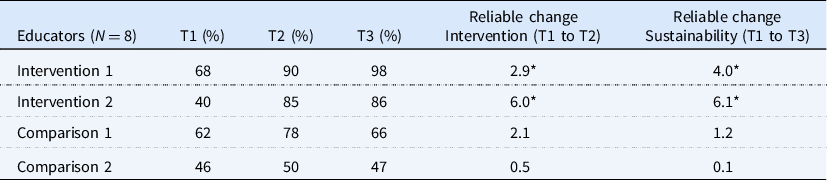
Before intervention (T1), educators were implementing, on average, about half (40–68%) of the TPOT practices (M = 54). The RCIs for the educators in the IGs were significant at T2 and sustained at T3 (p < .05). However, only CG1 showed significant change from T1 to T2, and this was not sustained at T3 (see Table 2). The TPOT indicators on which IG educators made progress were intentional teaching–related: Supportive Conversations, Teaching Behavioural Expectations, Teaching Social-Emotional Competencies (these three items assessed by observation only), Teaching Expressing Emotions, and Teaching Problem-Solving (these two items assessed by observation and interview). Fidelity was set at 80% of practices. Intervention educators, but not contrast educators, implemented practices with fidelity at T2 and T3.
Implementation of Pyramid Model Practices by Educators

*p < .05.
Effects of Pyramid Model Implementation on Children’s SE Skills
There was a substantial main effect for time, Wilks’s lambda = .84, F(1, 67) = 12.84, p = .001, partial eta squared = .16, with both groups showing an increase in SSIS SS scores at T2 (see Table 3). However, for within-subject effects on the SSIS SS scale, there was no significant interaction between groups and time, Wilks’s lambda = .99, F(1, 67) = .69, p = .41, partial eta squared = .01. Although the mean score for IGs was not significantly higher than the mean scores for CGs at pretest, the preintervention differences between the two groups may have contributed to the posttest groups’ average differences. Nonetheless, at T2, the mean difference in SSIS SS scores between the group that had the PM intervention and the CG was significant at a moderate level, F(1, 67) = 4.65, p = .035, partial eta squared = .065, suggesting the increase in social skills for children in the IG was greater than would be expected by chance and greater than the CGs.
Mean Social Skills Improvement System (SSIS) Rating Scales Scores Before and After Intervention

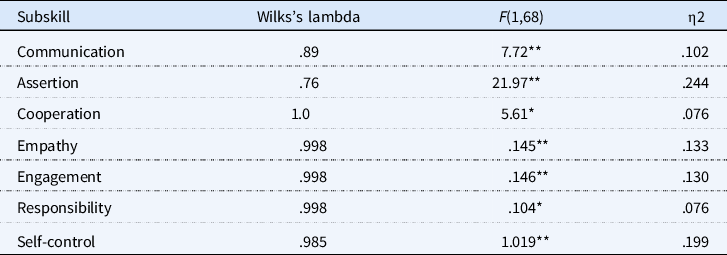
Further analyses examining the effects of time and of the PM intervention on the ratings of children’s social skills were conducted for ratings on all SS subscales (Communication, Cooperation, Assertion, Responsibility, Empathy, Engagement, and Self-Control), and significance was established using a Bonferroni correction. All SS subscales contributed to the rating of change in social skills over time (see Table 4), but only two of the subscales contributed to the intervention effects. These were Communication, F(1, 68) = 7.92, p = .006, partial eta squared = .104, and Engagement, F(1, 68), = 8.508, p = .005, partial eta squared = 111. That is, educators perceived the children as making significant change on all SS subscales over time irrespective of intervention. However, the IG educators were significantly more likely to regard the children as having better skills in communication and engagement post intervention than the CG educators with moderate effect sizes. Two other SS subscales for intervention were rated close to significance. These were Empathy, F(1, 68), = 3.095, p = .083, partial eta squared = .044, and Cooperation, F(1, 68), = 3.746, p = .057, partial eta squared = .052.
Mean Change in Social Skills Improvement System (SSIS) Rating Scales Subskills Over Time

*p < .05. **p < .01.
Educator Rating About the Importance of SE Skills
There was a significant increase over time in the importance ascribed by all educators (intervention and contrast) to SE skills within subjects, Wilks’s lambda = .620, F(3, 66) = 13.503, p = .001, partial eta squared = .901. One IG educator was a rating outlier. This educator initially rated many SS as not important (T1) and increased ratings to important (T2), whereas the other three educators were more likely to rate SS skills as important initially (T1) and to increase ratings to critical (T2).
Of the children identified with additional needs (n = 6), as a group the SSIS T1 did not identify them as having higher SE needs than others. Of the 65 children, eight (5IG and 3CG) were initially identified to have behavioural challenges, two of whom had diagnoses. Educators initially suggested these children required Tier 3 intervention. However, by the end of intervention (T2), no IG educators identified any children as requiring Tier 3 intervention. By contrast, the CG educators said the identified children with behavioural challenges still required Tier 3 intervention.
At T2 an IG integration aide, a member of one IG educator team, commented on the use of the PM with children with additional needs:
It’s always been about crowd control or specific child control rather than thinking, ‘Oh, … they don’t actually know [how to do] it ….’ There are a lot of people who do focus on social and emotional skills and wellbeing of children … it’s been a bit of an eye-opener for people to consider — well, for starters the percentage of children who don’t just get it.
Discussion
In this study, the researchers investigated the value of educators’ use of the PM for children’s SE development in four Victorian preschools. The effect of educators’ PM implementation on children’s SE development was assessed using an educator rating measure (SSIS) of children’s SE skills before commencement of (T1) and 6 months after (T2) educator PM training and implementation, supported by 16 coaching sessions. Educator implementation was measured using the TPOT observational measure at the same times (T1 and T2) for the IGs and CGs. The latter received PM training only after T2. Fidelity of PM implementation and its sustainability was measured three times over 18 months for both the intervention and contrast educators (T1, T2, and 12 months later, T3).
Children’s SE Development
After 6 months, all the 4–5-year-old children were rated to have made significant progress in SE development by both IG and CG educators. This is in contrast to Gresham and Elliott (Reference Gresham and Elliott2008, p. 92), who found no systematic change in social skills development from their research or for earlier work (Walker & McConnell, Reference Walker and McConnell1995). However, the IG educators suggested there was significantly more progress in their children than the CG educators, with moderate effect size. Educators had used PM Tier 1 and Tier 2 with these IG children. Notably, T3 was not used by IG educators for any children with or without additional needs, including those initially nominated as having behavioural challenges. This was similar to changes reported in earlier PM studies (Hemmeter et al., Reference Hemmeter, Snyder, Fox and Algina2011; Hemmeter, Snyder, et al., Reference Hemmeter, Snyder, Fox and Algina2016). In particular, the current research findings suggested skill development in communication and engagement contributed to SE gains, as rated by educators. However, the combined effects of other SE skills also contributed. The changes to educators’ ratings of children’s SE skills applied equally to those with diagnoses and those without. However, only the IG educators rated the children they initially identified as having severe behavioural challenges as no longer requiring intensive intervention support.
Changes in Educator Behaviour and Views
IG educators showed significant and sustained change in their teaching practices (using Tier 1 for all children and Tier 2 practices for most children) from T1 to T2 and T3 when compared to CG educators. PM training and practice-based coaching were effective in changing educator behaviour. However, as shown in the CG educators’ relatively stable TPOT scores (T2–T3), training without coaching was insufficient, despite training involving both educators and co-educators. Past studies have involved lead educators only, but also showed that training lead educators without coaching was insufficient for measurable change (Dunst & Trivette, Reference Dunst and Trivette2009; Snyder et al., Reference Snyder, Hemmeter and Fox2015).
Detailed inspection of the TPOT scores suggested that the educator behaviour changes were greatest in developing intentional teaching of SE skills (Tier 2: intervention TPOT subscales 7–11), although changes occurred across all facets of educator practice. Educators enhanced their intentional teaching support for children to help them learn behavioural expectations, initiate and sustain friendship skills, express their emotions, and socially problem-solve.
Additionally, despite SE development being at the heart of preschool education, after training in PM, educators ascribed significantly greater importance to it. Although most educators initially rated most SS ‘important’, by the end of intervention (T2) SS were rated as ‘important-critical’ in educators’ thinking. Contributions to these results likely included educators’ increased attention to SE development, their increased skills in promotion, and their observations of the effects of the changes on children and on preschool climates. These results accord with those reported elsewhere (Collie, Reference Collie, Frydenberg, Martin and Collie2017).
Implications for Practice
The trial sites were the subject of considerable interest from the organisations’ leaders, who observed changes in educators’ behaviour, which they came to value. Both educators and leaders became very positive about the skills developed by educators and children. Both preschool cluster groups commenced plans to implement PM in all of their preschools. After observing a difference in the children commencing at his school, a local school principal for one of the IGs visited to enquire what had changed. Such responses appear to contrast somewhat with the modest effect size, suggesting the possibility that the behaviours educators valued and highlighted were only partially sampled by the SSIS. Exploration of such possibilities should be undertaken in future.
The increasing importance that all educators ascribed to children’s SE skills over the course of the 6 months may have resulted from the implementers’ increased focus on children’s SE skills in their coaching, the questionnaires, and their involvement in the research. Alternative possibilities could be that responses reflected growing educator clarity about the value of SE skills to children and preschool functioning, along with increasing importance of SE skills and the personal self-reliance that ‘school readiness’ requires.
Although Australian educators have relatively strong skills in relationship building with children and creating learning environments (PM Tier 1), they have previously been shown to be likely to have less developed incidental and planned intentional teaching skills (PM Tier 2) as measured on the CLASS (Collie, Reference Collie, Frydenberg, Martin and Collie2017; Tayler et al., Reference Tayler, Cloney, Adams, Ishimine, Thorpe and Nguyen2016). Intervention educators were shown to have gained in Tier 2–related skills on the TPOT after they were in receipt of coaching, suggesting that PM training and coaching has the potential to support educator teaching skill development. Social skills development is likely to be highly intrinsically motivating and self-reinforcing for preschool children (Arslan, Durmuşoğlu-Saltali, & Yilmaz, Reference Arslan, Durmuşoğlu-Saltali and Yilmaz2011; Trivette & Dunst, Reference Trivette and Dunst2011). When relationships are actively supported and enabled through creation of a positive preschool culture with children, educator teams, and families, and when educators explicitly teach and support children’s SE skills development, the children appear to develop these skills quickly (Hepach, Vaish, & Tomasello, Reference Hepach, Vaish and Tomasello2017; Woolley & Fishbach, Reference Woolley and Fishbach2018).
Limitations and Future Research
This was a small pilot study; hence, results have to be regarded as indicators only. Replication with larger samples and in more varied settings and circumstances is necessary. Additionally, much information reported here reflects educator participant perception, which has potential confirmation bias. As changes in children’s SE skills were reported by educators’ ratings, the results need independent verification to exclude the effect of the educators’ expectations on their scores. However, Gresham and Elliott (Reference Gresham and Elliott2008) reported extensive studies on the validity of the teacher report form of the measure. Nonetheless, future research including independent observers will be important. Further, implementing practice change necessarily involves leaders’ and educators’ effort, motivation, and commitment. Therefore, educators’ perceptions and values are potentially important influencers of individual and group behaviour change. Hence, many types of evidence will be valuable contributions for implementation research (Blase, Fixsen, Sim, & Ward, Reference Blase, Fixsen, Sim and Ward2015).
Another important limitation was that all except one independent observer reported noticing changes in the intervention educators’ behaviour and changes in the preschool rooms and so were not blind to the intervention condition. From parents’ incidental comments about the rooms’ resources, the educators’ behaviour, and the parent resources distributed, this was also true for families. Additionally, the educational leadership in both preschool service groups observed and approved of the changes. Independently, both cluster groups encouraged others to observe the intervention educators, requested PM training for all of their educators, and sought funding to achieve this.
Conclusion
The current study has provided preliminary evidence of the effectiveness of the PM in enhancing preschoolers’ SE skills, whether they were typically developing or had behavioural challenges, in an Australian context. In addition, positive changes in teacher behaviour were observed and sustained for the intervention educators but not for the contrast educators, sufficient for the leadership of each service to propose the training and coaching model for all their educators. Further research investigations will be possible as one team was able to secure funding and will include further trials of PM in Victorian early childhood services with larger populations of children, more educators, and in more diverse conditions. Hopefully, other researchers will consider gathering evidence about the PM and its effectiveness in promoting SEB skills in young Australian children and their early childhood educators, independent of the current research team and of the PM originators.
Acknowledgements
A Faculty of Education Small Grant made this research possible. Professor Mary Louise Hemmeter (Vanderbilt University) and Dr Jessica Hardy (University of Louisville) consulted about the design of the study, provided the initial educator training, and supported the coaches to promote research and practice continuity and implementation fidelity. Graduate Diploma of Professional Psychology students Alison Chew, Felix Richartz, Lara Ryan, and Serife Ucar and coaches Sue Brear and Jenny Urbano contributed to data gathering and the latter two, to intervention. Sara Stockman was the independent observer. The leadership, parents, children, and educators made this study possible through their willingness to participate and to provide feedback.