


Introduction
The current financial crisis is a global factor leading to cuts in funding for mental healthcare provision (WHO, 2013). The impact of fewer resources in health and social care is likely to increase the needs of those with mental health problems and create new groups of vulnerable people, such as the young unemployed (WHO, 2013). Changing the way services are delivered to improve quality and reduce costs is key in governmental strategies for mental health in the UK [Department of Health (DoH), 2011], Europe (European Commission, 2005) and around the world [National Institute for Mental Health (NIMH), 2008].
Poor mental health is expensive, approximating to 3–4% of GDP in the European Union (European Commission, 2005). Severe problems, such as schizophrenia, have been estimated to cost US$65 billion in the USA (APA, 2009), and £6.7 billion across the life-course in the UK (Centre for Mental Health, 2010). Inpatient hospital stays are particularly costly accounting for 56% of the total spent on schizophrenia (Knapp et al. Reference Knapp, Chisholm, Leese, Amaddeo, Tansella, Schene, Thornicroft, Vazquez-Barquero, Knudsen and Becker2002). Patients with ‘treatment-resistant’ symptoms have some of the highest readmission rates (Haywood et al. Reference Haywood, Kravitz, Grossman, Cavanaugh, Davis and Lewis1995), accounting for half of all admissions longer than 90 days (Thompson et al. Reference Thompson, Shaw, Harrison, Ho, Gunnell and Verne2004), and costing around a quarter of the NHS's annual spend on mental health [National Institute for Health and Clinical Excellence (NICE), 2009].
However, labelling patients as ‘treatment-resistant’ presents a disempowering, hopeless message about recovery. Instead, consideration of what treatment is offered to these people is important. Currently, the main treatments for people diagnosed with schizophrenia are pharmacological (van Os & Kapur, Reference van Os and Kapur2009) and evidence suggests that 50% of people with a diagnosis of schizophrenia in the UK (Harrington et al. Reference Harrington, Lelliot, Paton, Konsolaki, Sensky and Okocha2002), and up to 70% worldwide (Tani et al. Reference Tani, Uchida, Suzuki, Fujii and Mimura2013) are prescribed more than one antipsychotic medication, despite guidelines which recommend monotherapy (NICE, 2009). Yet medication is only effective for around one third of patients (Mueser & McGurk, Reference Mueser and McGurk2004) and psychological therapies are often unavailable (van Os & Kapur, Reference van Os and Kapur2009).
There is evidence that cognitive behaviour therapy for psychosis (CBTp) is useful in treating the symptoms of schizophrenia and meta-analyses have shown positive effects of treatments aimed at different symptoms (Zimmerman et al. Reference Zimmerman, Favrod, Trieu and Pomini2005; Wykes et al. Reference Wykes, Steel, Everitt and Tarrier2008). Although recent research indicates some older studies may be overly optimistic about the effects (Jauhar et al. Reference Jauhar, McKenna, Radua, Fung, Salvador and Laws2014; Velthorst et al. Reference Velthorst, Koeter, van der Gaag, Nieman, Fett, Smit, Staring, Meijer and de Haan2014). Research using CBTp as an adjunct to antipsychotic medication has shown particularly large effect sizes in symptom reduction and improved medication adherence (Turkington et al. Reference Turkington, Dudley, Warman and Beck2004). However, there is variability in how this evidence has been incorporated in professional guidance (Gaebel et al. Reference Gaebel, Weinmann, Sartorius, Rutz and McIntyre2005). In the USA and Canada, psychological interventions are not recommended until after the acute phase (APA, 2004; Canadian Psychiatric Association, 2005); but UK and Australasian guidance suggests starting CBTp in acute treatment [Royal Australian and New Zealand College of Psychiatrists (RANZCP), 2005; National Institute for Health and Care Excellence (NICE), 2014]. The latter recommendation offers patients increased choice and a more hopeful message about recovery. Although it is still unclear whether CBTp is more effective than other psychosocial interventions (Jones et al. Reference Jones, Hacker, Cormac, Meaden and Irving2012), there is promising evidence that CBTp may have superior long-term effects by reducing readmission rates (Sarin et al. Reference Sarin, Wallin and Widerlöv2011) and reducing the length of inpatient stays (NICE, 2009), compared to other interventions.
Most evidence regarding CBTp has utilized outpatient samples receiving weekly individual therapy, so the generalizability of this research to inpatients is questionable. Inpatients are different as they may be more distressed, suffering more severe problems and have more comorbid difficulties (Kosters et al. Reference Kosters, Burlinghame, Nachtigall and Strauss2006). With the NHS attempting to cut costs, offering individual therapy to all inpatients with symptoms of psychosis is expensive and unrealistic without significantly more resources (Guaiana et al. Reference Guaiana, Morelli and Chiodo2012). Instead group CBTp offers a way of streamlining treatment and improving access for more people.
Interest in group CBT for people with severe mental health problems has grown. Questions have arisen regarding whether it is as effective as individual therapy (Morrison, Reference Morrison2001), or whether it enhances effects through additional peer support, inaccessible through individual therapy (Newton et al. Reference Newton, Larkin, Melhuish and Wykes2007). Reviews suggest that group CBTp is as effective as individual therapy for patients living in the community (Wykes et al. Reference Wykes, Steel, Everitt and Tarrier2008), and is possibly more effective if used as an early intervention (Saksa et al. Reference Saksa, Cohen, Srihari and Woods2009). However, little research has examined the effectiveness of group CBTp with inpatients.
Arguments that people experiencing acute psychosis cannot engage in talking therapies have been challenged by experienced clinicians (Hanna, Reference Hanna, Clarke and Wilson2009; Freemantle & Clarke, Reference Freemantle, Clarke, Clarke and Wilson2009; Fagin, Reference Fagin, Radcliffe, Hajek, Carson and Manor2010) and guidance which recommends CBTp in acute care (RANZCP, 2005; NICE, 2009). In line with calls from service users to improve choice of treatment available in hospital (DoH, 2007), recent incentive schemes to reward best practice, such as ‘star wards’, have encouraged all hospitals to offer ward-based talking therapy groups (Bright, 2006). However, the evidence base for some therapies is still developing and little research has evaluated group CBTp for inpatients. Consequently, this review questions whether group CBTp:
-
• is acceptable to inpatients;
-
• can reduce distress or unwanted symptoms;
-
• can improve coping or quality of life.
Therefore, this review aims to identify all studies published in peer-reviewed journals which provide evidence relevant to the research questions; review the findings and quality of evidence, and identify gaps in the evidence base which can be explored through further research.
Methods
Inclusion criteria
We included comparison studies which used a CBT intervention (including psycho-education if based on CBT material), delivered in a group format, to inpatients with psychosis or a diagnosis of schizophrenia. We excluded studies which were not comparison studies (including qualitative descriptions of groups); which delivered individual therapy or non-CBT-based group therapy; which used only outpatient samples; which used only inpatients without psychosis or a diagnosis of schizophrenia; or which were not written in English. Due to the small literature base being searched, no further exclusion criteria were used, such as dual diagnosis, comorbidity, intellectual disability or age. We also chose not to exclude studies which used a combination of inpatients and outpatients, or which included participants with a mixture of diagnoses (as long as this included psychosis or schizophrenia), because this would overly restrict the number of studies available for consideration.
Search strategy
We searched Scopus, Web of Science and EBSCO (including Medline and PsycINFO) databases using the terms: group AND (CBT OR cognitive behav* therapy) AND (psychosis OR schizophren* OR hearing voices) AND (inpatient OR hospital OR mental OR acute patient), not limited by year of publication.
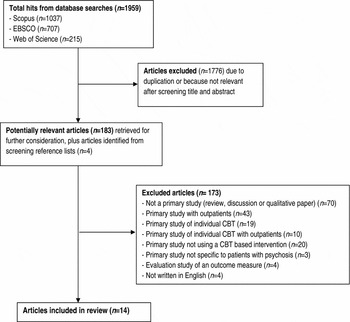
These searches, conducted in January 2013, generated 1959 articles which were reviewed via title and abstract and excluded articles which did not meet our inclusion criteria. We reviewed the resulting 183 articles after collecting the full text (and identified a further four articles from article reference lists) and further excluded articles, recording the reason for exclusion. We included the remaining 14 relevant articles in this review (see Fig. 1).
Electronic database search and review process.

Quality assessment
All 14 papers were assessed for quality of evidence. There are many tools available to evaluate quality, such as the Grading of Recommendations Assessment, Development and Evaluation (GRADE) guidelines (Atkins et al. Reference Atkins, Briss, Eccles, Flottorp, Guyatt, Harbour, Hill, Jaeschke, Liberati, Magrini, Mason, O’Connell, Oxman, Phillips, Schünemann, Edejer, Vist and Williams2005) or the Preferred Reporting Items for Systematic Reviews and Meta-Analyses (PRISMA) guidelines (Moher et al. Reference Moher, Liberati, Tetzlaff and Altman2009). However, given the small scale of this review, these tools were overly complex and exclusive. Therefore, all studies were included in the review and quality is discussed based on general principles of evaluating research evidence (Gugiu & Gugiu, Reference Gugiu and Gugiu2010).
Results
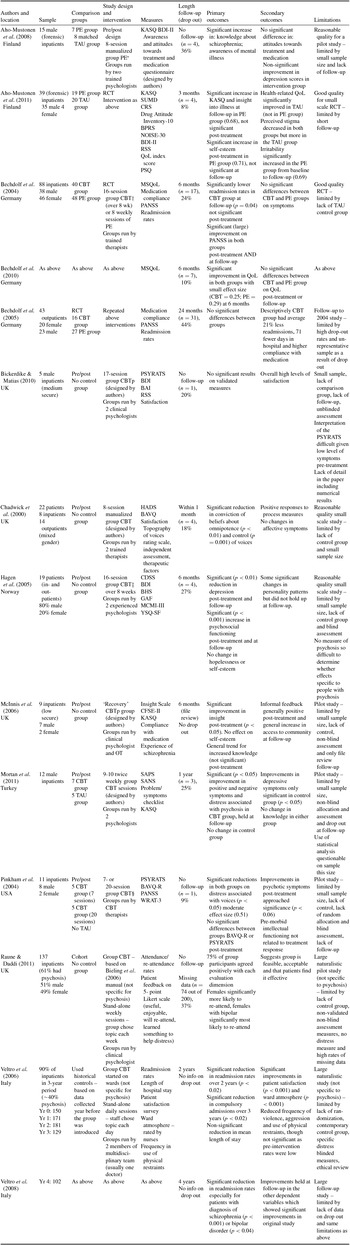
The 14 papers reviewed related to 10 studies. The majority were experimental studies (two randomized controlled trials (RCTs) and the rest used pre-/post-intervention measures), and two were cohort studies. Table 1 summarizes the study characteristics, findings and limitations.
Characteristics of studies included in the review

BAI, Beck Anxiety Inventory; BAVQ-R, Beliefs about voices questionnaire – revised; BDI-II, Beck Depression Inventory; BHS, Beck Hopelessness Scale; BPRS, Brief Psychiatric Rating Scale; CDSS, Calgary Depression Scale for Schizophrenia; CFSE-II, Culture Free Self-Esteem Scale; CRS, Compliance Rating Scale; GAF, Global Assessment of Functioning; HADS, Hospital Anxiety and Depression Scale; KASQ, Knowledge about Schizophrenia Questionnaire; MCMI-III, Millon Clinical Multiaxial Inventory; MSQoL, Modular System for Quality of Life; NOISE-30, Nurses Observation Scale for Inpatient Evaluation; PANSS, Positive and Negative Symptoms Scale; PE, patient education; PSQ, Perceived Stigma Questionnaire; PSYRATS, Psychotic Symptoms Rating Scales; QoL index score, Health-related quality of life single index score; RCT, randomized control trial; RSS, Rosenberg Self-esteem Scale; SANS, Scale for the Assessment of Negative Symptoms; SAPS, Scale for Assessment of Positive Symptoms; Satisfaction, Satisfaction Questionnaire – designed by authors; SUMD, Scale to Assess Unawareness of Mental Disorder; TAU, treatment as usual; WRAT-3, Wide Range Achievement Test III; YSQ-SF, Young Schema Questionnaire – Short Form.
*Manual modified from Ascher-Svanum & Krause (1991) – based on stress vulnerability model.
†Manual based on Tarrier et al. (1990).
‡Manual based on Free (1999) and modified by authors.
§Manual based on Wykes et al. (1999) and Wykes (2004) formats.
Discussion
Overall the studies reviewed indicate that group CBTp may be a positive addition to routine inpatient care. However, given the small number of studies identified, and the variation in methodologies and quality, caution is necessary in drawing any strong conclusions. In line with our original questions evidence from the studies reviewed suggests that group CBTp:
-
• Is acceptable to patients, as demonstrated by favourable responses on satisfaction questionnaires.
-
• Can potentially reduce distress associated with symptoms, through increased knowledge of, and sense of control over, symptoms.
-
• Can potentially improve quality of life and coping as demonstrated through improved psychosocial functioning.
Inpatients are often highly distressed and it is a difficult time to recruit research participants. A strength of this review is that it includes research which reflects the reality of working with a challenging population and did not exclude studies which used different methodological designs, such as cohort studies. However, understandably, this led to limitations in the quality of studies reviewed and it is currently not possible to conduct a meta-analysis due to heterogeneity in the data, study design, analysis and lack of reported effect sizes. Many studies had small samples and used non-parametric analyses or underpowered statistical calculations, with the exception of the longitudinal cohort studies. Comparison groups were often lacking and few studies included a treatment as usual (TAU) group, making it difficult to conclude whether changes are due to the intervention or other variables, such as time spent in hospital or medication. There was also heterogeneity in the CBTp manuals used; authors often adapted manuals or developed unique manuals. Although CBTp interventions should include the same basic principles, variations in the presentation of information in the various treatment manuals, and the further amendments made by the authors, make it difficult to compare whether different manuals were delivering the same ‘active’ components. There were differences in treatment length, from ‘stand-alone’ to 20 sessions, and variability in outcome measures. Some studies lacked any validated measures and relied on routinely collected data (such as readmission rates), some used newly developed scales of questionable reliability, and many did not blind the assessments or raters. All these differences make it difficult to compare what is being examined and generalize from studies which appear to measure the same intervention. Differences in the reporting of studies also means that the choice of search terms could potentially limit the studies captured, and in particular exclude third-wave therapies, which may not use the terms CBT or cognitive therapy but which stem from this tradition.
However, despite the limitations some conclusions can be drawn from the findings in this review. Four studies examined participants’ knowledge about schizophrenia. One pilot study followed by an RCT found significant improvements following intervention (Aho-Mustonen et al. Reference Aho-Mustonen, Miettinen, Koivisto, Timonen and Raty2008, Reference Aho-Mustonen, Tilonen, Repo-Tiihonen, Ryynanen, Miettinen and Raty2011), one small pre/post pilot study found a positive trend towards improvements (McInnis et al. Reference McInnis, Sellwood and Jones2006) and another pre/post pilot study found no change (Mortan et al. Reference Mortan, Tekinsav Sutcu and German Kose2011). Therefore, there is reasonable evidence that group CBTp can improve knowledge about schizophrenia. In addition three studies included a measure of insight and all found significant improvements following the intervention (McInnis et al. Reference McInnis, Sellwood and Jones2006; Aho-Mustonen et al. Reference Aho-Mustonen, Miettinen, Koivisto, Timonen and Raty2008, Reference Aho-Mustonen, Tilonen, Repo-Tiihonen, Ryynanen, Miettinen and Raty2011). However, it is worth noting that this may not lead to improvements in functioning in itself, as evidence suggests that improved insight may actually lead to increased depression, although it may also offer greater opportunity for treatment (Chakraborty & Basu, Reference Chakraborty and Basu2010).
Six studies included a measure of distress associated with positive symptoms of psychosis. Two pre/post studies (Chadwick et al. Reference Chadwick, Sambrooke, Rasch and Davies2000; Pinkham et al. Reference Pinkham, Gloege, Flanagan and Penn2004) found significant reductions on the Beliefs About Voices Questionnaire. Two studies, one RCT (Bechdolf et al. Reference Bechdolf, Knost, Kuntermann, Schiller, Klosterkotter, Hambrecht and Pukrop2004); and one small pilot (Mortan et al. Reference Mortan, Tekinsav Sutcu and German Kose2011) found significant reductions on the Scale for the Assessment of Positive Symptoms, and the Positive and Negative Symptoms Scale (PANSS), respectively. One pre/post study (Pinkham et al. Reference Pinkham, Gloege, Flanagan and Penn2004) found a positive trend towards reductions on the PANSS and the Psychotic Symptom Rating Scales; and one RCT found reductions on the Brief Psychiatric Rating Scale, although similar reductions were seen in controls (Aho-Mustonen et al. Reference Aho-Mustonen, Tilonen, Repo-Tiihonen, Ryynanen, Miettinen and Raty2011). Therefore, despite the use of different measures, group CBTp appears to lead to improvements in distress associated with positive symptoms of psychosis.
Similarly, six studies included a measure of depression or anxiety associated with psychosis. Two pre/post studies (Hagen et al. Reference Hagen, Nordahl and Grawe2005; Mortan et al. Reference Mortan, Tekinsav Sutcu and German Kose2011) found significant reductions in negative symptoms on the Beck Depression Inventory (BDI-II), and the Scale for the Assessment of Negative Symptoms, respectively. Aho-Mustonen and colleagues’ pilot study (Reference Aho-Mustonen, Miettinen, Koivisto, Timonen and Raty2008) and RCT (2011) both showed positive trends towards improvements on the BDI-II, and two pre/post studies (Chadwick et al. Reference Chadwick, Sambrooke, Rasch and Davies2000; Bickerdike & Matias, Reference Bickerdike and Matias2010) found no change on the Hospital Anxiety and Depression Scale or BDI-II, although the latter was poor quality. Therefore, there is an indication of a positive effect of group CBTp on negative symptoms.
All five studies (two pre/post and three cohort) which measured patient satisfaction reported positive findings (Chadwick et al. Reference Chadwick, Sambrooke, Rasch and Davies2000; Veltro et al. Reference Veltro, Falloon, Vendittelli, Oricchio, Scinto, Gigantesco and Morosini2006, Reference Veltro, Vendittelli, Oricchio, Addona, Avino, Figliolia and Morosini2008; Bickerdike & Matias, Reference Bickerdike and Matias2010; Raune & Daddi, Reference Raune and Daddi2011) although only Chadwick and colleagues (Reference Chadwick, Sambrooke, Rasch and Davies2000) used an independent person to collect this data. Therefore, although there are questions of demand characteristics it appears participants found group CBTp acceptable and found elements of the groups helpful.
Other variables, measured by only a few studies, showed more equivocal outcomes. One RCT found significant improvements in self-esteem (Aho-Mustonen et al. Reference Aho-Mustonen, Tilonen, Repo-Tiihonen, Ryynanen, Miettinen and Raty2011), but two pre/post studies found no change (Hagen et al. Reference Hagen, Nordahl and Grawe2005; McInnis et al. Reference McInnis, Sellwood and Jones2006). Similarly, two RCTs found significant improvements in Quality of Life (QoL) (Bechdolf et al. Reference Bechdolf, Knost, Kuntermann, Schiller, Klosterkotter, Hambrecht and Pukrop2004, Reference Bechdolf, Knost, Nelson, Schneider, Veith, Yung and Pukrop2010) but in another RCT, health-related QoL improved significantly in controls but not in the intervention group (Aho-Mustonen et al. Reference Aho-Mustonen, Tilonen, Repo-Tiihonen, Ryynanen, Miettinen and Raty2011). Perceived stigma significantly improved in one pilot study (Aho-Mustonen et al. Reference Aho-Mustonen, Miettinen, Koivisto, Timonen and Raty2008) and showed a positive trend in the resulting RCT, although the control group showed greater improvement (Aho-Mutonen et al. Reference Aho-Mustonen, Tilonen, Repo-Tiihonen, Ryynanen, Miettinen and Raty2011). Encouragingly, two studies of reasonable quality (one RCT, one cohort) found significant reductions in readmission rates (Bechdolf et al. Reference Bechdolf, Knost, Kuntermann, Schiller, Klosterkotter, Hambrecht and Pukrop2004; Veltro et al. Reference Veltro, Falloon, Vendittelli, Oricchio, Scinto, Gigantesco and Morosini2006) which held at follow-up (Bechdolf et al. Reference Bechdolf, Kohn, Knost, Pukrop and Klosterkotter2005; Veltro et al. Reference Veltro, Vendittelli, Oricchio, Addona, Avino, Figliolia and Morosini2008). Finally, three (two RCTs, one pre/post) found improvements in compliance with, or attitudes towards, medication (Bechdolf et al. Reference Bechdolf, Knost, Kuntermann, Schiller, Klosterkotter, Hambrecht and Pukrop2004, Reference Bechdolf, Kohn, Knost, Pukrop and Klosterkotter2005; McInnis et al. Reference McInnis, Sellwood and Jones2006; Aho-Mustonen et al. Reference Aho-Mustonen, Miettinen, Koivisto, Timonen and Raty2008, Reference Aho-Mustonen, Tilonen, Repo-Tiihonen, Ryynanen, Miettinen and Raty2011), although none of these reached significance, so the impact on adherence is questionable.
Conclusion
There are positive indications that group CBTp with inpatients can help alleviate distress associated with psychotic symptoms, increase knowledge, and reduce negative symptoms and readmission rates. However, there is currently not enough high-quality evidence to draw firm conclusions regarding effectiveness. There is a pressing need for better methodological quality in effectiveness studies which would help provide evidence for a more thorough examination of whether group CBTp with inpatients is a cost-effective way of delivering treatment, reducing readmissions and improving patient choice and satisfaction with care.
Acknowledgements
The project was jointly funded by the University of Liverpool and Mersey Care NHS Trust as part of M.O.'s doctoral training.
Declaration of Interest
None.
-
(1) Group CBTp with inpatients may help to alleviate distress from psychotic symptoms.
-
(2) Further high-quality evidence with inpatients is needed in order to judge effectiveness of group CBTp.
-
(3) Further evidence could help to examine the cost-effectiveness of group CBTp for inpatients.
-
(4) There is a need to explore patient experiences of CBTp in order to assess satisfaction with care.



Comments
No Comments have been published for this article.