Introduction
Wellbeing at a later age is closely related to an individual's social relationships. The characteristics of social networks include objectively measured indicators of social isolation, such as the number of social contacts or the amount of support received from others, as well as subjectively perceived loneliness, specifically the subjective experience of a discrepancy between the actual and desired number and quality of an individual's social relationships (Perlman and Peplau, Reference Perlman, Peplau, Peplau and Perlman1982). Social isolation and loneliness have negative impacts on physical and mental health and survival (Holt-Lunstad et al., Reference Holt-Lunstad, Smith and Layton2010, Reference Holt-Lunstad, Smith, Baker, Harris and Stephenson2015; Ye Luo et al., Reference Ye Luo, Hawkley, Waite and Cacioppo2012; Rico-Uribe et al., Reference Rico-Uribe, Caballero, Olaya, Tobiasz-Adamczyk, Koskinen, Leonardi, Haro, Chatterji, Ayuso-Mateos and Miret2016; Courtin and Knapp, Reference Courtin and Knapp2017; Smith and Victor, Reference Smith and Victor2019).
As one ages, the risk of a lack of social contacts increases. Although longitudinal research shows that loneliness in old age often reflects one's experience with social relationships over the previous decades of life, the risk of loneliness also increases with age among individuals who did not experience loneliness previously (Aartsen and Jylhä, Reference Aartsen and Jylhä2011; Dahlberg et al., Reference Dahlberg, Andersson and Lennartsson2018). The association of social isolation and loneliness with old age is closely linked to the partnership situations of older adults, especially to bereavement (Dykstra et al., Reference Dykstra, Van Tilburg and De Jong Gierveld2005; Aartsen and Jylhä, Reference Aartsen and Jylhä2011; Hansen and Slagsvold, Reference Hansen and Slagsvold2016).
Unlike the large body of research that relates loneliness to widowhood, much less is known about the consequences of loss of a spouse through divorce. To fill this gap in knowledge, this paper focuses on the relation between marital status, characteristics of close social network and loneliness in older adults. I use data from the Czech Republic because research on loneliness at a later age in this country is lacking to date. Comparative research shows that the countries of Central and Eastern Europe have a significantly higher prevalence of loneliness than the rest of Europe (Yang and Victor, Reference Yang and Victor2011; Hansen and Slagsvold, Reference Hansen and Slagsvold2016; Nyqvist et al., Reference Nyqvist, Nygård and Scharf2018), which emphasises the importance of understanding its causes in this region.
I test two hypotheses that expect that loneliness is less influenced by divorce than widowhood (Hypothesis 1) and that the effect of marital status is stronger among men (Hypothesis 2). When analysing the effect of marital status, I also measure the timing of divorce and widowhood, as well as the role of having a supportive partnership that goes beyond formal marital status.
Marriage, divorce and widowhood, and social relationships in later life
As proposed above, having a spouse or partner protects against a lack of social contacts. Partners usually provide each other with social and emotional support. They accompany each other and share activities. Partner relationships represent deep social bonds that prevent emotional loneliness (Liu and Rook, Reference Liu and Rook2013). The death of a spouse disrupts these benefits and is counted among the most stressful events in life (Utz et al., Reference Utz, Swenson, Caserta, Lund and De Vries2014). Losing a partner may also reduce one's social life indirectly because it is often accompanied by a loss of contact with their friends and relatives (Glaser et al., Reference Glaser, Tomassini, Racioppi and Stuchbury2006), financial problems or a loss of means of mobility (Victor et al., Reference Victor, Scambler and Bond2008).
Bereavement is a common experience at a later age, especially for women, who tend to live longer than men. However, ending a marriage through divorce is more prevalent in the general population. Divorce rates have been rising for decades in most countries, and this trend is also increasingly apparent at a later age (Brown and Lin, Reference Brown and Lin2012). It is therefore worth asking if divorce has the same negative effects on social relationships as widowhood. Research on the impact of divorce at a later age has found that it reduces social relationships and increases the risk of loneliness (Amato, Reference Amato2000). However, Van Tilburg et al. (Reference Van Tilburg, Aartsen and Van Der Pas2015) found that the effect of divorce on loneliness diminished in recent cohorts of older adults and relate this finding to a rising social acceptance of divorce.
Studies that directly compare the impacts of widowhood and divorce are scarce and inconclusive. Ben-Zur (Reference Ben-Zur2012) found that divorce, unlike widowhood, did not increase the risk of loneliness at a later age (but the divorced as well as widowed respondents had lower life satisfaction than the married ones). In another study, divorce reduced perceived social support and contact with friends while widowhood only impacted on the latter outcome (Glaser et al., Reference Glaser, Tomassini, Racioppi and Stuchbury2006).
The argument that the effect of divorce on social relationships may change when divorce becomes more common is also supported in terms of intergenerational ties. An international study found that grandparental divorce had a negative impact on care for grandchildren and that the size of the effect varied greatly depending on the prevailing divorce rate (Žilinčíková and Kreidl, Reference Žilinčíková and Kreidl2018). Care by grandparents in countries with higher divorce rates was less influenced by their divorced status (Žilinčíková and Kreidl, Reference Žilinčíková and Kreidl2018).
Divorce has been relatively common in the Czech Republic over the last several decades (Kreidl et al., Reference Kreidl, Štípková and Hubatková2017). Given this context, I expect that the effect of a divorced status on social network and loneliness would be less harmful than the effect of widowhood, if it is harmful at all (Hypothesis 1). I also examine the role of two factors that differentiate divorce from bereavement.
First of these is the quality of a relationship. Divorce, unlike bereavement, is a voluntary decision of at least one of the ex-partners. The decision to terminate a marriage is likely to reflect its poor quality or an outlook for a better life without the spouse, possibly with a new partner. Research on married older adults has revealed that marriage does not guarantee an absence of loneliness and that the quality of the relationship is more important for wellbeing than its mere existence or duration (Proulx et al., Reference Proulx, Helms and Buehler2007; De Jong Gierveld et al., Reference De Jong Gierveld, Van Groenou, Hoogendoorn and Smit2009; Carr et al., Reference Carr, Freedman, Cornman and Schwarz2014; Robles et al., Reference Robles, Slatcher, Trombello and McGinn2014). A longitudinal study by Margelisch et al. (Reference Margelisch, Schneewind, Violette and Perrig-Chiello2017) focused on people aged 60–89 years who had been continuously married for at least 40 years. The study revealed that high marital satisfaction was related to a wide range of positive outcomes, including a lower risk of social and emotional loneliness. I therefore expect that being divorced can be less lonely in some situations than staying in unhappy marriages. To test this expectation, I control for the presence of a supportive relationship apart from the effect of formal marital status.
The second factor that distinguishes divorce from widowhood is the lifecourse stage at which it usually occurs. Death of a spouse usually comes at a later age, whereas divorce is more typical at a younger age, despite the rising incidence of divorce after long marriages (Brown and Lin, Reference Brown and Lin2012). People at later ages usually have fewer resources to create new social relationships or to deepen the existing ones. The age when divorce or widowhood occurred is controlled in the analysis to determine if the consequence of losing a spouse is dependent on its timing rather than the event itself.
Previous research suggests that the importance of marriage and partnership might differ by gender. Men of any partner status tend to perceive having a partner as more important than women, and they also seem to have smaller social networks (Dykstra and Fokkema, Reference Dykstra and Fokkema2007). However, results regarding gender differences in the effects of marriage and its absence on loneliness are not conclusive. Some studies have shown that divorce has a more negative impact on men (Pinquart, Reference Pinquart2003; Dykstra and Fokkema, Reference Dykstra and Fokkema2007), while others found no gender difference (Dykstra and Gierveld, Reference Dykstra and De Jong Gierveld2004). Results regarding widowhood are more consistent and show a higher vulnerability for men (Pinquart, Reference Pinquart2003; Dykstra and De Jong Gierveld, Reference Dykstra and De Jong Gierveld2004; Utz et al., Reference Utz, Reidy, Carr, Nesse and Wortman2004).
The argument explaining the disadvantage of men is that women are often responsible for organising the social life of the couple and work as ‘kin-keepers’ (Rosenthal, Reference Rosenthal1985). Men without partners are less able to organise their social agenda and maintain social relationships. Women have a more intensive contact with their adult children (Hubatková and Petrová Kafková, Reference Hubatková and Petrová Kafková2017). The role of older women in maintaining family relationships was also demonstrated in the case of grandparenting. Men were found to be less involved in grandparental child care if they did not have a partner (Hasmanová Marhánková and Štípková, Reference Hasmanová Marhánková and Štípková2015; Hubatková and Petrová Kafková, Reference Hubatková and Petrová Kafková2017). Following these findings, I expect that marital status has more impact on the social networks and loneliness of men than women (Hypothesis 2).
Methods
I use the Czech component of the International Panel Survey of Health, Ageing and Retirement in Europe (SHARE), release 6.1.1.Footnote 1 The survey targets persons over 50 years of age and their partners with whom they live in the same household (without any age limit). This paper uses data from Wave 6, collected in 2015. This wave includes a special module about the social networks of the respondents as well as a measure of loneliness. The sample size is 4,355. After deleting observations with missing values of necessary variables, the final data-set includes 3,949 respondents who live in 2,806 households. Among them, 2,748 respondents live in 1,605 households formed by a couple and 1,201 respondents live without a partner (92% of them do not have a non-resident partner).
Loneliness
To measure the level of loneliness, SHARE uses the short version of the Revised University of California at Los Angeles Loneliness scale (R-UCLA; Hughes et al., Reference Hughes, Waite, Hawkley and Cacioppo2004).Footnote 2 It consists of three items asking about the frequency of feelings of lack of companionship, being left out and isolation from others. There are three options for responses: hardly ever or never (score 1), some of the time (score 2) and often (score 3). The final loneliness score is a summation of the three items, ranging from 3 to 9.
Social network characteristics
In the social network module, respondents were asked to provide information regarding up to seven persons with whom they discuss their personal matters or about persons who are very important to them for another reason.Footnote 3 They then responded to a number of questions about these persons. The variables used in this paper measure the size and composition of social networks.
Size of the network ranges from 0 to 7. Most respondents listed two to four persons. Composition of the network is measured by a set of variables that describe relationships with network members. They are binary indicators of presence of a partner, number of relatives, number of friends and number of other network members. For the purpose of modelling, I merge the number of friends and other non-relative persons.
The variable presence of a partner in the close social network is used as an indicator of high-quality partnership. Listing one's partner within the close social network is not the same as having a partner or a spouse. It will be shown later that a non-negligible proportion of respondents who have a spouse or partner did not list him or her within their close social network.
Independent variables
The main independent variables are gender (male versus female), marital status and presence of partner in the close social network. Marital status has six categories that reflect the formal marital status and, in the case of divorced and widowed persons, also the age when the marriage ended: married, never married, divorced before age 50, divorced at age 50+, widowed before age 50 and widowed at age 50+. The inclusion of age at the event allows for testing whether the expected difference between the effect of divorce and widowhood is due to the timing of the event within the individual's lifecourse.
The control variables in models of loneliness include parenthood (childless versus has child/ren),Footnote 4 age (value 50 set to 0 in models), education (three categories: basic, secondary and tertiary), employment status (works versus does not work), economic situation (has versus does not have difficulty making ends meet) and health measured as a limitation in daily activities due to health (three categories: no limitation, minor limitation and severe limitation).
Results
The results are presented in three sections. The first and second sections are descriptive. The first section focuses on the distribution of marital status categories and the presence of partners in close social networks. The second section discusses the size and composition of close social networks by marital status and gender. Finally, the last section deals with loneliness and tests the hypotheses. SHARE is a household survey, and some of the variables (including parenthood and financial difficulty) are measured at the household level. To account for the similarity of members of the same household, I use multi-level regression with random intercept (see e.g. Rabe-Hesketh and Skrondal, Reference Rabe-Hesketh and Skrondal2008) to model loneliness. Model selection is based on the Akaike information criterion (AIC). The lower the AIC value, the better the model fits the data (Burnham and Anderson, Reference Burnham and Anderson2004). A difference of at least 2 is considered to be evidence in favour of the model with the lower AIC value.
Marital status, partnership and its quality
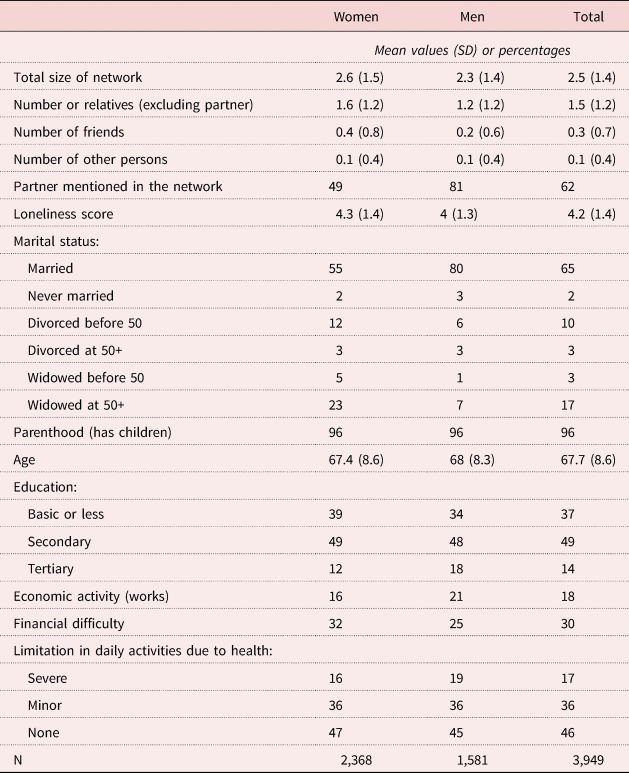
Table 1 provides the summary statistics of all the variables in total and by gender. It shows that there are gender differences in the marital status of older adults. A vast majority of men (80%) are married, whereas for women the figure is only 55 per cent. The second largest category is widows (23%) and widowers (7%) who lost their spouse at age 50 or higher, followed by those who divorced before 50 (12% women and 6% men). The smallest proportion of women are the never married (2%), and the smallest category among men is the early widowers (1%). Half of the female and 81 per cent of the male respondents listed a partner in their network. These differences reflect the longer survival of women, who are consequently more often widows, and also a higher propensity to re-marry after divorce among men.
Descriptive statistics

Notes: N = 3,949. SD: standard deviation.
Source: Survey of Health, Ageing and Retirement in Europe, Wave 6, 2015, own calculations.
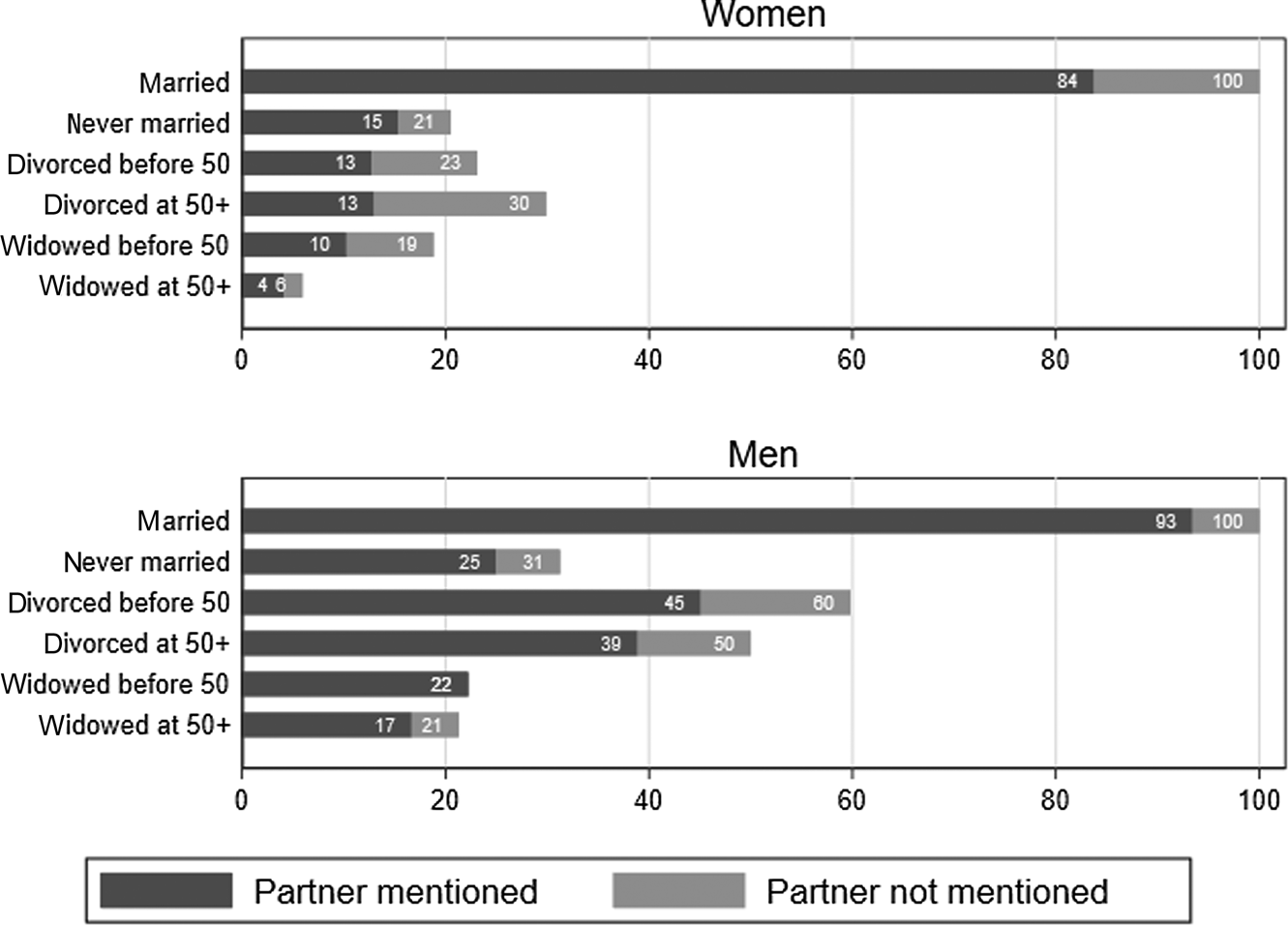
Figure 1 provides a closer view of the marital status and partnership quality of older women and men. It shows the percentage of respondents who have a partner, either co-resident or non-resident, and the percentage of those who mentioned their spouses or partners as members of their social networks.Footnote 5 I interpret the omission of the existing spouse or partner from the network as an indication of the low quality or supportiveness of the relationship.
Percentages of respondents who listed a partner in their social network and those who have a partner but did not mention him/her in their social network, by marital status and gender.
Data: SHARE 2015, own calculations; N = 3949.

Married individuals all have a partner, so the total length of the bar is 100 per cent, but those who mentioned their spouses were 84 per cent among women and 93 per cent among men. The proportion of partnerships in other marital status groups is much lower, especially among women. In total, 1,111 respondents do not have a partner (i.e. only 20% of those who are not married are partnered). The percentage of unmarried partnered persons is the highest in the category of male divorcees (60% of men who divorced at a young age and 50% among late male divorcees). Never-married men have a partner in 31 per cent of the cases and widowed men in approximately 22–23 per cent of the cases. Most unmarried men who have a partner acknowledge her in the close social network (between 75% among early divorcees to 100% in early widowers).
The proportion of partnered, unmarried women is also the highest among divorcees but much lower than among their male counterparts (30% among late divorcees and 23% among those who divorced at a younger age). Never-married women and those widowed at a younger age have a partner in 19–20 per cent of the cases. There is a large gap between women widowed at a younger age and those widowed at age 50 or higher. Only approximately 6 per cent of the latter have a partner. The proportions of partners who were listed in close social networks of unmarried women are much lower than among men. They range between 43 per cent among late divorcees and 75 per cent among the never married.
Size and composition of close social networks
The size of close social networks varied between 0 and 7, but most respondents did not fill all seven positions. Table 1 shows that the average size is 2.5 persons. Almost two-thirds (62%) of respondents listed a partner in their network. The largest share of the total network size is formed by the group of relatives (excluding partner), with an average size of 1.5. Listing friends or other people was much less frequent.
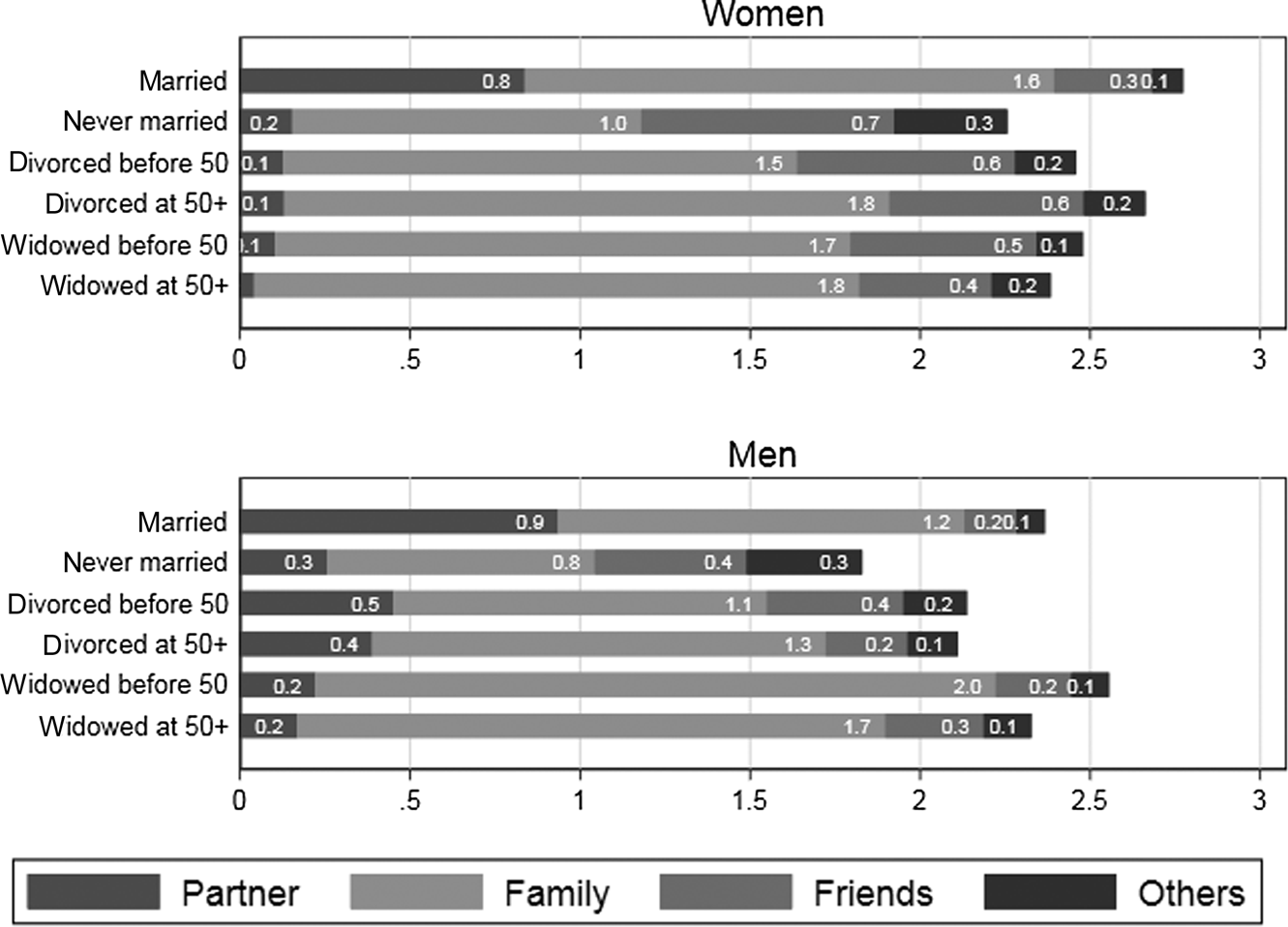
Figure 2 describes the size and composition of the social network by gender and marital status. The bars show the average size of each type of close relationship. It shows that the association between marital status and the characteristics of social network is gender-specific. Among women, those who are married have the largest network, followed by late divorcees. In contrast, the largest network among men is in the group widowed at a younger age, followed by married men. The networks of never-married persons are the smallest among both genders.
Size and composition of social network by marital status and gender.
Data: SHARE 2015, own calculations; N = 3949.

Regarding composition, relatives (including partners) prevail in networks of all marital status groups, among both men and women, but there are differences in how dominant they are. Because there could be only one spouse/partner in the network (i.e. the partner variable can only have values of 0 or 1), the average size of the partner variable can be interpreted as the proportion of respondents who reported a partner. This proportion is obviously largest among married men and women and considerably smaller among the other groups, especially unmarried women. This will be discussed in more detail below.
Relatives other than partners contribute the most to the total size of the network. Among women, there is a divide between the average number of listed family members of those who have never married (1) and all other groups (between 1.5 and 1.8). The pattern is more complex among men. Widowed men, especially those who lost their wives at a younger age, have the largest network of relatives (1.7 and 2.0). Married and both groups of divorced men have, on average, between 1.1 and 1.2 family members in their networks. Never-married men reported the smallest number of relatives (average 0.8).
The size of the network formed by friends and other non-relatives is largest among groups that have a smaller partner and family network. However, it does not compensate for the differences in the number of listed relatives and partners. The number of reported friends is higher among women than men.
There does not seem to be a clear similarity between persons who were divorced and widowed at a younger versus an older age in terms of the size or composition of the network.
Loneliness
Table 1 provides information about the mean loneliness score. The total score is 4.2 (on the scale that ranges from 3 to 9). Men seem to be less lonely than women (the score is 4.0 for men compared to 4.3 among women).
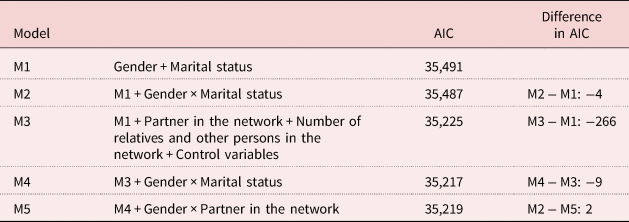
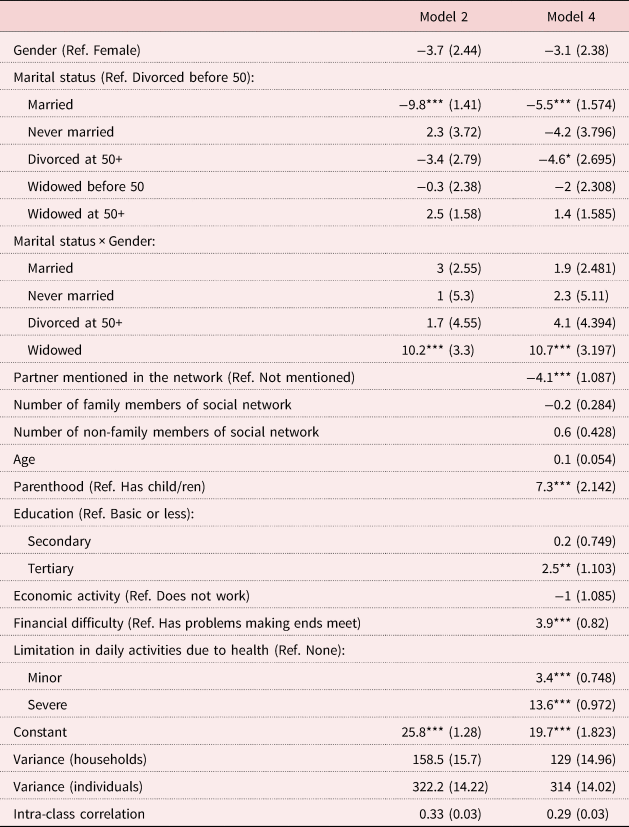
For the purpose of the models, I rescaled the loneliness scores to range between 0 and 100 so that the coefficients can be interpreted as percentage points. I estimated five models, which are listed in Table 2. The first two models describe the marital status differences in loneliness and test if the pattern is gender-specific. Model 1 includes only the effect of gender and marital status. Model 2 adds interaction between these two variables. For the purpose of the interaction I had to merge all widowers together as there are only 15 cases of men who were widowed before the age 50. Adding the interaction leads to the decline of AIC by 4, which suggests that the effect of marital status differs for men and women.
Estimated two-level models of loneliness with random intercepts

Notes: N (individuals) = 3,949; N (households) = 2,806. Control variables are age, education, parenthood, economic activity, financial difficulty and limitation of daily activities due to health. AIC: Akaike information criterion.
Source: Survey of Health, Ageing and Retirement in Europe, Wave 6, 2015, own calculations.
Models 3 and 4 extend Models 1 and 2, respectively, by adding social network characteristics, specifically, mentioning a partner, number of relatives (excluding the partner), number of other persons and other control variables. The new covariates improve the fit of the model significantly (AIC drops by 266 between Models 1 and 3). The comparison of Models 3 and 4 indicates that the interaction between marital status and gender is significant net of the control variables (AIC is lower by 9 in Model 4). To test if having a supportive partner relationship has the same effect for men and women, Model 5 adds interaction between gender and the presence of a partner in the social network. This does not lead to a better fit. AIC is higher by 2 in Model 5 than in Model 4. This makes Model 4 the preferred model.
The results of Models 2 and 4 are presented in Table 3. The coefficients for marital status refer to women. The reference category is the early divorcees. Compared to them, only married women have a clearly lower loneliness score. The difference is 9.8 percentage points in Model 2 and 5.2 in Model 4, and both of these effects are statistically significant at the 0.01 level. The reduction of the effect by almost a half in Model 4 suggests that the control variables explain a substantial part of the advantage of married women. The differences between women who divorced before age 50 and other unmarried groups are smaller and mostly statistically insignificant. The only effect worth discussing is that there seems to be an advantage of late divorcees of 4.6 percentage points, net of control variables in Model 4. The effect is only marginally statistically significant at the 0.1 level, possibly due to the fact that the group of late divorcees is small but its size (4.6 percentage points) is almost as large as the effect of marriage (5.2 percentage points).
Results of selected two-level models of loneliness with random intercepts

Notes: N (individuals) = 3,949; N (households) = 2,806. Standard errors are in parentheses. Ref.: reference category.
Source: Survey of Health, Ageing and Retirement in Europe, Wave 6, 2015, own calculations.
Significance levels: * p < 0.05, ** p < 0.01, *** p < 0.001.
The effect of male gender refers to the reference category of marital status (i.e. those who divorced before age 50). The coefficient is negative (suggesting a lower loneliness score) but not statistically significant. The only marital status group that has significantly different results for men than for women is the widowers. Men in this category are more endangered by loneliness than women, and this result is statistically significant. The size of the coefficient is 10.2 in Model 2 and 10.6 in Model 4. It means that the control variables cannot explain this gender gap. The interaction effect of late divorce is also relatively large (4.1) and, despite its statistical insignificance, might tentatively suggest that the advantage of late divorce refers only to women. The lower loneliness of late divorcees and the disadvantage of widowed men favours Hypothesis 1. The larger total difference between married status (the lowest loneliness) and widowed status (the highest loneliness) among men is in line with Hypothesis 2.
As discussed above, the advantage of married men and women is partially due to the control variables. When single covariates from Model 4 are added to Model 2, mentioning a partner in the close social network reduces the effect of married status the most (it declines from 9.8 in Model 2 to 6.6; not shown). Model 4 shows that respondents with a partner whom they consider a confidant have a loneliness score lower by 4.3 percentage points, net of marital status. Two more characteristics of close social networks, the size of the network of relatives and non-relatives, were included in Model 4. None of them proved to have an effect on loneliness.
Of the remaining variables, impaired health, parenthood and difficult financial situation are associated with increased loneliness. According to Model 4, a health condition that limits one's usual activities increases the loneliness score by 3.4 percentage points when it causes a minor limitation and by 13.6 percentage points if the limitation is severe. Having children reduces loneliness by 7.3 percentage points. Respondents who have difficulty making ends meet have a higher loneliness score by 3.9 percentage points on average.
Discussion
This paper provides new evidence about social networks and the loneliness of older men and women in the Czech Republic. It also adds to the, so far inconclusive, research on the impact of divorce on the loneliness of older adults and shows that the difference between the effects of widowhood and divorce depends on the gender and timing of the event. The Czech component of SHARE Wave 6, a large representative sample of persons aged 50 and more, was used for the analysis.
Two hypotheses were tested. Hypothesis 1 related to the difference between divorce and widowhood. Widowhood is known to impact social life negatively in comparison to marriage, but the effect of losing a partner though divorce is hypothesised to be lower. Hypothesis 2 predicted a stronger association of marital status with loneliness among men.
The results provided support for both hypotheses. There is a clear gradient between the effects of marriage, divorce and widowhood among men, with married men feeling the least and widowers the most lonely. This pattern is clear and statistically significant both with and without control variables. The evidence is less straightforward among women. The unfavourable effect of widowhood is much smaller among women, and the effect is not significantly different from the effect of divorce that happened at a younger age while divorce at a later age has less impact on loneliness.
Two aspects of the findings deserve further discussion. First, the effect of divorce varies by its timing in the lifecourse. When control variables, including economic situation, are accounted for, divorce at age 50 or later appears to be less detrimental than early divorce, especially among women. I originally expected that divorce and widowhood that occurred at similar ages would have similar impacts on loneliness, but this pattern was not confirmed. The effect of divorce at a later age is more similar to the effect of early divorce than to the effect of late widowhood. Previous research pointed to a gender gap in the social consequences of late divorce in the United States of America, termed male social penalty by the author (Crowley, Reference Crowley2018). Such gender difference was not confirmed by the presented analysis, but neither is there convincing evidence against it (the interaction effect of late divorce with gender was not significant, but it was relatively large).
The favourable effect of a later timing of divorce on loneliness can be related to this specific stage of family life. The partnership decisions of older adults usually do not involve considerations about the wellbeing of dependent children and increasingly reflect their personal preferences about intimate life (Bildtgard and Öberg, Reference Bildtgard and Öberg2017). Late divorce (of an unhappy marriage) could be a manifestation of a desire to maintain fulfilling relationships with another partner or other persons.
Second, having a spouse or partner whom the respondents list among their confidants is the only characteristic of the close social network that clearly influences loneliness. The fact that spouses are far more likely than other groups to have such a partner explains about one-third of the beneficial effect of marriage. Married persons (and early widowers) also tend to have a larger network of confidants and a higher proportion of family members in the network than other marital status groups. But the size and composition of the close social network is not associated with loneliness when age, parenthood, education, economic activity, financial situation and health are controlled for.
Interestingly, widowed men whose size of close social networks is similar to that of married persons have the highest loneliness score. This stresses the importance of distinguishing between the subjective perception of loneliness and objective characteristics of social networks. This finding is also in line with the results of Utz et al. (Reference Utz, Swenson, Caserta, Lund and De Vries2014) who found that widowed persons experienced an elevated level of social support from family and friends after bereavement, but the level of social support was unrelated to their personal feelings of loneliness. The discrepancy between a large close social network and high loneliness is specific for widowed men, unlike their female counterparts and unlike divorced men. They seem to be especially vulnerable and unprepared to accept support and maintain satisfying relationships other than the relationship to their spouses. The small number of widowed men (8% of the male population of 50 and more) possibly contributes to the vulnerability of the group.
The main limitation of the study is its cross-sectional nature. Despite the long history of high divorce rates in the Czech Republic and the relatively large sample size of SHARE, the number of respondents who experienced divorce at a later age in the sample is relatively low, which limits the analytical options. SHARE is a panel survey, but the number of divorces that occurred during the survey is too low for a meaningful analysis. Another limitation of the study is the indirect measurement of partnership quality.
More research is needed in this area because divorce at a later age is on the rise, and it is important to understand its consequences for the wellbeing of those who experience it. The Czech context is specific by the low level of childlessness in the surveyed cohorts and the relatively strong social, financial and instrumental support of older adults provided by their children (Albertini, Reference Albertini2016). It is likely that the effect of divorce and its timing would differ in countries with weaker intergenerational support where older adults could be more dependent on support from their partners.
Financial support
This work was supported by Grantová agentura České republiky (Czech Science Foundation) (grant number 17-06361S).
Ethical standards
No ethical approval was required.