Milk and dairy products are nutritionally important in the diet worldwide. The microbiological quality of raw milk is essential for the quality of the final dairy product. Quality assurance in milk production at herd level is therefore of great economic importance for both the dairy producer and the dairy industry. Dairy microbiology to date has mainly focused on hygiene bacteria, e.g., spore formers and psychrotrophs (Sørhaug & Stepaniak, Reference Sørhaug and Stepaniak1997), while there is limited information on how different mastitis bacteria affect raw milk. For sustainable milk production, there is a need to identify the most important bacteria to control and prioritise.
Despite the implementation of different control programmes, mastitis (inflammation of the udder) is still a major challenge for farmers and the dairy industry (Bradley, Reference Bradley2002). Subclinical mastitis is a great problem for the dairy industry, since this condition gives rise to no visible changes in the udder or in the milk. Many subclinical cases remain undetected, the milk is delivered to the dairy and consequently varying amounts of different mastitis bacteria are present in bulk milk (Jeffrey & Wilson, Reference Jeffrey and Wilson1987; Olde Riekerink et al. Reference Olde Riekerink, Barkema, Veenstra, Poole, Dingwell and Keefe2006).
The major milk proteins are the caseins, αS1-casein (αS1-CN), αS2-casein (αS2-CN), β-casein (β-CN) and κ-casein (κ-CN) while α-lactalbumin (α-LA) and β-lactoglobulin (β-LG) are the dominant whey proteins. These proteins, especially the caseins, are susceptible to degradation by indigenous and bacterial enzymes (Haddadi et al. Reference Haddadi, Moussaoui, Hebia, Laurent and Le Roux2005; Kelly et al. Reference Kelly, O'Flaherty and Fox2006). Most studies report that the economically important caseins decrease during mastitis, while the non-coagulating whey proteins increase (Kitchen, Reference Kitchen1981; Auldist et al. Reference Auldist, Coats, Sutherland, Mayes, McDowell and Rogers1996). The protein composition of raw milk is of great importance for dairies, since a decreased amount of caseins results in reduced yield and impaired stability and texture in fermented products, e.g., cheese and yoghurt (Auldist et al. Reference Auldist, Coats, Sutherland, Mayes, McDowell and Rogers1996; Kelly et al. Reference Kelly, O'Flaherty and Fox2006). Protein degradation is a major cause of reduced shelf-life for dairy products due to changes in flavour and texture (Datta & Deeth, Reference Datta and Deeth2003).
There are limited numbers of studies concerning how different mastitis bacteria affect the protein composition, and consequently also the processing properties, of raw milk. In a study by Larsen et al. (Reference Larsen, Rasmussen, Bjerring and Nielsen2004), milk from udder quarters experimentally infected with Streptococcus (Str.) uberis had significantly degraded caseins compared with milk from non-infected quarters. Similar results were found in milk from cows infected with Str. agalactiae (Saeman et al. Reference Saeman, Verdi, Galton and Barbano1988; Murphy et al. Reference Murphy, Cranker, Senyk, Barbano, Saeman and Galton1989). Merin et al. (Reference Merin, Fleminger, Komanovsky, Silanikove, Bernstein and Leitner2008) demonstrated that milk from cows subclinically infected with Str. dysgalactiae resulted in dairy products (cheese and yoghurt) with impaired quality, in agreement with previous results by Leitner et al. (Reference Leitner, Krifucks, Merin, Lavi and Silanikove2006). In those studies, milk from the udder quarter infected with Str. dysgalactiae could not even form a cheese curd. Haddadi et al. (Reference Haddadi, Moussaoui, Hebia, Laurent and Le Roux2005) carried out in vitro studies on casein degradation caused by proteases originating from Escherichia (Esch.) coli and these results were confirmed in an in vivo experiment (Haddadi et al. Reference Haddadi, Prin-Mathieu, Moussaoui, Faure, Vangroenweghe, Burvenich and Le Roux2006). In contrast, Dufour et al. (Reference Dufour, Jameh, Dary and Le Roux2009) only observed limited proteolysis in vitro by Esch. coli P4:O32, a mammary bacteria isolated from a case of acute clinical mastitis. Despite limited number of studies concerning the protein degrading effect of different mastitis bacteria, differences between these have been demonstrated. In addition, there are no studies comparing strains within bacteria species as regards their effect on protein degradation in milk. Str. agalactiae is a major cause of subclinical mastitis all over the world. It is a contagious mastitis bacterium often causing low-grade persistent infection and is frequently found in bulk tank milk samples (Keefe, Reference Keefe1997).
The aim of the present in vitro study was to investigate protein degradation by Str. agalactiae in bovine milk. In this study protein degradation is defined as the degradation mainly caused by exogenous proteases originating from Str. agalactiae. Six different naturally occurring strains of Str. agalactiae were included in order to also evaluate whether there were differences in protein degradation between strains within this bacteria species.
Materials and Methods
Farms and milk sampling
Milk sampling was performed on cows at 20 farms close to Ho Chi Minh city, Vietnam, and 96 isolates of Str. agalactiae were isolated in milk from subclinical infected cows in more than half of the farms. The cows included in the study were crossbred Holstein-Friesian with a mix of Red Sindhi-Yellow cattle yielding on average 13·4±4·6 kg/cow/day. The average milk somatic cell count (SCC) was 632 000±506 000 (Lam et al. Reference Lam, Östensson, Svennersten-Sjaunja, Norell and Wredle2011). In brief, aseptic quarter milk samples were collected using Mastistrip© cassettes (Artursson et al. Reference Artursson, Nilsson-Öst and Persson Waller2010) according to the manufacturer's instructions. The Mastistrip cassettes were sent to National Veterinary Institute (Uppsala, Sweden) and bacteriological examination was performed according to accredited routine methods at the mastitis bacteriological laboratory described by Eriksson Unnerstad et al. (Reference Eriksson Unnerstad, Lindberg, Persson Waller, Ekman, Artursson, Nilsson-Ost and Bengtsson2009).
Chromosomal DNA for pulsed field gel electrophoresis
Isolates of Str. agalactiae were initiated from frozen stocks, streaked for single colonies on 5% bovine blood agar plates with 0·05% esculin and incubated at 37°C for 24 h. Pulsed field gel electrophoresis (PFGE) was performed by the method described by Fasola et al. (Reference Fasola, Livdahl and Ferrieri1993) with some modifications. The bacterial isolates were harvested from the plate and dissolved in 1 ml EC buffer (6 mm-Tris-HCl, pH 7·5). Then 330 μl of the suspension were mixed with an equal volume of fresh EC buffer, molten 1·5% agarose (low-melting preparative-grade agarose; (Bio-Rad, 809 39, Munich, Germany) and 20 U/μl of mutanolysin (Sigma, SE-135 70, Stockholm, Sweden). The suspension was pipetted into plug moulds. Solidified plugs containing bacterial cells were lysed overnight at 37°C with gentle shaking in 5 ml of lysis solution (EC buffer with 250 μl lysosym, 20 mg/ml) (Boehringer, 680 01, Mannheim, Germany). On the next day, the lysis solution was replaced with 2·5 ml of fresh EC buffer with 100 μl proteinaseK 20 mg/ml (Roche, SE-117 43, Stockholm, Sweden) and incubated under shaking overnight at 56°C. The plugs were then washed under shaking at 56°C, first in 10 ml water and then four times in 10 ml of TE buffer (10 mm-Tris–1 mm-EDTA, pH 7·6), and stored until use in TE buffer. Before DNA digestion, approximately half an agarose plug was stabilised in 20 μl of 10×enzyme NE-buffer and 180 μl of sterile water for 30 min at 25°C. This stabilisation was followed by overnight restriction enzyme digestion with 40 U of SmaI (New England Biolabs, 659 29, Bad Schwalbach, Germany). When the restriction enzyme digestion was performed, the agarose plugs were washed in TE buffer and cut into slices loaded into the wells of 1% agarose gels in electrophoresis buffer (0·5×TBE buffer, pH 8·3). Lambda ladder PFG DNA (New England Biolabs) was used as size marker and Salmonella serotype Braenderup (H9812) as a reference standard restricted with XbaI. DNA digested by SmaI and XbaI was performed on a CHEF-DRII system (Bio-Rad), with pulse times increasing linearly from 0·5 to 40 s during the 24-h run. Voltage was constant at 6 V/cm. Gels were stained with 20 μl GelRed (Bio-Rad, CA 95 547, Hercules, California, USA) per 100 ml water and photographed under UV light.
Bacterial growth
Six different strains of Str. agalactiae were selected for characterisation of their ability to degrade milk proteins. The selection was based on the strains that were frequently detected on different farms. Five of the six strains selected were collected on different farms and one was a Swedish strain of Str. agalactiae (CCUG 39325, Culture Collection, Gothenburg, Sweden), which is used as a reference strain by the mastitis laboratory (National Veterinary Institute, Sweden).
Cultures of Str. agalactiae were initiated from single colonies, and cultured overnight in 5 ml of a nutrient broth containing 10% horse serum at 37°C. From the overnight culture 0·5 ml was added into 9·5 ml new nutrient broth containing 10% horse serum and incubated for 1·5 h at 37°C. Then 1·5 ml of the bacteria culture were added to 28·5 ml sterile ultra-high temperature (UHT) milk and incubated at 37°C. The milk samples were buffered at pH 6·7–6·8 (i.e., milk pH) with 0·1 m-3-morpholino-propanesulphonic acid (MOPS; Sigma) to prevent their acidification. The effect of the strains on milk pH and the growth of bacteria were recorded at six different time points (0, 0·5, 1, 2, 4 and 6 h). Milk samples to be analysed for protein degradation were collected at three different time points; 0·5, 2 and 6 h. In parallel, the sterile control milk and the MOPS buffer were also tested for bacterial growth. The collected milk samples were stored at −70°C until milk protein analysis by capillary electrophoresis (CE).
Capillary electrophoresis analyses
Protein analyses were carried out with CE (G-1600AX, Agilent Technologies Co., SE-164 94, Kista, Sweden), controlled by Chemstation software version A 10.02. Separations were performed using unfused silica standard capillary, 50 μm inner diameter, 40 cm active length (Chrom Tech, SE-195 30, Märsta, Sweden). The capillary was pre-conditioned with Milli-Q water (Milli-Q water system, Millipore, MA 017 30, Bedford, USA) for 10 min, followed by a 5-min pause. This was followed by flushing the capillary with run buffer for 20 min. Finally, the capillary was rinsed with Milli-Q water for 10 min and run buffer for 15 min. Separations were carried out at 45°C and linear voltage gradient from 0 to 25 kV for 3 min was used, followed by constant voltage at 25 kV. Before each separation the capillary was flushed with Milli-Q water for 3 min, followed by run buffer for 5 min. Sample solutions were injected at the anode by pressure injection at 50 mbar for 7 s.
Preparation of sample solutions and capillary electrophoresis buffers
Sterile control milk samples, with and without inoculation of bacteria, were defatted by centrifugation at 4°C for 12 min at 4000 rpm. Before preparation, the milk fractions were incubated in a water bath at 42°C for 30 min. The sample solution was prepared by mixing 300 μl milk with 700 μl sample buffer. After mixing, the sample solution was left at room temperature for 1 h. The sample buffer (pH 8·6±0·1) consisted of 0·167 m-TRIS (Sigma)–0·067 m-EDTA (Sigma)–0·042 m MOPS, (Sigma)–6 m-urea (Sigma)–0·017 m-d,l-dithiothreitol (DTT; Sigma) and w/w 0·05% methylhydroxyethylcellulose 3000 (MHEC; Sigma), dissolved in the urea solution. The sample solutions were filtered through 0·45 μm nylon membrane filter before analyses by CE. The run buffer (pH 3·0±0·1) consisted of 0·19 m-monohydrate citric acid (Sigma)–0·02 m-trisodium citrate dehydrate (Sigma)–6 m-urea and w/w 0·05% MHEC 3000, dissolved in the urea-trisodium-dehydrate solution. For both buffers, urea solution dissolved in water was prepared with 2 g/100 ml of ion exchange resin (AG® 501-X8 and Bio-Rex® MSZ 501(D) Mixed Bed Resin, Bio-Rad) and stirred until the conductivity reached below 2 μs. Both buffers were filtered through 0·45 μm filter paper (Durapore® membrane filters, Millipore, SE-171 28, Solna, Sweden). Buffers and samples were stored at −20°C prior to analysis.
Identification of peaks
Identification of peaks was based on milk protein standards, αS-CN, β-CN, κ-CN, α-LA and β-LG (all from Sigma), and confirmed with previously published electropherograms (Miralles et al. Reference Miralles, Ramos and Amigo2003). Multiple peaks around the main peak of αS2-CN were assigned to αS2-CN according to Heck et al. (Reference Heck, Olieman, Schennink, van Valenberg, Visker, Meuldijk and van Hooijdonk2008). The change in protein profile was calculated as percentage of degradation in relation to the sterile control milk.
Results
PFGE was performed on all isolates collected. Restriction enzyme DNA fragments were visually inspected and distinct patterns for each isolate group were identified. Strains were considered to be genetically similar when there was complete agreement of the electrophoretic mobility profiles of the DNA fragments and genetically dissimilar when there was a difference of one or more DNA bands. On this basis, 96 isolates of Str. agalactiae from 41 cows on 12 farms generated 11 different profiles with more than one strain. In addition, 18 unique strains were detected. One to five different strains usually predominated on individual farms.
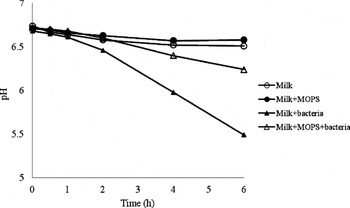
The pH of the sterile control milk was on average 6·72±0·01 and after incubation at 37°C a slight decrease in pH was observed. The pH was also measured in the sterile control milk with MOPS added, but there were no differences in pH compared with sterile control milk without MOPS (Fig. 1). MOPS buffer was added to prevent acidification, which usually occurs when bacteria are grown in vitro but not in vivo (Dufour et al. Reference Dufour, Jameh, Dary and Le Roux2009).
pH curves for sterile control milk, control milk with 0·1 m-3-morpholino-propanesulphonic acid (MOPS) added, control milk with Str. agalactiae, and control milk with MOPS and Str. agalactiae

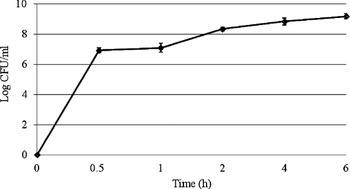
Bacterial growth of all six Str. agalactiae strains was monitored during incubation and recorded at six time points (0, 0·5, 1, 2, 4 and 6 h) (Fig. 2). All strains grew well, reaching a final concentration of approximately 108 CFU ml−1 after 6 h, whereas the sterile control milk or MOPS buffer had no bacterial growth.
Bacterial count (CFU/ml) of six strains of Str. agalactiae (mean value and sd) cultured in 37°C

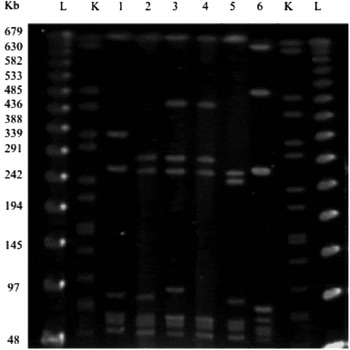
All isolates of Str. agalactiae displayed 7–8 distinct restriction patterns of 50–700 kb when analysed by PFGE (Fig. 3).
PFGE patterns of SmaI digests of six strains of Str. agalactiae. Lines 1–5 correspond to five different strains of Str. agalactiae collected at different farms and line 6 is a reference strain (CCUG 39325, Culture Collection, Gothenburg, Sweden). The outermost lines contain the Lambda Ladder PFG marker (L), approximate band size in kilobases and the Salmonella serotype Braenderup reference standard (H9812) (K), restricted with XbaI

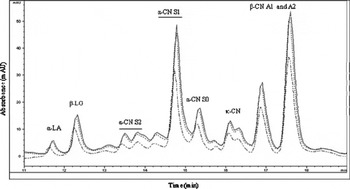
In contrast to the infected milk, the protein profile was unchanged in the sterile control milk after 6 h incubation at 37°C (Fig. 4).
Representative electropherograms of degradation of milk proteins. Sterile control milk before incubation at 37°C (whole line), sterile control milk after 6 h incubation at 37°C (dotted line), milk protein degradation by Str. agalactiae after 6 h incubation at 37°C (stretched line). Milk proteins detected: α-LA: α-lactalbumin; β-LG: β-lactoglobulin; αS2-CN: αS2-casein; αS1-CN: αS1-casein; αS0-CN: αS0-casein; κ-CN: κ-casein-1P; β-CN A1: β-casein A1; β-CN A2: β-casein A2

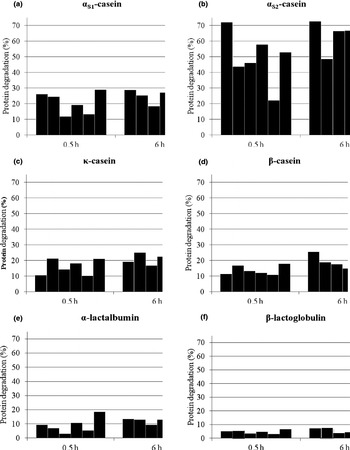
All six strains affected the relative concentration of milk proteins. The different strains of Str. agalactiae did not display similar ability for degradation of caseins and whey proteins. Generally, the caseins were more degraded (11–75%) (Fig. 5a–d) compared with whey proteins (3–21%) (Fig. 5e–f) in relation to the sterile control milk. Especially αS2-CN was degraded, where the proteolysis was around 70% for some strains compared with the sterile control milk, and the lowest breakdown for αS2-CN was found to be 30% (Fig. 5b).
Protein degradation by Str. agalactiae in milk. Counting from left to right, bars correspond to five different strains of Str. agalactiae collected at different farms and line 6 is a reference strain (CCUG 39325, Culture Collection, Gothenburg, Sweden). The measurements are calculated as percentage of protein degradation (y-axis) after 0·5 and 6 h (x-axis) in relation to the sterile control milk

Discussion
The degradation of proteins in the milk caused by Str. agalactiae was noteworthy and the bacteria degraded the individual milk proteins to varying extents. Degradation of milk protein was already observed after 0·5 h incubation at 37°C. The degree of protein degradation was very similar after 6 h incubation at 37°C. The most probable explanation of the fast degradation is that protein degrading enzymes originating from Str. agalactiae have already been secreted in a large amount and degradation of proteins could therefore start immediately when bacteria were added to the control milk. The milk samples were incubated at 37°C in this study to reflect the temperature in the udder, since degradation of proteins can already start in the udder between milkings (Saeman et al. Reference Saeman, Verdi, Galton and Barbano1988).
Among the individual caseins studied, αS2-CN was found to be particularly degraded by the different strains of Str. agalactiae. This can be explained by its random coil structure (Farrell et al. Reference Farrell, Malin, Brown and Mora-Gutierrez2009), which can be one of the reasons for the release of peptides when hydrolysed by proteolytic enzymes. In this study αS1-CN, the major component of the casein fraction of cow milk was much more resistant to proteolysis than αS2-CN. This may have been due to the greater amount present, e.g., Ng-Kwai-Hang (Reference Ng-Kwai-Hang2002) showed that the mean αS1-CN and αS2-CN content is 3:1. However the difference in protein degradation of αS1-CN and αS2-CN may also be associated with the accessibility of proteolytic enzymes to the respective protein substrate. In our study, β-casein was slightly more resistant to enzymatic degradation than αS1-CN and κ-CN. Although κ-CN is a quantitatively minor constituent of bovine milk, it is important for stabilising the casein micelle structure (Holt, Reference Holt1992). Fairbairn and Law (Reference Fairbairn and Law1986) suggested that it is mainly β-CN and κ-CN that can be degraded by bacterial proteases. κ-CN is more resistant to endogenous proteases (Grufferty & Fox, Reference Grufferty and Fox1988), in agreement with the results obtained in our study (Fig. 5d).
As shown in Fig. 5f degradation of the whey protein β-LG was much lower than for the other milk proteins. Proteolysis of β-LG by bacteria is difficult (Bertrand-Harb et al. Reference Bertrand-Harb, Ivanova, Dalgalarrondo and Haertllé2003), probably because of the compact β-barrel three-dimensional structure with two disulphide bonds in its native form (Schmidt & Markwijk, Reference Schmidt and Markwijk1993). Concerning α-LA, the degradation was also lower compared with the caseins in our study. α-LA has a compact three-dimensional structure at neutral pH, and in this condition it is resistant to some proteases (Hirai et al. Reference Hirai, Permyakov and Berliner1992). At slightly acidic pH, which in our study occurred after 6 h incubation despite the addition of MOPS, the structure of α-LA is less compact (molten globule state), probably allowing increased protein degradation by bacterial proteases. The most probable explanation for the slight acidification of the sterile control milk is the activity of the heat stable enzyme plasmin (Bastian & Brown, Reference Bastian and Brown1996).
Bacterial infection affects the composition of milk directly and indirectly. The bacteria may secrete extracellular enzymes, directly breaking down valuable milk components (Leitner et al. Reference Leitner, Krifucks, Merin, Lavi and Silanikove2006). Indirectly, the bacteria may activate the cow's immune system, resulting in an influx of components from the blood to the milk. The most studied protein-degrading enzyme originating from blood is plasmin, which increases during mastitis. Its effect on milk has been thoroughly investigated (Bastian & Brown, Reference Bastian and Brown1996). In recent years, a number of studies have focused on mechanisms by which bacteria can interfere with the indigenous enzymes found in milk (Fajardo-Lira et al. Reference Fajardo-Lira, Oria, Hayes and Nielsen2000; Larsen et al. Reference Larsen, McSweeney, Hayes, Andersen, Ingvartsen and Kelly2006). To our knowledge, there is no evidence that there is a similar mechanism for Str. agalactiae. During mastitis there is also an increased SCC in milk and some cells contain lysosomal proteases, e.g., cathepsins and elastases, which may contribute to protein degradation in the milk (Le Roux et al. Reference Le Roux, Laurent and Moussaoui2003; Larsen et al. Reference Larsen, Rasmussen, Bjerring and Nielsen2004). Most studies concerning mastitis bacteria and their effect on milk composition have investigated milk from cows with mastitis caused by different bacteria (Larsen et al. Reference Larsen, Rasmussen, Bjerring and Nielsen2004; Haddadi et al. Reference Haddadi, Prin-Mathieu, Moussaoui, Faure, Vangroenweghe, Burvenich and Le Roux2006; Leitner et al. Reference Leitner, Krifucks, Merin, Lavi and Silanikove2006; Merin et al. Reference Merin, Fleminger, Komanovsky, Silanikove, Bernstein and Leitner2008). It is therefore difficult to distinguish the direct effects caused by the bacteria from the indirect effects, i.e., the inflammatory reaction in the animal. In this in vitro study we investigated the protein degradation caused by different strains of Str. agalactiae, to evaluate the effect caused solely by the bacteria. The possibility that the bacteria contain activators affecting indigenous proteases in the milk cannot be excluded, but to minimise this effect sterile UHT milk was used as control milk. The indigenous protease activity is lower in UHT milk compared with low pasteurised milk, due to differences caused by the higher treatment temperature for UHT milk. Since whey proteins are less heat stable compared with the caseins, one hypothesis could be that their three-dimensional structure should have been destroyed in UHT milk and thereby more susceptible to degradation by proteases, but this was not observed in this study. However, no distinction could be made between indigenous proteases originating from milk and exogenous proteases originating from bacteria. There is a need for studies concerning the origin of proteolysis in milk, for example through investigate patterns of peptides and amino acids generated by different indigenous as well as exogenous enzymes.
The results from this study showed that proteases released by Str. agalactiae contributed to protein degradation of milk proteins and that there were some differences between strains. In future studies, it is important to evaluate whether certain mastitis bacteria have more severe effects on milk components and processing properties than others. Harmless bacteria from a diagnostic point of view could be harmful from a milk quality perspective and vice versa.
The authors wish to thank Susanne André, Anna Aspan, Hanna Skarin, Helena Ljung and co-workers at the National Veterinary Institute for valuable assistance in laboratory work on identification of the strains during the project. This study was funded by SIDA/SAREC MEKARN project and this support is gratefully acknowledged.