Introduction
Inborn errors of metabolism are multisystem disorders that may be inherited or result from de novo mutations, typically following a progressive clinical course and carrying the risk of acute metabolic decompensation. Reference Hoffmann, Zschocke and Nyhan1 Cardiac involvement is a major determinant of prognosis and may present as cardiomyopathy, rhythm disturbances, cardiac valve disorder, vasculopathies, pericardial effusion, or congenital heart anomalies. The incidence of cardiomyopathy in inborn errors of metabolism is estimated at approximately 5%, with inborn errors of metabolism accounting for around 30% of paediatric cardiomyopathy cases. Reference Cox2–Reference Kindel4
Pathophysiologically, cardiac involvement in inborn errors of metabolism arises primarily through three mechanisms: accumulation of storage substrates within cardiomyocytes, apoptosis secondary to toxic intermediate metabolites, and organelle dysfunction—including impaired molecular transport, mitochondrial failure, or defective energy metabolism—due to enzyme deficiencies. Reference Ferreira and Blau5
In this study, we retrospectively evaluated cardiac involvement in a large cohort of paediatric patients with inborn errors of metabolism from a single centre.
Materials and methods
Between 1 May 2021 and 1 May 2023, a retrospective analysis was conducted on 306 patients aged 0–18 years diagnosed with inborn errors of metabolism who underwent cardiac evaluation at the Department of Paediatric Metabolism and Nutrition, Ankara Bilkent City Hospital. Patients’ clinical and laboratory findings, age at diagnosis, follow-up duration, sex, family history, molecular analysis results, types and ages of cardiac involvement, imaging findings, electrocardiography, echocardiography results, and systemic and cardiac parameters were recorded using a standardised form.
Telecardiography, electrocardiography, and two-dimensional and Doppler echocardiography data were obtained. Echocardiography was performed using a Vivid 7 Pro (General Electric, Horten, Norway) with a 7-MHz multifrequency transducer and a Philips IE33 (Philips Healthcare, The Netherlands) X5-1 probe. M-mode, continuous wave, pulsed wave Doppler, and colour Doppler findings were documented.
Patients were excluded if they had not undergone cardiological evaluation, if their genetic or enzymatic analyses were still in progress, or if they were outside the 0–18 years age range.
Ethical approval was granted by the Clinical Research Ethics Committee of Ankara Bilkent City Hospital (Approval Number: 2, dated 27 April 2022; E2-22-1716), in accordance with the Declaration of Helsinki (2013 revision). Written informed consent was waived by the committee due to the retrospective nature of the study and the use of anonymised patient data.
Statistical analyses were performed using IBM SPSS Statistics for Windows, version 23.0 (IBM Corp., Armonk, NY, USA). Categorical variables were summarised as numbers and percentages and continuous variables as mean ± standard deviation or median (minimum–maximum). The Pearson chi-square test was used to compare categorical variables between independent groups. A p-value < 0.05 was considered statistically significant.
Results
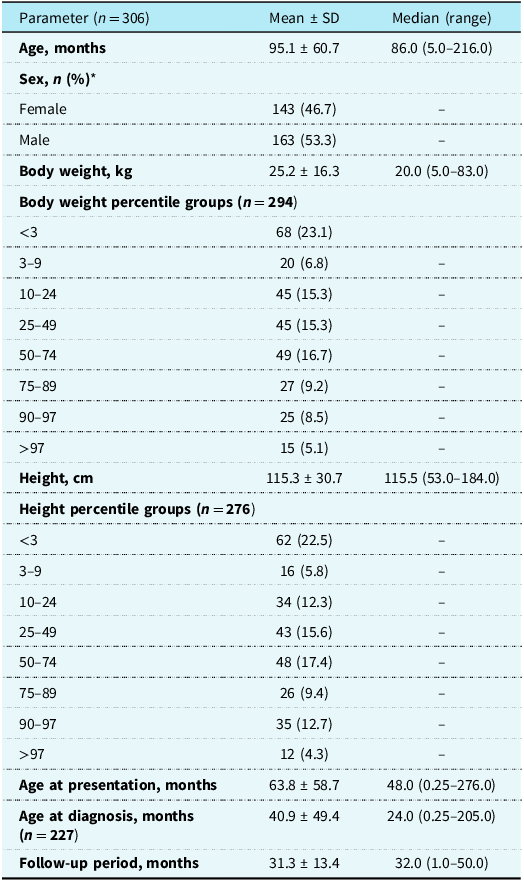
In the Paediatric Metabolic Diseases Clinic of Ankara Bilkent City Hospital, cardiac involvement was identified in 34.3% (n = 105) of 306 patients aged 0–18 years diagnosed with inborn errors of metabolism who underwent cardiac evaluation. Among the entire cohort, 53.3% (n = 163) were male and 46.7% (n = 143) female. The mean age was 95.1 ± 60.7 months, mean age at presentation 63.8 ± 58.7 months, mean age at diagnosis 40.9 ± 49.4 months, and follow-up period 31.3 ± 13.4 months. The descriptive characteristics of the study population are presented in Table 1.
Descriptive characteristics of patients

* Column percentages.
Lysosomal storage diseases were identified in 27.1% (n = 83), amino acid metabolism and transport disorders in 16.3% (n = 50), glycogen storage diseases in 14.0% (n = 43), vitamin-responsive metabolic diseases in 11.1% (n = 33), and lipoprotein metabolism disorders in 10.1% (n = 31). Heart failure occurred in one patient (0.3%) and cardiomyopathy in five (1.7%). Myocardial changes were detected in 8 patients (2.6%), secundum atrial septal defect in 17 (5.5%), and aortic anomalies in 2 (1.0%). The mean interval to the onset of additional cardiac findings was 36.6 ± 29.6 months.
The distribution of cardiac involvement across inborn error of metabolism groups is shown in Figure 1. Categories not listed individually including conditions such as arrhythmias, vasculopathies, pericardial effusion, CHD, and other less common abnormalities were classified as “others” (see Figure 1 for details). Figure 2 presents the distribution and types of valvular involvement across lysosomal storage disease subtypes.
Types of cardiac involvement according to inborn errors of metabolism disease groups. Valvular involvement is presented as mitral, aortic, tricuspid, and pulmonary regurgitation or stenosis. Myocardial involvement includes hypertrophic and dilated cardiomyopathy. Others include arrhythmias, vasculopathies, pericardial effusion, and CHD. Values represent the number of affected patients. Categories are not mutually exclusive; individual patients may have more than one cardiac finding.

Distribution of valvular involvement according to lysosomal storage disease subtypes. Values represent the number of affected patients. Mitral, aortic, tricuspid, and pulmonary valve involvement are shown as regurgitation or stenosis. Individual patients may have more than one valvular abnormality.

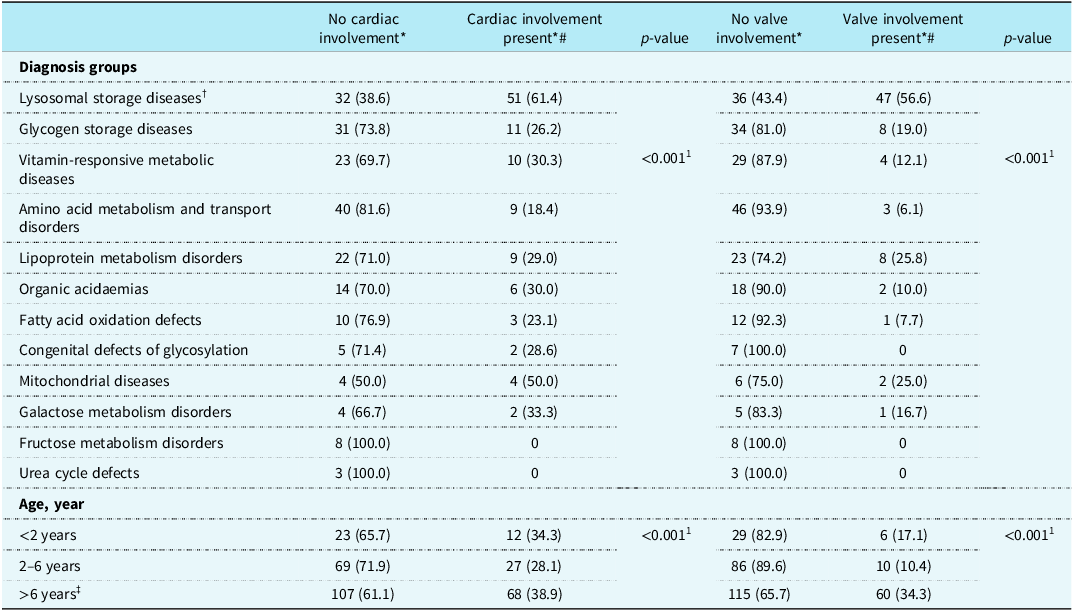
Cardiac involvement was compared across diagnostic and age groups. Two inborn error of metabolism groups, each represented by a single patient and one patient with multiple diagnoses, were excluded from the diagnostic-group comparative analysis. Comparison by diagnostic group revealed a significant difference in the prevalence of cardiac involvement (p < 0.001), driven largely by the lysosomal storage diseases group, in which 61.4% (n = 51) of patients exhibited cardiac involvement and 56.6% (n = 47) had valvular disease (Table 2). Among patients with lysosomal storage diseases, mitral valve involvement was present in 45.8%, aortic valve in 36.1%, tricuspid valve in 1.9%, and pulmonary valve in 0.6%. Valve involvement also differed significantly between diagnostic groups (p < 0.001), predominantly due to the lysosomal storage diseases subgroup.
Comparison of cardiac involvement in patients according to diagnosis and age

* Row percentages.
# Some patients exhibited more than one cardiac manifestation; therefore, categories are not mutually exclusive.
1 Pearson chi-square test.
† The group responsible for the difference in cardiac and valve involvement is the lysosomal storage diseases group.
‡ The group responsible for the difference in valve involvement is the >6 years age group.
When analysed according to age groups, cardiac involvement was present in 34.3% (n = 12) of patients aged younger than 2 years, 28.1% (n = 27) of those aged 2–6 years, and 38.9% (n = 68) of patients aged >6 years, with no significant difference in overall cardiac involvement by age. In contrast, cardiac valve involvement showed a significant age-related distribution, occurring in 17.1% (n = 6) of patients aged younger than 2 years, 10.4% (n = 10) of those aged 2–6 years, and 34.3% (n = 60) of patients aged >6 years (p < 0.001).
Cardiac involvement was observed at different stages of the disease course. Haemodynamically significant valvular regurgitation was identified in 20 patients (6.5%), while any form of valvular pathology was present in 77 patients (25.2%). In three patients, cardiac involvement constituted the initial clinical manifestation.
Among the five patients with cardiomyopathy, two showed improvement during follow-up; in both cases, cardiac involvement was the first presenting sign, and subsequent aetiological evaluation led to the diagnosis of primary carnitine deficiency and carnitine transport defect. Initiation of L-carnitine therapy following diagnosis was associated with resolution of dilated cardiomyopathy. The third patient, whose first clinical finding was cardiac involvement, was diagnosed with malonic aciduria and was referred to the Paediatric Cardiology Clinic due to suspicion of antenatal cardiomyopathy.
Other cardiovascular complications included pulmonary hypertension (n = 3), hypertension (n = 2), and prolonged QT interval (n = 1).
Discussion
Inborn errors of metabolism may present at any age and often involve multiple organ systems, with prognosis largely influenced by the presence of cardiac involvement. In several metabolic disorders, more than one form of cardiac involvement may coexist, and such manifestations may occur early or later in the disease course, contributing substantially to increased morbidity and mortality. Reference Ferreira and Blau5 Owing to the high metabolic demand of the myocardium, the reported prevalence of cardiac involvement in inborn errors of metabolism ranges from 15% to 60%. Reference Wicks and Elliott6–Reference Evangeliou, Papadopoulou-Legbelou and Daphnis8 In the present study, the prevalence of cardiac involvement was consistent with previously published data.
The predominant pathophysiological mechanism underlying cardiac involvement in lysosomal storage diseases is the progressive accumulation of undegraded substrates within cardiomyocytes, resulting in structural and functional impairment. The timing of disease onset and the pattern of cardiac manifestations vary according to the underlying metabolic defect: lysosomal storage diseases typically present in late infancy or childhood, organic acidaemias in the neonatal period, and carnitine deficiency or fatty acid oxidation defects in early life. Reference Ashworth9 In this cohort, lysosomal storage diseases constituted a substantial proportion of diagnoses, with cardiac involvement occurring more frequently in patients aged over 6 years, consistent with the progressive nature of substrate accumulation.
Lysosomes are intracellular organelles responsible for the degradation and recycling of complex macromolecules, including glycoproteins, sphingolipids, and mucopolysaccharides. Reference Nair, Belanger and Veinot10 In mucopolysaccharidoses, valvular regurgitation is a characteristic finding, predominantly affecting the left-sided valves—particularly the mitral and aortic valves—more severely than the right-sided valves. Reference Braunlin, Harmatz and Scarpa11,Reference Dangel12 Similarly, in sphingolipidoses, substrate accumulation in the connective tissue of the mitral and aortic valves may result in progressive thickening, calcification, and nodular formation. Reference Hoffmann, Zschocke and Nyhan13
Cardiac involvement varied substantially across diagnostic groups, with lysosomal storage diseases demonstrating the greatest burden of cardiac pathology. Within this group, valvular disease predominated, most frequently affecting the mitral and aortic valves, while right-sided valve involvement was uncommon. This pattern reflects the progressive accumulation of storage material within valvular connective tissue and is consistent with the pathophysiological mechanisms underlying lysosomal storage diseases. The predominance of valvular involvement in this subgroup underscores the importance of early diagnosis and systematic paediatric cardiology follow-up to enable timely detection and management of progressive cardiac complications in patients with inborn errors of metabolism.
Valvular pathology was highly prevalent among patients with mucopolysaccharidoses, with additional cardiac findings typically emerging during follow-up. Mitral valve involvement was the most frequent manifestation, followed by aortic, tricuspid, and pulmonary valve involvement. Mitral and aortic regurgitation predominated, whereas left ventricular hypertrophy was observed less commonly. These findings are consistent with previous reports: Çakar and Karaca described cardiac involvement in 70.2% of patients with mucopolysaccharidoses, predominantly affecting the mitral valve, with mitral and aortic regurgitation being the most common abnormalities; Reference Cakar and Karaca14 similarly, Leal et al. reported mitral valve dysfunction with thickening in 60.8%, aortic valve dysfunction in 35.8%, and left ventricular hypertrophy in 43% of cases. Reference Leal, de Paula, Leone and Kim15 Collectively, these observations align with the published literature and underscore the importance of systematic paediatric cardiology follow-up in patients with mucopolysaccharidoses for early detection and timely intervention in progressive valvular disease.
Valvular involvement was a prominent feature among lysosomal storage diseases, particularly in patients with mucopolysaccharidoses. In this subgroup, valvular pathology most frequently affected the mitral valve, followed by the aortic valve, whereas right-sided valve involvement was uncommon. The high prevalence of valvular disease observed in mucopolysaccharidoses is consistent with previous reports, although slightly higher rates have been described in some paediatric cohorts. Mueller et al. reported valvular involvement in approximately three-quarters of patients with mucopolysaccharidoses and a lower prevalence in other lysosomal storage diseases, Reference Mueller, Attenhofer-Jost and Rohrbach16 while Sestito et al. demonstrated substantial variability in cardiac involvement across mucopolysaccharidoses subtypes at the time of diagnosis. Reference Sestito, Rinninella and Rampazzo17
The high prevalence of valvular involvement observed in patients with mucopolysaccharidoses I is likely influenced by the small sample size but remains consistent with previous paediatric series. Schroeder et al. reported left-sided valve thickening in 96% of infants with severe (Hurler) mucopolysaccharidoses I; Dangel reported cardiac involvement in 92% of children, predominantly affecting the mitral and aortic valves. Reference Dangel12,Reference Schroeder, Orchard and Whitley18 All patients in our cohort were receiving weekly enzyme replacement therapy with iduronidase, which has been shown to improve ventricular hypertrophy, preserve ventricular function, and reduce mortality and morbidity. Reference Spranger, Kliegman, St Geme, Stanton and Schor19
Hunter syndrome (mucopolysaccharidoses type II) is inherited in an X-linked recessive manner due to iduronate-2-sulphatase deficiency, resulting in dermatan sulphate and heparan sulphate accumulation. Reference Wraith, Scarpa and Beck20 Its cardiac phenotype resembles that of mucopolysaccharidoses type I, including predominant cardiomyopathy and valvular involvement, and has been associated with reports of sudden death related to atrioventricular block. Reference Hishitani, Wakita and Isoda21,Reference Mohan, Hay, Cleary, Wraith and Patel22 In the present cohort, valvular involvement in mucopolysaccharidoses type II was frequent, consistent with previously described patterns.
Valvular pathology was also highly prevalent in patients with mucopolysaccharidoses type VI, predominantly affecting the mitral and aortic valves, with less frequent tricuspid involvement. The higher rates observed in this cohort compared with those reported by Kampmann et al. highlight the variability of cardiac involvement across different patient populations and reinforce the need for systematic cardiological follow-up in mucopolysaccharidoses type VI. Reference Kampmann, Lampe and Whybra-Trümpler23
The absence of cardiac involvement in patients with Pompe disease may be explained by early diagnosis and prompt initiation of enzyme replacement therapy with recombinant human alpha-glucosidase. Previous studies have demonstrated substantial regression of ventricular hypertrophy following early treatment. Levine et al. reported nearly complete reversal of ventricular hypertrophy within 1 year of therapy initiation in early-treated infants, while Forsha et al. described low rates of cardiac involvement at diagnosis in patients with late-onset Pompe disease. Reference Levine, Kishnani, Chen, Herlong and Li24,Reference Forsha, Li and Smith25 These findings support the concept that timely diagnosis and early therapeutic intervention can effectively mitigate cardiac manifestations in paediatric Pompe disease.
Gaucher disease, the most prevalent lysosomal storage disorder, is characterised by glucocerebrosidase (β-glucosidase) deficiency leading to glycosphingolipid accumulation in multiple organs, with cardiac involvement reported less frequently. Deposition within valvular connective tissues has been associated with thickening, calcification, and nodular changes, predominantly affecting the mitral and aortic valves. Reference Hoffmann, Zschocke and Nyhan13,Reference Bohra and Nair26 The limited valvular involvement observed in this cohort is consistent with previously reported patterns.
In Fabry disease, cardiac valve involvement predominantly affects the mitral and aortic valves, with mitral valve pathology often manifesting earlier in the disease course, while aortic root dilatation may occur at more advanced stages. Reference Linhart, Magage, Palecek and Bultas27 These cardiac manifestations are clinically significant and contribute substantially to morbidity and mortality. The pattern of mitral valve involvement is consistent with previously published reports.
Cardiac involvement in vitamin-responsive metabolic diseases appears to be heterogeneous and infrequently reported. Available evidence suggests that cardiomyopathy and structural cardiac abnormalities may occur in selected conditions, such as biotinidase deficiency; however, overall data on cardiac manifestations in this subgroup remain limited, underscoring the need for further studies.
Fatty acid oxidation disorders arise from defects in mitochondrial β-oxidation or carnitine-dependent fatty acid transport and are commonly associated with cardiomyopathy, particularly dilated cardiomyopathy in carnitine transport defects, although hypertrophic cardiomyopathy and tachyarrhythmias have also been reported. Reference Hoffmann, Zschocke and Nyhan13 In this cohort, myocardial and valvular involvement was observed; notably, in patients with primary carnitine deficiency or carnitine transport defect, dilated cardiomyopathy constituted the initial clinical manifestation. In these cases, subsequent aetiological evaluation enabled carnitine supplementation, which was associated with improvement in cardiac findings. These observations are consistent with previously reported reversible cardiac phenotypes in fatty acid oxidation disorders.
Cardiomyopathies are well recognised in mitochondrial diseases, most frequently presenting as hypertrophic cardiomyopathy, while dilated cardiomyopathy and left ventricular non-compaction have also been described. Reference Bates, Bourke, Giordano, d’Amati, Turnbull and Taylor28 Although valvular abnormalities were identified in a subset of patients in this cohort, cardiomyopathy was not observed. This finding may reflect phenotypic heterogeneity and underscores the importance of continued cardiological surveillance, as cardiac manifestations may evolve over time in mitochondrial diseases.
In addition to structural abnormalities, conduction disturbances have been described in organic acidaemias. The identification of a prolonged QT interval in a patient with propionic acidaemia in this cohort is consistent with previous reports and supports the association between this metabolic disorder and cardiac repolarisation abnormalities.
Isolated reports have described dilated cardiomyopathy as an initial manifestation in malonic aciduria, a pattern also observed in this cohort and consistent with published observations. In addition, conduction abnormalities have been reported in organic acidaemias; Ferreira et al. identified prolonged QT intervals in patients with propionic acidaemia, further supporting this association. Reference Ferreira and Blau5
Patients with lipoprotein metabolism disorders are at increased risk of long-term atherosclerotic vascular disease affecting the arterial vasculature. Although valvular involvement was identified in this subgroup, the relatively older age of these patients suggests that progressive atherosclerotic complications may emerge during follow-up, in keeping with existing literature.
Cardiac involvement has been reported in the majority of congenital disorders of glycosylation, most commonly presenting within the first 2 years of life. Reference Footitt, Karimova and Burch29 Reported manifestations include pericardial effusion, rhythm disturbances, valvular and septal defects, hypertrophic cardiomyopathy, and dilated cardiomyopathy. Reference Marques-da-Silva, Francisco, Webster, Dos Reis Ferreira, Jaeken and Pulinilkunnil30 The identification of hypertrophic cardiomyopathy in a patient with congenital disorders of glycosylation-I in this cohort is consistent with previously published findings.
In this single-centre retrospective cohort, cardiac involvement was identified in 34.3% of paediatric patients with inborn errors of metabolism, a prevalence that lies within the range reported in previous studies. Given the well-established impact of cardiac involvement on prognosis, morbidity, and mortality, comprehensive cardiovascular evaluation should be considered an integral component of the diagnostic approach. Cardiac manifestations may represent the initial clinical presentation in a subset of patients, and selected cases of dilated cardiomyopathy may reflect underlying primary carnitine deficiency, underscoring the potential for reversibility with timely diagnosis and appropriate treatment.
A multidisciplinary approach involving Paediatric Metabolism and Paediatric Cardiology Clinics is particularly important in patients with an as-yet unclear metabolic aetiology. In regions with high rates of consanguinity, including our country, families of patients diagnosed with inborn errors of metabolism should be offered genetic counselling. High-risk groups should undergo annual cardiology assessments, including electrocardiography and echocardiography, with 24-hour Holter monitoring for those at risk of rhythm disturbance and more frequent follow-up when clinically indicated.
Overall, our findings are largely consistent with the existing literature, although certain limitations should be acknowledged, particularly the small sample sizes within some inborn error of metabolism subgroups. Importantly, cardiac involvement may also emerge during follow-up even in patients without abnormalities at initial evaluation.
In conclusion, coordinated multidisciplinary follow-up and management are likely to play a key role in the early detection and optimal management of cardiac involvement, thereby contributing to improved clinical outcomes in paediatric patients with inborn errors of metabolism.
Acknowledgements
The authors have no acknowledgements to declare.
Financial support
This research received no specific grant from any funding agency, commercial, or not-for-profit sectors.
Competing interests
The authors have no conflicts of interest to declare.
Ethical standard
The authors assert that all procedures were conducted in accordance with national guidelines and the Helsinki Declaration (1975, revised 2013). Ethical approval was obtained from the Ankara Bilkent City Hospital Clinical Research Ethics Committee (Approval No: E2-22-1716, 27 April 2022). Due to the retrospective design and anonymised data, informed consent was waived.