Introduction
Depression is frequently diagnosed in elderly nursing home (NH) residents worldwide, with up to 78% reported as being depressed (Brown and Luisi, Reference Brown and Luisi2002; Blazer, Reference Blazer2003; Achterberg et al., Reference Achterberg, Pot, Kerkstra and Ribbe2006; Mcdougall et al., Reference Mcdougall, Matthews, Kvaal, Dewey and Brayne2006; Davison et al., Reference Davison, McCabe, Mellor, Ski, George and Moore2007; Levin et al., Reference Levin, Wei, Akincigil, Lucas, Bilder and Crystal2007; Lin et al., Reference Lin, Wang and Huang2007; McSweeney and O'Connor, Reference McSweeney and O'Connor2008). It has detrimental health consequences, including functional decline, malnutrition, poor life quality, and death (AGS/AAGP, 2003; Blazer, Reference Blazer2003). Two safe and effective approaches to treat depression used in the U.S.A. are antidepressants and psychotherapy (Lebowitz et al., Reference Lebowitz1997), with antidepressants much more frequently given (AGS/AAGP, 2003; Snowden, Reference Snowden2003). But other effective self-help and activity-based depression treatments (Morgan and Jorm, Reference Morgan and Jorm2008; O'Connor et al., Reference O'Connor, Ames, Gardner and King2009) are generally not available in the U.S.A. (Fullerton et al., Reference Fullerton, McGuire, Feng, Mor and Grabowski2009).
Historically, depression in U.S. NH residents has been under-diagnosed and under-treated (Brown and Luisi, Reference Brown and Luisi2002; Datto et al., Reference Datto, Oslin, Streim, Scheinthal, DiFilippo and Katz2002). Improving depression diagnosis and treatment in nursing homes is a high priority in the U.S.A. (OBRA, 1987; AGS/AAGP, 2003) and elsewhere (Mcdougall et al., Reference Mcdougall, Matthews, Kvaal, Dewey and Brayne2006; Lin et al., Reference Lin, Wang and Huang2007; McSweeney and Connor, Reference McSweeney and O'Connor2008). Thus, understanding prevalence and incidence patterns and factors associated with depression diagnoses in NH residents is important.
Cross-sectional studies of all elderly American nursing home residents found that younger, female, married or previously married, white non-Hispanics, of higher cognitive function, with physical comorbidities, and living in urban facilities more frequently had depression diagnoses (Brown, Reference Boyle, Roychoudhury, Beniak, Cohn, Bayer and Katz2002; Dobalian et al, Reference Dobalian, Tsao and Radcliff2003; Levin et al., Reference Levin, Wei, Akincigil, Lucas, Bilder and Crystal2007).
But identifying longitudinal depression is important for residents who stay in nursing facilities for long periods and are under the care of the facility for that time (Levy et al., Reference Levy, Epstein, Landry, Kramer, Harvell and Liggins2006). Compared to shorter stay U.S. NH residents, these long-term residents stay on average 1–3 years and have higher care needs (Houser, Reference Houser2007). Medically complex residents, with symptoms that can mask or be confused with depression, now permeate longer-term American NH resident populations (Miller and Mor, Reference Miller and Mor2006).
Timing of depression diagnosis among patients residing in nursing homes for long periods, and its implications for optimal treatment, are important concerns. Some studies find that residents often already have depression upon admission into a NH (Webber et al., Reference Webber, Martin, Harker, Josephson, Rubenstein and Alessi2005; Fullerton et al., Reference Fullerton, McGuire, Feng, Mor and Grabowski2009) and that depression is a risk factor for NH admission (Achterberg et al., Reference Achterberg, Pot, Kerkstra and Ribbe2006; Onder et al., Reference Onder, Liperoti, Soldato, Cipriani, Bernabei and Landi2007). While transition from the community into the NH might trigger depression (Rodstein et al., Reference Rodstein, Savitsky and Starkman1976), there are few studies on depression incidence after admission. Payne et al. (Reference Payne2002) found 6% incidence of depression during the first 12 months after admission among all NH residents and those with dementia, while Boyle et al. (Reference Brown and Luisi2004) noted that 12% of residents not depressed at admission had depression identified early in their stay.
Understanding the timing and cofactors of depression diagnoses among elderly Americans residing in NH for long periods based on current and geographically diverse U.S. data may help optimize depression treatment in this vulnerable population. This study assesses the prevalence of diagnosed depression at admission between 1999 and 2005, and its subsequent incidence during the first year of stay for elderly long-term nursing home (LTNH) residents from seven U.S. states. We further examine how prevalence and incidence of depression varied by resident and facility characteristics.
Methods
Study population and data sources
Assessments in the 1999–2006 nursing home Minimum Data Set (MDS) on NH residents admitted from January 1999 to December 2005 were merged with facility characteristics from Online Survey Certification and Reporting (OSCAR) data. Only MDS assessment types in which depression diagnosis was reported (admission, quarterly, significant change in status, and annual assessments) were used.
The study sample included NH residents aged ≥65 years old at admission in non-hospital based facilities in New York, Florida, Texas, Illinois, New Jersey, Georgia, and Ohio. Persons who were comatose or diagnosed with bipolar illness or schizophrenia were excluded as these other conditions either mask or change the etiology of depression. Admissions in New Jersey and Georgia in 1999 were excluded because “active depression diagnoses” (described later) were not recorded in quarterly assessments from those states in 1999. We only included LTNH residents with two or more quarterly, annual or significant change of status assessments, with at least one assessment being eight or more months after admission, to eliminate patients with insufficient stay and assessments to identify longitudinal depression incidence. The study sample had 634,060 admissions from 4,216 facilities.
The Minimum Data Set uses a 350-item screening and health status tool for a “full assessment” of NH residents; on admission, after a significant change in health status, and annually. Quarterly assessments use a subset of these 350 items every 3 months. Our analyses use only measures available in all types of assessments. MDS assessments, conducted by nurses who are trained to a guideline standard (CMS, 2004), obtain residents’ physical, cognitive and psychosocial functioning, active clinical diagnoses, health conditions, treatments and demographics. Active diagnosed disease (including depression), behavioral signs, and use of selected medication classes during the 7 days prior to the assessment are recorded. Medicare and Medicaid-certified nursing facilities must complete MDS assessments. OSCAR is a Centers for Medicare and Medicaid Services database of all Medicare and/or Medicaid certified nursing homes and uses updated self-reported information validated by surveyors as part of annual facility re-certification site visits (Harrington et al., Reference Harrington, Carrillo and LaCava2006).
Facility characteristics
Facility characteristics from the most recent OSCAR re-certification survey included ownership (for-profit, government, religious, other non-profit), presence of onsite mental health staff, registered nursing staffing hours/resident day, and proportion of facility residents using antipsychotic drugs or with Medicaid as primary payer. Facility case mix was quantified by the ACUINDEX, (Cowles, Reference Cowles2002). Facilities with implausible or erroneous data values (Harrington et al., Reference Harrington, Carrillo and LaCava2006) were excluded from the analysis. Continuous facility variables were categorized into quartiles, with facilities weighted by number of residents in the sample at admission.
Resident characteristics, medications and behavior
Age, gender, race/ethnicity, having graduated from high school and native language being English were recorded at admission. Diagnosed disease conditions (arthritis, diabetes, cancer, hypertension, stroke, congestive heart failure, and chronic obstructive pulmonary disorder) were summed to obtain number of medical comorbidities, which was categorized as 0, 1–2, 3–4, and ≥5. The MDS Cognition Scale (Hartmaier et al., Reference Hartmaier, Sloane, Guess and Koch1994) assessed cognitive function as: intact, moderate impairment, moderate-severe impairment and very severe impairment. Prior institutionalization in a nursing home or other residential facility was recorded at the admission assessment and directly observed in the 1999–2006 MDS data. Self-reported daily pain was also identified. Psychotropic drug use by drug class, (e.g. antidepressants), during the 7 days prior to the MDS assessment, was documented. Behavioral signs recorded include aggressive (verbally/physically abusive) behavior and physical restraint use in the past 7 days.
Physician diagnosed depression
The outcome for this study is a diagnosis of active depression as recorded in the Disease Diagnoses section of the MDS. Active depression is defined there as physician diagnosed depression that remains active, and is related to current functional, cognitive, mood/behavior status, medical treatment, nurse monitoring, or risk of death. Physicians do not use the MDS Depression Instrument as a criterion for making a depression diagnosis. Nurses document active depression (and other active diseases such as Alzheimer's disease, and other dementias) at each MDS assessment used in this study from resident medical records, including physician examinations and treatment orders.
Incident and cumulative physician diagnosed depression over the first year of stay
We assessed depression recorded at admission and, among those without depression identified prior to each time period, incidence of new depression in the first (1–3 months), second (4–6 months), third (6–9 months) and fourth (9–12 months) quarters. For each quarter, incident depression was defined as a new depression diagnosis in a person without prior depression diagnosis for that stay. When patients without prior depression diagnosis had multiple assessments in the same quarter, either the earliest assessment with depression diagnosed or the last assessment in the quarter if depression was not diagnosed in that quarter were used. At admission and each subsequent quarter, cumulative depression was defined as the proportion of residents having a diagnosis at or prior to that time period.
To illustrate how incident and cumulative depression were quantified, consider a cohort of 100 residents. At admission 20/100 have a depression diagnosis. Of the 80 with no diagnosis at admission, only 70 have an assessment during the first quarter and 7 were depressed. All 73 persons who did not have a diagnosis of depression at either admission or the first quarter were assessed at the second quarter, of whom 3 were depressed. Then “incidence” of depression is 20% = 20/100 at admission, 10% = 7/70 in the first quarter and 4.1% = 3/73 in the second quarter; while cumulative incidence is 20% = 20/100, 27% = (20 + 7)/100, and 30% = (20 + 7 + 3)/100, for admission and the first and second quarters respectively. Note that since 10 patients were not assessed in the first quarter (and had no depression diagnosed then by default), cumulative incidence of depression is lower than the corresponding product function of incidence under the assumption that all assessments were made.
Analyses
Proportions of resident-stays with (i) incident and (ii) cumulative depression during the stay were computed for admission and each subsequent quarter for the first year, and compared by patient and facility characteristics. P-values were obtained by Rao-Scott χ2 tests clustered on facility. Owing to the large number of possible patterns over four quarters, cumulative depression was not compared by patient characteristics (such as daily pain) that could change over time. Multivariate logistic regression with robust covariance estimation to adjust for clustering of resident-stays within facilities was fit to identify independent associations between patient/facility characteristics and; depression at admission, and new depression in the first and fourth quarters. A diagonal working covariance was used with Proc Genmod in SAS ® 9.3 (2003; Cary, NC: SAS Institute Inc.).
Results
Calendar year
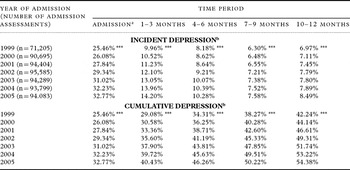
Table 1 presents proportions for incident and cumulative depression during the first year, by year of admission. Proportions diagnosed with depression substantially increased from 1999 to 2005. In 1999, 25.5% were depressed at admission vs. 32.8% in 2005, a difference of 7.3%. By 10–12 months of stay, this difference had risen to 11.9%, with cumulative depression proportions of 42.2% for those admitted in 1999 vs. 54.1% for those admitted in 2005.
Incident and cumulative depression diagnosis during the first year of stay by year of admission

Note: Based on long-term residents aged 65 years and older in nursing homes in seven states, excluding those who were in the home for less than 8 months or had fewer than three assessments, were comatose, or had an active diagnosis of schizophrenia or bipolar disorder.
aFor admission, incidence and cumulative incidence have the same value.
bAs described in the methods, cumulative incidence is lower than the product function of incidence because some persons do not have assessments for some quarters.
Rao-Scott χ2 probability for equality of all levels of variable across the time period: * < 0.01 ** < 0.001 *** < 0.0001
Characteristics associated with depression at admission and subsequent incidence
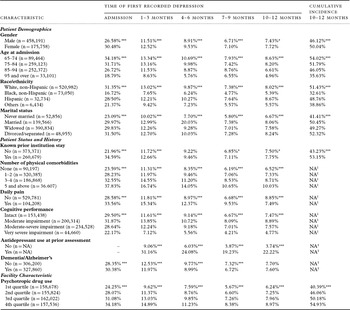
Table 2 presents incident and cumulative depression over the first year by important characteristics. Women had slightly more depression than men at admission (30.5% vs. 26.7%). But following admission, incidence differed little by gender; at 10–12 months, cumulative depression was still ~4% higher in women than men. Older LTNH residents had less depression at admission and post-admission. Of those aged 95 years and older, only 18.8% were depressed at admission, with cumulative depression of 35.6% at 10–12 months. Black residents had depression diagnosed substantially less often than did non-Hispanic whites at admission, 16.7% vs. 31.5%, with 10–12 month cumulative depression observed in 32.6% of black residents vs. 51.4% of whites. Those never married were 6–7% less depressed at admission than others; their cumulative depression was 9–11% lower at 10–12 months.
Depression diagnosis at admission and new depression during the first year of stay by selected characteristicsa

Note: Based on long-term residents aged 65 years and older in nursing homes in seven states, excluding those who were in the home for less than 8 months or had fewer than three assessments, were comatose, or had an active diagnosis of schizophrenia or bipolar disorder.
aThe following characteristics were examined and had minor associations with depression, education, aggressive patient behavior Type of facility ownership, rural/urban facility location, and facility quartiles of % residents funded by Medicaid and total nursing hours per resident day. State location of facility was also associated with depression, but is not reported here as noted in the text this likely reflected procedure differences in diagnosis rather than actual differences.
Rao-Scott χ2 probability for equality of all levels of variable * < 0.01 ** < 0.001 *** < 0.0001
Prior institutionalization in a NH or other residential facility was strongly associated with depression at admission (34.6% of those with prior institutionalization vs. 22.0% of those without were depressed at admission), yet it was not associated with subsequent depression incidence after admission. Prior use of an antidepressant had the strongest association with incidence of depression after admission. Among residents without depression diagnosis at admission, 31.2% of those who used antidepressants at admission had depression diagnosed at 1–3 months, versus only 9.1% of those who had not. Similar differences were observed for incident depression throughout the first year of stay. Notably, 48% of all LTNH residents initially diagnosed with depression during the first year after admission had antidepressant use noted at an assessment prior to the one in which depression was first diagnosed.
Depression at admission and its subsequent incidence was substantially lower in the severely cognitively impaired. It was 2.5–5% higher in those with daily pain. Residents with dementia/Alzheimer's disease at admission had slightly higher depression levels (30.9%) than did others (28.4%); but subsequent depression incidence was often lower in LTNH residents with dementia or Alzheimer's disease.
Most facility characteristics, including chain affiliation, number of beds, occupancy rate, acuity, mental health staffing, and number of deficiencies, had minor associations with depression among LTNH residents (data not shown). Percentages of facility patients with Medicaid coverage, total facility nurse staffing hours per resident day and rural facility had larger, but still small associations with depression (data not shown). Greater psychotropic drug use in a facility was substantially associated with higher depression diagnosis rates at admission and in subsequent quarters; at 10–12 months, cumulative depression was 40.4% in facilities in the lowest quartile of psychotropic drug use vs. 54.9% in facilities in the highest quartile.
Among states, Florida and Ohio had higher depression levels at admission (32–35%), with a cumulative depression rate of ~55% at 10–12 months. In the other states, 24–29% were reported depressed at admission, with a 44–47% cumulative depression rate at 10–12 months. New Jersey, Illinois and, to some extent, New York had lower post-admission depression incidence than did other states. These figures are not presented in Table 2 as state differences are likely to substantially reflect procedural differences in identifying depression rather than underlying state differences.
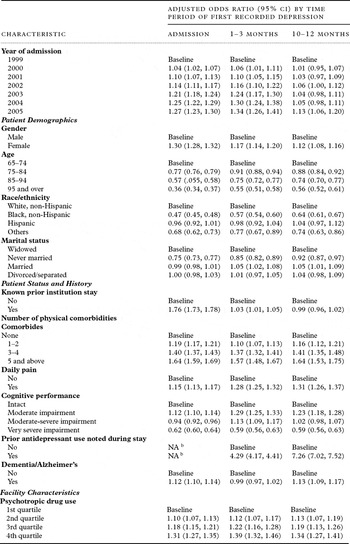
Table 3 presents adjusted odds ratios (aOR) and 95% confidence intervals in multivariate logistic regression models of depression among LTNH residents at admission, and incident depression diagnoses at 1–3 months and 10–12 months following admission. Correlates of depression at admission likely reflect associations with pre-existing depression, while correlates of incident depression at 1–3 months reflect associations with new depression during the initial adjustment to the facility. Correlates of incident depression at 10–12 months likely reflect associations with new depression that developed after an extended period in the nursing home. Prior antidepressant use was only included in models of incident depression at 1–3 months and 10–12 months after admission when it was the covariate of interest. We postulated that prior antidepressant use was temporally in the pathway between the onset/recording of depression at these times and its associations with other covariates.
Predictors of depression at admission and subsequent incidence at 1–3 months and 10–12 months in logistic regression modelsa

Note: Based on long- term residents aged 65 years and older in nursing homes in seven states, excluding those who were in the home for less than 8 months or had fewer than three assessments, were comatose, or had an active diagnosis of schizophrenia or bipolar disorder.
aFrom robust covariance logistic regression models that adjust for all variables in Table 2 including the footnotes (with the exception of antidepressant use at a prior visit) and also adjust for missing a prior assessment. Antidepressant use at a prior visit is not included in the models for the other variables, as explained in the text.
bNot applicable since use of antidepressants is not assessed before admission.
Generally, the direction of the associations between each variable and depression in the models were similar for depression at each time point. However, adjusted odds ratios (aOR) were typically strongest at admission and sometimes at 1–3 months, but weakest at 10–12 months. Year of admission was positively associated with depression at admission and new depression at 1–3 months; the aOR for 2005 vs. 1999 was 1.27 at admission and 1.34 at 1–3 months. However, there was no statistical difference in odds of incident depression at 10–12 months between 1999 and 2004; the odds were slightly elevated in 2005 (aOR = 1.13 vs. 1999).
Women were more likely to be depressed than men, with an aOR of 1.30 at admission which declined to an aOR of 1.12 for incident depression at 10–12 months. Non-Hispanic blacks were less likely to be diagnosed with depression than non-Hispanic whites, (aOR of 0.47 at admission; 0.64 at 10–12 months). Never married vs. widowed had an aOR of 0.75 for depression at admission, which rose to 0.92 for incident depression at 10–12 months.
Among clinical characteristics of LTNH residents, a prior NH/residential stay had an aOR of 1.76 for depression at admission which dropped to aORs close to 1 for new depression at 1–3 and 10–12 months. Daily pain had stronger adjusted associations with incident depression at 1–3 months (aOR = 1.28) and 10–12 months (aOR = 1.31) than at admission (aOR = 1.15). The adjusted relationship between physical comorbidities and incident depression was constant over time; compared to LTNH residents without physical comorbidities, those with ≥5 comorbid conditions had an aOR of 1.64 for depression at both admission and 10–12 months. Very severe cognitive impairment was associated with reduced adjusted depression diagnosis; compared to those cognitively intact, residents with very severe impairment had an aOR of 0.62 for depression at admission and 0.59 for new depression at 10–12 months. The association between antidepressant use prior to recorded depression diagnosis remained very strong in adjusted models; with an aOR = 4.29 at 1–3 months rising to an aOR = 7.26 at 10–12 months.
In facilities with higher proportions of residents on psychotropic drugs, the odds of a depression diagnosis at admission and new diagnoses at 1–3 and 10–12 months remained higher in models that adjusted for patient and other facility characteristics, with aORs ranging from 1.31 to 1.39 in facilities in the top vs. the bottom quartiles.
Discussion
Both depression at admission and new depression over the first year among these LTNH residents rose over calendar time, with (a) 25.5% depressed at admission in 1999 versus 32.8% in 2005, and (b) an additional 16.8% with new depression over the first 12 months in 1999 versus 21.6% in 2005. Whether these increases reflect true changes in depression rather than increased identification and/or over reporting is unclear. It is difficult to see why real depression levels among American LTNH residents should have increased from 1999 to 2005, especially as associations between calendar time and depression remained in multivariate models that adjusted for patient and facility characteristics. Diagnosing and treating depression in American community-dwelling elderly recently increased (Crystal, et al., Reference Crystal, Sambamoorthi, Walkup and Akincigil2003) and perhaps the same is true in American nursing homes. Greater NH use of standardized instruments recommended in AGS/AAGP guidelines (AGS/AAGP, 2003) and more staff alertness for early symptoms may have increased identification of mild depression in the MDS.
Perhaps expanded use of antidepressants in the U.S.A. makes it more likely that physicians and staff will identify historical depression as “active” in residents with ongoing treatment. Antidepressant use among all LTNH residents here rose from 28.7% in 1999 to 37.5% in 2005, and among those with depression diagnosed at admission, antidepressant use grew from 76.2% in 1999 to 83.2% in 2005 (data not shown). Interestingly, 48% of the LTNH residents who were first diagnosed with depression after admission had used antidepressants at an assessment prior to when depression was first noted. Perhaps depression diagnosis preceded the use of antidepressants in these residents, but those completing the MDS forms identified antidepressant use first, and/or antidepressants were prescribed before a depression diagnosis was formalized. Alternatively, antidepressants might have been used for other symptoms such as anxiety, agitation, pain, or insomnia that often precede/accompany depression.
Prior stay in an institution had the strongest association with depression at admission; close to 35% of LTNH residents with prior institutionalizations, compared to 22% of those without, were diagnosed as depressed at admission. In multivariate analysis, the aOR for prior institutionalization was 1.76 for depression at admission. But prior institutionalization had no association with post-admission depression incidence over the first year. Since depression is a risk factor for admission into a NH (Onder et al., Reference Onder, Liperoti, Soldato, Cipriani, Bernabei and Landi2007), and likely for other institutions also, residents with pre-existing depression may be more likely to have prior institutionalization. Depression may also be better identified in American institutions than in the community; thus, residents with prior institutionalizations may be more likely to be previously diagnosed with depression.
A causal role for institutional stays in generating depression – either real or over diagnosed – is possible given the ~20% incidence of new depression diagnosis we observed in LTNH residents over the first year of a NH stay. While overall incidence of new depression diagnoses was greater at 1–3 months (~14% in 2005) than at 10–12 months (~8.5% in 2005), it is unclear if incident depression was higher in the earlier months due to adjustment to environmental adjustment or if diagnosis of some depression existing at admission was delayed to 1–3 months.
We observed similar associations between LTNH resident characteristics and depression to those reported elsewhere for other nursing home patients (Brown, Reference Boyle, Roychoudhury, Beniak, Cohn, Bayer and Katz2002; Dobalian et al., Reference Dobalian, Tsao and Radcliff2003; Levin et al., Reference Levin, Wei, Akincigil, Lucas, Bilder and Crystal2007; McSweeney and O'Connor, Reference McSweeney and O'Connor2008). But associations between demographic characteristics and depression were often strongest at admission and attenuated by 10–12 months. Adjusted odds ratios for depression at admission and incident depression at 10–12 months were, respectively, 1.30 and 1.12 for women (vs. men), 0.47 and 0.64 for blacks (vs. non-Hispanic whites), and 0.75 and 0.92 for those never married (vs. those widowed). In contrast, strengths of the associations between patients’ mental and physical characteristics and depression remained similar across time periods. Daily pain was the exception; having greater association with depression incidence at 10–12 months (aOR = 1.31) than at admission (aOR = 1.15). This suggests that better pain management might reduce depression incidence later in the stay. Weakened relationships between demographic characteristics and new depression, with more time spent in the NH, suggests that other factors (such as chronic pain) may assume larger roles in the etiology of new depression as NH stays progress.
The only facility characteristic notably associated with depression was overall psychotropic drug use, with aOR of depression at admission and in subsequent quarters for the fourth (vs. firstt) quartiles ranging from 1.31 to 1.39. Facilities with greater psychotropic drug prescribing may admit residents with greater depression risk. Alternatively, facilities more frequently diagnosing depression may also more frequently prescribe psychotropic drugs including antidepressants. Increasingly high antidepressant usage in American NH (i.e. among 37.5% of all residents of this study in 2005) may reflect a spiraling trend of over-diagnosing depression and treating with chemotherapy while ignoring other depression treatment options.
Associations of depression with the US state of facility location likely reflect state differences in (a) diagnosing depression by NH physicians, (b) support for MDS assessment and data collection, and (c) real state/regional differences in depression rates, and thus are reported and interpreted here cautiously.
Some limitations of this study should be noted. While the seven states in this study were chosen to be representative of the U.S.A., it is possible they were not. The MDS also has limited information on severity of depression and other illnesses. The MDS only has psychotropic drug by class and indications for the specific drug used were not available, so we could not examine whether new types of antidepressants spurred diagnosis of previously undiagnosed depression, or were given for other indications.
In conclusion, cumulative depression identified over the first year of stay rose from 42% of elderly American LTNH residents in 1999 to 54% in 2005. While it was unclear whether this reflects a real increase in depression or its more proactive identification, including over-diagnosis, this does imply that American nursing homes need to treat and monitor substantial numbers of elderly LTNH residents for depression. Almost half of those who were first diagnosed with depression following admission had antidepressant use recorded before the assessment at which depression was first noted. This suggests that depression onset occurred before the formal diagnosis and/or that there is a trial period in which medication is used while signs and symptoms of depression are monitored, before a formal diagnosis is noted. The same demographic and clinical characteristics associated with depression at admission usually remained associated with new diagnosis throughout the first year. But the strength of the association of demographics with new depression diagnoses diminished over time in the NH, while pain became more important. This suggests that depression etiology changed post-admission and pain management in LTNH residents may prevent later depression onset. Facility characteristics had weak associations with both depression at admission and its subsequent incidence, suggesting that the need to recognize, monitor and treat depression in elderly American LTNH residents exists across all facilities.
Conflict of interest
None.
Description of authors’ roles
D.R. Hoover designed the study, performed the data analysis and wrote the paper. M. Siegel, J. Lucas, D. Gaboda, D. Devarand and S. Crystal assisted with study design and writing the paper. E. Kalay assisted with study design and data preparation.
Acknowledgments
This study was supported by the National Institutes of Health (NIH) award nos. MH076206 on Depression Care among Elderly Nursing Home Residents. We acknowledge additional support from the Agency for Healthcare Research and Quality's (AHRQ's) Centers for Education and Research on Therapeutics (CERTs) program through award no.U18-HS016097 to Rutgers for the Center for Education and Research on Mental Health Therapeutics and the Retirement Research Foundation.