Introduction
Polymer solar cells (PSCs) with bulk heterojunction structures have attracted significant attention due to their advantages of light weight, low cost, and elasticity in large area applications by inkjet printing and roll-to-roll solution processes [Reference Kim, Lee, Coates, Moses, Nguyen, Dante and Heeger1, Reference Bartelt, Beiley, Hoke, Mateker, Douglas, Collins, Tumbleston, Graham, Amassian, Ade, Fréchet, Toney and McGehee2, Reference Huo, Hou, Zhang, Chen and Yang3, Reference Zhou, Yang, Price, Knight and You4]. Typically, the key component of PSCs, photoactive blend layer, consists of p-type conjugated polymers (CPs) as electron donor and n-type electron acceptor materials, sandwiched between an anode and a cathode (at least one of them should be transparent) [Reference Li, Liang, Wang, Li, Tong, Bao and Xia5, Reference Chen, Huang, Li, Wang, Li, Jiang, Zheng and Yang6, Reference Chen, Jiang, Huang, Zhang, Cai, Wan and Yang7, Reference Li, Wang, Liang, Wang, Tong, Yang, Bao and Xia8, Reference Yu, Gao, Hummelen, Wudi and Heeger9]. Recently, the state-of-the-art power conversion efficiencies (PCEs) of single module PSCs in fullerene derivatives system have been boosted up to 11%, which is benefited from the novel materials innovation, the device structure, and fabrication process [Reference Liu, Zhao, Li, Mu, Ma, Hu, Jiang, Lin, Ade and Yan10, Reference Zhang, Ye, Zhao, Yang, Wang and Hou11, Reference He, Xiao, Liu, Wu, Yang, Xiao, Wang, Russell and Cao12, Reference Tumbleston, Collins, Yang, Stuart, Gann, Ma, You and Ade13, Reference Zhang, Zhang, Yin, Jiang, Wang, Xin, Ma, Yan, Huang and Cao14, Reference Li, Gao, Wan, Zhang, Kan, Xia, Liu, Yang, Feng, Ni, Wang, Peng, Zhang, Liang, Yip, Peng, Cao and Chen15, Reference Zhao, Li, Yang, Jiang, Lin, Ade, Ma and Yan16]. However, it still largely lags behind in contrast to inorganic solar cells. Therefore, of particular interest and significance for further driving the PSCs forward is developing the new CP materials and investigation on the correlation between the polymer structure and photovoltaic (PV) performance.
Among various donor materials, more and more attention have paid to the wide band gap (WBG) CPs because of the complementary absorption with some electron acceptors, which can not only broaden the absorption bandwidth of the active layer but also generate a high open circuit voltage (V OC) by reducing the energy loss; thus, a better PCE can be realized by simultaneously obtaining a high short circuit current densities (J SC) and V OC [Reference An, Liao, Chen, Yin, Ai, Xie, Huang, Jen and Chen17, Reference Lan, Chen, Hu, Ying, Zhu, Liu, Russell, Huang and Cao18, Reference Feng, Yang, Xu, Zhang, Yan, Awartani, Ye, Ade, Li and Peng19]. In the search for constructional units of ideal WBD CPs, we all know that benzo[1,2-b:4,5-b′]dithiophene (BDT) is a favorable electron-donating constructional unit, which has been used in building high-efficiency donor polymer materials because of its high stability against oxidation ability, planar molecular skeleton, and ability to easily synthesize [Reference Cai, Huo and Sun20, Reference Pan, Wu, Li, Liu, Ong, Zhu and Xu21]. The rigid and large planar conjugated structure of the BDT unit can facilitate to enhance π–π stacking and improve the charge transport performance [Reference Cai, Huo and Sun20, Reference Wang, Dong, Hu, Liu and Zhu22, Reference Yao, Ye, Zhang, Li, Zhang and Hou23]. Also, thieno[3,2-b]thiophene has been demonstrated to be an excellent building block and played a significantly important role in tuning the energy levels and polymer backbone stacking and thus the PV performance [Reference McCulloch, Heeney, Bailey, Genevicius, Macdonald, Shkunov, Sparrowe, Tierney, Wagner, Zhang, Chabinyc, Kline, Mcgehee and Toney24, Reference Zhang, Yang, Liu, Zhang, Zhao, Wang, He and Hou25, Reference Jin, Chen, Dong, Zheng, Ying, Jiang, Liu, Huang and Cao26, Reference Tong, Li, Zhang, Ma, Wang, An, Sun, Guo, Yang and Xia27].
A large quantity of successful optimization designs for CPs primarily originated from polymer backbone modulating, side engineering, and substituents [Reference Zhou, Yang, Price, Knight and You4, Reference Liu, Zhao, Li, Mu, Ma, Hu, Jiang, Lin, Ade and Yan10, Reference Tumbleston, Collins, Yang, Stuart, Gann, Ma, You and Ade13, Reference Zhang, Yang, Liu, Zhang, Zhao, Wang, He and Hou25, Reference Jin, Chen, Dong, Zheng, Ying, Jiang, Liu, Huang and Cao26, Reference Tong, Li, Zhang, Ma, Wang, An, Sun, Guo, Yang and Xia27, Reference Zhou, Yang and You28]. Apart from the above-mentioned strategies, the substitution positions of polymer, another important and effective method for promoting the PV performance, has been ignored to some content [Reference Xie, Zhang, Duan, Liu, Huang and Cao29, Reference Yao, Ye, Huo and Hou30, Reference Wang, Zhao, Cong, Xie, Gao, Wu and Cao31, Reference Le, Dao, Nghiêm, Péralta, Guillot, Pham, Fujii, Ozaki, Goubard and Bui32, Reference Liu, Kong, Ghadari, Jin, Chen, Yu, Hayat, Alsaedi, Guo, Tan, Chen and Dai33, Reference Singh, Pagona, Gregoriou, Tagmatarchis, Toliopoulos, Han, Fei, Katsouras, Avgeropoulos, Anthopoulos, Heeney, Keivanidis and Chochos34]. For example, in 2012, Huang and co-workers reported a series of novel carbazole-based acceptor CPs with different linkage sites (2,7- and 3,6-positions) and found that 2,7-carbazole-derived polymers showed slightly better PCEs than 3,6-carbazole-derived analogues, as a result of a widened absorption range, a deeper highest occupied molecular orbital (HOMO) level, and an improved hole mobility [Reference Xie, Zhang, Duan, Liu, Huang and Cao29]. Following that, Hou and co-workers reported three 2D-BDT-based polymers, PBDTDTBT-p, PBDTDTBT-o, and PBDTDTBT-m, with different alkyl substitution positions, which resulted in different steric hindrance and had a great impact on the PV properties of the corresponding polymers, i.e., V OC varied ranging from 0.67 to 0.90 V and thus PCEs of 3.48–5.76% [Reference Yao, Ye, Huo and Hou30]. Recently, Gao and co-workers changed the substitution positions of IEICO-4F and developed a new acceptor–donor–acceptor-structured nonfullerene acceptor i-IEICO-4F; this minor change helped to form the more twisted polymer backbone configuration and resulted in 164 nm blue-shifted absorption to obtain a complementary absorption when blended with J52, thereby achieving the excellent PCE up to 13.18% [Reference Wang, Zhao, Cong, Xie, Gao, Wu and Cao31]. These experimental results demonstrated that the substitution positions of materials have a significant influence on the performance of PSCs. Accordingly, it was of importance to further investigate in depth the relationship between substitution positions in CPs and PV performance, which was bound to enrich the donor polymer design and enhance the PCEs of corresponding PV devices.
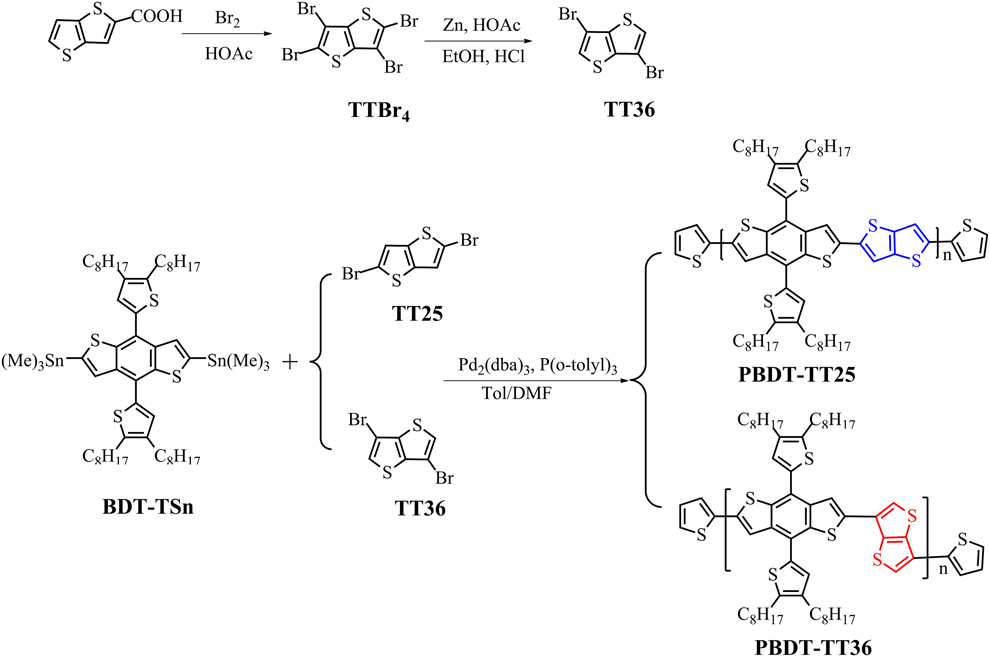
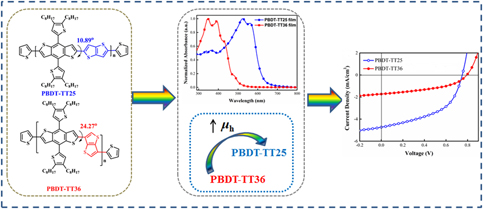
Considering the above factors, we designed and synthesized two new WBG polymers based on a benzo[1,2-b:4,5-b′]di-thiophene unit attached with the (4,8-bis(4,5-dioctyl-thiophen-2-yl) benzo[1,2-b:4,5-b′]dithiophene-2,6-diyl)bis(trimethylstannane) (BDT-TSn) and 3,6-dibromothieno[3,2-b]thiophene (TT36) or 2,5-dibromothieno[3,2-b]thiophene (TT25), named PBDT-TT36 and PBDT-TT25, respectively. We studied the impact of molecular linker positions on their thermal, aggregation, morphological, optical, and PV properties. After the linker positions changed from 3,6-isomer to 2,5-isomer, the optimal inverted polymer solar cells (i-PSCs) exhibited 1.87 times enhancement in PCEs.
Results and discussion
Synthesis and characterization of the copolymers
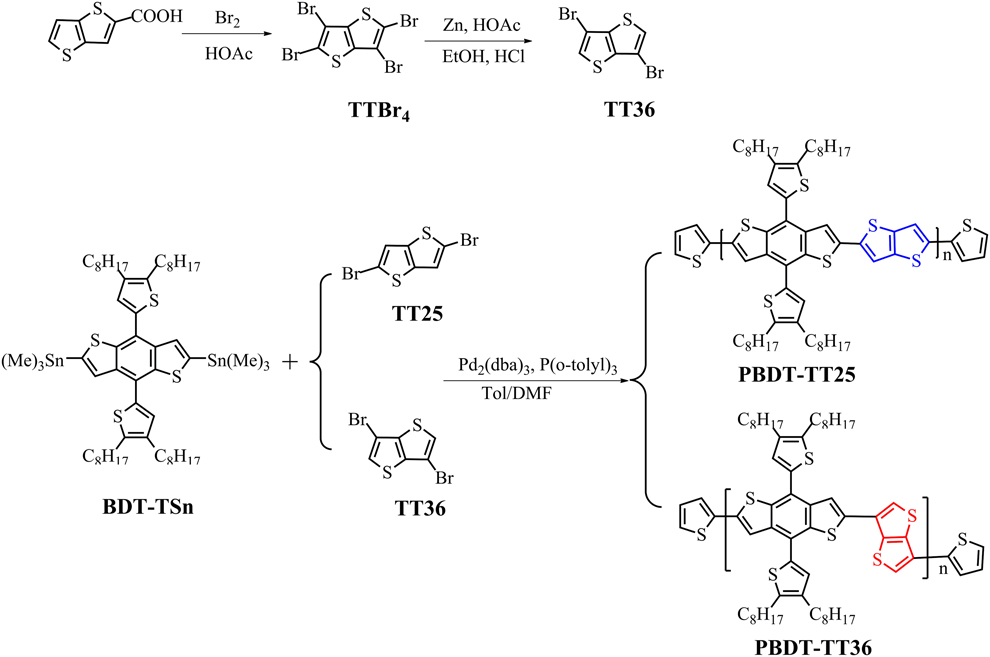
The synthetic routes of monomers and the copolymers are outlined in Scheme 1. The structures of the monomers were confirmed by 1H NMR before used (Figs. S1 and S2). And the obtained copolymers PBDT-TT25 and PBDT-TT36 were synthesized between TT25 or TT36 and BDT-TSn via the palladium-catalyzed Stille cross-coupling reaction (Scheme 1) [Reference An, Xie, Geng, Zhang, Jiang, Lei, He, Xiao and Ding38]. The copolymers were end-capped with 2-tributyl-stannylthiophene and 2-bromothiophene to remove bromo and trimethylstannyl end groups [Reference Blouin, Michaud and Leclerc39]. After the polymerization, the reaction was cooling to room temperature, and the mixture was precipitated in methanol and filtered. Purification of the precipitated material was carried out by Soxhlet extraction using in sequence acetone, hexane, chloroform, and toluene as the eluants. Then, the concentrated solutions of the copolymers in toluene were poured into methanol again, and the precipitated copolymers were collected with the yields of 75–80%. The copolymers possess good solubility in chloroform, chlorobenzene (CB), and o-dichlorobenzene (o-DCB). The number average molecular weight (M n) and PDI were examined by gel permeation chromatography (GPC) using tetrahydrofuran (THF) as the eluant. The results exhibited that the M n and PDI values were about 19,780 g/mol and 2.05 for PBDT-TT25 and 20,846 g/mol and 2.67 for PBDT-TT36 (Table SI), indicating that the effect generated by different molecular weights could be overlooked.
Synthesis routes of the monomers and copolymers.
Thermogravimetric analysis (TGA) measurement was carried out to evaluate the thermal stability of the polymers, and the TGA plots of the two polymers are shown in Fig. S3, and the data are also listed in Table SI. TGA profile reveals that the decompositions temperatures (T d) at 5% weight loss of the PBDT-TT25 and PBDT-TT36 are about 445 °C and 457 °C under N2 flow, respectively, indicating that two copolymers have good thermal stability for application in PSCs.
Optical properties and aggregation of the copolymers
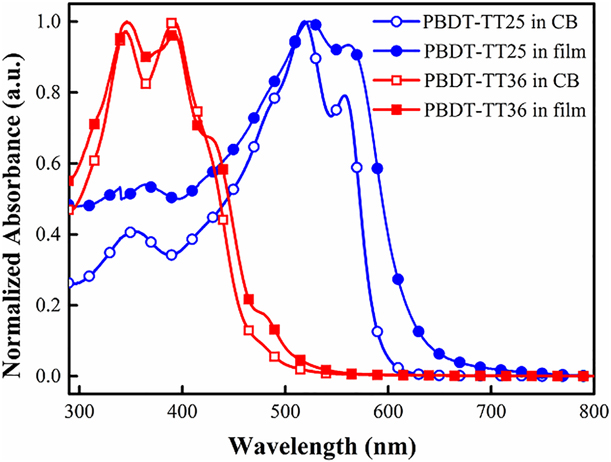
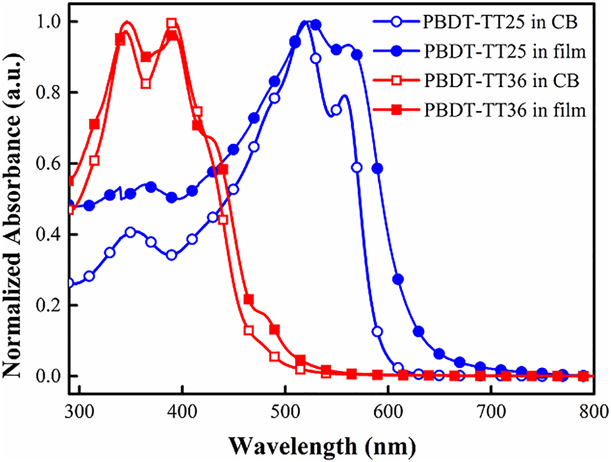
A UV-1800 spectrophotometer was used to monitor the ultraviolet–visible light (UV-vis) in solution and solid thin film; the normalized UV-vis absorption spectra and the data of PBDT-TT25 and PBDT-TT36 are shown in Fig. 1 and Table I, respectively. The PBDT-TT25 exhibited two absorption peaks at 352 and 518 nm with a shoulder absorption peak at around 557 nm in dilute CB solution. Compared with that in solution, the absorption spectrum of PBDT-TT25 in solid thin film exhibited relatively similar absorption profile but became greatly broader. It was worth to note that the maximum absorption and onset of the absorption were red-shifted by 8 and 30 nm, respectively, continuing on from solution to solid film, indicating PBDT-TT25 had a better coplanarity and stronger solid stacking interaction. Meanwhile, PBDT-TT36 exhibited similar but significantly blue-shifted absorption profiles in CB solution, i.e., absorption peaks and weak shoulder peak were blue-shifted to 344, 391, and 419 nm, respectively, when the linker positions varied from the 2,5-positions to 3,6-positions. And the maximum absorption peak and onset of the absorption were red-shifted by only −1 and 19 nm, respectively, from solution to solid film, implying that there existed relatively weaker molecular interaction [Reference Zhang, Ying, Tieke, Zhang and Yang40]. Moreover, the corresponding optical band gap values  $\left( {E_{\rm{g}}^{{\rm{opt}}}} \right)$ of PBDT-TT25 and PBDT-TT36 were 2.00 and 2.37 eV, respectively, according to the formula
 $E_{\rm{g}}^{{\rm{opt}}} = {{1240} / {\lambda _{{\rm{onset}}}^{{\rm{film}}}}}$. These large differences in absorption can explained by more twisted polymer backbone conformation and more nonlinear polymer arrangement obtained in the latter theoretical calculation obvious when the linker positions changed from 2,5- to 3,6-positions.
Normalized UV-Vis spectra of the PBDT-TT25 and PBDT-TT36 in diluted CB solution and solid thin film.
Optoelectronic and parameters of the PBDT-TT25 and PBDT-TT36.

a Calculated from the onset of the film absorption  $\left( {E_{\rm{g}}^{{\rm{opt}}} = {{1240} / {\lambda _{{\rm{onset}}}^{{\rm{film}}}}}} \right)$.
b Calculated from oxidation potential of the copolymer  $\left( {{E_{{\rm{HOMO}}}} = - \left( {\varphi _{{\rm{ox}}}^{{\rm{onset}}} + 4.69} \right)\;\left( {{\rm{eV}}} \right)} \right)$.
c Calculated from the  $E_{\rm{g}}^{{\rm{opt}}}$ and HOMO levels of the copolymers
 ${E_{{\rm{LUMO}}}} = {E_{{\rm{HOMO}}}} + E_{\rm{g}}^{{\rm{opt}}}\;\left( {{\rm{eV}}} \right)$.
It is well known that the factors which affect the absorption properties of materials, the extinction coefficient of materials is also an important measure. The molar extinction coefficient (ε) of PBDT-TT25 and PBDT-TT36 in o-DCB solution was also determined. As shown in Fig. S4, the ε at maximum absorption peak (λmax) was increased by 23% from 197,686 L/(mol cm) to 243,014 L/(mol cm) after the linker positions varied from 3,6- to 2,5-isomer. These observations suggested that PBDT-TT25 exhibited the greatly widened and enhanced absorption.
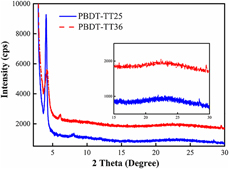
To gain insight into the aggregation characteristics of PBDT-TT25 and PBDT-TT36 in solid state, X-ray diffraction (XRD) analyses of the polymers films were carried out, as shown in Fig. 2. In the small angle region, obvious diffraction peaks were observed at 2θ = 4.06° for PBDT-25TT and 2θ = 4.18° for PBDT-TT36, respectively, corresponding to the distance between the polymer interlayer of 21.75 and 21.12 Å. It was noted that PBDT-25TT showed stronger diffraction intensity than PBDT-36TT. Meanwhile, the peaks in the wide angle region reflected the π–π stacking distances between the polymer backbones, which were located at 2θ = 23.34° for PBDT-25TT and 2θ = 23.07° for PBDT-36TT, respectively, Bragg’s law (i.e., λ = 2d sin θ) [Reference Tong, Li, Zhang, Ma, Wang, An, Sun, Guo, Yang and Xia27]. It was not difficult to find that even though PBDT-TT25 possesses a longer interlayer d-spacing distance, corresponding to the d-spacing of 3.80 and 3.85 Å based on the more important and shorter π–π stacking distance than PBDT-TT36 was observed, suggesting PBDT-TT25 had a more benefited solid molecular stacking interaction and thus obtained higher charge transfer than that of PBDT-TT36.
XRD patterns of the pristine PBDT-TT25 and PBDT-36TT.

Theoretical calculation
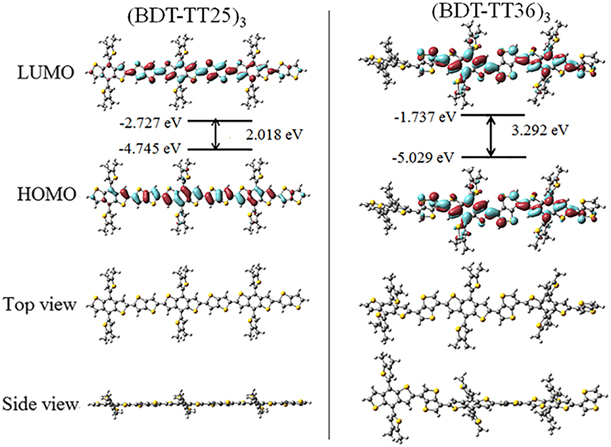
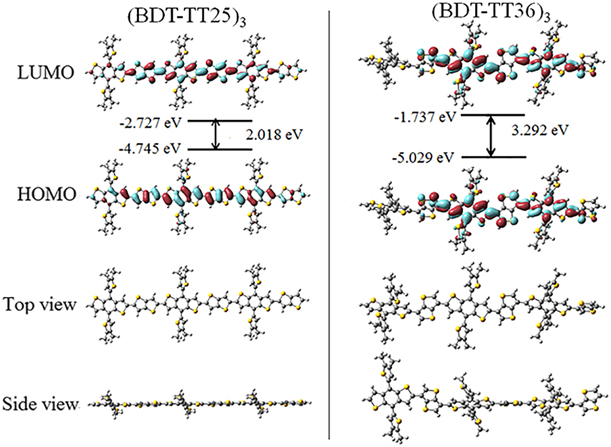
To further understand the influence of substitution positions on the molecular structures, the electronic properties of the copolymers as well as molecular geometry and orbital distributions of the molecular backbones, quantum chemistry calculations were adopted and used density functional theory (DFT) with the B3LYP/6-31G* level, as implemented in Gaussian 09 [Reference Frisch, Trucks, Schlegel, Scuseria, Robb, Cheeseman, Scalmani, Barone, Mennucci, Petersson, Nakatsuji, Caricato, Li, Hratchian, Izmaylov, Bloino, Zheng, Sonnenberg, Hada, Ehara, Toyota, Fukuda, Hasegawa, Ishida, Nakajima, Honda, Kitao, Nakai, Vreven, Montgomery, Peralta, Ogliaro, Bearpark, Heyd, Brothers, Kudin, Staroverov, Kobayashi, Normand, Raghavachari, Rendell, Burant, Iyengar, Tomasi, Cossi, Rega, Millam, Klene, Knox, Cross, Bakken, Adamo, Jaramillo, Gomperts, Stratmann, Yazyev, Austin, Cammi, Pomelli, Ochterski, Martin, Morokuma, Zakrzewski, Voth, Salvador, Dannenberg, Dapprich, Daniels, Farkas, Foresman, Ortiz, Cioslowski and Fox41]. To simplify the calculation process, we selected the model monomers with three repeated donor–acceptor units and substituted the long alkyl side chains with methyl groups. The distributions of HOMO and lowest unoccupied molecular orbital (LUMO) are illustrated in Fig. 3. The HOMO and LUMO frontier orbitals of BDT-TT25 systems were uniformly distributed along the entire conjugated planes. However, the HOMO and LUMO of BDT-TT36 systems were broken at the middle of the thieno[3,2-b]thiophene. Moreover, the calculation results showed that HOMO/LUMO/E g values were −4.745/−2.727/2.018 eV for (BDT-TT25)3 and −5.029/−1.737/3.292 eV for (BDT-TT36)3, which were similar with the variation trend observed in the absorption and CV measurements. Additionally, it has been demonstrated that the more linear configuration and more planar backbone structure lead to better charge transfer mobility and thereby increased J SC and PCE of the device. Thus, the optimized ground-state geometries of the (BDT-TT25)3 and (BDT-TT36)3 systems are shown in Fig. 3, and the data of dihedral angles are presented in Table SII. We can find that the dihedral angles (Φ1 and Φ2) between thieno[3,2-b]thiophene and BDT-T were 10.89° and 11.19° for (BDT-TT25)3 and 24.27° and 24.55° for (BDT-TT36)3. Clearly, the corresponding average twisted angle significantly enlarged (approximately 2.21 times) and the molecular linear configuration also became poor when the linker position changed from 2,5- to 3,6-isomer; these are bad for improving the solar cell property [Reference Wu, Li, Ma, Huang and Hou42, Reference Yu, An, Hai, Nie and Tang43, Reference Liu, Wang, Gu, Li, Bao and Yang44]. With a goal of investigating the difference of absorption between the PBDT-TT25 and PBDT-TT36, the calculated UV-vis spectra in (BDT-TT25)3 and (BDT-TT36)3 were accomplished, shown in Fig. S5. The calculation results exhibited that the λmax was red-shifted by 171 nm from 393 to 564 nm and the ε at λmax was increased by 60% from 96,451 L/(mol cm) to 154,664 L/(mol cm) after the linker positions varied from 3,6- to 2,5-isomer, which was consistent with the results from the absorption measurements. These facts can better account for what was the reason for large absorption difference between PBDT-TT25 and PBDT-TT36 aforementioned.
Optimized geometries of each trimer models for BDT-TT25 and BDT-TT36 by DFT at the B3LYP/6-31G* and surface plots and energy levels of frontier orbitals.
Electrochemical characteristics of the copolymers
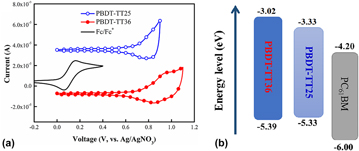
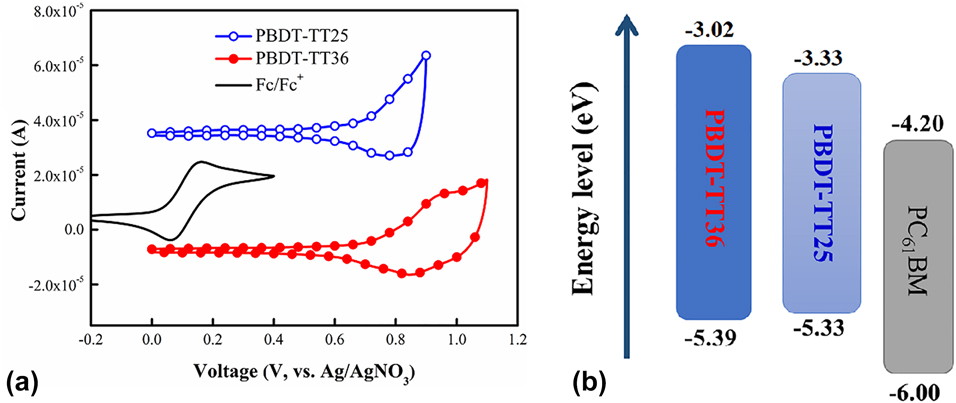
It is an important method to measure the electronic energy levels of the CPs with the electrochemical properties determined by cyclic voltammetry (CV) [Reference Li, Cao, Gao, Wang, Yu and Heeger45, Reference Sun, Wang, Yang and Li46]. The onset oxidation potential was determined by the CV curves and calibrated with the potential of ferrocene/ferrocenium (Fc/Fc+), assumed the energy level of ferrocene/ferrocenium (Fc/Fc+) to be −4.80 eV below the vacuum level [Reference Pommerehne, Vestweber, Guss, Mahrt, Bässler, Porsch and Daub47]. The redox potential of Fc/Fc+ in the above-mentioned condition was +0.11 V. The cyclic voltammograms of ferrocene and the two polymer films on a glassy carbon electrode in 0.1 mol/L Bu4NPF6 acetonitrile solution at a scan rate of 50 mV/s are shown in Fig. 4(a). The onset oxidation potential of PBDT-TT25 and PBDT-TT36 were 0.64 and 0.70 V, respectively [Fig. 4(a)]. The HOMO level and LUMO level, calculated by empirical formulas (E HOMO = −(E ox + 4.69) (eV) [Reference Pommerehne, Vestweber, Guss, Mahrt, Bässler, Porsch and Daub47] and E LUMO = −(|E HOMO| − E g) (eV), were about −5.33 and −3.33 eV for PBDT-TT25 and −5.39 and −3.02 eV for PBDT-TT36. After the linker positions changed from 2,5-positions to 3,6-positions, the calculated HOMO level showed a decrease from −5.33 to −5.39 eV, as a result of a more twisted planar geometry and weak conjugation from DFT calculation. Furthermore, Fig. 4(b) shows the energy levels diagram of these copolymers and PC61BM. It could be found that the E LUMO of all these copolymers were over 0.3 eV larger than that of PC61BM, which were capable to provide a sufficient driving force for efficient exciton dissociation at the interface between donor and acceptor [Reference Li48].
(a) CV curves and (b) energy levels schematic diagram of copolymers.
Hole mobility of the copolymers
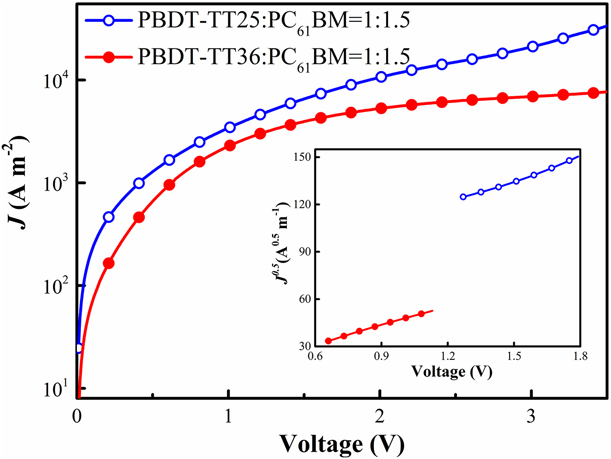
As known, the carrier charge mobility is an important parameter, which could affect charge separation of the exciton, charge carrier transport, and recombination in the PV devices [Reference Malliaras, Brock, Scott and Salem49, Reference Hu, Li, Jiang, Chen, Liao and Wang50]. The higher mobility will be beneficial to increase the current density and decrease the unfavorable exciton recombination. To investigate the influence of the studied copolymers PBDT-TT25 and PBDT-TT36 with different linker positions on charge carrier transport, the hole mobilities of the copolymers have been measured by space-charge-limited current (SCLC) method with a device structure of ITO/PEDOT:PSS/polymer:PC61BM/MoO3/Ag. The mobilities of the copolymers were calculated by SCLC model, which was described by Eq. (1).
 $$\mu = {{8{L^3}J} \over {9{\varepsilon _0}{\varepsilon _{\rm{r}}}{V^2}}}\quad,$$
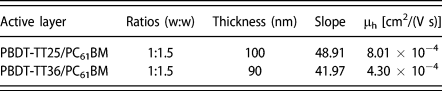
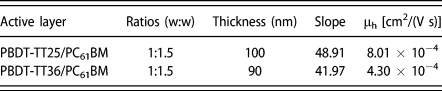
where J stands for current density, L is the film thickness of the active layers, ɛ0 is the permittivity of free space, ɛr is the relative dielectric constant of the transport medium, which is assumed to be around 3 for the CPs, V is the internal potential in the devices, and µ is the hole mobility. The thicknesses were 100 nm for PBDT-TT25/PC61BM and 90 nm for PBDT-TT36/PC61BM. The J–V characteristics of the devices from the PBDT-TT25/PC61BM and PBDT-TT36/PC61BM blend films are presented in Fig. 5 and the related data are listed in Table II. The hole mobilities were 8.01 × 10⁻⁴ cm2/(V s) for PBDT-TT25/PC61BM and 4.30 × 10⁻⁴ cm2/(V s) for PBDT-TT36/PC61BM. Compared with the counterpart, 1.86 times enhanced SCLC hole mobility in 2,5-linker positions was achieved and benefited from the significant polymer planar configuration, therefore resulting in and explaining an increase in the J SC and fill factor (FF) and thus PCEs from the J–V measurement.
J–V and J 0.5–V characteristics of the copolymers in the hole-only devices with configuration of ITO/PEDOT:PSS/polymer:PC61BM/MoO3/Ag.
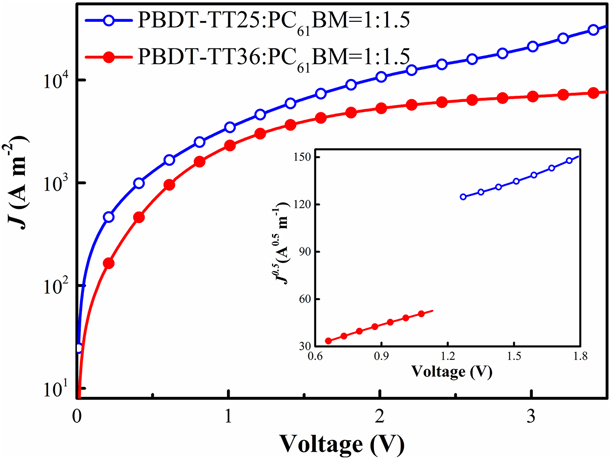
Hole mobilities of blend measured by SCLC model.
PV properties of the i-PSCs from the copolymers
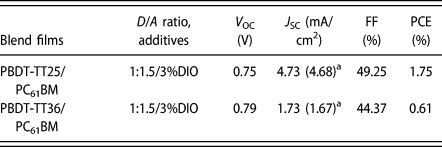
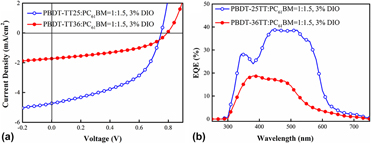
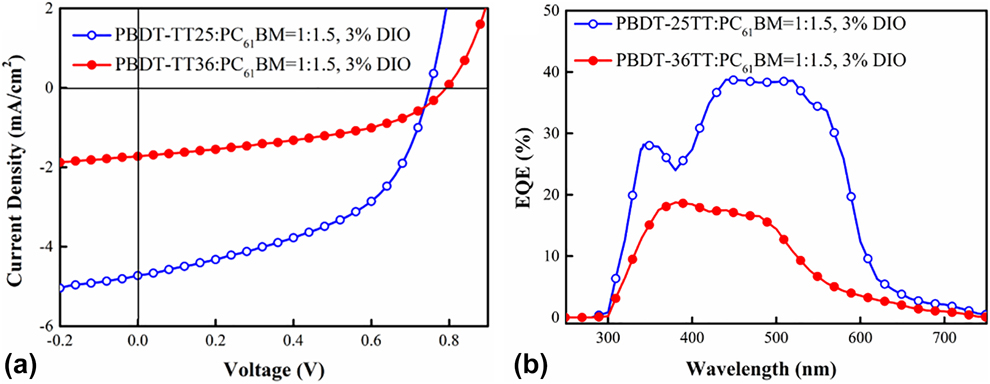
The PV properties of the two copolymers were explored by using i-PSCs based on the blend film of copolymers with configuration of ITO/PFN/polymer:PC61BM/MoO3/Ag, because the i-PSCs with PFN as cathode modified layers exhibited enhanced stability and performance [Reference Kyaw, Wang, Luo, Cao, Nguyen, Bazan and Heeger51]. The active layers spin-coated from CB solution were composed of PBDT-TT25 or PBDT-TT36 as electron donor and fullerene derivatives PC61BM as electron acceptor. The J–V characteristics and external quantum efficiency (EQE) spectra of inverted devices are shown in Fig. S6, as measured under illumination of AM 1.5G at 100 mW/cm2 conditions and the corresponding PV performances are listed in Table SIII. The weight ratios of the copolymers to PC61BM in the blend films were varied from 1:1 to 1:1.5 and then to 1:2, and the PCEs of the i-PSCs from PBDT-TT25 were increased from 1.31 to 1.46%, then dropped to 1.30%, while the PCE of the i-PSCs from PBDT-TT36 were increased from 0.16 to 0.44% and then dropped to 0.20%. The optimum D/A weight ratios of the photosensitive layer were both about 1:1.5, and the device based on PBDT-TT25/PC61BM as the photoactive layer exhibited a higher PCE of 1.46% with a V OC of 0.77 V, a J SC of 4.69 mA/cm2, and an FF of 40.43%. For PBDT-TT36/PC61BM, a PCE of 0.45%, a J SC of 1.55 mA/cm2, and an FF of 37.84% were observed. Recently, it is widely proved that the solvent additive processing, such as 1,8-diiodoctane (DIO), is an effective way to modify the morphology of photosensitive active layer and improve the PV performance of the CPs [Reference Chu, Lee and Song52, Reference Xia, Zhang, Li, Tong, Zhang and Yang53, Reference Li, He, Mao, Wei, Ding and Wang54, Reference Tong, An, Li, Lv, Guo, Li, Zhang, Yang, Xia and Wang55]. The PCEs of the i-PSCs from PBDT-TT25/PC61BM and PBDT-TT36/PC61BM with optimum weight ratio were correspondingly increased from 1.46 to 1.75% and 0.44 to 0.61% after 3% DIO (V DIO/V CB) was used as solvent additives (Table III, Fig. S6, and Table SIII). It was clear that PBDT-TT25 exhibited a significantly higher PCE than that of PBDT-TT36; this improvement was primarily ascribed to the enhancement of J SC and FF after the linker positions varied from 3,6-positions to 2,5-positions, as a result of the greatly widened and stronger absorption, linear and planar polymer backbone and stronger absorption, and higher SCLC hole mobility.
The optimal PV performance of the studied copolymers in i-PSCs.
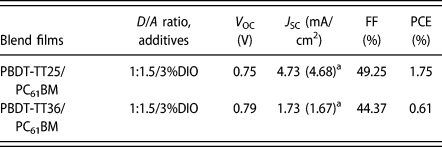
a The values in the parentheses are the integrated currents obtained from the EQE curves.
To confirm the accuracy of the measurement of the PV devices, the corresponding EQE spectra under each condition [Fig. 6(b)] as well as the used device fabrication conditions, including the different blend ratio and additive (Fig. S6), were all measured. As seen from Fig. 6(b), after the linker positions varied from 3,6-positions to 2,5-positions, these experiment results can partially account for greatly increased J SC value of PBDT-TT25. It was also noteworthy that the integrated J SC values from EQE curves were in accordance with those obtained from J–V evaluations within 3% error.
The (a) optimized current density–voltage (J–V) curves and (b) the EQE spectra of the i-PSCs from the copolymers blend film under AM1.5G illumination (100 mW/cm2).
Morphological analysis
To understand the reasons for using solvent additives to improve device performance, we used tapping-mode atomic force microscopy (AFM) to investigate the surface morphology of the active layers of copolymers under optimal preparation conditions [Reference Jin, Chen, Dong, Zheng, Ying, Jiang, Liu, Huang and Cao26]. As demonstrated by the AFM height images in Fig. S7, for PBDT-TT25/PC61BM the root-mean-square surface roughness (RMS) values greatly decreased from 2.42 to 0.78 nm, which can in part explain the 1.86 times enhanced SCLC hole mobility and thus 22% enhanced FF from 40.43 to 49.25%. For PBDT-TT36/PC61BM blends, the RMS slightly decreases from 0.86 to 0.80 nm. It can be seen the DIO additive has a distinct impact on the PBDT-TT25/PC61BM system but little influence on PBDT-TT36/PC61BM system. Also there was a little difference in the AFM height and phase images between PBDT-TT25/PC61BM and PBDT-TT36/PC61BM (Fig. S8); these AFM measurements observed cannot explain the difference between the studied copolymers with different linker positions.
Conclusions
In conclusion, we have synthesized two benzo[1,2-b:4,5-b′]di-thiophene-based WBG conjugated copolymers PBDT-TT25 and PBDT-TT36 by varying the linker positions of the thieno[3,2-b]thiophene unit. Interestingly, it exhibited the greatly widened and stronger absorption and more linear and planar molecular configuration and thus a 1.86 times increase in SCLC hole mobility was achieved even if elevated HOMO energy level when the linker positions changed from 3,6- to 2,5-positions. Thus, these important improvements led a 1.73 times increase in J SC and a 22% enhancement in FF and thus a 1.87 times increase in PCE under similar experimental testing condition. Although the obtained PCEs were unsatisfactory, the disclosed correlation between the property and polymer structure with the varied linker positions was still propitious to design and develop the efficient CP materials in PSCs.
Experiment
Materials
All reagents, unless otherwise specified, were obtained from Aladdin (Shanghai, China), Acros (Belgium, Wisconsin), and TCI Chemical Co. (Shanghai, China), and used as received. PC61BM was purchased from J & K (Beijing, China). All reagents purchased commercially were used without further purification except for THF and toluene, which were dried with sodium with benzophenone as indicator under N2 flow. The thieno[3,2-b]thiophene-2-carboxylicacid [Reference Lim, Jung and Shim35], 2,5-dibromothieno[3,2-b]thiophene (TT25) [Reference Lim, Jung and Shim35], BDT-TSn [Reference Gao, Tong, Guo, Li, Wang, Li, Ma, Zhang, Wang and Xia36], and poly[(9,9-bis(3′-(N,N-dimethylamino)propyl)-2,7-fluorene)-alt-2,7-(9, 9-dioctylfluorene)] (PFN) [Reference Zhu, Bao, Zhu, Gu, Qiu, Wen, Wang, Shahida and Yang37] were synthesized according to the procedure reported in the references. All the compounds were characterized by 1H NMR before use.
Synthesis of the monomers and copolymers
Tetrabromothieno[3,2-b]thiophene (TTBr4)
To a solution of thieno[3,2-b]thiophene-2-carboxylic acid (5.50 g, 30.00 mmol) in acetic acid (300 mL), a solution of Br2 (48.00 g, 30.00 mmol) was added dropwise at room temperature (r.t.) and stirred for 1 h, then 100 mL of water was added. The solution was heated to reflux and a solution of Br2 (48.00 g, 30.00 mmol) was added slowly at 120 °C and then stirred for 12 h. After cooling to r.t., 100 mL of water was added. The reaction mixture was extracted with chloroform. The organic phase was washed three times with water (3 × 50 mL), then dried over with Na2SO4 and concentrated to afford the brown crude product, which was recrystallized from chloroform and finally obtained a brown solid (10.40 g, 84%).
3,6-Dibromothieno[3,2-b]thiophene (TT36)
To a 250 mL three-necked flask, TTBr4 (7.00 g, 15.30 mmol), zinc powder (3.93 g, 61.40 mmol), absolute ethanol (70 mL), water (7 mL), acetic acid (17 mL), and concentrated hydrochloric acid (1.5 mL) were added, and the mixture was heated to 90 °C and stirred for 2 h. After cooling to r.t., the mixture was filtered and the residue was washed with anhydrous ethanol. The reaction mixture was extracted with ethyl acetate. The organic phase was washed three times with dilute aqueous NaHCO3, then dried over anhydrous Na2SO4. Ethyl acetate was evaporated under reduced pressure, and the crude product was purified by column chromatography on silica gel using petroleum ether/chloroform (15:1) as eluant, yielding a white solid (2.50 g, 55.6%). Melting point (M.p.): 128–129 °C. 1H NMR (400 MHz, CDCl3): δ (ppm) 7.33 (s, 2H).
2,5-Dibromothieno[3,2-b]thiophene (TT25)
The 2,5-dibromo-thieno[3,2-b]thiophene (TT25) was synthesized by a procedure adapted from the literature [Reference Lim, Jung and Shim35]. M.p.: 132–133 °C. 1H NMR (400 MHz, CDCl3): δ (ppm) 7.17 (s, 2H).
PBDT-TT25
TT25 (60 mg, 0.20 mmol), BDT-TSn (230 mg, 0.20 mmol), 10 mL of toluene, and 2 mL of N,N-dimethylformamide (DMF) were added to a 25 mL two-necked bottle. After being flushed with argon for 20 min, Pd2(dba)3 (1.5 mg) and P(o-tol)3 (2.5 mg) were added as the catalyst, and the mixture was then purged with argon for 10 min. The solution was heated to reflux and stirred for 48 h under argon atmosphere. At the end of polymerization, the polymer was end-capped with 2-tributylstannylthiophene and 2-bromothiophene to remove bromo and trimethylstannyl end groups. The reaction was cooling to room temperature, and the mixture was precipitated in methanol and filtered. Purification of the precipitated material was carried out by Soxhlet extraction using the sequence acetone, hexane, chloroform, and toluene as the eluants. Toluene was removed under reduced pressure and then poured into methanol (300 mL). The precipitation was collected and dried under vacuum overnight. Yield: 80%. M n = 19,778 g/mol with PDI of 2.05. 1H NMR (400 MHz, CDCl3): δ (ppm) 8.04 (br, ArH), 7.73–7.33 (br, ArH), 2.98 (m, CH2), 2.61 (m, CH2), 1.05–1.81 (m, CH, CH2), 0.86 (t, CH3).
PBDT-TT36
The PBDT-TT36 was synthesized as the procedure of PBDT-TT25, except that the polymerization was carried out with BDT-TSn (230 mg, 0.20 mmol) and TT36 (60 mg, 0.20 mmol). Yield: 75%. M n = 20,846 g/mol with PDI of 2.67. 1H NMR (400 MHz, CDCl3): δ(ppm) 7.52 (br, ArH), 7.37–7.31 (br, ArH), 7.23–7.21 (br, ArH), 2.87(m, CH2), 2.69 (m, CH2), 1.10–1.80 (m, CH, CH2), 0.85 (t, CH3).
Supplementary material
To view supplementary material for this article, please visit https://doi.org/10.1557/jmr.2019.81.
Acknowledgments
The authors are deeply grateful to the National Nature Science Foundation of China (51463011, 61404067), the Natural Science Foundation of Gansu Province (No. 17JR5RA093), the Foundation of a Hundred Youth Talents Training (152022), and Excellent Team of Scientific Research in Lanzhou Jiaotong University (201705, 201703). We also express our thanks to Instrument Analysis Center of Lanzhou Jiaotong University for related testing support.