Introduction
It has been suggested that auditory verbal hallucinations (AVHs) result from misattribution of one's own inner speech (verbal thoughts) to others (Frith & Done, Reference Frith and Done1988). Although the speech misattribution theory implicates speech in the pathogenesis of AVHs, it was initially based on behavioral neuroscience findings showing impairment of schizophrenia patients in the correction of errors occurring during willed actions (Frith & Done, Reference Frith and Done1989). The actions, however, were not those of speech.
Recently, several studies have used linguistic paradigms to test this theory. In one study (Allen et al. Reference Allen, Johns, Fu, Broome, Vythelingum and McGuire2004), subjects listened to words pre-recorded either with their own voice or the voice of another and were required to distinguish between the two types of words. Hallucinating patients made more self-other misattribution errors (reported hearing the voice of another when they were in fact hearing their own voice). Furthermore, using the same paradigm, two imaging studies (Allen et al. Reference Allen, Amaro, Fu, Williams, Brammer, Johns and McGuire2007; Mechelli et al. Reference Mechelli, Allen, Amaro, Fu, Williams, Brammer, Johns and McGuire2007) showed higher activation of the superior temporal gyrus with non-self-read relative to self-read words in the controls but not in the hallucinating patients. One limitation of these studies is that the experimental paradigms investigated speech perception rather than speech generation. There is a wide range of evidence indicating that AVHs result from a speech-generation disorder (Stephane et al. Reference Stephane, Barton and Boutros2001). Furthermore, such disorder is also implied by the misattribution theory as the misattributed speech is necessarily self-generated. Consequently, the investigation of speech perception falls short of an adequate evaluation of the misattribution theory.
Speech generation paradigms have been used to evaluate the misattribution question in several studies. In one paradigm (Woodward et al. Reference Woodward, Menon and Whitman2007), either the subject or the experimenter generated a word in response to a cue that both the experimenter and the subject could see. Hallucinating patients made more self-other misattribution errors than controls. However, as the subjects could see the cue as the experimenter generated the words, subjects might have simultaneously generated the words subvocally. Therefore, the distinction between self-generated and other-generated is blurred.
In another paradigm, subjects read aloud words and either their own voice or an alien voice, with or without distortion, was fed back to them by headphones in real time as they read. In one study (Cahill et al. Reference Cahill, Silbersweig and Frith1996), self-other misattribution was associated with delusions but not with hallucinations. Two other studies found more self-other misattribution errors in hallucinating patients (Johns et al. Reference Johns, Rossell, Frith, Ahmad, Hemsley, Kuipers and McGuire2001, Reference Johns, Gregg, Allen and McGuire2006) whereas no significant difference in the self-other misattribution was found between psychosis, psychosis-prone and healthy control groups (Versmissen et al. Reference Versmissen, Janssen, Johns, McGuire, Drukker, Campo, Myin-Germeys, Van Os and Krabbendam2007). With respect to the evaluation of speech generation, the above paradigm has an important limitation; whether subjects heard back their own voice or an alien voice, the speech itself was in both cases self-generated. This limitation may explain the inconsistent findings of the studies described above, and the negative findings would not be surprising if indeed AVHs are related to a speech-generation disorder. This limitation was adequately addressed in a recent study by Costafreda et al. (Reference Costafreda, Brébion, Allen, McGuire and Fu2008), where schizophrenia patients were required to distinguish between words (neutral or negative) that either they or the experimenter read aloud. Patients with hallucinations, but also with delusions, showed significantly more self-other than other-self errors.
There are also several methodological limitations in the experimental paradigm of the Costafreda et al. (Reference Costafreda, Brébion, Allen, McGuire and Fu2008) study. First, the study did not include a healthy, or other non-psychotic, control group. As a result, it is unclear whether the findings are illness specific. Second, the study only compared self-other to other-self misattribution. This comparison might provide a constrained view of processes of self-other distinction. Theoretically, errors in self-other distinction may not be necessarily unidirectional. Psychotic subjects may make both self-other and other-self misattribution errors (bidirectional impairment). Errors in the self-other direction have been reported previously and errors in the other-self direction could be anticipated given impairments in cognitive domains referred to as theory of mind (ToM) in schizophrenia (Sprong et al. Reference Sprong, Schothorst, Vos, Hox and van Engeland2007). The ToM refers to the capacity to recognize what the other intends, knows or feels. This is a crucial capacity for adequate social interactions and could involve also recognizing what the other has said. As the self experiences what the other has said, the impairment of recognizing that it originated from the other could result in attributing, to the self, what was said. Given these considerations, it is necessary to investigate errors of self-other distinction in both directions. Third, it is advantageous to include in the experimental design a control condition that has the same cognitive demands, apart from the operations of self-other distinction, as the self-other distinction condition. By adjusting performance on the latter condition to performance on the former condition, specific evaluation of self-other distinction can be accomplished.
Previous research points to additional factors that could affect self-other distinction. First, AVHs are experienced as male or female voices (Stephane et al. Reference Stephane, Thuras, Nassrallah and Georgopoulos2003). As the neural correlates of actual heard speech are dependent on the gender of the voice (Sokhi et al. Reference Sokhi, Hunter, Wilkinson and Woodruff2005), the gender of heard speech could impact self-other distinction operations differentially. Second, AVHs do not necessarily consist of single words, but can equally consist of sentences or conversations (Stephane et al. Reference Stephane, Thuras, Nassrallah and Georgopoulos2003). As the linguistic neural operations are dependent on linguistic complexity (Caplan, Reference Caplan1992), the linguistic complexity of speech could also impact self-other distinction operations differentially. Third, hallucinated phrases are either in the second or third person and rarely in the first person (Linn, Reference Linn1977). Consequently, the misattribution errors could be a function of the pronoun and this factor should also be considered in the experimental design.
In this study, we designed an experiment that takes the above considerations into account. After randomly reading aloud or hearing sentences, subjects were required to distinguish between three types of sentences: those that were read aloud (self-generated), heard (other-generated), and new filler sentences (neither self- nor other-generated). These sentences were in the first, second or third person in equal proportions, and the heard sentences were read in male or female voices also in equal proportions.
Method
Human subjects
Thirty-nine patients (36 males, three females) with schizophrenia or schizo-affective disorder and 26 healthy control subjects (25 males, one female) were included in the study. The patients were recruited from the out-patient clinic at the Minneapolis VA Medical Center. Potential research patients were identified by research staff and discussed with care providers who were familiar with the study; these providers, in turn, discussed the study with their patients. Those patients that expressed interest in the study were interviewed for further study procedures. The control subjects were recruited through flyers placed in the VA Medical Center. All subjects gave their informed consent before participation in the study. The experimental protocol was approved by the Institutional Review Boards of the VA Medical Center and the University of Minnesota. The diagnostic evaluation was carried out by a master's level psychometrician who was trained to use the Structured Clinical Interview for DSM-IV (SCID; First et al. Reference First, Spitzer, Gibbon and Williams1995). Consensus diagnosis between the psychometrician and the psychiatrist providing treatment was obtained. The two groups did not differ significantly with respect to age [patients: 52.6±9.7 (s.d.) years; controls: 53.3±10.2 years, p>0.8], personal level of education (patients: 14±3.3; controls: 14.5±2.5, p>0.6), mean parental level of education (patients: 11.8±3.2; controls: 11.8±3, p>0.6), or pre-morbid level of intellectual function as estimated by the National Adult Reading Test (NART; Blair & Spreen, Reference Blair and Spreen1989) (patients: 102.2±8.8; controls: 106±8, p>0.09).
The patient group included 31 patients with a lifetime history of AVHs (AVH subgroup) and eight patients without a lifetime history of AVHs (NAVH subgroup). The severity of illness was evaluated with the Brief Psychiatric Rating Scale (BPRS; Overall & Gorham, Reference Overall and Gorham1962), the Scale for the Assessment of Negative Symptoms (SANS; Andreasen, Reference Andreasen1983) and the Scale for the Assessment of Positive Symptoms (SAPS; Andreasen, Reference Andreasen1984). The mean scores in the patient group were 43±10, 8±4 and 8.4±4.7, respectively. The hallucinations and delusions mean scores were 3.5±1.9 and 2.6±1.8, respectively. The mean duration of illness was 24.5±12.8 years. The chlorpromazine equivalent doses of medications were estimated according to the methods of Woods (Reference Woods2003), and the patient group mean dose was 309±171 mg/day.
Experimental design
The experiment was carried out in 12 blocks. Each block consisted of presentation and test phases. In the presentation phase, subjects were required to read aloud sentences that appeared on the computer screen, or to listen to sentences read to them in a neutral tone by the computer while the screen remained blank. A total of 10 sentences were presented in each block (five read and five listened to), and the read and heard sentences were presented in a randomized order. In the test phase, these 10 sentences were presented visually along with five new sentences (neither read nor heard) one at a time in a random fashion. Subjects were then required to determine the source of the sentence (read=self, heard=other, neither read nor heard=neither self nor other). The heard sentences were read in a female voice in six blocks and in a male voice in six blocks, and the male and female blocks were performed on separate days and in a random fashion. Sentences were chosen from magazines in the patients' waiting room in the mental health clinic in the Minneapolis VA Medical Center. On average, the sentences were five words long, had neutral affective content, and belonged to general categories such as sports and daily living. They were written in the first, second or third person with equal probability. Subjects read and heard a total of 120 sentences (see Appendix). The task was programmed using Eprime (Psychology Software Tool, USA).
Analysis
First, we evaluated the accuracy of recognition of self-generated and other-generated speech relative to non-generated (self or other) speech. For this purpose, a mixed multi-level logistic regression model (SAS proc nlmixed) was used to examine the effects of Group (patients, controls), Sentence Source (self-generated, other-generated, non-generated), Pronoun (first, second and third person), and Gender of the Heard Voice (male, female) on correct versus incorrect trial responses. The Pronoun and Sentence Source variables were coded as indicator variables (with the first-person and non-generated categories as reference categories respectively) and all two-way interactions with group were included in the model.
Second, we specifically evaluated self-other and other-self misattribution errors relative to errors that are not related to self-other distinction. This was accomplished by replacing the Sentence Source variable in the above model by the Misattribution Bias (self-other, other-self, no-bias) variable. This variable reflected the trials where read sentences were recognized as heard (self-other bias), heard sentences recognized as read (other-self bias), and filler sentences recognized as read or heard (no-bias). The Pronoun and Misattribution Bias variables were coded as indicator variables (with the first-person and no-bias categories as reference categories respectively), and all two-way interactions with group were included in the model.
The mixed modeling approach (Singer & Willett, Reference Singer and Willett2003) includes both between-groups and within-subject effects. Data from different subjects are assumed to be independent, and repeated measurements within subjects may be correlated. These mixed effects models are two-stage or hierarchical models. The first stage describes the distribution of the outcome within subjects (i.e. is conditional on random effects). Estimation of within-subject effects is based on empirical Bayesian methods that combine a weighted average of an individual subject's data with data from the group as a whole. The second stage describes variability across subjects. The assumptions underlying the use of repeated-measures analysis of variance are frequently violated in repeated-measures designs. The logistic mixed modeling approach has several advantages over traditional approaches to the analysis of repeated-measures data, allowing for missing data, subjects measured at different time intervals or for differing numbers of trials, the inclusion of both fixed and time-varying covariates, and the estimation of individual effects. Autocorrelated errors are incorporated into the random regression model, thereby reducing error variance and increasing statistical power. Furthermore, because the parameter estimates are linear combinations of the raw repeated measures, they tend to be more reliable than the individual measures.
With respect to the questions under investigation, defining indicator variables in the model has the advantage of weighing specific cognitive impairments (for example, self-other and other-self biases) relative to general recognition capacity that has similar cognitive demands apart from self-other distinction (for example, no-bias). This ensures that the observed differences are specifically related to the operations of self-other distinction and not to the additional cognitive task requirement.
To control for possible confounds such as medication dosages and measures of severity of illness, Pearson correlation coefficients were obtained between the experiment's outcome measures (indices of Misattribution Bias) and chlorpromazine equivalent dosages of medication; the duration of illness; and BPRS, SANS and SAPS scores. Correlations analyses between hallucinations and delusions scores and misattribution indices were also obtained. Furthermore, differences across subgroups of patients (AVH, NAVH) were evaluated with t tests.
Results
Recognition of self-generated and other-generated speech
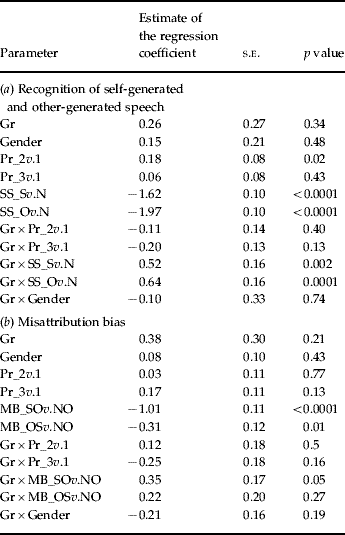
The experimental variables of Sentence Source and Pronoun were both significant predictors of response accuracy at p<0.0001 (both self versus neither and other versus neither) and p<0.03 (second person versus first person) respectively, whereas the Group and Gender-Heard variables were not significant. These effects were driven by lower recognition of self-generated and other-generated speech relative to non-generated speech, and lower recognition of stimuli in the second person relative to the first person. A significant Group×Sentence Source interaction is noted for self versus neither (p<0.002) and for other versus neither (p<0.0001), whereas the Group×Pronoun and Group×Gender-Heard interactions were not significant. Table 1a provides a summary of the findings. These results indicate that after adjusting to general recognition capacity (recognition of non-generated speech), a specific impairment in the recognition of both self-generated and other-generated sentences is observed in schizophrenia.
Summary of the results of the mixed multi-level logistic regression model for (a) recognition of self-generated and other-generated speech and (b) misattribution bias

Gr, Group; Gender, Gender_Heard; Pr_2v.1, Pronoun (second versus first person); Pr_3v.1, Pronoun (third versus first person); SS_Sv.N, Sentence Source (self versus neither); SS_Ov.N, Sentence Source (other versus neither); MB_SOv.NO, Misattribution Bias (self-other misattribution versus no-bias); MB_OSv.NO, Misattribution Bias (other-self misattribution versus no-bias); s.e., standard error.
Misattribution bias
Only the Misattribution Bias factor was significant for self-other bias (p<0.0001) and for other-self bias (p<0.01). The Group, Pronoun and Gender-Heard variables were not significant. The Group×Misattribution bias was the only significant interaction and was driven by more errors in the patient group in the self-other bias (p<0.05). Table 1b provides a summary of the findings. These results indicate that self-other and, to a lesser extent, other-self misattribution errors are common in the general population. However, more importantly, a group difference driven by a higher self-other misattribution in the patient group is observed. This group difference is specific to the operations of self-other distinction because the statistical model adjusts to general recognition capacity. As can be seen in Fig. 1, patients show more self-other and other-self misattribution errors than controls. They are similar to controls with respect to errors that do not involve self-other distinction.
Comparison of patients (▪) and controls (□) with respect to self-other and other-self misattribution errors and recognition of non-generated speech. The latter involves general recognition capacity that is not related to self-other distinction. Significant group difference is observed only in the self-other bias.

The performance on the Sentence Source (non-generated speech) and Misattribution Bias (no-bias) variables was close to perfect in both groups. Consequently, a ceiling effect is possible. However, both the non-generated speech and the no-bias variables were used as indicator variables in the source memory and misattribution bias analyses. As we obtained significance in both analyses, the ceiling effect is unlikely.
Clinical factors
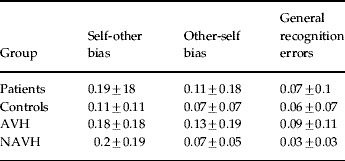
The AVH and NAVH subgroups of patients did not differ significantly with respect to self-other and other-self misattribution bias or general capacity for the recognition of stimuli. Table 2 summarizes the means and standard deviations for the above measures for the patients, healthy controls, AVH and NAVH groups. There was no significant correlation between self-other and other-self misattribution bias and chlorpromazine equivalent dose of medication, duration of illness, hallucinations and delusions scores, or the BPRS, the SANS, and SAPS total scores. Only the duration of illness was correlated positively with the error general recognition of the stimuli (no-bias) (r=0.52, p<0.001).
Means and standard deviations for the patient and control groups, and the hallucinating and non-hallucinating subgroups of patients

AVH, Auditory verbal hallucinations; NAVH, non-auditory verbal hallucinations.
Discussion
These data indicate that schizophrenia patients are impaired in the recognition of self-generated and other-generated speech and have a bias to attribute self-generated speech to others. Hallucinating patients differed from controls in the self-other misattribution bias, but were not different from the non-hallucinating patients, probably because of the small size of the latter group. As the neural correlates for inner and social speech are largely overlapping (Stephane et al. Reference Stephane, Barton and Boutros2001), and to the extent that a reading paradigm allows investigation of the neural operations involved in speech generation (Levelt, Reference Levelt1989), the present study supports the theory that AVHs result from attributing one's own verbal thoughts to others.
Although AVHs are generally attributed to non-self, when a patient reports experiencing verbal hallucinations the experience is necessarily generated by his/her own brain. As such, an AVH is an example of brain-self disjunction, but it is not the only one; various brain pathologies can result in such impairment. For example, alien limb syndrome, where the limb is described as ‘it does not do what I want it to do’ and ‘it can wander off by itself’ (Tiwari & Amar, Reference Tiwari and Amar2008), is found with lesions in the supplementary motor area (SMA) and in several other areas (Sumner & Husain, Reference Sumner and Husain2008). To date, schizophrenia literature provides two possible ways in which speech self-other indistinction can occur: electrophysiological and positron emission tomography (PET) research shows evidence of reduced corollary discharge from Broca's to Wernicke's areas (Ford et al. Reference Ford, Mathalon, Heinks, Kalba, Faustman and Roth2001) and abnormal laterality of the SMA (Stephane et al. Reference Stephane, Hagen, Lee, Uecker, Pardo, Kuskowski and Pardo2006) during speaking respectively.
There is growing evidence that AVHs do not have a unitary mechanism (David, Reference David2004), and that the mechanisms of AVHs could be dependent on AVH phenomenology (Stephane et al. Reference Stephane, Thuras, Nassrallah and Georgopoulos2003). This heterogeneity of AVHs could account for some of the negative findings in this study. Although the pronoun variable affected the capacity to recognize self-generated and other-generated speech in the general population, this effect did not differentiate between patients and controls. This lack of effect could be related to the hallucinating patient group combining patients with AVHs in the second person and patients with AVHs in the third person. Patients with second-person AVHs could have prominent misattribution bias of speech in the second person, and patients with third-person AVHs could have prominent bias with speech in the third person. Additionally, although patients did not differ significantly from controls in the other-self direction, this type of bias exceeded their general recognition impairment, suggesting that, with larger numbers and phenomenologically homogeneous subgroups of patients, significance in the other-self bias direction could emerge.
Of note, the acoustic quality of the heard speech (gender) did not affect self-other distinction of speech in any group. With respect to linguistic content, speech is processed similarly irrespective of acoustic qualities of the speaker, such as accent, age and gender (Levelt, Reference Levelt1989). This finding relates AVHs indirectly to a disorder of speech processes that involve linguistic meaning rather than language phonetics.
In summary, at the lexical level of linguistic complexity, self-other misattribution of speech has been reported, although inconsistently. In this study, we found self-other misattribution of speech at the sentence level of linguistic complexity. Patients did not differ significantly from controls in other-self misattribution and the pronoun factor did not impact the difference between the patient and control groups. However, these factors could become significant with a larger group of patients divided according to the characteristics of their hallucinations (such as hearing voices consisting of sentences in the second person and hearing voices consisting of sentences in the third person).
Appendix: The stimuli used in the practice session and blocks A–F
Practice
Read
My car had a flat tire.
You sang a solo in the concert.
She cared for her grandmother.
Hear
I took the bus into the city.
You were placed first in the marathon.
He works at the bank.
Neither
My brother sent me a package.
You went to the store.
His commander gave him a direct order.
Testing blocks A–F
(A)
Read
1. She stops for coffee every day.
2. I became eligible for a scholarship.
3. Your opposition group lost the election.
4. Your research team discovered the new drug.
5. He insisted on getting tickets early.
Hear
1. She was in a car accident.
2. You helped with the charity ball.
3. I was a White House official.
4. My heart was beating way too fast.
5. He complained about the price of medications.
Neither
1. He has always hated peas.
2. You love to read poetry.
3. Your opinions are important to the governor.
4. I hired a new assistant.
5. I am rooting for the other team.
(B)
Read
1. She became an assistant professor last Fall.
2. You are a coffee production specialist.
3. He plans to meet with the soldiers.
4. Your kids need to learn discipline.
5. I am winning the golf tournament.
Hear
1. He drinks red wine with his dinner.
2. I had plastic surgery in July.
3. You threatened the mayor of Boston.
4. Your dealership had an interest free plan.
5. She has three sons and a daughter.
Neither
1. My neighbor borrowed a shovel.
2. I changed the television station.
3. Your leader comes from Madison.
4. His bandages had to be changed.
5. My cousin came to visit.
(C)
Read
1. I gave her a nice diamond ring.
2. I live in the new apartments.
3. She must pay back taxes.
4. He thought the job would be easy.
5. Your team won the championship game.
Hear
1. You look like a famous actor.
2. He distributed the communion wine.
3. I visited all the foreign army bases.
4. My uncle stopped for a visit.
5. Your grandmother raised six children by herself.
Neither
1. He likes action movies the best.
2. He took the car for a drive.
3. My wife is a senator.
4. She makes three thousand dollars a month.
5. I like to watch racing.
(D)
Read
1. You wore a dark blue shirt.
2. I am leaving the country alone.
3. His taxes went up the following year.
4. You should lose twenty pounds.
5. My asthma inhaler may cause dizziness.
Hear
1. Your success was quite a surprise.
2. Her house is very beautiful.
3. I lost in the election.
4. I work at the North airport.
5. You should have held onto the football.
Neither
1. Your spouse did the laundry last night.
2. My job demands all my attention.
3. You used your power to help children.
4. He broke his leg during the race.
5. I took my brother to the park.
(E)
Read
1. You wore a pretty red dress.
2. I took pictures of my new house.
3. He told the platoon to move out.
4. I worked hard for the promotion.
5. You have pitched a complete baseball game.
Hear
1. She prepared a delicious meal.
2. You fell asleep in the movie theater.
3. He saw no alternative to war.
4. I organized a therapy workshop.
5. I asked my dad for advice.
Neither
1. Your garage is infested with mice.
2. I listened to the news report.
3. His government signed the treaty.
4. She invested in mutual funds.
5. Your uncle coaches a little league team.
(F)
Read
1. He took care of their pet cat.
2. I worked hard for seven years.
3. Your leader was killed by the enemy.
4. You can protect your skin with lotion.
5. I am allergic to carrots.
Hear
1. She rented a small apartment.
2. I found cheap tickets in the newspaper.
3. He is a political activist.
4. I think the economy is good.
5. You were suspended for using drugs.
Neither
1. His cat knocked over the plant.
2. I drove the kids to school.
3. You ran for public office.
4. You need to see a doctor.
5. He likes going to reunions.
Acknowledgments
This work was supported by grants to M.S. from the VA Medical Center and the Martha and William Muska Foundation.
Declaration of Interest
None.