


The organized vote, with large associations mobilizing their members to support the LDP, is a hallmark of Japanese money politics and at the core of patron-client relations, which make the party prone to serving special interests (Köllner, Reference Köllner2002; Maclachlan, Reference Maclachlan2014; Klein and McLaughlin, Reference Klein, McLaughlin, Pekkanen, Reed and Smith2021; Reed, Reference Reed2022). Yet time and again, the LDP breaks free from demands by key supporters, occasionally betraying their vital interests. For instance, in the name of macro-economic efficiency, Jun’ichirō Koizumi’s postal reform of 2005 eliminated the special post office system along with traditional family businesses run by postmasters who had been steadfast LDP supporters (Fujimura, Reference Fujimura2007; Maclachlan, Reference Maclachlan2025). Similarly, agricultural reform posed an existential threat to the business models of farmers who had served as the LDP’s rural backbone (Maclachlan and Shimizu, Reference Maclachlan, Shimizu, Pekkanen, Reed and Scheiner2016). One could add the successes of the LDP’s reformist camps in the realm of telecommunications and transportation (Kawabata, Reference Kawabata2006). Crucial electoral support by the decidedly pacifist Sōka Gakkai up until 2025, directly to the LDP and indirectly to the LDP’s coalition partner Kōmeitō, did not prevent the LDP from pursuing constitutional reform for a more robust defence policy (Klein and McLaughlin, Reference Klein, McLaughlin, Pekkanen and Pekkanen2022). Despite its intimate ties to interest groups, how has the LDP maintained independent manoeuvring space? How can the party accommodate allies with conflicting interests while limiting the costs of money politics? The voluminous literature on Japanese money politics describes the LDP’s largesse, embracing pork-barrel politics and other forms of clientelism with harmful effects (Saitō, Reference Saitō2010). But we know less about the LDP’s strategies to guard against political blackmail from clients, to contain the costs of pork-barrel politics, and to reduce reputational risks of money politics, in short: how the LDP hedges clientelist exposure.
Going against the grain, I suggest that an answer is found in the party’s grassroots institutions. According to a formerly accurate view, the LDP has a weak organizational infrastructure, mobilizing votes primarily at arms-length, through personal support groups, and by piggybacking on large interest groups as a substitute for the LDP’s own local organization (Matsushita, Reference Matsushita1961; Curtis, Reference Curtis1971; Köllner, Reference Köllner2006a; Popiolek, Reference Popiolek and Ciesielska-Klikowska2023). This view led to a focus on candidates’ personal support groups, factions, and the policy research council, at the neglect of formal local party institutions and party members (Krauss and Pekkanen, Reference Krauss and Pekkanen2011). Survey-based studies of local networks centre on local assembly members, with party institutions as an afterthought (Ōnishi and Tatebayashi, Reference Ōnishi and Tatebayashi2012; Tatebayashi, Reference Tatebayashi2013). Tatebayashi analyses electoral incentives of assembly members to explain the ‘organizational weakness of political parties especially at the local level’ (Tatebayashi, Reference Tatebayashi2012: 64 (author’s translation)). As far as the LDP and the Communist Party are concerned, one may raise questions. For one thing, since 2012 the membership base of the LDP has developed far better than that of most established parties in Western Europe. For another, recent studies demonstrate the prowess of local institutions of the LDP, from the Federation of Party Branches downward.
While there have always been dissenting voices (Foster, Reference Foster1982), after the LDP’s re-found dominance in 2012 more scholars have pointed to the LDP’s sophisticated institutions at the grassroots level (Ōkano, Reference Ōkano2015; Tsuruya, Reference Tsuruya2016; Nakakita, Reference Nakakita2020;). A seminal monograph by Mariko Sasabe puts the Prefectural Federations of Party Branches front and centre, demonstrating that they are a crucial pole of independent power (Sasabe, Reference Sasabe2017). Up until then, the LDP’s Prefectural Federations of Party Branches were considered as static and deriving their political power from national Diet members (Machidori, Reference Machidori2015: 156 f.). Occupational branches are even more rarely mentioned in the literature, with few discussions of their functions (Tatebayashi, Reference Tatebayashi2013). As a result, linkages to the local chapters of nationwide associations were identified as electoral assets, yet their institutionalized connection to the local party structure escaped analysis (Shinada, Reference Shinada2012). At a time when 40% of all party members are enrolled through the distinct system of occupational party branches, the lack of understanding of this peculiar affiliation is an important gap in the literature. While concluding that, unlike a cartel party, the LDP maintains strong local linkages to citizens, even Sasabe highlights geographically defined branches but discounts occupational branches (Sasabe, Reference Sasabe2017). In this article, I introduce the occupational branches of the LDP, thereby contributing to internationally comparative studies that illuminate the diverse models for party organization, party membership, and local party networks (Tavits, Reference Tavits2013; Scarrow, Reference Scarrow2015; van Haute and Gauja, Reference van Haute and Gauja2015).
I argue that occupational branches play an important role in Japanese money politics, as an institution that hedges the risks accompanying clientelism. The LDP has established a setup that keeps clients at bay and avoids encroachment by its clients’ potentially growing demands. In comparative terms, Japanese money politics falls under the category of ‘not-quite clientelism’, because the defining ‘contingent exchange of material benefits for votes‘ differs from typical arrangements (Hicken and Nathan, Reference Hicken and Nathan2020). For one thing, the pivotal exchange relationships are group-based (Köllner, Reference Köllner2002; Catalinac, Reference Catalinac2025a), whereas 95% of the clientelism literature describes transactions at the individual level (Hicken and Nathan, Reference Hicken and Nathan2020: 281). For another, when the LDP uses state resources to bolster support, privileged treatment does not necessarily buy votes or turnout, but campaigning or broader political support (Scheiner, Reference Scheiner2006; Reed, Reference Reed2022). At the same time, the party does not grant every request, weighs the costs and benefits of each exchange, and denies favours even to its closest allies (Mulgan, Reference Mulgan2000; Maclachlan, Reference Maclachlan, Shimizu, Pekkanen, Reed and Scheiner2016). While the vast literature has pointed out the power of sectoral interests (Tsujinaka, Reference Tsujinaka1996) and demonstrated the LDP’s largesse, we need to identify the mechanisms that keep the costs of money politics in check. Occupational branches are one such mechanism, which allows the party to mobilize interest groups without going through powerful associations at the national level. The party’s problem to achieve mass mobilization while maintaining autonomy from special interests is universal. Historically, if conservative parties solved this problem, they could serve as bulwarks against extremism (Ziblatt, Reference Ziblatt2017).
The ability to hedge clientelist exposure has been critical for the LDP’s longevity. Earlier scholarship argued that the LDP maintained dominance by competently adjusting its policy platform to voter preferences (Pempel, Reference Pempel1982; Muramatsu and Krauss, Reference Muramatsu, Krauss, Yamamura and Yasuba1987; Calder, Reference Calder1988). Yet recent scholarship demonstrates that citizens cast their votes, in part, for non-programmatic reasons, namely because the LDP carries valence in the form of trust (Hamzawi, Reference Hamzawi2022; Kuriwaki et al., Reference Kuriwaki, Horiuchi and Smith2025). This is why the reputational costs of the 2023–24 slush fund scandal were devastating. Undeclared monetary transactions related to fundraising events triggered public discontent with the LDP’s mobilizational practices, associated with significant losses in the 2024 Lower House elections (Catalinac, Reference Catalinac2025b). As the party’s linkage mechanisms are coming under electoral scrutiny, the long-term future of the LDP depends on public perceptions of whether the party’s handling of the organized vote is legitimate. The perceived legitimacy of the party’s micro-transactions, as practiced through occupational branches, can be decisive, because blatant transactions with a privileged few could gain the voters’ lasting disaffection. At stake is the ability of the LDP to preserve its ability to deny costly favours that would bankrupt the national treasury or ruin the economy – along with the party’s legitimacy as an electorally significant valence advantage.
The article is designed to build theory rather than test hypotheses, by directing attention to important yet overlooked features of the LDP. It pays attention to institutional legacies, structural incentives, as well as intentional agency by party organizers, which jointly gave rise to occupational branches and shaped their operating procedures. The first section clarifies the historical and contemporary roles of the LDP membership, as the down-to-earth building block for the occupational branches. The following section introduces the ‘occupational branch’ as a distinct type of LDP branch, explaining how it was shaped by a recruitment campaign, electoral rules and party presidential elections. Section 3 introduces the exemplary case of Toyama prefecture to establish an empirical baseline. Section 4 demonstrates the diversity of occupational branches, mediating between organized interests and larger policy goals. The final section before the conclusion describes procedures by which members input their interests and negotiate them with the party. I conclude that occupational branches are an important linkage mechanism connecting local interests to party-internal procedures, while allowing the LDP to deny costly favours.
1. From ghosts to party members
A ghostly metaphor has haunted academic debates about the LDP’s lack of a ‘proper’ organizational base. The party was likened to a spirit known as yūrei 幽霊, which challenged traditional kabuki theatre stagecraft because it is a faint creature without legs. Nathaniel Thayer introduced the metaphor into the academic debate in 1969, describing how the conservatives ruled (Thayer, Reference Thayer1969: 85). The metaphor traces further back to a party worker in Hiroshima, who called for developing the party at the grassroots level, in a 1964 meeting with Prime Minister Hayato Ikeda.Footnote 1 While the metaphor travelled widely, the context was lost,Footnote 2 as were the party’s systematic efforts to build up a stronger local base (LDP, 1975). Clearly, the electoral system with single non-transferable votes incentivized candidates to build personal support groups instead of relying on party networks. I do not question that the LDP had ghost-like features in the 1960s. But two decades after the Hiroshima meeting, James Foster presented evidence, from his ‘ghost-hunting’ endeavour in Hyōgo, that there was significant local party organization, albeit not centred on individual membership (Foster, Reference Foster1982). Since the 2000s, a tension arose between leading scholarship holding onto the ghost metaphor (Köllner, Reference Köllner2006b: 69; Krauss and Pekkanen, Reference Krauss and Pekkanen2011: 29) and dissenting views. Jun’ichirō Koizumi’s rise to power triggered some to gradually reevaluate the role of rank-and-file party members (Yomiuri Shimbun, 2001; Ehrhardt, Reference Ehrhardt2006; Nakakita, Reference Nakakita2020). Today, LDP members are neither ghosts nor glowing activists – but local party networks are far less spurious and more consequential than in the past. To be sure, some LDP members do little more than deliver their membership fee. The point is not to show that LDP party members are particularly active compared to party members in other countries, but that membership is no longer as ephemeral as it was in the 1970s.
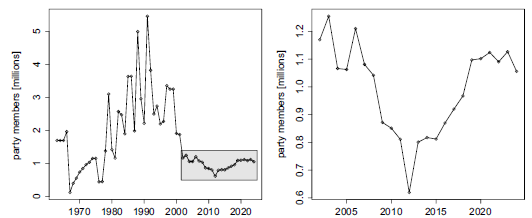
It is time to update our scholarly understanding of LDP membership and its historical trajectory of transformative change. As displayed in Figure 1, we can distinguish four phases. The initial phase (1955–78) was one of confusion, accompanied by calls for enlarging the party’s base. The above-mentioned Hiroshima party official, known for using the ghost metaphor, exemplifies the view that building grassroots support for the LDP was both vitally important and utterly neglected. In the Cold War context, leaders felt urgency, because the support base owned by the left appeared threatening and superior to their own. Writing in 1970, Haruhiro Fukui points to the near impossibility of discussing membership ‘with any degree of certainty,’ since ‘estimates varying as widely as from 50,000 to 5,900,000’ come without ‘assurance that these two extremes really delimit the range of the error’ (Fukui, Reference Fukui1970: 57). Still, Fukui is one of the few authors who critically discuss grassroots membership, grouping together some party affiliates in an ‘inner ring’ contrasting with others in the ‘middle and outer rings’ (Fukui, Reference Fukui1970: 79).
LDP members 1964–2024. The chart on the right magnifies the shaded square.
Sources: Financial disclosure reports from the Ministry of Internal Affairs and Communications (2002–2023), party-internal elections for LDP president (1976, 1978, 2024), (Köllner, Reference Köllner2006b) (1963–1975, 1977, 1981–1994, 1996–1999), Asahi Shimbun Jan 12, 1981.

The second phase began in 1978, when for the first time party members voted in party presidential elections. Their participation was meant to reduce the role of factions in leadership selection. Because the enrolment of party members in the run-up to leadership elections became the key for gaining control over the LDP, factions cut corners: signing up citizens without their knowledge, having donors pay their membership, and casting the vote in their stead.Footnote 3 As a result, membership statistics were extremely volatile. Spikes coincided with internal elections. Before the political finance reform of 1994, there were three party presidential elections with membership participation, namely in 1978, 1982, and 1991. In each instance, membership more than doubled compared to the previous year. Membership reached the maximum size of 5.5 million in 1991. The presence of spurious members undermined the rights of actual members, as well as the institution of party membership.
The era of vastly inflated membership rosters and conspicuous membership volatility ended soon after this peak, with the introduction of new transparency rules for political finances. The reforms of 1994, passed by the first non-LDP government since 1955, are remembered for introducing a new electoral system. They also included far-reaching political finance legislation with a significant impact, including on LDP-internal power dynamics (Carlson and Nakabayashi, Reference Carlson and Nakabayashi2024). The Political Parties Subsidy Law of 1994 (政党助成法 seitō josei hō) grants parties a state subsidy proportional to their electoral performance, to make them less dependent on donations from companies.Footnote 4 Concurrently, the law mandates comprehensive financial reporting requirements, which generated transparency.Footnote 5 Since the mislabelling of a donation as party membership fee is in violation of the law, proxy payments of membership fees became riskier, although an enforcement of the new rules did not occur overnight. The shrinking size of the party from 1991 to 2012 was a result of excluding straw men from the membership roster, and of recruitment not keeping pace with the passing of the older generation. Moreover, opportunists left when the LDP was in the opposition from 2009 to 12, leading to the 619,245-member low point in 2012.
The fourth phase, one of conscientious party-building, started in 2012. The time in the opposition had inspired a sense of urgency that new members were needed for the survival of the party. On the membership demand side of citizens who asked to join, including lobbyists and aspiring politicians, the LDP regained attraction when the memory of its stint in the opposition faded. More importantly, the party reached out to citizens in a series of membership campaigns. In the ‘campaign to own 1.2 million party members’ [120万党員獲得運動] of 2014, top-down quotas for recruiting new members were enforced by fines for Diet members who fell short of recruitment targets. To prevent illegal forms of membership financed by third parties, the fines were set lower than the annual membership fee, so that it would not be financially advantageous for a Diet member to pay the membership fee out of their own pocket instead of shouldering the fine (Nakakita, Reference Nakakita2020: 183 ff.). The target of 1.2 million members has remained a common benchmark.Footnote 6 Personal support groups are a pool of potential candidates. To avoid paying twice, for the personal support group and the party membership, one expects citizens to move from the support group to the LDP branch rather than holding concurrent memberships. But politicians can be more at ease about transitioning their support group to the party, because today Lower House candidates are no longer electorally competing with fellow party members in their shared electoral district, as used to be the case in multi-member districts.
Occasional violations of transparency rules are no longer tolerated by the party and meet media scrutiny. The new consensus is reflected in the intensity of reports about citizens who are surprised to find out about their membership in the LDP, typically through letters inviting them to vote in party presidential elections. In Toyama, one supporter of the Communist Party was signed up by her employer; in Ōsaka, an entire family was enlisted as the unexpected result of an encounter with an Upper House Councillor’s personal support group.Footnote 7 Today, instances of phony membership receive media attention, precisely because they are perceived as scandals, and no longer tolerated as a common practice. Thanks to changing norms, no longer can one expect party members to routinely pass on their empty ballots for party presidential elections (Tsurutani, Reference Tsurutani1980: 853). Without the questionable membership practices of the past, LDP-internal elections are no longer subverted by ghost members whose vote is cast by their sponsors.
The empowerment of the rank-and-file has far-reaching consequences, as party members actively participate in LDP presidential elections (‘primaries’): Out of roughly one million members, 66% cast their vote in the 2024 primaries, and 69% in 2025. This turnout is far greater than in the general elections, where turnout was 54% in 2024 and 56% in 2026. As far as we can tell from counterfactuals, the rank-and-file’s votes changed the outcome of both elections. In the first round of the LDP primaries, Diet members and rank-and-file party members cast separate votes, and the collective weight of the rank-and-file votes equals the total number of votes cast by Diet members. Ceteris paribus,Footnote 8 if only the Diet member votes had counted in 2024, Shigeru Ishiba would not have reached the runoff election and consequently would not have become the Prime Minister. Similarly in 2025, according to the Diet member votes alone, Sanae Takaichi came in third and would have been excluded from the runoff election. In other words, if it were not for her popularity among the grassroots LDP membership, likely Takaichi would not be the current Prime Minister.Footnote 9
2. Occupational branches and their evolution over time
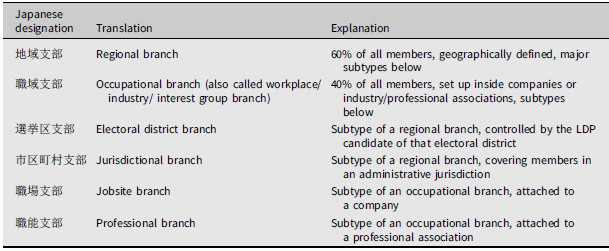
Of all party members, 40% belong to occupational branches,Footnote 10 a special kind of party branch largely neglected in the extant literature (compare Table 1).Footnote 11 Occupational branches (職域支部 shokuiki shibu), alternatively translated as workplace branches, industry branches, or interest group branches,Footnote 12 are a hallmark of the LDP’s grassroots presence. Each of the 1,800 occupational branches belongs to one of the LDP’s 47 Prefectural Federations of Party Branches (支部連合会 shibu rengōkai) and incorporates a group of party members, sorted together by shared interests, which could be the interests of an economic sector, or a group. Occupational branches are distinct from all the other types of party branches, which are always and exclusively geographically defined. Regional branches (地域支部 chiiki shibu) cover Japan by following administrative boundaries, as is standard practice in other countries. Overlapping with the regional branches are electoral district branches, also geographically defined. They coincide with campaign areas of LDP candidates. In single-member districts, each electoral branch covers an entire electoral district; in Upper House electoral districts, only the ‘principal bases of operation’.Footnote 13 Each electoral district branch is formally presided over by the LDP candidate in that district, resembling a personal support group (後援会 kōenkai). However, a candidate only presides over the branch as long as the person is the official LDP nominee – the crucial difference to a personal support group. Membership in specialized branches for women and young members is held concomitantly with the primary affiliation with a regional, occupational, or electoral branch.
The origins of occupational party branches can be traced back to the Cold War-inspired competition with the left in the late 1950s, when LDP organizers attempted to beat Socialists at their own game. At the time, mobilizers of the labour movement organized factory workers into unions, which conservatives found threatening. According to earlier official party historiography, the first occupational branch emerged in 1956, when a group of 130 workers at one firm defected from the All Japan Garrison Forces Labor Union, created their own union, and collectively joined the LDP (LDP, 1975: 17 and 237). According to newer party historiography, only a year later the first occupational branch was established at the Tsukiji fish market in Tōkyō, as a result of the Prime Minister’s initiative in response to widespread labour unrest (LDP, 1987, tōshihen: 231). Perhaps the 1956 branch’s association with the US military versus the 1957 branch’s association with a leadership initiative could have invited revisions. In any case, both accounts concur in placing the foundation of the earliest occupational branches squarely in the context of containing labour union influence. Over the next two decades, occupational branches were routinely mentioned at party congresses, as access to citizens who traditionally were more distant to the LDP, including blue and white collar workers (LDP, 1987, tōshihen: 128). In 1968, formal guidelines – mostly remembered for closing the loophole of registering party members twice, once with a geographic branch and once with an occupational branch – firmly established occupational branches into the tactical toolbox of the LDP.Footnote 14
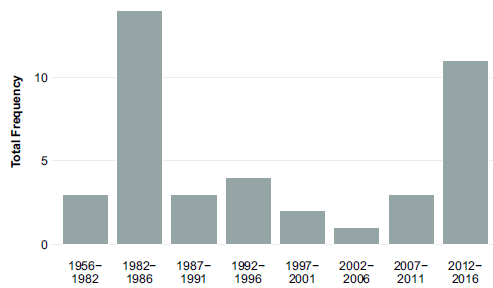
Only a small fraction of today’s occupational branches trace their origins back before the 1980s; in Toyama just three out of 42 branches (see Figure 2). In the 1980s, a combination of factors sharply increased the number and the size of occupational branches. To energize LDP organizers for a series of elections in 1982, the ‘campaign to maintain and strengthen the organization, win new members’ (組織整備強化・党員獲得運動 soshiki seibi kyōka tōin kakutoku undō) boosted the party organization with long-lasting consequences. The campaign developed two sub-types of occupational branches: It distinguished jobsite branches (職場支部 shokuba shibu), which incorporated party members in a given company, versus professional branches (職能支部 shokunō shibu), which brought together people doing the same type of work, or otherwise sharing common interests. At a party congress in early 1983, the leadership announced that more than 1,300 ‘leapfrogging’ occupational party branches had been established (LDP, 1987: 429). Two years later, 38% of all party branches were of the occupational type (LDP, 1987: 453). As we see in the case of Toyama (Figure 2), many of the occupational branches that we encounter today had been established at the time. Whereas the early occupational branches were jobsite branches, reminiscent of left-wing mobilization in industrial companies, the campaign of 1982 pivoted to professional branches.
Founding dates of Toyama’s occupational branches.
Source: LDP Toyama 2016.

Behind the scenes, the campaign came to be dominated by the LDP’s affiliated interest groups, because it coincided with an electoral reform that introduced a closed list PR system for the national tier of the Upper House elections.Footnote 15 The ranking of an interest group’s representative on the LDP’s PR list depended on the group’s relative ability to deliver new party members to the occupational branches (Nakakita, Reference Nakakita2020: 152). To be clear, the electoral system did not directly incentivize affiliated interest groups to organize occupational branches, because the interest groups were able to mobilize their members through their own organizational networks. However, because of the party expansion movement described above, the recruitment of party members became the essential party-building goal and metric, through which interest groups could signal their loyalty and strength. By recruiting party members to occupational branches, rather than the geographically defined branches, interest groups could retain at least some control over their recruits.
Party presidential elections further boosted the nominal size of occupational branches while undermining their solidity. In 1978, ordinary members participated in these elections for the first time with competing factions enrolling individuals, as described in the previous section. With the second party presidential election of 1982, occupational branches became the main instrument for mass enrolment. At the time, analysts approximated the number of ‘true’ LDP members by the number of continuing members, as opposed to ‘phony’ new members whose membership lasted for less than one year – the transient members occasionally outnumbering the more permanent ones.Footnote 16 Using this yardstick, in the absence of national data, we can use uniquely detailed evidence from Yamaguchi to numerically assess the extent to which the malpractices of transient membership were linked to occupational branches. In 1991, 54% of all LDP members in Yamaguchi were phony and 98% of these phony members belonged to occupational branches (LDP Federation of Party Branches in Yamaguchi, 1991: 26).
The transformation of membership in the wake of the 1994 political finance legislation had a large impact on the occupational branches. Liberating them from phony members, they became more stable groups that Prefectural Federations of Party Branches could count on. The transformation from jobsite-type to professional-type occupational branches, along with the transformation of party membership, has turned occupational branches into a platform for local LDP politicians to garner support from associations, without going through the national headquarters. Nevertheless, as Figure 2 reflects, in the 1994–2009 period, the LDP expanded its occupational branch network only slowly. By contrast, after its electoral defeat of 2009, the party redoubled its efforts to build new occupational branches. With the exception of the 1982–86 period, no other five-year interval saw as much expansion as the 2012–19 period, following the LDP’s return to power.
Today, occupational branches are a routine instrument for the LDP to manage its local affiliates. Occasionally, occupational branches are conflated with the corresponding professional association, but the distinction is formally well-defined and analytically important. Legally, occupational branches belong to the LDP. Linguistic confusion arises when a branch covers the same professional sector as a special interest group. For instance, prefectural chapters of the Japan War-Bereaved Families Association (日本遺族会 nihon izokukai) maintain occupational branches of the LDP, officially known as LDP Branches of the War-Bereaved Family Association in Prefecture X (自由民主党〇〇県遺族会支部 jiyū minshutō marumaru ken izokukai shibu), but consistently abbreviated as ‘Bereaved Families Association‘ (遺族会 izokukai). As section 4 illuminates in more detail, branches have an ambiguous status: Formally part of the LDP, in practice outside associations hold considerable sway. But before addressing the bargain defining occupational branches, the next section presents basic characteristics of occupational branches through the case of one prefecture.
3. Occupational branches in the case of Toyama
This section introduces the case of Toyama and shows that occupational branches cover significant sections of society, creating linkages to large groups of citizens. In this article, Toyama serves as the primary point of reference, because to the best of my knowledge, it is the only Prefectural Federation of Party Branches that has published a party history, including a short vignette about each of its occupational branches. To be sure, one would expect the characteristics of occupational party branches to vary across prefectures, because Prefectural Federations of Party Branches are heterogeneous (Tatebayashi, Reference Tatebayashi2013; Sasabe, Reference Sasabe2017). As a partial remedy, Miyazaki and Shiga serve as additional references. Here also, the choice has been made because more information was available on these cases. Since statistical information on occupational branches is scarce, with no nationwide compilations, the data from cases are the point of departure, systematically supplemented with information from other places or national data, as available. The most complete, systematic information on any organizational branch comes from the Electoral Commissions of the prefectural governments, which process disclosure reports of political funds (Carlson, Reference Carlson2023). Although one can find the names of all party branches, the size of their membership is not consistently reported. Additionally, for Toyama I work with material compiled for the 63rd meeting of the LDP’s Federation of Party Branches in Toyama in 2014, as well as a booklet reporting the history of the LDP’s Federation in Toyama on the occasion of its 60th anniversary, and similar documents for Miyazaki and Shiga as cited in the text. Finally, some information comes from conversations in the field but has only been included if validated by written sources. While Toyama may have idiosyncrasies, the additional references suggest that its occupational branches are broadly representative of nationwide dynamics.
When occupational branches appear in the media, they are explained with reference to a small set of recurring examples, typically the construction industry and the doctors,Footnote 17 but the universe of occupational branches is more diverse. Since the Federation of Party Branches takes the lead in setting up and managing occupational branches, each prefecture not only has a slightly different set of occupational branches, but there is also variation in their strength. Some branches have declining membership, others grow. Some represent thriving sectors, others struggling companies. Some only offer the support of their own members, while others have a track record of mobilizing the public beyond their own membership. The example of Toyama helps to establish some orders of magnitude and trends currently affecting occupational branches. The case demonstrates the diversity of sectors represented by occupational branches; it indicates that, with each of the branches, the LDP associates different electoral opportunities and reputational risks.
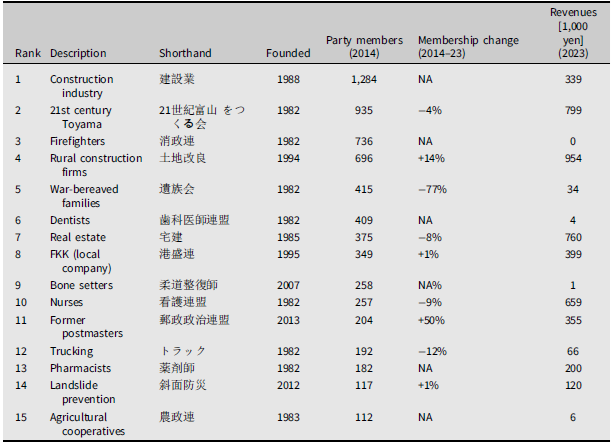
In Toyama, a rural prefecture along the Sea of Japan, 32% of the 25,412 LDP members belonged to occupational branches as of end-2024.Footnote 18 Compared to one decade ago, the relative prominence of occupational branches has increased from 28%, because the number of members in occupational branches stayed flat while overall membership dropped.Footnote 19 Table 2 lists the fifteen occupational branches with the most members, along with additional information: their founding date, membership developments in the last decade, and financial revenues in 2023. As in other places, the LDP’s occupational branch for the construction industry is among the largest, although a size of 1,284 members is exceptional. A more typical size of 237 members in Shiga still puts the construction industry near the top of the list, whereas in Miyazaki it is mid-sized, with 67 members.Footnote 20 The close relationship between the branch and the Construction Industry Association 建設業協会 is obvious, not only in the name, since the branch is located in the Construction Industry Building, the local lobby headquarters.Footnote 21 The branch institutionalizes the relationship between the LDP and the lobby organization, and its members embrace their dual status communicating LDP policy to the lobbyists, and lobby interests to the LDP, while owing personal loyalty to individuals on both sides.
Top 15 occupational branches in Toyama (by members in 2014)

Table 2. Long description
A table titled Top 15 occupational branches in Toyama (by members in 2014) with six columns and fifteen rows. The columns are Rank, Description, Shorthand, Founded, Party members (2014), Membership change (2014-23), and Revenues (1,000 yen) (2023). The table lists the top 15 occupational branches in Toyama by the number of party members in 2014, along with additional information such as their founding date, membership developments over the last decade, and financial revenues in 2023. Row 1: Rank 1, Description Construction industry, Shorthand 建設業, Founded 1988, Party members (2014) 1,284, Membership change (2014-23) NA, Revenues (1,000 yen) (2023) 339. Row 2: Rank 2, Description 21st century Toyama, Shorthand 21世紀富山をくる会, Founded 1982, Party members (2014) 935, Membership change (2014-23) -4 percent, Revenues (1,000 yen) (2023) 799. Row 3: Rank 3, Description Firefighters, Shorthand 消政連, Founded 1982, Party members (2014) 736, Membership change (2014-23) NA, Revenues (1,000 yen) (2023) 0. Row 4: Rank 4, Description Rural construction firms, Shorthand 地方改良, Founded 1994, Party members (2014) 696, Membership change (2014-23) +14 percent, Revenues (1,000 yen) (2023) 954. Row 5: Rank 5, Description War-bereaved families, Shorthand 遺族会, Founded 1982, Party members (2014) 415, Membership change (2014-23) -77 percent, Revenues (1,000 yen) (2023) 34. Row 6: Rank 6, Description Dentists, Shorthand 歯科医師連合, Founded 1982, Party members (2014) 409, Membership change (2014-23) NA, Revenues (1,000 yen) (2023) 4. Row 7: Rank 7, Description Real estate, Shorthand 宅建, Founded 1985, Party members (2014) 375, Membership change (2014-23) -8 percent, Revenues (1,000 yen) (2023) 760. Row 8: Rank 8, Description FKK (local company), Shorthand 港盛連, Founded 1995, Party members (2014) 349, Membership change (2014-23) +1 percent, Revenues (1,000 yen) (2023) 399. Row 9: Rank 9, Description Bone setters, Shorthand 柔道整復師, Founded 2007, Party members (2014) 258, Membership change (2014-23) NA percent, Revenues (1,000 yen) (2023) 1. Row 10: Rank 10, Description Nurses, Shorthand 看護連合, Founded 1982, Party members (2014) 257, Membership change (2014-23) -9 percent, Revenues (1,000 yen) (2023) 659. Row 11: Rank 11, Description Former postmasters, Shorthand 郵政政治連合, Founded 2013, Party members (2014) 204, Membership change (2014-23) +50 percent, Revenues (1,000 yen) (2023) 355. Row 12: Rank 12, Description Trucking, Shorthand トラック, Founded 1982, Party members (2014) 192, Membership change (2014-23) -12 percent, Revenues (1,000 yen) (2023) 66. Row 13: Rank 13, Description Pharmacists, Shorthand 薬剤師, Founded 1982, Party members (2014) 182, Membership change (2014-23) NA, Revenues (1,000 yen) (2023) 200. Row 14: Rank 14, Description Landslide prevention, Shorthand 斜面防災, Founded 2012, Party members (2014) 117, Membership change (2014-23) +1 percent, Revenues (1,000 yen) (2023) 120. Row 15: Rank 15, Description Agricultural cooperatives, Shorthand 農政連, Founded 1983, Party members (2014) 112, Membership change (2014-23) NA, Revenues (1,000 yen) (2023) 6.
Sources: (1) records entitled ‘63rd Regular Convention of the LDP Federation of Party Branches in Toyama’, p. 76 (shorthand and members in 2014); (2) LDP Toyama, 2016, pp. 126–142 (foundational date); (3) disclosures to the Election Commission of Toyama (members and revenue, 2023)
Out of the fifteen largest occupational branches in Toyama, only three are associated with a large industrial interest group: the construction industry, rural construction firms, and real estate, respectively. Other branches representing industrial interests are dominated not by a national association but by local firms: landslide prevention and FKK (a local firm). The majority of branches represent professional groups: firefighters, dentists, bone setters, nurses, postmasters, truckers, and pharmacists. The many farmers are represented through the agricultural cooperatives branch, and the shrinking number of families who lost members during World War II also have their own branch. The long-established 21st century Toyama branch is an interesting hybrid: On the one hand, it appears as a spiritual club promoting cultural exchange and healthy living, guided by the philosophy of the founder of the Church of World Messianity, Mokichi Ōkada (1882–1955). On the other hand, this branch initiates worldly marketing in the interest of the Toyama brand, with active participation from local businesses. Some types of branches, such as rental management businesses, exist in most prefectures, whereas other types, such as the one incorporating ‘specialists in acupuncture, moxibustion and massage’, are found only in a handful. The party does not fully standardize its occupational branches across prefectures.
Some branches handle significant sums of money, with the construction industry branch reporting revenues of one million yen (US$ 7,000). But overall, the sums involved are so small that financing cannot be the main purpose of occupational branches. Some do not handle finances at all. In 2023, the firefighters had neither revenues nor expenditures, and the transactions by the bone setters, dentists, and agricultural cooperatives amounted to a negligible subsidy from the LDP. Among those recording transactions, most rely on a share of the party membership fees – about one fourth of the usual fee of 4,000 yen.Footnote 22 The branches of 21st-century Toyama, of the rural construction industry, and of the war-bereaved family have no other income. By contrast, the branch for the pharmacists is entirely financed by the local pharmacists’ lobby, suggesting that it is largely controlled by the association. Some adopt mixed models. In the case of the branch for nurses, funds also come from the headquarters of the nurses’ association in Tōkyō, perhaps because their unusually active engagement necessitates additional resources. In addition to the greatly varying size of occupational branches, their financial transactions are evidence that occupational branches adopt idiosyncratic structures.
Considering the diversity of occupational branches, which appear in other prefectures in similar constellations, the organized vote is not just a matter of a few big national organizations dealing with the party headquarters in Tōkyō. Some branches are embedded in the structure of associations that operate nationwide. Many occupational branches represent business interests. These are not the financial stakes of far-away mega-corporations, but rather concern industries that are tied to the local economy in rural areas. Many are small to mid-sized local companies that create jobs in the rural periphery. Class narratives of the LDP siding with the powerful interests of capital against labour do not sit comfortably with the reality of vulnerable businesses pleading for help: When three men in yellow vests, an older person flanked by two younger ones, walk into the LDP’s headquarters in Toyama representing the occupational branch of the crisis-ridden Pachinko gaming industry and offer their help in preparing for future natural disasters, it is clear that much more is at stake for the Pachinko managers than for the LDP (LDP Toyama, 2016). When industry demands are justified in terms of local job creation, the LDP incorporates the interests of employed citizens in their electoral constituency.
4. The intermediary role of occupational branches
Through short descriptions of five occupational branches, selected to maximize institutional variation, this section further illuminates the position of occupational branches vis-à-vis the LDP and vis-à-vis outside associations. All occupational branches are formal party organs. In order to join a branch, one must be a party member. Yet for most branches, there is an outside sponsoring association with significant influence over the branch, especially when a branch consists of LDP members who concurrently hold a membership in the association. Thus emerging as intermediaries between the LDP and its local partners, occupational branches display a dual nature, with membership in a branch defined by competing loyalties. Comparing different branches, some offer more valuable support to the LDP than others; some resemble lobbying instruments more than others. Arguably, the most important variation among the branches lies in the degree of agency exercised by the party versus its partner organization. The LDP relinquishes some control over its branches to partner organizations, but gains linkages. Conversely, organized interests that work through occupational branches gain access, but at the same time lobby influences are channelled and thereby contained.
The limited number of occupational branches allows the Prefectural Association of Party Branches to custom-design each branch. On average, a Prefectural Federation of Party Branches deals with 28 occupational branches.Footnote 23 With 21 and 40 branches, respectively, Miyazaki and Toyama illustrate the range.Footnote 24 These numbers are small enough for the federation’s executive officer 事務局長, in charge of routine interactions, to handle each branch on its own terms, focusing on branches that promise political payoffs in terms of delivering votes, at low political cost to the party. Some associations depend more on favourable legislation or subsidies than others. Some are more assertive and feel entitled. Some can mobilize more members than others, and yet others mobilize beyond their own membership. This section investigates cases that represent the diversity of outcomes, with some occupational branches that come closer to association-dominated lobbying devices, and others where the party has retained its say.
Real estate lobby by other means: Some of the most association-dominated occupational branches are in the real estate sector. The National Business Association for Rental Management (全国賃貸管理ビジネス協会 zenkoku chintai kanri bijinesu kyōkai) conspicuously exercises unilateral authority over the LDP party branches in its domain. Directly competing with the formal line of authority, which puts branches under the LDP’s Prefectural Federations of Party Branches, the association has formally established a Federation of LDP Rental Management Branches (自民党ちんたい支部連合会 jimintō chintai shibu rengōkai). This federation shares its Tōkyō address with the association and is fully under the control of the association, in contrast to the dual identities of the occupational branches. Its president asserts that ‘in 2014, the association has established […] LDP rental management branches (occupational branches) in all prefectures’.Footnote 25 This slip of the tongue is revealing: While associations play a critical role whenever a new LDP branch is established within their sector, only the LDP can set up its own branches. This association trumpets its predominance. On the same website, the goal of the party branch is assertively described, as serving the association’s interest in influencing LDP policy. Perhaps the leaders of the association underestimate the two-way give-and-take.Footnote 26 Since research turned up no significant vote gathering activities, and only minor financial contributions, in this case it is questionable what the LDP gets in return. Either there is stealthy support that this research could not uncover, or the LDP is in the long game of building support in the future.
Nurses extending the LDP’s reach: The occupational branches of the nurses offer a striking contrast. They are not a run-of-the-mill lobby group and have internalized their dual status, defining their top goals as the recruitment of party members, influencing budgetary choices, and promoting joint LDP/nurses campaign efforts for election at all levels from local to Lower and Upper House elections (LDP Toyama, 2016: 137). At events of the occupational branches, the symbolism, the speakers, and the content generate ambiguity as to whether they are LDP events or Nursing Federation events.Footnote 27 Compared to the rental management firms, the nurses have far greater mobilizational potential: bigger-sized occupational branches,Footnote 28 an association many times larger than the branches with about 170,000 members,Footnote 29 and an agenda that has appeal outside the professional group of the nurses. The association moved closer to the LDP in the 1990s. Originally, from its founding in 1959, the association had representatives successfully competing in Upper-House elections, by promoting the special interests of the nurses. Yet since 1996, the association also has its candidates in Lower House elections, who must appeal to broader sections of the electorate (Japanese Nursing Federation, 2024), so that the nurses’ interests became more aligned with the LDP’s interests. When Emiko Takagai campaigned on promoting female health, this resonated with voters, so that the LDP gladly endorsed it as reflected in the prominence that Takagai and her agenda was given in the party’s magazine for women.Footnote 30 The similar overlapping-hearts logo of the LDP’s department for women and the Nursing Federation is not coincidental: The Nursing Federation contributed to the success of female politicians in the LDP. With the agenda of the nurses’ occupational branch defined more broadly than one may expect of a lobby organization, political influence runs in both directions.
The doctors’ strategic ambiguity: The doctors are a most assertive interest group. Their lobbying efforts go back to the late 19th century when doctors pushed for the acceptance of Western medicine. Later, doctors shaped the health insurance system and had great influence over the LDP soon after its founding in 1955 (Steslicke, Reference Steslicke1973). This pedigree may explain why the Japan Medical Association keeps the LDP on edge, instead of letting the party count on the doctors’ unwavering support. The doctors tend to ‘put a foot in both camps’ (Reed, Reference Reed2022) and spread their support widely, to the opposition and occasionally to the LDP’s partner Kōmeitō.Footnote 31 The occupational branches related to the Japan Medical Association are the medical care group branches (医療会支部 iryōkai shibu), but those are not found everywhere, at all times. In Toyama, no such branch existed in 2014. Later, a medical care group branch was established and headed by a former president of the prefectural doctors’ association, although with 61 members in 2023 it barely passed the minimum threshold of 50 members. In Shiga, it has not passed the minimum threshold for decades. Their moderate size has not inspired political modesty. Following the 2020 general assembly meeting of party branches in Toyama, the Japan Medical Association of the prefecture publicly complained that the voices of branches had not been taken into account properly.Footnote 32
The end of a branch’s lifecycle: The branch associated with the Bereaved Family Association once fought for social welfare benefits to the widows of soldiers fallen in World War II, and now focusses on the preservation of an honourable memory. In Shiga, requests over the last decade were about government support for collecting the remains of soldiers in Southeast Asia, and the restoration of a local war memorial.Footnote 33 Not extending membership beyond the generation immediately affected by World War II, the party branch of the bereaved families dwindles. Whereas the association once played hardball tactics to secure significant benefits for the families of fallen and missing soldiers, today the branch is in a weaker position. Moreover, personal relations between the branch members and LDP staff are now characterized by mutual loyalty rather than opportunistic scheming.Footnote 34
Legacy branches following old models: The LDP used to promote branches in individual companies to mobilize workers. Such jobsite branches still exist. But since they are no longer the preferred organizational model, many of them aspire to transform into multi-company entities. In Toyama, the company Fushiki Kairiku Unsō is at the centre of a party branch, although the name suggests that the branch unites port operators (kōseiren shibu 港盛連支部). The company has longstanding ties to the LDP, because its former president Kōtarō Tachibana served as an LDP Diet member; and his son Keiichirō Tachibana continues at the head of the company and has been serving as an LDP Diet member from 2009 to this day. The company is an important staging ground for his campaigns, with 354 party members signed up through this occupational branch.Footnote 35 The branch attracted nationwide attention when signing up a Communist Party member without her consent. In the short run, the branch does little to improve the company’s access to policymakers, because its top manager serves as LDP Diet member anyway. In the long run, the occupational branch helps the standing of the Tachibana family within the LDP, supports the nomination that opens their way into the Diet, and hence secures the company’s political access. Conversely, this party branch strengthens the LDP’s influence among the company’s staff and business partners.
Notable Absences. Relationships to some sections of the LDP’s constituency never mature enough to allow for the formal establishment of occupational branches. One looks in vain for occupational branches reserved for industrial workers. Such branches may be expected, because at the outset, when the first occupational branches were founded starting in 1956, the point was to target the workers. At most, one finds company branches that encompass workers and management alike. Also, with the partial exception of the 21st century branches, the LDP has no branches to connect with religious groups. According to a party organizer, the LDP had tried but failed to work with Shintō groups. The LDP’s informal ties to the Unification Church became a PR disaster in the wake of Shinzō Abe’s assassination in 2022. After breaking up with its long-term coalition partner Kōmeitō, the LDP also lost access to Buddhists of the Sōka Gakkai.
Occupational branches manifest a quid pro quo between the LDP and outside organizations, although the terms of engagement vary considerably across branches. In many of its occupational branches, the LDP finds local members of nationwide associations and can mobilize them without going through the associational headquarters in Tōkyō. For the associations, the goal is to have access to the policymaking process, ultimately in return for mobilizing votes. The Pharmacist Association in Toyama writes explicitly about its occupational branch as an influential lobbying platform to ‘actively campaign, to exchange information with National Diet members, prefectural assembly members, as well as mayors and council members, and to improve the status of pharmacists’.Footnote 36 There are many factors that determine the agency of the LDP and the partner organization, respectively, but from the cases above one might suggest a lifecycle hypothesis: Young branches are dominated by an emerging partner, whereas old branches are more aligned with the party. It is also clear that through careful coordination, both partners have a lot to gain, as the particularly productive nursing branches show. The following section sheds more light on the routine negotiations over mutual political support.
5. Procedures to hedge the exposure to clientelism
Occupational branches are pivotal for reconciling incompatible demands from party affiliates. The LDP routinely prioritizes some affiliates’ demands over others, due to budget constraints, and occasionally accommodates sharply opposing preferences. The LDP has developed mechanisms that make for versatility: with enough partners to avoid dependence on any single group, the LDP uses a variety of privileged communication formats for listening to associated groups and explaining policy choices, with competition where loyalty is rewarded. The ability to steer the dialogue and remain the ultimate arbiter of affiliates’ demands increases the party’s institutional autonomy.
Annual conference of all occupational branches in the prefecture: In contrast to under-the-table deals that one may expect in patron-client relationships, the LDP uses formal procedures for occupational branches to submit requests with budgetary implications. Specifically, the Prefectural Federations of Party Branches organize an annual gathering of occupational branches as the default opportunity for filing requests. Facilitating political participation, the conference is presented as a legitimate input mechanism. This approach has advantages over the alternative of ad-hoc requests informally submitted. For one thing, each occupational branch witnesses the requests by other occupational branches and the necessity to prioritize in light of budget constraints. For another, the timing disciplines affiliates into the institutional constraints of the parliamentary budgeting cycle. Transparency provides affiliates with a better understanding of the rationale by which some requests are granted, but not others. The annual conference is the principal tool to exude the image of a party as a proper input institution, as exemplified by the case of Miyazaki:
To discuss national and prefectural policy and budgetary requests (yōbō 要望) for the fiscal year 2014, on July 31 a policy conference (政策懇談会 seisaku kondan kai) brought together the LDP’s occupational branches, various organizations, the LDP Diet members, and staff from the Federation of Party Branches (section chairs). At the hearing, 37 organizations submitted 156 policy and budgetary requests. The same day, Diet members from the prefecture passed on the requests to the government. On December 22, the organizations received written responses. Regarding prefectural policy, 37 organizations made 179 requests, which were compiled by the prefectural headquarters. On September 7th, staff from the prefectural headquarters called on Governor Shunji Kōno, and the groups received written responses on February 23rd.Footnote 37
The petitioning process described in this quote defines the relationship between the LDP and its associates. While ready to help associates as legitimate representatives of local interests, the party also educates them on budgetary constraints. Such a procedure comes with risks. In some cases, an upcoming annual conference may trigger associates to formulate demands which otherwise may never have occurred to them. Moreover, a discontented associate may well stir up other associates to rebel against too stingy an LDP, as did the Doctors’ Association of Toyama on its public Facebook page, by reporting from a conference of Toyama’s occupational branches that the principle of ‘detailed consultation, unanimous decision, implementation in solidarity’ had been violated.Footnote 38 The LDP establishes itself as following fundamental principles: instead of marketing itself as a patron with deep pockets, the projected image is one of a professional manager in charge of tight public budgets.
One-on-one meetings with representatives of occupational branches: Representatives of organizational branches can also reach out to the LDP for one-on-one meetings any time, especially with urgent requests that have only minor budgetary implications. Photos of such meetings show branch representatives deferentially handing over a document, affirming a hierarchy with built-in expectations that the requests could be turned down. Other photos show conference tables with representatives of the Federation sitting across from branch representatives, signalling a more confrontational situation (LDP Toyama, 2016, photos: 127–141). The message is that the LDP is attentive to the concerns among citizens in the constituency. The Federations of Party Branches are centrally involved in facilitating appropriate formats, ranging from conversations with the federation’s leadership to meetings with specialized politicians and occasionally bureaucrats. Determining the format and protocol goes a long way in satisfying demands without selling out to special interests. For the purposes of LDP-internal power competition, these contacts render the Federation of Party Branches into a most pivotal agency that is handling linkages, brokering agreements, and communicating decisions. It requires experience, tact, and skills to handle such encounters in a way that deepens relationships without emptying the public treasury. Hence, the Federation can use its competence to make itself indispensable.
Competing for the party’s favours: The LDP keeps associations on the defensive. When submitting requests, many occupational branches must be prepared for critical questions. In Toyama, seven out of 40 occupational branches have fewer than the required minimum of 50 members, and another eight are just above the threshold with fewer than 60 members.Footnote 39 LDP officials act according to the contribution of an organization to the party’s electoral success, which is estimated in great detail. In one meeting attended by the author, members of an occupational branch were asked to gather names of citizens willing to be contacted by the LDP prior to the election. The number of names multiplied by 0.4 would be taken as the number of votes the occupational branch had contributed. A document from the LDP headquarters compiles numbers of supporters contributed by associations and companies, as estimated by LDP candidates. Since these estimates come with uncertainty and can be manipulated, the most straightforward measure of an occupational branch’s mobilizational efforts is the number of newly recruited party members. While all occupational branches have a voice, some would not raise it too loudly, if they fall short of the informal expectations or the formally necessary minimum membership. With ambitious recruitment targets, occupational branches tend to be on the defensive, while only a few stand out.
The LDP ceremoniously recognizes associations for expanding occupational branches to foster a sense of competition among its supporters. This is reminiscent of the tournament model among municipalities, with the most active support of the LDP at the ballot box resulting in fiscal subsidies (Catalinac, Reference Catalinac2025a). In 2020, the gold medal went to MOA International, the nation-level association corresponding to the 21st century Toyama branch discussed in section 4. Silver was shared between the ‘postmasters,’ as if celebrating their return to the LDP,Footnote 40 and the construction industry. As a highly active newcomer, the rental management businesses received bronze, as did the Nursing Federation.Footnote 41 In 2023, only two winners were announced: The association of rental management businesses achieving the largest absolute increase in party members across the organizational branches in its domain, and the association of craftsmen (nihon tobi kōgyō rengōkai日本鳶工業連合会) for the largest relative increase. They can expect more attention to their concerns.
6. Conclusion
This article breaks new ground by investigating the LDP’s occupational branches. In light of the findings, it is essential to distinguish between party members belonging to occupational party branches versus those belonging to geographically defined branches. Only then can we properly understand the importance of local LDP networks. Members in occupational branches facilitate interactions between the party and societal interest groups, far away from the LDP’s and the interest groups’ headquarters in Tōkyō. So far, the institution of the occupational party branch has received only scant scholarly scrutiny, partly because it has no obvious equivalent in other democratic parties, partly because data availability is limited, and partly because it has long been associated with spurious party membership. Yet this association is only accurate for one phase of their history, at the height of Japanese money politics. At their origin, occupational branches were created to beat left-wing parties at their own game, by organizing LDP-supportive workers into company-based party branches. Since the late 1970s, but especially since the Upper House electoral reform of 1982, branches became entangled in the maelstrom of money politics, accumulating phantom members. With new political finance legislation in 1994, practices of phantom membership have faded and, by now, become the exception. Occupational branches incorporate party members from the same groups of (broadly conceived) organized interests, such as professional associations. As this article demonstrates, their ambiguous position between the party and organized interests turns them into the staging ground for the LDP to strategically negotiate with various sectors of society. No longer is the LDP a ghost-like institution with fluctuating and dubious grassroots membership, solely relying on networks outside the party, such as personal support networks and linkages controlled by associations. An understanding of the LDP contributes to ongoing efforts in the broader comparative literature to identify and explain the variation of membership models in democratic parties.
The LDP’s occupational branches achieve institutionalized societal linkages that do not fit comfortably with commonplace notions of clientelism. These linkages serve to complement more clientelist approaches, epitomized by the municipal subsidies, which amount to a sophisticated form of LDP vote buying (Catalinac, Reference Catalinac2025a). The same cannot be said of occupational party branches. Their point is not targeted vote or turnout buying, but a comprehensive political alliance, and hence the clientelist label is misleading. Occupational branches operationalize a long-term political partnership of a transactional kind, where special interests are incorporated in return for support during election time. To grant privileged access to groups that have distinguished themselves during the campaign, the party calculates their vote contributions. This is reminiscent of practices known as perverse accountability (Stokes, Reference Stokes2005). But it is fundamentally different, because the secrecy of the individual vote is not undermined. Conversely, the linkage mechanism introduces accountability of politicians to interest groups. Occupational branches are an input institution that invites citizen associations to voice demands. Many occupational branches represent business interests. Yet as prefectural-level branches, these are business interests of companies in the periphery, many of them small-sized companies and locally important employers. Through professional associations such as the Nursing Federation, or retired railway workers, and through farming associations or families who lost members during World War II, broad sections of society find a prominent input channel. In some cases, the LDP is successful in influencing associations to develop broader appeals to voters, such as the female health agenda of the Nursing Federation. One should neither idealize the party’s connections as direct citizen linkages for mass participation, nor should one ignore the vast swaths of local societal interests that are covered by the occupational branches.
The findings have implications beyond the case of Japan. Democratic parties face a universal challenge: maintaining strong linkages into society comes with risks of capture. Capture is a party’s inability to deny requests that would undermine its policy goals, including the long-term ability to project itself as a responsible steward of ordinary citizen interests. Historically, the ability of conservative parties to master this twin challenge has been critical for preserving democratic institutions (Ziblatt, Reference Ziblatt2017). In this regard, the LDP has a notable track record. While heavily relying on interest groups to mobilize votes, the party routinely denies costly favours even to its closest allies. To explain the LDP’s effectiveness, occupational branches are key, because they serve as platforms to negotiate mutual support. Setting up these branches locally allows the LDP to deal directly with the smaller-sized interest groups, reducing dependency on powerful nationwide organizations. Procedures limit the costs of supporting special interests and configure political partnerships as responsible consultation with public accountability.
For now, the LDP has effectively outcompeted new challenger parties and emerging radical right organizations. The exceptional resilience of Japan’s perennial ruling party is supported by dense networks at the grassroots level, providing institutionalized yet adaptable forms of local linkages. While a quantitative assessment with causal identification of the effect of local linkages is beyond the scope of this paper, the findings concur with emerging views that the LDP’s local base is critical for explaining the party’s strength. To manage the LDP’s local base, occupational branches are a valuable instrument in the toolbox of Prefectural Federations of Party Branches. Historically grown, they amount to political capital not easily emulated by other parties, neither in Japan nor in other advanced democracies. But the findings encourage the search for linkage mechanisms to prevent popular alienation from parties and their elites, even when these linkages have transactional elements.
Transactional approaches to politics entail reputational costs. They signal opportunism, if not cynicism, and fall short of democratic expectations, such as programmatic mobilization. The LDP’s electoral losses in 2024 were triggered by a funding scandal, which put onto the agenda the LDP’s transactional approach to politics. Local linkage mechanisms can become electorally salient, when they influence the LDP’s sizable valence advantage. It depends on the institutional setup and procedures, whether the LDP’s arrangements surrounding occupational branches are perceived as legitimate. It helps legitimacy that its manifold linkages make the LDP less dependent on any one interest group, and that the party is able to deny favours to its partners on an everyday basis. These institutional features reduce the reputational costs of occupational branches. Still, the party is under pressure to adjust old recipes to changing public perceptions of legitimacy. The LDP’s future depends on its ability to develop its networks in ways that pass the evolving verdict of voters.
6.1. Online material
For the online material referenced in the footnotes, and a version of Table 2, but listing occupational branches in Shiga instead of Toyama, compare my website: https://koss.scholars.harvard.edu/online-supplements.
Types of LDP party branches; each member belongs to one branch. Young people’s sections 青年部 and women’s sections 女性部 are not a member’s primary affiliation

Table 1. Long description
A table categorizing types of LDP party branches and their explanations. The table has three columns: Japanese designation, Translation, and Explanation. It contains six rows of data. Row 1: 地域支部, Regional branch, 60% of all members, geographically defined, major subtypes below. Row 2: 職域支部, Occupational branch (also called workplace/industry/interest group branch), 40% of all members, set up inside companies or industry/professional associations, subtypes below. Row 3: 選挙区支部, Electoral district branch, Subtype of a regional branch, controlled by the LDP candidate of that electoral district. Row 4: 市区町村支部, Jurisdictional branch, Subtype of a regional branch, covering members in an administrative jurisdiction. Row 5: 職場支部, Jobsite branch, Subtype of an occupational branch, attached to a company. Row 6: 職能支部, Professional branch, Subtype of an occupational branch, attached to a professional association.
Acknowledgements
For feedback and support at various stages, I would like to thank, besides my interviewees, Amy Catalinac, Christina Davis, Shinju Fujihira, Naofumi Fujimura, Axel Klein, Tse-kang Leng, Jih-wen Lin, Patricia Maclachlan, Ayumi Nagatomi, Kōji Nakakita, Susan Pharr, Steven Reed, Yuichirō Shimizu, Daniel Smith, Masahiko Tsuruya, Jiajia Zhou, and three anonymous reviewers.
Funding statement
None.
Competing interests
I have no known conflict of interest to disclose.


 Open access

