The success of weed management relies on properly timing control strategies with the main emergence flushes of weed seedlings in the field, since this is a crucial stage in the life cycle of annual weeds whose establishment depends solely on seeds (Zimdahl 2004). Winter annual grass weeds such as silky windgrass and rattail fescue predominantly germinate in the autumn (Dowling Reference Dowling1996; Wallgren and Avholm Reference Wallgren and Avholm1978), while annual bluegrass seeds germinate all year round provided temperatures do not drop below 4 to 5 C when the soil upper layer is moist (Shem-Tov and Fennimore Reference Shem-Tov and Fennimore2003). In northern Europe, these grass weeds have become more problematic due to increased adoption of noninversion tillage practices in conjunction with more frequent cropping of winter cereals (Melander et al. Reference Melander, Munier-Jolain, Charles, Wirth, Schwarz, van der Weide, Bonin, Jensen and Kudsk2013). The life cycle of the three grasses has been shown to match that of winter cereals, and noninversion tillage systems favor accumulation of seeds in the upper layer of soil (Scherner et al. Reference Scherner, Melander and Kudsk2016); this combination promotes the proliferation of these grasses. Knowledge of the biology of seed germination provides essential information required for understanding weed seedling emergence patterns, ultimately allowing for improved timing of weed management strategies.
Temperature and soil moisture are the major environmental drivers governing weed seed germination and seedling emergence (Chauhan et al. Reference Chauhan, Gill and Preston2006; Ghorbani et al. Reference Ghorbani, Seel and Leifert1999). However, specific requirements for germination are often species dependent, and even minor differences in environmental conditions can change weed emergence in terms of germination rate and the overall course of emergence (Hartzler et al. Reference Hartzler, Buhler and Stoltenberg1999). Therefore, flushes of weed emergence occurring at variable time intervals are often observed (Colbach et al. Reference Colbach, Busset, Yamada, Durr and Caneill2006a; Vleeshouwers and Kropff Reference Vleeshouwers and Kropff2000).
In the field, weed emergence flushes are strictly related to the timing and rate of seed germination, which in turn depend on a number of factors, with seed dormancy levels, soil temperature, soil water content, and soil disturbance being of utmost importance (Baskin and Baskin Reference Baskin and Baskin2001; Tao et al. Reference Tao, Xu and Li1987; Webster and Cardina Reference Webster and Cardina2004). Germination responses to temperature are known to be species dependent, as some weed species have been shown to be able to germinate under constant or near-constant temperatures, while others have enhanced germination when diurnal temperatures vary sharply (Baskin and Baskin Reference Baskin and Baskin2001). Therefore, germination is highly correlated with temperature, with optimum temperatures increasing seed germination rates (Bradford Reference Bradford2002). Suboptimal water availability, however, generally slows germination processes and seedling growth of most weed species (Bradford Reference Bradford1990). Moreover, for water content near the wilting point, mortality increases among seedlings before and after emergence (Håkansson Reference Håkansson2003). Nevertheless, some weed seeds can germinate even at soil tensions close to the wilting point (−1.5 to −1.6 MPa), although the speed of germination becomes slower (Baskin and Baskin Reference Baskin and Baskin2001).
Silky windgrass is an annual overwintering weed native to Europe and northern Asia. It exhibits winter annual germination behavior and has little primary dormancy (Wallgren and Avholm Reference Wallgren and Avholm1978). Silky windgrass seeds in the seedbank are short-lived, with longevity typically ranging between 1 and 4 yr. However, the majority of silky windgrass seeds decays within a year (Koch and Hurle Reference Koch and Hurle1978).
Rattail fescue has been characterized as a winter annual weed according to its requirement for vernalization and cool temperatures to become reproductive and produce seeds (Dowling Reference Dowling1996; Wallace Reference Wallace1997). The species is reported to be a significant weed problem in direct-drilled crops (Code Reference Code1996; Scherner et al. Reference Scherner, Melander and Kudsk2016), a fact largely attributed to its strong adaptation to minimum soil disturbance.
Annual bluegrass is a common, highly prolific annual weed in northern European countries, displaying great adaptation to a wide range of environmental conditions and growing predominantly in the winter at such locations (Peachey et al. Reference Peachey, Pinkerton, Ivors, Miller and Moore2001). The effects of temperature and water availability on the seed germination of several annual bluegrass ecotypes have been studied around the world (Chwedorzewska et al. Reference Chwedorzewska, Giełwanowska, Olech, Molina-Montenegro, Wódkiewicz and Galera2015; McElroy et al. Reference McElroy, Walker and Wehtje2004; Shem-Tov and Fennimore Reference Shem-Tov and Fennimore2003). These ecotypes have been shown to display a wide variability in seed germination behavior, with significant morphological and physiological differences (Lush Reference Lush1989; Vargas and Turgeon Reference Vargas and Turgeon2004; Wu et al. Reference Wu, Till-Bottraud and Torres1987). Specific investigations are therefore needed to understand the germination requirements of local ecotypes. While several reports in the literature have focused on the germination biology of silky windgrass and annual bluegrass, there is a lack of information about the germination behavior of rattail fescue seeds under optimal and suboptimal environmental conditions. Furthermore, the study of local ecotypes can assist in determining the ratio of seedlings that could potentially emerge from the soil as well as the timing of their appearance in the field. Thus, knowledge about the parameters dictating seed germination and emergence under different environmental conditions allows the implementation of integrated weed control strategies such as tillage and herbicide applications (Shaner and Beckie Reference Shaner and Beckie2013)
In this study, the seed germination of silky windgrass, rattail fescue, and annual bluegrass was investigated across optimal and suboptimal temperatures and water potentials. An area of particular interest was the germination behavior of rattail fescue and its similarities and disparities with silky windgrass and annual bluegrass. The objectives were: (1) to characterize germination patterns of silky windgrass, annual bluegrass, and rattail fescue seeds across a range of temperatures similar to those recorded in the autumn, when cereals are typically sown in northern Europe; (2) to determine the effect of water potentials on seed germination; and (3) to investigate whether any germination can take place when temperatures are similar to those of frost-free periods in winter. The hypothesis was that these grass species respond differently to temperature and water potentials, a fact that needs to be taken into account in weed management programs.
Materials and Methods
Seed Source
Seeds of silky windgrass, rattail fescue, and annual bluegrass were collected in July 2013 and July 2014, representing two seed lots. Seeds were harvested from mature plants growing in experimental plots at the Department of Agroecology in Flakkebjerg, Denmark (55.32°N, 11.38°E). Thereafter, the seeds were dried for 3 wk at room temperature and then cleaned by being passed through different mesh sieves. The cleaned seeds were stored in paper bags at 4 C in the dark until germination experiments were initiated in February 2014 and February 2015. The average seed weight of silky windgrass, rattail fescue, and annual bluegrass is 0.014, 0.080, and 0.037 g for 100 seeds, respectively.
Temperature Responses
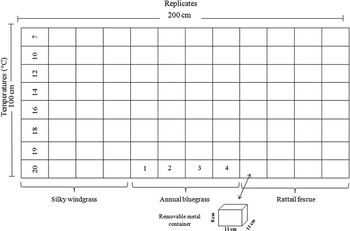
The effect of temperature on grass seed germination was studied on a temperature gradient table (Figure 1) manufactured at the Department of Agroecology in Flakkebjerg. Seed germination of the three species was tested at eight constant temperatures (7, 10, 12, 14, 16, 18, 19, and 20 C) in the dark. Two experiments were carried out, one in 2014 and one 2015. These were replicated in each year, making a total of four experiments. Each species by temperature treatment was replicated four times in the same experiment, totaling 96 experimental units (3 species by 8 temperatures by 4 replicates). The experiments performed in 2014 used the seed lot collected in 2013, while in 2015 the seed lot from 2014 was used.
Drawing of the temperature gradient table showing the temperature range and the placement of containers with the seeds on the table.

Seeds were placed on absorbent filter paper on the top of a 4-cm-tall metal support inside metal containers (11-cm width, 11-cm length, and 8-cm height), filled with 300 ml of water. The supports had an insertion in the middle where paper wicks were placed to suck up water from the water reservoir at the bottom of the containers.
The containers were filled with water 24 h prior to seed sowing and kept in a cooling room (4 C) to ensure the same water temperature in all units. Afterward, 50 seeds of each species were placed in separate containers and incubated for 24 h in the cooling room for seed imbibition. The temperature gradient table was switched on at least 24 h prior to the start of the trial to ensure that the correct temperatures were established when containers with seeds were set for germination.
Once the containers were on the temperature gradient table, they were all covered with a 3-cm layer of polystyrene. A plastic foil covering the whole table was placed on top of the polystyrene to ensure that the correct temperature was maintained in the containers. Germinated seeds were counted and removed daily until germination ceased, usually after 21 d. Seeds were considered germinated when the radicle exceeded 2 mm. The temperature in each container was recorded using two thermocouples, and the mean temperature values were used as a variable in the statistical analysis.
Effects of Low Temperatures
Seeds of the three grass species (2014 seed lot) were germinated in growth chambers at seven constant temperatures (1, 2, 3, 4, 5, 6, and 7 C) in the dark. Each species by temperature treatment consisted of 50 seeds placed on a double layer of absorbent filter paper in transparent plastic petri dishes (9-cm diameter). Aliquots of 4 ml of distilled water were added to each dish. The treatments were replicated four times, totaling 84 experimental units (3 species by 7 temperatures by 4 replicates). Germinated seeds were counted and removed daily over a period of 5 wk. Seeds were classified as germinated as described previously.
Influence of Water Potentials
Polyethylene glycol (PEG 6000, from Sigma-Aldrich Denmark ApS, 84 Kirkebjerg Allé, DK-2605, Broendby, Denmark) was used to prepare solutions with water potentials of 0 (pure distilled water), −0.05, −0.1, −0.25, −0.38, −0.50, −0.80, −1, and −1.5 MPa. The nine PEG solutions were prepared and warmed to germination temperature (15 C) according to Michel and Kaufmann (Reference Michel and Kaufmann1983). The experiment was carried out in 2015 and repeated in the same year with seeds from the three species collected in 2014. Each species by water potential treatment consisted of 50 seeds placed on a double layer of absorbent filter paper in transparent plastic petri dishes (9-cm diameter). The treatments were replicated four times, totaling 108 experimental units (3 species by 9 water potentials by 4 replicates).
Aliquots of 4 ml of PEG solution were added to each unit to obtain nonlimiting water conditions. The units were closed and encased with Parafilm M® (Sigma-Aldrich, Broendby, Denmark, DK-2605) to prevent evaporation and placed in an incubator at a constant temperature (15 C) in the dark. Germinated seeds were counted and removed daily over 20 d. Seeds were classified as germinated as described previously.
Statistical Analysis
A three-parameter log-logistic model (Equation 1) was fit to cumulative seed germination according to the time-to-event approach (Ritz et al. Reference Ritz, Pipper and Streibig2013):
 $$E\left( t \right)\, {\equals}\, {{d} \over {1{\plus}{\rm exp}\left[ {{ b}\left[ {{\rm log}\left( t \right){\minus}{\rm log}\left( {\rm T_{{50}} } \right)} \right]} \right]}}\, {\equals}\, {d \over {1{\plus}( {t \over {\rm T_{{50}} }})^{b} }}$$
where E is the cumulative seed germination at time t (equal to thermal time [degrees-day, Cd] or days), d is the upper limit representing the maximum germination (%) of the total number of seeds, T50 (or WP50) is the thermal time measured as thermal time (Cd), time (days), or water potential (−MPa), depending on the specific experiment, at which 50% of maximum seed germination (d) is achieved and b is the slope around T50 (WP50), denoting the germination rate.
The thermal time (Cd) was calculated using 0.6 C as the base temperature for silky windgrass and rattail fescue and 4.5 C for annual bluegrass for both seed lots. To estimate the base temperature (Tb) to attain Cd, the germination rate (1/T50) was regressed versus temperature using the data from the experiment with low temperatures. The base water potential (Ψb) was estimated using the same procedure, but regressing the germination rate (1/T50) versus water potentials. The abscissa intercept on the x-axis was assumed to be an estimate of the theoretical minimum temperature or water potential for germination (Tb or Ψb) (Patanè and Tringali Reference Patanè and Tringali2011; Patanè et al. Reference Patanè, Carvallaro and Consentino2009). Statistical confidence intervals (95%) for the base values were estimated by the bootstrap method (Efrom and Tibshirani Reference Efron and Tibshirani1993). Five thousand samples were taken from each species by randomly extracting one of the four replications for each temperature or water potential. The bootstrap distribution of the base estimates were used to determine a 95% confidence interval.
All statistical analyses were performed using R statistical software (R Core Team 2013) with the add-on package ‘drc’ (Ritz and Streibig Reference Ritz and Streibig2005). Full models were evaluated in which all three parameters, d, b, and T50, were dependent on experimental factors: temperature or water potential. For all experiments and species, the post hoc t-test was used to test whether the parameters differed between the temperatures and water potential (Ritz and Streibig Reference Ritz and Streibig2005). Models were successively reduced on the basis of F-tests when differences between parameters were not statistically significant.
Results and Discussion
Temperature Responses
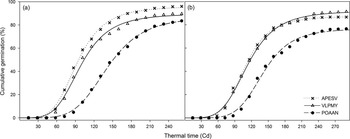
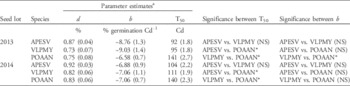
For all three species, cumulative seed germination was much faster at 20 C than at 7 C when germination time was expressed in days (unpublished data). For example, 50% of the seeds of rattail fescue germinated in approximately 5 d at 20 C, while a similar germination percentage was only reached after 13 d at 7 C. However, all relationships between cumulative germination and temperature sums could be described by the same parameters for each species and seed lot, irrespective of the eight constant temperatures under which the relationships were fit. Hence, data for cumulative germination patterns of silky windgrass, annual bluegrass, and rattail fescue were pooled across the eight constant temperatures and are shown as a function of thermal time (Cd) in Figure 2 with the estimated parameters (T50, d, and b) summarized in Table 1. The cumulative germination pattern is clearly S-shaped, and seed lot did not significantly affect the parameters T50 and b, which are the two parameters that primarily determine the shape of the curve and thus the germination pattern.
The relationships between cumulative germination and thermal time (Cd) for two seed lots of silky windgrass (APESV), rattail fescue (VLPMY), and annual bluegrass (POAAN). Seed lots were collected in (a) 2013 and (b) 2014. Observed values were pooled across eight constant temperatures and curves were fit using Equation 1, with parameter values given in Table 1.

Estimated parameter values (and SEs) from the curve fittings on the data shown in Figure 2 using Equation 1.

a Differences in the pattern of cumulative germination were tested between silky windgrass (APESV), rattail fescue (VLPMY), or annual bluegrass (POANN) within each seed lot for parameters T50 and b.
* Significance at the 5% level.
Comparisons for parameters T50 and b (germination rate) between the three species within seed lot are also shown in Table 1. T50 and b-values were not different between silky windgrass and rattail fescue within seed lots. However, annual bluegrass demonstrated a delayed emergence pattern compared with the other two species, with T50 values deviating for both seed lots. Germination rate (b) was only significantly different for the 2013 seed lot between annual bluegrass and the other two grasses.
Seeds from both seed lots of silky windgrass and rattail fescue required a temperature sum of approximately 60 Cd before germination was initiated, while annual bluegrass needed at least an extra 20 Cd to germinate. Furthermore, to reach 50% germination (T50) annual bluegrass required 40 Cd more than silky windgrass and rattail fescue.
The delayed germination pattern of annual bluegrass is probably related to its physiological requirements. Unlike the other species in this study, annual bluegrass is a non-strict winter annual weed that germinates readily whenever dormancy is broken and environmental conditions are adequate (Håkansson Reference Håkansson2003). Germination trials with both seed lots started approximately 6 mo after seed collection, and the storage was expected to be able to break primary dormancy of the seeds. Thus dormancy did not play a role in the present study.
Temperature is the main factor influencing the germination velocity of nondormant seeds (Batlla and Benech-Arnold Reference Batlla and Benech-Arnold2015). Therefore, it seems reasonable to think that there may be differences in temperature requirements in seeds of the three winter annuals investigated. Consequently, it is expected that germination responses of annual bluegrass are controlled more by environmental conditions than by dormancy, which is in accordance with the work of Shem-Tov and Fennimore (Reference Shem-Tov and Fennimore2003).
Effects of Low Temperatures
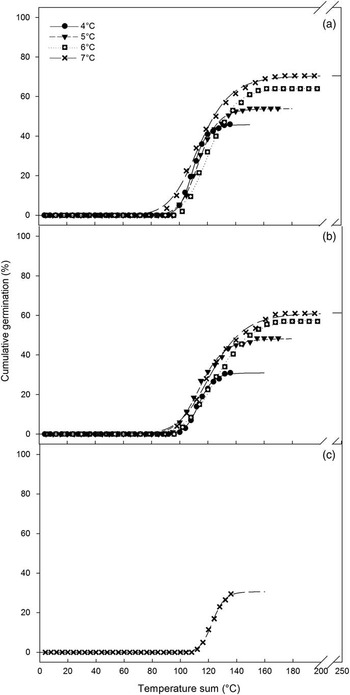
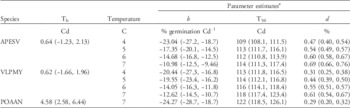
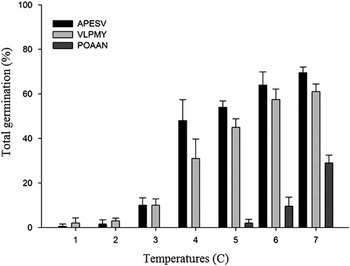
The germination patterns of silky windgrass, rattail fescue and annual bluegrass as affected by low-temperature treatments are shown in Figure 3, with parameter values provided in Table 2. Germination of silky windgrass and rattail fescue was observed for all temperatures. However, it was not possible to fit Equation 1 to the data for the temperatures of 1, 2, and 3 C. Some annual bluegrass germination was observed at 5 and 6 C (2% and 9% of total germination, respectively), but silky windgrass and rattail fescue reached more than 50% germination at these temperatures. At 1 and 2 C, less than 5% of the seeds of silky windgrass and rattail fescue germinated, with both species reaching 10% germination at 3 C.
Seeds of silky windgrass (a), rattail fescue (b), and annual bluegrass (c) germinated at four low temperatures and with germination percentages correlated to thermal time (Cd). Curves were fit to the observed data using Equation 1, with parameter values given in Table 2.

Estimated base temperature (Tb) and parameter values (with 95% confidence intervals) from the curve fittings shown in Figure 3 based on Equation 1. Numbers in parentheses represent CIs.

a Base temperature (Tb) was estimated for each species with the relation between germination rate (1/T50) vs. temperature. Seeds of silky windgrass (APESV), rattail fescue (VLPMY), and annual bluegrass (POAAN) were germinated at four low temperatures (4, 5, 6, and 7 C).
Silky windgrass and rattail fescue had similar germination patterns, with no significant differences between the b and T50 parameters for any temperatures (Table 2, comparisons not shown). An average temperature sum of 115 Cd was required for both species to reach 50% of total germination. The germination rate (b) of both species increased in a similar way with increasing temperature.
Seeds of annual bluegrass had lower germination at temperatures <7 C than the other two species, therefore Equation 1 could only be fit to the cumulative germination at 7 C. The T50 for this species was slightly higher than that for silky windgrass and rattail fescue; however, based on the confidence intervals, this difference is not significant. Nevertheless, the germination rate of annual bluegrass based on the confidence intervals was significantly slower than the other two species.
Total germination was greatly influenced by incubation temperature for each species (Figure 4). The species can be ranked according to their ability to germinate under low temperatures as silky windgrass=rattail fescue>annual bluegrass.
Total germination (%) of silky windgrass (APESV), rattail fescue (VLPMY), and annual bluegrass (POAAN) following exposure to seven temperatures. Error bars are SEs of the mean.

Final seed germination (parameter d) of silky windgrass and rattail fescue at 7 C was almost similar to the germination percentages found for higher temperatures. Thus, lower temperatures were needed to hamper seed germination of those two species in contrast to annual bluegrass, whose germination was completely inhibited by temperature <5 C.
Low final germination percentages are often linked to slow germination rates (Colbach et al. Reference Colbach, Dürr, Roger-Estrade, Chauvel and Caneill2006b), which in the case of this study, are correlated with low temperatures. This can partly be explained by the minimum temperature sum that these species require for the onset of germination processes being approximately 80 Cd for silky windgrass and rattail fescue and more than 100 Cd for annual bluegrass. In the case of very low temperatures (1, 2, and 3 C) more than 30 d of incubation would be needed for the onset of germination, and such a long period resulted in fungi and mold growth in the petri dishes that may have affected seed germinability. Under field conditions, seeds are also exposed to attacks from fungi, pathogens, and predation, especially those present near the soil surface (Davis and Renner Reference Davis and Renner2006). Thus, at low-temperature regimes, germination of these grass weeds can be reduced: the longer the nondormant seeds require before germination, the greater the chances of seed mortality.
It has been reported that winter annual grass species have a lower optimum temperature than perennial species (Lonati et al. Reference Lonati, Moot, Aceto, Cavallero and Lucas2009), and typically Tb below 4 C (Angus et al. 1981). Furthermore, previous studies have suggested that 0 C could be assumed as Tb for the germination of several winter annual grass weeds (Lonati et al. Reference Lonati, Moot, Aceto, Cavallero and Lucas2009; Moot et al. Reference Moot, Scott, Roy and Nicholls2000) such as smooth barley [Critesion glaucum (Steud.) A. Löve] and soft brome (Bromus mollis L.), showing up to 90% germination at 5 C (Monks et al. Reference Monks, Sadat-Asilan and Moot2009). These results are in accordance with the ones found in this study (Table 2) for silky windgrass and rattail fescue, which showed a base temperature close to zero (0.6 C). However, the base temperature estimated for annual bluegrass (4.5 C) was significantly higher than the other two species, indicating that this species had higher temperature requirements for germination in this study. Monks et al. (Reference Monks, Sadat-Asilan and Moot2009) reported for some grass species, such as ripgut brome (Bromus diandrus Roth), a response to temperature during germination similar to annual bluegrass, with very low germinability at 5 C and a suggested Tb of 4 C.
Influence of Water Potentials
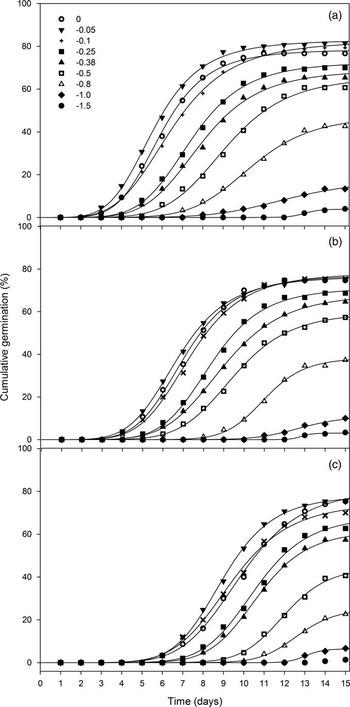
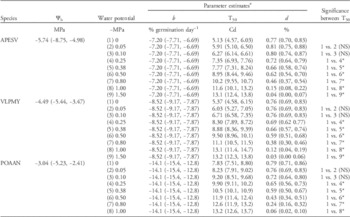
The cumulative germination patterns of silky windgrass, annual bluegrass, and rattail fescue over time as a function of nine water potentials are shown in Figure 5, with estimated parameters shown in Table 3 (data from experiments replicated in time were pooled). The very low water potentials (<−0.8 MPa) were not able to prevent seeds from germinating completely. However, all species demonstrated a delay in germination for water potentials ≤−0.25 MPa based on comparisons of T50 values. Significant differences were not found between the water potentials 0, −0.05, and −0.10 MPa for any of the three species, as shown in Table 3. Moreover, annual bluegrass seed germination at −1.5 MPa was very low, and Equation 1 could not be fit to the data.
Cumulative germination (%) of silky windgrass (a), rattail fescue (b), and annual bluegrass (c) in relation to time (days) shown for nine water potentials (−MPa). Curves were fit to observed values using Equation 1, with parameter values given in Table 3.

Estimated base water potential (Ψb) and parameter values (with 95% confidence intervals) from the curve fittings on the data shown in Figure 5 using Equation 1.

a Base water potential was estimated for each species with the relation between germination rate (1/T50) vs. water potentials. Comparison between T50 values within species are shown for seed germination of silky windgrass (APESV), rattail fescue (VLPMY), and annual bluegrass (POAAN) exposed to nine different water potentials.
* Significance at the 5% level.
The ability to germinate under limiting water conditions is in accordance with the base water potential (Ψb) values estimated for the three species (Table 3). Base water potential values showed that the range of water potentials studied in the experiment were higher than those needed for germination. Furthermore, annual bluegrass had a higher Ψb requirement, followed by rattail fescue and silky windgrass. Nevertheless, based on the confidence intervals, the Ψb estimates were not significantly different between the species, because these estimations were made with great uncertainty, resulting in large confidence intervals.
Annual bluegrass required approximately 8 d to reach 50% germination under no moisture stress (0 MPa), which corresponds to the T50 values estimated for silky windgrass and rattail fescue at −0.5 and −0.8 MPa, respectively. This is in accordance with the previous experiment, in which annual bluegrass also exhibited a germination delay of approximately 4 d compared with the other two species.
Total germination of all three grass species was greatly reduced by water potentials ≤−0.25 MPa in comparison with 0 MPa (no water limitations). The grass weeds were able to germinate under low water potential (−1.0 MPa), with 15%, 10%, and 7% of all seeds germinating for silky windgrass, rattail fescue, and annual bluegrass, respectively. The lower water potential (−1.5 MPa) caused significant limitations on seed germination for all three species, both in terms of total germination and rate of germination, though their germination was not totally inhibited.
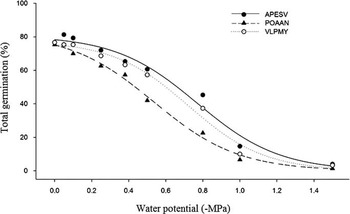
To illustrate the impact of water potential on maximum germination, the percentage of total germination is shown in Figure 6 as a function of the water potential, and the estimated parameter values and statistical comparisons between parameters (WP50, b, and d) are shown in Table 4. The maximum germination rate was reduced by 50% when water potentials were reduced to −0.76, −0.71, and −0.55 MPa for silky windgrass, rattail fescue, and annual bluegrass, respectively. Comparisons between the species revealed that annual bluegrass was less tolerant to water stress than the other species.
The relationships between total germination (%) of silky windgrass (APESV), rattail fescue (VLPMY), and annual bluegrass (POAAN) and nine water potentials (−MPa). Curves were fit to observed values using Equation 1, with parameter values given in Table 4.

Estimated parameter values (and SEs) from the curve fittings on the data shown in Figure 6 using Equation 1. Numbers in parentheses represent CIs.

a Differences in the total germination between species were tested for parameters WP50, slope (b), and upper limit (d) for silky windgrass (APESV), rattail fescue (VLPMY), and annual bluegrass (POAAN), respectively.
b WP50 corresponds to T50 in Equation 1, but here it is the water potential to reach 50% of total germination.
* Significance at the 5% level.
Several authors have reported germination of grass species at low water potentials. Roundy (Reference Roundy1995) found that tall wheatgrass [Agropyron elongatum (Host.) Beauv.] and basin wildrye [Leymus cinereus (Scribn. & Merr.) Á. Löve], both common grasses in North America, germinated at water potentials down to −2.0 MPa, although germination declined rapidly below −0.5 MPa. Sharma (Reference Sharma1976) found similar results for common wallaby grass (Danthonia caespitosa Gaud.), which displayed limited germination at −1.5 MPa. Pangolagrass [Digitaria eriantha Steud. subsp. pentzii (Stent) Kok.], when exposed to water stress, showed a reduction in total germination, although some germination could still be observed at a very low water potential (−1.5 MPa) (Brevedan et al. Reference Brevedan, Busso, Fioretti, Toribio, Baioni, Torres, Fernández, Giorgetti, Bentivegna, Entío, Ithurrart, Montenegro, Mujica, de las, Rodríguez and Tucat2013). Finally, some germination of sideoats grama [Bouteloua curtipendula (Michx.) Torr.], kleingrass (Panicum coloratum L.), bufflegrass (Cenchrus ciliaris L.), and Lehmann lovegrass (Eragrostis lehmanniana Nees) was observed at water potentials as low as −1.2 MPa (Emmerich and Hardegree Reference Emmerich and Hardegree1991).
The hypothesis that the three grass species respond differently to temperature and water potentials was only partly supported. Silky windgrass and rattail fescue showed very similar germination behavior under the different scenarios studied, indicating that they may also behave similarly under field conditions. Nevertheless, annual bluegrass demonstrated a different germination pattern, requiring higher temperatures but the same moisture levels to germinate.
The overall conclusions from this study are that the effects of temperature are similar for silky windgrass and rattail fescue but different from annual bluegrass. The three grass species often occur together in the same field winter cereals in northern Europe. The different germination behavior of annual bluegrass indicates that timing of control measures should be optimized to target all three species correctly. The soil-applied herbicide prosulfocarb has been widely used to control grass species prior to emergence of the winter cereals (Bailly et al. Reference Bailly, Dale, Archer, Wright and Kaundun2012). This herbicide has residual effects in the soil, with a half-life of 8 to 35 d under field conditions (Pesticide Properties Database [PPDB] 2009). Prosulfocarb shows high efficacy against silky windgrass and annual bluegrass (Adamczewski et al. Reference Adamczewski, Kierzek, Urban and Pietryga2009). However, its efficacy against rattail fescue depends strongly on the timing of application; only plants with maximum one leaf are sensitive (Dillon and Forcella 1994; Hull et al. Reference Hull, Mathiassen and Moss2011). Therefore, timing of direct management strategies against these grass weeds has to target mainly rattail fescue germination and emergence. Based on the results from this study, the adoption of direct management strategies targeting rattail fescue would also control silky windgrass, since they show a very similar germination pattern. Furthermore, even though annual bluegrass germinates later, it will still be controlled as long as prosulfocarb is mixed with an herbicide like pendimethalin, which has a much longer half-life (ca. 100 d; PPPD 2009).
The results also show that all three species were able to germinate under low water potential (−1.0 MPa), but germination was hampered when water potentials were beyond −0.25 MPa. This means that the establishment of winter cereals under very dry conditions can lead to delayed emergence of the grasses, which needs to be taken into account when timing control actions. However, drought periods, and thus soil water contents that can severely affect the germination of these grasses, re rarely seen in the humid climates of northern Europe. Therefore, temperature variations would normally have a greater influence on the germination of these grass species than soil moisture conditions.
Acknowledgments
We would like to thank the Danish Ministry of Food, Agriculture and Fisheries and the Science without Borders Programme of Brazil for funding this research. Technicians Eugene Driessen and Karen Bjørn Heinager are acknowledged for their skilful technical assistance.