1. Introduction
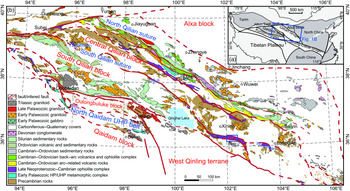
The Qilian Orogen is located on the northern margin of the Tibetan Plateau and adjacent areas, including the Qaidam Block to the south, the Tarim Block to the NW and the Alxa Block to the NE (Fig. 1a). It is a typical accretionary-collisional orogenic belt which connects with the eastern Qinling Orogen and SW Kunlun Orogen (Fig. 1a). It is considered to have developed as a result of the closure of the Proto-Tethyan Ocean and consists of two suture zones (the South Qilian suture to the south and the North Qilian suture to the north) sandwiched between the Alxa, Central Qilian and South Qilian blocks (Fig. 1b; Xiao et al. Reference Xiao, Windley, Yong, Yan, Yuan, Liu and Li2009; Gehrels et al. Reference Gehrels, Kapp, DeCelles, Pullen, Blakey, Weislogel, Ding, Guynn, Martin, McQuarrie and Yin2011; Yan et al. Reference Yan, Aitchison, Fu, Guo, Niu, Xia and Li2015; Zhang et al. Reference Zhang, Yu, Li, Yu, Lin and Mao2015a; Xia et al. Reference Xia, Li, Yu and Wang2016; Fu et al. Reference Fu, Yan, Wang, Buckman, Aitchison, Niu, Cao, Guo, Li, Li and Li2018a, 2019a; Li et al. Reference Li, Zhao, Liu, Cao, Yu, Li, Somerville, Yu and Suo2018a; Zuza et al. Reference Zuza, Wu, Reith, Yin, Li, Zhang, Zhang, Wu and Liu2018). To constrain the evolutionary history of the Qilian Orogen, previous researchers have investigated the ophiolite, island-arc, accretionary complex and igneous rocks associated with subduction, and collisional and post-collisional magmatism from geochronology, geochemistry and Sr–Nd–Hf isotopic compositions (Qian et al. Reference Qian, Zhang and Sun2001; Xiao et al. Reference Xiao, Windley, Yong, Yan, Yuan, Liu and Li2009; Tseng et al. Reference Tseng, Yang, Yang, Liu, Wu, Cheng, Chen and Ker2009; Wu et al. Reference Wu, Xu, Gao, Li, Lei, Gao, Frost and Wooden2010; Guo et al. Reference Guo, Li, Zhang, Gao, Li, Kong and Qian2015; Zhang et al. Reference Zhang, Li, Wang and Gao2015b; Xia et al. Reference Xia, Li, Yu and Wang2016; Wang et al. 2017a; Fu et al. Reference Fu, Kusky, Wilde, Polat, Huang and Zhou2018c; Cui et al. Reference Cui, Tian, Sun and Yang2019; Yan et al. Reference Yan, Fu, Aitchison, Buckman, Niu, Cao, Sun, Guo, Wang and Zhou2019a; Yang et al. Reference Yang, Song, Su, Allen, Niu, Zhang and Zhang2019a; Li et al. Reference Li, Xu, Yu, Zhang, Guo, Peng and Zhou2019b). Several models such as N-wards subduction (Xu et al. Reference Xu, Xu, Zhang, Li, Zhu, Qu, Chen, Chen and Yang1994; Song et al. Reference Song, Niu, Li and Xia2013; Huang et al. Reference Huang, Niu, Nowell, Zhao, Yu and Mo2015; Yang et al. Reference Yang, Zhang, Luo, Zhang, Xiong, Gao and Pan2015; Cui et al. Reference Cui, Tian, Sun and Yang2019; Fu et al. Reference Fu, Yan, Jonathan, Xiao, Buckman, Wang, Li, Li and Ren2020), S-wards subduction (Gehrels et al. Reference Gehrels, Kapp, DeCelles, Pullen, Blakey, Weislogel, Ding, Guynn, Martin, McQuarrie and Yin2011; Li et al. Reference Li, Tong, Zhu, Lin, Zheng and Brouwer2018c), double subduction (Wu et al. Reference Wu, Xu, Gao, Li, Lei, Gao, Frost and Wooden2010; Zhang et al. 2015; Wang et al. Reference Wang, Wang, Yan and Lin2018a) and multiple-accretionary (Yan et al. Reference Yan, Xiao, Wang and Li2007, Reference Yan, Xiao, Windley, Wang and Li2010; Xiao et al. Reference Xiao, Windley, Yong, Yan, Yuan, Liu and Li2009) have been proposed to explain the subduction history of the Proto-Tethyan Ocean during the Cambrian–Ordovician period. However, the collisional timing between these micro-blocks and subsequent tectonic evolution (Late Ordovician – Silurian) are still in debate. For example, Zhang et al. (2017) studied the Silurian (440–414 Ma) intrusive magmatism in the North Qilian and suggested that < 445 Ma magmatism was formed in a post-collisional setting. Huang et al. (Reference Huang, Niu, Nowell, Zhao, Yu and Mo2015) performed Nd–Hf isotope modelling to test the role of Archaean basement in the formation of c. 450 Ma magmatism within the Central Qilian and South Qilian blocks, and further suggested that the Late Ordovician igneous rocks (c. 450 Ma) were the products in response to the closure of the Proto-Tethyan Ocean. However, Li et al. (Reference Li, Li, Yu, Santosh, Zhao, Guo, Cao, Wang and Huang2018b) suggested that the lower Silurian andesitic-dacitic volcanic rocks in Yanjiasi-Chenjiahe regions were formed in continental arc and back-arc settings during the S-wards subduction of the North Qilian Ocean, implying that the closure of the Proto-Tethyan Ocean was not finished before 438 Ma. An understanding of the tectonic setting of these Upper Ordovician –Silurian igneous rocks is therefore critical to decipher the evolutionary history of the Qilian Orogen.
(a) Tectonic framework of China and location of the Qilian Orogen, NW China. (b) Geological map of the Qilian Orogen and the location of study area (modified after Fu et al. Reference Fu, Yan, Wang, Buckman, Aitchison, Niu, Cao, Guo, Li, Li and Li2018a, 2020).

The South Qilian suture is located between the Central Qilian and South Qilian blocks and contains relics of the early Palaeozoic intra-oceanic trench-arc system which recorded the subduction history of the South Qilian Ocean (southern branch of the Proto-Tethyan Ocean in the Qilian Orogen; Yan et al. Reference Yan, Fu, Aitchison, Buckman, Niu, Cao, Sun, Guo, Wang and Zhou2019a; Fu et al. Reference Fu, Yan, Wang, Buckman, Aitchison, Niu, Cao, Guo, Li, Li and Li2018a, 2019b). In this district, Upper Ordovician volcanic rocks and Upper Ordovician – Silurian fluvial sedimentary rocks have been reported and considered as the result of the collision between the micro-continental blocks. However, the Silurian igneous rocks have not been identified and recognized before, leading to the absence of tectonic evolution during the Silurian period. In this study, we report newly recognized lower Silurian subvolcanic rocks from the Lajishan district within the South Qilian suture zone. Zircon laser ablation inductively coupled plasma mass spectrometry (LA-ICP-MS) U–Pb ages, whole-rock major- and trace-element data and Sr-Nd isotopic compositions are presented to better understand the petrogenesis of these subvolcanic rocks. Combined with knowledge of regional geology, the tectonic setting and implications are discussed to further constrain the evolutionary history and closure timing of the South Qilian Ocean.
2. Regional geological setting
The Qilian orogenic belt is a pronounced orogenic collage of the Tethyan tectonic domain in the NE Tibetan Plateau and is bounded by the Altyn–Tagh Fault to the west, a Cenozoic basin along the Qinling–Dabie orogen to the SE and the Longshoushan Fault to the NE (see Fig. 1a). It mainly consists of two suture zones (the North Qilian and South Qilian suture zones), which separate the Central Qilian block and the South Qilian block (see Fig. 1b; Xiao et al. Reference Xiao, Windley, Yong, Yan, Yuan, Liu and Li2009; Gehrels et al. Reference Gehrels, Kapp, DeCelles, Pullen, Blakey, Weislogel, Ding, Guynn, Martin, McQuarrie and Yin2011; Yan et al. Reference Yan, Aitchison, Fu, Guo, Niu, Xia and Li2015; Zhang et al. Reference Zhang, Yu, Li, Yu, Lin and Mao2015a; Xia et al. Reference Xia, Li, Yu and Wang2016; Fu et al. Reference Fu, Yan, Wang, Buckman, Aitchison, Niu, Cao, Guo, Li, Li and Li2018a, 2019b; Li et al. Reference Li, Zhao, Liu, Cao, Yu, Li, Somerville, Yu and Suo2018a; Zuza et al. Reference Zuza, Wu, Reith, Yin, Li, Zhang, Zhang, Wu and Liu2018). The Central Qilian and South Qilian blocks are mainly composed of Precambrian lower greenschist- to amphibolite-facies metamorphic rocks and considered as mircocontinental fragments which rifted from South China (Wan et al. Reference Wan, Xu, Yang and Zhang2003, Reference Wan, Zhang, Yang and Xu2006; Tung et al. Reference Tung, Yang, Liu, Zhang, Yang, Shau and Tseng2012; Yan et al. Reference Yan, Aitchison, Fu, Guo, Niu, Xia and Li2015; Li et al. Reference Li, Tong, Zhu, Lin, Zheng and Brouwer2018c, 2020). In other literature, the South Qilian block was usually considered as a wide subduction–accretion complex named the South Qilian Belt (Song et al. Reference Song, Niu, Su, Zhang and Zhang2014; Zhang et al. Reference Zhang, Song, Yang, Su, Niu, Allen and Xu2017b) as a result of the discovery of numerous arc-like volcanic rocks and Silurian flysch related to subduction (Yan et al. Reference Yan, Aitchison, Fu, Guo, Niu, Xia and Li2015).
Systematic lithological, geochemical and geochronological studies indicated that the South Qilian Block was accreted to the south margin of the Central Qilian Block during the early Palaeozoic Era (Xiao et al. Reference Xiao, Windley, Yong, Yan, Yuan, Liu and Li2009; Yan et al. Reference Yan, Aitchison, Fu, Guo, Niu, Xia and Li2015, Reference Yan, Fu, Aitchison, Zhou, Buckman and Chen2020; Fu et al. Reference Fu, Zhen, Guo, Niu, Cao, Wu, Li and Wang2019b). It was then intruded by later subduction-related igneous rocks (arc-like volcanic rocks and gabbros) and overlain by Silurian flysch that covered the central part of the South Qilian Block (Fig. 2). We suggest that it is mainly composed of Precambrian base (Ma et al. Reference Ma, Jia, Li, Ma, Lei, Ren and Xu2017; Fu et al. Reference Fu, Zhen, Guo, Niu, Cao, Wu, Li and Wang2019b; Li et al. Reference Li, Wang, Li, Meert, Peng and Zhang2019a) and was accreted to the Central Qilian Block during early Palaeozoic time. Later igneous rocks and Silurian flysch associated with subduction and collision developed and overlapped on the Precambrian base. We therefore named this the South Qilian Block.
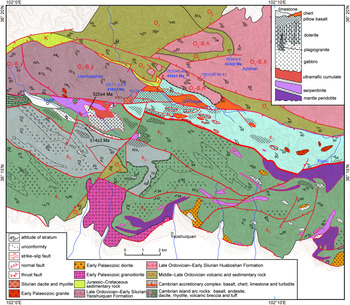
Geological map of the central part of the South Qilian suture with sampling localities and ages (modified after Fu et al. Reference Fu, Yan, Wang, Buckman, Aitchison, Niu, Cao, Guo, Li, Li and Li2018a; Yan et al. Reference Yan, Fu, Aitchison, Buckman, Niu, Cao, Sun, Guo, Wang and Zhou2019a).

The North Qilian suture zone is dominated by a typical Marianan-type intra-oceanic subduction system including accretionary complex, ophiolite, seamount, island arc and back-arc/fore-arc basins (Xiao et al. Reference Xiao, Windley, Yong, Yan, Yuan, Liu and Li2009; Tseng et al. Reference Tseng, Yang, Yang, Liu, Wu, Cheng, Chen and Ker2009; Wu et al. Reference Wu, Xu, Gao, Li, Lei, Gao, Frost and Wooden2010; Yan et al. Reference Yan, Xiao, Windley, Wang and Li2010; Yang et al. Reference Yang, Du, Cawood and Xu2012; Song et al. Reference Song, Niu, Li and Xia2013; Zhang et al. Reference Zhang, Zhang, Zhang, Xiong, Luo, Yang, Pan, Zhou, Xu and Guo2017a), which have been extensively studied in previous literature. The South Qilian suture zone is mainly composed of Cambrian ophiolite complex and volcano-sedimentary rocks, Ordovician intrusive and volcanic rocks, and latest Ordovician–Silurian sedimentary rocks (Wang & Liu, Reference Wang and Liu1976; Qiu et al. Reference Qiu, Zeng, Wang and Zhu1995; Yang et al. Reference Yang, Deng and Wu2002; Wang et al. Reference Wang, Wang, Wang, Lu, Wang and Santosh2018b; Fu et al. Reference Fu, Yan, Guo, Niu, Xia, Wang and Li2014, Reference Fu, Yan, Wang, Buckman, Aitchison, Niu, Cao, Guo, Li, Li and Li2018a, 2019b; Zhang et al. Reference Zhang, Long, Dong, Li, Gao and Zhao2019). These rocks are exposed discontinuously along the northern margin of the South Qilian Block and are preserved in the Lajishan area (Fig. 1b); other researchers (e.g. Qinghai Geological Survey Institute) also referred to the South Qilian suture as the Lajishan suture (Wang & Liu Reference Wang and Liu1976; Fu et al. Reference Fu, Yan, Wang, Buckman, Aitchison, Niu, Cao, Guo, Li, Li and Li2018a; Yan et al. Reference Yan, Fu, Aitchison, Niu, Buckman and Cao2019b). In this district, the Cambrian ophiolite complex is typical of a super-subduction zone ophiolite, which is composed of ultramafic rocks (e.g. amphibolite, peridotite and serpentinite), gabbro, plagiogranite, dolerite and pillow lava as revealed by the stratigraphic column of ophiolite complex in Figure 2 (Fu et al. Reference Fu, Yan, Wang, Buckman, Aitchison, Niu, Cao, Guo, Li, Li and Li2018a, 2019a; Yan et al. Reference Yan, Fu, Aitchison, Buckman, Niu, Cao, Sun, Guo, Wang and Zhou2019a).
The Cambrian volcano-sedimentary rocks contain pillow basalt, chert, limestone, mélange, tuff, massive basalt, andesite and dacite, representing a dismembered intra-oceanic arc-accretionary complex (Fu et al. Reference Fu, Yan, Wang, Niu, Guo, Yu and Li2018b, 2019a; Yan et al. Reference Yan, Fu, Aitchison, Buckman, Niu, Cao, Sun, Guo, Wang and Zhou2019a, b). The Ordovician intrusive rocks (including diorite, granodiorite and granite) intrude the Cambrian arc-accretionary complex and are interpreted as being associated with subduction and/or collision (Fu et al. Reference Fu, Yan, Wang, Buckman, Aitchison, Niu, Cao, Guo, Li, Li and Li2018a; Cui et al. Reference Cui, Tian, Sun and Yang2019). The Upper Ordovician volcanic rocks (andesite, tuff and volcanic breccia) are considered to have been generated in a collisional setting (Sun et al. Reference Sun, Niu, Li, Wu, Cai, Yuan, Wen and Li2019). Further, the strata described above are non-conformably overlain by the latest Ordovician–Silurian sedimentary rocks that are mainly distributed along the northern margin of the South Qilian suture.
3. Sampling, field and petrographic descriptions
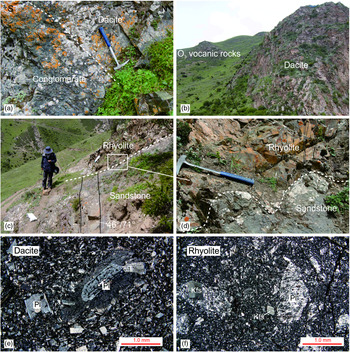
Thirteen subvolcanic samples with slight alteration were collected from Lianhuashan (15LT1, 15LT2, 15LT5, 15LT9, 15LT11), Ayishan (16GK4, 16GK5, 16GK6) and Shihuiyao (15DG36, 15DG48, 15DG49, 15DG40, 15DG41) in the South Qilian suture, and we also collected one sample c. 3.5 m from a subvolcanic dyke; the sampling locations are shown in Figure 2. Based on the observations of field outcrops, hand specimens and photomicrographs, we classify these samples into two types of subvolcanic rocks, dacite and rhyolite, respectively. At Lianhuashan, dacite dykes with a near-EW trend intrude O3-S1 sedimentary strata of the Yaoshuiquan formation. These dykes range in thickness from 3 to 15 m and have lateral extents of 20–80 m. They have sharp contacts with their host rocks (Fig. 3a). They are grey in colour and fine-grained, with plagioclase phenocrysts visible in hand specimens. We collected five samples from two different dykes (Fig. 2). At Ayishan, dacite dykes with a near-EW trend intrude Upper Ordovician volcanic rocks. These dykes range in thickness from c. 12 to 21 m and have lateral extents of c. 60 m. They have sharp contacts with their host rocks (Fig. 3b). They are light-grey in colour and fine-grained, with plagioclase phenocrysts visible in hand specimens. We collected three samples from one dyke. At Shihuiyao, rhyolite dykes with a near NW trend intrude O3-S1 sedimentary strata of the Huabaoshan formation. These dykes range in thickness from 1 to 10 m and have lateral extents of 20–60 m. They have sharp contacts with their host rocks (Fig. 3c, d). They are white grey in colour and fine-grained, with plagioclase and K-feldspar phenocrysts visible in hand specimens. We collected five samples from two different dykes (Fig. 2).
Representative photographs of field relationships and photomicrographs of the lower Silurian subvolcanic rocks from the South Qilian suture. (a) Lianhuashan dacites intruded conglomerate of the Yaoshuiquan formation (36° 17' 15.7" N, 102° 4' 12.4" E); (b) Ayishan dacites intruded the Upper Ordovician volcanic rocks (36° 18' 41.4" N, 102° 8' 24.7" E); (c, d) Shihuiyao rhyolites intruded sandstone of the Huabaoshan formation (36° 17' 40.1" N, 102° 6' 45.7" E); (e, f) photomicrographs under cross-polarized transmitted light, exhibiting obvious porphyritic texture comprising euhedral/subhedral phenocrysts and matrix; the phenocryst minerals mainly comprise plagioclase and minor K-feldspar. The size of the phenocrysts ranges over 0.10–1.6 mm. The matrix is mainly composed of plagioclase microlites and cryptocrystalline-glassy materials. Kfs – K-feldspar; Pl – plagioclase.

Dacites exhibit a typical porphyritic texture consisting of euhedral/subhedral phenocryst and matrix. The subhedral phenocrysts of plagioclase (1.6–0.10 mm) are more than 90 vol.%, whereas the matrix are less than 10 vol.% and comprise plagioclase microlites and cryptocrystalline-glassy materials (opaque minerals in Fig. 3e). Some of plagioclase phenocrysts have cores surrounded by altered or reacted rims. These rhyolites are grey-white and reveal a porphyritic texture as shown by photomicrograph under cross-polarized light. They also have subhedral phenocrysts comprising plagioclase and K-feldspar, and matrix consisting of plagioclase microlites and cryptocrystalline-glassy materials (Fig. 3f). No hydrous minerals (e.g. biotite, amphibolite) were found in these subvolcanic rocks.
4. Analytical methods
4.a. Zircon U–Pb dating
To determine the intrusion age of subvolcanic rocks, we collected three representative samples (15LT6, 16GK4, 15DG48) on which to perform LA-ICP-MS U–Pb dating of zircons. Zircon grains were separated from these samples using heavy-liquid and magnetic separation techniques. The separated zircons were hand-picked under a binocular microscope and mounted in epoxy resin, and were then polished to expose the centres of the zircon grains. To visualize the internal structure and select potential targets for U–Pb analysis, cathodeluminescence (CL) images (Fig. 4) were obtained using a scanning electron microscope at Beijing Createch Testing Technology Co. Ltd. Measurement of U, Th and Pb isotopes was performed using an Agilent 7500a LA-ICP-MS. An ESI NWR 193-nm laser-ablation system and an AnalytikJena PQMS Elite ICP-MS were combined for the experiments. A beam size of 25 μm was used for all samples. Zircon 91500 and Si in NIST SRM 610 were used for external calibration, and Zr was used as the internal standard (Liu et al. Reference Liu, Hu, Zong, Gao, Gao, Xu and Chen2010). Detailed protocols and analytical methods are described in Li et al. (Reference Li, Liu, Li, Guo and Chamberlain2009). Off-line raw data selection, the integration of background and analytical signals, and time-drift correction and quantitative calibration for U–Pb dating were all performed using ICP-MS DataCal (Liu et al. Reference Liu, Hu, Zong, Gao, Gao, Xu and Chen2010). Measured compositions were corrected for common Pb using non-radiogenic 204Pb, but corrections were found to be sufficiently small to be insensitive to the choice of common Pb composition. An average value of the present-day crustal composition (206Pb/204Pb=18.700; Stacey & Kramers, Reference Stacey and Kramers1975) was therefore used for the common Pb correction (assuming that common Pb is largely related to surface contamination introduced during sample preparation). Uncertainties on individual analyses are included in the data tables and are reported at a 1σ level. Mean ages for pooled U/Pb (and Pb/Pb) analyses are quoted within the 95% confidence interval. Data reduction was conducted using the Isoplot/Ex v. 3.0 program (Ludwig, Reference Ludwig2001).
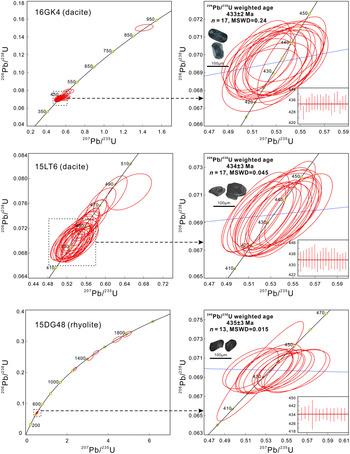
U–Pb concordia diagrams for dacites (16GK4, 15LT6) and rhyolite (15DG48) from the South Qilian suture. CL images of representative grains are also shown.

4.b. Whole-rock major and trace elements
Thirteen subvolcanic rock samples were chosen for analysis of major and trace elements and then pulverized to less than 200 mesh. A Phillips PW4400 sequential X-ray fluorescence spectrometer (XRF) with Rh-anode tube was used to measure the major-element oxides at the National Research Center for Geoanalysis, Chinese Academy of Geological Sciences, following the detailed analytical methods described in the article by Liu et al. (Reference Liu, Zong, Kelemen and Gao2008). All major-element oxide concentrations are reported on a volatile-free basis. Detection limits are < 0.01% for major elements. Trace elements, including rare earth elements (REEs), were fused-glassed dissolved in nitric acid, and measured by ICP-MS using a VG Elemental PQII Plus system. Rh was added as an internal standard to 1% HNO3 following the procedures of Liang et al. (Reference Liang, Jing and Gregoire2000). The international standard reference materials (e.g. GSR1 and GSR3) were used to monitor the stability and accuracy of the instrument during analyses. Accuracy and precision of the data are better than 5% for trace elements.
4.c. Sr–Nd isotopic analysis
Five subvolcanic rock samples from the South Qilian suture were chosen for Sr and Nd isotopic analyses. Firstly, sample powders were dissolved in an acidic mixture of HNO3 (1 mL), and HF (4 mL) in Teflon bombs on a hotplate at 150°C for 48 hours. The acid was then dried to incipient dryness and the digestion process was repeated. Solutions were separated by cation and HDEHP-coated columns using conventional cation-exchange techniques. We followed the procedures described by Li et al. (Reference Li, Li, Li, Guo and Yang2012) for sample preparation and chemical separation. Sr–Nd isotopic measurements were performed on a Thermo Fisher Scientific Neptune Plus MC-ICP-MS at the Beijing Createch Testing Technology Co. Ltd. Mass fractionation corrections for Sr and Nd isotopic ratios are based on 86Sr/88Sr = 0.1194 and 146Nd/144Nd = 0.7219, respectively. The 87Sr/86Sr ratio of the NIST SRM 987 (formerly NBS 987) Sr standard was 0.710258 ± 7 (2σ), and the measured 143Nd/144Nd ratios of the La Jolla and JNDI-1 Nd standard solutions were 0.511841 ± 3 (2σ) and 0.512104 ± 5 (2σ), respectively (Tanaka et al. Reference Tanaka, Togashi, Kamioka, Amakawa, Kagami, Hamamoto, Yuhara, Orihashi, Yoneda, Shimizu, Kunimaru, Takahashi, Yanagi, Nakano, Fujimaki, Shinjo, Asahara, Tanimizu and Dragusanu2000; Weis et al. Reference Weis, Kieffer, Maerschalk, Barling, de Jong, Williams, Hanano, Pretorius, Mattielli, Scoates, Goolaerts, Friedman and Mahoney2006).
5. Results
5.a. Zircon U–Pb ages
Three representational samples (16GK4, 15LT6, 15DG48) were selected from subvolcanic rocks in the South Qilian suture for zircon U–Pb dating. Complete U–Pb isotopic data for these zircons are presented in Table 1. LA-ICP-MS data for 16GK4, 15LT6 and 15DG48 yielded weighted mean average 206Pb/238U ages of 433 ± 2 Ma (1σ; mean square weighted deviation (MSWD), 0.24), 434 ± 3 Ma (1σ; MSWD, 0.045) and 435 ± 3 Ma (1σ; MSWD, 0.015) (Fig. 4), respectively. All of the analysed spots have high U (176–2631 ppm) and Th (32.7–856 ppm) contents with relative low Th/U ratios of 0.01–1.58 (mostly greater than 0.1), which suggests that these zircons have a magmatic origin (Belousova et al. Reference Belousova, Griffin, Reilly and Fisher2002; Wu et al. Reference Wu, Yang, Yang, Wooden, Shi, Chen and Zheng2004). This is also supported by the scallop-like and oscillatory zoning texture in CL imagine (Fig. 4). Some inherited zircon grains in these samples were dated. Most of the inherited zircons are of Ordovician – early Silurian age with 206Pb/238U ages ranging from 440 to 486 Ma. Five analyses from 15LT6 yield older 206Pb/238U ages of 1231–1803 Ma (late Palaeoproterozoic to Mesoproterozoic) and one analysis from 15GK4 gave a slightly older 206Pb/238U age of 903 Ma (Neoproterozoic). The 206Pb/238U ages are not correlated with U content (Fig. 5), suggesting that ages are not affected by the high U-matrix affect and radiation damage (White & Ireland, Reference White and Ireland2012; Gao et al. Reference Gao, Li, Griffin, O’Reilly and Wang2014). We therefore interpret these zircon U–Pb ages as the intrusion time of the subvolcanic rocks in the South Qilian suture.
LA-ICP-MS U–Pb isotopic compositions and ages of zircon from the lower Silurian subvolcanic rocks of the South Qilian suture

Plot of zircon U versus 206Pb/238U ages for dacites and rhyolites from the South Qilian suture. 206Pb/238U ages are not correlated with U contents of these lower Silurian subvolcanic rocks, suggesting that they are not affected by the high-U matrix affect and radiation damage.

5.b. Major- and trace-element geochemistry
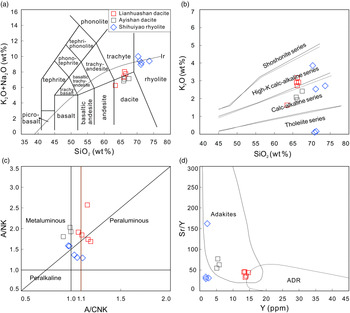
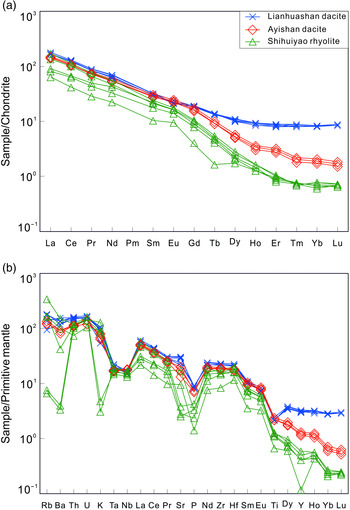
Data for major and trace elements of 13 subvolcanic rock samples are listed in Table 2. In the K2O+Na2O versus SiO2 (TAS) diagram (Fig. 6a), samples are classified into dacites and rhyolites with loss-on-ignition (LOI) values ranging from 0.70 to 4.30 wt%. The samples of dacite display SiO2 (61.43–65.13 wt%), high Al2O3 (15.76–19.11 wt%) and Fe2O3 T (3.46–4.42 wt%), and low MgO (0.85–1.36 wt%) and Mg no. (29.05–39.97). Instead, the samples of rhyolite have low K2O (0.09–3.81 wt%) concentrations and higher K2O/Na2O ratios (0.01–0.64). Most samples fall in the high-K calc-alkaline and calc-alkaline fields in the K2O–SiO2 diagram (Fig. 6b), and all show weakly metaluminous–peraluminous affinity with A/CNK indexes of 0.92–1.20 in the A/CNK–A/NK diagram (Fig. 6c). Notably, the dacites are enriched in Sr (278–640 ppm), low in Y (5.11–14.7 ppm, < 18 ppm) and Yb (0.29–1.39 ppm, < 1.9 ppm), and have high Sr/Y (32.26–76.84) and La/Yb (27.84–115.55, > 20) ratios, which are typical characteristics of adakites defined by Defant & Drummond (Reference Defant and Drummond1990). All samples of dacite are plotted in the adakite zone in the Sr/Y versus Y diagram (Fig. 6d), indicating that dacites are adakitic rocks. All subvolcanic rocks display slight to high fractionation between light REE (LREE) and heavy REE (HREE) (LaN/YbN = 19.97–225.95) and weakly negative to weakly positive Eu anomalies (δEu = 0.90–1.52; Fig. 7a). They exhibit relative depletion in high-field-strength elements (HFSEs; Nb, Ta, P, Ti) in the primitive-mantle-normalized trace-element spider diagram (e.g. Fig. 7b). Furthermore, they show three different patterns in REEs and the trace-element spider diagram (Fig. 7a, b). The dacites collected from Lianhuashan have relative flat REE patterns with low LREE/HREE ratios (14.85–15.88), whereas the rhyolites collected from Shihuiyao have high fractionation with greater LREE/HREE ratios (28.19–57.24), indicating they may have experienced different magmatic processes or originated from various sources.
Major- and trace-element compositions of the lower Silurian subvolcanic rocks of the South Qilian suture

Mg no. = 100 × molar MgO/(Mg + FeOT), assuming FeOT = 0.9 *Fe2O3 T
Plots of (a) (K2O + Na2O) versus SiO2, (b) K2O versus SiO2, (c) A/CNK versus A/NK and (d) Sr/Y versus Y of the lower Silurian subvolcanic rocks from the South Qilian suture. (d) Fields of adakites and classical island andesite–dacite–rhyolite (ADR) rocks are modified from Defant & Drummond (Reference Defant and Drummond1990). All SiO2 values are LOI-free.

(a) Plots of chondrite-normalized REE patterns and (b) primitive-mantle-normalized spider diagram for the lower Silurian subvolcanic rocks from the South Qilian suture. Primitive-mantle and chondrite-normalization values are from Sun & McDonough (1989) and Boynton (Reference Boynton and Henderson1984), respectively.

5.c. Sr–Nd isotope geochemistry
Data for the five subvolcanic rock samples chosen for Sr and Nd isotopic analyses are listed in Table 3. The initial 87Sr/86Sr ratios and ϵNd(t) values were calculated at t = 433 Ma. In addition, we used the model proposed by DePaolo (Reference DePaolo1981) to calculate the depleted-mantle Nd model ages (T DM). The results show that Sr–Nd isotopic compositions of the Lajishan subvolcanic rocks are characterized by relatively homogenous initial 87Sr/86Sr ratios of 0.7091 to 0.7138, and ϵNd(t) values of −6.50 to −3.44. The calculated values of the corresponding two-stage depleted-mantle Nd model ages (T 2DM) are 1.52–1.74 Ga, as listed in Table 3.
Whole-rock Sr–Nd isotopic compositions of the lower Silurian subvolcanic rocks of the South Qilian suture

* Chondrite uniform reservoir (CHUR) values used are 147Sm/144Nd = 0.1967, 143Nd/144Nd = 0.512638; λSm = 6.54 × 10⁻¹¹ year−1 (Lugmair & Marti, Reference Lugmair and Marti1978). (143Nd/144Nd)i and ϵNd(t) are calculated considering granitoid age as 433 Ma; single-(T DM) or two-stage (T 2DM) model age calculation method is from Jahn et al. (Reference Jahn, Wu, Lo and Tsai1999).
6. Discussion
6.a. Magmatic evolution of the lower Silurian subvolcanic rocks
The subvolcanic rocks (dacites and rhyolites) from the South Qilian suture have relatively low LOI values (0.70–4.30; average, 1.79; Table 2), indicating that the effect of alteration on the original chemical composition is negligible. We therefore suggest that the major- and trace-element data for these subvolcanic rocks can reflect their primary compositions. LOI-free data are plotted in all diagrams in this paper. There are two main mechanisms for the generation of intermediate-felsic melts: (1) fractional crystallization of mafic precursor magmas with or without assimilation of crustal materials into a magma chamber (Gertisser & Keller, Reference Gertisser and Keller2000; Grove et al. Reference Grove, Elkins-Tanton, Parman, Chatterjee, Müntener and Gaetani2003; Wanless et al. Reference Wanless, Perfit, Ridley and Klein2010); and (2) partial melting of previously emplaced volcanic, metamorphic or sedimentary rocks in the lower crust (Rapp & Watson, Reference Rapp and Watson1995; Dungan & Davidson, Reference Dungan and Davidson2004; Annen et al. Reference Annen, Blundy and Sparks2006). To understand the petrogenesis of Silurian subvolcanic rocks (dacites and rhyolites) in this study, we have to determine the mechanism that played the main role in their generation. Ma et al. (Reference Ma, Zheng, Xu, Griffin and Zhang2015) performed the trace-element modelling to illustrate the role of crustal assimilation and fractional crystallization (AFC) processes in the petrogenesis of the high-Sr/Y lavas, and suggested that AFC or fractional crystallization (FC) processes would drive the magmas toward low Sr/Y and negative Eu anomalies; this is the opposite of dacites with high Sr/Y ratios and no significantly negative Eu anomalies (Eu/Eu* = 0.90–1.08) in this study. The process of AFC therefore cannot produce melts with high, adakite-like Sr/Y and La/Yb ratios, or could only have played a limited role, at least without substantially affecting the trace elements, during magma evolution (Castillo, Reference Castillo2012; Ma et al. Reference Ma, Zheng, Xu, Griffin and Zhang2015). In this study, adakite-like subvolcanic rocks (Lianhuashan and Ayishan dacites) with high Sr contents, Sr/Y and La/Yb ratios could have been directly derived from their respective sources (Castillo, Reference Castillo2012). The result is also supported by a simple Sr–Nd isotopic modelling for classical adakite contaminated/mixed with the upper continental crust (Fig. 8a), indicating that no crustal assimilation was involved in the formation of high Sr/Y dacites. Due to the low partition coefficients (<< 1.0) of La and Sm (Adam & Green, Reference Adam and Green2006), the La/Sm ratio is extremely insensitive to partial melting process and can then be used to distinguish fractional crystallization and partial melting processes. Geochemical results show that partial melting has played a key role in the formation of Lianhuashan and Ayishan dacites, whereas fractional crystallization is important for the formation of Shihuiyao rhyolites from the South Qilian suture (Fig. 8b). A relatively constant range of Zr/Hf ratios for dacites and the obvious downward trend of rhyolites (Fig. 8c) probably suggest that no intensive fractional crystallization occurred in the magmatic evolution of dacites; however, the fractional crystallization of zircon may have taken placed in the magmatic stage of Shihuiyao rhyolites. These results are also supported by the discriminant diagram (Fig. 8d), where dacites are plotted in the OGT (unfractionated M-, I- and S-type granite) area and rhyolites are in the FG (fractionated felsic granite) area. We therefore suggest that adakite-like dacites (Lianhuashan and Ayishan) might not have experienced AFC or FC processes, and were directly derived from the partial melting of their source regime. Instead, the Shihuiyao rhyolites may be the result of fractional crystallization (FC) of mafic precursor magmas without assimilation of crustal materials into their magma chamber. In Harker diagrams (Fig. 9), the Shihuiyao rhyolites reveal an obvious decrease in Fe2O3, TiO2, P2O5 and MgO contents with increasing SiO2, indicating that they probably experienced fractional crystallization of Fe–Ti oxides and apatite. Furthermore, the plots of Ba versus Sr (Fig. 10a) and Ba versus Eu/Eu* (Fig. 10b) indicate the mineral phase that played a dominant role in the formation of rhyolites. The results show that the fractional crystallization of K-feldspar and biotite took place.
Plots of (a) (87Sr/86Sr)i versus (143Nd/144Nd)i, (b) La versus La/Sm, (c) SiO2 versus Zr/Hf and (d) Zr+Nb+Ce+Y versus (K2O+Na2O)/CaO for the lower Silurian subvolcanic rocks from the South Qilian suture. (a) A simple model for classical adakite (represented by C4 from Defant et al., Reference Defant, Jackson, Drummond, De Boer, Bellon, Feigenson, Maury, Stewart and Cawood1992) contaminated/mixed with the upper continental crust (UCC, Jahn et al. Reference Jahn, Wu, Lo and Tsai1999); no samples fall on the contaminating/mixing curves, indicating that crustal assimilation and fractional crystallization (AFC) did not involve magma evolution of lavas in this study. (b) Partial melting trend for the formation of Lianhuashan dacites. (c) Relatively constant range of Zr/Hf ratio for dacites, probably indicating no intensive fractional crystallization in their evolutionary process. Instead, a decreasing trend with increasing SiO2 for Shihuiyao rhyolites suggests that the fractional crystallization of zircon played a role in the magmatic stage. (d) Dacites are plotted in the OGT area, whereas Shihuiyao rhyolites are in the FG area in discriminant diagrams after Whalen et al. (Reference Whalen, Currie and Chappell1987), indicating that Shihuiyao rhyolites experienced obvious fractional crystallization but dacites did not. A – A-type granite; I – I-type granite; S – S-type granite; FG – fractionated felsic granite; OGT – unfractionated M-, I- and S-type granite.

Harker diagrams of selected major and trace elements for lower Silurian subvolcanic rocks from the South Qilian suture.

Plots of (a) Ba versus Sr and (b) Ba versus Eu/Eu* for Shihuiyao rhyolites from the South Qilian suture. (a) The slow downwards trend along the line of K-feldspar indicates that the fractionation of K-feldspar plays a dominant role in their evolution. (b) The downwards trend indicates the dominance of biotite fractionation in the evolution of the ryholites. Tick marks indicate the percentage of mineral phases removed (10% intervals). Vectors for K-feldspar, plagioclase and biotite fractionation were calculated using the partition coefficients from Arth (Reference Arth1976).

6.b. Natural source and tectonic setting of the lower Silurian subvolcanic rocks
6.b.1. Natural source of the dacites
Except for the classical adakites derived from the partial melting of a subducting oceanic slab (Defant & Drummond, Reference Defant and Drummond1990; Martin et al. Reference Martin, Smithies, Rapp, Moyen and Champion2005), several other models have been proposed to decipher the genesis of adakitic rocks: (1) the partial melting of the mafic lower crust (Hou et al. Reference Hou, Gao, Qu, Rui and Mo2004; Kay et al. Reference Kay, Godoy and Kurtz2005; Castillo, Reference Castillo2012; He et al. Reference He, Zhou, Tan, Liu, Wang, Jiang and Cao2019); (2) crystal fractionation of arc-basaltic magmas at high pressure (Castillo et al. Reference Castillo, Janney and Solidum1999; Rodriguez et al. Reference Rodriguez, Selles, Dungan, Langmuir and Leeman2007; Zhang et al. Reference Zhang, Zhou, Ying, Wang, Guo, Wan and Chen2008); and (3) interaction between mantle peridotite and melts derived from lower crustal material delaminated into the mantle in both arc or non-arc tectonic environments (Xu et al. Reference Xu, Shinjo, Defant, Wang and Rapp2002; Castillo, Reference Castillo2006, Reference Castillo2012; Chen et al. Reference Chen, Jahn and Suzuki2013). The Lianhuashan dacites in this study show enrichment in Sr (442–640 ppm), depletion in Y (13.3–14.7 ppm) and Yb (1.34–1.39 ppm), and high Sr/Y ratios (32.26–45.66). These geochemical signatures are typical of adakitic rocks. Due to different patterns of REE and trace-element distribution (Fig. 7a, b) for Lianhuashan and Ayishan dacites, we suggest that they may have different mechanisms of generation and be derived from different sources. Experimental studies suggest that the composition of source rocks plays a crucial role for generating adakitic melts with different geochemical characteristics (Castillo, Reference Castillo2012; Qian & Hermann, Reference Qian and Hermann2013; Ma et al. Reference Ma, Zheng, Xu, Griffin and Zhang2015). The Lianhuashan dacites have low Mg no. values (29.05–39.97) and low Ni (1.77–3.07 ppm; < 20 ppm) and Cr (2.88–4.45 ppm; < 10 ppm) contents, inconsistent with classical adakitic melts derived from subducting slabs (Defant & Drummond, Reference Defant and Drummond1990) but similar to melts derived from partial melting of mafic lower crust (Castillo, Reference Castillo2012; He et al. Reference He, Tan, Liu, Bai, Wang, Wang and Zhong2020). This is also supported by the high (87Sr/86Sr)i (0.7091–0.7094) and low ϵNd(t) values (−5.33 to −3.44), consistent with intrusive rocks derived from lower crust in the Qilian orogen (Zhang et al. Reference Zhang, Jin, Zhang, Yuan, Zhou and Zhang2006a, b; Tung et al. Reference Tung, Yang, Yang, Smith, Liu, Zhang, Wu, Shau, Wen and Tseng2016).
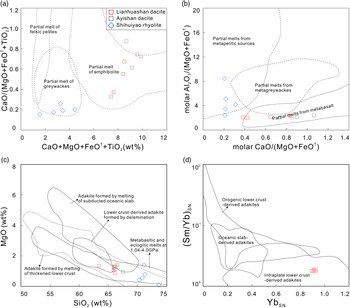
Furthermore, as both Nb and Ta are immobile elements and are little affected by fractional crystallization or hydrothermal overprint in later geological events, the Nb/Ta ratios in magmatic rocks must have been inherited from their sources and can be used to trace magma sources (Hawkesworth et al. Reference Hawkesworth, Gallagher, Hergt and Mcdermott1993). As shown in Figure 7b, the negative Nb and Ti concentration anomalies rule out the origin of normal mid-ocean ridge basalt (N-MORB) or ocean-island basalt (OIB) -type sources in non-subduction zone environments, with associated melts characterized by typically positive Nb and Ti anomalies (e.g. Hofmann, Reference Hofmann1997). The relatively low Nb/Ta ratios (12.22–14.30) of Lianhuashan dacites are similar to that of continental crust (average value, 13.4; Wedepohl, Reference Wedepohl1995), further supporting the conclusion that they are derived from partial melting of mafic lower crust. This result is also supported by the plots of CaO/(MgO+FeOT+TiO2) versus CaO+MgO+FeOT+TiO2 (Fig. 11a) and molar Al2O3/(MgO+FeOT) versus Al2O3+MgO+FeOT (Fig. 11b), where the Lianhuashan dacites are plotted within a mafic-rock-dominant source (amphibolite or metabasalt).
Plots of (a) CaO/(MgO+FeOT+TiO2) versus CaO+MgO+FeOT+TiO2; (b) molar Al2O3/(MgO+FeOT) versus molar CaO/(MgO+FeOT); (c) MgO versus SiO2; and (d) (Sm/Yb)SN versus YbSN for the lower Silurian subvolcanic rocks from the South Qilian suture. (a, b) Fields from Douce & Harris (Reference Douce and Harris1998), Sylvester (Reference Sylvester1998), Douce (1999) and Altherr et al. (Reference Altherr, Holl, Hegner, Langer and Kreuzer2000). (c) Data for metabasaltic and eclogite experimental melts (1–4.0 GPa) are from Rapp & Watson (Reference Rapp and Watson1995); the fields for subducted oceanic crust-derived adakites, delaminated or thickened lower crust-derived adakitic rocks are from Wang et al. (Reference Wang, Xu, Jian, Bao, Zhao, Li, Xiong and Ma2006). (d) Source-normalized (SN) data, normalized to mafic lower continental crust with Yb = 1.5 ppm and Sm/Yb = 1.87 for continental adakite (after Ma et al. Reference Ma, Zheng, Xu, Griffin and Zhang2015).

Although the Ayishan dacites also display adakitic geochemical characteristics with high Sr contents (278–416 ppm) and Sr/Y ratios (54.32–76.84), and lower Y (5.11–5.83 ppm) and Yb (0.29–0.34 ppm) contents, they have contents high of Ni (14.74–35.15 ppm; mostly > 20 ppm) and Cr (61.66–137.42 ppm; > 10 ppm), indicative of a mantle peridotite signature. However, the high (87Sr/86Sr)i (0.7109–0.7110) and low ϵNd(t) values (–6.50 to –6.28) rule out the theory that Ayishan dacites were derived from partial melting of peridotite mantle, which should have low (87Sr/86Sr)i and high positive ϵNd(t) values. The geochemical characteristics described above therefore probably indicate that the Ayishan dacites were derived from the interaction between minor peridotite mantle and melts derived from felsic crustal materials. This is the most reasonable way to generate this kind of magmatic rocks. The relative high (87Sr/86Sr)i (0.7108–0.7110) and low ϵNd(t) values (–6.50 to –6.28) of Ayishan dacites suggest that the proportion of peridotite mantle involved into the mixing process is minor. This possibility is also supported by the high Nb/Ta ratios (17.98–18.53) of the Ayishan dacites, which are significantly greater than those of continental crust.
6.b.2. Natural source of the rhyolites
Several mechanisms have been proposed to interpret the generation of rhyolites: (a) a large mid- to upper-crustal convecting magma body, thermally sustained by underlying mafic sills (e.g. Hildreth, Reference Hildreth1981; Lipman, Reference Lipman1984); (b) the silicic magmas, which are derived from partial melting by the injection of basalt into the lower crust on a relatively rapid timescales, rapidly rising through the crust and either intruding intermittently at the surface as rhyolitic subvolcanics (e.g. Huppert & Sparks, Reference Huppert and Sparks1988); or (c) derivation from crystal mushes in the shallow crust (e.g. Bachmann & Bergantz, Reference Bachmann and Bergantz2004, Reference Bachmann and Bergantz2008). Considering the absence of coeval mafic volcanic or intrusive rocks in the South Qilian suture and the mafic microgranular enclaves in these ryholites, we suggest that the Shihuiyao rhyolites were not significantly influenced by mixing between mafic and silicic magmas. While wall-rock assimilation or magma mixing can easily account for isotopic variations (Ma et al. Reference Ma, Zheng, Xu, Griffin and Zhang2015; He et al. Reference He, Zhou, Tan, Liu, Wang, Jiang and Cao2019), the Shihuiyao rhyolites have relatively high (87Sr/86Sr)i = 0.713747 and low ϵNd(t) = –5.48, consistent with Proterozoic basement rocks in Qilian orogen (Fig. 12). The Shihuiyao rhyolites may therefore be derived from felsic crust with various components at shallow level, which is also supported by the wide-ranging ages of inherited zircon (451–1803 Ma; see Table 1) from these rhyolites and the low MgO and Fe2O3 T contents. This result is consistent with that shown by the plots of CaO/(MgO+FeOT+TiO2) versus CaO+MgO+FeOT+TiO2 (Fig. 11a) and molar Al2O3/(MgO+FeOT) versus Al2O3+MgO+FeOT (Fig. 11b), where the samples of Shihuiyao rhyolites are plotted as originating from a greywacke- or metapelitic-dominant source.
Plots of ϵNd(t = 433 Ma) versus (87Sr/86Sr)i for the lower Silurian subvolcanic rocks from the South Qilian suture. These rocks have Sr–Nd isotopic compositions distinct from slab-derived adakites in North Qilian (after Chen et al. Reference Chen, Xia and Song2012) and lower crust-derived adakitic rocks (after Zhang et al. Reference Zhang, Zhang, Harris, Zhang, Chen, Chen and Zhao2006b; Tseng et al. Reference Tseng, Yang, Yang, Liu, Wu, Cheng, Chen and Ker2009; Zhang et al. Reference Zhang, Zhang, Zhang, Xiong, Luo, Yang, Pan, Zhou, Xu and Guo2017a; Li et al. Reference Li, Xu, Yu, Zhang, Guo, Peng and Zhou2019b; Yang et al. Reference Yang, Zhang, Xiao, Luo, Gao, Lu, Zhang and Guo2020a), but similar to intrusive rocks derived from Proterozoic basement (after Zhang et al. Reference Zhang, Jin, Zhang, Yuan, Zhou and Zhang2006a, b; Tung et al. Reference Tung, Yang, Yang, Smith, Liu, Zhang, Wu, Shau, Wen and Tseng2016) in the Qilian Orogen, indicating that they are derived from continental crust. Data describing ophiolite in Qilian are from Hou et al. (Reference Hou, Zhao, Zhang, Zhang and Chen2006a, b) and Fu et al. (Reference Fu, Yan, Wang, Buckman, Aitchison, Niu, Cao, Guo, Li, Li and Li2018a).

6.b.3. Tectonic setting of the lower Silurian subvolcanic rocks
Adakitic rocks derived from the partial melting of continental crust are widely used as a geodynamic indicator of lithospheric delamination, orogenic collapse or crustal thickening in recent studies (Castillo, Reference Castillo2012; Ma et al. Reference Ma, Zheng, Xu, Griffin and Zhang2015; He et al. Reference He, Tan, Liu, Bai, Wang, Wang and Zhong2020). Due to the empirical relationships between Sr/Y and La/Yb and crustal thickness in continental collisional orogens (Chapman et al. Reference Chapman, Ducea, DeCelles and Profeta2015; Hu et al. Reference Hu, Ducea, Liu and Chapman2017), we use the Sr/Y and La/Yb methods proposed by Hu et al. (Reference Hu, Ducea, Liu and Chapman2017) to calculate the crustal thickness of the Lajishan district at c. 433 Ma. The results show that the crustal thickness was over 50 km (see Fig. 13a, b), indicating that adakitic rocks (e.g. Lianhuashan dacites) in this study were derived from partial melting of a thickened crust. The result is consistent with the theory that crustal thickening is common in a continental collision orogeny caused by object extrusion pressure, where deep-seated adakitic melts (derived from > 50 km depth) occur at high pressure (Ma et al. Reference Ma, Zheng, Xu, Griffin and Zhang2015; He et al. Reference He, Tan, Liu, Bai, Wang, Wang and Zhong2020). We therefore suggest that the lower Silurian subvolcanic rocks were derived from a thickened crust. Considering numerous adakitic intrusive rocks with high Sr/Y and the evolutionary history in the Qilian orogen (Li et al. Reference Li, Xu, Yu, Zhang, Guo, Peng and Zhou2019b; Yang et al. Reference Yang, Zhang, Xiao, Luo, Gao, Lu, Zhang and Guo2020a), we favour a thickened crust model to interpret the occurrence of lower Silurian subvolcanic rocks within the South Qilian suture. According to the high contents of Sr/Y plutons and the calculation of crustal thickness variation, Yang et al. (Reference Yang, Zhang, Xiao, Luo, Gao, Lu, Zhang and Guo2020a) suggested that the eastern North Qilian experienced clear crustal thickening and thinning during Late Ordovician – late Silurian time, and reached a maximum thickness at c. 440 Ma. Despite the vague collisional timing between the South and Central Qilian blocks, most studies from previous literature suggested that the South Qilian Ocean closed prior to 440 Ma (Huang et al. Reference Huang, Niu, Nowell, Zhao, Yu and Mo2015; Yang et al. Reference Yang, Zhang, Luo, Zhang, Xiong, Gao and Pan2015), evidenced by the large number of 470–450-Ma igneous rocks (including volcanic rocks) with continental-arc affinity (Yan et al. Reference Yan, Aitchison, Fu, Guo, Niu, Xia and Li2015; Fu et al. Reference Fu, Yan, Wang, Buckman, Aitchison, Niu, Cao, Guo, Li, Li and Li2018a; Yang et al. Reference Yang, Song, Su, Allen, Niu, Zhang and Zhang2019a, b) and 450–440-Ma granitoids associated with continental collision (Huang et al. Reference Huang, Niu, Nowell, Zhao, Yu and Mo2015; Yang et al. Reference Yang, Zhang, Luo, Zhang, Xiong, Gao and Pan2015; Liu et al. Reference Liu, Li, Han, Ren, Gao, Du, Ren and Zhang2020) in this district. We therefore suggest that the lower Silurian subvolcanic rocks with ages of c. 433 Ma in the South Qilian suture were formed in a post-collisional setting.
Plots of Moho depth versus (a) Sr/Y and (b) (La/Yb)N for adakitic rocks of the Lianhuashan dacites. The calculation methods are after Hu et al. (Reference Hu, Ducea, Liu and Chapman2017), and the results reveal that the crustal thickness was over 50 km.

6.c. Implications for tectonic transition from Late Ordovician subduction to early Silurian post-collision
Based on their field occurrences, rock assemblages and tectonic affinities, voluminous Middle Ordovician – Silurian igneous rocks are present in the South Qilian suture, and its adjacent blocks are broadly subdivided into three stages: 470–450 Ma, 450–440 Ma and 440–420 Ma (Huang et al. Reference Huang, Niu, Nowell, Zhao, Yu and Mo2015; Yang et al. Reference Yang, Zhang, Luo, Zhang, Xiong, Gao and Pan2015; Yan et al. Reference Yan, Fu, Aitchison, Niu, Buckman and Cao2019b; Sun et al. Reference Sun, Niu, Li, Wu, Cai, Yuan and Li2020). Numerous diorites and granodiorites with ages of 470–450 Ma intruded into the Cambrian arc-accretionary complex (Fig. 2) and reveal typical subduction-related calc-alkaline geochemical affinity (Niu et al. Reference Niu, Huang, Deng, Xu, Chen, Ji and Li2016; Yan et al. Reference Yan, Fu, Aitchison, Niu, Buckman and Cao2019b), implying that a N-facing subduction system and associated Andean-type arc began to develop along the southern part of the central Qilian block during 470–450 Ma (Gehrels et al. Reference Gehrels, Yin and Wang2003; Tung et al. Reference Tung, Yang, Yang, Smith, Liu, Zhang, Wu, Shau, Wen and Tseng2016; Yan et al. Reference Yan, Fu, Aitchison, Buckman, Niu, Cao, Sun, Guo, Wang and Zhou2019a). Previous studies suggested that the collision between Qaidam–South Qilian and Central Qilian blocks was in progress during 450–440 Ma (Yang et al. Reference Yang, Zhang, Luo, Zhang, Xiong, Gao and Pan2015; Yan et al. Reference Yan, Fu, Aitchison, Buckman, Niu, Cao, Sun, Guo, Wang and Zhou2019a), which is indicated by voluminous I-type granites related to collision within the Central and South Qilian blocks (Tung et al. Reference Tung, Yang, Yang, Smith, Liu, Zhang, Wu, Shau, Wen and Tseng2016; Yan et al. Reference Yan, Aitchison, Fu, Guo, Niu, Xia and Li2015).
After 440 Ma, the Proto-Tethyan Ocean closed and resulted in early Silurian volcanic activity and magmatic emplacement in the South Qilian suture zone. This process is represented by the voluminous 440–420-Ma post-collisional granitoids, associated high-pressure granulite–facies metamorphism in the South Qilian belt and the Qaidam block, and accompanying anatexis (Yu et al. Reference Yu, Zhang, Mattinson, del Real, Li and Gong2014; Yan et al. Reference Yan, Aitchison, Fu, Guo, Niu, Xia and Li2015; Zhang et al. Reference Zhang, Yu, Li, Yu, Lin and Mao2015a; Li et al. Reference Li, Li, Yu, Santosh, Zhao, Guo, Cao, Wang and Huang2018b). Remarkably, 430-Ma felsic subvolcanic rocks directly intruded into the Upper Ordovician collisional volcanic strata of the Huabaoshan and Yaoshuiquan formations. Systematic field investigation and geochronological studies of the Huabaoshan and Yaoshuiquan formations indicate that they were deposited during Late Ordovician – Silurian time and represent alluvial deposition in a retro-foreland basin in response to collision between the South Qilian and Central Qilian blocks (Yan et al. Reference Yan, Fu, Aitchison, Buckman, Niu, Cao, Sun, Guo, Wang and Zhou2019a).
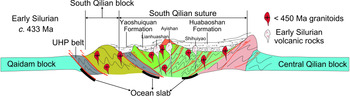
These newly recognized lower Silurian subvolcanic rocks further constrain the upper limit of the Upper Ordovician – Silurian retro-foreland basin, as well as indicate that the regional crust might have underwent post-collisional thickening (as depicted in Fig. 14) after the collision between the Qaidam–South Qilian and Central Qilian blocks. Available data confirm that early Silurian time was a transition period from collision to post-collision in the South Qilian suture. Here, the collision refers to a stage of continental collision or mountain building, and the post-collision represents exhumation and collapse (Song et al. Reference Song, Wang, Wang and Niu2015). Generally, collisional magmas are generated by crust during collision and mountain building without involvement of mantle materials; instead, post-collisional magmas are generated in the process of exhumation and collapse with crust–mantle interaction due to mantle upwelling (Prelević et al. Reference Prelević, Akal, Foley, Romer, Stracke and Van Den Bogaard2012; Yang et al. Reference Yang, Su, Song, Mark, Feng, Wang, Wang and Zhang2020b). In this study, Silurian subvolcanic rocks were mainly derived from continental crust without involvement of mantle materials. We therefore suggest that these lower Silurian subvolcanic rocks were produced in a transitional stage from collision to post-collision in the South Qilian suture.
Schematic tectonic model for the southern part of the Qilian Orogen during early Silurian time.

7. Conclusions
-
(1) Relatively high (87Sr/86Sr)i and negative ϵNd(t) values indicate that the lower Silurian subvolcanic rocks were mainly derived from continental crust. However, significantly different patterns of REEs and spider diagrams probably imply they have distinctly generation mechanisms with or without extensive fractional crystallization.
-
(2) The modelling calculation of Sr/Y and La/Yb and geochemical data indicate that the lower Silurian subvolcanic rocks from the South Qilian suture were derived from partial melting of a thickened crust in a post-collision setting.
-
(3) Considering the tectonic evolution and regional geology, we suggest that the early Silurian period was a transitional time from collision to post-collision for the South Qilian suture zone.
Acknowledgments
This study was supported by the National Natural Science Foundation of China (42072266, 41872241, 41702239, 41672221), China Geological Survey (DD20190006) and the Bureau of Geological Exploration and Development of Qinghai Province (2019-45). The authors thank two reviewers and editor Kathryn Goodenough for their valuable suggestions.