Introduction
The common bed bug, Cimex lectularius (Hemiptera: Cimicidae), which feeds nocturnally upon the blood of human hosts, is an important medical and veterinary pest in the temperate world (Boase, Reference Boase2004). During the past decade, this once common pest has re-emerged in increasing numbers, distribution and intensity of infestation in the US, Canada, Europe, Australia and Africa (Harlan, Reference Harlan2006a,Reference Harlanb; Romero et al., Reference Romero, Potter, Potter and Haynes2007). For example, there was an increase in calls made by the public to pest control operators of 300% in Atlanta, USA from 2000–2001, a 400% increase in complaints in Australia from 2001–2004, and an average increase of calls concerning bed bugs, as opposed to other household pests, of 24.7 calls per year from 2000–2006 in Greater London (Doggett et al., Reference Doggett, Geary and Russell2004; Harlan et al., Reference Harlan, Faulde, Baumann, Bonnefoy, Kampen and Sweeney2008, Richards et al., Reference Richards, Boase, Gezan and Cameron2009).
The only reliable monitoring method currently available involves the search for evidence of an active infestation, which is labour intensive and time consuming. Sticky traps are occasionally used but are not effective for low-level infestations (Potter, Reference Potter2005; Harlan, Reference Harlan2007; Harlan et al., Reference Harlan, Faulde, Baumann, Bonnefoy, Kampen and Sweeney2008). Bed bug control is currently reliant on residual insecticides, usually pyrethroids or carbamates, but several recent studies have shown the development of pyrethroid resistance in Cimicidae due to both indoor residual spraying in developed countries (Romero et al., Reference Romero, Potter, Potter and Haynes2007; Harlan et al., Reference Harlan, Faulde, Baumann, Bonnefoy, Kampen and Sweeney2008; Moore & Miller, Reference Moore and Miller2009) and the use of insecticide-treated bed nets in developing countries (Myamba et al., Reference Myamba, Maxwell, Asidi and Curtis2002; Weerakone, Reference Weerakone2007). Additionally, the withdrawal of organophosphates and carbamates from the UK and US markets have reduced the number of available effective insecticides (Harlan et al., Reference Harlan, Faulde, Baumann, Bonnefoy, Kampen and Sweeney2008; Potter et al., Reference Potter, Romero, Haynes, Robinson and Bajomi2008). Therefore, there is a need for new approaches for bed bug monitoring and control, for example, the addition of semiochemicals, such as aggregation pheromones, to currently available traps, changing them from simple interceptive devices, such as sticky traps, to species-specific odour-baited traps. These traps would intercept refuge-seeking bugs by attracting them into the device through behavioural manipulation with semiochemicals.
For the development of such trapping systems, identification of semiochemicals and further information about the behavioural roles of the identified compounds is necessary. Identification of the key semiochemicals will enable the production of economical odour baits. In addition, it is important to understand fully the role of the chemical in the insects' biology and behaviour before manipulation is attempted. Different semiochemicals will be perceived by bed bugs with varying effects on behaviour, which could influence the design of the trap and its ultimate efficacy as a monitoring device. It is also vital, for monitoring of this species, that a trap should catch every life stage, as all stages are haematophagous and cause potential harm. To identify semiochemicals that could be used to control bed bugs, an appropriate method for assessing behavioural responses is essential. Olfactometers have been investigated in the past, but they do not always take into account the natural crevice-dwelling behaviour of bed bugs, which are positively thigmotaxic, i.e. prefer to maintain close contact with conspecifics and surfaces within their refuges (Aboul-Nasr & Erakey, Reference Aboul-Nasr and Erakey1968a) and are not usually exposed to a strong air flow (Siljander et al., Reference Siljander, Penman, Harlan and Gries2007). Indeed, bed bugs tend to avoid air flow where possible. When subjected to moving air, for example in a Petterson four-way olfactometer, bed bugs turned away, lowered their antenna and retracted their legs (Aboul-Nasr & Erakey, Reference Aboul-Nasr and Erakey1968a). Previous studies that have successfully tested the response of bed bugs to chemical stimuli have done so in still-air olfactometers (Aboul-Nasr & Erakey, Reference Aboul-Nasr and Erakey1968b; Levinson & Bar Ilan, Reference Levinson and Bar Ilan1971; Levinson et al., Reference Levinson, Levinson, Muller and Steinbrecht1974b; Parashar et al., Reference Parashar, Ganesan, Sukumaran, Rao, Veer and Prakash2003; Siljander et al., Reference Siljander, Penman, Harlan and Gries2007, Reference Siljander, Gries, Khaskin and Gries2008). Some of these studies used groups of 10–30 bed bugs (Levinson & Bar Ilan, Reference Levinson and Bar Ilan1971; Levinson et al., Reference Levinson, Levinson, Muller and Steinbrecht1974b; Parashar et al., Reference Parashar, Ganesan, Sukumaran, Rao, Veer and Prakash2003), but testing groups of bed bugs can lead to confusing results due to the interactions between individuals, as they are known to aggregate and produce an alarm pheromone (Aboul-Nasr & Erakey, Reference Aboul-Nasr and Erakey1968a; Levinson et al., Reference Levinson, Levinson, Muller and Steinbrecht1974b; Marx, Reference Marx1955). More recent studies introduced individual insects into a still-air olfactometer (Siljander et al., Reference Siljander, Penman, Harlan and Gries2007, Reference Siljander, Gries, Khaskin and Gries2008). However, as all of these studies allow bed bugs to rest on treated papers, they do not discriminate between odour responses (chemotaxis) and responses due to physical contact (thigmotaxis) (Levinson & Bar Ilan, Reference Levinson and Bar Ilan1971; Levinson et al., Reference Levinson, Levinson and Maschwitz1974a; Parashar et al., Reference Parashar, Ganesan, Sukumaran, Rao, Veer and Prakash2003; Siljander et al., Reference Siljander, Penman, Harlan and Gries2007, Reference Siljander, Gries, Khaskin and Gries2008; Olson et al., Reference Olson, Moon and Kells2009). When contact stimuli are removed, attraction to the odour is usually lost (Siljander et al., Reference Siljander, Penman, Harlan and Gries2007). It is important that olfactometers allow the separation of chemotaxis from thigmotaxis, in order to determine the true effect of the volatile chemicals on bed bug behaviour. Additionally, olfactometers previously used were all final choice bioassays, and the intermediate behaviour was not taken into consideration. Studying behavioural responses over a short time frame provides a greater understanding of the behavioural role of the volatiles, which will become much more relevant when moving from laboratory to field testing. In addition, it is the first, not the final, choice that is important for the success of the trap as a monitoring device, as the bed bugs will be caught on first contact.
An alternative bioassay is the still-air Petri-dish olfactometer, comprising a two-choice arena in which one half differs from the other by only one variable at a time. In this case, the difference between the two halves of the arena is the presence or absence of the volatile chemical/s. The olfactometer prevents direct contact of the insect with the volatile source and has been used to measure the response of the vetch aphid, Megoura viciae, to a sex pheromone (Dawson et al., Reference Dawson, Griffiths, Janes, Mudd, Pickett, Wadhams and Woodcock1987). In the still-air Petri-dish olfactometer, bed bug behaviour can be studied in an environment with limited air flow. The position of the bed bug can be recorded along with activity variables, allowing an understanding of the behavioural response of the bed bug to the volatiles over a short time period. In addition, the olfactometer prevents contact of the bed bug with the volatile source, facilitating the separation of chemotactic and thigmotactic responses.
The aim of this study was to assess the suitability of the still-air Petri-dish olfactometer for observing bed bug behaviour. Behaviour was observed in response to bed bug-derived volatiles that would be found naturally occurring in bed bug refuges.
Materials and methods
Insects
Cimex lectularius were donated from a laboratory culture maintained at the London School of Hygiene and Tropical Medicine and then maintained at Rothamsted Research. The bed bugs were reared in plastic colony pots (60×40 mm) in a controlled environment at 25°C±1.5°C and 80% RH±5%. The light regime was set to 14L:10D. Bed bugs were given access to heparinised sheep blood (TCS Biosciences, UK) once per week via an artificial blood-feeding system (Montes et al., Reference Montes, Cuadrillero and Vilella2002). Experimental insects were adults of both sexes, which had been blood-fed 7–14 days previously. As the bed bugs were normally fed weekly, this would have allowed enough time for the bugs to digest their blood meal but not to become starved (Mellanby, Reference Mellanby1939). Starved bugs are bed bugs that have not been fed for a period greater than they have become accustomed to, in this case greater than one week. Recently engorged and starved bed bugs exhibit a low level of activity in the olfactometer (personal observation). Twelve hours before use, experimental insects were transferred into a pot and moved into the behaviour room to acclimatise.
Olfactometer
The still-air olfactometer consisted of a simple two-choice arena made from a Petri-dish lid (fig. 1) (Dawson et al., Reference Dawson, Griffiths, Janes, Mudd, Pickett, Wadhams and Woodcock1987) adapted to make the olfactometer suitable for bed bugs. Originally, the arena had no top, but to prevent escapes and to stop human odours contaminating the test environment, a Petri-dish base was used. On the floor of the arena were two holes (diameter, 26 mm), 64 mm apart, under which pots (60×40 mm) were placed. The arena was lined with fine muslin (pore size, 200 μm) to provide a suitable substrate for the bed bugs to walk on and to prevent contact with the volatile source. Two pots were present, a pot containing the bed bug-derived volatile source on filter paper (70×40 mm) and a pot that contained clean filter paper (70×40 mm), for convenience called the odour and the no-odour pot, respectively. The olfactometer was positioned inside a box screen (28×28×23 cm) as a precaution against directional bias that could be caused by variation within the room in environmental variables such as light and temperature. Clean cotton gloves were worn when handling equipment. After each replicate, olfactometers were washed with warm soapy water (Teepol) followed by 70% ethanol and air-dried before being used again.
Illustration of the still-air olfactometer showing side and plan view. Internal diameter 140 mm, hole diameter 26 mm, distance between holes 64 mm. Pots were plastic and 60×40 mm. Odour pot containing filter paper with bed bug-derived volatiles. No-odour pot containing clean filter paper.

Experimental protocol
Experiments were carried out in a controlled environment where the conditions were maintained at 25°C±1.5°C and 80% RH±5%. The light regime was set to 14L:10D. As bed bugs are nocturnal, all bioassays were completed during the scotophase of the insect and red lamps (Jessops Darkroom Safelights) were used to facilitate observation. Before use, the red lamps were tested using a two-choice arena. The >600 nm wavelength of light produced by the lamps was not found to have a significant photonegative effect on bed bug behaviour (χ2=0.67, df=1, P=0.41). Twenty replicates were completed in the presence and absence (control) of the volatiles using equal numbers of each sex. The odour pot was randomly assigned to one of the two positions, and the arena number, sex of the bed bug and order of treatments were also randomised. Controls were completed with two no-odour pots to test for bias. However, one pot was randomly assigned to be the odour pot for data analysis. Five minutes after setting up the equipment, the lid of the olfactometer was removed, and a bed bug was introduced into the centre of the arena using a paintbrush. This method was used as it was desirable to remove the bed bug from its refuge so that it would then exhibit refuge-seeking behaviour. The physical effects on the bed bug of using a paintbrush were found to be minimal and had no effect on its subsequent response to volatiles. The lid was then replaced and the bed bug was observed for 15 minutes. The following data were recorded by direct observation: (i) the first pot visit (odour or no-odour), (ii) the frequency with which bed bugs visited the area above the pots and (iii) the time spent active. Bed bugs that failed to make a choice were considered to be non-responders.
Bed bug-derived volatiles
Volatiles which occur naturally in bed bug refuges were tested to determine the suitability of the olfactometer for studying behavioural responses to potential semiochemicals. The response of adult bed bugs to bed bug-exposed material and conspecific bed bugs was tested. Bed bug-exposed papers, which consisted of faeces, cuticular compounds and any additional material deposited through contact with bed bugs, were chosen as a volatile source, as such papers have been shown to be attractive in previous studies (Levinson & Bar Ilan, Reference Levinson and Bar Ilan1971; Siljander et al., Reference Siljander, Penman, Harlan and Gries2007, Reference Siljander, Gries, Khaskin and Gries2008). In addition, the response to adult bed bugs was tested, as aggregating bed bugs may themselves produce semiochemicals that are attractive to refuge-seeking bugs. The bed bug-exposed material was filter paper that had been exposed to 100 bed bugs for one month. All bed bugs, exuviae and eggs were taken off the paper. The paper was then placed in a new pot, which was covered with clean mesh. For bed bug volatiles, ten adult bed bugs (five males and five females) were placed in a pot containing clean filter paper. The pot was covered with mesh and left for one week to allow the bed bugs to acclimatise. During this time, faeces and any other material that would accumulate in the presence of bed bugs was deposited on the papers, although it would be present in a lower concentration than on the bed bug-exposed papers. The pots were kept under the same conditions as the colony.
Statistical analyses
Response and first visit to a pot (odour or no-odour) were analysed by two-sample binomial tests. A visit was defined as a period of time spent in the area directly above a pot and one visit lasted from the time of entry to this area until exit. A success was defined as a first visit to the odour pot, whereas a failure was defined as first visit to the no-odour pot or no choice. The null hypothesis was that there was no significant difference in the probability of success in the presence and absence of the volatiles. All continuous data were tested for normality prior to parametric analysis and were found to be normally distributed. All means displayed are, therefore, arithmetric means. The difference in the frequency of visits to the pots was analysed using a paired t-test with the null hypothesis that there was no significant difference in the number of visits to the odour and no-odour pots. Time spent active was converted to a proportion of activity (prop_active) for the duration of the experiment (15 min). Volatile presence, sex and time of day were all considered as model factors. The time of day was separated into early (10:00–15:00) and late scotophase (15:00–20:00). As the data contained missing values, which made the final design unbalanced, a Restricted Maximum Likelihood (REML) analysis was used. The proportions were analysed with the null hypothesis that there were no significant differences between the proportion of time spent active in the presence and absence of volatiles. All results were analysed using GenStat version 11.0 (Payne et al., Reference Payne, Murray, Harding, Baird and Soutar2008).
Results
First choice
There was a significantly higher proportion of responsive bed bugs in the presence of volatiles from bed bug-exposed paper (50%, n=20, P=0.006, 95% CI=0.1445, 0.6555) compared with the response in the absence of the volatiles (10%). Significantly more bed bugs chose to visit the odour pot first in the presence (90%, n=20, P<0.001, 95% CI=0.2320, 0.6680) of the volatiles compared with when the volatiles were absent (0%).
There were no significant differences in the proportion of responsive bed bugs (n=20, P=0.337, 95% CI=−0.4528, 0.1528) in the presence (50%) and absence (35%) of volatiles from bed bugs. Additionally, there were no significant differences in the pot visited first in the presence (70%) and absence (90%) of the volatiles (n=20, P=0.519, 95% CI=−0.4021, 0.2021).
Frequency of visits
Bed bugs were less likely to leave the sides of the arena and visit the area above the pots in the absence of the volatiles. In the presence of volatiles from bed bug-exposed papers, significantly more visits were made to the odour pot than the no-odour pot (fig. 2a; t=2.83, df=19, P=0.011). During the control experiments, bed bugs showed no preference for either pot (t=−0.44, df=19, P=0.666).
The difference in mean frequency of visits to the area above the pots (odour–no-odour) by Cimex lectularius in the still-air Petri-dish olfactometer in the presence and absence (control) of volatiles from (a) bed bug-exposed paper and (b) bed bugs. Means±standard errors, asterix indicates significant differences in frequency of visits to the odour and no-odour pot *P<0.05, ns P>0.05.  , odour pot;
 , no-odour pot.

In the presence of volatiles from bed bugs, the frequency with which bed bugs visited the two pots was not significantly different (fig. 2b; t=1.64, df=19, P=0.117). During control experiments, bed bugs showed no preference for either pot (t=1.25, df=19, P=0.226).
Proportion of time spent active
There was a significant difference in the proportion of time spent active (prop_active or activity) in the presence of volatiles from bed bug-exposed papers (fig. 3a; F1,32=5.25, P=0.029). The sex of the bed bug had no significant effect on activity (fig. 3b; F1,32=0.01, P=0.904). The time of day at which the bioassays were completed (early or late scotophase) had a significant effect on the activity of bed bugs (fig. 3c; F1,32=4.97, P=0.033). Bed bugs showed an increased level of activity independent of the presence of the volatiles and sex in the early scotophase (10:00–15:00). None of the interactions between treatment, sex and time were found to be significant (table 1).
Mean proportion of time spent active (prop_active) by Cimex lectularius in the still-air Petri-dish olfactometer (a) in the presence and absence (control) of volatiles from bed bug-exposed paper, (b) by sex and (c) at different time periods during the scotophase (early 10:00–15:00 and late 15:00–20:00). Means±standard errors; asterix indicates significant differences in prop_active *P<0.05.

Statistical analysis of proportion of time spent active (prop_active) by Cimex lectularius in a still-air Petri-dish olfactometer. A table of interactions considering treatment (trt), sex and time of day as factors.

ns, not significant when tested at the 0.05 level by REML analysis; ndf, numerator degrees of freedom; ddf, denominator degrees of freedom.
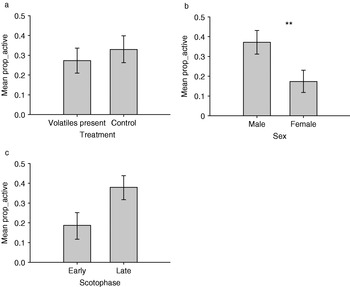
In the presence of volatiles from bed bugs, there was no significant difference found in the proportion of time spent active (fig. 4a; F1,14.1=0.99, P=0.337). There was a significant difference in activity dependent on the sex of the bed bug (fig. 4b; F1,24.4=8.18, P=0.009). Female bed bugs were significantly less active than male bed bugs independent of treatment and time. There was no significant effect of the time of day (early or late scotophase) on the activity of bed bugs during the bioassays (fig 4c; F1,16.5=3.04, P=0.1). None of the interactions between treatment, sex and time were found to be significant (table 1).
Mean proportion of time spent active (prop_active) by Cimex lectularius in the still-air Petri-dish olfactometer (a) in the presence and absence (control) of volatiles from bed bugs, (b) by sex and (c) at different time periods during the scotophase (early 10:00–15:00 and late 15:00–20:00). Means±standard errors; asterix indicate significant differences in prop_active **P<0.01.

Discussion
Response of C. lectularius to bed bug-derived volatiles in a still-air olfactometer
The present study modified a still-air olfactometer (Dawson et al., Reference Dawson, Griffiths, Janes, Mudd, Pickett, Wadhams and Woodcock1987) and successfully observed the responses of bed bugs to semiochemicals. Olfactory responses in the bed bug have been characterised by activation of the bed bug from its resting state, followed by antennal grooming, before random movement and lastly orientation towards the odour source (Aboul-Nasr & Erakey, Reference Aboul-Nasr and Erakey1968b). In the olfactometer, bed bugs exhibited a wide range of behaviour, including walking, antennal grooming and orientation towards a volatile source.
Unlike olfactometers used in previous studies, the still-air Petri dish olfactometer separated bed bugs from any potential contact stimuli, enabling the study of chemotactic responses to volatiles without interference from thigmotaxis (Levinson & Bar Ilan, Reference Levinson and Bar Ilan1971; Levinson et al., Reference Levinson, Levinson and Maschwitz1974a; Parashar et al., Reference Parashar, Ganesan, Sukumaran, Rao, Veer and Prakash2003; Siljander et al., Reference Siljander, Penman, Harlan and Gries2007, Reference Siljander, Gries, Khaskin and Gries2008; Olson et al., Reference Olson, Moon and Kells2009). The experimental protocol also involved the observation of the bed bugs over a short time frame, allowing the first choice and initial responses to the volatiles to be recorded. Previous studies were conducted over extended periods of time and only recorded the final choice (Levinson & Bar Ilan, Reference Levinson and Bar Ilan1971; Levinson et al., Reference Levinson, Levinson and Maschwitz1974a; Parashar et al., Reference Parashar, Ganesan, Sukumaran, Rao, Veer and Prakash2003; Siljander et al., Reference Siljander, Penman, Harlan and Gries2007, Reference Siljander, Gries, Khaskin and Gries2008; Olson et al., Reference Olson, Moon and Kells2009). Studying initial responses to the volatiles provides a greater understanding of the behavioural role of the semiochemicals and will become much more relevant when designing a monitoring device.
The presence of volatiles from the bed bug-exposed paper caused a significant increase in bed bug activity and orientation towards the volatile source. Attraction of bed bugs to bed bug-exposed papers has been shown in previous studies, but this is the first time initial responses to these volatiles, in the form of attraction and increased activity, have been observed over a short time period (Levinson & Bar Ilan, Reference Levinson and Bar Ilan1971; Siljander et al., Reference Siljander, Penman, Harlan and Gries2007, Reference Siljander, Gries, Khaskin and Gries2008). Bed bugs could be responding to a pheromone, volatiles from faeces, cuticular compounds or a combination of these factors. Faeces and cuticular compounds would be at the highest concentration within the refuge and could, therefore, act as a guide or aggregation pheromone to refuge-seeking bed bugs. Aggregation semiochemicals in the refuge would indicate a suitable habitat with potential mates and the benefits that come with aggregating with conspecifics (Sinha & Wallace, Reference Sinha and Wallace1966; Turchin & Kareiva, Reference Turchin and Kareiva1989; Benoit et al., Reference Benoit, Del Grosso, Yoder and Denlinger2007; Siljander et al., Reference Siljander, Gries, Khaskin and Gries2008). Release of aggregation semiochemicals often involves a high physiological investment due to the building of specialised glands and the production of vast quantities of pheromone (Cruz-Lopez et al., Reference Cruz-Lopez, Malo, Rojas and Morgan2001; Wertheim et al., Reference Wertheim, Van-Baalen, Dicke and Vet2005). Production of semiochemicals via faeces is potentially a low investment way of producing a pheromone (Peng & Weiss, Reference Peng and Weiss1992). As bed bug-exposed papers comprised material deposited by conspecific bed bugs, it is possible that aggregating bed bugs could produce semiochemicals that attract refuge-seeking bugs. However, when bed bugs were tested with volatiles from live bed bugs, there was no significant difference in activity and no significant orientation towards the volatile source. Previous studies have also recorded a lack of attraction to live bed bugs but attraction to bed bug refuges (Marx, Reference Marx1955). It is possible that, in order for bed bug volatiles to be attractive, they may need to be presented in combination with refuge volatiles. Bed bug volatiles, especially if from a low number of individuals, may not be an indication of an established refuge and so may not be of interest to a refuge-seeking bug. Alternatively, if the bed bugs within the odour pot were stressed, they could produce an alarm pheromone and this would affect the behavioural response of the test insect (Levinson et al., Reference Levinson, Levinson and Maschwitz1974a). Whilst stress to all insects was minimised by allowing acclimatisation to conditions and handling pots and insects with care, it is very easy to cause release of this pheromone with unnatural stimulation or changes in conditions (Reinhardt & Silva-Jothy, Reference Reinhardt and Silva-Jothy2007).
Effect of photoperiod
There was a significant increase in activity in the early scotophase independent of the presence of volatiles. Bed bugs are nocturnal insects that aggregate diurnally. Therefore, it may be expected that bed bugs would disperse as light intensity decreases and be at their most aggregated by the end of the scotophase. A study performed in a semi-field situation, an animal house, found that bed bugs were at their most active between 03:00 and 06:00 (Mellanby, Reference Mellanby1939). It is possible that, during the current study, a second peak of activity was present at the end of the scotophase, which would have escaped detection as bioassays were not completed in the last three hours of the scotophase. In addition, differences between the two studies may be associated with host behaviour. The animal house held mainly rats, and bed bugs may have adjusted their feeding behaviour to feed on these nocturnal mammals during a time when the insectary was not used and the rats were inactive.
Effect of sex
In this experiment, females were less active than males regardless of treatment or time. Physiological effects are more pronounced in female bed bugs due to the energy demands of reproduction. Although both sexes (and all nymphal instars) are obligate blood feeders, females take bigger blood meals and need to feed more frequently than males and nymphs (Jones, Reference Jones1930). The rate of metabolism in a reproductively active female was found to be equal to that of a male that was kept moving continuously (Mellanby, Reference Mellanby1939). Females may be generally less active than males during the bioassays, as it is important for them to conserve energy for feeding and oviposition.
Potential of bioassay
An aggregation pheromone, which is yet to be identified, could be exploited to develop effective monitoring tools to detect and control bed bug infestations. In order to identify semiochemicals associated with bed bug aggregation, knowledge of bed bug biology and behaviour is required. The current study has identified a suitable olfactometer and shown attraction to bed bug-derived volatiles from bed bug-exposed papers, but not to live bed bugs. The study has also highlighted differences in bed bug activity dependent upon the sex of the test insect and the time of day that the bioassays were completed. These differences need to be investigated further and should be considered when designing experiments in the future. This study has provided a basis for investigations into bed bug chemical ecology, including the role and identification of potential semiochemicals for monitoring or control of this important medical and veterinary insect pest.
Acknowledgements
E.N.I. Weeks was supported by a BBSRC CASE Studentship with AgriSense BCS Ltd. Rothamsted Research receives grant-aided support from the BBSRC. We would like to thank Lynda Castle for assistance with the olfactometer diagram. Cimex lectularius were donated by Dr Nigel Hill, London School of Hygiene and Tropical Medicine.