


1. INTRODUCTION
Bignon et al. (Reference Bignon, Esteves and Herranz-Loncán2015) argue that railway construction and export expansion were interdependent because of the influence of the latter on government revenues. This article examines this interdependent relationship at the micro-level, illustrating how failure of the former contributed to the lack of the latter in the Colombian department of Santander. There are three prominent perspectives within Latin American historiography which focus on exogenous factors as explanatory frameworks for poor outcomes: «dependency» (Zanetti and Garcia Reference Zanetti and Garcia1987), the «resources lottery» (Bulmer-Thomas Reference Bulmer-Thomas1994) and «geography is destiny» (Gallup et al., Reference Gallup, Gaviria and Lora2003). This case study focusses on the impact of the institutional and political environments of Colombia on railway development aiming to supplement these dominant trends within the historiography with an additional explanatory framework. The article examines the concurrent development of railway nationalism and «railway imperialism» (Davis et al., Reference Davis, Wilburn and Robinson1991) in early 20th century Colombia. It focuses on the British Great Northern Central Railway of Colombia «free-standing company» (Casson Reference Casson, Wilkins and Shroeter1998; Wilkins Reference Wilkins, Wilkins and Shroeter1998, Reference Wilkins, Flandreau, Holtfrerich and James2003) examining the way these competing political currents impacted railway development. It identifies repeated examples of elite agency, illustrating that Colombian elites largely determined the manner and degree of the country's integration into the world economy during the first period of globalisation. The article argues that the rise of railway nationalism intertwined with regionalism and personal interests was detrimental to railway development, and that its impact was particularly prejudicial to the economy of the department of Santander.
The «Ferrocarril de Puerto Wilches» as the railway is known locally, has a central position within the historiography of Santander. But the British company which initiated the project has been approached as an afterthought. Correa (Reference Correa2012) and Bayona Sarmiento and Niño Sánchez (Reference Bayona Sarmiento and Niño Sánchez2002) acknowledge the role of the railway project within the region's economic history, and Cuadros and Sánchez (Reference Cuadros Sánchez2013) explore the influence of regionalism, but none highlight the role of railway nationalism intertwined with these regionalist struggles in the collapse of the British company. Correa's (Reference Correa2012, pp. 74–80) comprehensive study largely parallels contemporary political discourse which viewed the British company and its bonds as negative and exploitative. Cuadros and Sánchez (Reference Cuadros Sánchez2013, pp. 173–183) chronicle popular mobilisation supporting the project and the railway's symbolic role within regional identity but fails to make the link to the national trend of railway nationalism hostile to foreign capital. Bayona Sarmiento and Niño Sánchez (Reference Bayona Sarmiento and Niño Sánchez2002, pp. 87–97) argue the company's collapse retarded railway development in the department but disregard the role of personal interests and regionalism within the railway company's disputes. Overall, the national historiography has viewed British involvement negatively, and have attributed fault for repeated disputes and contractual negotiations on British financiers and administrators (Ortega Reference Ortega1920, p. 551; Pérez Ángel Reference Pérez Ángel2008, pp. 39–46; Correa Reference Correa2012, pp. 75–81). By analysing the struggles of the British company in detail, the article addresses this lopsided view within the national historiography, as well as illustrating the relevance of the railway's history to the wider economic history of Colombia.
The history of the railway project is particularly important because it proved influential to the failure of the railway bond guarantee system in Colombia which Lewis (Reference Lewis1983, pp. 97–123; Reference Lewis1991, pp. 35–38), Summerhill (Reference Summerhill1998, Reference Summerhill2003) and Miller (Reference Miller1993, p. 133) argue was indispensable to Argentine, Brazilian and wider Latin American railway development. Within recent Latin American historiography bond guarantees are a key area of focus for countries such as Mexico, Brazil, Argentina, Uruguay, Peru and Chile, but the role these played in Colombia remains overlooked and poorly understood (Kuntz et al. Reference Kuntz2015). Where bond guarantees are addressed specifically by the national historiography it is from a negative and adversarial perspective (Correa Reference Correa2012, pp. 76–77; Reference Correa and Kuntz Ficker2015, pp. 142–143). Aggregate studies of Colombian railways largely overlook the system, focussing on the Fogel social savings methodology, or attributing the poor outcomes to «excessively favourable conditions for concession holders» (Fogel Reference Fogel1964; Ramírez Reference Ramírez2001, Reference Ramírez, Ramírez and Pachón2006, pp. 3–6, 48). The article presents a detailed analysis of the disputes over guaranteed bonds issued in London and Paris by the Great Northern Central Railway of Colombia. It chronicles how attacks from political actors who presented themselves as ideological railway nationalists contributed to the failure of the project. Examining the collapse of the British company demonstrates how the failure of the bond guarantee system inhibited railway development and export growth in the department of Santander.
The article is organised into three thematic sections of analysis. The first chronicles the development of railway nationalism and «railway imperialism» and summarises the economic situation in Santander. The second examines the company's struggles with the national government and varied individual political actors. The final section analyses the economic impact of the company's collapse on the department of Santander. The central conclusion is that railway nationalism was an important—and hitherto unacknowledged—factor in the collapse of the railway project and associated economic decline of Santander.
2. ECONOMIC AND POLITICAL CURRENTS
2.1 Railway Nationalism in the Regeneración (1880–1898)
The development of railway nationalism in Colombia was influenced by a longstanding political culture sceptical of foreign investment and economic interests. Railway nationalism was the defining principle of the first Colombian railways established during Rafael Nuñez's Regeneración. This political project can be conceptualised broadly as the period between his first ascent to power in 1880, and the end of Miguel Antonio Caro's presidency (Nuñez's protégé and Vice President) in 1898Footnote 1. The most influential aspect of the regime was the 1886 constitutional amendment which abolished the federalist system of «sovereign states» and centralised political power. A less documented activity was the development of railways with a nationalist system of subventions which—in contrast to neighbouring countries—left railways, at least initially, under national ownership rather than organised as British «free-standing companies». Multiple railway projects were initiated during this time to aid coffee-fuelled export-led development, but most stagnated when the funding for subventions dried up leaving many short sections of unfinished railways (Horna Reference Horna1992). These sections of railway were often left in the hands of local elites who had been awarded concessions because of political capital, and who had invested little of their own capital in the projects (Primmer Reference Primmer2018, pp. 94–95).
The failure of this scheme was a result of two factors: the lack of the necessary capital internally to fund the subventions, and the unavailability of foreign capital as a result of Colombia's repeated default on its sovereign debt obligations (Junguito Reference Junguito1995; Avella Reference Avella, Meisel and Ramírez2010). A political doctrine referred to by contemporaries as the verdad de la deuda was influential in this pattern of default, but its pivotal role has been largely overlooked by the national historiography which focuses largely on economic factors (Deas Reference Deas1982; Junguito Reference Junguito1995, p. 55; Avella Reference Avella, Robinson and Urrutia2007, Reference Avella, Meisel and Ramírez2010; Álvarez and Correa Reference Álvarez and Correa2017). This doctrine advocated debt repudiation and renegotiation to bring the nominal value of devalued bonds in line with their market value (Holguín Reference Holguín1908, pp. 77–81). Flandreau (Reference Flandreau, Flandreau, Holtfrerich and James2003) and Esteves and Tovar (Reference Esteves and Tovar Jalles2016) argue that European capital markets were sophisticated systems which discriminated in the long-term against historic repudiators of debt. The rationing they describe was evident in Colombia, which by 1890 had received only £3,485,883 of private investment as opposed to £84,978,788, £31,660,026 and £14,812,795 in Argentina, Brazil and Chile (mostly in railways) where «orthodox» and «conservative» fiscal policies were implemented (Rippy Reference Rippy1966, pp. 20, 37; Cain and Hopkins Reference Cain and Hopkins1993, pp. 58, 288–311). Adherence to the verdad de la deuda doctrine led to several successful partial write offs of the national debt (Primmer Reference Primmer2018, pp. 33–90). But despite benefitting from decreased nominal debt levels and lower interest payments, the policy proved deleterious as it cut-off the availability of capital for railway projects.
Nuñez's overall perspective was that the sovereign debt should be serviced only after all of Colombia's other needs «had been amply provided for», justified by his misguided belief that additional capital would be available overseas so long as «returns looked high enough» (Deas Reference Deas and Brown2008, p. 178). Nuñez successfully renegotiated the sovereign debt in 1889, but despite an unprecedented rise in nominal tax revenues from $4m in 1873 to $12m in 1891 (Junguito Reference Junguito, Ramírez and Meisel2010, p. 106), another default soon followed justified by the claim that interest payments would «endanger» Colombia's very existenceFootnote 2. At this time Colombia's overall debt burden was low, with a debt/exports ratio of 45 per cent compared to 320 per cent, 131 per cent, 200 per cent and 88 per cent in Argentina, Brazil, Chile and Mexico (Primmer Reference Primmer2018, p. 53). The paradox of feigning poverty during a period of favourable macro conditions did not go unnoticed by British bondholders, who argued angrily that if Colombia paid «£95,000 or £100,000» in the 1870s, it should «bear now a heavier interest charge than £36,000»Footnote 3.
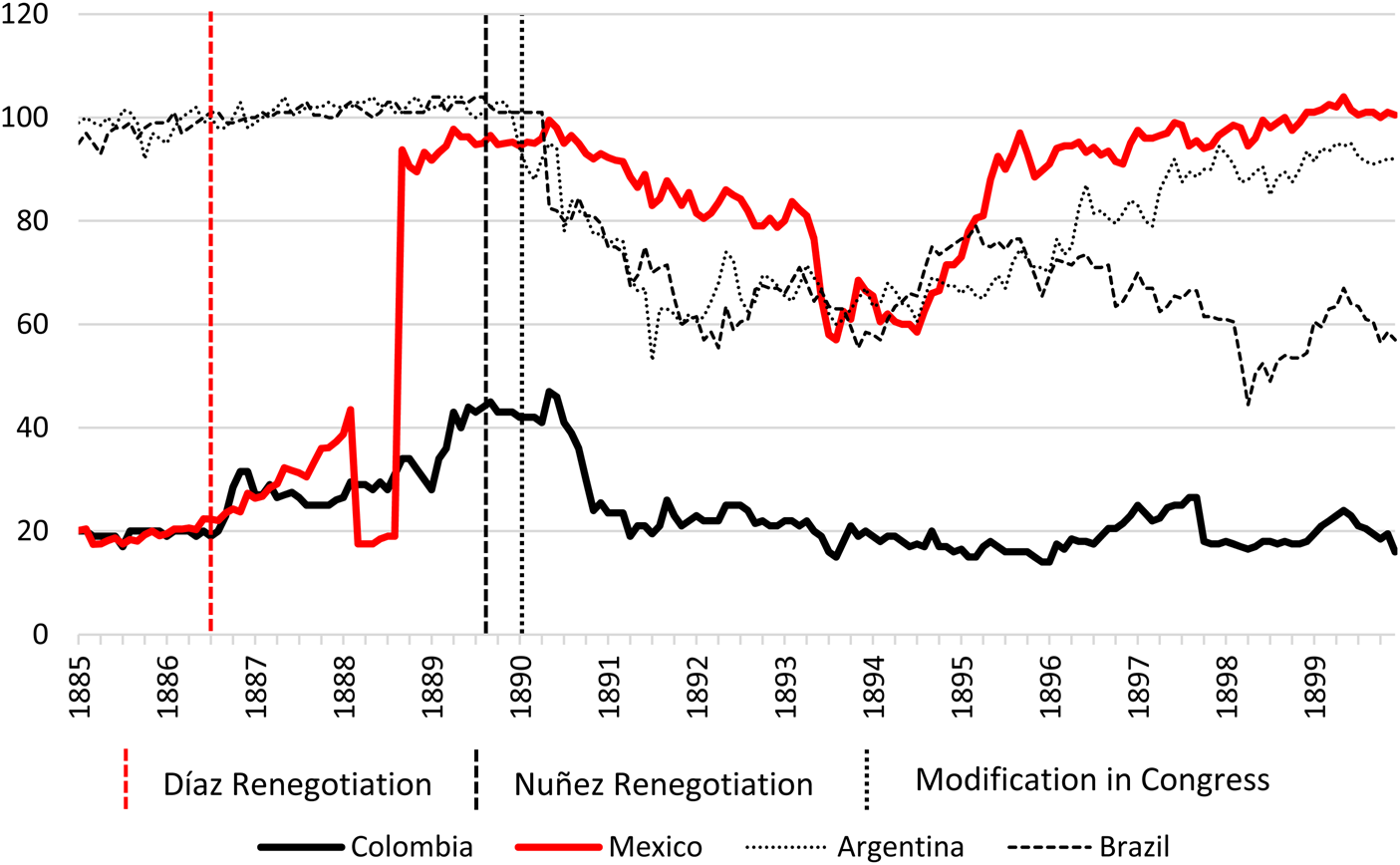
In Mexico, a very different political project was underway with a very different approach to sovereign debt, foreign investment and railway construction. Figure 1 illustrates the diverse impact of these contrary approaches to foreign capital. Following Díaz's renegotiation of the sovereign debt in 1886 the Porfiriato saw Mexico—which had hitherto been a serial defaulter and «pariah state» (Garner Reference Garner2011, p. 97)—transform into the region's most trustworthy debtor, leading to a flood of foreign investment in its railway network (Coatsworth Reference Coatsworth1981). In stark contrast, Nuñez's policies ensured Colombia's pariah status in London continued. In 1892, Nuñez's government created an institutional basis for raising bonds to finance his state-led railway construction project guaranteed with customs revenuesFootnote 4. But the policy proved impractical because his mismanagement of the sovereign debt meant attempts to raise capital in European capital markets—such as £1.65m for the Antioquia railway—proved utterly impossible, and there simply wasn't sufficient capital circulating internally to finance projects of this scale (Primmer Reference Primmer2018, pp. 55–61). The direct impact of these policies on railway building is illustrated well by a decision by Rothschild bank to cancel approval for a loan to finance construction works on the Girardot Railway (initiated with the subvention system) after learning of its connection to Colombia (Holguín Reference Holguín1908, p. 75). The length of railway constructed in each country was equally varied. Nuñez's system of railway nationalism saw 279 km built between 1885 and 1904, whilst the embrace of British (and American) «railway imperialism» in Porfirian Mexico saw 13,308 km of track laid between 1886 and 1910 (República de Colombia, 1909, p. 148; Pardo Pardo, Reference Pardo Pardo1972, p. 398; Coatsworth, Reference Coatsworth1981, pp. 36–37).
Colombian, Mexican, Argentine and Brazilian bond prices 1885–99 (per cent of par value).
Sources: Investor Monthly Manual, 1885–99.

2.2 The Economic Situation in Santander
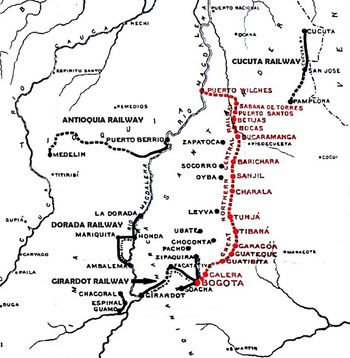
The Regeneración was unsuccessful in terms of the quantity of track completed, but the short sections completed had a significant economic impact on interior, which proved highly prejudicial to the economic competitiveness of Santander. The origins of coffee cultivation for export in Colombia were the departments of Santander and North Santander (Palacios Reference Palacios1980, pp. 14–17). Cultivation was centred in the northern part of the region and exported from the river port of Puerto Villamizar via the Zulia river which passes through western Venezuela into Lake Maracaibo on its way to the Caribbean. This route was strengthened in 1888 when the Cucuta Railway (funded by subvention) was completed (Correa Reference Correa2012, pp. 29–39; Pradilla Reference Pradilla Landazábal2012, pp. 73–76). An initial 40 km section of the Girardot Railway between the Magdalena River and the town of Juntas de Apulo in the midst of Cundinamarca's coffee producing zone was completed by 1889, and it likewise acted as a conduit to the Caribbean (Foreign Office 1910, pp. 25–26, 30; Horna Reference Horna1992, pp. 128–141). Antioquia completed a 47 km section of railway from the Magdalena River port of Puerto Berrio, which stimulated a rapid growth of coffee exports (Horna Reference Horna1992, p. 74). The Dorada Railway had also been completed, facilitating the export of Coffee from both Cundinamarca and Tolima (Horna Reference Horna1992, pp. 118–127). As a result of these developments, at the end of the Regeneración only Caldas and Santander lacked a rail link for coffee exports. Thus, insomuch as linking Colombia to the world economy through coffee-based export-led development, Nuñez's political project had been in some way successful. But, this process had been damaging to Santander, which had not seen any substantive progress developing its transportation infrastructure from the nationalist subvention system (Figure 2).
Map of the railways of the interior of Colombia and the proposed route of the Great Northern Central Railway of Colombia (in red) at the point of incorporation.
Source: The Great Northern Central Railway of Colombia Prospectus, TNA, FO371/1101.

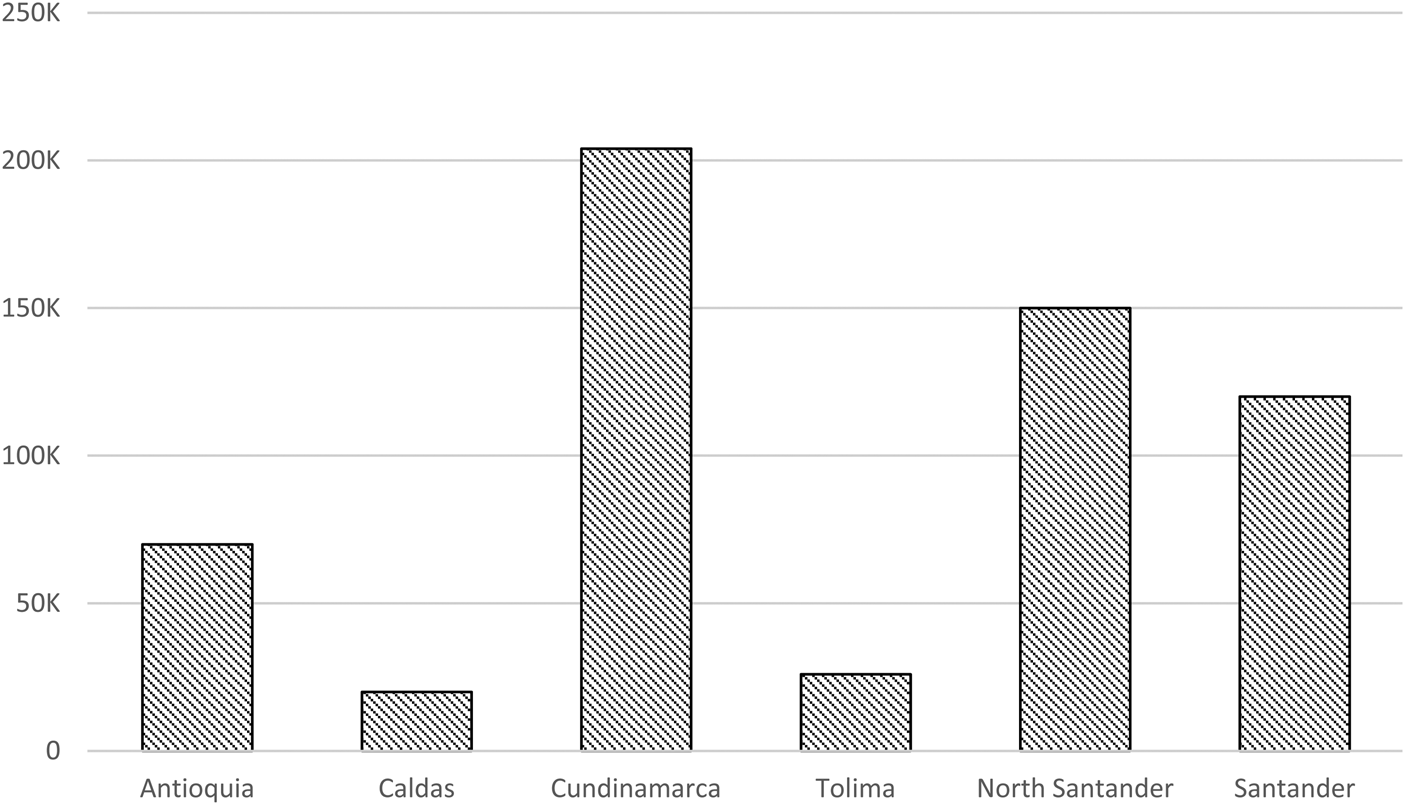
Figure 3 illustrates that at the close of the Regeneración, despite this clear handicap, Santander was still amongst the most economically dominant regions of the interior: its coffee exports represented 19.7 per cent of the national total. But as is explored in subsequent sections, attempts to address this economic hindrance were thwarted by the Great Northern Central Railway of Colombia's negative experience and subsequent bankruptcy, which was followed by a pronounced economic decline in the department.
Coffee exports (60 kg bags) by region 1898.
Source: Bejarano Ávila (Reference Bejarano Ávila and Ocampo Gaviria2015, p. 169).

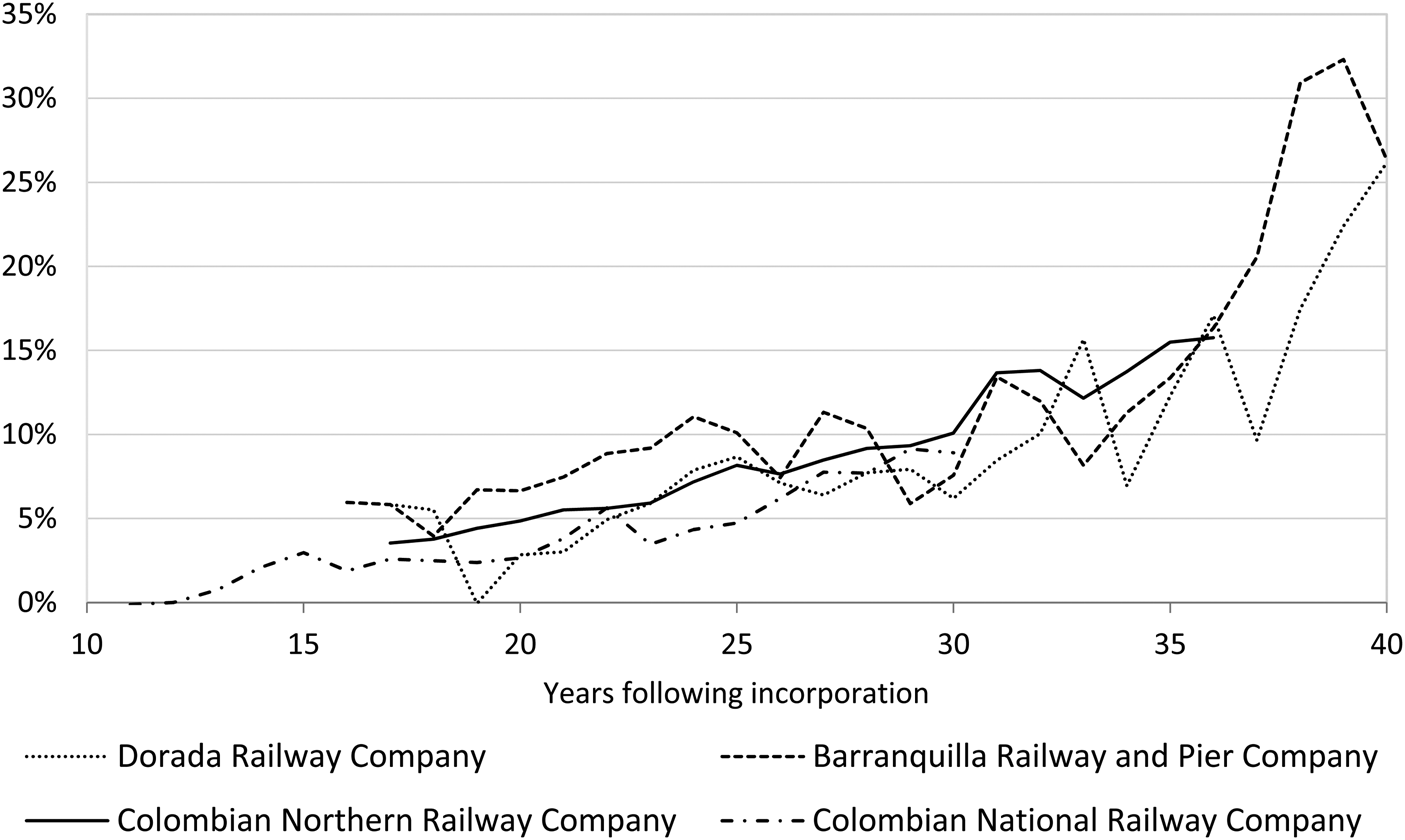
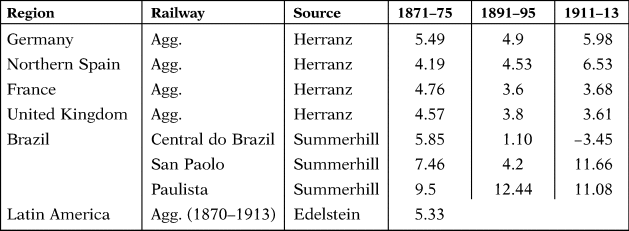
There was significant economic rationale for a railway in Santander: it would enjoy a total monopoly on coffee produced in the department and imports from overseas. Available data suggest that prospects for a profitable line were excellent. Figure 4 and Table 1 illustrate that the overall rate of return of British railway companies operating in Colombia was very high from a comparative perspectiveFootnote 5.
Rate of return of British railway companies operating in Colombia.
Source: Primmer (Reference Primmer2018, pp. 96, 167, 219, 281, 335).

RATE OF RETURN OF RAILWAYS IN SELECTED COUNTRIES AND YEARS (PERCENTAGE)

Source: Compiled from Table 5 of Meisel et al. (Reference Meisel, Ramírez and Jaramillo2016, p. 172) and Edelstein, (Reference Edelstein1982, p. 125).
Despite fulfilling different roles and varying in length and level of capitalisation the trend of profitability is very similar. Three of the railways were tied to the coffee export trade, two of which were mentioned earlier with respect to the development of regions of the interior. The Colombian National Railway (referred to locally as the Girardot Railway) supported coffee development in Cundinamarca, whilst the Dorada Railway Company supported coffee exports from both Cundinamarca and Tolima. The Barranquilla Railway and Pier Company served the export trade on the Caribbean coast, linking the river port of Barranquilla with ocean going vessels by way of a pier. The overall levels of profitability of the Colombian railway sector during 1920–1950 were also very high (Meisel et al. Reference Meisel, Ramírez and Jaramillo2016).
2.3 «Railway imperialism» and the Quinquenio (1904–1909)
The end of Rafael Nuñez's Regeneración (1898) was followed by three national disasters. A civil «war of principles» that became «a theatre of pillage» known as the War of a Thousand Days (1899–1902), concurrent hyperinflation, and the loss of the department of Panama (Bergquist Reference Bergquist1986, p. 190). Coatsworth (Reference Coatsworth1981, p. 175) describes Mexico on the eve of the Porfiriato as «a backward, war scarred, wreck of a nation», and this description is apt for Colombia following Panama's independence in 1903. These events were followed by Rafael Reyes's radically different and politically contentious administration termed the Quinquenio (1904–1909). In the Colombian context it was comparatively rather unique in its unequivocal championing of foreign investment. Reyes's aim was to emulate the Mexican Porfiriato, which has been characterised as «radical ‹jacobin› liberalism» combined with a strong caudilloesque leader (Garner Reference Garner2001, p. 224–225). He sought to «integrate Colombia into the dynamics of international capitalism» (Martínez Pinzón Reference Martínez Pinzón2013, p. 150). Economic liberalism was popular across the political divide and initially there was a broad coalition in support of the project (Delpar Reference Delpar1981, pp. 80, 189; Safford and Palacios Reference Safford and Palacios2002, 188; Palacios Reference Palacios2006, pp. 48–92). Reyes has been described as a «failed businessman who had roamed half of Colombia in search of fortune» and «slipped aboard a United Fruit Company boat and sailed off into exile» at the end of his presidency (Palacios Reference Palacios2006, pp. 61, 63). Others have argued whilst his administration «was extremely controversial» it nevertheless modernised the economy and provided a cohesive «plan for infrastructure construction» (Kalmanovitz Reference Kalmanovitz2010, p. 118).
Lewis (Reference Lewis1983, p. 98) argues that in order to develop its vast railway network with British capital Argentina had to accept the «rules of the game», which resulted in the creation of what Cain and Hopkins (Reference Cain and Hopkins1993, pp. 58, 288–311) term «compliant satellites» of British imperialism in Latin America. Reyes's Quinquenio was an advocate of what could broadly be considered British «railway imperialism», insofar as he sought to establish British railways operating as «free-standing companies» «at the end of shipping lines», developed to «integrate a country's economic development into a free-trading, international economy» (Robinson, Reference Robinson, Davis, Wilburn and Robinson1991, pp. 184–185). Reyes's support for this brand of British «railway imperialism» rested on his staunch belief that railways acted as universal harbingers of «civilisation» and «progress», and «could only be built with foreign capital», which required implementation of the correct political «climate» and «necessary guarantees» (Bergquist Reference Bergquist1986, pp. 221–222)Footnote 6. He resolved to «disregard the interference of congress and other bodies» in the award of concession contracts to foreign companies such as the Great Northern Central Railway of Colombia, which represented a central pillar of his political projectFootnote 7.
The Times commented on how encouraged they were by this stark contrast to what they termed as Reyes's «ignorant» countrymen who presented «foolish obstruction» by claiming that «foreigners are fleecing the country»Footnote 8. Reyes responded to the article by telegram promising to «guarantee foreign capital and win and maintain a place among earnest and civilised nations»Footnote 9. As a result of this revolutionary change in public policy, The Times described Reyes as «the best hope, politically for Colombia», and when the news hit the London capital market of his demise in June 1909, it was met with «severe disappointment» from investors, who hoped «he would do the same for Colombia» as Porfirio Díaz had done for MexicoFootnote 10. This receptive stance towards foreign capital is believed by many to have represented a determinant of British overseas investment in Latin America (Miller Reference Miller1976, Reference Miller1993; Lewis Reference Lewis1983, Reference Lewis1991; Summerhill Reference Summerhill, Bulmer-Thomas and Coatsworth2006, Reference Summerhill2003, Reference Summerhill1998; Garner Reference Garner2011). It should thus come as little surprise that Reyes's regime saw an unprecedented rise in British investment through the conduit of «free-standing companies».
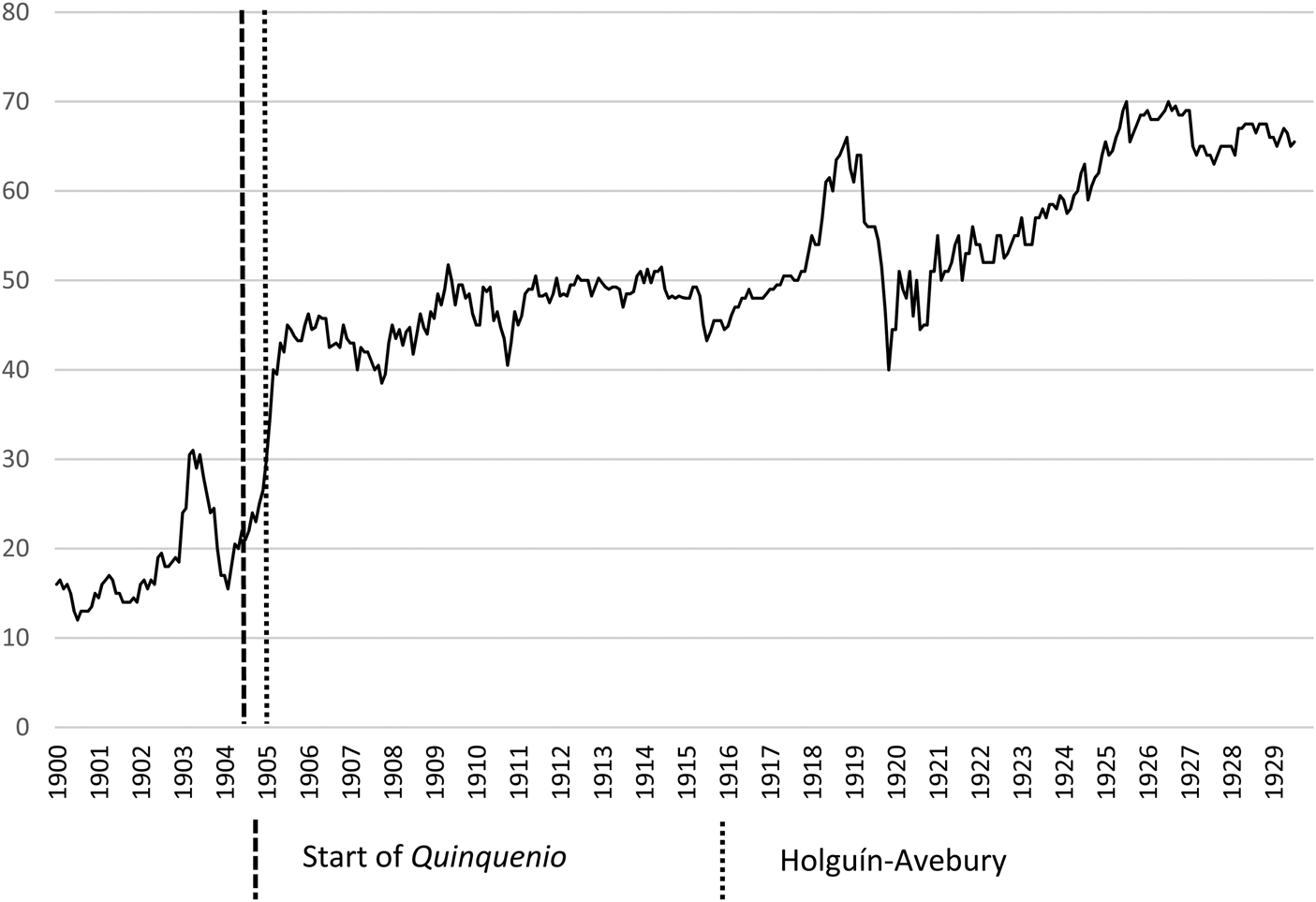
The regime's greatest achievement was the rehabilitation of Colombia's credit in the London capital market with the 1905 Holguín-Avebury agreement, which resumed payment on the sovereign debt, and would settle the accumulated unpaid interest from decades of default by committing 15 per cent of customs revenue (Holguín Reference Holguín1908, pp. 251–252). The agreement was politically unpopular with many who felt it was a humiliating kowtow to foreign interests, and represented a threat to national sovereignty (Junguito Reference Junguito1995, pp. 250–260). But from a comparative perspective the terms negotiated were highly favourable: the 3 per cent interest was significantly lower than the 4–6 per cent paid by Argentina, Brazil and ChileFootnote 11. The impacts of Reyes's policies are clear to see as in Figure 5: the price of Colombian sovereign debt bonds rose rapidly after the signing of the Holguín-Avebury agreement, and resulted in a long-term and significant rise in Colombia's overall creditworthiness. This revolutionary rehabilitation of Colombia's credit was indispensable to initial successes raising guaranteed bonds in London and Paris for the Great Northern Central Railway of Colombia.
Long-term impact of the Quinquenio and Holguín-Avebury agreement on sovereign debt bonds, 1900–29 (per cent of par value).
Source: Investor Monthly Manual, 1900–29.

2.4 The Re-emergence and Transformation of Railway Nationalism
The political trend for railway nationalism did not end with the Regeneración, even though those now tightly holding the reins of power held the contrary political perspective. The man most representative of a wave of left-liberal nationalism was Santiago Pérez Triana, son of radical liberal President Santiago Pérez de Manosalbas (1874–1876). Pérez Triana had been forced into exile in London during the Regeneración, after he was arrested in 1893 for attempted embezzlement of funds earmarked for the marquee project of Regeneración era railway nationalism: the Antioquia Railway. The scandal caused a serious diplomatic incident referred to within the Foreign Office as the Punchard-MacTaggart affair, which had a toxic influence on British–Colombian relations within the railway sector for decades (Rausch Reference Rausch2017, pp. 32–38; Primmer Reference Primmer2018, pp. 55–61).
The loss of the department of Panama had acted as a political catalyst fundamentally changing the character of railway nationalism. Whereas under Nuñez it had revolved around what was perceived to be in the best interests of Colombia, in post-Panama Colombia it became increasingly ideological, and its principal driver was a fear of imperial powers and foreign capital. Pérez Triana believed that «borrowing from abroad would bring not only economic slavery but also endanger national sovereignty» (Rausch Reference Rausch2017, p. 70). In his thesis Desde Lejos (1907)—published in opposition to the embrace of foreign capital during the Quinquenio—he argued that national sovereignty should take precedent over material progress and advocated for the return of state-led expansion of railways. Reyes ordered the burning of all copies, but some found their way into circulation in elite circles after Pérez Triana began smuggling them into the country incognito through the international mail service (Elías Reference Elías Ortiz1971, p. 20; Primmer Reference Primmer2018, pp. 108–109). Reyes's finance minister Jorge Holguín responded with a rebuttal named Desde cerca (1908), and the academic debate between these advocates of «railway imperialism» and railway nationalism became «one of the most interesting polemics in the economic history of Colombia» (Cruz Santos Reference Cruz Santos and Cruz Santos1966, p. 122). The debate formed the basis of subsequent national railway policy, but its influence in the wider economic history of Colombia has generally not been acknowledged by the historiography.
Santiago Pérez Triana was heavily critical of Reyes's support of «railway imperialism», which in relation to the Panama Railway Company's perceived role as «lynchpin of the [Panamanian] succession movement» he viewed as a «mortal danger for our existence as a sovereign and independent people» (Reference Pérez Triana1907, p. 50)Footnote 12. He was particularly hostile to the Great Northern Central Railway of Colombia, which he viewed as a unique creature of the Quinquenio resembling «a putrid corpse» (Pérez Triana Reference Pérez Triana1912, p. 2). The following excerpt from Desde Lejos (1907) illustrates clearly the catalysing effect of Panama within nationalist politics:
«The protection that the lack of internal communications within our national territory has provided us, has made us indifferent … towards the wider world, … with the candid belief that … no-one could possibly cross the sacred borders of la patria [to threaten our sovereignty]. … Well, we have had the first painful lesson demonstrating that things cannot go on as before. Our territory has been mutilated and we have been betrayed » (Pérez Triana Reference Pérez Triana1907, pp. 48, 50).
Pérez Triana is presented by Rausch as an anti-imperialist who established the cultural periodical Hispania to inspire «solidarity of the Hispanic world as a buffer» against imperial powers (Rausch Reference Rausch2018, p. 108). His political activities included representing Colombia at The Hague conference of 1907 in support of the Drago doctrine, which sought to outlaw the enforcement of debt repayment through military action (Pérez Triana Reference Pérez Triana1908, Reference Pérez Triana1909). At the conference he argued that «the principle of coercion depends on a strong creditor and weak debtor» meaning the region was a victim of imperial aggression aimed at ending «our integrity and independence» (Pérez Triana Reference Pérez Triana1908, p. 117). His critique at The Hague of capitalists controlling Latin America's sovereign debt carries unsettling similarities to J.A. Hobson's Imperialism: «the spirit of Shylock is omnipotent in our modern civilisation … [and] Shylock will continue demanding his pound of flesh» (Hobson Reference Hobson1902, pp. 46–63; Pérez Triana Reference Pérez Triana1908, p. 117).
Despite his objections to foreign investment and foreign railways he was highly supportive of railway development itself. The final chapter of Desde lejos (Pérez Triana Reference Pérez Triana1907) laid out an alternative system of railway expansion based on national ownership, which was republished as the pamphlet De ferrocarriles (Pérez Triana Reference Pérez Triana1908) for a wider audience. Pérez Triana (Reference Pérez Triana1907, pp. 209–220) argued that since a government guarantee was required to entice investors, the government should raise its own bonds and build its own railways rather than subsidising foreign companies. His ideas were part of a wider regional political anti-imperialist movement aimed at British railway companies. The 5-year period preceding the First World War saw the nationalist Mexican Revolution, batllismo economic nationalism in Uruguay which «instituted measures … [to] impede» British railways (Díaz Reference Díaz and Kuntz Ficker2015, p. 255), and «a new wave of anti-foreign economic nationalism» in Argentina (Wright Reference Wright1974, p. 103). Rausch is correct in arguing that Pérez Triana represented an important and hitherto unrecognised figure within this wider Latin American anti-imperialist movement, but she overlooks his most influential activity: formulating the nationalistic railway policy in Desde lejos which came to dominate post-1909 Colombian public policy (Pérez Triana Reference Pérez Triana1907, pp. 75–84; Rausch Reference Rausch2017).
3. THE GREAT NORTHERN CENTRAL RAILWAY OF COLOMBIA
3.1 Government Guaranteed Railway Bonds
The Great Northern Central Railway of Colombia concession was awarded with the aim of undoing the economic handicap which the railway nationalism of the Regeneración (1880–1898) had inadvertently created in the department of Santander. The railway was unique in two ways. It was the only British «free-standing company» which was established as a result of a concession contract awarded during the Quinquenio (1904–1909). All the other British railways which were awarded concessions had been transferred to British free-standing companies during the Regeneración, ostensibly to enable foreign investment, but in practice principally to place the assets of local elites under the protective umbrella of British diplomatic machinery (Horna Reference Horna1992, p. 146; Primmer Reference Primmer2018). It was also the only British railway company which would be financed entirely with government guaranteed bonds which proved so important to successful railway development elsewhere in the region (Lewis Reference Lewis1983, pp. 97–123; Reference Lewis1991, pp. 35–38; Miller Reference Miller1993, p. 133; Summerhill Reference Summerhill1998, Reference Summerhill2003). Reyes guaranteed 5.5 per cent interest payments on £9,600 of bonds per km of track, and with this commitment of financial support secured, the Great Northern Central Railway of Colombia Ltd was subsequently formed in London on the 4 April 1907Footnote 13. The national government authorised the company to issue £518,400 of bonds on the 25 July 1907 for 54 km of track, and the company proceeded to sell £192,000 of bonds in London corresponding to the first 20 km of the authorised emissionFootnote 14. These were rapidly taken up by the capital market, which represented a truly remarkable turnaround, considering that prior to the Holguín-Avebury agreement the mere mention of Colombia was sufficient to cut-off access to foreign capital for a railway project. The guarantee on bonds made the railway politically unpopular in some quarters, especially following the end of the administration, as Quinquenian railway concessions were increasingly viewed as shameful relics of collaboration to foreign interests. Some of the greatest opposition came from within the administration itself, which led to a catastrophic dispute over bonds contributing to the eventual collapse of the company into bankruptcy.
3.2 The Bond Dispute
At the beginning of his administration Reyes sent his then minister of finance Jorge Holguín to Europe to serve as Colombia's financial representative in negotiations over the sovereign debt and new loans, which he continued working on after being replaced as minister of finance at the end of 1904. Following the successful negotiation of the Holguín-Avebury agreement of 1905, he attempted to arrange a £2m loan to amortise the heavily devalued papel moneda Colombian peso, in which he was making positive progress throughout the first half of 1908Footnote 15. That summer Reyes unexpectedly dispatched his newly appointed finance minister Camilo Torres Elicechea—described years earlier by the Foreign Office as an «impecunious adventurer of doubtful antecedents»—to take over negotiationsFootnote 16. Negotiations almost immediately broke down, attributed by the Foreign Office to Torres's conduct who seemingly set about the intentional sabotage of the railway projectFootnote 17. The guarantee on the £192,000 of bonds raised in London in June 1907 was authorised by Colombia's diplomatic representative Domingo Esguerra under the counsel of Colombia's London-based lawyers Foss, Bilbrough & CoFootnote 18. Torres argued Esguerra had not been «authorised by the government» to do so, and demanded Foss, Bilbrough & Co. raise a notarial act disputing the legality of the guarantee on these existing bondsFootnote 19. Foss, Bilbrough & Co. refused and immediately sent a letter on the 22 December 1908 to the Minister of Public Works arguing that:
«Should such an idea become prevalent in the minds of financiers and others in London or Paris, any chance of … raising money for national purposes such as railways, would be very greatly prejudiced, if not rendered impossible»Footnote 20.
Torres ignored this advice and raised a notarial act on the same day using another lawyer's office. Six days later he was ordered by telegram by President Reyes to immediately authorise the issuance of new bonds guaranteed by the government to supplement the funds received for the initial £192,000 floatation and fund continued construction worksFootnote 21. He was thus in direct opposition to the administration, illustrating that the historiographical consensus contending the bond dispute was part-and-parcel of national policy is inaccurate (Bayona Sarmiento and Niño Sánchez Reference Bayona Sarmiento and Niño Sánchez2002, 87–97; Correa Reference Correa2012, 74–80; Cuadros and Sánchez Reference Cuadros Sánchez2013, 173–183).
The railway company responded by forfeiting its guarantee after negotiating independently with «first class bankers in Paris … [for] all the capital necessary for the construction … as far as Bucaramanga» (154 km), and by May 1909 had begun selling their own bonds in Paris at 84.5 per cent of par valueFootnote 22. Torres responded by publishing articles in the French financial press accusing the railway of selling fraudulent bonds, claims which in the following year the Ministry of Public Works acknowledged had been baselessFootnote 23. The result was a panic among investors and a mass sell-off of the bonds on the open market, forcing the company to sell the remaining issuance at a heavy discount. The ensuing dispute spawned a protracted legal case bringing construction works to a standstill. By 1913, the public demanded an explanation for this breakdown in relations, and in response, Domingo Esguerra—who initially authorised the issuance of railway's bonds—published an exposé of the affair in El Tiempo:
«With his famous protest Mr Torres no doubt had two aims: to appear as the saviour of national interests, at a time in which public opinion had turned against the concession contract, and to discredit my role, making it appear as if I was wholly responsible for the burdens the country would suffer, because according to him, I had superseded the instructions of the government»Footnote 24.
Esguerra argued that Torres «knew that the company did not pretend, nor could pretend the government would pay all interest [during construction]», and that his actions were calculated to inflict maximum damage to the projectFootnote 25. Because of his position in London Torres was able to attack the financial support structure of the company at its base and most vulnerable point, meaning his capacity to inflict material harm on the project was amplified. As the next section illustrates, Santiago Pérez Triana was equally well placed to inflict similar damage upon the company.
3.3 Whispering Campaign and Diplomatic Sabotage
The bond dispute and intentional publication of articles designed to spook investors in Paris and London, had in a very short time brought Colombia—after years of progress—back to the bad old days of pariah status in European capital markets. The graveness of the situation was commented on in the French financial press in no uncertain terms: «les choses en sont la… [merde]» (Bromberger Reference Bromberger1913, p. 41). But the company's problems were not limited to European capital markets, which were but one component of a three-pronged attack, including a whispering campaign coordinated against British administrative staff operating in Colombia, and the deliberate sabotage of diplomatic attempts to resolve the crisisFootnote 26. A component of the campaign in the press was multiple accusations that the bonds upon which the government guarantee had been authorised had been issued at between 50 and 58 per cent of par value (Montaña Reference Montaña1911, p. 24; Pérez Triana Reference Pérez Triana1912). As was mentioned previously, the company had been forced to sell the residual balance of the second tranche of bonds at a heavy discount because of the panicked sell-off of bonds in Paris. But the first tranche raised in London was at 77 per cent of par, and the second tranche had been selling at 84.5 per cent until Torres's publicationsFootnote 27. The fact that those attacking the company had caused the very devaluation being criticised was completely omitted from their treatise (Montaña Reference Montaña1911, p. 24)Footnote 28.
Santiago Pérez Triana who with Desde lejos had reformulated railway nationalism into an anti-imperialist political ideology, targeted the company locally, and also, through his position heading up the Colombian consul in London—which he was awarded by President Ramón González in «eagerness to go against the decisions of his predecessor (Reyes)» (Pérez Ángel Reference Pérez Ángel2008, p. 39)—sabotaged diplomatic channels attempting to resolve the conflictFootnote 29. His attacks upon the company through articles in the local press warned its «putrid corpse» would «rip the coat from the people's backs and take bread from their mouths to pay interest on bonds [to foreign financiers]» (Pérez Triana Reference Pérez Triana1912, p. 2). He took advantage of the prominence of Panama in the minds of Colombian political elites, and the associated fear of imperial powers, in order to instigate hostility towards the company. He argued the company would «endanger our sovereignty» and lead to «foreign intervention in our ports», before summarising the situation in the following melodramatic terms: «here we discuss the very life of the republic, the contract causes more damage than the loss of a department, to save ourselves we must all unite, like those in a sinking ship or a burning house» (Pérez Triana Reference Pérez Triana1912, p. 2). The article went as far as questioning the manhood of anyone supporting the British company: «if Colombians submissively accept this with smiles on their faces, it would be a good idea to open easy routes of emigration to the orient … where placid and oppressed men provide domestic service». His most bizarre and incendiary claim was that the local manager Fletcher Toomer had referred to Colombians as «monkeys … trained to eat from the palm» of his hand (Pérez Triana, Reference Pérez Triana1912, p. 2).
When the company sought diplomatic assistance from the Foreign Office Pérez Triana sabotaged any possibility of reaching a mutually beneficial agreement, since from his position in London, and in a manner reminiscent of Colombia's earlier repudiations of sovereign debt obligations, he repeatedly argued that since congress had been suspended by Reyes throughout the Quinquenio, they had been unable to approve the contract, meaning it was invalid, as well as (like Torres) disputing that Domingo Esguerra had been authorised to approve the guarantee on the railway's bondsFootnote 30. National railway historiography has described Pérez Triana as «the principal political actor engaging in fraud in contra to the national interests», but it has failed to recognise his role in the collapse of the railway project, which is attributed to the self-interest of foreign financiers (Pérez Ángel Reference Pérez Ángel2008, pp. 39–46). Because of unique positions at nexus points of the company's financial, diplomatic, and political support structure, individual political actors with ostensibly ideological objections to the project were able to inflict grave harm upon it.
3.4 Regionalism and Personal Interests
Both Pérez Triana and Torres had personal interests in other British railway projects which contradicted their oppositional position to the railway's concession. Pérez Triana had been accused of embezzlement in the aforementioned Punchard-McTaggart affair, and he shared personal and business connections with Juan Manuel Dávila and Luis Felipe Angulo of the Colombia Northern Railway Company: fellow enemies of the Reyes regime (Elías Reference Elías Ortiz1971, p. 13)Footnote 31. Torres was accused of embezzling the proceeds of a government guaranteed bond issuance for the Colombia National Railway Company, and they both signed the contract authorising the guarantee: Torres as representative of the Colombian government, and Pérez Triana as a company director (República de Colombia, 1911a, pp. 46–47; Torres, Reference Torres Elicechea1921). Furthermore, Torres's son (domiciled in London) acted as manager of the Colombian Southern Railway Company, and Pérez Triana sat on its board of directorsFootnote 32. These vested interests in British railway companies operating in their native department of Cundinamarca contradict the oppositional position to the Great Northern Central Railway of Colombia, illustrating how personal interests and regionalism were intertwined with political actions ostensibly motivated by ideological considerations. But the ideological brand of railway nationalism spawned to tackle the Great Northern Railway of Colombia would not spare the interests of those attacking it, since in subsequent decades all British railways became the target of hostility, increasingly spearheaded by the national government (Primmer Reference Primmer2018).
The Great Northern Central Railway of Colombia's situation was peculiar, and indeed perhaps even unique from a regional perspective, since its contractual rights were not only being disregarded, but rather, the contract itself in its entirety was—much like the sovereign debt in previous decades—being actively repudiated. Hundreds of thousands of pounds of French and British investment had been received and sunk into a 20 km section of track in active public service, yet the existence of the company itself was in question. As the local manager Fletcher Toomer noted with some irony, president Reyes and the then Minister of Public Works had «nailed down [the first rails] with their own hands», yet in the view of the national government the railway's existence «was solely illusionary», because «although the engine runs across the wilderness, there is still wanted the consent of the national congress»Footnote 33.
The case can be viewed as a symbolic demarcation of the end of large scale British investment in the sector, since following the collapse of the company the focus of the national government became seizing control of British «free-standing» railway companies, rather than—as had been the case under Reyes—actively seeking foreign investment to expand their operations. There were ideological considerations behind this stark reversal in public policy. But the rapid halt of capital migration was to a large extent a result of practicality on the part of European investors, rather than a reaction to ideological currents within national politics that they were generally unaware of. There was a certain amount of investment of British capital in railways in subsequent decades, most notably the ropeway expansion of the Dorada Railway Company which bridged the cordilleras between Caldas and Tolima. But this occurred in an extremely profitable enterprise which had established significant sinking funds and reserve accounts as a hedge against expropriation (Primmer Reference Primmer2018, pp. 275–331). Without this level of protection offered by a company's board, there was little motivation for British or French investors to risk additional capital in railway enterprise in Colombia, not when concession contracts signed by the national government were objectively not worth the paper they were written on.
Santandereanos felt the bond dispute had been orchestrated by «vampires» from the «high circles of politics» as part of a regionalist power struggle aiming to «ruining the life of a blooming region»Footnote 34. When construction works were suspended it sparked public discontent throughout Santander, and the personal interests of those attacking the project did not go unnoticed by local commentators, who made implicit reference to Pérez Triana:
«Among these vampires, the usurers who trade the honour of our homeland (la patria) and use contracts to pilfer the national exchequer, have fought most vehemently to have congress … suspend the concession contract. … The notion that the national government will continue works, is so ridiculous that it only fits in the minds of the obtuse or idiots. … We all know well that the few resources at the government's disposal are only enough to fill the pockets of the Bogotá elite which control the public purse through political intrigue. … Only foreign capital can redeem us»Footnote 35.
A public rally in defence of the railway company occurred in Bucaramanga in August 1911, where the crowd demanded the continued expansion of the railway. They also demanded the dismissal of Minister of Hacienda Tomas O. Eastman, who had publicly questioned the railway's economic utility. Unable to resolve disputes to reinitiate works, President Restrepo acquiesced to the second request several months later in an effort to «sooth the discomfort» of the muchedumbre santandereano (Cuadros and Sánchez Reference Cuadros Sánchez2011, pp. 167–168)Footnote 36.
Cuadros and Sánchez (Reference Cuadros Sánchez2013, p. 174) argues that the railway project was viewed locally as the «redemption of Santander» and Martínez Pinzón (Reference Martínez Pinzón2013, p. 153) contends railway construction in the Quinquenio sought to bring «civilisation» to the interior, meaning failure implied being «exiled not only from el progreso, but also from civilisation itself». As such, the collapse of the project represented not only a severe economic setback, but also an acute psychological trauma for santandereanos. This perspective was prevalent in other countries in the region. In Argentina the national elite «publicly defended» British railway investment, and in Mexico Díaz's dictatorship enforced a pro-investment ethos at the national level (Wright Reference Wright1974, p. 89). The loss of Panama inspired an ideologically driven brand of railway nationalism which viewed British railways as an existential threat to «la patria» which was much more pronounced than equivalent movements in these countries. In addition, the strong regionalism characteristic of late 19th and early 20th century Colombia meant whereas railways in Argentina operated in a relatively stable and homogeneous political climate at the national level, in Colombia support or opposition was—as was the case with the Great Northern Central Railway of Colombia—tied to regional economic power struggles or personal interests. In combination, these factors represented a serious challenge for the construction of «railway imperialism» which occurred in Argentina and elsewhere through the conduit of British «free-standing companies» (Fleming Reference Fleming, Davis, Wilburn and Robinson1991).
3.5 Application of Railway Nationalism within Public Policy
An amended concession contract was negotiated by the company in the year following the protests, and signed on the 8 June 1912 (Ortega Reference Ortega1920, p. 549). Management had made several significant sacrifices attempting to resolve the crisis. The railway would be nationalised without compensation after 50 years, and 62.5 per cent of post dividend profits during this time would be paid to the national governmentFootnote 37. In total, 150,000 shares would be issued to the government gratis, which in addition to 50,000 shares already held would represent 40 per cent of the share capitalFootnote 38. Strict construction deadlines were imposed, and failure to meet them would result in expropriation without compensationFootnote 39. The remaining 134 km needed to be completed within 4 years (1916), which was a completely unrealistic timescale, considering that following the collapse of the British company the railway was not completed until 1941 (Ortega Reference Ortega1932, p. 77; Correa Reference Correa2012, pp. 91–92). The national historiography views the contract renegotiations as having «resolved the conflict» to ensure the completion of the railway (Cuadros Sánchez Reference Cuadros Sánchez2011, p. 168). In stark contrast, according to the local manager Fletcher Toomer the Colombian Minister of Public Works had conceded in private in August 1914 that the purpose of negotiations was to make the contract «so onerous that it would be almost impossible for the Company to carry it out»Footnote 40. Attempts by the company to resolve the problems were ultimately futile, because those in opposition to the company, whether for ideological, regional or personal considerations, had resolved it must be destroyed.
Yet another bond dispute broke out between the company and national government, which was publicly aired in The Times in June 1913, cementing the status of the company in the eyes of the French capital market as «la… [merde]» (Bromberger Reference Bromberger1913, p. 41). The company argued they had «done everything in their power to obtain delivery of the new bonds from the Colombian Government» but had «been unable to issue the new bonds or to proceed with construction of the railway» because of the government's actionsFootnote 41. The government's lawyers released a rebuttal a few days later, attributing the delay to disagreements over the «supplementary contract»Footnote 42. Ortega (Reference Ortega1920, p. 551) and Correa (Reference Correa2012, pp. 75–81) argue the British maintained a policy of repeated renegotiation over terms and bore responsibility for the dispute, but the government's response in The Times clearly contradicts this argument, since they conceded the party taking issue over the contract was their ownFootnote 43. During 1909–1914 the Colombian government implemented a consistent policy of repeated disputes and contractual negotiations to financially undermine British railway companies. These aimed to make their lives so difficult they would willingly embrace nationalisation (Primmer Reference Primmer2018, pp. 91–330). This policy proved particularly successful with the Great Northern Central Railway of Colombia, which on the 7 August 1914—following half a decade of disputes—communicated its decision to end all involvement in the project by telegram, and «completely ceased construction works on the 4 October 1914»:
«The company is now convinced that the Colombian government does not intend to carry out engagements [for the] contract [of] 1912 …. and will claim compensation through proper channels for all losses, injury, prejudice and damage sustained by the company owing to the non-fulfilment of the obligations undertaken by the government in the contracts of 1906»Footnote 44.
The government's tactics had successfully pushed the company to the verge of bankruptcy: years of administrative costs combined with repeated telegrams, correspondence and legal costs, had depleted cash raised by the original bond issuances which was supposed to have financed construction works. Subsequent bankruptcy proceedings were exploited to acquire the railway at a discount, and on the 18 April 1918 £428,580 of 5 per cent sovereign debt bonds were raised at 70 per cent of par to finance the purchase of the railway for £300,000. This represented a significant loss for British and French investors who without considering company share capital, had invested a total of £498,000 in the company's debenture bonds (Ortega Reference Ortega1920, p. 552)Footnote 45.
4. ECONOMIC IMPACT
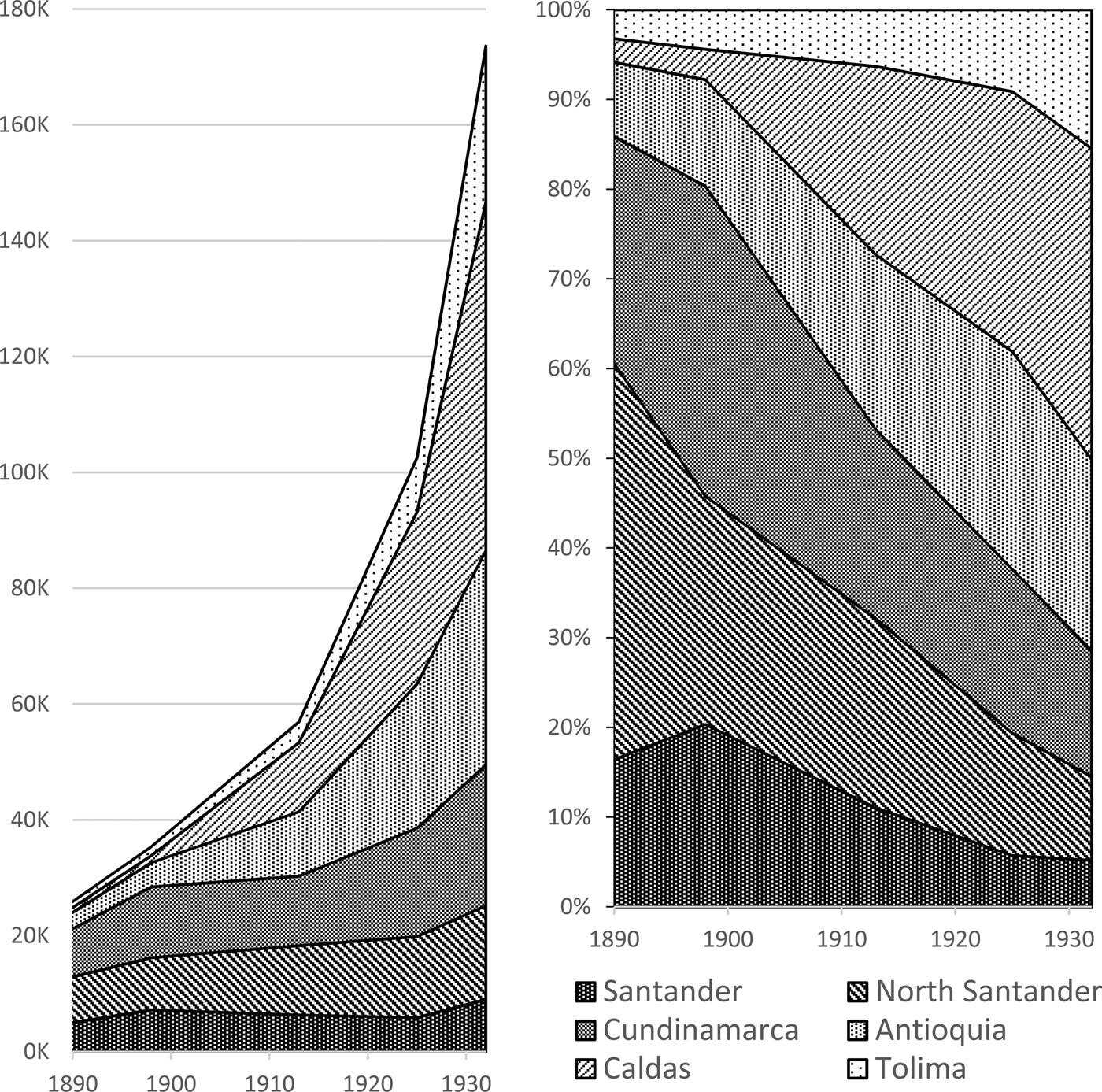
The economic decline of Santander is well established within the national historiography and represents one of the most important events in Colombian economic history. Palacios (Reference Palacios2006, pp. 54–55) argues the cause was «high transportation costs» resulting from the lack of a rail link which «blocked the takeoff of modern capitalism». The development (or lack thereof) of coffee exports which McGreevy (Reference Mcgreevy1971, pp. 244–279) argues were stimulated by the development of «coffee railways» was fundamental to this economic decline. As is evident in Figure 6, the department of Santander saw a marked decline in coffee exportation during the first three decades of the 20th century. There was an overall drop of the department's contribution to the national total from a peak of 19.7 per cent in 1898, to 5.2 per cent in 1932. This was partly a result of extensive growth in areas of the interior such as Tolima and Caldas, but whereas in the regions of Antioquia, North Santander and Cundinamarca nominal coffee exports continued expanding during this period, between 1898 and 1925 Santander experienced a drop from 7,200 to 5,880 tonnes.
Colombian coffee exports by department (nominal tonnes and per cent of total).
Source: Bejarano Ávila (Reference Bejarano Ávila and Ocampo Gaviria2015, p. 169).

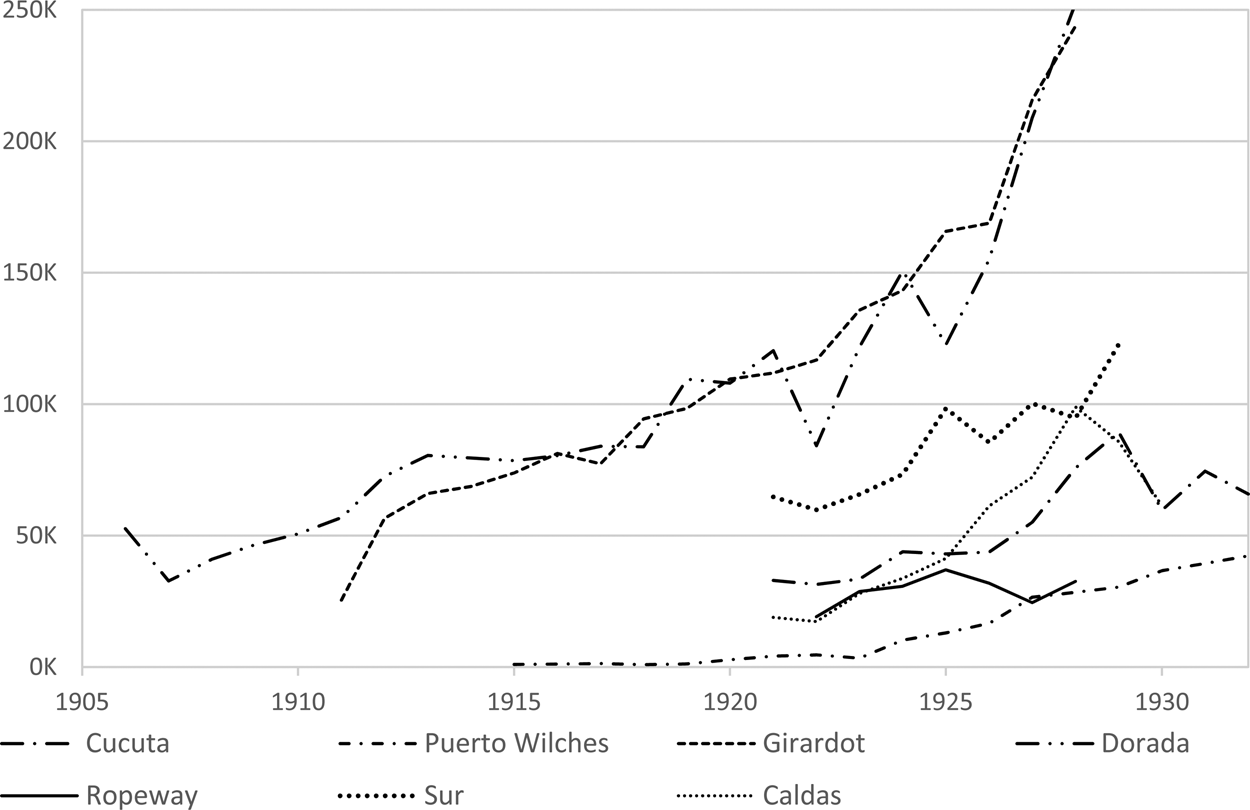
Palacios's (Reference Palacios2006, pp. 54–55) argument that the lack of a rail link was a significant factor in this decline seems pertinent, since there was substantially more progress with transport infrastructure projects in other regions of the interior, meaning the department's regional economic competitiveness was increasingly compromised. In Tolima the Dorada Railway Company and Ferrocarril del Tolima were expanded extensively, with the former constructing a ropeway crossing the cordilleras into the department of Caldas, supporting coffee expansion in both departments. In Cundinamarca the Colombian National Railway Company and Colombian Southern Railway Company connected the coffee growing regions of the department with the Magdalena River stimulating significant economic growth (Primmer Reference Primmer2013). In Antioquia the Ferrocarril de Antioquia made steady progress throughout the period with 207 km constructed by 1914 and 307 km by 1929 (Bejarano Ávila Reference Bejarano Ávila and Ocampo Gaviria2015, p. 191). Coffee exports in North Santander continued to be served by the Cucuta railway which enjoyed steadily increasing cargo during the 1920s (see Figure 7). The department of Caldas was supported by multiple infrastructure projects, which provided outlets for its coffee from both sides of Colombia. The Dorada Railway Company's ropeway provided an outlet to the Caribbean port of Barranquilla for coffee grown in the northern section of the department's coffee plantations around Manizales. This ropeway alone carried significantly more coffee during the 1920s than was exported from the entire of SantanderFootnote 46. Additionally, the rapidly expanding Ferrocarril del Pacífico and Ferrocarril del Caldas provided an additional route for exports through the Pacific port of Buenaventura, and the cargo of the Ferrocarril del Caldas grew exponentially throughout the «despegue cafetero» (Bejarano Ávila Reference Bejarano Ávila and Ocampo Gaviria2015) of the 1920s (see Figure 7).
Total annual cargo by railway (tonnes).
Sources: Guildhall Library, Stock Exchange Reports, Boxes 928, 974, 1021, 1067, 1115–6, 1167, 1217–8, 1267, 1318–9, 1369–70, 1420–1, 1469, 1512, 1557, 1602, 1647, 1693, 1738, 1782, 1830, 1879, 1929, 2030, 208; (República de Colombia, 1929; Ortega, Reference Ortega1932, pp. 57, 76, 78, 104, 235; Correa, Reference Correa2012, pp. 56, 115).
Note: Correa (Reference Correa2012) seems to have mislabelled the carga and pasajeros columns for the statistics of the Cucuta Railway. This has been amended to reflect the original data provided by Ortega which is also cited.

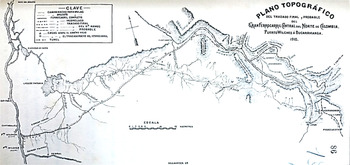
Whilst railway projects in competing regions of the interior progressed rapidly leading to associated growth of coffee exports and overall cargo, no progress beyond the initial 20 km section occurred with the Puerto Wilches project until large sums of capital became available from the United States in the mid-1920s (Ortega Reference Ortega1932, p. 75; Avella Reference Avella, Robinson and Urrutia2007). This lack of progress inhibited the growth of cargo because the 20 km section did not provide any discernible economic benefit to the export sector. The characteristics of the geographical area it served were such that the project needed around half of its 154 km extension (where it begins skirting the cordilleras as shown in Figure 8) to provide an impulse to coffee cultivation. As is clear in Figure 8 the initial 20 km section crossed an expanse of flatlands within the Magdalena River valley. The economic utility railway provided in Colombia was by connecting climatic zones in the foothills of the cordilleras to the world economy, since it was here that export crops were cultivated. The areas served by the 20 km section were not capable of producing anything which could not be grown adjacent to the river, meaning in its present state it was rendered economically ineffectual. Since the railway did not service productive areas the cargo requiring the services was minimal. As Figure 7 illustrates, cargo was almost non-existent until the 1920s when progress on the railway finally reinitiated, at which point it was far behind railways in neighbouring regions.
Topographical plan of the Puerto Wilches Railway (GNCRC) cf. 1911.
Source: República de Colombia (1911b).

Expansion beyond the initial 20 km section initiated at the start of 1924, with a further 9 km added by the end of the year. The first 50 km of the railway were completed during 1925, and in 1926 the total length reached 95 km (Ortega Reference Ortega1932, p. 75). At this point there was a marked increase in cargo (see Figure 7). However, «el despegue cafetero» gripping the interior was well underway by this point, and the expansion came too late for the department to fully benefit from these macro-economic conditions. Coffee cultivation has a relatively long gestation period: a newly established plantation will not produce for as much as 4–5 years. Because of the onset of the great depression landowners who planted coffee in 1924 in anticipation of the improved competitiveness the railway would shortly provide, would have been hit by rapid decrease in demand and cratering of price just as the plantation was ready to bear fruit. In this regard expansion of the railway was ultimately too late to be of much economic benefit to the department, since demand for coffee would not recover for quite some time. We can see in Figure 6 that a nominal increase in production did occur following the expansion of the railway, but it was not the explosive growth witnessed in regions such as Caldas, Tolima or Antioquia, which had seen more rapid improvement of their transportation infrastructure.
5. CONCLUSIONS
The national historiography has often presented British investment as interacting negatively with the railway sector, such as the view that the concession awarded to the Great Northern Central Railway of Colombia was exploited to extort damages from the national government (Pérez Ángel Reference Pérez Ángel2008, pp. 39–46; Ortega Reference Ortega1920, p. 551; Correa Reference Correa2012, 75–81). The use of primary sources from both the British and Colombian side of the dispute illustrates a decidedly different experience to that presented in previous studies (Bayona Sarmiento and Niño Sánchez Reference Bayona Sarmiento and Niño Sánchez2002; Cuadros Sánchez Reference Cuadros Sánchez2011, Reference Cuadros Sánchez2013; Correa Reference Correa2012). This has illustrated that the experience of the company was characterised by repeated contractual repudiation, coordinated attacks against the company's financial and political support structures, and sabotage of diplomatic efforts to resolve the conflict. These factors culminated in bankruptcy, and the company's overall experience was as negative as any British railway company explored within Latin American historiography.
The study has outlined an ideological basis for these negative experiences. The preponderance of a form of railway nationalism intertwined with regionalism and self-interest was an important and hitherto unrecognised factor in the failure of the project. The company's experience also demonstrates the importance of bond guarantees: a system which is comparatively poorly understood within the Colombian context. The Great Northern Central Railway of Colombia was a marquee project inextricably tied the implementation of railway bond guarantees in Colombia. Its experience illustrates the particularities of their use in this context, and the resistance which formed to them within national politics. This case study illustrates that the success or failure of the railway project was just as tied to the successful implementation of bond guarantees as has been shown to have been the case in aggregate studies of railways in Argentina, Brazil and elsewhere in Latin America (Lewis Reference Lewis1983, pp. 97–123, Reference Lewis1991, pp. 35–38; Miller Reference Miller1993, p. 133; Summerhill Reference Summerhill1998, Reference Summerhill2003). The main difference—and what separates Colombia from these countries—is that the system was unsuccessfully implemented.
This failure was particularly deleterious to the region of Santander due to a lack of alternative means of finance for its railway infrastructure. The project could not be advanced beyond the initial 20 km built by the British company until large scale borrowing from the USA came on stream in the mid-1920s (Ortega Reference Ortega1932, p. 75; Avella Reference Avella, Robinson and Urrutia2007). The available data suggest the lack of a rail link and the associated «high transportation costs» played an important role in the economic decline of Santander's export sector, which Palacios (Reference Palacios2006, pp. 54–55) contends blocked «the takeoff of modern capitalism» in the department. Conversely, the gap between economic performance of the export sector in Santander and other regions of the interior suggests that railways played an important role in the sustained export-led economic growth of the 1920s: an economic contribution which Santander largely missed out on.
The case study demonstrates significant elite agency in the interior of Colombia. Gallagher and Robinson (Reference Gallagher and Robinson1953) argue that «collaborating elites» were necessary for British imperialism in the «informal empire» to function and flourish. In the department of Santander, those elites unwilling to «collaborate» with British interests were ultimately successful in imposing their will over those who advocated «railway imperialism». The ideological clash examined throughout this article illustrates that during the first period of globalisation Colombian elites dictated the form and degree of integration of the country's «economic development into a free-trading, international economy». Moreover, they were generally opposed to the process of «railway imperialism» which converted countries or regions into an «economic satellite as easily as a self-governing colony» (Robinson, Reference Robinson, Davis, Wilburn and Robinson1991, pp. 184–185). Opposition was tied to questions of regionalism and self-interest, but ideology was nevertheless an important factor in the failure of the company. This ideological aversion to perceived «railway imperialism» developed quicker and was more pronounced than in Argentina, where «the oligarchy publicly defended the British enterprises as agents of progress» (Wright Reference Wright1974, p. 89). As such, railway nationalism in Colombia represents a hitherto unrecognised factor which contributed to poor railway expansion performance during the first period of globalisation.
ACKNOWLEDGEMENTS
The author would like to thank the University of Bristol for the award of the Deas Scholarship which financed primary source research in Colombia in 2016 and 2018, and Santander Bank for the Santander Travel Grant which supported archival research in the Archivo Nacional de Colombia in 2014. The author acknowledges advise and comments from Matthew Brown, Julio Decker, Colin Lewis, Simon Potter, Roger Middleton, Alfonso Herranz, Mark Casson, Heraclio Bonilla, Xavier Duran, Carlos Dávila, Adolfo Meisel, Salomon Kalmanovitz, Ivan Luzardo, Juliana Jaramillo, as well as those of the anonymous peer reviewers, all of which contributed to the development of the ideas and arguments presented in the article. Special thanks to Alfonso Fernandez Villa and the Department of History at the Universidad Industrial de Santander for organising a conference on the Ferrocarril de Puerto Wilches in 2018 from which the idea for a journal article originated.
SOURCES AND OFFICIAL PUBLICATIONS
Archives
Archivo General de la Nación, «Ferrocarriles» section of the Ministry of Public Works Archive, Bogotá.
The Guildhall Library, Stock Exchange Reports, London.
The National Archives, Foreign Office Section (FO), London.
The National Archives, Board of Trade Dissolved Companies Section (BT31), London.
Newspapers
The Economist; Investor Monthly Manual; El Ferrocarril; La Opinión; El Porvenir; El Republicano; El Tiempo; The Times.
Official Publications
Foreign Office. (1910): «Report on the Railways of Colombia», Vol. XCVI, Cd. 4968.
República de Colombia (1909): Informe que rinde el Ministerio de Obras Públicas ante el excelentísimo señor designado encargado del Poder Ejecutivo. Bogotá: Imprenta Eléctrica.
República de Colombia. (1911a): Documentos Relacionados con el Ferrocarril de Girardot. Bogotá: El Republicano.
República de Colombia. (1911b): Informe del ministerio de obras públicas al Congreso de 1911. Bogotá: Imprenta Nacional.
Republica de Colombia (1929): Ferrocarril de Girardot: informe del gerente al Ministro de Obras Públicas correspondiente al año 1928. Bogotá: Casa Editorial de Arboleba y Valencia.