Implications
Diversified pastures are considered to have the potential to better serve production and ecosystems services than species poor grasslands. However, there is a need for an improved understanding of the utilisation of complex grasslands to optimise their management. This implies investigations of animal responses to complex swards and, in particular, a better understanding of the interactions that can occur between plants on digestion and intake. This knowledge could help to improve current feed systems in terms of efficiency of feed use and environmental impact, and thus contribute to the development of a sustainable animal production.
Introduction
The development of a sustainable animal production industry requires the production function of grasslands to be balanced against a reduction of inputs, energy consumption, methane emission and nitrogen rejections, and conservation of floristic and animal biodiversity (Huyghe, Reference Huyghe2005). Several studies have shown that permanent or temporary multi-species grasslands, rather than monocultures, could integrate productivity and environmental requirements (Tilman et al., Reference Tilman, Wedin and Knops1996; Hector and Bagchi, Reference Hector and Bagchi2007). The use of mixtures of forages may positively or negatively affect the various components of the feeding value.
Current feed evaluation systems generally assume that digestibility, energy and nitrogen values, as well as voluntary intake of individual forages, can be added and do not take into account possible interactions between the different forage elements of a diet. However, these interactions can modify the metabolic processes in the gastrointestinal tract of ruminants, particularly in the rumen. As a consequence, digestibility and intake of a combination of forages can be higher (positive associative effects) or lower (negative associative effects) than the balanced median values calculated from forages taken separately.
Associative effects between forages and concentrate supplements are well documented in the literature (Berge and Dulphy, Reference Berge and Dulphy1985; Huhtanen, Reference Huhtanen1991; Doyle et al., Reference Doyle, Francis and Stockdale2005). The fermentation of high quantities of easily fermentable carbohydrates provided by concentrate feeds results in a decrease of the ruminal pH, which negatively affects cellulolytic activity and subsequently digestibility of plant cell walls (Mould et al., Reference Mould, Orskov and Mann1983). However, associative effects can also be positive: for instance, protein supplementation of straw may improve its digestibility and voluntary intake, thus alleviating nitrogen deficiency and stimulating the growth of rumen microbes (Church and Santos, Reference Church and Santos1981; Mawuenyegah et al., Reference Mawuenyegah, Shem, Warly and Fujihara1997). In contrast, few studies have focused on the digestive interactions between forage species to assess them accurately and clarify the underlying mechanisms, and information about them is quite scattered. Available data differ by type of studied plants, approach (in vivo, in vitro), animal species, processes and parameters measured such as animal performance, intake, transit, digestion, energy/nitrogen balance or microbial growth.
In this review article, in vitro and in vivo methodologies are described focusing on the opportunities, limits and complementarities of both approaches to study the associative effects. We then report three main situations in which interaction effects on intake and digestion can occur: (i) when grasses and legumes are combined, (ii) when poor forages such as straw or tropical grasses are supplemented by another plant and (iii) when certain secondary metabolites, including tannins and saponins, are present in the diet. We also discuss the mechanisms that can be hypothesised: increased rate of particle breakdown and passage with legumes, increased microbial activity when a plant of high nitrogen content supplements a poor forage, and the effects of secondary metabolites on protein digestion and methanogenesis.
Methodology for the study of associative effects
Measuring interactions between feeds requires them to be tested both singly and in one or more generally binary combinations (Van Soest, Reference Van Soest1994). Associative effects occur when digestion or intake of one feed is not independent of the other. They can be detected when the combination show a non-linear response. For these studies, in vitro and in vivo experiments can be carried out alternatively or simultaneously.
In vitro approach
In vitro techniques appear to be suitable to observe and explain digestive interactions in the rumen content. They are preferable to in situ methods, which dilute the substrates in the rumen and do not allow these to affect fermentation. However, such techniques do not allow for the study of animal response on digesta outflow, intake and performances.
The most usual method is the in vitro gas production technique. This technique has the advantage of simplicity; it is also inexpensive and requires only small quantities of feed. Briefly, ground substrates or combinations are fermented in a mixture of a buffered mineral solution and filtered rumen fluid under conditions simulating the ruminal environment in terms of temperature, anaerobiosis and agitation (Menke et al., Reference Menke, Raab, Salewski, Steingass, Fritz and Schneider1979; Theodorou et al., Reference Theodorou, Williams, Dhanoa, McAllan and France1994). In studies on associative effects between feeds, where the number of fermentation units to use for testing different combinations may be large, automated systems allowing continuous measurement of gas production (Cone et al., Reference Cone, van Gelder, Visscher and Oudshoorn1996; Davies et al., Reference Davies, Mason, Brooks, Griffith, Merry and Theodorou2000) could be useful.
In vitro techniques can provide much information on the mechanism of digestive interactions between feeds by allowing the measurement of a multitude of digestion parameters such as apparent or true dry matter (DM) or organic matter (OM) digestibility, plant cell wall (NDF, ADF, ADL) degradability, consumption/production of ammonia, microbial growth, efficiency of microbial protein synthesis (EMPS) and fermentative profiles (quantities and types of short chain fatty acids (SCFA) and gases produced) (Getachew et al., Reference Getachew, DePeters, Robinson and Fadel2005; Dijkstra et al., Reference Dijkstra, Kebreab, Bannink, France and Lopez2005; Lopez et al., Reference Lopez, Dhanoa, Dijkstra, Bannink, Kebreab and France2007). The partition factor, calculated as the ratio of substrate OM truly degraded to the volume of gas produced (Blummel et al., Reference Blummel, Makkar and Becker1997), provides information on partitioning of fermentation end-products towards gas or microbes. Testing forages alone and in combination should provide information on the ability of a plant to affect the partition of nutrients from another plant. It should also be possible to check if the nutrients of the tested forages are simultaneously or sequentially fermented.
The effect of secondary metabolites such as tannins or saponins on rumen fermentation can also be evaluated in vitro (Makkar, Reference Makkar2005). However, these authors highlighted the importance of measuring microbial biomass when effect of tannins is investigated because of the presence of tannin–protein complexes in the residues, and/or solubilisation of tannins from substrates that do not contribute to gas or microbial biomass, can produce artefacts in apparently and truly degraded values. In this case, the authors suggest incorporating 15N from buffer containing labelled ammonium bicarbonate or measuring purines or diaminopimelic acid as markers of microbial protein production. The use of polyethylene glycol (PEG), an inert compound presenting a strong affinity for tannins and which inactivates them, is also a suitable method (Makkar et al., Reference Makkar, Blummel and Becker1995; Getachew et al., Reference Getachew, Makkar and Becker2000).
Finally, in vitro techniques are time effective for screening plants or secondary metabolites that may have a positive effect on methane emission (Kamra et al., Reference Kamra, Agarwal and Chaudhary2006; Soliva et al., Reference Soliva, Zeleke, Clement, Hess, Fievez and Kreuzer2008) or on inhibition of the ruminal protein degradation (Selje et al., Reference Selje, Hoffmann, Muetzel, Ningrat, Wallace and Becker2007). These techniques could be used to investigate the anti-methanogenic activities observed in vivo with some forage mixtures, including grass/legume associations (Martin et al., Reference Martin, Morgavi, Doreau and Jouany2006).
In vivo approach
The in vivo approach gives access to intake and digestion parameters at the whole animal scale, animal performance or individual variations. This approach is necessary to validate information obtained from in vitro studies.
To investigate the digestive interactions between forages, independent of effects on intake, forages can be mixed and fed in various controlled proportions. For this type of study, feeding trials should be carried out with restricted intake in order to provide similar amounts of forage mixtures (e.g. Jones and Goetsch, Reference Jones and Goetsch1987). In addition to DM, fibre and nitrogen disappearance, measuring the transit of particles (reduction in forage particle size, retention time and passage rate through the rumen) using digestive markers and the duodenal flows of nutrients is relevant to understand how a particular forage can change the digestion of another (Jones and Goetsch, Reference Jones and Goetsch1987; Jones et al., Reference Jones, Goetsch, Stokes and Colberg1987a and Reference Jones, Goetsch and Stokes1987b).
To study the associative effects on DM and/or fibre voluntary intake, animals should be fed ad libitum with similar combinations of mixed forages also in controlled proportion (Reid et al., Reference Reid, Templeton, Ranney and Thayne1987). Digestion and flows of nutrients, including cellulose, hemicellulose, soluble carbohydrates and nitrogen, through different compartments of the gastrointestinal tract can be determined using animals fitted with ruminal fistulas and duodenal cannulas (Moseley and Jones, Reference Moseley and Jones1979). Since the in vivo approach allows measuring flows in the whole digestive tract, it is also possible to study the role of the small intestine and to check if an associative effect observed in the rumen also occurs at the animal level. In combining restricted and ad libitum feeding of mixed forages, the effect of intake on digestive parameters can be studied (Hunt et al., Reference Hunt, Paterson and Williams1985; Bhatti et al., Reference Bhatti, Bowman, Firkins, Grove and Hunt2008).
Animals that are fed ad libitum and can determine by themselves the proportion of each forage they eat provide information on intake taking account of animal preferences. When animals are able to determine themselves the composition of their diet, they generally select a mixed diet (Duncan et al., Reference Duncan, Ginane, Gordon and Orskov2003). Nutritional and behavioural factors that determine diet choices are complex and not completely understood. Cognisance, by animals, of the post-ingestive consequences of the feeds they eat is a key process of developing feed preferences. Forbes and Provenza (Reference Forbes and Provenza2000) hypothesised that diet choices are the result of maximising digestive, metabolic and sensorial comfort by the animals. Thus the diet composition of animals with free choice should reveal the optimal associative effects between the different feeds offered.
Animal performances, including gain of weight and/or milk yield and composition, are related to intake and digestion, thus, it can be suitable to add these parameters to in vivo studies (Bowman and Asplund, Reference Bowman and Asplund1988a). Further studies on associative effects between forages may include impact on environment (nitrogen and methane emissions) and animal health (e.g. parasitism).
Study of mixtures of more than two components
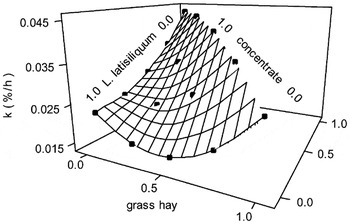
To evaluate associative effects of binary mixtures, continuous analysis can be easily made. They can be tested by analysis of linearity of regression, whereas interaction effect can be estimated by the significance of quadratic effect (e.g. Bowman and Asplund, Reference Bowman and Asplund1988a). For more complex mixtures (more than two components), some mathematical models have been proposed such as the response surface methodology associated to multiple regression analysis (Franci and Acciaioli, Reference Franci and Acciaioli1998). This model was used for the study of associative effects between lucerne (Medicago sativa L.) hay, wheat straw and maize gluten on feed intake, digestibility and performances of lambs (Franci et al., Reference Franci, Antongiovanni, Acciaioli, Bruni and Martini1997). In this three-component system, the composition is expressed as the percentage of the three dietary factors whose sum is 100, and the responses were represented by three-dimensional graphs. A similar representation was used by Sandoval-Castro et al. (Reference Sandoval-Castro, Capetillo-Leal, Cetina-Gongora and Ramirez-Aviles2002) to investigate in vitro associative effects between hay, leaves and concentrate using a mixture simplex design (Figure 1). To our knowledge, this type of approach has not been used to study interactions between just forage-based diets, but may be suitable to explore some forage combinations. Nevertheless, it seems difficult to approach the study of associative effects between several components of more complex mixtures representative of permanent or multi-species grasslands.
Example of three-dimension representation of associative effects between three feeds. Rate of gas production (k, in %/h) from Lysiloma latisiliquum leaf and its mixtures with Pennisetum purpureum grass hay and sorghum/soybean concentrate (Sandoval-Castro et al., Reference Sandoval-Castro, Capetillo-Leal, Cetina-Gongora and Ramirez-Aviles2002).

Associative effects between temperate grasses and legumes
It has been well established that DM intake (DMI) is higher when grass/legume associations are fed compared to grass alone, and the use of these mixtures generally results in an improvement of animal performance. The increase in milk production associated with an increase in DMI is particularly well described for the mixture of ryegrass (Lolium perenne) and white clover (Trifolium repens) in grazed swards (Harris et al., Reference Harris, Auldist, Clark and Jansen1998; Phillips and James, Reference Phillips and James1998; Ribeiro Filho et al., Reference Ribeiro Filho, Delagarde and Peyraud2003) and for silage feeding (Castle et al., Reference Castle, Reid and Watson1983).
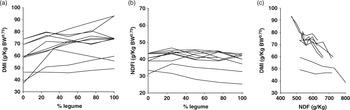
Figure 2a, which represents results from several studies focusing on the interactions between grasses and legumes, shows that the magnitude of associative effects on DMI varies among the mixed plant species and the proportion of legumes. For instance, with increasing level of legumes, Reid et al. (Reference Reid, Templeton, Ranney and Thayne1987) observed a linear increase of DMI in lambs with some combinations (e.g., orchard grass (Dactylis glomerata L.)/red clover (Trifolium pratense)), and a quadratic increase with others (e.g. ryegrass/lucerne). In another study, Lagasse et al. (Reference Lagasse, Goetsch, Landis and Forster1990) reported that the positive associative effect with lucerne on the digestible OM intake in steers varied according to the associated grass, the proportion of lucerne and also to the frequency of lucerne being fed to animals. Deviation from the linearity seems to be maximal at lower levels of legume inclusion. Reid et al. (Reference Reid, Templeton, Ranney and Thayne1987) reported an increase of 4to 5 g/kg BW0.75 of observed above predicted DMI values with inclusion of 25% or 50% legumes in the diet, representing a 6% to 7% increase in DMI. When this proportion is too high, the benefit of legumes may decrease since nitrogen excess results in an intense production of urea and an increase in excreted nitrogen. Bloat is also an important risk related to a too high incorporation of certain legumes such as white clover or lucerne (Clarke and Reid, Reference Clarke and Reid1974).
Animal responses to percentage of legume (a, b) or NDF (c) in grass/legume mixtures on dry matter intake (DMI) (a, c) or NDF intake (NDFI) (b). Data were compiled from studies of Moseley and Jones, Reference Moseley and Jones1979; Hunt et al., Reference Hunt, Paterson and Williams1985; Reid et al., Reference Reid, Templeton, Ranney and Thayne1987; Bowman and Asplund, Reference Bowman and Asplund1988a and Bhatti et al., Reference Bhatti, Bowman, Firkins, Grove and Hunt2008.

The increase in DMI caused by elevating the proportion of legume does not result in a significant increase in NDF intake (Figure 2b and c). This supports the classical concept of Van Soest (Reference Van Soest1982) that plant cell walls would limit rumen filling, so that animals would regulate their intake at a relatively constant NDF intake level. While the lower level of NDF of legumes, compared to grasses, can explain the increase in DMI (Figure 2a), the observed positive associative effect seems to be, instead, due to fast digestion of the soluble fraction of legumes, a higher rate of particle breakdown (Moseley and Jones, Reference Moseley and Jones1984; Waghorn et al., Reference Waghorn, Shelton and Thomas1989) and, finally, a higher passage rate through the rumen. Dewhurst et al. (Reference Dewhurst, Evans, Scollan, Moorby, Merry and Wilkins2003) suggested that the high intake level of legume silages may be the result of different mechanisms: high rates of particle breakdown with lucerne, and high rates of fermentation and passage with white clover.
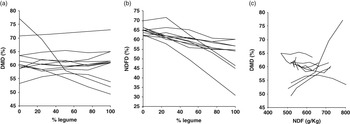
The associative effects between grasses and legumes on DM and NDF digestibility (DMD and NDFD) are generally slightly marked, and differ among grass and legume species mixed (Figure 3a and b). For Reid et al. (Reference Reid, Templeton, Ranney and Thayne1987), the increase in rate of transit may explain the reduction in DMD and NDFD of several associations in lamb. However, this may also increase the digestible OM digested post rumen as reported by Moseley and Jones (Reference Moseley and Jones1979) with the mixture of ryegrass/white clover in sheep. Glenn (Reference Glenn1989) observed a quadratic effect on microbial protein synthesis with a mixture of lucerne and orchard grass, and suggested that the reason for this was a synergism in rumen fermentation of NDF and nitrogen from the two species. Similarly, a mixture of high water-soluble carbohydrates, ryegrass silage and red clover silage in proportions 70 : 30 allows optimisation of the EMPS (g microbial N/kg apparently or truly digested OM), the efficiency of nitrogen use (g microbial N/g N feed) and an increase in the duodenal nitrogen microbial flow (Davies et al., Reference Davies, Leemans and Merry2002; Merry et al., Reference Merry, Lee, Davies, Dewhurst, Moorby, Scollan and Theodorou2006). The efficiency of incorporation of silage nitrogen into microbes was more than 20% greater with the high water-soluble carbohydrates ryegrass silage compared to the control grass silage (Merry et al., Reference Merry, Lee, Davies, Dewhurst, Moorby, Scollan and Theodorou2006).
Animal responses to percentage of legume (a, b) or NDF (c) in grass/legume mixtures on dry matter digestibility (DMD) (a, c) or NDF digestibility (NDFD) (b). Data were compiled from studies of Moseley and Jones, Reference Moseley and Jones1979; Hunt et al., Reference Hunt, Paterson and Williams1985; Reid et al., Reference Reid, Templeton, Ranney and Thayne1987; Bowman and Asplund, Reference Bowman and Asplund1988a and Bhatti et al., Reference Bhatti, Bowman, Firkins, Grove and Hunt2008.

The situation is quite different when whole-plant corn silage and legumes are mixed. Positive associative effects were observed on the OM digestibility and NDFD with a mixture of corn and lucerne silages in vitro (Moss et al., Reference Moss, Givens and Phipps1992). This observation was also made when both forages were simultaneously ensiled (Ozturk et al., Reference Ozturk, Kizilsimsek, Kamalak, Canbolat and Ozkan2006). This effect could be explained by the buffering ability of lucerne which could minimise the decrease of ruminal pH due to the fermentation of corn starch, thus stimulating cellulolytic activity (Moss et al., Reference Moss, Givens and Phipps1992).
Increase in intake with associated forages compared to the same forages fed alone was also found when animals are fed in a free-choice situation. Increase in intake was found at pasture with ryegrass and white clover association (Champion et al., Reference Champion, Orr, Penning and Rutter2004), but also with a mixture of two grass species (Cortes et al., Reference Cortes, Damasceno, Jamot and Prache2006). Moreover, increase of intake in choice situation was also found with animals fed indoors with different grass hays (Ginane et al., Reference Ginane, Baumont, Lassalas and Petit2002) or with a mixture of hay and silage (Baumont and Pomies, Reference Baumont and Pomies2004). The respective parts between digestive and behavioural factors that can explain these increases of intake remain to be understood.
Associative effects between low-quality forages and complementary plants
As early as 1967, Minson and Milford (Reference Minson and Milford1967) observed that increasing the white clover or lucerne proportions in a mature pangola-based diet increased feed intake and digestibility of DM and CP. The authors suggested that the legume balanced the nitrogen deficit of grass.
Supplementation of low- or medium-quality forages at high lignin and low nitrogen levels with other richer plants is an important and cost-effective strategy for feed autonomy in tropical countries, and for valorisation of culture residues in developed countries. The complementary plant should provide to the rumen microorganisms the nutrients required for their growth and fibrolytic activity. These nutrients, and in particular, nitrogen, are in a fermentable form generating ammonia necessary for microbial protein synthesis, minerals and vitamins.
The beneficial effects of legumes on fibre digestion and intake of poor grass hay, roughage and straw were largely reported (Paterson et al., Reference Paterson, Klopfenstein and Britton1982; Ndlovu and Buchanan-Smith, Reference Ndlovu and Buchanan-Smith1985; Brandt and Klopfenstein, Reference Brandt and Klopfenstein1986; Hunt et al., Reference Hunt, Klopfenstein and Britton1988; Atwell et al., Reference Atwell, Merchen, Jaster, Fahey, Berger, Titgemeyer and Bourquin1991; Haddad, Reference Haddad2000). Improvement in the rumen environment was reflected by an increase in the ammonia-N levels and the rate of passage of indigestible fractions (Ndlovu and Buchanan-Smith, Reference Ndlovu and Buchanan-Smith1985). Positive associative effects observed between tropical grasses and legumes on NDFD in vitro were due to a reduced lag time in the initiation of the digestion of fibres (Brown et al., Reference Brown, Lai and Pitman1991). Ammonia production with mixtures is also greater during this lag phase (Butterworth and Mosi, Reference Butterworth and Mosi1986; Bowman and Asplund, Reference Bowman and Asplund1988b; Brown and Pitman, Reference Brown and Pitman1991). The presence of a source of easily fermentable cellulose and hemicellulose in the diet increases the number of fibrolytic microorganisms, stimulating digestibility of other source of less degradable fibres (Silva and Orskov, Reference Silva and Orskov1988). That is for this reason that alkaline treatments which hydrolyse and solubilise fibres can strongly modify poor forage digestibility (Atwell et al., Reference Atwell, Merchen, Jaster, Fahey, Berger, Titgemeyer and Bourquin1991). Several studies have shown that the optimal proportion of lucerne in combination with straw to produce positive associative effects is approximately 25% (Hunt et al., Reference Hunt, Klopfenstein and Britton1988; Atwell et al., Reference Atwell, Merchen, Jaster, Fahey, Berger, Titgemeyer and Bourquin1991; Haddad, Reference Haddad2000).
It can also prove efficient to supplement poor forage with some fodder tree or shrub foliages rich in proteins (Barry et al., Reference Barry, North and Zealand1997; Rosales et al., Reference Rosales, Gill, Wood and Speedy1998). Being more digestible and richer in nitrogenous compounds than the poor forages, some of these plants can produce positive associative effects on DMD and/or NDFD (Liu et al., Reference Liu, Susenbeth and Sudekum2002; Doran et al., Reference Doran, Laca and Sainz2007) and voluntary intake (Norton, Reference Norton1994). Mulberry (Morus alba) leaves (Doran et al., Reference Doran, Laca and Sainz2007), Sesbania sesban L. used in tropical areas (Melaku et al., Reference Melaku, Peters and Tegegne2003; Tessema and Baars, Reference Tessema and Baars2004) or various tree foliage mixtures (Rosales et al., Reference Rosales, Gill, Wood and Speedy1998; Bobadilla et al., Reference Bobadilla, Ramirez Aviles and Sandoval Castro2002) have been reported to be efficient complementary plants. Rosales (Reference Rosales1996) noted that positive associative effects of mixtures of tree leaves are governed by the degree of synchronisation of the fermentation rates of the different components of a mixture, and these, in turn, are dependent on the fermentability of their chemical constituents, especially proteins, sugars and cellulose. The excessive tannin content of some of these plants can, however, be a problem with their extensive use (Barry et al., Reference Barry, North and Zealand1997). The choice of plant species, the level of their inclusion in the ration, and the identification and investigation of beneficial and anti-nutritional effects of secondary plant compounds are important research fields to optimise animal response with fodder trees.
Effects of secondary metabolites on digestion and intake
Some plants, mainly dicotyledonous plants including most of the legumes, produce secondary metabolites, of which some are bioactive on intake and in the rumen environment (Barry and McNabb, Reference Barry and McNabb1999; Rochfort et al., Reference Rochfort, Parker and Dunshea2008). According to their nature and concentration in the diet, they can provide nutritional and environmental advantages or disadvantages.
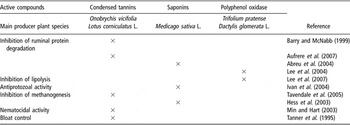
Since the ban of incorporation of antibiotics as growth promoters in animal feed and in the context of development of sustainable animal production by the European Union, in 2006, efforts are being made to identify plants and molecules that have a positive effect on digestive efficiency, animal health and are able to reduce animal emissions to the environment (Makkar et al., Reference Makkar, Francis and Becker2007). The main properties being investigated are those that can lead to reduction of ruminal proteolysis and methane production in the rumen (Martin et al., Reference Martin, Morgavi and Doreau2009), and antibiotic (Wallace, Reference Wallace2004) or nematicidal potential (Githiori et al., Reference Githiori, Athanasiadou and Thamsborg2006) (Table 1).
Effects of the main forage secondary metabolites on ruminal activities

Tannins are generally considered as anti-nutritional factors (Kumar and Singh, Reference Kumar and Singh1984). Dietary-condensed tannins (CT), occurring particularly in legumes such as sainfoin (Onobrychis vicifolia) and Lotus corniculatus L., bind to proteins inhibiting their degradation in the rumen (McSweeney et al., Reference McSweeney, Palmer, McNeill and Krause2001b). When dietary protein concentrations are low and fibre concentrations are high, CT are detrimental, decreasing digestibility, intake and animal performance by limiting microbial growth (Min et al., Reference Min, Attwood, McNabb, Molan and Barry2005), fibrolytic activity (McSweeney et al., Reference McSweeney, Palmer, Bunch and Krause2001a) or amino-acid absorption from the intestine (Waghorn, Reference Waghorn2008). However, when protein concentrations exceed animal requirements for CP, these effects can improve performance (Barry and McNabb, Reference Barry and McNabb1999). Some types of CT can reduce proteolysis in silos (Albrecht and Muck, Reference Albrecht and Muck1991) and protein solubility in the rumen (Martinez et al., Reference Martinez, Moyano, Diaz, Alarcon and Barroso2004; Aufrere et al., Reference Aufrere, Dudilieu, Poncet, Baumont and Dumont2007) in a concentration dependent manner, leading to a better use of feed nitrogen as a result of an increase in non-ammonia-N flow to the small intestine (Min et al., Reference Min, McNabb, Barry and Peters2000). Selje et al. (Reference Selje, Hoffmann, Muetzel, Ningrat, Wallace and Becker2007) recently tested 500 plants for their capacity to inhibit ruminal proteolysis. Five plants (Pelliphyllum peltatum, Helianthemum canum, Arbutus unedo, Arctostaphylos uva-ursi and Knautia arvensis) were particularly promising. Inhibition by the first four plants was caused by the formation of insoluble tannin–protein complexes. Interestingly, the mode of action of Knautia arvensis was different and remains to be elucidated. Some other benefits attributed to CT are prevention of bloat (Tanner et al., Reference Tanner, Moate, Davis, Laby, Li and Larkin1995; Li et al., Reference Li, Tanner and Larkin1996; McMahon et al., Reference McMahon, McAllister, Berg, Majak, Acharya, Popp, Coulman, Wang and Cheng2000) and gastrointestinal parasitism (Min and Hart, Reference Min and Hart2003). Lotus (Lotus pedunculatus) and sulla (Hedysarum coronarium) also decreased methanogenesis in growing lambs by 50% and 30%, respectively (Waghorn et al., Reference Waghorn, Tavendale and Woodfield2002). This could be explained by a direct effect of CT on the methanogenic archae and an indirect effect of decreasing digestion of the plant cell walls (Tavendale et al., Reference Tavendale, Meagher, Pacheco, Walker, Attwood and Sivakumaran2005).
Like CT, saponins can form complexes with proteins and could reduce their degradability in the rumen. The effects on the rumen microbial ecosystem seem to vary according to the species containing saponins. Diaz et al. (Reference Diaz, Avendano and Escobar1993) observed an increase in the content of cellulolytic bacteria and total population in the rumen of sheep with Sapindus saponaria, but Wang et al. (Reference Wang, McAllister, Yanke and Cheeke2000) observed that when saponins of Yucca schidigera were present, some strains of celluloytic bacteria lost their ability to digest cellulose whereas others were not affected. Consequently, the effect of saponins on the fermentative profiles is also variable (Hart et al., Reference Hart, Yanez-Ruiz, Duval, McEwan and Newbold2008). They could favourably affect the partition of degraded nutrients by producing more microbial proteins for the same volume of gas and/or a smaller quantity of SCFA. However, the effects vary considerably among plants containing saponins and with the diet fed to the animal (Hristov et al., Reference Hristov, McAllister, Van Herk, Cheng, Newbold and Cheeke1999; Francis et al., Reference Francis, Kerem, Makkar and Becker2002; Abreu et al., Reference Abreu, Carulla, Lascano, Diaz, Kreuzer and Hess2004). Saponins also cause a decrease in the proportion of protozoa in the rumen (Ivan et al., Reference Ivan, Koenig, Teferedegne, Newbold, Entz, Rode and Ibrahim2004). Thus, saponins could contribute to reducing methane emissions (Wallace et al., Reference Wallace, McEwan, McIntosh, Teferedegne and Newbold2002; Hess et al., Reference Hess, Kreuzer, Diaz, Lascano, Carulla, Soliva and Machmuller2003; Pen et al., Reference Pen, Sar, Mwenya, Kuwaki, Morikawa and Takahashi2006). Indeed, protozoa contribute to methane production by hydrogen production. In addition, some of the rumen methanogenic archaea are fixed on the cell surface (Vermorel and Jouany, Reference Vermorel and Jouany1989). However, it seems that the antimethanogenic effect of saponins persists only a few days as has been shown in sheep (Newbold et al., Reference Newbold, ElHassan, Wang, Ortega and Wallace1997). The ruminal microbial ecosystem seems to be able to adapt by degrading the saponins (Makkar and Becker, Reference Makkar and Becker1997). Nevertheless, Thalib et al. (Reference Thalib, Widiawati, Hamid, Suherman and Sabrani1996) observed the defaunating effect for up to at least three weeks by giving a saponin extract every 3 days.
Red clover and cocksfoot grass (Dactylis glomerata) contain polyphenol oxidase. This enzyme can convert native phenols to quinones which can bind proteins to form complexes resistant to the digestive enzymes (Kroll and Rawel, Reference Kroll and Rawel2001), thus reducing the proteolysis in the rumen (Lee et al., Reference Lee, Winters, Scollan, Dewhurst, Theodorou and Minchin2004). Lee et al. (Reference Lee, Parfitt, Scollan and Minchin2007) showed that the reduction of proteolysis was accompanied by an inhibition of lipolysis limiting the biohydrogenation of polyunsatured fatty acids, and consequently, might improve quality of milk and muscle (Edwards et al., Reference Edwards, Huws, Kim, Lee, Kingston-Smith and Scollan2008).
Some plants, including legumes, can contain anti-nutritional factors. The presence of phyto-oestrogens compounds, such as isoflavones, lignans and coumestans, can involve infertility and various reproductive disorders (Collins and Cox, Reference Collins and Cox1985). Cyanogenic glucosides present in red clover and Lotus spp. can release hydrogen cyanide even if concentrations are generally low (Barry and Reid, Reference Barry and Reid1984).
Secondary metabolites can occur in much diversified swards like permanent grasslands. The literature is almost non-existent on the associative effects of mixtures containing more than two forages on intake or digestion. This relates to the practical difficulties involved (number of animals used, experimental plan and interpretation). A recent study showed that by increasing the complexity of mixtures of grass and legumes (2; 3; 6; 9 species), no difference was observed on DMI, production and profile of blood metabolites (Soder et al., Reference Soder, Sanderson, Stack and Muller2006). However, the interactions between plants from complex forage mixtures need to be investigated further to have a better understanding of the nutritive value of diverse swards. Given the difficulty of this approach, one possibility could be to study the interactions between plants according to botanic family (grasses, legumes, dicotyledones) and then in each family, by subfamilies.
Conclusion
The variability of reported associative effects between forages among studies reflects the complexity and multiplicity of nutritional situations affecting intake and the ruminal ecosystem activity in a given animal. As a consequence, data reporting the associative effects should be assessed carefully, and providing general information would require an accumulation of data, which is not currently available in literature. To be sufficiently informative, studies should be linked to an accurate chemical composition analysis of forages, including energy and nitrogen, and secondary compounds of each mixture component. Although in vitro studies provide valuable information on mechanisms of digestive interactions, thanks to controlled experimental conditions they are only complementary to in vivo studies that only give access to the ruminants’ intake function. Investigations on associative effects are also complementary to studies on animal feed choices since it seems that there is a benefit for the ruminant’s digestive system if there is variety in its diet. A better understanding of associative effects between forages could help to improve current feed systems in terms of efficiency of feed use and environmental impact, and thus contribute to the development of a more sustainable animal production.